


Product Monograph - PDP-Benztropine (Pendopharm Division of Pharmascience, Solution)
SUMMARY PRODUCT INFORMATION
Route of Administration | Dosage Form / Strength | Non-medicinal Ingredients |
| Oral | Tablet, 1 mg | FD&C Yellow No. 6 Aluminum Lake, lactose monohydrate, magnesium stearate, microcrystalline cellulose and pregelatinized starch |
| Oral | Solution, 0.4 mg/mL | Alcohol, FD&C Yellow No. 6, glycerin methylparaben, orange flavor, propylparaben, purified water, sodium benzoate and sodium saccharin |
INDICATIONS AND CLINICAL USE
pdp-BENZTROPINE (benztropine mesylate) is indicated for the symptomatic treatment of all etiologic groups of Parkinsonism and drug-induced extrapyramidal disorders (except tardive dyskinesia).
Geriatrics: (> 65 years of age):
Generally, older patients cannot tolerate large doses of pdp-BENZTROPINE (see DOSAGE AND ADMINISTRATION).
Pediatrics: (3 - 18 years of age):
pdp-BENZTROPINE is contraindicated in infants and children less than 3 years of age (see CONTRAINDICATIONS) and should be used with caution in older children.
CONTRAINDICATIONS
pdp-BENZTROPINE (benztropine mesylate) is contraindicated in:
- Patients who are hypersensitive to benztropine mesylate or to any ingredient in the formulation or component of the container.
- Children less than 3 years of age.
- Patients with narrow angle glaucoma.
WARNINGS AND PRECAUTIONS
General
Since benztropine mesylate has cumulative action, continued supervision is advisable.
Dry mouth, blurred vision, nausea, vomiting and nervousness may develop. Adjustment of dosage or time of administration sometimes helps to control these reactions. If dry mouth is so severe that there is difficulty in swallowing or speaking or there is loss of appetite and weight, reduce dosage or discontinue temporarily. Vomiting may be controlled by temporary discontinuation, followed by resumption at a lower dosage.
Cardiovascular
Since benztropine mesylate has cumulative action, continued supervision is advisable especially in patients with a tendency to tachycardia.
Endocrine and Metabolism
Benztropine mesylate may produce anhidrosis. Therefore, it should be given with caution during hot weather, especially to elderly, the chronically ill, the alcoholic, those with Central Nervous System (CNS) disease and those who do manual labour in a hot environment. Anhidrosis may be anticipated to occur more readily when some disturbance of sweating already exists. If there is evidence of anhidrosis, dosage should be decreased at the discretion of the physician so that the ability to maintain body heat equilibrium by perspiration is not impaired.
Gastrointestinal
When benztropine mesylate is given concomitantly with phenothiazines or other drugs with anticholinergic activity, advise patients to report gastrointestinal complaints promptly. Paralytic ileus, sometimes fatal, has occurred in patients taking anticholinergic type antiparkinson drugs, including benztropine, in combination with phenothiazines and/or tricyclic antidepressants.
Genitourinary
Dysuria may occur. Since benztropine mesylate has cumulative action, continued supervision of patient is advisable, especially in patients with prostatic hypertrophy.
Immune
Occasionally, an allergic reaction develops (e.g. skin rash). This may be controlled by reducing the dosage, but, occasionally, the drug may need to be discontinued.
Musculoskeletal
The starting daily dosage of benztropine is 0.5 – 1 mg with a maximum of 6 mg. In large doses (upper range), benztropine mesylate may cause complaints of weakness and inability to move particular muscle groups. For example, if the neck has been rigid and suddenly relaxes, it may feel weak, causing some concerns. In this event, dosage adjustment is required.
Neurologic
Mental confusion, visual hallucinations and agitation may occur with large doses, or in susceptible patients.
Tardive dyskinesia may appear in some patients on long-term therapy with phenothiazines and related agents, or may occur after therapy with these drugs has been discontinued. Antiparkinson drugs usually do not alleviate the symptoms of tardive dyskinesia, and in some instances may aggravate or unmask such symptoms. Benztropine mesylate is not recommended in tardive dyskinesia.
Occupational Hazards
Benztropine mesylate may impair mental and/or physical abilities required for performance of hazardous tasks, such as operating machinery or driving a motor vehicle.
Ophthalmologic
The occurrence of glaucoma is possible. Although the drug does not appear to have any adverse effect on simple glaucoma, it should not be used in narrow angle glaucoma (see CONTRAINDICATIONS).
Psychiatric
The psychotogenic potential of antiparkinson drugs should be considered when managing patients with mental disorders. When benztropine mesylate is used to treat extrapyramidal symptoms due to CNS drugs such as phenothiazine derivatives and reserpine in patients with a mental disorder, occasionally, there may be intensification of mental disorders. When using benztropine mesylate in these patients, they should be kept under careful observation, especially at the beginning of treatment or if dosage is increased.
Special Populations
Pregnant Women: The use of this drug in pregnancy has not been studied.
Pediatrics: Because of its atropine-like side effects, pdp-BENZTROPINE is contraindicated in children less than 3 years of age, and should be used with caution in older children.
Geriatrics: Generally, older patients cannot tolerate large doses (see DOSAGE AND ADMINISTRATION).
ADVERSE REACTIONS
Adverse Drug Reaction Overview
The adverse reactions below, most of which are anticholinergic or antihistaminic in nature, have been reported and are listed below by body system in order of decreasing severity.
Cardiovascular: Tachycardia.
Digestive: Paralytic ileus, constipation, vomiting, nausea, dry mouth.
Nervous System: Toxic psychosis, including confusion, disorientation, memory impairment, visual hallucinations; exacerbation of pre-existing psychotic symptoms; nervousness; depression; listlessness; numbness of fingers.
Special Senses: Blurred vision, dilated pupils.
Urogenital: Urinary retention, dysuria.
Metabolic/Immune or Skin: Occasionally, an allergic reaction, e.g., skin rash, develops.
Other: Heat stroke, hyperthermia, fever.
DRUG INTERACTIONS
Drug-Drug Interactions
Occasionally, there may be an intensification of mental disorders when benztropine mesylate is used to treat extrapyramidal symptoms due to CNS drugs, such as phenothiazine derivatives and reserpine, in patients with a mental disorder. The psychotogenic potential of antiparkinson drugs should be considered when planning the management of patients with mental disorders. When using benztropine mesylate in these patients, keep them under careful observation, especially at the beginning of the treatment or if dosage is increased.
Additive anticholinergic effects (e.g. fatal paralytic ileus) may occur if benztropine mesylate is used concurrently with other drugs such as phenothiazines and/or tricyclic antidepressants.
The drugs listed below are based on either drug interaction case reports or studies, or potential interactions due to the expected magnitude and seriousness of the interaction.
Anticholinergics / antispasmodics – Additive anticholinergic effects may occur if benztropine is used concurrently with other drugs with anticholinergic effects such as amantadine, clidinium antihistamines, antipsychotics, muscle relaxants, tricyclic antidepressants.
Certain antiarrhythmics (e.g. disopyramide, procainamide, quinidine)
Cholinesterase inhibitors – Theoretically, anticholinergics such as benztropine may interfere with the action of centrally acting cholinesterase inhibitors (e.g., donepezil, galantamine, rivastigmine) and vice versa. In cases where both classes of drugs may be indicated, such as patients with both dementia and urge urinary incontinence, monitor for signs of decreased
response to either drug if they are used concurrently.
MAO inhibitors (e.g. moclobemide, phenelzine, tranylcypromine, methylene blue)
Motion sickness medication (e.g. scopolamine, dimenhydrinate) – decrease cholinergic effects/transmission. Additive anticholinergic adverse effects may be seen with concurrent use.
Narcotic pain relievers (e.g. codeine, meperidine, morphine)
Potassium Chloride – Slowed gastric emptying due to the anticholinergic effect of benztropine can increase the risk of gastrointestinal irritation or ulceration associated with solid oral potassium dosage forms. Avoid concurrent use when possible. Liquid forms of potassium may be preferable.
Tricyclic antidepressants (e.g., amitriptyline, doxepin) – decrease cholinergic effects/transmission. Additive anticholinergic adverse effects may be seen with concurrent use.
Drug-Food Interactions
Interactions with food have not been established.
Drug-Herb Interactions
Interactions with herbal products have not been established.
Drug-Laboratory Interactions
False test results may result with certain medical/laboratory tests (including brain scan for Parkinson’s disease).
Drug-Lifestyle Interactions
Ethanol can increase the sedative effects of benztropine.
DOSAGE AND ADMINISTRATION
Dosing Considerations
Benztropine mesylate has cumulative action, thus, therapy should be initiated with a low dose which is increased gradually at 5 or 6 day intervals to the smallest amount necessary for optimal relief. Initially, 0.5 mg (1.25 mL oral solution) is given daily. Increases should be made in increments of 0.5 mg (1.25 mL oral solution) or until optimal results are obtained without excessive adverse effects (maximum dose of 6 mg (15 mL oral solution)).
There are no adequate and well controlled studies on benztropine mesylate use in pediatric or geriatric patients. The dosage should be individualized based on severity of symptoms, patient characteristics and the type of Parkinsonism being treated. Dosing recommendations are based on clinical experience. In general, treatment should begin at the lowest dose, with gradual increases until maximum improvements are noted or intolerable adverse events occur.
Recommended Dose and Dosage Adjustment
Arteriosclerotic, idiopathic and postencephalitic Parkinsonism:
Adults
The usual daily dose is 1 mg to 2 mg (2.5 mL to 5 mL oral solution) with a range of 0.5 mg to 6 mg (1.25 mL to 15 mL oral solution).
Patients with a poor mental outlook are usually poor candidates for therapy.
In arteriosclerotic and idiopathic Parkinsonism, therapy may be initiated with a single daily dose of 0.5 mg to 1 mg (low dose) (1.25 mL to 2.5 mL oral solution) at bedtime. In some patients, this will be adequate; in others, 4 mg to 6 mg (10 mL to 15 mL oral solution) a day may be required. Generally, older patients, thin patients and those with arteriosclerotic Parkinsonism cannot tolerate large doses.
In postencephalitic Parkinsonism, therapy may be initiated with 2 mg a day in 1 or more doses. In highly sensitive patients, therapy may be initiated with 0.5 mg (1.25 mL oral solution) at bedtime, and increased as necessary. Most patients with postencephalitic Parkinsonism need fairly large doses and tolerate them well.
Some patients experience greatest relief by taking the entire daily dose at bedtime; others react more favourably to divided doses (2 to 4 times a day).
Therapy with other agents should not be terminated abruptly when therapy with benztropine mesylate is initiated, but may be reduced or discontinued gradually. Benztropine mesylate may be administered concomitantly with levodopa or a levodopa/carbidopa combination, in which case the dose of each may need adjustment.
Pediatric > 3 years
The usual dose is 0.02 mg/kg – 0.05 mg/kg (0.05 mL/kg - 0.125 mL/kg oral solution) administered orally 1-2 times a day.
Drug-induced extrapyramidal symptoms:
In treating extrapyramidal disorders due to phenothiazine derivatives or reserpine, the recommended dosage is 1 mg to 4 mg (2.5 mL to 10 mL oral solution) once or twice a day. Dosage must be individualized according to the need of the patient.
In acute dystonic reactions, 2 mg of benztropine mesylate i.v. quickly relieves the condition. Then, 1 mg to 2 mg (2.5 mL to 5 mL oral solution) given orally twice a day usually prevents recurrence.
When extrapyramidal disorders develop soon after initiation of treatment with phenothiazine derivatives or reserpine, they are likely to be transient. One (1 mg) to 2 mg (2.5 mL to 5 mL oral solution), 2 or 3 times a day usually provides relief within 1 to 2 days. After 1 or 2 weeks,
benztropine mesylate should be withdrawn to determine the continued need for it. If Parkinsonism recurs, benztropine mesylate can be reinstituted.
Benztropine mesylate should not be used beyond the period necessary to counteract the extrapyramidal manifestations. Consider reducing the dosage of neuroleptic agents or reserpine when adjunctive benztropine mesylate therapy is required.
Patients must be closely observed for severe reactions and benztropine mesylate discontinued temporarily if they appear (see WARNINGS AND PRECAUTIONS and ADVERSE REACTIONS).
Missed Dose:
If a tablet is missed, it should be taken as soon as possible. If it is almost time to take the next tablet, the missed tablet should not be taken, and the normal schedule should be resumed.
OVERDOSAGE
Symptoms: May be any of those seen in atropine poisoning or antihistamine overdosage: CNS depression, preceded or followed by stimulation; confusion; nervousness; listlessness; intensification of mental symptoms, or toxic psychosis, in patients with mental illness being treated with phenothiazine derivatives or reserpine; hallucinations (especially visual); dizziness; muscle weakness; ataxia; dry mouth; mydriasis; photophobia; tachycardia; dysuria; vomiting; giddiness; staggering; rapid pulse and breathing; drowsiness; stupor; blurred vision; palpitations; nausea; numbness of fingers; dysphagia; allergic reactions (e.g., skin rash); headache; hot, dry, flushed skin; delirium; shock; convulsions; coma; circulatory failure; respiratory arrest; anhidrosis; hyperthermia; glaucoma; constipation.
Treatment: Benzodiazepine agonists should be used to treat agitation and seizures. Although patients with very minor anticholinergic toxicity may respond well to small doses of benzodiazepines, those with moderate to severe agitation will likely respond better to physostigmine. Physostigmine salicylate, 1 to 2 mg, by s.c. or i.v. routes to reverse symptoms of anticholinergic intoxication. A second injection may be given after 2 hours if required. Otherwise, treatment is symptomatic and supportive. Induce emesis or perform gastric lavage (contraindicated in precomatose, convulsive, or psychotic states). Give a saline purgative, e.g., sodium sulfate 30 g in 250 mL water, to promote peristalsis. Maintain respiration; supportive care for depression (avoid convulsant stimulants); artificial respiration for severe respiratory depression; a local miotic for mydriasis and cycloplegia; ice bags and alcohol sponges for hyperpyrexia, a vasopressor and fluids for circulatory collapse; catheterize for anuria. Darken room for photophobia.
For management of a suspected drug overdose, contact your Regional Poison Control Centre immediately.
ACTION AND CLINICAL PHARMACOLOGY
Mechanism of Action
Benztropine mesylate contains the tropine portion of the atropine molecule and the benzohydryl portion of diphenhydramine. Thus, it possesses both anticholinergic and antihistaminic effects, although only the former has been established as therapeutically significant in the management of Parkinsonism.
Pharmacokinetics
The mean Cmax of 1.5 PO single dose is 2.5 ng/mL with a mean elimination half-life (t1/2) of 7 hours.
Benztropine is well-absorbed from the gastrointestinal tract. When given orally, benztropine has an onset of action of between 1 to 2 hours, though the pharmacologic effects of the drug may not be apparent for 2 to 3 days after initiation of therapy. The duration of action of benztropine, when given orally, is approximately 24 hours. Benztropine is highly protein bounded (95%), has a hepatic metabolism in animals, and is excreted primarily through the urine and bile unchanged.
STORAGE AND STABILITY
Store at room temperature (15°C-30°C).
DOSAGE FORMS, COMPOSITION AND PACKAGING
1 mg tablets: Supplied in bottles of 100 and 1000 tablets. Each round, cylindrical, bevelled-edge, flat faced, salmon coloured tablet cross-scored on one side and identified "PMS-1" on the other side contains 1 mg of benztropine mesylate and the following non-medicinal ingredients: FD&C Yellow No. 6 Aluminum Lake, lactose monohydrate, magnesium stearate, microcrystalline cellulose and pregelatinized starch.
0.4 mg/mL oral
solution:
Supplied in bottles of 500 mL. Each mL of yellow, orange-flavoured solution contains 0.4 mg of benztropine mesylate and the following non-medicinal ingredients: alcohol, FD&C Yellow No. 6, glycerin methylparaben, orange flavor, propylparaben, purified water, sodium benzoate, sodium saccharin.
PART II: SCIENTIFIC INFORMATION
PHARMACEUTICAL INFORMATION
Drug Substance
Proper name: Benztropine mesylate
Chemical name: 8-azabicyclo[3.2.1] octane, 3-(diphenylmethoxy)-,endo, methanesulfonate.
Molecular formula and molecular mass: C21H25NO·CH4O3S 403.54
Structural formula:
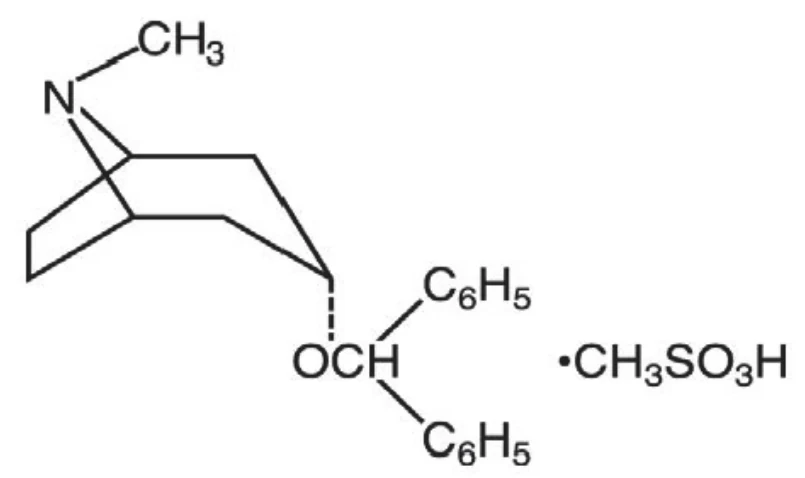
Physicochemical properties: Crystalline white powder, very soluble in water.
DETAILED PHARMACOLOGY
In the laboratory, the antihistaminic activity of benztropine mesylate approaches that of pyrilamine maleate. Its duration of action also approaches that of pyrilamine maleate.
In the isolated guinea pig ileum, benztropine mesylate anticholinergic activity is about equal to that of atropine; however, when administered orally to unanesthetized cats, it is only about half as active as atropine.
TOXICOLOGY
In animals, benztropine mesylate produces about the same degree of sedation as pyrilamine maleate and tripelennamine, but much less than diphenhydramine HC and promethazine.
Direct application to the eyes of cats and rabbits produces substantially the same mydriatic effect and paralysis of the light reflex as atropine sulfate, although benztropine mesylate is somewhat more irritating.
In anesthetized cats, i.v. injection causes a moderate decrease in blood pressure. Large doses decrease the heart rate but do not appreciably affect the respiratory tract.
No significant effects on growth, organ weights, or hemograms of adult rats were observed in a chronic toxicity study.
REFERENCE
- 1. pdp-BENZTROPINE 2 mg tablets, Prescribing Information, PENDOPHARM, Division of Pharmascience Inc. Control number 179633. November 14, 2014.