


Product Monograph - Pentamidine Isetionate for Injection BP (Marcan Pharmaceuticals)
RECENT MAJOR LABEL CHANGES
| 7 WARNINGS AND PRECAUTIONS | 08/2022 |
TABLE OF CONTENTS
Sections or subsections that are not applicable at the time of authorization are not listed.
RECENT MAJOR LABEL CHANGES ........................................................................................... 2
TABLE OF CONTENTS .............................................................................................................. 2
PART I: HEALTH PROFESSIONAL INFORMATION ........................................................................ 4
1 INDICATIONS ................................................................................................................ 4
1.1 Pediatrics ...................................................................................................................... 4
1.2 Geriatrics ...................................................................................................................... 4
2 CONTRAINDICATIONS ................................................................................................... 4
3 SERIOUS WARNINGS AND PRECAUTIONS BOX .............................................................. 4
4 DOSAGE AND ADMINISTRATION ................................................................................... 5
4.1 Dosing Considerations.................................................................................................. 5
4.2 Recommended Dose and Dosage Adjustment ............................................................ 5
4.3 Reconstitution .............................................................................................................. 5
4.4 Administration ............................................................................................................. 6
5 OVERDOSAGE ............................................................................................................... 6
6 DOSAGE FORMS, STRENGTHS, COMPOSITION AND PACKAGING .................................... 6
7 WARNINGS AND PRECAUTIONS .................................................................................... 6
7.1 Special Populations .......................................................................................................... 8
7.1.1 Pregnant Women .......................................................................................................... 8
7.1.2 Breast-feeding ............................................................................................................... 8
8 ADVERSE REACTIONS .................................................................................................... 8
8.1 Adverse Reaction Overview ......................................................................................... 8
8.2 Clinical Trial Adverse Reactions .................................................................................... 9
8.3 Less Common Clinical Trial Adverse Reactions .......................................................... 10
9 DRUG INTERACTIONS ................................................................................................. 10
9.4 Drug-Drug Interactions .............................................................................................. 10
9.5 Drug-Food Interactions .............................................................................................. 10
9.6 Drug-Herb Interactions .............................................................................................. 10
9.7 Drug-Laboratory Test Interactions ............................................................................. 10
10 CLINICAL PHARMACOLOGY ......................................................................................... 10
10.1 Mechanism of Action ................................................................................................. 10
10.3 Pharmacokinetics Absorption: ..................................................................................... 11
11 STORAGE, STABILITY AND DISPOSAL ........................................................................... 12
12 SPECIAL HANDLING INSTRUCTIONS ............................................................................. 12
PART II: SCIENTIFIC INFORMATION ........................................................................................ 13
13 PHARMACEUTICAL INFORMATION .............................................................................. 13
14 CLINICAL TRIALS ......................................................................................................... 14
15 MICROBIOLOGY ......................................................................................................... 14
16 NON-CLINICAL TOXICOLOGY ....................................................................................... 14
17 SUPPORTING PRODUCT MONOGRAPHS ...................................................................... 15
PATIENT MEDICATION INFORMATION ................................................................................... 16
PART I: HEALTH PROFESSIONAL INFORMATION
1 INDICATIONS
Pentamidine Isetionate for Injection BP is indicated for the treatment of pneumonia due to Pneumocystis jirovecii (Pneumocystis carinii Pneumonia or PCP).
1.1 Pediatrics
Pediatrics (<18 years of age): The safety and efficacy of pentamidine isetionate has not been established in the pediatric population, and pharmacokinetic data are extremely limited. Pentamidine Isetionate for Injection BP should be considered only if there is no other appropriate treatment (see 4 DOSAGE AND ADMINISTRATION).
1.2 Geriatrics
No data are available to Health Canada; therefore, Health Canada has not authorized an indication for geriatric use.
2 CONTRAINDICATIONS
Pentamidine Isetionate for Injection BP is contraindicated in:
- Patients who are hypersensitive to this drug, to any ingredient in the formulation or component of the container. For a complete listing, see the 6 DOSAGE FORMS, STRENGTHS, COMPOSITION AND PACKAGING section of the Prescribing Information with Patient Information.
3 SERIOUS WARNINGS AND PRECAUTIONS BOX
Serious Warnings and Precautions
- Pentamidine Isetionate for Injection BP should be used with caution in patients with hypertension, hypotension, hypoglycemia, hyperglycemia, hypocalcemia, leukopenia, thrombocytopenia, anemia and hepatic or renal dysfunction.
- Pentamidine Isetionate for Injection BP should be used only in a hospital setting with facilities to monitor blood glucose, blood count, renal function and hepatic function. Electrocardiograms should be carried out at regular intervals (see 7 WARNINGS AND PRECAUTIONS: Monitoring and Laboratory Tests).
- Profound severe hypotension may result after a single dose (see 7 WARNINGS AND PRECAUTIONS: Cardiovascular)
- Severe hypotension, hypoglycemia, acute pancreatitis, renal impairment and cardiac arrhythmias resulting in death (see 7 WARNINGS AND PRECAUTIONS and 8 ADVERSE REACTIONS)
- Extravasation reactions may result in ulceration, tissue necrosis and long-term sequelae (see 8 ADVERSE REACTIONS)
4 DOSAGE AND ADMINISTRATION
4.1 Dosing Considerations
Pentamidine Isetionate for Injection BP may be administered intravenously or intramuscularly. When administered intravenously, Pentamidine Isetionate for Injection BP must be given only by slow infusion (i.e. over a period of 2 to 3 hours). Intramuscular administration should be reserved for patients with adequate muscle mass and for whom a slow intravenous infusion is not practical. Intramuscular administration is normally not recommended because of poor local tolerance (see 7 WARNINGS AND PRECAUTIONS).
Since severe hypotension reactions may occur, patients receiving Pentamidine Isetionate for Injection BP should be in a supine position and blood pressure should be closely monitored during administration of the drug and several times thereafter until blood pressure is stable.
4.2 Recommended Dose and Dosage Adjustment
Adults: The recommended regimen is 4 mg/kg once a day for 14 to 21 days. The benefits and risks of therapy for longer than 14 doses are not well defined.
Patients with Renal Failure (creatinine clearance < 35 mL/min):
- Life-threatening infections: 4 mg/kg once daily for 7 to 10 days, followed by 4 mg/kg on alternate days to complete the course of 14 doses.
- Less severe infections: 4 mg/kg on alternate days for 14 doses.
Children: Clinical and pharmacokinetic data are extremely limited and further investigation is necessary to fully characterize the pharmacokinetics of pentamidine isetionate in this age group. However, a dosage of 4 mg/kg has been used in children. Pentamidine Isetionate for Injection BP should be considered only if there is no other appropriate treatment.
4.3 Reconstitution
Parenteral Products:
Preparation for Use and Reconstitution
For Intravenous Infusion: RECONSTITUTE ONLY WITH STERILE WATER FOR INJECTION.
RECONSTITUTION TABLE
| Vial size | Volume to be added to vial | Approximate available volume | Approximate average concentration |
| 300 mg | 3 mL | 3.15 mL | 100 mg / mL |
Further dilute the appropriate volume of reconstituted solution with 50 to 500 mL of 5% dextrose injection or 0.9% sodium chloride injection. The reconstituted solution should not be mixed with any other injection solution.
For Intramuscular Injection: Reconstitute as for intravenous injection and do not further dilute.
As with all parenteral drug products, intravenous admixtures should be inspected visually for clarity, particulate matter, precipitate, discolouration and leakage prior to administration whenever solution and container permit. Solutions showing haziness, particulate matter, precipitate, discolouration or leakage should not be used.
4.4 Administration
Intravenous infusion: The reconstituted and further diluted solution should be administered over a period of at least 60 minutes and preferably over a period of 2 to 3 hours.
Intramuscular injection: The appropriate volume of reconstituted solution should be administered well within the body of a relatively large muscle mass.
5 OVERDOSAGE
There are apparently no reports of acute toxicity associated with overdosage of pentamidine isetionate. In general, overdosage would be expected to produce effects that are an extension of common adverse effects or of the serious metabolic sequelae observed. In case of suspected overdosage, treatment should be symptomatic and supportive. Neither peritoneal dialysis nor hemodialysis appear to remove the drug rapidly enough to cause a precipitous decline in the plasma concentration of pentamidine isetionate.
6 DOSAGE FORMS, STRENGTHS, COMPOSITION AND PACKAGING
Table – Dosage Forms, Strengths, Composition and Packaging
| Route of Administration | Dosage Form / Strength/Composition | Non-medicinal Ingredients |
| Intravenous Intramuscular | Lyophilized powder for solution 300 mg per vial | The formulation does not contain any non- medicinal ingredients. |
Pentamidine Isetionate for Injection BP is supplied as a sterile, lyophilized powder/cake and supplied in single-dose vials, packages of 5 products.
Each vial contains: Pentamidine isethionate USP….300 mg
The Container closure system of Pentamidine Isetionate for Injection BP consist of a 20 ml clear glass vial stoppered with 20 mm dark grey rubber stopper and sealed with 20 mm red MT flip off seal.
7 WARNINGS AND PRECAUTIONS
Please see 3 SERIOUS WARNINGS AND PRECAUTIONS BOX.
General
Pentamidine Isetionate for Injection BP should only be administered under close medical supervision, and the patient should be very carefully monitored for the development of serious adverse reactions (see 8 ADVERSE REACTIONS). The administration of Pentamidine Isetionate for Injection BP should be limited to patients in whom Pneumocystis jirovecii infection has been confirmed.
Some patients may become nauseated or develop fever after taking each dose of Pentamidine Isetionate for Injection BP. In such cases, the prophylactic use of an antiemetic and/or acetaminophen may be considered.
For management of a suspected drug overdose, contact your regional poison control centre.
Cardiovascular
Patients may develop sudden, severe hypotension after receiving a single intramuscular or intravenous dose of pentamidine isetionate. Therefore, patients receiving Pentamidine Isetionate for Injection BP should be in a supine position and the blood pressure monitored closely during administration of the drug and several times thereafter until the blood pressure is stable. Equipment for emergency resuscitation should be readily available. Pentamidine Isetionate for Injection BP should be infused over a period of at least 60 minutes and preferably over 2 to 3 hours to minimize the risk of hypotension.
Severe hypotension with accompanying bradycardia has been observed in a patient after the sixth dose of pentamidine isetionate. This hypotension did not respond to intravenous colloids, graded compression stockings or corticosteroids but resolved within four days of stopping treatment.
Ventricular tachycardia and ECG abnormalities (including QT interval prolongation and torsade de pointes) may develop in patients receiving Pentamidine Isetionate for Injection BP. ECG's may be required at regular intervals if signs of cardiotoxicity develop
Phlebitis can occur after intravenous injection.
Endocrine and Metabolism
Pentamidine isetionate can produce hypoglycemia, which may be severe, life-threatening and/or prolonged. It generally occurs after 5 to 7 days of therapy but can even occur up to several days after the drug is discontinued. The duration appears quite variable, persisting for one day to several weeks. Pentamidine isetionate-induced hypoglycemia has been associated with pancreatic islet cell necrosis and inappropriately high plasma insulin concentrations. Hyperglycemia and diabetes mellitus, with or without preceding hypoglycemia, have also occurred, sometimes several months after termination of therapy with pentamidine isetionate.
Hypoglycemia induced by pentamidine isetionate may be controlled by intravenous administration of dextrose or (oral) diazoxide, but it is not known if such therapy can prevent the subsequent development of diabetes mellitus.
Gastrointestinal
Cases of nausea and vomiting have been observed with pentamidine isetionate treatment.
Hematologic
Leukopenia and thrombocytopenia, which can be severe (e.g. leukocyte count less than 1,000/mm3, platelet count less than 20,000/mm3), occur occasionally in patients receiving pentamidine isetionate. Cases of anemia have been observed. In a few cases, pentamidine isetionate therapy has been associated with neutropenia.
Hepatic/Biliary/Pancreatic
Abnormal liver function tests may occur. Liver function should be routinely monitored in patients receiving Pentamidine Isetionate for Injection BP (see 7 WARNINGS AND PRECAUTIONS: Monitoring and Laboratory Tests). Cases of acute pancreatitis have been observed with pentamidine isetionate treatment.
Immune
Hypersensitivity reactions at the injection site, such as skin rash and erythema, may occur (see 7 WARNINGS AND PRECAUTIONS: Skin and 8 ADVERSE REACTIONS).
Monitoring and Laboratory Tests
In order to monitor for possible toxicity, the following tests should be carried out before, during and after therapy:
- a) Daily determinations of blood urea nitrogen (BUN), serum creatinine and serum electrolytes.
- b) Daily blood glucose determinations during therapy and continuing several times after completion of therapy as required by the clinical condition.
- c) Twice weekly complete blood count and platelet count.
- d) Liver function tests including bilirubin, alkaline phosphatase, ALT (SGPT) and AST (SGOT), weekly or every 3-5 days if values are elevated.
- e) Weekly serum calcium determinations.
- f) Electrocardiograms at regular intervals.
Renal
Severe renal impairment resulting in death may also occur in the presence of various clinical complications (e.g. bacterial sepsis), concurrent administration of other nephrotoxic antibiotic agents or previous evidence of renal disease.
Skin
Intramuscular injections are often associated with pain, tenderness, erythema, and induration at the site of injection. Sterile abscesses have been observed. Therefore, intramuscular administration should be reserved for patients with adequate muscle mass and limited to the rare situations where intravenous infusion is not feasible.
7.1 Special Populations
7.1.1 Pregnant Women
In a teratogenicity study in rabbits, the drug was embryotoxic as evidenced by the number of post- implantation losses and by delayed ossification. It is not known whether pentamidine isetionate can cause fetal harm when administered to pregnant women. Pentamidine Isetionate for Injection BP should not be used during pregnancy, unless the benefits outweigh the risks and this medication recommended by the overseeing health professional.
7.1.2 Breast-feeding
Since it is not known whether pentamidine isetionate is excreted into breast milk, the drug should be used with caution in nursing mothers and cessation of nursing should be considered.
8 ADVERSE REACTIONS
8.1 Adverse Reaction Overview
Fatalities due to severe hypotension, hypoglycemia, acute pancreatitis, renal impairment and cardiac arrhythmias have been reported in patients treated with pentamidine isetionate.
The following life-threatening reactions have been reported in patients receiving pentamidine isetionate. They require immediate corrective measures and withdrawal of treatment: cardiac arrhythmias (including QT interval prolongation and torsade de pointes), hypotension, hypoglycemia, acute pancreatitis, hypocalcemia, leukopenia
(less than 1,000/mm3), thrombocytopenia (less than 20,000/mm3) and acute renal failure.
8.2 Clinical Trial Adverse Reactions
Clinical trials are conducted under very specific conditions. The adverse reaction rates observed in the clinical trials; therefore, may not reflect the rates observed in practice and should not be compared to the rates in the clinical trials of another drug. Adverse reaction information from clinical trials may be useful in identifying and approximating rates of adverse drug reactions in real-world use.
Adverse reactions (characterized as likely related to drug-therapy) occurring in ≥ 1% of pentamidine isetionate-treated patients are shown in Table 1 below. The table provides the frequency of adverse effects, which occurred in two prospective uncontrolled trials involving immunosuppressed patients with pneumonitis caused by Pneumocystis jirovecii treated with parenteral pentamidine isetionate 4 mg/kg/day for 12 to 14 days.
Table 1: Common (≥ 1%) Adverse Reactions Reported in patients treated with pentamidine isethionate
| System/Organ Class |
Adverse Reactions
Number of patients (%)1 Western et al. (1970) | Number of patients (%)2 Walzer et al. (1974) | ||
| Cardiovascular | Hypotension Tachycardia | 6 (3.7) 4 (2.4) | 39 (9.6) - |
| Gastrointestinal | Nausea, vomiting | 4 (2.4) | - |
| Hematologic | Anemia Depressed serum folate Hematologic disturbances Thrombocytopenia | 3 (1.8) 2 (1.2) - 2 (1.2) | - - 17 (4.2) - |
| Hepatic | Abnormal liver function (hepatic dysfunction) | 12 (7.3) | 39 (9.6) |
| Metabolic | Hypocalcemia Hypoglycemia | 4 (2.4) 15 (9.1) | 5 (1.2) 25 (6.2) |
| Renal and urogenital | Azotemia Impaired renal function | 31 (18.9) - | - 39 (9.6) |
| Skin | Abscess and/or necrosis Pain at injection site Abscess and/or pain at injection site Facial flushing Itching Rash | 11 (6.7) 16 (9.8) - 3 (1.8) 2 (1.2) 4 (2.4) | - - 74 (18.3) - - 6 (1.5) |
| Special senses | Unpleasant taste | 2 (1.2) | - |
1 Adverse reactions were observed in 42% of the patients treated with pentamidine isetionate (N=164). Some patients had more than one adverse effect. Refer to Western, K.A., Perera, D.R., and Schultz, M.G. Pentamidine isetionate in the treatment of Pneumocystis carinii pneumonia. 1970. Annals Intern. Med. 73: 695.
2 Adverse reactions were observed in 46.8% of the patients treated with pentamidine isetionate (N=404). Refer to Walzer, P.D., Perl, D.P, Kragstad, D.J. et al. Pneumocystis carinii pneumonia in the United States. 1974. Annals Intern. Med. 80: 83.
8.3 Less Common Clinical Trial Adverse Reactions
The following other reactions were observed less frequently or only occasionally in patients receiving pentamidine isetionate: Less common adverse reactions occurring in <1% of pentamidine isetionate- treated patients are shown in Table 2 below.
Table 2: Less Common (<1%) Adverse Reactions Reported in patients treated with pentamidine isetionate
| System/Organ Class | Adverse Reactions |
| Body as a whole | Death |
| Metabolic | Hyperglycemia, hyperkalemia |
| Neurologic | Dizziness, hallucinations, syncope |
| Skin | Alopecia, erythema multiforme |
| Renal and urogenital | Albuminuria, glycosuria |
| Vascular | Venous thrombosis |
Preliminary evidence suggests that the frequency of adverse effects due to pentamidine isetionate is higher in patients with acquired immunodeficiency syndrome (AIDS) than in non-AIDS patients. In one study, 20 of 24 (83%) AIDS patients treated with pentamidine isetionate experienced some kind of adverse effect. Hepatic abnormalities (58%), nausea and vomiting (46%), hypoglycemia (33%), azotemia (25%) and pain at injection site (25%) were the most commonly seen.
9 DRUG INTERACTIONS
9.4 Drug-Drug Interactions
Since nephrotoxic effects may be additive, the concurrent or sequential use of pentamidine isetionate with drugs having a nephrotoxic potential (e.g. aminoglycosides, amphotericin B, cisplatin, methoxyfluorane or vancomycin) should be undertaken with caution. Pentamidine Isetionate for Injection BP should be administered with caution to patients who are receiving drugs with hepatotoxic potential or medication that can impair the hematopoietic system.
9.5 Drug-Food Interactions
Interactions with food have not been established.
9.6 Drug-Herb Interactions
The effects of herbal products on the pharmacokinetics of pentamidine isetionate have not been studied.
9.7 Drug-Laboratory Test Interactions
Interactions with laboratory tests have not been established.
10 CLINICAL PHARMACOLOGY
10.1 Mechanism of Action
Pentamidine isetionate is a member of a class of compounds known as aromatic diamidines. The exact mechanism of antiprotozoal action of pentamidine isetionate has not been fully elucidated. Several mechanisms of action may be involved, and the role of the mechanism(s) may vary for different types of protozoa. In vitro, pentamidine isetionate appears to have a direct cidal effect on Pneumocystis jirovecii. Pentamidine isetionate is believed to act by inhibiting glucose metabolism, interfering with DNA and folate transformation, and by inhibiting RNA, protein synthesis and intracellular amino acid transport.
10.3 Pharmacokinetics Absorption:
Following daily intramuscular administration of single 4 mg/kg doses of pentamidine isetionate, the plasma pentamidine isetionate concentration has been reported in an early study to average 0.3 to 0.5 mcg/mL (range: 0.3 - 1.4 mcg/mL) after 1 to 10 days of therapy. In these patients, plasma drug concentrations did not vary appreciably throughout the day, did not increase with successive doses, and generally did not increase immediately after administration of a dose.
Significant differences in the pharmacokinetic parameters of pentamidine isetionate between intramuscularly and intravenously treated patients with the Acquired Immunodeficiency Syndrome (AIDS) have been reported. The mean peak concentration in plasma after intramuscular and intravenous administration (2 hour infusion) of a single 4 mg/kg dose (calculated as salt) were 209 ng/mL and 612 ng/mL, respectively. Plasma concentrations, which declined bi-exponentially, were detectable throughout the 24-hour post-dose interval and fell to <25 ng/mL after 8 hours. The mean plasma clearance, elimination half-life, apparent volume of distribution, and apparent volume at steady state for intramuscularly treated patients were 305 L/h, 9.36 hours, 924 liters, and 2,724 liters, respectively. These parameters for the intravenously treated patients were 248 L/h, 6.40 hours, 140 liters, and 821 liters respectively. Renal clearance of pentamidine isetionate was 5.0% of the plasma clearance for intramuscularly treated patients and 2.5% for intravenously treated patients.
Distribution:
Distribution of pentamidine isetionate into human body tissues and fluids has not been well characterized, but the drug appears to be rapidly and extensively distributed and/or bound to tissues. Following parenteral administration, highest concentrations have been found in the liver, followed by the kidneys, adrenals, spleen, lungs and pancreas. It is believed that continued parenteral administration beyond the first week of therapy may not substantially increase accumulation of the drug. Pentamidine isetionate penetrates the central nervous system (CNS) only very poorly after prolonged therapy. In vitro, pentamidine isetionate is reportedly 69% bound to serum proteins. It is not known whether pentamidine isetionate crosses the placenta or is distributed into breast milk.
Elimination:
Little is known about the elimination of pentamidine isetionate in humans. Plasma concentrations of pentamidine isetionate have been found to decline in a biphasic manner following a single intramuscular injection or intravenous infusion in patients with normal renal function. The mean elimination half-life was found to be 54 and 18 minutes in the initial phase, respectively, and 9.4 and 6.4 hours in the terminal phase, respectively. Pentamidine isetionate appears to be eliminated very slowly from tissues in which the drug principally accumulates. (e.g. liver, lungs). Limited data suggest that the elimination half-life of pentamidine isetionate is not substantially altered in patients with mild to moderate renal impairment, but may be prolonged up to 2 days or longer in patients with severe renal impairment. In humans, pentamidine isetionate is excreted in urine apparently as unchanged drug. It is not known is the drug is excreted in feces.
Urinary excretion has been found to occur mostly within the first 6 to 8 hours following administration of a dose, although decreasing amounts of pentamidine isetionate have been found to be excreted slowly for up to 6 to 8 weeks following discontinuation of the drug in several patients. Limited data suggest that pentamidine isetionate is not appreciably removed by haemodialysis or peritoneal dialysis.
11 STORAGE, STABILITY AND DISPOSAL
The unopened vials should be stored between 15°C and 25°C, protected from light.
Reconstituted solutions that have been further diluted in 5% dextrose injection or 0.9% sodium chloride injection to a concentration of approximately 2 mg / mL are stable for up to 24 hours at room temperature.
12 SPECIAL HANDLING INSTRUCTIONS
Not applicable.
PART II: SCIENTIFIC INFORMATION
13 PHARMACEUTICAL INFORMATION
Drug Substance
Proper Name: Pentamidine isetionate USP
Chemical Name: Ethanesulfonic acid, 2-hydroxy-, compd. with 4,4'- [1,5- pentanediylbis (oxy)] bis [benzenecarboximidamide]; 4,4'-
(Pentane-1,5-diylbis(oxy)) dibenzimidamide bis (2 hydroxyethanesulfonate)
Molecular Formula and molecular mass: C19H24N4O2. (C2H6O4S)2 ; 592.68 g/mol (Pentamidine Isetionate)
C19H24N4O2 ; 340.42 g/mol (Pentamidine)
Chemical Structure:
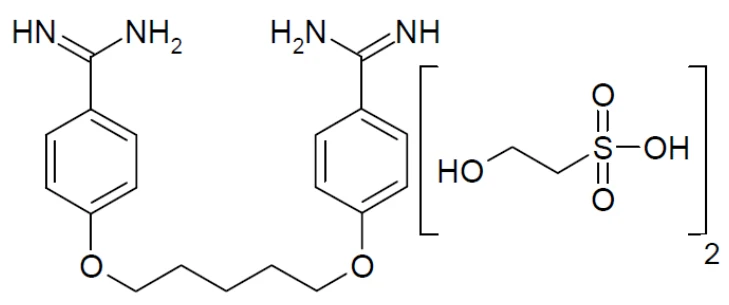
Physicochemical properties: White or almost white powder or colourless crystals. Pentamidine
Isetionate for Injection BP is a sterile lyophilized powder for injection.
It contains no preservative.
14 CLINICAL TRIALS
Not applicable.
15 MICROBIOLOGY
Pentamidine isetionate is active in vitro and/or in vivo against a variety of protozoa, including the genera of Trypanosomatidae pathogenic to humans. In vitro studies have not yet quantified the effects of pentamidine isetionate on Pneumocystis jirovecii, an organism generally considered a protozoan; however, several have compared the activity of the drug with that of trimethoprim/sulphamethoxazole.
In Vitro Activity: Pentamidine isetionate in concentrations of 0.3 to 9 mg/L decreased the viability of Pneumocystis jirovecii to a similar extent as did trimethoprim / sulphamethoxazol (trimethoprim 1.8 to 54 mg/L plus sulphamethoxazole 9 to 270 mg/L) in experimental models in chick embryo lung epithelial cells, and in the lung cells of rats with pneumonia which was induced by corticosteroids. Although both drugs inhibited the organism, pentamidine isetionate, unlike trimethoprim/ sulphamethoxazole, was demonstrated to be directly lethal to Pneumocystis jirovecii in its non-replicating state.
In Vivo Activity: Induction of Pneumocystis jirovecii pneumonia in rats given corticosteroids, a method first described by Frenkel et al. (1966), has served as the model of the in vivo activity of pentamidine isetionate. However, since Pneumocystis jirovecii is likely a species-specific organism, it is unclear whether these in vivo results have clinical applications. Using this rat model, Western et al. (1975) demonstrated that pentamidine isetionate 10 or 20 mg/kg subcutaneously or 4 mg/kg intramuscularly in daily or thrice weekly doses for 2 weeks prolonged survival time beyond that seen in control animals, but did not decrease mortality nor prevent proliferation of the organism. Pentamidine isetionate and trimethoprim/sulphamethoxazole decreased indices of disease severity to a similar extent, but only 14 to 52% of animals to which pentamidine isetionate was administered, recovered, in contrast to 64 to 79% of those receiving the combination antimicrobial agent. Further, unlike trimethoprim/ sulphamethoxazole, pentamidine isetionate was not shown to be useful prophylactically. Combination drug regimens of pentamidine isetionate plus trimethoprim/sulphamethoxazole, rifampicin or clindamycin in rat models have not improved the treatment success rate achieved with pentamidine isetionate alone.
16 NON-CLINICAL TOXICOLOGY
Acute toxicity:
The LD50 for pentamidine isetionate in mice by the intravenous and subcutaneous routes was 28 mg/kg and 64 mg/kg, respectively. Near lethal acute doses of pentamidine isetionate have produced a hyperglycemic effect in rabbits. In the guinea pig, toxic concentrations of pentamidine isetionate have produced fatty degeneration of the liver and cloudy swelling of the kidney. In a variety of anesthetized animals, a sharp fall in blood pressure followed the intravenous administration of pentamidine isetionate.
Subacute toxicity:
In a subacute 6-week I.V. toxicity study in rats, pentamidine isetionate was administered at dose levels of 0, 2, 6 and 18 mg/kg/day. This study included a 3-week recovery period for some of the animals. Significant clinical and laboratory findings included a reduction K+ in all treated animals, whereas total bilirubin levels were raised in all male treated groups. At the 18 mg/kg/day dose level, local irritation at the injection site, as well as reduction in body weight were observed in both sexes. At study termination, the relative kidney and liver weights were increased in both sexes dosed at 18 mg/kg/day and remained higher than those of the controls at the end of the recovery period.
There was evidence of some renal impairment at the18 mg/kg dose level. This consisted of increased plasma urea levels in association with increases in urinary volume, decreases in urinary specific gravity and increases in urine enzyme levels at termination of dosing.
An I.V. toxicity study was also done in Beagle dogs. Pentamidine isetionate was administered daily for 2 weeks at dose levels of 0, 2, 4 and 8 mg/kg/day. Weight gain was adversely affected in both sexes at the 8 mg/kg dose level, and reductions in food intake occurred in all treated animals. Elevation of plasma urea and creatinine, and of urinary LDH, NAG and lysozyme, together with the presence of renal tubular cells in the urine of dogs given 8 mg/kg pointed to the kidney as the target organ. No toxicologically significant macroscopic post-mortem findings or treatment related histopathological changes were recorded except for lesions at the injection site.
Reproductive and Developmental Toxicology:
Pentamidine isetionate was assessed for feto-toxic and teratogenic activity in mated female New Zealand white rabbits at dose levels of 1, 2, 3 and 8 mg/kg intravenously once daily from the fifth to the twentieth day post-coitum. A degree of maternal toxicity (severe central nervous system, somatomotor, respiratory and cardiovascular reactions) was evident at 8 mg/kg. A dose-related decreased body weight and food consumption was also noted in the dams.
Litter data parameters (viable fetuses, litter weight and fetal weight, sex ratio) remained largely unaffected by treatment except for a mild feto-toxic effect in all dosage groups as indicated by increased post-implantation loss and increased incidence of minor fetal skeletal anomalies which may have been linked to maternal toxicity.
17 SUPPORTING PRODUCT MONOGRAPHS
- 1.
Pentamidine Isetionate for Injection BP, Sterile Powder for Solution, 300 mg per vial, Submission control
number 255613, Product Monograph, Pfizer Canada ULC, January 31, 2022.