


Product Monograph - Pharixia
SUMMARY PRODUCT INFORMATION
| Route of Administration | Dosage Form / Strength | All Nonmedicinal Ingredients |
| Oral (Topical) | Mouthwash/ 1.5 mg/mL (0.15% w/v) | Alcohol, Citric Acid, Glycerin, Methylparaben, Mouthwash Natural and Artificial Flavour and Artificial Colour (contains D&C Yellow No. 10 and FD&C Blue No. 1), Polysorbate 80, Propylparaben, Purified Water, Sodium Citrate Dihydrate, Sorbitol. |
INDICATIONS AND CLINICAL USE
PHARIXIA (benzydamine hydrochloride) is indicated for the relief of pain in acute sore throat and for the symptomatic relief of oro-pharyngeal mucositis caused by radiation therapy.
CONTRAINDICATIONS
Benzydamine hydrochloride is contraindicated in subjects with a history of hypersensitivity to any ingredient in the formulation or component of the container. For a complete listing, see the Dosage Forms, Composition and Packaging section of the product monograph.
WARNINGS AND PRECAUTIONS
The use of undiluted PHARIXIA may produce local irritation manifested by burning sensation in patients with mucosal defects. If necessary, it may be diluted (1:1) with lukewarm water.
Renal
Since benzydamine hydrochloride is absorbed from oral mucosa and then excreted mostly unchanged in the urine, a possibility of its systemic action has to be considered in patients with renal impairment.
Pregnant Women
The safety of benzydamine hydrochloride has not been established in pregnant patients. Risk to benefit ratio should be established if PHARIXIA is to be used in these patients.
Pediatrics
Safety and dose directions have not been established for children five years of age and younger.
ADVERSE REACTIONS
The most frequent adverse reactions reported are: local numbness (9.7%), local burning or stinging sensation (8.2%), nausea and/or vomiting (2.1%).
The least frequent were reports of throat irritation, cough, dryness of the mouth associated with thirst, drowsiness and headache.
DOSAGE AND ADMINISTRATION
Not less than 15 mL of the liquid should be used for each gargle or rinse and repeated three or four times a day, depending on the severity of the treated condition. The liquid should be kept in contact with the inflamed mucosa for at least 30 seconds and then expelled from the mouth. Administration should begin the day prior to commencement of radiation therapy and continue daily during the treatment period as well as after cessation of radiation applications until desired improvement is obtained.
In acute sore throat, gargle with 15 mL every 1.5 to 3 hours. The solution should be expelled from the mouth after use.
OVERDOSAGE
For management of a suspected drug overdose; contact your regional Poison Control Centre.
There are no known cases of overdosage with Benzydamine Mouthwash. Since no specific antidote for benzydamine is available, cases of excessive ingestion of the liquid should receive supportive symptomatic treatment aimed at rapid elimination of the drug.
ACTION AND CLINICAL PHARMACOLOGY
Animal studies using the parenteral route have shown that benzydamine hydrochloride possesses properties of an analgesic/anti-inflammatory agent. This effect is not mediated through the pituitary-adrenal axis. Studies using the topical route have demonstrated local anesthetic properties of benzydamine hydrochloride. In controlled studies in humans with oro-pharyngeal mucosity due to radiation therapy, benzydamine hydrochloride use has provided relief through reduction of pain and edema. Similar studies in patients with acute sore throat demonstrated relief from pain.
Benzydamine hydrochloride has been detected in blood and urine after gargling four times for 20 seconds, in rapid succession, each time with a volume equivalent to 25.5 mg benzydamine per 70 kg body weight (approximately 17 mL per gargle). The average maximum plasma level of 59 ng/mL (range 17 to 173) was obtained 2 hours after ingestion. For comparison, one dose of 17 mL, when swallowed, yielded an average maximum plasma level of 180 ng/mL (range 102 to 324), also at 2 hours after ingestion. Benzydamine was still detectable 24 hours later in 7 out of 10 subjects after gargling (average plasma level of 7 ng/mL) and in 9 out of 10 subjects after the ingestion (average 32 ng/mL).
The urinary excretion was completed within 3-4 days after the single dose in both groups; about 46% of the dose was recovered in garglers, and 26% in ingestors. Repeated administration for 7 days did not result in a significant accumulation of benzydamine hydrochloride in plasma.
STORAGE AND STABILITY
Store at room temperature (15°C to 30°C).
DOSAGE FORMS, COMPOSITION AND PACKAGING
PHARIXIA (1.5 mg/mL; 0.15% (w/v) mouthwash) is available in PET bottles containing 100 mL and 250 mL of a clear, yellow-green liquid with a distinctive mint-like odour.
Nonmedicinal Ingredients: Alcohol, Citric Acid (for pH adjustment), Glycerin, Methylparaben, Mouthwash Natural and Artificial Flavour and Artificial Colour (contains D&C Yellow No. 10 and FD&C Blue No. 1), Polysorbate 80, Propylparaben, Purified Water, Sodium Citrate Dihydrate (for pH adjustment), Sorbitol.
PART II: SCIENTIFIC INFORMATION
PHARMACEUTICAL INFORMATION
Drug Substance
| Proper name: Benzydamine hydrochloride |
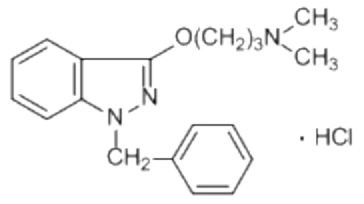
Chemical names: 1) 1-Propanamine, N,N-dimethyl-3-[[1-(phenyl-methyl)-1H-indazol-3- yl]oxy]-, monohydro chloride.
|
Molecular formula: C19H23N3O∙HCl Molecular mass: 345.87 |
Structural formula: Melting Point: 157°C - 160°C |
Physicochemical properties: Physical description: White to creamy-white, crystalline powder. Solubility: Freely soluble in water, alcohol, methanol and chloroform. Slightly soluble in acetone and practically insoluble in ether. pH: Between 4.5 and 5.5 (3% H2O) |
CLINICAL TRIALS
In controlled studies in humans with oro-pharyngeal mucosity due to radiation therapy, benzydamine hydrochloride use has provided relief through reduction of pain and edema. Similar studies in patients with acute sore throat demonstrated relief from pain.
DETAILED PHARMACOLOGY
Parenteral benzydamine hydrochloride in animal experiments inhibited morphological symptoms and pain due to various experimental inflammations (produced by carrageenin, serotonin, histamine, yeast, kaolin, dextran, egg albumin, cotton-pellet and croton oil granuloma, acrolein inhalation).
It had relatively little or no effect on Freund's adjuvant arthritis and on erythema produced by UV radiation or x-rays.
The analgesic activity of benzydamine was more pronounced in models involving an experimental inflammation rather than in non-inflammatory pain.
The mechanism of anti-inflammatory action is not related to a stimulation of the pituitary-adrenal axis. Like other non-steroidal anti-inflammatory agents, benzydamine inhibits the biosynthesis of prostaglandins under certain conditions but its properties in this respect have not been fully elucidated.
Benzydamine hydrochloride possesses a local anesthetic activity at low concentrations (0.15-1.0%) as demonstrated by corneal reflex inhibition in rabbits or in human volunteers using benzydamine mouthwash.
Peripheral reflexes were transiently inhibited after i.v. administration to cats.
TOXICOLOGY
Acute Toxicity
| Route | LD50 (mg/kg) | |||||||||||
|---|---|---|---|---|---|---|---|---|---|---|---|---|
| Mouse | Rat | Rabbit | Cat | Dog | Horse | |||||||
i.v. i.p. s.c. p.o. | 33 110 218 515 | -- 100 -- 1050 | -- -- -- 400 | 22 -- -- -- | 29 -- -- -- | 23 -- -- -- | ||||||
The acute toxic effects in mice and rats included muscle relaxation, ataxia, and at lethal doses, prostration and clonic convulsions.
Subacute Toxicity
Benzydamine was administered to rats (Long-Evans) at daily oral doses of 200 mg/kg for 1 month, at increasing doses from 200 to 300 mg/kg over 1 month or from 250 to 500 mg/kg over 3 months, or admixed in the diet (0.5% for 3 months; 0.01% and 0.1% for 6 months). Liver enlargement and a decrease in the growth rate were observed in rats treated with doses of 300 - 500 mg/kg/day or fed with the 0.5% diet. No histological toxic changes were found in the liver or other organs. Seven out of 30 rats died within 5 days of the increase of the daily dose from 250 to 500 mg/kg.
Mice (CF-1) were given a diet containing 0.01% or 0.1% benzydamine for 6 months (approximately 15 and 150 mg/kg). The mice exhibited an increase in liver weight, without histological changes, at the higher concentration. No other pathological alterations were noted.
Dogs were treated with benzydamine 30 mg/kg p.o. for 1 or 6 months. An increase in daily dosage to 45 mg/kg induced vomiting. No changes in behaviour, growth, organ weights, histology, blood counts, urinalysis, SGOT, glucose, BUN, serum electrophoresis and osmotic resistance of RBC were seen.
Topical administration (5% gel) to the rat and rabbit skin for 30 days did not result in any systemic toxicity.
Chronic Toxicity
Rats (Charles River) were treated daily with oral doses of 0, 10, 50 and 250 mg/kg for 18 months; urinalysis, hematological tests and determinations of fasting blood sugar, BUN, SGOT, SGPT, prothrombin time and coagulation time were performed and found to be within normal limits. High dose females showed hyperactivity. High dose animals showed inhibited growth rate. There was an increased liver/body weight ratio in males of the highest dosage group. Biochemical and hematological tests yielded normal values.
A 12-month experiment in Rhesus monkeys treated with daily doses of 0, 7, 20 and 60 mg/kg by gavage (10 animals per dose) revealed no pathological alterations in the biochemical and hematological tests performed.
Two animals died after receiving a single dose of 120 mg/kg, while two others were sacrificed in moribund condition after receiving 60 mg/kg per day after three and one-half and thirty-two days, respectively.
Local Tolerance
Rats appeared to be sensitive to skin applications of 5% benzydamine hydrochloride gel for 30 days at 0.5 and 1 g/day. No appreciable irritation was seen on normal or abraded skin of rabbits after application of the same gel for 30 days, or 5% cream for 1 day. Cats, dogs and ponies received a 2-week application of 5% cream to shaved skin without signs of intolerance.
Subcutaneous injections to rats and conjunctival instillations to rabbits produced transient symptoms of irritation after use of concentrations 0.25% and higher.
No sensitization could be demonstrated after repeated intradermal injections (0.1%) to guinea pigs.
Reproductive Studies
Orally administered benzydamine hydrochloride did not increase the incidence of fetal malformations in mice, rats and rabbits. Non-specific skeletal anomalies and retarded ossification were reported in the offspring of mice treated with 100 mg/kg/day s.c. or 240 mg/ kg/day p.o. and of rats treated with 150 mg/kg/day s.c., or 240 mg/ kg/day p.o. The incidence of dead fetuses was increased in rats, particularly at higher doses (200 and 240 mg/kg/day p.o.).
These findings were accompanied by lower maternal weights in the high dosage groups and were considered as manifestations of maternal toxicity rather than a specific teratogenic effect on fetal development.
REFERENCES
- 1. Balato N, Lembo G, Patruno C, Bordone F, Ayala F. Contact dermatitis from benzydamine hydrochloride. Contact Dermatitis 1986; 15: 105.
- 2. Baldock GA, Brodie LF, Chasseaud LF, Taylor T, Walmsley LM. Pharmacokinetics of benzydamine after intravenous, oral, and topical doses to human subjects. Biopharm Drug Disp 1991, 12: 481-92.
- 3. Bruynzeel DP. Contact allergy to benzydamine. Contact Dermatitis 1986; 14: 313-14.
- 4. Catanese B, Grasso A, Silvestrini B. Studies on the absorption and elimination of benzydamine in the mouse, rat, dog and man. Arzneim Forsch 1966; 16: 1354-57.
- 5. Christophersen J. Allergic contact dermatitis to benzydamine. Contact Dermatitis 1987; 16: 106-07.
- 6. Compendium of Pharmaceuticals and Specialities 12th Edition 1985; p. 679.
- 7. Fernandez de Corres L. Photodermatitis from benzydamine. Contact Dermatitis 1980; 6: 285.
- 8. Foti C, Vena GA, Angelini G. Occupational contact allergy to benzydamine hydrochloride.Contact Dermatitis 1992; 27: 328-29.
- 9. Froidevaux A-C. Traitement de la rhinite aigue. Experimentation en double aveugle chez l'adulte d'une solution a 1% de benzydamine en application topique par rapport a un placebo. Revue Med Suisse Rom. 1992; 112: 277-80.
- 10. Froom J. Benzydamine oral rinse for sore throat. Curr Ther Res 1979; 26(6): 856-61.
- 11. Goday Bujan JJ, Ilardia Lorentzen R, Soloeta Arechavala R. Allergic contact dermatitis from benzydamine with probable cross-reaction to indomethacin. Contact Dermatitis 1993; 28: 11l-12.
- 12. Harrison RG, O'Donnell PJ. The anti-inflammatory effects of benzydamine. Toxicol Appl Pharm 1970; 17: 355-60.
- 13. Jepson BA. Relieving the pain of pressure sores. Lancet 1992; 339: 503-04.
- 14. Kawaji A, Ohara K, Tababatake E. An assay of flavin- containing monooxygenase activity with benzydamine N-Oxidation. Biol & Pharm Bull 1994; 17 (5): 603-06.
- 15. Lisciani R, Scorza Barcellona P, Silvestrini B. Researches on the topical activity of benzydamine. Eur J Pharm 1968 3: 157-62.
- 16. McQuay HJ, Carroll D, Moxon A, Glynn CJ, Moore RA. Benzydamine cream for the treatment of post-herpetic neuralgia: minimum duration of treatment periods in a cross-over trial. Pain 1990; 40: 131-35.
- 17. Motley RJ, Reynolds AJ. Photodermatitis from benzydamine cream. Contact Dermatitis 1988; 19: 66.
- 18. O'Callaghan CA, Andrews PA, Ogg CS. Renal disease and use of topical non-steroidal anti-inflammatory drugs. BMJ 1994; 308: 110-11.
- 19. Prescribing Information- TANTUM (Benzydamine HCl 0.15% solutions) Oral Rinse - Locally Acting Analgesic Agent. Medicis Canada Ltd., Toronto, Ontario; January 3, 2012, Control # 152324.
- 20. Scorza Barcellona P, Catanese B. Induzione enzimaticae funzionalita epatica richerche sulla benzidamina. Bol Chim Farm 1966; 105: 367-74.
- 21. Silvestrini B, Catanese B, Del Basso P. Researches on the increase of liver weight produced by some drugs. Biochem Pharm 1966; 15: 249-54.
- 22. Silvestrini B, Garau A, Pozatti C, Cioli V. Pharmacological research on benzydamine - a new analgesic- anti-inflammatory drug. Arzneim Forsch 1966; 16: 59-63.
- 23. Silvestrini B, Garau A, Pozatti C, Cioli V, Catanese B. Additional pharmacological studies on benzydamine. Arch Int Pharmacodyn 1966; 163 (1): 61-9.
- 24. Silvestrini B, Scorza Barcellona P, Catanese B. Toxicology of benzydamine. Toxicol Appl Pharm 1967; 10: 148-59.
- 25. Silvestrini B, Tagliapietra L. Ricerche sperimentali sull'azione disinfettante della benzidamina. Boll Chim Farm 1968; 107: 353-61.
- 26. Simard-Savoie S, Forest D. Topical anesthetic activity of benzydamine. Curr Ther Res 1978; 23(6): 734-45.
- 27. Vermeulen HJ. A clinical investigation on the possible effects of benzydamine hydrochloride on liver function. Arzneim Forsch 1970; 20: 767-70.
- 28. Vincenzi C, Cameli N, Tardio M, Piraccini M. Contact and photocontact dermatitis due to benzydamine hydrochloride. Contact Dermatitis 1990; 23: 125-26.