


Product Monograph - PMS-Docusate Sodium
ACTION AND CLINICAL PHARMACOLOGY
Docusate sodium is a surface active agent that gently acts to maintain soft stools for easy natural passage. Docusate sodium reduces surface film tension of the interfacing liquid contents of the bowel promoting permeation of additional liquid into the stool to form a softer mass.
INDICATIONS AND CLINICAL USE
In the management and prophylaxis of constipation due to hard, dry stools, when peristaltic stimulants are contraindicated and maximum ease of passage is desirable to avoid difficult or painful defecation.
In patients who should not strain during defecation such as those with an episiotomy wound, painful thrombosed hemorrhoids, fissures or perianal abscesses, body wall and diaphragmatic hernias, anorectal stenosis, or postmyocardial infarction.
CONTRAINDICATIONS
Do not use when abdominal pain, nausea or vomiting is present.
pms-DOCUSATE SODIUM should not be used when the following medical problems exist:
< appendicitis, or symptoms of
< rectal or undiagnosed bleeding
< congestive heart failure
< hypertension
< fecal impaction
< intestinal obstruction
PRECAUTIONS
Overuse or extended use may cause dependence for bowel function. Do not take any type of laxative for more than 1 week unless advised by a physician. Do not take if you are pregnant or a nursing mother. pms-DOCUSATE SODIUM should not be taken within 2 hours of another medication because the desired effect of the other medicine may be reduced.
pms-DOCUSATE SODIUM should not be given to young children (up to 6 years of age) unless prescribed by a physician.
With extended use, blood glucose concentrations may be elevated, and serum potassium concentrations may be decreased; hypokalemia has occurred with extended use.
DRUG INTERACTIONS
Diuretics, potassium-sparing, or Potassium supplements: Chronic use or overuse of pms-DOCUSATE SODIUM may reduce serum potassium concentrations by promoting excessive potassium loss from the intestinal tract; may interfere with potassium-retaining effects of potassium-sparing diuretics.
Danthran, Mineral Oil, or Phenolphthalein: Concurrent use of these with pms-DOCUSATE
SODIUM may enhance the systematic absorption of these agents. Although such combinations are intentionally used in some Afixed-dose@ laxative preparations, the propensity for toxic effects is greatly increased. Liver injury has been reported with the Danthron combination following repeated dosage.
ADVERSE REACTIONS
Adverse reactions indicating need for medical attention: undetermined allergies (skin rash).
Adverse reactions indication need for medical attention only if continuing or are bothersome: stomach and/or intestinal cramping; throat irritation with liquid forms.
REPORTING SUSPECTED SIDE EFFECTS You can report any suspected adverse reactions associated with the use of health products to the Canada Vigilance Program by one of the following 3 ways:
Postage paid labels, Canada Vigilance Reporting Form and the adverse reaction reporting guidelines are available on the MedEffect™ Canada Web site at www.healthcanada.gc.ca/medeffect. NOTE: Should you require information related to the management of side effects, contact your health professional. The Canada Vigilance Program does not provide medical advice. |
SYMPTOMS AND TREATMENT OF OVERDOSAGE
There are no known cases of overdosage. Diarrhea and abdominal cramps may be controlled by a reduction of the dosage.
| For management of a suspected drug overdose, contact your regional Poison Control Center immediately. |
DOSAGE AND ADMINISTRATION
NOTE: Intake of at least 6 to 8 full glasses (240 mL) of fluid per day is necessary to aid in producing a soft stool and protect the patient against dehydration when large volumes of water are lost with passage of the stool.
The effect on the stools can be observed within the 1st to the 3rd day after the first oral dose.
Usual Oral Dose
Adult and children (12 years and over): 100 to 200 mg per day, with one full glass (240 mL) of water or other liquids, the dose being adjusted for patient size and need.
Children (6 to 12 years): 100 mg per day, with one full glass (240 mL) of water or other liquids, the dose being adjusted for patient size and need.
PHARMACEUTICAL INFORMATION
DRUG SUBSTANCE
Proper Name: Docusate Sodium
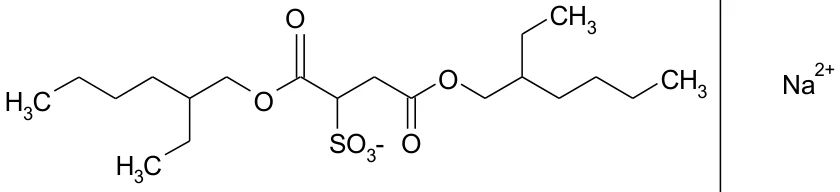
Chemical Names: Sulfobutanedioic acid 1,4-bis-(2-ethylhexyl) ester sodium salt;
Sulfosuccinic acid 1,4-bis(2-ethylhexyl) ester S-sodium salt;
Structural Formula:
Molecular Formula: C20H37NaO7S
Molecular Weight: 444.57
C 54.03%, H 8.39%, Na 5.17%, O 25.19%, S 7.21%.
Description: Available as wax-like solid, usually in rolls of tissue-thin material; also as 50 - 75% solutions in various solvents. Solubility in water (g/L): 15 (25ΕC), 23 (40ΕC), 30 (50ΕC), 55 (70ΕC). Soluble in CCl4, petr ether, naphtha, xylene, dibutyl phthalate, liq petrolatum, acetone, alcohol, vegetable oils. Very soluble in water + alcohol, water + water-miscible organic solvents. Stable in acid and neutral solutions; hydrolyzes in alkaline solutions.
Packaging and Storage: Store between 15 - 30Ε C (59 - 86Ε F).
AVAILABILITY OF DOSAGE FORMS
Capsules:
100 mg: Each reddish orange, oblong, softgel capsule, printed in white ink “PMS” on one side and “100” on the other, contains: Docusate Sodium 100 mg and the following non-medicinal ingredients: FD&C Yellow No. 6, FD&C Red No. 40, gelatine, glycerine, hypromellose, polyethylene glycol, propylene glycol, purified water, sodium methylparaben, sodium propylparaben, sorbitol, and titanium dioxide.
Available in bottles of 100 and 1000. Blisters of 30.
200 mg: Each orange, oblong, softgel capsule, printed in white ink with “PMS” on one side and “200” on the other side contains: Docusate Sodium 200 mg, and the following non-medicinal ingredients: FD&C Yellow No. 6, FD&C Red No. 40, gelatine, glycerine, hypromellose, polyethylene glycol, propylene glycol, purified water, sodium methylparaben, sodium propylparaben, sorbitol, and titanium dioxide.
Available in bottles of 100 and 1000. Blisters of 30.
Store between 15 and 30ΕC in a tight, light resistant container in a dry area.
Keep out of reach of children.