


Product Monograph - PMS-Leflunomide
SUMMARY PRODUCT INFORMATION
| Route of Administration | Dosage Form / Strength | All Non Medicinal Ingredients |
| oral | Coated Tablets 10 mg, 20 mg | Colloidal silicon dioxide, corn starch, crospovidone, lactose, polyethylene glycol, polyvinyl alcohol (partly hydrolyzed), povidone, talc, and titanium dioxide. Additionally, 20 mg tablets also contain iron oxide yellow. |
INDICATIONS AND CLINICAL USE
pms-LEFLUNOMIDE (leflunomide) should be used only by physicians who have fully familiarized themselves with the efficacy and safety profile of leflunomide and who are experienced in the therapy of rheumatoid diseases.
pms-LEFLUNOMIDE is indicated in adults for the treatment of active rheumatoid arthritis.
Geriatrics (> 65 years of age):
No dosage adjustment is needed in patients over 65 years of age.
Pediatrics (< 18 years of age):
The use in patients less than 18 years of age is contraindicated.
CONTRAINDICATIONS
Leflunomide is contraindicated in:
- 1) Patients with known hypersensitivity to leflunomide (especially previous Stevens-Johnson syndrome, toxic epidermal necrolysis or erythema multiforme), to teriflunomide or to any of pms-LEFLUNOMIDE’s excipients.
- 2)
Due to the lack of clinical experience in the following three patient populations, leflunomide is not to be administered to these patients due to its potential for
immunosuppression:
- i) Patients with immunodeficiency states, due to causes other than rheumatoid arthritis (e.g. AIDS) (see WARNINGS AND PRECAUTIONS, Immune).
- ii) Patients with impaired bone marrow function or significant anaemia, leucopenia, neutropenia or thrombocytopenia due to causes other than rheumatoid arthritis.
- iii) Patients with serious infections.
- 3) Patients with moderate to severe renal insufficiency because the kidney plays a role in the elimination of leflunomide.
- 4)
Patients with impairment of liver function (leflunomide in monotherapy or in combination with other hepatotoxic drugs e.g. Disease Modifying Antirheumatic Drugs [DMARDs] such as methotrexate) given the possible risk of increased hepatotoxicity and the role of the liver in activation, elimination and recycling of leflunomide (see DRUG INTERACTIONS).
While the mechanism of action of leflunomide and methotrexate are different, their pharmacodynamic action of interfering with cell division is similar. Concomitant treatment with methotrexate and/or other liver and bone marrow toxic medications is associated with an increased risk of serious hepatic or marrow reactions and requires strict vigilance in monitoring (see WARNINGS AND PRECAUTIONS, Monitoring and Laboratory Tests).
If a switch in treatment from leflunomide to another hepatotoxic DMARD is required the washout and monitoring must be adhered to as mentioned in the WARNINGS AND PRECAUTIONS, Monitoring and Laboratory Tests and General, Washout procedures section.
- 5) Patients with severe hypoproteinemia (e.g. in nephrotic syndrome). Since the active metabolite of leflunomide, A771726, is highly protein-bound and cleared via hepatic metabolism and biliary secretion.
- 6) Pregnant women, or women of childbearing potential who are not using reliable contraception before, during, and for a period of two years after treatment with leflunomide (or as long as the plasma levels of the active metabolite are above 0.02 mg/L). Pregnancy must be excluded before start of treatment with leflunomide (see WARNINGS AND PRECAUTIONS, Special Populations, Pregnant Women).
- 7) Women who are breast feeding (see WARNINGS AND PRECAUTIONS, Special Population, Nursing Women).
- 8) Patients less than 18 years of age.
Male patients should be aware of the possible male-mediated foetal toxicity. Reliable contraception during treatment with leflunomide should also be guaranteed (see
WARNINGS AND PRECAUTIONS, Sexual Function/Reproduction and Special Population, Pregnant Women).
WARNINGS AND PRECAUTIONS
General
The active metabolite of leflunomide, A771726, has a long half-life. Serious undesirable effects might occur and persist (e.g. hepatotoxicity, haematotoxicity or allergic reactions, see below), even if the treatment with leflunomide has been stopped. For the management of the above-mentioned toxicities a washout procedure should be performed.
If a severe adverse reaction to leflunomide occurs, or if for any other reason A771726 needs to be cleared rapidly from the body, cholestyramine or activated charcoal has to be initiated and continued/repeated as clinically necessary (see OVERDOSAGE). For suspected severe immunologic/allergic reactions, more prolonged cholestyramine or activated charcoal administration may be necessary to achieve rapid and sufficient clearance (see below the Washout Procedures).
Similarly, when switching to another DMARD (e.g. methotrexate) after treatment with leflunomide a washout procedure should be performed since there exist a possibility of additive risks of adverse events for a long time after the switching (see below the Washout Procedures and see also the CONTRAINDICATIONS and DRUG INTERACTIONS).
Recent treatment with hepatotoxic DMARDs may result in increased side effects; therefore, the initiation of leflunomide treatment has to be carefully considered regarding these benefit/risk aspects. Caution and careful monitoring of liver and bone marrow function is necessary if these drugs are used concomitantly (see CONTRAINDICATIONS and DRUG INTERACTIONS).
Co-administration of teriflunomide with pms-LEFLUNOMIDE is not recommended, since it will lead to an increase in the plasma exposure of A771726 in an additive manner, as leflunomide is the parent compound of teriflunomide.
Washout Procedures
One of the following is recommended to achieve a fast decrease in plasma levels after stopping treatment with leflunomide:
- 1) 8 g cholestyramine 3 times daily for 11 days OR
- 2) 50 g activated charcoal 4 times daily for 11 days
The duration may be modified depending on clinical or laboratory variables.
Similarly low A771726 plasma levels may be expected 2 years after stopping leflunomide without one of the above washout methods. Due to individual variation in drug clearance, some patients may decrease to below this plasma level in less time (e.g. 6 months).
Carcinogenesis and Mutagenesis
Malignancy
The risk of malignancy, particularly lymphoproliferative disorders, is increased with the use of some immunosuppressive medications. There is a potential for immunosuppression with leflunomide. No apparent increase in the incidence of malignancies and lymphoproliferative disorders was reported in the clinical trials of leflunomide, but larger and longer-term studies would be needed to determine whether there is an increased risk of malignancies or lymphoproliferative disorders with leflunomide.
Carcinogenesis, and Mutagenesis
No evidence of carcinogenicity was observed in a 2-year bioassay in rats at oral doses of leflunomide up to the maximally tolerated dose of 6 mg/kg (approximately 1/40 the maximum human A771726 systemic exposure based on the area under the curve [AUC]). However, male mice in a 2-year bioassay exhibited an increased incidence in lymphoma at an oral dose of 15 mg/kg, the highest dose studied (1.7 times the human A771726 exposure based on AUC). Female mice in the same study exhibited a dose-related increased incidence of bronchoalveolar adenomas and carcinomas combined beginning at 1.5 mg/kg (approximately 1/10 the human A771726 exposure based on AUC). The significance of the findings in mice relative to the clinical use of leflunomide is not known.
Leflunomide was not mutagenic in the Ames Assay, the Unscheduled DNA Synthesis Assay, or in the HGPRT Gene Mutation Assay. In addition, leflunomide was not clastogenic in the in vivo Mouse Micronucleus Assay nor in the in vivo Cytogenetic Test in Chinese Hamster Bone Marrow Cells. However, 4-trifluoromethylanaline (TFMA), a minor metabolite of leflunomide, was mutagenic in the Ames Assay and in the HGPRT Gene Mutation Assay and was clastogenic in the in vitro Assay for Chromosome Aberrations in the Chinese Hamster Cells. TFMA was not clastogenic in the in vivo Mouse Micronucleus Assay nor in the in vivo Cytogenetic Test in Chinese Hamster Bone Marrow Cells.
Cardiovascular
In addition to hypertension noted in Clinical Trials, isolated reports of difficulty with blood pressure control including cases of malignant hypertension and hypertensive crisis have been submitted. Although a causal relationship to leflunomide has not been established and confounding factors were present in most cases, it is considered essential that monitoring recommendations are closely followed (see WARNINGS and PRECAUTIONS, Monitoring and Laboratory Tests).
Serious cases of pulmonary hypertension, some with a fatal outcome, have been reported post-marketing in patients treated with leflunomide, The majority of these cases have been reported in patients with underlying heart disease, valvular disorders, lung disorders (ILD), and pulmonary thromboembolism. Caution should be exercised when leflunomide is used in patients with heart disease, valvular disorders, lung disorders (ILD), or pulmonary thromboembolism.
Gastrointestinal
Post marketing cases of colitis including ulcerative, microscopic colitis and Crohn’s Disease, have been reported in patients treated with leflunomide. Some cases were serious and some had a fatal outcome. Patients taking leflunomide and presenting with unexplained chronic diarrhoea or weight loss, should be investigated for colitis.
Hematologic
Monitoring for hematologic toxicity must be adhered to (see WARNINGS AND PRECAUTIONS, Monitoring and Laboratory Tests).
Leflunomide is contraindicated in patients with impaired bone marrow function or significant anaemia, leucopenia, neutropenia or thrombocytopenia due to causes other than rheumatoid arthritis (see CONTRAINDICATIONS). In patients with a lesser degree of pre-existing anemia, leucopenia, and/or thrombocytopenia as well as in patients with impaired bone marrow function or those at risk of bone marrow suppression, the risk of hematological disorders is increased. The same effects also occur in patients on concomitant myelosuppresive medications, for example methotrexate, therefore strict vigilance in monitoring is recommended for all patients on leflunomide on concomitant myelosuppressive medication. If such effects occur, a washout procedure to reduce plasma levels of A771726 should be considered.
In case of severe hematological reactions, including pancytopenia, leflunomide and any concomitant myelosuppressive medication must be discontinued and a washout procedure initiated (see WARNINGS AND PRECAUTIONS, General, Washout Procedures).
Hepatic/Biliary/Pancreatic
Monitoring for hepatotoxicity must be adhered to (see WARNINGS AND PRECAUTIONS, Monitoring and Laboratory Tests).
Leflunomide is contraindicated in patients with impairment of liver function (see CONTRAINDICATIONS). Given the possible risk of increased hepatotoxicity and the role of the liver in drug activation, elimination and recycling, the use of leflunomide is not recommended in patients with positive Hepatitis B or C serologies or pre-existing hepatic disease.
Rare cases (defined by Regulatory definition as events occurring at a frequency ranging from 0.01 to 0.1%) of serious liver injury, including liver failure some with a fatal outcome, have been reported during treatment with leflunomide. Most of the cases occurred within the first 6 months of treatment. While confounding factors were seen in many cases such as other hepatotoxic drugs such as methotrexate and/or nonsteroidal anti-inflammatory drugs (NSAIDs), a causal relationship to leflunomide cannot be excluded. It is essential that the monitoring recommendations be adhered to and washout procedure performed in appropriate cases (see WARNINGS AND PRECAUTIONS, Monitoring and Laboratory Tests).
Due to a potential for additive hepatotoxic effects, it is recommended that alcohol consumption be avoided during treatment with leflunomide.
In clinical trials, leflunomide treatment was associated with elevations of liver function tests, primarily ALT (SGPT) and AST (SGOT) in a significant number of patients; these effects were generally reversible. Most transaminase elevations were mild (≤ 2xULN) (upper limit of normal) and usually resolved while continuing treatment. Clinically significant elevations (>2 and ≤3xULN) were less common and were generally asymptomatic and reversible with dose reduction or, if persistent, by discontinuing leflunomide. More marked elevations (>3xULN) occurred infrequently and resolved after discontinuation of leflunomide. Some patients received cholestyramine to enhance clearance. Overall, persistent elevations after dose reduction were uncommon and were usually associated with concomitant NSAIDs use. Limited biopsy data did not suggest that leflunomide was associated with the development of cirrhosis or hepatic fibrosis.
The following table shows liver enzyme elevations seen with monthly monitoring in clinical trials US301, MN301 and MN302. It was notable that the absence of folate use in MN302 was associated with a considerably greater incidence of liver enzyme elevation on methotrexate.
| Table 1. Liver Enzyme Elevations > 3-fold Upper Limit of Normal (ULN) | ||||||||||||||||||||||
US301 no. of patients (% patients) | MN301 no. of patients (% patients) | MN302 no. of patients (% patients) | ||||||||||||||||||||
| LEF | PBO | MTX | LEF | PBO | SSZ | LEF | MTX | |||||||||||||||
ALT (SGPT) > 3-fold ULN (%) Reversed to ≤2-fold ULN | 8 (4.4) 8 | 3 (2.5) 3 | 5 (2.7) 5 | 2 (1.5) 2 | 1 (1.1) 1 | 2 (1.5) 2 | 13 (2.6) 12 | 83 (16.7) 82 | ||||||||||||||
Timing of Elevation 0-3 Months 4-6 Months 7-9 Months 10-12 Months | 6 1 1 - | 1 1 1 - | 1 3 1 - | 2 - - - | 1 - - - | 2 - - - | 7 1 - 5 | 27 34 16 6 | ||||||||||||||
AST (SGOT) > 3-fold ULN (%) Reversed to ≤2-fold ULN | 4 (2.2) 4 | 2 (1.7) 2 | 1 (0.6) 1 | 2 (1.5) 2 | 0 | 5 (3.6) 4 | 7 (1.4) 5 | 29 (5.8) 29 | ||||||||||||||
Timing of Elevation 0-3 Months 4-6 Months 7-9 Months 10-12 Months | 2 1 1 - | 1 1 - - | - 1 - - | 2 - - - | - - - - | 4 1 - - | 3 1 - 1 | 10 11 8 - | ||||||||||||||
LEF= leflunomide, SSZ= sulfasalazine, PBO= placebo, MTX= methotrexate
Guidelines for dose adjustment or discontinuation based on the severity and persistence of ALT (SGPT) elevation are recommended as follows: If ALT (SGPT) elevations between 2- and 3-fold the upper limit of normal persist or if ALT (SGPT) elevations of more than 3-fold the upper limit of normal are present, leflunomide should be discontinued. Cholestyramine or activated charcoal should be administered to more rapidly lower A771726 level (see WARNINGS AND PRECAUTIONS, General, Washout Procedures and Monitoring and Laboratory Tests).
Rare elevations of alkaline phosphatase and bilirubin have been observed. Trial US301 used
ACR Methotrexate Liver Biopsy Guidelines for monitoring therapy. One of 182 patients receiving leflunomide and 1 of 182 patients receiving methotrexate underwent liver biopsy at 106 and 50 weeks, respectively. The biopsy for the leflunomide subject was Roegnik Grade IIIA and for the methotrexate subject Roegnik Grade I.
Immune
Leflunomide is not recommended for patients with bone marrow dysplasia, or severe, uncontrolled infections or immuno-deficiency due to causes other than rheumatoid arthritis (see CONTRAINDICATIONS).
Medications like leflunomide that have immunosuppression potential may cause patients to be more susceptible to infections, including opportunistic infections (see ADVERSE REACTIONS). Infections may be more severe in nature.
It is known that patients with rheumatoid arthritis have an increased risk of severe infections, which may lead to sepsis and death. Rare cases of severe infection (including Pneumocystis jiroveci and cytomegalovirus infections) and sepsis (with fatal outcome in isolated cases) were reported in patients treated with leflunomide. Although in most cases a causal relationship to leflunomide has not been established and multiple confounding factors were present, infections developing in patients receiving leflunomide may require early and vigorous treatment.
In the event that a severe or uncontrolled infection occurs, it may be necessary to interrupt leflunomide treatment and administer a washout procedure (see WARNINGS AND PRECAUTIONS, General, Washout Procedures).
Leflunomide has not been studied in patients with a positive tuberculosis screen, and the safety of pms-LEFLUNOMIDE in individuals with latent tuberculosis infection is unknown. Before starting treatment, all patients should be evaluated for active and inactive (“latent”) tuberculosis. Patients testing positive in tuberculosis screening should be treated by standard medical practice prior to therapy with pms-LEFLUNOMIDE. Patients with a history of tuberculosis should be carefully monitored because of the possibility of reactivation of the infection.
Neurologic
Peripheral Neuropathy
Cases of peripheral neuropathy have been reported in patients receiving leflunomide. Most patients recovered after discontinuation of leflunomide, but some patients had persistent symptoms. Age older than 60 years, concomitant neurotoxic medications, and diabetes may increase the risk for peripheral neuropathy. If a patient taking leflunomide develops a peripheral neuropathy, consider discontinuing leflunomide, and performing a washout procedure (see WARNINGS AND PRECAUTIONS, General, Washout Procedures).
Renal
Leflunomide is contraindicated in patients with moderate to severe renal impairment. Because the kidney plays a role in the elimination of leflunomide, and without sufficient studies of the use of leflunomide in patients with renal insufficiency, caution should be used when considering the administration of leflunomide to patients with mild renal insufficiency.
Respiratory
Rare (<0.1%) spontaneous reports of interstitial lung disease occurring during treatment with leflunomide have been received worldwide (see ADVERSE REACTIONS, Respiratory, Thoracic and Mediastinal Disorders). Several of these cases had a fatal outcome. A large-scale cohort study to assess the risk of Interstitial lung disease (ILD) associated with leflunomide use was sponsored by Sanofi-Aventis and the Canadian Institutes of Health Research. The study used linked databases, prescribing and administrative information, for more than 235,000 patients with rheumatoid arthritis (RA). It was found that the risk of ILD was increased in patients with a history of methotrexate (MTX) use or interstitial lung disease (RR=2.6 [95% CI: 1.2-5.6]).
In a Japanese postmarketing surveillance program of 3658 patients with rheumatoid arthritis, the rate of interstitial lung disease was estimated at 0.8%, regardless of causality. Twenty-nine (29) cases of interstitial pneumonitis were reported, 11 with a fatal outcome. Assessment of the causality between leflunomide use and the reported interstitial lung disease is frequently confounded by pre-existing pulmonary disease (e.g. interstitial pneumonitis), and/or previous or concomitant use of other DMARDs known to induce interstitial lung disease (including methotrexate).
In patients with a current or previous history of pulmonary disease or who have been recently treated with drugs known to induce interstitial lung disease, it is recommended that pulmonary status be evaluated prior to initiation of leflunomide therapy and that patients be closely monitored during treatment.
Interstitial lung disease is a potentially fatal disorder, which may occur acutely at any time during therapy and has a variable clinical presentation. New onset or worsening pulmonary symptoms, such as cough and dyspnea, with or without associated fever, may be a reason for discontinuation of the therapy and for further investigation, as appropriate. If discontinuation of the drug is needed, the long half-life of the active metabolite of leflunomide may necessitate the initiation of wash-out procedures (see WARNINGS AND PRECAUTIONS, General, Washout Procedures).
Patients should be informed about the early warning signs of interstitial lung disease and asked to contact their physician as soon as possible if these symptoms appear or worsen during therapy.
Sexual Function/Reproduction
Procreation:
Pregnancy must be avoided if either partner is receiving leflunomide.
Females
There are no adequate and well-controlled studies evaluating leflunomide in pregnant women. However, based on animal studies, leflunomide may cause fetal death or teratogenic effects when administered to a pregnant woman. Women of childbearing potential must not be started on leflunomide until pregnancy is excluded and it has been confirmed that they are using reliable contraception.
Before starting treatment with leflunomide, patients must be fully counseled on the potential for serious risk to the fetus. Patient must be advised that if there is any delay in onset of menses or any other reason to suspect pregnancy, they must notify the physician immediately for pregnancy testing. Should pregnancy occur, the physician and patient should discuss the risk of continuing the pregnancy (see CONSUMER INFORMATION). It is possible that rapidly lowering the blood level of the active metabolite, by instituting the drug elimination procedure described below, at the first delay of menses may decrease the risk to the fetus from leflunomide.
For women who have received leflunomide treatment and wish to become pregnant, one of the following procedures is recommended:
- After stopping treatment with leflunomide, cholestyramine 8 g is administered 3 times daily for a period of 11 days OR
- After stopping treatment with leflunomide, 50 g of activated charcoal is administered 4 times daily for a period of 11 days.
The plasma levels of the active metabolite (A771726) must be less than 0.02 mg/L (0.02 mcg/mL). Below this plasma level (to be verified by 2 separate tests at an interval of at least 14 days), the teratogenic risk is considered very low (see CONTRAINDICATIONS and WARNINGS AND PRECAUTIONS, General, Washout Procedures).
Without the drug elimination procedure, it may take up to 2 years to reach A771726 levels <0.02 mg/L. However, also after a such waiting period, verification of A771726 levels less than 0.02 mg/L (0.02 mcg/mL) by 2 separate tests at an interval of a least 14 days is required.
If a waiting period of up to approximately 2 years under reliable contraception is considered unpractical, prophylactic institution of a washout procedure may be advisable (see WARNINGS AND PRECAUTIONS, General, Washout Procedures).
Reliable contraception with oral contraceptive may not be guaranteed during the washout procedure with cholestyramine or activated charcoal. Use of alternative contraceptive methods is recommended.
Males
Leflunomide must not be used by men who could potentially father a child and are not using reliable contraception during and for a total of 2 years after treatment with leflunomide, if no elimination procedure is used.
There are no specific data on the risk of male-mediated foetal toxicity. However, animal studies to evaluate this specific risk have not been conducted. To minimise any possible risk, men wishing to father a child should consider discontinuing use of leflunomide and use elimination procedure or wait 2 years after treatment cessation.
For men having received leflunomide treatment and wishing to father a child, plasma levels of the active metabolite (A771726) must be less than 0.02 mg/L (0.02 mcg/mL) to be verified by two separate tests at an interval of at least 14 days. After the second test confirming that the plasma concentration is below 0.02 mg/L an additional waiting period of 3 months is required. After that period, the risk of male-mediated foetal toxicity is considered very low (see CONTRAINDICATIONS and WARNINGS AND PRECAUTIONS, General, Washout Procedures).
Impairment of Fertility
Leflunomide had no effect on fertility in either male or female rats at oral doses up to 0.4 mg/kg (approximately 1/30 the human A771726 exposure based on AUC).
Skin
In case of ulcerative stomatitis, leflunomide administration should be discontinued.
Cases of Stevens-Johnson syndrome, toxic epidermal necrolysis and drug reaction with eosinophilia and systemic symptoms (DRESS) have been reported in patients treated with leflunomide. As soon as skin and/or mucosal reactions are observed which raise the suspicion of such severe reactions, leflunomide and any other possibly associated medication must be discontinued, and a washout procedure initiated immediately. A complete washout is essential in such cases. In such cases re-exposure to leflunomide is contraindicated (see CONTRAINDICATIONS and WARNINGS AND PRECAUTIONS, General, Washout Procedures).
Special Populations
Pregnant Women:
Leflunomide must not be administered to pregnant women or women of child bearing potential. Leflunomide must not be administered to male subjects who wish to father a child (see CONTRAINDICATIONS and WARNINGS AND PRECAUTIONS, Sexual Function/Reproduction).
Nursing Women:
Animal studies indicate that leflunomide or its metabolites pass into breast milk. Therefore, leflunomide must not be administered to nursing mothers (see CONTRAINDICATIONS).
Pediatrics (< 18 years of age):
The safety and efficacy of leflunomide in the pediatric population have not been fully evaluated, and its use in patients less than 18 years of age is contraindicated.
Geriatrics (> 65 years of age):
No dosage adjustment is needed in patients over 65 years of age.
Monitoring and Laboratory Tests
Leflunomide should be administered to patients only under careful medical supervision.
AST (SGOT) and ALT (SGPT) must be checked before initiation of the treatment and at monthly or more frequent intervals during the first 6 months, and every 8 weeks thereafter (see WARNINGS AND PRECAUTIONS, Hepatic/Biliary/Pancreatic).
ALT (SGPT) values are elevated more frequently than AST (SGOT).
For confirmed ALT (SGPT) elevations between 2- and 3-times the upper limit of normal, dose may be reduced from 20 to 10 mg/day and monitoring should be performed weekly. If ALT (SGPT) elevations of more than 2-times the upper limit of normal persist, or, if confirmed ALT (SGPT) increases to more than 3-times the upper limit of normal, leflunomide must be discontinued and washout procedures initiated.
If a severe undesirable effect of leflunomide occurs, or if for any other reason the active metabolite needs to be cleared rapidly from the body (e.g.: desired or unintended pregnancy, switching to another DMARD such as methotrexate), the washout procedures should be initiated. Cholestyramine or activated charcoal should be administered to more rapidly lower A771726 levels (see CONTRAINDICATIONS, WARNINGS AND PRECAUTIONS, General, Washout Procedures).
A complete blood cell count, including differential white blood cell count and platelets, must be performed before start of leflunomide treatment as well as every 2 weeks for the first 6 months of treatment and every 8 weeks thereafter (see WARNINGS AND PRECAUTIONS, Hematologic).
Blood pressure must be checked before the start of leflunomide treatment and periodically thereafter (see WARNINGS AND PRECAUTIONS, Cardiovascular and ADVERSE REACTIONS, Clinical Trial Adverse Drug Reactions).
In patients with a current or previous history of pulmonary disease or who have been recently treated with drugs known to induce interstitial lung disease, it is recommended that pulmonary status be evaluated prior to initiation of leflunomide therapy and that patients be closely monitored during treatment. Before starting treatment, all patients should be evaluated for active and inactive (“latent”) tuberculosis. Patients with a history of tuberculosis should be carefully monitored because of the possibility of reactivation of the infection.
Other Laboratory Tests Changes:
Due to an uricosuric effect presumably at the brush border of the proximal renal tubule, uric acid levels usually decrease. Phosphaturia and hypokalemia may also occur.
ADVERSE REACTIONS
Adverse Drug Reaction Overview
Hypertension, gastrointestinal disturbances, weight loss, headache, dizziness, paresthesia, asthenia, musculoskeletal and skin disorder are considered as some common adverse reactions seen with leflunomide.
Leucopenia and hypersensitivity reactions may occur and cases of Stevens-Johnson syndrome or toxic epidermal necrolysis and drug reaction with eosinophilia and systemic symptoms (DRESS) have been reported.
Hepatotoxicity has occurred. It is usually mild and reversible but cases of severe, sometimes fatal, liver disease, including acute hepatic necrosis, have been observed. There have been reports of pancreatitis, interstitial lung disease, and infections, including fatal sepsis (see Clinical Trial Adverse Drug Reactions and Less Common Clinical Trial Adverse Drug Reactions / Post-Market Adverse Drug Reactions).
Clinical Trial Adverse Drug Reactions
Because clinical trials are conducted under very specific conditions the adverse reaction rates observed in the clinical trials may not reflect the rates observed in practice and should not be compared to the rates in the clinical trials of another drug. Adverse drug reaction information from clinical trials is useful for identifying drug-related adverse events and for approximating rates.
There were a total of 5419 adverse events reported in 1339 subjects treated with leflunomide. Four percent (4%) of the subjects in controlled studies of leflunomide had a dose reduction as a result of an adverse event and 15.5% discontinued study treatment due to adverse events. There was a total of 377 serious adverse events which occurred in 294 (22%) leflunomide treated subjects. The percent of leflunomide treated patients experiencing an adverse event was similar to methotrexate, the next largest treatment population.
The most common adverse events, in the controlled clinical trials, considered related to leflunomide administration were of gastrointestinal origin and consisted predominantly of diarrhea (26.7% leflunomide, 11.9% placebo, 9.8% sulfasalazine, 12.5% methotrexate), LFT (liver function test) abnormalities (10.2% leflunomide, 2.4% placebo, 3.8% sulfasalazine, 15.1% methotrexate), abdominal pain (5.7% leflunomide, 4.3% placebo, 6.8% sulfasalazine, 7.5% methotrexate), and nausea and/or vomiting (17.8% leflunomide, 14.3% placebo, 22.6% sulfasalazine, 19.9% methotrexate). These disorders may as well be associated with concomitant NSAID administration, common in all treatment groups. The occurrences of hypertension and hypokalemia observed in patients treated with leflunomide may have been influenced by concomitant NSAID and/or steroid use. Monitoring blood pressure in patients on leflunomide should be considered as addition to the recommended Monitoring of hematologic and hepatic function (see WARNINGS AND PRECAUTIONS, Monitoring and Laboratory Tests).
Adverse reactions associated with the use of leflunomide in rheumatoid arthritis include diarrhea, elevated liver transaminases (ALT [SGPT] and AST [SGOT]), alopecia, rash, and hypertension. In the controlled studies, the following adverse events were reported regardless of causality:
| Table 2. Percentage of Patients with Adverse Events ≥3% in any leflunomide Treated Group | |||||||||||||||||||
|---|---|---|---|---|---|---|---|---|---|---|---|---|---|---|---|---|---|---|---|
| All RA Studies | Placebo-Controlled Trials | Active-Controlled Trials | |||||||||||||||||
| MN 301 and US 301 | MN 302† | ||||||||||||||||||
LEF (N=1339) | LEF (N=315) | PBO (N=210) | SSZ (N=133) | MTX (N=182) | LEF (N=501) | MTX (N=498) | |||||||||||||
| GENERAL DISORDER | |||||||||||||||||||
| Allergic Reaction | 2% | 5% | 2% | 0% | 6% | 1% | 2% | ||||||||||||
| Worsening RA | 8% | 5% | 11% | 20% | 4% | 17% | 19% | ||||||||||||
| Asthenia | 3% | 6% | 4% | 5% | 6% | 3% | 3% | ||||||||||||
| Flu Syndrome | 2% | 4% | 2% | 0% | 7% | 0% | 0% | ||||||||||||
| Infection | 4% | 0% | 0% | 0% | 0% | 0% | 0% | ||||||||||||
| Injury Accident | 5% | 7% | 5% | 3% | 11% | 6% | 7% | ||||||||||||
| Pain | 2% | 4% | 2% | 2% | 5% | 1% | <1% | ||||||||||||
| Abdominal Pain | 6% | 5% | 4% | 4% | 8% | 6% | 4% | ||||||||||||
| Back Pain | 5% | 6% | 3% | 4% | 9% | 8% | 7% | ||||||||||||
| CARDIOVASCULAR DISORDERS | |||||||||||||||||||
| Hypertension | 10% | 9% | 4% | 4% | 3% | 10% | 4% | ||||||||||||
| Chest Pain | 2% | 4% | 2% | 2% | 4% | 1% | 2% | ||||||||||||
| GASTROINTESTINAL DISORDERS | |||||||||||||||||||
| Anorexia | 3% | 3% | 2% | 5% | 2% | 3% | 3% | ||||||||||||
| Diarrhea | 17% | 27% | 12% | 10% | 20% | 22% | 10% | ||||||||||||
| Dyspepsia | 5% | 10% | 10% | 9% | 13% | 6% | 7% | ||||||||||||
| Gastroenteritis | 3% | 1% | 1% | 0% | 6% | 3% | 3% | ||||||||||||
| Abnormal Liver Function Tests | 5% | 10% | 2% | 4% | 10% | 6% | 17% | ||||||||||||
| Nausea | 9% | 13% | 11% | 19% | 18% | 13% | 18% | ||||||||||||
| GI/Abdominal Pain | 5% | 6% | 4% | 7% | 8% | 8% | 8% | ||||||||||||
| Mouth Ulcer | 3% | 5% | 4% | 3% | 10% | 3% | 6% | ||||||||||||
| Vomiting | 3% | 5% | 4% | 4% | 3% | 3% | 3% | ||||||||||||
| BLOOD AND LYMPHATIC DISORDERS | |||||||||||||||||||
| Leucopenia ( > 2 G/L) | 3% | - | 0% | 2% | 1% | 4% | 3% | ||||||||||||
| METAB. & NUTRITION DISORDERS | |||||||||||||||||||
| Hypokalemia | 1% | 3% | 1% | 1% | 1% | 1% | <1% | ||||||||||||
| Weight Decrease | 4% | 2% | 1% | 2% | 0% | 2% | 2% | ||||||||||||
| MUSCULOSKELETAL SYSTEM and CONNECTIVE TISSUE DISORDERS | |||||||||||||||||||
| Leg Cramps | 1% | 4% | 2% | 2% | 6% | 0% | 0% | ||||||||||||
| Joint Disorder | 4% | 2% | 2% | 2% | 2% | 8% | 6% | ||||||||||||
| Synovitis | 2% | <1% | 1% | 0% | 2% | 4% | 2% | ||||||||||||
| Table 2. Percentage of Patients with Adverse Events ≥3% in any leflunomide Treated Group |
|---|
| All RA Studies | Placebo-Controlled Trials | Active-Controlled Trials |
|---|
| MN 301 and US 301 | MN 302† |
|---|
LEF (N=1339) | LEF (N=315) | PBO (N=210) | SSZ (N=133) | MTX (N=182) | LEF (N=501) | MTX (N=498) | ||||||||
|---|---|---|---|---|---|---|---|---|---|---|---|---|---|---|
| Tendosynovitis | 3% | 2% | 0% | 1% | 2% | 5% | 1% | |||||||
| NERVOUS SYSTEM DISORDERS | ||||||||||||||
| Dizziness | 4% | 5% | 3% | 6% | 5% | 7% | 6% | |||||||
| Headache | 7% | 13% | 11% | 12% | 21% | 10% | 8% | |||||||
| Paresthesia | 2% | 3% | 1% | 1% | 2% | 4% | 3% | |||||||
| RESPIRATORY, THORACIC and MEDIASTINAL DISORDERS | ||||||||||||||
| Bronchitis | 7% | 5% | 2% | 4% | 7% | 8% | 7% | |||||||
| Increased Cough | 3% | 4% | 5% | 3% | 6% | 5% | 7% | |||||||
| Respiratory Infection | 15% | 21% | 21% | 20% | 32% | 27% | 25% | |||||||
| Pharyngitis | 3% | 2% | 1% | 2% | 1% | 3% | 3% | |||||||
| Pneumonia | 2% | 3% | 0% | 0% | 1% | 2% | 2% | |||||||
| Rhinitis | 2% | 5% | 2% | 4% | 3% | 2% | 2% | |||||||
| Sinusitis | 2% | 5% | 5% | 0% | 10% | 1% | 1% | |||||||
| SKIN AND SUBCUTANEOUS TISSUE DISORDERS | ||||||||||||||
| Alopecia | 10% | 9% | 1% | 6% | 6% | 17% | 10% | |||||||
| Eczema | 2% | 1% | 1% | 1% | 1% | 3% | 2% | |||||||
| Pruritis | 4% | 5% | 2% | 3% | 2% | 6% | 2% | |||||||
| Rash | 10% | 12% | 7% | 11% | 9% | 11% | 10% | |||||||
| Dry Skin | 2% | 3% | 2% | 2% | 0% | 3% | 1% | |||||||
| RENAL AND URINARY DISORDERS | ||||||||||||||
| Urinary Tract Infection | 5% | 5% | 7% | 4% | 2% | 5% | 6% | |||||||
† Study MN 302, an active-controlled study, treated a total of 999 subjects using 1:1 randomization to (1) leflunomide 20 mg/day after a loading dose of 100 mg/day for 3 days, or (2) methotrexate 10 mg/week or escalation to 15 mg/week. Treatment duration was 52 weeks.
LEF = leflunomide, SSZ= sulfasalazine, PBO= placebo, MTX= methotrexate, RA=Rheumatoid Arthritis
Less Common Clinical Trial Adverse Drug Reactions
The following adverse events have been reported in 1% to <3%, less than 1%, less than 0.1% or less than 0.01% of the rheumatoid arthritis patients in the leflunomide treatment group in controlled clinical trials or during post-marketing surveillance:
Blood and Lymphatic System Disorders:
1% to <3%: anemia (including iron deficiency anemia), ecchymosis, leucopenia (leucocytes > 2X10⁹/l [2 G/L])
Less than 1%: eosinophilia, leucopenia (leucocytes <2G /L), lymphadenopathy,
Cardiovascular Disorders:
1% to <3%: angina pectoris, palpitation, tachycardia, vasodilatation, varicose vein
Endocrine Disorders:
1% to <3%: diabetes mellitus, hyperthyroidism
Eye Disorders:
1% to <3%: amblyopia, cataract, conjunctivitis, eye disorders
Gastrointestinal Disorders:
1% to <3%: colitis, constipation, esophagitis, flatulence, gastritis, gingivitis, melena, oral moniliasis, pharyngitis, salivary gland enlarged, stomatitis (or aphthous stomatitis), tooth disorder, taste perversion
General Disorders:
1% to <3%: abscess, cyst, fever, hernia, malaise, pain, neck pain, pelvic pain, migraine
The risk of malignancy, particularly lymphoproliferative disorders, is also known to be increased with use of some immunosuppressive drugs (see WARNINGS and PRECAUTIONS, Carcinogenesis and Mutagenesis).
Hepatobiliary Disorders:
1% to <3%: cholelithiasis
Severe disturbances in liver function; increase in alkaline phosphatase, bilirubin, less often gamma-GT, and lactate dehydrogenase (LDH).
Metabolism and nutrition disorders:
1% to <3%: creatine phosphokinase increased, peripheral edema, hyperglycemia, hyperlipidemia
Less than 1%: hypokalemia, hypophosphatemia
Uric acid level usually decreases, due to an uricosuric effect.
Musculoskeletal System and Connective Tissue Disorders:
1% to <3%: arthrosis, bursitis, muscle cramps, myalgia, bone necrosis, bone pain, tendon rupture
Nervous System Disorders:
1% to <3%: anxiety, asthenia, depression, dry mouth, insomnia, neuralgia, neuritis, sleep disorder, sweating, vertigo
Respiratory, Thoracic and Mediastinal Disorders:
1% to <3%: asthma, dyspnea, epistaxis, lung disorder
Skin and Subcutaneous Tissue Disorders and Allergic Reactions:
1% to <3%: acne, contact dermatitis, fungal dermatitis, hair discoloration, hematoma, herpes simplex, herpes zoster, nail disorder, skin nodule, subcutaneous nodule, maculopapular rash, skin disorder, skin discolouration, skin ulcer Less than 1%: urticaria, anaphylactoid reactions, severe anaphylactic reaction
Renal and Urinary Disorders:
1% to <3%: albuminuria, cystitis, dysuria, hematuria, prostate disorder, urinary frequency
Reproductive System and Breast Disorders:
1% to <3%: menstrual disorder, vaginal moniliasis
Causal relationship of these events to leflunomide has not been established.
Adverse events during a second year of treatment with leflunomide in clinical trials were consistent with those observed during the first year of treatment and occurred at a similar or lower incidence.
Post-Market Adverse Drug Reactions
Blood and Lymphatic System Disorders:
Leucopenia, pancytopenia, thrombocytopenia, agranulocytosis.
Cardiovascular System:
Pulmonary hypertension (see WARNINGS AND PRECAUTIONS, Cardiovascular).
Gastrointestinal System:
Colitis including ulcerative, microscopic colitis (lymphocytic, and collagenous colitis) and Crohn’s Disease (see WARNINGS AND PRECAUTIONS, Gastrointestinal).
Hepatobiliary Disorders:
Hepatitis, jaundice/ cholestasis, severe liver injury such as hepatic failure and acute hepatic necrosis that may be fatal, pancreatitis.
Hypersensitivity:
Angioedema.
Infection and Infestations:
Severe infections including opportunistic infections and sepsis, which may be fatal.
Nervous System Disorders:
Peripheral neuropathy.
Respiratory, Thoracic and Mediastinal Disorders:
Interstitial lung disease (including interstitial pneumonitis and pulmonary fibrosis), sometimes fatal.
Skin and Subcutaneous Tissue Disorders and Allergic Reactions:
Cutaneous lupus erythematosus, erythema multiforme, pustular psoriasis or worsening psoriasis, Stevens-Johnson syndrome, toxic epidermal necrolysis, vasculitis, including cutaneous necrotizing vasculitis, drug reaction with eosinophilia and systemic symptoms (DRESS).
DRUG INTERACTIONS
Overview
Increased side effects may occur when leflunomide is given concomitantly with hepatotoxic, hematotoxic or immunosuppressive substances. This is also to be considered when leflunomide treatment is followed by such drugs without a washout period (see CONTRAINDICATIONS and WARNINGS AND PRECAUTIONS, General, Washout Procedures). Strict vigilance in monitoring of hepatic and hematologic functions is recommended for all patients prescribed leflunomide with other medications associated with increased risk of hepatotoxicity or hematotoxicity.
Due to a potential for additive hepatotoxic effects, it is recommended that alcohol consumption be avoided during treatment with leflunomide.
In vitro inhibition studies in human liver microsomes suggest that cytochrome P450 (CYP) 1A2, 2C19 and 3A4 are involved in leflunomide metabolism.
Following oral administration, leflunomide is rapidly converted to the active metabolite, A771726. In vitro studies indicate that A771726 inhibits cytochrome P4502C9 (CYP2C9) activity. Pharmacokinetic and pharmacodynamic interaction studies were conducted with A771726. As similar drug-drug interactions cannot be excluded for leflunomide at recommended doses, the corresponding study results and recommendations should be considered in patients treated with pms-LEFLUNOMIDE.
In clinical trials no safety problems were observed when leflunomide and NSAIDs metabolised by CYP2C9 were co-administered. Caution is advised when leflunomide is given together with drugs, other than NSAIDs, that are metabolised by CYP2C9 such as phenytoin, warfarin, and tolbutamide (see Drug-Drug Interactions).
Drug-Drug Interactions
Acetylsalicylic acid, NSAIDs, Corticosteroids
In clinical trials of over 1339 rheumatoid arthritis patients there were no apparent interactions between leflunomide and concomitantly administered acetylsalicylic acid, NSAIDs, and/or low dose corticosteroids. It has been shown that corticosteroid doses may be reduced gradually in patients who respond to leflunomide.
In vitro studies indicate that A771726 inhibits cytochrome P4502C9 (CYP2C9) activity. In clinical trials no safety problems were observed when leflunomide and NSAIDs metabolised by CYP2C9 were co-administered.
Based on protein binding measured in vitro using therapeutic concentrations, there was no effect of ibuprofen, or diclofenac on the protein binding of A771726. A771726 lead to a 13% to 50% increase in the unbound fractions of diclofenac and ibuprofen, which would not be expected to be clinically significant.
Acetylsalicylic acid, NSAIDs, and/or low dose corticosteroids may be continued during treatment with leflunomide. These combined used of leflunomide with NSAIDS and/or corticosteroids may be associated with hypertension.
Caffeine (CYP1A2 substrate)
Repeated doses of A771726 decreased mean Cmax and AUC of caffeine (CYP1A2 substrate) by 18% and 55%, respectively, suggesting that A771726 may be a weak inducer of CYP1A2 in vivo. Therefore, medicinal products metabolised by CYP1A2 (such as duloxetine, theophylline and tizanidine) should be used with caution during concomitant treatment, as it could lead to the reduction of the efficacy of these products. Clinical data with leflunomide are not available.
Cholestryramine or activated charcoal
Concomitant administration of leflunomide with cholestyramine or activated charcoal will lead to a rapid and significant decrease in plasma A771726 (the active metabolite of leflunomide) concentration. The mechanism is thought to be by interruption of enterohepatic recycling and/or gastrointestinal dialysis of A771726.
BCRP substrates
Although a pharmacokinetic interaction with a BCRP substrate (rosuvastatin) was observed with A771726 (see below), no pharmacokinetic interaction between leflunomide (10 to 20 mg per day) and methotrexate (a BCRP substrate; 10 to 25 mg per week) was demonstrated in a study involving 12 patients.
BCRP and /or organic anion transporting polypeptide B1 and B3 (OATP1B1/B3) substrates
There was an increase in mean rosuvastatin Cmax and AUC (2.65- and 2.51-fold, respectively), following repeated doses of A771726. However, there was no apparent impact of this increase in plasma rosuvastatin exposure on the HMG-CoA reductase activity. If used together, the dose of rosuvastatin should be reduced by 50% and should not exceed 10 mg once daily. For other substrates of BCRP (e.g., methotrexate, topotecan, sulfasalazine, daunorubicin, doxorubicin) and the OATP family especially HMG-CoA reductase inhibitors (e.g., simvastatin, atorvastatin, pravastatin) methotrexate, nateglinide, repaglinide, rifampin concomitant administration should also be undertaken with caution. Patients should be closely monitored for signs and symptoms of excessive exposure to the medicinal products and reduction of the dose of these medicinal products should be considered. Clinical data with leflunomide are not available.
Cimetidine
When co-administered with cimetidine (nonspecific weak Cytochrome P450 inhibitor), there were no changes in the pharmacokinetics of A771726 or TFMA, and slight increases in leflunomide concentrations were observed in some subjects.
Methotrexate
Concomitant administration of leflunomide with methotrexate has not been approved in Canada.
In an open label study, 30 patients with active rheumatoid arthritis despite methotrexate therapy (17±4 mg/week (mean±S.D.) for at least six months were administered leflunomide 10-20 mg/day. Twenty-three patients completed one year of treatment. No pharmacokinetic interaction between the methotrexate and leflunomide was noted. A 2- to 3-fold elevation in liver enzymes was seen in 5 of 30 patients. All elevations resolved, 2 with continuation of both drugs and 3 after discontinuation of leflunomide. A more than 3-fold increase was seen in another 5 patients. All of these also resolved, 2 with continuation of both drugs and 3 after discontinuation of leflunomide. Sixteen patients met ACR 20% criteria for clinical response. In the two patients that underwent liver biopsies there was no evidence of significant fibrosis.
Changing from leflunomide to methotrexate without a washout period may raise the possibility of additive risks even for a long time after the switching (i.e. kinetic interaction, organ toxicity) (see WARNINGS AND PRECAUTIONS, General). In addition, if leflunomide and methotrexate are given concomitantly, ACR guidelines for monitoring methotrexate liver toxicity must be followed with ALT (SGPT), AST (SGOT), and serum albumin testing monthly (see WARNINGS AND PRECAUTIONS, Hepatic/Biliary/Pancreatic).
Other DMARDs
The combined use of leflunomide with antimalarials, intramuscular or oral gold, D penicillamine or azathioprine has not been adequately studied. The risk associated with combination therapy, in particular in long-term treatment, is unknown. Since such therapy can lead to additive or even synergistic toxicity (e.g. hepato- or hematotoxicity), combination with another DMARD is not advisable.
Warfarin
Based on protein binding measured in vitro using therapeutic concentrations, there was no effect of warfarin on the protein binding of A771726. A771726 had no effect on the binding of warfarin.
A pharmacodynamic interaction with warfarin was observed with A771726 in a clinical pharmacology study.
Repeated doses of A771726 had no effect on the pharmacokinetics of S-warfarin suggesting that A771726 is not an inhibitor or an inducer of CYP2C9. The treatment ratio estimates of A771726+ warfarin vs. warfarin alone were as follows: Cmax: 1.08 (90%CI: 1.00, 1.16) and AUC: 1.12 (90%CI: 1.08, 1.15). However, a 25% decrease in peak international normalised ratio (INR) was observed when A771726 was coadministered with warfarin as compared with warfarin alone. Clinical data with leflunomide are not available.
There have been case reports of increased prothrombin time when leflunomide and warfarin were co-administered.
When warfarin is co-administered, caution is advised and close INR follow-up and monitoring is recommended.
Tolbutamide and Phenytoin
In vitro studies indicate that A771726 inhibits cytochrome P4502C9 (CYP2C9) activity. Caution is advised when leflunomide is given together with drugs, other than NSAIDs that are metabolised by CYP2C9 such as tolbutamide and phenytoin.
In vitro, A771726 lead to a 13% to 50% increase in the unbound fractions of tolbutamide, which would not be expected to be clinically significant. Tolbutamide led to an increase in the percent of unbound A771726, which was dependent upon the concentration of tolbutamide but independent of the concentration of A771726.
Oral contraceptives
In a study in which leflunomide was given concomitantly with a triphasic oral contraceptive pill containing 30 mcg ethinyloestradiol to healthy female volunteers, there was no reduction in contraceptive activity and A771726 pharmacokinetic parameters were within predicted ranges.
A pharmacokinetic interaction with oral contraceptives (0.03 mg ethinylestradiol and 0.15 mg levonorgestrel) was observed with A771726. There was an increase in mean ethinylestradiol Cmax and AUC0-24 (1.58- and 1.54-fold, respectively) and levonorgestrel Cmax and AUC0-24 (1.33- and 1.41-fold, respectively) following repeated doses of A771726. While this interaction is not expected to adversely impact the efficacy of oral contraceptives, consideration should be given to the type of oral contraceptive treatment.
Organic anion transporter 3 (OAT3) substrates
There was an increase in mean cefaclor Cmax and AUC (1.43- and 1.54-fold, respectively), following repeated doses of A771726, suggesting that A771726 is an inhibitor of OAT3 in vivo. Therefore, when coadministered with substrates of OAT3, such as cefaclor, benzylpenicillin, ciprofloxacin, indomethacin, ketoprofen, furosemide, cimetidine, methotrexate, zidovudine, caution is recommended. Clinical data with leflunomide are not available.
Rifampin
Following concomitant administration of a single dose of leflunomide to subjects receiving multiple doses of rifampin, A771726 levels were increased approximately 40% over those seen when leflunomide was administered alone. Because of the potential for leflunomide levels to continue to increase with multiple dosing, caution should be used if patients are to be receiving both leflunomide and rifampin.
Vaccination
No clinical data are available on the efficacy and safety of vaccination during leflunomide treatment. Vaccination with live vaccines is, however, not recommended. A live vaccine should only be given after a period of at least 6 months has elapsed after stopping leflunomide.
Repaglinide (CYP2C8 substrate)
There was an increase in mean repaglinide Cmax and AUC (1.7- and 2.4-fold, respectively), following repeated doses of A771726, suggesting that A771726 is an inhibitor of CYP2C8 in vivo. Therefore, monitoring patients with concomitant use of drugs metabolised by CYP2C8, such as repaglinide, paclitaxel, pioglitazone or rosiglitazone, is recommended as they may have higher exposure. Dose reduction for drugs metabolized by CYP2C8 may need to be considered based on the monitoring. Clinical data with leflunomide are not available.
Drug-Food Interactions
Interactions with food products and beverages have not been established.
Alcohol consumption should be avoided during treatment with pms-LEFLUNOMIDE due to a potential for additive hepatotoxic effects.
Drug-Herb Interactions
Interactions with herbal products have not been established.
Drug-Laboratory Interactions
Interactions with laboratory tests have not been established.
DOSAGE AND ADMINISTRATION
Recommended Dose and Dosage Adjustment
Loading Dose
Due to the long half-life in patients with rheumatoid arthritis and recommended dosing interval (24 hr), a loading dose is needed to yield steady-state concentrations more rapidly. It is recommended that leflunomide therapy be initiated with a loading dose of 100 mg per day for 3 days.
Maintenance Therapy
Daily dosing of 20 mg is recommended for treatment of patients with rheumatoid arthritis. A small cohort of patients (n=104) treated with 25 mg/day experienced a greater incidence of side effects: alopecia, weight loss, liver enzyme elevations. Doses higher than 20 mg/day are not recommended. If dosing at 20 mg/day is not well tolerated clinically, the dose may be decreased to 10 mg daily. Due to the prolonged half-life of the active metabolite of leflunomide, patients should be carefully observed after dose reduction since it may take several weeks for metabolite levels to decline (see WARNINGS AND PRECAUTIONS, Monitoring and Laboratory Tests).
A treatment effect may be evident after 4 weeks and may further improve up to 4 to 6 months after start of treatment.
Geriatric Use
No dosage adjustment is needed in patients over 65 years of age.
Pediatrics Use
The use in patients less than 18 years of age is contraindicated.
Impaired Renal Function
Because the kidney plays a role in the elimination of leflunomide, and without sufficient studies of the use of leflunomide in patients with renal insufficiency, caution should be used when considering the administration of leflunomide to patients with mild renal insufficiency (see
CONTRAINDICATIONS).
Missed Dose
If the patient forgot to take a tablet of pms-LEFLUNOMIDE they should be advised to take it as soon as they remember, unless it is nearly time for their next dose. The patient should be advised not to double-up on the next dose to make up for the missed dose.
Administration
pms-LEFLUNOMIDE tablets should be swallowed whole, with sufficient liquid. pms-LEFLUNOMIDE can be taken with or without food, without regard to meals, at the same time everyday.
OVERDOSAGE
There have been reports of chronic overdose in patients taking leflunomide at daily doses up to five times the recommended daily dose and reports of acute overdose in adults or children. The majority of the reported overdoses were without adverse events. In cases where adverse events were reported, they were consistent with the safety profile for leflunomide (see ADVERSE REACTIONS). The most frequent adverse events observed were diarrhea, abdominal pain, leucopenia, anemia and elevated liver function tests.
In the event of relevant overdose or toxicity, cholestyramine or activated charcoal administration is recommended.
Cholestyramine given orally at a dose of 8 g three times a day for 24 hours to three healthy volunteers decreased plasma levels of A771726 by approximately 40% in 24 hours and by 49-65% in 48 hours (see WARNINGS AND PRECAUTIONS, General, Washout Procedures).
Administration of activated charcoal (powder made into a suspension) orally or via nasogastric tube (50 g every 6 hours for 24 hours) has been shown to reduce plasma concentrations of the active metabolite, A771726, by 37% in 24 hours and by 48% in 48 hours.
These washout procedures may be repeated if clinically necessary.
Studies with both hemodialysis and CAPD (chronic ambulatory peritoneal dialysis) indicate that A771726, the primary metabolite of leflunomide, is not dialyzable.
| For management of a suspected drug overdose, contact your regional Poison Control Centre immediately. |
ACTION AND CLINICAL PHARMACOLOGY
Mechanism of Action
Leflunomide is an isoxazole immunomodulatory agent which inhibits de novo pyrimidine synthesis and has antiproliferative activity. Following oral administration, it is rapidly metabolized to A771726, which is active in vitro and is presumed to be the active drug in vivo. Leflunomide has demonstrated prophylactic and therapeutic effects in animal models of autoimmune disease. In addition, leflunomide has exhibited antiinflammatory and weak analgesic and antipyretic activity. In a model of experimental septicemia, leflunomide did not alter the resistance of mice to bacterial pathogens.
In vitro, after mitogen stimulation, A771726 inhibits T-cell proliferation, DNA synthesis, and expression of certain cell surface and nuclear antigens directly involved in T-cell activation and proliferation. It inhibits antigen-stimulated proliferation of human peripheral blood mononuclear cells (PBMCs) and proliferation in transformed murine and human cell lines, in a dose-dependent fashion. The antiproliferative activity is reversed by the addition of uridine to the cell culture, indicating that A771726 acts at the level of the de novo pyrimidine biosynthesis. Leflunomide inhibition of GvHD in vivo is also reversed by feeding uridine, further indicating that A771726 acts at the level of the de novo pyrimidine biosynthesis pathway.
It has been demonstrated that A771726 binds to and is a potent inhibitor of dihydroorotate dehydrogenase (DHODH), an enzyme in the de novo pyrimidine synthesis pathway important for DNA synthesis. In the heterotopic cardiac transplant model, DHODH activity is decreased in lymphocytes infiltrating heart allograft tissue in leflunomide-treated animals. In vitro, incubation of PHA/IL 2 stimulated human peripheral T cells with A771726 triggered cell cycle arrest at the GI phase or, in those cells undergoing DNA synthesis, at S phase. Exogenous uridine reversed this effect, and no increase in apoptotic cell numbers was observed. Increased levels of the tumor suppressor protein p53 with subsequent expression of the cyclin-dependent kinase (CDK) inhibitor p21 appear to mediate this reversible cell cycle arrest.
In vitro incubation of A771726 with rat, mouse, and human DHODH demonstrated inhibition of enzyme activity at concentrations lower than those, which exert antiproliferative effects upon rapidly dividing cells (10-367 mM). Rat and mouse enzymes are more sensitive to the inhibitory effect of A771726 (IC50 0.14 ± 0.08 and 16 ±11 mcM, respectively) than the human enzyme (IC50 46 ± 6 mcM).
Together, these data suggest that, in vivo at concentrations achievable in patients, leflunomide inhibits de novo pyrimidine synthesis in activated lymphocytes and other rapidly dividing cell populations resulting in reversible cell cycle arrest.
The inhibition of tyrosine kinase activities has also been reported for both in vitro and in vivo situations. These effects are observed at A771726 concentrations much higher than those needed for DHODH inhibition and could be secondary to the effect on DHODH. In addition, leflunomide orally and A771726 in vitro have been demonstrated to modulate the cell adhesion process in rheumatoid arthritis patients.
Pharmacokinetics
The pharmacokinetics of leflunomide, based upon plasma concentrations of the active metabolite, A771726, have been studied in healthy subjects and in patients with rheumatoid arthritis.
Absorption:
After oral administration of a 100 mg dose of 14C-leflunomide to healthy volunteers, leflunomide was not detectable (< 25 ng/mL) in plasma over the plasma sampling period (0.5 hrs to 37 days). Plasma concentrations of total radioactivity and A771726 were superimposable, demonstrating extensive conversion to the active metabolite A771726 during the absorption process. The minor metabolite 4-trifluoromethylaniline (TFMA) has been detected in the plasma of animals and man, but at concentrations (ng/mL) much less than those of A771726 (μg/mL). The slow but nearly complete recovery of radioactivity as metabolites indicated near complete absorption of leflunomide in man.
In a 24-week study in patients with rheumatoid arthritis, steady-state was reached between 7 and 8 weeks. Mean plasma A771726 concentrations 24 hours after a 100 mg loading dose (8.5 mcg/mL) were twice those after a 50 mg loading dose (4.0 mcg/mL). Pre-dose plasma concentrations after 24 weeks of dosing were linearly related to the maintenance dose (9, 18, and 63 mcg/mL after 5, 10 or 25 mg/day, respectively). The pharmacokinetics of A771726 are, therefore, linear over the range of loading and maintenance doses to be used clinically.
After single doses of leflunomide to healthy subjects, peak plasma concentrations of A771726 were approached between 6 and 12 hours. Based on determination of A771726, the bioavailability of leflunomide from a tablet formulation relative to an oral solution was 80%. Leflunomide administered with a high fat/high carbohydrate meal was bioequivalent to administration under fasted conditions.
Distribution:
In studies with plasma samples obtained from healthy subjects, A771726 was extensively bound to protein (> 99%) (albumin). The unbound fraction of A771726 was 0.62%. Binding of A771726 was linear up to 573 mcg/mL. Compared to healthy subjects, the unbound fraction was slightly increased (0.80%) in plasma from patients with rheumatoid arthritis and was approximately doubled in patients with chronic renal insufficiency. The extensive protein binding of A771726 is consistent with its low volume of distribution. After independent intravenous administration of A771726, steady-state volume of distribution averaged 11 L.
Metabolism:
Following oral administration, leflunomide is rapidly converted to the active metabolite, A771726. Animal studies suggest that conversion takes place during passage through both the gut wall and the liver.
The metabolic biotransformation of A771726 is not controlled by a single enzyme and has been shown to occur in microsomal and cytosolic cellular fractions.
The urinary metabolites were primarily glucuronide conjugates of leflunomide and an oxanilic acid derivative of A771726, while A771726 was the primary metabolite in the feces.
Excretion:
After oral administration of a 100 mg dose of 14C-leflunomide to healthy volunteers, urinary and fecal recovery of 14C-leflunomide over 28 days accounted for 43% and 48% of total radioactivity, respectively. Unchanged leflunomide was not detected in urine or feces. A771726 is cleared by slow excretion in feces, probably by biliary elimination and slow metabolism to the oxanilic acid metabolite excreted in urine.
After independent intravenous administration of A771726, clearance averaged 31 mL/hr and elimination half-life 10 days. A similar clearance estimate (29 ± 17 mL/hr) was obtained from population pharmacokinetics analysis of rheumatoid arthritis patients enrolled in pivotal safety and efficacy studies.
After single doses of leflunomide to healthy subjects, plasma concentrations of A771726 declined monoexponentially, with a half-life of approximately 8 days. After 24 weeks, the elimination half-life averaged 14 - 18 days.
The elimination half-life in patients is approximately 2 weeks. Oral administration of activated charcoal or cholestyramine is effective in enhancing the elimination of A771726. During oral administration of activated charcoal (50 g four times a day) or cholestyramine (8 g three times a day), the half-life of A771726 decreased to approximately 24 hours. Although the mechanism for the enhanced elimination is unknown, it may be related to interruption of enterohepatic recycling and/or dialysis across the gastrointestinal mucosa.
Special Populations and Conditions
Renal Insufficiency: When subjects with end-stage renal disease were administered a single 100 mg dose of leflunomide orally, plasma concentrations of A771726 both prior to and after dialysis (chronic ambulatory peritoneal dialysis [CAPD] or hemodialysis) were comparable to those of healthy volunteers administered the same dose. With hemodialysis, A771726 was cleared somewhat more rapidly and with a shorter half-life. The pharmacokinetic parameters for the CAPD patients were consistent with the values for healthy volunteers.
STORAGE AND STABILITY
Store between 15°C and 30°C in a dry place. Protect from light. Keep in a safe place, out of the reach and sight of children.
DOSAGE FORMS, COMPOSITION AND PACKAGING
Tablets
10 mg: Each round, white, coated tablet, debossed with “L” on one side and “10” on the other side, contains 10 mg of leflunomide, and the following non medicinal ingredients: colloidal silicon dioxide, corn starch, crospovidone, lactose, polyethylene glycol, polyvinyl alcohol (partly hydrolyzed), povidone, talc, and titanium dioxide.
Available in HPDE bottles of 30 and 100 coated tablets.
20 mg: Each triangular, off-white, coated tablet debossed with “L” on one side and “20” on the other side, contains 20 mg of leflunomide, and the following non medicinal ingredients: colloidal silicon dioxide, corn starch, crospovidone, iron oxide yellow, lactose, polyethylene glycol, polyvinyl alcohol (partly hydrolyzed), povidone, talc, and titanium dioxide.
Available in HDPE bottles of 30 and 100 coated tablets.
PART II: SCIENTIFIC INFORMATION
PHARMACEUTICAL INFORMATION
Drug Substance
Proper name: Leflunomide
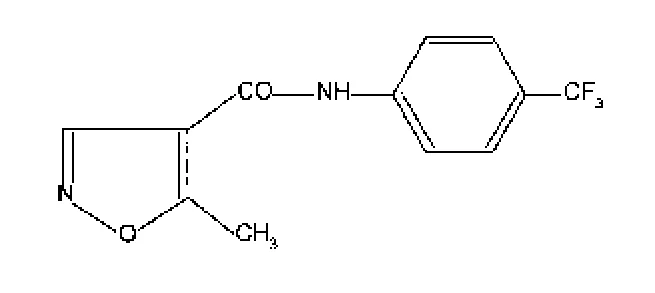
Chemical name: N-(4'trifluoromethylphenyl)-5-methylisoxazole-4-carboxamide
Molecular formula: C12H9F3N2O2
Molecular mass: 270.2 g/mol
Structural formula:
Physicochemical properties: Leflunomide is a white to almost white powder.
Leflunomide is practically insoluble in water and aqueous buffer systems. Leflunomide is freely soluble in methanol, ethanol, isopropanol, ethyl acetate, propylene carbonate, acetone and acetonitrile. pKa values: 10.8 at 23°C. Melting point between 165 and 167°C.
CLINICAL TRIALS
Comparative Bioavailability Studies
A randomized, 1-way parallel, bioequivalence study of pms-LEFLUNOMIDE 10 mg tablets was performed versus Aventis Pharma’s ARAVA® 10 mg tablets, administered as 1 x 10 mg tablet in 79 healthy adult male volunteers under fasting conditions. Bioavailability data were measured and the results are summarized in the following table:
SUMMARY TABLE OF COMPARATIVE BIOAVAILABILITY DATA
Leflunomide (1 x 10 mg) From measured data Geometric Mean Arithmetic Mean (CV %) | ||||
|---|---|---|---|---|
| Parameter | Test pms-LEFLUNOMIDE | Reference ARAVA* | % Ratio of Geometric Means | 90% Confidence Interval |
AUC0-72 (ng.h/mL) | 58009.68 58494.05 (13.25) | 59440.06 59837.35 (11.95) | 97.59 | 93.20 - 102.19 |
AUCI§ (ng.h/mL) | NAP | NAP | NAP | NAP |
CMAX (ng/mL) | 1065.3 1076.7 (14.47) | 1119.7 1128.7 (13.12) | 95.14 | 90.32 - 100.23 |
| TMAX** (h) | 3.52 (29.16) | 3.11 (54.38) | --- | --- |
| T½§ (h) | NAP | NAP | --- | --- |
* Arava tablets are manufactured in Canada by sanofi-aventis Canada Inc.
** expressed as arithmetic mean (%CV) only
§ Due to the design of the study, meaningful T1/2 and AUCI parameters could not be calculated.
A randomized, 1-way parallel, bioequivalence study of pms-LEFLUNOMIDE 20 mg tablets was performed versus Aventis Pharma’s ARAVA® 20 mg Tablets, administered as 1 x 20 mg tablet in 72 healthy male subjects under fasting conditions. Bioavailability data were measured and the results are summarized in the following table:
SUMMARY TABLE OF COMPARATIVE BIOAVAILABILITY DATA
Leflunomide ( 1 x 20 mg) From measured data Geometric Mean Arithmetic Mean (CV %) | ||||
|---|---|---|---|---|
| Parameter | Test pms-LEFLUNOMIDE | Reference ARAVA* | % Ratio of Geometric Means | 90% Confidence Interval |
AUC0-72 (ng.h/mL) | 107377.32 108487.37 (15.01) | 112073.98 113377.86 (11.63) | 95.81 | 90.69 - 102.22 |
AUCI§ (ng.h/mL) | NAP | NAP | NAP | NAP |
CMAX (ng/mL) | 1926.9 1948.6 (16.68) | 2102.5 2122.6 (10.05) | 91.65 | 86.63 - 96.95 |
| TMAX** (h) | 3.98 (40.66) | 3.37 (39.61) | --- | --- |
| T½§ (h) | NAP | NAP | --- | --- |
* Arava tablets are manufactured in Canada by sanofi-aventis Canada Inc.
** expressed as arithmetic mean (%CV) only
§ Due to the design of the study, meaningful T1/2 and AUCI parameters could not be calculated.
The efficacy and safety of leflunomide (leflunomide) in the treatment of rheumatoid arthritis was demonstrated in two placebo-controlled pivotal clinical studies. For these studies, summaries of the results are presented for the “ACR Success Rates” per treatment group, “ACR Responder Rates” over time, X-ray evaluation of disease progression, and health-related quality of life measures. An “ACR Success”, based upon the American College of Rheumatology (ACR) criteria, is a patient who completes the trial and is an ACR Responder at the trial endpoint. An “ACR Responder” is a patient with ≥ 20% improvement in both tender and swollen joint counts and in 3 of the following 5 criteria: [i] physician global assessment, [ii] patient global assessment, [iii] function/disability measure Health Assessment Questionnaire (HAQ) or Modified HAQ (MHAQ), [iv] visual analog pain scale, and [v] erythrocyte sedimentation rate (ESR) or C-reactive protein (CRP). Improvements in function/disability and health-related quality of life were measured by the HAQ, the MHAQ, the Problem Elicitation Technique (PET), and the Medical Outcomes Survey Short Form 36 (SF-36).
Study US301 enrolled 511 subjects with active rheumatoid arthritis of at least 6 months duration, using a 3:2:3 randomization to one of the following 3 groups: (1) leflunomide 20 mg/day after a loading dose of 100 mg/day for 3 days, (2) placebo, or (3) methotrexate 7.5 mg/week or escalation to 15 mg/week. Treatment duration was 52 weeks. Of the patients who completed the first 12 months of study US301, 235 continued into a second 12 months of double-blind treatment. leflunomide dose continued at 20 mg/day and the methotrexate dose could be increased to a maximum of 20 mg/week. 190 patients completed 2 years of double-blind treatment.
Study MN301/303/305 enrolled 358 subjects with active rheumatoid arthritis with at least 6 tender joints and 6 swollen joints. Patients were randomized on a 3:2:3 basis to 1 of 3 treatment arms: (1) leflunomide 20 mg/day after a loading dose of 100 mg/day for 3 days, (2) placebo, (3) sulfasalazine 2.0 g/day. Treatment duration was 24 weeks. Study MN303 was a 6-month blinded continuation of MN301 resulting in a 12-month comparison of the MN301 leflunomide and sulfasalazine treatment groups. 146 of 168 patients who completed the 12 months of treatment in study MN303 entered the double-blind, 1-year extension study MN305. Patients continued on the same daily dosage of leflunomide or sulfasalazine that they had been taking at the completion of MN303. 116 patients completed 2 years of double-blind treatment.
Study MN302/304, a clinical trial complementary to study US301, randomized 999 subjects with active RA to leflunomide 20 mg/day or methotrexate at 7.5 mg/week increasing to 15 mg/week. Treatment duration was 52 weeks. 612 of the 736 patients who completed 12 months of treatment in study MN302 entered the double-blind, 1-year extension study MN304. Patients continued on the same daily dosage of leflunomide or methotrexate that they had been taking at the completion of MN302. 497 patients completed 2 years of double-blind treatment.
ACR Responder Rates
ACR Success Rates for the placebo-controlled pivotal studies (including MN303 extension of MN301) are shown in Figure 1. leflunomide was statistically significantly superior to placebo in reducing the signs and symptoms of rheumatoid arthritis by the primary efficacy analysis, ACR Success Rate. ACR Success Rates with leflunomide treatment were consistent across the 6 and 12 month studies (41-49%).
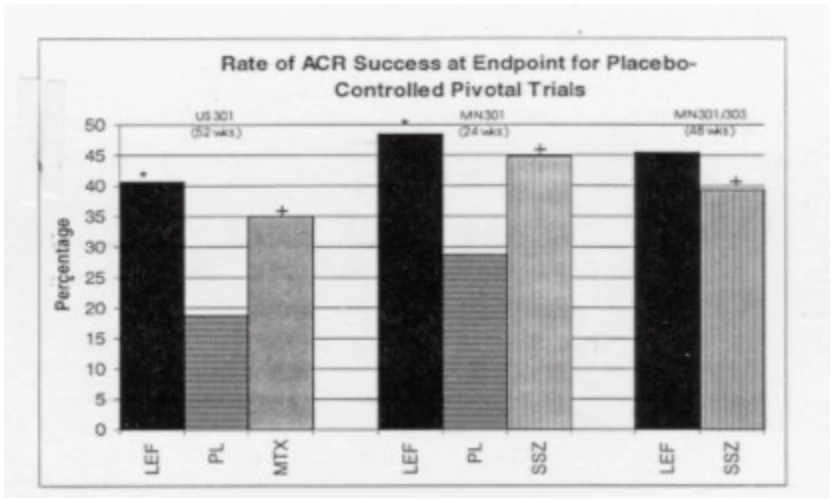
Figure 1
*p ≤0.01 leflunomide vs. placebo
+ Active comparator statistically equivalent to leflunomide
LEF= leflunomide
MTX= methotrexate
PL= placebo
SSZ= sulfasalazine
ACR Responder Rates over time in the placebo-controlled pivotal studies are shown in Figures 2 and 3. leflunomide was statistically significantly superior to placebo in all efficacy measures including ACR Responder Rate and all individual components of the ACR Responder criteria (tender joint count, swollen joint count, patient and physician global assessments, pain intensity assessment, HAQ or MHAQ, and ESR or CRP) as well as morning stiffness and rheumatoid factor levels. leflunomide treatment effect was evident by 1 month, stabilizing by 3-6 months, and continuing throughout the course of treatment. ACR Responder Rates at end of study with leflunomide treatment were consistent across the 6 and 12 month studies (52-55%).
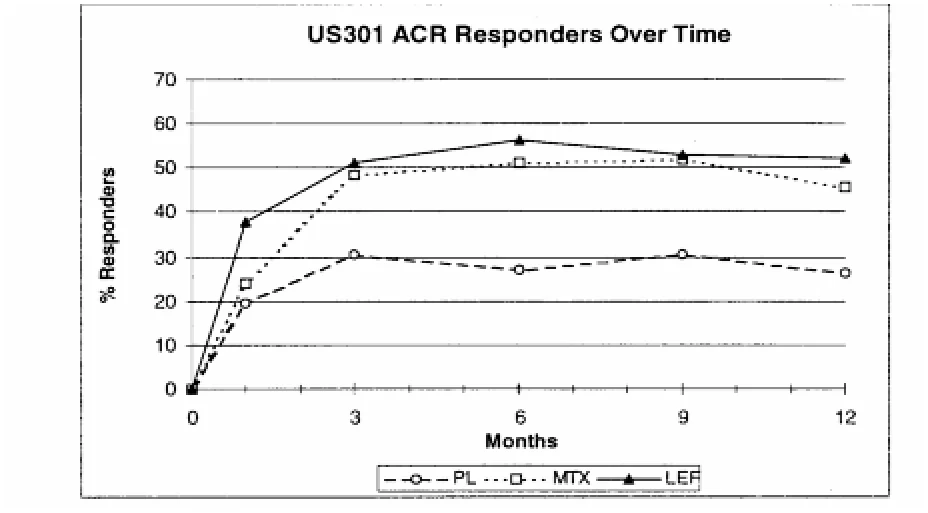
Figure 2
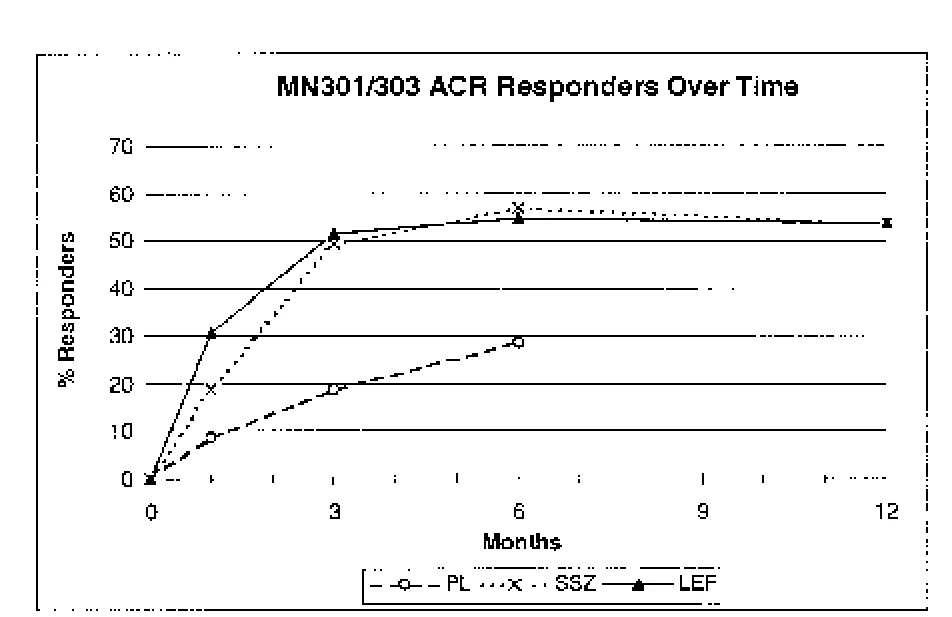
Figure 3
After completing 12 months of treatment in the original pivotal studies, patients were evaluated for an additional 12 months of double-blind treatment (total treatment period of 2 years) in studies US301, MN305, and MN304. Improvement in the ACR response demonstrated at 6 and 12 months was maintained over two years.
In addition, in a placebo-controlled dose ranging study enrolling 402 subjects with active rheumatoid arthritis, leflunomide 5 mg/day was not effective; whereas leflunomide 10 mg/day and 25 mg/day were statistically significantly superior to placebo. ACR Responder Rates at endpoint for 10 mg and 25 mg doses were consistent with those in the placebo-controlled pivotal clinical studies.
X-ray Findings
Results of the analyzed Sharp X-ray scores for the two placebo-controlled pivotal studies (including MN303 extension of MN301) are shown in Table 3. Leflunomide was statistically significantly superior to placebo in retarding disease progression as measured by x-ray analysis of both erosions and joint space narrowing. The retarding of progression of erosive disease by leflunomide treatment was further evidenced by statistically significant decreases in the percentage of patients with progression of erosions compared to placebo (US301 3% vs. 12%, and MN301 3% vs. 16%). Thirty percent of patients did not have paired X-rays and sensitivity analyses were required to support the validity of the results. There was a lack of correlation between changes in X-rays and changes in clinical assessments.
| Table 3. Analysis of X-rays by Sharp Scores | |||||||||||||||||||||||||||||||
| US301-12 mos | MN301-6 mos | MN301/303-12 mos | |||||||||||||||||||||||||||||
| Mean change in Total Score | Mean change in erosion subscore | Mean change in joint space narrowing subscore | Mean change in Total Score | Mean change in erosion subscore | Mean change in joint space narrowing subscore | Mean change in Total Score | Mean change in erosion subscore | Mean change in joint space narrowing subscore | |||||||||||||||||||||||
| LEF | 0.53±4.5*† | 0.23±2.20* | 0.31±2.78* | 0.06±12.3* | 0.17±4.50* | 0.22±8.02* | 0.90±5.3 | 0.74±2.18 | 0.16±3.98 | ||||||||||||||||||||||
| PBO | 2.16±4.0 | 0.89±1.87 | 1.27±2.69 | 5.60±9.83 | 1.97±4.02 | 3.63±7.31 | -- | -- | -- | ||||||||||||||||||||||
| MTX | 0.88±3.3 | 0.47±1.83 | 0.41±1.81 | -- | -- | -- | -- | -- | -- | ||||||||||||||||||||||
| SSZ | – | – | – | 1.44±13.0 | 0.78±3.56 | 0.66±9.73 | 1.46±13.0 | 0.92±3.76 | 0.54±9.69 | ||||||||||||||||||||||
* p ≤0.05 leflunomide vs. placebo
† p ≤0.05 leflunomide vs. active control
LEF= leflunomide, SSZ= sulfasalazine, PBO= placebo, MTX= methotrexate
As demonstrated in placebo-controlled pivotal studies, leflunomide reduces pain, articular swelling and tenderness, and ameliorates the signs and symptoms of rheumatoid arthritis. Joint damage as assessed by X-ray analysis of joint space narrowing and erosions may be retarded by leflunomide compared to placebo at the end of one year of therapy, but no consistent differences were noted between leflunomide and methotrexate or leflunomide and sulfasalazine on assessments of joint damage.
Physical function
The Health Assessment Questionnaire (HAQ) assesses disease-specific physical function and degree of disability in patients - (dressing, rising, eating, walking, hygiene, reach, grip and activities). The HAQ Disability Index (HAQ DI) uses the scores of the worst items within each of the eight categories, modified by the use of devices and aids.
The mean change from baseline in the HAQ Disability Index in the 6 and 12 month placebo and active controlled trials is shown in Figure 4 below.
Change in HAQ Disability Index
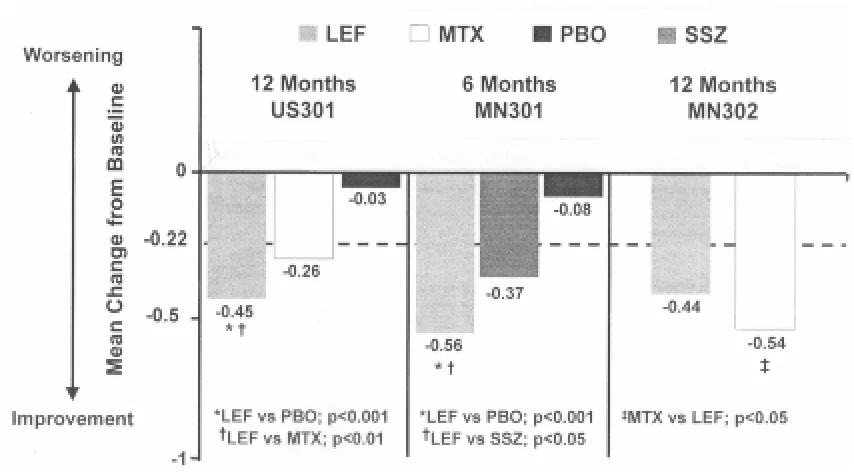
Figure 4 MX: Methotrexate, SSZ: Sulfasalazine, LEF= leflunomide, PBO= placebo
Leflunomide was statistically significantly superior to placebo in improving physical function from baseline to endpoint as assessed by the HAQ Disability Index. The magnitude of improvement in all subscales in the leflunomide treated group was clinically significant, i.e. exceeded the 0.22 unit change threshold. Superiority to placebo was demonstrated consistently across all eight HAQ sub-domains in both placebo controlled studies.
The improvement in physical function and disability demonstrated at 6 and 12 months was maintained over two years, as shown below in Figure 5. In patients continuing leflunomide for a second year of double-blind treatment in US301, MN301-305 and MN302-304, marked, clinically meaningful improvement from baseline in HAQ Disability Index continued to be documented at 24 months in all three trials with no clinically meaningful differences between month 12 and month 24.
Change in HAQ Disability Index - Year-2 cohort
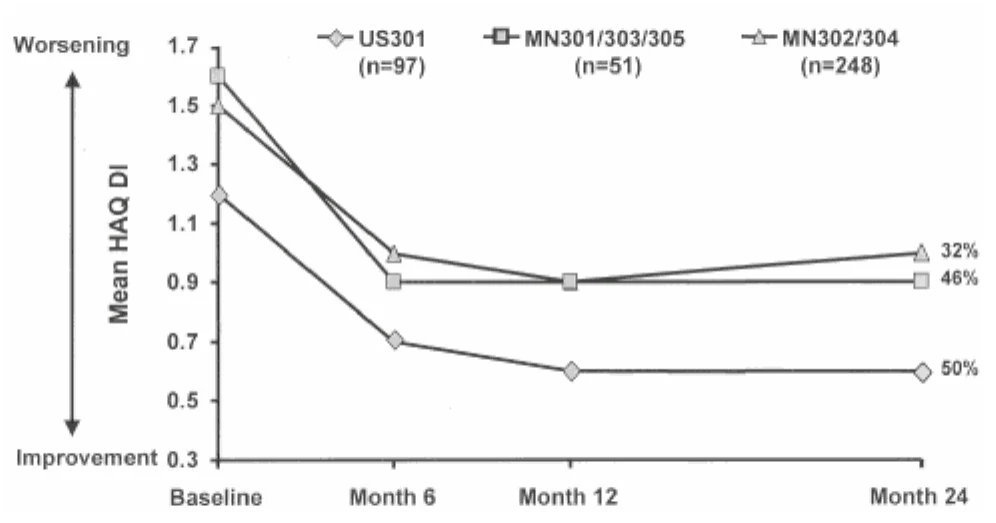
Figure 5
The Health Outcomes Survey Short Form 36 (SF-36) is a generic instrument that assesses physical function as well as social and emotional function. In US301, at 12 months, leflunomide provided statistically significant improvements compared to placebo in 5 of 8 SF-36 scales (physical functioning, pain, general health perception, vitality, and social functioning), the physical component score, and the work productivity score based on work limitations questionnaire. The improvement in physical and emotional functions, as measured by the SF-36, was maintained from 12 to 24 months for subjects treated with leflunomide as shown in Figure 6.
Change in SF-36, Year-2 Cohort
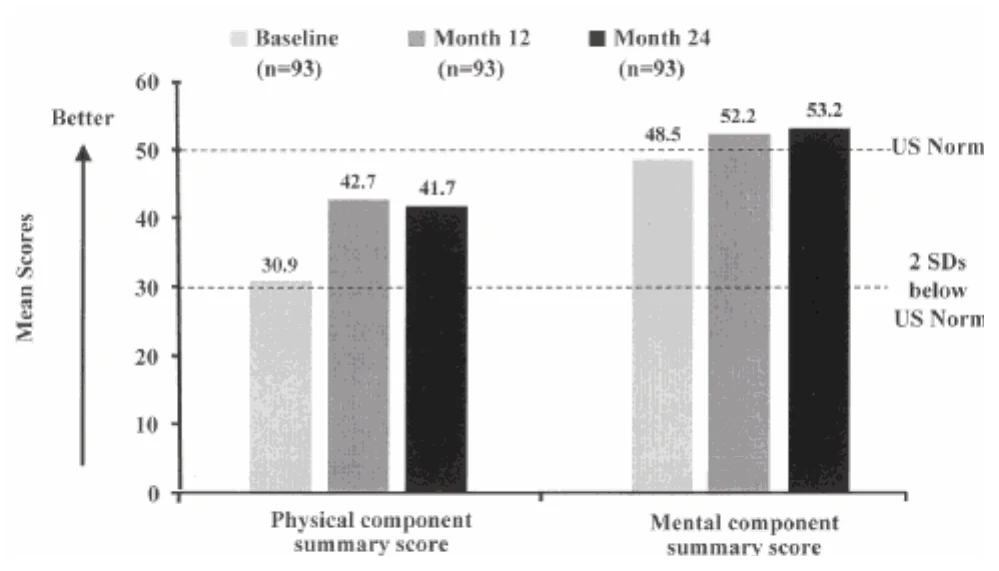
Figure 6
DETAILED PHARMACOLOGY
Animal Pharmacology
Autoimmunity Models
In rats, leflunomide dose dependently prevented the symptoms of induced arthritis with a median effective dose (ED50) of 1 to 4.5 mg/kg/day. Leflunomide suppressed radiographically detectable changes in bone structure and periarticular tissues when treatment was started within 12 days of disease induction, and the benefits persisted for as long as 79 days. Mice with such induced disease, however, required about 3 times as much drug as rats to obtain the same efficacy. In antigen-induced monoarticular arthritis in rats, leflunomide (10 mg/kg/day, po) administered during the effector phase produced significant inhibition of the DTH (delayed-type hypersensitivity) inflammation.
Leflunomide reduced the occurrence of chronic secondary lesions in adjuvant-induced arthritis caused by immunopathological mechanisms and was thus comparable to immunosuppressant drugs. In rats with T cell-mediated, allergic encephalomyelitis, a condition with characteristics similar to those of multiple sclerosis, leflunomide and A771726 were effective at dosages of 10 mg/kg/day, po, administered for 17 days. In rats with tubulointerstitial nephritis, a condition with characteristics of autoimmune kidney disorder, leflunomide was effective at dosages of 5 to 10 mg/kg/day, po, administered for 13 days.
In several studies, leflunomide was effective in preventing as well as treating the autoimmune condition, reducing antibody formation and improving survival rates, and the effects continued long after therapy had ceased. In rats administered leflunomide (10 mg/kg/day, po) as collagen- induced arthritis was developing, leflunomide produced significant inhibition of arthritic paw edema, paw lesions, acute phase response, anti-collagen antibodies and collagen dermal Arthus and DTH-like inflammation.
Beginning 17 days after the injection of parental lymphoid cells decreased proteinuria, administration of leflunomide (10-30 mg/kg/day, po) lowered immune complex deposition, and lowered the index of GvH (graft versus host) disease evaluated 10 weeks after disease induction. In addition, the response of splenic lymphocytes to mitogen stimulation, which is decreased in diseased animals, was normalized by leflunomide treatment.
Immunomodulatory Models
Studies of immunomodulation included studies of cell-mediated cytotoxicity (a T cell response to antigen), skin transplantation, and Type 1 allergy. Cell-mediated cytotoxicity was inhibited by leflunomide. In mice, leflunomide (50 mg/kg, po or ip) prevented the generation and proliferation of antigen-induced cytotoxic T lymphocytes, although A771726 did not interfere directly in the natural killer cytotoxicity of human peripheral blood mononuclear cells (PBMC) against K-562 target cells. In mice, leflunomide (12.5 mg/kg/day, po; 25 to 100 mg/kg/day, ip) and A771726 (10-20 mg/kg/day, po; 10 mg/kg/day, ip) inhibited the T cell-dependent and T cell- independent B cell responses. A771726 inhibited proliferation of B cells and the secretion of IgM, possibly by suppressing the expansion of antibody secreting cells or by inhibiting B cell differentiation or secretion. Leflunomide modified the immune system by depressing lymphocyte activity, especially in B cells. Therefore, these agents have immunosuppressive activity in both humoral and cell-mediated responses.
Mechanisms Underlying Anti-Autoimmune and Immunomodulatory Effects
Leflunomide was antiproliferative in in vitro experiments using mouse, rat, monkey and human lymphocytes either unstimulated or stimulated with a variety of B and T cell mitogens. Antiproliferation was also seen in transformed but unstimulated murine and human cell lines and in the murine mixed lymphocyte reaction of allogeneic spleen cells. The 50% inhibitory concentration (IC50) values were < 1.0 mM in rat cells, although cells from mice and humans were less sensitive, with IC50 values up to 10.0 mM.
In several species, A771726 dose dependently inhibited proliferation of splenocytes, thymocytes, lymphocytes, and peripheral blood mononuclear cells (PBMC) stimulated by various mitogens and interleukins. A771726 inhibited the expression of the interleukin-2 (IL-2) receptor and the nuclear protein antigens Ki-67 and PCNA in human PBMC. Both of these nuclear proteins are associated with progression into the cell cycle.
In rodent spleen cells, human PBMC, and several cell lines, A771726 blocked lymphocyte activation at a point downstream of initial signalling events. A771726 had similar kinetics on inhibition of proliferation of cells as the immunosuppressant drugs brequinar and rapamycin.
However, the mechanism of inhibiting cell cycle progression did not include general protein synthesis.
An important finding related to the effects on the cell cycle was that A771726 is an inhibitor of de novo pyrimidine biosynthesis. A771726 inhibits the mitochondrial enzyme dihydroorotate dehydrogenase (DHODH). This enzyme catalyses the conversion of dihydroorotate (DHO) to orotate, the fourth step in de novo biosynthesis of the pyrimidine nucleotides uridine and cytidine. Pyrimidine nucleotides are essential for normal immune cell functions. That inhibition of pyrimidine synthesis underlies the antiproliferative effects of A771726 is evidenced by the following findings in murine systems:
- A771726 failed to block mitogen-induced cell proliferation in the presence but not the absence of uridine.
- Inhibition of the DTH response showed a qualitative relationship with binding affinities of several A771726 analogues and with inhibition of DHODH activity.
- Uridine counteracts inhibition of the graft-versus host reaction.
A771726 IC50 values for the recombinant human and rat DHODH enzymes were 1 nM and 19 nM, respectively. Leflunomide was a relatively weak inhibitor of the recombinant human and rat eymes: IC50 = 98 nM and 6.3 nM, respectively.
Induction of cell-cycle arrest at the G1/S boundary in T cells treated in vitro with A771726 is mediated through DHODH inhibition and subsequent pyrimidine depletion, activating the p53 and p21WAF-1 pathways.
The rank order of IC50 values for inhibition of DHODH for the rat, mouse, and human enzymes (16 + 2 nM, 81 + 12 nM, and 657 + 46 nM) parallels the rank order of IC50 values for inhibition of cell proliferation (0.14 + 0.08 μM, 16 + 11 μM, and 46 + 6 μM).
Studies of Inflammation
Leflunomide (1-25 mg/kg) had an anti-inflammatory activity similar to NSAIDs in several animal models of inflammation, including ultraviolet (UV) -induced erythema in guinea pigs, carrageenan-induced paw edema, and granuloma formation in response to implantation of cotton pellets in rats. The effectiveness depended on the dose and time of application. Leflunomide was also effective in rats adrenalectomized 3 days previously, indicating that it did not act by stimulating release of endogenous corticosteroids. Various studies indicated that A771726 reduced arachidonic acid-induced ear edema in mice. Topical application of leflunomide was not effective.
The effects of leflunomide and A771726 on platelet aggregation were weak and variable. The enzymes of arachidonic acid metabolism, phosphorylase A2, 5-lipoxygenase and LTB4- hydrolase, thus are not targets for A771726.
Adherence of leucocytes to endothelium, basement membranes and other surfaces is seen in inflammatory responses. A771726 inhibited adhesion in studies including f-Met-Leu-Phe (FMLP) -induced leucocyte adhesion to rat mesenteric venule endothelium in vivo, aggregation of PBMC and spleen-derived mononuclear cells in experimental autoimmune diabetes in mice, and spontaneous and phorbol-ester homotypic adhesion of PBMC and mononuclear cells from synovial fluid of rheumatoid arthritis patients.
Safety Pharmacology
Leflunomide administered intraduodenally (1-100 mg/kg) to dogs did not affect cardiovascular parameters. Although leflunomide bears some resemblance to anilines and anilides, which cause methemoglobinemia, at concentrations of 37 - 370 mM leflunomide did not alter methemoglobin production by human whole blood (in vitro).
The effect of leflunomide on the gastrointestinal tract was studied in rats. Acute administration of leflunomide to fasted rats produced an ulcerative median dose (UD50) of approximately 33 mg/kg. Under the same conditions the UD50 for naproxen was 19 mg/kg and for phenylbutazone was 53 mg/kg. In fed rats that were dosed subacutely with leflunomide for 4 days a UD50 of approximately 70 mg/kg was observed.
Oral administration of 20 mg/kg of leflunomide to male Cebus monkeys caused a marked increase in uric acid excretion but did not change the excretion of urine and electrolytes compared to vehicle-treated monkeys.
In a series of experiments in mice and rats, leflunomide (10-100 mg/kg, po) had either no or only slight effects on general behaviour, the central nervous system, and the autonomic nervous system.
The effect of leflunomide on respiratory parameters in pentobarbital anaesthetized dogs administered intraduodenal doses of 1, 10, and 100 mg/kg was evaluated. The bronchospasmolytic effects of leflunomide (4-15 mg/kg) were specific against bradykinin but not against acetylcholine, histamine or serotonin in anaesthetized guinea pigs.
Leflunomide administered orally at 10, 20 and 40 mg/kg produced no antagonistic effect on reserpine or tetrabenazine-induced ptosis.
The inhibition of ex vivo platelet aggregation induced by collagen was evaluated in rabbits following oral doses of 5, 10, 15, 20, and 25 mg/kg of leflunomide. These doses produced a slight to moderate inhibition of platelet aggregation.
Drug Interactions
Rats administered leflunomide (0.1 - 3.0 mg/kg/day, po) with indomethacin (4.25 mg/kg/day, po) administered twice a day for 4 days did not show significantly increased gastrointestinal ulcers or erosions relative to rats receiving indomethacin alone.
In a study of saluresis and diuresis of conventional diuretic drugs in rats, leflunomide was administered at doses of 5, 10, and 20 mg/kg, po, alone and with hydrochlorothiazide (HCT) at 50 mg/kg and furosemide at 25 and 50 mg/kg. Phenylbutazone was used as a reference drug employing doses of 20, 50, and 100 mg/kg.
In rats saline-loaded orally, leflunomide had a slight diuretic effect but no substantial effects on the diuresis induced by HCT or furosemide. Phenylbutazone significantly reduced the diuretic effects of HCT and furosemide. Leflunomide produced a slight reduction in the excretion of Na+ and Cl-, but not K+, but had no additional affect on the activity of HCT and furosemide. In rats saline-loaded intraperitoneally, leflunomide did not significantly induce diuretic effects or affect the diuretic activity produced by HCT or furosemide. In rats with no saline loading, leflunomide produced no diuretic effect alone, and tended to decrease the effect of HCT and slightly decreased the effect of furosemide. Leflunomide did not affect ion excretion alone or in combination with HCT but did increase ion excretion induced by furosemide. Phenylbutazone increased the diuretic activity of both HCT and furosemide.
TOXICOLOGY
Acute Toxicity
Table 4 - List of Acute Toxicity Studies for Leflunomide and its Metabolites
| Test Compound | Species | Dose (mg/kg body weight) Route | LD50 (mg/kg body weight) - Observations |
|---|---|---|---|
| Leflunomide | Mouse | 200, 500 - p.o. | between 200 and 500 Mortality: At 500 mg/kg death occurred within 24 hrs. Symptoms: Reduced activity, lacrimation, trembling. Pathology: Lightly coloured kidneys in one animal that dies. |
| 200, 400 - i.p. | |||
| Rat | 100, 250 - p.o. | between 100 and 250 Mortality: 1/4 (100 mg/kg), 3/4 (250 mg/kg), deaths occurred between 4-10 days. Symptoms: Panting, reduced activity (100 mg/kg); stilted gait, reduced activity (250 mg/kg). Pathology: Stomach and chest filled with fluid, firm livers with uneven surfaces in rats that dies, no changes in rats surviving 3 weeks. | |
| 200, 400 - i.p. | between 200 and 400 Mortality: 1/4 (200 mg/kg), 4/4 (400 mg/kg). The intraperitoneal LD50 was between 200 and 400 mg/kg. Death occurred between 2-19 days after administration. Symptoms: Reduced motility, bristling fur, crawling, squatting (400 mg/kg). Pathology: Discoloured livers, reddish small intestinal mucosa, remnants of test material in abdomen in rats that died. No changes in rats that survived to 3 weeks. | ||
| Test Compound | Species | Dose (mg/kg body weight) Route | LD50 (mg/kg body weight) - Observations |
|---|---|---|---|
| Metabolites | |||
| A77 1726 | Mouse | 100, 200 - p.o. | between 100 and 200 Mortality: At 200 mg/kg death occurred between 6 and 8 days post doses. Symptoms: 200 mg/kg: reduced motility, bristling fur, transient trembling, crawling, pron position, red-brown discoloured feces, reduced body weight. Pathology: No gross pathological changes in surviving animals. Dark red-brown or red discolouration of the bowel contents in the animals which died. |
| 100, 160 - i.p. | between 100 and 160 Mortality: One death at 100 mg/kg, at 160 mg/kg death occurred within 3 days post dose. Symptoms: 100 mg/kg: reduced motility, trembling gait, watery eyes, bristling fur, panting, transient trembling, prone position, red-brown feces. 160 mg/kg: crawling, pronounced flank respiration, diarrhea, transient tremor. Pathology: No gross pathologic changes | ||
| Rat | 100, 200, 500 - p.o. | between 100 and 200 Mortality: At 200 and 500 mg/kg death occurred between 3 and 5 days post dose. Symptoms: 200 and 500 mg/kg reduced motility, diarrhea. Pathology: Reddish gastric and intestinal mucosa. No changes in rats that survived to 3 weeks. | |
| 63, 100 - i.p. | approximately 100 Mortality: At 100 mg/kg death occurred between 2 and 9 days post dosing Symptoms: Diarrhea, ruffled fur, trembling or ataxic gait, reduced motility, panting and edema of the iris. Pathology: Surviving animals at 100 mg/kg: partly swollen liver lobes, milky coating on liver surface, pale pinhead-sized deposits on liver, No changes in rats that died or received 63 mg/kg. | ||
| Test Compound | Species | Dose (mg/kg body weight) Route | LD50 (mg/kg body weight) - Observations |
|---|---|---|---|
| Trifluoromethylani line (TFMA) | Mouse | 400, 1000 - p.o. | between 400 and 1000 Mortality: Occurred within 24 hours in 1/4 mice at 400 mg/kg and 1/1 at 1000 mg/kg. Symptoms: Reduced activity, crawling, prone position, increased or irregular respiration, cyanosis and deep necrosis. In the two animals that died, necropsy revealed light-brown or grey lungs. Pathology: No gross pathologic changes were found in surviving animals. |
Long-Term Toxicity
Table 5 - List of Long-Term Toxicity Studies for Leflunomide and Metabolites
| Test Compound | Species | Route | Duration | Dose levels (mg/kg body weight) | Key Observations |
|---|---|---|---|---|---|
| Leflunomide | Mouse | p.o. | 14 days | 0, 15, 30, 60, 100 | At 60 and 100 mg/kg mortality occurred in 1/16 and 11/16. Anemia and lower platelet counts and lymphoid atrophy occurred at 30, 60 and 100 mg/kg/day. Also observed in mice given 60 or 100 mg/kg/day were gastro/esophageal ulceration, degeneration and/or atrophy or reproductive organs, and bone marrow hyperplasia or hypocellularity. |
| p.o. | 14 days | 30 | Behaviour and general health remained unaffected. TFMA levels ranged from 200 - 350 ng/mL at 2 hours and 70-170 ng/mL at 24 hours. | ||
| p.o. | 3 months | 0, 3, 10, 30 | All mice survived to their scheduled necropsy, except 1 male given 3 mg/kg/day and 1 female given 10 mg/kg/day. Males given 10 or 30 mg/kg/day and females given 30 mg/kg/day had higher spleen weights and spleen-to-body ratios. Mice given 30 mg/kg/day had higher liver weights and ratios. Females given 30 mg/kg/day had lower thymus gland weights and ratios. Increased splenic extramedullary hematopoiesis and hepatocellular centrilobular hypertrophy were present in mice administered 30 mg/kg/day. Mice given 30 mg/kg/day had increased incidence of thymic gland lymphoid atrophy. | ||
| Rat | p.o. | 14 days | 0, 10, 16, 25 | Mortality occurred in 2 rats given 25 mg/kg/day with all other rats surviving to scheduled necropsy. Rats given 25 mg/kg/day gained less weight than other groups. Thymus weights were lower in rats given 25 mg/kg/day. Gastric mucosal lesions were present in 1/10 rats at 16/mg/kg and in most rats at 25 mg/kg/day. |
| Test Compound | Species | Route | Duration | Dose levels (mg/kg body weight) | Key Observations | |||||
|---|---|---|---|---|---|---|---|---|---|---|
| p.o. | 3 months | 0, 5, 10, 20 | Mortality occurred in 2/30, 5/30 and 22/30 rats dosed at 3, 10 or 20 mg/kg/day respectively. Males given 10 mg/kg and males and females given 20 mg/kg gained less weight than controls. Food intake was decreased at 20 mg/kg. Hematology changes at 20 mg/kg included decreased erythrocyte count, hemoglobin, hematocrit and platelet counts beginning after 4 weeks of dosing. Leucocyte counts were lower and neutrophil counts were higher in rats given 20 mg/kg. AST levels were elevated in rats given 20 mg/kg. Increased liver and kidney weights were present at 20 mg/kg and increased spleen weights in females given 10 or 20 mg/kg. Histopathologic changes in rats that died during the treatment period included myocardial and liver necrosis, pulmonary edema, gastrointestinal extravasations of blood and changes in the gastrointestinal mucosa. | |||||||
| p.o. | 3 months | 0, 2, 4 ,8 | Similar toxicity profile to previous study. | |||||||
| p.o. | 6 months | 0, 0, 5, 1, 2, 4 | 12 animals died in the 4.0 mg/kg dose group and one animal died in the 0.5 mg/kg group. AST values were elevated in the male rats from the 4.0 mg/kg dose group at the end of dosing and at the end of the recovery period. The following findings were obtained uniformly in the ten animals which died and the two which were killed moribund in both higher dose groups; a) marked depletion of hematopoietic cells in the bone marrow, with preserved erythropoiesis and mostly missing thrombopoiesis in the spleen, b) hemorrhages in at least one spinal cord segment, frequently in the lymph nodes examined and in individual animals in the meninges, the gastrointestinal tract and the wall of urinary bladder, c) marked atrophy of the thymus. | |||||||
| Dog | p.o. | 5 days | 8, 16 | Hyperemia of the gastrointestinal mucosa was found at the autopsy of the dogs receiving 16 mg/kg. | ||||||
| p.o. | 3 months | 0, 4, 8, 16 | Mortality occurred in 2/6 dogs given 16 mg/kg/day. Symptoms included transient pale mucous membranes at all doses, decreased food intake and body weight (emaciated) and retinal vascular hypoperfusion at 16 mg/kg. Reduced RBCs were noted in one female at the 4 mg/kg dose. Anemia with Heinz bodies was noted at 8 and 16 mg/kg. Increased BUN AST, bilirubin was noted in males at 16 mg/kg. High liver weights, erythroid hypoplasia at 8 and 16 mg/kg. Gastric and/or duodenal ulcers, hepatic necrosis, pale prostate and testes at 16 mg/kg. | |||||||
| Test Compound | Species | Route | Duration | Dose levels (mg/kg body weight) | Key Observations |
|---|---|---|---|---|---|
| p.o. | 6 months | 0, 0.8, 2.5, 8 | Weight decrease (8 mg/kg/day) was noted in the dogs that died. Focal corneal opacities in all groups including controls, more pronounced at 8 mg/kg/day, corneal ulcers were present in some dogs. Extreme extramedullary hemopoiesis and hemosiderosis in spleen, liver, and bone marrow (2.5 - 8 mg/kg/day), endogenous lipopigment in renal tubular epithelium of all dose groups including control. | ||
| p.o. | 12 months | 0, 0.25 ,0.8, 2.5 | Symptoms in two animals receiving 2.5 mg/kg/day included reddish and dry skin and alopecia. Pathology and histopathology changes present only in animals necropsied before study end included severe cachexia, exsiccosis and paleness of the skeletal and intestinal musculature. Bone marrow hemopoiesis, severe involuation of the thymus and lymphocytic deplation of the spleen. Skeletal muscle and diaphragm exhibited disseminated hypertrophy of fibre diameter and muscle wall of stomach in pyloric region demonstrated infiltration of mononuclear and eosinophilic granulocytic cells. Laboratory changes included decreased RBC, Hb, Hct, Heinz bodies, Howell- Jolly bodies present in erythrocyte, increased reticulocytes. | ||
| Monkey | p.o. | 14 days | 20 | A slight to moderate muscular weakness was observed from day 7 in the male. A moderate decrease in body weight was noted in both animals. A moderate decrease in erythrocyte and increase in reticulocyte was noted in both animals. | |
| p.o. | 30 days | 0, 2, 6.3, 20 | Toxicity profile similar to previous study. | ||
| Metabolite | |||||
| A771726 | Rat | i.v. | 30 days | 0, 3.2, 8, 20 | Mortality in 6/30 rats at 3.2 mg/kg, 12/30 at 8 mg/kg and 27/30 at 20 mg/kg. The no toxic effect level was below 3.2 mg/kg/day. Symptoms included dose- dependent decreased weight gain, decreased food intake, hypoactivity, bloody feces, prone position, poor general condition, poor nutritional state, bristling coat, stilted gait, and pale skin at 20 mg/kg. Dose-dependent laboratory changes included decreased RBC count, Hb, Hct, increase in mean corpuscle volume, normoblasts, polychromasia, Heinz bodies, Howell Jolly bodies, reticulocytosis, decreased platelets, decreased leucocyte counts. Also noted were increased AST, ALT, very low thrombocyte and leucocyte counts, increased coagulation times, increased granulocyte counts (8 mg/kg), increased urea in females at 8 and 20 mg/kg. Intercurrent deaths were generally caused by basterial infection (Tyzzer`s disease). |
| Test Compound | Species | Route | Duration | Dose levels (mg/kg body weight) | Key Observations |
|---|---|---|---|---|---|
| i.v. | 30 days | 0, 0.25, 1 | Mortality occurred in 2/30 at 1 mg/kg dose. The no effect level was 0.25 mg/kg/day. Symptoms in 2 animals that died included hypoactivity, dragging hind limbs, prone position, and poor general health. Pathology findings only in the 2 animals which died included severe depression of hematopoiesis linked with lethal cerebellar hemorrhage in one and in the other, lethal Tyzzer`s disease with discoloration of liver, bone marrow and urinary bladder, seminal vesicle and prostate decreased in size. | ||
| Dog | i.v. | 30 days | 0, 0.8, 2.5, 8 | No deaths occurred. Symptoms in some animals included diarrhea, pale mucosa of the mouth, slightly decreased body weight at 8 mg/kg. Toxic hemolytic anemia was observed at 8 mg/kg. In 1 male and 2 females (8 mg/kg) increased erythropoietic proliferation in the bone marrow, pale intestinal muscles, light brown liver, one male had reduced bone marrow fatty tissue. | |
| TFMA | Mouse | p.o. | 3 months | 0, 10, 32, 100 | Mortality occurred in 7/40 at 100 mg/kg/day. Maximum tolerated dose was below 10 mg/kg/day. Symptoms included cyanosis, panting, gasping, poor general health, drawn-in-flanks, reddish urine, prone position, ruffled fur, decreased activity, palpebral closure, ataxic gait, squatting posture (100 mg/kg/day). Decreased RBC count, Hb, Hct, incidence of Heinz bodies, variation of Hb of erythrocytes, increase in total bilirubin, reticulocytosis, decreased platelets, increased leucocyte counts dose dependently. Increased MCV and MCH at 32 or 200 mg/kg/day. Pathology changes noted included discoloration and change in organ size in spleen, liver, lung, and lymph node. Spleen size increased dose dependently. Histopathology changes included dose-dependent siderosis, extramedullary hematopoiesis in spleen. Kupffer cells in liver and tubular epithelia of kidneys. |
Reproduction & Teratology
Leflunomide was teratogenic and caused embryo/fetal death while not causing systemic toxicity or affecting fertility in the parental generation. This was demonstrated in reproductive and developmental toxicity studies with leflunomide in the rat and rabbit.
Conclusions from fertility study
- in the rat, there were no effects on fertility ≤ 4 mg/kg/day
- there were no pre-and postnatal effects at 0.4 mg/kg/day
- leflunomide was teratogenic at ≥ 1.25 mg/kg/day
Conclusions from embryo-fetal/teratogenicity studies
- in the rat, there were no maternal or developmental effects at 1 mg/kg/day
- in the rabbit, there were no maternal effects at ≤ 10 mg/kg/day and no developmental effects at 1 mg/kg/day
- leflunomide was teratogenic at 15 mg/kg/day in the rat and 10 mg/kg/day in the rabbit
Conclusions from peri/postnatal studies
- in the rat, there were no maternal effects ≤ 1.25 mg/kg/day
- there were developmental effects at 0.4 mg/kg/day
- leflunomide was teratogenic at 4 mg/kg/day
Conclusions from in vitro study
- leflunomide and its major metabolite were teratogenic
- A771726 (metabolite) was twice as active as HWA 486 (parent compound)
Conclusions from Toxicokinetic Studies
- in the rabbit, there was no clear relation of Tmax at the dose level or number of administrations
- only at the 10 mg/kg (as opposed to 1 mg/kg) dose level was any effect of repeat dosing observed.
Table 6 – Reproduction and Teratology Studies
| Segment | Species/Strain | Initial Group | Mode of Admin. | Doses mg/kg/day | ||||||
| I | Wistar Rat | 32 M, 32 F (each group) | PO |
0, 0.4, 1.25 or 4 mg/kg for last 70 days (M) and last 14 days (F) before mating. Dosing continued in females during pregnancy and lactation period. | ||||||
| II | Wistar Rat | 3-10 F pregnant (each group) | PO |
5, 10, 15, 20 or 30 mg/kg from the 7th - 16th day of pregnancy | ||||||
| Wistar Rat | 22 F pregnant | PO |
1 or 15 mg/kg from the 7th - 19th day of pregnancy | |||||||
| Himalayan Rabbit | 2-11 F pregnant | PO |
5, 10, 15, 16, 20, 25 and 30 mg/kg from the 6th - 18th day of pregnancy | |||||||
| Himalayan Rabbit | 20 F pregnant | PO |
0, 1 or 10 mg/kg from the 6th - 18th day of pregnancy | |||||||
| Himalayan Rabbit* | 15 F pregnant (3 groups of 5 each) | PO |
0.1 and 10 mg/kg/day from Day 6 to Day 17 of pregnancy | |||||||
| in vitro | Sprague Dawley (strain not reported) Cells from 13-day old rat embryos | from 10 mated female rats | IV |
0.25, 0.5, 1, 2, 4, 8, 16, 31, 62, 125 and 250 mcg/mL.
0.25, 0.5, 1, 2, 4, 8, 16, 31, 62, 125 and 250 mcg/mL. | ||||||
| III | Wistar Rat | 20 F | PO |
0, 0.4, 1.25 or 4 mg/kg from Day 7 after mating to Day 21 after parturition | ||||||
* Toxicokinetic study in Himalayan Rabbit identical to the Segment II rabbit study performed to generate toxicokinetic data in pregnant rabbits.
Carcinogenicity
Table 7 – Carcinogenicity Studies in Mouse and Rat
Species/Strain No., Sex per Group | Doses (mg/kg/day) Route of Admin. Duration of Treatment | Observations |
Mouse/ CD-1 Group 1 :50 M, 50 F Group 2:50+16M, 50+16F* Group 3:50+16M, 50+16 F* Group 4 :50+16M, 50+16F* Group 5 :70+16M, 70+16F | Group 1: 0 mg/kg (control) Group 2: 0 mg/kg (control) Group 3: 1.5 mg/kg/day Group 4: 5.0 mg/kg/day Group 5: 15.0 mg/kg/day PO stomach tube 2-year carcinogenicity study |
|
Species/Strain No., Sex per Group | Doses (mg/kg/day) Route of Admin. Duration of Treatment | Observations |
Rat / Wistar Group 1 : 50 M, 50 F Group 2: 50M, 50F Group 3: 60M, 60 F Group 4 : 60M, 60F Group 5 : 80M, 80F Group 6: 80M, 80F | Group 1: 0 mg/kg (control) Group 2: 0 mg/kg (control) Group 3: 0.50 mg/kg/day Group 4: 1.25 mg/kg/day Group 5: 3.00 mg/kg/day Group 6: 6.00 mg/kg/day PO stomach tube 2-year carcinogenicity study |
|
* 16 male and 16 female animals from groups 2-5 served as satellite animals for toxicokinetic examinations.
Mutagenicity
Testing of leflunomide, with and without metabolic activation, has yielded consistently negative results in various mutagenicity assays, including point mutation assays with Salmonella typhimurium and E. coli (Ames test), in vitro HGPRT test with V79 Chinese hamster cells, the unscheduled DNA synthesis assay using rat primary hepatocyte cultures, the in vivo micronucleus test in NMRI mice, and the in vivo chromosomal aberration assay in bone marrow of Chinese hamsters.
In contrast, TFMA (the minor metabolite of leflunomide) was found in the literature to be mutagenic in the Ames test but inactive in the unscheduled DNA synthesis assay in rat hepatocytes. Additional mutagenicity testing revealed mutagenic potential in vitro in the Ames test, HGPRT test, and in vitro chromosomal aberration test in V79 Chinese hamster cells. No mutagenic/genotoxic effects were observed in 2 in vivo studies (micronucleus test after ip dosing and chromosomal aberration test in Chinese hamster bone marrow).
Toxicokinetics
Leflunomide was well absorbed and quickly metabolised to the active metabolite A771726 in mouse, rat, dog and man. The conversion to A771726 was virtually completed on first-pass (gut-wall and liver) and parent leflunomide concentrations were only occasionally above the detection limit in plasma. It was not possible to calculate AUC and hence compare exposure to leflunomide across the species.
The metabolite A771726 had a low volume of distribution (10.9 litres in man, 3.5 litres in dog), due to extensive plasma protein binding (> 98% in animals and >99% in man). The elimination half-lives of A771726 (or total radioactivity which reflected almost exclusively the metabolite A771726), in plasma were 10.6 hours in mouse, 9 hours in rat, approximately 15-20 hours in dog and 185 hours in man. There was no evidence for accumulation in rat or dog and in man steady- state plasma concentrations were close to those predicted from single dose data. The following table shows a comparison of the AUC and Cmax data for A771726 in animals and man upon repeated daily dosing. In rat and dog these data were obtained during toxicity studies whilst the human data was obtained during Phase II studies in rheumatoid patients at dose levels of 5, 10 and 25 mg. There were no significant differences in these parameters between healthy volunteers and rheumatoid patients.
Table 8 – AUC and Cmax Data Comparison for A771726
| Species | Dose (mg/day) | AUC(mcg h/mL) | Cmax (mcg/mL) C24h(ss) for man | |||||||
|---|---|---|---|---|---|---|---|---|---|---|
| Man | 5 | 211 | 8.78 | |||||||
| 10 | 432 | 17.98 | ||||||||
| 25 | 1512 | 63 | ||||||||
| Mouse | 1.5 | 156 | 7.5 | |||||||
| 5 | 797 | 39.2 | ||||||||
| 15 | 2380 | 112 | ||||||||
| Rat | 0.5 | 4.55 | 1.58 | |||||||
| 1.25 | 12.8 | 4 | ||||||||
| 3 | 22.1 | 7.5 | ||||||||
| 6 | 39 | 13.1 | ||||||||
| Species | Dose (mg/day) | AUC(mcg h/mL) | Cmax (mcg/mL) C24h(ss) for man | ||||
|---|---|---|---|---|---|---|---|
| Dog | 0.25 | 12.8 | 1.04 | ||||
| 0.8 | 54.2 | 4.22 | |||||
| 2.5 | 221 | 16.1 | |||||
The following table presents the IC50s for the effects of A771726 on DHO-DH activity and cell proliferation in rat, mouse and human.
Table 9
| IC50 dihydroorotate dehydrogenase (nM) | |||
| Rat | Mouse | Human | |
| A771726 | 16 ± 2 | 81 ±12 | 657 ± 46 |
| IC50 anti-proliferative activity (mcM) | |||
| A771726 | 0.14 ± 0.008 | 16 ± 11 | 46 ± 6 |
REFERENCES
Rheumatoid Arthritis – Leflunomide
- 1. Bartlett RR. An introduction to leflunomide. Immunopharmacology, SBU Rheumatology Proceedings of the Vienna Symposium, 12 October 1993. Birkhaeuser, Basel 1995: IX- XIV.
- 2. Bartlett R R. Hoffnung auf hilfe. Hoechst High Chem 13: 32-36.
- 3. Bruyn GAW, Griep E N. Eruption of vasculitis during treatment with leflunomide for rheumatoid arthritis. Br J Rheumatol 1996(suppl 1);35:226, abs 438.
- 4. Campion G, Loew-Friedrich I, Oed C, Seifert H. Comparison of different dosing regimens of leflunomide in the treatment of active rheumatoid arthritis (RA). Scand J Rheumatol 1994;98(suppl.98):abs 140.
- 5. Davis JP, Cain GA, Pitts WJ, Magolda RL, Copeland RA. The immunosuppressive metabolite of leflunomide is a potent inhibitor of human dihydroorotate dehydrogenase. Biochem 1996;35(4):1270-3.
- 6. Domljan Z, Popovic M, Mladenovic V, Rozman B, Mihajlovic D, Jajic I, et al. Efficacy and safety of leflunomide in the treatment of patients with rheumatoid arthritis (RA). Arthritis Rheum 1993;36(Suppl 9): S56, abs 108.
- 7. Fessler B. Leflunomide - Basic antirheumatic of the future? Dtsch Apoth Ztg 1996;136:3960-1.
- 8. Hermann M, Frangou C G, Kirschbaum B. Cell cycle control of the de novo pyrimidine synthesis inhibitor leflunomide through the p53 and p21 pathways. Arthritis Rheum 1997;40 Suppl:177.
- 9. Lucien J, Dias VC, LeGatt DF, Yatscoff RW. The blood distribution and single dose pharmacokinetics of the immunosuppressant leflunomide. Ther Drug Monit 1995;17:402, abs 75.
- 10. Metzler C, Reinhold-Keller E, Schmitt W, Gross WL. Maintenance of remission with leflunomide in 11 patients with Wegeners Granulomatosis (WG). Arthritis Rheum 1997;40 (Suppl 9): S165, abs. 808.
- 11. Mladenovic V, Domlijan Z, Rozman B, Jajic I, Mihajlovic D, Popovic M, et al. Phase II clinical trials with leflunomide in rheumatoid arthritis. Ann Rheum Dis 1995;54:764.
- 12.
Mladenovic V, Domljan Z, Rozman B, Jajic I, Mihajlovic D, Dordevic J, et al. Safety and effectiveness of leflunomide in the treatment of patients with active rheumatoid arthritis. Results of a randomized, placebo-controlled, phase II study. Arthritis Rheum
- 1995;38:1595-1603.
- 13. Morck H. Leflunomide, towards a new therapy for rheumatism. Pharm Zt 1988;133(20):28.
- 14. Musikic P, Logar D, Mladenovic V, Rozman B, Domljan Z, Jajic I, et al. Efficacy of leflunomide in patients with rheumatoid arthritis. Z Rheumatol 1992;51(Suppl 2):58-59, abs 223.
- 15. Parnham M J. Leflunomide: A potential new disease-modifying anti-rheumatic drug. Expert Opin Invest Drugs 1995;4:777-779.
- 16. Plosker G L, Wagstaff AJ, Emery P, Lang R. Leflunomide. Clin Immunother 1996;6:300-6.
- 17. Robertson SM, Lang LS. The efficacy of leflunomide in S-antigen-induced autoimmune uveitis. Agents Actions 1994;41:C274-5.
- 18. Roethig HJ, Collins J, Harnisch L, Rokitta C, Weber W. The effect of activated charcoal and cholestyramine on the pharmacokinetics of leflunomide. Clin Pharmacol Ther 1996;59:205.
- 19. Rozman B, Mladenovic V, Domljan Z, Jajic I, Popovic M, Mihajlovic D, et al. The effects of leflunomide in patients with rheumatoid arthritis. Arthritis Rheum 1992; 35 (Suppl 9):108,abs.A235.
- 20. Rozman B, Domljan Z, Popovic M, Mladenovic V, Mihajlovic D, Jajic I, et al. Long term administration of leflunomide to patients with rheumatoid arthritis (RA). Arthritis Rheum 1994;37 (Suppl):S339,abs. 1071.
- 21. Rozman B, Domljan Z, Popovic M, Mladenovic V, Mihajlovic D, Jajic I, et al. Weekly administration of leflunomide to patients with active rheumatoid arthritis (RA). Arthritis Rheum 1994;37 (Suppl):S339,abs. 1072
- 22. Scott DL, Strand V. Leflunomide: Novel therapeutic agents for the treatment of autoimmue diseases. New York: Marcel Dekker;1997;xiv:287-93.
- 23. Seifert H, Musikic P, Oed C, Loew-Friedrich I, Campion G. Clinical experience on leflunomide in patients with rheumatoid arthritis (RA), Symposium Leflunomide: Proceedings of the Vienna Symposium, 12 October 1993. Birkhaeuser, Basel 1995: A5
- 24. Seifert H, Loew-Friedrich I, Oed C. Leflunomide, A new immunomodulator for the treatment of chronic polyarthritis. Z Rheumatol 1994;53 (suppl 1):78,abs.PL9.
- 25.
Sharp JT, Strand V, Leung H, Hurley F, Loew-Friedrich I. Treatment with leflunomide slows radiographic progression of rheumatoid arthritis: results from three randomized
- controlled trials of leflunomide in patients with active rheumatoid arthritis. Arthritis Rheum 2000;43(3):495-505.
- 26. Silva GT Jr., Morris RE. Drug Evaluation: Leflunomide and malononitriloamides. Exp Opin Invest Drugs 1997;6:51-64.
- 27. Strand V, Cohen S, Schiff M, Weaver A, Fleischmann R, Cannon G, et al. Treatment of active rheumatoid arthritis with leflunomide compared with placebo and methotrexate. Arch Intern Med 1999;159(21):2542-50.
- 28. Strand V, Tugwell P, Bombardier C, Maetzel A, Crawford B, Dorrier C, et al. Function and health-related quality of life: results from a randomized controlled trial of leflunomide versus methotrexate or placebo in patients with active rheumatoid arthritis. Arthritis Rheum 1999;42(9):1870-8.
- 29. Tugwell P, Wells G, Strand V, Maetzel A, Bombardier C, Crawford B, et al. Clinical improvement as reflected in measures of function and health-related quality of life following treatment with leflunomide compared with methotrexate in patients with rheumatoid arthritis: sensitivity and relative efficiency to detect a treatment effect in a twelve-month, placebo-controlled trial. Arthritis Rheum 2000;43(3):506-14.
- 30. Waer M. The use of leflunomide in transplantation immunology. Transplant Immunol 1996;4:181-5.
- 31. Weber W, Harnisch L. Use of a population pharmacokinetic model to predict clinical outcome of leflunomide, a new DMARD in the treatment of rheumatoid arthritis. Arthritis Rheum 1997; 40(9 Suppl): S153, Abs: 731. 61st Nat Sci Mtg Am Coll Rheumatol 32nd Nat Sci Mtg Assoc Rheumatol Health Prof, Washington (Nov 1997).
- 32. Weinblatt M E, Kremer J M, Coblyn J S, Maier AL, Helfgott S, Morrell M, et al. Leflunomide plus methotrexate in refractory rheumatoid arthritis: Arthritis Rheum 1997; 40(9 Suppl): S193, Abs: 974. 61st Nat Sci Mtg Am Coll Rheumatol 32nd Nat Sci Mtg Assoc Rheumatol Health Prof, Washington (Nov 1997).
- 33. Williams J W, Discovery, rationale and developmental history of leflunomide. In: Lieberman R., Mukherjee A. editors. Principles of Drug Development in Transplantation and Autoimmunity. Austin: Landes; 1996. p. 311-312.
- 34. Zivkovic M, Seifert H, Campion G. Leflunomide is a safe and effective drug in the therapy of active rheumatoid arthritis (RA). Br J Rheumatol 1994;33(Suppl 1):149, abs 282.
Rheumatoid Arthritis - X-ray
- 1.
Bluhm GB, Sharp JT, Tilley BC, Alarcon GS, Cooper SM, Pillemer SR, et al. Radiographic results from the minocycline in rheumatoid arthritis (MIRA) trial, 1997. J
- Rheumatol 1997;24(7):1295-1302.
- 2. Cuchacovich M, Couret M, Peray P, Gatica H, Sany J. Precision of the Larsen and the Sharp methods of assessing the radiologic change in patients with rheumatoid arthritis. J Arthritis Rheum 1992;35:736-8.
- 3. Danfors T, Bergstrom M, Feltelius N, Ahlstrom H, Westerberg G, Langstrom B. Positron emission tomography with 11C-D-deprenyl in patients with rheumatoid arthritis. Evaluation of knee joint inflammation before and after intra-articular glucocorticoid treatment. Scand J Rheumatol 1997;26: 43-8.
- 4. Drosos AA, Tsifetaki N, Tsiakou EK, Timpanidou M, Tsampoulas C, Tatsis CK, et al. Influence of methotrexate on radiographic progression in rheumatoid arthritis: A sixty- month prospective study. Clin Exp Rheumatol 1997;15(3):263-7.
- 5. Fex E, Jonsson K, Johnson U, Eberhardt K. Development of radiographic damage during the first 5-6 yr of rheumatoid arthritis. A prospective follow-up study of a Swedish cohort. Br J Rheumatol 1996;35: 1106-15.
- 6. Forre O, Bjerkhoel F, Kjeldsen-Kragh J, Ostensen H, Astor T, Boe E, et al. Radiologic evidence of disease modification in rheumatoid arthritis patients treated with cyclosporine. Results of a 48-week multicenter study comparing low-dose cyclosporine with placebo. Arthritis Rheum 1994;37(10):1506-12.
- 7. Fries JF, Bloch D A, Sharp JT, McShane DJ, Spitz P, Bluhm GB, et al. Assessment of radiologic progression in rheumatoid arthritis- A randomized, controlled trial. Arthritis Rheum 1986;29(1):1-9.
- 8. Iannuzzi L, Dawson N, Zein N, Kushner I. Does drug therapy slow radiographic deterioration in rheumatoid arthritis? N Engl J Med 1983;309(17):1023-8.
- 9. Jeurissen M E C, Boerbooms A M, van de Putte LB, Doesburg WH, Lemmens AM. Influence of methotrexate and azathioprine on radiologic progression in rheumatoid arthritis. A randomized, double-blind study. Ann Intern Med 1991;114(12): 999-1004.
- 10. Kaarela K, Hannu K. Continuous progression of radiological destruction in seropositive rheumatoid arthritis. J Rheumatol 1997;24:1285-7.
- 11. Larsen A, Dale K, Eek M. Radiographic evaluation of rheumatoid arthritis and related conditions by standard reference films. Acta Radiologca (Diang) 1977;18:481-91.
- 12. Lassere M, Houssein D, Scott D, Edmonds J. Reference curves of radiographic damage in patients with rheumatoid arthritis: Application of quantile regression and fractional polynomials. J Rheumatol 1997;24:1288-94.
- 13.
Lopez-Mendez A, Daniel WW, Reading JC, Ward JR, Alarcon GS. Radiographic
- assessment of disease progression in rheumatoid arthritis patients enrolled in the Cooperative Systematic Studies of the Rheumatic Diseases Program randomized clinical trial of methotrexate, auranofin, or a combination of the two. Arthritis Rheum 1993;36:1364-9.
- 14. McDuffie FC. Meta analysis of the effect of methotrexate on radiological progression in rheumatoid arthritis. J Rheumtol 1993;20:1623.
- 15. Paimela L, Laasonen L, Kankaanpaa E, Leirisalo-Repo M. Progression of cervical spine changes in patients with early rheumatoid arthritis. J Rheumatol 1997;24:1280-4.
- 16. Palmer W E, Rosenthal D I, Schoenberg O E. Quantification of inflammation in the wrist with gadolinium-enhanced MR imaging and PET with 2-(F-18)-fluoro-2-deoxy-D- glucose. Radiology 1995; 196: 647-655.
- 17. Pincus T, Callahan L F, Fuchs HA, Larsen A, Kaye J. Quantitative analysis of hand radiographs in rheumatoid arthritis: Time course of radiographic changes, relation to joint examination measures and comparison of different scoring methods. J Rheumatol 1995;22:1983-9.
- 18. Polisson RP, Schoenberg OI, Fischman A, Rubin R, Simon LS, Rosenthal D, et al. Use of magnetic resonance imaging and positron emission tomography in the assessment of synovial volume and glucose metabolism in patients with rheumatoid arthritis. Arthritis Rheum 1995;38(6):819-25.
- 19. Rau R, Herborn G. A modified version of Larsen’s scoring method to assess radiologic changes in rheumatoid arthritis. J Rheumatol 1995;22:1976-82.
- 20. Rau R, Herborn G, Karger T, Werdier D. Retardation of radiologic progression in rheumatoid arthritis with methotrexate therapy, a controlled study. Arthritis Rheum 1991;10:1236-44.
- 21. Reykdal S, Steinsson K, Sigurjonsson K, Brekkan A. Methotrexate treatment of rheumatoid arthritis: Effects on radiological progression. Scand J Rheumatol 1989;18:221-6.
- 22. Roces A, Cantabrana A, Hayek M, Davila M. Reconsideration of the effects of methotrexate therapy on radiographic progression in rheumatoid arthritis: Comment on the article by Weinblatt et al. Arthritis Rheum 1994;37(7):1114.
- 23. Sany J, Kaliski S, Couret M, Cuchacovich M, Daures JP. Radiologic progression during intramuscular methotrexate treatment of rheumatoid arthritis. J Rheumatol 1990;17(12):1636-41.
- 24. Scott DL, Grindulus KA, Struthers GR, Coulton BL, Popert AJ, Bacon PA. Progression of radiological changes in rheumatoid arthritis. Ann Rheum Dis 1984;43:8-17.
- 25. Scott DL, Greenwood A, Davies J, Maddison PJ, Maddison MC, Hall ND. Radiological progression in rheumatoid arthritis: Do D- penicillamine and hydroxychloroquine have different effects? Br J Rheumatol 1990;29:126-7.
- 26. Sharp JT, Young DY, Bluhm GB, Brook A, Brower AC, Corbett M, et al. How many joints in the hands and wrists should be included in a score of radiologic abnormalities used to assess rheumatoid arthritis? Arthritis Rheum 1985;28(12):1326-35.
- 27. Sharp JT. Scoring radiographic abnormalities in rheumatoid arthritis. Radiol Clinic North Am 1996;34:233-41.
- 28. Sharp JT. Radiologic assessment as an outcome measure in rheumatoid arthritis. Arthritis Rheum 1989;32:221-9.
- 29. Verhoeven AC, Boers M. Limited bone loss due to corticosteriods; A systematic review of prospective studies in rheumatoid arthritis and other diseases. J Rheumatol 1997;24:1495-1503.
- 30. Weinblatt M E, Polisson R, Blotner S D, Sosman JL, Aliabadi P, Baker N, et al. The effects of drug therapy on radiographic progression of rheumatoid arthritis, Results of a 36-week randomized trial comparing methotrexate and auranofin. Arthritis Rheum 1993;36(5):613-9.
Rheumatoid Arthritis - General
- 1. Anderson JJ, Felson DT , Meenan RF, Williams HJ. Which traditional measures should be used in rheumatoid arthritis clinical trials? Arthritis Rheum 1989;32(9):1093-9.
- 2. Arnett FC, Edworthy SM, Bloch DA, McShane DJ, Fries JF, Cooper NS, et al The American Rheumatism Association 1987 Revised Criteria for the Classification of Rheumatoid Arthritis. Arthritis Rheum 1988;31(3):315-24.
- 3. Bombardier C, Buchbinder R, Tugwell, P. Efficacy of cyclosporin A in rheumatoid arthritis: Long-term follow-up data and the effect on quality of life. Scand J Rheumatol 1992;21:29-33.
- 4. Borstlap M, van de Laar M, Zant J, van der Korst J. Components of health: An analysis in rheumatoid arthritis using quality of life questionnaires and clinical and laboratory variables. Ann Rheum Dis 1993;52:650-4.
- 5. Buchbinder R, Bombardier C, Yeung M, Tugwell P. Which outcome measures should be used in rheumatoid arthritis clinical trials? Arthritis Rheum 1995;38:1568-80.
- 6. Carlson RP. Newer immunosuppressive drugs and other agents for the treatment of rheumatoid arthritis. Exp Opin Invest Drugs 1995;4:853-9.
- 7. Choy EHS, Scott DL. Drug treatment of rheumatic diseases in the 1990s. Achievements and future developments. Drugs 1997;53:337-48.
- 8. Decker JL. Toxicity of immunosuppressive drugs in man. Arthritis Rheum 1973;16:89-91.
- 9. Fassbender HG. Joint destruction in various arthritic diseases. Articular Cartilage Biochemistry/Workshop Conference Hoechst-Werk Albert, Wiesbaden, September 30- October 3, New York: Raven Press 1985; xix: 371-389.
- 10. Felson DT, Anderson JJ, Boers M, Bombardier C, Furst D, Goldsmith C, et al. The American College of Rheumatology preliminary definition of improvement in rheumatoid arthritis clinical trials. Arthritis Rheum 1995;38(6):727-35.
- 11. Felson DT, Anderson JJ, Meenan RF. The comparative efficacy and toxicity of second- line drugs in rheumatoid arthritis. Arthritis Rheum 1990;33:1449-61.
- 12. Felson DT, Andersen JJ, Charmoff MC, Meanan CF. The comparative efficacy of cyclosporine and other second line drugs in rheumatoid arthritis: Update of a meta- analysis. Arthritis Rheum 1995;38: Suppl: 283.
- 13. Ferraccioli GF, Salaffi F, Manganelli P. Need for acceptable measures of disease progression in rheumatoid arthritis. Lancet 1987;2(8555):388.
- 14. First MR. An update on new immunosuppressive drugs undergoing preclinical and clinical trials: potential applications in organ transplantation. Am J Kidney Dis 1997;29(2):303-17.
- 15. Fox R I, Morris R E. Inhibitors of de novo nucleotide synthesis in the treatment of rheumatoid arthritis. In: Strand V, Scott D L, Simon L S. Novel Therapeutic Agents for the Treatment of Autoimmune Diseases. New York: Marcel Dekker; 1997;xiv:257-286.
- 16. Fox R I. Sjogren’s Syndrome. In: Kelley W N, Harris E D, Ruddy S, Cledge C B. Textbook of Rheumatology, 5th Edition, Philadelphia: WB Saunders1997;xxviii:955-68.
- 17. Frizzera G. Immunosuppression, autoimmunity, and lymphoproliferative disorders. Hum Pathol 1994;25:627-9.
- 18. Goldsmith CH, Boers M, Bombardier C, Tugwell P. Criteria for clinically important changes in outcomes: Development, scoring and evaluation of rheumatoid arthritis patient and trial profiles. J Rheumatol 1993;20:561-5.
- 19. Goral S, Helderman JH. The evolution and future of immunosuppression in renal transplantation. Semin Nephrol 1997;17(4):364-72.
- 20. Harris E D. Clinical features of rheumatoid arthritis. In: Kelley W N, Harris E D, Ruddy S, Cledge CB. Textbook of Rheumatology, 5th Edition, Philadelphia: WB Saunders1997;xxviii:898-932.
- 21. Harris E D. Course and complications of established rheumatoid arthritis. In: editors? Rheumatoid Arthritis, Philadelphia : WB Saunders1997;xxiii:232-55.
- 22. Hof-Mussler S. Wirkstoffentwickling erfordert interdisziplinäre kooperation (Interdiciplinary cooperation in drug development). Dtsch Apoth Ztg 1993;133:100-4.
- 23. Johnson A G, Nguyen T V, Day R C. Do nonsteroidal anti-inflammatory drugs affect blood pressure? Ann Intern Med 1994; 121: 289-300.
- 24. Jones AK, Cunningham VJ, Ha-Kawa S, Fujiwara T, Luthra SK, Silva S, et al. Changes in central opioid receptor binding in relation to inflammation and pain in patients with rheumatoid arthritis. Br J Rheumatol 1994;33(10):909-16.
- 25. Jones AK, Liyi Q, Cunningham VV, Brown DW, Ha-Kawa S, Fujiwara T, et al. Endogenous opiate response to pain in rheumatoid arthritis and cortical and subcortical response to pain in normal volunteers using positron emission tomography. Int J Clin Pharmacol Res 1991;11(6): 261-6.
- 26. Kalden JR, Manger B. New therapeutic approaches in autoimmune rheumatic diseases, with special emphasis on rheumatoid arthritis. Br J Rheumatol 1995:34:193-6.
- 27. Linke SP, Clarkin KC, Di Leonardo A, Tsou A, Wahl GM. A reversible, p53-dependent G0/G1 cell cycle arrest induced by ribonucleotide depletion in the absence of detectable DNA damage. Genes and Development 1996;10(8): 934-47.
- 28. McDuffie FC. Morbidity impact of rheumatoid arthritis on society. Am J Med 1985;78:1-5.
- 29. Merkel PA, Letourneau EN, Polisson RP. Investigational agents for rheumatoid arthritis. Rheum Dis Clin North Am 1995;21:779-96.
- 30. Murphy NG, Zurier RB. Treatment of rheumatoid arthritis. Curr Opin Rheumatol 1991;3:441-8.
- 31. Parnham MJ. Variability in response to antirheumatic drugs. Drugs News Perspect 1992;5:445-8.
- 32. Parnham MJ. The search for new arthritis therapies. Drug News Perspect 1995;8:332-3.
- 33. Paulus HE. The use of combinations of disease-modifying antirheumatic agents in rheumatoid arthritis. Arthritis Rheum 1990;33:113-20.
- 34. Paulus, HE, Egger MJ, Ward JR, Williams HJ. Analysis of improvement in individual rheumatoid arthritis patients treated with disease-modifying antirheumatic drugs, based on the findings in patients treated with placebo. Arthritis Rheum 1990;33(4): 477-84.
- 35. Peter HH. General principles of immunosuppressive therapy of rheumatic diseases. Internist 1997;38:514-9.
- 36. Pope JE, Anderson JJ, Felson DT. A meta analysis of the effects of nonsteroidal anti- inflammatory drugs on blood pressure. Arch Intern Med 1993;153: 477-84.
- 37. Rainsford KD. 3rd World Conference on "Variability in response to anti-rheumatic drugs". Inflammopharm 1993;2:77-83.
- 38. Richardson C, Emery P. New therapies for rheumatoid arthritis. Br J Clin Pract 1995;49:135-9.
- 39. Rodriguez LAG, Williams R, Derby LE, Dean AD, Jick H, et al. Acute liver injury associated with non-steroidal anti-inflammatory drugs and the role of risk factors. Arch Intern Med 1994; 154(3):311-6.
- 40. Scott DL, Dawes PT, Fowler PD, Grindulis KA, Shadforth M, Bacon PA. Anti-rheumatic drugs and joint damage in rheumatoid arthritis. Q J Med 1985;54: 49-59.
- 41. Scott DG, Bacon PA, Tribe CR. Systemic rheumatoid vasculitis: A clinical and laboratory study of 50 cases. Medicine 1981;60:268-97.
- 42. Silva HT, Slaoson S, Shorthouse R, Loffler M, Morris RE. Inhibition of dihydroorotate dehydrogenase (DHO-DH) is the molecular mechanism of immunosuppression by malonitrilomides (MNAs) in vivo. Intl Soc Heart Lung Transplant 18th Ann Mtg. 1998 April 15-18, 1998 in Chicago, IL, USA:102.
- 43. Simon LS. Actions and toxicity of non-steroidal anti-inflammatory drugs. Curr Opin Rheumatol 1995;7:159-66.
- 44. Singh G, Fries JF, Williams CA, Zatarain E, Spitz P, Bloch DA. Toxicity profiles of disease modifying antirheumatic drugs in rheumatoid arthritis. J Rheumatol 1991;18:188-94.
- 45. Smolen JS. New pharmacological disease modifying agents for rheumatoid arthritis. Rheumatol Europe 1995;24:194-6.
- 46. Staite ND. Future therapies for rheumatoid arthritis. Remedies from the horns of dilemma? Expert Opin Invest Drugs 1997;6/7:805-9.
- 47. Stecher VJ, Carlson JA, Connolly KM, Bailey DM. Disease-modifying anti-rheumatic drugs. Med Res Rev 1985;5:371-90.
- 48. Stecher V J, Carlson JA, Connolly KM, Bailey DM. Disease modifying anti-rheumatic drugs. Ann Rep Medicinal Chem 1983; 18: 171-179.
- 49. Symmons D. Excess mortality in arthritis - Is it the disease or the drugs? J Rheumatol 1995;22:2200-201.
- 50. Tuttleman M, Pillemer SR, Tilley BC, Fowler SE, Buckley LM, Alarcon GS, et al. A cross sectional assessment of health status instruments in patients with rheumatoid arthritis participating in a clinical trial. J Rheumatol 1997;24(10):1910-15.
- 51. van der Heide A, Jacobs JWG, Bijlsma JWJ, Heurkens AH, van Booma-Frankfort C, van der Veen MJ, et al. The effectiveness of early treatment with “second-line” antirheumatic drugs. Ann Intern Med 1996;124(8): 699-707.
- 52. Waer M. New immunosuppressive agents for organ transplantation. Acta Clinica Belgica 1997;52:199-203.
- 53. Weatherall DJ, Ledingham JGG, Warrell DA. Oxford Textbook of Medicine, Second Edition. Burling Amer Drug Int Clin Phar 1988;22:283-9.
- 54. Weatherall DJ, Ledingham JGG, Warrell DA. Oxford Textbook of Medicine, Second Edition. Burling Amer Drug Int Clin Phar 1988;2:16.20-16.28.
- 55. Weatherall DJ, Ledingham JGG, Warrell DA. Oxford Textbook of Medicine, Second Edition; Burling Amer Drug Int Clin Phar 1988;2:21.211-21.216.
- 56. Willoughby DA, Seed MP. Are we seeking the correct targets for therapeutic intervention? Int J Tissue React 1992;14:77-89.
- 57. Wolf E. Immunomodulating approaches of arthritis. Pharm Ztg 1993;138:48-9.
Other
- 1. Product monograph – ARAVA, Sanofi-Aventis Canada Inc., Control No. 187857, Date of Revision: December 23, 2015.