


Patient Medication Information: uses, side effects, how to take - Premplus
ABOUT THIS MEDICATION
What the medication is used for::
To relieve menopausal and post-menopausal symptoms
(vasomotor symptoms like hot flushes and night sweats):
To prevent osteoporosis caused by low estrogen levels
associated with menopause. Osteoporosis is a thinning of the bones that makes them weaker and easier to break.
Use of Premplus® or Premplus Cycle® is to be considered in light of other available therapies for the prevention of postmenopausal osteoporosis. Adequate diet, calcium and vitamin D intake, cessation of smoking as well as regular physical weight bearing exercise should be discussed with your doctor or pharmacist in addition to the administration of Premplus® or Premplus Cycle®.
Use of Premplus® tablets or Premplus Cycle® tablets for the prevention of osteoporosis is recommended only for women who are at risk of developing this condition. If you use Premplus® or Premplus Cycle® only to prevent osteoporosis from menopause, talk with your healthcare provider about whether a different treatment or medicine without estrogens might be better for you.
To treat vulva and vaginal atrophy associated with
menopause (itching, burning, dryness in or around the vagina, difficulty or burning on urination)
If you use Premplus® tablets or Premplus Cycle® tablets only to treat symptoms of vulvar and vaginal atrophy associated with menopause, talk with your healthcare provider about whether a vaginal (topical) treatment might be better for you.
Premplus® or Premplus Cycle® should be used only under the supervision of a doctor, with regular follow-up at least once a year to identify side effects associated with its use.
Your first follow-up visit should be within 3 to 6 months of starting treatment. Your visit may include a blood pressure check, a breast exam, a Pap smear and pelvic exam. You should have a mammogram before starting treatment and at regular intervals as recommended by your doctor. Your doctor may recommend some blood tests.
You should carefully discuss the risks and benefits of hormone replacement therapy (HRT) with your doctor. You should regularly talk with your doctor about whether you still need treatment with HRT.
What it does:
When taking Premplus® or Premplus Cycle®, women are using a combination of two hormones, an estrogen (i.e. conjugated equine estrogens tablets) and a progestin (i.e. medroxyprogesterone acetate tablets). Premplus® and Premplus Cycle® replace the hormones in your body, which naturally decrease at menopause.
Premplus® and Premplus Cycle® have been shown to provide the benefits of estrogen replacement therapy while lowering the frequency of a possible precancerous condition of the uterine lining with the addition of the progestin. This therapy is not intended for women who have had a hysterectomy (surgical removal of the uterus).
Estrogens are female hormones that are produced by a woman’s ovaries and are necessary for the normal sexual development and the regulation of menstrual periods during the childbearing years.
When a woman is between 45 and 55 years old, the ovaries normally stop making estrogens. This leads to a drop in body estrogen levels and marks the beginning of menopause or the “change of life” (the end of monthly menstrual periods). A sudden drop in estrogen levels also occurs if both ovaries are removed during an operation before natural menopause takes place. This is referred to as “surgical menopause”.
When the estrogen levels begin dropping, some women get very uncomfortable symptoms, such as feelings of warmth in the face, neck and chest, or sudden strong feelings of heat and sweating (“hot flashes” or “hot flushes”). In some women the symptoms are mild, and they will not need to take estrogens. In other women, symptoms can be more severe. These symptoms may last only a few months or longer. Taking Premplus® or Premplus Cycle® can alleviate these symptoms. You and your healthcare provider should talk regularly about whether you still need treatment with Premplus® or Premplus Cycle®.
After menopause, some women develop osteoporosis. This is a thinning of the bones that makes them weaker and allows them to break more easily, often leading to fractures of the vertebrae, hip and wrist bones.
When it should not be used:
Estrogens and progestins should not be used to prevent heart disease, heart attacks, or strokes. You and your healthcare provider should talk regularly about the duration of your treatment with Premplus® or Premplus Cycle®.
Before using Premplus® or Premplus Cycle® be sure to tell your doctor if you have any of the following medical problems, as Premplus® or Premplus Cycle® should not be used under these conditions:
- Known, suspected, or past history of breast cancer.
- Known or suspected hormone-dependent cancer. Estrogens may increase the chances of getting certain types of
cancers, including cancer of the breast or uterus. If you have or had cancer, talk with your healthcare provider about whether you should take Premplus® or Premplus Cycle®.
- Unexpected or unusual vaginal bleeding
- Have (or have had) blood clot disorders, including blood clots in the legs or lungs or thrombophlebitis (inflammation of the veins).
- Serious liver disease
- Active or past history of heart disease, heart attacks or stroke.
If you are allergic to Premplus® or Premplus Cycle® or
any of their ingredients, or have had any unusual reactions to their ingredients (see What the medicinal ingredients are and What the nonmedicinal ingredients are).
If you are pregnant or suspect you may be pregnant. Since pregnancy may be possible early in the pre-menopause
while you are still having spontaneous periods, the use of non-hormonal birth control should be discussed with your physician at this time. If you accidentally take estrogen during pregnancy, there is a small risk of your unborn child having birth defects.
If you have partially or completely lost vision due to blood
vessel disease of the eye.
- If you have overgrowth of the lining of the uterus.
Have some types of congenital coagulation abnormalities (e.g.
protein C, protein S, antithrombin deficiency, or anti-cardiolipin antibodies)
- If you experience migraines with aura
What the medicinal ingredients are:
Conjugated equine estrogens and medroxyprogesterone acetate.
What the nonmedicinal ingredients are:
Non-Medicinal Ingredients of Premplus® and Premplus Cycle® Each Conjugated Estrogens Tablet contains the following inactive ingredients: calcium sulfate, carnauba wax, edible ink, erythrosine aluminum lake, FD&C blue No. 2, FD&C yellow No. 6, glyceryl monooleate, lactose, magnesium stearate, methyl cellulose, microcrystalline cellulose, pharmaceutical glaze, polyethylene glycol, povidone, sodium benzoate, stearic acid, sucrose, and titanium dioxide.
Each Medroxyprogesterone Acetate Tablet contains the following inactive ingredients:
Lactose, microcrystalline cellulose, methylcellulose and magnesium stearate. In addition, each Medroxyprogesterone Acetate 5.0 mg Tablet contains D&C blue No. 1 aluminum lake and D&C red No. 30 aluminum lake; and each Medroxyprogesterone Acetate 10.0 mg tablet contains D&C yellow No. 10 lake and D&C red No. 30 aluminum lake.
What dosage forms it comes in:
Premplus® is available as tablets, as follows:
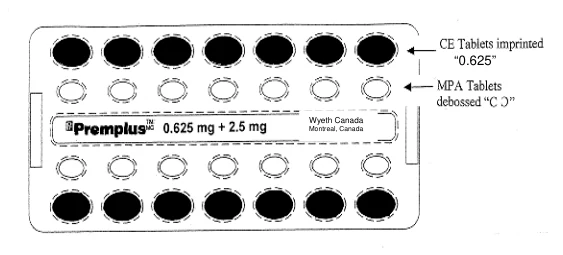
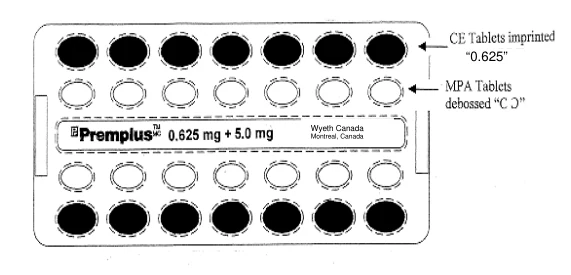
Premplus®: conjugated estrogens tablets, 0.625 mg, and medroxyprogesterone acetate tablets, 2.5 mg, and 5.0 mg
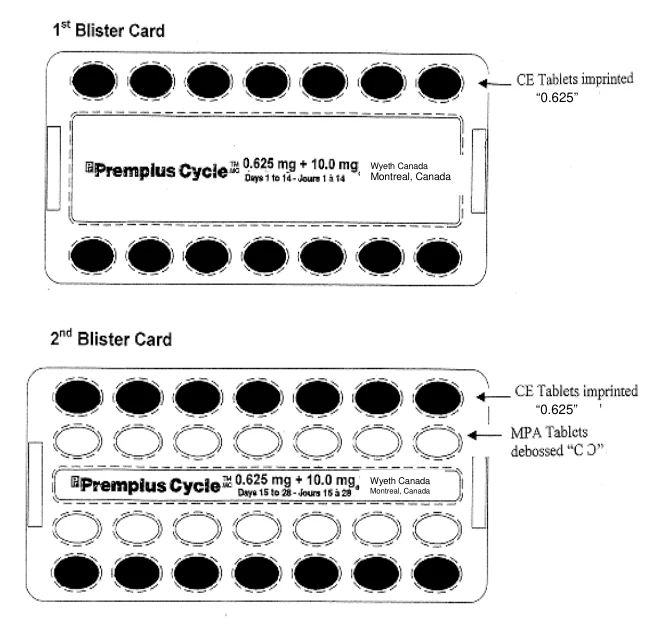
Premplus Cycle®: conjugated estrogens tablets, 0.625 mg, and medroxyprogesterone acetate tablets, 10.0 mg
Wyeth Canada
Montreal, Canada
“0.625”
Wyeth Canada
Montreal, Canada
“0.625”
Wyeth Canada
Montreal, Canada
“0.625”
Wyeth Canada
Montreal, Canada
“0.625”
WARNINGS AND PRECAUTIONS
Serious Warnings and Precautions
The Women’s Health Initiative (WHI) is a large clinical study that assessed the benefits and risks of oral combined estrogen plus progestin therapy and oral estrogen-alone therapy compared with placebo (a pill with no active ingredients) in postmenopausal women.
The WHI trial indicated an increased risk of myocardial infarction (heart attack), stroke, breast cancer, pulmonary emboli (blood clots in the lungs) and deep vein thrombosis (blood clots in the large veins) in postmenopausal women taking oral combined estrogen plus progestin.
The WHI trial indicated an increased risk of stroke and deep vein thrombosis in postmenopausal women with prior hysterectomy (surgical removal of the uterus) taking oral estrogen-alone.
Therefore, you should highly consider the following:
There is an increased risk of developing invasive breast
cancer, heart attack, stroke and blood clots in both lungs and large veins with the use of estrogen plus progestin therapy.
There is an increased risk of stroke and blood clots in the
large veins with the use of estrogen-alone therapy.
Estrogens with or without progestins should not be used for
the prevention of heart disease or stroke.
Estrogens with or without progestins should be used at the
lowest effective dose and for the shortest period of time possible. Regular medical follow-up is advised.
Breast Cancer
The results of the WHI trial indicated an increased risk of breast cancer in postmenopausal women taking combined estrogen plus progestin compared to women taking placebo.
The results of the WHI trial indicated no difference in the risk of breast cancer in post-menopausal women with prior hysterectomy taking estrogen-alone compared to women taking placebo.
Estrogens with or without progestins should not be taken by women who have a personal history of breast cancer.
In addition, women with a family history of breast cancer or women with a history of breast lumps, breast biopsies or abnormal mammograms (breast x-rays) should consult with their doctor before starting HRT.
Women should have a mammogram before starting HRT and at regular intervals during treatment as recommended by their doctor.
Regular breast examinations by a doctor and regular breast self-examination are recommended for all women. You should review technique for breast self-examination with your doctor. Overgrowth of the lining of the uterus and cancer of the uterus
The use of estrogen-alone therapy by post-menopausal women who still have a uterus increases the risk of developing endometrial hyperplasia (overgrowth of the lining of the uterus), which increases the risk of endometrial cancer (cancer of the lining of the uterus).
The purpose of adding a progestin medication to estrogen therapy is to reduce the risk of endometrial hyperplasia.
You should discuss progestin therapy and risk factors for endometrial hyperplasia and endometrial carcinoma with you doctor. You should also report any unexpected or unusual vaginal bleeding to your doctor.
If you have had your uterus removed, you are not at risk of developing endometrial hyperplasia or endometrial carcinoma. Progestin therapy is therefore not generally required in women who have had a hysterectomy.
Ovarian Cancer
In some studies, the use of estrogen-alone and estrogen plus progestin therapies for 5 or more years has been associated with an increased risk of ovarian cancer.
Heart Disease and Stroke
The results of the WHI trial indicated an increased risk of stroke and coronary heart disease in post-menopausal women taking combined estrogen plus progestin compared to women taking placebo.
The results of the WHI trial indicated an increased risk of stroke, but no difference in the risk of coronary heart disease in post-menopausal women with prior hysterectomy taking estrogen-alone compared to women taking placebo.
Abnormal Blood Clotting
The results of the WHI trial indicated an increased risk of blood clots in the lungs and large veins in post-menopausal women taking combined estrogen plus progestin compared to women taking placebo.
The results of the WHI trial indicated an increased risk of blood clots in the large veins, but no difference in the risk of blood clots in the lungs in post-menopausal women with prior hysterectomy taking estrogen-alone compared to women taking placebo.
The risk of blood clots also increases with age, if you or a family member has had blood clots, if you smoke or if you are severely overweight. The risk of blood clots is also temporarily increased if you are immobilized for long periods of time and following major surgery. You should discuss risk factors for blood clots with your doctor since blood clots can be life-threatening or cause serious disability.
Gallbladder Disease
The use of estrogens by postmenopausal women has been associated with an increased risk of gallbladder disease requiring surgery.
Dementia
The Women's Health Initiative Memory Study (WHIMS) was a substudy of the WHI trial and indicated an increased risk of dementia (loss of memory and intellectual function) in post-menopausal women age 65 and over taking oral combined estrogen plus progestin compared to women taking placebo.
The WHIMS indicated no difference in the risk of dementia in post-menopausal women age 65 and over with prior hysterectomy taking oral estrogen-alone compared to women taking placebo.
BEFORE you use Premplus® and Premplus Cycle® talk to your doctor or pharmacist if you:
have a history of allergy or intolerance to any medications or
other substances
have a personal history of breast disease (including breast
lumps) and/or breast biopsies, or a family history of breast cancer
have experienced any unusual or undiagnosed vaginal
bleeding
- have a history of uterine fibroids or endometriosis
have a history of liver disease, jaundice (yellowing of the eyes
and/or skin) or itching related to estrogen use or during pregnancy
- have a history of migraine headache
- have a history of high blood pressure
have a personal or family history of blood clots, or a personal
history of heart disease or stroke
- have a history of kidney disease, asthma or epilepsy (seizures)
have a history of bone disease (this includes certain metabolic
conditions or cancers that can affect blood levels of calcium and phosphorus)
- have been diagnosed with diabetes
have been diagnosed with porphyria (a disease of blood
pigment)
- have a history of high cholesterol or high triglycerides
- are pregnant or may be pregnant
- have had a hysterectomy (surgical removal of the uterus)
- smoke
Other existing conditions you should discuss with your health professional include lupus, very low calcium levels, thyroid problems, fluid retention, gallbladder disease, depression, and breastfeeding. If you have upcoming surgery or prolonged bedrest, you should also discuss these.
Clinical studies have not been conducted in the pediatric population. Premplus® and Premplus Cycle® are not indicated for use in children.
INTERACTIONS WITH THIS MEDICATION
Tell your doctor or pharmacist if you are taking any other medications, including prescription medications, over-the-counter medications, vitamins or herbal products (such as St. John’s wort). Some medications (such as medications for high blood pressure, diabetes, blood clots, sleeping, anxiety, seizures, pain-relief and tuberculosis) may affect how Premplus® and Premplus Cycle® work. Premplus® and Premplus Cycle® may also affect how other medicines work.
PROPER USE OF THIS MEDICATION
Usual dose:
Premplus® - take by mouth one maroon tablet (conjugated estrogens) and one white or purple tablet (progestin) at the same time each day, depending on the strength of the progestin you were prescribed.
Premplus Cycle® - take by mouth one maroon tablet (conjugated estrogens) at the same time each day of each month and one peach tablet (progestin) for the last 14 days of each month, i.e., days 15 to 28 of the cycle.
Estrogens should be used at the lowest dose possible for your treatment only as long as needed. You and your healthcare provider should talk regularly (for example, every 3 to 6 months) about the dose you are taking and whether you still need treatment with Premplus® or Premplus Cycle®.
Take Premplus® or Premplus Cycle® only as directed by your doctor or pharmacist.
Overdose:
Overdosage with Premplus® or Premplus Cycle® may cause nausea and vomiting, breast discomfort, fluid retention, bloating, or vaginal bleeding.
Overdosage may result in a period of amenorrhea (lack of menses) of a variable length and may be followed by irregular menses for several cycles. No cases of overdosage in male patients have been reported.
Missed Dose:
If you miss a dose, take it as soon as possible. If it is almost time for your next dose, skip the missed dose and go back to your normal schedule. Do not take 2 doses at the same time.
Contact your physician or local Poison Control Center in case of accidental ingestion of high doses of Premplus® or Premplus Cycle®.
Medicines are sometimes prescribed for conditions that are not mentioned in patient information leaflets. Do not take Premplus® or Premplus Cycle® for conditions for which they were not prescribed. Do not give Premplus® or Premplus Cycle® to other people, even if they have the same symptoms you have. It may harm them.
SIDE EFFECTS AND WHAT TO DO ABOUT THEM
Possible side effects may include, but are not necessarily limited to, those listed in this section.
In clinical trials for Premplus® and Premplus Cycle®, lasting 13 cycles, in which 1,724 patients participated, the most common adverse effects experienced by the participants are listed below. The adverse effects are ordered by frequency (percentage of participants experiencing adverse effect):
For the patients taking Premplus® and Premplus Cycle® in the study, the most frequent side effect was breast pain, reported by approximately one third of the patients. Headache was the second most common event for these patients. The most common side effects from the study are listed below, along with the frequencies.
- Breast pain – 32 to 36%
- Headache – 16 to 26%
- Abdominal pain – 11 to 16%
- Flatulence – 7 to 8%
- Nausea – 6 to 8%
- Painful menstrual cramps – 5 to 13%
- Back pain – 5 to 7%
- Depression – 4 to 8%
- Itching of the skin – 4 to 6%
- Genital bleeding/spotting – 3 to 6%
- Weight gain – 3%
Patients may have reported two or more different side effects during the study. The addition of progestin to estrogen replacement therapy may contribute to breast pain as a greater percentage of patients on Premplus® and Premplus Cycle® reported breast pain than those on Premarin alone. The following self-limiting side effects, in the table below, are listed by frequency and body categories. These include side effects from the clinical study as well as those gathered during the marketing of Premplus® and Premplus Cycle®:
Very Common: ≥10%
Common: ≥1% and <10%
Uncommon: ≥0.1% and <1%
Rare: ≥0.01% and <0.1%
Very rare: <0.01%
Body System Side effects
Reproductive system and breast disorders
Very common Breast pain
Common Breakthrough bleeding/ painful periods;
spotting Uncommon Change in menstrual flow;
Rare A spontaneous flow of milk from the nipple
Gastrointestinal disorders
Uncommon Nausea; bloating; abdominal pain Rare Vomiting, inflammation of the colon Nervous system disorders
Uncommon Dizziness; headache (including migraine) Rare Enlargement of benign brain tumours Musculoskeletal, connective tissue and bone disorders Common Joint pain
Psychiatric disorders
Uncommon Changes in libido; mood disturbances Rare Irritability
Skin and subcutaneous tissue disorders
Uncommon Acne; hair loss; itching
Rare Rash
Very rare Tender red nodules on the shins and legs Infections and Infestations
Common Inflammation of the vagina Immune system disorders
Rare Hives
Respiratory, thoracic and mediastinal disorders Rare Worsening of asthma
Investigations
Common Changes in weight (increase or decrease) Very rare Increase in blood pressure
| SERIOUS SIDE EFFECTS, HOW OFTEN THEY HAPPEN AND WHAT TO DO ABOUT THEM | ||||
| Frequency (common or uncommon) | Symptom / possible side effect | Talk with your doctor or pharmacist | Stop taking drug and call your doctor or pharmacist | |
| Only if severe | In all cases | |||
| Uncommon | Abdominal pain, nausea or vomiting | T | ||
| Rare | Breast lump, unusual discharge | T | ||
| Rare | Shortness of breath, weakness, unusual fatigue, cold sweat, dizziness, sleep disturbance, indigestion, anxiety | T | ||
| Uncommon | Pain or swelling in the leg | T | ||
| Common | Persistent sad mood | T | ||
| SERIOUS SIDE EFFECTS, HOW OFTEN THEY HAPPEN AND WHAT TO DO ABOUT THEM | ||||
Talk with your doctor or pharmacist | ||||
| Rare | Sharp pain in the chest, coughing blood or sudden shortness of breath | T | ||
| Very rare | Sudden partial or complete loss of vision | T | ||
| Rare | Sudden severe headache or worsening of headache, vomiting, dizziness, fainting, disturbance of vision or speech or weakness or numbness in an arm or leg | T | ||
| Very rare | Unexpected vaginal bleeding, difficult/ painful urination | T | ||
| Very rare | Yellowing of the skin or eyes | T | ||
| Uncommon | Memory loss, poor concentration, problems learning new ideas or skills | T | ||
This is not a complete list of side effects. For any unexpected effects while taking Premplus® or Premplus Cycle®, contact your doctor or pharmacist.
HOW TO STORE IT
Store Premplus® and Premplus Cycle® at 15° C to 25° C (room temperature).
Keep out of reach of children.
REPORTING SUSPECTED SIDE EFFECTS
You can report any suspected adverse reactions associated with the use of health products to the Canada Vigilance Program by one of the following 3 ways:
- Report online at www.healthcanada.gc.ca/medeffect
- Call toll-free at 1-866-234-2345
Complete a Canada Vigilance Reporting Form and:
- Fax toll-free to 1-866-678-6789, or
Mail to:
Canada Vigilance Program
Health Canada
Postal Locator 0701D
Ottawa, Ontario
K1A 0K9
Postage paid labels, Canada Vigilance Reporting Form and the adverse reaction reporting guidelines are available on the MedEffect™ Canada Web site at
www.healthcanada.gc.ca/medeffect.
NOTE: Should you require information related to the management of side effects, contact your health professional. The Canada Vigilance Program does not provide medical advice.
MORE INFORMATION
This document plus the full product monograph, prepared for health professionals can be found by contacting the sponsor,
Pfizer Canada Inc.
17,300 Trans-Canada Highway
Kirkland, Quebec H9J 2M5
toll-free, at: 1-800-463-6001
or at www.pfizer.ca