


Product Monograph - Pulmozyme
SUMMARY PRODUCT INFORMATION
| Route of Administration | Dosage Form / Strength | Clinically Relevant Non-medicinal Ingredients |
| Inhalation (using a nebulizer) | Solution / 1 mg/mL | None For a complete listing see Dosage Forms, Composition and Packaging section. |
INDICATIONS AND CLINICAL USE
Daily administration of PULMOZYME (dornase alfa) for inhalation in conjunction with standard therapies is indicated in the management of cystic fibrosis patients to reduce the frequency of respiratory infections requiring parenteral antibiotics and to improve pulmonary function. Safety and efficacy of daily administration have not been demonstrated in patients with FVC<40% of predicted, or for longer than twelve months.
CONTRAINDICATIONS
PULMOZYME (dornase alfa) is contraindicated in patients with known hypersensitivity to dornase alfa, Chinese Hamster Ovary cell products or any component of the product. For a complete listing, see the Dosage Forms, Composition and Packaging section of the product monograph.
WARNINGS AND PRECAUTIONS
General
PULMOZYME (dornase alfa) should be used in conjunction with standard therapies for cystic fibrosis (CF).
Patients should be instructed in the proper use and maintenance of the nebulizer and compressor system used in its delivery.
Carcinogenesis and Mutagenesis
There is no evidence of oncogenic or mutagenic potential (see TOXICOLOGY: Carcinogenesis, Mutagenesis for discussion on animal data).
Sexual Function/Reproduction
Fertility and reproductive performance were not affected in animal studies (see TOXICOLOGY: Reproduction/Development Studies).
Special Populations
Pregnant Women: The safety of PULMOZYME has not been established in pregnant women. Animal studies do not indicate direct or indirect harmful effects with respect to pregnancy, or embryofoetal development (see TOXICOLOGY: Reproduction/Developmental Studies). Caution should be exercised when prescribing PULMOZYME to pregnant women.
Nursing Women: As it is not known whether dornase alfa is excreted in human milk, caution should be exercised when PULMOZYME is administered to a nursing woman (see DETAILED PHARMACOLOGY: Pharmacokinetics).
Pediatrics (<5 years of age): There is limited experience in the use of PULMOZYME in patients under the age of 5 years. The clinical efficacy in patients under the age of 5 years is not established.
ADVERSE REACTIONS
Adverse Drug Reaction Overview
The adverse event data reflect the clinical trial and post-marketing experience of using PULMOZYME (dornase alfa) at the recommended dose regimen.
Adverse reactions attributed to PULMOZYME are rare (<1/1000). In most cases, the adverse reactions are mild and transient in nature and do not require alterations in the dosing of PULMOZYME.
| Body as a Whole: | Chest pain (pleuritic/non-cardiac), fever |
| Gastrointestinal System: | Dyspepsia |
| Respiratory System: | Voice alteration (hoarseness), pharyngitis (inflammation of the throat), dyspnea, laryngitis, rhinitis, decreased lung function |
| Skin and Appendages: | Rash, urticaria |
| Special Senses: | Conjunctivitis |
Patients who experience adverse events common to cystic fibrosis can, in general, safely continue administration of PULMOZYME as evidenced by the high percentage of patients completing clinical trials with PULMOZYME.
Upon initiation of therapy with PULMOZYME, as with any aerosol, pulmonary function may decline and expectoration of sputum may increase.
Clinical Trial Adverse Drug Reactions
Because clinical trials are conducted under very specific conditions the adverse reaction rates observed in the clinical trials may not reflect the rates observed in practice and should not be compared to the rates in the clinical trials of another drug. Adverse drug reaction information from clinical trials is useful for identifying drug-related adverse events and for approximating rates.
In clinical trials, few patients experienced adverse events resulting in permanent discontinuation from PULMOZYME, and the discontinuation rate was observed to be similar between placebo (2%) and PULMOZYME (3%).
Mortality rates observed in a controlled trial were similar for the placebo (1%) and PULMOZYME (1%). Causes of death were consistent with progression of cystic fibrosis and included apnea, cardiac arrest, cardiopulmonary arrest, cor pulmonale, heart failure, massive hemoptysis, pneumonia, pneumothorax, and respiratory failure.
The safety of PULMOZYME, 2.5 mg by inhalation, was studied with 2 weeks of daily administration in 98 patients with cystic fibrosis (65 aged 3 months to <5 years, 33 aged 5 to ≤10 years) all of whom received bronchoalveolar lavage on the first day of therapy (Z0644g).10 The number of patients reporting cough was higher in the younger age group as compared to the older age group (29/65, 45% compared to 10/33, 30%) as was the number reporting moderate to severe cough (24/65, 37% as compared to 6/33, 18%). Other events tended to be of mild to moderate severity. The number of patients reporting rhinitis was higher in the younger age group as compared to the older age group (23/65, 35% compared to 9/33, 27%) as was the number reporting rash (4/65, 6% as compared to 0/33). Adverse events were common in this study and some were considered to be due to bronchoalveolar lavage. The nature of adverse drug reactions was similar to that seen in the larger trials of PULMOZYME.
In this phase II uncontrolled study (Z0644g), 98 patients aged 3 months to 9 years were treated with PULMOZYME by inhalation daily at a dose of 2.5 mg (the recommended dose). Data presented in Table 1 are based on adverse drug reactions reported in Study Z0644g.
Table 1 Adverse Drug Reactions Occurring in ≥1% of Patients and Occurring in >1 Patient in Study Z0644g
Adverse Event System Organ Class (MedDRA) | Number | Percentage (n=98) |
| Infections And Infestations | ||
Rhinitis Pharyngitis | 12 7 | 12.2 7.1 |
| Psychiatric Disorders | ||
| Nervousness | 4 | 4.1 |
| Nervous System Disorders | ||
| Headache | 4 | 4.1 |
| Hyperkinesias | 2 | 2.0 |
| Eye Disorders | ||
| Conjunctivitis | 2 | 2.0 |
| Respiratory, Thoracic And Mediastinal Disorders | ||
| Cough increased | 35 | 35.7 |
| Lung disorder | 3 | 3.1 |
| Hyperventilation | 2 | 2.0 |
| Voice alteration | 14 | 14.3 |
| Gastrointestinal Disorders | ||
| Abdominal pain | 2 | 2.0 |
| Nausea | 2 | 2.0 |
| Vomiting | 7 | 7.1 |
| Skin And Subcutaneous Tissue Disorders | ||
| Rash | 2 | 2.0 |
| General Disorders And Administration Site Conditions | ||
| Pyrexia | 7 | 7.1 |
| Unevaluable reaction | 5 | 5.1 |
| Investigations | ||
| Sputum increased | 6 | 6.1 |
Allergic Reactions
There have been no reports of anaphylaxis attributed to the administration of PULMOZYME to date. Skin rash and urticaria have been observed, and were mild and transient in nature. Less than 5% of patients treated with PULMOZYME have developed antibodies to the drug and none of these patients have developed IgE antibodies to PULMOZYME. Improvement in pulmonary function tests has still occurred even after the development of antibodies to PULMOZYME.
DRUG INTERACTIONS
Clinical trials have indicated that PULMOZYME can be effectively and safely used in conjunction with standard cystic fibrosis therapies including oral, inhaled and parenteral antibiotics, bronchodilators, enzyme supplements, vitamins, oral and inhaled corticosteroids, and analgesics. No formal drug interaction studies have been performed.
DOSAGE AND ADMINISTRATION
Recommended Dose and Dosage Adjustment
The recommended dose for use in most cystic fibrosis patients is one 2.5 mg single use ampoule inhaled once daily using a recommended nebulizer (see Administration). Some patients may benefit from twice daily administration (see CLINICAL TRIALS: Phase III Studies, Table 2).
Missed Dose
The missed dose should be taken as soon as remembered, then the regular dosing schedule should be continued. Two doses of PULMOZYME should not be taken at the same time.
Administration
PULMOZYME should not be diluted or mixed with other drugs in the nebulizer. Mixing of PULMOZYME with other drugs could lead to adverse physicochemical and/or functional changes in PULMOZYME or the admixed compound.
Patients should be advised to squeeze each ampoule prior to use in order to check for leaks.
Clinical trials have been performed with the following nebulizers and compressors:
- the disposable jet nebulizer Hudson T Up draft II,
- the disposable jet nebulizer Marquest Acorn II in conjunction with a Pulmo Aide compressor,
- the PARI LC Plus Reusable Nebulizer in conjunction with the PARI PRONEB compressor, and
- eRapid Nebulizer System consisting of the eRapid Nebulizer Handset with eBase Controller.
Patients who are unable to inhale or exhale orally throughout the entire nebulization period may use the reusable PARI BABY nebulizer with a tight fitting face mask. It is recommended that patients <5 years of age use the PARI BABY nebulizer. Safety and efficacy have been demonstrated only with these recommended nebulizer systems.
No clinical data are currently available that support the safety and efficacy of administration of
PULMOZYME (dornase alfa) with other nebulizer systems. The patient should follow the manufacturer’s instructions on the use and maintenance of the equipment.
OVERDOSAGE
Single dose inhalation studies in rats and monkeys at doses up to 180 times higher than doses routinely used in clinical studies are well tolerated. Single dose oral administration of PULMOZYME (dornase alfa) in doses up to 200 mg/kg are also well tolerated by rats.
Cystic fibrosis patients have received up to 20 mg twice daily for up to 6 days and 10 mg twice daily intermittently (2 weeks on/2 weeks off drug) for 168 days. These doses were well tolerated.
No data are available specifically for patients <5 years of age.
| For management of a suspected drug overdose contact your regional Poison Control Centre. |
ACTION AND CLINICAL PHARMACOLOGY
Mechanism of Action
PULMOZYME (dornase alfa) for inhalation is a sterile, clear, colourless, highly purified solution of recombinant human deoxyribonuclease I (rhDNase), an enzyme which selectively cleaves DNA. The protein is produced by genetically engineered Chinese Hamster Ovary (CHO) cells containing DNA encoding for the native human protein, deoxyribonuclease I (DNase). The product is purified by tangential flow filtration and column chromatography.
PULMOZYME is administered by inhalation of an aerosol mist produced by a compressed air driven nebulizer system (see CLINICAL TRIALS and DOSAGE AND ADMINISTRATION). PULMOZYME may also be aerosolized and administered via micro-perforated vibrating membrane nebulizer technology. Each single use ampoule will deliver 2.5 mL of the solution to the nebulizer bowl.
In cystic fibrosis (CF) patients, retention of viscous purulent secretions in the airways contributes both to reduced pulmonary function and to exacerbations of infection.2,3
Purulent pulmonary secretions contain very high concentrations of extracellular DNA released by degenerating leukocytes that accumulate in response to infection.4 In vitro, PULMOZYME hydrolyzes the DNA in sputum of CF patients and reduces sputum viscoelasticity.1
Pharmacokinetics
When 2.5 mg dornase alfa was administered by inhalation to eighteen CF patients, mean sputum concentrations of 3 µg/mL DNase were measurable within 15 minutes. Mean sputum concentrations declined to an average of 0.6 µg/mL two hours following inhalation. Inhalation of up to 10 mg three times daily of dornase alfa by 4 CF patients for six consecutive days, did not result in a significant elevation of serum concentrations of DNase above normal endogenous levels.5,6 After administration of up to 2.5 mg of dornase alfa twice daily for six months to 321 CF patients, no accumulation of serum DNase was noted.
For pharmacokinetic data obtained in patients < 5 years old, please see CLINICAL TRIALS: Phase II Studies.
STORAGE AND STABILITY
PULMOZYME must be stored in the refrigerator at 2-8ºC (36-46ºF) and protected from light. It should be kept refrigerated during transport and should not be exposed to room temperatures for a total time of 24 hours. The solution should be discarded if it is cloudy or discoloured. PULMOZYME contains no preservative and, once opened, the entire ampoule must be used or discarded.
DOSAGE FORMS, COMPOSITION AND PACKAGING
Composition
Each 2.5 mL PULMOZYME (dornase alfa) single-use ampoule contains 1.0 mg/mL (2.5 mg) of dornase alfa formulated in calcium chloride dihydrate, sodium chloride and Sterile Water for Injection. The solution contains no preservative. The nominal pH of the solution is 6.3.
Availability
PULMOZYME (dornase alfa) is available in:
- 30 ampoule cartons: Each carton contains 5 foil pouches each containing 6 sterile, single-use ampoules of dornase alfa, PULMOZYME
PART II: SCIENTIFIC INFORMATION
PHARMACEUTICAL INFORMATION
Drug Substance
Proper name: dornase alfa
Chemical name: recombinant human deoxyribonuclease 1 (rhDNase)
Molecular formula and molecular mass: The purified glycoprotein contains 260 amino acids with an approximate molecular weight of 37,000 daltons.1 The primary amino acid sequence is identical to that of the native human enzyme.
Structural Formula: Not available
Physicochemical properties: PULMOZYME for inhalation is a sterile, clear, colourless, highly purified solution of recombinant human deoxyribonuclease I (rhDNase). The nominal pH of the solution is 6.3.
CLINICAL TRIALS
Phase II Studies:
PULMOZYME has been evaluated in an open-label 2-week study in cystic fibrosis patients aged 3 months to 9 years of age (Z0644g).10 PULMOZYME, 2.5 mg by inhalation, was administered daily to 98 patients aged 3 months to ≤10 years (65 aged 3 months to <5 years, 33 aged 5 to ≤10 years), and bronchoalveolar lavage (BAL) fluid was obtained within 90 minutes of the first dose. The PARI BABY™ reusable nebulizer (which uses a facemask instead of a mouthpiece) was utilized in patients unable to demonstrate the ability to inhale or exhale orally throughout the entire treatment period (54/65, 83% of the younger and 2/33, 6% of the older patients). BAL DNase concentrations were detectable in all patients but showed a broad range, from 0.007 to 1.8 µg/mL. Over an average of 14 days of exposure, serum DNase concentrations (mean ± s.d.) increased by 1.1 ± 1.6 ng/mL for the 3 months to <5 year age group and by 0.8 ± 1.2 ng/mL for the 5 to ≤10 year age group. The relationship between BAL or serum DNase concentration and adverse experiences and clinical outcomes is unknown.
Phase III Studies:
PULMOZYME has been evaluated in a large, randomized, placebo-controlled trial of clinically stable cystic fibrosis patients, 5 years of age and older, with baseline forced vital capacity (FVC) greater than or equal to 40% of predicted and receiving standard therapies for cystic fibrosis.7 Patients were treated with placebo (325 patients), 2.5 mg of PULMOZYME once a day
(322 patients) or 2.5 mg of PULMOZYME twice a day (321 patients) for six months administered via a Hudson T Up-draft II nebulizer with a Pulmo-Aide compressor.
Both doses of PULMOZYME resulted in significant reductions compared with the placebo group in the number of patients experiencing respiratory tract infections requiring use of parenteral antibiotics. Administration of PULMOZYME reduced the relative risk of developing a respiratory tract infection by 27% and 29% for the 2.5 mg daily dose and the 2.5 mg twice daily dose, respectively (see Table 2). The data suggest that the effects of PULMOZYME on respiratory tract infections in older patients (>21 years) may be smaller than in younger patients, and that twice daily dosing may be required in the older patients. Patients with baseline FVC>85% may also benefit from twice a day dosing (see Table 2). The reduced risk of respiratory infection observed in patients treated with PULMOZYME did not directly correlate with improvement in forced expiratory volume in 1 second (FEV1) during the initial two weeks of therapy.
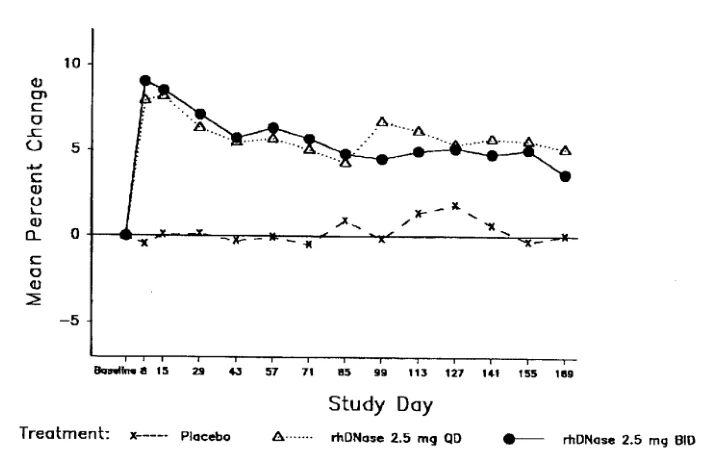
Within 8 days of the start of treatment with PULMOZYME mean FEV1 increased 7.9% in those treated once a day and 9.0% in those treated twice a day compared to the baseline values. The overall mean FEV1 observed during long-term therapy increased 5.8% from baseline at the 2.5 mg daily dose level and 5.6% from baseline at the 2.5 mg twice daily dose level. Placebo recipients did not show significant mean changes in pulmonary function testing (see Figure 1).
For patients 5 years of age or older, with baseline FVC greater than or equal to 40%, administration of PULMOZYME decreased the incidence of occurrence of first respiratory tract infection requiring parenteral antibiotics, and improved mean FEV1 regardless of age or baseline FVC.
Table 2 Incidence of Occurrence of First Respiratory Tract Infection Requiring Parenteral Antibiotics in a Controlled Trial
| Placebo n=325 | 2.5 mg Once Daily n=322 | 2.5 mg Twice Daily n=321 | |
|---|---|---|---|
| Percent of Patients Infected | 43% | 34% | 33% |
| Relative Risk (vs placebo) | 0.73 | 0.71 | |
| p-value (vs placebo) | 0.015 | 0.007 | |
| Subgroup by Age and Baseline FVC | Placebo (n) | 2.5 mg Once Daily (n) | 2.5 mg Twice Daily (n) |
| Age | |||
| 5-20 years | 42% (201) | 25% (199) | 28% (184) |
| 21 years and older | 44% (124) | 48% (123) | 39% (137) |
| Baseline FVC | |||
| 40-85%, Predicted | 54% (194) | 41% (201) | 44% (203) |
| >85%, Predicted | 27% (131) | 21% (121) | 14% (118) |
Figure 1: Mean Percent Change from Baseline FEV1 in a Controlled Trial
Other Studies:
The PULMOZYME Early Intervention trial was a 2 year randomized, double-blind, placebo-controlled trial that determined whether long-term treatment of young patients with CF (ages 6 to 10) with PULMOZYME maintains lung function and reduces respiratory tract exacerbations.11 A total of 474 patients were randomized into the trial (239 to the PULMOZYME group and 235 to the placebo group). At baseline, mean FEV1 was 95% predicted, mean forced expiratory flow, midexpiratory phase (FEF25-75) was 85% predicted and FVC was 102% predicted. At 2 years, the treatment benefit observed for FEV1 in patients treated with PULMOZYME compared with placebo in percent predicted was 3.2±1.2 (p=0.006). An increase in FEV1 was observed up to 48 weeks of treatment; at 2 years, patients treated with PULMOZYME maintained FEV1 at their baseline value, while patients in the control group had a mean decrease from baseline. Corresponding improvements in FEF25-75 (7.9 ± 2.3, p=0.008) and FVC (0.7 ±1.0, p=0.51) were reported in patients treated with PULMOZYME versus placebo. The risk of respiratory tract exacerbations was reduced by 34% in patients treated with Pulmozyme versus placebo (RR=0.33, p=0.048).
PULMOZYME did not produce a pulmonary function benefit in short-term usage in patients with FVC less than 40% of predicted. Studies are in progress to assess the impact of chronic use on pulmonary function and infection risk in this population.
Clinical trials have indicated that therapy with PULMOZYME can be continued or initiated during an acute respiratory exacerbation.
Short term dose ranging studies demonstrated that doses in excess of 2.5 mg twice daily did not provide further improvement in FEV1. Patients who have received drug on a cyclical regimen (i.e., administration of PULMOZYME 10 mg twice daily for 14 days, followed by a 14 day wash out period) showed rapid improvement in FEV1 with the initiation of each cycle and a return to baseline with each withdrawal of PULMOZYME.
Study ML28249 (IMPART) was a multicenter, randomized, open-label, two-period crossover Phase IV trial designed to compare the efficacy and safety of PULMOZYME in 85 patients with cystic fibrosis when delivered by two different nebulizer systems: the PARI eRapid and the PARI LC Plus Reusable Nebulizer. Study ML28249 met its primary efficacy endpoint of equivalence between the PARI eRapid (test) and the PARI LC Plus Reusable Nebulizer (reference) nebulizer with respect to lung function assessed by percent predicted FEV1 [95% Confidence Interval (CI) of the ratio (test/reference): 99.2%, 102.5%]. The incidence, severity, and nature of reported adverse events were similar between treatments administered using the two nebulizer systems. Patients reported mean PULMOZYME administration times of 2.7 minutes using the eRapid nebulizer compared with 10.2 minutes using the PARI LC Plus Reusable Nebulizer.
DETAILED PHARMACOLOGY
In vitro, rhDNase significantly reduces the viscoelasticity of infected cystic fibrosis sputum, as measured by quantitative viscometry. The reduction in viscoelasticity was concentration-dependent, at a range of concentrations of 1-20 μg rhDNase/mL sputum. Greater than 50% reduction in viscoelasticity was observed at concentrations of 2-4 μg/mL.1 Similar DNase concentrations are found in the sputum of cystic fibrosis patients 15 minutes following a 2.5 mg dornase alfa dose.
Safety Pharmacology/Acute Toxicity
Rats were evaluated for pharmacological effects of dornase alfa on the renal, gastrointestinal, and central nervous systems following administration of a single intravenous bolus injection. Doses of up to 10.0 mg/kg had no apparent effect on any of the pharmacological parameters evaluated.
Single, intravenous bolus doses of dornase alfa up to 10.0 mg/kg had no apparent effect when administered to Cynomolgus monkeys.
When a single dose (0.1 mL, 5 mg/mL) of dornase alfa was instilled into the conjunctival sac of rabbits to assess the potential for eye irritation, there was no ocular irritation up to 72 hours after application.
Pharmacokinetics
Following inhalation exposure pulmonary bioavailability of dornase alfa was <15% in rats and <2% in monkeys. Following i.v. administration in rats and primates, dornase alfa was rapidly removed from the systemic circulation and no evidence of accumulation was observed.
In a study performed in lactating Cynomolgus monkeys, receiving high doses of dornase alfa by the intravenous route, low concentrations (< 0.1% of the concentrations seen in the serum of pregnant Cynomolgus monkeys), were detectable in the maternal milk. When administered to humans according to the dosage recommendation, there is minimal systemic absorption of dornase alfa; therefore no measurable concentrations of dornase alfa would be expected in human milk (see WARNINGS AND PRECAUTIONS: Nursing Women).
TOXICOLOGY
The safety of dornase alfa was evaluated by conducting acute and subacute toxicity studies in rats, monkeys and mice. Subchronic inhalation studies were performed in rats and monkeys. A carcinogenicity study in rats was completed. Mutagenic, reproduction and teratologic studies were conducted using rats and rabbits.
| SHORT-TERM MULTIDOSE STUDIES | |||
|---|---|---|---|
| SPECIES/ ROUTE | INHALED DOSE/ DURATION | DOSE TO LRT* | COMMENTS |
| Rat/ Inhalation | 0, 0.21, 0.75, 2.18 mg/kg 4-week and 4-week recovery | 0, 0.02, 0.06, 0.24 mg/kg | Well tolerated at all doses. There were no significant antemortem findings, other than a dose-dependent increase in incidence of serum antibody titers at Week 4 (5, 10, and 32%, in low-, mid- and high-dose groups, respectively). Microscopic evidence of alveolitis in the high-dose rats was noted. This change fully regressed by the end of the treatment-free period. |
| Monkey/ Inhalation | 0, 0.25, 0.53, 2.15 mg/kg 4-week and 4-week recovery | 0, 0.14, 0.29, 1.18 mg/kg | Well tolerated at all doses. There were no significant antemortem findings. A dose-dependent increase in incidence of serum antibody titers (Week 4) was apparent (50, 75, and 92%, at the low-, mid- and high-dose levels, respectively). Titers in high-dose recovery monkeys were unchanged at Week 8. Microscopic evidence of bronchiolitis was noted in one high-dose animal at Week 4. |
- Doses in inhalation studies are estimations of inhaled doses. Doses to the lower respiratory tract (LRT) are lower based upon minute ventilation and fractional deposition to the LRT.
| LONG-TERM MULTIDOSE STUDIES | |||
|---|---|---|---|
| SPECIES / ROUTE | INHALED DOSE/ DURATION | DOSE TO LRT* | COMMENTS |
| Rat/ Inhalation | 0, 0.44, 0.87, 2.23 mg/kg 26-week and 4-week recovery | 0, 0.05, 0.10, 0.25 mg/kg | Well tolerated at all doses. No treatment-related mortalities or clinical or gross pathologic changes were apparent. Nondose-related incidence of positive antibody titers at Week 27 was evident at all doses. Serum concentrations of dornase alfa evident at mid- and high-dose levels. Microscopically, an increased incidence of animals with germinal centres in the bronchus associated lymphoid tissue (all doses), increased incidence of females with germinal centres in bronchial lymph nodes (all doses), and minimal to mild focal alveolitis (mid- and high-dose) were apparent. With the exception of alveolitis at the mid-dose level, all changes were reversible. |
| Monkey/ Inhalation | 0, 0.38, 1.00, 1.76, 2.00 mg/kg† 26-week and 4-week recovery † Intermittent exposure regimen (Weeks 1-13, 22-26) | 0, 0.21, 0.55, 0.98 and 1.11 mg/kg | Well tolerated at all doses. No treatment-related clinical or gross pathologic findings were evident. Positive antibody titers were initially noted at Week 4 and persisted throughout the treatment and recovery periods (all doses). Serum concentrations of dornase alfa indicated that no significant systemic accumulation occurred. Microscopic evidence of perivascular cuffing, peribronchial lymphoid hyperplasia, terminal airway-related bronchiolitis/alveolitis and siderophages in lung tissue was noted at all doses. There was a general trend toward an increase in the incidence or severity of pulmonary lesion in animals with elevated antibody titers. Overall, the histopathologic lung changes were indicated to be regressing at the end of the recovery period. Intermittent exposure (two months) at the high-dose level did not influence the safety profile of dornase alfa relative to continuous treatment. |
* Doses in inhalation studies are estimations of inhaled doses. Doses to the lower respiratory tract (LRT) are lower based upon minute ventilation and fractional deposition to the LRT.
In addition, two week repeat dose intravenous studies were conducted at doses up to 1.2 mg/kg/day in rats and primates. No evidence of any systemic toxicity was observed.
Mutagenesis
Ames tests using six different tester strains of bacteria (4 of S. typhimurium and 2 of E. coli), at concentrations up to 5000 μg/plate, a cytogenetic assay using human peripheral blood lymphocytes at concentrations up to 2000 μg/plate, and a mouse lymphoma assay at concentrations up to 1000 μg/plate, with and without metabolic activation, revealed no evidence of mutagenesis potential. Dornase alfa was tested in a micronucleus (in vivo) assay for its potential to produce chromosome damage in bone marrow cells of mice following a bolus intravenous dose of up to 10 mg/kg on two consecutive days. No evidence of chromosomal damage was noted.
Reproduction/Developmental Studies
Reproduction studies have been performed in rats and rabbits with intravenous doses up to 10 mg/kg/day, representing systemic exposures greater than 600 times that expected following the maximum recommended human dose. These studies have revealed no evidence of impaired fertility, harm to the fetus, or effects on development due to dornase alfa (see WARNINGS AND PRECAUTIONS: Pregnant Women).
Carcinogenesis
Lifetime studies in Sprague Dawley rats showed no carcinogenic effect when dornase alfa was administered as doses up to 246 µg/kg body weight per day. Dornase alfa was administered to rats as an aerosol for up to 30 minutes per day, daily for two years, with resulting lower respiratory tract doses of up to 246 µg/kg per day, which represents up to a 28.8-fold multiple of the clinical dose. There was no increase in the development of benign or malignant neoplasms and no occurrence of unusual tumor types in rats after lifetime exposure.
REFERENCES
- 1. Shak S, Capon DJ, Hellmiss R, Marsters SA, Baker CL. Recombinant human DNase I reduces the viscosity of cystic fibrosis sputum. Proc Natl Acad Sci USA 1990;87:9188-92.
- 2. Boat TF. Cystic Fibrosis. In: Murray JF, Nadel JA, editors. Textbook of respiratory medicine. Philadelphia: Saunders WB, 1988;1:1126-52.
- 3. Collins FS. Cystic Fibrosis: molecular biology and therapeutic implications. Science 1992;256:774-9.
- 4. Potter JL, Spector S, Matthews LW, Lemm J. Studies of pulmonary secretions. Amer Rev of Respiratory Disease 1969;99:909-15.
- 5. Hubbard RC, McElvaney NG, Birrer P, Shak S, Robinson WW, Jolley C, et al. A preliminary study of aerosolized recombinant human deoxyribonuclease I in the treatment of cystic fibrosis. New Eng J Med 1992;326:812-5.
- 6. Aitken ML, Burke W, McDonald G, Shak S, Montgomery AB, Smith A. Recombinant human DNase inhalation in normal subjects and patients with cystic fibrosis. JAMA 1992;267(14):1947-51.
- 7. Fuchs HJ, Borowitz D, Christiansen D, Morris E, Nash M, Ramsey B, et al. Aerosolized recombinant human DNase reduces pulmonary exacerbations and improves pulmonary function in patients with cystic fibrosis. Presented by Mary Ellen Wohl, M.D. at the 36th Annual Conference on Chest Disease, Intermountain Thoracic Society, January 26, 1993.
- 8. Ranasinha C, Assoufi B, Shak S, Christiansen D, Fuchs H, Empey D, Geddes D, Hodson M. Efficacy and safety of short-term administration of aerosolized recombinant human DNase I in adults with stable stage cystic fibrosis. Lancet 1993;342:199-202.
- 9. Ramsey BW, Astley SJ, Aitken ML, Burke W, Colin AA, Dorkin HL, Eisenberg JD, et al. Efficacy and safety of short-term administration of aerosolized recombinant human deoxyribonuclease in patients with cystic fibrosis. Am Rev Respir Dis 1993;148:145-151.
- 10. Wagener JS, Rock MJ, McCubbin MM, Hamilton SD, Johnson CA, Ahrens RC. Aerosol delivery and safety of recombinant human deoxyribonuclease in young children with cystic fibrosis: A bronchoscopic study. J Pediatr 1998;133:486-491.
- 11. Quan JM, Tiddens, dens, HA, Sy JP, McKenzie SG, Montgomery MD, Robinson PJ et al. A two-year randomized, placebo-controlled trial of dornase alfa in young patients with cystic fibrosis with mild lung function abnormalities. J Pediatr 2001; 139:813-20.