


Product Monograph - Ran-Tamsulosin
SUMMARY PRODUCT INFORMATION
| Route of Administration | Dosage Form / Strength | Clinically Relevant Nonmedicinal Ingredients |
| oral | sustained release capsules/0.4 mg | For a complete listing see Dosage Forms, Composition and Packaging section. |
INDICATIONS AND CLINICAL USE
RAN-TAMSULOSIN (tamsulosin hydrochloride) is indicated for the treatment of the signs and symptoms of benign prostatic hyperplasia (BPH).
RAN-TAMSULOSIN is not indicated for use in women.
RAN-TAMSULOSIN is not intended for use as an antihypertensive drug.
Geriatrics (> 65 years of age):
Tamsulosin hydrochloride has been found to be a safe and effective alpha1 adrenoreceptor antagonist when administered at therapeutic doses (0.4 mg and 0.8 mg once daily) to patients over the age of 65 years (see WARNINGS AND PRECAUTIONS - Special Populations - Geriatrics)
Pediatrics:
RAN-TAMSULOSIN is not indicated for use in children.
CONTRAINDICATIONS
$ Patients who are hypersensitive to tamsulosin or to any ingredient in the formulation or component of the container. For a complete listing, see the Dosage Forms, Composition and Packaging section of the product monograph.
WARNINGS AND PRECAUTIONS
The signs and symptoms of orthostasis (postural hypotension, dizziness and vertigo) were detected more frequently in tamsulosin hydrochloride treated patients than in placebo recipients. As with other alpha-adrenergic blocking agents, there is a potential risk of syncope (see ADVERSE REACTIONS).
Patients beginning treatment with RAN-TAMSULOSIN should be cautioned to avoid situations where injury could result should syncope occur (see ADVERSE REACTIONS).
Very rarely tamsulosin, like other alpha1 antagonists, has been associated with priapism (persistent painful penile erection unrelated to sexual activity). Because this condition can lead to permanent impotence if not properly treated, patients must be advised about the seriousness of the condition (see PART III: CONSUMER INFORMATION - WARNINGS AND PRECAUTIONS).
General
RAN-TAMSULOSIN is not indicated for the treatment of hypertension.
Carcinoma of the Prostate
Carcinoma of the prostate and BPH cause many of the same symptoms. These two diseases frequently co-exist. Patients should be evaluated prior to the start of RAN-TAMSULOSIN therapy to rule out the presence of carcinoma of the prostate.
Cardiovascular
Orthostatic Hypotension: While syncope is the most severe orthostatic symptom of tamsulosin hydrochloride, other symptoms can occur (dizziness and postural hypotension). In the two U.S. double-blind, placebo-controlled studies (Studies 1 and 2), orthostatic testing was conducted at each visit. Postural hypotension was reported in three patients (0.6%) receiving tamsulosin hydrochloride.
In 2102 patients included in U.S., European, and Japanese placebo-controlled clinical studies, 0.3% of patients receiving tamsulosin experienced postural hypotension, 10.2% experienced dizziness, and 0.7% experienced vertigo; patients receiving placebo experienced postural hypotension, dizziness, and vertigo at rates of 0.1%, 7.2%, and 0.4%, respectively.
Patients in occupations in which orthostatic hypotension could be dangerous should be treated with particular caution.
If hypotension occurs, the patient should be placed in the supine position and, if this measure is inadequate, volume expansion with intravenous fluids or vasopressor therapy may be used. A transient hypotensive response is not a contraindication to further therapy with RAN-
TAMSULOSIN.
Patients should be told that dizziness or fainting caused by a decrease in blood pressure can occur after taking RAN-TAMSULOSIN. Although these symptoms are unlikely, patients should avoid driving, operating machinery or performing hazardous tasks for 12 hours after the initial dose or after an increase in dose (see PART III - CONSUMER INFORMATION - WARNINGS AND PRECAUTIONS).
Intraoperative Floppy Iris Syndrome
During cataract surgery, a variant of small pupil syndrome known as Intraoperative Floppy Iris Syndrome (IFIS) has been reported during post-marketing surveillance in association with alpha-1 blocker therapy, including tamsulosin hydrochloride. Most reports to date were in patients taking tamsulosin hydrochloride when IFIS occurred, but in some cases, tamsulosin hydrochloride had been stopped prior to surgery. In most of these cases, tamsulosin hydrochloride had been stopped recently prior to surgery (2 to 14 days), but in a few cases, IFIS was reported after the patient had been off tamsulosin hydrochloride for a longer period. This variant of small pupil syndrome is characterized by the combination of a flaccid iris that billows in response to intraoperative irrigation currents, progressive intraoperative miosis despite preoperative dilation with standard mydriatic drugs and potential prolapse of the iris toward the phacoemulsification incisions. The patient's ophthalmologist should be prepared for possible modifications to their surgical technique, such as the utilization of iris hooks, iris dilator rings, or viscoelastic substances. The benefit of stopping alpha-1 blocker therapy, including tamsulosin hydrochloride, prior to cataract surgery has not been established.
Dependence/Tolerance
No data is available.
Ear/Nose/Throat
No data is available.
Endocrine and Metabolism
No data is available.
Gastrointestinal
No data is available.
Genitourinary
Patients should be advised about the possibility of priapism as a result of treatment with RAN-TAMSULOSIN Capsules and other similar medications. Patients should be informed that this reaction is extremely rare, but if not brought to immediate medical attention, can lead to permanent erectile dysfunction (impotence). (see PART III - CONSUMER INFORMATION - WARNINGS AND PRECAUTIONS)
Hematologic
No data is available.
Immune
No data is available.
Neurologic
No data is available.
Ophthalmologic
No data is available.
Peri-Operative Considerations
No data is available.
Psychiatric
No data is available.
Respiratory
No data is available.
Sensitivity/Resistance
No data is available.
Sexual Function/Reproduction
(see WARNINGS AND PRECAUTIONS - Genitourinary)
Skin
No data is available.
Special Populations
Pregnant Women: Studies in pregnant rats and rabbits at daily doses of 300 and 50 mg/kg, respectively (30,000 and 5,000 times the anticipated human dose), revealed no evidence of harm to the fetus. RAN-TAMSULOSIN is neither indicated nor recommended for use in women.
Nursing Women: RAN-TAMSULOSIN is not indicated for use in women.
Geriatrics: Cross-study comparisons of tamsulosin hydrochloride overall exposure (AUC) and half-life indicate that the pharmacokinetic disposition of tamsulosin may be slightly prolonged in geriatric males compared to young healthy male volunteers. However, tamsulosin hydrochloride has been found to be a safe and effective alpha1 adrenoreceptor antagonist when administered at therapeutic doses (0.4 mg and 0.8 mg once daily) to patients over the age of 65 years.
Pediatrics: RAN-TAMSULOSIN is not indicated for use in children.
Gender: RAN-TAMSULOSIN is not indicated for use in women. Safety, effectiveness, and pharmacokinetics have not been evaluated in women.
Hepatic Insufficiency: The treatment of patients with severe hepatic impairment should be approached with caution as no studies have been conducted in this patient population.
Renal Insufficiency: The treatment of severely renally impaired patients (creatinine clearance of <10mL/min) should be approached with caution, as these patients have not been studied.
Race: No data is available.
Genetic Polymorphism: No data is available.
ADVERSE REACTIONS
Adverse Drug Reaction Overview
The data suggest that tamsulosin is generally well tolerated at daily dose levels ranging from 0.1 to 0.8 mg. Adverse events seen were generally mild, transient, and self-limiting.
Clinical Trial Adverse Drug Reactions
Because clinical trials are conducted under very specific conditions the adverse reaction rates observed in the clinical trials may not reflect the rates observed in practice and should not be compared to the rates in the clinical trials of another drug. Adverse drug reaction information from clinical trials is useful for identifying drug-related adverse events and for approximating rates.
The incidence of treatment emergent adverse events has been ascertained from six short-term U.S. and European placebo-controlled clinical trials in which daily doses of 0.1 to 0.8 mg tamsulosin were used. These studies evaluated safety in 1783 patients treated with tamsulosin and 798 patients administered placebo. Table 1 summarizes the treatment emergent adverse events occurring in ≥ 1 % of patients receiving either tamsulosin or placebo during these six short-term, (U.S. and European) placebo-controlled trials.
No new types of AEs were apparent after long-term treatment with tamsulosin. Those AEs reported with the higher incidence by patients receiving tamsulosin compared to those receiving placebo in the short-term studies were reported with a similar pattern in the long-term studies.
Table 1 - TREATMENT EMERGENT ADVERSE EVENTS OCCURRING IN ≥1% OF TAMSULOSIN OR PLACEBO PATIENTS DURING SHORT-TERM (U.S. AND EUROPEAN) PLACEBO- CONTROLLED TRIALS1 (1Adverse events from patients given 0.1-0.8 mg tamsulosin daily were pooled) | ||
TAMSULOSIN N=1783 (%) | PLACEBO N=798 (%) | |
| BODY AS A WHOLE | ||
| Headache | 14.7 | 15.5 |
| Infection | 7.9 | 6.8 |
| Pain | 7.6 | 7.3 |
| Asthenia | 6.1 | 5.0 |
| Back Pain | 6.2 | 4.5 |
| Abdominal Pain | 3.4 | 4.3 |
| Chest Pain | 3.3 | 3.1 |
| Accidental Injury | 2.1 | 3.0 |
| Flu Syndrome | 2.1 | 2.9 |
| Neck Pain | 1.0 | 1.1 |
| Fever | 1.0 | 1.0 |
| Chills | 0.7 | 1.0 |
| Malaise | 0.4 | 1.1 |
| CARDIOVASCULAR SYSTEM | ||
| Hypertension | 0.9 | 1.1 |
| DIGESTIVE SYSTEM | ||
| Diarrhea | 4.4 | 4.4 |
| Dyspepsia | 3.8 | 5.4 |
| Nausea | 2.6 | 2.9 |
| Constipation | 1.3 | 1.4 |
| Tooth Disorder | 1.1 | 0.9 |
| METABOLIC AND NUTRITIONAL DISORDERS | ||
| Peripheral Edema | 0.8 | 1.0 |
| MUSCULOSKELETAL SYSTEM | ||
| Arthralgia | 3.0 | 3.3 |
| Myalgia | 1.7 | 2.1 |
| Arthritis | 1.1 | 1.0 |
| NERVOUS SYSTEM | ||
| Dizziness | 11.8 | 8.9 |
Table 1 - TREATMENT EMERGENT ADVERSE EVENTS OCCURRING IN ≥1% OF TAMSULOSIN OR PLACEBO PATIENTS DURING SHORT-TERM (U.S. AND EUROPEAN) PLACEBO- CONTROLLED TRIALS1 (1Adverse events from patients given 0.1-0.8 mg tamsulosin daily were pooled) | ||
TAMSULOSIN N=1783 (%) | PLACEBO N=798 (%) | |
| Somnolence | 2.5 | 1.5 |
| Insomnia | 1.7 | 0.6 |
| Hypertonia | 1.1 | 1.5 |
| Libido Decreased | 1.2 | 0.9 |
| Paresthesia | 0.4 | 1.1 |
| RESPIRATORY SYSTEM | ||
| Rhinitis | 11.6 | 6.9 |
| Pharyngitis | 4.3 | 3.9 |
| Cough Increased | 3.1 | 2.4 |
| Sinusitis | 2.1 | 1.3 |
| Dyspnea | 1.1 | 1.1 |
| Lung Disorder | 1.1 | 0.9 |
| SKIN AND APPENDAGES | ||
| Rash | 1.8 | 1.8 |
| Pruritis | 1.0 | 1.0 |
| Sweating | 1.1 | 0.8 |
| UROGENITAL SYSTEM | ||
| Abnormal Ejaculation | 8.7 | 0.5 |
| Urinary Tract Infection | 1.5 | 0.4 |
| Dysuria | 1.2 | 1.3 |
| Impotence | 1.2 | 1.5 |
Adverse reactions occurring in <1 % of the tamsulosin and placebo patient population include amblyopia, with a frequency of 0.6% and 0.2%, respectively.
Tamsulosin hydrochloride has not been associated with any clinically significant changes in the urinalysis or the routine biochemical and hematologic tests.
Table 2 shows the treatment emergent adverse events from which 0.5% of the patients administered tamsulosin (N=1783) placebo (N=798) discontinued U.S. and European short-term, placebo-controlled clinical studies. The most frequent adverse events resulting in discontinuation of tamsulosin treatment were dizziness, asthenia, abnormal ejaculation, and chest pain.
Table 2 - DESCRIPTION OF DISCONTINUATIONS OCCURRING IN ≥ 0.5% OF TAMSULOSIN OR PLACEBO PATIENTS IN U.S. AND EUROPEAN SHORT-TERM PLACEBO-CONTROLLED CLINICAL STUDIES1 | ||
TAMSULOSIN N=1783 (%) | PLACEBO N=798 (%) | |
| BODY AS A WHOLE | ||
| Asthenia | 0.7 | 0.6 |
| Headache | 0.4 | 0.6 |
| Chest Pain | 0.5 | 0.3 |
| NERVOUS SYSTEM | ||
| Dizziness | 1.4 | 0.9 |
| UROGENITAL SYSTEM | ||
| Abnormal Ejaculation2 | 0.6 | 0 |
1 Adverse events from patients given 0.1-0.8 mg tamsulosin daily were pooled.
2 Abnormal ejaculation includes ejaculation failure, ejaculation disorder, retrograde ejaculation and ejaculation decrease. Abnormal ejaculation was dose related in U.S. studies 8.4% in 0.4 mg group 18.1% in 0.8 mg group. Withdrawal from these clinical studies of tamsulosin hydrochloride because of abnormal ejaculation was also dose dependent 1.6% in the 0.8 mg group, and no patients in the 0.4 mg or placebo groups.
Post-Market Adverse Drug Reactions
The following adverse reactions have been reported during the use of tamsulosin hydrochloride: Dizziness, abnormal ejaculation and, less frequently, headache, asthenia, postural hypotension, palpitations and rhinitis.
Gastrointestinal reactions such as nausea, vomiting, diarrhea and constipation can occasionally occur.
Hypersensitivity reactions such as rash, pruritus, and urticaria can occur occasionally, angioedema has been rarely reported.
Syncope has been reported rarely. Priapism has been reported very rarely.
During cataract surgery, a variant of small pupil syndrome known as Intraoperative Floppy Iris Syndrome (IFIS) has been reported during postmarketing surveillance in association with alpha-1 blocker therapy, including tamsulosin hydrochloride (see WARNINGS AND PRECAUTIONS
- Intraoperative Floppy Iris Syndrome).
DRUG INTERACTIONS
Overview
The pharmacokinetic and pharmacodynamic interactions between tamsulosin hydrochloride and other alpha-adrenergic blocking agents have not been determined. However, interactions may be expected and caution should be exercised with concomittant administration of RAN-
TAMSULOSIN capsules and alpha-adrenergic blocking agents.
No clinically significant drug-drug interactions were observed when tamsulosin hydrochloride 0.4 mg or 0.8 mg was administered with one of the following therapeutic agents: nifedipine, atenolol, enalapril, digoxin, furosemide or theophylline.
Drug-Drug Interactions
Table 3 - Established or Potential Drug-Drug Interactions
| Proper name | Ref | Effect | Clinical comment |
| Nifedipine, Atenolol and Enalapril | CT | No clinically significant effects on blood pressure and pulse rate compared to placebo (n=4 per study). | No dosage adjustments are necessary when RAN-TAMSULOSIN is administered concomitantly with Procardia XL® (nifedipine), atenolol, or enalapril. In three studies in hypertensive subjects (age range 47-79 years) whose blood pressure was controlled with stable doses of Procardia XL® (nifedipine), atenolol, or enalapril for at least three months, tamsulosin hydrochloride 0.4 mg for seven days followed by tamsulosin hydrochloride 0.8 mg for another seven days (n=8 per study) was given. |
| Warfarin | T | ----- | A definitive drug-drug interaction study between tamsulosin and warfarin was not conducted. Results from limited in-vitro and in-vivo studies are inconclusive. Therefore, caution should be exercised with concomitant administration of warfarin and RAN-TAMSULOSIN capsules. |
| Digoxin and Theophylline | CT | No change in the pharmacokinetics of digoxin or theophylline. | No dosage adjustments are necessary when RAN-TAMSULOSIN is administered concomitantly with digoxin or theophylline. Two studies were conducted in healthy volunteers (n=10 per study; age range 19-39 years), receiving tamsulosin hydrochloride 0.4 mg/day for two days, followed by tamsulosin hydrochloride 0.8 mg/day for five to eight days, single intravenous doses of digoxin 0.5 mg or theophylline 5 mg/kg. |
| Proper name | Ref | Effect | Clinical comment |
| Furosemide | CT | Tamsulosin hydrochloride had no effect on the pharmacodynamics (excretion of electrolytes) of furosemide. While furosemide produced a 11 % to 12% reduction in tamsulosin Cmax and AUC, these changes are expected to be clinically insignificant. | No dosage adjustments are necessary when RAN-TAMSULOSIN is administered concomitantly with furosemide. The pharmacokinetic and pharmacodynamic interaction between tamsulosin hydrochloride 0.8 mg/day (steady-state) and furosemide 20 mg intravenously (single dose) was evaluated in ten healthy volunteers (age range 21-40 years). |
| Cimetidine | CT | Treatment with cimetidine resulted in a moderate increase in tamsulosin AUC (44%) due to a significant decrease (26%) in the clearance of tamsulosin. | The effects of cimetidine at the highest recommended dose (400 mg every six hours for six days) on the pharmacokinetics of a single tamsulosin hydrochloride 0.4 mg dose was investigated in ten healthy volunteers (age range 21-38 years). Therefore, RAN-TAMSULOSIN capsules should be used with caution in combination with cimetidine, particularly at doses higher than 0.4 mg. |
Legend: C = Case Study; CT = Clinical Trial; T = Theoretical
Drug-Food Interactions
The effects of food on the pharmacokinetics of tamsulosin are consistent regardless of whether tamsulosin hydrochloride is taken with a light breakfast or a high fat breakfast (see ACTION AND CLINICAL PHARMACOLOGY - Pharmacokinetics - Absorption)
Drug-Herb Interactions
Interactions with herbal products have not been established.
Drug-Laboratory Interactions
No laboratory test interactions with tamsulosin hydrochloride are known. Treatment with tamsulosin hydrochloride for up to 12 months had no significant effect on prostate specific antigen (PSA).
DOSAGE AND ADMINISTRATION
Recommended Dose and Dosage Adjustment
RAN-TAMSULOSIN (tamsulosin hydrochloride) 0.4 mg once daily is recommended as the dose for the treatment of the signs and symptoms of BPH. It should be administered approximately one-half hour following the same meal each day.
Depending on individual patient symptomatology and/or flow rates, the dose may be adjusted to 0.8 mg once daily. If RAN-TAMSULOSIN administration is discontinued or interrupted for
several days at either the 0.4 or 0.8 mg dose, therapy should be reinstituted, beginning with the 0.4 mg once daily dose.
Administration
Patients should be advised not to crush, chew, or open the capsules of RAN-TAMSULOSIN sustained-release formulation. These capsules are specially formulated to control the delivery of tamsulosin hydrochloride to the blood stream.
OVERDOSAGE
Should overdosage of RAN-TAMSULOSIN (tamsulosin hydrochloride) lead to hypotension, (see WARNINGS AND PRECAUTIONS - Cardiovascular - Orthostatic Hypotension), support of the cardiovascular system is of first importance. Restoration of blood pressure and normalization of heart rate may be accomplished by keeping the patient in the supine position. If this measure is inadequate, then administration of intravenous fluids should be considered. If necessary, vasopressors should then be used and renal function should be monitored and supported as needed. Laboratory data indicate that tamsulosin is 94% to 99% protein bound: therefore dialysis is unlikely to be of benefit.
Measures such as emesis, can be taken to impede absorption. When large quantities are involved, gastric lavage can be applied and activated charcoal and an osmotic laxative, such as sodium sulphate can be administered.
One patient reported an overdose of 30 capsules (0.4 mg) of tamsulosin hydrochloride. Following the ingestion of the capsules, the patient reported a headache judged to be severe and probably drug-related that resolved the same day.
ACTION AND CLINICAL PHARMACOLOGY
Mechanism of Action
Tamsulosin, an alpha1 adrenoreceptor blocking agent, exhibits selectivity for alpha1 receptors in the human prostate. At least three discrete alpha1 adrenoreceptor subtypes have been identified: alphalA, alphalB and alphalD; their distribution differs between human organs and tissue. Approximately 70% of the alpha1-receptor in human prostate are of the alphalA subtype.
Pharmacodynamics
The symptoms associated with benign prostatic hyperplasia (BPH) are related to bladder outlet obstruction, which is comprised of two underlying components: the static and dynamic. The static component is related to an increase in prostate size caused, in part, by a proliferation of smooth muscle cells in the prostatic stroma. However, the severity of BPH symptoms and the degree of urethral obstruction do not correlate well with the size of the prostate. The dynamic component is a function of an increase in smooth muscle tone in the prostate and bladder neck leading to constriction of the bladder outlet. Smooth muscle tone is mediated by the sympathetic
nervous stimulation of alpha1 adrenoreceptors, which are abundant in the prostate, prostatic capsule, prostatic urethra, and bladder neck. Blockade of these adrenoreceptors can cause smooth muscles in the bladder neck and prostate to relax, resulting in an improvement in urine flow rate and a reduction in symptoms of BPH.
Pharmacokinetics
The pharmacokinetics of tamsulosin have been evaluated in adult healthy volunteers and patients with BPH with doses ranging from 0.1 mg to 1 mg.
Absorption: Absorption of tamsulosin from the tamsulosin hydrochloride 0.4 mg sustained-release formulation is essentially complete (>90%) following oral administration under fasted conditions. Time to maximum concentration (Tmax) is reached by four to five hours under fasted conditions and by six to seven hours when tamsulosin is administered with food. The delay in Tmax when tamsulosin is administered with food has the desirable effect of smoothing the tamsulosin plasma concentration profile, thereby reducing fluctuation of the plasma peak and trough concentrations with multiple dosing. Taking tamsulosin under fasted conditions results in a 30% increase in bioavailability (AUC) and 40% to 70% increase in peak concentration (Cmax) compared to fed conditions. The effects of food on the pharmacokinetics of tamsulosin are consistent regardless of whether tamsulosin hydrochloride is taken with a light breakfast or a high fat breakfast (Table 4).
TABLE 4 - MEAN PHARMACOKINETIC PARAMETERS FOLLOWING DAILY (Q.D.) DOSING WITH TAMSULOSIN HYDROCHLORIDE 0.4 MG ONCE DAILY OR 0.8 MG ONCE DAILY WITH A LIGHT
BREAKFAST, HIGH FAT BREAKFAST OR FASTED.
Pharmacokinetic Parameter | 0.4 mg q.d. to healthy volunteers (age range 18-32 years) | 0.8 mg q.d. to healthy volunteers (age range 55-75 years) | |||
| Light Breakfast | Fasted | Light Breakfast | High Fat Breakfast | Fasted | |
| AUC (ng•hr/mL) | 151 | 199 | 440 | 449 | 557 |
| Tmax (hours)1 | 6.0 | 4.0 | 7.0 | 6.5 | 5.0 |
| Cmax (ng/mL) | 10.1 | 17.1 | 29.8 | 29.1 | 41.6 |
| Cmin (ng/mL) | 3.8 | 4.0 | 12.3 | 13.5 | 13.3 |
| Cmax/Cmin Ratio | 3.1 | 5.3 | 2.7 | 2.5 | 3.6 |
AUC : area under the tamsulosin plasma time curve over the dosing interval; Tmax: median time-to-maximum concentration; Cmax: observed maximum tamsulosin plasma concentration; Cmin: observed minimum concentration. Coefficients of variation (%CV) for Cmax and AUC generally ranged from 35%-53%, collectively.
1 median
Distribution: The mean steady-state apparent volume of distribution of tamsulosin after intravenous administration to ten healthy male adults was 16 liters, which is suggestive of distribution into extracellular fluids in the body. Additionally, whole body autoradiographic studies in mice, rats and dogs indicate that tamsulosin is widely distributed to most tissues
including kidney, prostate, liver, gall bladder, heart, aorta, and brown fat, and minimally distributed to the brain, spinal cord, and testes. Tamsulosin is extensively bound to human plasma proteins (94% to 99%), primarily alpha-1-acid glycoprotein (AAG) in humans, with linear binding over a wide concentration range (20 to 600 ng/mL). The results of two-way in vitro studies indicate that the binding of tamsulosin to human plasma proteins is not affected by amitriptyline, diclofenac, glyburide, simvastatin plus simvastatin-hydroxy acid metabolite, warfarin, diazepam, propranolol, trichlormethiazide, or chlormadinone. Likewise, tamsulosin had no effect on the extent of binding of these drugs.
Metabolism: Tamsulosin is extensively metabolized by cytochrome P450 enzymes (CYP3A) in the liver, followed by extensive glucuronide or sulfate conjugation of metabolites. On administration of a radiolabeled dose of tamsulosin to four healthy volunteers, 97% of the administered radioactivity was recovered, with urine (76%) representing the primary route of excretion compared to feces (21 %) over 168 hours. Less than 10% of the dose was recovered as unchanged (parent) compound in the urine.
Metabolites of tamsulosin do not contribute significantly to tamsulosin adrenoreceptor antagonist activity. Furthermore, there is no enantiomeric bioconversion from tamsulosin [R(-) isomer] to the S(+) isomer in studies with mice, rats, dogs, and humans.
Incubations with human liver microsomes showed no evidence of clinically significant interactions between tamsulosin and drugs which are known to interact or be metabolized by hepatic enzymes, such as amitriptyline, diclofenac, albuterol (beta agonist), glyburide (glibenclamide), finasteride (5 alpha-reductase inhibitor for treatment of BPH), and warfarin.
Excretion: Following intravenous or oral administration of an immediate-release formulation, the elimination half-life of tamsulosin in plasma ranged from five to seven hours. Because of absorption rate-controlled pharmacokinetics with the tamsulosin hydrochloride sustained-release formulation, the apparent half-life of tamsulosin increases to approximately 9 to 13 hours in healthy volunteers and to 14 to 15 hours in the target population.
Tamsulosin undergoes restrictive clearance in humans, with a relatively low systemic clearance (2.88 L/h). Tamsulosin exhibits linear pharmacokinetics following single or multiple dosing resulting in a proportional increase in Cmax and AUC at therapeutic doses. Intrinsic clearance is independent of tamsulosin binding to AAG, but diminishes with age, resulting in a 40% overall higher exposure (AUC) in subjects of age 55 to 75 years compared to subjects of age 20 to 32 years.
STORAGE AND STABILITY
Temperature: Store at room temperate (15-30ºC).
DOSAGE FORMS, COMPOSITION AND PACKAGING
Each Capsule of RAN-TAMSULOSIN (tamsulosin hydrochloride) sustained-release formulation for oral administration contains tamsulosin hydrochloride 0.4 mg, and the following non-medicinal ingredients (in alphabetical order): Eudragit L30 D55*, Eudragit L 100-55*, Magnesium Stearate, Microcrystalline Cellulose, Sodium Hydroxide, Talc, Titanium Dioxide, Triacetin.
(* Contains methacrylic acid - ethyl acrylate copolymer and may contain suitable surface active agents such as polysorbate 80 and sodium dodecyl sulphate)
Capsule Shell Composition (brown cap/ orange body size '2'):
Body Composition: Gelatin, Sunset Yellow, Ponceau 4R, Brilliant Blue, Quinolene Yellow, Titanium Dioxide
Capsule Shell Cap Composition: Gelatin, Yellow iron oxide, Brilliant Blue, Carmoisine, Titanium Dioxide.
Capsule Imprinting Ink Composition: Activated Charcoal, Shellac.
RAN-TAMSULOSIN sustained-release capsules 0.4 mg are supplied in blister packs of 100’s (10 x 10’s) and HDPE bottles of 100’s.
PART II: SCIENTIFIC INFORMATION
PHARMACEUTICAL INFORMATION
Drug Substance
Proper name: Tamsulosin hydrochloride
Chemical name: (-)-(R)-5-[2-[[2-o-ethoxyphenoxy)ethyl]amino]propyl]-2-methoxybenzenesulfonamide monohydrochloride.
Molecular formula (molecular mass): C20H28N2O5S•HCI (444.98)
Structural formula:
. HCl
H2NO2S
H3CO
H3C O
O N
CH3
H
Physicochemical properties: Tamsulosin hydrochloride occurs as white crystals that melt with decomposition at approximately 230°C. It is slightly soluble in aqueous pH 1.0, sparingly soluble in aqueous pH 4.5 and 6.5 and slightly soluble in aqueous pH 8.0. It is sparingly soluble in methanol, slightly soluble in glacial acetic acid and in ethanol, and practically insoluble in ether.
pH (7.5 mg/mL): 5.20
pKa: 8.37 (secondary amine). 10.23 (sulfonamide)
CLINICAL TRIALS
Four large placebo-controlled clinical studies and one large active-controlled clinical study comprising 2296 patients (1003 received tamsulosin hydrochloride 0.4 mg once daily, 491 received tamsulosin hydrochloride 0.8 mg once daily, and 802 were control patients) were conducted in the U.S. and Europe. These studies support the once daily tamsulosin hydrochloride dose of 0.4 mg and 0.8 mg.
Tamsulosin hydrochloride was extensively studied in two U.S. placebo-controlled, double-blind,
13-week, multicenter studies (Study 1 and Study 2) that included 1486 men with the signs and symptoms of BPH. The validated Total AUA Symptom Score questionnaire evaluated irritative (frequency, urgency, and nocturia), and obstructive (hesitancy, incomplete emptying, intermittency, and weak stream) symptoms. Decreases in scores are consistent with improvements in symptoms.
Peak urine flow rate was measured at all visits, and increased peak urine flow rate values over Baseline are consistent with decreased urinary obstruction.
In Study 1, peak urine flow rate was measured during the estimated time of peak plasma concentration (4 to 8 hours after dosing). In Study 2, peak urine flow rate was measured at the estimated time of peak plasma concentration for the first two weeks of the double-blind treatment (4 to 8 hours after dosing), and at the estimated time of trough plasma concentration (24 to 27 hours after dosing) thereafter. In both studies, patients were randomized to either placebo, tamsulosin hydrochloride 0.4 mg once daily or tamsulosin hydrochloride 0.8 mg once daily groups. Patients in tamsulosin hydrochloride 0.8 mg once daily treatment groups received a dose of 0.4 mg once daily for one week before increasing to the 0.8 mg once daily dose.
TABLE 5 - MEAN CHANGES FROM BASELINE TO ENDPOINT IN TOTAL AUA SYMPTOM
SCORE (0-35) AND PEAK URINE FLOW RATE (ML/SEC)
| Total AUA Symptom Score | Peak Urine Flow Rate | |||
| Mean Baseline | Mean Change | Mean Baseline | Mean Change | |
| Study 1† | ||||
tamsulosin hydrochloride 0.8 mg once daily | 19.9 n=247 | -9.6* n=237 | 9.57 n=247 | 1.78* n=247 |
tamsulosin hydrochloride 0.4 mg once daily | 19.8 n=254 | -8.3* n=246 | 9.46 n=254 | 1.75* n=254 |
| Placebo | 19.6 n=254 | -5.5 n=246 | 9.75 n=254 | 0.52 n=253 |
| Study 2‡ | ||||
tamsulosin hydrochloride 0.8 mg once daily | 18.2 n=244 | -5.8* n=238 | 9.96 n=244 | 1.79* n=237 |
tamsulosin hydrochloride 0.4 mg once daily | 17.9 n=248 | -5.1 * n=244 | 9.94 n=248 | 1.52 n=244 |
| Placebo | 19.2 n=239 | -3.6 n=235 | 9.95 n=239 | 0.93 n=235 |
* Statistically significant difference from placebo (p-value<0.050; Bonferroni-Holm multiple test procedure)
† Peak urine flow rate measured 4 to 8 hours post dose at endpoint
‡ Peak urine flow rate measured 24 to 27 hours post dose at endpoint
Mean Total AUA Symptom Score at Endpoint was improved relative to Baseline in Study 1 and Study 2 in both tamsulosin hydrochloride treatment groups (Table 5). Both treatment groups were statistically significantly improved (p-value ≤ 0.050) compared to placebo.
At the initial evaluation one week after dosing, a reduction in symptoms had occurred, with significant improvements from Baseline compared to placebo in the mean Total AUA Symptom Score in both tamsulosin hydrochloride treatment groups for Study 1 (Figure 1). The improvements persisted for the duration of the study.
FIGURE 1: Mean (±S.E.) Change from Baseline in
Total AUA Symptom Score (0-35)
Study 1
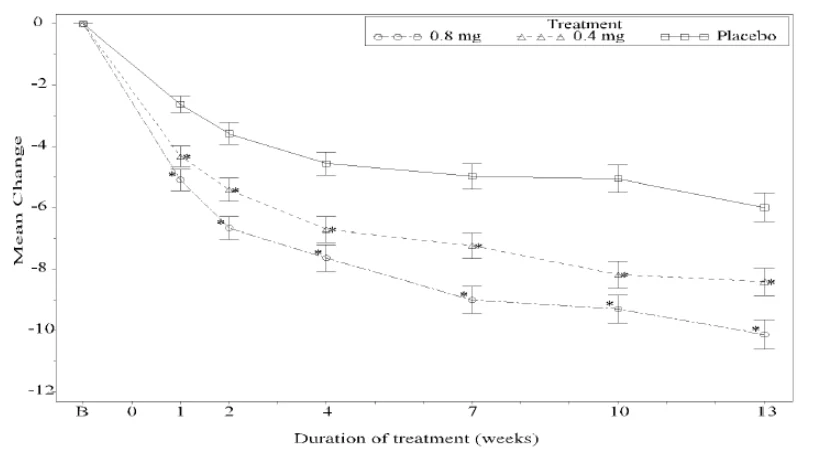
* indicates significant difference from placebo (p-value≤ 0.050).
B=Baseline determined approximately one week prior to the initial dose of double-blind medication at Week 0. Note: Patients in the 0.8 mg treatment group received 0.4 mg for the first week.
Note: Total AUA Symptom Scores range from 0 to 35.
Patients treated with tamsulosin hydrochloride had an increase in peak urine flow rate that was statistically significant (p-value ≤ 0.050) 4 to 8 hours after the initial dose of therapy (Figure 2). This improvement in the patients treated with tamsulosin hydrochloride was also evident throughout the duration of clinical studies in both the 0.4 mg once daily and 0.8 mg once daily dosing groups.
FIGURE 2: Mean (±S.E.) Increase in Peak Urine Flow Rate (mL/sec) Study 1
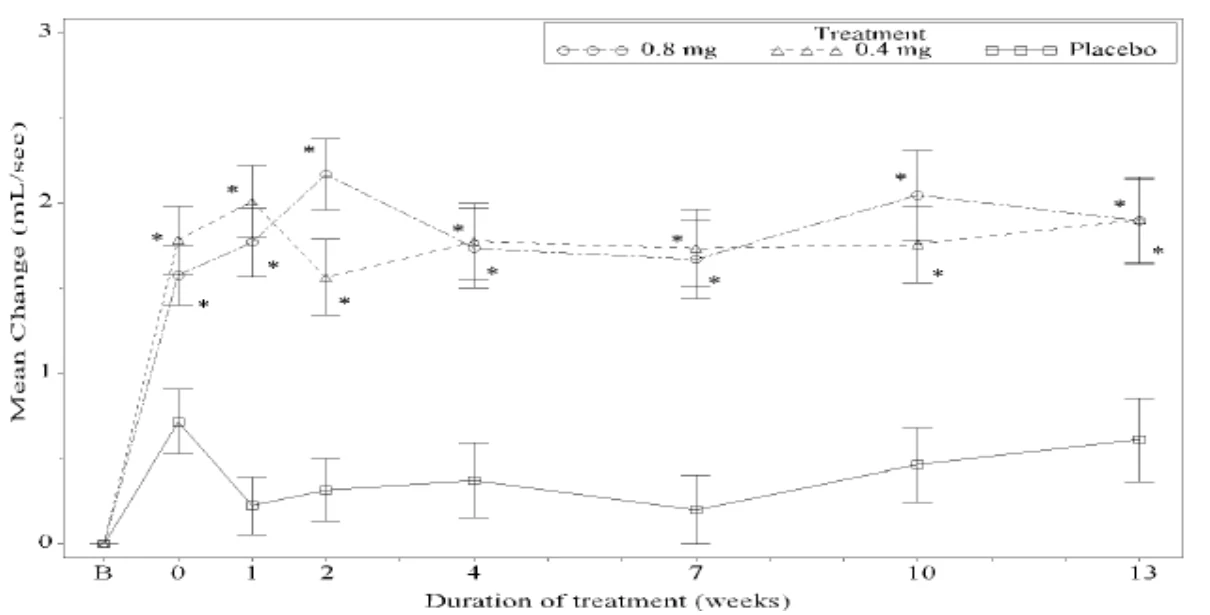
* indicates significant difference from placebo (p-value≤ 0.050).
B=Baseline determined approximately one week prior to the initial dose of double-blind medication at week 0.
Note: The uroflowmetry assessments at week 0 were recorded four to eight hours after patients received the first dose of double-blind medication.
Note: Patients in the 0.8 mg treatment group received 0.4 mg for the first week.
Patients in this study completed a validated Quality of Life assessment questionnaire covering the following topics: "physical discomfort," "worry about health," "bothersomeness of condition," and "time kept from doing things". Both tamsulosin hydrochloride treatment groups experienced statistically significant (p-value ≤ 0.050) improvements from Baseline to Endpoint compared with patients in the placebo treatment group. A subgroup analysis of the effect of tamsulosin hydrochloride on blood pressure of normotensive patients and uncontrolled hypertensive patients did not reveal any clinically significant blood pressure lowering effect of tamsulosin hydrochloride 0.4 or 0.8 mg once daily compared with placebo (Table 6). A similar lack of blood pressure lowering effect was also seen in controlled hypertensives (Baseline diastolic blood pressure < 90 mmHg).
TABLE 6 - MEAN CHANGE IN BLOOD PRESSURE (MMHG) FROM BASELINE TO FINAL VISIT IN STUDY 1
| Normotensio | Hypertension | ||||||
| Treatments | n | Mean Baseline Value | Mean Change | n | Mean Baseline Value | Mean Change | |
Systolic Blood Pressure (mmHg) | tamsulosin hydrochloride 0.8 mg once daily | 170 | 127 | -1.9 | 40 | 146 | -10.2 |
| tamsulosin hydrochloride 0.4 mg once daily | 182 | 127 | -2.7 | 37 | 145 | -7.2 | |
| Placebo | 172 | 127 | 1.3 | 41 | 147 | -8.4 | |
Diastolic Blood Pressure (mmHg) | tamsulosin hydrochloride 0.8 mg once daily | 170 | 80 | 0.1 | 40 | 96 | -8.5 |
| tamsulosin hydrochloride 0.4 mg once daily | 182 | 80 | 0.0 | 37 | 96 | -7.2 | |
| Placebo | 172 | 80 | 1.2 | 41 | 98 | -8.6 | |
* Hypertensive patients whose average of the last two diastolic measurements in the sitting position during the single-blind placebo evaluation period regardless of the treatment the patient was taking was ≥ 90 mmHg.
A total of 1547 patients with the signs and symptoms of BPH involved in the U.S. and European short-term trials continued therapy with tamsulosin hydrochloride in controlled and uncontrolled follow-up studies examining long-term efficacy and safety which support the use of tamsulosin hydrochloride for over one year in the treatment of BPH.
Results from a long-term, U.S. placebo-controlled, double-blind extension of Study 1 showed that, in the 269 patients treated with tamsulosin hydrochloride, both Total AUA Symptom Score and Peak Urine Flow Rate continued to show improvement (p-value <0.050) from Baseline for one year.
RENAL DYSFUNCTION
The pharmacokinetics of tamsulosin have been compared in subjects with moderate (n=6) or severe (n=6) renal impairment and in normal subjects (n=6). While a change in the overall plasma concentration of tamsulosin was observed as the result of altered binding to AAG, the unbound (active) concentration of tamsulosin, as well as the intrinsic clearance, remained relatively constant. Therefore, patients with such renal impairment do not require an adjustment in tamsulosin hydrochloride dosing. Patients with end stage renal disease (Clcr <10mL/min) have not been studied.
HEPATIC DYSFUNCTION
The pharmacokinetics of tamsulosin have been compared in subjects with hepatic dysfunction (n=8) and in normal subjects (n=8). While a change in the overall plasma concentration of tamsulosin was observed as the result of altered binding to AAG, the unbound (active)
concentration of tamsulosin does not change significantly with only a modest (32%) change in intrinsic clearance of unbound tamsulosin. Therefore, patients with mild to moderate hepatic dysfunction do not require an adjustment in tamsulosin hydrochloride dosage.
Three comparative bioavailability studies were performed under fed, fasting and steady-state conditions using healthy adult male volunteers.
A two-way crossover, blinded, single-dose, bioequivalence study was performed under fed conditions in 40 healthy adult male volunteers. A summary of the pharmacokinetic parameters is given in the Table 7 below:
Table 7 - Fed Tamsulosin 0.4 mg ( 1 x 0.4 mg) From measured data Geometric Mean Arithmetic Mean (CV %) | ||||
| Parameter | Test* | Reference† | % Ratio of Geometric Means* | 90% Confidence Interval* |
AUCT (ng x hr/mL) | 144.164 154.671 (38.9%) | 137.611 151.005 (44.6%) | 104.8 | 98.3 – 111.6 |
AUCI (ng x hr/mL) | 150.985 161.699 (38.7%) | 142.968 155.045 (44.3%) | 105.6 | 99.3 – 112.3 |
Cmax (ng/mL) | 9.231 9.966 (41.2%) | 8.060 8.883 (47.3%) | 114.5 | 105.0 – 124.9 |
Tmax $ (hrs) | 7.903 (29.2%) | 11.420 (44.8%) | ||
T½ $ (hrs) | 11.084 (24.4%) | 11.097 (25.6%) | ||
* Tamsulosin 0.4 mg Modified-Release Capsule (Ranbaxy Laboratories, Ltd., Batch No. 1380880) † FLOMAX ®, 0.4 mg SR Capsules (Boehringer Ingelheim, Canada, Batch No. K0400109) were purchased in Canada.
* Calculation based on least squares estimate
$ Expressed as arithmetic means (CV%) only.
A two-way crossover, blinded, single-dose, bioequivalence study was performed under fasting conditions in 36 healthy adult male volunteers. A summary of the pharmacokinetic parameters is given in the Table 8 below:
Table 8 - Fasting Tamsulosin 0.4 mg ( 1 x 0.4 mg) From measured data Geometric Mean Arithmetic Mean (CV %) | ||||
| Parameter | Test* | Reference† | % Ratio of Geometric Means* | 90% Confidence Interval* |
AUCT (ng x hr/mL) | 146.023 159.742 (44.9%) | 146.612 162.074 (47.1%) | 99.6 | 94.4 – 105 |
AUCI (ng x hr/mL) | 152.695 167.407 (45.5%) | 152.894 169.264 (47.8%) | 99.9 | 94.7 – 105 |
Cmax (ng/mL) | 12.999 13.593 (30.9%) | 14.208 14.933 (34.3%) | 91.5 | 85.2 – 98.2 |
Tmax $ (hrs) | 5.476 (18.6%) | 5.176 (19.7%) | ||
T½ $ (hrs) | 11.123 (40.3%) | 11.138 (30.7%) | ||
* Tamsulosin 0.4 mg Modified-Release Capsule (Ranbaxy Laboratories, Ltd., Batch No. 1380880) † FLOMAX ®, 0.4 mg SR Capsules (Boehringer Ingelheim, Canada, Batch No. K0400109) were purchased in Canada.
* Calculation based on least squares estimate
$ Expressed as arithmetic means (CV%) only.
A single blind, balanced, randomized, two-treatment, two-period, two-sequence, multiple-dose, crossover, bioequivalence study was performed under fasting condition in 32 healthy adult male volunteers. A summary of the pharmacokinetic parameters is given in the Table 9 below:
Table 9 – Steady-state Tamsulosin 0.4 mg (1 x 0.4 mg) From measured data Geometric Mean Arithmetic Mean (CV %) | ||||
| Parameter | Test # | Reference † | % Ratio of Geometric Means * | 90% Confidence Interval * |
AUC0-ح (ng-hr/mL) | 311.0810 339.7504 (44.2) | 303.0007 329.9317 (43.1) | 102.66 | 94.74 – 111.24 |
| (Cmax)ss (ng/mL) | 24.4986 25.9249 (34.4) | 25.7480 27.3947 (38.7) | 94.89 | 87.78 – 102.57 |
Cmin (ng/mL) | 5.5225 6.6148 (65.4) | 5.4298 6.4260 (61.3) | 101.93 | 91.63 – 113.38 |
| Tmax ** (h) | 5.219 (16.5) | 5.438 (16.5) | ||
| % Fluctuation ** | 147.9284 (27.1) | 162.2494 (24.8) | ||
# Tamsulosin 0.4 mg Modified-Release Capsule (Ranbaxy Laboratories Ltd., Batch No. 1670155). † FLOMAX ®, 0.4 mg SR Capsule (Boehringer Ingelheim, Canada, Lot No. G0600001) was purchased in Canada. * Calculation based on least squares estimate.
**Arithmetic Mean (CV %) only.
TOXICOLOGY
Carcinogenesis, Mutagenesis, and Impairment of Fertility
Rats administered doses up to 43 mg/kg/day in males and 52 mg/kg/day in females had no increases in tumour incidence with the exception of a modest increase in the frequency of mammary gland fibroadenomas in female rats receiving doses ≥ 5.4 mg/kg (P<0.015). The highest doses of tamsulosin evaluated in the rat carcinogenicity study produced systemic exposures (AUC) in rats 3 times the exposures in men receiving the maximum therapeutic doses of 0.8 mg/day.
Mice were administered doses up to 127 mg/kg/day in males and 158 mg/kg/day in females.
There were no significant tumour findings in male mice. Female mice treated for 2 years with the two highest doses of 45 and 158 mg/kg/day had statistically significant increases in the incidence of mammary gland fibroadenomas (P<0.0001) and adenocarcinomas (P<0.0075). The highest dose levels of tamsulosin evaluated in the mice carcinogenicity study produced systemic exposures (AUC) in mice 8 times the exposures in men receiving the maximum therapeutic dose of 0.8 mg/day.
The increased incidences of mammary gland neoplasms in female rats and mice were considered secondary to tamsulosin-induced hyperprolactinemia. It is not known if tamsulosin elevates prolactin in humans. The relevance for human risk of the findings of prolactin-mediated endocrine tumours in rodents is not known.
Tamsulosin produced no evidence of mutagenic potential in vitro in the Ames reverse mutation test, mouse lymphoma thymidine kinase assay, and chromosomal aberration assays in Chinese hamster ovary cells or human lymphocytes. There were no mutagenic effects in the in vivo sister chromatid exchange and mouse micronucleus assay.
Studies in rats revealed significantly reduced fertility in males dosed with single or multiple daily doses of 300 mg/kg/day of tamsulosin (AUC exposure in rats about 50 times the human exposure with the maximum therapeutic dose). The mechanism of decreased fertility in male rats is considered to be an effect of the compound on the vaginal plug formation possibly due to changes of semen content or impairment of ejaculation. The effects on fertility were reversible showing improvement by 3 days after a single dose and 4 weeks after multiple dosing. Effects on fertility in males were completely reversed within nine weeks of discontinuation of multiple dosing. Multiple doses of 10 and 100 mg/kg/day tamsulosin (1/5 and 16 times the anticipated human AUC exposure) did not significantly alter fertility in male rats. Effects of tamsulosin on sperm counts or sperm function have not been evaluated.
Studies in female rats revealed significant reductions in fertility after single or multiple dosing with 300 mg/kg/day of the R-isomer or racemic mixture of tamsulosin, respectively. In female rats, the reductions in fertility after single doses were considered to be associated with impairments in fertilization. Multiple dosing with 10 or 100 mg/kg/day of the racemic mixture did not significantly alter fertility in female rats.
REFERENCES
- 1. McGrath, J.C., Lepor H., Wyllit M.G. Report of a unique meeting between the alpha-blocker subcommittee and pharmaceutical industry. Urol 48(5), 1996.
- 2. Price D.T., Lomasney J.W., Allen L.F., Caron M.G., Lefkowitz. Identification, quantification, and localization of mRNA for three distinct alpha1 adrenergic receptor subtypes in human prostate. J Urol 1993; 150:546-551.
- 3.
Hatano A., Takahashi H., Tamaki M., Komeyama T., Koizumi T., Takeda M.
Pharmacological evidence of distinct α1 - adrenoceptor subtypes mediating the contraction of human prostatic urethra and peripheral artery. Br J Pharmacol
1994; 113:723-728.
- 4.
Moriyama N., Hamada K., Takanashi M., Kurimoto S., Kimura K., Inagaki 0.
Evaluation of α1 - adrenoceptor subtypes in human hypertrophied prostate using
[3H]YM617, an α1-selective antagonist. Acta Histochem Cytochem 1994; 27
(3):219-225.
- 5.
Faure C., Pimoule C., Vallancien G., Langer S.Z., Graham D. Identification of α1
- adrenoceptor subtypes present in the human prostate. Life Sci
1994;54(21):1595-1605.
- 6.
Michel M.C., Insel P.A. Comparison of cloned and pharmacologically defined rat tissue α1 - adrenoceptor subtypes. Naunyn-Schmiedebergs Arch Pharmacol
1994;350(2):136-142.
- 7.
Yamada S., Suzuki M., Tanaka C., Mori R., Kimura R., Inagaki 0. comparative study on α1 - adrenoceptor antagonist binding in human prostate and aorta.
Clinical and Experimental Pharmacol and Physiol 1994;21:405-411.
- 8. Product Monograph for Flomax® (tamsulosin hydrochloride) sustained-release capsules, 0.4 mg, Date of Revision: December 20, 2005.