


Patient Medication Information: uses, side effects, how to take - Retin-A Micro
ABOUT THIS MEDICATION
What the medication is used for:
RETIN-A MICRO contains tretinoin which is related to Vitamin A. RETIN-A MICRO is effective against:
- blackheads,
- whiteheads, and
inflammatory lesions of acne such as papules and
pustules.
It is applied to the skin.
What it does:
This medicine works by causing the outer layer of the skin to grow more rapidly, which decreases the amount of the protein “keratin” in the skin. As a result, the surface layer of the skin becomes thinner and pores are less likely to become blocked, reducing the occurrence of whiteheads, blackheads and pimples.
When it should not be used:
Do not use if you have an allergy to RETIN-A or any of the ingredients.
What the medicinal ingredient is:
Tretinoin
What the important nonmedicinal ingredients are: Other components of this formulation are Purified Water, Carbomer, Glycerin, Disodium EDTA, Propylene Glycol, Propylene Glycol Dicaprylate/Dicaprate, Sorbic Acid, PPG-20 Methyl Glucose Ether Distearate, Cyclomethicone and Dimethicone Copolyol, Benzyl Alcohol, Trolamine, and Butylated Hydroxytoluene.
What dosage forms it comes in:
RETIN-A MICRO is a microsphere gel in 0.04% w/w and 0.1% w/w strengths. It is supplied as a topical gel in a 50 g pump.
WARNINGS AND PRECAUTIONS
BEFORE you use RETIN-A MICRO talk to your doctor or pharmacist if:
You are pregnant or might become pregnant. If you are
female of child-bearing age, you should only use Retin-A Micro after consulting your doctor and seeking advice for contraceptive counselling. If you become pregnant, discontinue use of RETIN-A MICRO and consult your doctor.
You are breastfeeding. It is not known if RETIN-A
MICRO can pass through your milk to the baby.
- You are planning to be in the sun.
- You are using or plan to use any other medicine for your acne at the same time as RETIN-A MICRO.
You are taking medicines for other health conditions.
Some medicines may make your skin more sensitive to sunlight.
Avoid exposure to sunlight as much as possible while using RETIN-A MICRO. Do not use ultraviolet (UVB) or long-wavelength ultraviolet (UVA) sunlamps. If you have sunburn, you should not use RETIN-A MICRO until you are completely recovered. Do not apply RETIN-A MICRO to areas of the skin where you have other problems such as sunburn, eczema, severely inflamed skin or open lesions.
Safety and effectiveness in children below the age of 12 have not been established.
INTERACTIONS WITH THIS MEDICATION
Use other acne medicine only on your doctor’s advice and follow the doctor’s instructions carefully. The medications you used in the past might cause redness or peeling.
See also below “WHAT SHOULD I AVOID WHILE USING RETIN-A MICRO?”.
PROPER USE OF THIS MEDICATION
Usual dose: Use once per day.
- 1. Wash with a mild, non-medicated soap and dry skin gently.
- 2. Apply RETIN-A MICRO once daily before bedtime (or as directed by your doctor).
- 3.
You should not use more than the amount of RETIN-A
MICRO, suggested by your physician or to apply RETIN-A MICRO more frequently than instructed. Too much medication may irritate the skin, waste medication and will not give faster or better results.
- 4. Keep the medication away from the corners of the nose, mouth, eyes and open wounds or other areas where treatment is not intended. Spread it away from these areas when applying.
- 5. Pump: fully depress the pump twice to dispense a small amount (about the size of a pea) on your fingertip. Spread on the skin where acne lesions appear, using enough to cover the entire affected area lightly. Smooth gently into the skin. Some patients may experience a slight visible residue of medication after application.
IMPORTANT: PLEASE READ
- 6. Keep container closed when not in use.
- 7.
If your doctor has prescribed another topical acne treatment
(i.e. benzoyl peroxide or topical antibiotic), do not apply RETIN-A MICRO at the same time of day as the other products.
- 8.
Early in therapy, some patients may notice an appearance of
new blemishes (papules and pustules). At this stage it is important to continue using RETIN-A MICRO.
- 9.
Don't be discouraged if you see no immediate improvement.
Don’t stop treatment at the first signs of improvement. Therapeutic results may be noticed after two weeks, and more than four weeks of therapy are required before consistent beneficial effects are observed. It is likely that your doctor will have you use RETIN-A MICRO for 6 to 8 weeks before checking your progress. Patients in clinical trials were treated for 12 weeks.
What should I avoid while using RETIN-A MICRO?
Spend as little time as possible in the sun. Use a daily
sunscreen with a SPF 15 rating or higher, sun protective clothing, and a wide brimmed hat to protect you from sunlight. When outside, even on hazy days, areas treated with RETIN-A MICRO should be protected. Do not use sunlamps. RETIN-A MICRO may make you get sunburned more easily. If you do get sunburned, stop using RETIN-A MICRO until your skin is completely back to normal. Talk to your doctor about how to protect you skin if you must be in sunlight a lot.
Avoid cold weather and wind as much as possible and use
clothing to protect you from the weather. Skin treated with RETIN-A MICRO may dry out or get wind burned more easily.
Avoid skin products that may dry or irritate your skin. Such
products are those that contain astringents, alcohol, or spices and include certain medicated soaps, shampoos and hair permanent solutions. Avoid contact with the peel of limes. Your skin may become very dry, red swollen, blistered, or crusted with these products. If you get severe skin irritation or skin irritation that will not go away, stop using RETIN-A MICRO and call your doctor. You should talk to your doctor about the use of all skin care products while using RETIN-A MICRO .
Avoid washing your face too often and do not scrub your
face hard when washing it. Use a mild, non-medicated soap and wash gently and pat dry.
Overdose:
If you have applied too much RETIN-A MICRO, remove any excess applied. You may get severe skin irritation with redness, peeling, blistering and itchiness. If this happens, stop the treatment and contact your doctor. It is recommended that you apply a moisturizer or a moisturizer with sunscreen that will not aggravate your acne (non-comedogenic) every morning after you
wash.
Overdose:
If you have applied too much RETIN-A MICRO, remove any excess applied. You may get severe skin irritation with redness, peeling, blistering and itchiness. If this happens, stop the treatment and contact your doctor. It is recommended that you apply a moisturizer or a moisturizer with sunscreen that will not aggravate your acne (non-comedogenic) every morning after you wash.
Missed Dose:
If you forget to use RETIN-A MICRO, apply it when you remember, and then go back to using it as you would normally. If it is almost time for your next application, skip the one you missed.
SIDE EFFECTS AND WHAT TO DO ABOUT THEM
Peeling, burning, itching, dryness, stinging and redness may occur with some people during the first one or two weeks of therapy. These reactions can easily be minimized by following the instructions carefully. Should the effects become excessively troublesome, discontinue use and consult your doctor.
This is not a complete list of side effects. For any unexpected effects while taking RETIN-A MICRO, contact your doctor or pharmacist.
HOW TO STORE IT
Keep RETIN-A MICRO in a cool, dry place where the temperature is below 25°C. Protect pump containers from heat. Keep your medicines where children cannot reach them. Do not store RETIN-A MICRO or any other medicine, in the bathroom or near a sink. Do not leave medicines in the car or on windowsills. Heat and dampness can destroy some medicines.
Reporting Side Effects
You can report any suspected side effects associated with the use of health products to Health Canada by:
Visiting the Web page on Adverse Reaction Reporting (https://www.canada.ca/en/health-canada/services/drugs-health-products/medeffect-canada/adverse-reaction-reporting.html) for information on how to report online, by mail or by fax; or
Calling toll-free at 1-866-234-2345.
NOTE: Contact your health professional if you need information about how to manage your side effects. The Canada Vigilance Program does not provide medical advice.
IMPORTANT: PLEASE READ
MORE INFORMATION
This document plus the full product monograph, prepared for health professionals can be obtained by contacting the sponsor, Bausch Health, Canada Inc., at: 1-800-361-4261
Last revised: September 29, 2020
PHARMACOLOGY
Animal Studies
The pharmacokinetics and biotransformation of dermal tRA (tretinoin) have been studied extensively in animals. After application of 3H-tRA in tretinoin Microsponge Gel, the systemic exposure to total radioactivity was low, and decreased in the order: mice>> rats> rabbits> dogs. These levels paralleled both the agility of the animals for grooming and the known relationship of the permeability of the skin of the animals used in these studies. The high levels in mice (up to 0.2 mcg/mL) were probably due to ingestion of tRA. A comparable study in humans showed that the plasma levels achieved in these laboratory animals were orders of magnitude higher than those following the application of a potential therapeutic dose to man (see below).
Human Studies
Irritation Potential
Although tretinoin is intrinsically irritating to the skin, RETIN-A MICRO (microsphere) has been found to be significantly less irritating than Retin-A Cream, 0.1% w/w. In a trial in women with sensitive skin, but without acne or other skin diseases, when the products were applied to opposite facial cheeks for up to 14 days, RETIN-A MICRO (microsphere) was significantly better tolerated and less irritating than Retin-A Cream. In an irritancy study in both men and women with healthy skin, the cumulative 21-day irritation score for RETIN-A MICRO (microsphere) was consistent with a mild local irritant, whereas Retin-A Cream was substantially more irritating (see Figure 1). The lower irritancy of RETIN-A MICRO (microsphere) may be attributable to the design of its vehicle, which contains the patented MICROSPONGE System (acrylates copolymer microspheres).
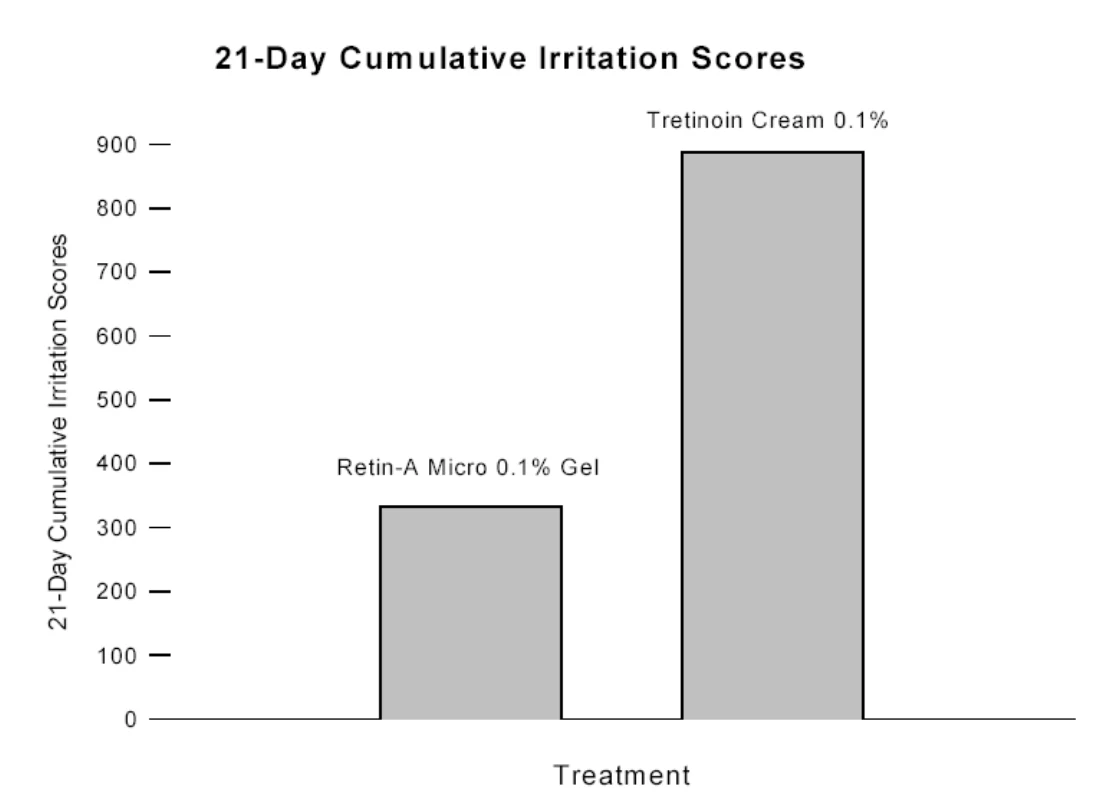
Figure 1: The maximum possible 21-day cumulative irritation score was 3,000; the vehicles associated with RETIN-A MICRO (microsphere) 0.1% w/w and tretinoin cream 0.1% w/w had 21-day scores of 2 and 7, respectively. Statistical analysis indicated that RETIN-A MICRO (microsphere) 0.1% w/w (score=332) was significantly less irritating then tretinoin cream 0.1% w/w (score=887), and that each tretinoin-containing product was significantly different from its vehicle.
Pharmacokinetics
A pharmacokinetics study (B0281S) was conducted in 44 healthy male and female subjects who received single or repeated daily topical applications of TMG 0.1% w/w or RETIN-A Cream 0.1% w/w. Percutaneous absorption was determined by cumulative excretion of radioactivity into the urine and feces. Mean (SD) total absorption was 0.82 (0.11) % and 1.41 (0.54) %, respectively, for subjects administered single or multiple dose(s) of TMG 0.1% w/w. Mean (SD) total absorption with RETIN-A Cream 0.1% w/w was 1.13 (0.31) % and 2.26 (0.55) % of the dose, respectively, for subjects who received single or multiple dose(s). Mean (SD) peak total plasma radioactivity concentrations were 0.062 (0.03) and 0.163 (0.078) ng.equivalents/mL after a single dose and after multiple doses of TMG 0.1% w/w, respectively. Mean (SD) peak total plasma radioactivity concentrations with RETIN-A Cream 0.1% w/w were 0.105 (0.046) and 0.242 (0.096) ng·equivalents/mL after a single dose and after multiple doses, respectively. Although absorption in all treatment groups was minimal, there was a statistically significant difference in overall absorption between subjects administered multiple doses of TMG 0.1% w/w and subjects administered multiple doses of RETIN-A Cream 0.1% w/w (p=0.0001). Endogenous concentrations of tretinoin and its metabolites, 13-cis-retinoic acid (CIS-RA), all-trans-4-oxo-retinoic acid (OXO-RA), and 13-cis-4-oxo-retinoic acid (CIS-OXO), generally ranged from 1-3 ng/mL and were essentially unaltered after either single or multiple applications of either TMG 0.1% w/w or RETIN-A Cream 0.1% w/w. The results of Study B0281S were consistent with those previously observed with various 0.05% tretinoin cream formulations.
TOXICOLOGY
Animal Studies
The preclinical toxicity of topically administered tretinoin has been extensively evaluated. The primary adverse effect is on the skin at the site of application. Secondarily there is evidence of systemic compensatory mechanisms in response to the dermal insult. Although oral administration of tretinoin can produce plasma levels adequate to produce systemic toxicity, the systemic exposure to tretinoin in animals treated dermally usually remains below the threshold required to produce these effects.
The APS MICROSPONGE formulation itself (no drug) demonstrated low potential for irritancy with no incremental risk due to the percutaneous absorption when compared to other topical tretinoin formulations. The polymer is highly cross-linked and is considered inert. The amount of possible residual monomers and solvents in the finished formulation have been shown to have safety factors greater than 3X10⁶, based on acute non-clinical toxicity studies.
Acute Toxicity
The acute oral toxicity of TMG 0.1% w/w was evaluated in rats. In each study, all animals survived the 14-day observation period, and there were no gross abnormalities noted at necropsy. In each acute toxicity study, it was concluded that the test articles were not toxic orally to rats under the test conditions.
Long-Term Toxicity
Multidose toxicity studies with TMG 0.1% w/w were performed in mice and dogs. The primary toxic effect of topically applied TMG 0.1% w/w in laboratory animals is dermal irritation in various degrees. Secondary effects are evident in the lymph systems that service the application sites, i.e., increased numbers of circulating leucocytes and lymphoid hyperplasia. These lesions are generally reversible on withdrawal of dosing. In the 3-month dermal toxicity study in mice, retinoid-like effects (increased food consumption, slight decreases in erythrocyte parameters in the males, decreased cholesterol and triglycerides in the males, decreased T4 concentrations, and decreased absolute and relative testes weights and absolute ovarian weights), were seen at the high dose of 5 mg/kg/day, probably due to ingestion of tretinoin. The analysis of plasma samples collected during the study supported this conclusion. Pre-dose concentrations of the retinoids were consistently below the limit of quantification (<5 ng/mL). By contrast, certain of the samples collected at 4 hours post-dose from the mid and high dose groups contained measurable concentrations of tRA, together with quantifiable levels of 13-cis-RA.
Carcinogenicity
Although there have been no direct studies on the carcinogenic potential of TMG 0.1% w/w, it has been previously demonstrated that topical application of tretinoin to mice for 20 months at dose levels up to 1.0 mg/kg (100 X the clinical dose of TMG 0.1% w/w) was not carcinogenic.
There is considerable conflicting information on the possible role of tretinoin in photocarcinogenicity studies in laboratory animals with simulated ultraviolet radiation. In addition, the human relevance of dermal carcinogenicity studies in albino mice has been questioned because these mice lack melanin and have no facility for developing a protective tan. In studies using pigmented mice, no evidence of photocarcinogenic activity has been seen. More importantly, with the experience of a quarter century of use, there is no clinical evidence that topically applied tretinoin enhances photocarcinogenicity.
Mutagenicity
There is no evidence that tretinoin possesses mutagenic potential as evaluated by the Ames assay or the Micronucleus Assay.
Reproduction and Teratology
Percutaneous administration of TMG 0.1% w/w does not affect the development of rat or rabbit conceptuses when administered at doses up to 500 X or 100 X the clinical dose, respectively. In rats, the maternal no-observable-effect-level (NOEL) for TMG 0.1% w/w was less than 0.2 mg tretinoin/kg/day, as 0.2 mg/kg/day was the lowest dose tested and caused cutaneous responses (erythema, edema, desquamation) and reduced body weight gain and feed consumption. The developmental NOEL for TMG 0.1% w/w was greater than or equal to 1.0 mg tretinoin/kg/day (>100 X the recommended clinical dose); no adverse effects on embryo-fetal viability, fetal body weight, or fetal morphology occurred at this, the highest dose tested. Thus, TMG 0.1% w/w was not considered to be a developmental toxicant in rats.
Two developmental toxicity studies were performed in New Zealand white rabbits. The maternal NOEL for TMG 0.1% w/w in the first study was less than 0.2 mg tretinoin/kg/day; all doses of the test article formulation significantly increased the severity of skin irritation, as compared with the level of skin irritation caused by the vehicle formulation. However, the vehicle formulation alone also caused skin irritation. No other adverse effects were caused by doses of the test article as high as 1.0 mg tretinoin/kg/day. The developmental NOEL for TMG 0.1% w/w was 0.2 mg tretinoin/kg/day (20 X the recommended clinical dose). Treatment with the 0.5 and 1.0 mg tretinoin/kg/day doses appeared possibly associated with increased incidences of varying degrees of dilation of the lateral and/or third ventricles in the brain and other alterations in some of the fetuses. Because all doses caused a maternal response, and alterations that occurred in the fetuses did not always present clear dose-dependent patterns, a clear causal relationship of the test article formulation and these fetal abnormalities could not be established. In addition, there were several animals with measurable parent and/or metabolite concentrations at sporadic intervals in the study, suggesting possible exposure by the oral route. Plasma analyses for determination of tretinoin and its metabolites, 13-cis-retinoic acid (13-cis-RA), all-trans-4-oxo-retinoic acid (4-oxo-tRA), and 4-oxo-13-cis-retinoic acid (4-oxo-13-cis-RA), indicated that, in general, the concentrations of these retinoids after treatment with TMG 0.1% w/w were all below the lower limit of quantification of 5 ng/mL, with the exception that tretinoin and/or 13-cis-RA were observed in a few samples collected from the mid-dose group and the high-dose group 24 hours after the first and final high dose, indicating minimal dermal absorption. However, the measurable concentrations of tretinoin and/or 13-cis-RA observed in the mid dose group and the high dose group 24 hours after the first and final dose suggested the possibility of sporadic ingestion.
An additional rabbit study was performed that took precautions to prevent ingestion of topically administered TMG 0.1% w/w (i.e. through grooming behaviour). There were no anomalies in any of the pups in this repeat rabbit teratology study at doses as high as 1.0 mL/kg of TMG 0.1% w/w (1.0 mg/kg tretinoin). This dose represents a multiple of 100 times the clinical dose (500 mg TMG 0.1% w/w) for a 50 kg individual.
Human Studies
Clinical studies performed with TMG 0.1% w/w demonstrate that TMG 0.1% w/w is less irritating than tretinoin cream 0.1% w/w. Additional, studies have shown that TMG 0.1% w/w does not cause contact sensitization, phototoxicity, or photoallergenic reactions in humans.
REFERENCES
- 1.
Buchan P, Eckhoff C, Caron D, Nau H, Shroot B. Repeated Topical Administration of
All-trans-Retinoic Acid and Plasma Levels of Retinoic Acids in Humans. J Am Acad Dermatol 1994;30(3):428-434.
- 2.
Gendimenico GJ, Mezick JA. Pharmacological Effects of Retinoids on Skin Cells. Skin
Pharmacology 1993;6(suppl 1):24-34.
- 3.
Kochhar DM, Christian MS. Tretinoin: A Review of the Nonclinical Developmental
Toxicology Experience. J Am Acad Dermatol 1997;36(3):S47-S59.
- 4.
Halder RM. The Role of Retinoids in the Management of Cutaneous Conditions in
Blacks. J Am Dermatol 1998;39:S98-103.
- 5.
Latriano L, Tzimas G, Wong F, Wills RJ. The Percutaneous Absorption of Topically
Applied Tretinoin and its Effect on Endogenous Concentrations of Tretinoin and its Metabolites after Single Doses or Long-term Use. J Am Acad Dermatol 1997;36(3):S37-S46.
- 6. Leyden JJ. Therapy for Acne Vulgaris. NEJM 1997;1156-1162 .
- 7.
Regazzi MB, Iacona I, Gervasutti C, Lazzarino M, Toma S. Clinical Pharmacokinetics of
Tretinoin. Clin. Pharmacokinetics 1997;32(5):382-402.
- 8. Scott SC. Retin-A Micro. Plast Reconstr Surg 1998;(102/4):1272-1273.
- 9.
Shapiro SS, Latriano L. Pharmacokinetic and Pharmacodynamic Considerations of
Retinoids: Tretinoin. J Am Acad Dermatol 1998;39:S13-S16.
- 10. Shapiro L, Pastuszak A, Curto G, Koren Get al. MotherRisk Update-is Topical Tretinoin
- 11. Safe During the First Trimester? Canadian Family Physician 1998; 44:495-498.
- 12.
Webster GF. Topical Tretinoin in Acne Therapy. J Am Acad Dermatol 1998;39:S38-
S44.
- 13. Nyirady J, Lucas C, Yusuf M, Mignone P, Wisniewski S. The stability of tretinoin in tretinoin gel microsphere 0.1%. Cutis 2002;70(5):295-8.
- 14. Nyirady J, Grossman RM, Nighland M, Berger RS, Jorizzo JL, Kim YH et al. A comparative trial of two retinoids commonly used in the treatment of acne vulgaris. J Dermatolog Treat 2001;12(3):149-57.
- 15.
Egan N, Loesche MC, Baker MM. Randomized, controlled, bilateral (split-face)
comparison trial of the tolerability and patient preference of adapalene gel 0.1% and tretinoin microsphere gel 0.1% for the treatment of acne vulgaris. Cutis 2001;68(4 Suppl):20-4.
- 16. Thiboutot D, Gold MH, Jarratt MT, Kang S, Kaplan DL, Millikan L et al. Randomized controlled trial of the tolerability, safety, and efficacy of adapalene gel 0.1% and tretinoin microsphere gel 0.1% for the treatment of acne vulgaris. Cutis 2001;68(4 Suppl):10-19.
- 17. Nyirady J, Nighland M, Payonk G, Pote J, Phillips S, Grossman R. A comparative evaluation of tretinoin gel microsphere, 0.1%, versus tretinoin cream, 0.025%, in reducing facial shine. Cutis 2000;66(2):153-6.
- 18. Galvin SA, Gilbert R, Baker M, Guibal F, Tuley MR. Comparative tolerance of adapalene 0.1% gel and six different tretinoin formulations. Br J Dermatol 1998;139(Suppl 52):34-40.