


Product Monograph - Sinografin - Liq IU
INDICATIONS
Sinografin is specifically intended for hysterosalpingography. Its density allows excellent visualization. Sinografin is valuable both in gynecological problems, where safe anatomical visualization of the cervix, uterine and tubal cavities is desirable in order to determine causes of sterility, and also in the diagnosis of pelvic pathology.
CONTRAINDICATIONS
Sinografin is contraindicated in the presence of pregnancy or acute pelvic inflammatory disease. Hysterosalpingography should not be attempted within
30 days following curettage or conization. Sinografin should not be administered to patients exhibiting sensitivity to the test dose.
Sensitivity to iodine per se or to other contrast media is not an absolute
contraindication to the use of Sinografin.
PRECAUTIONS
Diagnostic procedures which involve the use of radiopaque diagnostics agents should be carried out under the direction of personnel with the prerequisite training and with a thorough knowledge of the particular procedure to be performed.
In patients having or suspected of having carcinoma of the uterus and/or uterine tubes, the possible dispersion of carcinogenic cells during hysterosalpingography should be borne in mind.
Diatrizoate meglumine and iodipamide meglumine administered intravascularly has been found to be excreted in breast milk. Because small amounts of these agents may be absorbed following intra-uterine instillation, caution should be exercised when any diagnostic intra-uterine radiopaque agent is administered to a nursing woman.
Thyroid Dysfunction
Sinografin, like all other iodinated contrast media, may induce changes in thyroid function in some patients. Transient hyperthyroidism has been reported following iodinated contrast media administration to adult and pediatric patients.
ADVERSE REACTION
Hypersensitivity reactions may include urticaria, serum sickness-like reactions
(fever, rash, arthralgia), other skin rashes, and rarely, anaphylactoid shock. They are more likely to occur in individuals with a history of allergy, asthma, hay fever, or urticaria, and in those who have previously demonstrated hypersensitivity to
iodine compounds. Urticarial, serum sickness-like and other skin rash reactions
may be controlled by antihistamines and, if necessary, corticosteroids. Serious
anaphylactoid reactions are not controlled by antihistamines, and require such
measures as the immediate use of ephinephrine or phenylephrine, oxygen, and
intravenous corticosteroids.
Post-Market Adverse Drug Reaction
Endocrine Disorders
Thyroid function tests indicative of hypothyroidism or transient thyroid suppression have been uncommonly reported following iodinated contrast media administration to adult and pediatric patients.
PHARMACEUTICAL INFORMATION
CHEMISTRY
Proper Name: Diatrizoate Meglumine
Structural Formula:

Molecular Formula: C11H9I3N204 • C7H17N05
Molecular Weight: 809.13
Proper Name: Iodipamide Meglumine
Structural Formula:
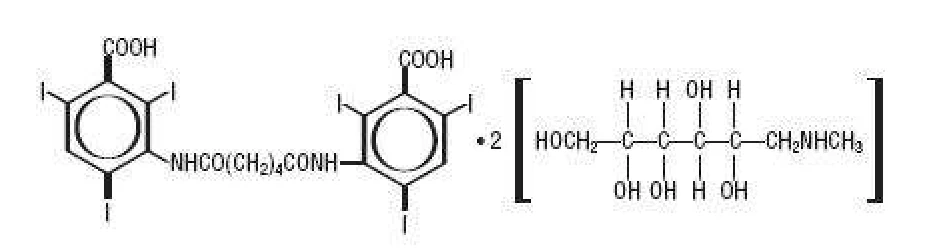
Molecular Formula: C20H14I6N206 • 2C7H17NO5
Molecular Weight: 1530.20
DOSAGE AND ADMINISTRATION
Preparation of the patient: As a precautionary measure, the procedure should be performed three to five days after the cessation of the patient’s menstrual period.
An enema and vaginal douche 1 hour before the examination are helpful, but not essential. Patients should empty the bladder before the examination. Since the
procedure is remarkably free of pain when Sinografin is used, no narcotic or
anesthesia is necessary.
Dosage: 3 to 4 mL of Sinografin are usually adequate to visualize the uterus, and an additional 3 to 4 mL will demonstrate the tubes. Total dosage varying from
1.5 to 10 mL has been employed with satisfactory results.
Administration: (See diagram2,3): The patient is placed in the lithotomy position and the vulva is cleansed with a suitable antiseptic solution. A Graves-type vaginal speculum is introduced, the cervix is exposed, and the vaginal vault is sponged with antiseptic solution. A tenaculum is placed on the cervical lip, usually the anterior lip. A sterile sound may be passed to determine the position of the uterus and the direction of the cervical canal, and, when necessary, the cervical canal may be dilated. (Sounding the uterine cavity and dilatation of the canal are usually not required when a flexible cannula tip is used.3)
A sterile syringe containing the Sinografin is attached by Luer-Lok to a uterine
cannula. The 2-way cannula valve is opened and all air bubbles in the cannula
and syringe are expressed. About 1.5 to 2 mL of Sinografin are required to fill
the cannula. (If preferred, a tubal insufflator under controlled pressure with a
salpinpogram attachment may be used instead of the syringe.)
The cannula tip is inserted into the cervical canal so that the adjustable rubber
acorn obturator fits snugly at the external os. Careful placement of the cannula
is important to avoid trauma and pain. Squeezing the trigger of the cannula to
provide simultaneous traction on the tenaculum and forward pressure on the
cannula should give a non-leaking cervical seal. Sinografin flows freely so that
only gentle pressure on the plunger is necessary.
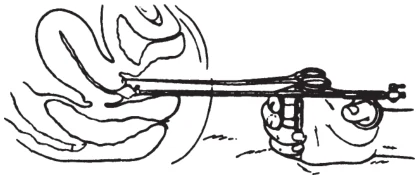
The connection at the external os is checked for leakage. If the acorn obturator
is inadequate, an inflatable balloon-obturator may be used to seal the cervical
canal.3 When the equipment has been positioned satisfactorily, the tenaculum
and cannula may be fixed in position until the procedure is terminated.
Radiography: Sinografin is administered in fractional doses of approximately
1 mL. A scout film may be made before the medium is administered. After the
initial instillation a film should be made using a Bucky diaphragm. After each
successive instillation of 1 mL, a film is taken, developed immediately, and
inspected in the dark room before the next fractional dose of Sinografin is given, until the procedure is completed. Anterior, posterior, and oblique films are taken.
To minimize radiation exposure, serial X-ray pictures should be taken in preference to fluoroscopic visualization where possible.
Clinical experience to date indicates that tubal patency, if present, will be
demonstrable at the time of the instillation4 and delayed films have not been
required. The medium is completely absorbed within 1 hour unless there is an
obstruction and dilatation of the tubes in which case absorption is generally
complete within 24 hours. Any residual Sinografin within the uterine cavity is
usually expelled immediately upon removal of the cannula.
SENSITIVITY TESTING
In patients with strong allergic histories, sensitivity testing may be accomplished
by slowly injecting 1 mL or a fraction thereof intravenously.
AVAILABILITY
Sinografin is supplied as an aqueous solution, providing 52.7% of the meglumine salt of diatrizoic acid (3,5-diacetylamino-2,4,6-triilodobenzoic acid) and 26.8%
of the meglumine salt of N,N’-adipyl-bis (3-amino-2,4,6- triiodobenzoic acid).
The solution contains approximately 38% (3.8 gm/10 mL) firmly bound iodine.
The preparation also contains 0.364% sodium citrate as a buffer, 0.04% disodiumedetate as a sequestering agent. Each vial contains 10 mL of Sinografin with sufficient excess for sensitivity testing if desired.
STORAGE
Sinografin may be stored at room temperature but should be protected against
exposure to strong light. The Sinografin solution may vary in color from essentially colorless to light amber; however, solutions which have become strongly discolored should not be used. When Sinografin is kept in the syringe for prolonged periods prior to injection, it should be protected from exposure to strong light. Sinografin should be used as promptly as possible following withdrawal into the syringe, and syringes should be rinsed as soon as possible after injection to prevent freezing of the plunger.
REFERENCES
- 1. Hemphill, J.E.: Hysterosalpingography with a water soluble contrast agent. Monogr Therap 2:301, 1957.
- 2.
Kahn, E.: Versatile self-retaining trigger cannula and traction tenaculum for modern tubal insufflation and uterosalpingography. Amer J Obstet Gynec
58:810, 1949.
- 3. Kahn, E.: Inflatable tip and other modified interchangeable tips for the triggercannula used in the study of female sterility. Amer J Obstet Gynec 60:692, 1950.
- 4. Whitelaw, M.J., and Miller, E.B.: New water-soluble medium (Sinografin) for hysterosalpingography. Fertil Steril 10:227, 1959