


Product Monograph - Sterile Water for Injection USP (B. Braun Medical, PM 00062611)
Serious Warnings and Precautions
- Hypotonic and Hemolytic: Do not inject until made isotonic by addition of an appropriate solute; due to possibility of hemolysis (see Warnings and Precautions);
- This product contains aluminum that may be toxic. Aluminum may reach toxic levels with prolonged parenteral administration if kidney function is impaired (see Warnings and Precautions).
Preparation for Administration
- 1. Remove plastic protector from sterile set port at bottom of container.
- 2. Attach administration set. Refer to complete directions accompanying set.
To Add Medication
Warning: Some additives may be incompatible.
Addition of medication should be accomplished using complete aseptic technique.
To Add Medication Before Solution Administration
- 1. Prepare medication site.
- 2. Using syringe with 18-22 gauge needle, puncture medication port and inner diaphragm and inject.
- 3. Squeeze and tap ports while ports are upright and mix solution and medication thoroughly.
To Add Medication During Solution Administration
- 1. Close clamp on the set.
- 2. Prepare medication site.
- 3. Using syringe with 18-22 gauge needle of appropriate length (at least 5/8 inch), puncture resealable medication port and inner diaphragm and inject.
- 4. Remove container from IV pole and/or turn to an upright position.
- 5. Evacuate both ports by tapping and squeezing them while container is in the upright position.
- 6. Mix solution and medication thoroughly.
- 7. Return container to in use position and continue administration.
5 OVERDOSAGE
Overdosage (hypotonic expansion) is a function of an increase in fluid intake over fluid output, and occurs when the increase in the volume of body fluids is due to water alone. Overdosage may occur in patients who receive large quantities of electrolyte-free water to replace abnormal excessive fluid losses, in patients whose renal tolerance to water loads is exceeded, or in patients who retain water postoperatively in response to stress.
Manifestations of water intoxication are behavioral changes (confusion, apathy, disorientation and attendant hyponatremia), central nervous system disturbances (weakness, muscle twitching, headaches, nausea, vomiting, convulsions) and weight gain.
Treatment consists of withholding fluids until excessive water is excreted. In severe hyponatremia it may be necessary to cautiously administer hypertonic saline to increase extracellular osmotic pressure and excretion of excess water by the kidneys.
For management of a suspected drug overdose, contact your regional poison control centre.
6 DOSAGE FORMS, STRENGTHS, COMPOSITION AND PACKAGING
| Route of Administration | Dosage Form / Strength/Composition | Non-medicinal Ingredients |
| For Intravenous Use Only | Liquid, 100% | There are no non-medicinal ingredients. |
Sterile Water for Injection USP is a clear, colorless, odorless liquid.
It is sterile, hypotonic, nonpyrogenic, and contains no bacteriostatic or antimicrobial agents. Sterile Water for Injection USP is a diluent or solvent suitable for intravascular injection after first having been made isotonic by the addition of suitable solute. pH 5.5 (5.0 – 7.0). The osmolarity is 0 mOsmol / L.
Excel Plastic Container not made with natural rubber latex, PVC or DEHP.
The plastic container is made from a multilayered film specifically developed for parenteral drugs. The solution contact layer is a rubberized copolymer of ethylene and propylene. The container is nontoxic and biologically inert. The container-solution unit is a closed system and is not dependent upon entry of external air during administration. The container is overwrapped to provide protection from the physical environment and to provide an additional moisture barrier when necessary. Sterile Water for Injection USP is supplied sterile and nonpyrogenic in EXCEL® Containers. The 1000 mL containers are packaged 12 per case; the 500 mL and
250 mL containers are packaged 24 per case.
The closure system has two ports; the one for the administration set has a tamper evident plastic protector and the other is a medication addition site. Refer to the Directions for Use of Excel Container.
7 WARNINGS AND PRECAUTIONS
Please see the Serious Warnings and Precautions Box at the beginning Part I: Health Professional Information.
General
The administration of intravenous solutions can cause fluid and/or solute overload resulting in dilution of serum electrolyte concentrations, overhydration, congested states or pulmonary edema. The risk of dilutional states is inversely proportional to the electrolyte concentration.
To minimize the risk of possible incompatibilities arising from the mixing of additives that may be prescribed, the final infusate should be inspected for cloudiness or precipitation immediately after mixing, prior to administration and periodically during administration.
Do not use plastic container in series connection.
If administration is controlled by a pumping device, care must be taken to discontinue pumping action before the container runs dry or air embolism may result. If administration is not controlled by a pumping device, refrain from applying excessive pressure (>300 mmHg) causing distortion to the container such as wringing or twisting. Such handling could result in breakage of the container.
This solution is intended for intravenous administration using sterile equipment. It is recommended that intravenous administration apparatus be replaced at least once every 24 hours.
Do not use product if liquid shows haziness, particulate matter, discolouration, or leakage.
Carcinogenesis and Mutagenesis
Refer to the product monograph, prescribing information or package insert of the solute used.
Renal
This product contains aluminum that may be toxic. Aluminum may reach toxic levels with prolonged parenteral administration if kidney function is impaired. Premature neonates are particularly at risk because their kidneys are immature, and they require large amounts of calcium and phosphate solutions, which contain aluminum.
Research indicates that patients with impaired kidney function, including premature neonates, who receive parenteral levels of aluminum at greater than 4 to 5 mcg / kg / day accumulate aluminum at levels associated with central nervous system and bone toxicity. Tissue loading may occur at even lower rates of administration.
The drug product contains no more than 25 mcg / L of aluminum.
Sexual Health
Reproduction
Refer to the product monograph, prescribing information or package insert of the solute used.
7.1 Special Populations
7.1.1 Pregnant Women
Refer to the product monograph, prescribing information or package insert of the solute used.
7.1.2 Breast-feeding
Refer to the product monograph, prescribing information or package insert of the solute used.
- 7.1.3 Pediatrics
See WARNINGS AND PRECAUTIONS, Renal.
Refer to the product monograph, prescribing information or package insert of the solute used.
- 7.1.4 Geriatrics
See WARNINGS AND PRECAUTIONS, Renal.
Refer to the product monograph, prescribing information or package insert of the solute used.
8 ADVERSE REACTIONS
Refer to the product monograph, prescribing information or package insert of the solute used.
Reactions which may occur because of the solution or the technique of administration include febrile response, infection at the site of injection, venous thrombosis or phlebitis extending from the site of injection, extravasation and hypervolemia.
The physician should also be alert to the possibility of adverse reactions to drug additives. Prescribing Information for drug additives to be administered in this manner should be consulted.
If an adverse reaction does occur, discontinue the infusion, evaluate the patient, institute appropriate therapeutic countermeasures and save the remainder of the fluid for examination if deemed necessary.
9 DRUG INTERACTIONS
Refer to the product monograph, prescribing information or package insert of the solute used.
Some additives may be incompatible. Consult with pharmacist. When introducing additives, use aseptic techniques. Mix thoroughly. Discard unused portion.
10 ACTION AND CLINICAL PHARMACOLOGY
Sterile Water for Injection USP is used as a diluent or solvent for other parenteral drugs. As such, Sterile Water for Injection USP contributes to the water for hydration when provided in parenteral drug and fluid therapy, after the introduction of suitable additives and/or mixture with suitable solutes to isotonicity.
11 STORAGE, STABILITY AND DISPOSAL
Exposure of pharmaceutical products to heat should be minimized. Avoid excessive heat. Protect from freezing. Store at 20° to 25°C; excursions permitted between 15° to 30°C. [See USP Controlled Room Temperature.]
PART II: SCIENTIFIC INFORMATION
13 PHARMACEUTICAL INFORMATION Drug Substance
Proper name: Water
Chemical name: Water
Molecular formula and molecular mass: H2O; 18.01 g / mol
Structural formula: 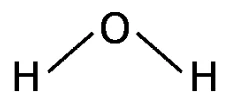
B. Braun Medical Inc.
824 Twelfth Avenue
Bethlehem, PA 18018-3524 USA Questions/Concerns: 1-800-227-2862
Date of Preparation: August 19, 2021