


Product Monograph - Sterile Water for Injection USP (Sterinova)
PRECAUTIONS
General
To minimize the risk of possible incompatibilities arising from the mixing of additives that may be prescribed, the final admixture should be inspected for cloudiness or precipitation immediately after mixing, prior to administration and periodically during administration.
Use only if solution is clear and container and seal are intact.
Carcinogenesis, Mutagenesis, Impairment of Fertility
There are no data available about the carcinogenicity, mutagenicity, or impairment of fertility of Sterile Water for Injection USP.
Usage in Pregnancy
There are no data available to show the potential for indirect harm to the fetus.
Nursing Mothers
There are no data available to show that Sterile Water for Injection USP can cause harm to infants when injected to nursing mothers.
ADVERSE REACTIONS
Reactions which may occur because of the solution or the technique of administration include febrile response, infection at the site of injection, venous thrombosis or phlebitis extending from the site of injection, extravasation and hypervolemia.
The physician should also be alert to the possibility of adverse reactions to drug additives. Prescribing information for drug additives to be administered in this manner should be consulted.
If an adverse reaction does occur, discontinue the infusion, evaluate the patient, institute appropriate therapeutic countermeasures and save the remainder of the fluid for examination if deemed necessary.
OVERDOSAGE
Overdosage (hypotonic expansion) is a function of an increase in fluid intake over fluid output, and occurs when the increase in the volume of body fluids is due to water alone. Overdosage may occur in patients who receive large quantities of electrolyte-free water to replace abnormal excessive fluid losses, in patients whose renal tolerance to water loads is exceeded, or in patients who retain water postoperatively in response to stress.
Manifestations of water intoxication are behavioral changes (confusion, apathy, disorientation and attendant hyponatremia), central nervous system disturbances (weakness, muscle twitching, headaches, nausea, vomiting, convulsions) and weight gain.
Treatment consists of withholding fluids until excessive water is excreted. In severe hyponatremia it may be necessary to cautiously administer hypertonic saline to increase extracellular osmotic pressure and excretion of excess water by the kidneys.
DOSAGE AND ADMINISTRATION
This solution is for intramuscular, intravenous or subcutaneous use. Do not inject until made isotonic by addition of appropriate solute.
The dosage and administration of Sterile Water for Injection USP is dependent upon the recommended dosage and administration of the solute used.
Some additives may be incompatible. Consult with pharmacist or call the distributor at 1 844-329-2939 for any questions or concerns. When introducing additives, use aseptic techniques.
Mix thoroughly. Do not store.
Parenteral drug products should be inspected visually for particulate matter and discoloration prior to administration.
DOSAGE FORMS, COMPOSITION, AND PACKAGING
Sterile Water for Injection USP is supplied sterile and nonpyrogenic in single use 10 mL LDPE plastic ampoules. The ampoules are available in boxes of 20.
The container is not made with natural rubber latex.
Exposure of pharmaceutical products to heat should be minimized. Avoid excessive heat. Protect from freezing. It is recommended that the product be stored at 15 – 30°C.
For management of a suspected drug overdose, contact your regional poison control centre.
Directions for Use of Plastic Ampoules
The instructions below should be followed when using the plastic ampoules with Luer systems:
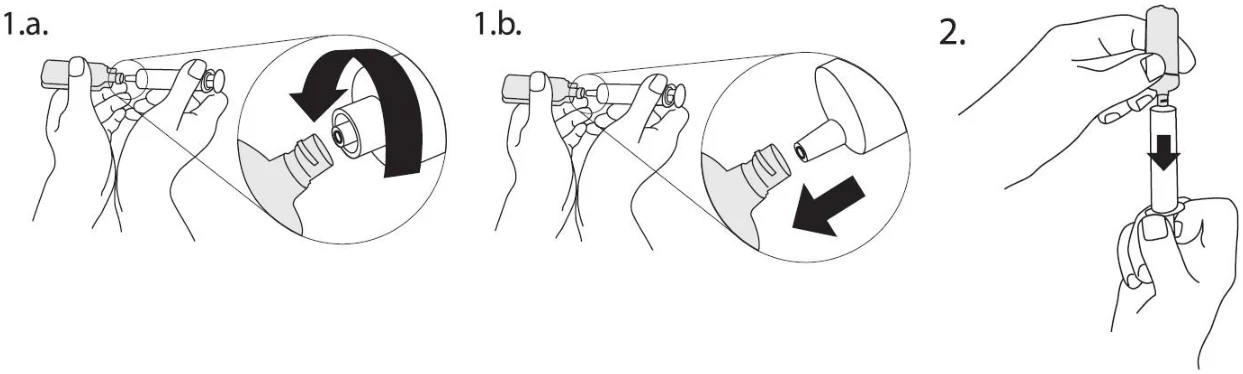
1.a. Luer Lock system:
Twist syringe hub onto ampoule opening until tight
1.b. Luer Slip system: Insert syringe hub into ampoule opening until tight
- 2. Flip so ampoule is above syringe, then pull plunger down to extract liquid from ampoule