


Product Monograph - Sterile Water for Irrigation USP
Serious Warnings and Precautions
- NOT FOR INJECTION
- Hypotonic and Hemolytic
Directions for Use of Plastic Container
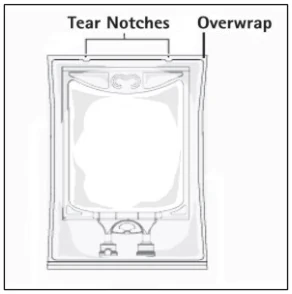
Not for injection.
Not for use with pressurized irrigation systems.
Aseptic technique is required.
- Inspect irrigation bag: overwrap and primary bag.
- Do not use if overwrap has been damaged.
- Do not use unless solution is clear and closure is intact.
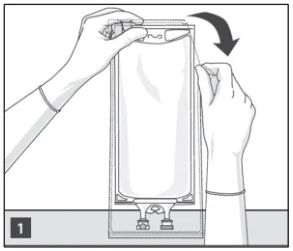
To Open
- 1. Tear overwrap starting from the tear notches. (Figure 1)
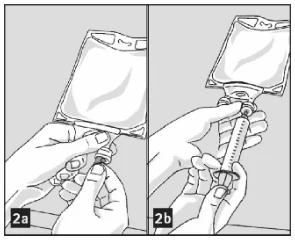
- 2.
Prepare medication port by removal of aluminum foil. (Figure 2a)
- Puncture resealable medication port by using 19 – 22 gauge needle and inject additive(s). (Figure 2b)
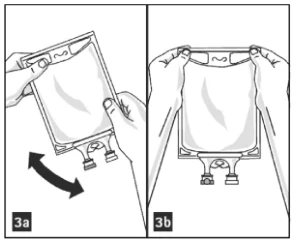
- Mix solution and medication thoroughly. (Figure 3a)
- Medication port must be swabbed with disinfection agent before re-puncturing.
- Check admixture visually for particulate matter. (Figure 3b)
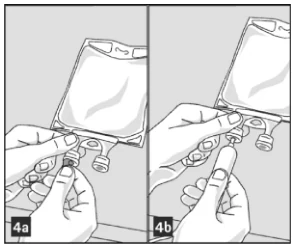
- 3. Remove aluminum foil from outlet/set port at bottom of the container (Figure 4a) and attach administration set (Figure 4b): use non-vented infusion set or close air vent on a vented set. Refer to directions for use accompanying the administration set.
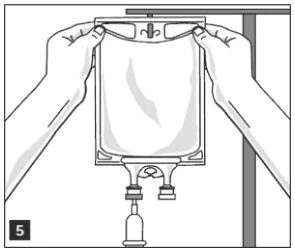
- 4. Hang bag on IV Pole. (Figure 5)
5 OVERDOSAGE
In the event of clinically relevant absorption of Sterile Water for Irrigation USP, patients must be evaluated and corrective measures instituted as indicated. Immediate intervention may be required to prevent fatal outcomes or permanent morbidity (see WARNINGS AND PRECAUTIONS).
| For management of a suspected drug overdose, contact your regional poison control centre. |
6 DOSAGE FORMS, STRENGTHS, COMPOSITION AND PACKAGING
Flexible Plastic Container not made with natural rubber latex, PVC or DEHP.
The plastic container is made from a multilayered film specifically developed for parenteral drugs. The solution contact layer is a rubberized copolymer of ethylene and propylene. The container is nontoxic and biologically inert. The container-solution unit is a closed system and is not dependent upon entry of external air during administration. The container is overwrapped to provide protection from the physical environment and to provide an additional moisture barrier when necessary.
Sterile Water for Irrigation USP is supplied sterile and nonpyrogenic in single use flexible irrigation containers. Both the 2000 mL and 3000 mL containers are packaged 4 per case.
7 WARNINGS AND PRECAUTIONS
Please see the Serious Warnings and Precautions Box at the beginning Part I: Health Professional Information.
General
For irrigation only. Not for injection or infusion by usual parenteral routes.
Sterile Water for Irrigation USP is hypotonic with an osmolarity of zero mOsmol / L. If used for continuous irrigation or allowed to dwell inside body cavities, absorption into the blood stream may occur resulting in hemolysis, therefore use under such conditions is not recommended.
After opening container, its contents should be used promptly to minimize the possibility of bacterial growth or pyrogen formation.
Discard unused portion of irrigating solution since it contains no preservative.
Do not use product if solution shows haziness, particulate matter, discolouration, or leakage.
Absorption of water for irrigation (e.g., through perforations, open wounds or body cavities) has resulted in fatal complications or permanent morbidity and use under these conditions is not recommended. Immediate intervention may be required to prevent these outcomes.
| Drug Product | Size (mL) | DIN | Container Type | Composition | pH | Osmolarity (mOsmol / L) |
| Sterile Water for Irrigation USP | 2000 | 01963961 | Flexible Plastic Container | 100% Water for Injection USP | 5.7 (5.0 – 7.0) | 0 |
| 3000 | ||||||
- Absorption can result in hyponatremia, hypoosmolality, as well as fluid overload.
- Possible complications include, but are not limited, to cerebral edema, encephalopathy, pulmonary edema, massive hemolysis, rhabdomyolysis, renal failure, and hyperkalemia and their secondary manifestations and complications (see ADVERSE REACTIONS).
- These complications can manifest after irrigation has ended.
- The development of these complications is dependent on factors such as rate, volume, pressure and duration of irrigation.
- If absorption of clinically relevant amounts of fluid is suspected, administration should be interrupted and the patient evaluated for signs of fluid absorption.
Close monitoring during and/or after the procedure is required in patients with increased risk for developing hyponatremic encephalopathy, such as:
- pediatric patients (< 16 years of age)
- women, in particular premenopausal women
- patients with hypoxemia
- patients with underlying central nervous system disease
Close monitoring during and/or after the procedure is required in patients at increased risk for developing a fluid overload syndrome (e.g., patients with severely impaired renal function, impaired cardiac function, or other clinical conditions associated with edematous states).
In cases where significant absorption may occur (e.g., transurethral resection of prostate), Sterile Water for Irrigation USP must, if at all, only be used with extreme caution:
- Very close monitoring is required during and for an appropriate period after the procedure to allow for timely intervention.
Sterile Water for Irrigation USP must be used only by physicians familiar with the treatment of possible complications.
Excessive volume or pressure during irrigation may cause undue distention of body cavities, and/or disruption of tissue.
7.1 Special Populations
7.1.1 Pregnant Women
There are no adequate data from the use of Sterile Water for Irrigation USP in pregnant women. Healthcare providers should carefully consider the potential risks and benefits for each specific patient before using Sterile Water for Irrigation USP.
7.1.2 Breast-feeding
There are no adequate data from the use of Sterile Water for Irrigation USP in lactating women. Healthcare providers should carefully consider the potential risks and benefits for each specific patient before using Sterile Water for Irrigation USP.
7.1.3 Pediatrics
Safety and effectiveness in pediatric patients have not been established by adequate and well-controlled trials.
Pediatric patients (< 16 years of age) are at increased risk for developing hyponatremic encephalopathy, even with mild hyponatremia.
7.1.4 Geriatrics
When deciding on volume of irrigant and on duration and pressure of irrigation for a geriatric patient, consider that geriatric patients are more likely to have cardiac, renal, hepatic, and other diseases or concomitant drug therapy.
8 ADVERSE REACTIONS
8.5 Post-market adverse reactions
The list of adverse reactions in this Prescribing Information is based on postmarketing reports (see below).
Post-Market Adverse Drug Reactions
METABOLISM AND NUTRITION DISORDERS: Hyponatremia, Fluid overload, Fluid Absorption, Electrolyte imbalance
NERVOUS SYSTEM DISORDERS: Cerebral edema
GENERAL DISORDERS AND ADMINISTRATION SITE CONDITIONS: Burning sensation (with irrigation of eyes and skin wounds)
MUSCULOSKELETAL AND CONNECTIVE TISSUE DISORDERS: Rhabdomyolysis (Myoglobinuria)
RENAL AND URINARY DISORDERS: Renal failure
Class Reactions
Adverse reactions which may occur in association with absorption of water for irrigation include:
BLOOD AND LYMPHATIC SYSTEM DISORDERS: Hemolysis (Hemoglobinemia, Hemoglobinuria)
METABOLISM AND NUTRITION DISORDERS: Hypervolemia, Hypoosmolality, Hyperkalemia, Acid / base balance disorder
NERVOUS SYSTEM DISORDERS: Encephalopathy (Convulsion, Loss of vision, Lethargy, Disorientation, Irritability, Vomiting, Nausea, Headache)
CARDIAC DISORDERS: Cardiac arrest, Cardiac failure, Bradycardia, Electrocardiogram abnormal
VASCULAR DISORDERS: Hypertension, Postoperative hypotension
RESPIRATORY, THORACIC AND MEDIASTINAL DISORDERS: Respiratory arrest, Respiratory failure, Pulmonary edema
Dosage and Administration
Volume and/or rate of irrigation depend on the type of the procedure and the capacity or the surface area of the structure to be irrigated.
Sterile Water for Irrigation USP must not be administered intravenously or by other, usual parenteral routes.
Sterile Water for Irrigation USP is not intended for oral administration.
Sterile Water for Irrigation USP should be inspected visually for particulate matter and discoloration prior to use whenever fluid and container permit. Do not use unless the fluid is clear and the seal is intact.
Aseptic technique must be used.
The contents of the opened container should be used immediately to minimize potential for bacterial growth and pyrogen formation, and the unused contents of opened containers must be discarded, since Sterile Water for Irrigation USP does not contain an antimicrobial agent.
Sterile Water for Irrigation USP is for single use only.
Microwave heating of irrigation fluids is not recommended.
Sterile Water for Irrigation USP that has been warmed must not be returned to storage.
Additives may be incompatible with Sterile Water for Irrigation USP.
Compatibility of additives with Sterile Water for Irrigation USP must be assessed before addition, by checking for, e.g., a possible color change and/or the appearance of precipitates, insoluble complexes, or crystals.
Before adding a substance or medication, verify that it is soluble and/or stable in water and that the pH range of Sterile Water for Irrigation USP is appropriate.
The instructions for use of the medication to be added and other relevant literature must be consulted.
Additives known or determined to be incompatible should not be used.
9 DRUG INTERACTIONS
Refer to the product monograph, prescribing information or package insert of the solute used.
10 ACTION AND CLINICAL PHARMACOLOGY
Sterile Water for Irrigation USP is utilized for a variety of clinical indications. Because of its low refractive index (1.3325), water provides excellent visibility during endoscopic urological procedures. It is also utilized as a pharmaceutic aid, as well as in the preparation of enteral nutrient products.
11 STORAGE, STABILITY AND DISPOSAL
Exposure of pharmaceutical products to heat should be minimized. Avoid excessive heat. Protect from freezing. Store at 20° to 25°C; excursions permitted between 15° to 30°C. [See USP Controlled Room Temperature.]
PART II: SCIENTIFIC INFORMATION
13 PHARMACEUTICAL INFORMATION
Drug Substance
Proper name: Water
Chemical name: Water
Molecular formula and molecular mass: H2O; 18.01 g / mol
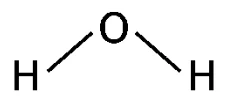
Structural formula:
14 SUPPORTING PRODUCT MONOGRAPHS
- 1. Sterile Water for Irrigation, (solution, 100%), submission control number 212689. Prescribing Information, Baxter Corporation. June 11, 2019.
B. Braun Medical Inc.
824 Twelfth Avenue
Bethlehem, PA 18018-3524 USA
Questions / Concerns: 1-800-227-2862
Date of Preparation: November 18, 2021