


Patient Medication Information: uses, side effects, how to take - Taro-Sumatriptan
What Taro-Sumatriptan is used for:
Taro-Sumatriptan is used in adults to relieve migraine headaches. These migraine headaches may or may not be accompanied by an aura. This is when you may see black spots, flashes of light or shimmering spots or stars. Taro-Sumatriptan should not be used to prevent or reduce the number of headaches you experience. Use Taro-Sumatriptan only to treat an actual migraine headache attack.
How Taro-Sumatriptan works:
Migraine headache is believed to be caused by a widening of the blood vessels in the head. Taro-Sumatriptan narrows these vessels and relieves the symptoms of migraine headache.
The ingredients in Taro-Sumatriptan are:
Medicinal ingredients: sumatriptan succinate
Non-medicinal ingredients: sodium chloride, water for injection
The needle shield contains latex.
Taro-Sumatriptan comes in the following dosage forms:
Solution: 6 mg / 0.5 mL (pre-filled syringe)
Taro-Sumatriptan injection [6 mg; total volume= 0.5 mL] is available in a pre-filled syringe. Each carton contains two pre-filled syringes and each is provided with an auto-injector.
Do not use Taro-Sumatriptan if:
- You are allergic to sumatriptan, or to any of the ingredients in Taro-Sumatriptan (See “The ingredients in Taro-Sumatriptan are ”)
- You have a heart problem such as heart failure or chest pains (angina) , or have already had a heart attack.
- You have had a stroke or a mini-stroke (also called a transient ischaemic attack or T IA).
- You have a history, symptoms or signs of peripheral vascular disease. This is a reduced blood flow to the limbs and organs other than the heart and brain, such as ischemic bowel disease and Raynaud’s syndrome.
- You have uncontrolled or severe high blood pressure
- You are taking or have taken within the past 2 weeks, a monoamine oxidase inhibitor (MAOI), medication (such as phenelzine sulfate, tranylcypromine sulfate, moclobemide or selegiline).
- You are taking or have taken within the past 24 hours medication containing ergotamine, dihydroergotamine, methysergide, or another triptan used to treat migraine headaches. If you are not sure if you have been prescribed these types of medications, ask your healthcare professional.
- You have severe liver problems.
You have certain other types of migraine headaches including:
- Hemiplegic migraines. These are migraine headaches where you have weakness on one side of your body, or
- basilar migraines. These are migraine headaches that start in the lower part of the brain, or
- ophthalmoplegic migraines. These are migraine headaches where you have pain around the eyes.
If you are not sure if you have these types of migraines, ask your healthcare professional.
Taro-Sumatriptan should not be used for the treatment of other types of headaches that are different from migraine attacks.
Taro-Sumatriptan should not be given intravenously, but only into the tissues just below the skin (on the outside of the thigh or in the upper arm).
To help avoid side effects and ensure proper use, talk to your healthcare professional BEFORE you take Taro-Sumatriptan. Talk about any health conditions or problems you may have, including if you:
- are allergic to latex. The needle shield contains latex.
are pregnant, think you might be pregnant, or are trying to become pregnant,
- are breastfeeding. The active ingredient in Taro-Sumatriptan, sumatriptan, will pass into your breast milk. Avoid breastfeeding for 24 hours after taking Taro-Sumatriptan. If you express any breast milk during this time, discard the milk and don’t give it to your baby
- have risk factors for heart disease. This includes high blood pressure, high cholesterol, obesity, diabetes, smoking, strong family history of heart disease, or you are postmenopausal or a male over 40
have ever had to stop taking this or any other medication because of an allergy or
- other problems, or you are allergic to drugs containing sulphonamides.
- are under 18 years of age
- are over 65 years of age
- had or have any liver or kidney problems
- had or have epilepsy or seizures
- experience a headache that is different from your usual migraine attacks.
Other warnings you should know about:
Taking Taro-Sumatriptan can cause serious side effects, including:
- Serious heart problems
- Long term eye problems
- Raynaud’s Syndrome
See the Serious side effects and what to do about them table, below for more information on these and other serious side effects.
Serotonin toxicity (also known as Serotonin syndrome): Taro-Sumatriptan can cause serotonin toxicity, a rare but potentially life-threatening condition. It can cause serious changes in how your brain, muscles and digestive system work. You may develop serotonin toxicity if you take Taro-Sumatriptan with certain medication to treat depression.
Serotonin toxicity symptoms include:
- fever, sweating, shivering, diarrhea, nausea, vomiting;
- muscle shakes, jerks, twitches or stiffness, overactive reflexes, loss of coordination;
- fast heartbeat, changes in blood pressure;
- confusion, agitation, restlessness, hallucinations, mood changes, unconsciousness, and coma.
Continuous use of Taro-Sumatriptan: Taro-Sumatriptan should not be used continuously to prevent or reduce the number of attacks you experience. Use Taro- Sumatriptan only to treat an actual migraine headache attack. If you use Taro-Sumatriptan too often, it may make your migraine headache worse. If this happens, your healthcare professional may tell you to stop taking Taro-Sumatriptan.
Driving and Operating Machines: Taro-Sumatriptan can cause dizziness which may affect your ability to drive or use machines. Wait to see how you respond to Taro-Sumatriptan before you drive or use machines.
Tell your healthcare professional about all the medicines you take, including any drugs, vitamins, minerals, natural supplements or alternative medicines.
The following may interact with Taro-Sumatriptan:
- Medicines used to treat depression such as MAO Inhibitors , selective serotonin reuptake inhibitors (SSRIs), and serotonin noradrenaline reuptake inhibitors (SNRIs)
- Other medicines used to treat migraine headaches such as triptans, 5-HT1 agonists, ergotamine, dihydroergotamine, and methysergide
How to use Taro-Sumatriptan:
- Taro-Sumatriptan is available in pre-filled syringes which should only be used with the Taro-Sumatriptan auto-injector.
- Before using the Taro-Sumatriptan auto-injector see the instructions below for information on loading your Taro-Sumatriptan auto-injector and discarding the empty syringes.
- Taro-Sumatriptan is given as a single injection into the tissues just below the skin on the outside of the thigh or the upper arm.
- Taro-Sumatriptan can be taken at any time during your migraine headache
- It may take up to 15 minutes for Taro-Sumatriptan to start working.
- If after taking Taro-Sumatriptan you need more pain relief, you can take another pain medication. This medication should not contain ergotamine. If you are not sure which medications you can use talk to your healthcare professional
Remember, this medicine has been prescribed only for you. Do not give it to anybody else, as they may experience undesirable effects, which may be serious.
Instructions for use of your Taro-Sumatriptan Autoinjector
This explains how to use the Taro-Sumatriptan auto- injector. Read it several times to make sure you understand it, before you begin the first step. If you have any questions, ask your healthcare professional.
Keep the Taro-Sumatriptan auto-injector out of the reach of children.
Do not load the Taro-Sumatriptan auto-injector until you are ready to give an injection.
CAUTIONS:
Do not remove the white needle shield from the auto-injector until you are ready to inject.
NEVER put the white needle shield back into the auto-injector.
NEVER put or press thumb, fingers, or hand over white needle cover.
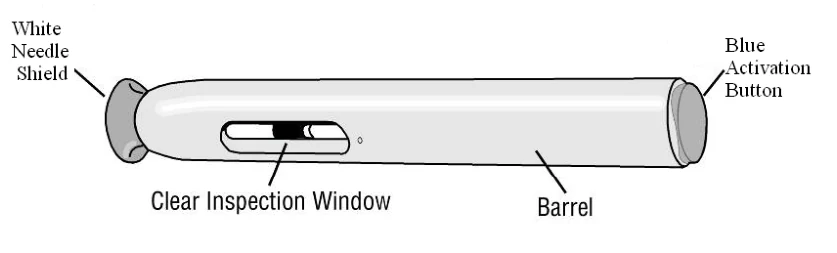
Check the appearance of Taro-Sumatriptan, through the inspection window (Figure 1). It must be a clear, colorless to pale yellow solution. Do not inject the solution if it looks discolored or cloudy or contains lumps, flakes, or particles.
Figure 1
How to use the auto-injector
Wash your hands thoroughly.
Find a comfortable, well-lit place and put everything you need where you can reach it (auto-injector, alcohol or sterile swabs).
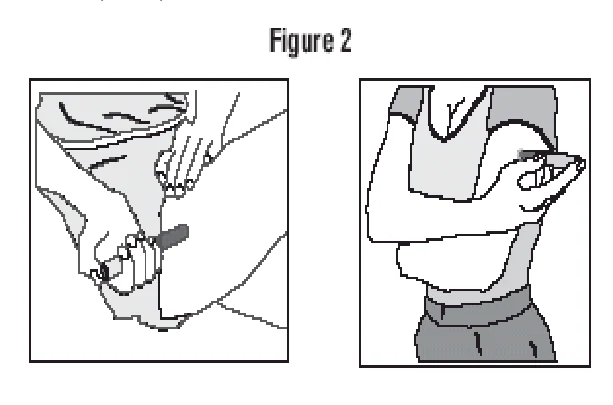
Identify the application area with an adequate fatty tissue layer for example on outer part of the thigh or back of the upper arm (Figure 2). Do not inject into areas where the skin is tender, bruised, red, or hard.
Wipe the injection site with alcohol or a new sterile swab and allow your skin to dry. Do not touch this area again before giving the injection.
Take out the auto-injector from the carton.
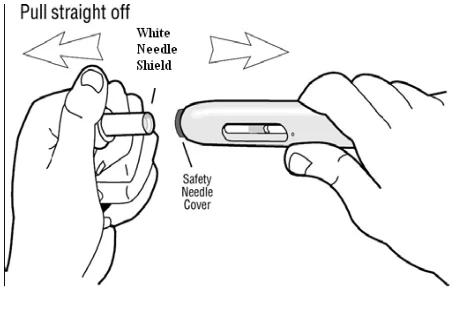
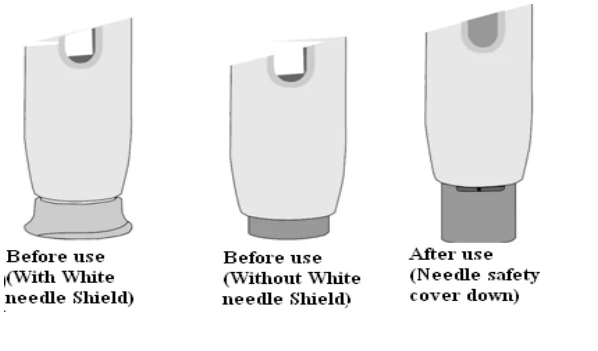
Pick up the auto-injector in one hand and smoothly remove the white needle shield by pulling it straight off (Figure 3). Do not twist it off, and do not recap the white needle shield, as either of these may damage the needle inside the auto-injector. The auto-injector has a cover that will protect you from needle sticks or loss of drug by accidental bumping or touching.
Figure 3
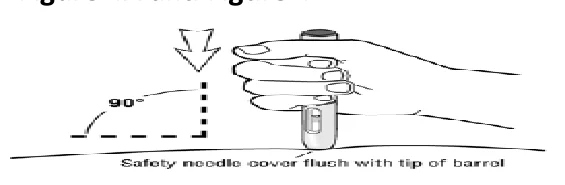
Without pressing the blue activation button, place the open end of the auto-injector on the injection site, straight up at a right angle (90º) and push the safety needle cover firmly against the skin to unlock (Figure 4A and Figure 4B, below). Continue to hold firmly against the skin.
Figure 4A and Figure 4 B
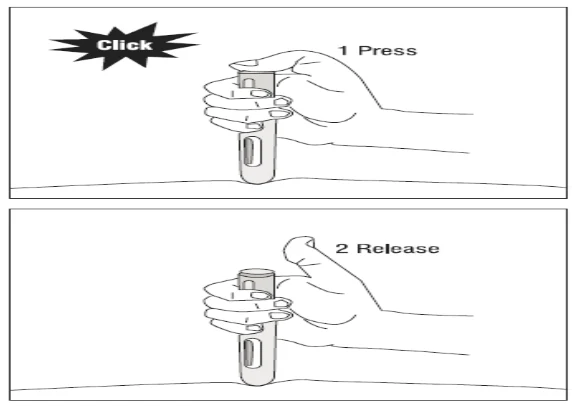
To start the injection (Figure 5A):
- (1) Press the Blue Button (first click will sound),
- (2) Immediately release your thumb.
Note: It is recommended that you not press the blue activation button until the auto injector is first firmly placed on the injection site with the needle cover pressed against the skin. However, if you first press and hold down the blue button, pressing the needle cover to the skin will also activate the injection (first click will sound). If this happens, immediately release your thumb after you press the needle cover to the skin.
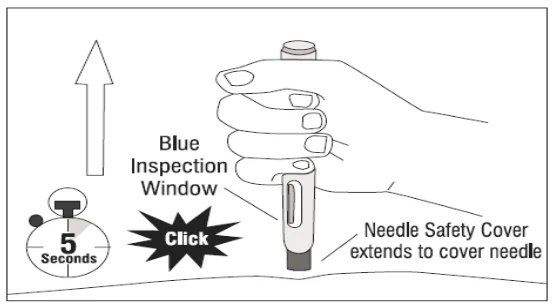
This starts the injection. Do not lift the auto-injector off the skin. Wait until you hear the second ‘click’. Once you hear the second click, lift the auto-injector straight up from the injection site. The injection is finished. The safety needle cover on the auto-injector will automatically extend to cover the needle. The needle will not be visible now.
Figure 5 A
If you did not remove your thumb from the blue button, the second ‘click’ cannot be heard. If this happens, slowly count to 5 before lifting the auto-injector from the injection site.
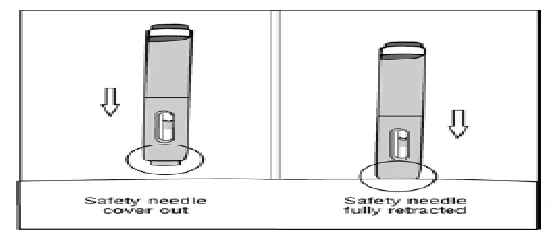
The needle safety cover will move down over the needle (Figure 5B) and lock into place. The inspection window will be blue, confirming the injection is complete. Verify that the inspection window is blue to ensure that the injection is complete before lifting the auto-injector (Figure 6). There is no need to replace the white needle shield.
Figure 5 B
If the inspection window is not blue, do not try to use the auto-injector again. NEVER ATTEMPT TO REUSE AN AUTO-INJECTOR.
If you suspect you have not received the full dose, do not repeat the injection using a new auto-injector.
Figure 6
If you notice a spot of blood at the injection site, dab away with a cotton ball or tissues. Do not rub the injection site. If needed, you may cover the injection site with a bandage.
Discard the auto-injector as instructed by your pharmacist. Do not discard in regular home waste.
Usual dose:
- The usual adult dose is 6 mg / 0.5 mL. Do not exceed the usual adult dose.
- If you do not respond to the first dose of Taro-Sumatriptan, do not take a second dose for the same attack.
- If your symptoms come back, and it has been 1 or more hour since your first injection, you may take a second injection
- DO NOT take more than 12 mg (two x 6 mg injections) in any 24 hour period.
Overdose:
If you think you, or a person you are caring for, have taken too much Taro-Sumatriptan, contact a healthcare professional, hospital emergency department, regional poison control centre or Health Canada’s toll-free number, 1-844 POISON-X (1-844-764-7669) immediately, even if there are no signs or symptoms. |
|---|
Possible side effects from using Taro-Sumatriptan:
These are not all the possible side effects you may feel when taking Taro-Sumatriptan. If you experience any side effects not listed here, contact your healthcare professional.
The most commonly reported side effects of Taro-Sumatriptan are:
- flushing (redness of the face lasting for a short time)
- feeling sick or vomiting
- dizziness
- drowsiness
- tiredness
- weakness
- temporary increase in blood pressure
- temporary pain at the site of injection
- stinging or burning, redness, swelling, bruising and bleeding at the site of injection.
Other side effects include:
- Trouble with eyesight such as blind spots, flashes of light, and seeing two images of a single object
- shaking, tremors or uncontrolled movements
- loss of normal colour in the fingers and toes.
- sweating
- breast pain
Serious side effects and what to do about them
| Frequency / Side Effect / Symptom | Talk to your healthcare professional | Stop taking this drug and get immediate medical help | |
|---|---|---|---|
| Only if severe | In all cases | ||
| Very common | |||
| Unusual sensations or discomfort including numbness, tingling, feeling hot or cold, pain, heaviness or pressure in any part of the body including chest, throat, neck, jaw, and upper limbs. | √ | ||
| Very rare | |||
| Symptoms of a heart attack: chest pain, sweating, shortness of breath | √ | ||
| Heart rhythm problems: Unusually slow or fast heartbeats, or a feeling of irregular and/or forceful heartbeats. | √ | ||
| Allergic reactions: shortness of breath, sudden wheeziness, chest tightness, swelling of the eyelids, face or lips, lumpy skin rash or hives. | √ | ||
| Seizures: loss of consciousness with uncontrollable shaking (‘fit’) | √ | ||
| Lower abdominal pain and/or severe rectal bleeding | √ | ||
| Raynaud’s syndrome: persistent purple discolouration of hands or feet | √ | ||
| Loss of vision | √ | ||
| Unknown | |||
If you have a troublesome symptom or side effect that is not listed here or becomes bad enough to interfere with your daily activities, tell your healthcare professional.
Storage:
Keep your pre-filled syringe away from heat and light which may spoil them. Store the pre-filled syringe and the auto-injector at controlled room temperature between 15-30°C. Improper handling of the device would jeopardize the sterility of the syringe and drug product. Protect from light. Do not use the device if it is dropped or damaged.
Medicines should not be disposed of via wastewater or household waste. Your healthcare professional will throw away any medicines that are no longer being used. These measures will help protect the environment.
Needles and syringes may be hazardous and should be disposed of safely and hygienically. Do not throw away your Taro-Sumatriptan auto-injector.
Keep out of reach and sight of children.
If you want more information about Taro-Sumatriptan:
| Frequency / Side Effect / Symptom | Talk to your healthcare professional | Stop taking this drug and get immediate medical help |
|---|---|---|
| Only if severe | In all cases | |
| Serotonin toxicity: a reaction which may cause feelings of agitation or restlessness, flushing, muscle twitching, involuntary eye movements, heavy sweating, high body temperature (>38 °C), or rigid muscles. | ||
| √ | ||
Reporting Side Effects
You can report any suspected side effects associated with the use of health products to Health Canada by:
NOTE: Contact your healthcare professional if you need information about how to manage your side effects. The Canada Vigilance Program does not provide medical advice. |
|---|
- Talk to your healthcare professional
- Find the full product monograph that is prepared for healthcare professionals and includes the Patient Medication Information by visiting the Health Canada Drug Product Database website (https://www.canada.ca/en/health-canada/services/drugs-health-products/drug-products/drug-product-database.html); the manufacturer’s website www.taro.ca or by calling 1-800-268-1975.
130 East Drive, Brampton, Ontario L6T 1C1
Date of Authorization: 2026-09-25