


Product Monograph - Taro-Terconazole
INDICATIONS AND CLINICAL USE
TARO-TERCONAZOLE (terconazole) Vaginal Cream 0.4% is indicated for the local treatment of vulvovaginal candidiasis (moniliasis). The diagnosis of monilial infection should be confirmed by microscopic examination of a KOH smear and/or by culture.
TARO-TERCONAZOLE vaginal cream may be used in pregnant patients during the second and third trimester if the physician considers it essential to the welfare of the patient (see PRECAUTIONS, Use During Pregnancy). The therapeutic effect of TARO-TERCONAZOLE vaginal cream is not affected by oral contraceptive usage, menstruation or previous monilial infection.
CONTRAINDICATIONS
Patients who are hypersensitive to terconazole or to any ingredient in the cream formulation. For a complete listing see PHARMACEUTICAL INFORMATION, Composition.
WARNINGS
Anaphylaxis and toxic epidermal necrolysis have been reported during terconazole therapy. TARO-TERCONAZOLE therapy should be discontinued if anaphylaxis or toxic epidermal necrolysis develops (see ADVERSE REACTIONS).
PRECAUTIONS
For topical use on the vulva and inside the vagina only. TARO-TERCONAZOLE (terconazole) Vaginal Cream 4% is not for ophthalmic or oral use.
TARO-TERCONAZOLE vaginal cream should be discontinued and patients should not be retreated if sensitization, vulvovaginal irritation, fever, chills or flu-like symptoms are reported during use.
Photosensitivity reactions were observed in some normal volunteers following repeated dermal application of terconazole 2.0% and 0.8% creams under conditions of filtered artificial ultraviolet light. Photosensitivity reactions have not been observed in clinical trials in patients who were treated vaginally with terconazole 0.4%, 0.8% or 1.6% vaginal cream.
If there is a lack of response to TARO-TERCONAZOLE vaginal cream therapy, appropriate microbiological studies (standard KOH smear and /or cultures) should be repeated to confirm the diagnosis and rule out other pathogens.
Intractable candidiasis may be the presenting symptom of unrecognized diabetes mellitus. In these cases, appropriate diagnostic tests for diabetes should be done.
Use in Children
Safety and efficacy in children have not been established.
Use During Pregnancy
Terconazole should not be used in the first trimester of pregnancy.
In studies, over 600 pregnant patients have used terconazole during the second and third trimesters with no apparent adverse effect on the course of pregnancy. These studies have not shown increased risk of abnormalities when administered during this period.
Pregnant patients should be advised to exercise caution in the use of the vaginal applicator.
Nursing Mothers
It is not known whether terconazole is excreted in human milk. Should the decision be made to use this drug, nursing should be discontinued during therapy.
Drug Interactions
The therapeutic effect of terconazole is not affected by oral contraceptive usage.
The levels of estradiol and progesterone did not differ significantly when 0.8% terconazole vaginal cream was administered to healthy female volunteers established on a low dose oral contraceptive.
ADVERSE REACTIONS
Clinical Trial Data
The safety of terconazole vaginal cream was evaluated in 3287 female patients who participated in 30 clinical trials for the treatment of vulvovaginitis. The 30 clinical trials included 8 open-label and 22 double-blind clinical trials and evaluated the safety of dose regimens using 40 mg and 80 mg terconazole vaginal ovules and 0.4% and 0.8% terconazole vaginal cream.
Adverse drug reactions reported by ≥1% of terconazole treated patients in these 30 clinical trials are shown in Table 1.
Table 1. Adverse Drug Reactions Reported by ≥1%
Terconazole-treated Patients in 30 Clinical Trials
System Organ Class Adverse Drug Reaction | Terconazole (n=3287) % |
Nervous System Disorders Headache Reproductive System and Breast Disorders Genital burning sensation Dysmenorrhoea Pruritus genital Genital discomfort Genital pain General Disorders and Administrative Site Conditions Pain | 13.3 3.9 3.0 2.6 2.0 1.2 2.6 |
Adverse drug reactions reported by <1% of terconazole treated patients in the 30 clinical trials are listed in Table 2.
Table 2. Adverse Drug Reactions Reported by < 1%
Terconazole-treated Patients in 30 Clinical Trials
System Organ Class Adverse Drug Reaction |
General Disorders and Administrative Site Conditions Chills Pyrexia |
Post-Market Adverse Drug Reactions
In addition to the adverse drug reactions reported during clinical studies and listed above, the following adverse reactions have been reported during post-marketing experience (Table 3). Since post-marketing adverse reactions are reported voluntarily from a population of unknown size, estimates of frequency cannot be made.
Table 3. Adverse Drug Reactions Identified During
Post-Marketing Experience with Terconazole
Immune System Disorders Anaphylaxis , Face Edema, Hypersensitivity |
Nervous System Disorders Dizziness |
Respiratory, Thoracic and Mediastinal Disorders Bronchospasm |
Gastrointestinal Disorders Abdominal pain |
Skin and Subcutaneous Tissue Disorders Toxic epidermal necrolysis, Rash, Urticaria |
General Disorders and Administration Site Conditions Influenza like illnessa, Asthenia |
a Influenza like illness encompasses other events, including Nausea, Vomiting, Myalgia, Arthralgia, and Malaise, as well as Fever and Chills
SYMPTOMS AND TREATMENT OF OVERDOSAGE
For management of a suspected drug overdose, contact your regional Poison Control Centre.
In the event of oral ingestion of vaginal cream, supportive and symptomatic measures should be carried out. If the cream is accidentally applied to the eyes, wash with clean water or saline and seek medical attention if symptoms persist.
DOSAGE AND ADMINISTRATION
TARO-TERCONAZOLE (terconazole) Vaginal Cream 4.0%
One applicatorful (5 g) of TARO-TERCONAZOLE Vaginal Cream 4% (20 mg of terconazole) is administered intravaginally once daily at bedtime for seven consecutive days. In addition, a thin layer of TARO-TERCONAZOLE vaginal cream 0.4% is applied for seven consecutive days directly to the vulva and massaged in gently.
Before prescribing another course of TARO-TERCONAZOLE vaginal cream therapy the diagnosis of monilial infection should be confirmed by microscopic examination of a KOH smear and/or by culture.
Intractable candidiasis may be the presenting symptom of unrecognized diabetes mellitus. In these cases appropriate diagnostic tests for diabetes should be done.
The therapeutic effect of TARO-TERCONAZOLE vaginal cream is not affected by oral contraceptive usage or menstruation.
PHARMACEUTICAL INFORMATION
Drug Substance:
Proper Name: Terconazole
Chemical Name: cis-1-[4-[[2-(2,4-dichlorophenyl)-2-(1H-1,2,4-triazol-1-ylmethyl)-1,3- dioxolan-4-yl]methoxy]phenyl]-4-1-(methylethyl) piperazine
Structural Formula:
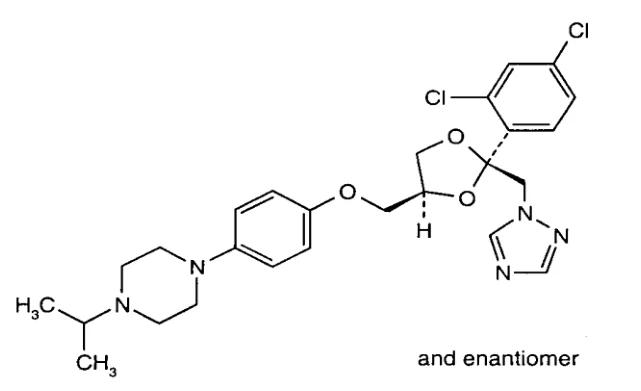
Molecular Formula: C26H31Cl2N5O3
Molecular Weight: 532.47
Physical Form: Terconazole, a triazole derivative, is a white to almost white powder.
Solubility: Insoluble in water, sparingly soluble in ethanol and soluble in butanol.
pH and pKa: Terconazole is a weak base with three protonation sites as determined from non-aqueous titration. Only the monocationic form is titratable in aqueous medium. Terconazole pKa’s are pKa1< 1.5, pKa2 < 1.5, pKa3 = 8.4.
Partition coefficient: The partition coefficient is log P = 3.51 (Octanol/Water).
Melting Point: The melting range is 125ºC - 129ºC.
Composition:
TARO-TERCONAZOLE (terconazole) Vaginal Cream 0.4% is a white to off-white, water washable cream for intravaginal administration containing 0.4% of the antifungal agent terconazole. Propylene glycol is the antimicrobial agent used as a preservative and butylated hydroxyanisole is present as an antioxidant.
Other nonmedicinal ingredients are as follows: cetyl alcohol, isopropyl myristate, polysorbate 60, polysorbate 80, purified water, stearyl alcohol.
Stability and Storage Recommendations:
TARO-TERCONAZOLE (terconazole) Vaginal Cream 0.4% should be stored at controlled room temperature (15ºC - 30ºC).
AVAILABILITY OF DOSAGE FORMS
TARO-TERCONAZOLE (terconazole) Vaginal Cream 0.4% is available in 45 g tubes with seven disposable, plastic, vaginal cream applicators.
MYCOLOGY
Antimycotic Activity (In Vitro)
In vitro terconazole effectively inhibits the growth of yeasts and other fungi including dimorphic and filamentous species. The potency of terconazole varies not only with the species tested, but also with the conditions under which the yeasts or other fungus is grown.
Yeast grown in medium favoring mycelium formation are particularly sensitive to terconazole. In addition, the pH and nutrient content of the media, as well as the presence of serum in the medium and the ambient temperature, all affect the in vitro potency of terconazole. While it is difficult to precisely define the in vitro antifungal potency of terconazole, it does demonstrate a broad spectrum of antimycotic activity (Table 4).
Antifungal activity also has been demonstrated against C. tropicalis, C. krusei, Trichophyton rubrum, T. mentagrophytes, Cryptococcus neoformans, Torulopsis glabrata and other yeasts and fungi.
The MIC values for terconazole against most species of lactic acid bacteria were > 128 mcg/mL. Therefore, these beneficial bacteria are not affected by drug treatment.
The effects of terconazole on yeast have been observed via the electron microscope. At concentrations as low as 10-8M (5.3 ng/mL) terconazole begins to affect yeast morphology, as manifested by the appearance of dense lipophilic bodies along the cell membrane and inhibition of mycelia formation. At 10-6M terconazole, degenerative changes in yeast cell morphology are present leading to complete necrosis.
Table 4.
IN VITRO ANTIFUNGAL ACTIVITY OF TERCONAZOLE (SABOURAUD GROWTH MEDIUM)
(from Van Cutsem et al., Chemotherapy 29: 322, 1983)
| No. of strains | 100 mg/mL | 10 mg/mL | 1 mg/mL | 0.1 mg/mL | |||||||||||||||||||||||||
| A | B | C | A | B | C | A | B | C | A | B | C | ||||||||||||||||||
| Microsporum canis | 4 | 4 | 4 | 4 | 4 | ||||||||||||||||||||||||
| M. audouini | 5 | 5 | 5 | 5 | 5 | ||||||||||||||||||||||||
| Trichophyton rubrum | 48 | 48 | 48 | 16 | 32 | 4 | |||||||||||||||||||||||
| T. mentagrophytes | 14 | 14 | 1 | 13 | 1 | 13 | 14 | ||||||||||||||||||||||
| T. tonsurans | 2 | 2 | 2 | 2 | 2 | ||||||||||||||||||||||||
| T. verrucosum | 4 | 4 | 4 | 1 | 3 | 4 | |||||||||||||||||||||||
| Keratinomyces aielloi | 1 | 1 | 1 | 1 | 1 | ||||||||||||||||||||||||
| Epidermophyton floccosum | 1 | 1 | 1 | 1 | 1 | ||||||||||||||||||||||||
| Candida albicans | 27 | 22 | 5 | 5 | 10 | 12 | 2 | 10 | 15 | 6 | 21 | ||||||||||||||||||
| C. tropicalis | 2 | 2 | 1 | 1 | 1 | 1 | 2 | ||||||||||||||||||||||
| C. krusei | 3 | 3 | 3 | 3 | 3 | ||||||||||||||||||||||||
| Torulopsis glabrata | 2 | 1 | 1 | 2 | 2 | 2 | |||||||||||||||||||||||
| Cryptococcus neoformans | 5 | 5 | 5 | 2 | 3 | 5 | |||||||||||||||||||||||
| Trichosporon cutaneum | 1 | 1 | 1 | 1 | 1 | ||||||||||||||||||||||||
| Sporothrix schenckii | 2 | 2 | 2 | 2 | 2 | ||||||||||||||||||||||||
| Scopulariopsis brevicaulis | 2 | 2 | 2 | 2 | 2 | ||||||||||||||||||||||||
| Allescheria boydii | 4 | 4 | 4 | 4 | 4 | ||||||||||||||||||||||||
| Monosporium apiospermum | 1 | 1 | 1 | 1 | 1 | ||||||||||||||||||||||||
| Ascosphaera apis | 3 | 3 | 3 | 3 | 3 | ||||||||||||||||||||||||
| Phialophora verrucosa | 1 | 1 | 1 | 1 | 1 | ||||||||||||||||||||||||
| Cladosporium carrionii | 1 | 1 | 1 | 1 | 1 | ||||||||||||||||||||||||
| Cladosporium sp. | 1 | 1 | 1 | 1 | 1 | ||||||||||||||||||||||||
| Aspergillus fumigatus | 10 | 2 | 8 | 10 | 10 | 10 | |||||||||||||||||||||||
| Saprolegnia sp. | 1 | 1 | 1 | 1 | 1 | ||||||||||||||||||||||||
| Mucor sp. | 3 | 1 | 1 | 1 | 1 | 2 | 3 | 3 | |||||||||||||||||||||
| Rhisopus sp. | 2 | 2 | 2 | 2 | 2 | ||||||||||||||||||||||||
| Absidia ramosa | 1 | 1 | 1 | 1 | 1 | ||||||||||||||||||||||||
| Pythium ultimum | 1 | 1 | 1 | 1 | 1 | ||||||||||||||||||||||||
| Basidiobolus meristosporus | 1 | 1 | 1 | 1 | 1 | ||||||||||||||||||||||||
A: complete inhibition after 2 weeks of exposure;
B: marked inhibition;
C: no marked inhibition
Assessment of Resistance
Using a range of Candida species and dermatophytic fungi in a standard, classical test for emergence of resistance to an antifungal compound, it has been concluded that resistance of fungi to terconazole should not occur during the agent’s clinical use. No resistance to terconazole has developed during successive passages of C. albicans.
In Vivo Protection Studies
When applied intravaginally in the rat (Table 5) cures of 50% of the animals or more are observed with terconazole concentration doses of 0.25% or more.
Table 5.
TOPICAL TREATMENT WITH TERCONAZOLE OF RAT VAGINAL CANDIDOSIS
(from Van Cutsem et. al. Chemotherapy 29:322, 1983)
| Treatment | Prophylactic Regimen | Therapeutic Regimen | ||||
| Aa | Ba | Ca | A | B | C | |
| Control (no treatment) | 0/43b | 0/43 | 43/43 | c | - | - |
| Placebo (vehicle) | 0/50 | 1/50 | 49/50 | 0/124 | 1/124 | 123/124 |
Terconazole @ 0.063% 0.125% 0.25% 0.5% 1.0% 2.0% | - 14/18 9/14 11/12 c - | - 0/18 2/14 1/12 - - | - 4/18 3/14 0/12 - - | 2/24 12/46 24/48 35/48 31/32 8/8 | 1/24 2/46 10/48 2/48 0/32 0/8 | 21/24 32/46 14/48 11/48 1/32 0/8 |
a A = cured
B = marked improvement
C = not improved or cured
b data are presented as the number of animals cured, improved or not cured over the number of animals tested c no data.
PHARMACOLOGY
Animal
Pharmacologic Activity:
Studies performed in mice, rats and dogs determined that terconazole has no intrinsic secondary pharmacologic activity (Table 6).
Table 6.
PHARMACOLOGY STUDIES - TERCONAZOLE
| Species | Type of Test(s) | Dose & Route of Administration | Conclusion |
| Mouse | Neuropharmacology screening battery | 40 mg/kg Subcutaneous (vehicle 20% PEG 200) | Terconazole has no central nervous system or autonomic activity. |
| Rat | Neuropharmacology screening battery | 40 mg/kg Intraperitoneal (vehicle 20% PEG 200) | Terconazole has no central nervous system or autonomic activity. |
| Dog | Cardiac and hemodynamic activity in anesthetized animals | 0.04 - 10 mg/kg Intravenous (vehicle dist. H2O acidified with tartaric acid) | No significant effects predicted in clinical use. |
| Dog | Cardiac, hemodynamic, and behavioural activity in conscious animals. | 10 mg/kg Oral (vehicle dist. H2O, acidified with tartaric acid) | No significant effects predicted in clinical use. |
Pharmacokinetics:
Terconazole is readily absorbed following oral or subcutaneous administration (dog and rat) and slowly and poorly absorbed following vaginal (dog, rat and rabbit) or dermal (rabbit) administration.
Following oral or subcutaneous administration (dog and rat), the amount of terconazole absorbed increased with increasing administered dose. In the dog, (above 5 mg/kg oral), the increase in the amount of terconazole absorbed into the systemic circulation was disproportionately greater than the increment in administered doses. The disproportionality was not observed for rat, rabbit or man (Table 7).
Table 7.
COMPARATIVE PEAK PLASMA TERCONAZOLE CONCENTRATIONS
| Species | Dose | Route of Administration | Mean Peak Plasma Terconazole Concentration (mg/mL) |
| Rat | 40 mg/kg 20 mg/kg 5 mg/kg | Intraperitoneal Oral Subcutaneous | - 284-336 323-537 |
| Dog | 10 mg/kg 2.9 mg/kg | Oral Intravenous | 1,294 1,023-1,307 |
| Rabbit | 16-26 mg/kg 2 mg/kg 4 mg/kg 8 mg/kg | Intravaginal Dermal Dermal Dermal | 100-195 6.44 (Day 3) 6.53 (Day 3) 23.6 (Day 3) |
| Human Female | 20 mg as 0.4% Vaginal cream 80 mg Suppository 240 mg Suppository | Intravaginal Intravaginal Intravaginal | 4 10 26 |
Terconazole is highly bound (> 95%) to plasma proteins in blood in vitro (rat, dog and man). Following oral (4-6, 10 or 20 mg/kg) or subcutaneous (5 or 10 mg/kg) administration of radiolabeled terconazole to rats, radioactivity is extensively distributed to body tissues with the highest amounts occurring, primarily, in the well perfused organs. The rate of decline (of terconazole related radioactivity) from tissues examined was similar to that in blood, suggesting no usual accumulation of parent compound and/or metabolites in any particular tissue.
In a dermal study in rabbits, plasma terconazole levels were below 2.5 ng/mL at all three dosage levels. However on day 3, the average plasma terconazole levels 2 hours after treatment (at doses of 2,4 and 8 mg/kg, respectively) were 6.44, 6.53 and 23.6 ng/mL. In spite of repeated applications on subsequent days, levels did not change significantly from Day 3.
Terconazole is readily eliminated in the rat (5 mg/kg oral or subcutaneous) and does not accumulate following multiple dose oral administration of 5.0 or 20 mg/kg in the rat and 16-26 mg/kg (10 day) intravaginal administration in the rabbit.
In the dog, the pharmacokinetics of terconazole are both dose and time dependent and terconazole does accumulate following multiple dose administration (5, 10 or 15 mg/kg for 13 weeks). This was not found in humans.
Terconazole is rapidly and extensively metabolized (rat, dog and human) with the metabolites, due primarily to oxidative N- and O-dealkylation, conjugation and dioxolane ring cleavage, being slowly eliminated by bilary/fecal and renal pathways.
Thus the major metabolic reactions involved in the biotransformation of terconazole in animals and humans appear to be similar.
Human
Pharmacokinetics:
Following oral (30 mg) administration of 14C-labelled terconazole, the half-life of elimination from the blood for the parent terconazole was 6.9 hours (range 4.0 - 11.3). Terconazole is extensively metabolized; both the Cmax and AUC for unchanged terconazole represented a very small fraction (2.1% and 0.6% respectively) of the corresponding Cmax and AUC for total radioactivity, suggesting rapid conversion of terconazole to metabolites. Total radioactivity from an oral dose was eliminated from the blood with a half-life of 52.2 hours (range 44-60). Excretion of radioactivity was both by renal (32-56%) and fecal (47-52%) routes.
The absorption characteristics of terconazole 0.8% vaginal cream in pregnant or non-pregnant patients with vulvovaginal candidiasis were similar to those found in normal volunteers. Terconazole is not expected to affect the activity of hepatic drug metabolizing enzymes following therapeutic administration. Antimycotic concentrations of terconazole persist in the vagina for at least two days following therapy.
Clinical Study:
A comparative, double-blinded, randomized, parallel group bioavailability study was performed to compare TARO-TERCONAZOLE Vaginal Cream 0.4% to Terconazole Vaginal Cream 0.4%. The mycological, clinical and therapeutic cure data obtained for the creams are included in Table 8.
Table 8.
CURE DATA FOR TERCONAZOLE VAGINAL CREAM 0.4%
| Parameter | Percent Cured | 90% Confidence Interval | ||
Taro-Terconazole Vaginal Cream 0.4% (N = 98) | Terconazole Vaginal Cream 0.4% (N = 101) | Upper Limit | Lower Limit | |
| Mycologic Cure1 | 70% | 67% | 13.87 | -7.71 |
| Clinical Cure2 | 81% | 68% | 22.35 | 2.24 |
| Therapeutic Cure3 | 60% | 53% | 18.26 | -4.78 |
1 Mycologic cure defined as: Culture and KOH negative at 2 and 4 weeks after baseline
2 Clinical cure defined as reduction in total score at the 2 week visit and having no symptoms at the 4 week visit
3 Therapeutic cure defined as having both a clinical and mycologic cure
TOXICOLOGY
Acute Toxicity:
| Species | No. of Animals/ Group | Route | Dose Levels mg/kg | LD50 mg/kg |
Rat Male Female Male Female | 10 10 10 10 | Oral Oral Subcutaneous Subcutaneous | 0, 160, 320, 640, 1280, 2560 0, 160, 320, 640, 1280, 2560 0, 640 0, 640 | 1741 849.3 > 640 > 640 |
Dog Male Female Male Female | 4 4 4 4 | Oral Oral Subcutaneous Subcutaneous | 160, 320, 640, 1280 160, 320, 640, 1280 40, 80, 160 40, 80, 160 | 1280 > 640 97.8 113 |
No lethality or systemic toxicity was observed following oral administration of 5 g/kg of terconazole 0.4% or 2% cream formulations. Formulation dependent local irritation was observed following dermal applications of the 5% cream and 2% lotion formulation.
Subchronic Toxicity:
Intravenous administration for up to 28 days of terconazole 0.4% cream (sham control, untreated control, 0, 0.04, 0.12 or 0.20 mg/kg/day; 10 females/group) revealed no drug related effects in rats. Only a local inflammatory response was observed in rabbits following intravaginal administration of 0.4% cream formulation (sham control, untreated control: 0, 0.04, 0.4, 0.12, 0.20 mg/kg/day; 6/group) and 0.8% cream formulation (sham control: 0, 2.0 mg/kg/day; 6/group).
In multidose dermal studies with rats and rabbits, the only toxicological finding was dose dependent local irritation. Table 9 summarizes these studies.
Table 9.
| Study Animals | Route | Duration (weeks) | Average Dose Levels Terconazole mg/kg/day | Results (Severity) |
Rat 15/Sex/Group Rabbit 4/Sex/Group Rabbit 4/Sex/Group | Topical 2% Cream Formulation Topical 0.4% Cream Formulation Topical 2 or 5% Cream Formulation | 6 (Treatment) 4 (Recovery) 4 (Treatment) 2 (Recovery) 13 | 0, 80, 400 or 2000 0, 2, 4 2% Cream 0 8 16 5% Cream 20 40 | Local Irritation (Slight Erythema) Local Irritation Minimal Local Irritation Moderate |
No systemic toxicity or vaginal irritation was observed in a 4 week multidose study with terconazole in a PEG suppository formulation, (vehicle control, sham control, 40 or 80 mg/kg/day; 6/group). Peak plasma levels of terconazole in rabbits ranged from 96-256 mg/mL over 28 days with no significant change in plasma levels.
Reddening of the vaginal mucosa was the only treatment related finding observed in a study with dogs receiving up to 16 mg/kg/day (160 mg suppository, vehicle control, sham control: 2 or 3/group) or 31.4 mg/kg/day of terconazole (Wecobee or PEG base suppository (4/group), vehicle control, sham control).
Chronic Toxicity:
In multidose studies, no systemic toxicity was observed following oral or subcutaneous administration of up to 8.7 mg/kg/day of terconazole for 3 months to rats. Minimum effects occurred at a dose of approximately 35-40 mg/kg/day (Table 10). Following oral or subcutaneous administration to dogs for 3 to 6 months there was no systemic toxicity observed (3/sex/group in all dog studies: Oral; 0, 0.31, 1.25, 5.0 or 0, 5, 10, 15 mg/kg/day for 3 months. Subcutaneous:
0, 0.31, 1.25, 5 mg/kg/day for 6 months).
Table 10.
Strain/ Species | Mode of Admin. | No./Sex/ Group | Average Dose Levels mg/kg/day | Study Duration (weeks) | Results |
| Wistar Rats | Oral | M-20 F-20 | 0, 2.14, 8.7, 35.9 0, 2.31, 9.4, 39.9 | 13 | M and F: No systemic toxicity up to 8.7 mg/kg/day. No lethality. Decreased body weight gain. F: Increased yellow pigment zona reticularis adrenal gland. Greater relative and absolute liver weights (12.9 g vs 11.9 g, high dose vs. controls). Increased liver vacuoliazation, decreased lipid deposition in the glomerularis. |
| Wistar Rats | S.C. | 20 | 0, 2.5, 10, 40 | 13 | M and F: No systemic toxicity. No treatment related lethality. Increased spleen weight. Inflammatory reaction at injection site. M: Decreased body weight gain (40 mg/kg/day) F: Increased liver weight (40 mg/kg/day group) |
Morbidity in a 3 month oral chronic study occurred in dogs receiving 15 mg/kg/day. Administration of 15 mg/kg/day was associated with decreased food consumption, decreased body weight gain, changes in hematologic and clinical pathology parameters and histopathic changes consistent with gastrointestinal bleeding, inanition and dehydration. At 15 mg/kg/day there was thyroid C cell hyperplasia in females and thymic atrophy in males. Only an increased evidence of diarrhea and emesis was associated with daily doses of 10 mg/kg/day of terconazole.
The onset of these toxicological effects may be in part explained by the results of drug plasma level studies. These studies have indicated that following oral and subcutaneous administration of terconazole in dogs, the amount of terconazole absorbed increases disproportionately to the increase in dose. Further, terconazole accumulates following multiple administrations. In the 6 month subcutaneous chronic toxicity study there was no systemic toxicity or lethality. At 5 mg/kg/day there was an increase in leucocyte count and increased haptoglobin.
Special Studies:
In four standard ten day rabbit vaginal irritation studies, terconazole as a 0.4% cream,(1.0 mL/rabbit; 2 or 3/group) PEG or Wecobee base suppository formulation (1.0 mL/rabbit of 80 mg or 240 mg suppository 2; 3 or 9/group) was acceptable. All studies included sham control, vehicle control and untreated control groups.
As evaluated by the Buehler method, terconazole 5% cream formulation (0.5 mL/animal; 40 guinea pigs; 5/sex/group) was not considered a contact sensitizer to guinea pigs. In studies conducted subsequent to results suggestive of photo reaction in clinical studies, terconazole was found to be a photoirritant, but not a photoallergen to guinea pigs (5 day topical application of 0.05 mL of 2% terconazole (induction) and of 0.05 mL 0.1% terconazole (elicitation) in 6 guinea pigs). Results of in vitro studies show that phototoxic reaction may not be detectable in the selected methodologies.
In primary dermal irritation studies (6 male rabbits in each of three studies) the level of observed irritation was found to be formulation dependent. Moderate irritation was observed with both active and vehicle cream (0.5 mL of 5% terconazole) and lotion (0.5 mL of 2% terconazole, propylene glycol base formulations). Severe irritation with 0.5 mL of terconazole 2% tefose (mineral oil base formulations) was observed.
Reproductive Studies:
General Fertility and Reproductive Performance:
No impairment of fertility occurred when rats were administered terconazole orally (0, 2.5, 10 or 40 mg/kg/day; 20/sex/group; treated animals mated to non-treated animals).
There was an increase in the fetal resorption rate and a decrease in litter size when only the males were orally dosed at 40 mg/kg/day.
Teratology and Embryotoxicity:
There was no evidence of teratogenicity when terconazole was administered orally to rats throughout organogenesis at dosage levels up to 40 mg/kg/day (100 times that recommended for the cream) or subcutaneously at doses up to 20 mg/kg/day.
While these data indicate that terconazole does not show a teratogenic potential there is evidence of embryotoxicity when the drug is given orally to animals.
When terconazole was administered to rats by gavage (vehicle control, 5, 10 or 20 mg/kg/day; 20/group) during the period of organogenesis a slight decrease in fetal weight, an increase in skeletal variants (incidence of shortened wavy ribs) and delayed ossifications occurred at 20-40 mg/kg/day. This alteration of skeletal ossification and the increase in skeletal variants at the highest dosage is considered to be secondary to the maternal toxicity or stress exhibited in the dams of this group by a reduction in body weight gain during most of the period of organogenesis.
Dosages at or below 10 mg/kg/day produced no embryotoxicity. The no-effect oral dose of 10 mg/kg/day resulted in a mean peak plasma level of terconazole in pregnant rats which exceeds by 44 times the mean peak plasma levels seen in normal subjects (0.004 mcg/mL) after intravaginal administration of terconazole. This assessment does not account for possible exposure of the fetus through direct transfer of terconazole from irritated vagina to the fetus by diffusion across amniotic membranes.
Maternal stress was evident at the 20 mg/kg/day level. In dietary admixture studies where maternal stress was not evident, these effects were not seen at 40 mg/kg/day.
There was no evidence of teratogenicity in the offspring of rabbits treated orally with terconazole (0, 1.25, 5 or 20 mg/kg/day; gestation days 6 through 15; 15/group). However, the data indicated a trend towards embryotoxicity at a dosage of 20 mg/kg/day (reduced percentage of pregnancies, increased resorptions, reduction in average pup weight) which may reflect the toxic effects resulting in loss of body weight in the dams.
Perinatal and Post Natal Studies:
There was no evidence of prolonged gestation or dystocia in rats administered terconazole orally from day 16 of pregnancy through a three week lactation period (untreated: 2.5, 10 or 40 mg/kg/day; 20/group). It is concluded that terconazole does not adversely affect parturition.
Decreased pup weight gain and a decrease in pup survival were seen when terconazole was administered by gavage during the last third of gestation and continuing through weaning (4 and 40 mg/kg; 57 or 42/group). Pup weights were returned to normal range after the first week even though the dams continued to receive the drug.
In absorption, distribution, metabolism and excretion studies in which pregnant rats were orally or subcutaneously administered 3H-terconazole, small amounts of terconazole related radioactivity crossed the placenta and were found (1% of dose) in pooled fetuses.
The presence of terconazole in milk was not evaluated in nursing animals. Animal studies, however, have shown that rat offspring exposed to terconazole via milk of dams treated orally with 40 mg/kg/day during lactation showed decreased survival through the first few days post-partum.
Mutagenicity:
Terconazole was not mutagenic when tested in vitro for induction of microbial point mutation (Ames test), chromosome aberration (human lymphocyte) or for inducing cellular transformation (BALB/3T3 cell culture) and in vivo for chromosome breaks (micronucleus test) or dominant lethal mutations in mouse germ cells.
REFERENCES
- 1. Cartwright RY. Terconazole, a new triazole antifungal agent. Gynak, Rdsch. 1985; 25 (Suppl. 1): 6-11.
- 2. Fromtling RA. Imidazoles as medically important antifungal agents: An Overview. Drugs of Today. 1984; 20(7): 325-49.
- 3. Lee I, Abrams L and Marriott T. Systematic bioavailability of terconazole following vaginal administration to female beagle dogs. Presented at the 39th National Meeting of APhA - Academy of Pharmaceutical Sciences. Minneapolis, MN. 1985, October 20-24.
- 4. Lee IY, Abrams LS, Marriott TB, et al. Absorption and elimination of terconazole following oral and intravenous administration to the beagle dog. Presented at the 37th National Meeting of APhA - Academy of Pharmaceutical Sciences. Philadelphia, PA. 1984, October 28 - November 1.
- 5. Lee I, Buck R, Carver A, et al. Pharmacokinetics of terconazole following single and multiple oral doses to beagle dogs. Presented at the 39th National Meeting of APhA - Academy of Pharmaceutical Sciences. Minneapolis, MN. 1985, October 20-24.
- 6. Lee IY, Carver A, Marriott TB. Determination of terconazole in the plasma by HPLC with electro-chemical detection. Presented at 37th National Meeting of APhA-Academy of Pharmaceutical Sciences, Philadelphia, PA. 1984, October 28 - November 1.
- 7. Heeres J, Hendrickx R. and Van Cutsem J. Antimycotic azoles 6. Synthesis and antifungal properties of terconazole, a novel Triazole Ketal J. MedChem. 1983; 26: 611-613.
- 8. Martinek G. Summary of clinical studies with vaginal formulations of terconazole. Gynak. Rdsh. 1985; 25 (Suppl.1): 105-113.
- 9. Siedentof HG. Terconazole 0.8% vaginal cream (5 days) versus clotrimazole 1% (6 days): efficacy and tolerability in an open study. Gynak. Rdsch. 1985; 25 (Suppl. 1): 33-41.
- 10. Van Cutsem J, Van Gerven F, Zaman R, et al. Terconazole - a new broad spectrum antifungal. Chemotherapy. 1983; 29: 322-331.
- 11. Wesel S, Benijts G, Ubachs JMH, et al. Comparative open evaluation of efficacy and tolerability of terconazole 0.8% cream in a 5-day regimen versus clotrimazole 100 mg tablets in a 6-day regimen. Gynak. Rdsch. 1985; 25 (Suppl.1): 67-73.
- 12. Product Monograph, Terazol®, Terconazole Vaginal Cream, Janssen Inc., Control No. 175293 dated August 13, 2014.