


Patient Medication Information: uses, side effects, how to take - Teva-Triacomb
WARNINGS AND PRECAUTIONS
General
Patients should be advised to inform subsequent physicians of the prior use of corticosteroids.
TEVA-TRIACOMB should not be used under occlusive dressings (see ADVERSE REACTIONS).
Cardiovascular
Topical corticosteroids should be used with caution in patients with stasis dermatitis and other skin diseases associated with impaired circulation. If a symptomatic response is not noted within 7 days, the patient should be re-evaluated. Prolonged use of topical antibiotics should be avoided.
Endocrine and Metabolism
Although adrenal suppression and other systemic adverse effects are rare with topical corticosteroid preparations, their possible occurrence must be kept in mind, particularly when these preparations are used over large areas or for an extended period of time. Prolonged use may lead to steroid withdrawal when the medication is discontinued.
Because of the potential hazard of nephrotoxicity and ototoxicity, avoid prolonged use or the use of large amounts in the treatment of skin infections following burns, tropic ulceration and other conditions when absorption of neomycin is possible.
Gramicidin absorption following topical administration is unlikely; however, hemolysis may occur should the drug enter the blood. If gramicidin is allowed in close proximity to the sub-arachnoid space, a chemical arachnoiditis may occur (see ADVERSE REACTIONS).
Ophthalmologic
Topical corticosteroids should be used with caution on lesions close to the eye. Posterior subcapsular cataracts have been observed following systemic corticosteroid therapy (see ADVERSE REACTIONS).
Sensitivity
Hypensitivity of nystatin is extremely uncommon. Sensitivity reactions following the topical use of gramicidin or triamcinolone acetonide are rarely encountered. Burning, itching, irritation, dryness, erythema, folliculitis, hypertrichosis, acnelform eruptions, tinnitus, deafness and hypopigmentation have been reported with topical corticosteroids.
An increase in the incidence of patients allergic to neomycin has been reported in literature.
Neomycin itself may cause an allergic otitis extema. Systemic neomycin toxicity has occurred rarely following topical administration; tinnitus and deafness have been reported (see ADVERSE REACTIONS).
Susceptibility/Resistance
Development of Drug Resistant Bacteria: Prescribing TEVA-TRIACOMB in the absence of the authorized indications is unlikely to provide benefit to the patient and risks the development of resistant organisms.
Potential for Microbial Overgrowth: As with any antibiotic preparation, prolonged use may result in overgrowth of nonsusceptible organisms, including fungi other than candida. Constant observation of the patient is essential. Should superinfection due to non-susceptible organisms occur, TEVA-TRIACOMB should be discontinued and appropriate therapy instituted.
Skin
When steroid preparations are used for long periods in intertriginous areas or under occlusive dressings, striae may occur. Damage to collagen, which constitutes a middle layer of the tympanic membrane, may occur. Delayed healing and systemic effects, including adrenal suppression and subcapsular cataracts, may occur if absorbed in appreciable amounts.
If local irritation or sensitization develops, TEVA-TRIACOMB should be discontinued and appropriate therapy instituted. Prolonged use of corticosteroids may produce atrophy of the skin and subcutaneous tissues, particularly on flexor surfaces and on the face. If this is noted, discontinue the use of the product.
The use of occlusive dressings is not recommended with products containing anti-infective agents (see ADVERSE REACTIONS).
Special Populations
Pregnant Women: The safety of Topical Corticosteroid preparations during pregnancy and lactation has not been established. The potential benefit of the use of topical corticosteroids during pregnancy should be weighed against possible hazards to the fetus.
Nursing Women: It is not known whether Topical Corticosteroids are excreted in human milk.
Topical Corticosteroids should not be used during breast feeding unless the potential benefit justifies the potential risk to the nursing infant.
ADVERSE REACTIONS
Adverse Drug Reaction Overview
The following adverse skin reactions have been reported with the use of topical corticosteroids: dryness, itching, burning, local irritation, skin atrophy, striae, atrophy of subcutaneous tissue, folliculitis, acneiform eruptions, hypertrichosis, change in skin pigmentation and telangiectasia.
Adrenal suppression has also been reported following topical corticosteroid therapy. Posterior subcapsular cataracts have been observed following systemic corticosteroid therapy.
Hypersensitivity reactions to neomycin, gramicidin, and nystatin have been reported. Systemic neomycin toxicity has occurred rarely following topical administration; tinnitus and deafness have also been reported. Overgrowth of non-susceptible organisms has occurred.
DOSAGE AND ADMINISTRATION
Recommended Dose and Dosage Adjustment
Each gram of TEVA-TRIACOMB contains triamcinolone acetonide 1 mg, nystatin 100,000 units, neomycin base (as sulfate) 2.5 mg and gramicidin 0.25 mg.
Apply a small quantity two or three times daily. Do not apply more than prescribed by physician. For external use only.
OVERDOSAGE
| For management of a suspected drug overdose, contact your regional Poison Control Centre immediately. |
Percutaneous absorption of corticosteroids can occur, especially if used over a large area for prolonged periods of time. If large amounts of corticosteroids are absorbed, toxic effects may include mild reversible suppression of adrenal function, ecchymoses of the skin, peptic ulceration, hypertension, aggravation of infections, hirsutism, acne, edema and muscle weakness due to protein depletion. Prolonged use of large amounts of TEVA-TRIACOMB would likely increase the absorption of neomycin which in turn would enhance the potential for nephrotoxicitiy and ototoxicity as well as ulceration.
No specific antidote is available, treatment should be primarily symptomatic and administration of the cream discontinued.
ACTION AND CLINICAL PHARMACOLOGY
TEVA-TRIACOMB provides relief from the itching and burning associated with secondarily infected inflammatory conditions by virtue of:
the anti-inflammatory antipruritic and vasoconstrictive properties of triamcinolone
acetonide;
- the broad spectrum anti-bacterial activity of neomycin and gramicidin;
- the anti-candidal activity of nystatin.
STORAGE AND STABILITY
Store at room temperature, 15 °C – 30 °C. Keep tube tightly closed. Do not freeze.
DOSAGE FORMS, COMPOSITION AND PACKAGING
TEVA-TRIACOMB is a yellow, homogeneouscream. Absence of
foreign matter.
TEVA-TRIACOMB: Each gram contains 1 mg triamcinolone acetonide, 100,000 units nystatin, 2.5 mg neomycin (as sulphate), 0.25 mg gramicidin, aluminum hydroxide, ceteareth-20, cetearyl alcohol, glyceryl monostearate, glyceryl stearate, methylparaben, petrolatum, polysorbate 60, propylene glycol, propylene glycol monostearate, propylparaben, purified water, sorbitol and titanium dioxide.
TEVA-TRIACOMB is available in 15, 30 and 60 g tubes and in 450 g jars.
PART II: SCIENTIFIC INFORMATION
PHARMACEUTICAL INFORMATION
Drug Substances
Proper name: Triamcinolone acetonide
Chemical name: 9-Fluoro-11, 21-dihydroxy-16, 17-[1 - methylethylidenebis(oxy)] pregna - 1, 4 - diene - 3, 20 - dione; 9 α - fluoro - 11ß, 16 α, 17, 21 - tetrahydroxypregna - 1, 4 - diene - 3, 20 - dione cyclic 16, 17 - acetal with acetone
Molecular formula and molecular mass: C24 H31 FO6, 434.49 g/mol
Structural formula:
O CH3 CO CH 2OH . . . . . . O O 3 CH3 HO F C (CH )2
Physicochemical properties:
Description: White to cream-colored, with a light odor crystalline powder.
Solubility: Practically insoluble in water, very soluble in dehydrated alcohol, chloroform and methyl alcohol.
Proper name: Neomycin
Chemical name: O - 2, 6 - diamino - 2, 6 - dideoxy - α - D - glucopyranosyl - (1→3) - O - ß - D - ribofuranosyl - (1→5) - O - [2, 6 - diamino - 2, 6 - dideoxy -α - D - glucopyranosyl - (1→4)] - 2 - deoxy - D - streptamine for neomycin B, replace α - D - glucopyranosyl by ß - L – idopyranosyl
Molecular formula and molecular mass: C23 H46 N6 O13, 614.7 g/mol
Structural formula:
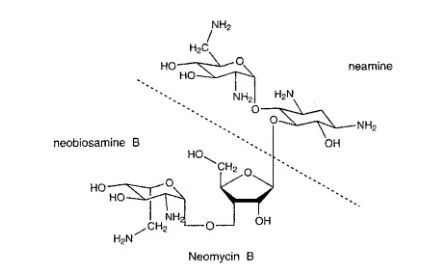
Physicochemical properties:
Description: Neomycin base (in sulfate): white or yellowish-white, odorless or almost odorless, hydroscopic powder.
Solubility: Neomycin base (in sulfate): Soluble 1 in 1 of water; very slightly soluble in alcohol; practically insoluble in acetone, chloroform and ether.
Proper name: Gramicidin
Chemical name: Gramicidin
Molecular formula and molecular mass: 1. gramicidin J1
C44 H65 N9 O7, 831 g/mol
- 2. gramicidin T2
C35 H56 N8 O6, 684 g/mol
- 3. gramicidin S
C60 H92 N12 O10, 1140 g/mol
Structural formula:
- 1. gramicidin J1
L-Phe-D-Leu-D-Phe-L-Orn-L-Val-b-Orn-L-Pro
- 2. gramicidin T2
b-Phe-D-Leu-L-Orn-L-Val-D-Orn-L-Pro
- 3. gramicidin S
L-Val-L-Orn-L-Leu-D-Phe-L-Pro L-Pro-D-Phe-L-Leu-L-Orn-L-Val
Physicochemical properties:
Description: White or almost white, odorless, crystalline powder.
Solubility: Soluble in alcohol, acetic acid, pyridine; moderately soluble in dry acetone and dioxane. Practically insoluble in ether, hydrocarbons.
Proper name: Nystatin
Chemical name: Nystatin
Molecular Formula C47 H75 NO17, 926.1 g/mol
Structural formula:
OH H O HO NH C 2 3H OH OH OH OH OH OH OH HO O CH H C CH O 3 3 3 O COOH O
Physicochemical properties:
Description: Yellow to light tan powder, having an odor suggestive of cereals. It is hydroscopic and is affected by long exposure to light, heat and air.
Solubility: Very slightly soluble in water, slightly to sparingly soluble in alcohol, methyl alcohol, n-propyl alcohol and n-butyl alcohol; insoluble in chloroform and ether.
REFERENCES
- 1.
PrVIADERM K.C.® CREAM and PrVIADERM K.C.® OINTMENT (Triamcinolone Acetonide 1 mg/g, Nystatin 100,000 units/g, Neomycin base (as sulphate) 2.5 mg/g, and Gramicidin 0.25 mg/g) Product Monograph, Taro Pharmaceuticals Inc Date of Revision: July 5, 2018. Control Number: 214456.
READ THIS FOR SAFE AND EFFECTIVE USE OF YOUR MEDICINE
PATIENT MEDICATION INFORMATION
PrTEVA-TRIACOMB
Triamcinolone Acetonide, Nystatin, Neomycin Sulfate,
and Gramicidin Cream
USP
Read this carefully before you start taking TEVA-TRIACOMB and each time you get a refill. This leaflet is a summary and will not tell you everything about this drug. Talk to your healthcare professional about your medical condition and treatment and ask if there is any new information about TEVA-TRIACOMB.
What is TEVA-TRIACOMB used for?
TEVA-TRIACOMB (Triamcinolone Acetonide, Nystatin, Neomycin Sulfate, and Gramicidin) is used to provide relief from the itching, burning, and swelling caused by bacterial and/or fungal infections.
TEVA-TRIACOMB contain antibacterial ingredients called gramicidin and neomycin, and should be used exactly as directed by your health care professional.
How does TEVA-TRIACOMB work?
TEVA-TRIACOMB is antibacterial and antifungal which destroy the bacteria and fungi (yeasts) causing the skin infections.
How to take TEVA-TRIACOMB?
Misuse or overuse of TEVA-TRIACOMB could lead to the growth of bacteria that will not be killed by gramicidin and/or neomycin (resistance). This means that TEVA-TRIACOMB or other medicines that contain gramicidin and/or neomycin may not work for you in the future.
Do not share your medicine.
What are the ingredients in TEVA-TRIACOMB?
Medicinal ingredients: Triamcinolone Acetonide, Nystatin, Neomycin Sulfate, and Gramicidin Non-medicinal ingredients: aluminum hydroxide, ceteareth-20, cetearyl alcohol, glyceryl monostearate, glyceryl stearate, methylparaben, petrolatum, polysorbate 60, propylene glycol, propylene glycol monostearate, propylparaben, purified water, sorbitol and titanium dioxide
TEVA-TRIACOMB comes in the following dosage forms:
TEVA-TRIACOMB (Triamcinolone Acetonide 1 mg / g, Nystatin 100,000 units / g, Neomycin base (as sulphate) 2.5 mg / g, and Gramicidin 0.25 mg / g) is available in 15 g, 30 g, and 60 g tubes, and in 450 g jars.
Do not use TEVA-TRIACOMB:
- if you are allergic to Triamcinolone Acetonide, Nystatin, Neomycin Sulfate, and Gramicidin or any of its non-medicinal ingredients (See What are the ingredients of TEVA-TRIACOMB),
- if you have primary skin infections,
- if you have any serious skin lesions, most viral lesions of the skin (including chicken pox (varicella) cold sores or genital herpes (Herpes simplex)), and fungal skin lesions except caused by yeasts infections,
- in your eyes,
- in the outer area of your ear if you have an ear infection or holes in your eardrums (see p. 4), and
- under covered skin dressing if you have skin swelling and infections
To help avoid side effects and ensure proper use, talk to your healthcare professional before you take TEVA-TRIACOMB. Talk about any health conditions or problems you may have, including:
- your previous use of corticosteroids,
- if your condition has not changed within 7 days,
- if you use it for large skin areas,
- if you have skin lesions close to the eye, and
- if you have allergic reactions such as burning, itching, irritation, dryness, and skin discoloration.
Other warnings you should know about:
- Avoid contact with the eyes. If accidental contact occurs, rinse the eyes thoroughly with water
- If further skin irritation develops or the infection worsens, contact your doctor.
- Avoid continuous or prolonged use as potential adverse effects increase with longer use.
Tell your healthcare professional about all the medicines you take, including any drugs, vitamins, minerals, natural supplements or alternative medicines.
The following may interact with TEVA-TRIACOMB:
Drug interactions studies have not been done for TEVA-TRIACOMB.
How to take TEVA-TRIACOMB:
Small quantity 2 or 3 times daily.
Usual dose:
Apply a small amount to the affected area 2 or 3 times daily.
Do not apply to open wounds or burns to avoid absorption of the drug(s) into the blood. Do not apply more than prescribed by the doctor. For external use only.
Overdose:
| If you think you have applied too much TEVA-TRIACOMB, contact your healthcare professional, hospital emergency department or regional Poison Control Centre immediately, even if there are no symptoms. |
What are possible side effects from using TEVA-TRIACOMB?
- Skin reactions such as burning, itching, irritation, dryness, and skin discoloration.
These are not all the possible side effects you may feel when taking TEVA-TRIACOMB. If you experience any side effects not listed here, contact your healthcare professional. Please also see Warnings and Precautions.
If you have a troublesome symptom or side effect that is not listed here or becomes bad enough to interfere with your daily activities, talk to your healthcare professional.
Reporting Side Effects
You can report any suspected side effects associated with the use of health products to Health Canada by: Visiting the Web page on Adverse Reaction Reporting (https://www.canada.ca/en/health-canada/services/drugs-health-products/medeffect-canada/adverse-reaction-reporting.html) for information on how to report online, by mail or by fax; or Calling toll-free at 1-866-234-2345 NOTE: Contact your health professional if you need information about how to manage your side effects. The Canada Vigilance Program does not provide medical advice. |
Storage:
Store at room temperature between 15ºC and 30ºC. Keep tube tightly closed. Do not freeze. Keep out of reach and sight of children.
If you want more information about TEVA-TRIACOMB:
- Talk to your healthcare professional
- Find the full product monograph that is prepared for healthcare professionals and includes this Patient Medication Information by visiting the Health Canada website (https://health-products.canada.ca/dpd-bdpp/index-eng.jsp); the manufacturer’s website http://www.tevacanada.com; or by calling 1-800-268-4127 ext. 3; or email druginfo@tevacanada.com.