


Product Monograph - Trihexyphenidyl
Recent Major Label Changes
| 2 Contraindications | 2026-08 |
|---|---|
| 4 Dosage and Administration, 4.1 Dosing Considerations | 2026-08 |
| 4 Dosage and Administration, 4.2 Recommended Dose and Dosage Adjustment | 2026-08 |
| 4 Dosage and Administration, 4.4 Administration | 2026-08 |
| 7 Warnings and Precautions, General | 2026-08 |
| 7 Warnings and Precautions, Carcinogenesis and Genotoxicity | 2026-08 |
| 7 Warnings and Precautions, Cardiovascular | 2026-08 |
| 7 Warnings and Precautions, Dependence, Tolerance and/or Abuse Liability | 2026-08 |
| 7 Warnings and Precautions, Driving and Operating Machinery | 2026-08 |
| 7 Warnings and Precautions, Endocrine and Metabolism | 2026-08 |
| 7 Warnings and Precautions, Gastrointestinal | 2026-08 |
| 7 Warnings and Precautions, Neurologic | 2026-08 |
| 7 Warnings and Precautions, Ophthalmologic | 2026-08 |
| 7 Warnings and Precautions, Reproductive Health | 2026-08 |
| 7 Warnings and Precautions, 7.1.1 Pregnancy | 2026-08 |
| 7 Warnings and Precautions, 7.1.2 Breastfeeding | 2026-08 |
| 7 Warnings and Precautions, 7.1.4 Geriatrics | 2026-08 |
Table of Contents
Certain sections or subsections that are not applicable at the time of the preparation of the most recent authorized product monograph are not listed.
Recent Major Label Changes .................................................................................................... 2
Table of Contents .................................................................................................................... 2
Part 1: Healthcare Professional Information ............................................................................ 5
- 1.
Indications ................................................................................................................... 5
1.1. Pediatrics ............................................................................................................... 5
1.2. Geriatrics ............................................................................................................... 5
- 2. Contraindications ......................................................................................................... 5
- 4.
Dosage and Administration .......................................................................................... 5
4.1. Dosing Considerations ........................................................................................... 5
4.2. Recommended Dose and Dosage Adjustment ...................................................... 5
4.2.1. Discontinuing Treatment ....................................................................................... 6
4.4. Administration ....................................................................................................... 6
4.5. Missed Dose .......................................................................................................... 7
- 5. Overdose...................................................................................................................... 7
- 6. Dosage Forms, Strengths, Composition, and Packaging ................................................ 7
- 7.
Warnings and Precautions ............................................................................................ 8
General .............................................................................................................................. 8
Carcinogenesis and Genotoxicity ...................................................................................... 8
Cardiovascular ................................................................................................................... 8
Dependence, Tolerance and/or Abuse Liability ................................................................. 8
Driving and Operating Machinery ..................................................................................... 9
Endocrine and Metabolism ............................................................................................... 9
Gastrointestinal ................................................................................................................. 9
Genitourinary .................................................................................................................... 9
Hepatic/Biliary/Pancreatic ................................................................................................ 9
Neurologic ......................................................................................................................... 9
Ophthalmologic ............................................................................................................... 10
Renal ............................................................................................................................... 10
Reproductive Health ....................................................................................................... 10
7.1. Special Populations .............................................................................................. 11
7.1.1. Pregnancy ............................................................................................................ 11
7.1.2. Breastfeeding ....................................................................................................... 11
7.1.3. Pediatrics ............................................................................................................. 11
7.1.4. Geriatrics ............................................................................................................. 11
- 8.
Adverse Reactions ...................................................................................................... 11
8.1. Adverse Reaction Overview ................................................................................. 11
8.2. Clinical Trial Adverse Reactions ........................................................................... 12
8.3. Less Common Clinical Trial Adverse Reactions .................................................... 12
8.4. Abnormal Laboratory Findings: Hematologic, Clinical Chemistry, and Other Quantitative Data ............................................................................................................ 13
8.5. Post-Market Adverse Reactions .......................................................................... 13
- 9.
Drug Interactions ....................................................................................................... 13
9.2. Drug Interactions Overview ................................................................................. 13
9.3. Drug-Behaviour Interactions ............................................................................... 13
9.4. Drug-Drug Interactions ........................................................................................ 13
9.5. Drug-Food Interactions ........................................................................................ 15
9.6. Drug-Herb Interactions ........................................................................................ 15
9.7. Drug-Laboratory Test Interactions ....................................................................... 16
- 10.
Clinical Pharmacology ................................................................................................ 16
10.1. Mechanism of Action ....................................................................................... 16
10.2. Pharmacodynamics ......................................................................................... 16
10.3. Pharmacokinetics ............................................................................................ 16
- 11. Storage, Stability, and Disposal .................................................................................. 16
Part 2: Scientific Information ................................................................................................. 17
- 13. Pharmaceutical Information ....................................................................................... 17
- 14. Clinical Trials .............................................................................................................. 17
- 15. Microbiology .............................................................................................................. 17
- 16. Non-Clinical Toxicology .............................................................................................. 17
Patient Medication Information ............................................................................................ 19
Part 1: Healthcare Professional Information
1. Indications
TRIHEXYPHENIDYL (trihexyphenidyl hydrochloride tablets) is indicated for:
- Treatment of all forms of Parkinsonism (postencephalitic, arteriosclerotic, and idiopathic).
- Prevention or control of extrapyramidal disorders due to central nervous system drugs such as reserpine and the phenothiazines.
1.1. Pediatrics
Pediatrics (<18 years of age): No data are available to Health Canada; therefore, Health Canada has not authorized an indication for pediatric use.
1.2. Geriatrics
Geriatrics (>60 years of age): Evidence from clinical studies and experience suggests that use in the geriatric population is associated with differences in safety or effectiveness. See 4.2 Recommended Dose and Dosage Adjustment, Geriatrics and 7.1.4 Geriatrics.
2. Contraindications
TRIHEXYPHENIDYL is contraindicated in:
- Patients who are hypersensitive to this drug or to any ingredient in the formulation, including any non-medicinal ingredient, or component of the container. For a complete listing, see 6 Dosage Forms, Strengths, Composition and Packaging.
- Patients with narrow angle glaucoma. Blindness after long-term use due to narrow angle glaucoma has been reported. See 7 Warnings and Precautions, Ophthalmologic.
4. Dosage and Administration
4.1. Dosing Considerations
- Dosage should be individualized. The initial dosage should be low and then increased gradually, especially in patients over 60 years of age.
- Patients with arteriosclerosis or with a history of idiosyncrasy to other drugs should be allowed to develop a tolerance through the initial administration of a small dose and a gradual increase in dose until an effective level is reached. If a severe reaction should occur, administration of the drug should be discontinued for a few days and then resumed at a lower dosage.
4.2. Recommended Dose and Dosage Adjustment
Parkinsonism
1 mg orally the first day; increased by 2 mg daily at intervals of 3 to 5 days, up to 6 to 10 mg daily. The 2 mg tablets are scored therefore can be split adequately in equal halves if necessary. The total daily dose will depend upon what is found to be the optimal level. Many patients derive maximum benefit from this daily total of 6 to 10 mg, but some patients, chiefly those in the postencephalitic group, may require a total daily dose of 12 to 15 mg.
Drug-Induced Parkinsonism
The size and frequency of doses of TRIHEXYPHENIDYL needed to control drug-induced extrapyramidal reactions, attributable especially to reserpine and phenothiazine derivatives, must be determined empirically. The total daily dosage usually ranges between 5 and 15 mg although, in some cases, these reactions have been satisfactorily controlled on as little as 1 mg daily. It may be advisable to commence therapy with a single 1 mg dose. If the extrapyramidal manifestations are not controlled in a few hours, the subsequent doses may be progressively increased until satisfactory control is achieved. Satisfactory control may sometimes be more rapidly achieved by temporarily reducing the dosage of the tranquilizer or instituting TRIHEXYPHENIDYL therapy and then adjusting dosage of both drugs until the desired ataractic effect is retained without onset of the extrapyramidal reactions.
It is sometimes possible to maintain the patient on a reduced TRIHEXYPHENIDYL dosage after the reactions have remained under control for several days. Instances have been reported in which these reactions have remained in remission for long periods after therapy was discontinued.
Pediatrics (<18 years of age): Health Canada has not authorized an indication for pediatric use. See 1.1 Pediatrics.
Geriatrics (>60 years of age): Geriatric patients, especially those over the age of 60, frequently develop increased sensitivity to parasympatholytic drugs and therefore require strict dosage regulation. Treatment should be initiated at a low dose, and followed by a gradual titration. See 7.1.4 Geriatrics.
Hepatic and renal impairment: No information is available for this drug product.
4.2.1. Discontinuing Treatment
Patients should be observed carefully if abrupt reduction or discontinuation of TRIHEXYPHENIDYL is required, especially if the patient is receiving neuroleptics. Abrupt withdrawal of treatment for parkinsonism may result in acute exacerbation of parkinsonism symptoms, or neuroleptic malignant syndrome (NMS). See 7 Warnings and Precautions, Neurologic, Neuroleptic Malignant Syndrome.
The development of psychiatric disturbances may necessitate discontinuation of treatment. See 8.1 Adverse Reaction Overview.
4.4. Administration
Best tolerated in divided doses at mealtime. High doses (>10 mg daily) may be divided into 4 parts (3 with meals and 1 at bedtime). The timing of dosing (before or after meals) should be based on patient response. If excessive dry mouth occurs, dosing before meals may be preferable, unless it causes nausea. When taken after meals, thirst may be relieved with mint candies, chewing gum, or water.
Postencephalitic patients, who are usually more prone to excessive salivation, may prefer to take it after meals. In some cases, small amounts of atropine may be used as an effective adjuvant.
4.5. Missed Dose
If the patient misses a dose, instruct the patient to take the dose as soon as they remember. If it is almost time for the next dose, inform the patient to skip the missed dose and continue the regular dosing schedule.
5. Overdose
In humans, doses up to 300 mg (5 mg/kg) have been ingested without fatalities or sequelae. However, rare cases of death associated with trihexyphenidyl hydrochloride tablets overdosages taken in conjunction with other CNS depressant agents have been reported or in patients with a compromised respiratory condition. Trihexyphenidyl blood concentrations associated with the fatalities ranged from 0.03 to 0.80 mg/L. In animals, toxicity, including lethality, have been reported. See 16 Non-Clinical Toxicology.
Signs and Symptoms
Overdosage with trihexyphenidyl hydrochloride tablets produces typical central symptoms of atropine intoxication (the central anticholinergic syndrome). Correct diagnosis depends upon recognition of the peripheral signs of parasympathetic blockade, including dilated and sluggish pupils; warm, dry skin; facial flushing; decreased secretions of the mouth, pharynx, nose, and bronchi; foul-smelling breath; elevated temperature; tachycardia, cardiac arrhythmias; decreased bowel sounds; and urinary retention. Neuropsychiatric signs such as delirium, disorientation, anxiety, hallucinations, illusions, confusion, incoherence, agitation, hyperactivity, ataxia, lip smacking and tasting movements, loss of memory, paranoia, combativeness, and seizures may be present. The condition can progress to stupor, coma, paralysis, cardiac and respiratory arrest, and death.
Treatment
Treatment of acute overdose involves symptomatic and supportive therapy. A small dose of diazepam or a short-acting barbiturate may be administered if CNS excitation is observed. Phenothiazines are contraindicated because the toxicity may be intensified due to their antimuscarinic action, causing coma. Respiratory support, artificial respiration or vasopressor agents may be necessary. Hyperpyrexia must be reversed, fluid volume replaced and acid-balance maintained. Urinary catheterization may be necessary. It is not known if TRIHEXYPHENIDYL is dialyzable.
For the most recent information in the management of a suspected drug overdose, contact your regional poison control centre or Health Canada’s toll-free number, 1-844 POISON-X (1-844-764-7669).
- 6. Dosage Forms, Strengths, Composition, and Packaging
Table 1 – Dosage Forms, Strengths and Composition
| Route of Administration | Dosage Form / Strength / Composition | Non-Medicinal Ingredients |
| Oral | Tablets 2 mg, 5 mg of trihexyphenidyl | Croscarmellose sodium, lactose monohydrate, magnesium stearate, and microcrystalline cellulose. |
This drug product contains lactose. See 7 Warnings and Precautions, Endocrine and Metabolism.
Description
TRIHEXYPHENIDYL 2 mg tablet: Each white, round, flat-faced, bevelled-edge tablet, engraved score over TRM on one side, other side plain, contains 2 mg trihexyphenidyl hydrochloride. Available in bottles of 100.
TRIHEXYPHENIDYL 5 mg tablet: Each white, round, flat-faced, bevelled-edge tablet, engraved score over 5 on one side, other side plain, contains 5 mg trihexyphenidyl hydrochloride. Available in bottles of 100.
7. Warnings and Precautions
General
Patients undergoing prolonged therapy should be subjected to constant and careful long-term observation to avoid allergic and other untoward reactions.
TRIHEXYPHENIDYL should be administered with caution in the presence of fever, hot weather, and/or during physical exercise, especially when given concomitantly with other atropine-like drugs to the chronically ill, alcoholics, those who have central nervous system disease, or those who do manual labor in a hot environment. Anhidrosis may occur more readily when some disturbance of sweating already exists. If there is evidence of anhidrosis, the possibility of hyperthermia should be considered. Dosage should be decreased so that the ability to maintain body heat equilibrium via perspiration is not impaired. Severe anhidrosis and fatal hyperthermia have occurred with the use of anticholinergics under the conditions described above. Patients should be advised to report the occurrence of heat intolerance promptly since hypothermia or heat stroke may occur.
Carcinogenesis and Genotoxicity
No carcinogenicity studies or adequate genotoxicity studies have been conducted for trihexyphenidyl hydrochloride tablets.
Cardiovascular
Maintain patients with cardiac or hypertensive disorders under close observation. TRIHEXYPHENIDYL has anticholinergic properties; as a result, existing hypertension may be aggravated and tachycardia may occur. Patients at risk (arrhythmia, heart failure, coronary heart disease, mitral stenosis) should be monitored carefully over a prolonged period. TRIHEXYPHENIDYL should be used with caution in patients with cardiac disease such as ischaemic heart disease, or with atherosclerosis and hypertension because of its positive chronotropic effect that could cause tachycardia and/or coronary ischemia.
Dependence, Tolerance and/or Abuse Liability
Although TRIHEXYPHENIDYL is not classified as a controlled substance, it may be subject to abuse due to
| Route of Administration | Dosage Form / Strength / Composition | Non-Medicinal Ingredients |
| hydrochloride | ||
its stimulant, hallucinogenic, and euphoriant properties.
Driving and Operating Machinery
TRIHEXYPHENIDYL may impair mental and/or physical abilities required for performance of hazardous tasks, such as operating machinery or driving a motor vehicle. While taking TRIHEXYPHENIDYL, patients should be cautioned not to drive, operate dangerous machinery or engage in activities that require alertness or physical coordination if they are experiencing any of these effects.
Endocrine and Metabolism
This medicinal product contains lactose. Patients with rare hereditary problems of galactose intolerance, the Lapp lactase deficiency or glucose-galactose malabsorption should not take this medicine. See 6. Dosage Forms, Strengths, Composition, and Packaging.
Gastrointestinal
TRIHEXYPHENIDYL should be used with caution in patients with obstructive disease of the gastrointestinal tract.
Patients should be advised to report the occurrence of gastrointestinal symptoms promptly since paralytic ileus may occur.
If gastrointestinal disorder occurs, TRIHEXYPHENIDYL may be taken with food. See 4 Dosage and Administration, 4.4 Administration.
Genitourinary
TRIHEXYPHENIDYL should be used with caution in patients with obstructive disease of the genitourinary tract, and in elderly males with possible prostatic hypertrophy.
Hepatic/Biliary/Pancreatic
Maintain patients with liver disorders under close observation.
Neurologic
Abrupt withdrawal of treatment for parkinsonism may result in acute exacerbation of parkinsonism symptoms, or neuroleptic malignant syndrome (NMS); therefore, abrupt withdrawal should be avoided. See 4.2.1 Discontinuing Treatment.
Neuroleptic Malignant Syndrome: A potentially fatal symptom complex resembling Neuroleptic Malignant Syndrome, including muscular rigidity, increased body temperature, mental changes (e.g., agitation, confusion, coma), evidence of autonomic instability (irregular pulse or blood pressure, tachycardia, diaphoresis and cardiac dysrhythmias), and increased serum creatine phosphokinase, has been reported when anti-Parkinsonian medicinal products were withdrawn abruptly.
Rhabdomyolysis secondary to Neuroleptic Malignant Syndrome or severe dyskinesias have been observed rarely in patients with Parkinson’s disease. Patients should be carefully observed when the dose of TRIHEXYPHENIDYL are abruptly reduced or discontinued, especially if the patient is receiving antipsychotics. Should a combination of such symptoms occur, the patient should be kept under medical surveillance, hospitalized if necessary, and appropriate symptomatic treatment given. This may include resumption of therapy with TRIHEXYPHENIDYL after appropriate evaluation.
The diagnostic evaluation of patients with this syndrome is complicated. In arriving at a diagnosis, it is important to identify cases where the clinical presentation includes both serious medical illness (e.g., pneumonia, systemic infection, etc.) and untreated or inadequately treated extrapyramidal signs and symptoms (EPS). Other important considerations in the differential diagnosis include central anticholinergic toxicity, heat stroke, drug fever, and primary central nervous system (CNS) pathology.
Tardive dyskinesia: Tardive dyskinesia may appear in some patients on long-term therapy with antipsychotic drugs or may occur after therapy with these drugs has been discontinued. Antiparkinsonism agents do not alleviate the symptoms of tardive dyskinesia, and in some instances may aggravate them. See 9.4 Drug-Drug Interactions.
However, parkinsonism and tardive dyskinesia often coexist in patients receiving chronic neuroleptic treatment, and anticholinergic therapy with TRIHEXYPHENIDYL may relieve some of these parkinsonism symptoms. TRIHEXYPHENIDYL is not recommended for use in patients with tardive dyskinesia unless they have concomitant Parkinson's disease.
Myasthenia gravis: Since TRIHEXYPHENIDYL has been associated with the clinical worsening of myasthenia gravis, the drug should be avoided or used with great caution in patients with this condition.
Ophthalmologic
TRIHEXYPHENIDYL should not be used in patients with glaucoma. Incipient glaucoma may be precipitated by TRIHEXYPHENIDYL. See 2 Contraindications.
Patients to be treated with TRIHEXYPHENIDYL should have a gonioscope evaluation prior to initiation of therapy and close monitoring of intraocular pressures at regular intervals. TRIHEXYPHENIDYL can induce cycloplegia and mydriasis. The use of anticholinergic drugs may precipitate angle closure with an increase in intraocular pressure. If blurring of vision occurs during therapy, the possibility of narrow angle glaucoma should be considered. Blindness has been reported due to aggravation of narrow angle glaucoma. See 2 Contraindications and 8.1 Adverse Reaction Overview, Eye disorders.
Renal
Maintain patients with kidney disorders under close observation.
Reproductive Health
Fertility
No fertility studies have been conducted for TRIHEXYPHENIDYL.
7.1. Special Populations
7.1.1. Pregnancy
As no data were submitted and reviewed by Health Canada, the safety of TRIHEXYPHENIDYL during pregnancy as well as its effects on reproductive capacity have not been be established, and the potential risk is considered unknown. TRIHEXYPHENIDYL should be avoided during pregnancy unless the potential benefits to the mother outweighs the potential risk to the fetus. See 16 Non-Clinical Toxicology.
7.1.2. Breastfeeding
It is unknown if trihexyphenidyl hydrochloride is excreted in human milk. Precaution should be exercised because many drugs can be excreted in human milk. The excretion of trihexyphenidyl hydrochloride in milk has not been studied in animals. Infants may be very sensitive to the effects of antimuscarinic medications. TRIHEXYPHENIDYL should not be used during breastfeeding.
7.1.3. Pediatrics
Pediatrics (<18 years of age): No data are available to Health Canada; therefore, Health Canada has not authorized an indication for pediatric use.
7.1.4. Geriatrics
Geriatrics (>60 years of age): Geriatric patients, particularly over the age of 60, frequently develop increased sensitivity to parasympatholytic drugs and hence, require strict dosage regulation. Geriatric patients generally should be started on low doses of TRIHEXYPHENIDYL and observed closely. See 4.2 Recommended Dose and Dosage Adjustment.
TRIHEXYPHENIDYL should be used with caution in geriatric males with possible prostatic hypertrophy. See 7 Warnings and Precautions, Genitourinary.
Incipient glaucoma may be precipitated by TRIHEXYPHENIDYL. See 7 Warnings and Precautions, Ophthalmologic.
TRIHEXYPHENIDYL has been shown to cause some cognitive dysfunctions in geriatric patients, including confusion, delusions, hallucinations, and memory impairment. See 8.1 Adverse Reaction Overview.
8. Adverse Reactions
8.1. Adverse Reaction Overview
Dryness of mouth, constipation, blurred vision, dizziness, mild nausea or nervousness will be experienced by 30 to 50% of all patients. These sensations, however, are much less troublesome with TRIHEXYPHENIDYL than with belladonna alkaloids and are usually less disturbing than unalleviated parkinsonism. Such reactions tend to become less pronounced, and even to disappear, as treatment continues. Even before these reactions have remitted spontaneously, they may often be controlled by careful adjustment of dosage form, amount of drug, or interval between doses.
Patients with arteriosclerosis or with a history of idiosyncrasy to other drugs may exhibit reactions of mental confusion, agitation, disturbed behavior, or nausea and vomiting.
Psychiatric disturbances can result from indiscriminate use (leading to overdosage) to sustain continued euphoria.
Potential untoward effects associated with the use of any atropine-like drugs include the following:
Cardiac disorders: Tachycardia, paradoxical sinus bradycardia.
Eye disorders: Dilatation of pupils with loss of accommodation and photophobia, intraocular pressure increased, and cycloplegia. See 7 Warnings and Precautions, Ophthalmologic.
The occurrence of angle-closure glaucoma in patients receiving TRIHEXYPHENIDYL has been reported (blindness has been reported in some cases). See 2 Contraindications and 7 Warnings and Precautions, Ophthalmologic.
Gastrointestinal disorders: Constipation, large bowel dilatation, paralytic ileus, suppurative parotitis secondary to excessive dryness of the mouth, dry mouth with difficulty swallowing, nausea, vomiting.
General disorders and administration site conditions: Weakness, thirst, pyrexia.
Immune system disorders: Hypersensitivity.
Nervous system disorders: Drowsiness, headache, restlessness, cognitive dysfunctions, including confusion and memory impairment, choreiform movements.
Exacerbation of parkinsonism with abrupt treatment withdrawal has been reported. Neuroleptic malignant syndrome with abrupt treatment withdrawal has been reported. See 4.2.1 Discontinuing Treatment, and 7 Warnings and Precautions, Neurologic.
Worsening of myasthenia gravis may occur. See 7 Warnings and Precautions, Neurologic.
Psychiatric disorders: Hallucinations, delusions, agitation, paranoia, confusional states, insomnia.
Renal and urinary disorders: Urinary hesitancy or retention, difficulty in micturition.
Respiratory, thoracic and mediastinal disorders: Decreased bronchial secretions.
Skin and subcutaneous tissue disorders: Dry skin, flushing, skin rashes.
8.2. Clinical Trial Adverse Reactions
This information is not available for this drug product.
8.3. Less Common Clinical Trial Adverse Reactions
This information is not available for this drug product.
8.4. Abnormal Laboratory Findings: Hematologic, Clinical Chemistry, and Other Quantitative Data
This information is not available for this drug product.
8.5. Post-Market Adverse Reactions
This information is not available for this drug product.
9. Drug Interactions
9.2. Drug Interactions Overview
As no data were submitted and reviewed by Health Canada, the potential for drug interactions of TRIHEXYPHENIDYL cannot be established, and the associated risk remains unknown.
9.3. Drug-Behaviour Interactions
Cannabinoids, barbiturates, opiates, and alcohol may have additive effects with TRIHEXYPHENIDYL, and thus, an abuse potential exists.
Concurrent use of alcohol or other CNS depressants with TRIHEXYPHENIDYL may cause increased sedative effects.
9.4. Drug-Drug Interactions
The drugs listed in this table are based on either drug interaction case reports or studies, or potential interactions due to the expected magnitude and seriousness of the interaction (i.e., those identified as contraindicated).
Table 2 - Established or Potential Drug-Drug Interactions
| Proper / Common name | Source of Evidence | Effect | Clinical comment |
| Proper / Common name | Source of Evidence | Effect | Clinical comment |
| Proper / Common name | Source of Evidence | Effect | Clinical comment |
| Levodopa | T | Concomitant administration may increase drug-induced involuntary movements. The absorption of levodopa may possibly be reduced when used in conjunction with TRIHEXYPHENIDYL. | The usual dose of either TRIHEXYPHENIDYL or levodopa may need to be reduced during concomitant therapy. |
| Metoclopramide and domperidone | T | TRIHEXYPHENIDYL may be antagonistic with the actions of metoclopramide and domperidone on gastrointestinal function. | |
| Monoamine oxidase inhibitors and tricyclic antidepressants | T | Monoamine oxidase inhibitors and tricyclic antidepressants possessing significant anticholinergic activity may intensify the anticholinergic effects of antidyskinetic agents because of the secondary anticholinergic activities of these medications. This can cause dry mouth, blurred vision, urinary hesitancy, urinary retention and constipation. In the elderly, there is a danger of precipitating acute glaucoma or paralytic ileus. | In general, anticholinergic agents should be used with caution in patients who are receiving tricyclic antidepressants or monoamine oxidase inhibitors. In patients who are already on antidepressant therapy, the dose of TRIHEXYPHENIDYL should be initially reduced and the patient reviewed regularly. |
| Neuroleptics | T | There may be an increased risk for the development of tardive dyskinesia during concomitant administration of anticholinergics and neuroleptics. See 7 Warnings and Precautions, Neurologic. | Prophylactic administration of anticholinergic agents, such as TRIHEXYPHENIDYL, as a prevention of drug induced parkinsonism during neuroleptic therapy is not recommended. |
| Parasympathomimetics | T | TRIHEXYPHENIDYL may be antagonistic with the actions of Parasympathomimetics. | |
| Phenothiazines, clozapine, antihistamines, disopyramide, nefopam and amantadine | T | Possibility of increased anti-muscarinic side-effects. | Extra care should be taken when TRIHEXYPHENIDYL is given concomitantly. |
| Anticonvulsants | T | Exacerbation of seizures in patients with adequately controlled epilepsy has been suggested during initiation of anticholinergic agents such as TRIHEXYPHENIDYL. | Use TRIHEXYPHENIDYL cautiously in patients with epilepsy or other seizure disorders. Initiate at a low dose, titrate gradually, and monitor for changes in seizure control. |
| Prokinetic drugs | T | The antimuscarinic properties of TRIHEXYPHENIDYL may pharmacodynamically oppose the effects of prokinetic agents such as metoclopramide, tegaserod and domperidone on gastro-intestinal function. | Concomitant use of gastrointestinal prokinetic agents with anticholinergic agents should be avoided, if possible. |
| Carbonic anhydrase inhibitors | T | Acetazolamide can decrease excretion and enhance the effects of antimuscarinics. Carbonic anhydrase inhibitors increase the alkalinity of the urine, thereby increasing the amount of nonionised drug available for renal tubular reabsorption | Use caution if carbonic anhydrase inhibitors are administered with TRIHEXYPHENIDYL and monitor for excessive anticholinergic adverse effects. Through an additive effect, the use of topiramate (a weak carbonic anhydrase inhibitor) with TRIHEXYPHENIDYL may lead to oligohidrosis, hyperthermia and/or heat stroke. |
| Magnesium hydroxyde | T | Magnesium hydroxide inhibits the absorption of TRIHEXYPHENIDYL | Simultaneous administration should be avoided; separate dosing by at least 2 hours to limit an interaction |
| Memantine | T | The adverse effects of TRIHEXYPHENIDYL such as dry mouth, urinary hesitancy or blurred vision may be enhanced with use of memantine | Dosage adjustments of TRIHEXYPHENIDYL may be required when memantine is co-administered. |
Legend: T = Theoretical
9.5. Drug-Food Interactions
The use of acidic foods such as citrus and fruit juices may decrease the effect of a TRIHEXYPHENIDYL dose. Large amounts of coffee with TRIHEXYPHENIDYL use may lead to a euphoric effect.
9.6. Drug-Herb Interactions
Interactions with herbal products have not been established.
9.7. Drug-Laboratory Test Interactions
Interactions with laboratory tests have not been established.
10. Clinical Pharmacology
10.1. Mechanism of Action
Trihexyphenidyl hydrochloride is an anticholinergic agent. It is an antispasmodic drug which exerts a direct inhibitory effect on the parasympathetic nervous system.
10.2. Pharmacodynamics
Trihexyphenidyl hydrochloride diminishes salivation, increases the heart rate, dilates the pupils and reduces spasm of smooth muscle
10.3. Pharmacokinetics
Absorption
Trihexyphenidyl hydrochloride is well absorbed from gastro-intestinal tract.
Distribution:
Trihexyphenidyl hydrochloride disappears rapidly from the plasma and tissues and does not accumulate in the body during continued administration of conventional doses.
- 11. Storage, Stability, and Disposal
Store at room temperature, 15 to 30°C. Preserve in tight container.
Part 2: Scientific Information
13. Pharmaceutical Information
Drug Substance
Non-proprietary name of the drug substance: Trihexyphenidyl Hydrochloride
Chemical name: (1RS)-1-Cyclohexyl-1-phenyl-3-(piperidin-1-yl) propan-1-ol Hydrochloride
Molecular formula and molecular mass: C20H32ClNO and 337.93 g/mol
Structural formula:
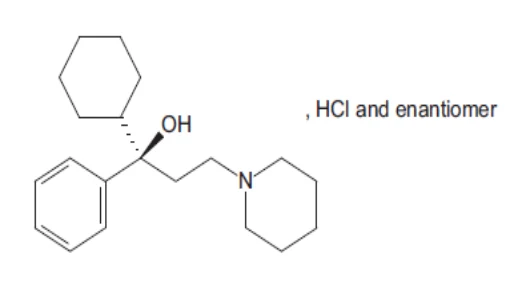
Physicochemical properties:
Appearance: White or almost white crystalline powder.
Solubility: Slightly soluble in Water, sparingly soluble in Ethanol (96%) and in Methylene Chloride.
Melting Point: About 250°C.
Pharmaceutical standard: USP-EP
14. Clinical Trials
The clinical trial data on which the original indication was authorized is not available.
15. Microbiology
No microbiological information is required for this drug product.
16. Non-Clinical Toxicology
The mean oral LD50 of trihexyphenidyl hydrochloride has been reported to be 365 mg/kg (range, 325 to 410 mg/kg) in mice and 1660 mg/kg (1420 to 1940 mg/kg) in rats. At a dose of 40 mg/kg, dogs have exhibited emesis, restlessness followed by drowsiness, equilibrium disturbances, and mydriasis.
Reproductive and Developmental Toxicology
Animal reproduction studies to evaluate teratogenic and embryotoxic potential have not been conducted with trihexyphenidyl hydrochloride.