


Product Monograph - Tryngolza
Recent Major Label Changes
None at time of the most recent authorization.
Table of Contents
Certain sections or subsections that are not applicable at the time of the preparation of the most recent authorized product monograph are not listed.
Recent Major Label Changes .............................................................................................................. 2
Part 1: Healthcare Professional Information ....................................................................................... 4
- 1.
Indications ................................................................................................................................. 4
1.1. Pediatrics ................................................................................................................................. 4
1.2. Geriatrics ................................................................................................................................. 4
- 2. Contraindications ....................................................................................................................... 4
- 4.
Dosage and Administration ......................................................................................................... 4
4.1. Dosing Considerations ............................................................................................................. 4
4.2. Recommended Dose and Dosage Adjustment........................................................................ 4
4.4. Administration ......................................................................................................................... 5
4.5. Missed Dose ............................................................................................................................ 5
- 5. Overdose ................................................................................................................................... 5
- 6. Dosage Forms, Strengths, Composition, and Packaging ................................................................ 6
- 7.
Warnings and Precautions .......................................................................................................... 6
General ................................................................................................................................................. 6
Cardiovascular ...................................................................................................................................... 6
Immunogenicity (Hypersensitivity) ....................................................................................................... 6
Laboratory Tests ................................................................................................................................... 7
7.1. Special Populations ................................................................................................................. 7
7.1.1. Pregnancy ....................................................................................................................... 7
7.1.2. Breastfeeding ................................................................................................................. 7
7.1.3. Pediatrics ........................................................................................................................ 8
7.1.4. Geriatrics ........................................................................................................................ 8
- 8.
Adverse Reactions ...................................................................................................................... 8
8.1. Adverse Reaction Overview .................................................................................................... 8
8.2. Clinical Trial Adverse Reactions ............................................................................................... 8
8.2.1. Clinical Trial Adverse Reactions – Pediatrics .................................................................. 9
8.3. Less Common Clinical Trial Adverse Reactions ....................................................................... 9
8.4. Abnormal Laboratory Findings: Hematologic, Clinical Chemistry and Other Quantitative Data ............................................................................................................................................... 10
- 9.
Drug Interactions ...................................................................................................................... 10
9.2. Drug Interactions Overview .................................................................................................. 10
9.3. Drug-Behaviour Interactions ................................................................................................. 11
9.4. Drug-Drug Interactions .......................................................................................................... 11
9.5. Drug-Food Interactions ......................................................................................................... 11
9.6. Drug-Herb Interactions ......................................................................................................... 11
9.7. Drug-Laboratory Test Interactions ........................................................................................ 11
- 10.
Clinical Pharmacology ............................................................................................................... 11
10.1. Mechanism of Action ............................................................................................................ 11
10.2. Pharmacodynamics ............................................................................................................... 11
10.3. Pharmacokinetics .................................................................................................................. 12
10.4. Immunogenicity .................................................................................................................... 13
- 11. Storage, Stability, and Disposal ................................................................................................. 13
Part 2: Scientific Information ............................................................................................................ 14
- 13. Pharmaceutical Information ..................................................................................................... 14
- 14.
Clinical Trials ............................................................................................................................ 15
14.1. Clinical Trials by Indication .................................................................................................... 15
- 16. Non-Clinical Toxicology ............................................................................................................. 17
Patient Medication Information ....................................................................................................... 19
Part 1: Healthcare Professional Information
1. Indications
TRYNGOLZA (Olezarsen injection) is indicated:
- as an adjunct to diet for the treatment of adult patients with familial chylomicronemia syndrome (FCS) to reduce triglyceride levels.
Patients in the pivotal trial for TRYNGOLZA were all patients with genetically confirmed FCS (see 14 Clinical Trials).
1.1. Pediatrics
Pediatrics (< 18 years of age): No data are available to Health Canada; therefore, Health Canada has not authorized an indication for pediatric use.
1.2. Geriatrics
Geriatrics (≥ 65 years of age): Based on limited data from clinical studies, use in the geriatric population is not associated with differences in safety or effectiveness.
2. Contraindications
TRYNGOLZA is contraindicated in
- patients who are hypersensitive to this drug or to any ingredient in the formulation, including any non-medicinal ingredient, or component of the container. For a complete listing, see 6 Dosage Forms, Strengths, Composition, and Packaging.
4. Dosage and Administration
4.1. Dosing Considerations
TRYNGOLZA is to be administered subcutaneously once monthly.
TRYNGOLZA has not been studied in patients with severe renal impairment or end-stage renal disease or in patients with moderate or severe hepatic impairment.
4.2. Recommended Dose and Dosage Adjustment
The recommended dosage of TRYNGOLZA is 80 mg administered by subcutaneous injection once monthly.
No dose adjustment is required in patients ≥ 65 years of age.
Based on a population pharmacokinetic and pharmacodynamic analysis, no dose adjustment is necessary in patients with mild or moderate renal impairment (estimated glomerular filtration rate [eGFR] ≥30 to < 90 mL/min/1.73 m2).
A population pharmacokinetic and pharmacodynamic analysis showed no clinically meaningful differences in the pharmacokinetics or pharmacodynamics of olezarsen based on mild hepatic impairment. No dose adjustment is necessary in patients with mild hepatic impairment (total bilirubin ≤ upper limit of normal [ULN] with aspartate aminotransferase [AST] > ULN, or total bilirubin > 1-1.5 × ULN with any AST).
Health Canada has not authorized an indication for pediatric use.
4.4. Administration
TRYNGOLZA is intended for subcutaneous use only. It should not be administered intramuscularly.
Each autoinjector is for single use only.
TRYNGOLZA should be inspected visually for particulate matter and discoloration prior to administration. The solution should be clear and colourless to yellow. It is normal to see air bubbles in the solution. If the solution is cloudy or contains visible particulate matter, the contents must not be injected and the medicinal product should be returned to the pharmacy.
Patients and/or caregivers should be trained in the preparation and administration of this medicinal product in accordance with the Patient Medication Information.
The single dose autoinjector should be removed from refrigerated storage (2°C to 8°C) at least 30 minutes before use. It should be allowed to reach room temperature prior to injection. Other warming methods should not be used.
TRYNGOLZA should be administered into the abdomen or front of the thigh. The back of the upper arm can also be used as an injection site if a healthcare provider or caregiver administers the injection.
4.5. Missed Dose
If a dose is missed, administer TRYNGOLZA as soon as possible after the missed dose. Resume dosing at monthly intervals from the date of the most recently administered dose.
5. Overdose
There is no clinical experience with overdose of this medicinal product. In the case of overdose, patients should be carefully observed and supportive care administered, as appropriate.
| For the most recent information in the management of a suspected drug overdose, contact your regional poison control centre or Health Canada’s toll-free number, 1-844 POISON-X (1-844-764-7669). |
|---|
- 6. Dosage Forms, Strengths, Composition, and Packaging
Table 1 – Dosage Forms, Strengths, and Composition
Description
TRYNGOLZA is a sterile, preservative-free, clear, colorless to yellow parenteral solution of olezarsen intended for monthly subcutaneous (SC) administration (Table 1).
TRYNGOLZA is available in a carton containing one single-dose autoinjector.
7. Warnings and Precautions
General
Limited safety data exist for TRYNGOLZA use in patients with FCS at the time of marketing authorization. While the risk of thrombocytopenia and bleeding events, hepatotoxicity or renal toxicity has not been fully elucidated during clinical development, these adverse reactions have been identified with some other antisense oligonucleotides and cannot be completely excluded.
Cardiovascular
Major Adverse Cardiovascular Events (MACE) were numerically higher in patients treated with TRYNGOLZA in a supportive study carried out in a non-FCS population with Atherosclerotic Cardiovascular Disease (ASCVD) or at increased risk of developing ASCVD. No FCS patients treated with TRYNGOLZA experienced any components of adjudicated MACE events that were assessed as related to study drug. Prior to TRYNGOLZA therapy, it is recommended to assess the patient’s comorbidities.
Immunogenicity (Hypersensitivity)
Hypersensitivity reactions (including symptoms such as bronchospasm, diffuse erythema, facial swelling, urticaria, chills, myalgia) have been reported in patients treated with TRYNGOLZA. If a severe hypersensitivity reaction occurs, immediately discontinue administration of TRYNGOLZA and initiate appropriate therapy. Based on the data, a serious hypersensitivity reaction may occur following multiple exposures to the drug.
| Route of Administration | Dosage Form/ Strength/Composition | Non-Medicinal Ingredients |
| Subcutaneous injection | Solution/80 mg/0.8 mL in a single dose autoinjector/Single dose pre-filled autoinjector contains 80 mg olezarsen (equivalent to 84 mg of olezarsen sodium) in 0.8 mL of solution. | Disodium hydrogen phosphate Hydrochloric acid (for pH adjustment) Sodium chloride Sodium dihydrogen phosphate Sodium Hydroxide (for pH adjustment) Water for Injection (WFI) |
Laboratory Tests
Decreases in Platelet counts:
TRYNGOLZA can cause reductions in platelet count. In the Balance trial, the mean platelet count in the TRYNGOLZA 80mg group was 188,000/mm3 at baseline, and the mean percent change in platelet count was -10% at Week 53. In comparison, the mean platelet count in the placebo group was 215,000/mm3 at baseline, and the mean percent change in platelet count was 22% at Week 53. No TRYNGOLZA treated patient with FCS had a platelet count <50,000/mm3. Patients who experienced treatment emergent adverse events of platelet or thrombocytopenia were 13.6% and 4.3% in the olezarsen 80 mg group and the placebo group, respectively, in the Balance trial.
Increase in Liver Enzymes:
Increases from baseline in liver enzymes within the normal range were observed with TRYNGOLZA treatment in the FCS population. These increases occurred within the first months of treatment and stabilized. Liver enzymes returned toward baseline with discontinuation of TRYNGOLZA.
Increase in glucose:
Small increases in fasting glucose (<17 mg/dL [0.94 mmol/L]) and HbA1c (<0.2 percentage points) were observed over time with TRYNGOLZA treatment in the FCS population in the Balance trial. The incidence of hyperglycemia (defined as adverse events, new antidiabetic medication or laboratory values) was higher in TRYNGOLZA-treated patients without a medical history of diabetes at baseline (52%) compared to placebo treated patients (35%).
Increase in low-density lipoprotein cholesterol (LDL-C):
Increases in LDL-C and total apolipoprotein B (apoB) were observed in the FCS population treated with TRYNGOLZA compared to those treated with placebo (see 14 Clinical Trials). Despite increases in LDL-C, the maximum LDL-C value remained low for most patients (<70mg/dL [1.81 mmol/L]) for 74% of patients treated with TRYNGOLZA.
As TRYNGOLZA related laboratory changes have been observed, obtaining baseline levels of these blood tests may be considered, in case monitoring these laboratory values are considered clinically necessary during TRYNGOLZA therapy.
7.1. Special Populations
7.1.1. Pregnancy
There are no available data on olezarsen use in pregnant women.
Based on animal data (see 16 Non-Clinical Toxicology), olezarsen is predicted to have a low probability of increasing the risk of adverse developmental outcomes above background risk.
No clinical data on the effect of this medicinal product on human fertility are available.
7.1.2. Breastfeeding
There is no information regarding the presence of olezarsen in human milk, the effects of the drug on the breast-fed infant, or the effects of the drug on milk production. In animal studies of the unconjugated form of olezarsen, volanesorsen, available data have shown excretion of very low amounts of volanesorsen in milk of lactating mice (see
16 Non-Clinical Toxicology).
When a drug is present in animal milk, it is likely that the drug will be present in human milk (see 16 Non-Clinical Toxicology).
The developmental and health benefits of breast-feeding should be considered along with the mother’s clinical need for olezarsen and any potential adverse effects on the breast-fed infant from olezarsen or from the underlying maternal condition.
7.1.3. Pediatrics
No data are available to Health Canada; therefore, Health Canada has not authorized an indication for pediatric use.
7.1.4. Geriatrics
No dose adjustment is required in patients ≥ 65 years of age. In clinical studies, 111 (38%) patients treated with olezarsen were ≥ 65 years of age. No overall differences in safety or effectiveness were observed between these patients and younger adult patients.
8. Adverse Reactions
8.1. Adverse Reaction Overview
In a combined analysis from three clinical trials including the Balance trial and 2 open-label studies (CS7 and CS13) in patients with FCS (N = 89), the following adverse reactions were reported in patients treated with TRYNGOLZA: injection site erythema (17%), chills (7%), myalgia (7%), injection site pain (6%), and hypersensitivity (2%). Serious adverse reactions that were reported included sudden death (1%), treatment emergent hepatic adverse events (1%) and treatment emergent bleeding events (2%).
During the Balance study, (see 14 Clinical Trials), adverse reactions led to discontinuation treatment in 7% of TRYNGOLZA-treated patients and 0% of placebo-treated patients.
8.2. Clinical Trial Adverse Reactions
Clinical trials are conducted under very specific conditions. Therefore, the frequencies of adverse reactions observed in the clinical trials may not reflect frequencies observed in clinical practice and should not be compared to frequencies reported in clinical trials of another drug. Adverse reaction information from clinical trials may be useful in identifying and approximating rates of adverse drug reactions in real-world use.
The safety of TRYNGOLZA was evaluated in patients with FCS enrolled in the Balance study (see 14 Clinical Trials). In this study, 43 patients received at least one dose of TRYNGOLZA, 50 mg (N=21) or 80 mg (N=22) and 23 patients received placebo. TRYNGOLZA 50 mg is not an approved dosing regimen for FCS (see 4 Dosage and Administration). Across treatment groups, the mean age was 45 years and 42% of patients were male. Eighty-five percent of patients were White, 9% were Asian and 6% were reported as other races. Thirty-seven patients were treated with TRYNGOLZA for more than 360 days.
Adverse reactions that occurred in >5% of patients treated with TRYNGOLZA and at >3% higher frequency than placebo during the Balance study are presented in Table 2.
Table 2 – Adverse Reactions That Occurred in >5% of Patients with FCS Treated with TRYNGOLZA and at >3% Higher Frequency than Placebo in the Balance Study
| Adverse Reaction | Total TRYNGOLZA (N = 43) (%) | Placebo (N = 23) (%) |
|---|---|---|
| Injection site reactionsa | 8 (19%) | 2 (9%) |
| Platelet count decreased | 5 (12%) | 1 (4%) |
| Arthralgia | 4 (9%) | 0 |
a Grouped terms composed of several similar terms, including injection site bruising (2.3%), injection site discolouration (2.3%), injection site erythema (7.0%), injection site inflammation (2.3%), injection site pain (7.0%) and injection site pruritus (2.3%).
Injection Site Reactions:
Injection site reactions occurred in TRYNGOLZA-treated patients with FCS (N=89) across all treatment groups (including the Balance study and studies CS7 and CS13). These local reactions were mostly mild and consisted of injection site erythema (7%), discoloration (2%), pain (6%) and swelling (5%). The injection site reactions were generally self-limiting or could be managed using symptomatic treatment.
8.2.1. Clinical Trial Adverse Reactions – Pediatrics
No studies have been conducted in patient below the age of 18 years.
8.3. Less Common Clinical Trial Adverse Reactions
Less frequent adverse reactions that occurred with an incidence <5% included:
Gastrointestinal Disorders: Abdominal pain lower, diarrhoea, nausea, salivary hypersecretion, vomiting.
General disorders and administration site conditions: Chest discomfort, chills, fatigue, peripheral swelling.
Hematologic: Thrombocytopenia
Investigations: Albumin urine present, gamma-glutamyl transferase increased, urine protein/creatinine ratio increased.
Musculoskeletal and connective tissue disorders: Myalgia, pain in extremity, trismus.
Nervous System Disorders: Headache
Skin and Subcutaneous Tissue Disorders: Alopecia
Vascular disorders: Flushing
8.4. Abnormal Laboratory Findings: Hematologic, Clinical Chemistry and Other Quantitative Data
Clinical Trial Findings
Hematology
| Parameter | TRYNGOLZA 80 mg N=22 | Placebo (pooled) N=23 | ||||||||||||
|---|---|---|---|---|---|---|---|---|---|---|---|---|---|---|
| BL (Mean) | Week 53 (Mean) | Mean % Change at Week 53 | BL (Mean) | Week 53 (Mean) | Mean % Change at Week 53 | |||||||||
| Platelets (109/L) | 188.2 | 171.7 | -9.5 | 214.8 | 255.0 | 21.6 | ||||||||
Chemistry
| Parameter | TRYNGOLZA 80 mg N=22 | Placebo (pooled) N=23 | |||||||||||||
|---|---|---|---|---|---|---|---|---|---|---|---|---|---|---|---|
| BL (Mean) | Week 53 (Mean) | Mean % Change at Week 53 | BL (Mean) | Week 53 (Mean) | Mean % Change at Week 53 | ||||||||||
| Glucose (mmol/L) | 5.4 | 6.3 | 21.2 | 5.7 | 5.6 | 12.4 | |||||||||
| Liver enzymes | |||||||||||||||
| AST (U/L) | 25.6 | 30.4 | 21.3 | 23.4 | 27.3 | 15.4 | |||||||||
| ALT (U/L) | 23.2 | 30.0 | 49.0 | 23.5 | 24.9 | 12.1 | |||||||||
| LDL-C (mmol/L) | 0.59 | 0.69 | 22.9 | 0.43 | 0.39 | -5.6 | |||||||||
| apoB (g/L) | 0.58 | 0.61 | 6.9 | 0.60 | 0.58 | 4.0 | |||||||||
Abbreviations: AST = aspartate aminotransferase; ALT = alanine aminotransferase; ALP = alkaline phosphatase; LDL-C = low-density lipoprotein cholesterol; apoB = apolipoprotein B
9. Drug Interactions
9.2. Drug Interactions Overview
No clinical drug-drug interaction studies have been conducted with olezarsen.
In vitro studies show that olezarsen is not a substrate or inhibitor of transporters OAT1, OAT3, OCT1, OCT2, OATP1B1, OATP1B3, MATE1, MATE2-K, BCRP, P-gp, and BSEP.
Olezarsen does not interact with highly plasma protein bound drugs. It does not displace warfarin and ibuprofen from plasma protein binding sites.
Olezarsen is not an inhibitor or inducer of cytochrome P450 (CYP) enzymes.
Oligonucleotide therapeutics, including olezarsen, are not typically substrates of CYP enzymes. Therefore, olezarsen is not expected to cause or be affected by drug-drug interactions mediated through drug transporters, plasma protein binding or CYP enzymes.
9.3. Drug-Behaviour Interactions
The interaction of TRYNGOLZA with individual behavioural risks (e.g. cigarette smoking, cannabis use, and/or alcohol consumption) has not been studied.
9.4. Drug-Drug Interactions
Interactions with other drugs have not been established.
9.5. Drug-Food Interactions
Interactions with food have not been established.
9.6. Drug-Herb Interactions
Interactions with herbal products have not been established.
9.7. Drug-Laboratory Test Interactions
Interactions with laboratory tests have not been established.
10. Clinical Pharmacology
10.1. Mechanism of Action
Olezarsen is an antisense oligonucleotide-triantennary N-acetylgalactosamine (GalNAc3) conjugate that binds to apoC-III mRNA leading to RNase H1-mediated mRNA degradation and resulting in a decrease of triglycerides through a reduction of serum apoC-III protein.
Studies suggest that the apoC-III protein inhibits lipoprotein lipase (LPL), the primary mechanism by which plasma triglycerides are hydrolyzed. The apoC-III protein also regulates the metabolism of triglyceride-rich lipoproteins through LPL-independent pathways, which play an important role in patients with familial chylomicronemia syndrome (FCS) who have a substantial deficit of LPL activity and a markedly increased risk of acute pancreatitis.
10.2. Pharmacodynamics
In a randomized, placebo-controlled, double-blind clinical trial in adult patients with FCS and fasting triglyceride levels ≥ 880 mg/dL (≥ 10 mmol/L) (Balance Study; See 14 Clinical Trials), following administration of olezarsen 80 mg dosage every 4 weeks, a decrease in fasting apoC-III was observed at the first assessment (Week 5). The placebo-corrected percent change from baseline was -69%, -74%, and -81% at Months 3, 6, and 12, respectively.
Cardiac Electrophysiology
At a dose 1.5 times the maximum recommended dose for TRYNGOLZA, clinically significant QTc interval prolongation was not observed.
10.3. Pharmacokinetics
The pharmacokinetic (PK) properties of olezarsen were evaluated following subcutaneous administration of single and multiple doses (once every week, and once every 4 weeks) in healthy adults and multiple doses (once every 4 weeks) in patients with FCS. Olezarsen maximum concentration (Cmax) and area under the curve (AUC) showed a slightly greater than dose-proportional increase following single subcutaneous doses ranging from 10 to 120 mg (i.e., 0.13- to 1.5-times the recommended dose) in healthy adults.
A summary of plasma pharmacokinetic parameters following a single 80 mg subcutaneous dose of olezarsen in healthy adults is presented in Table 3.
Table 3 – Summary of Plasma Pharmacokinetic Parameters in Healthy Adults Receiving a Single 80 mg Subcutaneous Dose of Olezarsen
| n | Arithmetic Mean (CV%) | ||||||
|---|---|---|---|---|---|---|---|
| Cmax (ng/mL) | Tmax1 (h) | AUC0-336h (ng۰h/mL) | |||||
| 51 | 986 (79.7) | 3.00 (1.00-4.00) | 6431 (54.3) | ||||
Abbreviations: CV% = coefficient of variation, calculated as 100 × (exp(MSE)-1)0.5; Cmax = maximum plasma concentration; Tmax = time of maximum plasma concentration; AUC0-336h = area under the plasma concentration-time curve from time 0 to 336 hours
1Expressed as the median (range) only
Population estimates (mean ± SD) of steady state Cmax, and AUCτ were 883 ± 662 ng۰h /mL and 7440 ± 3880 ng۰h/mL, respectively, following 80 mg monthly dosing in patients with FCS. No accumulation of olezarsen appeared to occur in repeated dosing (once every 4 weeks).
Absorption
Following subcutaneous administration, olezarsen is rapidly absorbed with time to Cmax (Tmax) attained at approximately 2 hours.
Distribution
Olezarsen is bound to human plasma proteins (> 99%) in vitro. The population estimates for the apparent central volume of distribution is 91.9 L and the apparent peripheral volume of distribution is 2960 L.
In non-clinical studies, olezarsen was distributed to liver and kidney in mice and monkeys. Olezarsen is expected to distribute primarily to the liver and kidney cortex after subcutaneous dosing.
Metabolism
Olezarsen is not a substrate for CYP metabolism and is metabolized by endo- and exonucleases to short oligonucleotide fragments of varying sizes within the liver.
Elimination
The terminal elimination half-life of olezarsen is approximately 4 weeks.
Less than 1% of administered dose of olezarsen is eliminated unchanged in urine within 24 h.
Special populations and conditions
Population pharmacokinetic and pharmacodynamics analysis showed no clinically meaningful difference in the pharmacokinetics or pharmacodynamics of olezarsen based on age, body weight, sex, race, mild and moderate renal impairment (eGFR ≥30 to <90 mL/min), or mild hepatic impairment (total bilirubin ≤ ULN, >1x-1.5x ULN and AST> any ULN, or total bilirubin >1.5x to 3x ULN and any AST).
No dedicated clinical trials have been conducted to investigate the effect of hepatic impairment or renal impairment on olezarsen PK.
Olezarsen has not been studied in patients with severe renal impairment, end-stage renal disease, or in patients with moderate and severe hepatic impairment.
10.4. Immunogenicity
The observed incidence of anti-drug antibodies (ADAs) is highly dependent on the sensitivity and specificity of the assay. Differences in assay methods preclude meaningful comparisons of the incidence of ADAs in the study described below with the incidence of anti-drug antibodies in other studies, including those of olezarsen.
In the Balance study, with duration of treatment up to 53 weeks, ADA were very commonly detected, with 18 out of 43 (42%) patients treated with TRYNGOLZA developed treatment-emergent ADAs. The presence of ADAs did not affect olezarsen plasma Cmax but increased Ctrough. Although ADA development was not found to affect the pharmacodynamics, safety, or efficacy of TRYNGOLZA in these patients, the available data are limited to make definitive conclusions.
- 11. Storage, Stability, and Disposal
Store the TRYNGOLZA autoinjector in the refrigerator between 2°C to 8°C in the original carton.
The TRYNGOLZA autoinjector can be stored at room temperature up to 30°C in the original carton for up to 6 weeks. If not used within the 6 weeks stored at room temperature, discard TRYNGOLZA.
Do not freeze. Do not expose to heat. Protect from light.
Part 2: Scientific Information
13. Pharmaceutical Information
Drug Substance
Non-proprietary name of the drug substance(s): Olezarsen sodium
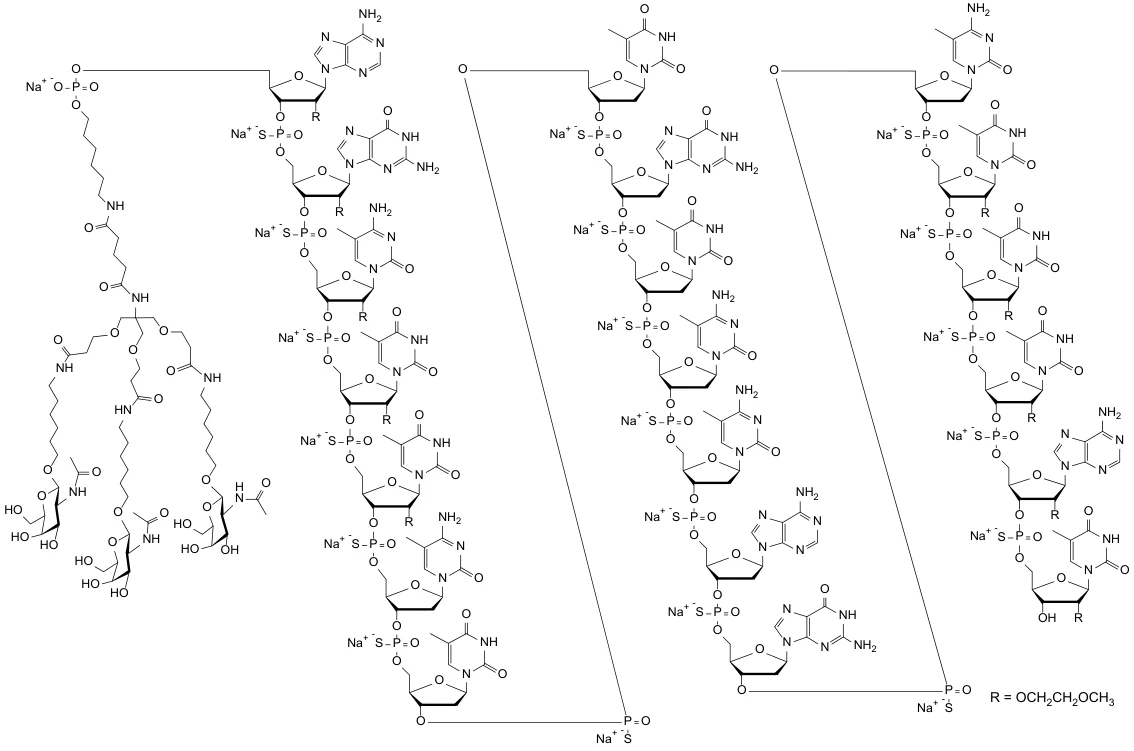
Chemical name: DNA, d(P-thio) ([2′-O-(2-methoxyethyl)] rA-[2′-O-(2-methoxyethyl)] rG-[2′-O-(2-methoxyethyl)] m5rC-[2′-O-(2-methoxyethyl)] m5rU-[2′-O-(2-methoxyethyl)] m5rU-m5C-T-T-G-T-m5C-m5C-A-G-m5C-[2′-O-(2-methoxyethyl)] m5rU-[2′-O-(2-methoxyethyl)] m5rU-[2′-O-(2-methoxyethyl)] m5rU-[2′-O-(2-methoxyethyl)] rA-[2′-O-(2-methoxyethyl)]m5rU), 5′-[26-[[2-(acetylamino)-2-deoxy-β-D-galactopyranosyl]oxy]-14,14-bis[[3-[[6-[[2-(acetylamino)-2-deoxy-β-D-galactopyranosyl]oxy]hexyl]amino]-3-oxopropoxy]methyl]-8,12,19-trioxo-16-oxa-7,13,20-triazahexacos-1-yl hydrogen phosphate], sodium salt (1:20).
Molecular formula and molecular mass: Molecular Formula: C296H419N71O154P20S19Na20
Molecular Mass: 9124.48 daltons
Structural formula:
Physicochemical properties: Olezarsen sodium is a white to yellow solid and it is freely soluble in water and in phosphate buffer.
Pharmaceutical standard: Professed
Product Characteristics:
TRYNGOLZA is a sterile, preservative-free solution for subcutaneous injection. Each single-dose autoinjector contains 80 mg olezarsen (equivalent to 84 mg of olezarsen sodium) in 0.8 mL of solution. The solution also contains the following inactive ingredients: disodium hydrogen phosphate, sodium chloride, sodium dihydrogen phosphate, water for injection, and may include hydrochloric acid and/or sodium hydroxide for pH adjustment between 6.9 - 7.9. Each dose of TRYNGOLZA injection contains 6 mg of phosphorous and 5 mg of sodium.
14. Clinical Trials
14.1. Clinical Trials by Indication
Familial chylomicronemia syndrome (FCS)
Table 4 – Summary of Patient Demographics for Clinical Trials in patients with FCS
| Study # | Study design | Dosage, route of administration and duration | Study subjects (n) | Mean Age (range) | Sex |
ISIS 678354-CS3 Balance | Randomized, Double-Blind, Placebo-Controlled | Route: SC Dose: 50 mg, 80 mg or placebo every 4 weeks for 12 months | Total: 66 Olezarsen 50mg: n=21 Olezarsen 80mg: n=22 Placebo: n=23 | Olezarsen: 45.5 years (18 - 78) Placebo: 44 years (21 - 69) | Female: 38 (58%) Male: 28 (42%) |
The efficacy of TRYNGOLZA was demonstrated in a randomized, placebo-controlled, double-blind clinical trial in adult patients with FCS and fasting triglyceride (TG) levels ≥880 mg/dL (≥10 mmol/L) (Balance; ISIS 678354-CS3). Patients were screened and enrolled based on documented loss-of-function variants in various genes known to cause complete or partial deficiency in the function of lipoprotein lipase, an enzyme that hydrolyzes TGs transported by TG-rich lipoproteins into free fatty acids. After a ≥4-week run-in period where patients continued to follow a diet with ≤20 grams fat per day, patients were randomly assigned 1:1 to Cohort A (50 mg) or Cohort B (80 mg) and each cohort was further randomized 2:1 to receive monthly doses of TRYNGOLZA or matching volume of placebo via subcutaneous injection over a 53-week treatment period.
Patient demographic and baseline characteristics were generally similar across the 3 treatment groups (see 8 Adverse Reactions). The proportion of patients with diabetes at enrollment was 32% in the TRYNGOLZA 80 mg group and 14% in the TRYNGOLZA 50 mg group compared with 26% in the placebo group. Across all treatment groups, patients enrolled were being treated with statins (24%), omega-3 fatty acids (38%), fibrates (46%), or other lipid lowering therapies (9%) at study entry. Seventy-one percent of all patients had a history of documented acute pancreatitis in the prior 10 years. Mean (SD) fasting TG level at baseline was 2,629.5 (1,315.45) mg/dL (29.71 (14.86) mmol/L).
Study Results
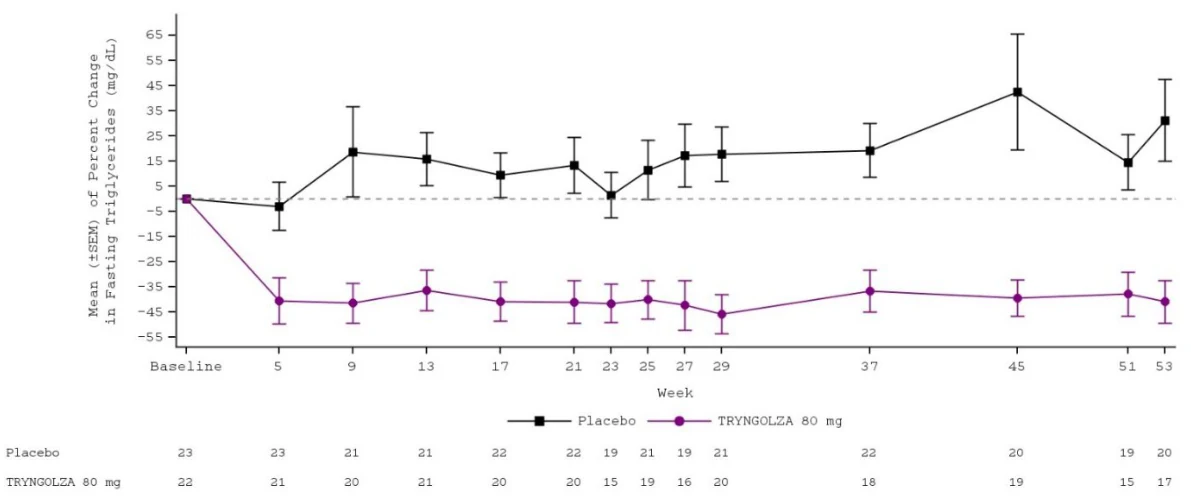
The primary endpoint was percent change in fasting triglycerides from baseline to Month 6 (average of Weeks 23, 25, and 27) compared to placebo. The difference between TRYNGOLZA 80 mg group and the placebo group in percent change in fasting triglycerides from baseline to Month 6 was -43.5% (95% CI: -69.1%, -17.9%; p<0.0009), a statistically significant reduction (Table 5). The difference between TRYNGOLZA 50 mg and placebo in percent change in fasting triglycerides from baseline to Month 6 was not statistically significant.
Table 5 – Mean Baseline (BL) and Mean Percent (%) Changes from Baseline of Key Endpoints in Patients with FCS at 6 Months in the Balance Study
Abbreviations: TG = Triglycerides; apoC-III = apolipoprotein CIII; apoB-48 = apolipoprotein B48; non-HDL-C = non-high-density lipoprotein cholesterol.
Median percent change from baseline (Figure 1) over time demonstrated a consistent lowering effect during the 12-month treatment period.
Figure 1: Percent Change in Fasting Triglyceride (mg/dL) Over Time
| Parameter (mg/dL) | TRYNGOLZA 80 mg N = 22 | Placebo N = 23 | TRYNGOLZA 80 mg vs. Placebo | ||
|---|---|---|---|---|---|
| BL | % change | BL | % change | Treatment Difference (95% CI) | |
| Primary Endpoint | |||||
| TG | 2613.1 | -32 | 2595.7 | +12 | -43.5 (-69.1, -17.9) p < 0.05 |
| Secondary Endpoints | |||||
| ApoC-III | 27.5 | -66 | 27.7 | +8 | -73.7 (-94.6, -52.8) |
| ApoB-48 | 11.6 | -59 | 14.2 | +25 | -84.0 (-137.0, -31.0) |
| Non-HDL-C | 262.9 | -19 | 271.3 | +5 | -24.2 (-40.5, -7.9) |
Over the 12-month treatment period, the numerical incidence of pancreatitis in patients treated with TRYNGOLZA 80 mg was lower compared with placebo (1 patient experienced 1 event of adjudicated acute pancreatitis in the TRYNGOLZA 80 mg group compared with 11 events experienced by 7 patients in the placebo group).
For the TRYNGOLZA 80 mg group, a clinically meaningful reduction in the proportion of patients who experienced at least one event of acute pancreatitis from Week 1 to Week 53 compared with the placebo group was observed for all patients.
16. Non-Clinical Toxicology
General toxicology
General toxicology and pharmacokinetic studies with olezarsen included sub-chronic (13-week repeat dose studies in mice with a 13-week recovery and monkeys) and chronic (26-week in mice with a 13-week recovery and 39-week in monkeys with a 26-week recovery) study durations. Animals were administered weekly SC doses of 2, 6 and 24 mg/kg/week or 2, 6, 12 and 30 mg/kg/week in the 13-week mouse and monkey studies, respectively. In the chronic toxicity studies, mice received weekly SC injections at doses of 2, 6, 20 mg/kg/week for 26 weeks, while monkeys received weekly doses of 2, 6 and 12 mg/kg/week for 39 weeks. In mice, the no observed adverse effect level (NOAEL) was determined at 6 mg/kg/week which provides 9-fold safety margin over expected human exposure based on monthly clinical dose of 80 mg. At 20 mg/kg/week in mice, severe increase in ALT and AST were noted, and one male animal had minimal hepatocellular necrosis.
Collectively, there were no toxicologically significant findings at doses up to 6 mg/kg/week for up to 39 weeks in the monkey. The only significant test article-related finding was a marked decrease in PLT in 1 monkey at 12 mg/kg/week (840 mg/week human equivalent dose (HED) assuming 70 kg human olezarsen body weight). Thus, the NOAEL in monkeys was determined to be 6 mg/kg/week (420 mg/week HED assuming 70 kg human body weight). This NOAEL provides an approximately ≥ 89.5-fold safety margin at the maximum monthly clinical dose at 80 mg in patients based on cumulative plasma AUC measurement.
Genotoxicity
Olezarsen was negative for genotoxicity in in vitro (bacterial reverse mutation, chromosomal, and chromosome aberration in Chinese hamster lung cells) and in vivo (mouse bone marrow micronucleus) assays.
Carcinogenicity
No long-term carcinogenicity studies were conducted with olezarsen in animals. In long-term carcinogenicity animal studies of volanesorsen (the unconjugated form of olezarsen), volanesorsen was administered at 0, 6, 25, 40 mg/kg/week in mice (along with a mouse-specific surrogate at 25 mg/kg/week) or 0, 0.2, 1, 5 mg/kg/week in rats for a duration of 2 years. In male mice, there were statistically significant increases in the incidences of hepatocellular adenomas and carcinomas at ≥25 mg/kg/week and hemangiomas and hemangiosarcomas at all doses. In female mice, there were statistically significant increases in the incidences of histiocytic sarcomas at all doses (including the mouse-specific surrogate) and pituitary gland adenomas at 25 mg/kg/week. In rats, the incidence of malignant fibrous histiocytoma at the injection site was increased in both sexes at doses ≥1 mg/kg/week. These tumors are considered a response to chronic tissue irritation and inflammation caused by repeated subcutaneous injection. The clinical relevance of these findings is uncertain. The tumor types observed are consistent with known incidence of common rodent tumors and rodent species-specific sensitivity to the proinflammatory effects of oligonucleotides and are not considered indicative of innate carcinogenic potential of olezarsen.
Reproductive and developmental toxicology
Subcutaneous administration of olezarsen (0, 5, 10, or 20 mg/kg) to male and female mice every other week prior to mating, and every other day during mating and continuing in females until implantation (GD 6) resulted in no adverse effects on fertility.
In animal studies of the unconjugated form of olezarsen, volanesorsen, available data have shown excretion of very low amounts of volanesorsen in milk of lactating mice. Owing to poor oral bioavailability of volanesorsen, it is considered unlikely that these low milk concentrations would result in systemic exposure from nursing.
No reproductive and developmental toxicity studies were conducted with olezarsen. Reproductive and developmental toxicity studies in mice and rabbits (embryofetal development) and a pre- and post-natal development (PPND) study in mice were completed with unconjugated olezarsen. The studies exhibited no adverse effects on embryofetal development and PPND.