


Patient Medication Information: uses, side effects, how to take - Tuzemty
Serious warnings and precautions box
What TUZEMTY is used for:
- TUZEMTY is used for reducing the risk of developing cancer-related complications like broken bones and/or bone pain that need surgery or radiation.
- TUZEMTY is used for reducing the risk of developing cancer-related complications in patients with multiple myeloma. Multiple myeloma is a cancer of plasma cells (a type of white blood cell).
- TUZEMTY is used to treat giant cell tumour of bone, which cannot be treated by surgery or where surgery is not the best option in adults and adolescents (aged 13-17 years) whose bones have stopped growing.
- TUZEMTY is used to reduce high levels of calcium in the blood in cancer patients (hypercalcemia of malignancy) after other drugs called bisphosphonates did not work.
How TUZEMTY works:
TUZEMTY works differently than other medications used to treat cancer patients whose disease has spread to their bones. It works as a RANK Ligand (RANKL) inhibitor. RANKL is a protein that promotes the breakdown of bone. TUZEMTY blocks RANKL to stop the breakdown of bone. This action strengthens your bones by increasing bone mass and lowers the chance of the cancer causing problems with your bones, such as fractures or severe pain requiring radiation treatment.
TUZEMTY reduces the amount of calcium in the blood by reducing the breakdown of bones. In patients with hypercalcemia of malignancy, the breakdown of bones can cause too much calcium in the blood.
The ingredients in TUZEMTY are:
Medicinal ingredient: Denosumab
- Osteonecrosis of the jaw (sore in mouth involving gums or jaw bones)
Non-medicinal ingredients: Acetic acid, polysorbate 20, sodium hydroxide, sorbitol and water for injection. TUZEMTY is citrate-free.
TUZEMTY comes in the following dosage forms:
TUZEMTY is a liquid for injection, with enough liquid in it for one shot. Each vial delivers 120 mg of denosumab. TUZEMTY is supplied in a carton containing 1 vial.
Do not use TUZEMTY if:
- you are allergic to denosumab or any other ingredient of TUZEMTY. Allergic reactions (eg, rash, hives, or in rare cases, swelling of the face, lips, tongue, throat, or trouble breathing) have been reported.
- you have hypocalcemia (low calcium levels in the blood), until your healthcare professional corrects this condition.
To help avoid side effects and ensure proper use, talk to your healthcare professional before you take TUZEMTY. Talk about any health conditions or problems you may have, including if you have:
Hypocalcemia (low calcium levels in the blood)
TUZEMTY may lower levels of calcium in your blood. In the post-marketing setting, cases of low blood calcium with severe symptoms, including death, have been reported. If you have low blood calcium before you start receiving TUZEMTY, it may get worse during treatment. Your low blood calcium must be treated before you receive TUZEMTY. Most people with low calcium levels do not have symptoms, but some people may have symptoms. When the calcium levels in your blood go down, your body tries to correct the calcium levels by increasing the amount of a hormone made by your parathyroid glands (parathyroid hormone) in your blood. Call your healthcare professional right away if you have symptoms of low blood calcium such as:
- Spasms, twitches, or cramps in your muscles.
- Numbness or tingling in fingers, toes or around the mouth.
Conditions which increase the risk of low blood calcium:
- If you cannot take daily calcium and/or vitamin D.
- If you have severe kidney disease or are on dialysis.
Your healthcare professional will tell you to take calcium and vitamin D to help prevent low calcium levels in your blood while you take TUZEMTY, unless your blood calcium is high. Take calcium and vitamin D as your healthcare professional tells you to.
Osteonecrosis of the Jaw (sore in mouth involving gums or jaw bones)
Severe jaw bone problems may happen when you take TUZEMTY. Your healthcare professional should examine your mouth before you start TUZEMTY. Your healthcare professional may tell you to see your dentist before you start TUZEMTY. It is important for you to practice good mouth care such as brushing and flossing your teeth regularly during treatment with TUZEMTY.
Tell your healthcare professional immediately about any dental symptoms, including pain or unusual feeling in your teeth or gums, or any dental infections. If possible, you should not undergo tooth extraction or other dental procedures (excluding regular dental cleaning) while you are receiving treatment with TUZEMTY without talking to your healthcare professional first.
If you do need dental work, tell your dentist that you are receiving TUZEMTY and tell your healthcare professional that you are having dental work done.
Unusual Thigh Bone Fractures
Unusual fracture in the thigh bone may occur with some medicines, including TUZEMTY. Contact your healthcare professional if you experience new or unusual pain in your hip, groin, or thigh.
High Calcium Levels in the Blood after Stopping Treatment with TUZEMTY
Some patients with giant cell tumour of the bone and some who are still growing during treatment with TUZEMTY, have developed high calcium levels in the blood weeks to months after stopping treatment.
Your healthcare professional will monitor you for signs and symptoms of high levels of calcium, after you stop receiving TUZEMTY.
Risk of Broken Bones in the Spine After Stopping Treatment with TUZEMTY
Do not stop taking TUZEMTY without first talking with your healthcare professional. After treatment with TUZEMTY is stopped, there may be an increased risk of having broken bones in your spine, especially in people who have had a fracture or who have had osteoporosis (a condition in which bones become thin and fragile).
Skin Infections
Tell your healthcare professional promptly if you develop a swollen, red area on your skin that feels hot and tender with symptoms of fever (cellulitis) while taking TUZEMTY.
Pregnancy or Breastfeeding
TUZEMTY is not recommended for use in women who are pregnant or plan to become pregnant and nursing mothers. TUZEMTY may interfere with normal bone and tooth development in fetuses and nursing babies, and may interfere with breastfeeding.
TUZEMTY is not intended for use in pregnant women. You should not be given TUZEMTY if you are pregnant. A highly effective method of birth control should be used when taking TUZEMTY, or for at least 5 months after the last dose of TUZEMTY.
It is not known whether TUZEMTY is excreted into human milk.
Use in Children
TUZEMTY is not recommended for anyone under 18 years of age except for adolescents with giant cell tumour of bone whose bones have stopped growing. The use of TUZEMTY has not been studied in children and adolescents with other cancers that have spread to bone.
Other warnings you should know about:
TUZEMTY contains the medicine denosumab. If you are being treated with TUZEMTY, you should not be taking other denosumab-containing medicinal products.
Tell your healthcare professional about all the medicines you take, including any drugs, vitamins, minerals, natural supplements or alternative medicines.
The following may interact with TUZEMTY:
Before starting TUZEMTY, tell your healthcare professional about all the medicines you take, including prescription and non-prescription drugs, vitamins and herbal supplements.
Interactions between TUZEMTY and other drugs have not been studied.
How to take TUZEMTY:
TUZEMTY is administered as a single injection under the skin (subcutaneous) once every four weeks. You should not inject TUZEMTY into the muscle (intramuscular), into your veins (intravenous) or between the layers of the skin (intradermal). The injection can be in your upper arm, upper thigh, or abdomen. The injection should be administered under the supervision of your healthcare professional who is familiar with this drug. You may be able to give yourself TUZEMTY injections only if you have been trained in giving the injection and your healthcare professional thinks you are capable of doing it correctly and if your healthcare professional follows up with you as necessary.
Keep all medicines, including TUZEMTY, away from children.
Do not share TUZEMTY product with others, even if they have a similar disease.
Instructions for Injection
IMPORTANT: TO HELP AVOID CONTAMINATION AND POSSIBLE INFECTION DUE TO INJECTION, PLEASE READ AND FOLLOW THESE INSTRUCTIONS CAREFULLY.
How to prepare for TUZEMTY injection
TUZEMTY is available as a liquid in vials. When you receive your TUZEMTY, always check to see that:
- The name TUZEMTY appears on the package and vial label.
- The expiration date on the vial label has not passed. Do not use a vial after the date on the label.
- The TUZEMTY liquid in the vial is clear to slightly opalescent, colourless to slightly yellow. Do not use if the solution is cloudy or discoloured.
Only use disposable syringes and needles. Use the syringes only once and dispose of them as instructed by your healthcare professional.
Setting up for an injection
- 1. Find a clean flat working surface, such as a table.
- 2. Remove the vial of TUZEMTY from the refrigerator. Allow TUZEMTY to reach room temperature (this takes about 15 to 30 minutes). Vials should be used only once. DO NOT SHAKE THE VIAL. Shaking may damage the TUZEMTY. If the vial has been shaken vigorously, the solution may appear foamy and it should not be used.
- 3.
Assemble the supplies you will need for an injection:
- • TUZEMTY vial and sterile disposable syringe with a 27-gauge needle.
- •
Two alcohol swabs and one cotton ball or gauze pad.
- • Sharps disposal container.
- 4. Clean your work surface thoroughly and wash your hands with soap and warm water.
Selecting and preparing the injection site
- 1.
Choose an injection site. The recommended injection sites for TUZEMTY are:
- • The outer area of your upper arms.
- • The abdomen, except for the two-inch (5 cm) area around your navel.
- • The top of your thighs.
How to prepare the dose of TUZEMTY in vials
- 1. Take the cap off the vial. Clean the stopper with an alcohol swab.
- 2. Check the package containing the syringe. If the package has been opened or damaged, do not use that syringe. Dispose of that syringe in the sharps disposal container. If the syringe package is undamaged, open the package and remove the syringe.
- 3. Keep the vial on your flat working surface and insert the needle straight down through the rubber stopper. Do not put the needle through the rubber stopper more than once.
- 4. Push the plunger of the syringe down and inject the air from the syringe into the vial of TUZEMTY. Keeping the needle inside the vial, turn the vial upside down. Make sure that the tip of the needle is in the TUZEMTY liquid.
- 5. Keeping the vial upside down, slowly pull back on the plunger to fill the syringe with TUZEMTY liquid. Withdraw the entire content of the vial.
- 6. Keeping the needle in the vial, turn the syringe needle up and check for air bubbles in the syringe. If there are air bubbles, gently tap the syringe with your fingers until the air bubbles rise to the top of the syringe. Then slowly push the plunger up to force the air bubbles out of the syringe.
- 7. Remove the syringe from the vial but do not lay it down or let the needle touch anything.
Injecting the dose of TUZEMTY
- 1. Hold the syringe in the hand you will use to inject TUZEMTY. With the other hand, clean the injection site with an alcohol swab. Use a circular motion from the inside to the outside of the injection site.
- 2. Pinch a fold of skin at the cleaned injection site.
- 3.
Holding the syringe like a pencil, use a quick “dart-like” motion to insert the needle either straight up and down (90-degree angle) or at a slight angle (45 degrees) into the skin.
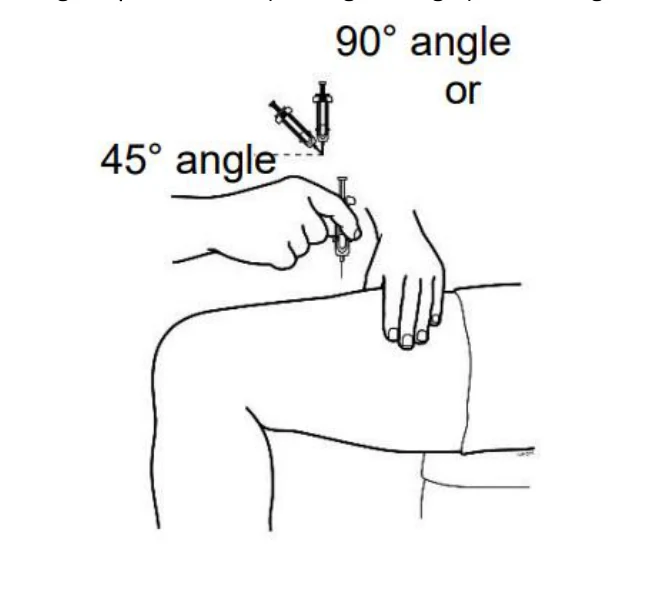
- 4. After the needle is inserted, let go of the skin. Inject the prescribed dose subcutaneously as directed by your healthcare professional.
- 5. When the syringe is empty, pull the needle out of the skin and place a cotton ball or gauze over the injection site and press for several seconds.
- 6. Use a syringe, needle and vial only once. DO NOT put the needle cover (the cap) back on the needle. Discard the vial with any remaining TUZEMTY liquid.
Disposal of syringes, needles and vials
You should always follow the instructions given by your healthcare professional on how to properly dispose of containers with used syringes, needles and vials. There may be special provincial or local laws for disposal of used needles and syringes.
- Place all used needles, needle covers, syringes, and vials (empty or unused contents) into a Sharps disposal container given to you by your healthcare professional or in a hard-plastic container with a screw-on cap, or a metal container with a plastic lid, labelled “used syringes.” Do not use glass or clear plastic containers.
- When the container is full, tape around the cap or lid to make sure the cap or lid does not come off. Do not throw the container in the household trash. Do not recycle.
- Always keep the container out of the reach of children.
Usual dose:
The usual dose of TUZEMTY is 120 mg administered once every 4 weeks. If you are being treated for giant cell tumour of bone or hypercalcemia of malignancy, you will receive an additional dose 1 week and 2 weeks after the first dose in the first month of treatment only.
You should also take supplements of calcium and vitamin D as instructed by your healthcare professional.
Overdose:
If you think you, or a person you are caring for, have taken too much TUZEMTY, contact a healthcare professional, hospital emergency department, or regional poison control centre or Health Canada’s toll-free number 1-844 POISON-X (1-844-764-7669) immediately, even if there are no signs or symptoms.
Missed Dose:
If you miss a dose you should try to receive that dose as soon as you can. In order for TUZEMTY to work properly, TUZEMTY needs to be given every 4 weeks. Continue to schedule your doses every four weeks.
Possible side effects from using TUZEMTY:
These are not all the possible side effects you may have when taking TUZEMTY. If you experience any side effects not listed here, tell your healthcare professional.
Low blood calcium (hypocalcemia)
Symptoms of low blood calcium may include muscle spasms, twitches, cramps, numbness or tingling in fingers, toes or around the mouth.
- Skin infection with swollen, red area of skin that feels hot and tender and may be accompanied by fever (cellulitis)
- Sore in mouth involving gums or jaw bones (osteonecrosis of the jaw)
- Shortness of breath (dyspnea)
- Low phosphate levels in the blood (hypophosphatemia)
- Allergic reactions (e.g., rash, hives, or in rare cases, swelling of the face, lips, tongue, throat, or trouble breathing)
- Unusual thigh bone fractures (atypical femoral fracture)
- Rash that may occur on the skin or sores in the mouth (lichenoid drug eruption)
- Hair loss (alopecia)
- Pain, sometimes severe, in the muscles, joints, arms, legs or back
- High calcium levels in the blood (hypercalcemia) after stopping treatment in patients who are still growing while on treatment with TUZEMTY.
- High calcium levels in the blood (hypercalcemia) after stopping treatment in patients with giant cell tumour of the bone.
- Broken bones in your spine (multiple vertebral fractures) after stopping treatment with TUZEMTY.
Serious side effects and what to do about them
| Symptom / effecta | Talk to your healthcare professional | Stop taking drug and get immediate medical help | |
|---|---|---|---|
| Symptom / effecta | Talk to your healthcare professional | Stop taking drug and get immediate medical help | |
| Only if severe | In all cases | ||
| Only if severe | In all cases | ||
| Very Common | |||
| Low calcium levels in the blood (hypocalcemia): muscle spasms, twitches, cramps, numbness or tingling in fingers, toes or around the mouth | √ | ||
| Common | |||
| Sore in mouth involving gums or jaw bones (osteonecrosis of the jaw) | √ | ||
| Uncommon | |||
| Skin infection (mainly cellulitis) leading to hospitalization | √ | ||
| High calcium levels in the blood (hypercalcemia) after stopping treatment in patients with giant cell tumour of bone | √ | ||
| Unusual thigh bone fractures (atypical femoral fracture) | √ | ||
| Rare | |||
| Allergic reactions: e.g. rash, hives, or in rare cases, swelling of the face, lips, tongue, throat, or trouble breathing (drug hypersensitivity) | √ | ||
| High calcium levels in the blood (hypercalcemia) after stopping treatment in patients who are still | √ | ||
| growing while on treatment with TUZEMTY | |||
Broken bones in your spine following discontinuation of TUZEMTY (multiple vertebral fracture) | √ | ||
a Frequency reflects all adverse events
If you have a troublesome symptom or side effect that is not listed here or becomes bad enough to interfere with your daily activities, tell your healthcare professional.
Reporting Side Effects
You can report any suspected side effects associated with the use of health products to Health Canada by:
- Visiting the Web page on Adverse Reaction Reporting (canada.ca/drug-device-reporting) for information on how to report online, by mail or by fax; or
- Calling toll-free at 1-866-234-2345.
NOTE: Contact your health professional if you need information about how to manage your side effects. The Canada Vigilance Program does not provide medical advice.
Storage:
Keep out of reach and sight of children.
TUZEMTY should be stored in the refrigerator at 2°C to 8°C in the original carton to protect it from light. Do not freeze TUZEMTY. Do not shake TUZEMTY.
TUZEMTY may be removed from the refrigerator and allowed to reach room temperature (up to 25°C) to make the injection more comfortable.
Once removed from the refrigerator, TUZEMTY must not reach temperatures above 25°C and must be used within 30 days. If not used within 30 days, TUZEMTY should be discarded.
Do not use TUZEMTY after the expiry date which is printed on the carton and label.
Medicines should not be disposed of via wastewater or household waste. Ask your pharmacist how to dispose of medicines that are no longer required.
If you want more information about TUZEMTY:
- Talk to your healthcare professional
Find the full product monograph that is prepared for healthcare professionals and includes this Patient Medication Information by visiting the Health Canada website:
- (https://www.canada.ca/en/health-canada/services/drugs-health-products/drug-products/drug-product-database.html; Canadian distributor (Organon Canada Inc.) website www.organon.ca, or by calling 1-844-820-5468.
Date of Authorization [YYYY-MM-DD]