


Product Monograph - Van-Anastrozole
SUMMARY PRODUCT INFORMATION
Route of
Administration
Dosage Form /
Strength
All Nonmedicinal Ingredients
Oral Tablet / 1 mg Lactose Monohydrate, Titanium Dioxide,
Povidone K30, Sodium Starch Glycolate, Magnesium Stearate,
Hydroxypropylmethylcellulose (Hypermellose E5), Polyethylene glycol.
INDICATIONS AND CLINICAL USE
VAN-Anastrozole (anastrozole) is indicated for the adjuvant treatment of postmenopausal women with hormone receptor positive early breast cancer.
Approval is based on superior disease-free survival for anastrozole in comparison to tamoxifen. However, overall survival was not significantly different between the two treatments (see PART II, CLINICAL TRIALS).
VAN-Anastrozole (anastrozole) is indicated for hormonal treatment of advanced breast cancer in postmenopausal women.
Geriatrics:
No changes in dose are necessary for elderly patients.
Pediatrics:
Anastrozole is not recommended for use in pediatric patients as safety and efficacy have not been established in this group of patients.
CONTRAINDICATIONS
- Patients who are hypersensitive to VAN-Anastrozole (anastrozole) or to any ingredient in the formulation. For a complete listing, see the Dosage Forms, Composition and Packaging section of the Product Monograph.
- Pregnant or lactating women.
WARNINGS AND PRECAUTIONS
Serious Warnings and Precautions
- Not recommended for use in pre-menopausal women as safety and efficacy have not been established in these patients (see ACTION AND CLINICAL PHARMACOLOGY section).
- Not recommended for use in pediatric patients as safety and efficacy have not been established in these patients (see Special Populations, Pediatrics section below).
- Potential risk/benefit should be carefully assessed in patients with severe hepatic and severe renal impairment (see Hepatic/Biliary and Renal sections below).
- Potential risk/benefit should be carefully assessed in patients with osteoporosis or risk factors for osteoporosis (see Musculoskeletal section below).
- Should be administered under the supervision of a qualified physician experienced in the use of anti-cancer agents (see DOSAGE AND ADMINISTRATION section).
Body as a Whole
VAN-Anastrozole is unlikely to impair the ability of patients to drive and operate machinery. However, asthenia and somnolence have been reported with the use of anastrozole and caution should be observed when driving or operating machinery while such symptoms persist.
Cardiovascular
In the ATAC trial, ischemic cardiovascular events were reported more frequently in patients treated with anastrozole compared to those treated with tamoxifen, although the difference was not statistically significant. A retrospective evaluation has shown that this numerical difference was associated with a sub-group of patients with pre-existing ischemic heart disease. A statistical analysis could not be performed on this subgroup evaluation. Serious adverse events continued to be collected during the off-treatment follow-up and the incidence of cardiovascular events reported was similar in the anastrozole and tamoxifen arms (3.9% vs. 3.7%, respectively).
Hepatic/Biliary
Anastrozole pharmacokinetics have been investigated in subjects with stable hepatic cirrhosis related to alcohol abuse. The apparent oral clearance of anastrozole was approximately 30% lower in subjects with hepatic cirrhosis than in control subjects with normal liver function. However, plasma anastrozole concentrations in the subjects with hepatic cirrhosis are within the range of
concentrations seen in normal subjects across all clinical trials. Dosage adjustment in patients with mild-to-moderate hepatic dysfunction is not necessary.
Anastrozole has not been investigated in patients with severe hepatic impairment. The potential risk/benefit to such patients should be carefully considered before administration of VAN-Anastrozole.
Musculoskeletal
Bone Mineral Density:
The use of estrogen lowering agents, including VAN-Anastrozole, may cause a reduction in bone mineral density with a possible consequent increased risk of fracture. Data available from a phase III/IV study [SABRE (Study of Anastrozole with the Bisphosphonate RisedronatE)] showed that in postmenopausal women with hormone receptor positive early breast cancer with existing moderate (T-score < –1.0 in either lumbar spine or total hip, provided neither of these was less than –2.0, and with no personal history of a fragility fracture) or high risk (T-score < -2.0 in either the lumbar spine, or hip, or a personal history of fragility fracture) of fragility fracture, bone mineral density (BMD) loss could be inhibited by using anastrozole together with a bisphosphonate (risedronate). All patients in the study received vitamin D and calcium supplementation. Patients at existing low risk (T-score in both the lumbar spine, and total hip, of -1.0 or higher, and no personal history of fragility fracture) of fragility fracture in the study were treated with anastrozole only and did not have a loss of lumbar spine BMD following 12 months of treatment although statistically significant changes were seen following 24 months of treatment (estimated percentage change –2.07%; 95% Confidence Interval (CI): -3.60, -0.53; p=0.0109). No change in total hip BMD was seen at 12 and 24 months in the low-risk group (see Clinical Trials, Adjuvant treatment of breast cancer in postmenopausal women – assessment of bone). Women should have their osteoporosis risk assessed and managed according to local clinical practice and guidelines.
Myalgia : Myalgia has been associated with both anti-estrogens and estrogen-lowering agents.In the adjuvant setting,muscle pain was reported in the ATAC study at a higher incidence for anastrozole (5.8%) compared to tamoxifen (5.2%).
Other
Anastrozole has not been investigated in patients with any degree of brain or leptomeningeal involvement or with pulmonary lymphangitic disseminated disease.
Renal
Anastrozole pharmacokinetics have been investigated in subjects with renal insufficiency. Anastrozole renal clearance decreased proportionately with creatinine clearance and was approximately 50% lower in subjects with severe renal impairment (creatinine clearance less than 30 mL/min/1.73m2
or 0.5 mL/sec/1.73m2
) compared to controls. Because renal clearance is not a significant pathway of elimination, the apparent oral clearance of anastrozole is unchanged even in
severe renal impairment. Dosage adjustment in patients with renal dysfunction is not necessary.
Anastrozole has not been investigated in patients with breast cancer and severe renal impairment. The potential risk/benefit to patients with severe renal impairment should be carefully considered prior to the administration of VAN-Anastrozole.
Special Populations
Pregnant Women: VAN-Anastrozole is contraindicated in pregnant women.
The extent of exposure in pregnancy to anastrozole during clinical trials and postmarketing is very limited to individual cases only. If a patient becomes pregnant while receiving this drug, the patient should be apprised of the potential hazard to the fetus or potential risk for loss of the pregnancy.
Anastrozole has been found to cross the placenta following oral administration of 0.1 mg/kg in rats and rabbits. Studies in both rats and rabbits at doses equal to or greater than 0.1 and 0.02 mg/kg/day, respectively (about 1 and 1/3, respectively, the recommended human dose on a mg/m2
basis), administered during the period of organogenesis showed that anastrozole increased pregnancy loss (increased pre- and/or post-implantation loss, increased resorption and decreased numbers of live fetuses). Effects were dose related in rats. Placental weights were significantly increased in rats at doses of 0.1 mg/kg/day or more.
Evidence of fetotoxicity, including delayed fetal development (i.e. incomplete ossification and depressed fetal body weights), was observed in rats administered doses of 1 mg/kg/day (about 8 times the recommended human dose on a mg/m2
basis). There was no evidence of teratogenicity in rats administered doses up to 1 mg/kg/day. In rabbits, anastrozole caused pregnancy failure at doses equal to or greater than 1 mg/kg/day (about 16 times the recommended human dose on a mg/m2 basis). There was no evidence of teratogenicity in rabbits administered 0.2 mg/kg/day (about 3 times the recommended human dose on a mg/m2
basis).
Nursing Women: VAN-Anastrozole is contraindicated in lactating women.
Pediatrics: Anastrozole is not recommended for use in pediatric patients as safety and efficacy have not been established.
Geriatrics: Anastrozole pharmacokinetics have been investigated in postmenopausal female volunteers and patients with breast cancer. The pharmacokinetics were similar in volunteers and in patients, and no age related effects were seen
Monitoring and Laboratory Tests
Anastrozole has not been observed to interfere with routine clinical laboratory test results. During the ATAC trial, more patients receiving anastrozole were reported to have elevated serum
cholesterol compared to patients receiving tamoxifen (9.0% versus 3.5%, respectively). Lipid profile was assessed as part of the SABRE trial. In this study, treatment for 12 months with anastrozole alone had a neutral effect on lipid profile.
ADVERSE REACTIONS
Adverse Drug Reaction Overview
Anastrozole has generally been well tolerated. Adverse events have usually been mild to moderate with few withdrawals from treatment due to undesirable events.
The pharmacological action of anastrozole may give rise to certain expected effects. Arthritis/arthralgia, joint pain/stiffness and hot flushes were reported very commonly (≥10%). Common adverse reactions (≥1% - 10%) are: asthenia, bone pain, myalgia, carpal tunnel syndrome, vaginal dryness, hair thinning (alopecia), rash, nausea, diarrhea, headache and increases in alkaline phosphatase, alanine aminotransferase and aspartate aminotransferase. Uncommonly reported adverse reactions (≥0.1% - 1%) are: vaginal bleeding, trigger finger, anorexia, hypercholesterolaemia, hypercalcaemia, vomiting, and somnolence, hepatitis and increases in gamma-GT and bilirubin. Rare cases (≥0.1% - 0.1%) of cutaneous vasculitis have been observed. Very rare cases (<0.01%) of erythema multiforme, Stevens-Johnson syndrome and allergic reactions including angioedema, urticaria and anaphylaxis have also been reported. These reported frequencies are generated from a number of anastrozole studies as well as post-marketing reports.
In the ATAC trial, ischemic cardiovascular events were reported more frequently in patients treated with anastrozole compared to those treated with tamoxifen, although the difference was not statistically significant. A retrospective evaluation has shown that this numerical difference was associated with a sub-group of patients with pre-existing ischemic heart disease. A statistical analysis could not be performed on this subgroup evaluation. Serious adverse events continued to be collected during the off-treatment follow-up and the incidence of cardiovascular events reported was similar in the anastrozole and tamoxifen arms (3.9% vs. 3.7%, respectively).
Events of carpal tunnel syndrome have been reported in patients receiving anastrozole treatment in clinical trials in greater numbers than those receiving treatment with tamoxifen. The majority of these events occurred in patients with identifiable risk factors for the development of the condition. In the ATAC adjuvant trial, 83 events of carpal tunnel syndrome occurred in 78 patients in the anastrozole monotherapy arm, and 22 events occurred in 22 patients in the tamoxifen arm.
Vaginal bleeding has been reported infrequently, mainly in patients during the first few weeks after changing from existing hormonal therapy to treatment with anastrozole. If bleeding persists, further evaluation should be considered.
Clinical Trial Adverse Drug Reactions
Adjuvant Treatment of Early Breast Cancer in Postmenopausal Women:
Anastrozole was generally well tolerated in the ATAC trial. At the time of the 5-year treatment completion analysis, the median duration of adjuvant treatment was 59.8 months and 59.6 months for patients receiving anastrozole 1 mg and tamoxifen 20 mg, respectively. The combination of anastrozole and tamoxifen did not demonstrate any safety benefits in comparison to tamoxifen alone after the results from the first analysis (median duration of treatment was approximately 33 months).
Anastrozole was associated with statistically significant fewer discontinuations from treatment as a result of an adverse event compared to tamoxifen (11.1% vs. 14.3%) and fewer adverse drug reactions leading to discontinuation (6.5% vs. 8.9%). The incidence of on-treatment serious adverse events is significantly lower in patients receiving anastrozole 1 mg relative to tamoxifen 20 mg (33.3% versus 36.0%).
Adverse events occurring with an incidence of at least 5% in either treatment group during treatment or within 14 days of the end of treatment are presented below in Table 1.
Table 1 Adverse events occurring with an incidence of at least 5% in any treatment group during or within 14 days of the end of treatment from the ATAC trial
Body system and adverse event by
COSTART – preferred term
Number (%) of Patientsa 33-month Analysis
(data cut-off 29 June 2001)
5-year treatment completion analysis (data cut-off
31 March 2004) Anastrozole
1 mg
(N=3092)
Tamoxifen
20 mg
(N=3094)
Anastrozole
1 mg
(N=3092)
Tamoxifen 20 mg
(N=3094) Body as a whole Asthenia 483 (15.6) 466 (15.1) 575 (18.6) 544 (17.6) Pain 432 (14.0) 413 (13.3) 533 (17.2) 485 (15.7) Back pain 238 (7.7) 234 (7.6) 321 (10.4) 309 (10.0) Headache 253 (8.2) 197 (6.4) 314 (10.2) 249 (8.0) Accidental injury 195 (6.3) 189 (6.1) 311 (10.1) 303 (9.8) Infection 197 (6.4) 205 (6.6) 285 (9.2) 276 (8.9) Abdominal pain 202 (6.5) 211 (6.8) 271 (8.8) 276 (8.9) Chest pain 145 (4.7) 115 (3.7) 200 (6.5) 150 (4.8) Flu syndrome 146 (4.7) 164 (5.3) 175 (5.7) 195 (6.3) Neoplasm 101 (3.3) 99 (3.2) 162 (5.2) 144 (4.7) Cyst 96 (3.1) 110 (3.6) 138 (4.5) 162 (5.2) Cardiovascular
Body system and adverse event by
COSTART – preferred term
Number (%) of Patientsa 33-month Analysis
(data cut-off 29 June 2001)
5-year treatment completion analysis (data cut-off
31 March 2004) Anastrozole
1 mg
(N=3092)
Tamoxifen
20 mg
(N=3094)
Anastrozole
1 mg
(N=3092)
Tamoxifen 20 mg
(N=3094) Vasodilation 1060 (34.3) 1229 (39.7) 1104 (35.7) 1264 (40.9) Hypertension 255 (8.2) 218 (7.0) 402 (13.0) 349 (11.3) Digestive Nausea 287 (9.3) 281 (9.1) 343 (11.1) 335 (10.8) Diarrhea 206 (6.7) 168 (5.4) 265 (8.6) 216 (7.0) Constipation 183 (5.9) 203 (6.6) 249 (8.1) 252 (8.1) Gastrointestinal disorder 126 (4.1) 104 (3.4) 210 (6.8) 158 (5.1) Dyspepsia 150 (4.9) 124 (4.0) 206 (6.7) 169 (5.5) Haemic and lymphatic Lymphoedema 247 (8.0) 277 (9.0) 304 (9.8) 341 (11.0) Anemia 73 (2.4) 102 (3.3) 113 (3.7) 159 (5.1) Metabolic and nutritional Peripheral edema 236 (7.6) 246 (8.0) 311 (10.1) 343 (11.1) Weight gain 234 (7.6) 236 (7.6) 285 (9.2) 274(8.9) Hypercholesterolemia 186 (6.0) 68 (2.2) 278 (9.0) 108 (3.5) Musculoskeletal disorders Arthritis 380 (12.3) 296 (9.6) 512 (16.6) 445 (14.4) Arthralgia 386 (12.5) 252 (8.1) 467 (15.1) 344 ((11.1) Osteoporosis 192 (6.2) 134 (4.3) 325 (10.5) 226 (7.3) Fracture 183 (5.9) 115 (3.7) 315 (10.2) 209 (6.8) Arthrosis 161 (5.2) 112 (3.6) 207 (6.7) 156 (5.0) Bone pain 158 (5.1) 139 (4.5) 201 (6.5) 185 (6.0) Joint disorder 102 (3.3) 95 (3.1) 184 (6.0) 160 (5.2) Myalgia 114 (3.7) 103 (3.3) 179 (5.8) 160 (5.2) Nervous system Depression 323 (10.4) 315 (10.2) 413 (13.4) 382 (12.3) Insomnia 253 (8.2) 226 (7.3) 309 (10.0) 281 (9.1) Dizziness 180 (5.8) 191 (6.2) 236 (7.6) 234 (7.6) Paraesthesia 181 (5.9) 106 (3.4) 215 (7.0) 145 (4.7) Anxiety 147 (4.8) 147 (4.8) 195 (6.3) 180 (5.8) Respiratory Pharyngitis 335 (10.8) 327 (10.6) 443 (14.3) 422 (13.6) Cough increased 194 (6.3) 216 (7.0) 261 (8.4) 287 (9.3) Dyspnea 173 (5.6) 164 (5.3) 234 (7.6) 237 (7.7) Sinusitis 137 (4.4) 118 (3.8) 184 (6.0) 159 (5.1) Bronchitis 126 (4.1) 107 (3.5) 167 (5.4) 153 (4.9)
Body system and adverse event by
COSTART – preferred term
Number (%) of Patientsa 33-month Analysis
(data cut-off 29 June 2001)
5-year treatment completion analysis (data cut-off
31 March 2004) Anastrozole
1 mg
(N=3092)
Tamoxifen
20 mg
(N=3094)
Anastrozole
1 mg
(N=3092)
Tamoxifen 20 mg
(N=3094) Skin and appendages Rash 281 (9.1) 314 (10.1) 333(10.8) 387 (12.5) Sweating 112 (3.6) 158 (5.1) 145 (4.7) 177 (5.7) Special senses Cataract specified 107 (3.5) 116 (3.7) 182 (5.9) 213 (6.9) Urogenital Breast pain 176 (5.7) 121 (3.9) 251 (8.1) 169 (5.5) Urinary tract infection 169 (5.5) 224 (7.2) 244 (7.9) 313 (10.1) Vulvovaginitis 169 (5.5) 119 (3.8) 194 (6.3) 150 (4.8) Breast neoplasm 94 (3.0) 89 (2.9) 164 (5.3) 139 (4.5) Vaginitis 79 (2.6) 122 (3.9) 125 (4.0) 158 (5.1) Vaginal hemorrhageb 100 (3.2) 151 (4.9) 122 (3.9) 180(5.8) Leucorrhea 68 (2.2) 264 (8.5) 86 (2.8) 286 (9.2) a Patients with multiple events in the same category are counted only once in that category. Patients with events in more than 1 category are counted once in each of those categories.
b Vaginal hemorrhage without further diagnosis.
COSTART Coding Symbols for Thesaurus of Adverse Reaction Terms.
N Number of patients treated.
Certain adverse events (irrespective of drug causality) and combinations of adverse events were prospectively specified for analysis, based on the known pharmacological properties and side effect profiles of anastrozole and tamoxifen. Tamoxifen was statistically superior to anastrozole for the adverse events of joint disorders and fractures (including fractures of spine, hip and wrist) while anastrozole was statistically superior to tamoxifen for the adverse events of hot flushes, vaginal bleeding, vaginal discharge, endometrial cancer, venous thromboembolic events (including deep thromboembolic events) and ischemic cerebrovascular events.
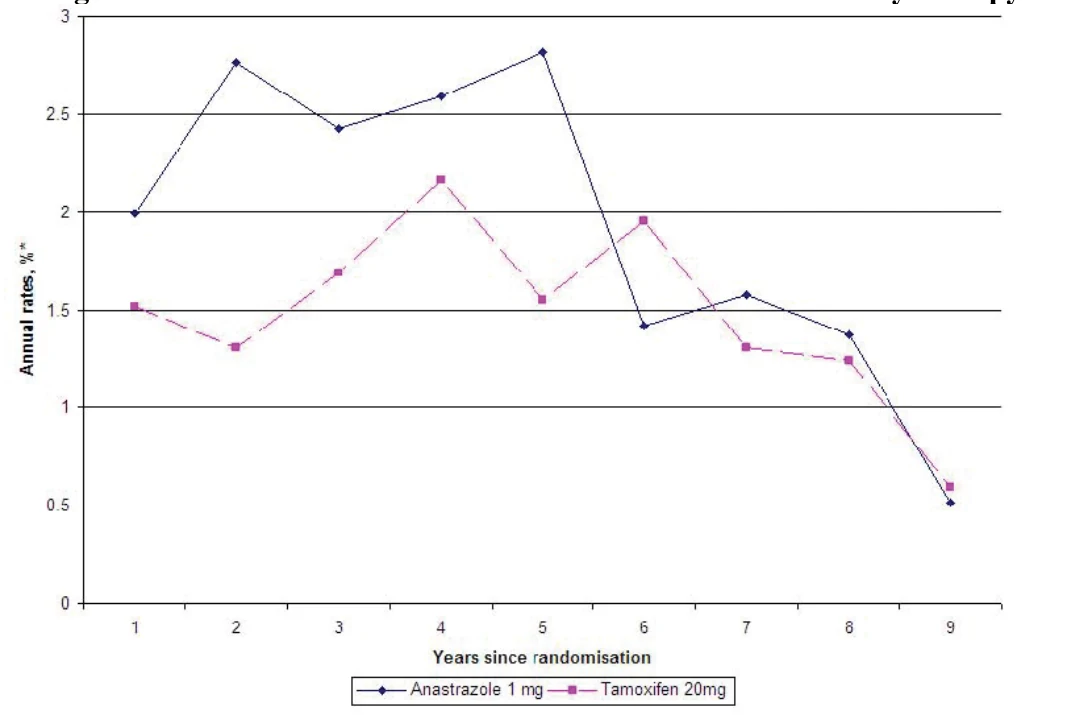
A fracture rate of 22 per 1000 patient years was observed on anastrozole and 15 per 1000 patient years with the tamoxifen group with a median follow-up of 68 months. The rate of hip fractures was similar for anastrozole and tamoxifen in the ATAC trial. After a median follow-up of 100 months, fractures were reported more frequently in patients treated with anastrozole in comparison to tamoxifen, both during and off-treatment (13.7% vs 10.1%; see Table 2), but the rate of fracture remained stable between the two groups. During the posttreatment follow-up period, the annual fracture rates were similar in the anastrozole and tamoxifen arms and the increased fracture episode rate seen during treatment was not observed following treatment completion as shown in Figure 1.
Table 2 Incidence of fractures (during or off-trial treatment)
Category Number (%) of patients a
2007 update analysis (data cut-off 31 March 2007) Anastrozole 1 mg (N=3092) Tamoxifen 20 mg(N=3094) Non-serious or serious
All Fractures 425 (13.7) 313 (10.1)
Wrist/Colles 95 (3.1) 84 (2.7)
Spine 61 (2.0) 38 (1.2)
Hip 49 (1.6) 42 (1.4)
Serious
All fractures 212 (6.9) 170 (5.5)
Wrist/Colles 49 (1.6) 45 (1.5)
Spine 23 (0.7) 18 (0.6)
Hip 46 (1.5) 40 (1.3)
a Patients with multiple events in the same category are counted only once in that category. Patients with events in more than 1 category are counted once in each of those categories.
Note: Off-trial treatment AEs were SAEs and any fracture event reported as being serious or non-serious that occurred more than 14 days after stopping study treatment (but within 10 years of starting study treatment). AEs starting after the patients first recurrence visit were not reported.
Note: Off-trial treatment AEs included all off-treatment reports regardless of whether a patient had had a similar report on treatment.
N Number of patients treated.
Figure 1 Annual first event rates of all fractures on or off study therapy
In the ATAC trial, ischemic cardiovascular events were reported more frequently in patients treated with anastrozole compared to those treated with tamoxifen, although the difference was not statistically significant (see Table 3). A retrospective evaluation has shown that this numerical difference was associated with a sub-group of patients with pre-existing ischemic heart disease. A statistical analysis could not be performed on this subgroup evaluation. From the 33 month analysis to the 68 month analysis, the incidence of cardiovascular events also remains stable over time between the two treatment groups. The incidence of myocardial infarctions increased by 0.1% in the anastrozole treatment group and 0.2% in the tamoxifen treatment group; the incidence of cerebrovascular accidents increased by 0.3% in each treatment group. During the off-treatment follow-up, when serious adverse events continued to be collected, the incidence of myocardial infarctions and cerebrovascular accidents was similar in both treatment groups.
Table 3 provides a summary of the pre-specified adverse events that occurred in either treatment group during treatment and after cessation of trial therapy.
Table 3 Incidence of pre-specified adverse events occurring in either treatment group during treatment and after cessation of trial therapy from the ATAC trial*
| Adverse Event | Number (%) of patientsa | |||
| 5 year treatment completion analysis (data cut-off 31 March 2004) | ||||
| Anastrozole 1 mg (N=3092) | Tamoxifen 20 mg (N=3094) | Odds ratiob | p-value | |
| Hot flushes | 1104 (35.7) | 1264 (40.9) | 0.80 | <0.0001 |
| Mood disturbances | 600 (19.4) | 557 (18.0) | 1.10 | 0.2 |
| Fatigue/asthenia | 577 (18.7) | 544 (17.6) | 1.08 | 0.3 |
| Nausea and vomiting | 396 (12.8) | 385 (12.4) | 1.03 | 0.7 |
| Vaginal discharge | 111 (3.6) | 407 (13.2) | 0.25 | <0.0001 |
| Vaginal bleeding | 171 (5.5) | 323 (10.4) | 0.50 | <0.0001 |
| Joint pain/stiffness | 1111 (35.9) | 922 (29.8) | 1.32 | <0.0001 |
| Fractures | 340 (11.0) | 238 (7.7) | 1.48 | <0.0001 |
Fractures of the spine, hip, or wrist/Colles Hipc Spinec Wrist/Collesc | 148 (4.8) 37 (1.2) 45 (1.5) 72 (2.3) | 112 (3.6) 31 (1.0) 27 (0.9) 63 (2.0) | 1.34 NC NC NC | 0.02 NC NC NC |
| Cataracts | 191 (6.2) | 219 (7.1) | 0.86 | 0.2 |
| Ischemic cardiovascular disease | 137 (4.4) | 119 (3.8) | 1.16 | 0.2 |
| Adverse Event | Number (%) of patientsa | |||
| 5 year treatment completion analysis (data cut-off 31 March 2004) | ||||
| Anastrozole 1 mg (N=3092) | Tamoxifen 20 mg (N=3094) | Odds ratiob | p-value | |
Angina Pectorisc Myocardial infarctc Coronary artery disorderc Myocardial ischemiac | 75 (2.4) 42 (1.4) 26 (0.7) 24 (0.8) | 56 (1.8) 40 (1.3) 27 (0.9) 16 (0.5) | NC NC NC NC | NC NC NC NC |
| Venous thromboembolic events | 95 (3.1) | 151 (4.9) | 0.62 | 0.0003 |
| Deep venous thromboembolic events | 57 (1.8) | 83 (2.7) | 0.68 | 0.03 |
| Ischemic cerebrovascular events | 67 (2.2) | 94 (3.0) | 0.71 | 0.03 |
| Endometrial cancerd | 5 (0.2) | 17 (0.8) | 0.29 | 0.02 |
* All adverse events occurring during treatment or within 14 days of the end of treatment; all serious adverse events and all non-serious fractures occurring after 14 days from the end of treatment and prior to the confirmation of recurrence of breast cancer. a Patients with multiple events in the same category are counted only once in that category. Patients with events in more than 1 category are counted once in each of those categories.
b Odds ratios of <1.00 indicate that treatment with anastrozole 1 mg is associated with a lower incidence of a specific event than tamoxifen 20 mg.
cIndividual COSTART–preferred terms for a particular category of event – the broader category was the ‘pre-specified adverse event’.
d Percentages calculated based upon the numbers of patients with an intact uterus at baseline (N=2229 for anastrozole and N=2236 for tamoxifen).
N Number of patients treated.
NC Not calculated.
Patients with Advanced Breast Cancer:
Two controlled clinical trials involving postmenopausal women with advanced breast cancer, compared treatment with tamoxifen (20 mg daily) versus treatment with anastrozole (1 mg daily). Table 4 presents adverse events reported in these trials with an incidence of greater than 5% in either treatment group, regardless of causality.
Table 4 Number (%) of patients with adverse events from Trials 0027 and 0030*
Adverse Event by Body
System
Anastrozole 1 mg (n =506)
Tamoxifen 20 mg (n =511)
Body as a Whole
Asthenia
83 (16.4)
81 (15.9)
Pain 70 (13.8) 73 (14.3)
Back Pain 60 (11.9) 68(13.3)
Headache 47 (9.3) 40 (7.8)
Chest Pain 37 (7.3) 37 (7.2)
Flu Syndrome 35 (6.9) 30 (5.9)
Pelvic Pain 23 (4.5) 30 (5.9)
Cardiovascular
Adverse Event by Body
System
Anastrozole 1 mg (n =506)
Tamoxifen 20 mg (n =511)
Vasodilation 128 (25.3) 106 (20.7) Hypertension 25 (4.9) 36 (7.0) Digestive
Nausea 94 (18.6) 106(20.7) Constipation 47 (9.3) 66 (12.9) Abdominal Pain 40 (7.9) 38 (7.4) Diarrhea 40 (7.9) 33 (6.5) Vomiting 38 (7.5) 36 (7.0) Anorexia 26 (5.1) 46 (9.0) Metabolic and Nutritional
Peripheral Edema 51 (10.1) 41 (8.0) Musculoskeletal Disorders
Bone Pain 54 (10.7) 52 (10.2)
Nervous System
Insomnia 30 (5.9) 28(5.5) Dizziness 30 (5.9) 22 (4.3) Depression 23 (4.5) 32(6.3) Hypertonia 16 (3.2) 26 (5.1)
Respiratory
Cough Increased
55(10.9)
52(10.2)
Dyspnea 51(10.1) 47(9.2) Pharyngitis 49(9.7) 68(13.3) Skin and Appendages
Rash 38(7.5) 34(6.7) Urogenital
Leucorrhea 9(1.8) 31(6.1) * A patient may have more than one adverse event.
Based on results from the established safety profiles of anastrozole and tamoxifen, the incidences of nine pre-specified adverse event categories, potentially causally related to one or both therapies because of their pharmacology, were statistically analyzed. No statistically significant differences were seen between treatment groups. The results are shown in Table 5.
Table 5 Number (%) of patients from Trials 0027 and 0030*
Adverse Event by Body
System
Anastrozole 1 mg n=506 (%)
Tamoxifen 20 mg n=511 (%)
Body as a Whole
Tumour Flare 15 (3.0) 18 (3.5) Cardiovascular
Adverse Event by Body
System
Anastrozole 1 mg n=506 (%)
Tamoxifen 20 mg n=511 (%)
Hot Flushes 134 (26.5) 118(23.1)
Thromboembolic Disease 23 (4.5) 39 (7.6)
Digestive
Gastrointestinal Disturbances 170 (33.6) 196 (38.4)
Metabolic and Nutritional
Weight Gain 11 (2.2) 8 (1.6)
Nervous System
Depression 23 (4.5) 32 (6.3)
Lethargy 6 (1.2) 15 (2.9)
Urogenital
Vaginal Dryness 15 (3.0) 13 (2.5)
Vaginal Bleeding 5 (1.0) 11 (2.2)
*Patients may appear in more than one row.
The low incidence of vaginal bleeding and vaginal discharge was consistent with the known pharmacology of anastrozole, which would be predicted to have no estrogenic effect, and no effect on the endometrium. Despite the lack of estrogenic activity, there was no increase in myocardial infarction or pathological fracture when compared with tamoxifen. There was a low incidence of thromboembolic disease.
Patients with Advanced Breast Cancer Who had Disease Progression Following Tamoxifen Therapy
For two controlled clinical trials comparing anastrozole (1 mg and 10 mg) versus megestrol acetate (160 mg), adverse events reported in greater than 5% of the patients in any of the treatment groups, regardless of causality, are presented in Table 6.
Table 6 Number (n) and percentage of patients with adverse events from Trials 0004 and
0005*
| Adverse Event by Body System | Anastrozole 1 mg (n=262) n (%) | Anastrozole 10 mg (n=246) n (%) | Megestrol Acetate (160 mg) n = 253 |
| Body as a Whole | |||
| Asthenia | 42 (16.0) | 33 (13.4) | 47 (18.6) |
| Headache | 34 (13.0) | 44 (17.9) | 24 (9.5) |
| Pain | 28 (10.7) | 38 (15.4) | 29 (11.5) |
| Back Pain | 28 (10.7) | 26 (10.6) | 19 (7.5) |
| Pelvic Pain | 14 (5.3) | 17 (6.9) | 13 (5.1) |
| Adverse Event by Body System | Anastrozole 1 mg (n=262) n (%) | Anastrozole 10 mg (n=246) n (%) | Megestrol Acetate (160 mg) n = 253 |
| Chest Pain | 13 (5.0) | 18 (7.3) | 13 (5.1) |
| Cardiovascular | |||
| Hot Flushes | 32 (12.2) | 29 (10.6) | 21 (8.3) |
| Digestive | |||
| Nausea | 41 (15.6) | 48 (19.5) | 28 (11.1) |
| Vomiting | 24 (9.2) | 26 (10.6) | 16 (6.3) |
| Diarrhea | 22 (8.4) | 18 (7.3) | 7 (2.8) |
| Constipation | 18 (6.9) | 18 (7.3) | 21 (8.3) |
| Abdominal Pain | 18 (6.9) | 14 (5.7) | 18 (7.1) |
| Anorexia | 18 (6.9) | 19 (7.7) | 11 (4.3) |
| Dry Mouth | 15 (5.7) | 11 (4.5) | 13 (5.1) |
| Metabolic and Nutritional | |||
| Peripheral Edema | 14 (5.3) | 21 (8.5) | 28 (11.1) |
| Weight Gain | 4 (1.5) | 9 (3.7) | 30 (11.9) |
| Increased Appetite | 0 (0) | 1 (0.4) | 13 (5.1) |
| Musculoskeletal Disorders | |||
| Bone Pain | 17 (6.5) | 26 (11.8) | 19 (7.5) |
| Nervous System | |||
| Dizziness | 16 (6.1) | 12 (4.9) | 15 (5.9) |
| Depression | 14 (5.3) | 6 (2.4) | 5 (2.0) |
| Paresthesia | 12 (4.6) | 15 (6.1) | 9 (3.6) |
| Respiratory | |||
| Dyspnea | 24 (9.2) | 27 (11.0) | 53 (20.9) |
| Cough Increased | 22 (8.4) | 18 (7.3) | 19 (7.5) |
| Pharyngitis | 16 (6.1) | 23 (9.3) | 15 (5.9) |
| Skin and Appendages | |||
| Rash | 15 (5.7) | 15 (6.1) | 19 (7.5) |
| Sweating | 4 (1.5) | 3 (1.2) | 16 (6.3) |
| Urogenital | |||
| Vaginal Hemorrhage | 6 (2.3) | 4 (1.6) | 13 (5.1) |
* A patient may have more than one adverse event.
Other less frequent (2% to 5%) adverse experiences reported in patients receiving anastrozole 1 mg in the two pivotal clinical trials are listed below. These adverse experiences are listed by body system and are in order of decreasing frequency within each body system regardless of assessed causality.
Body as a Whole: Flu syndrome; fever; neck pain; malaise; accidental injury; infection
Cardiovascular: Hypertension; thrombophlebitis
Hepatic: Gamma GT increased; SGOT increased; SGPT increased
Hematologic: Anemia; leukopenia
Metabolic and Nutritional: Alkaline phosphatase increased; weight loss
Mean serum total cholesterol levels increased by 0.5 mmol/L among patients receiving anastrozole. Increases in LDL cholesterol have been shown to contribute to these changes.
Musculoskeletal: Myalgia; arthralgia; pathological fracture
Nervous: Somnolence; confusion; insomnia; anxiety; nervousness
Respiratory: Sinusitis; bronchitis; rhinitis
Skin and Appendages: Hair thinning; pruritus
Urogenital: Urinary tract infection; breast pain
The incidence of the following adverse event groups, potentially causally related to one or both of the therapies because of their pharmacology, were statistically analyzed: weight gain, edema, thromboembolic disease, gastrointestinal disturbance, hot flushes, and vaginal dryness. These six groups, and the adverse events captured in the groups, were prospectively defined. The results are shown in Table 7.
Table 7 Number (n) and percentage of patients from Trials 004 and 0005
Adverse Event by Body System Anastrozole
1 mg
(n =262) n(%)
Anastrozole 10 mg
(n=246)
n(%)
Megestrol
Acetate 160 mg n=253
n(%)
Cardiovascular
Hot Flushes 33 (12.6) 29 (11.8) 35 (13.8) Thromboembolic Disease 9 (3.4) 4 (1.6) 12 (4.7) Digestive
Gastrointestinal Disturbance 77 (29.4) 81 (32.9) 54 (21.3) Metabolic and Nutritional
Edema 19 (7.3) 28 (11.4) 35 (13.8) Weight Gain 4 (1.5) 10 (4.1) 30 (11.9) Urogenital
Vaginal Dryness 5 (1.9) 3 (1.2) 2 (0.8)
More patients treated with megestrol acetate reported weight gain as an adverse event compared to patients treated with anastrozole 1 mg (p<0.0001). Other differences were not statistically significant.
An examination of the magnitude of change in weight in all patients was also conducted. Thirty-four percent (87/253) of the patients treated with megestrol acetate experienced weight gain of 5% or more and 11% (27/253) of the patients treated with megestrol acetate experienced weight gain of 10% or more. Among patients treated with anastrozole 1 mg, 13% (33/262) experienced weight gain of 5% or more and 3% (6/262) experienced weight gain of 10% or more. On average, this 5 to 10% weight gain represented between 6 and 12 pounds.
No patients receiving anastrozole or megestrol acetate discontinued treatment due to drug-related weight gain.
Abnormal Hematologic and Clinical Chemistry Findings
Systematic collection of laboratory results (including total cholesterol) was not performed as specific endpoints in the ATAC trial. Abnormal laboratory results in ATAC are reported as an adverse event. During the ATAC trial, more patients receiving anastrozole were reported to have elevated serum cholesterol levels compared to patients receiving tamoxifen (9% versus 3.5%, respectively). In the SABRE trial, which was designed to specifically evaluate lipid levels in patients on anastrozole, no difference was observed in levels of low density lipoprotein-cholesterol (LDL-C), total cholesterol or triglycerides in patients taking anastrozole for 12 months compared to levels prior to commencing anastrozole treatment. There was a statistically significant increase in high density lipoprotein-cholesterol (HDL-C) in patients taking anastrozole for 12 months compared to levels prior to commencing anastrozole treatment (see Clinical Trials, Adjuvant treatment of breast cancer in postmenopausal women – assessment of lipids). On the basis of the SABRE data, no specific requirements for lipid monitoring due to anastrozole therapy are recommended.
Post-Market Adverse Drug Reactions
A case of severe acute hepatitis has been reported. Although late onset hepatotoxicity due to previous chemotherapy could not be ruled out, the temporal evidence suggested anastrozole as a possible cause. Cases of toxic hepatitis have been reported in association with anastrozole administration.
Cases of cutaneous vasculitis (including some reports of Henoch-Schönlein purpura) have been associated with anastrozole administration and symptoms have been reported to resolve within 10 - 30 days of discontinuing the drug, either spontaneously or with additional treatments.
Severe hypercalcaemia with high serum parathyroid hormone (PTH) levels was reported in a 65 year old woman on anastrozole. All parathyroid glands were considered normal and the hypercalcaemia
and high PTH levels resolved within one month of anastrozole withdrawal.Calcium and PTH values increased to high levels again within 6 weeks of resumption of anastrozole.
DRUG INTERACTIONS
Overview
Anastrozole inhibits reactions catalyzed by cytochrome P450 1A2, 2C8/9, and 3A4 in vitro with Ki values which are approximately 30 times higher than the mean plasma steady-state Cmax values observed following a 1 mg daily dose. Anastrozole has no inhibitory effect on reactions catalyzed by cytochrome P450 2A6 or 2D6 in vitro. Administration of a single 30 mg or multiple 10 mg doses of anastrozole to subjects had no effect on the clearance of antipyrine or urinary recovery of antipyrine metabolites. Based on these in vitro and in vivo results, it is unlikely that the administration of anastrozole 1 mg will result in clinically significant inhibition of cytochrome P450-mediated metabolism of co-administered drugs.
Antipyrine, cimetidine, tamoxifen and warfarin clinical interaction studies indicate that the co-administration of anastrozole with other drugs is unlikely to result in clinically significant drug interactions mediated by cytochrome P450.
A review of a global clinical trial safety database did not reveal evidence of clinically significant interactions in patients treated with anastrozole who also received other commonly prescribed drugs.
Estrogen-containing therapies should not be used with VAN-Anastrozole as they may counteract the goal of achieving estrogen suppression.
Drug-Drug Interactions
Warfarin
The pharmacokinetics and anticoagulant activity of warfarin (25 mg) co-administered with anastrozole (1 mg daily) have been studied in healthy male volunteers. The mean plasma concentrations of anastrozole achieved throughout the warfarin dosing and sampling period were within the range seen in postmenopausal women with advanced breast cancer taking the clinically recommended dose of the drug. Overall, there was no evidence to suggest that anastrozole has any clinically relevant effects on the pharmacokinetics or anti-coagulant activity of warfarin.
Bisphosphonates
A review of a global clinical trial safety database showed that there are no clinically significant interactions with bisphosphonates. Results from the SABRE trial demonstrate that anastrozole in combination with the bisphosphonate, risedronate, was well tolerated.
Tamoxifen
The effect of anastrozole on tamoxifen (20 mg daily) pharmacokinetics has been studied in postmenopausal women with early breast cancer, who were already receiving tamoxifen as adjuvant therapy. There was no evidence of anastrozole having any significant effect on blood levels of tamoxifen compared to placebo (p=0.919).
Co-administration of anastrozole and tamoxifen did not affect tamoxifen or N-desmethyltamoxifen plasma concentrations, however, anastrozole plasma concentrations were reduced by 27% compared to those achieved with anastrozole alone. Combination treatment of anastrozole with tamoxifen has shown that anastrozole does not have a significant effect on blood levels of tamoxifen; estradiol suppression is consistent with that seen in patients treated with anastrozole alone.
Results from the ATAC trial (median follow-up of 33 months) suggest that tamoxifen should not be co-administered with anastrozole. The combination did not demonstrate any efficacy or safety benefit when compared to anastrozole or tamoxifen treatment alone, subsequently resulting in the discontinuation of the combination arm from the ATAC trial.
Table 8 Established or potential drug-drug interactions
Anastrozole Ref Effect Clinical comment
Tamoxifen CT Tamoxifen and metabolite
N-desmethyltamoxifen concentrations not affected.
ATAC results indicate that the anastrozole-tamoxifen combination does not demonstrate any efficacy or safety benefits compared to tamoxifen monotherapy.
Anastrozole concentrations
are decreased.
Legend: C = Case Study; CT = Clinical Trial; T = Theoretical
Drug-Food Interactions
Interactions with particular food has not been established.
Drug-Herb Interactions
Interactions with herbal products have not been established. Estrogen-containing herb therapies should not be used with VAN-Anastrozole as they may counteract the goal of achieving estrogen suppression.
Drug-Laboratory Interactions
Anastrozole has not been observed to interfere with routine clinical laboratory tests results.
DOSAGE AND ADMINISTRATION
Dosing considerations
Age: Patients should be postmenopausal.
Recommended Dose and Dosage Adjustment
VAN-Anastrozole (anastrozole) should be administered 1 mg orally, once a day. In the adjuvant setting, it is currently recommended that treatment be given for 5 years.
Elderly: No changes in dose are necessary for elderly patients.
Hepatic Impairment: Although the apparent oral clearance of anastrozole was decreased in subjects with cirrhosis due to alcohol abuse, plasma anastrozole concentrations remained within the range seen across all clinical trials in subjects without liver disease. Therefore, no changes in dose are recommended for patients with mild-to-moderate hepatic impairment, although patients should be monitored for side effects. Anastrozole has not been studied in patients with severe hepatic impairment. The potential risk/benefit to such patients should be carefully considered before administration of VAN-Anastrozole.
Renal Impairment: No changes in dose are necessary for patients with renal impairment. The potential risk/benefit to patients with severe renal impairment should still be considered prior to the administration of VAN-Anastrozole in these patients.
Missed Dose
A missed dose should be taken as soon as possible, as long as it is taken at least 12 hours before the next dose is due. A missed dose should not be taken within 12 hours of the next dose.
Administration
Patients should swallow VAN-Anastrozole with fluids.
Patients should try to take VAN-Anastrozole at the same time each day.
OVERDOSAGE
For the management of a suspected drug overdose, contact your regional Poison Control Centre.
There is limited clinical experience of accidental overdosage. Acute toxicity was seen in animals at a dose greater than 45 mg/kg (equivalent to 2.7 g). Clinical trials have been conducted with various dosages of anastrozole, up to 60 mg in a single dose given to healthy male volunteers and up to 10 mg daily given to postmenopausal women with advanced breast cancer; these dosages were well tolerated. A single dose of anastrozole that results in life-threatening symptoms has not been established.
There is no specific antidote to overdosage and treatment must be symptomatic. In the management of an overdose, consideration should be given to the possibility that multiple agents may have been taken. Vomiting may be induced if the patient is alert. Dialysis may be helpful because VAN-Anastrozole is not highly protein bound. General supportive care, including frequent monitoring of vital signs and close observation of the patient, is indicated.
ACTION AND CLINICAL PHARMACOLOGY
Mechanism of Action
Many breast cancers have estrogen receptors and growth of these tumours can be stimulated by estrogens. In postmenopausal women, the principal source of circulating estrogen (primarily estrone) is conversion of adrenally-generated androstenedione to estrone by aromatase in peripheral
tissues, such as adipose tissue, with further conversion of estrone to estradiol. Many breast cancers also contain aromatase; the importance of tumour-generated estrogens is uncertain.
Treatment of breast cancer has included efforts to decrease estrogen levels by ovariectomy pre-menopausally and by use of anti-estrogens and progestational agents both pre- and post-menopausally, and these interventions lead to decreased tumour mass or delayed progression of tumour growth in some women.
VAN-Anastrozole (anastrozole) is a potent and selective non-steroidal aromatase inhibitor. It significantly lowers serum estradiol concentrations and has no detectable effect on formation of adrenal corticosteroids or aldosterone.
Pharmacodynamics
Inhibition of aromatase activity is primarily due to anastrozole, the parent drug.
The relationship between dose and response, measured as suppression of serum estradiol, was studied in postmenopausal women. Daily doses of anastrozole at 1 mg for 14 days produced estradiol suppression of greater than 80%. Suppression of serum estradiol was maintained for up to 6 days after cessation of daily dosing with 1 mg anastrozole.
In a study of 14 postmenopausal women diagnosed with locally advanced (Stage T3-T4) breast cancer with non-inflammatory, estrogen-receptor positive tumours, anastrozole was shown to be a potent suppressor of intra-tumoural estrogen levels. Following use as a 15week primary systemic treatment (prior to any local surgery and/or radiotherapy), anastrozole suppressed intra-tumoural concentrations of estradiol (E2), estrone (E1) and estrone sulfate (E1S) to mean values of 11.1%, 16.7% and 26.6%, respectively, of baseline levels. Three patients had intra-tumoural levels of E2, E1 and E1S suppressed below assay detection limits.
The selectivity of anastrozole to the aromatase enzyme, rather than other cytochrome P450 enzymes controlling glucocorticoid and mineralocorticoid synthesis in the adrenal gland, has been established. Furthermore, provocative stimulation of the adrenal glands by ACTH in subjects under treatment with anastrozole up to 10 mg, produced a normal response in terms of cortisol and aldosterone secretion. Therefore, patients treated with anastrozole do not require glucocorticoid or mineralocorticoid replacement therapy.
VAN-Anastrozole does not possess direct progestogenic, androgenic or estrogenic activity and does not interfere with secretion of thyroid stimulating hormone (TSH).
Because of its pharmacological action, patients with estrogen and/or progesterone receptor-positive disease are the most appropriate population for VAN-Anastrozole therapy.
Pharmacokinetics
Absorption: Absorption of anastrozole is rapid and maximum plasma concentrations typically occur within 2 hours of dosing under fasted conditions. Studies with radiolabeled drug have
demonstrated that orally administered anastrozole is well absorbed into the systemic circulation. Food reduces the rate, but not the overall extent of anastrozole absorption.
Distribution: The pharmacokinetics of anastrozole are linear over the dose range of 1 to 20 mg and do not change with repeated dosing. Consistent with the 50-hour plasma elimination half-life, plasma concentrations of anastrozole approach steady-state concentrations after 7 days of once daily dosing and are approximately three- to four-fold higher than the concentrations observed after a single dose of anastrozole. The protein binding of anastrozole to plasma proteins is about 40% and independent of concentration over a range, which includes therapeutic concentrations.
Metabolism: Metabolism of anastrozole occurs by N-dealkylation, hydroxylation and glucuronidation. Three metabolites of anastrozole (triazole, a glucuronide conjugate of hydroxy-anastrozole, and a glucuronide conjugate of anastrozole itself) have been identified in human plasma or urine. Several minor (less than 5% of the radioactive dose) metabolites excreted in the urine have not been identified. The major metabolite of anastrozole in the circulation, triazole, lacks pharmacologic activity.
Excretion: Studies in postmenopausal women with radiolabeled anastrozole demonstrated that elimination occurs primarily via metabolism (approximately 85%) and to a lesser extent renal excretion of unchanged anastrozole (approximately 11%). Anastrozole is eliminated slowly with a plasma elimination half-life of approximately 50 hours in postmenopausal women.
Special Populations and Conditions
Geriatrics: Anastrozole pharmacokinetics have been investigated in postmenopausal female volunteers and patients with breast cancer. The pharmacokinetics were similar in volunteers and in patients and no age related effects were seen.
Race: Anastrozole pharmacodynamics and pharmacokinetics have been studied in healthy, postmenopausal women in Japan, dosed for 16 days. The pharmacodynamic effect and pharmacokinetics of anastrozole 1 mg daily were similar in Japanese and Caucasian volunteers, and there was no indication that there would be any clinically significant differences in therapeutic responses to anastrozole between Japanese and Caucasian patients with breast cancer.
Hepatic Insufficiency: Anastrozole pharmacokinetics have been investigated in subjects with stable hepatic cirrhosis related to alcohol abuse. The apparent oral clearance of anastrozole was approximately 30% lower in subjects with hepatic cirrhosis than in control subjects with normal liver function. However, plasma anastrozole concentrations in the subjects with hepatic cirrhosis are within the range of concentrations seen in normal subjects across all clinical trials. Dosage adjustment in patients with mild to moderate hepatic impairment is not necessary. Anastrozole has not been studied in patients with severe hepatic impairment. The potential risk/benefit to such patients should be carefully considered before administration of VAN-Anastrozole.
Renal Insufficiency: Anastrozole pharmacokinetics have been investigated in subjects with renal insufficiency. Anastrozole renal clearance decreased proportionately with creatinine clearance and
was approximately 50% lower in volunteers with severe renal impairment (creatinine clearance less than 30 mL/min/1.73m2
or 0.5 mL/sec/1.73m2
) compared to controls. Because renal clearance is not a significant pathway of elimination, the apparent oral clearance of anastrozole is unchanged even in severe renal impairment. Dosage adjustment in patients with renal dysfunction is not necessary The potential risk/benefit to patients with severe renal impairment should still be considered prior to the administration of VAN-Anastrozole in these patients.
STORAGE AND STABILITY
VAN-Anastrozole should be stored at room temperature (15 to 30°C).
SPECIAL HANDLING INSTRUCTIONS
No special instructions for handling are required.
DOSAGE FORMS, COMPOSITION AND PACKAGING
VAN-Anastrozole is a 1 mg, white to off-white round, film coated tablets with debossing of ‘AN’ and “1” on one side and plain surface on other side.
In addition to the active ingredient anastrozole, each tablet contains the following inactive ingredients: Hydroxypropylmethylcellulose (Hypermellose E5), Lactose Monohydrate, Magnesium Stearate, Polyethylene glycol, Povidone K30, Sodium Starch Glycolate, Titanium Dioxide.
Packaging formats: VAN-Anastrozole is available in bottle packs of 100 tablets .
PART II: SCIENTIFIC INFORMATION
PHARMACEUTICAL INFORMATION
Drug Substance
Proper Name: Anastrozole
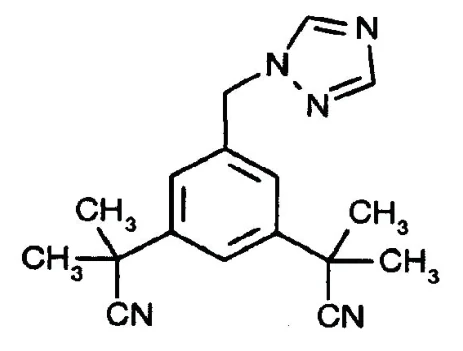
Chemical Name: 2, 2'-[5-(1H-1,2,4-triazol-l-ylmethyl)-1, 3 phenylene] bis (2-methylpropiononitrile) (IUPAC)
Molecular Formula and Molecular Mass: C17H19N5; 293.4 g/mol
Structural Formula:
Physicochemical Properties:
Anastrozole is a white to off-white crystalline powder, which has moderate aqueous solubility (0.53 mg/mL at 25°C) which is dependent on pH, from pH 1 to 4, but independent of pH thereafter.
| pH | mg/ml |
| 1.0 | 2.26 |
| 2.0 | 0.05 |
| 3.0 | 0.06 |
| 4.0 | 0.06 |
| 5.0 | 0.04 |
| 6.0 | 0.04 |
| 6.8 | 0.04 |
Anastrozole is optically inactive, no chiral centers in the molecule and hence no chirality. There are two polymorphic forms were identified and are labeled as Form-I and Form-II. The drug substance produced for this submission is Form-II
CLINICAL TRIALS
A randomized, open label, 2-way crossover, bioequivalence study of anastrozole 1mg tablet of Vanc Pharmaceuticals Inc., and Arimidex (anastrozole) 1mg tablet of AstraZeneca Pharmaceuticals LP, USA was conducted in healthy, post-menopausal female subjects, aged 45 to 64 years under fasting conditions. Data from 19 subjects who completed the study are presented below:
(one x 1 mg) From measured data uncorrected for potency Geometric Mean Arithmetic Mean (CV %) | ||||||
| Parameter | VAN- Anastrozole* | Arimidex† | % Ratio of Geometric Means | 90% Confidence Interval | ||
| Lower | Upper | |||||
AUC0-72h (pg.h/mL) | 509179.05 501830.55 (15.83) | 511276.24 502010.24 (16.94) | 99.96 | 98.37 | 101.58 | |
Cmax (pg/mL) | 16387.11 16100.00 (13.26) | 16033.55 15867.88 (11.05) | 101.46 | 98.62 | 104.38 | |
Tmax§ (h) | 1.47 (30.55) | 1.45 (34.08) | ||||
* VAN-Anastrozole by Vanc Pharmaceuticals Inc.
† Arimidex manufactured by AstraZeneca Pharmaceuticals LP, USA
§ Expressed as the arithmetic mean (CV%) only
AUCI and T1/2 are not reported, these parameters could not be accurately estimated due to the long half-life of the active ingredient and the design of the study.
Adjuvant treatment of breast cancer in postmenopausal women
Study demographics and trial design
A multicentre phase III trial entitled "A Randomized, Double-Blind Trial Comparing Anastrozole Alone with Nolvadex (tamoxifen) Alone, with Anastrozole and Nolvadex in Combination, as Adjuvant Treatment in Postmenopausal Women with Breast Cancer" (ATAC) was conducted in 9,366 postmenopausal patients with operable breast cancer. The patients were randomized to receive anastrozole 1 mg daily, tamoxifen 20 mg daily, or a combination of the two treatments for five years or until recurrence of the disease. However, at the time of the primary analysis (at a median of 33 months follow-up), the combination of anastrozole and tamoxifen did not demonstrate any efficacy benefit when compared with tamoxifen, and this treatment arm was subsequently discontinued from the trial, leaving the 6,241 patients who had been randomized to the anastrozole and tamoxifen monotherapy arms of the study. These patients will be followed to 10 years post-randomization.
The primary endpoints were disease-free survival and safety. Disease-free survival includes loco-regional (including new primary ipsilateral breast cancer) and distant recurrences, new contralateral primaries and death from any cause as a first event. The secondary endpoints were distant disease-free survival (time to a first event of distant recurrence or death from any cause), the incidence of new contralateral breast primaries and overall survival. The primary analysis for disease-free survival was to be carried out after 352 events per treatment arm and occurred after a median of 33 months of follow-up; the major analysis for survival was to be carried out after a total of 352 events per treatment arm and occurred after a median follow-up of 68 months.
Demographics and other baseline characteristics were similar between the two treatment groups and are summarized in Table 9.
Table 9 Summary of demographic and baseline characteristics for the ATAC trial
Demographic Characteristic Anastrozole 1 mg
(N = 3125)
Tamoxifen 20 mg (N=3116)
Mean age (yrs) 64.1 64.1
Age Range (yrs) 38.1-92.8 32.8-94.9
<45 yrs 0.7 0.4
45-60 yrs 34.6 35.1
>60<70yrs 38.0 37.1
>70 yrs 26.7 27.4
Mean Weight (kg) 70.8 71.1
Receptor Status (%)
Positive1 83.8 83.4
Negative2 7.5 8.0
Other3 8.8 8.6
Other treatment prior to randomization (%)
Mastectomy 47.8 47.3
Demographic Characteristic Anastrozole 1 mg
(N = 3125)
Tamoxifen 20 mg (N=3116)
Breast conservation4 52.2 52.7
Axillary surgery 95.5 95.7
Radiotherapy 63.4 62.5
Chemotherapy 22.3 20.8
Neoadjuvant Tamoxifen 1.6 1.6
Primary tumour size (%)
T1(≤ 2 cm) 63.9 62.9
T2 (> 2 cm and ≤ 5 cm) 32.5 34.2
T3 (>5 cm) 2.7 2.2
Nodal status (%)
Node positive 34.9 33.6
1-3 (# of nodes) 24.5 24.5
4-9 7.5 6.4
>9 2.9 2.7
Tumour grade (%)
Well differentiated 20.8 20.5
Moderately differentiated 46.8 47.8
Poorly undifferentiated 23.6 23.3
Not assessed/recorded 8.7 8.4
1
includes patients who were estrogen receptor (ER) positive or progesterone receptor (PgR) positive, or both positive. 2
includes patients with both ER negative and PgR negative receptor status.
3
includes all other combinations of ER and PgR receptor status unknown.
4
among the patients who had breast conservation, radiotherapy was administered to 95.0% of patients in the anastrozole arm and 94.1% in the tamoxifen arm.
N=Number of patients randomized to the treatment.
Study results
Patients in the ATAC trial have now been treated for a median of 60 months (5 years) and followed for a median of 100 months. The primary analysis was carried out after a median follow-up of 33 months; the most recent analyses were carried out after a median follow-up of 68 and 100 months.
In the assessment of disease-free survival, anastrozole was superior to tamoxifen in the intent-to-treat population with a statistically significant 17% reduction in the risk of disease recurrence or death from any cause (p=0.01) at the primary analysis (median follow-up of 33 months) and a 13% reduction in risk after a median follow-up of 68 months (p=0.01). At a median follow-up of 100 months, anastrozole maintained statistical superiority with a 10% reduction in the risk of disease recurrence or death from any cause (p=0.0252). In the hormone receptor positive subgroup (representing about 84% of trial patients), there was a significant 22% reduction in the risk of disease recurrence or death from any cause (p=0.006) at the primary analysis, a 17% reduction (p=0.005) at the 68 month analysis and a 15% reduction (p=0.0027) at the 100 month analysis. These results demonstrate a carryover effect of the efficacy benefit of anastrozole following treatment completion
in both the ITT and the HR+ populations. The absolute difference in disease-free survival continues to increase from 2.4% at 68 months to 2.8% at 100 months in the intent-to-treat population and from 2.5% in the hormone receptor positive subgroup at 68 months to 4.1% at 100 months.
Figure 2 and 3 presents the Kaplan-Meier probability of the protocol-defined disease-free survival for the intent to treat population and the hormone receptor positive subgroup.
Figure 2 Kaplan-Meier probability of disease-free survival for the intention-to-treat (ITT) population.
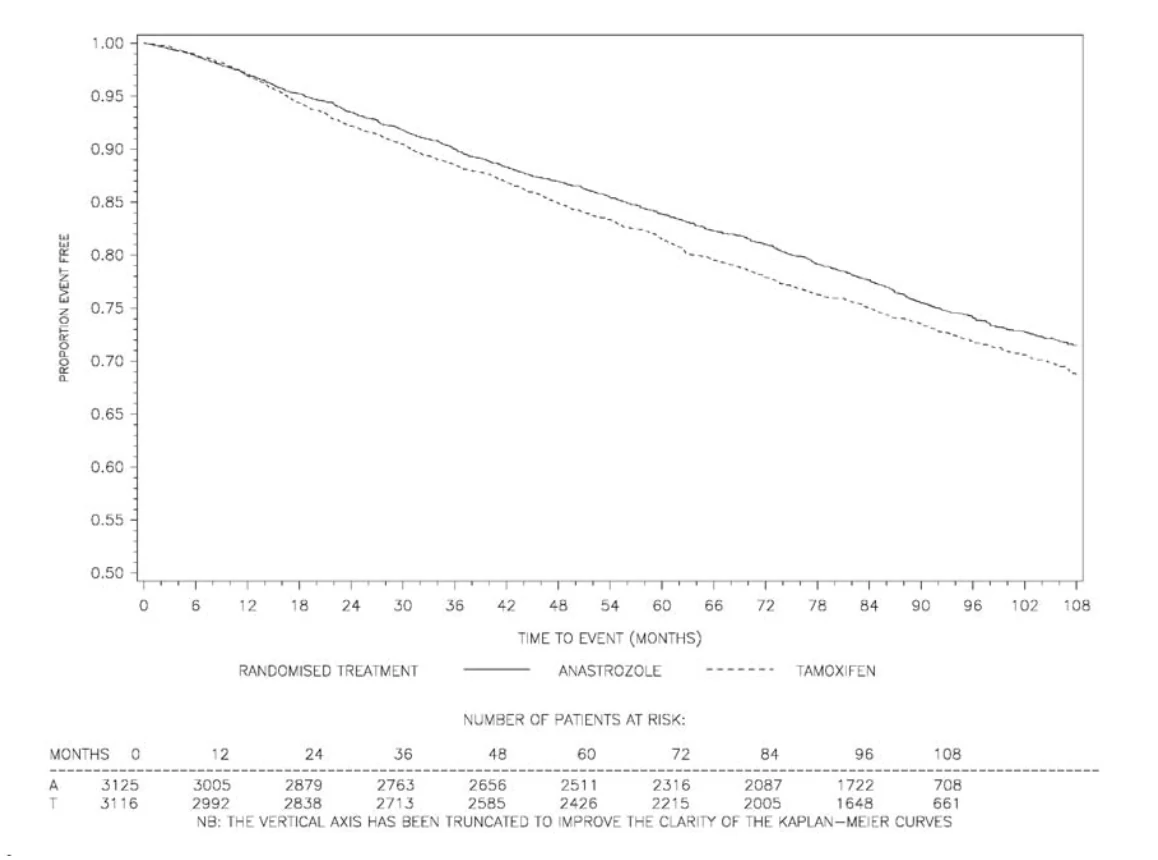
Figure 3 Kaplan-Meier probability of disease-free survival for the hormone receptor positive subgroup.
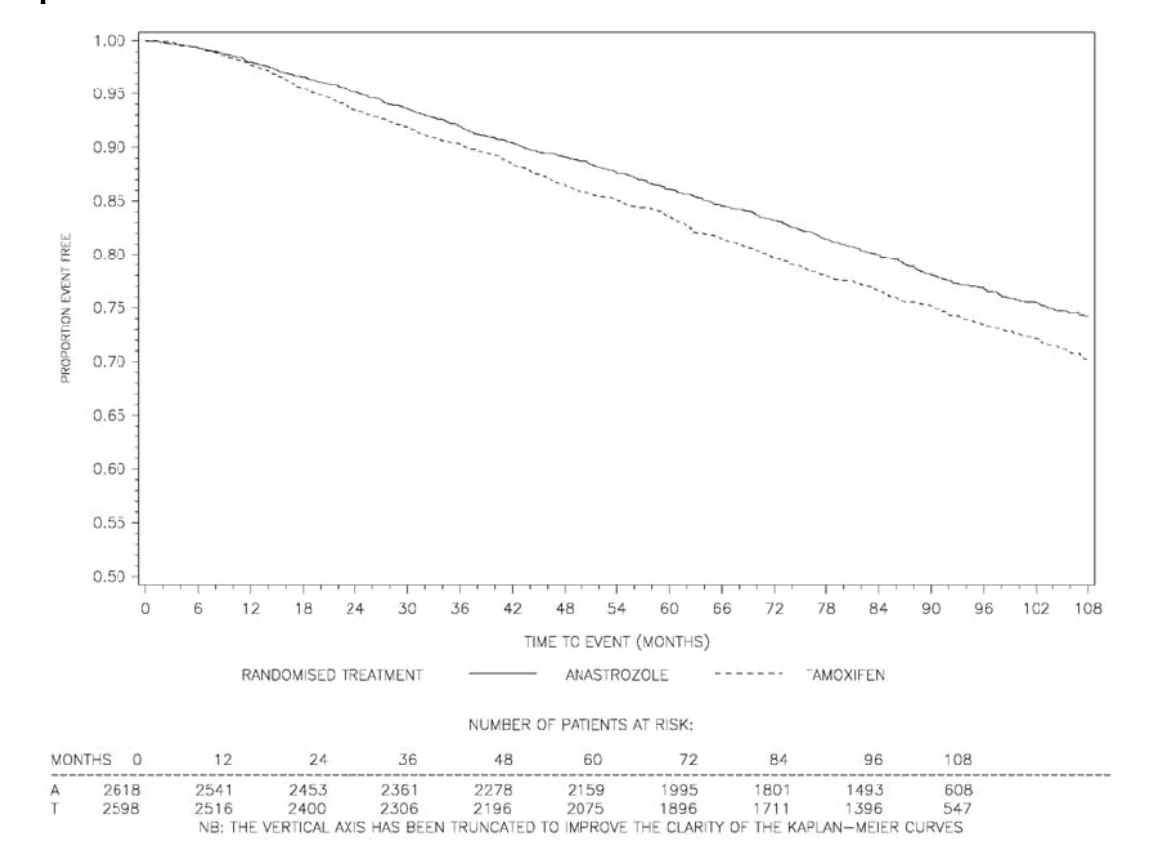
The post-treatment follow-up analysis continues to demonstrate a significant advantage of anastrozole over tamoxifen in time to recurrence in both the intent-to treat population (HR 0.81, 95% CI 0.73 to 0.91, p=0.0004) and the hormone receptor positive subgroup (HR 0.76, 95% CI 0.67 to 0.87, p=0.0001), as well as in the time to distant recurrence in both the intent-to-treat population (HR 0.86, 95% CI 0.75 to 0.98, p=0.022) and the hormone receptor positive subgroup (HR 0.84, 95% CI 0.72 to 0.97, p=0.022). Additionally, there is a significant advantage of anastrozole over tamoxifen in risk of invasive contralateral breast cancer in both the intent-to-treat population (HR 0.68, 95% CI 0.49 to 0.94, p=0.02) and the hormone receptor positive subgroup (HR 0.60, 95% CI 0.42 to 0.85, p=0.004).
Anastrozole 1 mg did not show a survival advantage over tamoxifen 20 mg in the primary analysis of survival, which was carried out after a median follow-up of 68 months. Overall survival was similar in the two arms of the trial for both the intent-to-treat population (HR 0.97, 95% CI 0.85 to 1.12, p=0.71) and the hormone receptor positive subgroup (HR 0.97, 95% CI 0.83 to 1.14, p=0.73). After a median follow-up of 100 months, overall survival continued to be similar in the two arms of the trial for both the intent-to-treat population (HR 1.00, 95% CI 0.89 to 1.12, p=0.99) and the hormone receptor positive subgroup (HR 0.97, 95% CI 0.86 to 1.11, p=0.68).
Overall, a similar number of deaths occurred in the tamoxifen group and the anastrozole arm although there were fewer deaths following breast cancer recurrence in the anastrozole arm (HR=0.91; A=11.2%, T=12.3%). There were more deaths due to causes other than breast cancer and fewer deaths related to breast cancer among patients receiving anastrozole therapy. The difference in the numbers of non-breast cancer deaths before recurrence in the intention to treat population between the two treatment groups is small (absolute difference of 1.1%; A =8.9%, T =7.8%). The largest imbalance is seen among deaths from secondary cancers (A=2.8%, T=2.1%) and, in particular, deaths from lung and colorectal cancer compared with tamoxifen.
The incidence of ovarian cancer, endometrial cancer and melanoma was lower with anastrozole than in the tamoxifen group (see Table 10).
Table 10 : Incidences of new primary cancers in either treatment group prior to
recurrence (during or off-trial treatment)
Body system and adverse event
by COSTART-preferred term
Number (%) of patients
2007 update analysis (data cut-off 31 March 2007)
Anastrozole 1 mg Tamoxifen 20 mg
(N=3092) (N=3094) Skin – non melanoma a, b 94 (3.0) 100 (3.2) Contralateral breast cancer c 62 (2.0) 87 (2.8) Colorectal 56 (1.8) 36 (1.2) Lung 42 (1.4) 24 (0.8) Ovary 12 (0.4) 26 (0.8)
Head and neck 12 (0.4) 5 (0.2) Kidney 11 (0.4) 6 (0.2)
Lymphoma (non-Hodgkins) 10 (0.3) 8 (0.3) Gastric d 10 (0.3) 6 (0.2) Melanoma 8 (0.3) 18 (0.6) Leukaemia 7 (0.2) 9 (0.3) Bladder 6 (0.2) 9 (0.3) Brain 4 (0.1) 6 (0.2)
Endometrium a 4 (0.1) 23 (0.7) Cervix a 2 (0.1) 5 (0.2) Pancreas 2 (0.1) 6 (0.2) Other 34 (1.1) 21 (0.7)
TOTAL 351 (11.4) 365 (11.8)
a In addition to the new primary cancers tabulated here, the following new primary cancers were reported as SAEs: 4 skin cancers and 1 endometrial cancer in the anastrozole 1 mg group and 8 skin cancers, 1 cervix cancer and 1 endometrial cancer in the tamoxifen 20 mg group.
b These totals include 2 patients in the anastrozole 1 mg group and 1 patient in the tamoxifen 20 mg group with new primary skin cancers that were categorised as skin (non-Hodgkin’s).
c Excludes any new primary (contralateral) breast cancer occurring after recurrence.
d These totals include 2 patients in the anastrozole 1 mg group with new primary gastric cancers that were
categorised as stomach cancers.
COSTART Coding Symbols for Thesaurus of Adverse Reaction Terms.
N Number of patients treated.
Deaths (both during and off-trial treatment) resulting from ischaemic cardiovascular events (A =1.3%, T =1.2%) or other cardiovascular events (A =0.9%, T =0.9%) occurred with similar frequency for both treatment groups.
The analyses of the study endpoints in the intent-to-treat population and hormone receptor positive subgroup at the time of the primary, the 5-year treatment completion and the 100 month analyses are summarized in Table 11. The frequency of individual events in the intent-to-treat population and the hormone receptor positive subgroup at the 100 month analyses are described in Table 12.
Table 11 ATAC endpoint summary
| 33-month analysis (data cut-off 29 June 2001) | 68-month analysis (data cut-off 31 March 2004) | 100-month analysis (data cut-off 31 March 2007) | ||||
| Intent to treat population | Hormone receptor positive population | Intent to treat population | Hormone receptor positive population | Intent to treat population | Hormone receptor positive population | |
Anastro zole 1 mg (N=3125 ) Tamoxi fen 20 mg (N=311 6) | Anastrozo le 1 mg (N=2618) Tamoxife n 20 mg (N=2598) | Anastro zole 1 mg (N=3125 ) Tamoxife n 20 mg (N=3116) | Anastro zole 1 mg (N=2618 ) Tamoxife n 20 mg (N=2598) | Anastrozol e 1 mg (N=3125) Tamoxife n 20 mg (N=3116) | Anastrozol e 1 mg (N=2618) Tamoxi fen 20 mg (N=259 8) | |
Disease- free survival (# of events) Hazard ratio (2- sided 95% CI) p-value | 318 379 0.83 (0.71 to 0.96) 0.01 | 217 272 0.78 (0.65 to 0.93) 0.005 | 575 651 0.87 (0.78 to 0.97) 0.01 | 424 497 0.83 (0.73 to 0.94) 0.005 | 817 887 0.90 (0.82 to 0.99) 0.0252 | 619 702 0.85 (0.76 to 0.94) 0.0027 |
Time to recurrenc e (# of events) Hazard ratio (2- sided 95% CI) p-value | 240 298 0.80 (0.67 to 0.94) 0.009 | 153 204 0.73 (0.59 to 0.90) 0.004 | 402 498 0.79 (0.70 to 0.90) 0.0005 | 282 370 0.74 (0.64 to 0.87) 0.0002 | 538 645 0.81 (0.73 to 0.91) 0.0004 | 391 494 0.76 (0.67 to 0.87) 0.0001 |
Distant
disease-
free
survival (# of events)
Hazard
ratio (2-
sided 95% CI)
267
299
0.89 (0.74 to 1.07)
185 212
0.86 (0.69 to 1.08)
500 530
0.94 (0.83 to 1.06)
370 394
0.93 (0.80 to 1.07)
N/A N/A
N/A
N/A N/A
N/A
Table 11 ATAC endpoint summary
| 33-month analysis (data cut-off 29 June 2001) | 68-month analysis (data cut-off 31 March 2004) | 100-month analysis (data cut-off 31 March 2007) | ||||
| Intent to treat population | Hormone receptor positive population | Intent to treat population | Hormone receptor positive population | Intent to treat population | Hormone receptor positive population | |
Anastro zole 1 mg (N=3125 ) Tamoxi fen 20 mg (N=311 6) | Anastrozo le 1 mg (N=2618) Tamoxife n 20 mg (N=2598) | Anastro zole 1 mg (N=3125 ) Tamoxife n 20 mg (N=3116) | Anastro zole 1 mg (N=2618 ) Tamoxife n 20 mg (N=2598) | Anastrozol e 1 mg (N=3125) Tamoxife n 20 mg (N=3116) | Anastrozol e 1 mg (N=2618) Tamoxi fen 20 mg (N=259 8) | |
| p-value | 0.2 | 0.1 | 0.3 | 0.3 | N/A | N/A |
Contra- lateral breast primary (# of events) Odds Ratio (2-sided 95% CI) p-value | 14 33 0.42 (0.22 to 0.79) 0.007 | 11 30 0.36 (0.18 to 0.72) 0.004 | 35 59 0.59 (0.39 to 0.89) 0.01 | 26 54 0.47 (0.30 to 0.76) 0.002 | 61 87 0.68 (0.49 to 0.94) 0.02 | 50 80 0.60 (0.42 to 0.85) 0.004 |
Overall
survival (# of events)
Hazard
ratio (2-
sided 95% CI)
p-value
202 203
Not calculated
(not enough events at cut-off to conduct analysis)
131 136
Not calculated
(not enough events at cut-off to conduct analysis)
411 420
0.97 (0.85 to 1.12)
0.7
296 301
0.97 (0.83 to 1.14)
0.7
629 624
1.00 (0.89 to 1.12)
0.99
472 477
0.97 (0.86 to 1.11)
0.68
Table 11 ATAC endpoint summary
| 33-month analysis (data cut-off 29 June 2001) | 68-month analysis (data cut-off 31 March 2004) | 100-month analysis (data cut-off 31 March 2007) | ||||
| Intent to treat population | Hormone receptor positive population | Intent to treat population | Hormone receptor positive population | Intent to treat population | Hormone receptor positive population | |
Anastro zole 1 mg (N=3125 ) Tamoxi fen 20 mg (N=311 6) | Anastrozo le 1 mg (N=2618) Tamoxife n 20 mg (N=2598) | Anastro zole 1 mg (N=3125 ) Tamoxife n 20 mg (N=3116) | Anastro zole 1 mg (N=2618 ) Tamoxife n 20 mg (N=2598) | Anastrozol e 1 mg (N=3125) Tamoxife n 20 mg (N=3116) | Anastrozol e 1 mg (N=2618) Tamoxi fen 20 mg (N=259 8) | |
Time to distant recurrence (# of events) Hazard ratio (2- sided 95% CI) p-value | Not analysed at the 33 month analysis | 324 375 0.86 (0.74 to 0.99) 0.0427 | 226 265 0.84 (0.74 to 0.99) 0.0559 | 424 487 0.86 (0.75 to 0.98) 0.022 | 305 357 0.84 (0.72 to 0.97) 0.022 | |
N = Number of patients randomized to the treatment. N/A = Not available
Table 12 All recurrence and death events (data cut-off 31 March 2007; median follow-up 100 months)
Number (%) of patients Intention-to-treat
population
Hormone receptor positive population Anastrozole
1mg
(N=3125)
Tamoxifen
20mg
(N=3116)
Anastrozole
1mg
(N=2618)
Tamoxifen
20mg (N=2598) Loco-regional
recurrence,a,b
155 (5.0) 184 (5.9) 102 (3.9) 130 (5.0)
Chest Wall 56 (1.8) 66 (2.1) 37 (1.4) 47 (1.8) Ipsilateral breast c 56 (1.8) 73 (2.3) 38 (1.5) 56 (2.2)
Axillary lymph nodes 27 (0.9) 39 (1.3) 20 (0.8) 28 (1.1) Other regional nodes d 31 (1.0) 43 (1.4) 16 (0.6) 28 (1.1) Contralateral recurrencee 61 (2.0) 87 (2.8) 50 (1.9) 80 (3.1)
Invasive 42 (1.3) 68 (2.2) 36 (1.4) 63 (2.4)
Ductal Carcinoma in situ 15 (0.5) 9 (0.3) 10 (0.4) 8 (0.3)
Unknown 4 (0.1) 10 (0.3) 4 (0.2) 9 (0.3) Distant Recurrence a 333 (10.7) 389 (12.5) 250 (9.5) 294 (11.3)
Bone/soft tissue 213 (6.8) 226 (7.3) 170 (6.5) 182 (7.0)
Bone 208 (6.7) 223 (7.2) 166 (6.3) 180 (6.9) Soft tissue 8 (0.3) 8 (0.3) 6 (0.2) 6 (0.2)
Visceral 239 (7.6) 290 (9.3) 165 (6.3) 215 (8.3)
Pulmonary 110 (3.5) 140 (4.5) 78 (3.0) 95 (3.7)
Hepatic 82 (2.6) 144 (4.6) 61 (2.3) 113 (4.3)
Other 74 (2.4) 81 (2.6) 49 (1.9) 63 (2.4) Death from Any Cause 629 (20.1) 624 (20.0) 472 (18.0) 477 (18.4)
Deaths following
recurrence
350 (11.2) 382 (12.3) 245 (9.4) 269 (10.4)
Deaths without recurrence 279 (8.9) 242 (7.8) 227 (8.7) 208 (8.0)
a Patients may fall into more than one category.
b Patients who presented with distant recurrence or new primary (contralateral) breast cancer on the same day as loco-regional recurrence are included in this table but were counted either as distant recurrence or new primary (contralateral) breast cancer, respectively, in the summary of DFS (protocol-specified definition).
C Includes ductal carcinoma in situ and ipsilateral new breast primaries.
d Includes supraclavicular and internal mammary.
e Any new primary breast cancers occurring after loco-regional recurrence or distant recurrence were not included in this variable. N= Number of patients randomized to the treatment.
Adjuvant treatment of breast cancer in postmenopausal women – assessment of bone
In the phase III/IV SABRE trial, 234 postmenopausal women with hormone receptor positive early breast cancer scheduled for treatment with anastrozole were stratified to low (T-score in both lumbar spine and total hip of -1.0 or higher and with no personal history of fragility fracture), moderate (T-score < –1.0 in either lumbar spine or total hip, provided neither of these was less than –2.0, and with no personal history of a fragility fracture) and high-risk (T-score < -2.0 in either lumbar spine, or total hip, or with a personal history of fragility fracture) groups. All patients received treatment with vitamin D and calcium. Patients in the low-risk group received anastrozole alone, those in the moderate group were randomised to anastrozole plus bisphosphonate (risedronate) or anastrozole plus placebo and those in the high-risk group received anastrozole plus bisphosphonate (risedronate). The primary variable of the SABRE trial was the change from baseline in lumbar spine (L1-L4) bone mineral density (BMD) following 12 months of treatment. Secondary variables were changes in total hip BMD at 12 and 24 months as well as lumbar spine BMD at 24 months.
In postmenopausal breast cancer patients with a high-risk of fragility fracture, treatment with anastrozole and risedronate was associated with a statistically significant increase from baseline in lumbar spine BMD at 12 months (estimated percentage change 3.36%; 95% CI: 2.05, 4.69; p< 0.0001) and 24 months (estimated percentage change 3.02%; 95% CI: 1.40, 4.67; p=0.0006).
In postmenopausal breast cancer patients with a moderate-risk of fragility fracture, treatment with anastrozole and risedronate resulted in a statistically significant increase in lumbar spine BMD at 12 months compared with anastrozole and placebo treatment (estimated percentage change 1.20% versus –1.22%; treatment ratio 1.02; 95% CI: 1.01, 1.04; p< 0.0001) and at 24 months (estimated percentage change 2.24% versus –1.76%; treatment ratio 1.04; 95% CI: 1.02, 1.06; p<0.0001).
In postmenopausal breast cancer patients with a low-risk of fragility fracture, treatment with anastrozole monotherapy was associated with no statistically significant change in lumbar spine BMD at 12 months (estimated percentage change -0.62%; 95% CI: -1.93, 0.71; p=0.3511). The change in lumbar spine BMD at 24 months was statistically significant (estimated percentage change –2.07%; 95% CI: -3.60, -0.53; p=0.0109).
Table 13 Analysis of lumbar spine BMD (g/cm²) at 12 & 24 months in the high- risk, moderate-risk and low-risk strata (PAP) High-risk stratum: analysis of change from baseline Anastrozole +Risedronate Na Baseline gmean at Estimated % changeb Time effectc p-value gmean time point (95% CI) (95% CI) (g/cm2) (g/cm2) 12 months
36 0.84 0.87 3.36 (2.05, 4.69) 1.03 (1.02, 1.05) < 0.0001 24 months
33 0.83 0.86 3.02 (1.40, 4.67) 1.03 (1.01, 1.05) 0.0006 Moderate-risk stratum: randomized comparison
Na Baseline gmean at Estimated glsmeand Treatment p-valued gmean time % changeb,d (g/cm2) ratioe (g/cm2) point (95% CI) (95% CI) (g/cm2) 12 months Anastrozole + 65 0.98 0.97 -1.22 0.99 placebo (-2.19, -0.24) Anastrozole + 73 0.98 1.00 1.20 1.01 1.02 < 0.0001 risedronate (0.22, 2.19) (1.01, 1.04) 24 months Anastrozole + 54 0.96 0.95 -1.76 0.98 placebo (-3.25, -0.25) Anastrozole + 60 0.98 1.00 2.24 1.02 1.04 < 0.0001 risedronate (0.73, 3.76) (1.02, 1.06)
Low-risk stratum: analysis of change from baseline Anastrozole monotherapy Na Baseline gmean at Estimated % changeb Time effectc p-value gmean time point (95% CI) (95% CI) (g/cm2) (g/cm2) 12 months
35 1.15 1.14 -0.62 (-1.93, 0.71) 0.99 (0.98, 1.01) 0.3511 24 months
26 1.15 1.12 -2.07 (-3.60, -0.53) 0.98 (0.96, 0.99) 0.0109 a Patients with values at baseline and 12 month visit. b 100*((time effect)-1).
c Ratio of post baseline value/baseline
value. d Covariance analysis. e Anastrozole+risedronate/anastrozole+placebo.
BMD Bone mineral density; CI Confidence interval; glsmean Geometric least squares mean; gmean Geometric mean; PAP Primary analysis population.
In summary, the 12- and 24-month main analyses have shown that patients already at moderate- to high-risk of fragility had their bone health (assessed by bone mineral density and bone formation and resorption markers) successfully managed by using anastrozole in combination with a bisphosphonate (risedronate). These findings were mirrored in the secondary efficacy variable of change from baseline in total hip BMD at 12 and 24 months (see Table 14). In addition, no changes in lumbar spine BMD were seen in the low-risk group following 12 months of treatment with anastrozole alone and given vitamin D and calcium but were seen following 24 months of treatment. No change in total hip BMD was seen at 12 and 24 months in the low-risk group.
This study provides evidence that postmenopausal women with early breast cancer scheduled to be treated with anastrozole should have their bone status managed according to treatment guidelines already available for postmenopausal women at similar risk of fragility fracture.
Table 14 Analysis of total hip BMD (g/cm²) at 12 & 24 months in the high-risk, moderate-risk and low-risk strata (PAP)
High-risk stratum: analysis of change from baseline Anastrozole +Risedronate
Na Baseline gmean at Estimated % changeb Time effectc p-value gmean time point (95% CI) (95% CI) (g/cm2) (g/cm2) 12 months
37 0.79 0.81 1.53 (0.37, 2.71) 1.02 (1.00, 1.03) 0.0112 24 months
33 0.80 0.81 1.96 (0.49, 3.44) 1.02 (1.00, 1.03) 0.0104
Moderate-risk stratum: randomized comparison
Na Baseline gmean at Estimated glsmeand Treatment p-valued gmean time % changeb,d (g/cm2) ratioe (g/cm2) point (95% CI) (95% CI) (g/cm2) 12 months Anastrozole + 65 0.87 0.87 -0.44 1.00 placebo (-1.17, 0.31) Anastrozole + 73 0.89 0.90 0.86 1.01 1.01 0.0023 risedronate (0.12, 1.61) (1.00, 1.02) 24 months Anastrozole + 54 0.87 0.86 -1.12 0.99 placebo (-2.14, -0.10) Anastrozole + 60 0.90 0.92 1.81 1.02 1.03 < 0.0001 risedronate (0.78, 2.86) (1.02, 1.04)
Low-risk stratum: analysis of change from baseline Anastrozole monotherapy
Na Baseline gmean at Estimated % changeb Time effectc p-value gmean time point (95% CI) (95% CI) (g/cm2) (g/cm2) 12 months
35 1.00 1.01 -0.35 (-1.37, 0.68) 1.00 (0.99, 1.01) 0.4918 24 months
26 1.01 1.00 -0.44 (-2.10, 1.26) 1.00 (0.98, 1.01) 0.5988 a Patients with values at baseline and 12 month visit. b 100*((time effect)-1).
c Ratio of post baseline value/baseline
value. d Covariance analysis. e Anastrozole+risedronate/anastrozole+placebo.
BMD Bone mineral density; CI Confidence interval; glsmean Geometric least squares mean; gmean
Geometric mean; PAP Primary analysis population.
Adjuvant treatment of breast cancer in postmenopausal women – assessment of lipids
In postmenopausal women with early breast cancer in the SABRE trial who received anastrozole alone (the primary analysis population), there was no statistically significant change in low-density lipoprotein-cholesterol (LDL-C) from baseline to 12 months (mean percent change -2.25% (95% CI: -7.64, 3.13) p-value 0.2859), a statistically significant increase in high-density lipoprotein-cholesterol (HDL-C) from baseline to 12 months (mean percent change 6.85% (95% CI: 2.79, 10.91) p-value 0.0016) and no statistically significant changes in total cholesterol or triglycerides (see Table 15).
In addition, no statistically significant changes from baseline to 12 months were seen in LDL-C [(mean percent change (-2.91% (95% CI: -7.20, 1.38) p-value 0.0770)], HDL-C [(mean percent change (4.00% (95% CI: 0.21, 7.79) p-value 0.1070)], total cholesterol or triglycerides in patients who received anastrozole in combination with the bisphosphonate, risedronate (the secondary analysis population).
The mean TC:HDL-C ratio decreased from baseline to 12 months in both populations for lipids. In the primary analysis population, the TC:HDL-C ratio decreased from a mean of 3.30 mmol/L (SD=0.82) at baseline to 3.11 mmol/L (SD=0.86) at 12 months while the secondary analysis population decreased from a mean of 3.48 mmol/L (SD=0.90) at baseline to 3.28 mmol/L (SD=0.85) at 12 months.
Table 15 Summary of lipid profile changes from baseline in LDL-C, HDL-C, total cholesterol and serum triglycerides (mmol/L) at 12 months
Anastrozole 1 mg Population Anastrozole 1 mg + risedronate
35 mg Population
(PAPL) (SP) (N=66) (N=65)
LDL-C
Na 54 59 Mean (baseline) 2.97 2.99 Mean (12 months) 2.88 2.89 Differences in means -0.09 -0.11 Mean % change -2.25 (-7.64, 3.13) -2.91 (-7.20, 1.38) (95% CI)
p-valueb 0.2859 0.0770 HDL-C
Na 54 60 Mean (baseline) 1.68 1.62 Mean (12 months) 1.79 1.67 Differences in means 0.11 0.05 Mean % change 6.85 (2.79, 10.91) 4.00 (0.21, 7.79) (95% CI)
p-valueb 0.0016 0.1070 Total cholesterol (TC)
Na 54 60 Mean (baseline) 5.25 5.24 Mean (12 months) 5.27 5.19 Differences in means 0.02 -0.05 Mean % change 0.76 (-3.08, 4.60) -0.44 (-3.27, 2.39) (95% CI)
p-valueb 0.8647 0.4840 Serum triglycerides (TG)
Na 54 60 Mean (baseline) 1.31 1.40 Mean (12 months) 1.31 1.50 Differences in means 0.00 0.11
Table 15 Summary of lipid profile changes from baseline in LDL-C, HDL-C, total cholesterol and serum triglycerides (mmol/L) at 12 months
Anastrozole 1 mg Population Anastrozole 1 mg + risedronate
35 mg Population
(PAPL) (SP) (N=66) (N=65)
Mean % change -0.60 (-7.15, 5.94) 7.03 (-5.02, 19.09) (95% CI)
p-valueb 0.9881 0.4313 a Patients with values at baseline and 6 or 12 months.
b Paired t-test comparing the means at baseline and 12 months.
CI Confidence interval; ITT Intent-to-treat; LDL-C Low-density lipoprotein-cholesterol; PAPL Primary analysis population for lipids; SP Secondary analysis population for lipids. LDL-C, HDL-C, TC, TG and TC:HDL-C ratio were analysed independently of strata in patients who did not have elevated cholesterol at baseline, according to the ATP [Adult Treatment Panel] III criteria.
Treatment for 12 months with anastrozole alone or combination treatment with anastrozole and risedronate had a neutral effect on lipid profile. Therefore, no specific requirements for lipid monitoring due to anastrozole therapy are recommended.
Treatment of Postmenopausal Women with Advanced Breast Cancer
Anastrozole was studied in two, double-blind, controlled trials of similar design (0030, a North American study; 0027, a predominantly European study) in 1021 postmenopausal women with advanced breast cancer. Eligible patients were randomized to receive a single daily dose of either anastrozole 1 mg, or tamoxifen 20 mg. The trials were designed to allow data to be pooled.
Demographics and other baseline characteristics were similar for the two treatment groups, however there were differences in hormone receptor status between the two trials. In Trial 0030, 88.3% of anastrozole-treated patients and 89.0% of tamoxifen-treated patients were known to be estrogen and/or progesterone receptor positive, compared to 45.3% and 43.9% (respectively) of patients in Trial 0027.
Anastrozole was shown to be at least as effective as tamoxifen for the primary endpoints of time to progression and objective response rate. In Trial 0030, a non-protocolled analysis indicated that anastrozole had a statistically significant advantage over tamoxifen (p=0.005) for time to progression (11.1 months versus 5.6 months, respectively) (see Figure 4a). Trial 0027 showed anastrozole to be at least as effective as tamoxifen for time to progression (8.2 months versus 8.3 months, respectively) (see Figure 4b) and objective response rate. The combined data from the two trials showed anastrozole to be numerically superior to tamoxifen for time to progression (8.5 months versus 7.0 months, respectively) (see Figure 4c). In a retrospective data analysis, patients from Trial 0027 who
were known to be estrogen and/or progesterone receptor positive were shown to have longer median times to progression (271 days) when treated with anastrozole, than those treated with tamoxifen (237 days) (see Figure 4d). In addition, combined data from both trials, for patients who were estrogen and/or progesterone receptor positive, showed median times to progression of 10.7 months versus 6.4 months for anastrozole versus tamoxifen treated patients (two sided, p=0.022, retrospective analysis). These subgroup analyses support the results of Trial 0030 in suggesting numerical superiority for anastrozole over tamoxifen in patients known to be estrogen and/or progesterone receptor positive. Furthermore, these analyses demonstrate that patients with estrogen and/or progesterone receptor positive tumours are clearly the most appropriate population for anastrozole therapy.
Figure 4 Kaplan-Meier plots of time to progression (intention-to-treat population). a) Trial
0030 all patients; b) Trial 0027 all patients; c) Trials 0030 and 0027 combined; d) Trial 0027 estrogen/progesterone receptor positive patients only.
a)
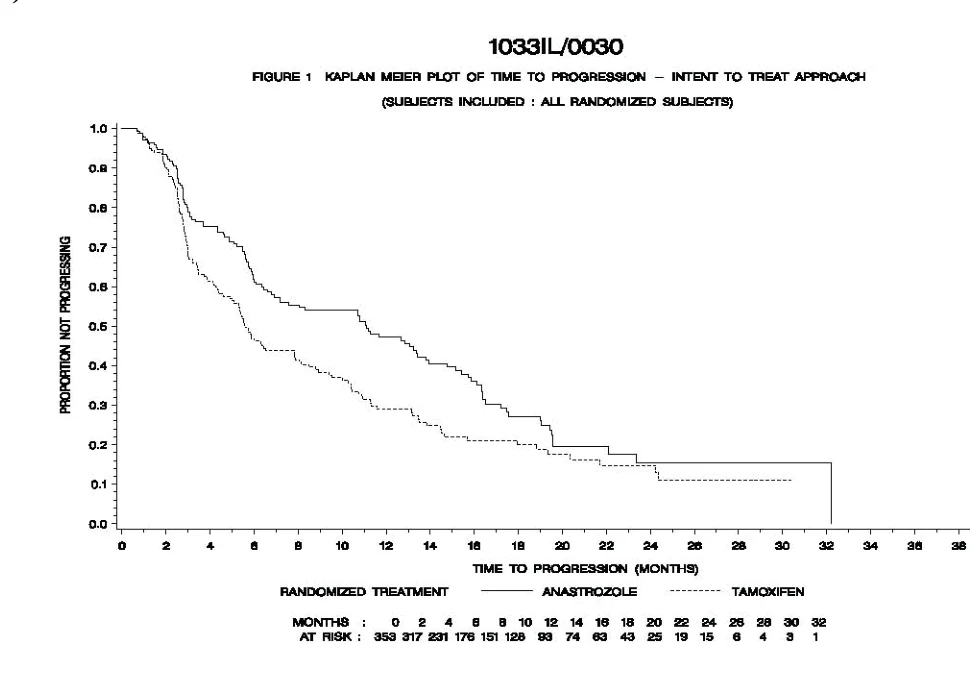
b)
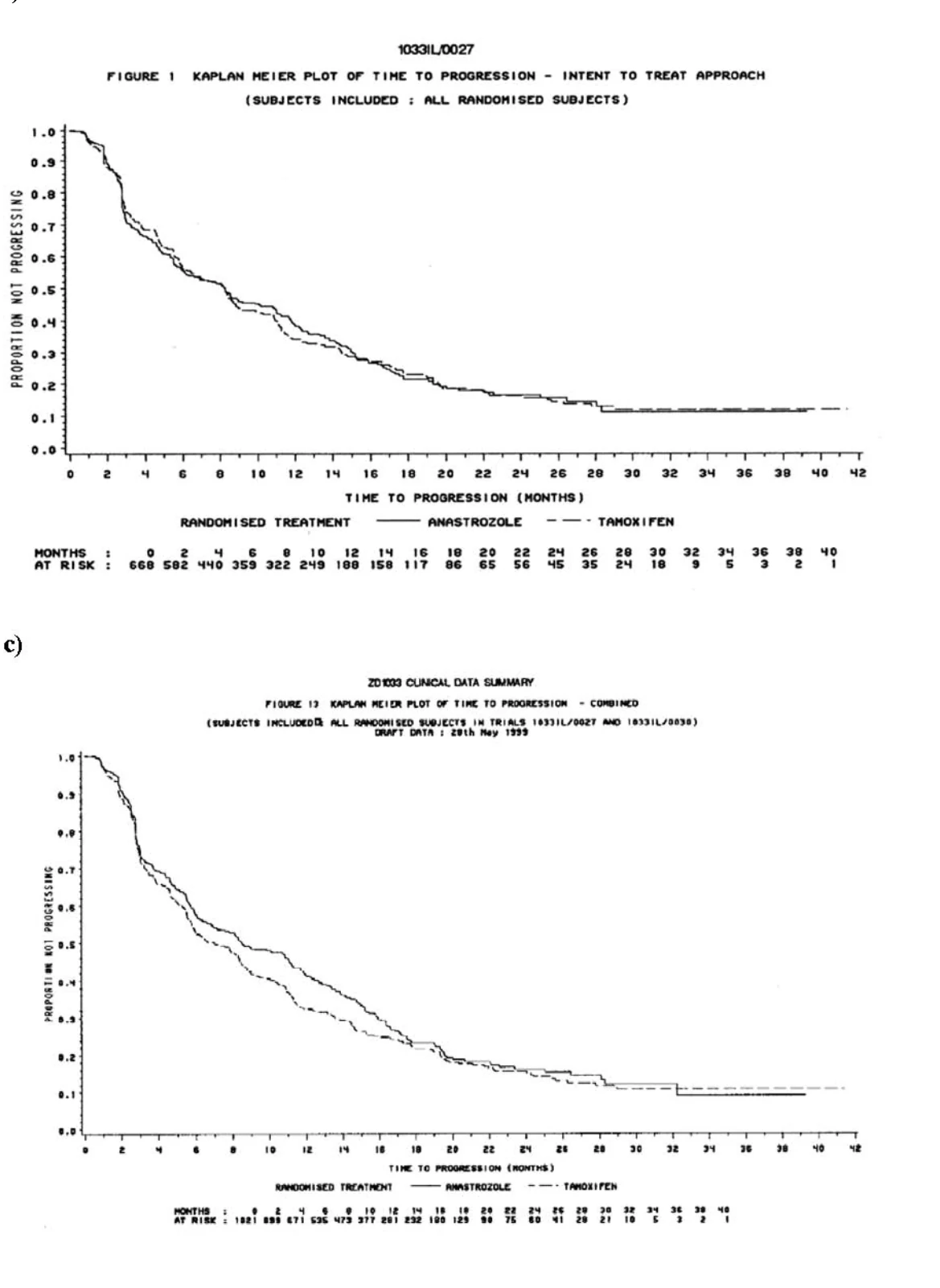
d)
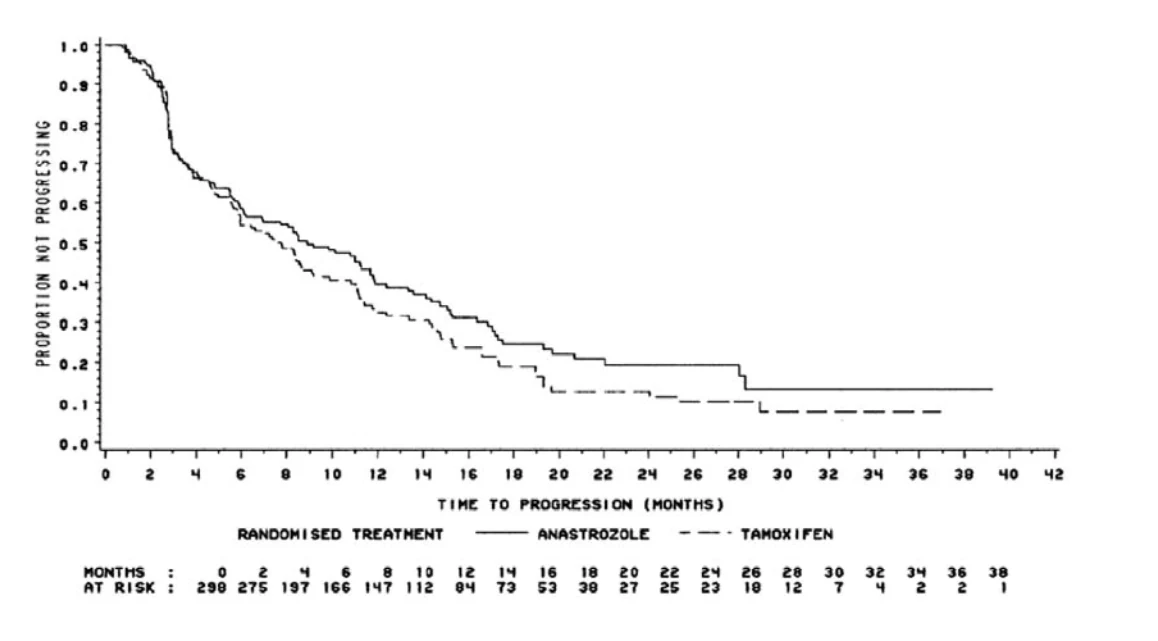
Results from the secondary endpoints of time to treatment failure, duration of response, and duration of clinical benefit were supportive of the results of the primary efficacy endpoints. The number of patients who experienced clinical benefit (best objective response of complete response [CR], partial response [PR] or stable disease [SD] ≥ 24 weeks is shown in Table 16.
Table 16 Analysis of secondary endpoints in Trials 0030, 0027 and combined
Clinical
Benefit
Trial 0030 Number (%) of Patients
Trial 0027
Combined Trials
Anastrozole
1mg (n=171)
Tamoxifen
20mg
(n=182)
Anastrozole 1mg (n=340)
Tamoxifen 20mg
(n=328)
Anastrozole
1mg (n=511)
Tamoxifen 20mg
(n=510)
CR 5 (2.9) 5 (2.7) 19 (5.6) 16 (4.9) 24 (4.7) 21 (4.1) PR 31 (18.1) 26 (14.3) 93 (27.4) 91 (27.7) 124 (24.3) 117 (22.9) SD≥24
weeks
65 (38.0) 52 (28.6) 79 (23.2) 75 (22.9) 144 (28.2) 127 (24.9)
Total
Clinical
benefit
101 (59.1)* 83 (45.6)* 191 (56.2) 182 (55.5) 292 (57.1) 265 (52.0)
CR complete response
PR partial response
SD stable disease
* two-sided p=0.0098, retrospective analysis
There were too few deaths occurring across treatment groups of both trials to assess overall survival differences at the time of data analysis.
Treatment of Postmenopausal Women with Advanced Breast Cancer who had Disease Progression following Tamoxifen Therapy
Anastrozole was studied in two well-controlled clinical trials (0004, a North American study; 0005, a predominantly European study) in postmenopausal women with advanced breast cancer who had disease progression following tamoxifen therapy. Most patients were estrogen receptor-positive; a smaller fraction was estrogen receptor-unknown or estrogen receptor-negative. Eligible patients were randomized to receive either a single daily dose of 1 mg or 10 mg of anastrozole, or megestrol acetate 40 mg four times a day. The studies were double-blinded with respect to anastrozole. Approximately 1/3 of the patients in each treatment group in both studies had either an objective response or stabilization of their disease for greater than 24 weeks. Hazard ratios for time to progression and odds ratios for response rates were calculated for the pooled studies were shown to be similar. After analysis of mature data involving 473 patients among 764 randomized participants, the hazard ratios for survival demonstrated a significant prolongation of survival in the 1 mg anastrozole group compared to hormonal treatment with megestrol acetate.
Table 17 Analysis of time to death for patients in Trials 0004 and 0005 combined
Time of death Trial Treatment Hazard ratio*, (97.5% CI)
and p-values# Anastrozole
1mg
Anastrozole 10mg
MA Anastrozole
1mg Vs MA
Anastrozole 10mg Vs MA
Number of
patients who
died (%)
(57.4)
151 of 248 (60.9)
(67.6)
2-year
survival rate
56.1% 54.6% 46.3%
Median time
to death
(months)
26.7 25.5 22.5 0.78
(0.6040 to
0.9996)
P=0.0248+
0.83
(0.6452 to 1.0662)
P=0.0951+
* Hazard ratio greater than 1.00 indicated that the first treatment is associated with shorter time to death than is
the second treatment
# The critical p-value for statistical significance is 0.025
+ Calculated using Cox's regression model
Cl Confidence interval
MA Megestrol acetate
Patients with estrogen receptor-negative disease rarely responded to anastrozole, but there were too few patients in this group for a meaningful analysis.
DETAILED PHARMACOLOGY
Animal Pharmacology
Pharmacodynamics
in vitro: Anastrozole inhibited human placental aromatase with an IC50 (concentration inhibiting enzyme activity by 50%) of 15 nM; Ki values could not be calculated. It is therefore an inherently potent aromatase inhibitor.
in vivo: In rats, aromatase is not found in peripheral adipose tissue but is confined to the ovaries and brain so chronic inhibition of aromatase in this species invariably leads to marked compensatory ovarian changes. Two assessments of aromatase inhibitory activity in rats were therefore made in circumstances in which ovarian-hypothalamo-pituitary feedback effects were minimized, namely acute (single dose) inhibition of ovulation in adult rats, and inhibition of uterine hypertrophy in sexually immature rats given exogenous androstenedione. Anastrozole consistently inhibited ovulation at a dose of 0.1 mg/kg. In this respect it was comparable in activity to fadrozole and 200 times as potent as aminoglutethimide, and it completely prevented the uterotrophic response to exogenous androstenedione at the same dose (given daily for three days).
As in the human, in Macaque monkeys aromatase is present in peripheral tissues in both males and females and the male monkey therefore affords an opportunity to assess chronic aromatase inhibitory activity in circumstances entirely analogous to the human male and comparable to postmenopausal women. Measurement of plasma estradiol concentrations in male pigtailed Macaques after ascending doses, each given for periods of 7 days, showed that anastrozole achieved maximal suppression at a dose of 0.1 mg/kg b.i.d. and was again comparable in potency to fadrozole.
Pharmacokinetics
Although species and gender-dependent effects are noted in anastrozole pharmacokinetics, anastrozole is rapidly and completely absorbed in all species evaluated. Elimination half-life of anastrozole is longer in humans (approximately 50 hours) than in animals and is independent of anastrozole dose. Following administration of a single 1 mg/kg anastrozole dose, elimination half-life of anastrozole is approximately 10 hours in male dogs, 9 hours in female dogs, 7 hours in female rats and 2 hours in male rats. Consistent with its elimination half-life and with once a day dosing, 3-4 fold accumulation of anastrozole is observed in patients, while the accumulation pattern of anastrozole in rat and dog varies in a time and dose-dependent manner at doses greater than 5 mg/kg/day in the rat and 3 mg/kg/day in the dog.
Anastrozole is widely distributed into the tissues and is eliminated in both urine and bile in rats and dogs. Metabolism was qualitatively similar in rats, dogs and man, although a glucuronide conjugate of anastrozole was detectable in humans but not in rats or dogs. While some metabolites possess intrinsic aromatase inhibitory activity, they were not detectable in the plasma or were quantitatively minor metabolites (<5%). The results show that anastrozole itself is responsible for the observed pharmacological activity in vivo.
Adequate exposure to anastrozole and all metabolites except for the anastrozole glucuronide was achieved in the rat and dog relative to man. The anastrozole glucuronide is unlikely to possess pharmacological or toxicological activity.
TOXICOLOGY
The preclinical safety evaluation of anastrozole has included acute studies, 1 and 6-month toxicity studies in rats and dogs, teratology, genetic toxicology, antigenicity and irritancy studies. Additional toxicology studies include a 2-year oncogenicity study in rats and a 2-year oncogenicity study in mice. Two additional investigative studies have also been completed to assist interpretation of the neoplastic changes observed in the rat oncogenicity study.
Acute Toxicity
The majority of mice dosed orally with 250 mg/kg anastrozole and all mice dosed intraperitonealy with 50 mg/kg showed signs of non-specific toxicity following dosing, but all recovered by day 2 and appeared normal for the remainder of the 14 day observation periods. Rats did not tolerate doses of 250 mg/kg and above by either route. No atypical signs were seen in rats following 100 mg/kg orally. However, there were signs of non-specific toxicity, but no deaths, following 50 mg/kg intraperitonealy. Non-specific toxicity in the rodent comprised the following: subdued behaviour, hunched posture, trembling, decreased respiration rate, fully or partially closed eyes, pilo-erection, salivation, lacrimation, convulsions, loss of skin tone, and lying prone.
In dogs treated orally with 45 mg/kg anastrozole, only minimally toxic effects were observed consisting of emesis, loose stools, body weight loss and reduced food consumption.
Multiple Dose Toxicity Studies
Anastrozole was well tolerated at up to 50 mg/kg/day in multiple dosing studies in rats, but 12 mg/kg/day was not tolerated in dogs in the 1 month study. Consequently, the top dose in the 6 month dog study was set at 8 mg/kg/day.
Anastrozole is a potent inhibitor of the aromatase enzyme and as such may be expected to induce a variety of effects resulting from the long-term inhibition of estrogen production in multiple dosing studies. Such pharmacological effects were observed in the reproductive tract and endocrine organs at all dose levels in rat and dog in both 1 month and 6 month toxicity studies. These effects included increased ovarian weight with increased numbers of Graafian follicles and/or corpora lutea together with mammary gland/uterine/vaginal changes in rats and dogs and testicular Leydig cell changes in dogs. Other pharmacologically induced changes in rats were reduced pituitary and adrenal gland weights, while in dogs, thymic involution was seen in both sexes in all dose groups. Changes in blood parameters included reversible increases in platelet numbers in both species, a reversible increase in erythrocyte parameters in female rats at 1 month, with a reversible decrease in male rats and dogs at 6 months, and increased white blood cells in rats of both sexes.
Non-pharmacologically induced changes in rats included an increased incidence of chronic progressive glomerular nephropathy at high dose (50 mg/kg/day) in the 6 month study. This was of minimal to mild severity and is thought to represent an exacerbation of the spontaneously
occurring condition, possibly due to a slightly increased protein load in these animals. In addition, liver enlargement (reversible on withdrawal) accompanied by centrilobular hypertrophy and reduced glycogen at doses of 5 mg/kg/day and above in both the 1 month and 6 month studies, was considered indicative of induction of mixed function oxidases by anastrozole.
In the dog, liver enlargement (reversible on withdrawal), generally accompanied by centrilobular hypertrophy and increased plasma alkaline phosphatase, was seen at mid and high dose levels in both multiple dose toxicity studies. This finding was consistent with induction of mixed function oxidase enzymes. Reversible hepatotoxicity, characterised by multifocal degeneration/necrosis and accompanied by elevated plasma alanine aminotransferase, was seen at the high dose (8 mg/kg/day) in the 6 month dog study. No degenerative changes were seen at the mid dose (3 mg/kg/day) in dogs, implying at least a 150 fold margin for hepatotoxicity in the dog based on a human dosage of 1 mg/day (approximately 0.02 mg/kg and approximately a 40 fold margin based on comparable AUC data).
Changes in clinical chemistry parameters in the toxicology studies included a reduction in triglycerides (all doses) and an increase in cholesterol (5 and 25 mg/kg/day) in male rats after 1 month dosing, and changes in potassium levels at 25 mg/kg/day. In dogs, plasma cholesterol and urinary creatine were reduced after 1 month at 12 mg/kg/day. Cholesterol was increased in female dogs (no change in males) after 6 months at 8 mg/kg/day. However, no ocular effects were seen in either species.
A reversible reduction in R-wave amplitude was seen in the dog studies at the high doses of 12 and 8 mg/kg/day in the 1 and 6 month studies respectively. This effect was not accompanied by any waveform interval or histopathological changes and is of unknown etiology.
Reproductive Toxicology
Anastrozole has been found to cross the placenta following oral administration of 0.1 mg/kg in rats and rabbits. Studies in both rats and rabbits at doses equal to or greater than 0.1 and 0.02 mg/kg/day, respectively, administered during the period of organogenesis showed that anastrozole increased pregnancy loss (increased pre- and/or post-implantation loss, increased resorption and decreased numbers of live fetuses). Effects were dose related in rats. Placental weights were significantly increased in rats at doses of 0.1 mg/kg/day or more.
Evidence of fetotoxicity, including delayed fetal development (i.e. incomplete ossification and depressed fetal body weights), was observed in rats administered doses of 1 mg/kg/day. There was no evidence of teratogenicity in rats administered doses up to 1 mg/kg/day. In rabbits, anastrozole caused pregnancy failure at doses equal to or greater than 1 mg/kg/day. There was no evidence of teratogenicity in rabbits administered 0.2 mg/kg/day.
Oral administration of anastrozole to female rats produced a high incidence of infertility at 1 mg/kg/day and increased pre-implantation loss at 0.02 mg/kg/day. These effects were related to the pharmacology of the compound and were completely reversed after a 5-week compound withdrawal period.
Oncogenicity
The oncogenicity study in rats at doses of 1.0 to 25 mg/kg/day, administered by oral gavage for up to 2 years, revealed increases in the incidence of hepatocellular adenoma and carcinoma in high dose females, uterine stromal polyps in the high dose females and thyroid adenoma in the high dose males. Dose related increases were observed in the incidences of ovarian and uterine hyperplasia in females. At 25 mg/kg/day, plasma AUC(0-24hr) levels in rats were about 100 times higher than the level exhibited in postmenopausal volunteers at the recommended dose.
A separate oncogenicity study in mice at oral doses of 5 to 50 mg/kg/day for up to 2 years, produced increases in the incidence of benign ovarian epithelial and sex cord stromal granulosa cell tumours, at all dose levels. A dose related increase in the incidence of ovarian stromal hyperplasia was also observed in female mice. These ovarian changes are considered to be rodent-specific effects of aromatase inhibition and are of no significance to postmenopausal breast cancer patients. The incidence of lymphosarcoma was marginally increased in males and females at the high dose. At 50 mg/kg/day, plasma AUC(0-t) levels in mice were about 30 times higher than the level exhibited in postmenopausal volunteers at the recommended dose.
Other Toxicology Studies
There were no significant findings in genetic toxicology or in special toxicity studies designed to assess the irritant or antigenic potential of anastrozole.
Additional studies to provide further reassurance of the mechanisms underlying the formation of liver and thyroid tumours in rats have been completed.
In the first study, female rats dosed with anastrozole at 25 mg/kg/day for up to 28 days showed a 27% increase in relative liver weight, an increase in hepatocyte replication, and centrilobular hepatocyte hypertrophy. It was concluded that anastrozole, a known hepatic cytochrome P450 enzyme inducer in rats, elicited a spectrum of biological changes in the rat liver similar to those observed with the non-genotoxic hepatocarcinogen, phenobarbitone. The hepatic changes in this study, and the tumours seen in female rats at 25 mg/kg/day after two-years, are considered a result of this non-genotoxic process.
In the second study, male rats were dosed at 25 mg/kg/day for 30 days. Thyroid follicular epithelial cell hypertrophy, increased TSH activity and increased plasma clearance of 125I-T4, in association with liver enlargement, centrilobular hepatocyte hypertrophy, increase in CYP2B (predominantly) activity and increase in T4 UDP-glucuronyltransferase activity, are consistent with anastrozole being a liver enzyme inducer of the phenobarbitone type. Thus, the thyroid tumours that occurred in male rats dosed with 25 mg/kg/day anastrozole over two-years can be considered to be mechanistically related to an increased clearance of thyroid hormone resulting from an induction of specific liver enzymes resulting in a TSH-mediated non-genotoxic response.
The spectrum of biological changes in the rat liver and thyroid are similar to those reported in the literature following the administration of the non-genotoxic carcinogen, phenobarbitone. It is, therefore, concluded that the hepatic and thyroid changes seen in these investigative studies confirm
the non-genotoxic mechanism responsible for the formation of tumours in the two-year rat oncogenicity study. The results do not alter the risk benefit assessment for the clinical use of anastrozole.
In support of clinical investigations using the combination of anastrozole and tamoxifen, an investigative study was performed in the rat to determine whether anastrozole, when administered in combination with tamoxifen, alters the metabolism of tamoxifen and the level of tamoxifen-DNA adducts in the rat liver. In the high dose group, where anastrozole produced a major increase in liver P450 enzyme activity (specifically CYP2B and CYP3A), there was a significant reduction in the number of tamoxifen-DNA liver adducts compared to the animals given tamoxifen alone or in combination with a non-inducing dose of anastrozole. The plasma concentration of anastrozole was not determined but, in combination with the high dose of anastrozole, there was a reduction in the concentration of tamoxifen in plasma and liver, and a reduction in the concentration of tamoxifen metabolites in the liver.
REFERENCES:
1 ATAC (Arimidex, Tamoxifen Alone or in Combination) Trialists’ Group. Anastrozole alone or in combination with tamoxifen versus tamoxifen alone for adjuvant treatment of postmenopausal women with early breast cancer: first results for the ATAC randomised trial. Lancet 2002; 359: 2131-2139.
2 ATAC Trialists’s Group. Anastrozole alone or in combination with tamoxifen versus tamoxifen alone for adjuvant treatment of postmenopausal women with early breast cancer: Results of the ATAC (Arimidex, Tamoxifen Alone or in Combination) Trial Efficacy and Safety Update Analyses. Cancer 2003; 98: 1802-1810.
- 3.
ATAC Trialists’Group.
Results of the ATAC (Arimidex, Tamoxifen, Alone or in Combination) trial after completion of 5 years’ adjuvant treatment for breast cancer. Lancet 2005; 365: 60-62
- 4.
ATAC Trialists’ Group.
ATAC (Arimidex, Tamoxifen, Alone or in Combination): A phase III adjuvant therapy trial in postmenopausal breast cancer – 100 month follow-up results. Lancet Oncol 2008; 9(1):45-53.
- 5.
Bonneterre J, Buzdar A, Nabholtz JM et al.
Anastrozole is Superior to Tamoxifen as First-Line Therapy in Hormone Receptor Positive Advanced Breast Carcinoma. Cancer 2001; 92(9):2247-2258.
- 6.
Bonneterre J, Thürlimann BJK, Robertson JFR et al.
Anastrozole Versus Tamoxifen as First-Line Therapy for Advanced Breast Cancer in 668 Postmenopausal Women: Results of the Tamoxifen or Arimidex Randomized Group Efficacy and Tolerability Study. Journal of Clin Oncology 2000; 18 (issue 22):3748-3757.
- 7.
Bonneterre J, Thürlimann BJK, Robertson JFR.
Preliminary results of a large comparative multi-centre clinical trial comparing the efficacy and tolerability of Arimidex (anastrozole) and Tamoxifen (TAM) in postmenopausal women with advanced breast cancer (ABC). [abstract]. Euro Journal of Cancer 1999; 35 (suppl. 4): 313.
- 8.
Brodie AMH.
Aromatase inhibitors in the treatment of breast cancer. Journal of Steroid Biochemistry and Molecular Biology 1994; 49(4-6):281-287.
- 9.
Buzdar A, Jonat W, Howell A, Jones SE et al.
Anastrozole, a potent and selective aromatase inhibitor, versus megestrol acetate in
postmenopausal women with advanced breast cancer: Results of overview analysis of two phase III trials. Journal Clin Oncology 1996; 14:2000-2011.
- 10.
Buzdar A, Jonat W, Howell A, Jones SE, et al.
Anastrozole versus megestrol acetate in the treatment of postmenopausal women with advanced breast carcinoma: results of a survival update based on a combined analysis of data from two mature phase III trials. Cancer 1998; 83 (8): 1142 -1152.
- 11. De la Cruz L, Romero-Vazquez, J, Jimenez-Saenz M, Padron JR, Herrerias- Gutierrez JM. Severe acute hepatitis in a patient treated with anastrozole. Lancet 2007;369:23-4.
- 12.
Dowsett M, Yates RA, Lindsay A, Dukes M.
Endocrine effects of 'Arimidex', a potent aromatase inhibitor, in men and postmenopausal women. Breast Cancer Research and Treatment 1993; 27(1/2):152 Abs.
- 13.
Dowsett M, Yates R, Wong YWJ.
'Arimidex' (anastrozole): Lack of interactions with tamoxifen, antipyrine, cimetidine and warfarin. European Journal of Cancer 1998;34 Suppl 1:S39-S40 Abs P100. Proceedings of the 6th International Conference on Adjuvant Therapy of Primary Breast Cancer, St. Gallen, 25-28 Feb 1998.
- 14.
Duffy SR, Greenwood M.
The endometrial cancer data from the ATAC (Arimidex, Tamoxifen, Alone or in Combination) trial indicates a protective effect of anastrozole (Arimidex) upon the endometrium. Breast Cancer Research and Treatment 2003;82(Suppl 1):S29, Abs 134.
- 15.
Eastell R.
Effect of anastrozole on bone mineral density: 2-year results of the 'Arimidex' (anastrozole), tamoxifen, alone or in combination (ATAC) trial. Journal of Bone and Mineral Research 2003;18(Suppl 2):S312, Abs M070.
- 16.
Fallowfield L, Cella D.
Assessing the quality of life (QOL) of postmenopausal (PM) women randomized into the ATAC (Arimidex, Tamoxifen, Alone or in Combination) adjuvant breast cancer (BC) trial. Program/proceedings - American Society of Clinical Oncology 2002;21(1):40A, Abs 159.
- 17. Geisler J, Berntsten H, Ottestad L, Lindtjorn B, Dowsett M, Lonning PE. Neoadjuvant treatment with anastrozole ('ARIMIDEX') causes profound suppression of intra-tumor estrogen levels [abstract]. Proc ASCO 1999;18: 82a, (Abstract 311).
- 18.
Goss PE, Gwyn KMEH.
Current perspectives on aromatase inhibitors in breast cancer. Journal Clin Oncology 1994; 12(11):2460-2470.
- 19.
Locker GY, Eastell R.
The time course of bone fractures observed in the ATAC ('Arimidex', Tamoxifen, Alone or in Combination) trial. Program/proceedings - American Society of Clinical Oncology 2003;22:25, Abs 98.
- 20.
Nabholtz JM.
Results of a North American, first-line trial comparing 'Arimidex' with tamoxifen in postmenopausal women with advanced breast cancer [abstract]. Presented at ECCO 10, the European Cancer Conference, Vienna, Austria; September 15, 1999.
- 21.
Nabholtz JM, Buzdar A, Pollak, M et al.
Anastrozole is Superior to Tamoxifen as First-Line Therapy for Advanced Breast Cancer in Postmenopausal Women: Results of a North American Multicenter Randomized Trial. Journal of Clinical Oncology 2000; 18 (issue 22): 3758-3767.
- 23.
Plourde PV, Dyroff M, Dukes M.
'Arimidex': A potent and selective fourth-generation aromatase inhibitor. Breast Cancer Research and Treatment 1994; 30(1):103-111.
- 22. Pellegrini F, Rossi V, Fassone F, Castracane E, Persemoli L et al. Henoch-Schönlein purpura and aromatase inhibitors. European Journal of Dermatology 2009;19(5):519-20
- 24. Thürlimann BJK, Nabholtz JM, Bonneterre J, Buzdar AU, et al. Preliminary results of two comparative multi-centre clinical trials comparing the efficacy and tolerability of Arimidex(r) (anastrozole) and tamoxifen (TAM) in postmenopausal women with advanced breast cancer (ABC). Breast 1999; 8 (4):214 Abs 004. 6th Nottingham International Breast Cancer Conference, 22-24 Sep 1999.
- 25.
Vanden-Bossche H, Moereels H, Koymans LMH.
Aromatase inhibitors - mechanisms for non-steroidal inhibitors. Breast Cancer Research and Treatment 1994; 30(1):43-55.
- 26.
Walton PL, Yates RA, Dukes M.
'Arimidex': an overview of a new selective nonsteroidal aromatase inhibitor. In: Motta M, Serio M, editors. Sex hormones and antihormones in endocrine dependent pathology: basic and clinical aspects. Proceedings of an international symposium; 1994 April 10-14; Milan, Italy. Excerpta Medica International Congress Series 1994(1064); 311-316.
- 27.
Zapata E, Zubiaurre L, Bujanda L, Pierola A.
Anastrozole-induced hepatoxicity. Eur J Gastroenterol Hepatol 2006; 7:1233-4.
- 28. Product Monograph, Arimidex, AstraZeneca, Control# 159214, Date of Revision: January 04, 2013.