


Product Monograph - Vermox
RECENT MAJOR LABEL CHANGES
| 7 WARNINGS AND PRECAUTIONS, General | 08/2024 |
|---|
TABLE OF CONTENTS
Sections or subsections that are not applicable at the time of authorization are not listed.
RECENT MAJOR LABEL CHANGES ......................................................................................... 2
TABLE OF CONTENTS ............................................................................................................... 2
PART I: HEALTH PROFESSIONAL INFORMATION .................................................................. 4
1 INDICATIONS ................................................................................................................... 4
1.1 Pediatrics .......................................................................................................... 4
2 CONTRAINDICATIONS ................................................................................................... 4
4 DOSAGE AND ADMINISTRATION ...................... ERROR! BOOKMARK NOT DEFINED.
4.2 Recommended Dose and Dosage Adjustment ................................................. 4
4.4 Administration ................................................................................................... 4
5 OVERDOSAGE ................................................................................................................ 4
6 DOSAGE FORMS, STRENGTHS, COMPOSITION AND PACKAGING ......................... 5
7 WARNINGS AND PRECAUTIONS .................................................................................. 5
7.1 Special Populations ........................................................................................... 6
7.1.1 Pregnant Women ............................................................................................... 6
7.1.2 Breast-feeding ................................................................................................... 6
7.1.3 Pediatrics ........................................................................................................... 6
8 ADVERSE REACTIONS ................................................................................................... 6
8.2 Clinical Trial Adverse Reactions ....................................................................... 6
8.5 Post-Market Adverse Reactions ........................................................................ 6
9 DRUG INTERACTIONS .................................................................................................... 7
9.4 Drug-Drug Interactions ...................................................................................... 7
9.5 Drug-Food Interactions ..................................................................................... 7
9.6 Drug-Herb Interactions ...................................................................................... 7
9.7 Drug-Laboratory Test Interactions .................................................................... 7
10 CLINICAL PHARMACOLOGY ......................................................................................... 7
10.1 Mechanism of Action ......................................................................................... 7
10.2 Pharmacodynamics ........................................................................................... 7
10.3 Pharmacokinetics .............................................................................................. 8
11 STORAGE, STABILITY AND DISPOSAL ........................................................................ 8
12 SPECIAL HANDLING INSTRUCTIONS ........................................................................... 9
PART II: SCIENTIFIC INFORMATION ....................................................................................... 10
13 PHARMACEUTICAL INFORMATION ............................................................................ 10
14 CLINICAL TRIALS ......................................................................................................... 10
14.1 Clinical Trials by Indication .............................................................................. 10
15 MICROBIOLOGY ............................................................................................................ 10
16 NON-CLINICAL TOXICOLOGY ..................................................................................... 10
PATIENT MEDICATION INFORMATION .................................................................................. 12
PART I: HEALTH PROFESSIONAL INFORMATION
1 INDICATIONS
Vermox (mebendazole) is indicated for a broad spectrum of anthelmintic activity and is effective in the treatment of single or mixed helminthic infestations. Clinical studies have shown it to be effective in the treatment of Enterobius vermicularis (pinworm); Ascaris lumbricoides (roundworm); Trichuris trichiura (whipworm); Ancylostoma duodenale and Necator americanus (hookworm). It has also been used to treat infestations due to Strongyloides stercoralis (threadworm) and Taenia solium (large tapeworms).
1.1 Pediatrics
Pediatrics (1 to <18 years of age): Based on the data submitted and reviewed by Health Canada, the safety and efficacy of Vermox in pediatric patients has been established. Therefore, Health Canada has authorized an indication for pediatric use (see 7.1.3 Pediatrics).
2 CONTRAINDICATIONS
Vermox is contraindicated in patients who are hypersensitive to this drug or to any ingredient in the formulation or component of the container. For a complete listing, see the 6 DOSAGE FORMS, STRENGTHS, COMPOSITION AND PACKAGING section of the Product Monograph.
4 DOSAGE AND ADMINISTRATION
4.2 Recommended Dose and Dosage Adjustment
Adults and Children 2 Years and Older
Enterobiasis: 1 tablet (100 mg) given as a single dose. Since reinfections by Enterobius are known to be very frequent, it is recommended that treatment be repeated after 2 and 4 weeks, especially in eradication programs.
Trichuriasis, ascariasis, ankylostomiasis, strongyloidiasis, taeniasis and mixed infestations: 1 tablet (100 mg) two times a day in the morning and evening for 3 consecutive days.
No special procedures such as fasting, or purgation are required.
Children Under 2 Years
Vermox 100 mg tablets should not be used in children below the age of 1 year. For use in children between 1 and 2 years of age, see 7.1.3 Pediatrics, Use in Children Under 2 Years.
4.4 Administration
Vermox tablets may be chewed or swallowed whole. For children 1 to 6 years old who have difficulty in swallowing tablets, crush the tablet before administering.
5 OVERDOSAGE
Agranulocytosis and glomerulonephritis are adverse reactions observed at high dosage and for prolonged periods of time. (see 8.5 Post-Market Adverse Reactions).
In the event of accidental overdose, abdominal cramps, nausea, vomiting and diarrhea may occur.
There is no specific antidote. Activated charcoal may be administered to aid in the removal of unabsorbed drug if considered appropriate. General supportive measures are recommended.
| For management of a suspected drug overdose, contact your regional poison control centre. |
|---|
6 DOSAGE FORMS, STRENGTHS, COMPOSITION AND PACKAGING
Table 1 – Dosage Forms, Strengths, Composition and Packaging
Vermox 100 mg tablets contain 100 mg mebendazole as the active medicinal ingredient.
Vermox is available as a faintly orange, flat-faced, round tablet inscribed with “JANSSEN” on one side and “Me/100” (scored) on the other and contains 100 mg of mebendazole.
Vermox tablets are supplied in cartons with 1 blister card containing 6 tablets.
7 WARNINGS AND PRECAUTIONS
General
There have been reports of reversible liver function disturbances, hepatitis, and neutropenia described in patients who were treated with mebendazole at recommended dosages for indicated conditions. Agranulocytosis and glomerulonephritis have also been reported in patients treated with dosages substantially above those recommended and with treatment for prolonged periods of time (see 8.5 Post-Market Adverse Reactions).
Monitoring and Laboratory Tests
Patients should be carefully checked to detect any alteration in blood studies or hepatic or renal function tests following treatment with Vermox. Special attention should be given to patients with intestinal pathology (e.g., Crohn's ileitis, ulcerative colitis).
Skin
Results from a case-control study investigating an outbreak of Stevens-Johnson syndrome/toxic epidermal necrolysis (SJS/TEN) suggested a possible relationship between SJS/TEN and the concomitant use of Vermox and metronidazole. Further data suggesting such a drug-drug interaction are not available. Therefore, concomitant use of Vermox and metronidazole should be avoided.
| Route of Administration | Dosage Form / Strength/Composition | Non-medicinal Ingredients |
| oral | tablet 100 mg | colloidal anhydrous silica, cottonseed oil hydrogenated, magnesium stearate, maize starch, microcrystalline cellulose, orange flavour, orange yellow S (E110), saccharin sodium, sodium lauryl sulphate, sodium starch glycolate, and talc |
7.1 Special Populations
7.1.1 Pregnant Women
Animal trials conducted in a wide range of species revealed an embryotoxic and teratogenic effect in the rat. Also, the safety of use in pregnant women has not been established. Therefore, Vermox should not be administered during pregnancy, particularly in the first trimester, unless the potential benefit to the patient outweighs the possible risk to the fetus.
7.1.2 Breast-feeding
Limited data from case reports demonstrate that a small amount of mebendazole is present in human milk following oral administration. Therefore, caution should be exercised when Vermox tablets are administered to nursing women.
7.1.3 Pediatrics
Use in Children Under 2 Years: Since Vermox has not been extensively studied in infants under 2 years of age, its use in such individuals should only be implemented in cases where the potential therapeutic effects outweigh the possible hazard to the patient.
Convulsions in children, including in infants, have been reported during post-marketing experience with Vermox. Vermox should only be given to very young children if their worm infestation interferes significantly with their nutritional status and physical development.
8 ADVERSE REACTIONS
8.2 Clinical Trial Adverse Reactions
Clinical trials are conducted under very specific conditions. The adverse reaction rates observed in the clinical trials; therefore, may not reflect the rates observed in practice and should not be compared to the rates in the clinical trials of another drug. Adverse reaction information from clinical trials may be useful in identifying and approximating rates of adverse drug reactions in real-world use.
At the recommended dose, Vermox is generally well tolerated. However, patients with high parasitic burdens have manifested diarrhea, vomiting, and/or abdominal pain when treated with Vermox. Other adverse reactions reported were drowsiness, itching, headache, flatulence, dizziness, increased SGOT, SGPT, alkaline phosphatase, and BUN. Eosinophilia and decreased hemoglobin and/or white cell count, hematuria, and cylindruria have been reported.
8.5 Post-Market Adverse Reactions
Adverse drug reactions from spontaneous reports during post-marketing experience with Vermox are shown in Table 2 below.
| Table 2 - Adverse Reactions Identified During Post-marketing Experience with Vermox | |
|---|---|
| System Organ Class | Adverse Reaction |
| Blood and Lymphatic System Disorders | Agranulocytosis*, Neutropenia |
| Immune System Disorders | Hypersensitivity including anaphylactic reaction and anaphylactoid reaction |
| Nervous System Disorders | Convulsions, Dizziness |
| Gastrointestinal Disorders | Abdominal pain, Nausea, Vomiting |
|---|---|
| Hepatobiliary Disorders | Hepatitis, Abnormal liver function tests |
| Skin and Subcutaneous Tissue Disorders | Toxic epidermal necrolysis, Stevens-Johnson syndrome, Exanthema, Angioedema, Urticaria, Alopecia |
| Renal and Urinary Disorders | Glomerulonephritis* |
* Observed in patients treated with higher and prolonged doses
9 DRUG INTERACTIONS
9.4 Drug-Drug Interactions
Concomitant treatment with cimetidine may inhibit the metabolism of Vermox in the liver, resulting in increased plasma concentrations of the drug, especially during prolonged treatment.
Concomitant use of Vermox and metronidazole should be avoided (see 7 WARNINGS AND PRECAUTIONS, Skin).
9.5 Drug-Food Interactions
Interactions with food have not been established.
9.6 Drug-Herb Interactions
Interactions with herbal products have not been established.
9.7 Drug-Laboratory Test Interactions
Interactions with laboratory tests have not been established.
10 CLINICAL PHARMACOLOGY
10.1 Mechanism of Action
Mebendazole induces in vitro and in vivo inhibition of the glucose uptake by parasitic helminths; this is associated with glycogen depletion and a decrease in the generation of ATP, leading to inhibition of larval development.
10.2 Pharmacodynamics
Mebendazole at 40 mg/kg in mice and 160 mg/kg in rats is devoid of parasympatholytic, parasympathomimetic, CNS-stimulating, CNS-depressing, hypnotic, morphine-like, acetylsalicylic acid-like, anticonvulsive, and toxic effects.
Mebendazole has also been tested in rats for its anti-inflammatory effects in the Mycobacterium butyricum arthritis test and was found devoid of effect.
10.3 Pharmacokinetics
Absorption: Following oral administration, < 10% of the dose reaches the systemic circulation, due to incomplete absorption and extensive pre-systemic metabolism (first-pass effect). Maximum plasma concentrations are generally seen 2 to 4 hours after administration. Dosing with a high-fat meal leads to a modest increase in the bioavailability of mebendazole.
Animal and human studies indicate that mebendazole is slightly to moderately absorbed. It is excreted mainly in the feces and partially in the urine. The metabolites identified in the urine are common to all species tested, indicating a similar metabolic pathway.
Distribution: The plasma protein binding of mebendazole is 90 to 95%. The volume of distribution is 1 to 2 L/kg, indicating that mebendazole penetrates areas outside the vascular space. This is supported by data in patients on chronic mebendazole therapy (e.g., 40 mg/kg/day for 3–21 months) that show drug levels in tissue.
Metabolism: Orally administered mebendazole is extensively metabolized primarily by the liver. Plasma concentrations of its major metabolites (amino and hydroxylated amino forms of mebendazole) are substantially higher than those of mebendazole. Impaired hepatic function, impaired metabolism, or impaired biliary elimination may lead to higher plasma levels of mebendazole.
The metabolism of mebendazole appears to be similar in humans and animals. In rats and dogs, the drug is mainly excreted with the feces (about 90%), in its unchanged form. Only 1% (dogs) and 5 to 10% (rats) of the dose was eliminated with the urine up to four days after drug administration. The urine samples of these treated animals contained mainly metabolic breakdown products. Tissue levels were low and comprised mainly metabolites.
Elimination: Mebendazole, the conjugated forms of mebendazole, and its metabolites likely undergo some degree of enterohepatic recirculation and are excreted in the urine and bile. The apparent elimination half-life after an oral dose ranges from 3 to 6 hours in most patients.
In the pig, 30 to 50% of the dose was eliminated with the urine within three days of drug administration. Metabolites were found mainly in the urine. Excretion in the feces was also considerable, consisting of 45 to 65% of the administered dose.
In a study where three male subjects were administered 0.1 mg/kg of 14C-mebendazole, plasma levels were low, peaking two to four hours after treatment. Approximately 10% of the administered dose was excreted in the urine in less than eight hours. The major metabolite detectable in the urine was 2-amino-5(6)-benzimidazolyl phenyl ketone.
Steady-state Pharmacokinetics: During chronic dosing (e.g., 40 mg/kg/day for 3–21 months), plasma concentrations of mebendazole and its major metabolites increase, resulting in approximately three-fold higher exposure to steady-state compared to single dosing.
11 STORAGE, STABILITY AND DISPOSAL
Stability and Storage Recommendations
Store between 15 and 30°C. Protect from light.
Keep out of the sight and reach of children.
12 SPECIAL HANDLING INSTRUCTIONS
Not Applicable.
PART II: SCIENTIFIC INFORMATION
13 PHARMACEUTICAL INFORMATION
Drug Substance
Proper Name: mebendazole
Chemical Name: Methyl 5-benzoyl-2-benzimidazolecarbamate
Structural Formula:
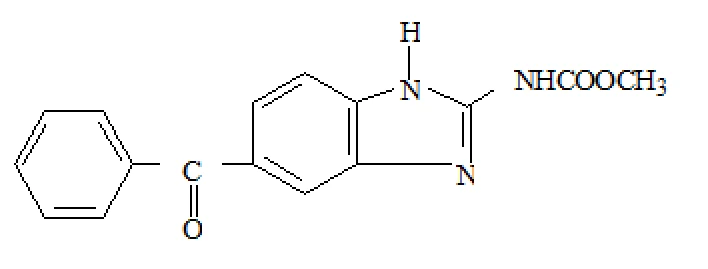
Molecular Formula: C16H13N3O3
Molecular Weight: 295.30
Description: Mebendazole is an off-white to slightly yellow powder which is insoluble in water and common organic solvents but is freely soluble in formic acid. The melting point of mebendazole is 288.5°C.
14 CLINICAL TRIALS
14.1 Clinical Trials by Indication
The clinical trial data on which the indication was originally authorized is not available.
15 MICROBIOLOGY
In vitro and in vivo studies indicate that mebendazole inhibits larval development for the eggs of Trichuris trichiura and hookworms. In vivo efficacy has been demonstrated against Trichuris, Ascaris, hookworm, Enterobius, Strongyloides, Taenia, and Lymenolipos. Mebendazole acts locally in the lumen of the gut by interfering with cellular tubulin formation in the intestines of worms. Mebendazole binds specifically to tubulin and causes ultrastructural degenerative changes in the intestine. As a result, the glucose uptake and the digestive functions of the worm are disrupted to such an extent that an autolytic process occurs.
16 NON-CLINICAL TOXICOLOGY
General Toxicology:
Acute
Acute oral toxicity of mebendazole has been investigated in 12 animal species. The single-dose toxicity evaluations in multiple species revealed that mebendazole was well tolerated and has a large margin of safety. The only side effects observed were transient softening of the feces and, occasionally, diarrhea. In LD50 studies, single oral doses up to 1280 mg/kg in mice, rats, guinea pigs, and pheasants; 1000 mg/kg in chickens and cats; 640 mg/kg in rabbits and dogs; 400 mg/kg in horses; 320 mg/kg in sheep; 80 mg/kg in cattle; and 20 mg/kg in pigs produced no deaths.
Chronic
The chronic oral toxicity of mebendazole has been investigated in horses, sheep, chickens, guinea fowl, rats, dogs, pigs, and pheasants. In these studies, the oral administration of mebendazole to dogs at doses up to 40 mg/kg once daily for 13 weeks; to horses at doses up to 6 g/250 lb once daily for 15 days; to sheep at doses of 60 mg/kg once daily for 5 days; to pheasants at doses of 125 ppm for 63 days; and to guinea fowl at doses up to 120 ppm for 10 days did not cause any significant side effects as observed by clinical examination, clinical pathology, gross pathology, or histopathology. However, in dogs the liver weight was increased for all treated animals and some showed hyaline degeneration.
Doses ranging from 23 mg/kg once daily for 74 days to 51 mg/kg once daily for 66 days to horses failed to produce any overt clinical effects or significant changes in the hematological and biochemical parameters examined. In the pig, doses of 63 ppm once daily in food for 92 days produced diarrhea but no other drug-related changes. In chickens, 125 ppm for one month was considered the upper level of safe medication: higher doses markedly reduced both rate of lay and hatchability. In the rat, histological studies revealed a chronic stimulation of the hepatocytes at 160 mg/kg given once daily for 13 weeks. At 160 mg/kg, the testes of the rat had deficient tubules and impaired spermatogenesis. The upper limits of safe treatment of rats appeared to be 40 mg/kg for at least nine months and 160 mg/kg for six weeks.
In controlled safety studies, humans have received from 100 to 1200 mg of mebendazole daily for up to 14 days with no reported side effects.
No carcinogenic effects were observed in the mouse or rat. No mutagenic activity was shown in in vitro gene-mutagenicity studies. In vivo tests revealed no structural chromosome damaging activity. Micronucleus test results have shown aneugenic effects in mammalian somatic cells above a threshold plasma concentration of 115 ng/mL.
Reproductive and Developmental Toxicology:
The effect of mebendazole on reproduction has been determined in various animal species. Included in these studies were determinations on potential embryotoxicity and teratogenicity in rats, rabbits, dogs, sheep, and horses; and male and female fertility in rats.
These studies show that mebendazole is embryotoxic and teratogenic in rats at 40 mg/kg given daily from Days 6 to 15 of pregnancy or at 10 mg/kg given on the tenth day of pregnancy. Effects observed with other species were inconclusive regarding teratogenicity and embryotoxicity.