


Product Monograph - Vyepti
Recent Major Label Changes
None at time of the most recent authorization
Table of Contents
Certain sections or subsections that are not applicable at the time of the preparation of the most recent authorized product monograph are not listed.
Recent Major Label Changes .................................................................................................... 2
Table of Contents .................................................................................................................... 2
Part 1: Healthcare Professional Information ............................................................................ 4
- 1.
Indications ................................................................................................................... 4
1.1 Pediatrics ............................................................................................................... 4
1.2 Geriatrics ............................................................................................................... 4
- 2. Contraindications ......................................................................................................... 4
- 4.
Dosage and Administration .......................................................................................... 4
4.1 Dosing Considerations ........................................................................................... 4
4.2 Recommended Dose and Dosage Adjustment ...................................................... 4
4.3 Reconstitution ....................................................................................................... 5
4.4 Administration ....................................................................................................... 5
4.5 Missed Dose .......................................................................................................... 6
- 5. Overdose...................................................................................................................... 6
- 6. Dosage Forms, Strengths, Composition, and Packaging ................................................ 6
- 7.
Warnings and Precautions ............................................................................................ 7
Cardiovascular ................................................................................................................... 7
Endocrine and Metabolism ............................................................................................... 7
Hepatic/Biliary/Pancreatic ................................................................................................ 7
Immune ............................................................................................................................. 7
Neurologic ......................................................................................................................... 7
Renal ................................................................................................................................. 8
Reproductive Health ......................................................................................................... 8
7.1 Special Populations ................................................................................................ 8
7.1.1. Pregnancy .......................................................................................................... 8
7.1.2. Breastfeeding .................................................................................................... 8
7.1.3. Pediatrics ........................................................................................................... 8
7.1.4. Geriatrics ........................................................................................................... 8
- 8.
Adverse Reactions ........................................................................................................ 8
8.1 Adverse Reaction Overview ................................................................................... 8
8.2 Clinical Trial Adverse Reactions ............................................................................. 9
8.3 Less Common Clinical Trial Adverse Reactions .................................................... 11
8.4 Abnormal Laboratory Findings: Hematologic, Clinical Chemistry, and Other Quantitative Data ............................................................................................................ 11
8.5 Post-Market Adverse Reactions .......................................................................... 11
- 9.
Drug Interactions ....................................................................................................... 11
9.2 Drug Interactions Overview ................................................................................. 11
9.3 Drug-Behaviour Interactions ............................................................................... 12
9.4 Drug-Drug Interactions ........................................................................................ 12
9.5 Drug-Food Interactions ........................................................................................ 12
9.6 Drug-Herb Interactions ........................................................................................ 12
9.7 Drug-Laboratory Test Interactions ....................................................................... 12
- 10.
Clinical Pharmacology ................................................................................................ 12
10.1 Mechanism of Action ........................................................................................... 12
10.2 Pharmacodynamics ............................................................................................. 12
10.3 Pharmacokinetics ................................................................................................ 13
10.4 Immunogenicity ................................................................................................... 13
- 11. Storage, Stability, and Disposal .................................................................................. 14
- 12. Special Handling Instructions ..................................................................................... 14
Part 2: Scientific Information ................................................................................................. 15
- 13. Pharmaceutical Information ....................................................................................... 15
- 14.
Clinical Trials .............................................................................................................. 15
14.1 Clinical Trials by Indication .................................................................................. 15
14.2 Comparative Bioavailability Studies..................................................................... 20
- 15. Microbiology .............................................................................................................. 20
- 16. Non-Clinical Toxicology .............................................................................................. 20
Patient Medication Information ............................................................................................ 22
Part 1: Healthcare Professional Information
1. Indications
VYEPTI (eptinezumab for injection) is indicated for:
- the prevention of migraine in adults who have at least 4 migraine days per month.
VYEPTI should be prescribed by healthcare professionals experienced in the diagnosis and treatment of migraine.
1.1 Pediatrics
Pediatrics (< 18 years of age): No data are available in the pediatric population (< 18 years of age); therefore, VYEPTI is not authorized for pediatric use.
1.2 Geriatrics
Geriatrics (≥ 65 years of age): The safety and efficacy of VYEPTI has not been established in patients aged 65 or older. The clinical study program of VYEPTI did not include sufficient numbers of patients aged 65 and over to determine whether they respond differently from younger patients (see 7.1.4 Warnings and Precautions, Special Populations, Geriatrics).
2. Contraindications
- In patients who are hypersensitive to eptinezumab or to any ingredient in the formulation, including any non-medicinal ingredient, or component of the container (For a complete listing, see 6 Dosage Forms, Strengths, Composition, and Packaging and 7. Warnings and Precautions, Patients with hereditary fructose intolerance).
4. Dosage and Administration
4.1 Dosing Considerations
- VYEPTI should be administered as an intravenous infusion only.
- VYEPTI requires dilution prior to administration (see 4.3 Dosage and Administration, Reconstitution)
4.2 Recommended Dose and Dosage Adjustment
- The recommended dose is 100 mg administered by intravenous infusion every 12 weeks. Some patients may benefit from a dosage of 300 mg administered by intravenous infusion every 12 weeks (see 14.1 Clinical Trials by Indication, Study results).
- The need for dose escalation should be assessed within 12 weeks after initiation of the treatment.
- When switching dosage options, the first dose of the new regimen should be given on the next scheduled dosing date of the prior regimen.
- The treatment benefit should be assessed 3-6 months after initiation of the treatment.
- Any further decision to continue the treatment should be made on an individual patient basis and determined prior to each dose (see 14 Clinical Trials).
- VYEPTI is not authorized for pediatric use (see 1.1 Indications, Pediatrics).
4.3 Reconstitution
Parenteral Products:
Each vial of VYEPTI is intended for single use only.
Preparation instructions:
Use appropriate aseptic technique when preparing VYEPTI solution for intravenous infusion. The product contains no preservative and is intended for single use only.
VYEPTI is a sterile, clear to slightly opalescent, colourless to brownish-yellow solution. Prior to dilution, the solution in the vial(s) should be inspected visually; do not use if the solution contains visible particulate matter or is cloudy or discoloured (other than clear to slightly opalescent, colourless to brownish-yellow).
For both the 100 mg and the 300 mg dose, a 100 mL bag of 0.9% sodium chloride for injection should be used to prepare the VYEPTI infusion solution as described below. No other intravenous diluents or volumes may be used to prepare the VYEPTI infusion solution.
Gently invert the solution to mix completely. Do not shake.
Following dilution, the infusion solution must be infused within 8 hours. During this time, the infusion solution may be stored at room temperature or refrigerated at 2°C to 8°C. If stored at 2°C to 8°C, allow the solution to warm to room temperature prior to infusion. DO NOT FREEZE (see 11 Storage, Stability and Disposal).
100 mg dose:
To prepare the solution, withdraw 1.0 mL of VYEPTI from one single-use 100 mg vial using a sterile needle and syringe. Inject the 1.0 mL (100 mg) content into a 100 mL bag of 0.9% sodium chloride for injection.
300 mg dose:
To prepare the solution, withdraw 1.0 mL of VYEPTI from each of 3 single-use 100 mg vials or 3.0 mL of VYEPTI from one single-use 300 mg vial using a sterile needle and syringe. Inject the resulting 3.0 mL (300 mg) content into a 100 mL bag of 0.9% sodium chloride for injection.
4.4 Administration
VYEPTI is for intravenous infusion only.
VYEPTI requires dilution prior to administration (see 4.3 Dosage and Administration, Reconstitution).
VYEPTI must be administered by a healthcare professional.
Infusion administration instructions:
Parenteral drug products should be inspected visually for particulate matter and discoloration prior to administration, whenever solution and container permit. Do not use if the liquid contains visible particulate matter or is cloudy or discolored (see 6 Dosage Forms, Strengths, Composition, and Packaging).
No other medications should be administered through the infusion set or mixed with VYEPTI.
Do not administer VYEPTI as an intravenous bolus injection.
Use an intravenous infusion set with a 0.2 or 0.22 μm in-line or add-on filter. After the infusion is complete, flush the line with 20 mL of 0.9% sodium chloride for injection (see 4.3 Dosage and Administration, Reconstitution).
Following dilution of the vial contents in a 100 mL bag of 0.9% sodium chloride for injection (see 4.3 Dosage and Administration, Reconstitution), infuse VYEPTI 100 mg dose or VYEPTI 300 mg dose as prescribed over approximately 30 minutes.
4.5 Missed Dose
In case of a missed dose, resume the regular dosing schedule as soon as possible.
5. Overdose
There has been no experience of overdose with eptinezumab. Doses up to 1000 mg have been administered intravenously to humans without tolerability issues or clinically significant adverse reactions.
In the event of an overdose, it is recommended that the patient should be monitored for any signs or symptoms of adverse reactions and appropriate supportive treatment be available for institution immediately if needed.
For the most recent information in the management of a suspected drug overdose, contact your regional poison control centre or Health Canada’s toll-free number, 1-844 POISON-X (1-844-764-7669).
- 6. Dosage Forms, Strengths, Composition, and Packaging
Table 1 – Dosage Forms, Strengths, and Composition
VYEPTI is a clear to slightly opalescent, colourless to brownish-yellow, sterile, preservative-free concentrate to be diluted in a 100 mL bag of 0.9% sodium chloride for injection prior to infusion.
Each single-use glass vial contains either:
- 100 mg of eptinezumab in 1 mL solution
- 300 mg of eptinezumab in 3 mL solution
Each carton contains one vial.
To help ensure the traceability of biologic products, health professionals should recognise the importance of recording both the brand name and the non-proprietary (active ingredient) name as well as other product-specific identifiers such as the Drug Identification Number (DIN) and the batch/lot number of the product supplied.
| Route of Administration | Dosage Form / Strength/Composition | Non-medicinal Ingredients |
| Intravenous infusion | 100 mg/1 mL solution in a single use vial 300 mg/3 mL solution in a single use vial | L-histidine, L-histidine monohydrochloride, polysorbate 80, sorbitol and water for injection |
7. Warnings and Precautions
Cardiovascular
Patients with Cardiovascular Diseases
No safety data are available in these populations. Patients with a known history or evidence of arteriosclerosis, cardiomyopathy, coronary artery disease, serious heart rhythm abnormalities, hypertension, cerebrovascular disease, Raynaud’s disease, and/ or any active, progressive or unstable cardiovascular disorder were excluded from the clinical trials (see 14 Clinical Trials).
Endocrine and Metabolism
Patients with diabetes or morbid obesity
Patients with a known history or evidence of diabetes were excluded from the clinical trials. (see 14 Clinical Trials). Limited safety data are available in patients with morbid obesity.
Patients with hereditary fructose intolerance (HFI)
This medicinal product contains 40.5 mg of sorbitol in each mL. Patients with hereditary fructose intolerance (HFI) must not be given this medicinal product unless strictly necessary.
A detailed history with regard to HFI symptoms has to be taken of each patient prior to being given this medicinal product.
Hepatic/Biliary/Pancreatic
Hepatic Insufficiency
No dedicated hepatic studies were conducted to assess the effects of hepatic impairment upon the pharmacokinetics of eptinezumab (see 10.3 Clinical Pharmacology, Pharmacokinetics).
Patients with HIV, Hepatitis B and C
No safety data are available in these populations. Patients with a known history or screened positive for any of these infections were excluded from the clinical trials.
Immune
Serious Hypersensitivity
Serious hypersensitivity reactions, including angioedema, urticaria, rash and anaphylactic reactions have been reported with the CGRP- class products including VYEPTI. These reactions may develop within minutes of the infusion. If a serious hypersensitivity reaction occurs, administration of VYEPTI should be discontinued immediately and appropriate therapy initiated.
Patients with autoimmune disorder
Patients with a known history or evidence of autoimmune disorder were excluded from the clinical trials (see 14 Clinical Trials)
Neurologic
Patients with neurological disorder
Patients with a known history or evidence of any active, progressive or unstable neurological disorder were excluded from the clinical trials (see 14 Clinical Trials).
Renal
Renal Insufficiency
No dedicated renal impairment studies were conducted to assess the effects of renal impairment upon the pharmacokinetics of eptinezumab (see 10.3 Clinical Pharmacology, Pharmacokinetics).
Reproductive Health
- Fertility
The effect of eptinezumab on human fertility has not been evaluated.
7.1 Special Populations
7.1.1. Pregnancy
There is a very limited amount of data from the use of eptinezumab in pregnant women. Animal studies do not indicate direct or indirect harmful effects with respect to reproductive toxicity (see 16 Non-Clinical Toxicology). Human IgG is known to cross the placental barrier; therefore, eptinezumab may be transmitted from the mother to the developing fetus.
Eptinezumab has a half-life of approximately 29 days (see 10 Clinical Pharmacology). This should be taken into consideration for women who are pregnant or plan to become pregnant while using VYEPTI (see 16 Non-Clinical Toxicology).
VYEPTI should not be used by pregnant women unless the expected benefit to the mother justifies the potential risk to the fetus.
7.1.2. Breastfeeding
There are no data on the presence of eptinezumab in human milk, the effects on the breastfed infant, or the effects on milk production. Human IgG is known to be excreted in breast milk; therefore, eptinezumab may be transmitted from the mother to the breastfed infant. The developmental and health benefits of breastfeeding should be considered along with the mother’s clinical need for VYEPTI and any potential adverse effects on the breastfed infant.
7.1.3. Pediatrics
Pediatrics (< 18 years of age): No data are available in the pediatric population (< 18 years of age); therefore, VYEPTI is not authorized for pediatric use.
7.1.4. Geriatrics
The clinical study program of VYEPTI did not include sufficient numbers of patients aged 65 and over to determine whether they respond differently from younger patients.
8. Adverse Reactions
8.1 Adverse Reaction Overview
The safety of VYEPTI has been evaluated in more than 2,000 patients with migraine who received at least one dose of VYEPTI, representing more than 1,600 patient-years of exposure; of these, approximately 1,500 patients were exposed to 100 mg or 300 mg. Across all doses, 1872 patients were exposed for at least 24 weeks and 991 patients were exposed for 48 weeks. Approximately 86% were female and the mean age was 40.4 years at study entry.
Patients with a history of cardiovascular disease (hypertension, ischemic heart disease), neurological disease, cerebrovascular disease, morbid obesity and diabetes, alcohol/drug abuse, and severe mental disorders were excluded from clinical studies.
The most common adverse reactions in the placebo-controlled clinical studies (PROMISE 1 and PROMISE 2) for the preventive treatment of migraine were nasopharyngitis and hypersensitivity (see Table 2).
Table 2: Adverse Reactions Reported with VYEPTI-treated Patients (and More Frequently than in Patients Receiving Placebo) by System Organ Class and Preferred Term
| System Organ Class/ Preferred Term | VYEPTI 100 mg every 12 weeks N=579 n (%) | VYEPTI 300 mg every 12 weeks N=574 n (%) | Placebo N=588 n (%) | |||
| Infections and Infestations | ||||||
| Nasopharyngitis | 36 (6.2) | 47 (8.2) | 34 (5.8) | |||
| Immune System Disorders | ||||||
| Hypersensitivity reactions | 15 (2.6) | 22 (3.8) | 7 (1.2) | |||
8.2 Clinical Trial Adverse Reactions
Clinical trials are conducted under very specific conditions. Therefore, the frequencies of adverse reactions observed in the clinical trials may not reflect frequencies observed in clinical practice and should not be compared to frequencies reported in clinical trials of another drug.
In the placebo-controlled pivotal clinical studies (PROMISE 1 and PROMISE 2) of 1,372 patients, 579 patients received at least one dose of VYEPTI 100 mg, 574 patients received at least one dose of VYEPTI 300 mg, and 588 patients received placebo during 24 weeks or 48 weeks of double-blind treatment.
In the pivotal studies, the following adverse events in Table 3 were observed to occur at or above 1% and greater than placebo during the double-blind treatment phase.
Table 3: Incidence of Treatment-emergent Adverse Events in ≥ 1 % of patients with Episodic Migraine and Chronic Migraine in either eptinezumab group (100 mg or 300 mg) and equal or greater than placebo
| System organ class/preferred term | Eptinezumab 100 mg N= 579 n (%) | Eptinezumab 300 mg N= 574 n (%) | Placebo N= 588 n (%) | ||||
|---|---|---|---|---|---|---|---|
| Ear and labyrinth disorders | |||||||
| Vertigo | 6 (1.0) | 2 (0.3) | 6 (1.0) | ||||
| Gastrointestinal disorders | |||||||
| Constipation | 4 (0.7) | 7 (1.2) | 2 (0.3) | ||||
| Diarrhoea | 6 (1.0) | 11 (1.9) | 4 (0.7) | ||||
| Nausea | 11 (1.9) | 17 (3.0) | 15 (2.6) | ||||
| Vomiting | 4 (0.7) | 9 (1.6) | 7 (1.2) | ||||
| General Disorders and administration site conditions | |||||||
| Fatigue | 16 (2.8) | 14 (2.4) | 8 (1.4) | ||||
| Hepatobiliary disorders | |||||||
| Cholelithiasis | 6 (1.0) | 1 (0.2) | 0 | ||||
| Immune system disorders | |||||||
| Hypersensitivity | 1 (0.2) | 8 (1.4) | 0 | ||||
| Infections and infestations | |||||||
| Gastroenteritis | 6 (1.0) | 5 (0.9) | 5 (0.9) | ||||
| Gastroenteritis viral | 7 (1.2) | 5 (0.9) | 5 (0.9) | ||||
| Influenza | 5 (0.9) | 18 (3.1) | 14 (2.4) | ||||
| Nasopharyngitis | 36 (6.2) | 47 (8.2) | 34 (5.8) | ||||
| Upper respiratory tract infection | 37 (6.4) | 42 (7.3) | 36 (6.1) | ||||
| Urinary tract infection | 11 (1.9) | 16 (2.8) | 9 (1.5) | ||||
| Injury, poisoning and procedural complications | |||||||
| Muscle strain | 6 (1.0) | 2 (0.3) | 2 (0.3) | ||||
| Investigations | |||||||
| Blood pressure increased | 6 (1.0) | 3 (0.5) | 4 (0.7) | ||||
| Weight increased | 7 (1.2) | 3 (0.5) | 2 (0.3) | ||||
| Musculoskeletal and connective tissue disorders | |||||||
| Arthralgia | 10 (1.7) | 14 (2.4) | 9 (1.5) | ||||
| Back pain | 14 (2.4) | 9 (1.6) | 13 (2.2) | ||||
| Nervous system disorders | |||||||
| Dizziness | 15 (2.6) | 13 (2.3) | 12 (2.0) | ||||
| Psychiatric disorders | |||||||
| Anxiety | 7 (1.2) | 7 (1.2) | 2 (0.3) | ||||
| Depression | 6 (1.0) | 8 (1.4) | 6 (1.0) | ||||
| Insomnia | 5 (0.9) | 8 (1.4) | 7 (1.2) | ||||
| Respiratory, thoracic and mediastinal disorders | |||||||
| Cough | 10 (1.7) | 12 (2.1) | 7 (1.2) | ||||
| Oropharyngeal pain | 6 (1.0) | 6 (1.0) | 3 (0.5) | ||||
| Rhinorrhoea | 7 (1.2) | 4 (0.7) | 0 | ||||
| Skin and subcutaneous tissue disorders | |||||||
| Rash | 1 (0.2) | 7 (1.2) | 3 (0.5) | ||||
Nasopharyngitis
Nasopharyngitis was most frequent after the first dose of VYEPTI at any dose. The incidence decreased with subsequent doses and was stable thereafter.
Infusion site reactions
Infusion site-related adverse events occurred infrequently and in similar proportions of VYEPTI and placebo patients (< 2%) with no apparent relationship to VYEPTI dose. The most frequently occurring infusion-site related adverse event was infusion site extravasation, which occurred in < 1 % of VYEPTI and placebo patients in pivotal trials. Other infusion site reactions include infusion site rash and infusion site pain.
Hypersensitivity and infusion-related reactions
Approximately 4% of patients on 300 mg, 3% of patients on 100 mg and 1% of patients on placebo in PROMISE 1 and PROMISE 2 experienced hypersensitivity reactions. The reactions were reported with multiple related adverse event terms, such as hypersensitivity, angioedema, urticaria, flushing/hot flush, rash and pruritus.
Serious hypersensitivity reactions, including anaphylactic reactions, have been reported in other trials and may develop within minutes of the infusion. The reported anaphylactic reactions have included symptoms of hypotension and respiratory difficulties, and have led to discontinuation of VYEPTI (See 7 Warnings and Precautions, Serious Hypersensitivity).
Other symptoms reported in association with eptinezumab infusion include respiratory symptoms (nasal congestion, rhinorrhea, throat irritation, cough, sneezing, dyspnea) and fatigue.
8.3 Less Common Clinical Trial Adverse Reactions
From all placebo-controlled clinical trials with VYEPTI in adult patients with migraine, the following less common adverse events of <1% have been observed. Causality related to treatment with VYEPTI has not been established.
Eye disorders: vision blurred
Gastrointestinal disorders: dry mouth
General disorders and administration site conditions: asthenia
Metabolism and nutrition disorders: decreased appetite
Nervous system disorders: migraine, lethargy, memory impairment
Psychiatric disorders: abnormal dreams
Reproductive system and breast disorders: menorrhagia
Respiratory, thoracic and mediastinal disorders: nasal congestion, asthma
Skin and subcutaneous tissue disorders: pruritus generalized
8.4 Abnormal Laboratory Findings: Hematologic, Clinical Chemistry, and Other Quantitative Data
No data available
8.5 Post-Market Adverse Reactions
The following adverse event has been identified during post-approval use of VYEPTI. This event is reported voluntarily from a population of uncertain size, and it is not possible to reliably estimate its frequency or establish a causal relationship to drug exposure.
Immune system disorders: Anaphylactic reaction
9. Drug Interactions
9.2 Drug Interactions Overview
Eptinezumab is not metabolized by cytochrome P450 enzymes. Therefore, interactions by eptinezumab with concomitant medications that are substrates, inducers, or inhibitors of cytochrome P450 enzymes are considered unlikely.
9.3 Drug-Behaviour Interactions
Not available.
9.4 Drug-Drug Interactions
The drugs listed are based on either drug interaction case reports or studies, or potential interactions due to the expected magnitude and seriousness of the interaction (i.e., those identified as contraindicated).
Table 4 - Established or Potential Drug-Drug Interactions
| Eptinezumab | Source of Evidence | Effect | Clinical comment |
| Sumatriptan | CT | The co-administration of a single dose of 300 mg eptinezumab in combination with a single dose of 6 mg sumatriptan administered subcutaneously did not alter the pharmacokinetics of eptinezumab or sumatriptan in healthy participants |
Legend: C = Case Study; CT = Clinical Trial; T = Theoretical
Interactions with other drugs have not been studied.
9.5 Drug-Food Interactions
Not relevant as VYEPTI is administered intravenously.
9.6 Drug-Herb Interactions
Interactions with herbal products have not been established.
9.7 Drug-Laboratory Test Interactions
Interactions with laboratory tests have not been established.
10. Clinical Pharmacology
10.1 Mechanism of Action
Eptinezumab is a humanized immunoglobulin G1 (IgG1) antibody that binds to human calcitonin gene-related peptide (CGRP) ligand with picomolar affinity and blocks its binding to the CGRP receptors.
Eptinezumab is highly selective and does not bind to any of the related neuropeptides amylin, calcitonin, adrenomedullin and intermedin.
10.2 Pharmacodynamics
The relationship between the pharmacodynamic activity and the mechanism(s) by which eptinezumab exerts its clinical effects is unknown.
10.3 Pharmacokinetics
Eptinezumab exhibits linear pharmacokinetics and exposure increases proportionally with intravenous doses from 100 to 300 mg.
Following the dose regimens of 100 mg and 300 mg every 12 weeks, steady-state was attained within 24 weeks. The mean accumulation ratios based on Cmax and AUC0-tau are 1.08 and 1.15, respectively, based on a population pharmacokinetics analysis. Pharmacokinetic exposure parameter values for eptinezumab are included in Table 5. The steady-state AUC0- tau of eptinezumab was estimated to be 52% lower in a 190 kg patient (heaviest patient in clinical trials) and 51% higher in a 39 kg patient (lightest patient in clinical trials) compared to a 70 kg patient.
Table 5: Summary of Pharmacokinetic Parameters of Eptinezumab at Steady State
| Pharmacokinetic Parameters | Eptinezumab 100 mg every 12 weeks | Eptinezumab 300 mg every 12 weeks |
|---|---|---|
| Cmaxa, mean (SD) b | 40.9 (10.9) µg/mL | 125 (36.5) µg/mL |
| AUC0-tauc, mean (SD)b | 867 (278) day∙µg/mL | 2629 (791) day∙µg/mL |
a Cmax = the maximum concentration
b SD = Standard deviation
c AUC0-tau = area under the concentration-time curve during a dosing interval (12 weeks) following 30 to 60-minute IV infusion
Absorption
Eptinezumab is administered by intravenous infusion which bypasses extravascular absorption and is 100% bioavailable. Median time to peak concentration was attained at the end of infusion (30 minutes).
Distribution
The volume of distribution for eptinezumab was approximately 4.8 L in chronic migraine and episodic migraine patients, based on a population pharmacokinetics analysis.
Metabolism
Eptinezumab is expected to be degraded by proteolytic enzymes into small peptides and amino acids.
Elimination
The systemic clearance was 0.12 L/day (CV 34%), and the terminal elimination half-life was approximately 29 days in chronic migraine and episodic migraine patients, based on a population pharmacokinetics analysis.
Special Populations and Conditions
The pharmacokinetics of eptinezumab were not significantly impacted by age, sex, or race based on a population pharmacokinetics analysis.
- Hepatic or Renal Insufficiency
No dedicated hepatic or renal impairment studies were conducted to assess the effects of hepatic and renal impairment upon the pharmacokinetics of eptinezumab. Population pharmacokinetic analysis revealed that hepatic or renal impairment did not have any significant impact on the pharmacokinetics of eptinezumab. Patients with severe renal impairment (creatinine clearance <30 mL/min) have not been studied.
10.4 Immunogenicity
There is a potential for immunogenicity with all therapeutic proteins.
The detection of antibody formation is highly dependent on the sensitivity and specificity of the assay. Additionally, the observed incidence of antibody (including neutralizing antibody) positivity in an assay may be influenced by several factors including assay methodology, sample handling, timing of sample collection, concomitant medications, and underlying disease. For these reasons, comparison of incidence of antibodies in the studies described below with the incidences of antibodies in other studies or to other products may be misleading.
In placebo-controlled pivotal clinical studies, PROMISE 1 (up to 56 weeks) and PROMISE 2 (up to 32 weeks), the incidence of anti-eptinezumab antibodies across both studies was 18% (105/579) and 20% (115/574) in patients receiving 100 mg and 300 mg every 12 weeks dosing, respectively. In both studies, the incidence of anti-eptinezumab antibodies peaked at Week 24. The incidence of neutralizing antibodies across both studies was 8.3% (48/579) and 6.1% (35/574) for the 100 mg and 300 mg treatment groups, respectively.
In an open-label study with 84 weeks of treatment of 300 mg eptinezumab every 12 weeks, 18% (23/128) of patients developed anti-eptinezumab antibodies with an overall incidence of neutralizing antibodies of 7% (9/128). Eptinezumab trough plasma concentrations appeared lower in patients who developed anti-eptinezumab antibodies.
There was no evidence of impact of anti-eptinezumab antibody development on efficacy or safety in the clinical studies.
- 11. Storage, Stability, and Disposal
Store refrigerated at 2°C to 8°C. Keep the vial(s) in the outer carton in order to protect from light.
If the vials are removed from the refrigerator, VYEPTI must be used within 7 days when stored in original carton at room temperature (up to 25°C) or discarded. If it is stored at a higher temperature or for a longer period, it must be discarded.
Do not freeze or shake.
Following dilution, VYEPTI solution (VYEPTI and 0.9% sodium chloride for injection) must be infused within 8 hours. During this time, the solution may be stored at room temperature or refrigerated at 2°C to 8°C. If stored at 2°C to 8°C, allow the solution to warm to room temperature prior to infusion.
Any unused medicinal product or waste material should be disposed.
12. Special Handling Instructions
Do not use if the solution contains visible particulate matter or is cloudy or discolored (other than clear to slightly opalescent, colorless to brownish-yellow).
No other IV diluents than 0.9% sodium chloride for injection (100 mL) may be used to prepare the VYEPTI solution.
Do not freeze or shake.
Part 2: Scientific Information
13. Pharmaceutical Information
Drug Substance
Non-proprietary name of the drug substance: Eptinezumab for injection
Chemical name: Immunoglobulin G1, anti-(calcitonin gene-related peptide) (human-Oryctolagus cuniculus monoclonal ALD403 heavy chain), disulfide with human-Oryctolagus cuniculus monoclonal ALD403 κ-chain, dimer.
Molecular mass: Eptinezumab has an approximate molecular mass of 143 kDa
Structural formula: Eptinezumab is an IgG1 kappa immunoglobin containing human constant region sequences. The light and heavy chain variable regions are comprised of both human and humanized rabbit sequences. Eptinezumab is composed of two heavy chains of 441 amino acids and two light chains of 219 amino acids.
Physicochemical properties: VYEPTI is supplied as a sterile, nonpyrogenic, preservative free aqueous solution of eptinezumab for intravenous administration after dilution. VYEPTI is clear to slightly opalescent, colorless to brownish-yellow colored solution with a pH of 5.8.
Product Characteristics : Eptinezumab is a humanized monoclonal immunoglobulin G1 (IgG1) antibody directed against the human α-and β-forms of calcitonin gene-related peptide (produced in a yeast-based (Pichia pastoris) or a Chinese hamster ovary (CHO) cell-based expression system).
14. Clinical Trials
14.1 Clinical Trials by Indication
- VYEPTI was evaluated for the prevention of migraine in two pivotal studies (Table 6): PROMISE 1 was conducted in patients with episodic migraine (n=888) and PROMISE 2 in patients with chronic migraine (n=1072). Both studies excluded patients with a known history of cardiovascular disease (hypertension, ischemic heart disease), neurological disease, cerebrovascular disease, autoimmune disease, diabetes, Raynaud’s disease, and life-threatening allergy (e.g., anaphylaxis), and morbid obesity (in PROMISE 2 only).
Table 6: Summary of Trial Design and Patient Demographics for Clinical Trials in Migraine Prevention
| Study | Study design | Dosage, route of administration and duration of study | Study subjects (n) | Mean age (Range) | Sex |
| PROMISE 1 | Parallel group, double-blind, placebo-controlled global trial Efficacy and safety in episodic migraine prevention | 30 mg, 100 mg, or 300 mg Intravenous infusion 24 weeks double-blind treatment period a | Total = 888 Placebo = 222 30 mg = 223 100 mg = 221 300 mg = 222 | 40 years (18 to 71) | Female: 84% Male: 16% |
| PROMISE 2 | Parallel group, double-blind, placebo-controlled global trial Efficacy and safety in chronic migraine prevention | 100 mg or 300 mg Intravenous infusion 12 weeks double-blind treatment period b | Total = 1072 Placebo = 366 100 mg = 356 300 mg = 350 | 41 years (18 to 65) | Female: 88% Male: 12% |
a The total duration of the study was 56 weeks, including a 48-week placebo-controlled treatment period and a safety follow-up after the last infusion at week 36.
b The total duration of the study was 32 weeks, including a 24-week placebo-controlled treatment period and a safety follow-up after the last infusion at week 12.
VYEPTI was also evaluated in an efficacy and safety study (DELIVER) in episodic (n=535) and chronic (n=355) migraine patients with documented failure to two to four migraine preventive treatments, which included a 24-week double-blind, placebo-controlled treatment period.
Study Results
Episodic Migraine
PROMISE 1 was a parallel group, double-blind, placebo-controlled global trial to evaluate the efficacy and safety of VYEPTI for the preventive treatment of episodic migraine (defined as ≥4 and ≤14 headache days of which at least 4 had to be migraine days during the 28-day screening period) in adults. A total of 888 patients were randomized (1:1:1:1) to receive placebo (N=222), 30 mg eptinezumab (N=223), 100 mg eptinezumab (N=221), or 300 mg eptinezumab (N=222) every 12 weeks for 48 weeks (4 infusions). Patients were allowed to use concurrent acute migraine or headache medications, including migraine-specific medications (e.g., triptans, ergotamine derivatives), during the trial. Regular use (greater than 7 days per month) of other treatments for the prevention of migraine was not allowed. Overall, there were 856 patients (96.4%) with at least 1 acute concomitant headache medication and 41 patients (4.6%) with at least 1 prophylactic headache medication.
Headache information was captured daily throughout study participation using the electronic headache diary device. The primary efficacy endpoint was the change from baseline in mean monthly migraine days (MMD) over Weeks 1-12. The key secondary endpoints included migraine responder rates defined as the proportion of patients achieving ≥ 75% reduction in migraine days over Weeks 1-4 and 1-12.
Patients had a mean age of 40 years (range: 18 to 71 years), 84% were female, and 84% were white. The mean migraine frequency at baseline was 8.6 migraine days per month and was similar across treatment groups.
The results of the study are presented in Table 7.
Table 7: Primary and Key Secondary Efficacy Endpoint Results in PROMISE 1 (Episodic Migraine)
VYEPTI 100 mg N=221 | VYEPTI 300 mg N=222 | Placebo N=222 | ||||||||
|---|---|---|---|---|---|---|---|---|---|---|
| Reduction in Monthly Migraine Days (MMD) – Weeks 1-12b | ||||||||||
| Baselinea | 8.7 | 8.6 | 8.4 | |||||||
| Mean Change from baseline | -3.9 | -4.3 | -3.2 | |||||||
| Difference from placebo | -0.7 | -1.1 | ||||||||
| CI95% | (-1.3, -0.1) | (-1.7, -0.5) | ||||||||
| p-value vs placebo | 0.0182 | 0.0001 | ||||||||
| ≥ 75% MMD responders – Weeks 1-4c | ||||||||||
| Responders | 30.8% | 31.5% | 20.3% | |||||||
| Difference from placebo | 10.5% | 11.3% | ||||||||
| p-value vs placebo | 0.0112 | 0.0066 | ||||||||
a Baseline was the average over the 28-day screening period prior to receiving treatment
b The change from baseline in MMDs (Week 1-12) was analysed using ANCOVA with baseline MMDs as covariate and treatment as a fixed effect.
c For the 75% responders, eptinezumab was compared to placebo using the Cochran Mantel-Haenszel test, stratified by baseline MMDs (≤9 or >9).
Note: Type 1 error was controlled for all endpoints.
Chronic Migraine
PROMISE 2 was a parallel group, double-blind, placebo-controlled global trial to evaluate the efficacy and safety of VYEPTI for the preventive treatment of chronic migraine (defined as ≥ 15 to ≤ 26 headache days, of which ≥ 8 were assessed as migraine days) in adults. A total of 1,072 patients were randomized and received placebo (N=366), 100 mg eptinezumab (N=356), or 300 mg eptinezumab (N=350) every 12 weeks for 24 weeks (2 infusions). During the trial, patients were allowed to use an established stable regimen (except for onabotulinumtoxinA) of acute or preventive medication for migraine or headache. Patients using opioids or butalbital containing products > 4 days/month were excluded.
The primary efficacy endpoint was the change from baseline in mean monthly migraine days (MMD) over Weeks 1-12. The key secondary endpoints included the proportion of patients with 50% or greater and 75% or greater reductions from baseline in monthly migraine days over Weeks 1-12.
Patients had a mean age of 41 years (range: 18 to 65 years), 88% were female, and 91% were white. Forty-one percent of patients were taking concomitant preventive medication for migraine. The mean migraine frequency at baseline was 16.1 migraine days per month and was similar across treatment groups.
The results of the study are presented in Table 8.
Table 8: Primary and Key Secondary Efficacy Endpoint Results in PROMISE 2 (Chronic Migraine)
VYEPTI 100 mg N=356 | VYEPTI 300 mg N=350 | Placebo N=366 | |||||||
|---|---|---|---|---|---|---|---|---|---|
| Reduction in Monthly Migraine Days (MMD) – Weeks 1-12b | |||||||||
| Baselinea | 16.1 | 16.1 | 16.2 | ||||||
| Mean Change from baseline | -7.7 | -8.2 | -5.6 | ||||||
| Difference from placebo | -2.0 | -2.6 | |||||||
| CI95% | (-2.9, -1.2) | (-3.5, -1.7) | |||||||
| p-value vs placebo | < 0.0001 | < 0.0001 | |||||||
| ≥ 75% MMD responders – Weeks 1-12c | |||||||||
| Responders | 26.7% | 33.1% | 15.0% | ||||||
| Difference from placebo | 11.7% | 18.1% | |||||||
| p-value vs placebo | 0.0001 | < 0.0001 | |||||||
| ≥ 50% MMD responders – Weeks 1-12c | |||||||||
| Responders | 57.6% | 61.4% | 39.3% | ||||||
| Difference from placebo | 18.2% | 22.1% | |||||||
| p-value vs placebo | < 0.0001 | < 0.0001 | |||||||
a Baseline was the average over the 28-day screening period prior to receiving treatment
b The change from baseline in MMDs (Week 1-12) was analysed using ANCOVA with baseline MMDs as covariate and treatment and prophylactic medication use (Yes/No) as fixed effects.
c For the 75% and 50% responders, eptinezumab was compared to placebo using the Cochran-Mantel-Haenszel test, stratified by baseline MMDs (<17 or ≥17) and prophylactic medication use (Yes/No).
CI: Confidence Interval
Note: Type 1 error was controlled for all endpoints.
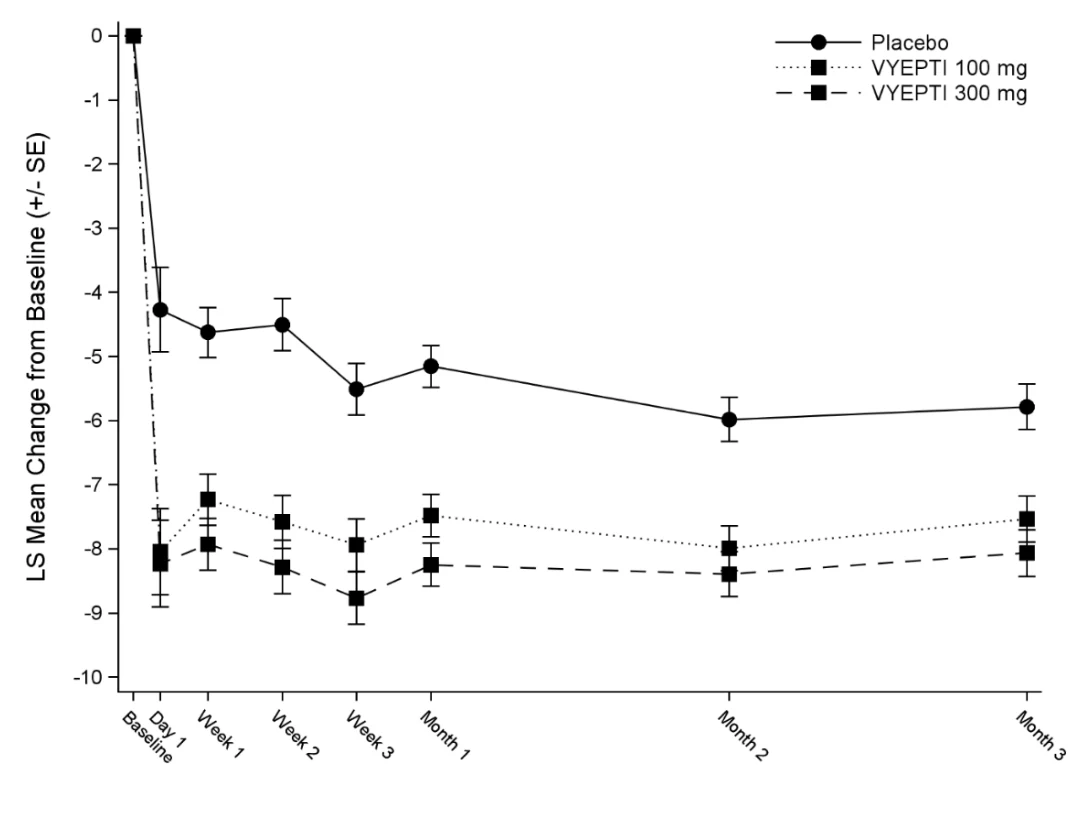
The results over Weeks 1-12, following one infusion of VYEPTI treatment are presented as change from baseline in mean MMDs (Figure 1). For both doses of VYEPTI, patients had greater mean decreases from baseline in MMDs at all timepoints through Week 12, compared to placebo-treated patients.
Figure 1: Mean Change from Baseline of MMDs, Day 1 After Infusion, and Weeks 1-12, PROMISE 2
A total of 431 patients (40%) with a dual diagnosis of chronic migraine and medication overuse headache (overuse of triptans, ergotamine, or combination analgesics > 10 days/month, or acetaminophen, acetylsalicylic acid, or non-steroidal anti-inflammatory drugs ≥ 15 days/month) were included in the study (eptinezumab 300 mg n=147, eptinezumab 100 mg n=139, and placebo n=145). The treatment difference observed between VYEPTI 100 mg and placebo and between VYEPTI 300 mg and placebo for the reduction of MMD in these patients were -3.0 days and -3.2 days, respectively.
Prevention of migraine in patients with prior preventive treatment failure
DELIVER was a parallel-group, double-blind, placebo-controlled efficacy and safety study of VYEPTI for the preventive treatment in episodic migraine (defined as migraine occurring on ≥4 days/ month and headache occurring on ≤14 days/month) and chronic migraine (defined as migraine occurring on ≥8 days/month and headache occurring on ≥ 15 days/month) in patients with two-to-four prior migraine preventive treatment failures. A total of 892 patients were randomized and efficacy analysis was based on 890 patients
(eptinezumab 300mg n=293, eptinezumab 100mg n=299, placebo n=298). During the trial, patients were allowed to use acute antimigraine medications.
Patients had a mean age of 44 years (range: 18 to 74 years), 90% were female, and 96% were white. Ninety-four percent of patients were taking concomitant preventive medication for migraine. The mean migraine frequency at baseline was 15 migraine days per month and it was similar across treatment groups.
The primary efficacy endpoint was the change from baseline in mean MMDs over Weeks 1-12. The key secondary endpoints included the proportion of patients with ≥50% and ≥75% reductions from baseline in MMDs over Weeks 1-12 and change from baseline in the number of MMDs over Weeks 13-24.
For the primary endpoint, the mean reductions in monthly migraine days (MMD) at Week 12 were -4.8 in the VYEPTI 100 mg group and -5.3 in the VYEPTI 300 mg group, compared to -2.1 in the placebo group, corresponding to a difference to placebo of -2.7 days (95% CI: -3.4, -2.0) and -3.2 days (95% CI: -3.9 to -2.5), respectively. For the key secondary endpoints, 16% of subjects in the VYEPTI 100 mg group and 19% of subjects in the VYEPTI 300 mg group achieved at least 75% reduction in MMDs at Week 12, compared to 2% of subjects in the placebo group, while 42% of subjects in the VYEPTI 100 mg group and 50% of subjects in the VYEPTI 300 mg group achieved at least a 50% reduction in MMDs at Week 12, compared to 13% of subjects in the placebo group. The mean reductions in MMDs over Week 13-24 were -5.4 in VYEPTI 100 mg group and -6.1 in the VYEPTI 300 mg group, compared to -2.4 in the placebo group.
14.2 Comparative Bioavailability Studies
Not applicable
15. Microbiology
No microbiological information is required for this drug product.
16. Non-Clinical Toxicology
General Toxicology
Eptinezumab was assessed for general toxicity in a 6-month repeat-dose toxicity study in cynomolgus monkeys. In that study, groups of male and female cynomolgus monkeys (n=3/sex/group) were administered 0 (vehicle only), 20, 50 or 150 mg/kg (10-, 43-, or 123-times greater than the maximum recommended human dose [MRHD] based on AUC) by IV bolus injection every two weeks for 6 months. A cohort (n=2/sex/group) was administered the same treatment and maintained as a recovery group for an additional 3 months following the main study. One low-dose female died shortly after administration of the sixth dose on study day 71. This death is considered a result of an ADA-mediated anaphylactic response. The no-observed-adverse-effect-level (NOAEL) was identified as the highest dose tested (150 mg/kg/dose).
Genotoxicity
Non-clinical studies have not been conducted to evaluate the genotoxic potential of eptinezumab.
Carcinogenicity
Non-clinical studies have not been conducted to evaluate the carcinogenic potential of eptinezumab.
Reproductive and Developmental Toxicology
In the fertility study, male and female rats were administered eptinezumab at doses of 0 (vehicle only), 75, or 150 mg/kg by IV injection once weekly during the pre-mating, mating, and gestation period (up to gestation day [GD] 4). No eptinezumab-related toxicity or effects on fertility and reproductive performance were observed. One female death was reported at a dose of 150 mg/kg from undetermined causes. The NOAEL was determined to be 150 mg/kg/dose (60-times greater than the human exposure based on body surface area).
In two embryo-fetal development studies, pregnant rats and rabbits administered eptinezumab at doses of 0 (vehicle only), 75, or 150 mg/kg by IV injection once weekly during the period of organogenesis (GD 6 to 18 in rats and GD 7 to 20 in rabbits). No maternal toxicity was reported. No fetal toxicity or teratogenicity were observed. The NOAEL was determined to be 150 mg/kg/dose (36- and 33-times greater than the MRHD based on Cmax for the rat and rabbit studies, respectively).
In the extended pre- and postnatal development study, pregnant rats were administered eptinezumab at doses of 0 (vehicle only), 75, or 150 mg/kg by IV injection once every 6 days from GD 6 until lactation day 20. No overt maternal toxicity was reported; however, one F0 female from the high-dose group died from undetermined causes. In utero exposure to eptinezumab did not affect F1 male and female development, sexual maturation, fertility, or reproductive performance. The NOAEL was determined to be 150 mg/kg/dose (60-times greater than the human exposure based on body surface area).