


Product Monograph - Xiaflex
SUMMARY PRODUCT INFORMATION
| Route of Administration | Dosage Form / Strength | Clinically Relevant Nonmedicinal Ingredients |
| Intralesional injection | Lyophilized powder for solution 0.9 mg/vial | None For a complete listing see Dosage Forms, Composition and Packaging section. |
DESCRIPTION
XIAFLEX® contains purified collagenase clostridium histolyticum, consisting of two microbial collagenases in a defined mass ratio, Collagenase AUX-I and Collagenase AUX-II, which are isolated and purified from the fermentation of Clostridium histolyticum bacteria. A collagenase is an enzyme that recognizes and binds to collagen in its native conformation and cleaves the peptide bonds resulting in collagen breakdown. Collagenase AUX-I is a single polypeptide chain consisting of approximately 1000 amino acids of known sequence. It has an observed molecular weight of 114 kiloDaltons (kDa). It belongs to the class I Clostridium histolyticum collagenases. Collagenase AUX-II is a single polypeptide chain consisting of approximately 1000 amino acids of known sequence. It has an observed molecular weight of 113 kDa. It belongs to the class II Clostridium histolyticum collagenases.
INDICATIONS AND CLINICAL USE
XIAFLEX (collagenase clostridium histolyticum) is indicated for:
- The treatment of adult patients with Dupuytren’s contracture with a palpable cord.
- The treatment of adult men with Peyronie’s disease with a palpable plaque and curvature deformity of at least 30 degrees at the start of therapy.
The safety and efficacy of XIAFLEX have not been established in patients with ventral plaques.
Geriatrics (> 65 years of age): Experience from clinical studies suggests that use in the geriatric population is associated with no overall differences in safety or effectiveness of XIAFLEX between these patients and younger patients.
Pediatrics (< 18 years of age): Safety and effectiveness of XIAFLEX in pediatric patients have not been established.
CONTRAINDICATIONS
Collagenase clostridium histolyticum is contraindicated in:
- Patients who are hypersensitive to this drug or to any ingredient in the formulation or component of the container. For a complete listing of the components, see the DOSAGE FORMS, COMPOSITION AND PACKAGING section of the product monograph.
- The treatment of Peyronie’s plaques that involve the penile urethra due to potential risk to this structure.
WARNINGS AND PRECAUTIONS
General
Tendon Rupture or Other Serious Injury to the Injected Extremity in the Treatment of Dupuytren’s Contracture
In the controlled and uncontrolled portions of the clinical trials, flexor tendon ruptures (3 patients) occurred after XIAFLEX (collagenase clostridium histolyticum) injection (see ADVERSE REACTIONS). Injection of XIAFLEX into collagen-containing structures such as tendons or ligaments of the hand may result in damage to those structures and possible injury such as tendon rupture or ligament damage, which could be permanent, or skin lacerations. Therefore, XIAFLEX should be injected only into the collagen cord with a MP or PIP joint contracture, and care should be taken to avoid injecting into tendons, nerves, blood vessels, or other collagen-containing structures of the hand. When injecting a cord affecting a PIP joint of the fifth finger, the needle insertion should not be more than 2 to 3 mm in depth and avoid injecting more than 4 mm distal to the palmar digital crease (see DOSAGE AND ADMINISTRATION).
Patients with Dupuytren’s contractures that adhere to the skin may be at higher risk of skin lesions as a result of the pharmacological effect of XIAFLEX and the finger extension procedure on the skin overlying the targeted cord.
Other XIAFLEX-associated serious local adverse reactions in the controlled and uncontrolled portions of the studies included, ligament injury/pulley rupture (1 patient), complex regional pain syndrome (1 patient), and sensory abnormality of the hand (1 patient).
Thirteen reports of skin tears requiring skin graft were reported in post-marketing use. Most occurred during the finger extension procedure. Care should be taken during release of contracture. Subjects who used anesthesia were more likely to experience injection site swelling, skin lacerations, and injection site pain. Subjects who did not use anesthesia were more likely to experience oedema peripheral and injection site pruritus (see DOSAGE AND ADMINISTRATION, Administration, Finger Extension Procedure, step b).
Corporal Rupture (Penile Fracture) or other Serious Injury to the Penis in the Treatment of Peyronie’s Disease
Corporal rupture was reported as an adverse reaction after XIAFLEX injections in 0.5% of XIAFLEX treated patients in the controlled and uncontrolled Phase 3 clinical trials in Peyronie’s Disease.
In other XIAFLEX-treated patients (0.9%), a combination of penile ecchymosis or hematoma, sudden penile detumescence, and/or a penile “popping” sound or sensation was reported, and in these cases, a diagnosis of corporal rupture cannot be excluded. These patients were managed without surgical intervention, but the long-term consequences are unknown.
Severe penile hematoma was also reported as an adverse reaction in 3.7% of patients in the controlled and uncontrolled clinical trials in Peyronie’s disease.
Signs or symptoms that may reflect serious injury to the penis should be promptly evaluated in order to assess for corporal rupture or sever penile hematoma, which may require surgical intervention.
Injection of XIAFLEX into collagen-containing structures such as the corpora cavernosa of the penis may results in damage to those structures and possible injury such as corporal rupture (penile fracture). Therefore, XIAFLEX should be injected only into the Peyronie’s plaque and care should be taken to avoid injection into the urethra, nerves, blood vessels, corpora cavernosa or other collagen-containing structures of the penis. XIAFLEX is not indicated for patients presenting with ventral plaques, due to the proximity of ventral plaques to the urethra.
Patients with Abnormal Coagulation
In the XIAFLEX trials in Dupuytren’s Contracture (Studies 1 and 2), ecchymosis/contusion and injection site hemorrhage were developed in XIAFLEX-treated patients at a significantly higher rate than placebo patients (70% and 38%, respectively).
In the XIAFLEX controlled trials in Peyronie’s disease (Studies 5 and 6), 75.7% of XIAFLEX-treated patients developed penile hematoma, and 35.8% developed penile ecchymosis.
The efficacy and safety of XIAFLEX in patients receiving anticoagulant medications (other than low-dose acetylsalicylic acid e.g., up to 150 mg per day) within 7 days prior to XIAFLEX administration is not known. Therefore, XIAFLEX should be used with caution in patients with coagulation disorders including patients receiving concomitant anticoagulants (except for low-dose acetylsalicylic acid).
Immune
Hypersensitivity Reactions, Including Anaphylaxis
In the controlled portions of the clinical trials in Dupuytren’s Contracture (Studies 1 and 2), a greater proportion of XIAFLEX-treated patients (15%) compared to placebo-treated patients (1%) had mild allergic reactions (pruritus) after up to 3 injections. The incidence of XIAFLEX-associated pruritus increased after more XIAFLEX injections in patients with Dupuytren’s contracture. In the supportive clinical studies, 3 patients experienced urticaria (localized hives) that resolved with antihistamine treatment. Two of these patients received additional injections of XIAFLEX without premedication and did not experience recurrence of urticaria.
Although there were no severe allergic reactions observed in the registration XIAFLEX studies for Dupuytren’s contracture (e.g., those associated with respiratory compromise, hypotension, or end-organ dysfunction), an anaphylactic reaction was reported following administration of two doses concurrently in one patient who had previous exposure to XIAFLEX for the treatment of Dupuytren’s contracture during a post-marketing clinical study, demonstrating that severe reactions, including anaphylaxis, can occur following XIAFLEX injections.
In the double-blind, placebo-controlled portions of the clinical trials in Peyronie’s disease (Studies 5 and 6), a greater proportion of XIAFLEX-treated patients (4.5%) compared to placebo-treated patients (0.4%) had localized pruritus after up to 4 treatment cycles (comprised of up to 8 XIAFLEX injection procedures). The incidence of XIAFLEX-associated pruritus was similar after each injection regardless of the number of injections administered.
Because XIAFLEX contains foreign proteins, severe allergic reactions to XIAFLEX can occur. Some patients with Dupuytren’s contracture developed anti-drug antibodies (anti-AUX-I and anti-AUX-II) after treatment with XIAFLEX, in greater proportions and higher titers with successive XIAFLEX injections. The dynamics of the immune response to the drug in the treatment of Peyronie’s disease was similar to that observed in Dupuytren’s contracture. Health professionals should be prepared to address severe allergic reactions following XIAFLEX injections (see ADVERSE REACTIONS, Immunogenicity).
Special Populations
Pregnant Women: There is no clinical data on the effects of XIAFLEX in pregnant women.
Patients develop anti-drug antibodies (ADAs) after repeated XIAFLEX administration, whose cross-reactivity with endogenous MMPs involved in pregnancy and labor cannot be excluded.
The use of XIAFLEX is not recommended in pregnancy and treatment should be postponed until after pregnancy.
Nursing Women: It is not known whether collagenase clostridium histolyticum is excreted in human milk. Because many drugs are excreted in human milk, caution should be exercised when XIAFLEX is administered to a nursing woman.
Geriatrics (> 65 years of age): Of the 249 XIAFLEX-treated patients in the double-blind, placebo-controlled, clinical trials in Dupuytren’s contracture (Studies 1 and 2), 42% were 65 years of age or older and 9% were 75 years of age or older. Of the 551 XIAFLEX-treated patients in the double-blind, placebo-controlled, clinical trials in Peyronie’s disease (Studies 5 and 6), 18% were 65 years of age or older and 0.9% were 75 years of age or older.
No overall differences in safety or effectiveness of XIAFLEX were observed between these patients and younger patients.
Pediatrics (< 18 years of age): Safety and effectiveness of XIAFLEX in pediatric patients have not been established.
ADVERSE REACTIONS
Dupuytren’s Contracture
Adverse Drug Reaction Overview in Dupuytren’s Contracture
The most frequently reported adverse drug reactions (≥ 25%) in the XIAFLEX (collagenase clostridium histolyticum) clinical trials in Dupuytren’s contracture included edema peripheral (mostly swelling of the injected hand), contusion, injection site hemorrhage, injection site reaction, and pain in the treated extremity.
Clinical Trial Adverse Drug Reactions in Dupuytren’s Contracture
Because clinical trials are conducted under very specific conditions the adverse reaction rates observed in the clinical trials may not reflect the rates observed in practice and should not be compared to the rates in the clinical trials of another drug. Adverse drug reaction information from clinical trials is useful for identifying drug-related adverse events and for approximating rates.
Out of 1082 patients who received 0.58 mg of XIAFLEX in the controlled and uncontrolled portions of the XIAFLEX studies in Dupuytren’s contracture (2630 XIAFLEX injections), 3 (0.3%) patients had a flexor tendon rupture of the treated finger within 7 days of the injection.
The data described below are based on two pooled randomized, double-blind, placebo-controlled trials through Day 90 in patients with Dupuytren’s contracture (Studies 1 and 2). In these trials, patients were treated with up to 3 injections of 0.58 mg of XIAFLEX or placebo with approximately 4-week intervals between injections and the patients had finger extension procedures the day after injection, if needed, to facilitate disruption of the cord (see CLINICAL TRIALS). These trials were comprised of 374 patients of whom 249 and 125 received 0.58 mg of XIAFLEX and placebo, respectively. The mean age was 63 years, 80% were male and 20% were female, and 100% were white.
In the placebo-controlled portions of Studies 1 and 2 through Day 90, 98% and 51% of XIAFLEX-treated and placebo-treated patients had an adverse reaction after up to 3 injections, respectively. Over 95% of XIAFLEX-treated patients in Dupuytren’s contracture had an adverse reaction of the injected extremity after up to 3 injections. Approximately 81% of these local reactions resolved without intervention within 4 weeks of XIAFLEX injections. The adverse reaction profile was similar for each injection, regardless of the number of injections administered. However, the incidence of pruritus increased with more injections (see WARNINGS AND PRECAUTIONS).
Table 1 shows the incidence of adverse reactions that were reported in greater than or equal to 1% of XIAFLEX-treated patients and at a frequency greater than placebo-treated patients after up to 3 injections in the pooled placebo-controlled trials through Day 90 (Studies 1 and 2) in Dupuytren’s contracture.
Table 1: Adverse Reactions Occurring in ≥ 1% of XIAFLEX-Treated Patients and at a Greater Incidence than Placebo in the Placebo-Controlled Trials Through Day 90 After Up to 3 Injections in Studies 1 and 2 for treatment of Dupuytren’s Contracture
XIAFLEX N=249 N (%) | Placebo N=125 N (%) | |
| All Adverse Reactions a | 242 (89.0) | 29 (21.2) |
| Blood and Lymphatic System Disorders: | ||
| Lymph node pain | 21 (8.4) | 0 (0.0) |
| Lymphadenopathyb | 32 (12.9) | 0 (0.0) |
| Gastrointestinal disorders: | ||
| Nausea | 3 (1.2) | 0 (0.0) |
| General disorders and Administration Site Conditions: | ||
| Axillary pain | 15 (6.0) | 0 (0.0) |
| Inflammation | 8 (3.2) | 0 (0.0) |
| Injection site hemorrhage | 95 (38.2) | 4 (3.2) |
| Injection site reactionc | 87 (34.9) | 7 (5.6) |
| Injection site swellingd | 61 (24.5) | 8 (6.4) |
| Injection site vesicles | 6 (2.4) | 1 (0.8) |
| Edema peripherale | 183 (73.5) | 6 (4.8) |
| Pruritusf | 37 (14.9) | 1 (0.8) |
| Swelling | 6 (2.4) | 0 (0.0) |
| Tenderness | 60 (24.1) | 0 (0.0) |
| Injury, Poisoning, and Procedural Complications: | ||
| Contusiong | 173 (69.5) | 4 (3.2) |
| Skin laceration | 22 (8.8) | 0 (0.0) |
| Musculoskeletal and Connective Tissue Disorders: | ||
| Arthralgia | 10 (4.0) | 1 (0.8) |
| Joint swelling | 6 (2.4) | 0 (0.0) |
| Myalgia | 3 (1.2) | 0 (0.0) |
| Pain in extremity | 85 (34.1) | 4 (3.2) |
| Nervous System Disorders: | |||
| Burning sensation | 3 (1.2) | 0 (0.0) | |
| Dizziness | 3 (1.2) | 0 (0.0) | |
| Headache | 5 (2.0) | 2 (1.6) | |
| Hypoesthesia | 5 (2.0) | 0 (0.0) | |
| Paresthesia | 6 (2.4) | 1 (0.8) | |
| Skin and Subcutaneous Tissue Disorders: | |||
| Blister | 11 (4.4) | 0 (0.0) | |
| Blood blister | 10 (4.0) | 0 (0.0) | |
| Erythema | 14 (5.6) | 0 (0.0) | |
| Hyperhidrosis | 3 (1.2) | 0 (0.0) | |
| Rash | 3 (1.2) | 0 (0.0) | |
a Severe AEs in the XIAFLEX-treated patients: injection site reaction, pain in extremity (2%); peripheral edema, contusion (1.6%); injection site hemorrhage (1.2%); and tenderness, injection site cellulitis, ligament injury, skin laceration, tendon rupture, chest wall pain, irritability (<1%) b Includes the terms: lymphadenopathy and axillary mass c Includes the terms: injection site reaction, injection site erythema, injection site inflammation, injection site irritation, injection site pain, and injection site warmth d Includes the terms: injection site swelling and injection site edema e Most involved swelling of the treated extremity. f Includes the terms: pruritus and injection site pruritus g Includes the terms: contusion (any body system) and ecchymosis | |||
The safety of two concurrent injections of XIAFLEX 0.58 mg into Dupuytren’s cords in the same hand was evaluated in a historically-controlled, open-label multi-centre trial in 715 adult subjects with Dupuytren’s contracture (Study 3). In Study 3, finger extension procedures were performed approximately 24 to 72 hours after injection. The patient demographics were similar to Studies 1 and 2.
Out of 715 patients who received two concurrent injections of XIAFLEX in the same hand (1450 XIAFLEX injections) in Study 3, one (0.1%) patient experienced a tendon rupture of the treated finger within 3 days of the injection and one (0.1%) patient who was previously treated with XIAFLEX in another study experienced an anaphylactic reaction.
The incidence of skin laceration (29%) was higher for subjects treated with two concurrent injections of XIAFLEX in Study 3 in Dupuytren’s contracture compared with subjects treated with up to three single injections in the Studies 1 and 2 (skin laceration: 9%). This was most likely related to greater use of anesthesia during the finger manipulation procedure. The ability to extend the finger more fully under anesthesia could have allowed for more frequent tearing of the taut, contracted skin. The skin lacerations generally were considered mild or moderate in intensity (96%), and none was reported as an SAE.
Table 2 shows the incidence of adverse reactions that were reported in greater than or equal to 1% of XIAFLEX-treated patients after two concurrent injections of XIAFLEX in the same hand through Day 60 in Study 3 in Dupuytren’s contracture.
Table 2: Adverse Reactions Occurring in ≥ 1.0% of Patients Who Received Two Concurrent Injections of Collagenase clostridium histolyticum 0.58 mg (One Injection per Joint) in the Same Hand in Study 3 for treatment of Dupuytren’s Contracture
| Body System/Preferred Term | Two Concurrent Injections of Collagenase clostridium histolyticum Into the Same Hand N=715 N (%) | |||
| Patients with at least one Adverse Reaction | 680 (95.1) | |||
| Blood and lymphatic disorders | ||||
| Lymph node pain | 14 (2.0) | |||
| Lymphadenopathy | 93 (13.0) | |||
| Gastrointestinal disorders | ||||
| Nausea | 7 (1.0) | |||
| General disorders and administration site conditions | ||||
| Axillary pain | 51 (7.1) | |||
| Injection site haematoma | 59 (8.3) | |||
| Injection site haemorrhage | 45 (6.3) | |||
| Injection site laceration | 19 (2.7) | |||
| Injection site oedema | 15 (2.1) | |||
| Injection site pain | 101 (14.1) | |||
| Injection site pruritus | 28 (3.9) | |||
| Injection site swelling | 42 (5.9) | |||
| Injection site vesicles | 14 (2.0) | |||
| Oedema peripheral | 552 (77.2) | |||
| Swelling | 7 (1.0) | |||
| Injection, poisoning and procedural complications | ||||
| Contusion | 419 (58.6) | |||
| Laceration | 160 (22.4) | |||
| Procedural pain | 7 (1.0) | |||
| Musculoskeletal and connective tissue disorders | ||||
| Arthralgia | 14 (2.0) | |||
| Joint swelling | 8 (1.1) | |||
| Musculoskeletal stiffness | 12 (1.7) | |||
| Pain in extremity | 361 (50.5) | |||
| Nervous system disorders | ||||
| Paraesthesia | 15 (2.1) | |||
| Skin and subcutaneous disorders | ||||
| Blister | 10 (1.4) | |||
| Blood blister | 89 (12.4) | |||
| Ecchymosis | 37 (5.2) | |||
| Pruritus | 106 (14.8) | |||
| Vascular disorders | ||||
| Hematoma | 20 (2.8) | |||
The overall AE profile was similar regardless of the timing of the post-injection finger extension procedure (i.e., 24 hours, 48 hours, and ≥72 hours after injection) among patients who received two concurrent injections of XIAFLEX in Study 3.
Safety of Retreatment of Recurrent Contractures in Dupuytren’s Contracture
A study (Study 4) was conducted in subjects who had recurrence of contracture in a joint that was effectively treated with XIAFLEX in a previous clinical study. No new safety signals were identified among subjects who were retreated with XIAFLEX. Most adverse events were non-serious, mild or moderate in intensity, and related to the local administration of XIAFLEX or to the finger extension procedure to facilitate cord disruption.
AEs were experienced equally by those using anesthesia and those who did not, although the pattern of AEs was somewhat different (Table 3).
Table 3: Most common AEs by anesthesia use/non-use in Study 4 in Dupuytren’s Contracture
| Used Anesthesia | Not Used Anesthesia | |
| N (Cycles) | 50 | 20 |
| At least one AE | 43 (86%) | 17 (85%) |
| Edema peripheral | 21 (42%) | 17 (85%) |
| Contusion | 18 (36%) | 8 (40%) |
| Pain in extremity | 14 (28%) | 7 (35%) |
| Injection site pain | 13 (26%) | 1 (5%) |
| Pruritus | 8 (16%) | 5 (25%) |
| Injection site hematoma | 10 (20%) | 2 (10%) |
| Lymphadenopathy | 5 (10%) | 3 (15%) |
| Skin laceration | 7 (14%) | 0 (0%) |
| Injection site pruritus | 2 (4%) | 3 (15%) |
| Injection site swelling | 9 (18%) | 0 (0%) |
The incidence of tendon ruptures, ligament injuries and skin lacerations in Studies 1, 2, 3 and 4 is shown in Table 4.
Table 4: Incidence of tendon ruptures, ligament injuries and skin lacerations in Studies 1, 2, 3 and 4 in Dupuytren’s Contracture
| Studies 1 and 2 | Study 3 | Study 4 | |
| N | 249 | 715 | 52 |
| Tendon rupture | 2 (0.8%) | 1 (0.1%) | 0 (0%) |
| Ligament injuries | 1 (0.4%) | 0 (0%) | 1 (2%) |
| Skin laceration | 22 (9%) | 208 (29%) | 7 (13%) |
The impact of treatment with XIAFLEX on subsequent surgery, if needed, is not known.
Long-term safety
An observational study was conducted to evaluate the long-term safety profile of XIAFLEX. No new safety signals were identified among subjects who were followed for 5 years after their initial injection of XIAFLEX in a previous clinical study. The majority of adverse events reported during the long-term follow-up period were non-serious, mild or moderate in intensity, and were not related to the local administration of XIAFLEX. These data support the long term safety profile of XIAFLEX confirming that no new safety risks were identified during the 5 years follow-up period.
Less Common Clinical Trial Adverse Drug Reactions (< 1% of XIAFLEX-Treated Patients and at a Greater Incidence than Placebo) in Dupuytren’s Contracture
Blood and Lymphatic System Disorders: thrombocytopenia
Eye Disorders: eyelid edema
Gastrointestinal Disorders: abdominal pain upper, diarrhea, vomiting
General Disorders and Administration Site Conditions: discomfort, fatigue, feeling hot, influenza like illness, injection site desquamation, injection site discolouration, injection site nodule, local swelling, malaise, edema, pain, pyrexia, therapeutic response unexpected
Immune System Disorders: hypersensitivity
Infections and Infestations: bronchitis, conjunctivitis infective, injection site cellulitis
Injury, Poisoning, and Procedural Complications: ligament injury, limb injury, open wound, tendon rupture, wound dehiscence
Investigations: alanine aminotransferase increased, aspartate aminotransferase increased, lymph node palpable
Musculoskeletal and Connective Tissue Disorders: chest wall pain, Dupuytren’s contracture, groin pain, joint crepitation, joint stiffness, limb discomfort, muscle spasms, muscular weakness, musculoskeletal discomfort, musculoskeletal stiffness, neck pain, shoulder pain
Nervous System Disorders: complex regional pain syndrome, monoplegia, syncope vasovagal, tremor
Psychiatric Disorders: agitation, disorientation, insomnia, irritability, restlessness
Reproductive System and Breast Disorders: breast tenderness, hypertrophy breast
Respiratory, Thoracic, and Mediastinal Disorders: dyspnea, epistaxis, hyperventilation
Skin and Subcutaneous Tissue Disorders: eczema, pain of skin, rash erythematous, rash macular, scab, skin discoloration, skin disorder, skin exfoliation, skin lesion, skin tightness, swelling face
Vascular Disorders: hematoma, hypertension, hypotension
Peyronie’s Disease
Adverse Drug Reaction Overview in Peyronie’s Disease
The most frequently reported adverse drug reactions (≥ 25%) in the XIAFLEX clinical trials in patients with Peyronie’s disease were penile hematoma, penile swelling, and penile pain.
Clinical Trial Adverse Drug Reactions in Peyronie’s Disease
Because clinical trials are conducted under very specific conditions the adverse reaction rates observed in the clinical trials may not reflect the rates observed in practice and should not be compared to the rates in the clinical trials of another drug. Adverse drug reaction information from clinical trials is useful for identifying drug-related adverse events and for approximating rates.
In the controlled and uncontrolled clinical studies of XIAFLEX in Peyronie’s disease, 1233 patients received a total of 8808 XIAFLEX injections.
Corporal Rupture and Other Serious Penile Injury
- Corporal rupture was reported as an adverse reaction after XIAFLEX injections in 0.5% of XIAFLEX-treated patients.
- In other XIAFLEX-treated patients (0.9%), a combination of penile ecchymoses or hematoma, sudden penile detumescence, and/or a penile “popping” sound or sensation was reported, and in these cases, a diagnosis of corporal rupture cannot be excluded. These patients were managed without surgical intervention, but the long-term consequences are unknown.
- Severe penile hematoma was also reported as an adverse reaction in 3.7% of patients in the controlled and uncontrolled clinical trials in Peyronie’s disease.
The data described below are based on pooled data from two identical, randomized, double-blind, placebo-controlled, multi-centre 1 year trials in patients with Peyronie’s disease (Studies 5 and 6). These trials included 832 patients of whom 551 and 281 received XIAFLEX and placebo, respectively. In these trials, patients were given up to 4 treatment cycles of XIAFLEX or placebo. In each cycle, two injections of XIAFLEX or placebo were administered 1 to 3 days apart. A penile modeling procedure was performed at the study site on patients 1 to 3 days after the second injection of the cycle. The treatment cycle was repeated at approximately 6-week intervals up to three additional times, for a maximum of 8 total injection procedures and 4 total modeling procedures (see Clinical Studies).
The majority of Peyronie’s patients experienced at least one adverse reaction (92.2% XIAFLEX- treated patients, 61.2% placebo-treated). Most adverse reactions were local events of the penis and groin and the majority of these events were of mild or moderate severity, and most (79%) resolved within 14 days of the injection without intervention. The adverse reaction profile was similar after each injection, regardless of the number of injections administered.
Table 5 shows the incidence of adverse reactions that were reported in greater than or equal to 1% of XIAFLEX-treated patients and at a frequency greater than placebo-treated patients after up to 8 injections in the pooled placebo-controlled trials through Day 365 (Studies 5 and 6).
Table 5: Adverse Reactions Occurring in ≥ 1% of XIAFLEX-Treated Patients with Peyronie’s Disease and at a Greater Incidence than Placebo After Up to Four Treatment Cycles in Studies 5 and 6 Combined
| Adverse Reaction | XIAFLEX N=551 N (%) | Placebo N=281 N (%) |
| All Adverse Reactions | 508 (92.2) | 172 (61.2) |
| Penile hematomaa | 388 (70.4) | 65 (23.1) |
| Penile swellingb | 318 (57.7) | 9 (3.2) |
| Penile painc | 267 (48.5) | 29 (10.3) |
| Penile ecchymosesd | 168 (30.5) | 24 (8.5) |
| Blood blister | 26 (4.7) | 0 |
| Nasopharyngitis | 19 (3.4) | 6 (2.1) |
| Penile blister | 18 (3.3) | 0 |
| Penile erythema | 18 (3.3) | 4 (1.4) |
| Pruritus genital | 18 (3.3) | 1 (0.4) |
| Erectile dysfunction | 17 (3.1) | 2 (0.7) |
| Painful erection | 16 (2.9) | 0 |
| Headache | 15 (2.7) | 6 (2.1) |
| Sinusitis | 14 (2.5) | 4 (1.4) |
| Musculoskeletal pain | 12 (2.2) | 2 (0.7) |
| Skin discolouration | 10 (1.8) | 0 |
| Cough | 8 (1.5) | 3 (1.1) |
| Injection site vesicles | 8 (1.5) | 0 |
| Nodule | 8 (1.5) | 0 |
| Skin laceration | 8 (1.5) | 1 (0.4) |
| Localized edema | 7 (1.3) | 0 |
| Dyspareunia | 6 (1.1) | 0 |
| Excoriation | 6 (1.1) | 0 |
| Injection site pruritus | 6 (1.1) | 0 |
| Pain in extremity | 6 (1.1) | 1 (0.4) |
| Skin hyperpigmentation | 6 (1.1) | 0 |
| Suprapubic pain | 6 (1.1) | 0 |
a Includes: injection site hematoma and penile hematoma were reported with the verbatim term of penile bruising or injection site bruising in 87% of subjects
b Includes: injection site swelling, penile edema, penile swelling, local swelling, scrotal swelling, and injection site edema
c Includes: injection site pain, penile pain, and injection site discomfort
d Includes: contusion, ecchymoses, penile hemorrhage, and injection site hemorrhage
Severe penile hematoma or severe injection site hematoma were reported in 6% of XIAFLEX-treated patients and in 0% of placebo-treated patients, in Studies 5 and 6 combined.
Reports of penile “popping” sounds or sensations
A popping noise or popping sensation in the penis, sometimes described as “snapping” or “cracking”, and sometimes accompanied by detumescence, hematoma and/or pain, were reported in 13.2% of XIAFLEX-treated patients and in 0.3% of placebo-treated patients.
There were no clinically meaningful differences in the incidence of adverse events following treatment with XIAFLEX based on the severity of baseline erectile dysfunction or concomitant phosphodiesterase type 5 (PDE5) inhibitor use.
XIAFLEX was not associated with shortening of penile length in clinical trials for the treatment of Peyronie’s disease.
Less Common Clinical Trial Adverse Drug Reactions (<1% of XIAFLEX-Treated Patients and at a Greater Incidence than Placebo) in Peyronie’s Disease
Blood and Lymphatic System Disorders: anemia, lymph node pain, eosinophilia
Cardiac Disorders: atrial fibrillation, cardiac flutter, heart valve incompetence, hypertrophic cardiomyopathy
Congenital, familial and genetic disorders: dysplastic nevus syndrome
Endocrine disorders: adrenal mass
Eye disorders: conjunctival hemorrhage, conjunctivitis, eye irritation, eyelid ptosis, ocular hyperaemia, photopsia, retinal detachment, vitreous detachment
Gastrointestinal Disorders: abdominal adhesions, abdominal discomfort, abdominal distension, colitis ulcerative, colonic polyp, Crohn’s disease, dyspepsia, enterocutaneous fistula, gastroesophageal reflux disease, gingival pain, gingivitis, glossodynia, hemorrhoids, intestinal perforation, mesenteric artery stenosis, mouth ulceration, nausea, toothache, umbilical hernia
General Disorders and Administration Site Conditions: chest discomfort, chest pain, drug withdrawal syndrome, fatigue, hernia, mucosal inflammation, edema peripheral, vessel puncture site hematoma, feeling hot, injection site reaction or discolouration, pyrexia, swelling, chills, cyst, induration, influenza like illness, oedema, secretion discharge, tenderness
Hepatobiliary disorders: cholecystitis acute, cholelithiasis
Immune System Disorders: seasonal allergy
Infections and Infestations: bacteremia, cellulitis, fungal infection, fungal skin infection, gastroenteritis, gastroenteritis viral, localized infection, Lyme disease mumps, onychomycosis, oral herpes, otitis media, pharyngitis, pneumonia primary atypical, post procedural infection, respiratory tract infection, Rock Mountain spotted fever, staphylococcal skin infection
Injury, Poisoning, and Procedural Complications: fibula fracture, foot fracture, fracture of penis, limb crushing injury, post laminectomy syndrome, procedural dizziness, rib fracture, road traffic accident, skeletal injury, spinal compression fracture, tendon rupture, tibia fracture, traumatic lung injury, wound, open wound, scrotal hematoma, joint injury, penis injury
Investigations: blood alkaline phosphatase decreased, blood calcium abnormal or decreased, blood glucose abnormal, blood iron decreased, blood pressure increased, blood pressure systolic increased, blood sodium abnormal, blood testosterone decreased, blood triglycerides abnormal, blood urea increased, blood uric acid decreased, increased or normal, body temperature increased, crystal urine present, glucose urine present, lymphocyte count decreased, needle biopsy site unspecified abnormal, weight decreased
Metabolism and nutrition disorders: decreased appetite, dehydration, fluid retention, hypercholesterolemia, hyperglycemia, hyperkalemia, hyperlipidemia, hypertriglyceridemia, hypoglycemia, hyponatremia, impaired fasting glucose, vitamin B12 deficiency
Musculoskeletal and Connective Tissue Disorders: bursitis, costochondritis, Dupuytren’s contracture, intervertebral disc protusion, joint stiffness, muscles spasms, musculoskeletal chest pain, neck pain, osteitis, osteoarthritis, rotator cuff syndrome, spinal column stenosis, temporomandibular joint syndrome, vertebral foraminal stenosis, pubic pain, ligament disorder, ligament pain
Neoplasms benign, malignant and unspecified: B-cell lymphoma, basal cell carcinoma, bladder transitional cell carcinoma, colon cancer, lung cancer metastatic, malignant melanoma, rectal cancer metastatic, skin cancer, skin papilloma
Nervous System Disorders: ageusia, carpal tunnel syndrome, dysgeusia, encephalomalacia, grand mal convulsion, hypogeusia, hyposmia, paresthesia, burning sensation, hyperesthesia, Parkinson’s disease, sinus headache, syncope, tension headache, transient ischemic attack, trigeminal neuralgia
Psychiatric Disorders: abnormal dreams, attention deficit/hyperactivity disorder, bipolar disorder, insomnia, orgasm abnormal sexual inhibition
Renal and Urinary Disorders: dysuria, glycosuria, hematuria, hypertonic bladder, micturition urgency, nocturia, urinary hesitation
Reproductive System and Breast Disorders: hematospermia, penile adhesion, penis disorder, Peyronie’s disease, penile plaque, prostatic pain, prostatomegaly, sexual dysfunction, scrotal erythema, genital discomfort, genital hemorrhage, pelvic pain, penile size reduced, penile vein thrombosis, scrotal edema, scrotal pain, testicular swelling
Respiratory, Thoracic and Mediastinal Disorders: choking, chronic obstructive pulmonary disease, dyspnea, pleuritic pain, pneumothorax, pulmonary embolism, rhinorrhea, sinus congestion, sneezing
Skin and Subcutaneous Tissue Disorders: cold sweat, decubitus ulcer, dermatitis, erythema, heat rash, hypoesthesia facial, ingrown hair penile ulceration, rash erythematous, night sweats, skin disorder, granuloma, blister, rash, scar, skin nodule, irritation or edema, pigmentation disorder
Surgical and medical procedures: rotator cuff repair, umbilical hernia repair
Vascular Disorders: arteriosclerosis, diabetic vascular disorder, hematoma, hemorrhage, lymphangiopathy, orthostatic hypotension, thrombophlebitis superficial, thrombosis
Dupuytren’s Contracture and Peyronie’s Disease
Immunogenicity
During the phase 3 clinical studies in Dupuytren’s contracture and Peyronie’s disease, patients were tested at multiple time points for antibodies to the protein components of XIAFLEX (AUX-I and AUX-II).
In the Dupuytren’s contracture clinical studies (Studies 1 and 2), at 30 days post the first injection of XIAFLEX 0.58 mg, 92% of patients had antibodies detected against AUX-I and 86% of patients had antibodies detected against AUX-II. The proportion of patients who developed anti-drug antibodies increased with increased numbers of injections; positive antibodies to both AUX-I and AUX-II developed in all subjects who received a third or fourth injection. At five years after the initial injection of XIAFLEX, 92.8% and 93.4% of subjects were seropositive for anti-AUX-I and anti-AUX-II respectively.
Long-term follow-up of 634 patients who participated in the clinical studies in Dupuytren’s contracture showed that approximately two years after the initial injection of XIAFLEX, 7.7% (49/634) of patients were sero-negative for AUX-I antibodies and 5.0% (32/634) were sero-negative for AUX-II antibodies. Of the 49 subjects who were sero-negative for AUX-I antibodies at the Year 2 follow-up, 44 had been positive for AUX-I antibodies during Phase 3. Of the 32 who were sero-negative for AUX-II antibodies at the Year 2 follow-up, 29 had been positive for AUX-II antibodies during Phase 3.
In Study 1 (Dupuytren’s contracture), neutralizing antibodies to AUX-I or AUX-II were detected in 10% and 21% of patients treated with XIAFLEX, respectively.
While there is no clinical evidence of musculoskeletal syndrome (MSS) developing following the administration of XIAFLEX, the potential for it to occur cannot be excluded. In the retreatment study (Study 4) in patients with Dupuytren's contracture, 150 anti-AUX-I antibody positive samples and 149 anti-AUX-II antibody positive samples were assessed for potential cross-reactivity with human MMPs-1, -2, -3, -8, and -13. Results showed no cross-reactivity with any of the five MMPs tested.
In Study 3 (Dupuytren’s contracture), among the patients with no prior collagenase exposure, approximately 10% were anti-collagenase antibody positive at baseline.
In the Peyronie’s disease clinical studies 5 and 6, at 6 weeks after the first treatment cycle of XIAFLEX 0.58 mg, approximately 75% of patients had antibodies against AUX-I and approximately 55% of patients had antibodies against AUX-II. Six weeks after the eighth injection (fourth treatment cycle) of XIAFLEX, > 99% of XIAFLEX-treated patients developed high titers of antibodies to both AUX-I and AUX-II. Neutralizing antibodies were assayed for a subset of 70 samples selected to be representative of high and low titer binding antibody responses at week 12 of treatment. For each subject in whom a Week 12 sample was selected, the corresponding Week 6, 18, 24, and 52 samples were assayed if they were also binding antibody positive. Neutralizing antibodies to AUX-I or AUX-II, were detected in 60% and 51.8%, respectively, of patients tested.
In patients treated for these two indications, there was no apparent correlation of antibody frequency, antibody titers, or neutralizing status to clinical response or adverse reactions, although the potential for anti-drug antibodies to reduce efficacy cannot be excluded.
Since the protein components in XIAFLEX (AUX-I and AUX-II) have some sequence homology with human matrix metalloproteinases (MMPs), anti-drug antibodies could theoretically interfere with human MMPs. In vitro studies showed no evidence of cross-reactivity between anti-drug-antibody positive patient sera and a series of relevant MMPs. No safety concerns related to the inhibition of endogenous MMPs have been observed indicating the development or exacerbation of autoimmune diseases or the development of MSS.
Immunogenicity assay results are highly dependent on the sensitivity and specificity of the assay used in detection and may be influenced by several factors, including sample handling, timing of sample collection, concomitant medications, and underlying disease. For these reasons, comparison of incidence of antibodies to collagenase clostridium histolyticum with the incidence of antibodies to other products may be misleading.
Abnormal Hematologic and Clinical Chemistry Findings
The percentage of subjects with clinically significant laboratory values was low and similar to that observed among subjects treated with placebo.
Post-Market Adverse Drug Reactions
Rare reports of skin tears requiring skin graft were reported in post-marketing use. Most occurred during the finger extension procedure (see WARNINGS AND PRECAUTIONS, General, Tendon Rupture or Other Serious Injury to the Injected Extremity).
Rarely, cases of lymphangitis have been reported in post-marketing use. Based on the temporal association, a causal relationship between XIAFLEX and lymphangitis could not be excluded.
Although there were no severe allergic reactions observed in the registration XIAFLEX studies (e.g., those associated with respiratory compromise, hypotension, or end-organ dysfunction), an anaphylactic reaction was reported following administration of two doses concurrently in one patient who had previous exposure to XIAFLEX for the treatment of Dupuytren’s contracture during a post-marketing clinical study, demonstrating that severe reactions, including anaphylaxis, can occur following XIAFLEX injections.
DRUG INTERACTIONS
Overview
Due to the lack of quantifiable systemic exposure of XIAFLEX (collagenase clostridium histolyticum) in patients with Dupuytren’s contracture and only minimal and short-lived systemic exposure of XIAFLEX in patients with Peyronie’s disease, no formal medicinal product interaction studies with XIAFLEX have been performed.
Drug-Drug Interactions
Anticoagulant drugs: XIAFLEX should be used with caution in patients receiving concomitant anticoagulants (except for low-dose acetylsalicylic acid) (see WARNINGS AND PRECAUTIONS).
Tetracycline, anthracycline, and anthraquinone drugs: There is no clinical evidence of an interaction between XIAFLEX and tetracycline, anthracycline, anthraquinone, or their derivatives. However, such drugs have been shown to inhibit matrix metalloproteinase-mediated collagen degradation at suprapharmacological concentrations in vitro. XIAFLEX should be used with caution in patients receiving tetracycline, anthracycline, anthraquinone, or their derivatives.
Drug-Food Interactions
No formal studies on drug-food interactions have been performed.
Drug-Herb Interactions
No formal studies on drug-herb interactions have been performed.
Drug-Laboratory Interactions
No formal studies on drug-laboratory interactions have been performed.
Drug-Lifestyle Interactions
Patients can resume normal activities after treatment with XIAFLEX in Dupuytren’s contracture. It is recommended to avoid strenuous activities of the treated finger until instructed further by the treating health professional.
Patients should not have sex between the first and second injections of a treatment cycle with XIAFLEX in Peyronie’s disease. Patients should wait at least 4 weeks after the second injection of a treatment cycle before resuming sexual activity, provided pain and swelling have subsided or until instructed further by the treating health professional. It is recommended to not use a vacuum erection device during treatment with XIAFLEX. It is also recommended to avoid abdominal straining, such as straining during physical activities and bowel movements (e.g., constipation).
DOSAGE AND ADMINISTRATION
Dupuytren’s Contracture
Dosing Considerations for Dupuytren’s Contracture
XIAFLEX (collagenase clostridium histolyticum) should be administered by a health professional experienced in injection procedures of the hand and in the treatment of patients with Dupuytren’s contracture.
Supportive information regarding the dosage and administration of XIAFLEX is available in the Training Guide for the Administration of XIAFLEX and the XIAFLEX Training Video, available at www.xiaflex.ca or by contacting the distributor Paladin Labs Inc., at 1-888-867-7426.
Recommended Dose and Dosage Adjustment for Dupuytren’s Contracture
XIAFLEX, supplied as a lyophilized powder in a single-dose vial, must be reconstituted with the provided sterile diluent prior to use. The recommended dose of XIAFLEX is 0.58 mg per injection into a palpable cord with a contracture of a metacarpophalangeal (MP) joint or a proximal interphalangeal (PIP) joint. Each vial of XIAFLEX and sterile diluent for reconstitution should only be used for a single injection. If cords of two affected joints on the same hand are to be treated during a treatment visit, separate vials and syringes should be used for each reconstitution and injection.
Administration for Dupuytren’s Contracture
Table 6 displays an overview of the volumes of sterile diluent for reconstitution and the reconstituted XIAFLEX solution to be used in the intralesional injection.
Table 6: Volumes Needed for Reconstitution and Administration for Dupuytren’s Contracture
For cords affecting MP joints | For cords affecting PIP joints | |||
| Sterile Diluent for Reconstitution | ||||
| Volume | 0.39 mL | 0.31 mL | ||
| Reconstituted XIAFLEX Solution to be Injected1 | ||||
| Volume | 0.25 mL | 0.20 mL | ||
1 The reconstituted XIAFLEX solution to be used in the intralesional injection contains 0.58 mg of XIAFLEX.
Note: The entire reconstituted XIAFLEX solution contains 0.9 mg of XIAFLEX. Reconstituted XIAFLEX solution remaining in the vial after the injection should be discarded.
Approximately 24-72 hours after injection, perform a finger extension procedure if a contracture persists to facilitate cord disruption.
Four weeks after the XIAFLEX injection and finger extension procedure, if a MP or PIP contracture remains, the cord may be re-injected with a single dose of 0.58 mg of XIAFLEX and the finger extension procedure may be repeated (approximately 24 hours after injection). Injections and finger extension procedures may be administered up to 3 times per cord at approximately 4-week intervals.
Inject up to two cords or two affected joints in the same hand according to the injection procedure during a treatment visit. Two palpable cords affecting two joints may be injected or one palpable cord affecting two joints in the same finger may be injected at two locations during a treatment visit. Each injection contains a 0.58 mg dose.
If a patient has other palpable cords with contractures of MP or PIP joints, these cords may be injected with XIAFLEX at other treatment visits approximately 4 weeks apart as determined by the health professional.
Reconstitution of the Lyophilized Powder for Dupuytren’s Contracture
- a) Before use, remove the vial(s) containing the lyophilized powder of XIAFLEX and the vial(s) containing the sterile diluent for reconstitution from the refrigerator and allow the vials to stand at room temperature for at least 15 minutes and no longer than 60 minutes. Visually inspect the vial(s) containing XIAFLEX. The cake of lyophilized powder should be intact and white in colour.
- b) Each vial of XIAFLEX and sterile diluent for reconstitution should only be used for a single injection. If two cords of affected joints on the same hand are to be treated during a treatment visit, separate vials and syringes should be used for each reconstitution and injection.
- c) Confirm the joint(s) to be treated (MP or PIP) as the volume of diluent required for reconstitution is determined by the type of joint (PIP joint requires a smaller volume for injection).
- d) After removal of the flip-off cap from each vial, using aseptic technique swab the rubber stopper and surrounding surface of the vial containing XIAFLEX and the vial containing the sterile diluent for reconstitution with sterile alcohol (no other antiseptics should be used).
- e) Use only the supplied sterile diluent for reconstitution. The sterile diluent contains calcium which is required for the enzymatic activity of XIAFLEX.
- f)
Using a 1 mL sterile syringe that contains 0.01 mL graduations with a 26- or 27-gauge ½-inch needle (not supplied), withdraw a volume of the sterile diluent supplied, as follows:
- 0.39 mL for cords affecting a MP joint, or
- 0.31 mL for cords affecting a PIP joint.
- g) Inject the sterile diluent slowly towards the sides of the vial containing the lyophilized powder of XIAFLEX. Do not invert the vial or shake the solution. Slowly swirl the solution to ensure that all of the lyophilized powder has gone into solution.
- h) As there is no preservative, the reconstituted XIAFLEX solution should be used immediately. The reconstituted XIAFLEX solution can be kept at room temperature (20º to 25ºC) for up to one hour or refrigerated at 2º to 8°C for up to 3 hours prior to administration. If the reconstituted XIAFLEX solution is refrigerated, allow this solution to return to room temperature for approximately 15 minutes before use.
- i) Discard the syringe and needle used for reconstitution and the sterile diluent vial.
Preparation Prior to Injection for Dupuytren’s Contracture
- a) The reconstituted XIAFLEX solution should be clear. Inspect the solution visually for particulate matter and discoloration prior to administration. If the solution contains particulates, is cloudy, or is discoloured, do not inject the reconstituted solution.
- b) Administration of a local anesthetic agent prior to injection is not recommended, as it may interfere with proper placement of the XIAFLEX injection.
- c) If injecting into a cord affecting the PIP joint of the fifth finger, care should be taken to inject as close to the palmar digital crease as possible (as far proximal to the digital PIP joint crease), and the needle insertion should not be more than 2 to 3 mm in depth. Tendon ruptures occurred after XIAFLEX injections near the digital PIP joint crease (see WARNINGS AND PRECAUTIONS).
- d) Reconfirm the cord(s) to be injected. The site chosen for injection should be the area where the contracting cord is maximally separated from the underlying flexor tendons and where the skin is not intimately adhered to the cord.
- e) Apply an antiseptic at the site of the injection and allow the skin to dry.
Injection Procedure for Dupuytren’s Contracture
- a)
Using a new sterile1 mL hubless syringe that contains 0.01 mL graduations with a permanently fixed, 26- or 27-gauge ½-inch needle (not supplied), withdraw a volume of reconstituted solution (containing 0.58 mg of XIAFLEX) as follows:
- 0.25 mL for cords affecting a MP joint or
- 0.20 mL for cords affecting a PIP joint.
- b) When administering two injections in the same hand during a treatment visit, begin with the affected finger in the most lateral ulnar aspect of the hand and continue toward the medial radial aspect (eg, fifth finger to index finger). Within each finger, begin with the affected joint in the most proximal aspect of the finger and continue toward the distal aspect (eg, MP to PIP). For each injection, follow the steps described below.
- c) With the non-dominant hand, secure the patient’s hand to be treated while simultaneously applying tension to the cord. With your dominant hand, place the needle into the cord, using caution to keep the needle within the cord. Avoid having the needle tip pass completely through the cord to help minimize the potential for injection of XIAFLEX into tissues other than the cord (see WARNINGS AND PRECAUTIONS). After needle placement, if there is any concern that the needle is in the flexor tendon, apply a small amount of passive motion at the distal interphalangeal (DIP) joint. If insertion of the needle into a tendon is suspected or paresthesia is noted by the patient, withdraw the needle and reposition it into the cord.
- d) If the needle is in the proper location, there will be some resistance noted during the injection procedure. After confirming that the needle is correctly placed in the cord, inject approximately one-third of the dose.
- e) Next, withdraw the needle tip from the cord and reposition it in a slightly more distal location (approximately 2 to 3 mm) to the initial injection in the cord and inject another one-third of the dose.
- f) Again withdraw the needle tip from the cord and reposition it a third time proximal to the initial injection (approximately 2 to 3 mm) and inject the final portion of the dose into the cord.
- g) Wrap the patient’s treated hand with a soft, bulky, gauze dressing.
- h) Instruct the patient to limit motion of the treated finger and to keep the injected hand elevated until bedtime.
- i) Instruct the patient not to attempt to disrupt the injected cord(s) by self-manipulation and to return to the health professional’s office approximately 24-72 hours after each injection for follow-up and a finger extension procedure(s), if needed.
- j) Discard the unused portion of the reconstituted solution and sterile diluent after injection. Do not store, pool, or use any vials containing unused reconstituted solution or sterile diluent.
Finger Extension Procedure for Dupuytren’s Contracture
- a) At the follow-up visit approximately 24-72 hours after the injection, if a contracture remains, perform a passive finger extension procedure on each treated joint (as described below) to facilitate cord(s) disruption. If two joints in one finger were treated, perform the finger extension procedure on the affected MP joint before performing the finger extension procedure on the affected PIP joint.
- b) Local anesthesia may be used. Avoid direct pressure on the injection site as it will likely be tender. Care should be taken during release of contracture(s), as some patients may experience a skin tear. If this occurs, cover the area with gauze and apply gentle pressure until bleeding stops. Standard wound care with regular dressings should be applied.
- c) While the patient’s wrist is in the flexed position, apply moderate stretching pressure to the injected cord(s) by extending the finger for approximately 10 to 20 seconds. For cords affecting the PIP joint, perform the finger extension procedure when the MP joint is in the flexed position.
- d) If the first finger extension procedure does not result in disruption of the cord, a second and third attempt can be performed at 5- to 10-minute intervals. However, no more than 3 attempts per affected joint are recommended to disrupt a cord.
- e) If the cord has not been disrupted after 3 attempts of extension, a follow-up visit may be scheduled in approximately 4 weeks after the injection. If, at that subsequent visit, the contracted cord persists, an additional XIAFLEX injection with finger extension procedures may be performed.
- f) Following the finger extension procedure(s), fit patient with a splint and provide instructions for use at bedtime for up to 4 months to maintain finger extension. Also, instruct the patient to perform finger extension and flexion exercises several times a day for several months.
Peyronie’s Disease
Dosing Considerations for Peyronie’s Disease
XIAFLEX (collagenase clostridium histolyticum) should be administered by a health professional appropriately trained in the correct administration of the medicinal product and experienced in the diagnosis and treatment of male urological diseases.
Patients with penile curvature > 90° were not included in the clinical studies, nor were patients with ventral Peyronie’s disease plaques. Treatment in these groups is therefore not recommended.
Supportive information regarding the dosage and administration of XIAFLEX is available in the Training Guide for the Administration of XIAFLEX and the XIAFLEX Training Video, available at www.xiaflex.ca or by contacting the distributor Paladin Labs Inc., at 1-888-867-7426.
Recommended Dose and Dosage Adjustment for Peyronie’s Disease
XIAFLEX, supplied as a lyophilized powder in a single-dose vial, must be reconstituted with the provided sterile diluent prior to use. The recommended dose of XIAFLEX is 0.58 mg per injection administered into a Peyronie’s plaque. If more than one plaque is present, inject into the plaque causing the curvature deformity.
A treatment course consists of a maximum of 4 treatment cycles, each consisting of two XIAFLEX injection procedures and one penile modeling procedure. The second XIAFLEX injection is to be performed 1 to 3 days after the first. The penile modeling procedure is to be performed 1 to 3 days after the second injection of the treatment cycle. The interval between treatment cycles is approximately six weeks. The treatment course therefore, consists of a maximum of 8 injection procedures and 4 modeling procedures.
If the curvature deformity is less than 15 degrees after the first, second or third treatment cycle, or if the health professional determines that further treatment is not clinically indicated, then the subsequent treatment cycles should not be administered.
The safety of more than one treatment course of XIAFLEX is not known.
Administration for Peyronie’s Disease
Table 7 displays an overview of the volumes of sterile diluent for reconstitution and the reconstituted XIAFLEX solution to be used in the intralesional injection.
Table 7: Volumes Needed for Reconstitution and Administration for Peyronie’s Disease
| Sterile Diluent for Reconstitution | |
| Volume | 0.39 mL |
| Reconstituted XIAFLEX Solution to be Injected1 | |
| Volume | 0.25 mL |
1 The reconstituted XIAFLEX solution to be used in the intralesional injection contains 0.58 mg of XIAFLEX.
Note: The entire reconstituted XIAFLEX solution contains 0.9 mg of XIAFLEX. Reconstituted XIAFLEX solution remaining in the vial after the injection should be discarded.
Reconstitution of the Lyophilized Powder for Peyronie’s Disease
- a) Before use, remove the vial containing the lyophilized powder of XIAFLEX and the vial containing the sterile diluent for reconstitution from the refrigerator and allow the two vials to stand at room temperature for at least 15 minutes and no longer than 60 minutes. Visually inspect the vial containing XIAFLEX. The cake of lyophilized powder should be intact and white in colour.
- b) After removal of the flip-off cap from each vial, using aseptic technique swab the rubber stopper and surrounding surface of the vial containing XIAFLEX and the vial containing the sterile diluent for reconstitution with sterile alcohol (no other antiseptics should be used).
- c) Use only the supplied sterile diluent for reconstitution. The sterile diluent contains calcium which is required for the enzymatic activity of XIAFLEX.
- d) Using a 1 mL sterile syringe that contains 0.01 mL graduations with a 26- or 27-gauge ½-inch needle (not supplied), withdraw a volume of 0.39 mL the sterile diluent supplied.
- e) Inject the sterile diluent slowly into the sides of the vial containing the lyophilized powder of XIAFLEX. Do not invert the vial or shake the solution. Slowly swirl the solution to ensure that all of the lyophilized powder has gone into solution.
- f) As there is no preservative, the reconstituted XIAFLEX solution should be used immediately. The reconstituted XIAFLEX solution can be kept at room temperature (20º to 25ºC) for up to one hour or refrigerated at 2º to 8°C for up to 3 hours prior to administration. If the reconstituted XIAFLEX solution is refrigerated, allow this solution to return to room temperature for approximately 15 minutes before use.
- g) Discard the syringe and needle used for reconstitution and the sterile diluent vial.
Identification of Treatment Area for Peyronie’s Disease
Prior to each treatment cycle, identify the treatment area as follows:
- Induce a penile erection. A single intracavernosal injection of 10 or 20 micrograms of alprostadil may be used for this purpose. Apply antiseptic at the site of the injection and allow the skin to dry prior to intracavernosal injection.
- Locate the plaque at the point of maximum concavity (or focal point) in the bend of the penis.
- Mark the point with a surgical marker. This indicates the target area in the plaque for XIAFLEX deposition.
Preparation Prior to Injection for Peyronie’s Disease
- a) The reconstituted XIAFLEX solution should be clear. Inspect the solution visually for particulate matter and discolouration prior to administration. If the solution contains particulates, is cloudy, or is discoloured, do not inject the reconstituted solution.
- b) Apply antiseptic at the site of the injection and allow the skin to dry.
- c) Administer suitable local anesthetic, if desired.
Injection Procedure for Peyronie’s Disease
Using a new hubless syringe containing 0.01 mL graduations with a permanently fixed 26 or 27-gauge ½-inch needle (not supplied), withdraw a volume of 0.25mL of reconstituted solution (containing 0.58 mg of XIAFLEX).
- a) The penis should be in a flaccid state before XIAFLEX is injected. Place the needle tip on the side of the target plaque in alignment with the point of maximal concavity. Orient the needle so that it enters the edge of the plaque and advance the needle into the plaque itself from the side. Do not advance the needle beneath the plaque nor perpendicularly towards the corpora cavernosum.
- b) Insert and advance the needle transversely through the width of the plaque, towards the opposite side of the plaque without passing completely through it. Proper needle position is tested and confirmed by carefully noting resistance to minimal depression of the syringe plunger.
- c) With the tip of the needle placed within the plaque, initiate injection, maintaining steady pressure to slowly inject XIAFLEX into the plaque. Withdraw the needle slowly so as to deposit the full dose along the needle track within the plaque. For plaques that are only a few millimeters in width, the distance of withdrawal of the syringe may be very minimal. The goal is always to deposit the full dose entirely within the plaque.
- d) Upon complete withdrawal of the needle, apply gentle pressure at the injection site. Apply a dressing as necessary.
- e) Discard the unused portion of the reconstituted solution and sterile diluent after each injection. Do not store, pool, or use any vials containing unused reconstituted solution or sterile diluent.
- f) The second injection of each treatment cycle should be made approximately 2 to 3 mm apart from the first injection.
Penile Modeling Procedure for Peyronie’s Disease
Penile modeling helps relieve curvature deformity and straighten the penile shaft. At a follow-up visit 1 to 3 days after the second injection of each treatment cycle, perform a penile modeling procedure (as described below) on the flaccid penis to stretch and elongate the treated plaque.
- Administer suitable local anesthetic, if desired.
- Wearing gloves, grasp the plaque or indurated portion of the flaccid penis about 1 cm proximal and distal to the injection site. Avoid direct pressure on the injection site.
Using the target plaque as a fulcrum point, use both hands to apply firm, steady pressure to elongate and stretch the plaque. The goal is to gradually create bending opposite to the
- patient’s penile curvature, with stretching to the point of moderate resistance. Hold pressure for 30 seconds and then release.
- After a 30 second rest period, repeat the penile modeling technique for a total of 3 modeling attempts at 30 seconds for each attempt.
For each treatment cycle, at the follow-up visit for the penile modeling procedure, patients should be instructed to self-perform penile modeling activities at home each day for the subsequent 6-week period, as follows:
- During spontaneous erections, gently attempt to straighten the penis without producing pain and hold the penis in a straightened position for 30 seconds.
- The flaccid penis should be gently stretched three times daily. Slow, gentle force should be used without producing pain.
The patients should be provided with the “At-home patient guide”.
OVERDOSAGE
The effects of overdose of XIAFLEX are unknown. It is possible that multiple simultaneous or excessive doses of XIAFLEX may cause more severe local effects including serious adverse reactions in the injected area (e.g. tendon ruptures or corporal ruptures dependent on the injection site) than the recommended doses. Supportive care and symptomatic treatment are recommended in these circumstances.
| For management of a suspected drug overdose, contact your regional Poison Control Centre. |
ACTION AND CLINICAL PHARMACOLOGY
This pharmacology summary presents both Dupuytren’s contracture and Peyronie’s disease together given the mechanism of action, collagen digestion, and systemic responses are similar for the two indications.
Mechanism of Action
Collagenases are proteinases that recognize and bind to collagen and hydrolyze the peptide bonds in collagen in its native triple helical conformation under physiological conditions, resulting in lysis of collagen deposits.
Injection of XIAFLEX into a Dupuytren’s cord, which is comprised mostly of collagen, may result in enzymatic disruption of the cord.
The signs and symptoms of Peyronie’s disease are caused by a collagen plaque. Injection of XIAFLEX into a Peyronie’s plaque, which is comprised mostly of collagen, may result in enzymatic disruption of the plaque. Following this disruption of the plaque, penile curvature deformity and patient bother caused by Peyronie’s disease may be reduced.
Results of in vitro studies suggest that the collagenases (AUX-I and AUX-II) worked synergistically to provide hydrolyzing activity towards collagen. However, there are no clinical data regarding the relative contributions of the individual collagenases (AUX-I or AUX-II) to the efficacy of XIAFLEX in the treatment of Dupuytren’s contracture or Peyronie’s disease.
Results of in vitro studies, including those of explant tissues containing Peyronie’s plaques, suggest that XIAFLEX disrupts the predominant collagen found in plaques (Types I and III). At higher doses and longer incubation times, non-fibrillar Type IV collagen was affected causing collagen lysis in small veins, but did not cause structural damage to arteries, nerves or large veins which contain Type IV collagen in in vitro or in vivo studies.
Collagen fragments generated from clostridial collagenase have been shown to generate increased vascular permeability, inflammatory responses, and regenerative changes. However, the effects of the formation of the collagen fragments derived from the collagen plaque are unknown.
Pharmacodynamics
No pharmacodynamic studies have been conducted.
Pharmacokinetics
Absorption and distribution:
- In treatment of Dupuytren’s Contracture: Following administration of either a single XIAFLEX dose of 0.58 mg into a Dupuytren’s cord in 20 patients, or two concurrent injections of 0.58 mg of XIAFLEX into Dupuytren’s cords in the same hand of 12 patients, no quantifiable levels of XIAFLEX (AUX-I or AUX-II) were detected in plasma up to 30 days post injection.
- In treatment of Peyronie’s Disease: Following each of two intralesional administrations, separated by 24 hours, of XIAFLEX 0.58 mg into the penile plaque of 19 subjects with Peyronie’s disease, plasma levels of AUX-I and AUX-II in subjects with quantifiable levels were minimal and short-lived (79% and 40% for AUX-I and AUX-II, respectively). The maximal plasma concentrations of AUX-I and AUX-II were < 29 ng/mL and < 71 ng/mL, respectively, and were observed approximately within 10 minutes after injection. All plasma levels were below the limits of quantification within 30 minutes following dosing. There was no evidence of accumulation following two sequential injections of XIAFLEX administered 24 hours apart. No subject had quantifiable plasma levels 15 minutes after modeling of plaque on Day 3 (i.e., 24 hours after Injection 2 on Day 2).
Metabolism and Excretion: Because XIAFLEX is not a substrate for cytochrome P450 or other medicinal product metabolizing enzyme pathways, and because no active metabolites are expected, no metabolism studies have been performed. Because there is no quantifiable systemic exposure following a single injection of XIAFLEX in Dupuytren’s contracture and only minimal and short-lived systemic exposure in patients with Peyronie’s disease, no formal studies on excretion have been performed.
Special Populations and Conditions
Geriatrics: No special considerations are needed.
Hepatic Impairment: Due to the lack of quantifiable systemic exposure in patients with Dupuytren’s contracture and minimal and short-lived systemic exposure in patients with Peyronie’s disease, no dose adjustment is necessary.
Renal Impairment: Due to the lack of quantifiable systemic exposure in patients with Dupuytren’s contracture and minimal and short-lived systemic exposure in patients with Peyronie’s disease, no dose adjustment is necessary.
Pediatrics: Safety and effectiveness of XIAFLEX in pediatric patients have not been established.
Gender: No special considerations are needed.
STORAGE AND STABILITY
Prior to reconstitution, the vials of XIAFLEX (collagenase clostridium histolyticum) and sterile diluent should be stored in a refrigerator at 2º to 8ºC (see DOSAGE AND ADMINISTRATION). Do not freeze.
As there is no preservative, the reconstituted XIAFLEX solution should be used immediately. The reconstituted XIAFLEX solution can be kept at room temperature (20º to 25ºC) for up to one hour or refrigerated at 2º to 8°C for up to 3 hours prior to administration.
SPECIAL HANDLING INSTRUCTIONS
All vials, including expired vials should be disposed of carefully as is done with all medical waste.
DOSAGE FORMS, COMPOSITION AND PACKAGING
XIAFLEX (collagenase clostridium histolyticum) is supplied in single-use glass vials containing 0.9 mg of collagenase clostridium histolyticum as a sterile, lyophilized powder for reconstitution. Each vial also contains 18.5 mg of sucrose and 1.1 mg of tromethamine, and hydrochloric acid (for pH adjustment).
Sterile diluent for reconstitution is provided in the package in a single-use glass vial containing 3 mL of 0.3 mg/mL calcium chloride dihydrate in 0.9% sodium chloride.
PART II: SCIENTIFIC INFORMATION
PHARMACEUTICAL INFORMATION
Drug Substance
| Proper name: | collagenase clostridium histolyticum |
| Molecular formula and molecular mass: | Collagenase AUX-I has an observed molecular weight of 114 kiloDaltons (kDa). Collagenase AUX-II has an observed molecular weight of 113 kDa. |
| Structural formula: | Collagenase clostridium histolyticum consists of two microbial collagenases in a defined mass ratio, Collagenase AUX-I and Collagenase AUX-II, which are isolated and purified from the fermentation of Clostridium histolyticum bacteria. Collagenase AUX-I is a single polypeptide chain consisting of approximately 1000 amino acids of known sequence. It belongs to the class I Clostridium histolyticum collagenases. Collagenase AUX-II is a single polypeptide chain consisting of approximately 1000 amino acids of known sequence. It belongs to the class II Clostridium histolyticum collagenases. |
| Physicochemical properties: | Collagenase clostridium histolyticum drug substance is a purified mixture of clostridial collagenase derived from non-recombinant Clostridium histolyticum. The collagenases bind to and degrade collagen. The drug product is a white lyophilized powder. The collagenase proteins are soluble in aqueous solution. The enzymatic reaction to digest collagen requires calcium and zinc. Collagenase clostridium histolyticum drug substance concentrate has a measured extinction co-efficient of approximately 1.50. The observed pI of AUX-I and of AUX-II is 5.65 and 5.56, respectively. |
Product Characteristics
XIAFLEX is a sterile lyophilized powder (white cake).
CLINICAL TRIALS
Dupuytren’s Contracture
The efficacy of XIAFLEX (collagenase clostridium histolyticum) was evaluated in 4 studies in patients with Dupuytren’s Contracture; 3 studies evaluated initial treatment and 1 studied patients with recurrence.
The efficacy of 0.58 mg of XIAFLEX was evaluated in two randomized, double-blind, placebo-controlled, multi-centered trials in 374 adult patients with Dupuytren’s contracture [Studies 1 (Hurst et al., 2009) and 2 (Gilpin et al., 2010)]. At study entry, patients must have had: (1) a finger flexion contracture with a palpable cord of at least one finger (other than the thumb) of 20° to 100° in a metacarpophalangeal (MP) joint or 20° to 80° in a proximal interphalangeal (PIP) joint and (2) a positive “table top test” defined as the inability to simultaneously place the affected finger(s) and palm flat against a table top. Patients could not have received a surgical treatment (e.g., fasciectomy, fasciotomy) on the selected primary joint within 90 days before the first injection of study medication and patients could not have received anticoagulation medication (except for up to 150 mg of acetylsalicylic acid per day) within 7 days before the first injection of study medication.
The cord affecting the selected primary joint received up to 3 injections of 0.58 mg of XIAFLEX or placebo on Days 0, 30, and 60. About 24 hours after each injection of study medication, if needed, the investigator manipulated (extended) the treated finger in an attempt to facilitate rupture of the cord (finger extension procedure). Following manipulation, patients were fitted with a splint, instructed to wear the splint at bedtime for up to 4 months, and instructed to perform a series of finger flexion and extension exercises each day. Each injection was separated by approximately 4 weeks.
See Table 8 for the baseline disease characteristics of patients with Dupuytren’s contracture in Studies 1 and 2.
Table 8: Baseline Disease Characteristics of Patients with Dupuytren’s Contracture
| Study 1 | Study 2 | |||
| Proportion of patients with prior surgery for Dupuytren’s contracture1 | 38% | 53% | ||
| Proportion of patients with prior surgery for Dupuytren’s contracture on the same finger as the primary joint1 | 8% | 18% | ||
| Mean number of affected joints | 3.0 | 3.3 | ||
| 1 Prior surgery for Dupuytren’s contracture included fasciotomy and fasciectomy | ||||
In Studies 1 and 2, the primary endpoint was to evaluate the proportion of patients who achieved a reduction in contracture of the selected primary joint (MP or PIP) to within 0° to 5° of normal, 30 days after the last injection of that joint on Days 30, 60, or 90 (after up to 3 injections).
A statistically significantly greater proportion of XIAFLEX-treated patients compared to placebo-treated patients achieved the primary endpoint (see Table 9).
Table 9: Percentage of Patients Who Achieved Reduction in Contracture of the Primary Joint to 0° to 5° After Up to 3 Injections in Studies 1 and 2a
| Treated Joint | Study 1 | Study 2 | ||||||||||||
|---|---|---|---|---|---|---|---|---|---|---|---|---|---|---|
| XIAFLEXb | Placebo | XIAFLEXb | Placebo | |||||||||||
All Joints (MP and PIP)c,d Difference (CIe) | N=203 | N=103 | N=45 | N=21 | ||||||||||
64% 57% (47%, 67%) | 7% - | 44% 40% (14%, 62%) | 5% - | |||||||||||
MP Jointsc Difference (CIe) | N=133 | N=69 | N=20 | N=11 | ||||||||||
77% 69% (57%, 79%) | 7% - | 65% 56% (19%, 83%) | 9% - | |||||||||||
PIP Jointsd Difference (CIe) | N=70 | N=34 | N=25 | N=10 | ||||||||||
40% 34% (14%, 52%) | 6% - | 28% 28% (-10%, 61%) | 0% - | |||||||||||
a Patients may have received up to 3 injections of study medication into the cords associated with contracture of the primary joints on Days 0, 30, and 60. Assessments were made 30 days after the last injection (on Days 30, 60, or 90). b For XIAFLEX-treated patients, the mean (±SD) number of injections given to the cord associated with the contracture was 1.7 (±0.8) in the 90-day controlled period in each trial. c MP joints are metacarpophalangeal joints d PIP joints are proximal interphalangeal joints e 95% confidence interval | ||||||||||||||
The proportion of patients who achieved a contracture reduction of the primary joint to 0° to 5° after the first injection was 39% and 1% in Study 1 and 27% and 5% in Study 2 in the XIAFLEX and placebo groups respectively.
XIAFLEX-treated patients, compared to placebo-treated patients, showed a greater increase from baseline in the range of motion of MP and PIP joints (see Table 10).
Table 10: Mean Increase in Range of Motion from Baseline in Degrees After Up to 3 Injections in Studies 1 and 2a
| Treated Joint | Study 1 | Study 2 | ||||||||
| XIAFLEX | Placebo | XIAFLEX | Placebo | |||||||
| All Joints b,c | N=196 | N=102 | N=45 | N=21 | ||||||
Baseline Final Increase | 44 (20) 80 (20) 36 (21) | 45 (19) 50 (22) 4 (15) | 40 (15) 76 (18) 35 (18) | 44 (16) 52 (20) 8 (15) | ||||||
| MP Joints b | N=129 | N=68 | N=20 | N=11 | ||||||
Baseline Final Increase | 43 (20) 83 (16) 41 (20) | 46 (19) 50 (21) 4 (13) | 40 (12) 80 (11) 40 (13) | 41 (21) 50 (22) 9 (15) | ||||||
| PIP Joints c | N=67 | N=34 | N=25 | N=10 | ||||||
Baseline Final Increase | 46 (20) 75 (24) 28 (22) | 44 (18) 49 (24) 5 (19) | 41 (18) 73 (21) 32 (20) | 47 (10) 54 (18) 7 (16) | ||||||
a Patients may have received up to 3 injections of study medication into the cords associated with contracture of the primary joints on Days 0, 30, and 60. Assessments were made 30 days after the last injection (on Days 30, 60, or 90). Baseline and final range of motion degree values are expressed in mean (SD). b MP = Metacarpophalangeal joint c PIP = Proximal interphalangeal joint Range of Motion = Degrees of Full Flexion minus Degrees of Fixed Extension Not all patients had range of motion values at both time points. | ||||||||||
In Study 3, the primary endpoint was to evaluate fixed flexion contracture in the treated joint pair subgroup. A summary of the change from baseline to Day 31 in fixed flexion contracture by treated joint pair subgroup following a single injection per affected joint is presented in Table 11.
Table 11: Percent Change and Change from Baseline to Day 31 in Total Fixed Flexion Contracture Following Administration of Two Concurrent Injections of XIAFLEX 0.58 mg (One Injection per Joint) in the Same Hand by Treated Joint Pair Subgroup – Study 3 mITTa Population
| Treated Joint Pairs | |||||||||||||
|---|---|---|---|---|---|---|---|---|---|---|---|---|---|
| Time Point | Different Fingers/ Both MP N=244 | Different Fingers/ Both PIP N=72 | Different Fingers/ One MP and One PIP N=58 | Same Finger/ One MP and One PIP N=350 | Total Number N=724 | ||||||||
Baseline Mean (SD) Median Min, Max | 89.3 (30.91) 85.0 20, 175 | 108.5 (37.27) 105.0 40, 201 | 95.9 (27.58) 95.0 50, 170 | 101.5 (31.09) 100.0 40, 185 | 97.6 (32.04) 95.0 20, 201 | ||||||||
Day 31 Mean (SD) Median Min, Max | 16.9 (27.68) 5.0 0, 180 | 46.5 (38.81) 37.5 0, 153 | 30.8 (28.84) 25.0 0, 155 | 29.9 (27.09) 25.0 0, 170 | 27.3 (30.05) 20.0 0, 180 | ||||||||
Change from baseline Mean (SD) Median Min, Max 95% CI | 72.4 (29.10) 70.0 -5, 170 68.7-76.1 | 61.9 (32.27) 60.0 -5, 165 54.3-69.5 | 65.1 (33.77) 62.5 -25, 135 56.3-74.0 | 71.6 (29.24) 70.0 -5, 165 68.5-74.7 | 70.4 (30.02) 70.0 -25, 170 68.2-72.6 | ||||||||
Percent change from baseline Mean (SD) Median Min, Max 95% CI | 83.85 (23.164) 95.65 -2.9, 100.0 80.9-86.8 | 60.48 (28.934) 59.63 -5.6, 100.0 53.7-67.3 | 67.72 (27.178) 73.33 -33.3, 100.0 60.6-74.9 | 71.80 (22.283) 76.45 -7.1, 100.0 69.5-74.1 | 74.41 (24.834) 79.81 -33.3, 100.0 72.6-76.2 | ||||||||
CI=confidence interval; SD=standard deviation
Note: Subject 5610-5211 had the ring MP and middle MP joints treated, both with baseline fixed flexion contracture measurements of 10°. It was noted in the clinical monitoring report that a subinvestigator treated different joints than the primary investigator had originally intended at screening.
a mITT = modified Intent to Treat
Figure 1. Mean Degree of Total Fixed-Flexion Contracture at Baseline and 30 Days After Two Concurrent Injections of XIAFLEX 0.58 mg (One Injection per Joint) in the Same Hand by Time of Finger Extension Procedure – mITTa Population Study 3
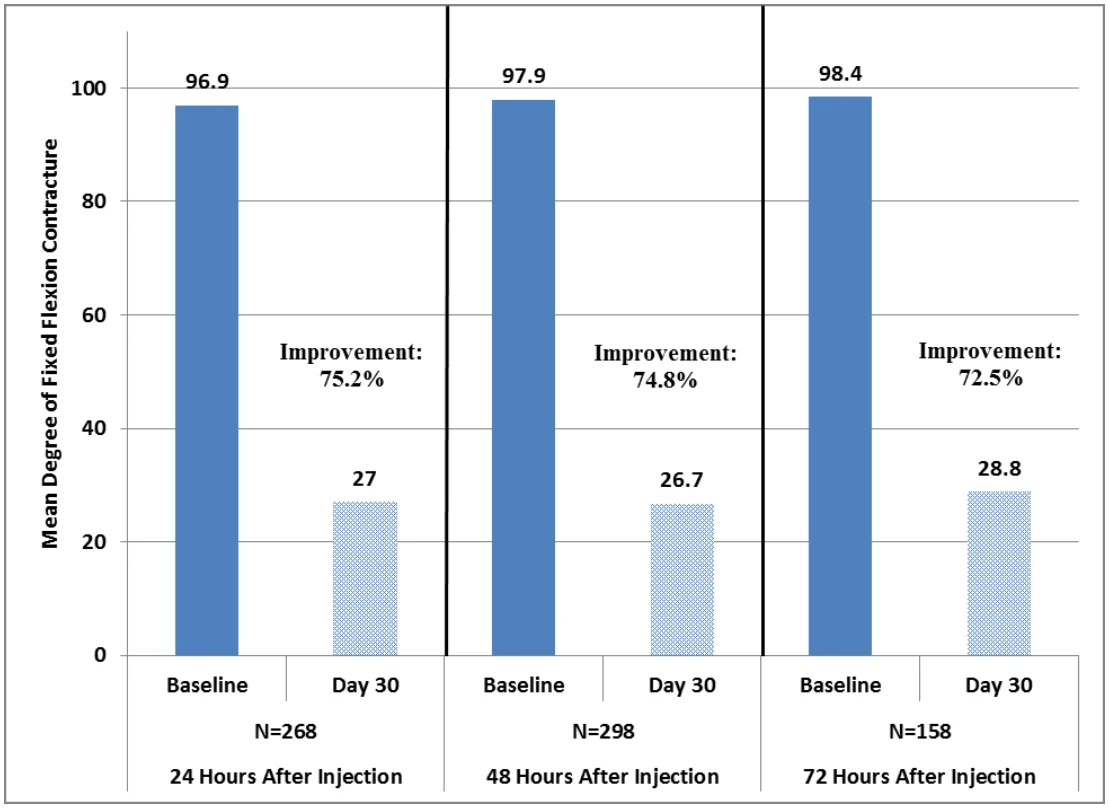
a mITT = modified Intent to Treat
Clinical success (a reduction of contracture to ≤ 5° within 30 days after two concurrent injections of XIAFLEX (one per joint) in the same hand was achieved for the majority of MP joints (64.6%) compared with 28.6% of PIP joints following a single injection per affected joint. Time of finger extension after injection had no impact on the rate of clinical success for either MP or PIP joints.
A long term, non-treatment, Year 2 to Year 5 follow-up study was undertaken to evaluate recurrence of contracture in subjects who received up to 8 single Injections of XIAFLEX 0.58mg in a previous Phase 3 open-label or double-blind with open-label extension study. Recurrence was assessed in successfully treated joints (i.e., subjects had a reduction in contracture to 5° or less at the Day 30 evaluation after the last injection of XIAFLEX in a previous study) and was defined as an increase in joint contracture by at least 20° in the presence of a palpable cord, or the joint underwent medical or surgical intervention primarily to correct a new or worsening Dupuytren’s contracture in that joint. The cumulative recurrence rate during the follow-up period at years 1, 2, 3, 4 and 5 was 3%, 19.6%, 35.2%, 42.4% and 46.7%, respectively; over five years: 48.8%.
An additional analysis was performed using a 30° increase as the definition for recurrence. By Day 1825 after reaching success, 198 of 623 joints successfully treated in a previous study and evaluated for the Year 5 report had recurred based on a 30° definition. The cumulative nominal rate of recurrence at years 1, 2, 3, 4 and 5 was 2.1%, 12.4%, 21.7%, 27.6% and 31.8% respectively.
Retreatment of Recurrent Contractures in Dupuytren’s Contracture
Study 4 enrolled 52 subjects who had a Dupuytren’s contracture successfully treated with XIAFLEX in one of the Phase III studies, and whom reported the contracture recurrence during the 5-year follow-up study, and then had the contracture retreated with XIAFLEX in Study 4. The subjects in the study were primarily male (96%); all were white and the average age was 66 years. One subject was eliminated from the efficacy population due to the investigator treating a joint different than the recurrent joint. Overall 31 MP joints and 20 PIP joints were treated (2 subjects, 1 each with an involved MP joint and an involved PIP joint, had spontaneous rupture of the cord and did not require finger manipulation). These joints tended to recur within 2 years of achieving success (median = 736 days) and were recurrent for approximately 2.5 years (median = 840 days) prior to entry into Study 4. Most of the joints (63%) received just one injection of XIAFLEX in the Phase III study (Table 12).
Table 12: Efficacy by anesthesia use/non-use in Study 4 in Dupuytren’s Contracture
| Study 4 | Used Anesthesia* | Not Used Anesthesia** |
| N (MP/PIP) | 35 (21/14) | 14 (9/5) |
| Success | 22 (63%) | 7 (50%) |
| % Change from baseline | 78.5% | 79.6% |
| 1 injection | 26 (74%) | 8 (57%) |
| 2 injections | 7 (20%) | 4 (29%) |
| 3 injections | 2 (6%) | 2 (14%) |
| Average injections | 1.31 | 1.57 |
* Includes 1 subject who had 2 injections and had anesthesia after the second injection, but not after the first.
** Includes 1 subject who had 2 injections and did not have anesthesia after the second injection, but did after the first, and also includes 1 subject who had 3 injections and did not have anesthesia after the third injection but did after the first 2 injections.
MP = metacarpophalangeal joint; N = number; PIP = proximal interphalangeal joint.
Clinical efficacy in Study 4 was similar to that reported in studies 1 and 2. In Study 4, 64.5% of recurrent MP joints and 45.0% of recurrent PIP joints achieved clinical success after retreatment with up to three injections of XIAFLEX.
Refer to ADVERSE REACTIONS, Clinical Trial Adverse Drug Reactions.
Peyronie’s Disease
The efficacy of XIAFLEX was evaluated in two randomized, double-blind, placebo-controlled studies, Study 5 (AUX-CC-803) and Study 6 (AUX-CC-804) in adult males with Peyronie's disease. The double-blind study population comprised 832 male patients of whom 551 patients received XIAFLEX and 281 received placebo. At study entry, patients must have had penile curvature deformity of at least 30 degrees in the stable phase of Peyronie's disease. Patients were excluded if they had a ventral curvature deformity, an isolated hourglass deformity or a calcified plaque that could have interfered with the injection technique. At baseline, penile pain was either not present or was mild in most patients (98%). Baseline characteristics are presented in Table 13.
In these studies, patients were given up to 4 treatment cycles of XIAFLEX or placebo (weeks 0, 6, 12, 18), and were followed in a non-treatment follow-up period (weeks 24 -52). In each treatment cycle, two injections of XIAFLEX 0.58 mg or two injections of placebo were administered 1 to 3 days apart. A penile modeling procedure was performed on patients at the study site 1 to 3 days after the second injection of the cycle. The treatment cycle was repeated at approximately six-week intervals for up to three additional times, for a maximum of 8 total injection procedures and 4 total modeling procedures. In addition, patients were instructed to perform penile modeling at home for six weeks after each treatment cycle.
The co-primary endpoints in both studies were:
- the percent change from baseline to Week 52 in penile curvature deformity and
- the change from baseline to Week 52 in the Bother domain of the Peyronie's Disease Questionnaire (PDQ)
The Bother domain score is a composite of the following patient-reported items: concern about erection pain, erection appearance, and the impact of Peyronie's disease on intercourse and on frequency of intercourse.
Efficacy results are presented in Table 14.
XIAFLEX treatment significantly improved penile curvature deformity in patients with Peyronie's disease compared with placebo. XIAFLEX significantly reduced patient-reported bother associated with Peyronie's disease compared with placebo. Treatment effect for both endpoints was not affected by the degree of penile curvature.
Table 13: Baseline disease characteristics of patientsa with Peyronie's Disease (PD)
| Study 5 | Study 6 | |||||||||||||
XIAFLEX N=277 | Placebo N=140 | XIAFLEX N=274 | Placebo N=141 | |||||||||||
| Median age (years) (Min-Max) | 59.0 (28-79) | 59.0 (30-81) | 58.0 (23-84) | 58.0 (33-78) | ||||||||||
Mean duration of PD (years) (Min-Max) | 3.9 (1.0 - 35.9) | 4.8 (1.0 - 50.8) | 4.2 (1.1 - 30.9) | 3.4 (1.1 - 17.1) | ||||||||||
Mean Penile Curvature deformity (degrees) (Min-Max) | 48.8 (30-85) | 49.0 (30-89) | 51.3 (30-90) | 49.6 (30-85) | ||||||||||
| Peyronie's Disease Questionnaire (PDQ), – Mean Patient-Reported PD Bother Domain Score (range: 0-16) c | 7.5 | 7.4 | 7.4 | 8.2 | ||||||||||
| History of Erectile Dysfunction N (%) | 128 (46.2) | 75 (53.6) | 134 (48.9) | 76 (53.9) | ||||||||||
a Subjects were from ITT population and received at least one dose of study drug in Study 5 or 6
b Each PDQ assessment required subjects to have had vaginal intercourse in the 3 months prior to completion c Higher scores represent worse symptoms
Table 14: Mean percent change in penile curvature deformity and mean change in PDQ Bother Domain Score from baseline to week 52 in Studies 5 and 6
| Study 5 | Study 6 | ||||||||||||||||
XIAFLEX N=277 | Placebo N=140 | XIAFLEX N=274 | Placebo N=141 | ||||||||||||||
| Change in penile curvature deformity | |||||||||||||||||
| Baseline Mean (degrees) | 48.8° | 49.0° | 51.3° | 49.6° | |||||||||||||
| Mean Percent Changea | -47.2% | -29.7% | -44.9% | -30.7% | |||||||||||||
| Treatment Difference | -17.5% | -14.3% | |||||||||||||||
| p value | < 0.0001 | < 0.0001 | |||||||||||||||
| Change in PDQ Bother Domain Score | |||||||||||||||||
| Baseline Mean | 7.5 | 7.4 | 7.4 | 8.2 | |||||||||||||
| Mean Changeb | -4.6 | -3.3 | -3.3 | -2.4 | |||||||||||||
| Treatment Difference | -1.4 | -0.8 | |||||||||||||||
| p value | < 0.0001 | 0.0213 | |||||||||||||||
a Mean percent change in penile curvature deformity, treatment difference, and p-value were based on a mixed model with repeat measurements (MMRM) in the ITT population. The multiple linear regression mixed model includes class variables - baseline smoking status, baseline alcohol use, penile shortening severity, penile erection pain severity, plaque calcification, and distress over PD and covariates - duration of PD, age, number of treatment cycle received and baseline penile curvature except for treatment group, study visit (repeat time) and their interactions.
b Mean change in PDQ Bother Domain Score, treatment difference, and p-value were based on a MMRM in the ITT population. The multiple linear regression mixed model includes class variables - baseline smoking status, baseline alcohol use, penile shortening severity, penile erection pain severity, plaque calcification, and distress over PD and covariates - duration of PD, age, number of treatment cycle received and baseline PDQ bother score except for treatment group, study visit (repeat time) and their interactions.
XIAFLEX was not associated with shortening of penile length in clinical trials in the treatment of Peyronie's disease.
Refer to ADVERSE REACTIONS, Clinical Trial Adverse Drug Reactions.
DETAILED PHARMACOLOGY
This pharmacology summary presents both Dupuytren’s contracture and Peyronie’s disease together given the mechanism of action, collagen digestion, and systemic responses are similar for the two indications.
Mechanism of Action
Collagenases are proteinases that recognize and bind to collagen and hydrolyze the peptide bonds in collagen in its native triple helical conformation under physiological conditions, resulting in lysis of collagen deposits.
Injection of XIAFLEX (collagenase clostridium histolyticum) into a Dupuytren’s cord or into a Peyronie’s plaque, which are both comprised mostly of collagen, may result in enzymatic disruption of the cord/plaque.
Results of in vitro studies suggest that the collagenases (AUX-I and AUX-II) worked synergistically to provide hydrolyzing activity towards collagen. However, there are no clinical data regarding the relative contributions of the individual collagenases (AUX-I or AUX-II) to the efficacy of XIAFLEX in the treatment of Dupuytren’s contracture.
Results of in vitro studies, including those of explant tissues containing Peyronie’s plaques, suggest that XIAFLEX disrupts the predominant collagen found in plaques (Types I and III). At higher doses and longer incubation times, non-fibrillar Type IV collagen was affected causing collagen lysis in small veins, but did not cause structural damage to arteries, nerves or large veins which contain Type IV collagen in in vitro or in vivo studies.
Pharmacodynamics
Information regarding the primary pharmacodynamic activity of collagenase clostridium histolyticum has been primarily derived from the peer-reviewed literature describing the structure, activity, cofactor requirements and substrate specificity of purified clostridial collagenase. Collagen (particularly Types I and III) is the most relevant target in Dupuytren’s disease, as it is the primary component of the advanced stage disease cords.
Because there are no suitable animal models, the efficacy of purified clostridial collagenase or collagenase clostridium histolyticum in fibrotic disease states was evaluated in explant cultures of pathologic tissues (Dupuytren’s cord or Peyronie’s plaque) and/or normal human tissues (for comparison). The rate of collagen digestion was greatest at early timepoints (first four hours of incubation of Peyronie’s plaques or tunica albuginea), with no differences in digestion rate noted between different tissues. No damage to non-collagenous tissue elements (elastic fibers, arteries, arterioles, nerve fibers, and fibroblasts) were detected following exposure to collagenase clostridium histolyticum, with the exception that disruption of small venules and the perinerium did occur in injected tissues. Collagen digestion resulting from injection of collagenase clostridium histolyticum into Dupuytren’s cords increased the elasticity of the remaining tissue (93% decrease in the mean tensile modulus 24 hours following injection with 3600 U) and decreased the amount of force needed to rupture the tissue to physiologically achievable levels (~2.7 to 4.1 megapascals, estimated normal extensor forces in the human finger, in cords treated with ≥ 300 U).
The evaluation of the relevant primary pharmacologic activity of collagenase clostridium histolyticum was performed in explant tissues containing Peyronie’s plaques from Peyronie’s patients. Cell viability indicated that exposure to collagenase clostridium histolyticum was well-tolerated. The temporal pattern of collagenase clostridium histolyticum was collagenolytic activity on Peyronie’s plaque tissue and Dupuytren’s cord explants was similar, with rapid degradation occurring in the first 4 hours followed by a slower rate of degradation from 4 to 12 hours. The maximal effective dose was 1500 U (0.087 mg); a 750 U dose yielded 78% of maximal activity.
Consistent with the collagen digestion assay results, collagen digestion detected histologically in was nearly complete at the 12 hour timepoint in both Peyronie’s plaque and Dupuytren’s cord tissue explants. Collagen lysis by collagenase clostridium histolyticum was selective for Types I and III collagen. Type IV collagen that is associated with blood vessel/capillary basement membranes, smooth muscle and the perineurium/epineurium of nerves was not affected, except at higher doses of collagenase clostridium histolyticum (3000 U/0.17mg) and longer incubation times. Collagenase clostridium histolyticum was without detectable effect on the histomorphology of blood vessels, nerves and fibroblasts at all doses and incubation timepoints evaluated.
Pharmacokinetics
Administration of collagenase clostridium histolyticum by local injection (single dose or repeat dose) does not result in any systemic toxicity or significant systemic exposure to collagenase clostridium histolyticum components when administered to rats, guinea pigs, dogs, rabbits or minipigs at any injection site or dose level. A lack of systemic exposure following administration of collagenase clostridium histolyticum at the clinical dose in subjects with Dupuytren’s contracture has also been confirmed in clinical studies. Following administration of a single XIAFLEX dose of 0.58 mg into a Dupuytren’s cord in 20 patients, no quantifiable levels of XIAFLEX (AUX-I or AUX-II) were detected in plasma up to 30 days post injection.
Following each of two intralesional administrations of XIAFLEX 0.58 mg, separated by 24 hours, into the penile plaque of 19 subjects with Peyronie’s disease, plasma levels of AUX-I and AUX-II in subjects with quantifiable levels) were minimal and short-lived (79% and 40% for AUX-I and AUX-II, respectively. The maximal plasma concentrations of AUX-I and AUX-II were < 29 ng/mL and < 71 ng/mL, respectively, and were observed approximately within 10 minutes after injection. All plasma levels were below the limits of quantification within 30 minutes following dosing. There was no evidence of accumulation following two sequential injections of XIAFLEX administered 24 hours apart. No subject had quantifiable plasma levels 15 minutes after modeling of plaque on Day 3 (i.e., 24 hours after Injection 2 on Day 2).
Plasma kinetics following either IV or local administration of collagenase clostridium histolyticum are consistent with the inactivation of collagenase clostridium histolyticum by plasma proteins, as a result of complex formation with α-2-macroglobulin (α2M) (endogenous protease inhibitor, either secreted locally or derived from the serum) or other plasma proteases followed by rapid removal of the complexes by fixed tissue phagocytes in the injection site, liver and/or spleen. The ability of human α2M to inactivate AUX-I and AUX-II has been directly examined, inactivation of commercial research-grade purified collagenase either by the α2M serum fraction from a number of species or by purified human α2M has been demonstrated.
In vitro studies provide a basis for limited systemic circulation of AUX-I and AUX-II, showing that at physiological concentrations 1) human plasma inhibits AUX-I and AUX-II enzymatic activities by up to 32% and 65%, respectively, and 2) alpha-2-macroglobulin, a protease inhibitor in the human plasma proteome, inhibited activities by 90% and 88%, respectively.
TOXICOLOGY
Please note that AA4500 refers to Collagenase clostridium histolyticum
Acute Toxicity Studies
| Species/Strain | No./Sex/ Group | Route | Duration | Doses (U/dose) | Approximate Lethal Dose (U/dose) | Findings |
|---|---|---|---|---|---|---|
Mice/ Swiss-Webster | 4 M/group | IM | Single dose | 80, 160, 320, 640 or 1200 | 640 | Death occurred with 24-72 hours at ≥640 units/animal. Local reactions (skin ulceration, hemorrhage & necrosis of muscle at ≥160 units/animal |
Mice/ Swiss-Webster | 4 M/group | IP | Single dose | 20, 40, 80, 160 or 320 | 40 | Death within 4 hours at ≥160 units/animal. Associated findings: dyspnea, piloerection, hunched posture, hemorrhage in pleural and peritoneal cavities at necropsy |
Mice/ Swiss-Webster | 5 M/group | IP | Single dose | 80, 99, 104, 122, 129, 150, 159, 185, 196 or 241 | 80 | Acute deaths (within 24-48 hours) in the majority of animals at ≥150 units/animal; adverse clinical signs piloerection, hyperpnea) noted at all doses; hemorrhage (pleural and peritoneal cavities, congestion of lungs, liver, and kidneys at necropsy at all doses. |
Mice/ Swiss-Webster | 5 M/group | IP | Single dose | 80, 99, 122, 150, 185, 228 or 281 | 150 | Majority of deaths occurred 24 - 46 hours following dosing; adverse clinical signs (piloerection, hyperpnea) noted (dose levels not specified); hemorrhage (pleural and peritoneal cavities, congestion of lungs, liver, and kidneys at necropsy (dose levels not specified) |
Rats/ Sprague-Dawley Crl:CD(SD) | 3 F/group | IV | 3 days | 5000; 10,000; or 20,000 (0.29, 0.58, or 1.16 mg/dose) | 10,000 | Acute deaths (between 1-24 hours) following first dose at ≥10,000 U/animal. Hyperpnea, lacrimation, red perioral/ perinasal substance, seizures, discolouration of the tail, red fluid/gelatinous material in pleural or peritoneal cavity, friable livers (histologic correlates of subcapsular necrosis, acute capsular & multifocal hemorrhage at 10,000 U/dose); dark, red, mottled or spongy lungs (histologic correlates of acute hemorrhage, alveolar edema and/or emphysema at ≥10,000 U/dose); sloughing of tail (injection site) at 5000 U/animal |
Rats/ Sprague-Dawley (Crl:CD) | 3 F/group | IV | 3 days | 50, 150, 500 or 2240 | Not determined | No significant findings |
Repeated-Dose Toxicity Studies
| Species/Strain | No./Sex/ Group | Route | Doses (U/dose) | Study Duration | Dosing Regimen | Findings |
|---|---|---|---|---|---|---|
Rats/ Sprague-Dawley Crl:CD(SD) | 10 | IV | 0, 50, 150, or 500 | 16 days | Once every other day | No AA4500-related systemic effects. Discolouration of injection site; minimal to mild chronic perivascular inflammation and perivascular hemorrhage. Antibodies to AA4500 were detected in the majority of animals. Systemic levels of drug were low, short-lived (≤1 hr), and/or not dose-proportional. Local NOEL: 150 U/dose/animal Local NOAEL: 500 U/dose/animal |
Rats/ Sprague-Dawley | 10-15 | IV | 0, 500, 2240, or 5000 (0, 0.029, 0.13 or 0.29 mg/animal) | 16 days | Once every other day | A few deaths (10/108) at high dose level (likely due to peritoneal hemorrhage), friable livers and/or spleens; dose-dependent liver findings including hematoma, fibrosis, and focal necrosis with increases in hepatic enzymes. Discolouration at injection sites correlated with perivascular edema, hemorrhage, inflammation, fibrosis and/or necrosis. Partial or complete recovery was observed. Systemic levels were low and/or short-lived (t1/2 <1hr). Antibodies to AA4500 were detected in the majority of animals. Systemic and Local NOELs were 0.029 mg/dose/animal |
Rats/ Sprague-Dawley Crl:CD(SD) | 15 | SC (plantar) | 0, 258, 517, or 776 | 13 wks | Once every 2 weeks | No AA4500-related systemic effects. Local dose-dependent swelling, discolouration of injected limb/site transient swelling and/or bruising adjacent to the site of injection and hemorrhage, acute to subacute inflammation progressing to chronic (mononuclear) inflammation, and neovascular proliferation histologically Antibodies to AA4500 were detected in the majority of animals. Systemic levels of drug were low, sporadic and/or not dose-proportional. Systemic NOAEL was 776 U/dose/animal; local NOEL was not determined. |
Repeated-Dose Toxicity Studies (continued)
| Species/Strain | No./Sex/ Group | Route | Doses (U/dose) | Study Duration | Dosing Regimen | Findings |
|---|---|---|---|---|---|---|
Dogs/ Beagle | 3-6M/grp | Intrapenile | 0, ~140, ~430, or ~1430/1050 | 62 days | 3x/wk (q48hr) every 4 wks (3 wks between treatment cycles for 3 cycles; 9 doses total) | No AA4500-related systemic effects. Local injection site reactions: discolouration, bruising, edema, inflammation, hemorrhage, neovascular proliferation (one mid-dose dog was euthanized due to secondary toxicities due to local reaction. Partial or complete recovery was observed. Systemic levels of drug were low, sporadic and/or not dose-proportional. Systemic levels of drug were low, sporadic and/or not dose-proportional. Antibodies to AA4500 were detected in the majority of animals. Local NOAEL was ~140 U/dose/animal (0.008 mg/kg/animal) |
Dogs/ Beagle | 5 | SC (palmar) | 0, 2586, 3879, or 6466 | 13 wks | Once every 28 days, 4 doses total) | No AA4500-related systemic effects. Local site reactions: discolouration, edema, inflammation, hemorrhage, fibroplasia/ neovascularization or fibrosis of the subcutis, and tendon fibrosis, local lymph node findings (neutrophil infiltration, sinus erythrocytosis) secondary to inflammation and hemorrhage. Antibodies to AA4500 were detected in the majority of animals. Systemic levels of drug were low, sporadic and/or not dose-proportional. Systemic NOAEL was 6646 U/dose/animal; local NOAEL was not determined. |
Reproductive Toxicity Studies
| Study Type | Species/Strain | No./Sex/ Group | Route | Doses (U/dose) | Dosing Period/ Regimen | Findings |
|---|---|---|---|---|---|---|
| Fertility and Early Embryonic | Rats Sprague-Dawley Crl:CD(SD) | 25 | IV bolus | 0, 250, 750 or 2240 | M: 61-64 days F: up to 21 days (last dose on 7th day of gestation); Every other day | No AA4500-related deaths or premature terminations occurred. Local injection site: swollen, discolouration. A slight decrease in body weight gain and/or food consumption at 2240 U/dose. No effect observed in estrous cycling, sperm count and motility, reproductive behavior, or fertility parameters for both sexes. Similarly, no AA4500-related effects were noted for the litter averages, implantations, viable and nonviable embryos. NOAELs for general parental toxicity were 250 U/dose in both sexes (based on injection site reactions). The NOEL for male and female reproductive toxicity was 2240 U/dose. |
| Embryo-Fetal Development | Rats Sprague-Dawley Crl:CD(SD) | 25F/grp | IV bolus | 0, 250, 750 or 2240 | F: Days 7-17 of gestation); Every other day | No AA4500-related deaths nor effects on body weights food consumption. Local injection site reactions: swelling and/or discolouration at ≥750 U/dose. Pregnancy occurred in 24 or 25 animals per dose group. No effects on uterine or ovarian findings, litter parameters, or external, soft tissue or skeletal fetal alterations (malformations or variations). The NOAEL for both maternal and developmental toxicity was 2240 U/dose. |
Local Tolerance Studies
| Species/Strain | No./Sex/ Group | Route | Doses (U/dose) | Study Duration | Findings |
|---|---|---|---|---|---|
Rats/ Zucker Crl:(ZUC) FA/FA | 7 F/grp | SC | 0, 1000, or 2000 | One day | No systemic effects. Local injection site at 48 hours post-dosing: discolouration, hemorrhage, and inflammation (both doses) and fat cell disruption at 2000 U/animal |
Rats/ Sprague-Dawley Crl:CD(SD) | 15 | SC (plantar) | 0, 258, 517, 1034 or 2586 | Single dose | Premature euthanasia in two males, one female at 2586 U/animal due to skin lacerations (dorsal surface of the paw, opposite the injection site) No AA4500-related systemic effects. Local injection site reactions: swelling and/or discolouration seen at all dose levels (all findings resolved by day 19). Additional findings at ≥1034 U/animal: scabbing, impaired use, toes flexed (resolved in all but one animal by day 19); enlargement, dark red discolouration popliteal lymph node all dose levels at necropsy (no dose responses). Histology findings at the injection site: hemorrhage, edema, subacute inflammation (occasionally extending to the periosteum of the metacarpal bones at ≥1034 U/animal), skeletal muscle necrosis, fibroplasia/ neovascularization, sporadic intramural arterial hemorrhage, arterial fibrinoid necrosis, and epidermal surface exudate seen at all dose levels. Histology findings in the draining (popliteal) lymph node (sinus erythrocytosis at all dose levels, hemorrhage at ≥517 U/animal, and acute inflammation in the prematurely euthanized animals at 2586 U/animal. Partial to complete reversal at the end of 4 week recovery period. |
Dogs/ Beagle | 4-5 | Intratendon and SC (palmar) | Intratendon: 0, 1293, 2586, or 5172 SC: 0, 2586, 7759, or 12931 | Single dose | No AA4500-related systemic effects. Local injection site reactions: swelling, discolouration, impaired use seen at all dose levels; generally more severe when AA4500 given subcutaneously; skin lacerations seen at ≥2586 U/animal. All findings resolved by study day 42. Enlarged, dark red discolouration of the right axillary lymph nodes at all dose levels. Histopathology findings: hemorrhage, edema, subacute inflammation, and/or lysis of collagen in the interstitium and the superficial digital flexor tendon, occasionally arterial intramural hemorrhage and/or ulceration of the palmar epidermis. Collagen lysis in the tendons by either dose route did not completely disrupt the tendons. No effects on the collagen of the arteries and peripheral nerves in the affected tissues. Secondary changes included hemorrhage of the axillary and/or thoracic skin and skeletal muscle and sinus erythrocytosis in the associated axillary lymph nodes. Partial (with evidence of ongoing reversal) to complete reversal of all histologic findings at the end of the 8 weeks recovery period. |
Local Tolerance Studies (continued)
| Species/Strain | No./Sex/G roup | Route | Doses (U/dose) | Study Duration | Findings |
|---|---|---|---|---|---|
Minipigs/ Göttingen | 3 | SC | 844 U/animal, divided into 12 different injections at concentratio ns ranging from 26 to 2586 U/mL (dose volumes of 0.05, 0.1 or 0.2 mL) | One day | No AA4500-related systemic effects. Local injection sites: swelling at injection sites treated with concentrations ≥259 U/mL, dark red discolouration of the subcutaneous tissue noted at necropsy at all dose levels. Histology findings: collagen lysis, hemorrhage, and/or acute inflammation at all dose levels, skeletal muscle necrosis (panniculus carnosis) at ≥52 U/mL; sporadic perivascular and intramural edema, neovascularization/fibrosis, vascular necrosis, and/or thrombosis at ≥155 U/mL; sporadic arterial intramural hemorrhage at ≥517 U/mL. Collagen lysis was dose dependent at <259 U/mL, but was generally proportional to the dose volume injected as opposed to the total dose or formulation concentration at ≥259 U/mL. |
Guinea pigs/ Unspecified | 3 | Intradermal | 0 or 300 U/animal | Single dose | Minimal to slight erythema within 0.5 hours following dosing. Complete recovery in all animals (except one male) within 24 hours following the injection |
Dogs/ Beagle | 3-5 M/grp | Intrapenile (tunica albuginea (TA), corpus cavernosum (CC), vein-artery- nerve complex (VAN), urethra (UR)) | 0, ~1430, or ~2570 | Single dose | Discolouration/bruising of penis/adjacent skin and swelling of the penis noted at all dose levels, in all sites (poor dose responses). Severity of histologic findings at 72 hours (hemorrhage, edema, necrosis, inflammation, neovascular proliferation) reflected injection site more than dose (CC/UR/VAN > TA). Minimal collagen lysis of TA following injection of TA or CC, only at 72 hours (not apparent in recovery). No effects on arteries, veins, nerves or urethral mucosa. Complete reversal of findings in TA, partial reversal in CC, VAN and UR Low levels of AUX-I/AUX-II (< 40 ng/mL) only at 5 mins. when injected into vascular tissue (CC, UR). |
Other Toxicity Studies
| Study Type | Species/Strain | No./Sex/ Group | Route | Doses (U/dose) | Study Duration | Findings |
| Antigenicity | Guinea Pigs/ Unspecified | 2-3 | IP (doses 1-4), IC (5th dose) | 0 or 300 | 21 d (3 doses D1-D7, 4th dose D14, 5th dose D21) | No effects following IP doses 1-4. Transient hyperemia of ears, hyperventilation and hyperrecativity at 300 U/dose following IC injection; attributed to direct effects of IC enzyme and not a response to immunization. |
| Antigenicity | Guinea Pigs/ Unspecified | 2-3 | IP (doses 1-4), IC (5th dose) | 0 or 300 | 21 d (3 doses D1-D7, 4th dose D14, 5th dose D21) | No effects following any dose |
Genotoxicity Studies
| Study Type | Species/Strain | No./Sex/ Group | Route | Doses (U/dose) | Study Duration | Findings |
| Bacterial reverse mutation (Ames) - in vitro | Salmonella typhimurium/T A1535, TA1537, TA98, TA100 | -- | In vitro | 0-3400 U/plate | 72 hours | AA4500 was not mutagenic in the presence or absence of a metabolic activation system (S9). |
| Chromosome aberration – in vitro | Human lymphocyte | -- | In vitro | 0-1700 U/mL | 24 hours (-S9) or 2 hours (+S9) | AA4500 was not clastogenic in the presence or absence of a metabolic activation system (S0). |
Mouse micronucleus – in vivo | Mice/ Swiss CD-1 | 5 | IP | 0, 1070, or 2140 U/kg | 24, 48, or 72 hours after a single dose | AA4500 was not clastogenic in vivo. |
Carcinogenicity Studies
No carcinogenicity studies of collagenase clostridium histolyticum have been conducted.
REFERENCES
- 1. Badalamente MA, Hurst L. Enzyme injection as a nonoperative treatment for Dupuytren’s disease. Drug Delivery. 1996; 3:35-40.
- 2. Bond MD, van Wart HE. Characterization of the individual collagenases from Clostridium histolyticum. Biochemistry 1984; 23 (13) :3085-3091
- 3. French MF, Mookhtiar KA, van Wart HE. Limited proteolysis of type I collagen at hyperreactive sites by Class I and II Clostridium histolyticum collagenases: complementary digestion patterns. Biochemistry. 1987; 26:681-687.
- 4. Gelbard MK, Walsh DR, Kaufman JJ. Collagenase for Peyronie’s disease experimental studies. Urol Res. 1982;10:135-140.
- 5. Gilpin D, Coleman S, Hall S, Houston A, Karrasch J, Jone N. Injectable collagenase clostridium histolyticum: a new nonsurgical treatment for Dupuytren's disease. J Hand Surg 2010; 35:2017-2038.
- 6. Golub LM, Lee HM, Ryan ME, Giannobile WV, Payne J, and Sorsa T. Tetracyclines inhibit connective tissue breakdown by multiple non-antimicrobial mechanisms. Adv Dent Res. 1998; 12:12-26.
- 7. Hurst L, Badalamente MA, Hentz VR, Hotchkiss RN, Kaplan FTD, Meals RA et al. Injectable collagenase clostridium histolyticum for Dupuytren’s contracture. N Engl J Med 2009; 361:968-979.
- 8. Matsushita O, Koide T, Kobayashi R, Nagata K, Okabe A. Substrate recognition by the collagen-binding domain of Clostridium histolyticum Class I collagenase. J Biol Chem. 2001; 276:8761-8770.
- 9. Melling M, Karimian-Teherani D, Mostler S, Benham M, Sobal G, Menzel EJ. Changes of biochemical and biomechanical properties in Dupuytren disease. Arch Pathol Lab Med. 2000; 124:1275-1281.
- 10. Mookhtiar, KA, Van Wart HE. Clostridium histolyticum collagenases: a new look at some old enzymes. Matrix 1992; Suppl.1: 116-126.
- 11. Seifter S, Gallop PM, Klein L, Meilman E. Studies on collagen. II. Properties of purified collagenase and its inhibition. J Biol Chem. 1959; 234(2):285-293.
- 12. Sottrup-Jensen L, Birkedal-Hansen H. Human fibroblast collagenase-α-macroglobulin interaction. J Biol Chem. 1989; 264(1):393-401.
- 13. Starkweather KD, Lattuga S, Hurst LC, Badalamente MA, Guilak F, Sampson SP, Dowd A, Wisch D. Collagenase in the Treatment of Dupuytren's disease: an In Vitro Study. The Journal of Hand Surgery. 1996; 21A (No. 3): 490-495.
- 14. Steinbrink DR, Bond MD, van Wart HE. Substrate specificity of β-collagenase from Clostridium histolyticum. J Biol Chem. 1985; 260: 2771-2776.
- 15. Toyoshima T, Matsushita O, Minami J, Nishi N, Okabe A. Itano T. Collagen-binding domain of a Clostridium histolyticum collagenase exhibits a broad substrate spectrum both in vitro and in vivo. Connect Tissue Res. 2001; 42(4):281-90.
- 16. Werb Z, Burleigh MC, Barrett AJ, Starkey PM. The interaction of α2-macroglobulin with proteinases. Binding and inhibition of mammalian collagenases and other metal proteinases. Biochem J. 1974; 139:359-368.
- 17. Traore EJ, Wang W, Yafi FA, Hellstrom WJ. Collagenase Clostridium histolyticum in the management of Peyronie's disease: a review of the evidence. Therapeutic Advances in Urology. 2016; 8(3):192-202.
- 18. Lipshultz LI, Goldstein I, Seftel AD, Kaufman GJ, Smith TM, Tursi JP, Burnett AL. Clinical efficacy of collagenase Clostridium histolyticum in the treatment of Peyronie's disease by subgroup: results from two large, double-blind, randomized, placebo-controlled, phase III studies. BJU International. 2015; 116: 650-656