


Product Monograph - Zaditen (Teva Canada, Tablet)
RECENT MAJOR LABEL CHANGES
Indications 10/2022
Dosage and Administration 10/2022
Warnings and Precautions 10/2022
TABLE OF CONTENTS
Sections or subsections that are not applicable at the time of authorization are not listed.
RECENT MAJOR LABEL CHANGES ................................................................................. 2
TABLE OF CONTENTS ................................................................................................... 2
PART I: HEALTH PROFESSIONAL INFORMATION ............................................................ 4
1 INDICATIONS .......................................................................................................... 4
1.1 Pediatrics ........................................................................................................... 4
1.2 Geriatrics............................................................................................................ 4
2 CONTRAINDICATIONS ............................................................................................. 4
4 DOSAGE AND ADMINISTRATION .............................................................................. 4
4.1 Dosing Considerations ......................................................................................... 4
4.2 Recommended Dose and Dosage Adjustment ......................................................... 5
4.4 Administration ..................................................................................................... 5
4.5 Missed Dose ....................................................................................................... 5
5 OVERDOSAGE ........................................................................................................ 5
6 DOSAGE FORMS, STRENGTHS, COMPOSITION AND PACKAGING ............................. 6
7 WARNINGS AND PRECAUTIONS .............................................................................. 6
7.1 Special Populations ............................................................................................. 7
7.1.1 Pregnant Women .............................................................................................. 7
7.1.2 Breast-feeding .................................................................................................. 7
7.1.3 Pediatrics......................................................................................................... 7
7.1.4 Geriatrics ......................................................................................................... 7
8 ADVERSE REACTIONS ............................................................................................ 7
8.1 Adverse Reaction Overview .................................................................................. 7
8.2 Clinical Trial Adverse Reactions ............................................................................. 7
8.2.1 Clinical trial adverse reactions - pediatrics............................................................. 7
8.4 Abnormal Laboratory Findings: Hematologic, Clinical Chemistry and Other Quantitative Data Clinical Trial Findings ......................................................................................... 8
8.5 Post-Market Adverse Reactions ............................................................................. 8
9 DRUG INTERACTIONS ............................................................................................. 9
9.2 Drug Interactions Overview ................................................................................... 9
9.4 Drug-Drug Interactions ......................................................................................... 9
9.5 Drug-Food Interactions ......................................................................................... 9
9.6 Drug-Herb Interactions ......................................................................................... 9
9.7 Drug-Laboratory Test Interactions .......................................................................... 9
10 CLINICAL PHARMACOLOGY ................................................................................... 9
10.1 Mechanism of Action .......................................................................................... 9
10.2 Pharmacodynamics............................................................................................ 9
10.3 Pharmacokinetics............................................................................................. 10
11 STORAGE, STABILITY AND DISPOSAL .................................................................. 11
12 SPECIAL HANDLING INSTRUCTIONS .................................................................... 11
PART II: SCIENTIFIC INFORMATION.............................................................................. 12
13 PHARMACEUTICAL INFORMATION ....................................................................... 12
14 CLINICAL TRIALS ................................................................................................. 13
15 MICROBIOLOGY .................................................................................................. 13
16 NON-CLINICAL TOXICOLOGY ............................................................................... 14
PATIENT MEDICATION INFORMATION .......................................................................... 17
PART I: HEALTH PROFESSIONAL INFORMATION
1 INDICATIONS
Zaditen (ketotifen hydrogen fumarate) is indicated as an add-on medication for the chronic treatment of mild atopic asthma in children 5 years and older.
Zaditen is not indicated for the relief of acute bronchospasm (see General).
1.1 Pediatrics
Pediatrics (< 5 years of age): No data are available to Health Canada; therefore, Health Canada has not authorized an indication for Zaditen tablets for pediatric use in children < 5 years of age.
Pediatrics (5 to < 18 years of age): Based on the data submitted and reviewed by Health Canada, the safety and efficacy of Zaditen in pediatric patients 5 to < 18 years of age has been established. Therefore, Health Canada has authorized an indication for pediatric use.
1.2 Geriatrics
Geriatrics: No data are available to Health Canada; therefore, Health Canada has not authorized an indication for geriatric use.
2 CONTRAINDICATIONS
Zaditen is contraindicated in patients who are hypersensitive to this drug or to any ingredient in the formulation, including any non-medicinal ingredient, or component of the container. For a complete listing, see 6 DOSAGE FORMS, STRENGTHS, COMPOSITION AND PACKAGING.
4 DOSAGE AND ADMINISTRATION
4.1 Dosing Considerations
Concomitant Therapy: Zaditen is for use as add-on maintenance treatment for mild atopic asthma. Existing asthma therapy should be maintained. A progressive reduction in dosage of other asthma therapy, where clinically indicated, should be attempted only after 6-12 weeks of Zaditen therapy.
Zaditen is for maintenance treatment. Patients should be made aware that for optimum benefit, it should be used on a continuous basis. Zaditen should not be used more often than recommended or at higher doses than recommended.
Several weeks of Zaditen therapy may be necessary before the therapeutic effect becomes clinically evident. Full clinical effectiveness is generally reached after 10 weeks of treatment. It is therefore recommended that for patients not adequately responding within a few weeks, treatment with Zaditen should be maintained for a minimum of 2 to 3 months. If it is necessary to withdraw Zaditen, this should be done progressively over a period of 2 to 4 weeks as symptoms of asthma may recur.
Patients should be informed that Zaditen should not be used to treat acute symptoms of asthma. Patients should be prescribed a rapid onset, short duration inhaled bronchodilator (e.g. salbutamol) to relieve acute symptoms such as shortness of breath. Patients should be advised to have this available for use at all times.
4.2 Recommended Dose and Dosage Adjustment
Children 5 to < 18 years of age
In children 5 years of age and older, Zaditen should be given at a dose of 1 tablet (1 mg) twice daily, once in the morning and once in the evening.
To minimize the initial sedation with Zaditen, a slow increase in dosage is recommended during the first week of treatment commencing with one half the daily recommended dosage given in 2 divided doses or in a single dose given in the evening, followed within 5 days, by an increase to the full therapeutic dose.
4.4 Administration
For oral use. Patients should be instructed to swallow the tablets whole.
4.5 Missed Dose
If a dose is missed, it should be taken as soon as possible. If it is almost time for the next dose, the missed dose should be skipped and the next dose taken at the usual time. A double dose should not be taken.
5 OVERDOSAGE
Overdosages with up to 120 mg Zaditen (ketotifen fumarate) have been reported. The main symptoms of acute overdosage include drowsiness to severe sedation, confusion and disorientation, tachycardia, hypotension, convulsions (especially in children), hyperexcitability in children and reversible coma. Treatment should be symptomatic. If ingestion is very recent, emptying of the stomach may be considered. Administration of activated charcoal may be beneficial. If necessary, specific or symptomatic treatment and monitoring of the cardiovascular system and physostigmine for anticholinergic effects are recommended; if excitation or convulsions are present, short-acting barbiturates or benzodiazepines may be given.
| For management of a suspected drug overdose, contact your regional poison control centre. |
6 DOSAGE FORMS, STRENGTHS, COMPOSITION AND PACKAGING
Table 1– Dosage Forms, Strengths, Composition and Packaging
Route of Administration | Dosage Form / Strength/Composition | Non-medicinal Ingredients |
| Oral | Tablet, 1 mg | Lactose Monohydrate, Magnesium Stearate, Starch 1500 |
Each scored white tablet is embossed with the name "ZADITEN" and contains 1 mg ketotifen as ketotifen hydrogen fumarate. Available in bottles of 100 tablets.
7 WARNINGS AND PRECAUTIONS
General
Not for acute use
Zaditen should not be used for the relief of acute symptoms of asthma (i.e., as rescue therapy for the treatment of acute episodes of bronchospasm). Patients should be prescribed a rapid onset inhaled bronchodilator (e.g., salbutamol) to relieve acute symptoms such as shortness of breath, and advised to have this available for use at all times.
For add-on therapy
Zaditen should not be used as monotherapy. Symptomatic and maintenance asthma therapy (xanthine derivatives, β2-adrenergic agonists, sodium cromoglycate, corticosteroids) already in use should be continued and should not be reduced immediately when treatment with Zaditen is initiated. Zaditen is indicated for children with mild asthma who should be taking low dose asthma medications, therefore reduction in dose of other asthma treatments may not be possible.
Driving and Operating Machinery
Drowsiness may occur in the early stages of therapy, therefore patients engaging in activities requiring rapid and precise responses should be cautioned.
Patients should exercise caution when driving or operating a vehicle or potentially dangerous machinery
Immune
Hypersensitivity reactions have been reported with ketotifen.
Neurologic
Convulsions have been reported very rarely during Zaditen therapy. As Zaditen may lower the seizure threshold it should be used with caution in patients with a history of epilepsy or seizures. In particular, young children may be more susceptible to developing new seizures during treatment ketotifen. Zaditen should be discontinued in patients who experience a seizure while on treatment.
7.1 Special Populations
7.1.1 Pregnant Women
Although ketotifen was without effect on pregnancy and on peri- and post-natal development at dose levels which were tolerated by the mother animals, its safety in human pregnancy has not been established. Zaditen should therefore be given to pregnant women only if the benefits outweigh the risks.
7.1.2 Breast-feeding
It is not known whether ketotifen is excreted in human breast milk. However, ketotifen is excreted in rat milk. It is assumed that this drug is also excreted in human breast milk, and therefore mothers taking Zaditen should not breast-feed.
7.1.3 Pediatrics
Pediatrics (< 5 years of age): No data are available to Health Canada; therefore, Health
Canada has not authorized an indication for Zaditen tablets for pediatric use in children < 5 years of age.
7.1.4 Geriatrics
No data are available to Health Canada; therefore, Health Canada has not authorized an indication for geriatric use.
8 ADVERSE REACTIONS
8.1 Adverse Reaction Overview
The safety of Zaditen is based on data from patients 5 to 17 years of age in a double-blind, placebo-controlled 30 week trial. The most common adverse reactions reported with Zaditen treated patients were weight gain, respiratory infections and rash.
8.2 Clinical Trial Adverse Reactions
Clinical trials are conducted under very specific conditions. The adverse reaction rates observed in the clinical trials; therefore, may not reflect the rates observed in practice and should not be compared to the rates in the clinical trials of another drug. Adverse reaction information from clinical trials may be useful in identifying and approximating rates of adverse drug reactions in real-world use.
8.2.1 Clinical trial adverse reactions - pediatrics
The following adverse reactions were reported in a Canadian multicentre double-blind, placebo-controlled 30 week trial involving 196 asthmatic children aged 5 to 17 years.
Table 2 - REPORTED ADVERSE REACTIONS
| System | Reaction | Incidence (%) | |
|---|---|---|---|
Zaditen (n=75) | Placebo (n=78) | ||
| CNS | Sedation Headache Sleep disturbance | 8.0 1.3 1.3 | 9.0 1.3 0 |
| Gastrointestinal | Weight gain Increased appetite Abdominal pain | 5.3 1.3 1.3 | 1.3 0 0 |
| Skin | Rash Urticaria | 4.0 1.3 | 1.3 1.3 |
| Infections | Ear Flu Respiratory | 1.3 2.6 4.0 | 2.6 1.3 0 |
| Miscellaneous | Nose bleed Puffy eyelid | 1.3 1.3 | 0 0 |
There was a relatively low incidence of adverse reactions reported. These were similar in both the Zaditen and placebo treated groups of patients.
8.4 Abnormal Laboratory Findings: Hematologic, Clinical Chemistry and Other Quantitative Data Clinical Trial Findings
Thrombocytopenia has been reported when Zaditen is combined with oral hypoglycemic agents (see 9.2 Drug Interactions Overview).
Occasional, isolated, instances of elevated liver enzymes levels have been seen during clinical trials. No definite relationship to ketotifen fumarate therapy has been established.
8.5 Post-Market Adverse Reactions
Sedation and, rarely, dry mouth or slight dizziness may occur at the beginning of treatment, but usually disappear spontaneously with continued medication. Occasionally, symptoms of CNS stimulation, such as excitation, irritability, insomnia and nervousness have been observed, particularly in children. Weight gain has also been reported.
Cystitis has been rarely described in association with Zaditen. Very rarely Zaditen may cause an increase in liver enzymes and hepatitis. Isolated cases of severe skin reactions (erythema multiforme, Stevens Johnson syndrome), have been reported, the occurrence being approximately 1 case in 2 million patients exposed to Zaditen.
9 DRUG INTERACTIONS
9.2 Drug Interactions Overview
Interactions with ketotifen and other asthma medications have not been established.
9.4 Drug-Drug Interactions
A reversible fall in the thrombocyte count in patients receiving Zaditen concomitantly with oral antidiabetic agents has been observed in rare cases. Thrombocyte counts should therefore be carried out in patients taking oral antidiabetic agents concomitantly.
Zaditen may potentiate the effects of sedatives, hypnotics, antihistamines and alcohol.
9.5 Drug-Food Interactions
Interactions with food have not been established.
9.6 Drug-Herb Interactions
Interactions with herbal products have not been established.
9.7 Drug-Laboratory Test Interactions
Interactions with laboratory tests have not been established.
10 CLINICAL PHARMACOLOGY
10.1 Mechanism of Action
Ketotifen is a non-bronchodilator anti-asthmatic drug which inhibits the effects of inflammatory mediators, and thereby exerts anti-allergic activity. Ketotifen inhibits the release of mediators from mast cells involved in hypersensitivity reactions. Ketotifen is also a non-competitive histamine H1 receptor antagonist. Preclinical studies indicated that the ketotifen histamine H1 antagonist effect seems to be distinct from its anti-allergic properties.
10.2 Pharmacodynamics
Ketotofin fumarate may have an anti-inflammatory effect in the lungs and the time of onset of clinical efficacy may reflect the recovery period of the lungs from inflammation.
Pharmacological studies have revealed a number of properties of ketotifen fumarate which may contribute to its anti-allergic activity and its ability to affect the underlying pathology of asthma.
In vivo, ketotifen was shown to inhibit the development of airway hyperreactivity associated with activation of platelets by platelet activating factor (PAF) or caused by neural activation following the use of sympathomimetic drugs or exposure to allergen. Ketotifen inhibited PAF-induced accumulation of eosinophils and platelets in the airways. Ketotifen was shown to suppress the priming of eosinophils by human recombinant cytokines and thereby suppression of the influx of eosinophils into inflammatory loci. Ketotifen was also shown to antagonize bronchoconstriction due to leukotrienes.
Ketotifen fumarate inhibits in human tissue the in vitro release of a number of myotonic and inflammatory mediators, such as leukotrienes and histamines, as well as the in vivo release of neutrophil chemotactic factor.
In vitro animal studies have shown that ketotifen fumarate produces a concentration dependent inhibition of stimulated histamine release from rat peritoneal mast cells, histamine induced contraction of isolated guinea pig ileum, and inhibits the induced release of slow-reacting substance of anaphylaxis (SRS-A) and histamine from sensitized guinea pig lungs.
In vitro studies of human tissue have shown similarly that ketotifen fumarate pre-treatment of passively sensitized isolated leukocytes, and ketotifen fumarate treatment of lung tissue and basophils, produce a dose dependent inhibition of histamine and SRS-A (leukotrienes C4 and D4) after IgE-mediated challenge.
In vivo animal studies have shown that ketotifen fumarate also inhibits the action of mediators including a strong and persistent H-1 receptor blocking action resulting in protection of guinea pigs against the lethal effects of high doses of histamine and an inhibition of bronchospasms produced by histamine aerosol. Ketotifen fumarate inhibited the bronchoconstriction elicited by leukotrienes (SRS-A) and the bronchial hyperreactivity, eosinophilia and bronchoconstriction elicited by PAF in guinea pigs.
Ketotifen has been shown to attenuate beta2-adrenergic agonist desensitization which may play a role in asthma.
10.3 Pharmacokinetics
The pattern of metabolism in children is the same as in adults, but the clearance is higher in children. Children over the age of 5 years therefore require the same daily dosage regimen as adults.
Absorption
Following oral administration of ketotifen fumarate in both man and animals, the absorption is almost complete, as judged from both plasma and urinary excretion levels. The rate of absorption is fast. The plasma concentration reached its maximum 2-4 hours after oral administration and the half-life of absorption of less than 1 hour. Bioavailability amounts to about 50% due to a first pass effect of 50% in the liver. The bioavailability of ketotifen is not influenced by the intake of food.
After administration of repeated doses the steady state is attained in less than 4 days. This is in accordance with the half-life of elimination recorded for a single dose of ketotifen fumarate.
Distribution
Distribution studies after oral or intravenous administration in the rat showed a rapid decline in tissue levels of the total radioactivity in parallel with blood concentrations. Liver, kidney and lung had the highest drug levels. No retention was observed in any of the organs as confirmed by the macroautoradiographic studies. The drug passes the maternal/fetal barrier; however, only low levels were found in the fetal tissues. Protein-binding studies in plasma of different species showed that approximately 75% of the drug was bound within a concentration range of 100 - 200 micrograms per mL. Maximal plasma concentrations are reached within 2 to 4 hours.
Metabolism
The metabolism of ketotifen fumarate proceeds by 3 main pathways: N-glucuronide formation, N-demethylation and reduction of the ketone group of the nucleus in position 10 giving rise to the 10 hydroxyl derivative.
The main metabolite in man found in both urine and plasma is the glucuronide of the unchanged drug. Nor-ketotifen, the N-demethylated metabolite (2% of the dose) and the 10-hydroxyl derivative (less than 1% of the dose) are the only other detectable metabolites present in human urine. Both the 10-hydroxyl derivative and N-glucuronide conjugate may reform the intact product by in vivo reversibility. In rats, nor-ketotifen is the main metabolite, while in the rabbit, the main metabolite is the N-sulphate of nor-ketotifen. The nor-ketotifen metabolite is found to be approximately as active as ketotifen fumarate. Fifteen different metabolites have been isolated and identified in animal and human species and considerable inter-species differences occur.
Elimination
The excretion of ketotifen fumarate and its metabolites is rapid in both animals and man. Ketotifen fumarate is eliminated biphasically; there are two disposition half-lives of 3-5 hours and 21 hours for distribution and disappearance phases, respectively. More than 60% of the dose of ketotifen fumarate administered is recovered from the urine. Within 48 hours, urinary excretion amounts to 1% as unchanged drug and 60-70% as metabolites. The main metabolite in the urine is the inactive ketotifen-N-glucuronide.
11 STORAGE, STABILITY AND DISPOSAL
Store at temperatures not exceeding 25oC, in a dry place.
12 SPECIAL HANDLING INSTRUCTIONS
Not Applicable
PART II: SCIENTIFIC INFORMATION
13 PHARMACEUTICAL INFORMATION
Drug Substance
Proper name: ketotifen hydrogen fumarate
Chemical name: 4-(1-methyl-4-piperidylidene)-4H-benzo [4,5] cyclohepta [1,2-b] thiophene-10 (9H)- one hydrogen fumarate
Structural formula:
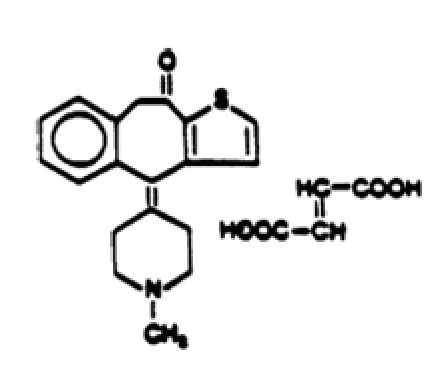
Molecular formula and molecular mass: C19H19NOS + C4H4O4; 425.5 g/mol
Physicochemical properties: Fine crystalline, yellowish gray powder with a faintly bitter taste. In the form of the hydrogen fumarate it is readily soluble in water. The active ingredient is stable in slightly acidic solution.
pKa-Value
Ka I = 8.43 ± 0.11
Estimated with ketotifen base by linear extrapolation with values from 5 different mixtures in ethanol/water.
Partition Coefficient
Chloroform/hydrochloric acid 0.1 N 1.2 : 1 n-Octanol/hydrochloric acid 0.1 N 0.7 : 1
Chloroform/phosphate buffer pH 6.8, 0.05 M >100 : 1 n-Octanol/phosphate buffer pH 6.8, 0.05 M >100 : 1
Melting Point
Ketotifen hydrogen fumarate melts with decomposition at about 190oC. Ketotifen hydrogen fumarate with 2.5 H2O melts at approximately 130oC.
14 CLINICAL TRIALS
14.1 Clinical Trials by Indication
Asthma
In a double-blind, placebo-controlled, Canadian, multicentre,e 30 week study, the efficacy of Zaditen 1 mg twice daily compared to placebo, was evaluated in 138 asthmatic children aged 5 to 17 years who continued treatment with beta-adrenergic agonists and/or theophylline.
Over the study period, only the ketotifen treated patients showed a significant decrease in their daily use of theophylline. Data from periodic spirometric measurements showed a significant increase from baseline from treatment week 6 for forced expiratory volume in one second (FEV1) and forced vital capacity (FVC) for the ketotifen-treated patients at many more visits than the increases seen for the placebo-treated patients. Increases in the mean daily peak flow values and decreases in asthma symptoms were found to be statistically significant on more occasions for the ketotifen-treated group than the placebo group. Significantly fewer ketotifen-treated patients compared to placebo-treated patients required hospital visits for asthma and for upper respiratory tract infection (URTI). Patient global evaluation indicated that a significantly higher percentage of ketotifen (54%) versus placebo (38%) patients reported their asthma to be "absent" to "much improved". Thirty-eight percent (38%) of the placebo-treated patients also reported their asthma to be "unchanged" or "worse", compared with 21% of ketotifen-treated patients. Clinical evaluation by the physician indicated that the percent of patients with ratings of "good" to "excellent" were significantly higher in the ketotifen group. Ketotifen was shown to be well tolerated.
15 MICROBIOLOGY
No microbiological information is required for this drug product.
16 NON-CLINICAL TOXICOLOGY
General Toxicology
Acute Toxicity
| LD50 Values for ketotifen fumarate | |||||
|---|---|---|---|---|---|
| SPECIES | STRAIN | BODY WEIGHT | SEX | ROUTE | LD50 (mg/kg) |
| Mouse | Albino, MF2 | 10–31 g | M & F | i.v. | 13.8 ± 0 |
| Mouse | Albino, MF2 | 10–31 g | M & F | Oral | 165 ± 53 |
| Rat | Albino, OFA | 155–240 g | M & F | i.v. | 5.3 ± 0 |
| Rat | Albino, OFA | 155–240 g | M & F | Oral | 360 ± 65 |
| Rabbit | Mixed Domestic | 2.11–3.09 kg | M & F | i.v. | 21.0 ± 5 |
| Rabbit | Mixed Domestic | 2.11–3.09 kg | M & F | Oral | 790 ± 14 |
Accelerated and noticeable forced breathing and motor excitation were the first signs of toxicity after the intravenous (i.v.) doses. Whole body cramps, muscular fibrillation, rapid blinking and slit opening of the eyes, coupled with drowsiness appeared later. The surviving animals recovered within hours after administration. After oral administration the type and sequence of signs were similar but slower in onset.
Subacute and Chronic
Rats
In general, toxicity was observed in rats only after long-term administration of ketotifen fumarate at doses which were up to 700 times those required to obtain antiallergic and anti-histaminic effects.
A three-week study in rats at doses of 1, 9 and 83 mg/kg administered in the diet and in doses of 1, 10 and 100 mg/kg administered by gavage showed no mortality. Body weights in the dietary experiment only were decreased during the third week in both sexes at 83 mg/kg, and females at 9 mg/kg. In both studies hepatic lipid was slightly increased and liver weights increased in males only at the highest doses.
A thirteen-week study, at doses of 10, 33 and 157 mg/kg/day given in the diet, resulted in a slightly increased food intake in the lower and mid-dose groups. Slightly increased serum cholesterol levels in these two groups were apparent at week 6 and week 13. Hepatomegaly with some discolouration (brown/yellow) was seen microscopically with 33 and 157 mg/kg/day.
Microscopic adaptive hepatic changes (i.e. occasional hyaline inclusion bodies) were seen at 10 mg/kg/day. With 33 and 157 mg/kg/day, increased hyaline inclusion bodies, cytomegaly and increased stainable fat were noted. Males were more affected than females. Degenerative changes in the beta cells in the pancreatic islets were seen only in males given 157 mg/kg/day. Additional biochemical studies in animals showed higher total lipid values, cholesterol values, higher cytochrome P-450 values, and higher N-demethylase activity at the two higher doses. These observations are consistent with an induction of the mixed function oxidases of the rat combined with slight hepatosteatosis.
In a 98-week (males) or 105-week (females) study of rats receiving 2, 16 and 71 mg/kg/day of ketotifen fumarate in the diet, body weight gain and food consumption were reduced in the high dose animals. There was slight reduction of hemoglobin and hematocrit mean values from week 26 on in females receiving the high dose. Some degenerative liver changes (liver cell swelling and vacuolization) were seen in the high dose group. There was a slight trend to increased mortality in all dose groups, reaching statistical significance in the high dose females.
Only the high dose males showed slightly elevated alanine aminotransferase (ALT) values at weeks 57, 78 and 98, elevated total protein values at weeks 13 and 26, and raised cholesterol values at weeks 13, 26 and 52. After 26 and 52 weeks, males of the treated groups showed distinctly diminished urine volume with significantly raised specific gravity.
Dogs
In a study with dogs treated with ketotifen fumarate in the diet at doses of 1.25, 5, 20 and 80 mg/kg/day for thirteen weeks, sedation was noted in all dogs in the high dose (80 mg/kg) group and convulsions occurred in one dog. At all dose levels there was a slight increase in food intake and weight gain. With 5 mg/kg/day, ALT and alkaline phosphatase levels were raised in one out of four dogs with no microscopic evidence of hepatotoxicity. With 20 mg/kg/day, ALT was slightly raised in two out of four dogs and adaptive microscopic liver changes were observed. Three out of four dogs showed changes in alkaline phosphatase, ALT, and microscopic evidence at 80 mg/kg. These dogs also showed significant liver weight increase, toxic liver changes and albuminuria. Tachycardia and slight functional ECG changes occurred in the dogs receiving 80 mg/kg/day.
In a 52-week study of dogs receiving ketotifen fumarate at doses of 0.1, 0.5, 5, and 50 mg/kg/day, slight disturbances in equilibrium in two dogs at week 26 and slight clonic-tonic cramps in three dogs occurred at 50 mg/kg. Dogs receiving 0.5 mg/kg or more showed slight increases in food intake and weight gain. One dog in the 5 mg/kg group died in week 30. A slight decrease in mean hemoglobin and hematocrit was found after 3, 6 and 13 weeks in males of the 50 mg/kg group. Significantly decreased urinary potassium excretion and increased serum alkaline phosphatase and ALT values were also noted in this group. Microscopically, there was hepatocytomegaly with increased cytoplasmic granularity, increase of pigments in Kupffer cells and slight bile duct proliferation. An increase in minute, dark concrements in the gall bladder was also noted. One dog showed slight ECG changes at 50 mg/kg.
Reproductive and Developmental Toxicology:
No teratogenic or embryolethal activity was seen when ketotifen fumarate was given to female rats in doses of 10, 30, 56 and 100 mg/kg/day between the sixth and fifteenth day of pregnancy. The maternal weight gain and total body weight were decreased at the 56 and 100 mg/kg dose levels. The 100 mg/kg dose was lethal to some of the adult animals. In rabbits, no effect on embryolethal or teratogenic effects were seen following ketotifen fumarate treatment by gavage at daily doses of 5, 15 and 45 mg/kg between the sixth and eighteenth day of pregnancy.
In male rats treated orally for seventy days with 2, 10 and 50 mg/kg of ketotifen fumarate, no adverse effects were observed on fertility or on the development of the offspring up to the dose of 10 mg/kg. In the 50 mg/kg group decreased copulation and fertility index and an increased pre and postnatal mortality of the offspring was seen. However, high mortality occurred in males in the 10 and 50 mg/kg dose groups.
In female rats treated orally with ketotifen fumarate at doses of 2, 10 and 50 mg/kg for two weeks, subsequent mating with untreated males showed no adverse effects either on the fertility of the females or the development of their offspring at any dose level. Impairment of weight gain and increased mortality was seen in mothers treated with 10 and 50 mg/kg.
In female rats treated orally with 2, 10 and 50 mg/kg of ketotifen fumarate from day fifteen postcoitum to day twenty-one post-partum, no adverse effects on the pre- and post-natal development of the offspring were found in the two lower dose groups. However, the 50 mg/kg dose produced mortality in 10 percent of the mothers as well as an increased loss of pups, resulting in slightly decreased litter size and reduced weight gain during the first four days.