


Product Monograph - Accel-Clonazepam
INDICATIONS AND CLINICAL USE
Accel-Clonazepam (clonazepam) is used alone or as an adjunct in the managment of myoclonic and akinetic seizures and petit mal variant (Lennox-Gastaut syndrome). Accel-Clonazepam may also be used in the management of absence (petit mal) seizures in patients who have not responded to succinimides. Up to nearly one-third of the patients in some studies have shown a loss of anticonvulsant activity, often within the first three months of administration of clonazepam. In some patients, dosage adjustment may restore efficacy.
CONTRAINDICATIONS
ACCEL-CLONAZEPAM (clonazepam) is contraindicated in patients with clinical or biochemical evidence of significant hepatic impairment or a history of sensitivity to benzodiazepines. The drug is contraindicated in patients with acute angle-closure glaucoma, but may be used with caution in patients with open-angle glaucoma who are receiving appropriate therapy.
WARNINGS
Usage in Pregnancy
Recent reports indicate an association between the use of anticonvulsant drugs and an elevated incidence of birth defects in children born to epileptic women taking such medication during pregnancy. The incidence of congenital malformations in the general population is regarded to be approximately 2%; in children of treated epileptic women this incidence may be increased two to three-fold. The increase is largely due to specific defects, e.g., congenital malformations of the heart, the cleft lip and/or palate. Nevertheless, the great majority of mothers receiving anticonvulsant medications deliver normal infants.
Data are more extensive with respect to diphenylhydantoin and phenobarbital, but these drugs are also the most commonly prescribed anticonvulsants. Some reports indicate a possible similar association with the use of other anticonvulsant drugs, including trimethadione and paramethadione. However, the possibility also exists that other factors, e.g., genetic predisposition or the epileptic condition itself may contribute to or may be mainly responsible for the higher incidence of birth defects.
Anticonvulsant drugs should not be discontinued in patients in whom the drug is administered to prevent major seizures, because of the strong possibility of precipitating status epilepticus with attendant hypoxia and risk to both the mother and the unborn child. With regard to drugs given for minor seizures, the risk of discontinuing medication prior to or during pregnancy should be weighed against the risk of congenital defects in the particular case and with the particular family history.
Epileptic women of childbearing age should be encouraged to seek professional counsel and should report the onset of pregnancy promptly to their physician. Where the necessity for continued use of anti-epileptic medication is in doubt, appropriate consultation might be indicated.
In a reproductive study in rabbits, administration of clonazepam was associated with an increased incidence of cleft palate and other anomalies at two dose levels (see TOXICOLOGY -
TERATOLOGY AND REPRODUCTION STUDIES). The preceding considerations should be borne in mind and clonazepam should be used in women of child-bearing potential only when the expected benefits to the patient warrant the possible risk to a fetus. Mothers receiving clonazepam should not breast feed their infants.
Usage in Children
The effect of long-term administration of clonazepam on physical and mental development in children has not been established. Therefore, ACCEL-CLONAZEPAM (clonazepam) should not be administered to pediatric patients unless the potential benefits outweigh the possible risks.
PRECAUTIONS
Simultaneous administration of several anticonvulsant drugs may be considered with ACCEL-
CLONAZEPAM (clonazepam), however, it should be borne in mind that the use of multiple anticonvulsants may result in an increase of central depressant adverse effects. In addition, the dosage of each drug may be required to be adjusted to obtain the optimal effect.
Gradual withdrawal of ACCEL-CLONAZEPAM (clonazepam) is advised and the drug should not be withdrawn abruptly, particularly not in patients on long-term, high-dose therapy, since this may precipitate status epilepticus. Therefore, as with any other anticonvulsant, gradual withdrawal is essential when discontinuing Accel-Clonazepam. While ACCEL-CLONAZEPAM is being gradually withdrawn, the simultaneous substitution of another anticonvulsant may be indicated.
A paradoxical increase in seizure activity or the appearance of new seizure types has occurred in a very few patients during treatment with clonazepam. When used in patients in whom several different types of seizures coexist, Accel-Clonazepam may increase the incidence or precipitate the onset of generalized tonic-clonic seizures (grand mal). These phenomena may require the addition of appropriate anticonvulsants or an increase in their dosage. The concomitant use of valproic acid and clonazepam may produce absence status.
Patients receiving Accel-Clonazepam should be cautioned against engaging in hazardous occupations requiring complete mental alertness, such as operating machinery or driving a motor vehicle. They also should be warned against the concomitant use of alcohol and other CNS depressant drugs.
The central nervous system depressant action of the benzodiazepine class of drugs may be potentiated by other drugs such as alcohol, narcotics, barbiturates, non-barbiturate hypnotics, anti-anxiety agents, phenothiazines, thioxanthene and butyrophenone classes of antipsychotic agents, monoamine oxidase inhibitors, and the tricyclic antidepressants.
Benzodiazepines have produced habituation, dependence and withdrawal symptoms similar to those noted with barbiturates and alcohol. Therefore, patients who may be prone to increasing the dose of drugs on their own initiative should be under careful monitoring when receiving
Accel-Clonazepam.
Periodical liver function tests and blood counts are recommended during long-term therapy with
Accel-Clonazepam.
Since Accel-Clonazepam and its metabolites are excreted mainly by the kidneys, caution is advised in the administration of the drug to patients with impaired renal function to avoid excessive accumulation.
Accel-Clonazepam has been reported to increase the production of saliva. This should be taken into consideration before prescribing the drug to patients who have difficulties in handling increased secretions (small mentally retarded children). Because of this and the possibility of respiratory depression, ACCEL-CLONAZEPAM should be used with caution in patients suffering from chronic respiratory diseases.
ADVERSE REACTIONS
The most frequently reported adverse reactions to ACCEL-CLONAZEPAM (clonazepam) are referable to CNS depression. Drowsiness occurred in approximately 50% of patients and ataxia in approximately 30 %. In some cases, these side effects diminish with time. Behavioral problems have been reported in approximately 25% of patients and increased salivation in 7%.
Other adverse reactions are:
Central Nervous System: alterations in behaviour, which have been variously reported as aggressiveness, argumentative behaviour, hyperactivity, agitation, depression, euphoria, irritability, forgetfulness and confusion. These behavioural reactions are particularly likely to occur in patients with a prior history of psychiatric disturbances and are known to occur in patients with chronic seizure disorders.
Other adverse reactions involving the central nervous system have included nystagmus, unsteady gait, slurred speech, dysarthria, vertigo, insomnia, and diplopia. Isolated reports of akinesia, hemiparesis, tremor, hypotonia, headache and choreiform movements have been received. Minor changes in EEG patterns, specifically low-voltage fast activity.
Respiratory: chest congestion, rhinorrhea, shortness of breath, hypersecretion in upper respiratory passages.
Cardiovascular: palpitations.
Dermatologic: nonspecific erythematous, papular and maculopapular rash, ankle and facial edema, urticaria and pruritus. Hirsutism and hair loss have also been reported, but drug relationship has not been established.
Gastrointestinal: increased salivation, nausea, vomiting, anorexia, constipation, diarrhea, abdominal pain, hepatomegaly, encopresis, dry mouth, increased appetite.
Genitourinary: rarely dysuria, enuresis, nocturia, incontinence, urinary retention.
Musculoskeletal: muscle weakness, low back pain.
Hematopoietic: anemia, leukopenia (WBC below 4000/mm3, thrombocytopenia, eosinophilia.
Hepatic: transient elevation of serum transaminases and alkaline phosphatase.
Miscellaneous: palpitations, coated tongue, dehydration, fever, lymphadenopathy, weight loss or gain, changes in libido, gynecomastia, hallucinations, dysdiadochokinesis, coma and aphonia.
SYMPTOMS AND TREATMENT OF OVERDOSAGE
Symptoms of ACCEL-CLONAZEPAM (clonazepam) overdosage resemble those produced by other CNS depressants and include somnolence, confusion, coma and diminished reflexes.
Effects on respiration, pulse, and blood pressure are minimal, unless overdosage is extreme.
Patients have recovered from dosages of up to 60 mg without special treatment. When the effects of overdosage begin to wear off, the patient exhibits some jitteriness and overstimulation.
Treatment of overdosage includes monitoring of respiration, pulse and blood pressure, general supportive measures and immediate gastric lavage (taking care to prevent aspiration of gastric contents). Intravenous fluids should be administered and an adequate airway maintained. If severe hypotensive effects occur, they can be alleviated by norepinephrine (levartenol bitartrate)
or metaraminol bitartrate. To combat CNS depression, methylphenidate or caffeine and sodium benzoate may be given. As in overdosage with other benzodiazepines, dialysis is of no known value in ACCEL-CLONAZEPAM overdosage.
DOSAGE AND ADMINISTRATION
ACCEL-CLONAZEPAM (clonazepam) is administered orally. Dosage of Accel-Clonazepam should be individualized and depends above all on the age of the patient. Dosage of Accel-
Clonazepam must be determined in each patient to clinical response and tolerance.
Adults: the initial dose should not exceed 1.5 mg/day divided into three doses. Dosage may be increased in increments of 0.5 to 1 mg every three days until seizures are adequately controlled or until side effects preclude any further increase. Maintenance dosage must be individualized for each patient depending upon response. A recommended maintenance dose for adults is 8 to
10 mg/day in 3 divided doses. Maximum recommended daily dose is 20 mg. The use of multiple anticonvulsants may result in an increase of depressant adverse effects. This should be borne in mind whenever Accel-Clonazepam is added to an already existing anticonvulsant regimen.
Infants and Children: In order to minimize drowsiness, the initial dose for infants and children
(up to 10 years of age or 30 kg of body weight) should be between 0.01 and 0.03 mg/kg/day but not to exceed 0.05 mg/kg/day given in two or three divided doses. Dosage should be increased by no more than 0.25 to 0.5 mg every third day until a daily maintenance dose of 0.1 mg to 0.2 mg/kg of body weight has been reached unless seizures are controlled or side effects preclude further increase. Whenever possible, the daily dose should be divided into three equal doses. If doses are not equally divided, the largest dose should be given at night before retiring. PHARMACEUTICAL INFORMATION
Drug Substance: Clonazepam, USP
Chemical Name: (1) 2H-1,4-Benzodiazepin-2-one, 5-(2-chlorophenyl)-1,3- dihydro-7-nitro
(2) 5-(o-Chlorophenyl)-1,3-dihydro-7-nitro-2H-1,4-benzodiazepin-2-one
Structural Formula: 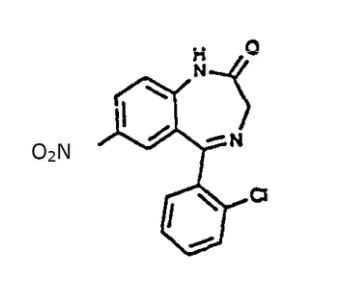
Molecular Formula: C15H10ClN3O3
Molecular Weight : 315.72
Description: clonazepam is an off-white to light yellow crystalline powder, with a faint odor, and is insoluble in water at 20°C. The pH of clonazepam is between 5.5 and 6.2 in 1
% aqueous suspension and the pKas values are 10.5 and 1.6.
COMPOSITION
ACCEL-CLONAZEPAM (clonazepam) tablets contain:
* clonazepam, USP
Nonmedicinal Ingredients:
* lactose, NF
* pregelatinized starch, NF
* magnesium stearate, NF
* colours (FD&C & D&C)
FD&C Yellow #6 lake 15 %;
FD&C Blue # 2 aluminum lake 12% and D&C Yellow #10
Aluminum Lake 17%
Stability and Storage Recommendations
ACCEL-CLONAZEPAM (clonazepam) tablets should be stored in air-tight, light-resistant containers at controlled room temperature (15-30°C). ACCEL-CLONAZEPAM tablet have an expiration date of 2 years following the date of manufacture.
AVAILABILITY
Each round, biconvex, orange tablet scored on one side and embossed C31 on the other side contains 0.5 mg clonazepam, USP. Bottles of 100 and 500.
Each round, biconvex, green tablet scored on one side and embossed C32 on the other side contains 1.0 mg clonazepam, USP. Bottles of 100 and 500.
Each round, biconvex, white, tablet scored on one side and embossed C33 on the other side contains 2.0 mg clonazepam, USP. Bottles of 100 and 500.
INFORMATION TO THE CONSUMER
The drug you have been prescribed by your physician is called ACCEL-CLONAZEPAM. Its chemical name is clonazepam and it belongs to the drug family of benzodiazepines.
Description
Benzodiazepines belong to the group of medicines called central nervous system (CNS)
depressants, medicines that slow down the nervous system. ACCEL-CLONAZEPAM is used to treat certain convulsive (seizure) disorders, such as epilepsy.
Before Using ACCEL-CLONAZEPAM
Before you start taking ACCEL-CLONAZEPAM, tell your physician if you have ever had
* allergic reactions to benzodiazepines, foods, preservatives, dyes or any other substances.
Tell your physician if you are
* pregnant (studies in animals have shown that clonazepam cause birth defects or other problems, including death of the animal fetus. Too much use of benzodiazepines during pregnancy may cause the baby to become dependent on the medicine. This may lead to withdrawal side effects after birth. Also, use of benzodiazepines during pregnancy, especially during the last weeks, may cause drowsiness, slow heartbeat, shortness of breath, or troubled breathing in the newborn infant.
* breast-feeding - benzodiazepines may pass into the breast milk and cause drowsiness, slow heartbeat, shortness of breath, or troubled breathing in nursing babies of mothers taking this medicine.
Tell your physician if you take other medicines. If you take a benzodiazepine, it is important that your physician knows if you are taking the following medication/s:
* Central nervous system depressants. The effects of either of these medicines or
benzodiazepines may be increased. Tell your physician if you have any other medical condition, especially:
* alcohol abuse (or history of)
* drug abuse or dependence (or history of)
* brain disease
* difficulty in swallowing
* emphysema, asthma, bronchitis, or other chronic lung disease
* glaucoma
* hyperactivity
* mental depression
* myasthenia gravis
* porphyria
* sleep apnea (temporarily stopping of breathing during sleep)
* epilepsy or history of seizures (although clonazepam is used in treating epilepsy, starting or suddenly stopping treatment with this medication may increase seizures)
* kidney or liver disease (higher blood levels of clonazepam may result, increasing the chance of side effects)
Proper Use of ACCEL-CLONAZEPAM
Take ACCEL-CLONAZEPAM as prescribed only. Do not change the dosage without consulting with your physician first.
If you are taking ACCEL-CLONAZEPAM regularly and you miss a dose, take it right away if you remember within an hour or so of the missed dose. However, if you do not remember until later, skip the missed dose and go back to your regular dosing schedule. DO NOT DOUBLE
DOSES.
STORAGE OF ACCEL-CLONAZEPAM
* keep medicine out of reach of children
* store away from heat and direct light
* do not store in the bathroom, near the kitchen sink, or in other damp places.
* do not keep outdated medicine or medicine no longer needed. Be sure that any discarded medicine is out of the reach of children.
SIDE EFFECTS OF ACCEL-CLONAZEPAM
Along with its needed effects, a medicine may cause some unwanted effects. Although not all of these side effects may occur, if they do occur consult with your physician:
confusion or mental depression; seizures; low blood pressure. Symptoms of overdose are continuing confusion, severe drowsiness, shakiness, slow heartbeat, shortness of breath or troubled breathing, slow reflexes, continuing slurred speech, staggering, severe weakness.
PHARMACOLOGY
Benzodiazepines in clinical use exert qualitatively similar effects. However, important quantitative differences in their pharmacodynamic spectra and pharmacokinetic properties have led to varying patterns of therapeutic application. There is reason to believe that a number of distinct mechanisms of action contribute in varying degrees to the sedative-hypnotic, muscle relaxant, anxiolytic, and anticonvulsant effects of the benzodiazepines. The effects of the benzodiazepines virtually all result from actions of these drugs on the CNS. The most prominent of these effects are sedation, hypnosis, decreased anxiety, muscle relaxation, anterograde amnesia, and anticonvulsant activity.
The following table gives an indication of the relative potency of clonazepam and other anticonvulsants in various experimental tests in animals.
Convulsant Test Oral LD50 Values (mg/kg) in Mice and Humans
Drug Max. human
therapeutic Dose (mg/kg)
Metrazol Seizures
Thiosemicarbazide
Seizured
30% Strychnine
Threshold
Maximum Electroshock
Clonazepam 0.40 0.08-0.16 0.73 2.1 8.4 Diazepam 0.43 0.8 - 1.4 3.4 6.2 9.0 Chlordiazepoxide 1.43 - 27.0 22.2 17.2 Phenobarbital 8.5 8.0 -27.0 63.0 37.2 7.3 Trimethadione 25.7 300 770 - 490 DPH 7.7 - 7800 7300 8.7
The pharmacological profile for a given benzodiazepine varies markedly from species to species.
In some species, the subject may become alert before CNS depression is evident. For example, the 7-nitrobenzo-diazepines induce hyperactivity in mice, rats, and monkeys, but not in most other species.
Interestingly, muscle relaxation in cats and anticonvulsant activity against pentylenetetrazol in mice correlate better with the sedative, antianxiety, and hypnotic properties in man than do the actions to suppress motor activity, induce sleep, and release suppressed behavior in experimental animals. Clonazepam is effective in reducing photomyoclonic responses in baboons in doses under 0.5 mg/kg i.m.. However, seizures evoked by local application of benzylpenicillin or strychnine do not respond well to systemic administration of clonazepam. Other CNS effects noted in several species at varying doses include taming, disinhibitory, sedative, ataxic and hypnotic effects.
In the vast majority of studies conducted in vivo or in situ, the local or systemic administration of benzodiazepines reduces the spontaneous or evoked electrical activity of major neurons in all regions of the brain and spinal cord; significant effects can usually be detected at doses that are consistent with those used in man.
A number of issues remain unresolved, including an explanation for the different patterns of effects displayed by some of the benzodiazepines currently in clinical use. For example, clonazepam produces less sedative-hypnotic effect for a given degree of protection against seizures than other members of the group. One possibility is the existence of variant sites of action. Although different types of high-affinity binding sites for benzodiazepines have been detected in the brain, it has not been possible to assign any particular action to a given site.
Nevertheless, there is evidence for several different forms of a subunit of the GABA-regulated chloride channel, the presumed site of benzodiazepine action, and this possibility remains open.
Another view ascribes differing patterns of pharmacological effects to the partial agonistic properties of a given agent. In this view, sedative-hypnotic effects require a relatively high degree of occupancy of sites by a full agonist, and the relatively low sedative efficacy of some benzodiazepines, including clonazepam, is attributed to the fact that they are partial agonist. In support of this is the growing list of experimental compounds that have a limited ability to enhance the binding and electrophysiological actions of GABA as well as to produce sedation, and that also antagonize the sedative-hypnotic effects of presumed full-agonist benzodiazepines.
Blood pressure in dogs is lowered and vascular responses to serotonin and noradrenaline are inhibited by clonazepam in doses between 1 and 4 mg/kg intravenously. There is a slight myocardial depressant action at these doses. Other pharmacologic effects occur only at higher doses in which gross CNS depressant effects are observed.
Metabolic pathways are similar in several species and the chief metabolites, 7-amino and 7-acetyl amino derivatives, have been isolated in urine of rats, dogs and man. Hydroxylation also occurs as a prominent metabolic pathway. Metabolites are excreted primarily in urine, approximately 50% of an oral dose is excreted within 7 days. Excretion of the drug plus metabolites increases with increasing doses.
TOXICITY
Male and female animals, mice (ten per dose level), rats (ten per dose level) and rabbits (three per dose level) were administered clonazepam orally, with the exception of intraperitoneal administration to one group of mice. The animals were observed for five days and the results tabulated as shown below:
Acute Toxicity of Clonazepam
Species Method of Administration LD50
(mg/kg)
mice i.p. > 800
oral > 4,000
intravenous 2.85±0.1
rats
-adult oral > 4,000
-neonate oral 550±120
rabbit oral > 2,000
Acute Toxicity of Clonazepam: Rats were fed clonazepam in the diet for 18 months in concentrations corresponding to 5, 20 and 50 mg/kg/day. No gross drug-related toxicity was evident. Slight and transient elevations in liver function tests appeared in high dose animals corresponding to increases in liver weights, but these findings were not accompanied by histologic evidence of liver damage.
A study in dogs was conducted in which animals received clonazepam in doses of 3, 10 and 30 mg/kg/day for 12 months. Weight gain was reduced in mid- and high-dose animals compared to controls. The following significant changes in laboratory values were noted: a decrease in hemoglobin and hematocrit values in mid- and high-dose animals, a decreased albumin/globulin ratio due to decreased albumin and increased globulins in high-dose animals, increased alkaline phosphatase and bilirubin values in high-dose animals. There was a significant increase in liver weight in high dose animals.
TERATOGENICITY
Five reproductive experiments were conducted in rats and three in rabbits with doses of clonazepam varying from 1 to 100 mg/kg/day in the former and 0.2 to 10 mg/kg/day in the latter species. The drug was administered for various periods of time prior to, during and/or after gestation in the various investigations.
In a two-litter study in rats, conception and off-spring survival were reduced, possibly because of excessive tranquilization. Five off-spring in one litter, whose parents had received 100 mg/kg/day, were born with various degrees of clubbing and webbing of the hind paws.
Similar anomalies were seen in two rabbit studies. Seven of eight fetuses in one litter, whose dam had received 10 mg/kg/day between gestation day 7 and 18, had shortened fore and/or hind legs with syndactyly. In a repeat experiment, three of ten fetuses in one litter and ten of ten in another litter, whose dams had received 0.2 or 5 mg/kg/day respectively between gestation days
7 to 18, had similar hind leg lesions; nine of the former fetuses and ten of the latter also had cleft palates. None of the fetuses whose dams had received 1 or 10 mg/kg/day during this period had similar anomalies. The incidences of cleft palate usually are considerably lower in these rabbits.
BIBLIOGRAPHY
- 1.
American Hospital Formulary Service: Benzodiazepines: Clonazepam. In: AHFS 95
Drug Information. 1436-1438
- 2.
Clonazepam. In: The Pharmaceutical Codex; 11th Edition, The Pharmaceutical Press
1979:203-204
- 3.
DeVane C.L., Ware M.R. and Lydiard R.B. Pharmacokinetics, pharmacodynamics, and treatment issues of benzodiazepines: Alprazolam, Adinazolam, and Clonazepam.
Psychopharmacology Bulletin, 1991; 27, 4: 463-473
- 4. Greenblatt D.J., Miller L.G. and Shader R.I. Clonazepam pharmacokinetics, brain uptake, and receptor interactions. J Clin Psychiatry 1987; 48, 10(Suppl): 4-9
- 5.
Rall T.W. Hypnotics and Sedatives; Ethanol. Chapter 17 in: Goodman and Gilman's The
Pharmacological Basis of Therapeutics. 8th Edition Eds. Goodman Gilman A., Rall T.W.,
Nies A.S. and Taylor P. Pergamon Press 1990: 345-382
- 6.
Rall R.W. and Scheifer L.S. Drugs effective in the therapy of the epilepsies. Chapter 19 in: Goodman and Gilman's The Pharmacological Basis of Therapeutics. 8th Edition Eds.
Goodman Gilman A., Rall T.W., Niew A.S. and Taylor P. Pergamon Press 1990: 436-462
- 7. Treiman D.M. Pharmacokinetics and clinical use of benzodiazepines in the management of status epilepticus. Epilepsia 1989; 30 (Suppl. 2): S4-S10
- 8.
Benzodiazepines Systemic. In: USP DI 1995, 15th Edition Advice for the Patient. 1995;
Vol. II: 389-396
- 9. Product Monograph: RIVOTRIL Roche (Clonazepam): 1-11