


Patient Medication Information: uses, side effects, how to take - AG-Moxifloxacin (Angita Pharma, 400 mg)
Serious Warnings and Precautions
Fluoroquinolone antibiotics, like AG-MOXIFLOXACIN, are related to disabling and possibly long lasting effects such as:
- inflamed tendon (tendonitis), tendon rupture.
- nerve damage (peripheral neuropathy).
problems in the brain such as:
- convulsions
- nervous breakdown
- confusion
- and other symptoms
Fluoroquinolone antibiotics, like AG-MOXIFLOXACIN
- have lengthened the heartbeat (QT prolongation).
- have led to serious allergic reactions, including death
- may be related to increased tendonitis (inflamed tendon)
- may worsen myasthenia gravis (a muscle disease)
- may lead to seizures and nervous breakdowns. Tell your doctor if you have brain or spinal cord problems (such as epilepsy)
- may cause liver injury which may lead to death
For further information and symptoms see:
- the “To help avoid side effects and ensure proper use,…” section
- the “What are possible side effects from using AG-MOXIFLOXACIN?” section
Talk to your doctor to see if AG-MOXIFLOXACIN is right for you.
What is AG-MOXIFLOXACIN used for?
Your doctor has prescribed AG-MOXIFLOXACIN because you have a certain type of bacterial infection.
Antibacterial drugs like AG-MOXIFLOXACIN treat only bacterial infections. They do not treat viral infections such as the common cold. Although you may feel better early in treatment,
AG-MOXIFLOXACIN should be used exactly as directed. Misuse or overuse of AG- MOXIFLOXACIN could lead to the growth of bacteria that will not be killed by AG- MOXIFLOXACIN (resistance). This means that AG-MOXIFLOXACIN may not work for you in the future. Do not share your medicine.
How does AG-MOXIFLOXACIN work?
AG-MOXIFLOXACIN is an antibiotic. It kills many of the types of bacteria that can infect the lungs, sinuses, abdomen, and skin.
What are the ingredients in AG-MOXIFLOXACIN Tablets?
Medicinal ingredients: 400 mg of moxifloxacin as moxifloxacin hydrochloride.
Non-medicinal ingredients: cellulose microcrystalline, croscarmellose sodium, magnesium stearate, mannitol, silica colloidal anhydrous, macrogol 40000, talc, polyvinyl alcohol, titanium dioxide, FD & C Yellow # 6/Sunset Yellow FCF Aluminum Lake, Ponceau 4R Aluminum Lake, FD&C Blue # 2/Indigo Camine Aluminum Lake and purified water.
AG-MOXIFLOXACIN Tablets come in the following dosage forms:
AG-MOXIFLOXACIN tablets are available as oblong, convex-shaped, dull red film-coated tablets containing 400 mg moxifloxacin (as hydrochloride). Oblong, convex-shaped, dull red film- coated tablets engraved “Moxi” on one side and “400” on the other
Do not use AG-MOXIFLOXACIN if:
- you are allergic to AG-MOXIFLOXACIN (moxifloxacin hydrochloride) or other fluoroquinolone antibiotics.
- you are allergic to any other ingredient in the formulation (see “What are the ingredients in AG- MOXIFLOXACIN Tablets?”).
To help avoid side effects and ensure proper use, talk to your healthcare professional before you take AG-MOXIFLOXACIN. Talk about any health conditions or problems you may have, including if you:
- have or have a family history of irregular heart rhythm (such as QT prolongation).
- have or have had heart problems such as heart failure, an irregular heartbeat, or a slow heartbeat.
- have low potassium blood levels (see “The following may interact with AG- MOXIFLOXACIN.”)
- have a history of seizures.
are pregnant, planning to become pregnant, or if you are breast feeding.
- are less than 18 years of age.
- have a history of tendon problems (such as pain, swelling or rupture of a tendon) related to the use of fluoroquinolone antibiotics.
- have myasthenia gravis (a muscle disease).
- have diabetes as AG-MOXIFLOXACIN may affect blood sugar levels. AG- MOXIFLOXACIN may also affect blood sugar levels in those without diabetes.
- have an aortic aneurysm which is an abnormal bulge in a large blood vessel called the aorta.
- have or if anyone in your family has a condition called aneurysm disease which is an abnormal bulge in any large blood vessel in the body.
- have an aortic dissection which is a tear in the wall of the aorta.
- have any of the following conditions: Marfan syndrome, vascular Ehlers-Danlos syndrome, Takayasu arteritis, giant cell arteritis or Behcet’s disease.
- have high blood pressure.
- have atherosclerosis, which is a hardening of your blood vessels.
Other warnings you should know about:
Blood Sugar Changes
Medicines like AG-MOXIFLOXACIN can cause blood sugar levels to rise and drop in patients with diabetes. Serious cases of hypoglycemia (low blood sugar levels) that caused coma or death have been seen with medicines like AG-MOXIFLOXACIN. If you have diabetes, check your blood sugar levels often while taking AG-MOXIFLOXACIN.
While taking AG-MOXIFLOXACIN:
- Avoid too much sunlight or artificial ultraviolet light (such as sunlamps).
- Contact your doctor if a sunburn or rash occurs.
Do not drive or use machinery if you feel dizzy or lightheaded.
Quinolones, including AG-MOXIFLOXACIN has been associated with an enlargement or “bulge” of a large blood vessel called the aorta (aortic aneurysm) and a tear in the aorta wall (aortic dissection).
The risk of these problems is higher if you:
- are elderly
- have or anyone in your family has had aneurysm disease
- have an aortic aneurysm or an aortic dissection
- have any of the following conditions: Marfan syndrome, vascular Ehlers-Danlos syndrome,
Takayasu arteritis or giant cell arteritis or Behcet’s disease
- have high blood pressure or atherosclerosis
- If you experience sudden, severe pain in your abdomen, chest or back, a pulsating sensation in your abdomen, dizziness or loss of consciousness, get immediate medical help.
Tendon problems can happen within the first 48 hours of treatment.

Tell your healthcare professional about all the medicines you take, including any drugs, vitamins, minerals, natural supplements or alternative medicines.
The following may interact with AG-MOXIFLOXACIN:
- Antacids or vitamin/mineral supplements
- Nonsteroidal anti-inflammatorydrugs (NSAIDs)
- Antidiabetic medicines (such as, insulin, glyburide, glibenclamide)
- Quinidine, procainamide, amiodarone, sotalol, cisaprideb, erythromycin, antipsychotics, tricyclic antidepressants, diuretics (furosemide, hydrochlorothiazide).
bno longer marketed in Canada
How to take AG-MOXIFLOXACIN:
- You must take AG-MOXIFLOXACIN exactly as prescribed by your doctor. YOU SHOULD NOT INCREASE THE PRESCRIBED DOSE.
You can take AG-MOXIFLOXACIN with or without food.
- You should drink lots of fluids while taking AG-MOXIFLOXACIN.
- If your doctor decides to stop the treatment, dispose of all unused AG-MOXIFLOXACIN tablets.
Usual dose:
- Take one 400 mg AG-MOXIFLOXACIN tablet once a day.
- Swallow each AG-MOXIFLOXACIN tablet whole with a drink of water. Do not crush or chew AG-MOXIFLOXACIN tablets.
- If you are taking antacids or vitamin/mineral supplements which contain magnesium or aluminium, take AG-MOXIFLOXACIN at least 4 hours before or 8 hours after taking the supplement or antacid.
- Your doctor has decided on the best dose for you and for how long based on your needs.
- The usual length of treatment with AG-MOXIFLOXACIN is 5-10 days. IT IS IMPORTANT TO COMPLETE THE FULL LENGTH OF TREATMENT, EVEN IF YOU BEGIN TO FEEL BETTER.
Overdose:
Missed Dose:
If you forget to take your tablet you should take it as soon as you remember on the same day. If you do not take your tablet on one day, take your normal dose (one tablet) on the next day. Do not take a double dose to make up for a forgotten dose. If you are unsure about what to do, consult your healthcare professional.
What are possible side effects from using AG- MOXIFLOXACIN?
All medicines, including AG-MOXIFLOXACIN, can cause side effects, although not everyone gets them.
These are not all the possible side effects you may feel when taking AG-MOXIFLOXACIN. If you have any side effects not listed here or if conditions worsen or do not improve then:
- contact your healthcare professional.
see the “To help avoid side effects and ensure proper use, …” section. Stop taking AG-MOXIFLOXACIN and contact your doctor if:
- a)
you have symptoms of an allergic reaction such as:
- rash, hives, blistering or other skin reaction
- swelling of the mouth, throat, limbs
- difficulty breathing
- irregular or rapid heartbeat, or fainting spells
- b)
you have pain, swelling or rupture of a tendon. These side effects may last more than 30 days. You should:
- rest
- avoid physical exercise
- c)
you have neuropathy (damage to the nerves) with symptoms such as:
- pain, burning, tingling, numbness or weakness
- d)
you have severe diarrhea (bloody or watery) with or without:
- fever
- stomach pain or tenderness
- a)
You may have Clostridium difficile colitis (bowel inflammation). See your doctor right away.
Other side effects include:
- your eyesight worsens or changes. These side effects may last more than 30 days .See your doctor or eye specialist right away.
- nausea, dizziness
worsening of myasthenia gravis (a muscle disease) with symptoms such as:
- weakness
- difficulty walking, swallowing, drooping eyelids
Do not use AG-MOXIFLOXACIN if you have this condition.
mental problems such as:
- confusion, headache, shaking
- hallucinations, depression, agitation
- difficulty sleeping, anxiety, nervousness, suicidal thoughts These side effects may last more than 30 days.
Contact your doctor if you have suicidal thoughts.
Self-Limiting Side Effects:
- feeling lightheaded
- insomnia (difficulty sleeping)
- nightmares
If any of these affect you severely, tell your doctor or pharmacist.
Serious Side Effects and What to do About Them
| Symptom/ Effect | Talk to your healthcare professional | Stop taking drug and get immediate medical help | ||||||||||
| Only if severe | In all cases | |||||||||||
| RARE | ||||||||||||
| Irregular heartbeat or fainting spells | ✓ | |||||||||||
Mental health problems:
| ✓ | |||||||||||
Neurological problems:
| ✓ | |||||||||||
| Serious Side Effects and What to do About Them | ||||||||||||
| Symptom/ Effect | Talk to your healthcare professional | Stop taking drug and get immediate medical help | ||||||||||
| Only if severe | In all cases | |||||||||||
Nervous system side effects:
| ✓ | |||||||||||
Rise in the pressure within your skull:
| ✓ | |||||||||||
| Tendon pain, inflammation, or rupture (these side effects may last more than 30 days) | ✓ | |||||||||||
Symptoms of an allergic reaction (which may lead to death):
| ✓ | |||||||||||
| Liver problems with symptoms such as yellowing of the skin and/or eyes, nausea, abdominal pain, dark urine, and pale stools | ✓ | |||||||||||
Symptoms of a severe bowel condition (Clostridiumdifficile colitis):
| ✓ | |||||||||||
| Serious Side Effects and What to do About Them | ||||||||||||
| Symptom/ Effect | Talk to your healthcare professional | Stop taking drug and get immediate medical help | ||||||||||
| Only if severe | In all cases | |||||||||||
| VERY RARE | ||||||||||||
Hypoglycemia (low blood sugar) such as:
| ✓ | |||||||||||
| UNKNOWN | ||||||||||||
Aortic aneurysm (abnormal bulge in a large blood vessel called the aorta) /Aortic dissection (tear in the wall of the aorta):
| ✓ | |||||||||||
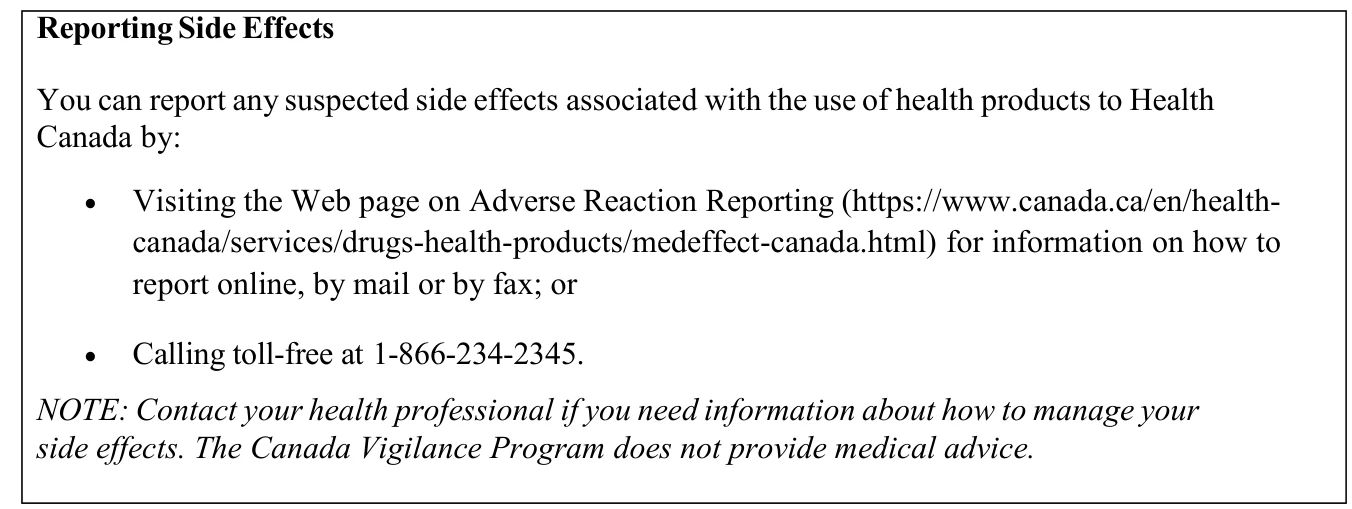
If you have a troublesome symptom or side effect that is not listed here or becomes bad enough to interfere with your daily activities, talk to your healthcare professional.
Storage:
AG-MOXIFLOXACIN tablets should be stored:
- at room temperature (15°C - 30°C)
- in a tightly closed container away from heat and direct light.
- Do not freeze the tablets.
Keep out of reach and sight of children.
If you want more information about AG-MOXIFLOXACIN:
- Talk to your healthcare professional
- Find the full product monograph that is prepared for healthcare professionals and includes this Patient Medication Information by visiting the (the https://health-products.canada.ca/dpd- bdpp/index-eng.jsp);; the manufacturer’s website (www.agpharma.com) or by calling the 1- 866-399-9091
1310 rue Nobel,
Boucherville Québec, Canada, J4B 5H3