


Patient Medication Information: uses, side effects, how to take - Quinsair
What is QUINSAIR used for?
QUINSAIR is used to treat adults with cystic fibrosis who have bacterial chest infections with Pseudomonas aeruginosa (see “What is Pseudomonas aeruginosa?” section below).
Serious Warnings and Precautions
Quinolone antibiotics, like QUINSAIR, are related to disabling and possibly long lasting effects such as:
- swollen or inflamed tendon (tendinitis), tendon rupture. Tendons are flexible bands of tissue that connect muscles to bones.
- nerve damage (peripheral neuropathy)
problems in the brain such as:
- seizures
- nervous breakdown
- confusion
- and other symptoms
Quinolone antibiotics, like QUINSAIR:
- have caused serious changes in heart rhythm (QT prolongation)
- have led to serious allergic reactions including death
- may worsen myasthenia gravis (a muscle disease)
QUINSAIR should not be used during pregnancy, as the bone development of the fetus may be affected.
For further information and symptoms see :
- the “To help avoid side effects and ensure proper use…” section
- the “Other warnings you should know about” section
- the “Serious side effects and what to do about them” table
Talk to your doctor to see if QUINSAIR is suitable for you.
Antibacterial drugs like QUINSAIR treat only bacterial infections. They do not treat viral infections such as the common cold. Although you may feel better early in treatment, QUINSAIR should be used exactly as directed. Misuse or overuse of QUINSAIR could lead to the growth of bacteria that will not be killed by QUINSAIR (resistance). This means that QUINSAIR may not work for you in the future. Do not share your medicine.
How does QUINSAIR work?
QUINSAIR contains a medicine called levofloxacin. Levofloxacin belongs to the quinolone class of antibiotics. QUINSAIR is breathed (inhaled) directly into the lungs so that the antibiotic can kill the Pseudomonas aeruginosa bacteria causing the infection. This helps to fight chest infection and improve breathing in people with cystic fibrosis.
What is Pseudomonas aeruginosa?
Pseudomonas aeruginosa are very common bacteria that infect the lungs of nearly all patients with cystic fibrosis at some time during their life. If the infection is not properly controlled it will continue to damage the lungs, causing further problems.
What are the ingredients in QUINSAIR?
Medicinal ingredients: Levofloxacin (as levofloxacin hemihydrate)
Non-medicinal ingredients: Magnesium Chloride and Water for Injection During manufacturing of QUINSAIR levofloxacin forms a complex with magnesium.
QUINSAIR comes in the following dosage forms:
QUINSAIR is a clear, pale yellow solution.
QUINSAIR comes in a single use, ready-to-use plastic ampoule. Each plastic ampoule contains 2.4 mL of solution.
Each ampoule contains 240 mg of levofloxacin (as levofloxacin hemihydrate). Each 28 day pack of QUINSAIR contains:
- one box of 56 ampoules (14 foil sachets, each sachet containing 4 ampoules)
- a Consumer Information Leaflet
one box holding a ZIRELA® Nebulizer Handset with the Manufacturer's Instruction for
Use.
Do not use QUINSAIR if:
You are allergic to:
- levofloxacin or to any other quinolone antibiotics such as ofloxacin, ciprofloxacin, moxifloxacin hydrochloride, gatifloxacin or norfloxacin
any of the non medicinal ingredients (see “What are the ingredients in
QUINSAIR?”).
If you’ve had an allergic reaction to any quinolone, you should discuss this with your healthcare professional.
You have ever had any problems with your tendons while taking another quinolone antibiotic such as:
- swelling of the tendon (tendinitis)
- tendon rupture (tearing).
To help avoid side effects and ensure proper use, talk to your healthcare professional before you take QUINSAIR. Talk about any health conditions or problems you may have, including if you:
- Have severe kidney problems.
- Have liver problems.
- Have nerve problems.
- Have rheumatoid arthritis (RA).
- Have irregular heart rhythm (such QT prolongation).
- Have heart problems such as low heart beat (bradycardia) or have had a heart attack.
- Have diabetes as levofloxacin can increase or decrease blood glucose levels.
- Have epilepsy or a history of seizures.
- Have myasthenia gravis (a muscle disorder).
- Have a glucose 6 phosphate dehydrogenase deficiency.
- Have a history of tendon problems (such as pain, swelling or rupture of a tendon) while taking another quinolone antibiotic. QUINSAIR should not be used in patients who have a history of tendon problems (see “Do not use QUINSAIR if” section.
- Are less than 18 years of age.
- Are pregnant, planning to become pregnant, breastfeeding or planning to breastfeed.
- Have an aortic aneurysm which is an abnormal bulge in a large blood vessel called the aorta.
- Have or if anyone in your family has a condition called aneurism disease which is an abnormal bulge in any large blood vessel in the body.
- Have an aortic dissection which is a tear in the wall of the aorta.
- Have any of the following conditions: Marfan syndrome, vascular Ehlers-Danlos syndrome, Takayasu arteritis, giant cell arteritis, or Behcet’s disease.
- Have high blood pressure.
- Have atherosclerosis, which is a hardening of your blood vessels.
Other warnings you should know about:
While taking QUINSAIR:
Quinolones, including QUINSAIR, have been associated with tendon rupture or swelling of the tendon (tendinitis).
- These problems may happen in the tendons in your shoulder, your hand, back of your ankle (Achilles tendon) or in other parts of your body.
The risk of getting tendon problems while you take quinolones is higher if you:
- are over 60 years of age
- are taking a corticosteroid medicine, also commonly referred to as a steroid
- have received kidney, heart or lung transplants.
- Tendon problems can also happen if you do not have the risks listed above.
Other reasons that can increase your risk of tendon problems may include:
- physical activity or exercise
- condition where the kidneys are not working well enough (kidney failure)
tendon problems in the past, such as in people with rheumatoid arthritis
(RA).
- Tendon problems can happen during your treatment or for up to several months after you have finished taking your quinolone.
If you experience inflammation of a tendon causing pain, stiffness and/or swelling in your joints (tendinitis) or tendon rupture, you should:
- stop taking QUINSAIR
- rest (avoid exercise and using the affected area)
- call your healthcare professional.
See the “Serious side effects and what to do about them” table below.
QUINSAIR may make your skin become more sensitive to sunlight than it is normally. To protect your skin from sunburn, you should:
- Wear protective clothing and sunglasses
- Limit your time in the sun especially between 11 a.m. and 4 p.m.
- Use sunscreen
- Avoid using tanning beds or sunlamps.
If your skin becomes reddened, swollen, or blistered, like a sunburn, call your healthcare professional right away.
- Stop taking QUINSAIR at the first sign of a skin rash and call your healthcare professional. Skin rash may be a sign of a more serious reaction to QUINSAIR (see the “Serious side effects and what to do about them” table below).
Do not drive, operate machinery, or do other activities that require mental alertness or coordination if you feel tired, dizzy or lightheaded.
- If you notice any changes in your eyesight or any other problems with your eyes, call your healthcare or eye specialist right away.
Blood Sugar Changes
- Medicines like QUINSAIR can cause blood sugar levels to rise and drop in patients with diabetes. Serious cases of hypoglycemia (low blood sugar levels) that caused coma or death have been seen with medicines like QUINSAIR. If you have diabetes, check your blood sugar levels often while taking QUINSAIR.
Fluoroquinolones, including QUINSAIR (levofloxacin), have been associated with an enlargement or “bulge” of a large blood vessel (aortic aneurysm or large vessel peripheral aneurysm) and aortic dissection (a tear in the aorta wall)
The risk of these problems is higher if you:
- are elderly
- have or anyone in your family has had aneurism disease
- have an aortic aneurysm or an aortic dissection
have any of the following conditions: Marfan syndrome, vascular Ehlers-
Danlos syndrome, Takayasu arteritis or giant cell arteritis or Behcet’s disease
- have high blood pressure or atherosclerosis.
- If you experience sudden, severe pain in your abdomen, chest or back, a pulsating sensation in your abdomen, dizziness or loss of consciousness, get immediate medical help.
Tell your healthcare professional about all the medicines you take, including any drugs, vitamins, minerals, natural supplements or alternative medicines.
The following may interact with QUINSAIR:
Tell your doctor if you are taking any of the following:
- Theophylline (a medicine used to treat breathing problems).
Non-steroidal anti-inflammatory medicines (NSAIDs) such as ibuprofen, naproxen, etc.
NSAID medicines are used for pain and swelling. Taking an NSAID while you take QUINSAIR or other quinolones may increase your risk of central nervous system effects and seizures.
- Probenecid (a medication used to prevent gout).
- Cimetidine (a medicine used to treat stomach problems).
- Blood thinners such as warfarin.
- Cyclosporine (a medication used after organ transplants).
- Tricyclic antidepressants or antipsychotics (medicines used to treat mental illness).
- Medicines to control your heart rate or rhythm (antiarrhythmics).
- Macrolide antibiotics such clarithromycin or erythromycin.
Ask your healthcare professional if you are not sure if any of your medicines are listed above.
Keep a list of your medicines and show it to your healthcare professional when you get a new medicine.
How to take QUINSAIR:
- QUINSAIR is administered using an inhaler called the ZIRELA® Nebulizer Handset. This inhaler is only designed for use with QUINSAIR. The ZIRELA® Nebulizer Handset consists of an Aerosol Head connected to an eBase or an eFlow® rapid Controller. The eBase Controller provides the energy to the Aerosol Head to make the medicine easy to breathe in. You should not use QUINSAIR with any other type of handset or aerosol head.
- The solution in the ampoule should be clear and yellow. Do not use the solution if it is cloudy or if particles appear in this solution.
Carefully read the instructions for use that are provided with your ZIRELA® Nebulizer
Handset before using it for the first time (see the step-by-step Instructions in the “Preparing the Nebulizer System to take QUINSAIR” section below).
- Drink plenty of water or liquids during QUINSAIR therapy to remain well hydrated.
Usual adult dose:
- Inhale the contents of one ampoule (240 mg levofloxacin) twice daily in alternating cycles of 28 days “on treatment” followed by 28 days “off treatment”. It takes about 5 minutes to take the medicine using the inhaler (ZIRELA® Nebulizer).
- Inhaling QUINSAIR at the same time each day will help you remember when to take your medicine. Take one ampoule in the morning and one ampoule in the evening. It is best to leave close to 12 hours between your doses.
- It is important that you keep using the product twice a day during your 28 days on treatment and that you keep to the 28-days on, 28 days off cycle.
- If you experience breathing difficulties after taking QUINSAIR, your doctor may prescribe you an inhaler containing a bronchodilator medicine (e.g. salbutamol). Inhale this medicine at least 15 minutes or up to 4 hours before your next dose of QUINSAIR.
If you are taking several different inhaled treatments and other therapies for cystic fibrosis, it is recommended that you take your medicines in the following order:
- 1st Bronchodilators
- 2nd Dornase alfa
- 3rd Airway clearance techniques
- 4th QUINSAIR
- 5th Inhaled steroids
Preparing the Nebulizer System to take QUINSAIR
Keep the ZIRELA® Instructions for Use in a safe place as they give full details on assembling the device.
- 1) Make sure that the ZIRELA® Nebulizer Handset is on a flat and stable surface.
- 2)
Squeeze all of the contents of one ampoule into the medicine reservoir of the ZIRELA®
Nebulizer Handset (Figure 1). Ensure that you completely empty the ampoule, gently tapping it against the side of the reservoir if necessary.
Figure 1
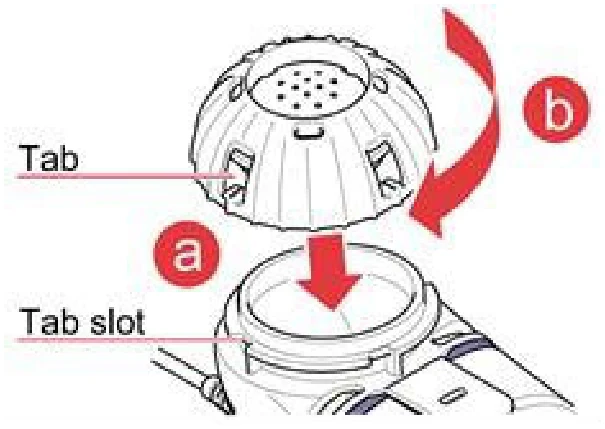
- 3) Close the medicine reservoir by aligning the tabs of the medicine cap with the slots of the
reservoir (a). Press down and turn the cap clockwise as far as it will go (b, Figure 2). 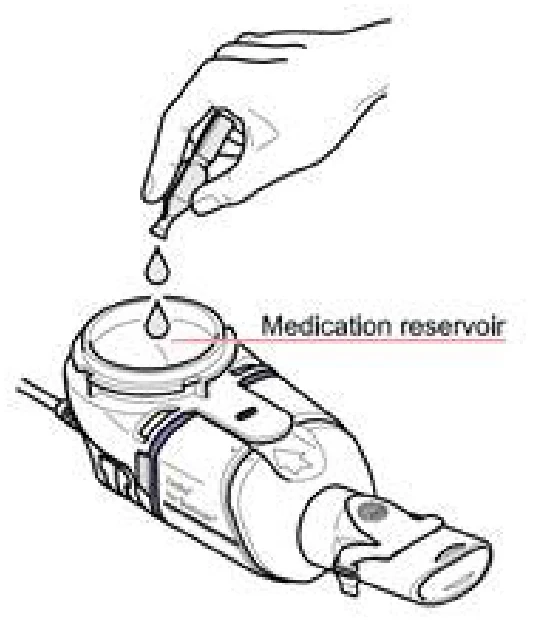
Figure 2
How do I use the ZIRELA® Nebulizer System?
- 1) When you start your treatment, sit in a relaxed, upright position.
- 2) Hold the handset level, press and hold the on/off button on the controller for a few seconds. You will hear one ‘beep’ and the status light will turn green.
- 3) Keep the handset in a level position during use.
- 4)
After a few seconds, a mist will begin to flow into the aerosol chamber of the ZIRELA®
Nebulizer Handset. If the mist does not begin to flow, please refer to the ZIRELA® Instructions for Use for help.
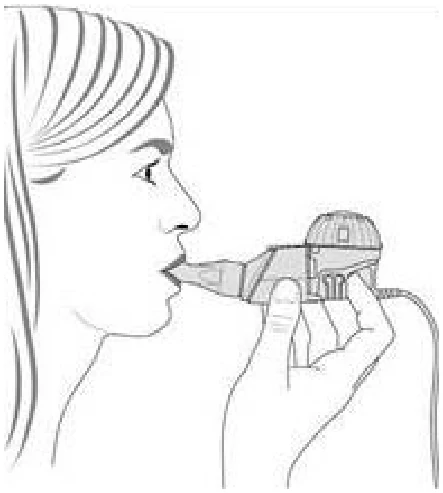
- 5) Keeping the handset level, place the mouthpiece in your mouth and close your lips around it (Figure 3).
Figure 3
- 6) Breathe normally (inhale and exhale) through the mouthpiece. Try not to breathe through your nose. Continue to inhale and exhale comfortably until the treatment is finished. It takes about 5 to 7 minutes to inhale the medicine using the ZIRELA® Nebulizer.
- 7)
When all of the medicine has been delivered, you will hear two ‘beeps’, which means the
treatment is complete.
- 8) Once complete, open the medicine cap to ensure all of the medicine has been used. A few drops of medicine may remain at the bottom of the reservoir at the end of treatment. This is ok. However, if there are more than a few drops left, replace the medicine cap and restart treatment.
- 9)
Once treatment is complete, disconnect the controller and take apart the ZIRELA®
Nebulizer Handset for cleaning and disinfecting. The Instructions for Use will give full details on cleaning and disinfecting.
What if I need to stop my treatment before I’ve finished?
If for any reason you must stop the treatment before it's finished, press and hold the controller’s on/off button for one second. After it has completely turned itself off and when you are ready to restart, press and hold the on/off button for one second again. Treatment will restart. You must inhale and exhale through the mouthpiece as before.
How and when do I replace the ZIRELA® Nebulizer Handset?
One nebulizer handset should be used for one 28 day treatment course. Please refer to the Instructions for Use for cleaning and storage advice.
Overdose:
Accidental overdose by inhalation use is highly unlikely.
If you think you have taken too much QUINSAIR, contact your healthcare professional, hospital emergency department or regional Poison Control Centre immediately, even if there are no symptoms.
Missed Dose:
If you forget to take a dose, take it as soon as you remember as long as it is close to 12 hours before inhaling the next dose. However if it is nearly the time for your next dose, skip the missed dose.
Do not inhale the contents of more than one ampoule to make up for a missed dose.
What are possible side effects from using QUINSAIR?
These are not all the possible side effects you may feel when taking QUINSAIR. If you experience any side effects not listed here, contact your healthcare professional. Please also see the Serious Warnings and Precautions box and “Other warnings you should know about” section above
Like all medicines, QUINSAIR can cause side effects, although not everybody gets them.
Very common side effects (affecting more than 10 out of 100 patients) include:
- Abnormal sense of taste
Common side effects (affecting between 1 and 10 patients out of 100) include:
- Cough
- Feeling tired
- Feeling and being sick
- Fever
- Rash
- Fungal infection around vagina
- Changes in the levels of certain substances in your blood
- Joint pain
- Headache
- Nausea
- Vomiting
Uncommon side effects (affecting between 1 and 10 patients out of 1000) include:
- Retching
- Fungal infection of the mouth
Self-Limiting Side Effects
- Feeling lightheaded
- Insomnia (difficulty sleeping)
- Nightmares
Some side effects can be serious.
This is not a complete list of side effects. For any unexpected effects while taking QUINSAIR, contact your doctor or pharmacist.
| Serious side effects and what to do about them | |||
| Symptom / effect | Talk to your healthcare professional | Stop taking drug and get immediate medical help | |
| Only if severe | In all cases | ||
Bronchospasm:
| ✓ | ||
| Coughing up large amounts of blood | ✓ | ||
Heart rhythm changes (QT prolongation)
| ✓ | ||
Tendons Problems:
| ✓ | ||
| Serious side effects and what to do about them | |||
| Symptom / effect | Talk to your healthcare professional | Stop taking drug and get immediate medical help | |
| Only if severe | In all cases | ||
| |||
| Worsening muscle weakness or breathing problems | ✓ | ||
Serious allergic reaction:
| ✓ | ||
Neuropathy (damage or disease of the nerves):
| ✓ | ||
| If you have diabetes and you develop a hypoglycemic (low blood sugar) reaction | ✓ | ||
Hypoglycemia (low blood sugar)
| ✓ | ||
Hyperglycemia (high blood sugar):
| ✓ | ||
Liver problems:
| ✓ | ||
| Bowel infection (Clostridium difficile colitis): | ✓ | ||
| Serious side effects and what to do about them | |||
| Symptom / effect | Talk to your healthcare professional | Stop taking drug and get immediate medical help | |
| Only if severe | In all cases | ||
May happen 2 or more months after you have finished QUINSAIR
| |||
Mental Health Problems:
| ✓ | ||
Neurological Problems:
| ✓ | ||
Rise in the pressure within your skull:
| ✓ | ||
Aortic aneurysm (abnormal bulge in a large blood vessel called the aorta) / Aortic dissection (tear in the wall of the aorta):
| ✓ | ||
If you have a troublesome symptom or side effect that is not listed here or becomes bad enough to interfere with your daily activities, talk to your healthcare professional.
Reporting Side Effects
| You can report any suspected side effects associated with the use of health products to Health | |
| Canada by: | |
| |
| mps/medeff/report-declaration/index-eng.php) for information on how to report online, | |
| by mail or by fax; or | |
| |
NOTE: Contact your health professional if you need information about how to manage your side effects. The Canada Vigilance Program does not provide medical advice.
Storage:
- Keep this medicine out of the sight and reach of children.
- QUINSAIR should be stored at controlled room temperature (15°C to 30°C). • Store in the original package in order to protect from light.
- Do not use QUINSAIR beyond the expiration date embossed on the ampoule. • The ampoules are for single use only. Once opened, use immediately. Any unused product must be discarded.
- Replace any unused, unopened ampoules from the strip back into the sachet to protect them from light and store at controlled room temperature (15°C to 30°C). • Ampoules should be used within 4 days after the opening of the sachet.
If you want more information about QUINSAIR:
- Talk to your healthcare professional.
- Find the full product monograph that is prepared for healthcare professionals and includes this Patient Medication Information by visiting the Health Canada website (http://hc-sc.gc.ca/index-eng.php); the importer’s website www.methapharm.com, or by calling 1-800-287-7686.