


Product Monograph - Ametop Gel 4%
RECENT MAJOR LABEL CHANGES
| 7 WARNINGS AND PRECAUTIONS | 04/2022 |
TABLE OF CONTENTS
Sections or subsections that are not applicable at the time of authorization are not listed.
RECENT MAJOR LABEL CHANGES .......................................................................................... 2
TABLE OF CONTENTS ............................................................................................................ 2
PART I: HEALTH PROFESSIONAL INFORMATION .................................................................... 4
1 INDICATIONS ............................................................................................................. 4
1.1 Pediatrics .................................................................................................................. 4
1.2 Geriatrics .................................................................................................................. 4
2 CONTRAINDICATIONS ................................................................................................ 4
4 DOSAGE AND ADMINISTRATION ................................................................................ 4
4.2 Recommended Dose and Dosage Adjustment ........................................................ 4
4.4 Administration ......................................................................................................... 5
5 OVERDOSAGE ............................................................................................................ 5
6 DOSAGE FORMS, STRENGTHS, COMPOSITION AND PACKAGING ................................ 5
7 WARNINGS AND PRECAUTIONS ................................................................................. 6
7.1 Special Populations .................................................................................................. 6
7.1.1 Pregnant Women ............................................................................................... 6
7.1.2 Breast-feeding .................................................................................................... 6
7.1.3 Pediatrics ............................................................................................................ 6
8 ADVERSE REACTIONS................................................................................................. 7
8.1 Adverse Reaction Overview ..................................................................................... 7
8.2 Clinical Trial Adverse Reactions ............................................................................... 7
8.5 Post-Market Adverse Reactions ............................................................................... 7
9 DRUG INTERACTIONS ................................................................................................ 7
9.4 Drug-Drug Interactions ............................................................................................ 7
9.5 Drug-Food Interactions ............................................................................................ 7
9.6 Drug-Herb Interactions ............................................................................................ 7
9.7 Drug-Laboratory Test Interactions........................................................................... 7
10 CLINICAL PHARMACOLOGY ........................................................................................ 8
10.1 Mechanism of Action ......................................................................................... 8
10.2 Pharmacodynamics ............................................................................................ 8
10.3 Pharmacokinetics ............................................................................................... 8
11 STORAGE, STABILITY AND DISPOSAL .......................................................................... 8
12 SPECIAL HANDLING INSTRUCTIONS ............................................................................ 9
PART II: SCIENTIFIC INFORMATION ....................................................................................... 9
13 PHARMACEUTICAL INFORMATION ............................................................................ 9
14 CLINICAL TRIALS ........................................................................................................ 9
15 MICROBIOLOGY ........................................................................................................ 9
16 NON-CLINICAL TOXICOLOGY .................................................................................... 10
PATIENT MEDICATION INFORMATION ................................................................................ 11
PART I: HEALTH PROFESSIONAL INFORMATION
1 INDICATIONS
AMETOP Gel 4% (Tetracaine Hydrochloride Gel) is indicated for:
- Percutaneous local anaesthetic to produce anaesthesia of the skin prior to venepuncture or venous cannulation, including intravenous injections of medications.
1.1 Pediatrics
Pediatrics (older than one month and in the case of premature babies: 1 month after the expected delivery date (44 gestation weeks) – 18 years of age): Based on the data submitted and reviewed by Health Canada, the safety and efficacy of AMETOP Gel 4% in pediatric patients has been established. Therefore, Health Canada has authorized an indication for pediatric use.
1.2 Geriatrics
Geriatrics: Evidence from clinical studies and experience suggests that use in the geriatric population is not associated with differences in safety or effectiveness. There is no significant difference in pseudocholinesterase activity in men between the ages of 16 – 94 years and women aged 40 – 99years.
2 CONTRAINDICATIONS
AMETOP Gel 4% (Tetracaine Hydrochloride Gel) is contraindicated in:
- Patients who are hypersensitive to this drug or to any ingredient in the formulation, including any non-medicinal ingredient, or component of the container. For a complete listing, see 6 DOSAGE FORMS, STRENGTHS, COMPOSITION AND PACKAGING.
- Patient who are hypersensitive to local anaesthetics of the ester type.
- Premature babies or full-term infants less than one month of age, in whom the metabolic pathway for tetracaine may not be fully developed. For premature babies use of AMETOP Gel 4% is not recommended before 1 month after the expected delivery date (44 weeks gestation).
- Do not apply AMETOP Gel 4% to broken skin, mucous membranes or to the eyes or ears.
4 DOSAGE AND ADMINISTRATION
4.2 Recommended Dose and Dosage Adjustment
- Adults (including the elderly): No more than the contents of 1 tube (approximately 1g) should be applied per site of venepuncture or venous cannulation. In certain circumstances anaesthesia of more than one site may be necessary (e.g., where cannulation is difficult). In such cases, a maximum of 5 sites may be anaesthetized at the outset of a course of treatment, if required to ensure that a series of sites are available for cannulation in the event that venous access cannot be achieved at the first site. The maximum cumulative dose in a 24-hour period should not exceed 7 tubes.
- Children (over 1 month of age): The contents of no more than 1 tube (approximately 1 g) can be applied at separate sites in a single application. The maximum cumulative dose in a 24-hour period should not exceed 2 tubes.
4.4 Administration
Apply the contents of the tube to the skin starting from the centre of the area to be anaesthetised and cover with an occlusive dressing. The contents expellable from one tube (approximately one gram) are sufficient to cover and anaesthetise an area of up to 30 cm2 (6 x 5 cm). Smaller areas of anaesthetised skin may be adequate in infants and small children. Each tube is intended for use on a single occasion only.
Adequate anaesthesia can usually be achieved for venepuncture following a thirty-minute application time, and for venous cannulation following a forty-five-minute application time; after which the gel should be removed with a gauze swab and the site prepared with an antiseptic wipe in the normal manner.
It is not necessary to apply AMETOP Gel 4% for longer than the above recommended times and anaesthesia is maintained for 4 to 6 hours in most patients after a single application.
5 OVERDOSAGE
Overdosage with AMETOP Gel 4% (Tetracaine Hydrochloride Gel) is unlikely to result from application to intact skin. If accidentally ingested systemic toxicity may occur, and signs will be similar to those observed after administration of other local anaesthetics.
Systemic effects of overdose of tetracaine have been described as: signs of inebriation, tingling, numbness of the tongue, tinnitus, nystagmus, nausea or vomiting, twitching and ultimately convulsions. Oxygen is recommended as the first line treatment for systemic toxicity.
| For management of a suspected drug overdose, contact your regional poison control centre. |
6 DOSAGE FORMS, STRENGTHS, COMPOSITION AND PACKAGING
Table – Dosage Forms, Strengths, Composition and Packaging
Description
1.5g internally lacquered, aluminum collapsible tubes, designed to deliver 1.0 g of AMETOP Gel 4% (Tetracaine Hydrochloride Gel) on squeezing.
| Route of Administration | Dosage Form / Strength/Composition | Non-medicinal Ingredients |
| Topical | Gel / 4% w/w / Tetracaine hydrochloride | Potassium phosphate, purified water, sodium chloride, sodium hydroxide, sodium methylparaben, sodium propylparaben and xanthan gum |
7 WARNINGS AND PRECAUTIONS
General
Only apply to intact, unbroken skin. Not to be taken internally.
Repeated exposure to AMETOP Gel 4% (Tetracaine Hydrochloride Gel) may increase the risk of sensitisation reactions to tetracaine.
Do not use AMETOP Gel 4% to anaesthetize skin prior to immunization. (See 9.4 Drug-Drug Interactions).
Ear/Nose/Throat
Do not apply AMETOP Gel 4% to broken skin, mucous membranes or to the eyes or middle ear. AMETOP Gel 4%, like other local anaesthetics may be ototoxic and should not be instilled into the middle ear or used for procedures which might involve penetration into the middle ear.
Immune
| AMETOP Gel 4% contains sodium methylparaben and sodium propylparaben which may cause allergic reactions (possibly delayed). |
Neurologic
Although the systemic availability of tetracaine by percutaneous absorption of AMETOP Gel 4% is low, caution should be exercised in patients with epilepsy.
Reproductive Health: Female and Male Potential
Fertility
No studies have been conducted to determine if tetracaine hydrochloride has an effect on fertility.
7.1 Special Populations
7.1.1 Pregnant Women
The product is not recommended for use by pregnant women. The rapid hydrolysis of tetracaine by plasma pseudocholinesterase suggests that it is unlikely to present a significant hazard to the foetus when used as indicated.
7.1.2 Breast-feeding
It is not known whether tetracaine or its metabolite are secreted in breast milk. Therefore the product Is not recommended for use in breastfeeding mothers.
7.1.3 Pediatrics
Pediatrics (premature babies): Use of AMETOP Gel 4% in premature babies before 1 month after the expected delivery date (44 weeks gestation) and in full term infants less than one month of age is not recommended because the metabolic pathway for tetracaine may not be fully developed.
8 ADVERSE REACTIONS
8.1 Adverse Reaction Overview
Slight erythema is frequently seen at the site of application and is due to the pharmacological action of tetracaine dilating capillary vessels. This may help in delineating the anaesthetised area.
Slight oedema or itching are less frequently seen at the site of application. More severe erythema, oedema and/or itching have rarely been reported. This may be due to the local release of histamine and 5-HT.
In very rare instances, blistering of the skin at the site of application may be apparent; in these cases, remove the gel immediately and treat the affected area symptomatically.
8.2 Clinical Trial Adverse Reactions
Clinical trials are conducted under very specific conditions. The adverse reaction rates observed in the clinical trials; therefore, may not reflect the rates observed in practice and should not be compared to the rates in the clinical trials of another drug. Adverse reaction information from clinical trials may be useful in identifying and approximating rates of adverse drug reactions in real-world use.
8.5 Post-Market Adverse Reactions
- Common: Erythema (slight), Oedema (slight), Pruritus (slight)
- Slight erythema is frequently seen at the site of application and is due to the pharmacological action of amethocaine (tetracaine) in dilating capillary vessels. This may help delineating the anaesthetized area.
- Slight oedema or itching are less frequently seen at the site of application.
Rare: Erythema (severe)
- Oedema (severe)
- Pruritus (severe)
Very rare: Blistering. In cases of blistering of the skin at the site of application, remove the gel immediately and treat the affected area symptomatically.
9 DRUG INTERACTIONS
9.4 Drug-Drug Interactions
Do not use AMETOP Gel 4% (Tetracaine Hydrochloride Gel) to anaesthetize skin prior to immunization.
9.5 Drug-Food Interactions
Interactions with food have not been established.
9.6 Drug-Herb Interactions
Interactions with herbal products have not been established.
9.7 Drug-Laboratory Test Interactions
Interactions with laboratory test have not been established.
10 CLINICAL PHARMACOLOGY
10.1 Mechanism of Action
Tetracaine is a local anaesthetic and is believed to act by blocking nerve conduction mainly by inhibiting sodium ion influx across the axon membrane. Tetracaine achieves this by acting upon specific receptors that control gating mechanisms responsible for conductance changes in specialised proteinaceous sodium channels.
Blocking sodium ion flux prevents the setting up of an action potential in the nerve axon, thus preventing pain receptors signalling to the central nervous system.
10.2 Pharmacodynamics
Tetracaine additionally has vasodilatory effects, which commonly results in a localised erythema.
10.3 Pharmacokinetics
Absorption:
In vivo (pigs) data has demonstrated that AMETOP Gel 4% (Tetracaine Hydrochloride Gel) is 15 ± 11% bioavailable when administered to intact normal skin, with mean absorption and elimination half lives of 1.23 ± 0.28hours. No un-metabolised tetracaine has been conclusively detected in human plasma following topical administration.
Distribution:
In vitro studies using human plasma show that AMETOP Gel 4% is metabolised rapidly in the blood by plasma pseudocholinesterase, suggesting that AMETOP Gel 4% will have an effect only at the site of application and will have no systemic effects.
Metabolism:
The ester type “caine” anaesthetics are rapidly metabolised in human blood mainly by plasma pseudocholinesterase. In an in vitro study, an initial concentration of tetracaine 3.33 µM (1 µg/ml) in human plasma was found to have been fully metabolised within 20 seconds.
Elimination:
Twelve subjects (6 Females / 6 Males) received topical applications of 10g of AMETOP Gel 4% (400 mg of amethocaine) which was spread over 300 cm2 on both thighs and covered with a dressing for one hour. No quantifiable amethocaine was found in plasma samples. However, p-(n-butylamino) benzoic acid (BABA), the major metabolite of tetracaine, was found in most samples, and had a mean lag time of 1.5 ± 0.9 hours, tmax of 4.6 ± 2.3 hours and Cmax of 65 ± 50 ng/mL. Low levels of amethocaine, 11 to 78 ng / mL, were found in seven of ten urine samples (4 – 10 hours).
Peak plasma levels of p-(n-butylamino) benzoic acid (BABA), the major metabolite of amethocaine, are between 3-6 hours post dose.
11 STORAGE, STABILITY AND DISPOSAL
Temperature:
Keep refrigerated at 2° to 8°C.
Do not freeze.
Protect from heat.
Others:
Keep in a safe place out of the reach of children.
12 SPECIAL HANDLING INSTRUCTIONS
As tetracaine can cause contact sensitization reactions, particularly with repeated contact, healthcare professionals are advised to wash their hands thoroughly after use, to avoid contamination of other parts of the body. It may be advisable to use a finger cot or protective glove during application and removal of AMETOP Gel 4% (Tetracaine Hydrochloride Gel).
PART II: SCIENTIFIC INFORMATION
13 PHARMACEUTICAL INFORMATION
Drug Substance
Proper name: Tetracaine
Chemical name: Tetracaine hydrochloride
Molecular formula and molecular mass: C15H24N2O2 and 264.37 g/mol
Structural formula:
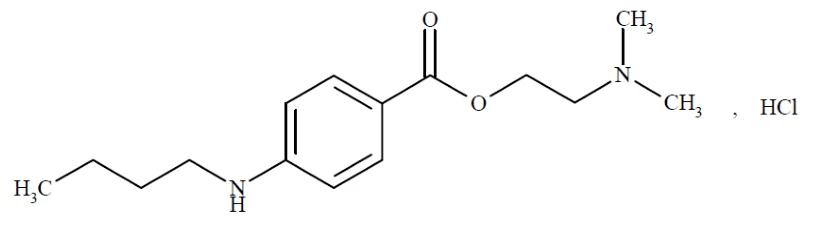
Physicochemical properties:
Melting point : about 148°C (mixture of Tetracaine polymorphs: 134 - 150°C)
Solubility: Freely soluble in Water and Ethanol 96%
14 CLINICAL TRIALS
The clinical trial data on which the original indication was authorized is not available.
15 MICROBIOLOGY
No microbiological information is required for this drug product.
16 NON-CLINICAL TOXICOLOGY
No long-term animal studies have been performed to evaluate carcinogenic or mutagenic potential or whether AMETOP GEL 4% affects fertility in males or females.