


Patient Medication Information: uses, side effects, how to take - Apo-Bimatoprost (Apotex, PM 00067890)
What is APO-BIMATOPROST used for?
APO-BIMATOPROST is used to treat hypotrichosis (less than normal hair) of the eyelash to increase the length, thickness and darkness of eyelashes.
How does APO-BIMATOPROST work?
APO-BIMATOPROST is believed to lengthen the growth period of your eyelashes and increasing the number of lashes involved in the growth phase. This results in longer, fuller and darker eyelashes.
What are the ingredients in APO-BIMATOPROST?
Medicinal ingredients: Bimatoprost
Non-medicinal ingredients: benzalkonium chloride as preservative, citric acid anhydrous, sodium chloride, sodium phosphate dibasic anhydrous, and water for injection. Hydrochloric acid and/or sodium hydroxide may be added to adjust pH.
APO-BIMATOPROST comes in the following dosage forms:
Topical solution 0.03%, w/v
Do not use APO-BIMATOPROST if:
- You are allergic to bimatoprost, to any of the other ingredients, or to any of the parts of the container (see section What are the ingredients in APO-BIMATOPROST?).
To help avoid side effects and ensure proper use, talk to your healthcare professional before you use APO-BIMATOPROST. Talk about any health conditions or problems you may have, including if you:
- have no visible eyelashes. Your doctor will consider any underlying conditions to determine whether this product is appropriate for you
- are taking, or have recently taken, any other medicines. Using APO-BIMATOPROST with other medicines or bimatoprost products may reduce their effectiveness.
are pregnant or are planning to become pregnant
- are breastfeeding or planning to breastfeed. Ask your doctor about how to feed your baby while using APO-BIMATOPROST.
- have an active eye infection, inflammation (e.g. uveitis) or any other eye or eyelid condition
- need to have eye surgery
Other warnings you should know about:
Changes in eye and eyelid colour:
APO-BIMATOPROST use has been associated with iris pigmentation (change in the coloured part of the eye). This is likely to be permanent. To help avoid pigmentation, it is extremely important to strictly observe the following measures:
- Do not apply directly in the eye.
- Do not add more than one drop to an applicator.
- Blot any excess solution outside the upper eyelid margin with a tissue or other absorbent material.
- Do not administer the medication more than once daily.
- Do not apply to the lower eyelash line.
- Do not use the same applicator for more than one eye.
- Do not reuse applicators.
- Do not alter the applicator in any form.
- Do not use any other brush/applicator to apply APO-BIMATOPROST.
Using too much APO-BIMATOPROST may contribute to iris pigmentation. APO-BIMATOPROST use may also cause darkening of the eyelid skin which may be reversible in most patients. (see Overdose section).
Hair growth:
It is possible for hair growth to occur in other areas of your skin that APO-BIMATOPROST frequently touches. Any excess solution outside the upper eyelid margin should be blotted with a tissue or other absorbent material to reduce the chance of this from happening. It is also possible for a difference in eyelash length, thickness, fullness, pigmentation, number of eyelash hairs, and/or direction of eyelash growth to occur between eyes. These differences, should they occur, will usually go away if you stop using APO-BIMATOPROST.
Changes in vision:
Application of APO-BIMATOPROST may temporarily blur your vision. Do not drive or use machines until your vision has cleared.
Tell your healthcare professional about all the medicines you take, including any drugs, vitamins, minerals, natural supplements or alternative medicines.
If you are using bimatoprost ophthalmic solution or other products in the same class for elevated intraocular pressure (IOP), or if you have a history of abnormal IP, you should only use APO-BIMATOPROST under the close supervision of your doctor.
The following may interact with APO-BIMATOPROST:
No specific drug interaction studies have been done with this medication.
How to take APO-BIMATOPROST:
DO NOT APPLY in your eye or to the lower lid. ONLY use the sterile applicators supplied with APO-BIMATOPROST to apply the product. Do not reuse or modify applicators and do not use any other
- brush/applicator to apply APO-BIMATOPROST. Fifty percent of patients treated with bimatoprost topical solution in a clinical study saw significant improvement by 2 months after starting treatment.
- If APO-BIMATOPROST solution from a single dose gets into the eye, it is not expected to cause harm. Don’t allow the tip of the bottle or applicator to contact surrounding structures, fingers, or any other unintended surface in order to avoid contamination by common bacteria known to cause infections.
- APO-BIMATOPROST contains a preservative called benzalkonium chloride which may discolour soft contact lenses if the eye is exposed. If you wear contact lenses, remove them before using APO-BIMATOPROST. They may be reinserted 15 minutes after APO-BIMATOPROST application.
- Always use APO-BIMATOPROST exactly as your doctor has instructed you.
Follow these steps to use APO-BIMATOPROST properly:
- Clean your face and ensure that makeup and contact lenses are removed (see Illustration 1).
- Remove an applicator from its tray. Then, holding the sterile applicator horizontally, place ONLY one drop of APO-BIMATOPROST on the area of the applicator closest to the tip but not on the tip (see Illustration 2).
- Immediately draw the applicator carefully across the skin of the upper eyelid margin at the base of the eyelashes (where the eyelashes meet the skin) going from the inner part of your lash line to the outer part (see Illustration 3).
- Blot any excess solution beyond the eyelid margin (see Illustration 4).
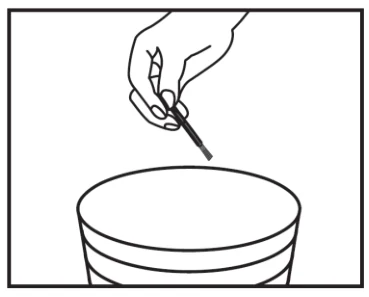
- Dispose of the applicator after one use (see Illustration 5).
- Repeat for the opposite upper eyelid margin using a NEW sterile applicator. This helps minimize any potential for contamination from one eyelid to another.
Illustration 1: Ensuring your face is clean
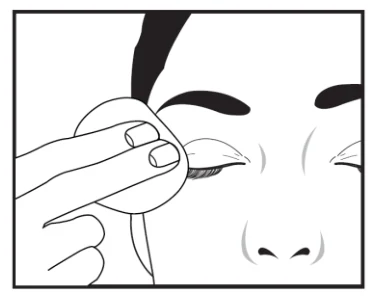 |
Illustration 2: Properly applying the drop to the unmodified applicator
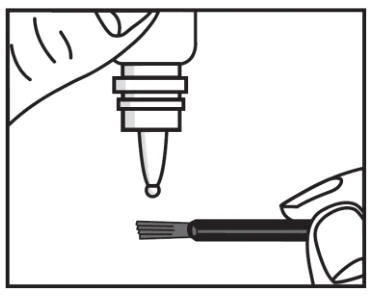 |
Illustration 3: Applying APO-BIMATOPROST to the upper eyelid margin using the unmodified applicator provided
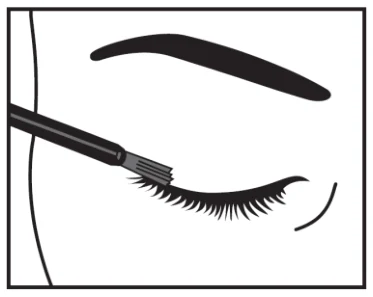 |
Illustration 4: Blotting any excess solution
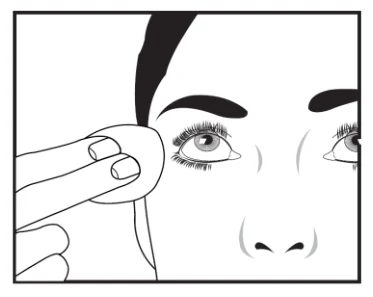 |
Illustration 5: Dispose of the applicator
 |
Usual dose:
The recommended dosage is one application nightly to the skin of the upper eyelid margin of each eye at the base of the eyelashes only.
Use of APO-BIMATOPROST more than once a day is not expected to increase the growth of eyelashes more than use once a day.
Overdose:
Overdosing (putting more than one drop on the applicator) may result in an increased chance of iris pigmentation (IP). Any extra solution outside the upper lid margin should be blotted with a tissue. If APO-BIMATOPROST solution from a single dose gets into your eyes, it is not expected to cause harm.
| If you think you, or a person you are caring for, have taken too much APO-BIMATOPROST, contact a healthcare professional, hospital emergency department, or regional poison control centre immediately, even if there are no symptoms. |
Missed Dose:
If you miss a dose, don’t try to “catch up.” Just apply APO-BIMATOPROST solution the next evening. Do not double dose.
What are possible side effects from using APO-BIMATOPROST?
These are not all the possible side effects you may have when taking APO-BIMATOPROST. If you experience any side effects not listed here, tell your healthcare professional.
Like all medicines, APO-BIMATOPROST can have side effects. Most of the side effects are not serious.
The most common side effects after using APO-BIMATOPROST solution are an itching sensation in the eyes and/or eye redness. This was reported in approximately 4% of patients. APO-BIMATOPROST solution may cause other less common side effects which typically occur on the skin close to where APO-BIMATOPROST is applied, or in the eyes. These include skin darkening, iris pigmentation, eye irritation, peeling of skin, deepening and drooping of the eyelid, dryness of the eyes and redness of the eyelids.
Serious side effects and what to do about them
| Symptom / effect | Talk to your healthcare professional | Stop taking drug and get immediate medical help |
| Only if severe | In all cases | |
| UNKNOWN FREQUENCY | ||
| New ocular condition (e.g., trauma or infection), experience a sudden decrease in visual acuity (vision), have ocular (eye) surgery, or develop any ocular reactions, particularly conjunctivitis (eyelid infection) and eyelid reactions | ||
| ||
If you have a troublesome symptom or side effect that is not listed here or becomes bad enough to interfere with your daily activities, tell your healthcare professional.
Reporting Side Effects
You can report any suspected side effects associated with the use of health products to Health Canada by:
NOTE: Contact your health professional if you need information about how to manage your side effects. The Canada Vigilance Program does not provide medical advice. |
Storage:
APO-BIMATOPROST should be stored in the original container at 2°C to 25°C.
Discard 28 days after opening.
Keep out of reach and sight of children.
If you want more information about APO-BIMATOPROST:
- Talk to your healthcare professional
Find the full product monograph that is prepared for healthcare professionals and includes this Patient Medication Information by visiting the Health Canada website:
(http://www.canada.ca/en/health-canada/services/drugs-health-products/drug-products/drug-product-database.html); Find the Patient Medication Information on the manufacturer’s website (http://www.apotex.ca/products), or by calling 1-800-667-4708.