


Patient Medication Information: uses, side effects, how to take - Arbesda Respiclick
What is ARBESDA RESPICLICK used for?
ARBESDA RESPICLICK is used for the treatment of asthma. It is used in people who are 12 years of age and older.
ARBESDA RESPICLICK should be used in patients:
- who have asthma that is not adequately controlled with a long term asthma medication such as an inhaled corticosteroid (ICS) alone; or
- whose asthma severity requires treatment with both an ICS and a long-acting beta2 agonist (LABA).
ARBESDA RESPICLICK should not be the first asthma medication you use. Do not use it as your first asthma medication unless your doctor tells you that you can. It is only to be used when a regular inhaled corticosteroid medicine along with a fast acting ‘reliever’ medicine, such as salbutamol, are not adequately helping you with your breathing problems.
How does ARBESDA RESPICLICK work?
ARBESDA RESPICLICK contains 2 ingredients:
- salmeterol xinafoate
- fluticasone propionate
Salmeterol xinafoate is a bronchodilator. It relaxes the muscles in the walls of the small air passages in the lungs. This helps to open the airways and makes it easier for air to get in and out of the lungs. When it is taken regularly with an inhaled corticosteroid, it helps the small air passages to remain open.
Fluticasone propionate belongs to a group of medicines called corticosteroids. They reduce the inflammation in the airways of the lungs. This helps you breathe easier.
What are the ingredients in ARBESDA RESPICLICK?
Medicinal ingredients: fluticasone propionate and salmeterol xinafoate.
Non-medicinal ingredients: lactose monohydrate.
ARBESDA RESPICLICK comes in the following dosage forms:
Dry powder for inhalation: Each actuation contains: 55 mcg, 113 mcg or 232 mcg fluticasone propionate and 14 mcg salmeterol.
Each inhaler contains 60 actuations.
Do not use ARBESDA RESPICLICK:
- to treat sudden symptoms of an asthma attack. ARBESDA RESPICLICK is not a rescue inhaler and should not be used to give you fast relief from an asthma attack.
- If you are allergic or have had an allergic reaction to fluticasone propionate or salmeterol xinafoate or any of the ingredients in ARBESDA RESPICLICK.
- If you have a severe allergy to milk proteins.
To help avoid side effects and ensure proper use, talk to your healthcare professional before you take ARBESDA RESPICLICK. Talk about any health conditions or problems you may have, including if you:
- are suffering from any chest infection (cold, bronchitis)
- have ever had to stop taking another medication for your breathing problems because you were allergic to it or it caused problems
- are allergic to lactose (milk sugar) or milk protein
- ever had a yeast infection (thrush) in your mouth
- are having treatment for a thyroid condition
- have diabetes
- have low blood potassium levels
- have high blood pressure
have heart problems such as:
- heart rhythm problems
- inadequate blood flow to the heart muscle
- have or ever had seizures
- have had tuberculosis (TB) infections
- are taking other “steroids” by mouth or by inhalation.
are pregnant or planning to become pregnant. Tell your doctor right away if you become pregnant while taking ARBESDA RESPICLICK.
- are breastfeeding or plan to breastfeed. It is not known if the ingredients in ARBESDA RESPICLICK can pass into breast milk
- are taking a medicine called ketoconazole, used to treat fungal infection.
- are taking medicines used to treat HIV infection, such as: (e.g. ritonavir, atazanavir, indinavir, nelfinavir, or saquinavir).
- have liver problems or disease.
Other warnings you should know about:
Asthma specific warnings:
- When LABA medicines are used alone without an ICS, they increase the risk of hospitalization and death from asthma problems. ARBESDA RESPICLICK contains both an ICS and LABA. Studies showed that when an ICS and LABA are used together, there is not a significant increased risk in hospitalizations and death from asthma problems.
Tell your doctor immediately if:
- There is a change in your symptoms such as more coughing, attacks of wheezing, chest tightness, or an unusual increase in the severity of the breathlessness.
- You wake up at night with chest tightness, wheezing or shortness of breath.
- You are using increasing amounts of your fast acting ‘reliever’ medicine.
These could be warning signs that your condition may be worsening. Do not stop taking ARBESDA RESPICLICK without talking to your doctor.
Measles and Chickenpox: While taking ARBESDA RESPICLICK, you should avoid coming into contact with anyone who has measles or chickenpox. If you or your child(ren) do come into contact with someone who has it, tell your doctor right away.
Effect on Growth: All corticosteroids, especially when taken for a long time, may affect the usual growth pattern in adolescents. Your doctor should monitor you or your child(ren) regularly.
Risk of Bone Fractures: When using medicines like ARBESDA RESPICLICK for long term treatment, you may be at risk of:
- breaking a bone
- osteoporosis (brittle bones)
You should take extra care to avoid any injuries, especially falls. Your doctor should also monitor you.
Eye Disorders: Medicines like ARBESDA RESPICLICK can cause eye disorders such as:
- Cataracts: clouding of the lens in the eye, blurry vision, eye pain;
- Glaucoma: an increased pressure in your eyes, eye pain. If untreated, it may lead to permanent vision loss.
- Central serous chorioretinopathy (CSCR): blurry vision or other changes in vision.
You should have regular eye exams.
Monitoring: Ask your doctor whether you need to be monitored in any special way, especially if you:
- were previously taking another form of corticosteroids (like an injection or an oral tablet) and have switched to an inhaled corticosteroid. Your doctor should look out for tiredness, weakness, nausea and vomiting and low blood pressure.
- are being treated for diabetes. You may need more frequent blood sugar monitoring or a change in the dose of your diabetes medication.
Tell your healthcare professional about all the medicines you take, including any drugs, vitamins, minerals, natural supplements or alternative medicines.
The following may interact with ARBESDA RESPICLICK:
- other medicines similar to ARBESDA RESPICLICK used for your lung disease. It may increase the risk of experiencing possible side effects. This includes other medicines containing a long-acting beta2-agonist or a corticosteroid;
- Monoamine Oxidase Inhibitors (MAOIs) used to treat depression or other antidepressants. You should be very careful if you are taking a MAOI or other types of antidepressants while you are taking ARBESDA RESPICLICK.
medicines used to treat HIV infection or AIDS, such as:
- ritonavir. You should avoid taking ARBESDA RESPICLICK if you are taking ritonavir.
- atazanavir
- indinavir
- nelfinavir
- saquinavir
- ketoconazole (a drug used to treat fungal infections);
- clarithromycin (a drug used to treat bacterial infections);
beta-blockers used in the treatment of:
- high blood pressure or other heart problems (e.g. such as propranolol) or
- glaucoma
- medicines used to decrease the level of potassium in your blood (i.e. diuretics). These are also known as “water pills”. They are used to treat high blood pressure.
- methylxanthines (such as theophylline) used to treat asthma and COPD.
How to take ARBESDA RESPICLICK:
ARBESDA RESPICLICK is for oral inhalation only.
Take it:
- every day
- at about the same time each day
Do not stop taking ARBESDA RESPICLICK suddenly – even if you feel better. Your doctor will tell you how to slowly stop taking the medication if necessary.
Do not change the dose unless you are told to by your doctor.
Usual Dose (Adults and Adolescents 12 years of age and older):
Take 1 inhalation twice a day about 12 hours apart.
Important: Do not use it more than twice a day.
Instructions for Use:
About the inhaler:
When you are ready to use ARBESDA RESPICLICK for the first time, remove the inhaler from the foil pouch.
There are 2 main parts of your ARBESDA RESPICLICK inhaler (see Figure A):
- the white inhaler with the mouthpiece
- the yellow cap that covers the mouthpiece of the inhaler.
Figure A:
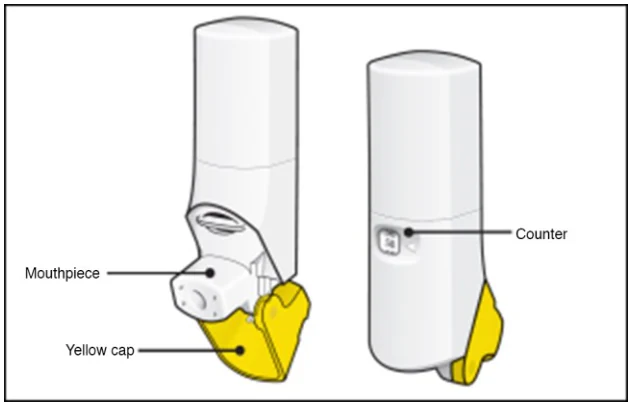
Front view Back view
IMPORTANT POINTS TO REMEMBER ABOUT USING YOUR INHALER:
- One actuation is equal to one dose. An actuation is when you inhale the medication from the mouthpiece into your lungs.
- The ARBESDA RESPICLICK inhaler does not require priming.
- There is no button or canister that you need to press to load a dose. Opening the yellow cap will load the dose. Every time the yellow cap is opened and it “clicks”, one dose is ready to be inhaled. If you do not hear the “click” sound the inhaler may not be activated to give you a dose of medicine.
- Always close the yellow cap after using it so your inhaler will be ready for you to take your next dose.
- Do not open the cap unless you are ready to take your next dose. Opening and closing the cap without inhaling a dose will waste the medicine and may damage your inhaler.
- Your ARBESDA RESPICLICK inhaler contains dry powder so it is important that you do not blow or breathe into it.
About the counter:
- Your ARBESDA RESPICLICK inhaler contains 60 actuations (inhalations).
- There is a counter in the back of the inhaler with a viewing window that shows you how much of the medicine you have left (see Figure A).
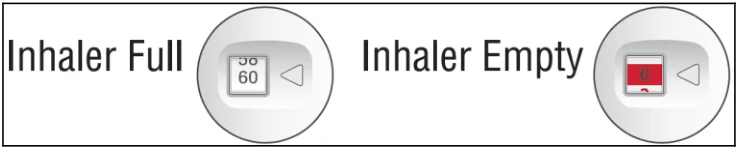
- The counter will count down (in units of two) each time the yellow cap is opened and closed (for example, 60, 58, 56, etc.).
- When there are 20 actuations left, the color of the numbers will change to red. You should refill your prescription or ask your doctor for another prescription.
- When the counter shows the number ‘0’, the background will change to red and the colour of the number ‘0’ will change to black. Your inhaler is empty. You should stop using the inhaler and throw it away (see Figure B).
Figure B:
Using your inhaler:
STEP 1: Open
Figure C:
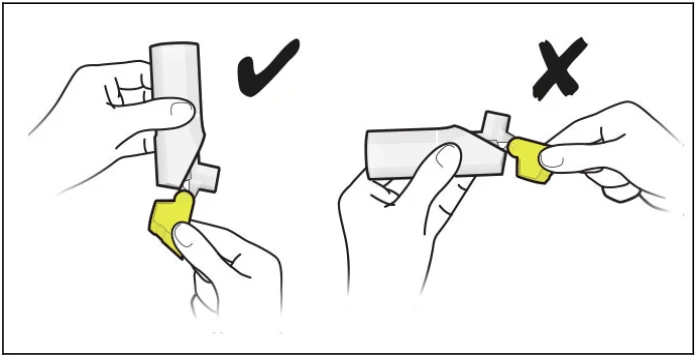
- Make sure the cap is closed.
- Hold the inhaler upright (see Figure C).
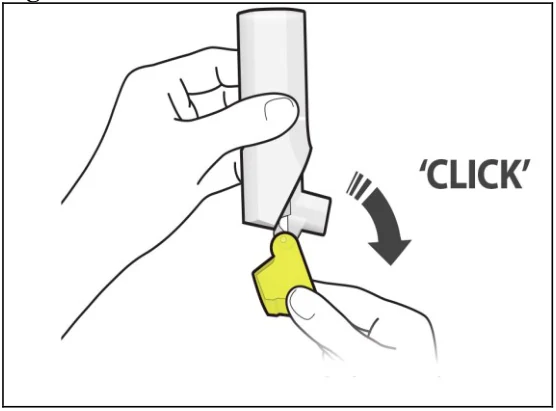
Figure D:
STEP 2: Inhale
Figure E:
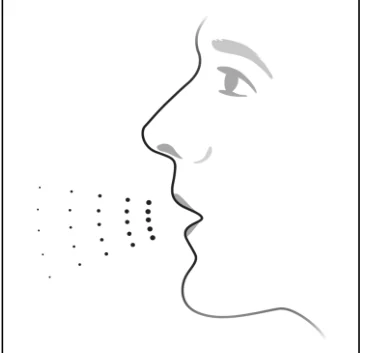
Before inhaling, hold the inhaler away from your mouth
- and breathe out through your mouth as much air as you
- can and as is comfortable. Never breathe out into the
- inhaler mouthpiece (see Figure E).
Figure F:
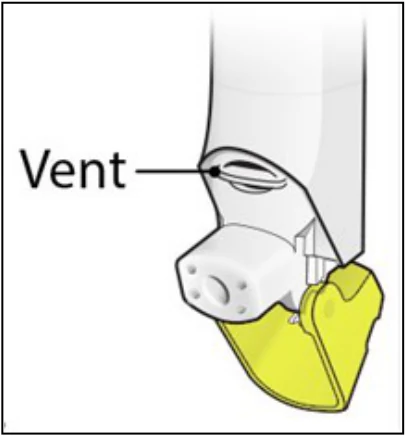
Do not block the vent above the mouthpiece with your lips or fingers (see Figure F).
- Open the yellow cap all the way back until you feel and hear a ‘click’ (see Figure D).
- Every time the yellow cap is opened and it ‘clicks’, one dose is ready to be inhaled.
- Do not open the yellow cap unless you are taking a dose.
Figure G:
STEP 3: Close:
Figure H:
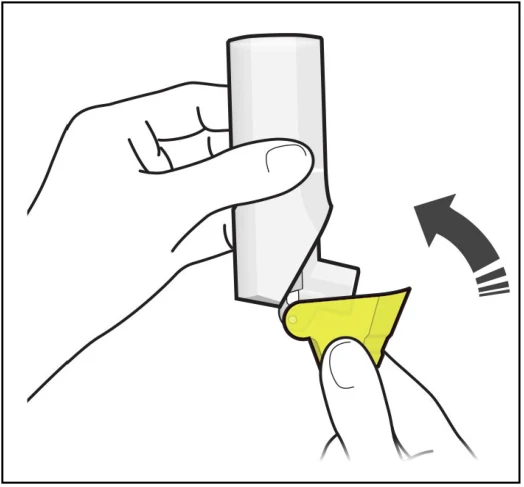
- Close the yellow cap after inhaling so that the inhaler will be ready for your next dose (see Figure H).
- Rinse your mouth with water after taking your dose. Spit out the water. Do not swallow it.
- Throw the inhaler away 30 days after you have opened the foil pouch or when the counter reads ‘0,’ whichever comes first.
Cleaning your inhaler:
- Never wash or put any part of the inhaler in water.
Gently wipe the mouthpiece with a dry cloth or tissue once a week.
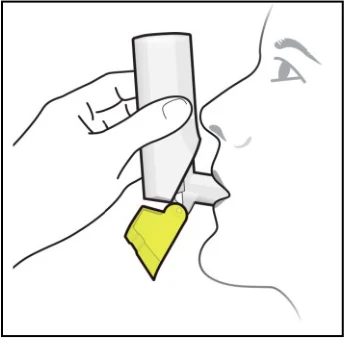
- Place the mouthpiece in your mouth and close your lips around it so you form a good seal.
- Breathe in quickly and deeply through your mouth, until your lungs feel completely full of air (see Figure G).
- Remove the inhaler from your mouth.
- Hold your breath for about 10 seconds or for as long as you comfortably can.
- Your ARBESDA RESPICLICK inhaler delivers your dose of medicine as a very fine powder that you may or may not taste or feel. Do not take an extra dose from the inhaler even if you do not taste or feel the medicine.
Overdose:
| If you think you have taken too much ARBESDA RESPICLICK contact your healthcare professional, hospital emergency department or regional Poison Control Centre immediately, even if there are no symptoms. |
If you accidentally take a larger dose than recommended, you may notice:
- your heart is beating faster than usual
- that you feel shaky
- you have a headache
- you have muscle weakness
- you have aching joints
Missed Dose:
If you miss a dose of ARBESDA RESPICLICK, just skip that dose. Take your next dose at your usual time. Do not take 2 doses at the same time.
What are possible side effects from using ARBESDA RESPICLICK?
These are not all the possible side effects you may feel when taking ARBESDA RESPICLICK. If you experience any side effects not listed here, contact your healthcare professional.
Side effects include:
Effects on heart
- faster heart beat than usual
- high blood pressure
Effects on muscles and joints
- pain in joints
- muscle cramps
- back pain
Effects on nervous system
- feeling a little shaky
- headache
- behavioural changes (including agitation, anxiety, and irritability)
- disturbed sleep
- fainting
- spinning sensation (vertigo)
- dizziness
- tingling/numbness of the hands, arms, legs or feet
- feeling anxious
Other Effects
- hoarseness and voice changes
- increased bruising
- cough
- develop a mild yeast infection of the mouth or throat (thrush, Candidiasis) or, rarely, in the esophagus. Common signs are white, slightly raised, sore patches on your tongue and inner cheeks. Remember to rinse and gargle your mouth with water and spit after using ARBESDA RESPICLICK. If you wear dentures, cleaning them may also help.
- tightness in the chest
- shortness of breath
Serious side effects and what to do about them
| Symptom / effect | Talk to your healthcare professional | Stop taking drug and get immediate medical help | |
|---|---|---|---|
| Only if severe | In all cases | ||
| COMMON | |||
| Thrush: yeast infection of the mouth or throat; thick white patches in the mouth, tongue or on the throat, sore throat | √ | ||
| RARE | |||
| Allergic reactions: lumpy skin rash or hives anywhere on the body. | √ | ||
| Fast or irregular heartbeat that does not go away on its own. | √ | ||
| Hyperglycemia: (Increase amount of sugar in blood): excessive thirst, frequent urination, dry skin, blurred vision and fatigue. | √ | ||
| Glaucoma: increased pressure in your eyes, eye pain. | √ | ||
| Cataracts: clouding of the lens in the eye, blurry vision, and/or eye pain. | √ | ||
| Churg-Strauss syndrome: a flu-like illness, rash, pins and needles or numbness of arms or legs, severe sinusitis and worsening lung or breathing problems. | √ | ||
| Low blood potassium: muscle weakness and muscle spasms | √ | ||
Serious side effects and what to do about them
| Symptom / effect | Talk to your healthcare professional | Stop taking drug and get immediate medical help |
|---|
| Only if severe | In all cases | ||
|---|---|---|---|
| Decreased Adrenal function: tiredness, weakness, nausea and vomiting, low blood pressure. | √ | ||
| Severe Allergic reactions: sudden wheeziness and chest pain or tightness; or swelling of eyelids, face, lips, tongue or throat. | √ | ||
| Sudden worsening of shortness of breath and wheezing shortly after using ARBESDA RESPICLICK. | √ | ||
| Mouth, throat becomes unusually irritated causing high pitched wheezing and choking. | √ | ||
| Esophageal candidiasis: Yeast infection of the esophagus (food tube); difficulty swallowing | √ | ||
| VERY RARE | |||
| Osteonecrosis: Persistent pain and/or limited range of motion of a joint or a limb. | √ | ||
| Slowed growth in children and adolescents. | √ | ||
| Cushing’s Syndrome: Round "moon face", rapid weight gain especially around the body. Excess sweating and thinning of the skin with easy bruising and dryness. Muscle and bone weakness. | √ | ||
| Bone Fractures or Osteoporosis: In situations where healthy people would not normally break a bone you may have sudden pain in any location and especially in the wrist, spine or hip. This may be a fracture. | √ | ||
| UNKNOWN | |||
| Decreased ability to fight infections. Symptoms of | √ | ||
Serious side effects and what to do about them
| Symptom / effect | Talk to your healthcare professional | Stop taking drug and get immediate medical help |
|---|
| Only if severe | In all cases |
|---|---|
| infection may include fever, pain, chills, feeling tired and sore throat. | |
| Worsening of lung symptoms such as increased shortness of breath, wheezing, cough and chest tightness accompanied by fever and more phlegm. | |
| √ | |
If you have a troublesome symptom or side effect that is not listed here or becomes bad enough to interfere with your daily activities, talk to your healthcare professional.
Reporting Side Effects
You can help improve the safe use of health products for Canadians by reporting serious and unexpected side effects to Health Canada. Your report may help to identify new side effects and change the product safety information. 3 ways to report:
NOTE: Contact your health professional if you need information about how to manage your side effects. The Canada Vigilance Program does not provide medical advice. |
Storage:
- Store ARBESDA RESPICLICK at room temperature (between 15ºC and 25ºC) in a dry place.
Keep the:
- inhaler away from extreme heat, cold, or humidity.
- yellow cap on the inhaler closed during storage.
- inhaler dry and clean at all times.
- Throw the inhaler away 30 days after you have opened the foil pouch or when the counter reads ‘0,’ whichever comes first.
- Keep out of the reach and sight of children
If you want more information about ARBESDA RESPICLICK:
- Talk to your healthcare professional
- Find the full product monograph that is prepared for healthcare professionals and includes this Patient Medication Information by visiting the Health Canada website http://hc-sc.gc.ca/index-eng.php; the manufacturer’s website http://www.tevacanadainnovation.ca, or by calling 1-855-514-8382.
Last Revised: December 21, 2018
ARBESDA RESPICLICK is a trademark of Ivax International B.V., a member of the Teva Group; used under license.