


Product Monograph - Azopt
RECENT MAJOR LABEL CHANGES
| 7 WARNINGS AND PRECAUTIONS; Hypersensitivity; Skin | 01/2023 |
|---|
TABLE OF CONTENTS
Sections or subsections that are not applicable at the time of authorization are not listed.
RECENT MAJOR LABEL CHANGES............................................................................................2
TABLE OF CONTENTS .............................................................................................................. 2
PART I: HEALTH PROFESSIONAL INFORMATION ..................................................................... 4
1 INDICATIONS .............................................................................................................. 4
1.1 Pediatrics .............................................................................................................. 4
1.2 Geriatrics............................................................................................................... 4
2 CONTRAINDICATIONS ................................................................................................. 4
4 DOSAGE AND ADMINISTRATION................................................................................. 4
4.1 Dosing Considerations ....................................................................................... 4
4.2 Recommended Dose and Dosage Adjustment..................................................... 5
4.4 Administration................................................................................................... 5
4.5 Missed Dose ...................................................................................................... 5
5 OVERDOSAGE ............................................................................................................. 5
6 DOSAGE FORMS, STRENGTHS, COMPOSITION AND PACKAGING ................................. 6
7 WARNINGS AND PRECAUTIONS .................................................................................. 6
7.1 Special Populations ............................................................................................ 8
7.1.1 Pregnant Women ......................................................................................... 8
7.1.2 Breast-feeding.............................................................................................. 8
7.1.3 Pediatrics ..................................................................................................... 8
7.1.4 Geriatrics ..................................................................................................... 9
8 ADVERSE REACTIONS .................................................................................................. 9
8.1 Adverse Reaction Overview................................................................................ 9
8.2 Clinical Trial Adverse Reactions .......................................................................... 9
8.3 Less Common Clinical Trial Adverse Reactions (<1%)......................................... 10
8.5 Post-Market Adverse Reactions........................................................................ 10
9 DRUG INTERACTIONS................................................................................................ 11
9.2 Drug Interactions Overview.............................................................................. 11
9.3 Drug-behavioural interactions .......................................................................... 11
9.4 Drug-Drug Interactions .................................................................................... 11
9.5 Drug-Food Interactions .................................................................................... 11
9.6 Drug-Herb Interactions .................................................................................... 11
9.7 Drug-laboratory test interactions ..................................................................... 12
10 CLINICAL PHARMACOLOGY ....................................................................................... 12
10.1 Mechanism of Action.................................................................................. 12
10.2 Pharmacodynamics .................................................................................... 12
10.3 Pharmacokinetics ....................................................................................... 12
11 STORAGE, STABILITY AND DISPOSAL ......................................................................... 13
12 SPECIAL HANDLING INSTRUCTIONS........................................................................... 13
PART II: SCIENTIFIC INFORMATION ...................................................................................... 14
13 PHARMACEUTICAL INFORMATION............................................................................ 14
14 CLINICAL TRIALS........................................................................................................ 14
14.1 Clinical Trials by Indication.......................................................................... 14
Intraocular Pressure (IOP) Reduction ......................................................................... 14
15 MICROBIOLOGY ........................................................................................................ 16
16 NON-CLINICAL TOXICOLOGY ..................................................................................... 16
PATIENT MEDICATION INFORMATION ................................................................................. 18
PART I: HEALTH PROFESSIONAL INFORMATION
1 INDICATIONS
AZOPT® (brinzolamide ophthalmic suspension) is indicated for:
- the treatment of elevated intraocular pressure (IOP) in adult patients with ocular hypertension or open-angle glaucoma.
1.1 Pediatrics
Pediatrics (< 18 years of age): The safety and effectiveness of AZOPT in pediatric patients have not been established; therefore, Health Canada has not authorized an indication for pediatric use.
1.2 Geriatrics
Geriatrics (> 65 years of age): No overall differences in safety and effectiveness have been observed between elderly and other adult patients.
2 CONTRAINDICATIONS
Brinzolamide ophthalmic suspension is contraindicated in:
- Patients with hypersensitivity to brinzolamide or to any ingredient in the formulation or component of the container. For a complete listing, see 6 DOSAGE FORMS, STRENGTHS, COMPOSITION AND PACKAGING
- Patients with hypersensitivity to sulfonamides.
- Patients with severe renal impairment (CrCl < 30 mL/min), as brinzolamide and its metabolite are excreted predominantly by the kidney.
- Patients with hyperchloremic acidosis.
- Patients taking oral carbonic anhydrase inhibitors due to the potential additive systemic effects of carbonic anhydrase inhibition.
No studies have been conducted with AZOPT in patients with hepatic or renal impairment, or in patients with hyperchloremic acidosis.
4 DOSAGE AND ADMINISTRATION
4.1 Dosing Considerations
- AZOPT is a carbonic anhydrase inhibitor formulated for topical ophthalmic use. With any evident signs of hypersensitivity or discomfort, AZOPT must be discontinued.
- Caution is advised when using AZOPT in patients with mild to moderate renal impairment (see 7 WARNING AND PRECAUTIONS).
4.2 Recommended Dose and Dosage Adjustment
Monotherapy:
When used as a monotherapy, the recommended starting adult dose is one drop of AZOPT in the affected eye(s) two times daily. If the clinical response is not adequate after four weeks, the dosage may be increased to one drop three times daily.
Adjunctive Therapy with Beta-Blockers:
AZOPT may be used as adjunctive therapy with ophthalmic beta-blockers (see 14 CLINICAL TRIALS).
When AZOPT is used concomitantly with beta-blockers, the recommended dose is the same as when it is used as a monotherapy. The drugs should be administered at least ten minutes apart.
Health Canada has not authorized an indication for pediatric use.
4.4 Administration
Shake well before use.
Nasolacrimal occlusion or gently closing the eyelid for two minutes after instillation is recommended. This may reduce the systemic absorption of medications administered via the ocular route and result in a decrease in systemic adverse events.
If more than one topical ophthalmic medicinal product is being used, the medicines must be administered at least ten minutes apart.
Do not allow the dropper tip of the bottle to touch the eye or other surrounding structures, because this could cause eye injury or contaminate the tip with common bacteria known to cause eye infections. Serious damage to the eye with subsequent loss of vision may result from using contaminated eye drop solutions. Do not use suspension if the bottle is cracked or damaged in any way.
4.5 Missed Dose
If a dose is missed, a single drop should be applied as soon as possible before reverting to the regular routine. However, if it is almost time for the subsequent dose, the missed dose should be skipped and the regular dosing schedule resumed. Do not use a double dose to make up for a missed dose.
5 OVERDOSAGE
No data are available in humans with regards to overdosage by accidental or deliberate ingestion of AZOPT.
If overdose with AZOPT occurs, treatment should be symptomatic and supportive. Electrolyte imbalance, development of an acidotic state, and possible nervous system effects may occur. Serum electrolyte levels (particularly potassium) and blood pH levels should be monitored.
| For management of a suspected drug overdose, contact your regional poison control centre. |
|---|
6 DOSAGE FORMS, STRENGTHS, COMPOSITION AND PACKAGING
Table 1 – Dosage Forms, Strengths, Composition and Packaging
| Route of Administration | Dosage Form / Strength/Composition | Non-medicinal Ingredients |
| Ophthalmic (topical) | Suspension/ brinzolamide 1% w/v | Carbomer 974P, edetate disodium, hydrochloric acid (to adjust pH), mannitol, purified water, sodium chloride, sodium hydroxide (to adjust pH), tyloxapol. Benzalkonium chloride (0.01% w/v) as a preservative. |
Description
AZOPT is supplied as a sterile, aqueous suspension of brinzolamide which has been formulated to be readily suspended and slow settling following shaking. The pH has been adjusted to pH 7.5 (pH range 6.5 - 8.5) to match the physiologic pH of tears and the product has also been formulated to be iso-osmotic to optimize ocular comfort upon instillation.
AZOPT is supplied in natural, plastic dispensers with a controlled dispensing-tip containing 5 mL.
Tamper evidence is provided by a closure with an extended skirt that locks to the bottle finish on application and breaks away from the closure on opening. After cap is removed: if tamper evident snap collar is loose, remove before using product.
7 WARNINGS AND PRECAUTIONS
General
FOR TOPICAL OPHTHALMIC USE ONLY.
Like all other topically applied ophthalmic agents, brinzolamide, the active ingredient of AZOPT, is absorbed systematically.
AZOPT contains brinzolamide, a sulfonamide. The same types of adverse reactions that are attributable to sulfonamides may occur with topical administration of AZOPT. Hypersensitivity reactions common to all sulfonamide derivatives can occur in patients receiving AZOPT. Sensitization may occur when a sulfonamide is re-administered irrespective of the route of administration. If signs of serious reactions or hypersensitivity occur, discontinue the use of AZOPT.
AZOPT contains brinzolamide, an inhibitor of carbonic anhydrase, and although administered topically, is absorbed systemically. Acid-base disturbances have been reported with oral carbonic anhydrase inhibitors. The same types of adverse reactions that are attributable to oral carbonic inhibitors (i.e. acid-base disturbances) may occur with topical administration. Caution is advised when using AZOPT in patients with mild to moderate renal impairment because of the possible risk of metabolic acidosis. AZOPT is contraindicated in patients with severe renal impairment (see 2 CONTRAINDICATIONS).
There is a potential for an additive effect on the known systemic effects of carbonic anhydrase inhibition in patients receiving an oral carbonic anhydrase inhibitor and AZOPT. The concomitant administration of AZOPT and oral carbonic anhydrase inhibitors is not recommended (see 2 CONTRAINDICATIONS).
The management of patients with acute angle-closure glaucoma requires therapeutic interventions in addition to ocular hypotensive agents. AZOPT is not recommended for use in patients with acute angle-closure glaucoma due to a lack of studies in such patients.
Carcinogenicity and Mutagenesis
See 16 NON-CLINICAL TOXICOLOGY, Carcinogenicity and Genotoxicity.
Driving and Operating Machinery
AZOPT may temporarily result in blurred vision following dosing. Care should be exercised in operating machinery or driving a motor vehicle.
Hepatic/Biliary/Pancreatic
AZOPT has not been studied in patients with hepatic impairment and therefore, should be used with caution in such patients.
Hypersensitivity
AZOPT contains brinzolamide which is a sulfonamide, and although administered topically is absorbed systemically. Therefore, the same types of adverse reactions that are attributable to sulfonamides may occur with topical administration of AZOPT. Fatalities have occurred due to severe reactions to sulfonamides including Stevens Johnson Syndrome (SJS), Toxic Epidermal Necrolysis (TEN), fulminant hepatic necrosis, agranulocytosis, aplastic anemia, and other blood dyscrasias (See section 8. ADVERSE REACTIONS). Rechallenge irrespective of the route of administration should not be undertaken in patients with hypersensitivity syndrome and SJS/TEN (See section 7 WARNINGS AND PRECAUTIONS, Skin).
Neurologic
Carbonic anhydrase inhibitors can impair the ability to perform tasks requiring mental alertness and/or physical coordination. As AZOPT is absorbed systematically, caution is advised when using AZOPT in patients requiring mental alertness and/or physical coordination.
Ophthalmologic
The possible role of brinzolamide on corneal endothelial functions has not been investigated in patients with compromised corneas (particularly in patients with low endothelial counts) or in patients wearing contact lenses. When using brinzolamide, careful monitoring of these patients is recommended since carbonic anhydrase inhibitors may affect corneal hydration and wearing contact lenses might increase the risk for the cornea. Likewise, in other cases of compromised corneas, such as patients with diabetes mellitus or corneal dystrophies, careful monitoring is recommended.
AZOPT contains the preservative benzalkonium chloride, which may cause eye irritation and is known to discolour soft contact lenses. Contact with soft contact lenses is to be avoided. Patients must be instructed to remove contact lenses prior to instillation of AZOPT and to wait at least 15 minutes after instillation before re-inserting contact lenses.
Benzalkonium chloride has been reported to cause punctate keratopathy and/or toxic ulcerative keratopathy. Close monitoring is required with frequent or prolonged use.
Renal
AZOPT is contraindicated in patients with severe renal impairment. Caution is advised when using AZOPT in patients with mild to moderate renal impairment (see 2 CONTRAINDICATIONS).
Reproductive Health: Female and Male Potential
- Fertility
The effect of AZOPT on human fertility is unknown. Animal studies with brinzolamide demonstrated no effect on fertility (see 16 NON-CLINICAL TOXICOLOGY, Reproductive and Developmental Toxicology).
Skin
AZOPT should be discontinued immediately at the appearance of a skin rash, as the rash may be, in some instances, followed by dermatological reactions/hypersensitivity syndrome including SJS and TEN. At the time of prescription, patients should be informed of the signs and symptoms, and advised to monitor closely for skin reactions.
7.1 Special Populations
7.1.1 Pregnant Women
AZOPT is not recommended during pregnancy or in women of child-bearing potential not using contraception.
No adequate studies with brinzolamide have been conducted in pregnant and breast-feeding women. Developmental toxicity with brinzolamide was observed in animal studies. Orally administered brinzolamide increased the number of fetal variations, such as accessory skull bones, in rabbits and decreased body weights of fetuses in rats. No treatment-related malformations were seen (see 16 NON-CLINICAL TOXICOLOGY, Reproductive and Developmental Toxicology).
7.1.2 Breast-feeding
AZOPT should not be used by women nursing neonates/infants.
It is not known whether topical AZOPT is excreted in human milk; however, a risk to the nursing child cannot be excluded.
In a study of brinzolamide in lactating rats, decreases in body weight gain were observed in offspring at an oral dose of 15 mg/kg/day (312 times the recommended human ophthalmic dose). Following oral administration of 14C-brinzolamide to lactating rats, radioactivity was found in milk at concentrations below those in the blood and plasma.
7.1.3 Pediatrics
Pediatrics (< 18 years of age): Based on the data submitted and reviewed by Health Canada, the safety and efficacy of AZOPT in pediatric patients has not been established; therefore, Health Canada has not authorized an indication for pediatric use.
7.1.4 Geriatrics
Geriatrics (> 65 years of age): In well-controlled clinical studies of AZOPT, the probability of having an adverse reaction was independent of age. No difference in patients experiencing adverse reactions was noted in patients less than 65 years of age, between 65 and 75 years of age, and greater than 75 years of age (see 1.2 Geriatrics).
8 ADVERSE REACTIONS
8.1 Adverse Reaction Overview
In clinical trials, the most frequently reported adverse drug reactions were blurred vision and dysgeusia (see description below).
Dysgeusia (bitter or unusual taste in the mouth following instillation) was a frequently reported systemic adverse reaction associated with the use of AZOPT during clinical trials. It is likely to be caused by passage of the eye drops in the nasopharynx via the nasolacrimal canal. Nasolacrimal occlusion or gently closing the eyelid after instillation may help reduce the occurrence of this effect.
8.2 Clinical Trial Adverse Reactions
Clinical trials are conducted under very specific conditions. Therefore, the adverse reaction rates observed in the clinical trials may not reflect the rates observed in practice and should not be compared to the rates in the clinical trials of another drug. Adverse reaction information from clinical trials may be useful in identifying and approximating rates of adverse drug reactions in real-world use.
Safety and efficacy of Azopt was evaluated in well-controlled, short- and long-term clinical studies. These studies included adult patients with elevated intraocular pressure in patients with ocular hypertension or open-angle glaucoma. One drop twice- or thrice-daily dosing regimens of Azopt was evaluated as monotherapy in adult patients unresponsive to beta-blockers or in adult patients in whom beta-blockers are contraindicated, or as adjunctive therapy to beta-blockers or prostaglandin analogues. Details of these studies are available in 14 CLINICAL TRIALS. Adverse reactions related to AZOPT were generally mild to moderate and usually did not lead to discontinuation of therapy. The most frequently reported ocular adverse reaction was blurred vision (5%). Dysgeusia was the most frequently reported systemic adverse reaction (5.6%). Adverse reactions with a frequency ≥ 1% are presented in Table .
| Table 2 - Treatment-Related Adverse Reactions (≥ 1%) | ||||
| MedDRA Preferred Term (v15.1) | AZOPT 1% n =1173 (%) | Placebo n =101 (%) | ||
| Eye Disorders | ||||
| Vision blurred | 5.0 | 2.0 | ||
| Ocular discomfort | 2.6 | 3.0 | ||
| Foreign body sensation in eyes | 1.8 | 0 | ||
| Dry Eye | 1.2 | 1.0 | ||
| Ocular hyperemia | 1.1 | 1.0 | ||
| Eye pain | 1.0 | 1.0 | ||
| Gastrointestinal Disorders | ||||
| Dysgeusia | 5.6 | 1.0 | ||
| Nervous System Disorders | ||||
| Headache | 1.5 | 1.0 | ||
8.3 Less Common Clinical Trial Adverse Reactions (<1%)
Eye disorders: abnormal vision, blepharitis, conjunctivitis, eye discharge, eye fatigue, eyelid margin crusting, eye pruritus, lacrimation increased (tearing), keratitis, sticky sensation
Gastrointestinal disorders: dry mouth, dyspepsia, nausea
Nervous system disorders: dizziness, paresthesia
Psychiatric disorders: depression
Respiratory, thoracic and mediastinal disorders: bronchitis, dyspnea, pharyngitis, rhinitis
Skin and subcutaneous tissue disorders: alopecia, dermatitis
8.5 Post-Market Adverse Reactions
The following adverse reactions were identified from subsequent clinical trials:
Cardiac disorders: angina pectoris, heart rate irregular
Ear and labyrinth disorders: tinnitus
Eye disorders: asthenopia, conjunctivitis allergic, corneal edema, corneal erosion, diplopia, hypoesthesia eye, periorbital edema, photophobia, photopsia, punctate keratitis, visual acuity reduced
Gastrointestinal disorders: abdominal discomfort, diarrhea
General disorders and administration site conditions: asthenia, chest pain, fatigue, feeling jittery, irritability
Nervous system disorders: memory impairment, somnolence
Psychiatric disorders: insomnia
Respiratory, thoracic and mediastinal disorders: bronchial hypersensitivity, cough, epistaxis, nasal congestion, nasal dryness, oropharyngeal pain, rhinorrhea, sinus congestion, throat irritation, upper airway cough syndrome, upper airway tract congestion
Skin and subcutaneous tissue disorders: pruritus generalised, urticaria
The following adverse reactions were identified via spontaneous post-market reporting:
Hypersensitivity or Skin disorders: Stevens-Johnson syndrome (SJS), Toxic epidermal necrolysis (TEN)
Metabolism and nutrition disorders: decreased appetite
Musculoskeletal and connective tissue disorders: arthralgia
Nervous system disorders: hypoesthesia
Vascular disorders: blood pressure decreased
9 DRUG INTERACTIONS
9.2 Drug Interactions Overview
No specific drug interaction studies have been performed with AZOPT. Interactions between brinzolamide and CYP450 enzymes are expected. Concomitant use of AZOPT and CYP3A4 inhibitors, salicylates and/or oral carbonic acid inhibitors is not recommended (see 9.4 Drug-Drug Interactions).
9.3 Drug-behavioural interactions
Interactions with behavior have not been established.
9.4 Drug-Drug Interactions
AZOPT contains brinzolamide, a carbonic acid inhibitor. Acid-base disturbances have been reported with oral carbonic anhydrase inhibitors. The potential for interactions must be considered in patients receiving AZOPT.
The cytochrome P-450 isozymes responsible for metabolism of brinzolamide include CYP3A4 primarily, in addition to CYP2A6, CYP2B6, CYP2C8 and CYP2C9. It is expected that inhibitors of CYP3A4, such as ketoconazole, itraconazole, clotrimazole, ritonavir and troleandomycin, will inhibit the metabolism of brinzolamide by CYP3A4. Caution is advised if CYP3A4 inhibitors are given concomitantly. Brinzolamide is not an inhibitor of cytochrome P-450 isozymes.
Concomitant use of salicylates (e.g. acetylsalicylic acid) with AZOPT is not recommended. AZOPT may lead to decreased efficacy of the salicylate, central nervous system (CNS) toxicity, metabolic acidosis and other adverse reactions. These alterations were not observed in clinical trials with brinzolamide ophthalmic suspension 1%; however, in patients treated with oral carbonic anhydrase inhibitors, rare cases of acid-base alterations have occurred with high dose salicylate therapy.
Concomitant use of oral carbonic anhydrase inhibitors and AZOPT is not recommended. There is a potential for an additive effect on the known systemic effects of carbonic anhydrase inhibition in patients receiving an oral carbonic anhydrase inhibitor and brinzolamide eye drops (see 2 CONTRAINDICATIONS).
9.5 Drug-Food Interactions
Interactions with food have not been established.
9.6 Drug-Herb Interactions
Interactions with herbal products have not been established.
9.7 Drug-laboratory test interactions
Interactions with laboratory tests have not been established.
10 CLINICAL PHARMACOLOGY
10.1 Mechanism of Action
AZOPT is a carbonic anhydrase inhibitor formulated for topical ophthalmic use.
Carbonic anhydrase (CA) is an enzyme found in many tissues of the body including the eye. It catalyzes the reversible reaction involving the hydration of carbon dioxide and the dehydration of carbonic acid. In humans, CA exists as a number of isoenzymes, the most active being carbonic anhydrase II (CA-II). CA-II is found primarily in red blood cells (RBCs), but also in other tissues. Inhibition of CA in the ciliary processes of the eye decreases aqueous humor secretion, presumably by slowing the formation of bicarbonate ions with subsequent reduction in sodium and fluid transport. The result is a reduction in intraocular pressure (IOP).
AZOPT contains brinzolamide, a potent inhibitor of CA-II with an in vitro IC50 of 3.2 nM and a Ki of 0.13 nM against CA-II. Brinzolamide has also been shown to have little or no affinity for 34 known receptors or second messenger systems indicating that it is highly selective for CA-II and should have minimum potential for inducing non-Carbonic Anhydrase Inhibitors (CAI) related side-effects. Following topical ocular administration, brinzolamide reduces elevated IOP. Elevated IOP is a major risk factor in the pathogenesis of optic nerve damage and glaucomatous visual field loss.
10.2 Pharmacodynamics
Not Available.
10.3 Pharmacokinetics
An oral pharmacokinetic study was conducted in which healthy volunteers received 1 mg capsules of brinzolamide twice per day for up to 32 weeks. This regimen provided a higher rate of systemic drug input than topical ocular administration of AZOPT dosed to both eyes three times per day and allowed more rapid saturation of systemic CA-II and achievement of systemic steady state than by topical dosing. RBC CA activity was measured to assess the degree of systemic CA inhibition. Brinzolamide saturation of RBC CA II was achieved within four weeks (RBC concentrations of approximately 20 μM). N-Desethyl brinzolamide accumulated in RBCs to steady-state within 20-28 weeks reaching concentrations ranging from 6-30 μM. The inhibition of total RBC CA activity at steady-state was approximately 70-75%, which is below that expected to adversely affect renal function or respiration.
In a topical ocular study, patients with open-angle glaucoma or ocular hypertension received AZOPT either two or three times per day for up to 18 months. Steady-state concentrations of brinzolamide were reached for most subjects within 6-9 months. Brinzolamide RBC concentrations were similar to those found in the oral study, but levels of the N-desethyl metabolite were lower. CA activity was approximately 40-70% of pre-dose levels, indicating a degree of inhibition that was substantially lower than observed orally and unlikely to elicit systemic side effects.
Absorption:
Following topical ocular administration, brinzolamide is absorbed into the systemic circulation.
Distribution:
Due to its high affinity for CA-II, brinzolamide distributes extensively into the RBCs and exhibits a long half-life in whole blood (approximately 111 days).
Metabolism:
In humans, the metabolite N-desethyl brinzolamide is formed, which also binds to CA and accumulates in RBCs. This metabolite binds mainly to carbonic anhydrase I (CA-I) in the presence of brinzolamide. In plasma, both parent brinzolamide and N-desethyl brinzolamide concentrations are low and generally below assay quantitation limits (<10 ng/mL). Binding to plasma proteins is not extensive (about 60%).
Elimination:
Brinzolamide is eliminated predominantly in the urine as unchanged drug. N-Desethyl brinzolamide is also found in the urine along with trace concentrations (<1% of the dose) of the N-desmethoxypropyl and O-desmethyl metabolites.
11 STORAGE, STABILITY AND DISPOSAL
Store AZOPT at 4-30oC (36-86oF). Keep bottle tightly closed when not in use. Keep out of the reach and sight of children. Do not use AZOPT after the expiry date shown on the bottle.
12 SPECIAL HANDLING INSTRUCTIONS
Patients should be advised to avoid touching the tip of the bottle to the eye or any surface, as this may contaminate the solution. See 4.4 Administration for more detailed information.
PART II: SCIENTIFIC INFORMATION
13 PHARMACEUTICAL INFORMATION
Drug Substance
Proper name: Brinzolamide
Chemical name: (R)-(+)-4-Ethylamino-2-(3-methoxypropyl)-3,4-dihydro-2H-thieno [3,2-e]-1,2-thiazine-6-sulfonamide-1,1-dioxide
Molecular formula and molecular mass: C12H21N3O5S3; 383.5 g/mol
Structural formula:
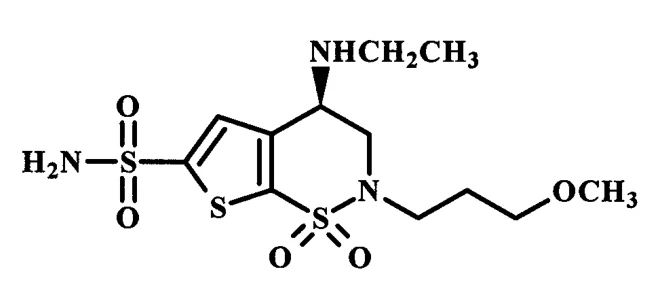
Physicochemical properties: White powder; insoluble in water and slightly soluble in methanol and ethanol; melting point of about 131oC.
14 CLINICAL TRIALS
14.1 Clinical Trials by Indication
Intraocular Pressure (IOP) Reduction
AZOPT, dosed two or three times per day (BID or TID) in patients with primary open-angle glaucoma or ocular hypertension, produced significant reductions in IOP when used either as primary therapy or when used adjunctively to TIMOPTIC® 0.5% BID (Timolol Maleate Ophthalmic Solution).
Table 3: Summary of patient demographics for clinical trials in IOP
| Study | Study design | Dosage, route of administration and duration | Study subjects (N) | Mean age (Range) | Sex (male:female) |
| Monotherapy | two, well controlled, three month | AZOPT: BID or TID TRUSOPT 2%: TID | N = 463 N = 572 | 63.1 (26-89) 61.9 (19-86) | 214:219 272:300 |
| Adjunctive therapy to beta-blockers | three month clinical trial | AZOPT TID Timolol 0.5% | N = 132 | 62.5 (34-89) | 63:69 |
| Long term | long term multicenter clinical trial | Brinzolamide BID and TID dosing | N = 379 | 61.4 (24-91) | 172:206 |
| Ocular Comfort | two, well-controlled, one week | AZOPT TID TRUSOPT 2% TID | N = 109 N = 104 | 61.8 (31-82) 68.6 (36-92) | 48:61 38:66 |
Monotherapy:
When used as primary therapy, AZOPT produced significant reductions in IOP when dosed either BID (3.4 to 5.7 mmHg) or TID (4.1 to 5.6 mmHg). These IOP reductions were statistically equivalent to each other and to the reductions (4.3 to 5.9 mmHg) observed with TRUSOPT (Dorzolamide Hydrochloride Ophthalmic Solution) 2% dosed TID in the same studies. From a responder analysis, it was determined that 38 to 75% of patients receiving AZOPT BID and 48 to 80% of the patients receiving AZOPT TID as primary therapy achieved either an IOP reduction ≥ 5 mmHg or had their IOP reduced to ≤ 21 mmHg. In comparison, 45 to 80% of the patients receiving TRUSOPT 2% TID were determined to have achieved these same reductions.
Adjunctive therapy to beta-blockers:
The IOP-lowering efficacy and safety of AZOPT TID, dosed adjunctively to timolol (a beta-blocker) has been established in a three month clinical trial in 132 patients who, while using timolol 0.5%, had pre-dose IOP measurement of 24 mmHg to 36 mmHg. When dosed adjunctively to timolol 0.5% BID, AZOPT provided a small but statistically significant additional reduction in IOP: 3.2 to 4.1 mmHg reduction for the group (with timolol 0.5% BID and AZOPT 1% TID treatments) versus 1.0 to 2.6 mmHg reduction for the group with timolol 0.5% treatment alone (p-value < 0.05).
Long term:
A long term multicenter clinical trial was conducted in which 379 patients with primary open angle glaucoma or ocular hypertension received brinzolamide BID or TID for at least 12 months. Both BID and TID dosing with brinzolamide produced clinically and statistically significant IOP reductions from baseline (3.2 to 3.9 mmHg) at each treatment visit. These IOP reductions were statistically equivalent to each other and were maintained for the 12-month treatment period. Adverse events related to therapy demonstrate that brinzolamide 1% dosed BID or TID was safe and well-tolerated. The most frequently reported related ocular adverse events for brinzolamide were transient blurred vision (5.9%) and ocular discomfort (4.3%). There were no clinically relevant changes in hematology, blood chemistry or urinalysis. Brinzolamide 1% BID or TID did not have any negative effects on corneal health, as evaluated by specular microscopy of the corneal endothelium.
Ocular comfort:
In patients with open angle glaucoma or ocular hypertension, AZOPT TID was demonstrated to be more comfortable than TRUSOPT 2% TID. In these studies, a significantly greater percentage of patients experienced no discomfort with AZOPT (71 to 81%) as compared to TRUSOPT 2% (17 to 20%).
15 MICROBIOLOGY
No microbiological information is required for this drug product.
16 NON-CLINICAL TOXICOLOGY
General Toxicology:
Acute Toxicity:
The oral LD50 of brinzolamide in rats was found to be between 1000 to 2000 mg/kg.
Long Term Toxicity:
Repeated dose studies in rats and mice have demonstrated brinzolamide to possess a general toxicity profile consistent with those of other carbonic anhydrase inhibitors. In a chronic (six-month) study of brinzolamide administered orally to male and female Fischer 344 rats, renal mineralization was seen in female rats in the mid and high dosage groups of 3 and 8 mg/kg/day (62 and 166 times the recommended human ophthalmic dose). Minimal to mild nephropathy was observed in females at the highest dosage. Renal and urinary findings were not seen in rats given oral doses equivalent to approximately 20 times the recommended human ophthalmic dose. The increased incidence of renal and urinary findings seen in the mid and high-dose rats is a class-effect of carbonic anhydrase inhibitors in rats. Rats are particularly prone to developing renal pathology in response to foreign bodies, compounds causing crystalluria, and diverse sodium salts.
Carbonic anhydrase activity has been observed in both the cytoplasm and around the plasma membranes of the corneal endothelium. In a twelve month topical ocular primate study, continued administration of AZOPT resulted in no significant effect on the corneal endothelium, as evaluated by specular microscopy.
Ocular Administration:
No changes in ocular, renal or urinary pathology were seen in rabbits given brinzolamide, up to 4%, dosed topically to the eye QID for six months (88 times the recommended human ophthalmic dose) or monkeys dosed topically to the eye TID at concentrations up to 4% brinzolamide (~66 times the recommended human ophthalmic dose) for one year.
Carcinogenicity:
Carcinogenicity data on brinzolamide are not available.
Genotoxicity:
The following tests for mutagenic potential were negative:
(1) in vivo mouse micronucleus assay;
(2) in vitro mammalian forward mutation assay;
(3) in vivo sister chromatid exchange assay; and
(4) Ames E. coli test.
Reproductive and Developmental Toxicology:
In reproduction studies of brinzolamide in rats, there were no adverse effects on the fertility or reproductive capacity of males or females at doses up to 18 mg/kg/day (375 times the recommended human ophthalmic dose).
Developmental toxicity studies with brinzolamide in rabbits at oral doses of 1, 3 and 6 mg/kg/day (43, 129 and 258 times the recommended human ophthalmic dose) produced maternal toxicity at 6 mg/kg/day and a significant increase in the number of fetal variations, such as accessory skull bones, which was only slightly higher than the historic value at 1 and 6 mg/kg/day. In rats, statistically decreased body weights of fetuses from dams receiving oral doses of 18 mg/kg/day during gestation were proportional to the reduced maternal weight gain, with no statistically significant effects on organ or tissue development. Increases in unossified sternebrae, reduced ossification of the skull and unossified hyoid that occurred at 6 and 18 mg/kg were not statistically significant. No treatment-related malformations were seen. Following oral administration of 14C-brinzolamide to pregnant rats, radioactivity was found to cross the placenta and was present in the fetal tissues and blood.