


Product Monograph - Bevqolva
Recent Major Label Changes
| Not applicable |
|---|
Table of Contents
Certain sections or subsections that are not applicable at the time of the preparation of the most recent authorized product monograph are not listed.
Recent Major Label Changes .................................................................................................... 2
Table of Contents ..................................................................................................................... 2
Part 1: Healthcare Professional Information ............................................................................ 5
1 Indications ........................................................................................................................ 5
1.1. Pediatrics ............................................................................................................................... 6
1.2. Geriatrics ............................................................................................................................... 6
2 Contraindications .............................................................................................................. 6
3 Serious Warnings and Precautions Box ............................................................................. 7
4 Dosage and Administration ............................................................................................... 8
4.1. Dosing Considerations ........................................................................................................... 8
4.2. Recommended Dose and Dosage Adjustment ...................................................................... 8
4.3. Reconstitution ....................................................................................................................... 9
4.4. Administration ..................................................................................................................... 10
5 Overdose ........................................................................................................................ 10
6 Dosage Forms, Strengths, Composition and Packaging .................................................... 10
7 Warnings and Precautions .............................................................................................. 11
General ....................................................................................................................................... 11
Carcinogenesis and Mutagenesis ............................................................................................... 12
Studies have not been performed to evaluate the carcinogenic and mutagenic potential of bevacizumab. ............................................................................................................................. 12
Cardiovascular ............................................................................................................................ 12
Driving and Operating Machinery .............................................................................................. 14
Gastrointestinal .......................................................................................................................... 14
Genitourinary ............................................................................................................................. 15
Hematologic ............................................................................................................................... 16
Hepatic/Biliary/Pancreatic .......................................................................................................... 17
Hypersensitivity Reactions, Anaphylactic Reactions (including Anaphylactic Shock), Infusion-related Reactions ........................................................................................................................ 18
Neurologic .................................................................................................................................. 18
Osteonecrosis of the Jaw (ONJ) .................................................................................................. 18
Perioperative Considerations ..................................................................................................... 19
Renal .......................................................................................................................................... 19
Reproductive Health ................................................................................................................... 19
7.1. Special Populations ............................................................................................................. 20
7.1.1. Pregnancy ........................................................................................................ 20
7.1.2. Breastfeeding ................................................................................................... 20
7.1.3. Pediatrics ......................................................................................................... 20
7.1.4. Geriatrics ......................................................................................................... 20
8 Adverse Reactions .......................................................................................................... 21
8.1. Adverse Reaction Overview ................................................................................................. 21
8.2. Clinical Trial Adverse Reactions ........................................................................................... 22
8.3. Less Common Clinical Trial Adverse Reactions .................................................................... 66
8.4. Abnormal Laboratory Findings: Hematologic, Clinical Chemistry, and Other Quantitative Data ............................................................................................................................................ 69
8.5. Post-Market Adverse Reactions .......................................................................................... 70
9 Drug Interactions ............................................................................................................ 71
9.2 Drug Interactions Overview ................................................................................................. 71
9.3. Drug-Behaviour Interactions ............................................................................................... 71
9.4 Drug-Drug Interactions ........................................................................................................ 71
9.5 Drug-Food Interactions........................................................................................................ 72
9.6 Drug-Herb Interactions ........................................................................................................ 72
9.7 Drug-Laboratory Test Interactions ...................................................................................... 72
10 Clinical Pharmacology ..................................................................................................... 73
10.1. Mechanism of Action .................................................................................................. 73
10.2. Pharmacodynamics ..................................................................................................... 73
10.3. Pharmacokinetics ....................................................................................................... 73
10.4. Immunogenicity .......................................................................................................... 76
11 Storage, Stability, and Disposal ....................................................................................... 77
12 Special Handling Instructions .......................................................................................... 77
Part 2: Scientific Information ................................................................................................. 78
13 Pharmaceutical Information ........................................................................................... 78
14 Clinical Trials – Reference Biologic Drug .......................................................................... 79
14.1. Clinical Trials by Indication ......................................................................................... 79
15 Microbiology .................................................................................................................. 98
16 Non-Clinical Toxicology ................................................................................................... 98
17 Supporting Product Monographs .................................................................................. 100
Patient Medication Information .......................................................................................... 101
Part 1: Healthcare Professional Information
BEVQOLVA (bevacizumab for injection) is a biosimilar biologic drug (biosimilar) to AVASTIN®(bevacizumab for injection). A biosimilar is a biologic drug that was granted authorization based on a demonstration of similarity to a version previously authorized in Canada, known as the reference biologic drug.
1 Indications
BEVQOLVA (bevacizumab for injection) is indicated for:
Metastatic Colorectal Cancer (mCRC)
- BEVQOLVA (bevacizumab), in combination with fluoropyrimidine-based chemotherapy is indicated for first-line treatment of patients with metastatic carcinoma of the colon or rectum.
- Consideration should be given to current standard of care guidelines for colorectal cancer.
- See 9.4 Drug-Drug Interactions for further information on the use of BEVQOLVA in combination with irinotecan. Please refer to the Product Monographs for irinotecan, 5-fluorouracil and leucovorin for additional information on these products, and specifically 4 Dosage and Administration for guidance on dose adjustments.
Locally Advanced, Metastatic or Recurrent Non-Small Cell Lung Cancer (NSCLC)
- BEVQOLVA, in combination with carboplatin/paclitaxel chemotherapy regimen, is indicated for treatment of patients with unresectable advanced, metastatic or recurrent non-squamous non-small cell lung cancer.
Platinum-Sensitive Recurrent Epithelial Ovarian, Fallopian Tube and Primary Peritoneal Cancer
- BEVQOLVA, in combination with carboplatin and gemcitabine is indicated for the treatment of patients with first recurrence platinum-sensitive epithelial ovarian, fallopian tube, or primary peritoneal cancer. These patients should not have received prior VEGF-targeted therapy including BEVQOLVA.
- The effectiveness of bevacizumab in platinum-sensitive recurrent epithelial ovarian, fallopian tube or primary peritoneal cancer is based on an improvement of progression- free survival in patients who had first recurrence after 6 months of platinum-based chemotherapy. No overall survival benefit was demonstrated with bevacizumab.
Platinum-Resistant Recurrent Epithelial Ovarian, Fallopian Tube and Primary Peritoneal Cancer
BEVQOLVA, in combination with paclitaxel, topotecan or pegylated liposomal doxorubicin, is indicated for the treatment of patients with recurrent, platinum-resistant epithelial ovarian, fallopian tube, or primary peritoneal cancer who received no more
- than two prior chemotherapy regimens. These patients should not have received prior VEGF-targeted therapy including BEVQOLVA.
- The effectiveness of bevacizumab in platinum-resistant recurrent epithelial ovarian, fallopian tube or primary peritoneal cancer is based on a study in patients with disease progression within < 6 months from the most recent platinum-based chemotherapy, with a minimum of 4 platinum therapy cycles completed. A statistically significant improvement in progression-free survival was seen. No overall survival benefit was demonstrated with bevacizumab.
Malignant Glioma (WHO Grade IV) – Glioblastoma
- BEVQOLVA, in combination with lomustine, is indicated for the treatment of patients with glioblastoma after relapse or disease progression, following prior therapy.
- The efficacy of bevacizumab in relapsed glioblastoma is based on an improvement in progression free survival, while an improvement in overall survival was not demonstrated in study EORTC 26101 (see 14 Clinical Trials – Reference Biologic Drug for information).
1.1. Pediatrics
Pediatrics (≤ 18 years of age): The safety and efficacy of BEVQOLVA in patients under the age of 18 years have not been established (see 7 Warnings and Precautions). Therefore, Health Canada has not authorized an indication for pediatric use.
1.2. Geriatrics
Geriatrics (> 65 years of age): Evidence from clinical studies and experience suggests that use in the geriatric population is associated with differences in safety or effectiveness (see 7.1 Special Populations).
2 Contraindications
BEVQOLVA is contraindicated in patients with known hypersensitivity to:
- This drug or any ingredient in the formulation, including any non-medicinal ingredient, or component of the container. For a complete listing, see 6 Dosage Forms, Strengths, Composition, and Packaging).
- Chinese hamster ovary cell products or other recombinant human or humanized antibodies.
BEVQOLVA is contraindicated in patients with untreated Central Nervous System (CNS) metastases (see 7 Warnings and Precautions and 8 Adverse Reactions).
3 Serious Warnings and Precautions Box
- Eye Disorders
BEVQOLVA is not formulated and has not been authorized for intravitreal use. Local and systemic adverse events have been reported in the post-market setting with unauthorized intravitreal use (see 7 Warnings and Precautions General).
- Gastrointestinal Perforations
BEVQOLVA administration can result in the development of gastrointestinal perforation in some instances resulting in fatality. Gastrointestinal perforation, sometimes associated with intra-abdominal abscess, occurred throughout treatment with bevacizumab (i.e., was not correlated to duration of exposure). The typical presentation was reported as abdominal pain associated with symptoms such as constipation and vomiting. Gastrointestinal perforation should be included in the differential diagnosis of patients on BEVQOLVA presenting with abdominal pain. The incidence of gastrointestinal perforation, some fatal, in bevacizumab treated patients ranges from 0.3 to 3.2%. Gastrointestinal perforations (including gastrointestinal fistula and abscess) have been reported in up to 2.7% in patients with metastatic colorectal cancer, 0.6% in platinum-sensitive ovarian cancer, and 1.7% in platinum-resistant ovarian cancer studies. The incidence of gastrointestinal perforation in patients receiving irinotecan/bolus 5-fluorouracil/leucovorin with bevacizumab was 2%. BEVQOLVA therapy should be permanently discontinued in patients with gastrointestinal perforation (see 7 Warnings and Precautions, Gastrointestinal and 8 Adverse Reactions, Gastrointestinal).
- Wound Healing Complications
BEVQOLVA administration can result in wound dehiscence, in some instances resulting in fatality. BEVQOLVA therapy should be permanently discontinued in patients with wound dehiscence requiring medical intervention. BEVQOLVA should be discontinued at least 28 days prior to elective surgery. BEVQOLVA therapy should not be initiated for at least 28 days following major surgery or until the surgical wound is fully healed (see 7 Warnings and Precautions, Perioperative Considerations).
- Hemorrhage
Severe or fatal hemorrhage, including hemoptysis, gastrointestinal bleeding, central nervous systems (CNS) hemorrhage, epistaxis, and vaginal bleeding occurred up to fivefold more frequently in patients receiving bevacizumab. Do not administer BEVQOLVA to patients with serious hemorrhage or recent hemoptysis (see 4 Dosage and Administration, 7 Warnings and Precautions and 8 Adverse Reactions).
4 Dosage and Administration
4.1. Dosing Considerations
It is recommended that BEVQOLVA treatment be continued until progression of the underlying disease.
There are no recommended dose reductions. Discontinue BEVQOLVA for:
- Gastrointestinal perforations (gastrointestinal perforations, fistula formation in the gastrointestinal tract, intra-abdominal abscess);
- Internal fistula not arising in the GI tract, tracheoesophageal (TE) fistula or any Grade 4 fistula;
- Wound dehiscence and wound healing complications requiring medical intervention;
- Necrotizing fasciitis;
- Serious hemorrhage or recent hemoptysis;
- Severe arterial thromboembolic events;
- Life-threatening (Grade 4) venous thromboembolic events (VTEs), including pulmonary embolism;
- Severe hypertension not controlled with medical management;
- Hypertensive crisis or hypertensive encephalopathy;
- Posterior Reversible Encephalopathy Syndrome (PRES);
- Nephrotic syndrome.
Temporarily suspend BEVQOLVA for:
- At least 4 weeks prior to elective surgery;
- Moderate to severe proteinuria pending further evaluation;
- Severe infusion reactions.
4.2. Recommended Dose and Dosage Adjustment
Health Canada has not authorized an indication for pediatric use (see 7 Warnings and Precautions, 7.1.3 Pediatrics).
Metastatic Colorectal Cancer
The recommended dose of BEVQOLVA is 5 mg/kg of body weight given once every 14 days as an intravenous infusion.
Locally Advanced, Metastatic or Recurrent Non-Small Cell Lung Cancer (NSCLC)
The recommended dose of BEVQOLVA is 15 mg/kg of body weight given once every 3 weeks as an intravenous infusion in addition to carboplatin + paclitaxel chemotherapy regimen.
In clinical trials, bevacizumab was administered in addition to carboplatin + paclitaxel chemotherapy for up to 6 cycles of treatment followed by bevacizumab as a single agent until disease progression.
Platinum-Sensitive Recurrent Epithelial Ovarian, Fallopian Tube and Primary Peritoneal Cancer
The recommended dose of BEVQOLVA is 15 mg/kg of body weight given once every 3 weeks as an intravenous infusion.
BEVQOLVA is administered in combination with carboplatin and gemcitabine for 6 cycles and up to 10 cycles followed by continued use of BEVQOLVA as single agent until disease progression.
Platinum-Resistant Recurrent Epithelial Ovarian, Fallopian Tube and Primary Peritoneal Cancer
The recommended dose of BEVQOLVA is 10 mg/kg of body weight given once every 2 weeks as an intravenous infusion when administered in combination with one of the following agents – paclitaxel, topotecan (given weekly) or pegylated liposomal doxorubicin [see 14 Clinical Trials – Reference Biologic Drug section, Study MO22224 (AURELIA) for chemotherapy regimens].
Alternatively, the recommended dose of BEVQOLVA is 15 mg/kg every 3 weeks when administered in combination with topotecan given on days 1-5, every 3 weeks [see 14 Clinical Trials – Reference Biologic Drug section, Study MO22224 (AURELIA) for chemotherapy regimen].
Malignant Glioma (WHO Grade IV) - Glioblastoma
The recommended dose of BEVQOLVA is 10 mg/kg of body weight given once every 2 weeks as an intravenous infusion in combination with lomustine every 6 weeks until disease progression. An oral dose of 90 mg/m2 (maximum dose 160 mg) of lomustine is recommended for the first cycle; in the absence of Grade > 1 hematological toxicity during the first cycle, it can be escalated to 110 mg/m2 (maximum dose 200 mg) from the second cycle onwards (see also 14 Clinical Trials – Reference Biologic Drug).
4.3. Reconstitution
Parenteral Products: Parenteral drug products should be inspected visually for particulate matter and discoloration prior to administration. Discard the vial if visible particles are observed.
BEVQOLVA should be prepared by a healthcare professional using aseptic technique. Use sterile needle and syringe to prepare BEVQOLVA. Withdraw the necessary amount of BEVQOLVA and dilute to the required administration volume with 0.9% sodium chloride solution. The concentration of the final bevacizumab solution should be kept within the range of 1.4 - 16.5 mg/mL.
Discard any unused portion left in a vial, as the product contains no preservatives (see 11 Storage, Stability, and Disposal).
BEVQOLVA INFUSIONS SHOULD NOT BE ADMINISTERED OR MIXED WITH DEXTROSE OR GLUCOSE SOLUTIONS. A concentration-dependent degradation profile of bevacizumab was observed when diluted with dextrose solutions (5%).
No incompatibilities between BEVQOLVA and polyvinyl chloride or polyolefin bags have been observed.
BEVQOLVA is not formulated for intravitreal use (see 7 Warnings and Precautions).
4.4. Administration
Do not administer as an intravenous push or bolus.
The initial BEVQOLVA dose should be delivered over 90 minutes as an intravenous infusion. If the first infusion is well tolerated, the second infusion may be administered over 60 minutes. If the 60-minute infusion is well tolerated, all subsequent infusions may be administered over 30 minutes.
5 Overdose
In addition to the possible adverse reactions listed in this PM, the highest dose of bevacizumab tested in humans (20 mg/kg of body weight, intravenous, multiple doses) was associated with severe migraine in several patients.
For the most recent information in the management of a suspected drug overdose, contact your regional poison control centre or Health Canada’s toll-free number, 1-844 POISON-X (1-844-764-7669).
6 Dosage Forms, Strengths, Composition and Packaging
To help ensure the traceability of biologic products, health professionals should record both the brand name and the non-proprietary (active ingredient) name as well as other product-specific identifiers such as the Drug Identification Number (DIN) and the batch/lot number of the product supplied.
Table 1. Dosage Forms, Strengths, Composition and Packaging
| Route of Administration | Dosage Form/ Strength/Composition | Non-Medicinal Ingredients |
| Intravenous infusion | 100 mg and 400 mg vials (25 mg/mL solution for injection) | α, α-trehalose dihydrate, polysorbate 20, sodium phosphate and water for injection. |
BEVQOLVA is available as single-use, preservative-free, clear glass vials with butyl rubber stopper containing 25 mg/mL bevacizumab as either 100 mg bevacizumab in 4 mL or 400 mg bevacizumab in 16 mL. Non-medicinal ingredients: α,α-trehalose dihydrate, polysorbate 20, sodium phosphate and water for injection. Packs of 1 vial.
7 Warnings and Precautions
See 3 Serious Warnings and Precautions Box.
General
All patients discontinuing treatment with BEVQOLVA should be monitored according to medical practice.
Unauthorized Intravitreal Use: Eye Disorders
Individual cases and clusters of serious ocular adverse events affecting multiple patients have been reported from unauthorized intravitreal use of bevacizumab following variable and non- validated methods in compounding, storage, and handling of bevacizumab vials authorized for intravenous administration in cancer patients. These events included infectious endophthalmitis (some cases leading to permanent blindness, one case reported extraocular extension of infection resulting in meningoencephalitis), intraocular inflammation1 (such as sterile endophthalmitis, uveitis, and vitritis) (some cases leading to permanent blindness), retinal detachment, retinal pigment epithelial tear, intraocular pressure increased, intraocular hemorrhage (such as vitreous hemorrhage or retinal hemorrhage), conjunctival hemorrhage.
An observational claims database2 study comparing unauthorized intravitreal bevacizumab to an authorized treatment in patients treated for wet age-related macular degeneration has reported an increased risk of intraocular inflammation for bevacizumab (adjusted HR: 1.82; 99% CI: 1.20, 2.76) (Incidence 0.46 events per 100 patients per year; comparator 0.26 events per 100 patients per year) as well as an increased risk for cataract surgery (adjusted HR: 1.11; 99% CI: 1.01, 1.23) (Incidence 6.33 events per 100 patients per year; comparator 5.64 events per 100 patients per year).
Unauthorized Intravitreal Use: Systemic Events
An observational claims database3 study comparing unauthorized intravitreal bevacizumab to an authorized treatment in patients treated for wet age-related macular degeneration has reported an increased risk of hemorrhagic stroke for bevacizumab (adjusted HR: 1.57; 99% CI: 1.04, 2.37) (Incidence 0.41 events per 100 patients per year; comparator 0.26 events per 100 patients per year) as well as an increased risk for overall mortality (adjusted HR: 1.11; 99% CI:
1 Gower et al. Adverse Event Rates Following Intravitreal Injection of AVASTIN or LUCENTIS for Treating Age- Related Macular Degeneration ARVO 2011, Poster 6644, Data on File
2 Ibid
3 Ibid
1.01, 1.23) (Incidence 6.03 events per 100 patients per year; comparator 5.51 events per 100 patients per year). A second observational study found similar results for all-cause mortality.4 A randomized controlled clinical trial comparing unauthorized bevacizumab to an authorized treatment for patients with wet age-related macular degeneration5 has reported an increased risk of serious systemic adverse events for bevacizumab, most of which resulted in hospitalization (adjusted risk ratio 1.29; 95% CI: 1.01, 1.66) (Incidence 24.1%; comparator 19.0%). The most frequent serious systemic adverse events reported directly to the sponsor include myocardial infarction, cerebrovascular accident, and hypertension.
Carcinogenesis and Mutagenesis
Studies have not been performed to evaluate the carcinogenic and mutagenic potential of bevacizumab.
Cardiovascular
Hypertension
An increased incidence of hypertension was observed in patients treated with bevacizumab. Clinical safety data from a single phase III study suggests that the risk of hypertension may be greater in platinum-sensitive recurrent ovarian cancer patients treated with bevacizumab (see 8 Adverse Reactions).
Clinical safety data suggest that the incidence of hypertension is likely to be dose-dependent. Pre-existing hypertension should be adequately controlled before starting BEVQOLVA treatment. There is no information on the effect of bevacizumab in patients with uncontrolled hypertension at the time of initiating bevacizumab therapy.
Frequently monitor of blood pressure (e.g., 2-3 weeks) during BEVQOLVA therapy in order to detect potentially serious complications of therapy, including hypertensive encephalopathy and Posterior Reversible Encephalopathy Syndrome (PRES) (see 7 Warnings and Precautions and 8 Adverse Reactions).
In most cases hypertension was controlled adequately using standard antihypertensive treatment appropriate for the individual situation of the affected patient. The use of diuretics to manage hypertension is not advised in patients who receive a cisplatin-based chemotherapy regimen. BEVQOLVA treatment should be permanently discontinued if medically significant hypertension cannot be adequately controlled with antihypertensive therapy, or, if the patient develops hypertensive crisis or hypertensive encephalopathy (see 8 Adverse Reactions).
Thromboembolism
4 Curtis LH, et al. Risks of mortality, myocardial infarction, bleeding, and stroke associated with therapies for age- related macular degeneration. Arch Ophthalmol. 2010;128(10):1273-1279
5 Comparison of Age-Related Macular Degeneration Treatment Trials (CATT) Research Group, Ranibizumab and Bevacizumab for Neovascular Age-Related Macular Degeneration. 10.1056/NEJMoa1102673
Arterial Thromboembolism
In clinical trials, the incidence of Arterial Thromboembolic Events (ATEs) including cerebrovascular accident, transient ischemic attack and myocardial infarction was higher in patients receiving bevacizumab in combination with chemotherapy compared to those who received chemotherapy alone (see 8 Adverse Reactions).
BEVQOLVA should be permanently discontinued in patients who develop arterial thromboembolic events.
Patients receiving BEVQOLVA plus chemotherapy with a history of arterial thromboembolism, diabetes or age greater than 65 years have an increased risk of developing arterial thromboembolic events during BEVQOLVA therapy. Caution should be used when treating such patients with BEVQOLVA (see 8 Adverse Reactions). Regular clinical, and if necessary, special radiological investigations, should be performed to assess for signs of ATEs. Appropriate treatment, including permanent discontinuation of BEVQOLVA, should be carried out in case of identified ATE.
Venous Thromboembolism
Patients may be at risk of developing Venous Thromboembolic Events (VTEs), including pulmonary embolism under BEVQOLVA treatment.
In a clinical trial, patients with persistent, recurrent, or metastatic cervical cancer who were administered bevacizumab showed an increased risk of venous thromboembolic events (see 8 Adverse Reactions, Venous thromboembolism). BEVQOLVA is not authorized for use in cervical cancer.
BEVQOLVA should be discontinued in patients with life-threatening (Grade 4) VTEs, including pulmonary embolism. Patients with ≤ Grade 3 venous thromboembolism need to be monitored closely in accordance with local practice guidelines and receive appropriate treatment for VTEs including discontinuation of BEVQOLVA therapy if their condition deteriorates.
Congestive Heart Failure (CHF)/Cardiomyopathy
Events consistent with CHF were reported in clinical trials. The findings ranged from asymptomatic declines in left ventricular ejection fraction to symptomatic CHF, requiring treatment or hospitalization.
Caution should be exercised when treating patients with clinically significant cardiovascular disease such as pre-existing coronary artery disease, or CHF with BEVQOLVA.
CHF was observed in all cancer indications. Most of the patients who experienced CHF had metastatic breast cancer and had received previous treatment with anthracyclines, prior radiotherapy to the left chest wall or other risk factors for CHF were present (see 8 Adverse Reactions). BEVQOLVA is not authorized for the treatment of metastatic breast cancer. The signs and symptoms of CHF include unspecific symptoms such as fatigue, weakness and fainting and depending on the side of heart affected, abdominal pain, nausea, orthopnea, pulmonary and/or peripheral edema, shortness of breath, palpitations and/or irregular fast heartbeat.
If symptomatic cardiac failure develops during therapy with BEVQOLVA, it should be treated with the standard medications for this purpose. Discontinuation of BEVQOLVA should be strongly considered in patients who develop clinically significant CHF, taking into account a careful benefit-risk assessment.
Driving and Operating Machinery
No studies on the effects on the ability to drive and use machines have been performed.
Gastrointestinal
Gastrointestinal Perforations and Fistula
Patients may be at increased risk for the development of gastrointestinal perforation and fistulae when treated with BEVQOLVA and chemotherapy (see 8 Adverse Reactions). Bevacizumab use has been associated with serious and sometimes fatal cases of gastrointestinal perforation and fistula in clinical trials (see 8 Adverse Reactions). In bevacizumab clinical trials, gastrointestinal fistulae have been reported with the highest incidence of around 2% in patients with metastatic colorectal cancer and ovarian cancer, but were also reported less commonly in patients with other types of cancers (e.g., breast cancer, lung cancer and others). The typical presentation may include abdominal pain, nausea, emesis, constipation, and fever. The majority of cases occurred within the first 50 days of initiation of bevacizumab.
In a clinical trial, patients with persistent, recurrent, or metastatic cervical cancer who were administered bevacizumab showed an increased risk of fistulae between the vagina and any part of the GI tract (gastrointestinal-vaginal fistulae) (see 8 Adverse Reactions, Gastrointestinal, Gastrointestinal Perforations and Fistula). Prior radiation is an additional important risk factor for the development of GI-vaginal fistulae. BEVQOLVA is not authorized for use in cervical cancer.
BEVQOLVA should be permanently discontinued in patients who develop gastrointestinal perforation. Patients may be at increased risk for the development of gallbladder perforation when treated with BEVQOLVA (see 8 Adverse Reactions).
Non-Gastrointestinal Fistula
Patients may be at increased risk for the development of fistulae when treated with BEVQOLVA (see 8 Adverse Reactions).
Bevacizumab use has been associated with serious cases of fistulae including events resulting in death.
Permanently discontinue BEVQOLVA in patients with any Grade 4 fistula. Limited information is available on the continued use of bevacizumab in patients with other fistulae. In cases of internal fistula not arising in the GI tract, BEVQOLVA should be discontinued.
Serious and sometimes fatal non-gastrointestinal fistula formation involving tracheoesophageal, bronchopleural, biliary, vaginal, renal, and bladder sites occurs at a higher incidence in bevacizumab-treated patients compared to controls. Uncommon (≥ 0.1% to < 1%) reports of non- gastrointestinal perforation were observed in clinical studies across various indications at any time points ranging from one week to greater than 1 year from initiation of bevacizumab treatment, with most of the events occurring within the first 6 months of bevacizumab therapy. Fistulae have also been reported in post-marketing experience. Although other risk factors (e.g., diagnosis of cancer, cancer progression, cancer treatments) are known to be associated with an increased risk of development of fistulae, a role for BEVQOLVA in increasing this risk cannot be excluded.
Tracheoesophageal (TE) Fistula
Cases of TE fistula have been reported in lung and esophageal cancer studies of bevacizumab in combination with chemotherapy alone or with concurrent radiation treatment. TE fistulae have not to date been reported in patients with metastatic colorectal cancer, but the possibility that this is a rare adverse drug reaction associated with bevacizumab in indications other than lung or esophageal cancer cannot be excluded.
Permanently discontinue BEVQOLVA in patients with tracheoesophageal (TE) fistula.
Genitourinary
Ovarian Failure
BEVQOLVA may cause ovarian failure. Therefore, fertility preservation strategies and hormonal changes should be discussed with women of reproductive potential prior to starting treatment with BEVQOLVA (see 7 Warnings and Precautions, Special Populations, Pregnancy, and 8 Adverse Reactions). Long term effects of the treatment with BEVQOLVA on fertility are unknown.
Proteinuria
Patients with a history of hypertension are at increased risk for the development of proteinuria when treated with BEVQOLVA. There is evidence suggesting that ≥ Grade 1 proteinuria may be related to bevacizumab dose. Monitor proteinuria by dipstick urine analysis for the development or worsening of proteinuria with serial urinalyses during BEVQOLVA therapy. Patients with a 2+ or greater urine dipstick reading should undergo further assessment with a 24-hour urine collection.
Temporarily suspend BEVQOLVA administration for ≥2 grams of proteinuria/24 hours and resume when proteinuria is <2 grams/24 hours. BEVQOLVA should be permanently discontinued in patients who develop Grade 4 proteinuria (nephrotic syndrome) (see 8 Adverse Reactions). Proteinuria may not completely resolve after discontinuation of BEVQOLVA.
Data from a post-marketing safety study of bevacizumab showed poor correlation between UPCR (Urine Protein/Creatine Ratio) and 24 hour urine protein [Pearson Correlation 0.39 (95% CI 0.17, 0.57)].
In clinical trials, the incidence of proteinuria was very common and higher in patients receiving bevacizumab in combination with chemotherapy compared to those who received chemotherapy alone. Clinical safety data from a single phase III study suggests that the risk of proteinuria may be greater in platinum-sensitive recurrent ovarian cancer patients treated with bevacizumab (see 8 Adverse Reactions). Proteinuria (any Grade) was reported in 21.5% (53/247) of the patients in the bevacizumab arm versus 4.3% (10/233) of the patients in the chemotherapy arm. Grade ≥ 3 proteinuria was observed in 10.9% (27/247) of the patients treated with bevacizumab versus 0.9% (2/233) of the patients treated with chemotherapy alone. The incidence of Grade 3 proteinuria was common in patients treated with bevacizumab. Grade 4 proteinuria (nephrotic syndrome) was seen in up to 1.4% of patients treated with bevacizumab, and in some instances resulted in fatal outcomes. In a published case series, kidney biopsy of six patients with proteinuria showed findings consistent with thrombotic microangiopathy.
Limited safety information is available for patients with proteinuria ≥0.5g/24 hr urine collection as they were excluded from clinical trials.
Hematologic
Hemorrhage
Patients treated with BEVQOLVA have an increased risk of hemorrhage, especially tumour- associated hemorrhage (see 8 Adverse Reactions). BEVQOLVA can result in gastrointestinal bleeding, hematemesis, CNS hemorrhage, hemoptysis, epistaxis or vaginal bleeding. Patients should be monitored for bleeding events. BEVQOLVA should be permanently discontinued in patients who experienced Grade 3 or 4 bleeding (i.e., bleeding requiring medical intervention) during BEVQOLVA therapy, and aggressive medical management should be initiated. Routine assessment of this event should include serial complete blood counts and physical examination.
There is no information on the safety profile of bevacizumab in patients with congenital bleeding diathesis, acquired coagulopathy or in patients receiving full dose of anticoagulants for the treatment of thromboembolism prior to starting bevacizumab treatment, as such patients were excluded from clinical trials. Therefore, caution should be exercised before initiating BEVQOLVA therapy in these patients. However, patients who developed venous thrombosis while receiving bevacizumab therapy did not appear to have increased rate of Grade 3 or above bleeding when treated with full dose of warfarin and bevacizumab concomitantly.
CNS hemorrhage
Cases of CNS hemorrhage, some with fatal outcome, have been observed with bevacizumab use. In one phase III study with platinum-sensitive recurrent ovarian cancer, one patient treated with bevacizumab experienced a Grade 4 hemorrhage stroke and one patient experienced a Grade 5 intracranial hemorrhage. Patients should be monitored for signs and symptoms of CNS bleeding, and BEVQOLVA treatment discontinued in case of intracranial bleeding.
The risk of CNS hemorrhage in patients with CNS metastases receiving bevacizumab could not be fully evaluated, as these patients were excluded from clinical trials (see 2 Contraindications).
Intracranial hemorrhage can occur in patients with relapsed glioblastoma. In study EORTC 26101, 2.5% of patients in the bevacizumab + lomustine arm versus 0.7% in the lomustine arm experienced intracranial hemorrhage.
Non-CNS hemorrhage
In Study AVF4095g with platinum-sensitive recurrent ovarian cancer, 6/247 (2.4%) patients had serious non-CNS bleeding events.
Pulmonary Hemorrhage/Hemoptysis
Patients with non-small cell lung cancer treated with BEVQOLVA may be at risk for serious, and in some cases fatal, pulmonary hemorrhage/hemoptysis. Patients with recent pulmonary hemorrhage/hemoptysis (>1/2 teaspoon red blood) should not be treated with BEVQOLVA (see 8 Adverse Reactions, Hemorrhage).
Neutropenia and Infections
Increased rates of severe neutropenia, febrile neutropenia, or infection with or without severe neutropenia (including some fatalities) have been observed in patients treated with some myelotoxic chemotherapy regimens plus bevacizumab in comparison to chemotherapy alone (see 8 Adverse Reactions). Patients should be closely monitored for signs of febrile neutropenia, and white blood cell count carried out according to local oncology standards. Treatment of neutropenia and febrile neutropenia should follow established oncological standards.
Thrombocytopenia
The incidence of thrombocytopenia was higher in patients receiving bevacizumab in combination with chemotherapy (eg. cisplatin/gemcitabine) compared to those who received chemotherapy alone. Increased incidence of thrombocytopenia (any Grade) was reported in patients treated with bevacizumab (57.9%, 143/247) as compared to those who received chemotherapy alone (51.1%, 119/233) in the platinum-sensitive ovarian cancer indication clinical trial. Grade ≥3 thrombocytopenia was observed in 40.1% (99/247) of the patients treated with bevacizumab and in 33.9% (79/233) of the patients treated with chemotherapy alone. The incidence of Grade 3 thrombocytopenia was common in patients treated with bevacizumab. Patients >65 years of age appeared to be at higher risk for Grade ≥3 thrombocytopenia compared with younger patients. In the platinum-sensitive ovarian cancer indication, a higher incidence of patients treated with bevacizumab developed thrombocytopenia that was accompanied or followed by a bleeding event compared with those treated with chemotherapy alone (see 8 Adverse Reactions).
Hepatic/Biliary/Pancreatic
The safety and efficacy of BEVQOLVA have not been studied in patients with hepatic impairment.
Hypersensitivity Reactions, Anaphylactic Reactions (including Anaphylactic Shock), Infusion-related Reactions
Patients may be at risk of developing hypersensitivity reactions, anaphylactic reactions (including anaphylactic shock), and infusion-related reactions. Close observation of the patient during and following the administration of BEVQOLVA is recommended. If an anaphylactic reaction occurs, the infusion should be permanently discontinued and appropriate medical therapies should be administered. A systematic premedication specifically for bevacizumab administration, in general, is not warranted; however, use of premedication should be based on clinical judgment. If an infusion-related reaction occurs, treatment should be temporarily interrupted until resolution of symptoms. Permanently discontinue BEVQOLVA for severe (Grade ≥3) infusion related-reactions.
Infusion reactions reported in the clinical trials and post-marketing experience include hypertension, hypertensive crises associated with neurologic signs and symptoms, wheezing, oxygen desaturation, Grade 3 hypersensitivity, chest pain, headaches, rigors, and diaphoresis.
Neurologic
Posterior Reversible Encephalopathy Syndrome (PRES) [previously known as Reversible Posterior Leukoencephalopathy Syndrome (RPLS)]
There have been rare reports of patients treated with bevacizumab developing signs and symptoms that are consistent with PRES, a rare neurological disorder, which can present with the following signs and symptoms among others: seizures, headache, altered mental status, visual disturbance, or cortical blindness, with or without associated hypertension. Three cases (2 confirmed and 1 unconfirmed of PRES were reported in the platinum-sensitive recurrent ovarian cancer study AVF4095g (see 7 Warnings and Precautions and 8 Adverse Reactions). PRES has been reported with an incidence rate of up to 0.8% in clinical studies. The frequency of PRES was 0.5% in cervical cancer, 0.5% in glioblastoma multiforme, 0.1% in non-small cell lung cancer, 0.2% in ovarian cancer, and 0.3% in renal cancer. No cases of PRES were reported in metastatic colorectal carcinoma and breast cancer trials.
The symptoms of PRES may be difficult to differentiate from those of uncontrolled hypertension, therefore neurological examination should be carried out in a patient presenting with the above signs and symptoms. Brain imaging, particularly Magnetic Resonance Imaging (MRI), confirms the diagnosis of PRES. The onset of symptoms has been reported to occur from 16 hours to 1 year after initiation of bevacizumab. Discontinue BEVQOLVA in patients developing PRES, and treat patient-specific symptoms including control of hypertension. Signs and symptoms of PRES usually resolve within days, although neurologic sequelae may remain. The safety of reinitiating therapy with BEVQOLVA in patients previously experiencing PRES is not known (see 8 Adverse Reactions).
Osteonecrosis of the Jaw (ONJ)
Cases of ONJ have been reported in cancer patients treated with bevacizumab, the majority of whom had received prior or concomitant treatment with i.v. bisphosphonates, for which ONJ is an identified risk. Caution should be exercised when BEVQOLVA and i.v. bisphosphonates are administered simultaneously or sequentially.
Invasive dental procedures are also an identified risk factor. A dental examination and appropriate preventive dentistry should be considered prior to starting the treatment with BEVQOLVA. In patients who have previously received or are receiving i.v. bisphosphonates invasive dental procedures should be avoided, if possible. Other known risk factors for ONJ include other treatments such as radiotherapy and glucocorticoids.
Perioperative Considerations
Wound Healing
BEVQOLVA may adversely affect the wound healing process. Serious wound healing complications with a fatal outcome have been reported. In the platinum-sensitive recurrent ovarian cancer study AVF4095g, one (0.4%) non-fatal serious case of wound dehiscence was reported in a patient treated with bevacizumab and there was no case of serious wound complication reported in patients treated with chemotherapy alone.
BEVQOLVA therapy should not be initiated for at least 28 days following major surgery or until the surgical wound is fully healed. In patients who experience wound healing complications during BEVQOLVA treatment, BEVQOLVA should be withheld until the wound is fully healed. BEVQOLVA therapy should be withheld for elective surgery (see 8 Adverse Reactions).
Necrotizing fasciitis including fatal cases, has rarely been reported in patients treated with bevacizumab; usually secondary to wound healing complications, gastrointestinal perforation or fistula formation. BEVQOLVA therapy should be discontinued in patients who develop necrotizing fasciitis, and appropriate treatment should be promptly initiated (see 8 Adverse Reactions, 8.5 Post-Market Adverse Reactions and 8.2 Clinical Trial Adverse Reactions).
Renal
The safety and efficacy of BEVQOLVA have not been studied in patients with renal impairment (see Proteinuria and Genitourinary above).
Reproductive Health
- Fertility
Repeat dose safety studies in animals have shown that bevacizumab may have an adverse effect on female fertility (see 16 Non-Clinical Toxicology). A sub study with 295 women of reproductive potential has shown a higher incidence of new cases of ovarian failure in the bevacizumab group compared to the control group (39.0 vs. 2.6%). After discontinuation of bevacizumab treatment, ovarian function recovered in the majority (86%) of patients. Long term effects of the treatment with bevacizumab on fertility are unknown (see 8 Adverse Reactions).
7.1. Special Populations
7.1.1. Pregnancy
There are no adequate and well controlled studies in pregnant women. IgGs are known to cross the placental barrier, and BEVQOLVA may inhibit angiogenesis in the fetus. In the post-marketing setting, cases of fetal abnormalities in women treated with bevacizumab alone or in combination with known embryotoxic chemotherapeutics have been observed (see 8.5 Post-Market Adverse Reactions).
Therefore, BEVQOLVA should not be used during pregnancy. In women with childbearing potential, appropriate precautions must be undertaken to avoid pregnancy and at least two contraceptive methods should be used with BEVQOLVA therapy and for at least 6 months following the last dose of BEVQOLVA.
Angiogenesis has been shown to be critically important to fetal development. The inhibition of angiogenesis following administration of BEVQOLVA could result in an adverse outcome of pregnancy.
Bevacizumab has been shown to be embryotoxic and teratogenic when administered to rabbits. Observed effects included decreases in maternal and fetal body weights, an increased number of fetal resorptions and an increased incidence of specific gross and skeletal fetal alterations. Adverse fetal outcomes were observed at all tested doses of 10-100 mg/kg.
7.1.2. Breastfeeding
It is not known whether bevacizumab is excreted in human milk. As maternal IgG is excreted in milk and bevacizumab could harm infant growth and development, women should be advised to discontinue nursing during BEVQOLVA therapy and not to breastfeed for at least 6 months following the last dose of BEVQOLVA.
7.1.3. Pediatrics
BEVQOLVA is not approved for use in patients under the age of 18 years. The safety and efficacy of BEVQOLVA in this population has not been established. The addition of bevacizumab to standard of care did not demonstrate clinical benefit in pediatric patients in two phase II clinical trials: one in pediatric high-grade glioma and one in pediatric metastatic rhabdomyosarcoma (RMS) or non-rhabdomyosarcoma soft tissue sarcoma (NRSTS) (see 14 Clinical Trials-Reference Biologic Drug, and 7.1.3 Pediatrics).
In published reports, cases of osteonecrosis at sites other than the jaw have been observed in patients under the age of 18 years exposed to bevacizumab (see 16 Non-Clinical Toxicology).
7.1.4. Geriatrics
Patients receiving BEVQOLVA plus chemotherapy with a history of arterial thromboembolism, diabetes and age greater than 65 years have a higher risk of arterial thromboembolic events. Caution should be used when treating these patients with BEVQOLVA (see 8 Adverse Reactions). In randomized clinical trials, age > 65 years was associated with an increased risk of developing arterial thromboembolic events (including cerebrovascular accidents, transient ischemic attacks, myocardial infarction), Grade 3-4 leukopenia, neutropenia, thrombocytopenia, proteinuria, diarrhea and fatigue as compared to those aged ≤ 65 years when treated with bevacizumab (see 7 Warnings and Precautions, Cardiovascular and 8 Adverse Reactions). The risk and benefit of BEVQOLVA administration in patients > 65 should be carefully evaluated prior to initiating therapy.
In study AVF4095g, the safety profile of the bevacizumab in platinum-sensitive recurrent ovarian cancer patients, ≥ 65 years of age is consistent with the known overall safety profile of bevacizumab across other tumor types. In addition to the higher risk of events in the elderly as noted above, events of hypertension, arthritis, increased blood pressure, dizziness, decreased appetite, and dysphonia occurred at a higher frequency in the elderly patients in study AVF4095g.
In study E4599, patients aged > 65 years receiving carboplatin, paclitaxel, and bevacizumab had a greater relative risk for proteinuria as compared to younger patients.
8 Adverse Reactions
8.1. Adverse Reaction Overview
Clinical trials have been conducted in patients with various malignancies treated with bevacizumab, predominantly in combination with chemotherapy. The safety profile from a clinical trial population of approximately 5000 patients is presented in this section.
The most serious adverse drug reactions were:
- Gastrointestinal Perforations (see 7 Warnings and Precautions)
- Hemorrhage including pulmonary hemorrhage/hemoptysis, which is more common in NSCLC patients (see 7 Warnings and Precautions)
- Arterial Thromboembolism (see 7 Warnings and Precautions)
- Non-gastrointestinal Fistula
- Hypertensive Crises
- Posterior Reversible Encephalopathy Syndrome (PRES)
- Neutropenia and Infections
- Nephrotic Syndrome
- Congestive Heart Failure
Please refer to 8 Adverse Reactions, Further Information on Selected, Serious Adverse Drug Reactions for clinical trial frequency analysis of each serious adverse drug reaction listed above.
Analyses of the clinical safety data suggest that the occurrence of hypertension and proteinuria with bevacizumab therapy are likely to be dose-dependent.
The most frequently observed adverse drug reactions across all clinical trials in patients receiving bevacizumab were fatigue or asthenia, diarrhea, hypertension, and abdominal pain, all with a frequency of very common (≥10%).
8.2. Clinical Trial Adverse Reactions
Clinical trials are conducted under very specific conditions. Therefore, the frequencies of adverse reactions observed in the clinical trials may not reflect frequencies observed in clinical practice and should not be compared to frequencies reported in clinical trials of another drug.
Table 2 lists adverse drug reactions associated with the use of bevacizumab in combination with different chemotherapy regimens in multiple indications. These reactions had occurred either with at least a 2% difference compared to the control arm (NCI-CTC Grade 3-5 reactions) or with at least a 10% difference compared to the control arm (NCI-CTC Grade 1-5 reactions), in at least one of the major clinical trials. The adverse drug reactions listed in the table fall into the following categories: Very Common (≥ 10%) and Common (≥ 1% - < 10%). Adverse drug reactions are added to the appropriate category in the table below according to the highest incidence seen in any of the major clinical trials. Within each frequency grouping adverse drug reactions are presented in order of decreasing seriousness. Some of the adverse reactions are reactions commonly seen with chemotherapy; however, BEVQOLVA may exacerbate these reactions when combined with chemotherapeutic agents. Examples include palmar-plantar erythrodysesthesia syndrome with capecitabine or pegylated liposomal doxorubicin and peripheral sensory neuropathy with paclitaxel or oxaliplatin and nail disorders or alopecia with paclitaxel.
Table 2. Very Common and Common Adverse Drug Reactions
| System Organ Class (SOC) | NCI-CTC Grade 3-5 Reactions (≥2 % difference between the study arms in at least one clinical trial) | All Grade Reactions (≥10 % difference between the study arms in at least one clinical trial) | |||||
|---|---|---|---|---|---|---|---|
| System Organ Class (SOC) | NCI-CTC Grade 3-5 Reactions (≥2 % difference between the study arms in at least one clinical trial) | All Grade Reactions (≥10 % difference between the study arms in at least one clinical trial) | |||||
| System Organ Class (SOC) | NCI-CTC Grade 3-5 Reactions (≥2 % difference between the study arms in at least one clinical trial) | All Grade Reactions (≥10 % difference between the study arms in at least one clinical trial) | |||||
Very Common (≥10%) | Common (≥1% - <10%) | Very Common (≥10%) | |||||
Very Common (≥10%) | Common (≥1% - <10%) | Very Common (≥10%) | |||||
Very Common (≥10%) | Common (≥1% - <10%) | Very Common (≥10%) | |||||
| Infections and infestations | Sepsis Abscess Cellulitis Infection | ||||||
| Blood and the lymphatic systems disorders | Febrile neutropenia Leukopenia Neutropenia Thrombocytopenia | Anemia Lymphopenia | |||||
| Immune system disorders | Hypersensitivity, anaphylactic, infusion-related reactions | ||||||
| Metabolism and nutrition disorders | Dehydration Hyponatremia | Anorexia Hypomagnesemia Hyponatremia | |||||
| Nervous system disorders | Peripheral sensory neuropathy | Cerebrovascular accident Syncope Somnolence Headache | Dysgeusia Headache | ||||
| Eye disorders | Eye disorder Lacrimation increased | ||||||
| Cardiac disorders | Cardiac failure congestive Supraventricular tachycardia | ||||||
| Vascular disorders | Hypertension | Thromboembolism (arterial) Deep vein thrombosis Hemorrhage | Hypertension | ||||
| Respiratory, thoracic and mediastinal disorders | Pulmonary embolism Dyspnea Hypoxia Epistaxis | Dyspnea Epistaxis Rhinitis Cough | |||||
| Gastrointestinal disorders | Diarrhea Nausea Vomiting Abdominal pain | Intestinal Perforation Ileus Intestinal obstruction Recto-vaginal fistulae* Gastrointestinal disorder Stomatitis Proctalgia | Constipation Stomatitis Rectal hemorrhage | ||||
| Endocrine disorders | Ovarian failure** | ||||||
| Skin and subcutaneous tissue disorders | Palmar-plantar erythrodysesthesia syndrome | Exfoliative dermatitis Dry skin Skin discolouration | |||||
| Musculoskeletal, connective tissue and bone disorders | Muscular weakness Myalgia Back pain | Arthralgia | |||||
| Renal and urinary disorders | Proteinuria Urinary Tract Infection | Proteinuria | |||||
| General disorders and administration site conditions | Asthenia Fatigue | Pain Lethargy Mucosal Inflammation | Pyrexia Asthenia Pain Mucosal inflammation | ||||
| Reproductive System and Breast | Pelvic pain | ||||||
| Investigations | Weight decreased | ||||||
*Recto-vaginal fistulae are the most common fistulae in the GI-vaginal fistula category **Based on a sub study from AVF3077s (NSABP C-08) with 295 patients
Metastatic Colorectal Cancer (mCRC) (Studies AVF 2107g, AVF 0780g, and AVF 2192g)
Data presented in 3 are based on the experience with the recommended dose of bevacizumab in 788 patients treated with irinotecan/5-fluorouracil/leucovorin (IFL) in Study AVF2107g.
Table 3. NCI-CTC Grade 3 and 4 Adverse Events (Events with ≥ 2% Higher Incidence in Arm 2) in Study AVF2107g
Adverse Event System Organ Class (MedDRA) | Arm 1 IFL* + Placebo (n = 396) | Arm 2IFL* + bevacizumab (n = 392) |
|---|---|---|
Adverse Event System Organ Class (MedDRA) | Arm 1 IFL* + Placebo (n = 396) | Arm 2IFL* + bevacizumab (n = 392) |
| Patients with at least one adverse event | 293 (74.0%) | 333 (84.9%) |
Cardiac Disorders Hypertension | 9 (2.3%) | 43 (11.0%) |
Blood & Lymphatic System Disorders Leukopenia | 123 (31.1%) | 145 (37.0%) |
Gastrointestinal Disorders Abdominal pain NOS Diarrhea NOS | 20 (5.1%) 98 (24.7%) | 28 (7.1%) 127(32.4%) |
General Disorders & Administration Site Conditions Pain NOS | 12 (3.0%) | 20 (5.1%) |
Vascular Disorders Thromboembolism (Arterial)** Deep Vein Thrombosis | 3 (0.8%) 25 (6.3%) | 12 (3.1%) 35 (8.9%) |
* IFL = irinotecan/5-fluorouracil/leucovorin (see Table 4 for treatment regimen)
** This represents a pooled list of thromboembolic events of arterial origin including myocardial infarction, cerebrovascular accident, transient ischemic attack and other arterial thromboembolism.
Data are unadjusted for the differential time on treatment.
Median duration of safety observation was 28 weeks for Arm 1 and 40 weeks for Arm 2 NOS = Not otherwise specified
The safety profile of 5-fluorouracil/leucovorin (5-FU/LV) + bevacizumab combination (Arm 3) and concurrently enrolled patients in IFL + placebo arm (Arm 1) and IFL + bevacizumab arm (Arm 2) is shown in Table 4.
Table 4. Adverse Events of all Grades during Randomized Therapy (Events with ≥ 10% Higher Incidence in Arms 2 or 3 Compared to Arm 1) in Study AVF2107g: Patients Enrolled in Arm 3 and Concurrently Enrolled Patients in Arms 1 and 2
MedDRA System Organ Class Adverse Event | Arm 1 IFL + Placebo (n = 98) | Arm 2* IFL + bevacizumab (n = 102) | Arm 3 Bolus 5-FU/LV + bevacizumab (n = 109) | |||||||
|---|---|---|---|---|---|---|---|---|---|---|
MedDRA System Organ Class Adverse Event | Arm 1 IFL + Placebo (n = 98) | Arm 2* IFL + bevacizumab (n = 102) | Arm 3 Bolus 5-FU/LV + bevacizumab (n = 109) | |||||||
| Cardiac Disorders | ||||||||||
| Hypertension | 14 (14.3%) | 22 (21.6%) | 37 (33.9%) | |||||||
| General Disorders & Administration Site Conditions | ||||||||||
| Pain NOS | 34 (34.7%) | 51 (50.0%) | 43 (39.4%) | |||||||
| Gastrointestinal Disorders | ||||||||||
| Constipation | 28 (28.6%) | 41 (40.2%) | 32 (29.4%) | |||||||
| Rectal Hemorrhage | 2 (2.0%) | 17 (16.7%) | 9 (8.3%) | |||||||
| Stomatitis | 13 (13.3%) | 24 (23.5%) | 19 (17.4%) | |||||||
| Metabolism & Nutrition Disorders | ||||||||||
| Anorexia | 29 (29.6%) | 44 (43.1%) | 37 (33.9%) | |||||||
| Respiratory, Thoracic & Mediastinal Disorders | ||||||||||
| Epistaxis | 10 (10.2%) | 36 (35.3%) | 35 (32.1%) | |||||||
| Dyspnea | 15 (15.3%) | 26 (25.5%) | 27 (24.8%) | |||||||
| Rhinitis NOS | 12 (12.2%) | 26 (25.5%) | 23 (21.1%) | |||||||
| Skin & Subcutaneous Tissue Disorders | ||||||||||
| Dry Skin | 7 (7.1%) | 7 (6.9%) | 22 (20.2%) | |||||||
| Exfoliative Dermatitis | 3 (3.1%) | 3 (2.9%) | 21 (19.3%) | |||||||
| Skin Discolouration | 3 (3.1%) | 2 (2.0%) | 17 (15.6%) | |||||||
| Nervous System Disorders | ||||||||||
| Dysgeusia | 8 (8.2%) | 12 (11.8%) | 21 (19.3%) | |||||||
| Eye Disorders | ||||||||||
| Eye Disorders NOS | 2 (2.0%) | 6 (5.9%) | 20 (18.3%) | |||||||
*Showed the safety profile at the time of the decision that the combination of IFL + bevacizumab (Arm 2) was sufficiently safe, and subsequently enrollment in the 5-FU/LV + bevacizumab arm (Arm 3) was discontinued.
NOS = Not otherwise specified
IFL = irinotecan/5-fluorouracil/leucovorin;
5-FU/LV = 5-fluorouracil/leucovorin
NCI-CTC Grade 3 or 4 events were experienced by 71.2% of patients in the 5 FU/LV + placebo arm and 87% of patients in the 5-FU/LV + bevacizumab arm (see Table 4). Common adverse events of any Grade with a higher incidence of ≥10% in the 5 FU/LV + bevacizumab arm compared to the 5-FU/LV + placebo arm are displayed in Table 6.
Table 5. NCI-CTC Grade 3 or 4 Adverse Events during Randomized Therapy (Events with ≥ 2% Higher Incidence in Arm 2) in Study AVF2192g
MedDRA System Organ Class Adverse Event | Arm 1 5-FU/LV + Placebo (n = 104) | Arm 2 5-FU/LV + bevacizumab (n = 100) |
|---|---|---|
| Subjects with at least one adverse event | 74 (71.2%) | 87 (87.0%) |
| Cardiac Disorders | ||
| Hypertension | 3 (2.9%) | 16 (16.0%) |
| General Disorders & Administration Site Conditions | ||
| Asthenia Pain NOS | 12 (11.5%) 2 (1.9%) | 17 (17.0%) 6 (6.0%) |
| Infections & Infestations | ||
| Abscess Sepsis | 1 (1.0%) 3 (2.9%) | 3 (3.0%) 8 (8.0%) |
| Nervous System Disorders | ||
Syncope Cerebral ischemia | 2 (1.9%) 1 (1.0%) | 4 (4 .0%) 3 (3.0%) |
| Vascular Disorders | ||
| Thromboembolism (Arterial)* | 5 (4.8%) | 9 (9.0%) |
*This represents a pooled list of thromboembolic events of arterial origins including myocardial infarction, cerebrovascular accident, cerebral ischemia and infarct, and another arterial thromboembolism.
Note: Data are unadjusted for the differential time on treatment. Median duration of safety observation was 23 weeks for Arm 1 and 31 weeks for Arm 2. 5-FU/LV = 5-fluorouracil/leucovorin
Table 6. Adverse Events of all Grades (NCI-CTC) during Randomized Therapy (Events with ≥ 10% Higher Incidence in Arm 2 compared to Arm 1) in Study AVF2192g
MedDRA System Organ Class Adverse Event | Arm 1 5-FU/LV + Placebo (n = 104) | Arm 2 5-FU/LV + bevacizumab (n = 100) | ||||
|---|---|---|---|---|---|---|
MedDRA System Organ Class Adverse Event | Arm 1 5-FU/LV + Placebo (n = 104) | Arm 2 5-FU/LV + bevacizumab (n = 100) | ||||
| Total | 102 (98.1%) | 100 (100%) | ||||
| Cardiac Disorders | ||||||
| Hypertension | 5 (4.8%) | 32 (32.0%) | ||||
| Gastrointestinal Disorders | ||||||
| Stomatitis | 13 (12.5%) | 25 (25.0%) | ||||
| Central Disorders & Administration Site Conditions | ||||||
| Asthenia Pain NOS Pyrexia | 63 (60.6%) 21 (20.2%) 11 (10.6%) | 76 (76.0%) 34 (34.0%) 24 (24.0%) | ||||
Note: Data are unadjusted for the differential time on treatment. Median duration of safety observation was 23 weeks for Arm 1 and 31 weeks for Arm 2. 5-FU/LV = 5-fluorouracil/leucovorin
Locally Advanced, Metastatic or Recurrent Non-Small Cell Lung Cancer (NSCLC) (Studies E4599 and AVF0757g)
Table 7. All NCI−CTC Grade 3−5 Non−Hematologic* and Grade 4−5 Hematologic* Adverse Events (i.e., regardless of drug relationship) Occurring in ≥ 1% of Patients in Study E4599 (NSCLC)
| Toxicity Category and Term | Control Arm Carboplatin/Paclitaxel | Treatment Arm Bevacizumab + Carboplatin/Paclitaxel | |||||||
|---|---|---|---|---|---|---|---|---|---|
| Toxicity Category and Term | Control Arm Carboplatin/Paclitaxel | Treatment Arm Bevacizumab + Carboplatin/Paclitaxel | |||||||
| Toxicity Category and Term | Control Arm Carboplatin/Paclitaxel | Treatment Arm Bevacizumab + Carboplatin/Paclitaxel | |||||||
| (n = 441) | (n = 427) | ||||||||
| (n = 441) | (n = 427) | ||||||||
| (n = 441) | (n = 427) | ||||||||
| Blood/Bone Marrow | |||||||||
| Neutrophils | 76 (17.2%) | 113 (26.5%) | |||||||
| Leukocytes | 11 (2.5%) | 19 (4.4%) | |||||||
| Platelets | 1 (0.2%) | 7 (1.6%) | |||||||
| Cardiovascular (Arrhythmia) | |||||||||
| Sinus Tachycardia | 4 (0.9%) | 7 (1.6%) | |||||||
| Supraventricular Arrhythmias | 7 (1.6%) | 2 (0.5%) | |||||||
| Cardiovascular (General) | |||||||||
| Hypertension | 3 (0.7%) | 33 (7.7%) | |||||||
| Thrombosis/Embolism | 14 (3.2%) | 24 (5.6%) | |||||||
| Hypotension | 11 (2.5%) | 14 (3.3%) | |||||||
| Cardiac-Ischemia | 3 (0.7%) | 7 (1.6%) | |||||||
| Constitutional Symptoms | |||||||||
| Fatigue | 57 (12.9%) | 67 (15.7%) | |||||||
| Constitutional | 1 (0.2%) | 19 (4.4%) | |||||||
| Fever | 6 (1.4%) | 7 (1.6%) | |||||||
| Dermatology/Skin | |||||||||
| Rash/Desquamation | 4 (0.9%) | 10 (2.3%) | |||||||
| Gastrointestinal | |||||||||
| Nausea | 25 (5.7%) | 27 (6.3%) | |||||||
| Vomiting | 20 (4.5%) | 25 (5.9%) | |||||||
| Anorexia | 17 (3.9%) | 24 (5.6%) | |||||||
| Dehydration | 18 (4.1%) | 23 (5.4%) | |||||||
| Constipation | 15 (3.4%) | 13 (3.0%) | |||||||
| Diarrhea | 9 (2.0%) | 15 (3.5%) | |||||||
| Stomatitis | 5 (1.1%) | 2 (0.5%) | |||||||
| Hemorrhage | |||||||||
| Hemoptysis | 2 (0.5%) | 9 (2.1%) | |||||||
| Melena/GI Bleeding | 2 (0.5%) | 5 (1.2%) | |||||||
| Hepatic | |||||||||
| SGPT | 3 (0.7%) | 5 (1.2%) | |||||||
| Infection/Febrile Neutropenia | |||||||||
| Infection w/o Neutropenia | 12 (2.7%) | 30 (7.0%) | |||||||
| Febrile Neutropenia | 8 (1.8%) | 23 (5.4%) | |||||||
| Infection w/ Grade 3 or 4 Neutropenia | 9 (2.0%) | 19 (4.4%) | |||||||
| Infection-Other | 1 (0.2%) | 5 (1.2%) | |||||||
| Neurology | |||||||||
| Neuropathy−Sensory | 48 (10.9%) | 39 (9.1%) | |||||||
| Dizziness / Lightheadedness | 8 (1.8%) | 14 (3.3%) | |||||||
| Confusion | 10 (2.3%) | 11 (2.6%) | |||||||
| Syncope | 9 (2.0%) | 8 (1.9%) | |||||||
| Neuropathy−Motor | 8 (1.8%) | 7 (1.6%) | |||||||
| Cerebrovascular Ischemia | 3 (0.7%) | 6 (1.4%) | |||||||
| Anxiety/Agitation | 6 (1.4%) | 1 (0.2%) | |||||||
| Metabolic/Laboratory | |||||||||
| Hyperglycemia | 17 (3.9%) | 17 (4.0%) | |||||||
| Hyponatremia | 5 (1.1%) | 16 (3.7%) | |||||||
| Hypokalemia | 5 (1.1%) | 8 (1.9%) | |||||||
| Musculoskeletal | |||||||||
| Muscle Weakness | 15 (3.4%) | 17 (4.0%) | |||||||
| Musculoskeletal-Other | 0 (0%) | 6 (1.4%) | |||||||
| Allergy/Immunology | |||||||||
| Allergic Reaction | 13 (2.9%) | 17 (4.0%) | |||||||
| Pain | |||||||||
| Bone Pain | 18 (4.1%) | 18 (4.2%) | |||||||
| Myalgia | 21 (4.8%) | 17 (4.0%) | |||||||
| Arthralgia | 16 (3.6%) | 18 (4.2%) | |||||||
| Abdominal Pain | 6 (1.4%) | 14 (3.3%) | |||||||
| Headache | 2 (0.5%) | 13 (3.0%) | |||||||
| Chest Pain | 4 (0.9%) | 9 (2.1%) | |||||||
| Pain-Other | 8 (1.8%) | 6 (1.4%) | |||||||
| Tumour Pain | 5 (1.1%) | 5 (1.2%) | |||||||
| Pulmonary | |||||||||
| Dyspnea | 66 (15.0%) | 56 (13.1%) | |||||||
| Pneumonitis/Pulmonary Infiltrates | 11 (2.5%) | 21 (4.9%) | |||||||
| Hypoxia | 15 (3.4%) | 14 (3.3%) | |||||||
| Cough | 8 (1.8%) | 10 (2.3%) | |||||||
| Pulmonary−Other | 5 (1.1%) | 7 (1.6%) | |||||||
| Pleural Effusion | 3 (0.7%) | 5 (1.2%) | |||||||
| Renal/Genitourinary | |||||||||
| Proteinuria | 0 (0%) | 13 (3.0%) | |||||||
*Grade 1-2 non-hematologic and Grade 1-3 hematologic adverse events were not assessed in the clinical trial.
Table 8 below includes adverse events that occurred with ≥2% increased frequency in the bevacizumab group over the control arm.
Table 8. Adverse Events That Occurred with ≥ 2% Difference in Rates between Treatment Arms: Treated Patients, Study E4599 (NSCLC)
| NCI-CTC Category Terma | Control Arm Carboplatin / Paclitaxel (n = 441) | Treatment Arm Bevacizumab + Carboplatin / Paclitaxel (n = 427) |
|---|---|---|
| NCI-CTC Category Terma | Control Arm Carboplatin / Paclitaxel (n = 441) | Treatment Arm Bevacizumab + Carboplatin / Paclitaxel (n = 427) |
| Any event | 286 (64.9%) | 327 (76.6%) |
| Blood/bone marrow | ||
| Neutropenia | 76 (17.2%) | 112 (26.2%) |
| Constitutional symptoms | ||
| Fatigue | 57 (12.9%) | 67 (15.7%) |
| Infection/febrile neutropenia | ||
| Infection without neutropenia | 12 (2.7%) | 22 (5.2%) |
| Febrile neutropenia | 8 (1.8%) | 19 (4.4%) |
| Cardiovascular (general) | ||
| Hypertension | 3 (0.7%) | 32 (7.5%) |
| Metabolic/laboratory | ||
| Hyponatremia | 5 (1.1%) | 15 (3.5%) |
| Pain | ||
| Headache | 2 (0.5%) | 13 (3.0%) |
| Renal/genitourinary | ||
| Proteinuria | 0 (0%) | 13 (3.0%) |
Note: Events were sorted by highest relative frequency across all treatment groups combined.
a Events were reported and graded according to NCI-CTC, Version 2.0. Per protocol, investigators were required to report only Grade 3–5 non-hematologic and Grade 4–5 hematologic events.
Table 9. Adverse Events (i.e., regardless of drug relationship) Occurring in ≥ 4%* of Patients in Study AVF0757g (NSCLC)
| Body System/Preferred Term | Control Arm Carboplatin / Paclitaxel (N = 32) | Treatment Arm Bevacizumab7.5 mg/kg + Carboplatin / Paclitaxel (N = 32) | Treatment Arm Bevacizumab 15 mg/kg + Carboplatin / Paclitaxel (N = 34) |
|---|---|---|---|
| Body System/Preferred Term | Control Arm Carboplatin / Paclitaxel (N = 32) | Treatment Arm Bevacizumab7.5 mg/kg + Carboplatin / Paclitaxel (N = 32) | Treatment Arm Bevacizumab 15 mg/kg + Carboplatin / Paclitaxel (N = 34) |
| Body System/Preferred Term | Control Arm Carboplatin / Paclitaxel (N = 32) | Treatment Arm Bevacizumab7.5 mg/kg + Carboplatin / Paclitaxel (N = 32) | Treatment Arm Bevacizumab 15 mg/kg + Carboplatin / Paclitaxel (N = 34) |
| Body System/Preferred Term | Control Arm Carboplatin / Paclitaxel (N = 32) | Treatment Arm Bevacizumab7.5 mg/kg + Carboplatin / Paclitaxel (N = 32) | Treatment Arm Bevacizumab 15 mg/kg + Carboplatin / Paclitaxel (N = 34) |
| Body System/Preferred Term | Control Arm Carboplatin / Paclitaxel (N = 32) | Treatment Arm Bevacizumab7.5 mg/kg + Carboplatin / Paclitaxel (N = 32) | Treatment Arm Bevacizumab 15 mg/kg + Carboplatin / Paclitaxel (N = 34) |
| Body as a Whole | |||
| Asthenia | 22 (68.8%) | 24 (75.0%) | 26 (76.5%) |
| Headache | 3 (9.4%) | 10 (31.3%) | 16 (47.1%) |
| Pain | 13 (40.6%) | 13 (40.6%) | 14 (41.2%) |
| Chest Pain | 9 (28.1%) | 6 (18.8%) | 12 (35.3%) |
| Infection | 8 (25.0%) | 10 (31.3%) | 12 (35.3%) |
| Fever | 4 (12.5%) | 11(34.4%) | 11 (32.4%) |
| Abdominal Pain | 3 (9.4%) | 4 (12.5%) | 8 (23.5%) |
| Back Pain | 2 (6.3%) | 5 (15.6%) | 4 (11.8%) |
| Chills | 3 (9.4%) | 4 (12.5%) | 4 (11.8%) |
| Reaction Unevaluable | 1 (3.1%) | 4 (12.5%) | 0 (0%) |
| Moniliasis | 0 (0%) | 0 (0%) | 3 (8.8%) |
| Cellulitis | 0 (0%) | 2 (6.3%) | 2 (5.9%) |
| Abscess | 0 (0%) | 0 (0%) | 2 (5.9%) |
| Accidental Injury | 1 (3.1%) | 1 (3.1%) | 2 (5.9%) |
| Mucous Membrane Disorder | 2 (6.3%) | 1 (3.1%) | 2 (5.9%) |
| Allergic Reaction | 2 (6.3%) | 1 (3.1%) | 0 (0%) |
| Cardiovascular | |||
| Hypertension | 1 (3.1%) | 5 (15.6%) | 6 (17.6%) |
| Hemorrhage | 0 (0%) | 4 (12.5%) | 0 (0%) |
| Hypotension | 1 (3.1%) | 4 (12.5%) | 3 (8.8%) |
| Vasodilatation | 3 (9.4%) | 4 (12.5%) | 4 (11.8%) |
| Syncope | 2 (6.3%) | 2 (6.3%) | 4 (11.8%) |
| Cerebrovascular Accident | 0 (0%) | 0 (0%) | 2 (5.9%) |
| Deep Thrombophlebitis | 0 (0%) | 1 (3.1%) | 2 (5.9%) |
| Phlebitis | 1 (3.1%) | 0 (0%) | 2 (5.9%) |
| Tachycardia | 1 (3.1%) | 1 (3.1%) | 2 (5.9%) |
| Thrombosis | 0 (0%) | 0 (0%) | 2 (5.9%) |
| Heart Arrest | 2 (6.3%) | 0 (0%) | 0 (0%) |
| Digestive | |||
| Nausea | 15 (46.9%) | 16 (50.0%) | 17 (50.0%) |
| Anorexia | 8 (25.0%) | 9 (28.1%) | 14 (41.2%) |
| Constipation | 13 (40.6%) | 13 (40.6%) | 14 (41.2%) |
| Diarrhea | 6 (18.8%) | 9 (28.1%) | 14 (41.2%) |
| Dyspepsia | 7 (21.9%) | 8 (25.0%) | 6 (17.6%) |
| Stomatitis | 3 (9.4%) | 5 (15.6%) | 8 (23.5%) |
| Vomiting | 6 (18.8%) | 6 (18.8%) | 8 (23.5%) |
| Oral Moniliasis | 0 (0%) | 3 (9.4%) | 1 (2.9%) |
| Dysphagia | 2 (6.3%) | 1 (3.1%) | 3 (8.8%) |
| Flatulence | 2 (6.3%) | 1 (3.1%) | 3 (8.8%) |
| Rectal Disorder | 0 (0%) | 0 (0%) | 3 (8.8%) |
| Nausea and Vomiting | 0 (0%) | 2 (6.3%) | 0 (0%) |
| Cheilitis | 0 (0%) | 0 (0%) | 2 (5.9%) |
| Liver Function Tests Abnormal | 1 (3.1%) | 1 (3.1%) | 2 (5.9%) |
| Rectal Hemorrhage | 1 (3.1%) | 1 (3.1%) | 2 (5.9%) |
| Ulcerative Stomatitis | 0 (0%) | 0 (0%) | 2 (5.9%) |
| Hemic and Lymphatic | |||
| Leukopenia | 10 (31.3%) | 15 (46.9%) | 19 (55.9%) |
| Anemia | 7 (21.9%) | 6 (18.8%) | 10 (29.4%) |
| Thrombocytopenia | 5 (15.6%) | 2 (6.3%) | 7 (20.6%) |
| Ecchymosis | 0 (0%) | 0 (0%) | 4 (11.8%) |
| Hypochromic Anemia | 1 (3.1%) | 1 (3.1%) | 2 (5.9%) |
| Metabolic/Nutrition | |||
| Peripheral Edema | 6 (18.8%) | 7 (21.9%) | 5 (14.7%) |
| Hyperglycemia | 3 (9.4%) | 4 (12.5%) | 7 (20.6%) |
| Weight Loss | 0 (0%) | 2 (6.3%) | 6 (17.6%) |
| Alkaline Phosphatase Increased | 1 (3.1%) | 0 (0%) | 3 (8.8%) |
| Dehydration | 2 (6.3%) | 1 (3.1%) | 3 (8.8%) |
| Hypocalcemia | 1 (3.1%) | 2 (6.3%) | 1 (2.9%) |
| Edema | 0 (0%) | 1 (3.1%) | 2 (5.9%) |
| SGOT Increased | 1 (3.1%) | 0 (0%) | 2 (5.9%) |
| SGPT Increased | 2 (6.3%) | 0 (0%) | 2 (5.9%) |
| Musculoskeletal | |||
| Arthralgia | 16 (50.0%) | 17 (53.1%) | 14 (41.2%) |
| Myalgia | 16 (50.0%) | 9 (28.1%) | 9 (26.5%) |
| Arthritis | 2 (6.3%) | 4 (12.5%) | 0 (0%) |
| Bone Pain | 0 (0%) | 3 (9.4%) | 2 (5.9%) |
| Leg Cramps | 1 (3.1%) | 1 (3.1%) | 3 (8.8%) |
| Myasthenia | 2 (6.3%) | 1 (3.1%) | 3 (8.8%) |
| Nervous | |||
| Peripheral Neuritis | 9 (28.1%) | 8 (25.0%) | 13 (38.2%) |
| Paresthesia | 7 (21.9%) | 9 (28.1%) | 12 (35.3%) |
| Insomnia | 14 (43.8%) | 8 (25.0%) | 5 (14.7%) |
| Depression | 2 (6.3%) | 5 (15.6%) | 8 (23.5%) |
| Anxiety | 4 (12.5%) | 3 (9.4%) | 7 (20.6%) |
| Confusion | 0 (0%) | 2 (6.3%) | 5 (14.7%) |
| Dizziness | 4 (12.5%) | 4 (12.5%) | 5 (14.7%) |
| Neuropathy | 9 (28.1%) | 4 (12.5%) | 5 (14.7%) |
| Somnolence | 1 (3.1%) | 0 (0%) | 4 (11.8%) |
| Agitation | 0 (0%) | 2 (6.3%) | 0 (0%) |
| Nervousness | 2 (6.3%) | 2 (6.3%) | 2 (5.9%) |
| Amnesia | 0 (0%) | 0 (0%) | 2 (5.9%) |
| Ataxia | 1 (3.1%) | 0 (0%) | 2 (5.9%) |
| Emotional Lability | 0 (0%) | 1 (3.1%) | 2 (5.9%) |
| Respiratory | |||
| Cough Increased | 8 (25.0%) | 12 (37.5%) | 17 (50.0%) |
| Epistaxis | 2 (6.3%) | 10 (31.3%) | 15 (44.1%) |
| Dyspnea | 11 (34.4%) | 14 (43.8%) | 14 (41.2%) |
| Hemoptysis | 2 (6.3%) | 9 (28.1%) | 4 (11.8%) |
| Pharyngitis | 3 (9.4%) | 5 (15.6%) | 9 (26.5%) |
| Rhinitis | 0 (0%) | 8 (25.0%) | 7 (20.6%) |
| Voice Alteration | 0 (0%) | 5 (15.6%) | 8 (23.5%) |
| Sinusitis | 1 (3.1%) | 3 (9.4%) | 7 (20.6%) |
| Lung Disorder | 3 (9.4%) | 6 (18.8%) | 6 (17.6%) |
| Bronchitis | 1 (3.1%) | 3 (9.4%) | 4 (11.8%) |
| Hiccup | 1 (3.1%) | 2 (6.3%) | 2 (5.9%) |
| Pleural Effusion | 0 (0%) | 2 (6.3%) | 0 (0%) |
| Pneumonia | 2 (6.3%) | 2 (6.3%) | 1 (2.9%) |
| Asthma | 2 (6.3%) | 1 (3.1%) | 2 (5.9%) |
| Skin and Appendages | |||
| Alopecia | 17 (53.1%) | 20 (62.5%) | 22 (64.7%) |
| Rash | 3 (9.4%) | 11 (34.4%) | 8 (23.5%) |
| Pruritus | 0 (0%) | 5 (15.6%) | 2 (5.9%) |
| Sweating | 3 (9.4%) | 4 (12.5%) | 4 (11.8%) |
| Acne | 1 (3.1%) | 0 (0%) | 4 (11.8%) |
| Special Senses | |||
| Taste Perversion | 1 (3.1%) | 3 (9.4%) | 2 (5.9%) |
| Amblyopia | 2 (6.3%) | 0 (0%) | 3 (8.8%) |
| Ear Pain | 2 (6.3%) | 1 (3.1%) | 3 (8.8%) |
| Tinnitus | 1 (3.1%) | 2 (6.3%) | 1 (2.9%) |
| Urogenital | |||
| Urinary Tract Infection | 0 (0%) | 1 (3.1%) | 5 (14.7%) |
| Cystitis | 0 (0%) | 0 (0%) | 3 (8.8%) |
| Urinary Incontinence | 1 (3.1%) | 0 (0%) | 2 (5.9%) |
| Urinary Frequency | 3 (9.4%) | 0 (0%) | 0 (0%) |
*Due to the size of the trial and rates, the table of adverse events occurring in ≥ 1% patients was condensed to the table of adverse events occurring in ≥ 4 % of patients (1 patient per group equals < 4%).
Table 10. Summary of Adverse Events that Occurred with ≥ 4%* Difference in Incidence Rate between Treatment Arms in Study AVF0757g
| Body System/Preferred Term | Control Arm Carboplatin / Paclitaxel (N = 32) | Treatment Arm Bevacizumab 7.5 mg/kg + Carboplatin / Paclitaxel (N = 32) | Treatment Arm Bevacizumab 15 mg/kg + Carboplatin / Paclitaxel (N = 34) | ||||||||||
|---|---|---|---|---|---|---|---|---|---|---|---|---|---|
| (N = 32) | (N = 32) | (N = 34) | |||||||||||
| Body as a Whole | |||||||||||||
| Asthenia | 22 (68.8%) | 24 (75.0%) | 26 (76.5%) | ||||||||||
| Headache | 3 (9.4%) | 10 (31.3%) | 16 (47.1%) | ||||||||||
| Chest Pain | 9 (28.1%) | 6 (18.8%) | 12 (35.3%) | ||||||||||
| Infection | 8 (25.0%) | 10 (31.3%) | 12 (35.3%) | ||||||||||
| Fever | 4 (12.5%) | 11 (34.4%) | 11 (32.4%) | ||||||||||
| Abdominal Pain | 3 (9.4%) | 4 (12.5%) | 8 (23.5%) | ||||||||||
| Back Pain | 2 (6.3%) | 5 (15.6%) | 4 (11.8%) | ||||||||||
| Reaction Unevaluable | 1 (3.1%) | 4 (12.5%) | 0 (0%) | ||||||||||
| Moniliasis | 0 (0%) | 0 (0%) | 3 (8.8%) | ||||||||||
| Cellulitis | 0 (0%) | 2 (6.3%) | 2 (5.9%) | ||||||||||
| Abscess | 0 (0%) | 0 (0%) | 2 (5.9%) | ||||||||||
| Cardiovascular | |||||||||||||
| Hypertension | 1 (3.1%) | 5 (15.6%) | 6 (17.6%) | ||||||||||
| Hemorrhage | 0 (0%) | 4 (12.5%) | 0 (0%) | ||||||||||
| Hypotension | 1 (3.1%) | 4 (12.5%) | 3 (8.8%) | ||||||||||
| Syncope | 2 (6.3%) | 2 (6.3%) | 4 (11.8%) | ||||||||||
| Cerebrovascular Accident | 0 (0%) | 0 (0%) | 2 (5.9%) | ||||||||||
| Deep Thrombophlebitis | 0 (0%) | 1 (3.1%) | 2 (5.9%) | ||||||||||
| Thrombosis | 0 (0%) | 0 (0%) | 2 (5.9%) | ||||||||||
| Digestive | |||||||||||||
| Anorexia | 8 (25.0%) | 9 (28.1%) | 14 (41.2%) | ||||||||||
| Diarrhea | 6 (18.8%) | 9 (28.1%) | 14 (41.2%) | ||||||||||
| Stomatitis | 3 (9.4%) | 5 (15.6%) | 8 (23.5%) | ||||||||||
| Vomiting | 6 (18.8%) | 6 (18.8%) | 8 (23.5%) | ||||||||||
| Oral Moniliasis | 0 (0%) | 3 (9.4%) | 1 (2.9%) | ||||||||||
| Body System/Preferred Term | Control Arm Carboplatin / Paclitaxel | Treatment Arm Bevacizumab 7.5 mg/kg + Carboplatin / Paclitaxel | Treatment Arm Bevacizumab 15 mg/kg + Carboplatin / Paclitaxel | ||||||||||
|---|---|---|---|---|---|---|---|---|---|---|---|---|---|
| Body System/Preferred Term | Control Arm Carboplatin / Paclitaxel | Treatment Arm Bevacizumab 7.5 mg/kg + Carboplatin / Paclitaxel | Treatment Arm Bevacizumab 15 mg/kg + Carboplatin / Paclitaxel | ||||||||||
| (N = 32) | (N = 32) | (N = 34) | |||||||||||
| (N = 32) | (N = 32) | (N = 34) | |||||||||||
| Rectal Disorder | 0 (0%) | 0 (0%) | 3 (8.8%) | ||||||||||
| Nausea and Vomiting | 0 (0%) | 2 (6.3%) | 0 (0%) | ||||||||||
| Cheilitis | 0 (0%) | 0 (0%) | 2 (5.9%) | ||||||||||
| Ulcerative Stomatitis | 0 (0%) | 0 (0%) | 2 (5.9%) | ||||||||||
| Hemic and Lymphatic | |||||||||||||
| Leukopenia | 10 (31.3%) | 15 (46.9%) | 19 (55.9%) | ||||||||||
| Anemia | 7 (21.9%) | 6 (18.8%) | 10 (29.4%) | ||||||||||
| Thrombocytopenia | 5 (15.6%) | 2 (6.3%) | 7 (20.6%) | ||||||||||
| Ecchymosis | 0 (0%) | 0 (0%) | 4 (11.8%) | ||||||||||
| Metabolic/Nutrition | |||||||||||||
| Hyperglycemia | 3 (9.4%) | 4 (12.5%) | 7 (20.6%) | ||||||||||
| Weight Loss | 0 (0%) | 2 (6.3%) | 6 (17.6%) | ||||||||||
| Alkaline Phosphatase Increased | 1 (3.1%) | 0 (0%) | 3 (8.8%) | ||||||||||
| Edema | 0 (0%) | 1 (3.1%) | 2 (5.9%) | ||||||||||
| Musculoskeletal | |||||||||||||
| Arthritis | 2 (6.3%) | 4 (12.5%) | 0 (0%) | ||||||||||
| Bone Pain | 0 (0%) | 3 (9.4%) | 2 (5.9%) | ||||||||||
| Leg Cramps | 1 (3.1%) | 1 (3.1%) | 3 (8.8%) | ||||||||||
| Nervous | |||||||||||||
| Peripheral Neuritis | 9 (28.1%) | 8 (25.0%) | 13 (38.2%) | ||||||||||
| Paresthesia | 7 (21.9%) | 9 (28.1%) | 12 (35.3%) | ||||||||||
| Depression | 2 (6.3%) | 5 (15.6%) | 8 (23.5%) | ||||||||||
| Anxiety | 4 (12.5%) | 3 (9.4%) | 7 (20.6%) | ||||||||||
| Confusion | 0 (0%) | 2 (6.3%) | 5 (14.7%) | ||||||||||
| Somnolence | 1 (3.1%) | 0 (0%) | 4 (11.8%) | ||||||||||
| Agitation | 0 (0%) | 2 (6.3%) | 0 (0%) | ||||||||||
| Amnesia | 0 (0%) | 0 (0%) | 2 (5.9%) | ||||||||||
| Emotional Lability | 0 (0%) | 1 (3.1%) | 2 (5.9%) | ||||||||||
| Respiratory | |||||||||||||
| Cough Increased | 8 (25.0%) | 12 (37.5%) | 17 (50.0%) | ||||||||||
| Epistaxis | 2 (6.3%) | 10 (31.3%) | 15 (44.1%) | ||||||||||
| Dyspnea | 11 (34.4%) | 14 (43.8%) | 14 (41.2%) | ||||||||||
| Hemoptysis | 2 (6.3%) | 9 (28.1%) | 4 (11.8%) | ||||||||||
| Pharyngitis | 3 (9.4%) | 5 (15.6%) | 9 (26.5%) | ||||||||||
| Rhinitis | 0 (0%) | 8 (25.0%) | 7 (20.6%) | ||||||||||
| Voice Alteration | 0 (0%) | 5 (15.6%) | 8 (23.5%) | ||||||||||
| Sinusitis | 1 (3.1%) | 3 (9.4%) | 7 (20.6%) | ||||||||||
| Lung Disorder | 3 (9.4%) | 6 (18.8%) | 6 (17.6%) | ||||||||||
| Bronchitis | 1 (3.1%) | 3 (9.4%) | 4 (11.8%) | ||||||||||
| Pleural Effusion | 0 (0%) | 2 (6.3%) | 0 (0%) | ||||||||||
| Skin and Appendages | |||||||||||||
| Alopecia | 17 (53.1%) | 20 (62.5%) | 22 (64.7%) | ||||||||||
| Rash | 3 (9.4%) | 11 (34.4%) | 8 (23.5%) | ||||||||||
| Pruritus | 0 (0%) | 5 (15.6%) | 2 (5.9%) | ||||||||||
| Acne | 1 (3.1%) | 0 (0%) | 4 (11.8%) | ||||||||||
| Special Senses | |||||||||||||
| Taste Perversion | 1 (3.1%) | 3 (9.4%) | 2 (5.9%) | ||||||||||
| Urogenital | |||||||||||||
| Urinary Tract Infection | 0 (0%) | 1 (3.1%) | 5 (14.7%) | ||||||||||
| Cystitis | 0 (0%) | 0 (0%) | 3 (8.8%) | ||||||||||
* Due to the size of the trial and rates (1 patient per group equals < 4%), the table is condensed to the table of adverse events occurring with ≥ 4% increased frequency in bevacizumab groups over the active control group.
Platinum-Sensitive Recurrent Epithelial Ovarian, Fallopian Tube and Primary Peritoneal Cancer
Table 11. All Treatment-Related Adverse Events with a Frequency of ≥ 1% for both Treatment Arms in Study AVF4095g
| Toxicity Category and Term | Control Arm Carboplatin + Gemcitabine + Placebo (n=233) | Treatment Arm Carboplatin + Gemcitabine + Bevacizumab (n=247) |
|---|---|---|
| Toxicity Category and Term | Control Arm Carboplatin + Gemcitabine + Placebo (n=233) | Treatment Arm Carboplatin + Gemcitabine + Bevacizumab (n=247) |
| Toxicity Category and Term | Control Arm Carboplatin + Gemcitabine + Placebo (n=233) | Treatment Arm Carboplatin + Gemcitabine + Bevacizumab (n=247) |
| Toxicity Category and Term | Control Arm Carboplatin + Gemcitabine + Placebo (n=233) | Treatment Arm Carboplatin + Gemcitabine + Bevacizumab (n=247) |
| Blood And Lymphatic System Disorders | ||
| Anemia | 44 (18.9%) | 32 (13.0%) |
| Leukopenia | 15 (6.4%) | 13 (5.3%) |
| Neutropenia | 50 (21.5%) | 60 (24.3%) |
| Thrombocytopenia | 31 (13.3%) | 50 (20.2%) |
| Ear and Labyrinth Disorders | ||
| Tinnitus | 2 (0.9%) | 3 (1.2%) |
| Eye Disorders | ||
| Lacrimation Increased | 2 (0.9%) | 4 (1.6%) |
| Vision Blurred | 2 (0.9%) | 7 (2.8%) |
| Gastrointestinal Disorders | ||
| Abdominal Discomfort | 1 (0.4%) | 4 (1.6%) |
| Abdominal Distension | 3 (1.3%) | 3 (1.2%) |
| Abdominal Pain | 4 (1.7%) | 8 (3.2%) |
| Constipation | 25 (10.7%) | 30 (12.1%) |
| Diarrhea | 11 (4.7%) | 24 (9.7%) |
| Dry Mouth | 0 (0%) | 4 (1.6%) |
| Dyspepsia | 0 (0%) | 5 (2.0%) |
| Gingival Bleeding | 0 (0%) | 12 (4.9%) |
| Gingival Pain | 0 (0%) | 4 (1.6%) |
| Glossodynia | 0 (0%) | 3 (1.2%) |
| Hematochezia | 3 (1.3%) | 1 (0.4%) |
| Nausea | 36 (15.5%) | 57 (23.1%) |
| Oral Pain | 0 (0%) | 6 (2.4%) |
| Rectal Hemorrhage | 3 (1.3%) | 6 (2.4%) |
| Stomatitis | 6 (2.6%) | 13 (5.3%) |
| Vomiting | 11 (4.7%) | 23 (9.3%) |
| General Disorders And Administration Site Conditions | ||
| Asthenia | 5 (2.1%) | 5 (2.0%) |
| Chest Discomfort | 0 (0%) | 3 (1.2%) |
| Chest Pain | 1 (0.4%) | 3 (1.2%) |
| Chills | 3 (1.3%) | 6 (2.4%) |
| Fatigue | 64 (27.5%) | 73 (29.6%) |
| Influenza Like Illness | 0 (0%) | 3 (1.2%) |
| Mucosal Inflammation | 5 (2.1%) | 13 (5.3%) |
| Edema Peripheral | 4 (1.7%) | 9 (3.6%) |
| Pyrexia | 5 (2.1%) | 8 (3.2%) |
| Infections And Infestations | ||
| Rhinitis | 0 (0%) | 3 (1.2%) |
| Sinusitis | 5 (2.1%) | 3 (1.2%) |
| Urinary Tract Infection | 1 (0.4%) | 3 (1.2%) |
| Injury, Poisoning And Procedural Complications | ||
| Contusion | 4 (1.7%) | 14 (5.7%) |
| Investigations | ||
| Alanine Aminotransferase Increased | 3 (1.3%) | 1 (0.4%) |
| Blood Alkaline Phosphatase Increased | 3 (1.3%) | 2 (0.8%) |
| Blood Pressure Increased | 0 (0%) | 4 (1.6%) |
| Hemoglobin Decreased | 9 (3.9%) | 11 (4.5%) |
| Neutrophil Count Decreased | 12 (5.2%) | 8 (3.2%) |
| Platelet Count Decreased | 8 (3.4%) | 10 (4.0%) |
| Urine Protein/Creatinine Ratio Increased | 2 (0.9%) | 3 (1.2%) |
| White Blood Cell Count Decreased | 11 (4.7%) | 5 (2.0%) |
| Metabolism And Nutrition Disorders | ||
| Decreased Appetite | 14 (6.0%) | 15 (6.1%) |
| Dehydration | 4 (1.7%) | 1 (0.4%) |
| Hypokalemia | 5 (2.1%) | 3 (1.2%) |
| Hypomagnesemia | 0 (0%) | 3 (1.2%) |
| Musculoskeletal And Connective Tissue Disorders | ||
| Arthralgia | 10 (4.3%) | 15 (6.1%) |
| Muscle Spasms | 1 (0.4%) | 6 (2.4%) |
| Musculoskeletal Pain | 3 (1.3%) | 3 (1.2%) |
| Myalgia | 5 (2.1%) | 9 (3.6%) |
| Pain In Extremity | 4 (1.7%) | 10 (4.0%) |
| Nervous System Disorders | ||
| Dizziness | 3 (1.3%) | 13 (5.3%) |
| Dysgeusia | 9 (3.9%) | 10 (4.0%) |
| Headache | 22 (9.4%) | 41 (16.6%) |
| Hypoaesthesia | 3 (1.3%) | 3 (1.2%) |
| Neuropathy Peripheral | 7 (3.0%) | 8 (3.2%) |
| Peripheral Sensory Neuropathy | 3 (1.3%) | 1 (0.4%) |
| Psychiatric Disorders | ||
| Insomnia | 1 (0.4%) | 6 (2.4%) |
| Renal And Urinary Disorders | ||
| Proteinuria | 7 (3.0%) | 49 (19.8%) |
| Respiratory, Thoracic And Mediastinal Disorders | ||
| Cough | 4 (1.7%) | 4 (1.6%) |
| Dysphonia | 4 (1.7%) | 18 (7.3%) |
| Dyspnea | 7 (3.0%) | 10 (4.0%) |
| Dyspnea Exertional | 4 (1.7%) | 4 (1.6%) |
| Epistaxis | 24 (10.3%) | 106 (42.9%) |
| Nasal Congestion | 2 (0.9%) | 5 (2.0%) |
| Oropharyngeal Pain | 3 (1.3%) | 7 (2.8%) |
| Rhinorrhea | 4 (1.7%) | 17 (6.9%) |
| Sinus Congestion | 1 (0.4%) | 4 (1.6%) |
| Skin And Subcutaneous Tissue Disorders | ||
| Alopecia | 7 (3.0%) | 12 (4.9%) |
| Dry Skin | 0 (0%) | 5 (2.0%) |
| Ecchymosis | 0 (0%) | 3 (1.2%) |
| Erythema | 3 (1.3%) | 4 (1.6%) |
| Petechiae | 2 (0.9%) | 6 (2.4%) |
| Pruritus | 4 (1.7%) | 4 (1.6%) |
| Rash | 14 (6.0%) | 17 (6.9%) |
| Skin Discolouration | 0 (0%) | 5 (2.0%) |
Table 11. All Treatment-Related Adverse Events with a Frequency of ≥ 1% for both Treatment Arms in Study AVF4095g
| Toxicity Category and Term | Control Arm Carboplatin + Gemcitabine + Placebo (n=233) | Treatment Arm Carboplatin + Gemcitabine + Bevacizumab (n=247) |
|---|---|---|
| Skin Hyperpigmention | 0 (0%) | 3 (1.2%) |
| Vascular Disorders | ||
| Deep Vein Thrombosis | 1 (0.4%) | 4 (1.6%) |
| Flushing | 4 (1.7%) | 4 (1.6%) |
| Hypertension | 15 (6.4%) | 80 (32.4%) |
| Thrombosis | 0 (0%) | 4 (1.6%) |
The most frequent (≥ 20%) adverse events observed in the bevacizumab arm were anemia, neutropenia, thrombocytopenia, abdominal pain, constipation, diarrhea, nausea, vomiting, fatigue, arthralgia, back pain, dizziness, headache, insomnia, cough, dyspnea, epistaxis, alopecia, rash, and hypertension. The most frequent (≥20%) adverse events observed in the chemotherapy arm were anemia, neutropenia, thrombocytopenia, abdominal pain, constipation, diarrhea, nausea, vomiting, fatigue, decreased appetite, headache, peripheral neuropathy, dyspnea, alopecia, and rash.
22.3% of patients in the bevacizumab arm and 4.7% of patients in the chemotherapy alone arm experienced an adverse event of any Grade that led to discontinuation of study drug. The most common treatment-emergent adverse events leading to study drug discontinuation were neutropenia (1.6% in the bevacizumab arm vs 0.4% in the chemotherapy arm), thrombocytopenia (1.6% vs 0.9%), proteinuria (3.6% vs 0.0%), epistaxis (1.2% vs 0.0%), and hypertension (4.0% vs 0.0%).
Table 12. Treatment-Emergent Adverse Events Occurring in ≥2% of Platinum-Sensitive Recurrent Ovarian Cancer Patients Treated with bevacizumab + Chemotherapy Compared to Those Treated with Chemotherapy Alone in Study AVF4095g
| Toxicity Category and Term | Control Arm Carboplatin + Gemcitabine + Placebo (n=233) | Treatment Arm Carboplatin + Gemcitabine + Bevacizumab (n=247) |
|---|---|---|
| Toxicity Category and Term | Control Arm Carboplatin + Gemcitabine + Placebo (n=233) | Treatment Arm Carboplatin + Gemcitabine + Bevacizumab (n=247) |
| Toxicity Category and Term | Control Arm Carboplatin + Gemcitabine + Placebo (n=233) | Treatment Arm Carboplatin + Gemcitabine + Bevacizumab (n=247) |
| Blood And Lymphatic System Disorders | ||
| Thrombocytopenia | 119 (51.1%) | 143 (57.9%) |
| Gastrointestinal Disorders | ||
| Diarrhea | 68 (29.2%) | 95 (38.5%) |
| Gastritis | 0 (0%) | 5 (2.0%) |
| Gingival Bleeding | 1 (0.4%) | 17 (6.9%) |
| Gingival Pain | 0 (0%) | 8 (3.2%) |
| Glossodynia | 0 (0%) | 8 (3.2%) |
| Hemorrhoids | 6 (2.6%) | 19 (7.7%) |
| Nausea | 153 (65.7%) | 179 (72.5%) |
| Oral Pain | 3 (1.3%) | 13 (5.3%) |
| Rectal Hemorrhage | 10 (4.3%) | 21 (8.5%) |
| Stomatitis | 16 (6.9%) | 38 (15.4%) |
| Toothache | 4 (1.7%) | 12 (4.9%) |
| Vomiting | 69 (29.6%) | 82 (33.2%) |
| General Disorders And Administration Site Conditions | ||
| Catheter Site Pain | 5 (2.1%) | 14 (5.7%) |
| Chest Pain | 9 (3.9%) | 18 (7.3%) |
| Fatigue | 175 (75.1%) | 202 (81.8%) |
| Mucosal Inflammation | 23 (9.9%) | 38 (15.4%) |
| Immune System Disorders | ||
| Drug Hypersensitivity | 18 (7.7%) | 30 (12.1%) |
| Seasonal Allergy | 3 (1.3%) | 9 (3.6%) |
| Infections And Infestations | ||
| Cellulitis | 8 (3.4%) | 14 (5.7%) |
| Influenza | 1 (0.4%) | 9 (3.6%) |
| Oral Herpes | 2 (0.9%) | 9 (3.6%) |
| Sinusitis | 21 (9.0%) | 36 (14.6%) |
| Upper Respiratory Tract Infection | 28 (12.0%) | 42 (17.0%) |
| Injury, Poisoning And Procedural Complications | ||
| Confusion | 21 (9.0%) | 43 (17.4%) |
| Investigations | ||
| Blood Pressure Increased | 0 (0%) | 7 (2.8%) |
| Hemoglobin Decreased | 21 (9.0%) | 30 (12.1%) |
| Metabolism And Nutrition Disorders | ||
| Hyperglycemia | 17 (7.3%) | 23 (9.3%) |
| Hyponatremia | 5 (2.1%) | 12 (4.9%) |
| Musculoskeletal And Connective Tissue Disorders | ||
| Arthralgia | 44 (18.9%) | 69 (27.9%) |
| Back Pain | 31 (13.3%) | 51 (20.6%) |
| Muscle Spasms | 14 (6.0%) | 21 (8.5%) |
| Musculoskeletal Pain | 15 (6.4%) | 21 (8.5%) |
| Musculoskeletal Stiffness | 1 (0.4%) | 9 (3.6%) |
| Myalgia | 32 (13.7%) | 42 (17.0%) |
| Plantar Fasciitis | 0 (0%) | 6 (2.4%) |
| Nervous System Disorders | ||
| Amnesia | 2 (0.9%) | 8 (3.2%) |
| Dizziness | 39 (16.7%) | 57 (23.1%) |
| Headache | 70 (30.0%) | 120 (48.6%) |
| Migraine | 0 (0%) | 6 (2.4%) |
| Psychiatric Disorders | ||
| Anxiety | 18 (7.7%) | 29 (11.7%) |
| Depression | 24 (10.3%) | 34 (13.8%) |
| Insomnia | 36 (15.5%) | 51 (20.6%) |
| Renal And Urinary Disorders | ||
| Proteinuria | 8 (3.4%) | 49 (19.8%) |
| Respiratory, Thoracic and Mediastinal Disorders | ||
| Cough | 43 (18.5%) | 64 (25.9%) |
| Dysphonia | 8 (3.4%) | 33 (13.4%) |
| Dyspnea | 56 (24.0%) | 74 (30.0%) |
| Epistaxis | 33 (14.2%) | 135 (54.7%) |
| Oropharyngeal Pain | 23 (9.9%) | 40 (16.2%) |
| Rhinorrhea | 9 (3.9%) | 25 (10.1%) |
| Sinus Congestion | 4 (1.7%) | 19 (7.7%) |
| Skin And Subcutaneous Tissue Disorders | ||
| Dry Skin | 6 (2.6%) | 13 (5.3%) |
| Nail Disorder | 1 (0.4%) | 7 (2.8%) |
| Petechiae | 4 (1.7%) | 13 (5.3%) |
| Pruritus | 27 (11.6%) | 35 (14.2%) |
| Skin Discolouration | 0 (0%) | 5 (2.0%) |
| Vascular Disorders | ||
| Flushing | 9 (3.9%) | 15 (6.1%) |
| Hot Flush | 13 (5.6%) | 19 (7.7%) |
| Hypertension | 20 (8.6%) | 104 (42.1%) |
Platinum-Resistant Recurrent Epithelial Ovarian, Fallopian Tube and Primary Peritoneal Cancer
Table 13. All Treatment−Related Adverse Events with a Frequency of ≥ 1% in either Treatment Arms in Study M022224
| System Organ Class/ Preferred Term | Control Arm Chemotherapy (n = 181) | Treatment Arm Chemotherapy + Bevacizumab (n = 179) | |||||
|---|---|---|---|---|---|---|---|
| Blood and Lymphatic System Disorders | |||||||
| Neutropenia | 46 (25.4%) | 52 (29.1%) | |||||
| Anemia | 40 (22.1%) | 29 (16.2%) | |||||
| Leukopenia | 25 (13.8%) | 21 (11.7%) | |||||
| Thrombocytopenia | 12 (6.6%) | 10 (5.6%) | |||||
| Lymphopenia | 7 (3.9%) | 1 (0.6%) | |||||
| Eye Disorders | |||||||
| Lacrimation Increased | 0 (0%) | 3 (1.7%) | |||||
| Gastrointestinal Disorders | |||||||
| Nausea | 8 (4.4%) | 14 (7.8%) | |||||
| Diarrhea | 8 (4.4%) | 11 (6.1%) | |||||
| Vomiting | 13 (7.2%) | 8 (4.5%) | |||||
| Constipation | 9 (5.0%) | 6 (3.4%) | |||||
| Abdominal Pain Upper | 1 (0.6%) | 4 (2.2%) | |||||
| Abdominal Pain | 3 (1.7%) | 3 (1.7%) | |||||
| Aphthous Stomatitis | 1 (0.6%) | 3 (1.7%) | |||||
| Dyspepsia | 1 (0.6%) | 2 (1.1%) | |||||
| Esophagitis | 2 (1.1%) | 2 (1.1%) | |||||
| Stomatitis | 0 (0%) | 2 (1.1%) | |||||
| General Disorders and Administration Site Conditions | |||||||
| Fatigue | 38 (21.0%) | 41 (22.9%) | |||||
| Mucosal Inflammation | 10 (5.5%) | 20 (11.2%) | |||||
| Pyrexia | 2 (1.1%) | 3 (1.7%) | |||||
| General Physical Health Disorder | 1 (0.6%) | 2 (1.1%) | |||||
| Edema Peripheral | 1 (0.6%) | 2 (1.1%) | |||||
| Asthenia | 5 (2.8%) | 1 (0.6%) | |||||
| Immune System Disorders | |||||||
| Hypersensitivity | 3 (1.7%) | 2 (1.1%) | |||||
| Infections and Infestations | |||||||
| Tooth Abscess | 0 (0%) | 4 (2.2%) | |||||
| Infection | 2 (1.1%) | 3 (1.7%) | |||||
| System Organ Class/ Preferred Term | Control Arm Chemotherapy (n = 181) | Treatment Arm Chemotherapy + Bevacizumab (n = 179) |
|---|---|---|
| System Organ Class/ Preferred Term | Control Arm Chemotherapy (n = 181) | Treatment Arm Chemotherapy + Bevacizumab (n = 179) |
| Localized Infection | 0 (0%) | 2 (1.1%) |
| Paronychia | 1 (0.6%) | 2 (1.1%) |
| Tooth Infection | 0 (0%) | 2 (1.1%) |
| Urinary Tract Infection | 3 (1.7%) | 2 (1.1%) |
| Nail Infection | 2 (1.1%) | 1 (0.6%) |
| Bronchitis | 2 (1.1%) | 0 (0%) |
| Oral Fungal Infection | 2 (1.1%) | 0 (0%) |
| Investigations | ||
| Weight Decreased | 4 (2.2%) | 6 (3.4%) |
| Gamma-Glutamyl transferase | 1 (0.6%) | 2 (1.1%) |
| Platelet Count Decreased | 4 (2.2%) | 2 (1.1%) |
| Metabolism and Nutrition Disorders | ||
| Decreased Appetite | 10 (5.5%) | 8 (4.5%) |
| Hypomagnesemia | 0 (0%) | 2 (1.1%) |
| Musculoskeletal and Connective Tissue Disorders | ||
| Pain In Extremity | 1 (0.6%) | 3 (1.7%) |
| Musculoskeletal Pain | 3 (1.7%) | 1 (0.6%) |
| Nervous System Disorders | ||
| Peripheral Sensory Neuropathy | 11 (6.1%) | 30 (16.8%) |
| Renal And Urinary Disorders | ||
| Proteinuria | 0 (0%) | 18 (10.1%) |
| Respiratory, Thoracic and Mediastinal Disorders | ||
| Epistaxis | 0 (0%) | 9 (5.0%) |
| Dyspnea | 0 (0%) | 3 (1.7%) |
| Pulmonary Embolism | 2 (1.1%) | 3 (1.7%) |
| Skin and Subcutaneous Tissue Disorders | ||
| Palmar−Plantar Erythrodysesthesia Syndrome | 8 (4.4%) | 19 (10.6%) |
| Alopecia | 11 (6.1%) | 15 (8.4%) |
| Nail Disorder | 1 (0.6%) | 7 (3.9%) |
| Nail Toxicity | 0 (0%) | 7 (3.9%) |
| Onycholysis | 3 (1.7%) | 7 (3.9%) |
| Erythema | 1 (0.6%) | 4 (2.2%) |
| Rash | 1 (0.6%) | 4 (2.2%) |
| Nail Dystrophy | 1 (0.6%) | 3 (1.7%) |
| Skin Lesion | 1 (0.6%) | 2 (1.1%) |
| Skin Ulcer | 0 (0%) | 2 (1.1%) |
| Dermatitis | 2 (1.1%) | 0 (0%) |
| Vascular Disorders | ||
| Hypertension | 0 (0%) | 31 (17.3%) |
| Venous Thrombosis | 0 (0%) | 2 (1.1%) |
The most frequent (≥ 20%) all grade adverse events occurring in the bevacizumab plus paclitaxel arm were neutropenia, fatigue, peripheral sensory neuropathy, alopecia, and hypertension. The most frequent events occurring in the paclitaxel only arm were neutropenia, fatigue, and peripheral sensory neuropathy.
The most frequent (≥ 20%) events occurring in the bevacizumab plus pegylated liposomal doxorubicin (PLD) arm were mucosal inflammation, fatigue, proteinuria, palmar-plantar erythrodysesthesia syndrome, and hypertension. The most frequent events occurring in the PLD only arm were fatigue.
The most frequent (≥ 20%) events occurring in the bevacizumab plus topotecan group were neutropenia, anemia, and fatigue. The most frequent events occurring in the topotecan only arm were neutropenia, anemia, and leukopenia.
In the bevacizumab plus paclitaxel group 45.0% of patients discontinued treatment due to adverse events compared to 16.4% in the paclitaxel group. The most common (≥ 2%) Grade 2– 5 adverse events that led to study treatment discontinuation and occurred in the bevacizumab plus paclitaxel arm were neutropenia (5.0%), fatigue (6.7%), peripheral sensory neuropathy (11.7%), nail disorder (5.0%), nail dystrophy (3.3%), and nail toxicity (3.3%). In the bevacizumab plus PLD group 21.0% of patients discontinued treatment due to adverse events compared to 3.2% in the PLD group. The most common events that led to study treatment discontinuation and occurred in the bevacizumab plus PLD arm were palmar-plantar erythrodysesthesia syndrome (8.1%) and hypertension (3.2%). In the bevacizumab plus topotecan group 21.1% of patients discontinued treatment due to adverse events compared to 7.9% in the topotecan group. The most common event that led to study treatment discontinuation and occurred in the bevacizumab plus topotecan arm was fatigue (3.5%).
Among patients initially randomized to chemotherapy alone, 72 (40%) crossed over to receive single-agent bevacizumab after progression of disease. Median duration of bevacizumab monotherapy in this subgroup was 11.6 weeks (0 - 55 week range). Grade 3–5 adverse events occurred in 19/72 patients (26.4%). Sixteen patients (22.2%) experienced Grade 3 adverse events. Two patients (2.8%) experienced Grade 4 adverse events (transient ischemic attack and PRES). One patient (1.4%) experienced a Grade 5 GI hemorrhage.
Table 14. Treatment-Emergent Adverse Events Occurring in ≥ 2% of Platinum-Resistant Recurrent Ovarian Cancer Patients Treated with bevacizumab + Chemotherapy Compared to those Treated with Chemotherapy Alone (by chemotherapy cohort) in Study M022224
| System Organ Class / Preferred Term | Control Arm | Treatment Arm | ||||||||||||
|---|---|---|---|---|---|---|---|---|---|---|---|---|---|---|
| System Organ Class / Preferred Term | Control Arm | Treatment Arm | ||||||||||||
| System Organ Class / Preferred Term | Control Arm | Treatment Arm | ||||||||||||
| System Organ Class / Preferred Term | Control Arm | Treatment Arm | ||||||||||||
| System Organ Class / Preferred Term | Control Arm | Treatment Arm | ||||||||||||
| Paclitaxel + Placebo (n = 55) | Paclitaxel + Bevacizumab (n = 60) | |||||||||||||
| Paclitaxel + Placebo (n = 55) | Paclitaxel + Bevacizumab (n = 60) | |||||||||||||
| Paclitaxel + Placebo (n = 55) | Paclitaxel + Bevacizumab (n = 60) | |||||||||||||
| Paclitaxel + Placebo (n = 55) | Paclitaxel + Bevacizumab (n = 60) | |||||||||||||
| Paclitaxel + Placebo (n = 55) | Paclitaxel + Bevacizumab (n = 60) | |||||||||||||
| Blood and Lymphatic System Disorders | ||||||||||||||
| Neutropenia | 12 (21.8%) | 24 (40.0%) | ||||||||||||
| Leukopenia | 6 (10.9%) | 9 (15.0%) | ||||||||||||
| Anemia | 10 (18.2%) | 7 (11.7%) | ||||||||||||
| Thrombocytopenia | 0 (0%) | 2 (3.3%) | ||||||||||||
| Eye Disorders | ||||||||||||||
| Lacrimation Increased | 0 (0%) | 3 (5.0%) | ||||||||||||
| Conjunctivitis | 0 (0%) | 2 (3.3%) | ||||||||||||
| Gastrointestinal Disorders | ||||||||||||||
| Abdominal Pain | 8 (14.5%) | 7 (11.7%) | ||||||||||||
| Abdominal Pain Upper | 1 (1.8%) | 4 (6.7%) | ||||||||||||
| Aphthous Stomatitis | 0 (0%) | 3 (5.0%) | ||||||||||||
| Dyspepsia | 0 (0%) | 2 (3.3%) | ||||||||||||
| Subileus | 0 (0%) | 2 (3.3%) | ||||||||||||
| Vomiting | 7 (12.7%) | 2 (3.3%) | ||||||||||||
| Ascites | 4 (7.3%) | 0 (0%) | ||||||||||||
| General Disorders and Administration Site Conditions | ||||||||||||||
| Fatigue | 21 (38.2%) | 20 (33.3%) | ||||||||||||
| Pyrexia | 3 (5.5%) | 6 (10.0%) | ||||||||||||
| Mucosal Inflammation | 0 (0%) | 4 (6.7%) | ||||||||||||
| General Physical Health Deterioration | 0 (0%) | 2 (3.3%) | ||||||||||||
| Asthenia | 2 (3.6%) | 0 (0%) | ||||||||||||
| Hepatobiliary Disorders | ||||||||||||||
| Hyperbilirubinemia | 0 (0%) | 2 (3.3%) | ||||||||||||
| Infections and Infestations | ||||||||||||||
| Infection | 2 (3.6%) | 9 (15.0%) | ||||||||||||
| Urinary Tract Infection | 4 (7.3%) | 6 (10.0%) | ||||||||||||
| Cystitis | 2 (3.6%) | 4 (6.7%) | ||||||||||||
| Bronchitis | 0 (0%) | 2 (3.3%) | ||||||||||||
| Device Related Infection | 0 (0%) | 2 (3.3%) | ||||||||||||
| Sinusitis | 0 (0%) | 2 (3.3%) | ||||||||||||
| Respiratory Tract Infection | 2 (3.6%) | 0 (0%) | ||||||||||||
| Investigations | ||||||||||||||
| Weight Decreased | 0 (0%) | 2 (3.3%) | ||||||||||||
| Metabolism and Nutrition Disorders | ||||||||||||||
| Decreased Appetite | 6 (10.9%) | 3 (5.0%) | ||||||||||||
| Hypomagnesemia | 0 (0%) | 2 (3.3%) | ||||||||||||
| Paclitaxel + Placebo (n = 55) | Paclitaxel + Bevacizumab (n = 60) | |||||||||||||
| Musculoskeletal and Connective Tissue Disorders | ||||||||||||||
| Musculoskeletal Pain | 4 (7.3%) | 3 (5.0%) | ||||||||||||
| Bone Pain | 2 (3.6%) | 0 (0%) | ||||||||||||
| Nervous System Disorders | ||||||||||||||
| Peripheral Sensory Neuropathy | 12 (21.8%) | 22 (36.7%) | ||||||||||||
| Headache | 3 (5.5%) | 2 (3.3%) | ||||||||||||
| Paresthesia | 2 (3.6%) | 0 (0%) | ||||||||||||
| Psychiatric Disorders | ||||||||||||||
| Anxiety | 2 (3.6%) | 0 (0%) | ||||||||||||
| Renal and Urinary Disorders | ||||||||||||||
| Proteinuria | 0 (0%) | 7 (11.7%) | ||||||||||||
| Vesical Fistula | 0 (0%) | 2 (3.3%) | ||||||||||||
| Respiratory, Thoracic and Mediastinal Disorders | ||||||||||||||
| Epistaxis | 0 (0%) | 5 (8.3%) | ||||||||||||
| Dyspnea | 0 (0%) | 3 (5.0%) | ||||||||||||
| Pulmonary Embolism | 3 (5.5%) | 0 (0%) | ||||||||||||
| Skin and Subcutaneous Tissue Disorders | ||||||||||||||
| Alopecia | 8 (14.5%) | 12 (20.0%) | ||||||||||||
| Nail Disorder | 0 (0%) | 7 (11.7%) | ||||||||||||
| Onycholysis | 3 (5.5%) | 7 (11.7%) | ||||||||||||
| Nail Toxicity | 0 (0%) | 6 (10.0%) | ||||||||||||
| Nail Dystrophy | 1 (1.8%) | 3 (5.0%) | ||||||||||||
| Vascular Disorders | ||||||||||||||
| Hypertension | 3 (5.5%) | 12 (20.0%) | ||||||||||||
| Embolism Venous | 0 (0%) | 2 (3.3%) | ||||||||||||
| Blood and Lymphatic System Disorders | ||||||||||||||
| Anemia | 8 (12.7%) | 11 (17.7%) | ||||||||||||
| Lymphopenia | 4 (6.3%) | 0 (0%) | ||||||||||||
| Gastrointestinal Disorders | ||||||||||||||
| Abdominal Pain Upper | 1 (1.6%) | 3 (4.8%) | ||||||||||||
| Subileus | 5 (7.9%) | 1 (1.6%) | ||||||||||||
| General Disorders and Administration Site Conditions | ||||||||||||||
| Mucosal Inflammation | 7 (11.1%) | 18 (29.0%) | ||||||||||||
| Asthenia | 3 (4.8%) | 1 (1.6%) | ||||||||||||
| Pyrexia | 3 (4.8%) | 1 (1.6%) | ||||||||||||
| Infections and Infestations | ||||||||||||||
| Urinary Tract Infection | 3 (4.8%) | 5 (8.1%) | ||||||||||||
| Tooth Abscess | 0 (0%) | 4 (6.5%) | ||||||||||||
| Cystitis | 1 (1.6%) | 3 (4.8%) | ||||||||||||
| Bronchitis | 2 (3.2%) | 0 (0%) | ||||||||||||
| Investigations | ||||||||||||||
| Weight Decreased | 4 (6.3%) | 6 (9.7%) | ||||||||||||
| Metabolism and Nutrition Disorders | ||||||||||||||
| Dehydration | 1 (1.6%) | 3 (4.8%) | ||||||||||||
| Musculoskeletal and Connective Tissue Disorders | ||||||||||||||
| Musculoskeletal Pain | 0 (0%) | 2 (3.2%) | ||||||||||||
| Nervous System Disorders | ||||||||||||||
| Peripheral Sensory Neuropathy | 0 (0%) | 5 (8.1%) | ||||||||||||
| Headache | 0 (0%) | 2 (3.2%) | ||||||||||||
| Psychiatric Disorders | ||||||||||||||
| Depression | 2 (3.2%) | 0 (0%) | ||||||||||||
| Renal and Urinary Disorders | ||||||||||||||
| Proteinuria | 1 (1.6%) | 13 (21.0%) | ||||||||||||
| Hydronephrosis | 3 (4.8%) | 0 (0%) | ||||||||||||
| Respiratory Thoracic and Mediastinal Disorders | ||||||||||||||
| Epistaxis | 0 (0%) | 4 (6.5%) | ||||||||||||
| Skin and Subcutaneous Tissue Disorders | ||||||||||||||
| Palmar-Plantar Erythrodysesthesia Syndrome | 8 (12.7%) | 17 (27.4%) | ||||||||||||
| Erythema | 1 (1.6%) | 4 (6.5%) | ||||||||||||
| Dermatitis | 2 (3.2%) | 0 (0%) | ||||||||||||
| Vascular Disorders | ||||||||||||||
| Hypertension | 4 (6.3%) | 19 (30.6%) | ||||||||||||
| Venous Thrombosis | 0 (0%) | 2 (3.2%) | ||||||||||||
| Blood and Lymphatic System Disorders | ||||||||||||||
| Neutropenia | 25 (39.7%) | 21 (36.8%) | ||||||||||||
| Anemia | 30 (47.6%) | 17 (29.8%) | ||||||||||||
| Leukopenia | 13 (20.6%) | 9 (15.8%) | ||||||||||||
| Thrombocytopenia | 12 (19.0%) | 8 (14.0%) | ||||||||||||
| Gastrointestinal Disorders | ||||||||||||||
| Abdominal Pain | 6 (9.5%) | 7 (12.3%) | ||||||||||||
| Nausea | 3 (4.8%) | 7 (12.3%) | ||||||||||||
| Diarrhea | 1 (1.6%) | 6 (10.5%) | ||||||||||||
| Constipation | 7 (11.1%) | 5 (8.8%) | ||||||||||||
| Vomiting | 7 (11.1%) | 5 (8.8%) | ||||||||||||
| Subileus | 3 (4.8%) | 4 (7.0%) | ||||||||||||
| Abdominal Pain Upper | 2 (3.2%) | 3 (5.3%) | ||||||||||||
| Ileus | 0 (0%) | 3 (5.3%) | ||||||||||||
| Intestinal Obstruction | 0 (0%) | 2 (3.5%) | ||||||||||||
| Toothache | 0 (0%) | 2 (3.5%) | ||||||||||||
| Ascites | 4 (6.3%) | 1 (1.8%) | ||||||||||||
| Abdominal Distension | 3 (4.8%) | 0 (0%) | ||||||||||||
| General Disorders and Administration Site Conditions | ||||||||||||||
| Fatigue | 12 (19.0%) | 14 (24.6%) | ||||||||||||
| General Physical Health Deterioration | 0 (0%) | 2 (3.5%) | ||||||||||||
| Mucosal Inflammation | 3 (4.8%) | 1 (1.8%) | ||||||||||||
| Pyrexia | 5 (7.9%) | 1 (1.8%) | ||||||||||||
| General Symptom | 2 (3.2%) | 0 (0%) | ||||||||||||
| Infections and Infestations | ||||||||||||||
| Infection | 4 (6.3%) | 8 (14.0%) | ||||||||||||
| Urinary Tract Infection | 6 (9.5%) | 4 (7.0%) | ||||||||||||
| Nasopharyngitis | 0 (0%) | 2 (3.5%) | ||||||||||||
| Tooth Infection | 0 (0%) | 2 (3.5%) | ||||||||||||
| Investigations | ||||||||||||||
| Weight Decreased | 1 (1.6%) | 3 (5.3%) | ||||||||||||
| Platelet Count Decreased | 4 (6.3%) | 2 (3.5%) | ||||||||||||
| Weight Increased | 0 (0%) | 2 (3.5%) | ||||||||||||
| Nervous System Disorders | ||||||||||||||
| Peripheral Sensory Neuropathy | 1 (1.6%) | 5 (8.8%) | ||||||||||||
| Renal and Urinary Disorders | ||||||||||||||
| Proteinuria | 0 (0%) | 2 (3.5%) | ||||||||||||
| Respiratory, Thoracic and Mediastinal Disorders | ||||||||||||||
| Dyspnea | 4 (6.3%) | 6 (10.5%) | ||||||||||||
| Cough | 0 (0%) | 2 (3.5%) | ||||||||||||
PLD = pegylated liposomal doxorubicin
Malignant Glioma (WHO Grade IV)- Glioblastoma
Table 15. Summary of Related Adverse Events with a Frequency of ≥ 1% in either
Treatment Arms in Study EORTC 26101
| System Organ Class/ Preferred Term | Control Arm Lomustine (n = 147) | Treatment Arm Bevacizumab + Lomustine (n = 278) |
|---|---|---|
| System Organ Class/ Preferred Term | Control Arm Lomustine (n = 147) | Treatment Arm Bevacizumab + Lomustine (n = 278) |
| System Organ Class/ Preferred Term | Control Arm Lomustine (n = 147) | Treatment Arm Bevacizumab + Lomustine (n = 278) |
| Gastrointestinal Disorders | ||
| Nausea | 21 (14.3%) | 57 (20.5%) |
| Vomiting | 7 (4.8%) | 19 (6.8%) |
| Stomatitis | 4 (2.7%) | 21 (7.6%) |
| Constipation | 8 (5.4%) | 15 (5.4%) |
| Diarrhea | 5 (3.4%) | 18 (6.5%) |
| Abdominal Pain | 2 (1.4%) | 9 (3.2%) |
| Dry Mouth | 2 (1.4%) | 4 (1.4%) |
| Periodontal Disease | 0 (0%) | 6 (2.2%) |
| Mouth Hemorrhage | 0 (0%) | 5 (1.8%) |
| Gastroesophageal Reflux Disease | 2 (1.4%) | 2 (0.7%) |
| Esophageal Pain | 0 (0%) | 4 (1.4%) |
| Dyspepsia | 2 (1.4%) | 1 (0.4%) |
| Hemorrhoids | 0 (0%) | 3 (1.1%) |
| Rectal Hemorrhage | 0 (0%) | 3 (1.1%) |
| General Disorders and Administration Site Conditions | ||
| Fatigue | 51 (34.7%) | 143 (51.4%) |
| Malaise | 3 (2.0%) | 8 (2.9%) |
| Edema Peripheral | 2 (1.4%) | 4 (1.4%) |
| Pyrexia | 0 (0%) | 5 (1.8%) |
| Immune System Disorders | ||
| Hypersensitivity | 1 (0.7%) | 5 (1.8%) |
| Infections and Infestations | ||
| Urinary Tract Infection | 1 (0.7%) | 5 (1.8%) |
| Herpes Zoster | 1 (0.7%) | 3 (1.1%) |
| Lung Infection | 2 (1.4%) | 2 (0.7%) |
| Wound Infection | 0 (0%) | 4 (1.4%) |
| Upper Respiratory Tract Infection | 0 (0%) | 3 (1.1%) |
| Injury, Poisoning and Procedural Complications | ||
| Wound Complication | 0 (0%) | 5 (1.8%) |
| Wound Dehiscence | 0 (0%) | 4 (1.4%) |
| Investigations | ||
| Weight Decreased | 2 (1.4%) | 9 (3.2%) |
| Gamma−Glutamyl transferase Increased | 2 (1.4%) | 3 (1.1%) |
| Metabolism and Nutrition Disorders | ||
| Decreased Appetite | 4 (2.7%) | 26 (9.4%) |
| Musculoskeletal and Connective Tissue Disorders | ||
| Arthralgia | 1 (0.7%) | 12 (4.3%) |
| Myalgia | 1 (0.7%) | 7 (2.5%) |
| Muscular Weakness | 0 (0%) | 3 (1.1%) |
| Nervous System Disorders | ||
| Headache | 3 (2.0%) | 12 (4.3%) |
| Peripheral Sensory Neuropathy | 1 (0.7%) | 11 (4.0%) |
| Dysgeusia | 0 (0%) | 7 (2.5%) |
| Dizziness | 1 (0.7%) | 5 (1.8%) |
| Hemorrhage Intracranial | 0 (0%) | 5 (1.8%) |
| Peripheral Motor Neuropathy | 1 (0.7%) | 3 (1.1%) |
| Respiratory, Thoracic and Mediastinal Disorders | ||
| Epistaxis | 1 (0.7%) | 34 (12.2%) |
| Pulmonary Embolism | 0 (0%) | 13 (4.7%) |
| Dysphonia | 0 (0%) | 9 (3.2%) |
| Dyspnea | 1 (0.7%) | 8 (2.9%) |
| Cough | 1 (0.7%) | 3 (1.1%) |
| Rhinitis Allergic | 1 (0.7%) | 3 (1.1%) |
| Pneumonitis | 3 (2.0%) | 0 (0%) |
| Skin and Subcutaneous Tissue Disorders | ||
| Pruritus | 1 (0.7%) | 8 (2.9%) |
| Rash Maculo−Papular | 3 (2.0%) | 6 (2.2%) |
| Alopecia | 1 (0.7%) | 6 (2.2%) |
| Dry Skin | 0 (0%) | 5 (1.8%) |
| Dermatitis Acneiform | 0 (0%) | 3 (1.1%) |
| Erythema | 2 (1.4%) | 0 (0%) |
| Vascular Disorders | ||
| Hypertension | 2 (1.4%) | 65 (23.4%) |
| Embolism | 0 (0%) | 10 (3.6%) |
All adverse events were collected in 425 patients enrolled in Study EORTC 26101 who received either lomustine alone or bevacizumab plus lomustine. All patients involved in the study had experienced first progression after radiation therapy concurrent/adjuvant chemotherapy for glioblastoma multiforme (GBM). Of patients who discontinued any study treatment due to adverse events, there were 21.9% in bevacizumab plus lomustine arm, compared with 10.2% of patients in the Lomustine arm. In patients receiving bevacizumab plus Lomustine (N=278), the most frequently reported adverse events (regardless of drug relationship) of any grade (≥20%) were fatigue (61.9%), hypertension (33.1%), headache (31.7%), nausea (24.5%) and seizures (23.7%). The most frequently reported adverse events of grade ≥ 3 and with an incidence rate of at least 2 % were hypertension (15.1%), seizure (6.1%), fatigue (5.0%), pulmonary embolism (4.7%), dyspnea (2.2%) and lung infection (2.2%).
Further Information on Selected, Serious Adverse Drug Reactions
The following adverse drug reactions, reported using NCI-CTC (common toxicity criteria) for assessment of toxicity, have been observed in patients treated with bevacizumab.
Cardiovascular
Hypertension
An increased incidence of hypertension (all Grades) of up to 43.7% has been observed in patients treated with bevacizumab compared with up to 14% in the comparator arm (see 7 Warnings and Precautions). In clinical trials across all indications the overall incidence of NCI-CTC Grade 3 and 4 hypertensions in patients receiving bevacizumab ranged from 3.0% to 17.9%. Grade 4 hypertension (hypertensive crisis) occurred in up to 1.0% of patients treated with bevacizumab compared to up to 0.2% patients treated with the same chemotherapy alone. The incidence of hypertension in platinum-sensitive ovarian cancer patients was greater in the bevacizumab in combination with chemotherapy arm (43.7%) than the chemotherapy alone arm (8.6%). Grade ≥3 hypertension was also observed at a higher incidence in the bevacizumab arm (18.2%) compared with the chemotherapy arm (0.9%).
Hypertension was generally adequately controlled with oral anti-hypertensives such as angiotensin converting enzyme inhibitors, diuretics and calcium-channel blockers. It rarely resulted in discontinuation of treatment with bevacizumab or hospitalization. Very rare cases of hypertensive encephalopathy have been reported, some of which were fatal. BEVQOLVA should be permanently discontinued in patients who develop hypertensive encephalopathy. Hypertensive encephalopathy is a complication of malignant hypertension. Signs and symptoms may include severe hypertension associated with headache, nausea, vomiting, convulsions, or confusion.
Hypertensive encephalopathy may be reversible if treated by progressively reducing blood pressure to near normal ranges within several hours.
Posterior Reversible Encephalopathy Syndrome (PRES) [previously known as Reverse Posterior Leukoencephalopathy Syndrome (RPLS)]
Three cases of PRES (2 confirmed and 1 unconfirmed) have been reported in one clinical study with platinum-sensitive recurrent ovarian cancer (see 7 Warnings and Precautions). PRES has been reported with an incidence rate of up to 0.8% in clinical studies.
Symptoms usually resolve or improve within days, although some patients have experienced neurologic sequelae.
Two cases of PRES have been reported in one clinical study with platinum-resistant recurrent ovarian cancer. One patient in the treatment arm experienced Grade 3 PRES and 1 patient in the monotherapy crossover arm experienced Grade 4 PRES.
Thromboembolism
Arterial Thromboembolism
An increased incidence of arterial thromboembolic events (ATEs) was observed in patients treated with bevacizumab across indications including cerebrovascular accidents, myocardial infarction, transient ischemic attacks, and other arterial thromboembolic events (see 7 Warnings and Precautions).
In clinical trials, the overall incidence ranged up to 5.9% in the bevacizumab containing arms and up to 1.7% in the chemotherapy control arms. Fatal outcome was reported in 0.8% of patients receiving bevacizumab in combination with chemotherapy compared to 0.5% of patients receiving chemotherapy alone. Cerebrovascular accidents (including transient ischemic attacks) were reported in up to 2.3% of bevacizumab treated patients versus 0.5% of patients in the control group: myocardial infarction was reported in 1.4% of bevacizumab treated versus 0.7% of patients in the observed control group.
Patients with metastatic colorectal cancer who were not candidates for treatment with irinotecan, were included in clinical trial AVF2192g. In this trial arterial thromboembolic events were observed in 11% (11/100) of bevacizumab patients compared to 5.8% (6/104) in the chemotherapy control group.
In the study AVF4095g, 2.4% of the patients treated with bevacizumab and 0.4% of the patients who received chemotherapy alone had arterial thromboembolic events, and most of the events were of Grade 3 (1.6% in the bevacizumab arm versus 0.0% in the chemotherapy arm). One patient in the bevacizumab arm also had Grade 4 myocardial infarction which was assessed as not related to study medications by the investigator.
The incidence of all grade arterial thromboembolic events in study EORTC 26101 in patients with first recurrence of glioblastoma was comparable between the bevacizumab plus lomustine arm and the lomustine arm (11.5% vs. 10.9%). The most commonly reported ATE events (in
> 1% of patients in either treatment arm) were hemiparesis (19 patients [6.8%] in the bevacizumab plus lomustine arm vs. 11 [7.5%] in the lomustine arm) and embolism (11 [4.0%] vs. 3 [2.0%]).
Venous Thromboembolism
In clinical trials across indications the overall incidence of venous thromboembolic events (VTEs) ranged from 2.8% to 17.3% in the bevacizumab containing arms compared to 3.2% to 15.6% in the chemotherapy control arms. Venous thromboembolic events include deep venous thrombosis, pulmonary embolism.
Grade 3-5 venous thromboembolic events have been reported in up to 7.8% of patients treated with chemotherapy plus bevacizumab compared with up to 4.9% in patients with chemotherapy alone.
In the study AVF4095g, 8.1% of the patients treated with bevacizumab and 4.3% of the patients treated with chemotherapy alone experienced venous thromboembolic events. Grade ≥ 3 venous thromboembolic events were observed in 4.5% of the bevacizumab-treated patients and 2.6% of the chemotherapy-treated patients.
Patients who have experienced a venous thromboembolic event may be at higher risk for a recurrence if they receive BEVQOLVA in combination with chemotherapy versus chemotherapy alone.
From a clinical trial in patients with persistent, recurrent, or metastatic cervical cancer, Grade 3-5 venous thromboembolic events have been reported in up to 10.6% of patients treated with chemotherapy and bevacizumab compared with up to 5.4% in patients with chemotherapy alone. BEVQOLVA is not authorized for use in cervical cancer.
In study EORTC 26101 in patients with first recurrence of glioblastoma, patients in the bevacizumab + lomustine arm experienced a higher rate of all grade VTEs (13/278 [4.7%]) than in the lomustine arm (3/147 [2.0%]). All patients were reported to have experienced events that were Grade ≥ 3.
Congestive Heart Failure (CHF)
In clinical trials with bevacizumab, CHF was observed in all cancer indications studied to date, but occurred predominantly in patients with metastatic breast cancer (see 7 Warnings and Precautions). In the study AVF4095g, CHF Grade ≥ 3 was observed in two patients in each arm. However, CHF (any Grade) was greater in the bevacizumab arm (2.0%) compared with the control arm (0.9%), and 12.6% of patients in the bevacizumab arm compared with 9.0% in the control arm experienced cardiac- related adverse events (any Grade). In study AVF2119g, the incidence of CHF Grade 3 or higher was 2.2% in patients treated with bevacizumab in combination with capecitabine compared with 0.5% in patients treated with capecitabine alone. In study E2100, the incidence of CHF Grade 3 or higher was 2.2% in patients treated with bevacizumab in combination with paclitaxel compared with 0.3% in patients treated with paclitaxel. In study BO17708, the
incidence of CHF Grade 3 or higher ranged from 0 to 1.2% in patients treated with bevacizumab in combination with docetaxel compared to 0% in the docetaxel arm. In study AVF3694g, the incidence of CHF Grade 3 or higher was 2.0% in patients treated with bevacizumab in combination with taxanes, vs. 0% for taxanes alone, 2.9% for patients treated with bevacizumab plus anthracyclines vs. 0% for anthracyclines alone, and 1% for patients treated with bevacizumab plus capecitabine compared to 0.5% in patients treated with capecitabine alone.
Most patients showed improved symptoms and/or left ventricular function following appropriate medical therapy. In most clinical trials of bevacizumab, patients with pre-existing CHF of NYHA II – IV were excluded; therefore, no information is available on the risk of CHF in this population.
Prior anthracyclines exposure and/or prior radiation to the chest wall may be possible risk factors for the development of CHF.
An increased incidence of CHF has been observed in a clinical trial of patients with diffuse large B-cell lymphoma when receiving bevacizumab with a cumulative doxorubicin dose greater than 300 mg/m2. This phase III clinical trial compared rituximab/ cyclophosphamide/ doxorubicin/vincristine/ prednisone (R-CHOP) plus bevacizumab to R-CHOP without bevacizumab. While the incidence of CHF was, in both arms, above that previously observed for doxorubicin therapy, the rate was higher in the R-CHOP plus bevacizumab arm. These results suggest that close clinical observation with appropriate cardiac assessments, such as left ventricular ejection fraction measurements, should be considered for patients exposed to cumulative doxorubicin doses greater than 300 mg/m2 combined with bevacizumab.
Non-Gastrointestinal Fistula
Bevacizumab use has been associated with serious cases of fistulae (0.8%, 14/1804) (see 7 Warnings and Precautions).
From a clinical trial in patients with persistent, recurrent, or metastatic cervical cancer, 1.8% of bevacizumab treated patients and 1.4% of control patients were reported to have had non- gastrointestinal vaginal, vesical, or female genital tract fistulae. BEVQOLVA is not authorized for use in cervical cancer.
Uncommon (≥ 0.1% to < 1%) reports of other types of fistulae that involve areas of the body other than the gastrointestinal tract (e.g,, tracheoesophageal, bronchopleural, and biliary fistulae) were observed across various indications. Fistulae have also been reported in post-marketing experience.
Events were reported at various time points during treatment ranging from one week to greater than 1 year from initiation of bevacizumab, with most events occurring within the first 6 months of therapy.
Gastrointestinal
Gastrointestinal Perforation and Fistula
Bevacizumab has been associated with serious cases of gastrointestinal perforation or fistulae (see 7 Warnings and Precautions). Gastrointestinal perforations have been reported in clinical trials with an incidence of less than 1% in patients with metastatic breast cancer or non-squamous non-small cell lung cancer, up to 2% in patients with ovarian cancer and up to 2.7% (including gastrointestinal fistula and abscess) in metastatic colorectal cancer patients. Fatal outcome was reported in approximately a third of serious cases of gastrointestinal perforations, which represents between 0.2% - 1% of all bevacizumab treated patients.
From a clinical trial in patients with persistent, recurrent, or metastatic cervical cancer, gastrointestinal perforations (all Grade) were reported in 3.2% of patients, all of whom had a history of prior pelvic radiation. BEVQOLVA is not authorized for use in cervical cancer.
In bevacizumab clinical trials, gastrointestinal fistulae (all Grade) have been reported with an incidence of up to 2% in patients with metastatic colorectal cancer and ovarian cancer, but were also reported less commonly in patients with other types of cancers.
In a trial of patients with persistent, recurrent or metastatic cervical cancer, the incidence of gastrointestinal-vaginal fistulae was 8.3% in bevacizumab treated patients and 0.9% in control patients, all of whom had a history of prior pelvic radiation. Patients who develop gastrointestinal-vaginal fistulae may also have bowel obstructions and require surgical intervention as well as diverting ostomies. BEVQOLVA is not authorized for use in cervical cancer.
In Study EORTC 26101 in patients with first recurrence of glioblastoma, 6 (2.2%) patients in the bevacizumab plus lomustine and no patients in the lomustine arm experienced gastrointestinal perforation events. The majority of patients experienced Grade ≥ 3 events (4 [1.4%] patients). There was 1 fatal event of large intestinal perforation among the four patients who experienced gastrointestinal perforation serious adverse events. Events were reported to have resolved in 4/6 (66.7%) patients.
A causal association of intra-abdominal inflammatory process and gastrointestinal perforation to bevacizumab has not been established.
Genitourinary
Ovarian Failure
The incidence of new cases of ovarian failure, defined as amenorrhea lasting 3 or more months, FSH level ≥ 30 mIU/mL and a negative serum β-HCG pregnancy test, has been evaluated in a sub study (see 7.1 Special Populations). New cases of ovarian failure were reported more frequently in patients receiving bevacizumab (39.0% vs. 2.6%). Age did not seem to have an influence on development of an ovarian failure for patients randomized to the mFOLFOX6 (modified 5-fluorouracil/folinic acid, oxaliplatin) + bevacizumab arm compared with patients randomized to the mFOLFOX6 arm. Conclusions about age and risk of ovarian failure should be interpreted with caution, due to the small sample size of patients with ovarian failure in this sub study. After discontinuation of bevacizumab treatment, ovarian function recovered in a majority of women (86%). Long term effects of the treatment with bevacizumab on fertility are unknown.
Proteinuria
In clinical trials proteinuria was very common and has been reported in up to 38% of patients receiving bevacizumab (see 7 Warnings and Precautions). Proteinuria ranged in severity from clinically asymptomatic, transient, trace proteinuria to nephrotic syndrome. Grade 3 proteinuria was reported in up to 8.1% of treated patients, and Grade 4 proteinuria (nephrotic syndrome) was seen in up to 1.4 % of treated patients. In the study AVF4095g, a higher proportion of patients in the bevacizumab arm (21.5%) experienced proteinuria compared with the chemotherapy arm (4.3%). Grade ≥ 3 proteinuria was reported in 10.9% of the patients in the bevacizumab arm and 0.9% of the patients in the chemotherapy arm.
Grades 3-4 proteinuria ranged from 0.7 to 7.4% in global studies. In an exploratory pooled analysis of 8,273 patients treated in 7 randomized clinical trials, 5.4% (271 of 5037) of patients receiving bevacizumab in combination with chemotherapy experienced Grade ≥ 2 proteinuria. The Grade ≥ 2 proteinuria resolved in 74.2% (201 of 271) of patients. Bevacizumab was re- initiated in 41.7% (113 of 271) of patients. Of the 113 patients who re-initiated bevacizumab, 47.8% (54 of 113) experienced a second episode of Grade ≥2 proteinuria.
The overall incidence of all Grade adverse events suggestive of renal impairment was higher in the bevacizumab in combination with cisplatin/gemcitabine arms compared with chemotherapy arm.
Hematologic
Hemorrhage
CNS Hemorrhage
Cases of CNS hemorrhage, some with fatal outcome, have been observed in clinical trials of bevacizumab. Patients should be monitored for signs and symptoms of CNS bleeding, and BEVQOLVA treatment discontinued in case of intracranial bleeding (see 7 Warnings and Precautions).
Intracranial hemorrhage can occur in patients with relapsed glioblastoma. In study EORTC 26101, intracranial hemorrhage was seen in 2.5% of patients in the bevacizumab plus lomustine arm versus 0.7% in the lomustine arm.
Within 10 randomized controlled Phase III trials across the tumour indications advanced or metastatic colorectal cancer, renal cell cancer, non-small cell lung cancer, breast cancer and pancreatic cancer, representing a total of 8036 patients, the incidence of intracranial hemorrhage (all Grades)6 ranged between 0% and < 1% in both the control arms and in the bevacizumab arms. The incidence of Grade 5 events ranged between 0% and < 1% in both the control arms and in the bevacizumab arms.
Non-CNS hemorrhage
Eighteen patients (in studies in patients with non-small cell lung cancer [NSCLC]) prematurely discontinued at least one component of study treatment due to a bleeding adverse event. In
6 Of note: In the three Eastern Co-operative Oncology Group (ECOG) trials out of the ten mentioned trials, only Grade 3 to 5 events were collected.
clinical trials across all indications the overall incidence of NCI-CTC Grade 3-5 bleeding events ranged from 0.4% to 6.9% in patients treated with bevacizumab, compared to 0 to 4.5% of patients in the chemotherapy control group. The hemorrhagic events that have been observed in bevacizumab clinical studies were predominantly tumour-associated hemorrhage (see below) and minor mucocutaneous hemorrhage (e.g., epistaxis).
In patients with platinum-sensitive recurrent ovarian cancer, non-CNS hemorrhage events occurred in 68% of the patients treated with bevacizumab compared with 32.6% in the control arm. Grade 3 events were reported at a higher incidence in the bevacizumab arm (5.7%) compared with the control arm (0.9%). Epistaxis was the most frequently reported Grade 3 event in the bevacizumab arm.
Tumour-associated hemorrhage
Tumour associated hemorrhage was observed in bevacizumab studies. Major or massive pulmonary hemorrhage/hemoptysis has been observed primarily in studies in patients with non- small cell lung cancer. These events can occur suddenly and can present as major or massive pulmonary hemorrhage/hemoptysis. Possible risk factors include squamous cell histology, treatment with antirheumatic/anti-inflammatory drugs, treatment with anticoagulants, prior radiotherapy, bevacizumab therapy, previous medical history of atherosclerosis, central tumour location and cavitation of tumours prior to or during therapy. The only variables that showed statistically significant correlations with bleeding were bevacizumab therapy and squamous cell histology. Patients with NSCLC of known squamous cell histology or mixed cell type with predominant squamous cell histology were excluded from subsequent studies, while patients with unknown tumour histology were included.
In patients with NSCLC excluding predominant squamous histology, all Grade pulmonary hemorrhage events were seen with a frequency of up to 9% when treated with bevacizumab plus chemotherapy compared with 5% in the patients treated with chemotherapy alone. Grade 3-5 pulmonary hemorrhage events have been observed in up to 2.3% of patients treated with bevacizumab plus chemotherapy as compared with <1% with chemotherapy alone. Grade 3-5 pulmonary hemorrhage/hemoptysis can occur suddenly and up to two thirds of these cases resulted in a fatal outcome.
There were four cases of cerebral hemorrhage; three cases were Grade 4 events and one case was a Grade 2 event. None of the patients with cerebral hemorrhage had brain metastasis at baseline.
Gastrointestinal hemorrhages, including rectal bleeding and melena have been reported in colorectal patients, and have been assessed as tumour-associated hemorrhages. Tumour- associated hemorrhages were also seen rarely in other tumour types and locations and included cases of central nervous system (CNS) bleeding in patients with CNS metastases and in patients with glioblastoma.
Within 10 randomized controlled Phase III trials across the tumour indications advanced or metastatic colorectal cancer, renal cell cancer, NSCLC, breast cancer and pancreatic cancer, representing a total of 8036 patients, the incidence of gastrointestinal bleeding (all Grades)7 ranged between < 1% and 9% in the control arms and between 1% and 10% in the bevacizumab arms. The incidence of Grade 5 events ranged between 0% and < 1% in the control arms and between 0% and 1% in the bevacizumab arms.
Mucocutaneous Hemorrhage
Across all bevacizumab clinical trials, mucocutaneous hemorrhages were seen in up to 50% of patients treated with bevacizumab. These were most commonly NCI-CTC Grade 1 epistaxis that lasted less than 5 minutes, resolved without medical intervention and did not require any change in the bevacizumab treatment regimen. Clinical safety data suggest that the incidence of minor mucocutaneous hemorrhage (e.g., epistaxis) may be dose dependent.
There have also been less common events of minor mucocutaneous hemorrhage in other locations, such as gingival bleeding or vaginal bleeding.
Neutropenia and Infections
An increased rate of severe neutropenia, febrile neutropenia, or infection with or without severe neutropenia, in some cases with a fatal outcome, was identified for patients treated with some myelotoxic/myelosuppressive chemotherapy regimens in combination with bevacizumab compared to chemotherapy alone (see 7 Warnings and Precautions). These increases were seen mainly in patients with non- small cell lung cancer, from ECOG4599 treated with carboplatin + paclitaxel in combination with bevacizumab (26.2% in the bevacizumab containing arm vs. 17.2% in the chemotherapy arm), and also in combination with myelosuppressive chemotherapy agents used to treat metastatic colorectal cancer (19.7% in the bevacizumab arm vs. 13.6% in the chemotherapy arm of AVF2107g). In study AVF4095g, incidences of infection were reported at 58.3% (144/247) in the bevacizumab arm versus 53.2% (124/233) in the chemotherapy only arm for all Grade events and 8.1% (20/247) versus 5.2% (12/233) for Grade ≥ 3 events.
Across the bevacizumab clinical trials, the frequencies of patients experiencing death due to neutropenia and infection occurring within 21 days after last study treatment dose of bevacizumab were generally low. In metastatic colorectal carcinoma trials, the frequency of fatal cases of neutropenia and infection was 0.9% and 1.3% in patients treated with bevacizumab plus chemotherapy and treated with chemotherapy alone, respectively. Events occurring in the bevacizumab treated patients included sepsis, necrotizing fasciitis, peritoneal abscess, and peritonitis. In study AVF3708, a non-comparative trial that led to approval of bevacizumab in recurrent glioblastoma multiforme, 1 of 163 patients (0.6%) treated with bevacizumab died of neutropenic infection. In non-small cell lung carcinoma trials, the frequencies of patients experiencing death due to neutropenia and infection were 1.0% and 0.3% in patients treated with chemotherapy plus bevacizumab and chemotherapy only, respectively. Events occurring in the bevacizumab treated patients included neutropenic infection, febrile neutropenia, infection, respiratory tract infection, pneumonia,
7 Of note: In the three Eastern Co-operative Oncology Group (ECOG) trials out of the ten mentioned trials, only Grade 3 to 5 events were collected.
bronchopneumonia, and empyema. No deaths due to neutropenia and infection were reported in the ovarian carcinoma study AVF4095g within 21 days after last study treatment dose.
In Study EORTC 26101, the incidence of all infections was 31.3% in the bevacizumab arm, Grade 3-5 infection was 7.9%. Of the overall infection cases, one was fatal.
Thrombocytopenia
Across bevacizumab clinical trials, the reported incidence of thrombocytopenia (all Grade and Grade ≥3) in patients treated with bevacizumab occurring within 21 days after the last study treatment dose of bevacizumab was 36.6% and 14.2% respectively.
The incidence of thrombocytopenia was higher in patients receiving bevacizumab in combination with chemotherapy (e.g., cisplatin/gemcitabine) compared to those who received chemotherapy alone. The incidence of Grade 3 thrombocytopenia was common in patients treated with bevacizumab. Patients > 65 years of age appeared to at higher risk for Grade ≥ 3 thrombocytopenia compared with younger patients.
In Study AVF4095g, thrombocytopenia of any Grade (57.9%, 143/247) and Grade ≥ 3 (40.1%, 99/247) was observed with bevacizumab. A total of 262 patients developed one or more events of thrombocytopenia and/or bleeding. Of these, 114 patients had bleeding episode(s) either accompanied by or following thrombocytopenia with a higher rate in the bevacizumab- chemotherapy arm (56.6%) compared to the placebo-chemotherapy arm (27.7%). The median time to onset of thrombocytopenia (any Grade) was 3.6 months in the bevacizumab arm versus
4.9 months in the chemotherapy arm, and time to resolution was longer in the bevacizumab arm (2.3 months) compared with that in the chemotherapy arm (0.8 months).
Hypersensitivity, Infusion Reactions, Anaphylactic Reactions (including Anaphylactic Shock), Infusion-Related Reactions
In some clinical trials anaphylactic and anaphylactoid-type reactions were reported more frequently in patients receiving bevacizumab in combination with chemotherapies than with chemotherapy alone (see 7 Warnings and Precautions). The incidence of these reactions in bevacizumab clinical trials is common (up to 5% in bevacizumab-treated patients).
Infusion reactions reported in clinical trials and post-marketing experience include hypertension, hypertensive crises associated with neurologic signs and symptoms, wheezing, oxygen desaturation, Grade 3 hypersensitivity, chest pain, headaches, rigors, and diaphoresis. In study AVF4095g, anaphylactic and hypersensitivity reactions of any Grade were reported for a higher percentage of patients receiving bevacizumab in combination with chemotherapy (19%, 47/247) than patients who received chemotherapy with placebo (13.3%, 31/233) with a majority of events being Grade 1-2 in severity in both treatment arms. Similarly, a higher incidence of Grade 3-4 severity events of anaphylactic and hypersensitivity reactions was seen in the bevacizumab in combination with chemotherapy arm (6.5%, 16/247) compared to the chemotherapy alone arm (3.9%, 9/233).
Deaths
In metastatic colorectal cancer trials, the incidence of fatal adverse events occurring within 21 days of the last study treatment dose of bevacizumab was 3.3% and 3.4% in patients treated with bevacizumab + chemotherapy and in patients treated with chemotherapy alone respectively.
In a single-arm trial of GBM patients, fatal adverse events occurred in 3.1% of patients treated with bevacizumab + chemotherapy.
In non-small cell lung carcinoma trials, fatal adverse events occurred in 5.7% and 3.0% of patients treated with chemotherapy + bevacizumab and chemotherapy only, respectively.
For ovarian carcinoma, fatal adverse events occurred in 0.4% of patients treated with chemotherapy + bevacizumab, and 0.4% of patients treated with chemotherapy only.
In a platinum-sensitive recurrent ovarian cancer trial, a total of five patients in the bevacizumab arm versus one patient in the chemotherapy arm died due to adverse events. One patient in each arm experienced a treatment-emergent Grade 5 AE (intracranial hemorrhage in the bevacizumab arm and acute myocardial infarction in the chemotherapy arm). In the bevacizumab arm, additional causes of death occurring later than 21 days after the last bevacizumab study treatment dose included sepsis, respiratory failure, and unspecified adverse events. Furthermore, another patient in the bevacizumab arm and two patients in the chemotherapy arm died of unknown causes. In a platinum-resistant recurrent ovarian cancer trial, nine patients in the bevacizumab arm versus six patients in the chemotherapy arm died due to adverse events. In the bevacizumab + chemotherapy arm, the causes of death were aspiration pneumonia (2 patients), sepsis (2 patients), cardiac arrest, cardiopulmonary failure, gastrointestinal disorder, general physical health deterioration, and shock. In the chemotherapy arm, the causes of death were septic shock (2 patients), cardiac failure, multi-organ failure, peritonitis, and GI hemorrhage (latter occurred after the patient started crossover bevacizumab monotherapy).
Peri-Operative Conditions
Wound Healing
As bevacizumab may adversely impact wound healing, patients who had major surgery within the last 28 days prior to starting bevacizumab treatment were excluded from participation in phase III trials (see 7 Warnings and Precautions).
Across metastatic colorectal cancer clinical trials there was no increased risk of post-operative bleeding or wound healing complications observed in patients who underwent major surgery between 28-60 days prior to starting bevacizumab therapy. An increased incidence of post- operative bleeding or wound healing complications occurring within 60 days of major surgery was observed, if the patient was being treated with bevacizumab at the time of surgery. The incidence varied between 10% (4/40) and 20% (3/15). 4/247 (1.6%) patients treated with bevacizumab and 3/233 (1.3%) patients on chemotherapy alone developed wound healing complications in the platinum-sensitive recurrent ovarian cancer study AVF4095g.
Cases of serious wound healing complications have been reported during bevacizumab use, some of which had a fatal outcome (see 7 Warnings and Precautions, Perioperative Considerations, Wound Healing).
In Study EORTC 26101, the incidence of all grade wound healing complications including post- operative wound healing complications was higher in bevacizumab plus lomustine arm than the lomustine arm (4.7% vs. 0.7%) as was the incidence of Grade ≥ 3 events (1.8% vs. 0.7%).
Nasal Septum Perforations
Very rare cases of nasal septum perforations have been reported in patients treated with bevacizumab.
Special Populations and Conditions
Gender:
In clinical trials in metastatic NSCLC, female patients treated with bevacizumab had an increased risk of Grade 3 adverse reactions of fatigue, abdominal pain and hypertension compared to both males and females treated with chemotherapy. Grades 1 and 2 AEs were not captured.
Geriatrics:
In randomized clinical trials, age > 65 years was associated with an increased risk of developing arterial thromboembolic events including cerebrovascular accidents, transient ischemic attacks, myocardial infarction, proteinuria, Grade 3-4 leukopenia, neutropenia, thrombocytopenia, diarrhea, and fatigue as compared to those aged ≤ 65 years when treated with bevacizumab (see 7 Warnings and Precautions). Other reactions with a higher frequency seen in patients over 65 were all Grade nausea, and headache.
In study AVF4095g, the safety profile of the bevacizumab in platinum-sensitive recurrent ovarian cancer patients, ≥ 65 years of age is consistent with the known overall safety profile of bevacizumab across other tumor types. In addition to the higher risk of events in the elderly as noted above, events of hypertension, arthritis, increased blood pressure, dizziness, decreased appetite, and dysphonia occurred at a higher frequency in the elderly patients in study AVF4095g.
No increase in the incidences of other reactions including gastrointestinal perforation, wound healing complications, and congestive heart failure was observed in elderly patients (> 65 years) receiving bevacizumab as compared to those aged
- 65 years treated with bevacizumab.
8.3. Less Common Clinical Trial Adverse Reactions
Listing 1 Less Common NCI−CTC Grade 3−5 Non−Hematologic and Grade 4−5 Hematologic Clinical Trial Adverse Events (< 1%) in Study E4599 [NSCLC] including Control Arms
Blood/Bone Marrow: Hemoglobin.
Cardiovascular (Arrhythmia): Vasovagal Episode, Sinus Bradycardia, Arrhythmia-Other, Conduction Abnormality, Dysrhythmia.
Cardiovascular (General): Cardiac-Left Ventricular Function, Edema, Cardiac Troponin I, Cardiac-Other, Pericardial Effusion/Pericarditis, Cardiac Troponin T.
Coagulation: Any Toxicity, PTT, PT.
Constitutional Symptoms: Weight Loss.
Dermatology/Skin: Wound – Infectious, Alopecia, Flushing, Pruritus, Radiation Dermatitis, Wound – Non- Infectious, Dermatitis, Skin-Other, Urticaria.
Endocrine: Any Toxicity, SIADH, Hypothyroidism.
Gastrointestinal: Dysphagia, GI−Other, Proctitis, Colitis, Ileus, Dyspepsia, Dysphagia−Esophageal Radiation, Fistula−Esophageal, Fistula−Rectal/Anal, Gastritis, Pancreatitis.
Hemorrhage: CNS Hemorrhage, Epistaxis, Hematemesis, Hemorrhage-Other, Vaginal Bleeding, Hemorrhage with Grade 3 or 4 Platelets.
Hepatic: SGOT, Alkaline Phosphatase, Bilirubin, GGT, Hypoalbuminemia, Hepatic-Other, Liver Dysfunction/Failure.
Infection/Febrile Neutropenia: Infection w/ Unknown ANC, Catheter-Related Infection.
Metabolic/Laboratory: Hyperkalemia, Amylase, Hypoglycemia, Hypercholesterolemia, Hypocalcemia, Hypercalcemia, Hypermagnesemia, Hypernatremia, Hypertriglyceridemia, Hyperuricemia, Hypomagnesemia, Lipase, Metabolic-Other, Acidosis, Alkalosis.
Musculoskeletal: Osteonecrosis.
Neurology: Depressed Level of Consciousness, Ataxia, Depression, Neurologic−Other, Speech Impairment, Hallucinations, Insomnia, Seizure, Memory Loss, Tremor, Cognitive Disturbance.
Ocular/Visual: Any Toxicity, Double Vision, Cataract, Blurred Vision.
Pain: Neuropathic Pain, Pleuritic Pain, Hepatic Pain, Pelvic Pain, Rigors/Chills, Weight Gain.
Pulmonary: ARDS, Pulmonary Fibrosis, Pneumothorax, Apnea, Voice Changes/Stridor.
Renal/Genitourinary: Creatinine, Incontinence, Renal Failure, Renal/GU-Other, Urinary Retention.
Syndromes: Any Toxicity, Syndromes-Other.
Listing 2 Clinical Trial Adverse Events (< 4%*) in Study AVF0757g [NSCLC] including Control Arms
Body as a Whole: Face Edema, Infection Bacterial, Injection Site Edema, Injection Site Inflammation, Injection Site Reaction, Neoplasm, Sepsis, Abdomen Enlarged, Hernia, Infection Fungal, Injection Site Pain, Lab Test Abnormal, Neck Pain, Neck Rigidity, Flank Pain, Flu Syndrome.
Cardiovascular: Arrhythmia, Atrial Fibrillation, Bradycardia, Cerebral Ischemia, Migraine, Vascular Anomaly, Vascular Disorder, Endocarditis, Palpitation, Postural Hypotension, Angina Pectoris, Cardiovascular Disorder, Pericardial Effusion, Pulmonary Embolus.
Digestive: Gastrointestinal Disorder, Gastrointestinal Hemorrhage, Gingivitis, Glossitis, Hematemesis, Hepatic Failure, Increased Salivation, Jaundice, Melena, Mouth Ulceration, Abnormal Stools, Eructation, Gastroenteritis, Intestinal Obstruction, Salivary Gland Enlargement, Dry Mouth, Esophagitis.
Endocrine: Diabetes Mellitus, Hypothyroidism.
Hemic and Lymphatic: Prothrombin Decreased, Lymphadenopathy, Lymphangitis, Pancytopenia, Thrombocythemia, Leukocytosis, Thromboplastin Increased.
Metabolic/Nutrition: Alkalosis, Bilirubinemia, Creatinine Increased, Hypercalcemia, Hypoglycemia, Hypokalemia, Hypomagnesemia, Hypophosphatemia, Hypovolemia, Respiratory Alkalosis, Amylase Increased, Hyperkalemia, Calcium Disorder, Electrolyte Depletion, Weight Gain.
Musculoskeletal: Joint Disorder, Pathological Fracture, Tendon Disorder, Twitching.
Nervous: Abnormal Gait, Hallucinations, Hypertonia, Incoordination, Sleep Disorder, Speech Disorder, Thinking Abnormal, Tremor, Vertigo, Convulsion, Hyperesthesia, Myoclonus, Neuralgia, Nystagmus, Reflexes Increased, Stupor, Reflexes Decreased, Stupor, Reflexes Decreased.
Respiratory: Emphysema, Hypoxia, Laryngitis, Pleural Disorder, Pneumothorax, Respiratory Disorder.
Skin and Appendages: Fungal Dermatitis, Pustular Rash, Vesiculobullous Rash, Dry Skin, Herpes Simplex, Hirsutism, Maculopapular Rash, Skin Discoloration, Skin Ulcer.
Special Senses: Abnormal Vision, Dry Eyes, Otitis Media, Cataract NOS, Diplopia, Ear Disorder, Keratitis.
Urogenital: Albuminuria, Nephrosis, Nocturia, Urination Impaired, Vaginal Moniliasis, Breast Pain, Hematuria, Urinary Retention, Vaginal Hemorrhage, Dysuria.
*Due to the size of the trial and rates (1 patient per group equals < 4%), the listing of adverse events is presented as the listing of adverse events occurring in < 4% of patients.
Listing 3 Clinical Trial Related Adverse Events (< 1%) in Study EORTC 26101 including Control Arm
Infections and Infestations: Nail Infection, Rhinitis, Sinusitis, Skin Infection, Anorectal Infection, Appendicitis, Arthritis Infective, Bronchitis, Cystitis, Diverticulitis, Enterocolitis Infectious, Epididymitis, Escherichia Urinary Tract Infection, Gingivitis, Paronychia, Peritonitis, Pharyngitis, Sepsis, Soft Tissue Infection.
Gastrointestinal Disorders: Colitis, Dysphagia, Large Intestine Perforation, Abdominal Distension, Abdominal Pain Upper, Anal Fistula, Duodenal Ulcer, Gastritis, Gastrointestinal Perforation, Hemorrhoidal Hemorrhage, Oral Pain, Tooth Loss, Toothache.
Nervous System Disorders: Cerebral Ischemia, Lethargy, Paresthesia, Somnolence, Amnesia, Aphasia, Cerebrospinal Fluid Leakage, Disturbance in Attention, Dysarthria, Hemiparesis, Posterior Reversible Encephalopathy Syndrome.
Skin and Subcutaneous Tissue Disorders: Onychomadesis, Petechiae, Decubitus Ulcer, Dermatitis Bullous, Nail Disorder, Nail Ridging, Onychoclasis.
Vascular Disorders: Hematoma, Hot Flush, Deep Vein Thrombosis, Flushing, Hypotension, Phlebitis, Vasculitis.
Eye Disorders: Dry Eye, Lacrimation Increased, Blindness, Blindness Unilateral, Retinopathy, Vision Blurred.
Musculoskeletal and Connective Tissue Disorders: Bone Pain, Neck Pain, Pain in Extremity, Muscle Spasms, Soft Tissue Disorder.
General Disorders and Administration Site Conditions: Chills, General Physical Health Deterioration, Injection Site Reaction, Localized Edema, Non-Cardiac Chest Pain, Edema.
Renal and Urinary Disorders: Acute Kidney Injury, Cystitis Non-infective, Proteinuria, Urinary Incontinence.
Respiratory, Thoracic and Mediastinal Disorders: Oropharyngeal Pain, Productive Cough.
Investigations: Weight Increased
Blood and Lymphatic System Disorders: Febrile Neutropenia, Thrombotic Thrombocytopenic Purpura.
Cardiac Disorders: Left Ventricular Dysfunction, Palpitations.
Injury, Poisoning and Procedural Complications: Infusion Related Reaction.
Metabolism and Nutrition Disorders: Dehydration, Hyperglycemia.
Psychiatric Disorders: Confusional State, Insomnia.
Hepatobiliary Disorders: Portal Hypertension.
Immune System Disorders: Anaphylactic Reaction.
8.4. Abnormal Laboratory Findings: Hematologic, Clinical Chemistry, and Other Quantitative Data
Clinical Trial Findings
Laboratory Abnormalities
Decreased neutrophil count, decreased white blood count, and presence of urine protein may be associated with BEVQOLVA treatment.
Across clinical trials, the following Grade 3 and 4 laboratory abnormalities were seen with an increased (≥2%) incidence in patients treated with bevacizumab compared to those in the control groups: hyperglycemia, decreased hemoglobin, hypokalemia, hyponatremia, decreased white blood cell count, thrombocytopenia, increased PT prothrombin time and normalized ratio.
Clinical trials have shown that transient increases in serum creatinine (ranging between 1.5-1.9 times baseline level), both with and without proteinuria, are associated with the use of BEVQOLVA. The observed increase in serum creatinine was not associated with a higher incidence of clinical manifestations of renal impairment in patients treated with bevacizumab.
8.5. Post-Market Adverse Reactions
| System Organ Class | Reactions (frequency)1 |
|---|---|
| Body as a whole | Polyserositis |
| Gastrointestinal disorders | Gastrointestinal ulcer (frequency not known), intestinal necrosis, anastomotic ulceration |
| Cardiovascular | Mesenteric venous occlusion |
| Congenital, familial and genetic disorders | Cases of fetal abnormalities in women treated with bevacizumab alone or in combination with known embryotoxic chemotherapeutics have been observed (see 7 Warnings and Precautions). |
| Hepatobiliary disorders | Gallbladder perforation (frequency not known) |
| Immune system disorders | Hypersensitivity reactions, including anaphylactic reaction, infusion reactions (frequency not known); possibly associated with the following co-manifestations: dyspnea/difficulty breathing, flushing/redness/rash, hypotension or hypertension, oxygen desaturation, chest pain, rigors and nausea/vomiting (see 7 Warnings and Precautions and 8 Adverse Reactions) |
| Nervous system disorders | Hypertensive encephalopathy (very rare) Posterior Reversible Encephalopathy Syndrome (PRES) (rare) (see 7 Warnings and Precautions) |
| Respiratory, thoracic and mediastinal disorders | Nasal septum perforation (frequency not known), Pulmonary hypertension* (frequency not known), Dysphonia (common) |
| Vascular disorders | Renal thrombotic microangiopathy, clinically manifested as proteinuria (frequency not known) (see 7 Warnings and Precautions, and 8 Adverse Reactions) Arterial (including aortic) aneurysms, dissections, and rupture |
| Musculoskeletal and Connective Tissue disorders | Cases of Osteonecrosis of the Jaw (ONJ) have been observed in bevacizumab treated patients mainly in association with prior or concomitant use of bisphosphonates. Cases of osteonecrosis at sites other than the jaw, have been observed in bevacizumab treated pediatric patients (see 7 |
| Warnings and Precautions, Pediatrics)**. | |
| Infections and Infestations | Necrotizing fasciitis (rare), usually secondary to wound healing complications, gastrointestinal perforation or fistula formation (see 7 Warnings and Precautions). |
1
If specified, the frequency has been derived from clinical trial data.
* Symptoms of pulmonary hypertension include dyspnea on exertion, fatigue, syncope, anginal chest pain, hemoptysis, and Raynaud’s phenomenon.
** Osteonecrosis observed in pediatric population in non-company clinical trials was identified through post- marketing surveillance and has therefore been added to the post-marketing section as neither CTC Grade nor reporting rate were available from published data.
Renal failure, sepsis, febrile neutropenia, and non-gastrointestinal fistula were reported during post-marketing use of bevacizumab in combination with chemotherapy.
9 Drug Interactions
9.2 Drug Interactions Overview
No formal drug interaction studies with other antineoplastic agents have been conducted. However, the existing data suggest that bevacizumab does not affect the pharmacokinetics of 5-fluorouracil (5-FU), carboplatin, paclitaxel and doxorubicin.
9.3. Drug-Behaviour Interactions
Not applicable.
9.4 Drug-Drug Interactions
Irinotecan
In study AVF2107g, irinotecan concentrations were similar in patients receiving IFL (irinotecan/5-fluorouracil/leucovorin) alone and in combination with bevacizumab. Concentrations of SN38, the active metabolite of irinotecan, were analyzed in a subset of patients, i.e., approximately 30 per treatment arms. Concentrations of SN38 were on average 33% higher in patients receiving IFL in combination with bevacizumab compared with IFL alone. Due to high inter-patient variability and limited sampling, it is unclear if the observed increase in SN38 levels was due to bevacizumab. There was a small increase in diarrhea and leukopenia adverse events (known adverse drug reactions of irinotecan), and also more dose reductions of irinotecan were reported in the patients treated with IFL + bevacizumab. Patients who develop severe diarrhea, leukopenia or neutropenia with BEVQOLVA and irinotecan combination therapy should have irinotecan dose modifications as specified in the irinotecan product information.
Sunitinib Malate
In two clinical studies of metastatic renal cell carcinoma, microangiopathic hemolytic anemia (MAHA) was reported in 7 of 19 patients (37%) treated with bevacizumab (10 mg/kg every two weeks) and sunitinib malate (50 mg daily) combination.
MAHA is a hemolytic disorder which can present with red cell fragmentation, anemia, and thrombocytopenia. In addition, hypertension (including hypertensive crisis), elevated creatinine, and neurological symptoms were observed in some of these patients. All of these findings were reversible upon discontinuation of bevacizumab and sunitinib malate (see 7 Warnings and Precautions).
The safety and efficacy of BEVQOLVA in combination with sunitinib malate has not been established, therefore this combination is not recommended.
Combination with platinum- or taxane-based therapies
Increased rates of severe neutropenia, febrile neutropenia, or infection with or without severe neutropenia (including some fatalities) have been observed mainly in patients treated with platinum- or taxane-based therapies in the treatment of NSCLC.
Epidermal growth factor receptor (EGFR) monoclonal antibodies in combination with bevacizumab chemotherapy regimens
No interaction studies have been performed. EGFR monoclonal antibodies should not be administered for the treatment of mCRC in combination with bevacizumab-containing chemotherapy.
Radiotherapy
The safety and efficacy of concomitant administration of radiotherapy and BEVQOLVA has not been established in approved indications.
9.5 Drug-Food Interactions
Interactions with food have not been established.
9.6 Drug-Herb Interactions
Interactions with herbal products have not been established.
9.7 Drug-Laboratory Test Interactions
Interactions with laboratory tests have not been established.
10 Clinical Pharmacology
10.1. Mechanism of Action
Bevacizumab is a recombinant humanized monoclonal antibody that selectively binds to and neutralizes the biologic activity of human vascular endothelial growth factor (VEGF).
Bevacizumab contains human framework regions with antigen binding regions of a humanized murine antibody that binds to VEGF. Bevacizumab is produced by recombinant DNA technology in a Chinese hamster ovary mammalian cell expression system and is purified by a process that includes specific viral inactivation and removal steps. Bevacizumab consists of 1334 amino acids and has a molecular weight of approximately 149 000 Daltons.
Bevacizumab inhibits the binding of VEGF to its receptors, Flt-1 and KDR, on the surface of endothelial cells. Neutralizing the biologic activity of VEGF reduces the vascularization of tumours, thereby inhibiting tumour growth.
10.2. Pharmacodynamics
Administration of bevacizumab or its parental murine antibody to xenotransplant models of cancer in nude mice resulted in extensive anti-tumour activity in human tumour xenografts, including colon, breast, pancreas and prostate. Metastatic disease progression was inhibited and microvascular permeability was reduced.
The exposure-response relationships of bevacizumab have not been fully characterized in patients with multiple solid tumours.
Cardiac Electrophysiology:
In an open-label Phase III 3-arm study in adjuvant colon carcinoma (BO17920), serial ECG recordings were performed in 1,122 subjects, of which 756 were exposed to bevacizumab at a dose of either 5 mg/kg every 2 weeks, or 7.5 mg/kg every 3 weeks, in combination with chemotherapy for a total of 24 weeks. Bevacizumab was then administered as monotherapy at a dose of 7.5 mg/kg every 3 weeks.
Mean values of maximum changes from baseline for QTcF were similar across the treatment arms, with the majority of values (approximately 90%) ≤ 30 msec. A similar proportion of patients across the treatment arms had maximum changes from baseline of >30 to 60 msec, and there were a small number of patients with values >60 msec. A similar profile was observed for maximum QTcB change from baseline. Mean values for maximum post-baseline QTcF intervals were similar for all treatment arms. With the exception of a single QTcF value of 555 msec, all individual maximum post baseline QTcF intervals were ≤ 500 ms. Maximum post baseline QTcB intervals showed similar findings. Change from baseline in ECG data for PQ, QRS, QT, and RR values showed no obvious imbalance between the treatment arms.
10.3. Pharmacokinetics
The pharmacokinetic data for bevacizumab are available from eight clinical trials in patients with solid tumours. In all clinical trials, bevacizumab was administered as an intravenous infusion.
The rate of infusion was based on tolerability, with an initial infusion duration of 90 minutes. In the first phase I study the pharmacokinetics of bevacizumab was linear at doses ranging from 1 to 10 mg/kg.
The pharmacokinetics of bevacizumab are well described by a two-compartment model as per a population pharmacokinetic analysis of 491 subjects receiving bevacizumab weekly, every 2 weeks, or every 3 weeks, in doses ranging from 1 to 20 mg/kg.
The geometric mean (CV%) of bevacizumab AUCtau after a single dose of 5 mg/kg Q2W, 10 mg/kg Q2W and 15 mg/kg Q3W were 734 (20.7%) mg/L*day, 1468 (20.7%) mg/L* day and 2801 (21.6%) mg/L*day, respectively. The geometric mean (CV%) of bevacizumab Cmax after a single dose of 5 mg/kg Q2W, 10 mg/kg Q2W and 15 mg/kg Q3W were 128 (19.1%) mg/L, 256 (19.1%) mg/L and 384 (19.1%) mg/L, respectively. The geometric mean (CV%) of bevacizumab AUCtau at steady state after 5 mg/kg Q2W, 10 mg/kg Q2W and 15 mg/kg Q3W were 1692 (31.2%) mg/L*day, 3383 (31.2%) mg/L*day and 5075 (31.2%) mg/L*day, respectively. The geometric mean (CV%) of bevacizumab Cmax at steady state after 5 mg/kg Q2W, 10 mg/kg Q2W and 15 mg/kg Q3W were 215 (23.4%) mg/L, 430 (23.4%) mg/L and 445 (23.4%) mg/mL, respectively. After repeated doses of bevacizumab, the steady state was reached at Day 84. The geometric mean (CV%) of bevacizumab accumulation ratio was 1.53 (13.6%) for 5 mg/kg Q2W and 10 mg/kg Q2W and was 1.26 (10.1%) for 15 mg/kg Q3W, respectively.
Table 17 - Summary of Bevacizumab Pharmacokinetic Parameters in Patients with Multiple Solid Tumours.
| Dose | Cmax (mg/L) | Ctrough (mg/L) | AUC0-∞ (mg/L*day) | AUCtau a (mg/L*day) | T½ (day) | CL (L/day) | Vc (L) | Vp (L) | |
|---|---|---|---|---|---|---|---|---|---|
| Single dose | 5 mg/kg | 128 (19.1%) | 32.1 (24.9%) | 1692 (31.2%) | 734 (20.7%) | 20.3 (21.6%) | 0.220 (33.0%) | 2.87 (21.9%) | 2.99 (21.9%) |
| 10 mg/kg | 256 (19.1%) | 64.2 (24.9%) | 3383 (31.2%) | 1468 (20.7%) | |||||
| 15 mg/kg | 384 (19.1%) | 75.2 (28.6%)c | 5075 (31.2%) | 2801 (21.6%) | |||||
| Steady State | 5 mg/kg Q2W | 215 (23.4%) | 84.7 (38.4%) | NA | 1692 (31.2%) | ||||
| 10 mg/kg Q2W | 430 (23.4%) | 169 (38.4%) | NA | 3383 (31.2%) | |||||
| 15 mg/kg Q3W | 445 (23.4%) | 148 (41.4%) | NA | 5075 (31.2%) | |||||
Values are reported as geometric mean (geometric coefficient of variation - CV%) and are based on Population PK analysis of 491 subjects.
Abbreviations: Cmax, maximum serum concentration; AUC0-∞-, area under the serum concentration-time curve after bevacizumab infusion from time 0 to infinity, AUC0-tau, area under the serum concentration-time curve after bevacizumab infusion at steady state; T1/2, terminal elimination half-life; CL, clearance; Vc, central volume of distribution; Vp, peripheral volume of distribution, NA, not applicable
a tau is 14 days for 5mg/kg Q2W and 10 mg/kg Q2W, tau is 21 days for 15 mg/kg Q3W
Absorption:
Bevacizumab is administered via the intravenous route and therefore is immediately and expected to be completely bioavailable.
Distribution
Based on a population pharmacokinetic analysis of 491 subjects receiving bevacizumab weekly, every 2 weeks, or every 3 weeks, in doses ranging from 1 to 20 mg/kg, the geometric mean (CV%) of volume of the central compartment (Vc) and volume of distribution of peripheral compartment (Vp) were 2.87 L (21.9%) and 2.99 L (21.9%), respectively. The typical value of volume of central compartment (Vc) was 2.66 L and 3.25 L for female and male subjects, respectively. Results also indicated that, after correcting for body weight, male subjects had a larger Vc (+22%) than females.
Metabolism
Assessment of bevacizumab metabolism in rabbits following a single intravenous dose of 125 I-bevacizumab indicated that its metabolic profile was similar to that expected for a native IgG molecule which does not bind VEGF. The metabolism and elimination of bevacizumab is similar to endogenous IgG i.e., primarily via proteolytic catabolism throughout the body, including endothelial cells, and does not rely primarily on elimination through the kidneys and liver. Binding of the IgG to the FcRn receptor result in protection from cellular metabolism and the long terminal half-life.
Elimination
Based on a population pharmacokinetic analysis of 491 subjects receiving bevacizumab weekly, every 2 weeks, or every 3 weeks, in doses ranging from 1 to 20 mg/kg, the geometric mean (CV%) of clearance (CL) was 0.220 (33.0%). Bevacizumab typical clearance was 0.207 L/day for females and 0.262 L/day for males. The typical Vc and typical clearance correspond to an initial typical half-life of 1.4 days and a terminal half-life of 20 days for females and 19 days for males. This half-life is consistent with the terminal elimination half-life for human endogenous IgG, which is 18 to 23 days. Results of the population pharmacokinetic analysis indicated that, after correcting for body weight, male subjects had a higher bevacizumab clearance (+26%) than females. However, no dose adjustment is required. There was no correlation between bevacizumab clearance and subject age. In patients with low albumin (≤ 29 g/dL) and high alkaline phosphatase (≥ 484 U/L) (both markers of disease severity), bevacizumab clearance was approximately 20% faster than in patients with median laboratory values.
Special Populations and Conditions
The population pharmacokinetics of bevacizumab were analyzed to evaluate the effects of demographic characteristics on exposure. The results showed no significant difference in the pharmacokinetics of bevacizumab in relation to age, when body weight is taken into account.
- Hepatic Insufficiency: No studies have been conducted to investigate the pharmacokinetics of bevacizumab in patients with hepatic impairment since the liver is not a major organ for bevacizumab metabolism or excretion.
- Renal Insufficiency: No studies have been conducted to investigate the pharmacokinetics of bevacizumab in renally impaired patients since the kidneys are not a major organ for bevacizumab metabolism or excretion.
10.4. Immunogenicity
All therapeutic proteins have the potential for immunogenicity.
The detection of antibody formation is highly dependent on the sensitivity and specificity of the assay. Additionally, the observed incidence of antibody (including neutralizing antibody) positivity in an assay may be influenced by several factors including assay methodology, sample handling, timing of sample collection, concomitant medications, and underlying disease. For these reasons, comparison of incidence of antibodies in the studies described below with the incidences of antibodies in other studies or to other products may be misleading.
As with all therapeutic proteins, there is a potential for an immune response to bevacizumab. In clinical trials of adjuvant colon carcinoma, 14 of 2233 evaluable patients (0.63%) tested positive for treatment-emergent anti-bevacizumab antibodies detected by an electrochemiluminescent (ECL) based assay. Among these 14 patients, three tested positive for neutralizing antibodies against bevacizumab using an enzyme-linked immunosorbent assay (ELISA). The clinical significance of these anti-product antibody responses to bevacizumab is unknown. Samples for assessment of human-anti-human antibody (HAHA) were not collected in the platinum-sensitive recurrent ovarian cancer study AVF4095g or in the platinum-resistant ovarian cancer study MO22224.
11 Storage, Stability, and Disposal
Store vials in a refrigerator at 2ºC to 8ºC. Keep vial in the outer carton in order to protect from light.
Do not freeze. Do not shake.
BEVQOLVA does not contain any antimicrobial preservative; therefore, care must be taken to ensure the sterility of the prepared solution.
Chemical and physical in-use stability has been demonstrated for 48 hours at 2ºC to 30ºC in 0.9% sodium chloride solution. From a microbiological point of view, the product should be used immediately. If not used immediately, in-use storage times and conditions are the responsibility of the user and would normally not be longer than 48 hours at 2°C to 8°C, unless dilution has taken place in controlled and validated aseptic conditions.
Discard any unused portion left in a vial, as the product contains no preservatives.
12 Special Handling Instructions
Disposal of unused/expired medicines
The release of pharmaceuticals in the environment should be minimized. Medicines should not be disposed of via wastewater and disposal through household waste should be avoided. Use established “collection systems,” if available in your location.
Part 2: Scientific Information
13 Pharmaceutical Information
Drug Substance
Proper name:
Bevacizumab for injection
Chemical name:
recombinant, humanized anti-VEGF monoclonal antibody
Molecular formula and molecular mass:
bevacizumab is a highly purified, approximately 149 000 dalton antibody that includes 1334 amino acids.
Structural formula:
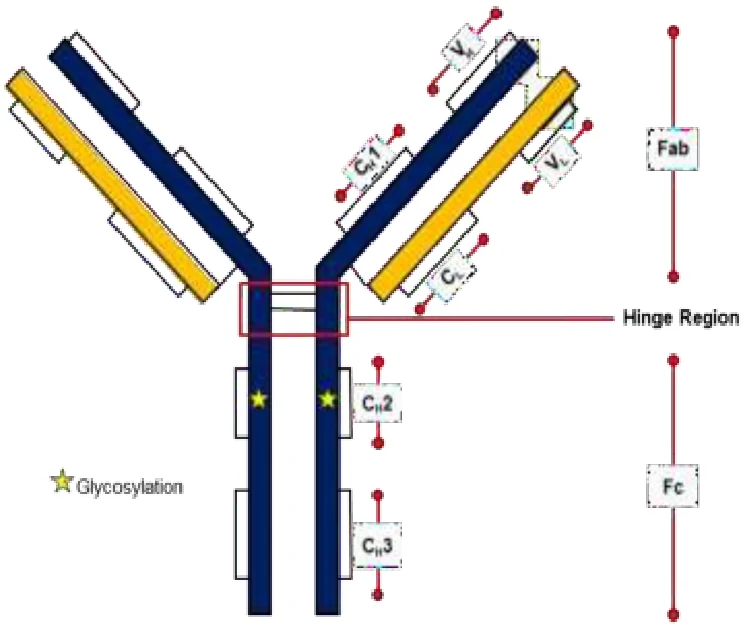
Heavy chains are shown in blue and light chains are shown in orange
Black lines represent disulfide bonds.
VH is the variable domain of the heavy chain
CH1, CH2, and CH3 are the constant domains of the heavy chain VL is the variable domain of the light chain
CL is the constant domain of the light chain
Physicochemical properties
Concentrate for solution for infusion: clear to slightly opalescent, colourless to yellow, sterile, pH 6.2 solution for intravenous infusion
Product Characteristics:
BEVQOLVA (bevacizumab) is a recombinant humanized monoclonal antibody that selectively binds to and neutralizes the biologic activity of human vascular endothelial growth factor (VEGF).
14 Clinical Trials – Reference Biologic Drug
14.1. Clinical Trials by Indication
Metastatic Colorectal Cancer
The safety and efficacy of the recommended dose of bevacizumab (5 mg/kg of body weight every two weeks) in metastatic carcinoma of the colon or rectum were studied in three randomized, active-controlled clinical trials in combination with fluoropyrimidine-based first line chemotherapy. Bevacizumab was combined with two chemotherapy regimens:
- AVF2107g: A weekly schedule of irinotecan/bolus 5-fluorouracil/leucovorin (IFL regimen) for a total of 4 weeks of each 6 week cycle
- AVF0780g: In combination with bolus 5-fluorouracil/leucovorin (5 FU/LV) for a total of 6 weeks of each 8 week cycle (Roswell Park regimen);
- AVF2192g: In combination with bolus 5-fluorouracil/leucovorin (5-FU/LV) for a total of 6 weeks of each 8 week-cycle (Roswell Park regimen) in patients who were not optimal candidates for first-line irinotecan treatment.
All three trials evaluated bevacizumab at a dose of 5 mg/kg of body weight every 2 weeks and both enrolled patients with previously untreated metastatic carcinoma of the colon or rectum.
Bevacizumab in Combination with Irinotecan, 5-Fluorouracil and Leucovorin (IFL) for First- Line Treatment of Metastatic Carcinoma of the Colon or Rectum (AVF2107g)
This was a phase III randomized, double blind, active controlled clinical trial evaluating bevacizumab in combination with IFL as first line treatment for metastatic carcinoma of the colon or rectum. Eight hundred thirteen patients were randomized to receive IFL + placebo (Arm 1) or IFL + bevacizumab (5 mg/kg every 2 weeks, Arm 2) (see Table 18). A third group of 110 patients received bolus 5 FU/LV + bevacizumab (Arm 3). Enrollment in Arm 3 was discontinued, as pre-specified, once safety of bevacizumab with the IFL regimen was established and considered acceptable.
Table 18. Treatment Regimens in Study AVF2107g
| Treatment | Starting Dose | Schedule | |
|---|---|---|---|
| Treatment | Starting Dose | Schedule | |
| Arm 1 | Irinotecan | 125 mg/m2 IV | |
| 5-Fluorouracil | 500 mg/m2 IV | Given once weekly for 4 weeks every 6 weeks | |
| Leucovorin | 20 mg/m2 IV | ||
| Placebo | IV | Every 2 weeks | |
| Arm 2 | Irinotecan | 125 mg/m2 IV | |
| 5-Fluorouracil | 500 mg/m2 IV | Given once weekly for 4 weeks every 6 weeks | |
| Leucovorin | 20 mg/m2 IV | ||
| bevacizumab | 5 mg/kg IV | Every 2 weeks | |
| Arm 3 | 5-Fluorouracil | 500 mg/m2 IV | |
| Leucovorin | 500 mg/m2 IV | Given once weekly for 6 weeks every 8 weeks | |
| bevacizumab | 5 mg/kg IV | Every 2 weeks |
5-Fluorouracil: IV bolus injection immediately after leucovorin Leucovorin: IV bolus injection (over 1-2 minutes) immediately after each irinotecan dose
Study Results
The primary efficacy parameter of the trial was duration of survival. The addition of bevacizumab to IFL resulted in a statistically significant increase in overall survival (see Table 19 and Figure 1). The clinical benefit of bevacizumab, as measured by survival, was seen in all pre- specified patient subgroups, including those defined by age, sex, performance status, location of primary tumour, number of organs involved, and duration of metastatic disease (see Figure 3).
The efficacy results of bevacizumab in combination with IFL chemotherapy are displayed in Table 19, Figure 1 and Figure 2 (Kaplan Meier plots for duration of survival and progression free survival).
Table 19. Efficacy Results for Study AVF2107g
Arm 1 IFL + Placebo | Arm 2 IFL + bevacizumaba | |
|---|---|---|
Arm 1 IFL + Placebo | Arm 2 IFL + bevacizumaba | |
| Number of Patients | 411 | 402 |
| Overall Survival | ||
| Median (months) | 15.6 | 20.3 |
| 95% confidence interval (CI) | 14.29 - 16.99 | 18.46 - 24.18 |
| Hazard Ratiob (95% CI) | 0.66 (0.54; 0.81) | |
| p-value | 0.00004 | |
| Progression-free Survival | ||
| Median (months) | 6.2 | 10.6 |
| 95% confidence interval (CI) | 5.59 - 7.66 | 9.03 - 11.04 |
| Hazard Ratiob (95% CI) | 0.54 (0.45; 0.66) | |
| p-value | < 0.00001 | |
| Overall Response Rate | ||
| Rate (%) | 34.8 | 44.8 |
| 95% confidence interval (CI) | 30.2 - 39.6 | 39.9 - 49.8 |
| p-value | 0.0036 | |
| Duration of Response | ||
| Median (months) | 7.1 | 10.4 |
| 25-75 percentile (months) | 4.7 - 11.8 | 6.7 - 15.0 |
a 5 mg/kg every 2 weeks; b Relative to control arm IFL irinotecan/5-fluorouracil/leucovorin
Among the 110 patients randomized to Arm 3 (5-FU/LV + bevacizumab), the median overall survival was 18.3 months, median progression free survival was 8.8 months, overall response rate was 39% and median duration of response was 8.5 months.
Figure 1. Plot of Kaplan Meier Estimates for Survival in Study AVF2107g
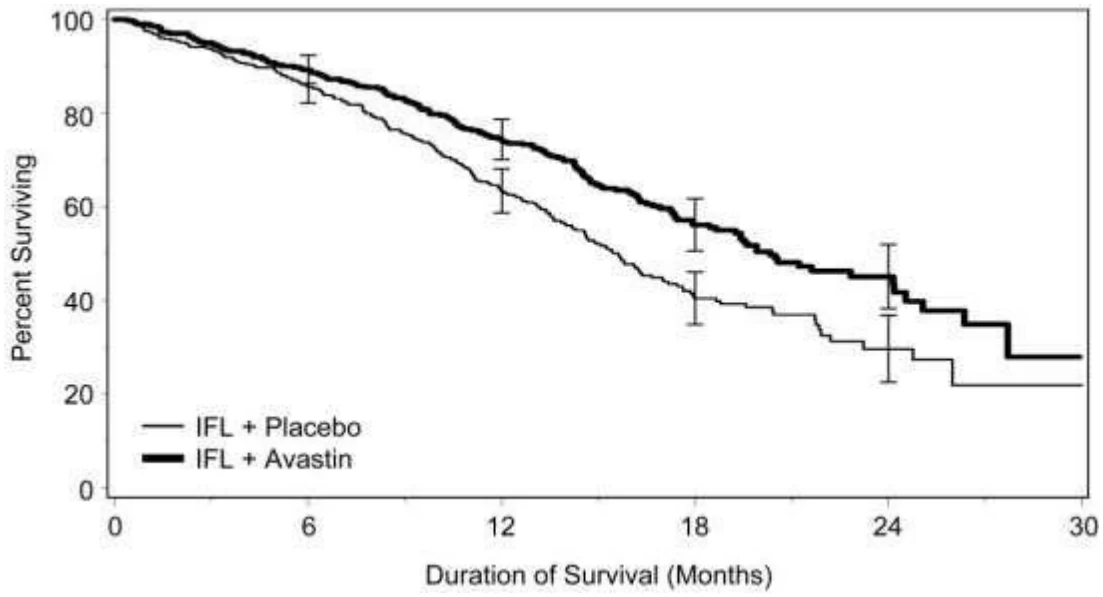
Figure 2. Progression Free Survival during First-Line Therapy in Study AVF2107g
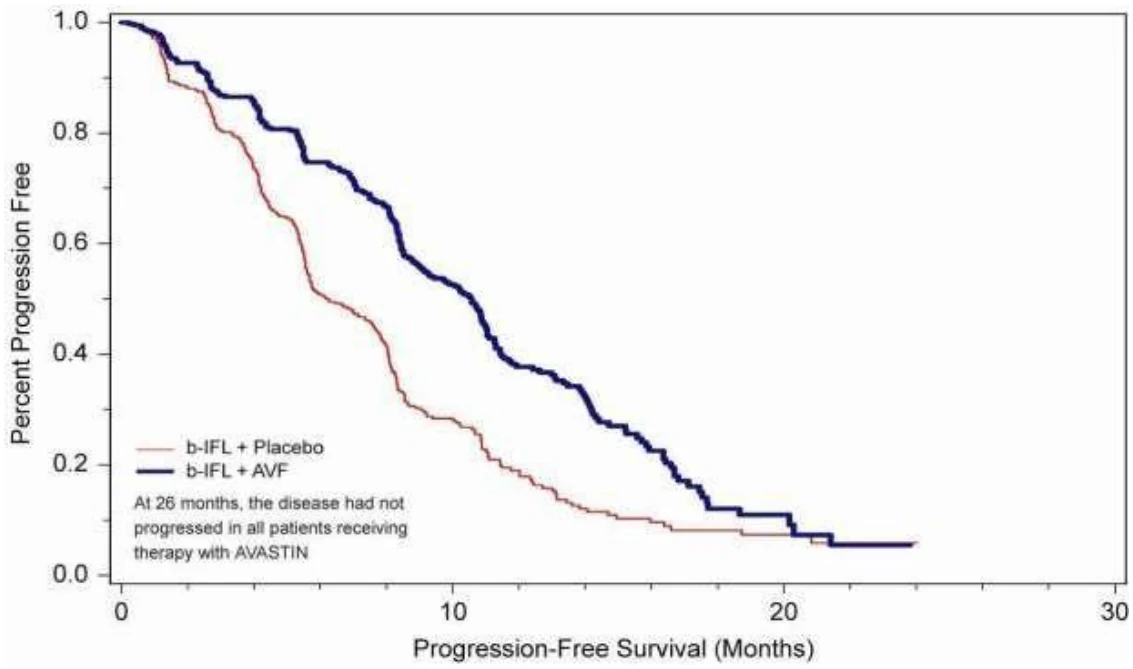
Figure 3. Duration of Survival by Baseline Risk Factor in Study AVF2107g
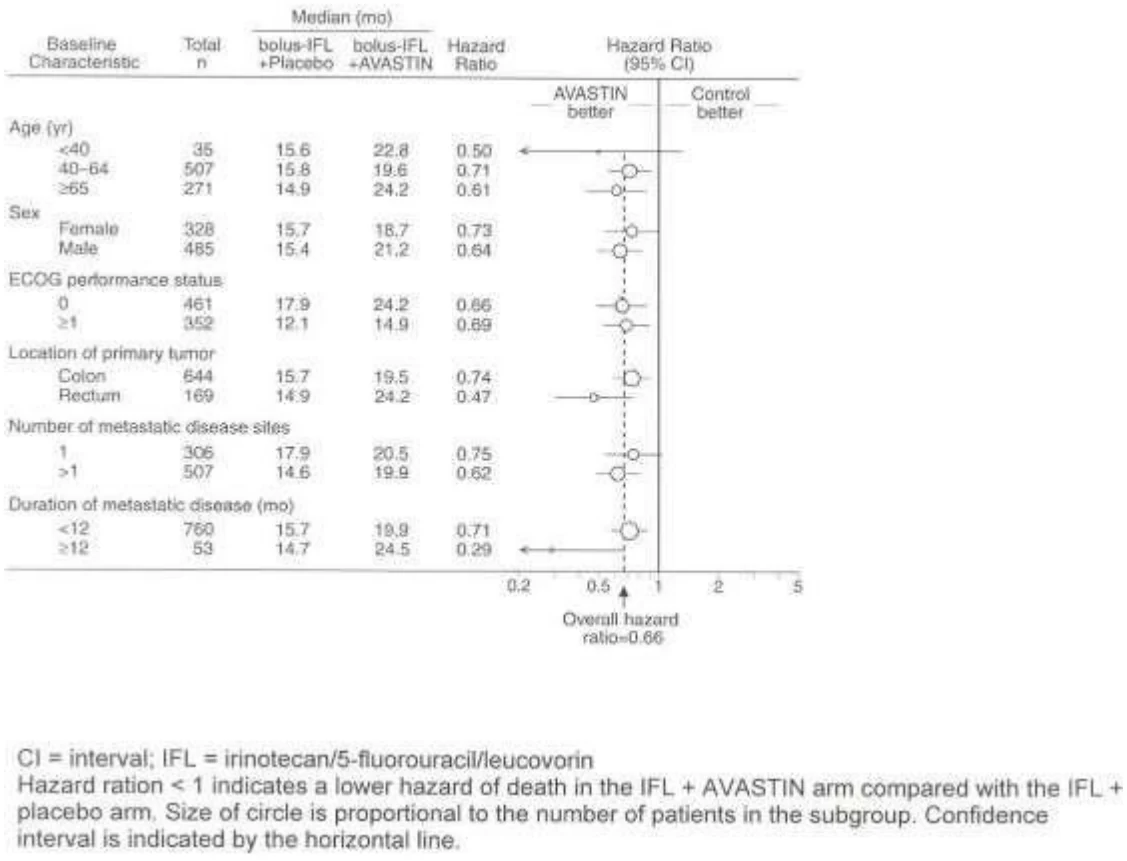
Bevacizumab in Combination with 5 FU/LV Chemotherapy for the First Line Treatment of Metastatic Carcinoma of the Colon or Rectum in patients who were not optimal candidates for first-line irinotecan treatment (AVF2192g)
This was a phase II randomized, active-controlled, open-labelled clinical trial investigating bevacizumab in combination with 5 FU/Leucovorin as first-line treatment for metastatic colorectal cancer in patients who were not optimal candidates for first-line irinotecan treatment. Patients had to be either more susceptible to irinotecan toxicity (≥ 65 years, prior radiotherapy to pelvis or abdomen) or less likely to benefit from irinotecan treatment (PS ≥ 1, baseline albumin < 3.5 g/dl) in order to be eligible for enrolment. One hundred and five patients were randomized to 5 FU/LV + placebo arm and 104 patients randomized to 5 FU/LV + bevacizumab (5 mg/kg every 2 weeks). All treatments were continued until disease progression. The overall age was 71 years; 28.2% of patients had an ECOG performance status of 0, 65.1% had a value of 1 and 6.7% had a value of 2.
Study Results
The addition of bevacizumab 5 mg/kg every two weeks to 5 FU/LV resulted in higher objective response rates, significantly longer progression free survival, and a trend in longer survival, compared with 5 FU/LV chemotherapy alone (see Table 20). These efficacy data were consistent with the results observed in studies AVF2107g and AVF0780g.
Table 20. Treatment Regimens in Study AVF2192g
| Treatment | Starting Dose | Schedule | |
|---|---|---|---|
| Arm 1 | 5-Fluorouracil Leucovorin | 500 mg/m2 IV 500 mg/m2 IV | Given once weekly for 6 weeks of 8-week cycle |
| Placebo | IV | Every 2 weeks | |
| Arm 2 | 5-Fluorouracil Leucovorin | 500 mg/m2 IV 500 mg/m2 IV | Given once weekly for 6 weeks of 8-week cycle |
| bevacizumab | 5 mg/kg IV | Every 2 weeks | |
| 5-Fluorouracil: IV bolus (slow push) 1 hour after initiation of the 2-hour leucovorin infusion. Leucovorin: IV infusion over 2 hours | |||
Bevacizumab in Combination with 5 FU/LV Chemotherapy for the First Line Treatment of Metastatic Carcinoma of the Colon or Rectum (AVF0780g)
This was a phase II randomized, active-controlled, open-labelled clinical trial investigating bevacizumab in combination with 5-FU/LV as first-line treatment of metastatic colorectal cancer. Seventy-one patients were randomized to receive bolus 5-FU/LV or 5-FU/LV + bevacizumab (5 mg/kg every 2 weeks). A third group of 33 patients received bolus 5-FU/LV + bevacizumab (10 mg/kg every 2 weeks). Patients were treated until disease progression. The primary endpoints of the trial were objective response rate and progression free survival.
Study Results
The addition of 5 mg/kg every two weeks of bevacizumab to 5-FU/LV resulted in higher objective response rates, longer progression free survival, and a trend in longer survival, compared with 5-FU/LV chemotherapy alone (see Table 21). This efficacy data is consistent with the results from study AVF2107g.
Table 21. Efficacy results for Study AVF0780g and AVF2192g
| AVF0780g | AVF2192g | ||||||||||||||||
|---|---|---|---|---|---|---|---|---|---|---|---|---|---|---|---|---|---|
| AVF0780g | AVF2192g | ||||||||||||||||
| 5-FU/LV | 5-FU/LV bevacizumaba | 5-FU/LV bevacizumabb | 5-FU/LV placebo | 5-FU/LV bevacizumab | |||||||||||||
| 5-FU/LV | 5-FU/LV bevacizumaba | 5-FU/LV bevacizumabb | 5-FU/LV placebo | 5-FU/LV bevacizumab | |||||||||||||
| Number of Patients | 36 | 35 | 33 | 105 | 104 | ||||||||||||
| Overall Survival | |||||||||||||||||
| Median (months) | 13.6 | 17.7 | 15.2 | 12.9 | 16.6 | ||||||||||||
| 95% Confidence | 10.35 - 16.95 | 13.63 - 19.32 | |||||||||||||||
| Interval (CI) | |||||||||||||||||
| Hazard Ratioc (95% CI) | 0.52 (0.25; 1.08) | 1.01 (0.53; 1.91) | 0.79 (0.56; 1.10) | ||||||||||||||
| p-value | 0.073 | 0.978 | 0.16 | ||||||||||||||
| Progression-free Survival | |||||||||||||||||
| Median (months) | 5.2 | 9 | 7.2 | 5.5 | 9.2 | ||||||||||||
| Hazard ratio (95% CI) | 0.44 (0.24; 0.8) | 0.69 (0.38; 1.25) | 0.5 (0.34; 0.73) | ||||||||||||||
| p-value | 0.0049 | 0.217 | 0.0002 | ||||||||||||||
| Overall Response Rate | |||||||||||||||||
| Rate (%) | 16.7 | 40 | 24.2 | 15.2 | 26 | ||||||||||||
| 95% Confidence Interval (CI) | 7.0 - 33.5 | 24.4 - 57.8 | 11.7 - 42.6 | 9.2 - 23.9 | 18.1 - 35.6 | ||||||||||||
| p-value | 0.029 | 0.43 | 0.055 | ||||||||||||||
| Duration of Response | |||||||||||||||||
| Median (months) | NR | 9.3 | 5 | 6.8 | 9.2 | ||||||||||||
| 25-75 percentile (months) | 5.5 - NR | 6.1 - NR | 3.8 - 7.8 | 5.59 - 9.17 | 5.88 - 13.01 | ||||||||||||
a 5 mg/kg every 2 weeks; b 10 mg/kg every 2 weeks; c Relative to control arm 5-FU/LV = 5-fluorouracil/leucovorin; NR = Not reached
Adjuvant Colon Cancer (aCC)
Study BO17920
Study Demographics and Trial Design
This was a phase III randomized open-label, 3-arm study evaluating the efficacy and safety of bevacizumab administered at a dose equivalent to 2.5 mg/kg/week on either a 2-weekly schedule in combination with FOLFOX4, or on a 3-weekly schedule in combination with XELOX versus FOLFOX4 alone as adjuvant chemotherapy in 3451 patients with high-risk stage II and stage III colon carcinoma.
More relapses and deaths due to disease progression were observed in both bevacizumab arms compared to the control arm. The primary objective of prolonging disease free survival (DFS) in patients with stage III colon cancer (n = 2867) by adding bevacizumab to either chemotherapy regimen was not met. The hazard ratios for DFS were 1.17 (95% CI: 0.98-1.39) for the FOLFOX4 + bevacizumab arm and 1.07 (95% CI: 0.90-1.28) for the XELOX + bevacizumab arm. At the time of the clinical cut-off for end-of-study follow-up (which occurred 2 years after the primary analysis for DFS and was at least 5 years after the last patient was randomized), the unstratified hazard ratio for overall survival was 1.27 (95% CI: 1.03-1.57) for the FOLFOX4 + bevacizumab arm and 1.15 (95% CI: 0.93-1.42) for the XELOX + bevacizumab arm compared to FOLFOX alone.
Locally Advanced, Metastatic or Recurrent Non-Small Cell Lung Cancer (NSCLC)
The safety and efficacy of bevacizumab in the treatment of patients with non-small cell lung cancer (NSCLC) was assessed in addition to a carboplatin/paclitaxel chemotherapy regimen in studies E4599 and AVF0757g.
Study E4599
Study Demographics and Trial Design
E4599 was an open-label, randomized, active-controlled, multicentre clinical trial evaluating bevacizumab as first-line treatment of patients with locally advanced, metastatic or recurrent NSCLC other than predominantly squamous cell histology.
Patients were randomized to platinum-based chemotherapy (paclitaxel 200 mg/m2 and carboplatin AUC = 6.0, both by IV infusion) (PC) on day 1 of every 3-week cycle for up to 6 cycles or PC in combination with bevacizumab at a dose of 15 mg/kg IV infusion day 1 of every 3- week cycle. After completion of six cycles of carboplatin-paclitaxel chemotherapy or upon premature discontinuation of chemotherapy, patients on the bevacizumab + carboplatin– paclitaxel arm continued to receive bevacizumab as a single agent every 3 weeks until disease progression. 878 patients were randomized to the two arms.
The combination of carboplatin and paclitaxel is used as a current Canadian standard of care in major treatment centers for the treatment of NSCLC.
During the study, of the patients who received trial treatment, 32.2% (136/422) of patients received 7-12 administrations of bevacizumab and 21.1% (89/422) of patients received 13 or more administrations of bevacizumab.
The primary endpoint was duration of survival. Results are presented in Table 22.
Table 22. Efficacy Results for Study E4599
| Arm 1 Carboplatin/ Paclitaxel | Arm 2 Carboplatin/ Paclitaxel + Bevacizumab 15 mg/kg q 3 weeks | |
|---|---|---|
| Arm 1 Carboplatin/ Paclitaxel | Arm 2 Carboplatin/ Paclitaxel + Bevacizumab 15 mg/kg q 3 weeks | |
| Number of Patients | 444 | 434 |
| Number of Patients | 444 | 434 |
| Overall Survival | ||
| Median (months) | 10.3 | 12.3 |
| Hazard ratio | 0.80 (p = 0.003) 95% CI (0.69, 0.93) | |
| Overall Response Rate | ||
| Rate (%) | 12.9 | 29.0 (p < 0.0001) |
Figure 4. Study E4599: Kaplan Meier Plot of Overall Survival (All Randomized Patients)
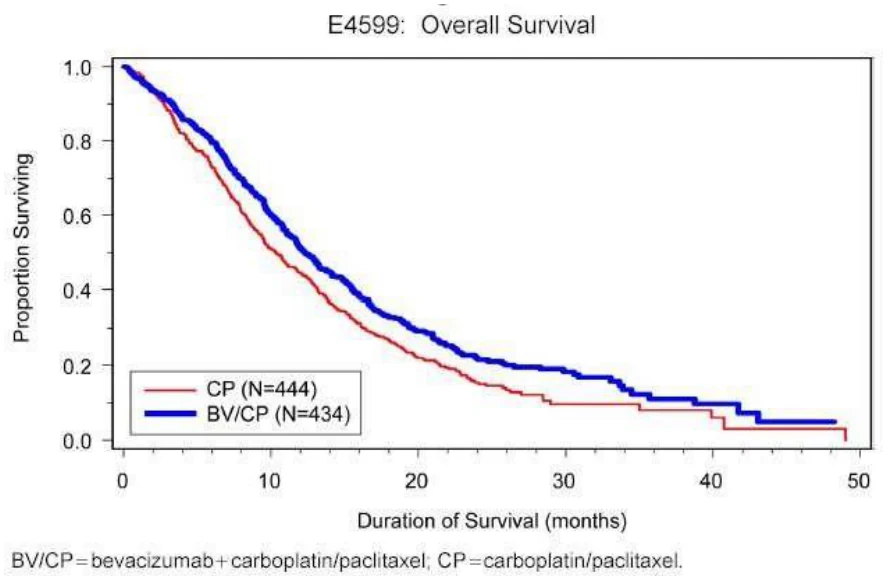
In an exploratory analysis across patients’ subgroups, improvement in duration of survival was not observed with bevacizumab treatment in females. The hazard ratio (HR) of survival for females was HR 0.99 (95% CI: 0.79, 1.25; p = 0.95), patients aged 65 years or older HR 0.91 (95% CI: 0.72, 1.14) or weight loss of 5% or greater in the 6 months prior to treatment initiation HR 0.96 (95% CI: 0.73, 1.26).
In a pre-specified exploratory analysis, improvement in the duration of survival was not consistent in all histology subtypes. The majority of the patients in this trial (69.3%) had adenocarcinoma, which was the only subgroup considered large enough from which to draw a conclusion regarding overall survival. In an exploratory analysis, the extent of bevacizumab benefit on overall survival was less pronounced in the subgroup of patients who did not have adenocarcinoma histology. The hazard ratio (HR) of survival for different histological subtypes was as follows: adenocarcinoma HR 0.69 (95% CI: 0.58, 0.83), squamous HR 0.00 (95% CI:0.00,
-), large cell undifferentiated HR 1.15 (95% CI: 0.60, 2.24), bronchoalveolar (BAC) HR 1.48 (95% CI: 0.57, 3.89), NSCLC, NOS HR 1.16 (95% CI: 0.84, 1.61) and other HR 0.92 (95% CI: 0.43, 1.98).
Table 23. Histological Subtypes in study E4599
| CP N = 442 N (%) | Bv15+CP N = 433 N (%) | Total N = 875 N (%) | |
|---|---|---|---|
| Adenocarcinoma | 302 (68.3%) | 300 (69.3%) | 602 (68.8%) |
| Squamous carcinoma | 2 (0.5%) | 1 (0.2%) | 3 (0.3%) |
| Large cell undifferentiated | 30 (6.8%) | 18 (4.2%) | 48 (5.5%) |
| Bronchioalveolar (BAC) | 11 (2.5%) | 12 (2.8%) | 23 (2.6%) |
| NSCLC, NOS | 86 (19.5%) | 79 (18.2%) | 165 (18.9%) |
| Other | 11 (2.5%) | 23 (5.3%) | 34 (3.9%) |
CP = carboplatin/paclitaxel; Bv15+CP = 15 mg/kg/q3w bevacizumab + carboplatin/paclitaxel
Study AVF0757g
Study Demographics and Trial Design
The design for the pivotal phase III trial (study E4599) was based on the findings from an earlier supporting phase II study AVF0757g. In this randomized, multicentre, open label, Phase II trial, 99 patients were randomized to treatment; 32 patients were assigned to the control carboplatin/paclitaxel arm (CP), 32 patients to the 7.5 mg/kg/q3w bevacizumab plus carboplatin/paclitaxel arm (Bv7.5+CP) and 35 patients to the 15 mg/kg/q3w bevacizumab plus carboplatin/paclitaxel arm (Bv15+CP). Study AVF0757g was designed to test the efficacy, safety, pharmacokinetics, and pharmacodynamics of bevacizumab in combination with carboplatin/paclitaxel chemotherapy in subjects with locally advanced, metastatic, or recurrent NSCLC.
With respect to the demographic and baseline characteristics imbalances between treatment arms were noted in the proportion of men to women, patients with an ECOG performance status of 0, disease duration of <1year, squamous cell histology, cancer stage (IIIB and IV) and prior cancer treatment.
Study Results
Primary efficacy endpoints were time to disease progression (TTP) and best confirmed response rate as assessed both by the investigator and by a blinded independent review facility (IRF). Though not statistically significant based on the IRF assessment, there was a trend for improvement in TTP (7.0 vs 6.0 months) and the response rate (40% vs 31%) for patients in the 15 mg/kg arm compared with the control arm. There was not a statistically significant difference in survival between patients in the 15 mg/kg arm and the control arm (14.4 vs 13.3 months), however, 19 out of 32 patients randomized to the control arm crossed over to receive bevacizumab following disease progression.
In this trial, the incidence of serious or fatal pulmonary hemorrhage was 31% (4 of 13) in bevacizumab -treated patients with squamous cell histology and 4% (2 of 53) in bevacizumab - related patients with histology other than squamous cell. The subgroup of subjects with squamous cell histology appeared to be at higher risk for this toxicity and was excluded from Study E4599. Rates of most serious adverse events (SAEs), hypertension and proteinuria were similar to the pivotal trial E4599. Other safety signals (headache, respiratory tract infections, epistaxis, fever, and rash) were considered manageable.
Platinum-Sensitive Recurrent Epithelial Ovarian, Fallopian Tube and Primary Peritoneal Cancer
Study AVF4095g
Study Demographics and Trial Design
The safety and efficacy of bevacizumab in the treatment of patients with platinum-sensitive, recurrent epithelial ovarian, fallopian tube or primary peritoneal cancer, who have not received prior chemotherapy in the recurrent setting or prior bevacizumab treatment, was studied in a phase III randomized, double-blind, placebo-controlled trial (AVF4095g). The study compared the effect of adding bevacizumab to carboplatin and gemcitabine chemotherapy followed by maintenance therapy with bevacizumab as a single agent until progression, to carboplatin and gemcitabine alone.
Patients with histologically documented ovarian, primary peritoneal, or fallopian tube carcinoma that had recurred > 6 months after platinum-based chemotherapy, who had not received chemotherapy in the recurrent setting, and who had not received prior therapy with bevacizumab or other VEGF inhibitors or VEGF receptor–targeted agents were included in the study.
Bevacizumab was administered in combination with carboplatin and gemcitabine for 6 to10 cycles followed by continued use of bevacizumab as single agent until disease progression.
Patient demographic characteristics were similar across the two treatment arms. All but one patient had an ECOG baseline performance status of 0 or 1. The median age of all randomized patients was 61 years (range, 28-87 years). The majority of patients were < 65 years (63%) of age and 37% were ≥ 65 years of age. Patients were predominantly White (90.9%), with an equal number of Asians and Black or African Americans enrolled (3.1% each); 2 patients (0.4%) were Native Hawaiian or Other Pacific Islander.
Stratification factors were time to recurrence since last platinum-based chemotherapy (6-12 months, > 12 months) and cytoreductive surgery for recurrent EOC, PPC, or FTC (yes, no).
A total of 484 patients with measurable disease were randomized in 1:1 to either:
- Carboplatin (AUC4, Day 1) and gemcitabine (1000 mg/m2 on Days 1 and 8) and concurrent placebo every 3 weeks for 6 and up to 10 cycles followed by placebo alone until disease progression or unacceptable toxicity
- Carboplatin (AUC4, Day 1) and gemcitabine (1000 mg/m2 on Days 1 and 8) and concurrent bevacizumab (15 mg/kg Day 1) every 3 weeks for 6 and up to 10 cycles followed by bevacizumab (15 mg/kg every 3 weeks) alone until disease progression or unacceptable toxicity
Study Results
The primary endpoint was progression-free survival based on investigator assessment using RECIST criteria. Additional endpoints included objective response, duration of response, safety and overall survival. An independent review of the primary endpoint was also conducted and showed consistency with the investigator-assessed PFS as well as ORR results. OS benefit was not demonstrated in the study.
The results of this study are summarized in Table 24.
Table 24. Efficacy Results from Study AVF4095g
| Placebo + C/G (n = 242) | bevacizumab + C/G (n = 242) | |||||||||
|---|---|---|---|---|---|---|---|---|---|---|
| Progression-free survival | ||||||||||
| Investigator Assessment 1 | ||||||||||
| Median PFS (months) | 8.4 | 12.4 | ||||||||
| Hazard ratio (95% CI) | 0.484 [0.388, 0.605] | |||||||||
| p-value | <0.0001 | |||||||||
| Objective response rate | ||||||||||
| Investigator Assessment | ||||||||||
| % pts with objective response | 57.4 % | 78.5 % | ||||||||
| p-value | <0.0001 | |||||||||
| Overall survival (Interim)2 | ||||||||||
| Median OS (months) | 29.9 | 35.5 | ||||||||
| Hazard ratio (95% CI) | 0.751 [0.537, 1.052] | |||||||||
| p-value | 0.094 | |||||||||
| Overall survival (Final)3 | ||||||||||
| Median OS (months) | 32.9 | 33.6 | ||||||||
| Hazard ratio (95% CI) | 0.952 [0.771, 1.176] | |||||||||
| p-value | 0.6479 | |||||||||
C = carboplatin; G = gemcitabine
1 Primary analysis
2 Interim protocol-specified overall survival stratified analysis performed when approximately 29% of the patients had died and tested at the 0.001 level at the time of the OS interim analysis.
3 Final overall survival stratified analysis performed when approximately 73% of the patients had died. α =0.001. OS benefit was not demonstrated in the study.
The overall Type I error rate for the two-sided test for the primary endpoint of PFS was controlled at α = 0.05. Only one futility interim analysis was planned for the primary endpoint PFS. As a result, the total α = 0.05 was reserved for the final PFS analysis. To protect the experiment-wise error rate among objective response and OS, a hierarchical procedure was used for testing the hypotheses associated with the two endpoints. Specifically, ORR was tested at the α = 0.05 level. If the active arm was declared superior to the control arm with respect to ORR, then OS was to be tested at the α = 0.05 level: the interim OS was tested at the α = 0.001 level, and the final OS at the α = 0.049 level.
Figure 5. Kaplan Meier Estimates of Progression-Free Survival Based on
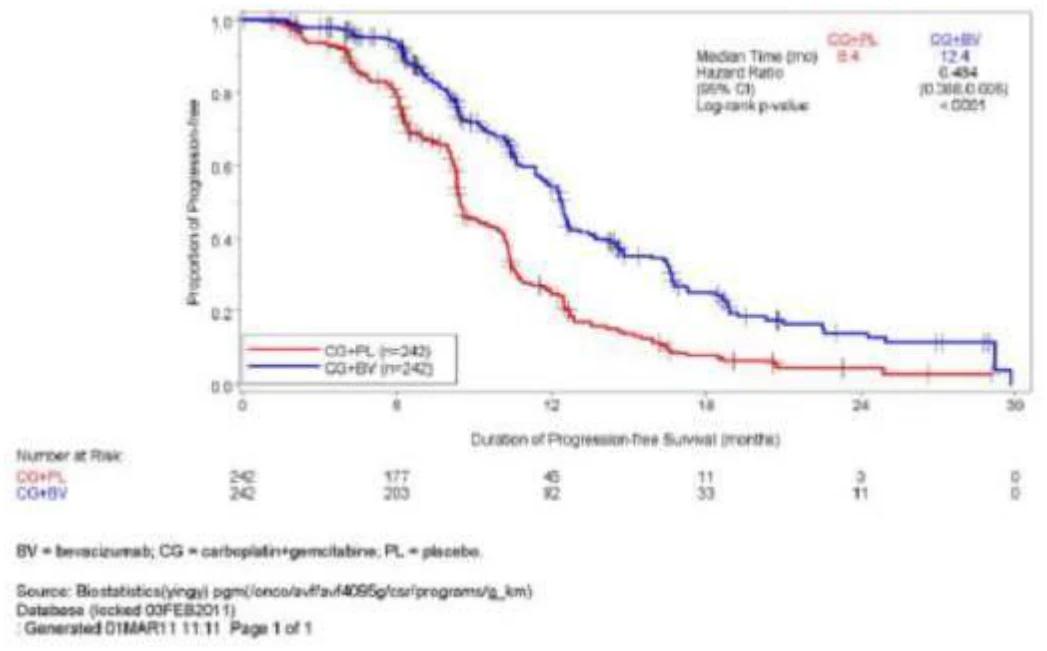
Platinum-Resistant Recurrent Epithelial Ovarian, Fallopian Tube and Primary Peritoneal Cancer
Study MO22224 (AURELIA)
Study MO22224 evaluated the efficacy and safety of bevacizumab in combination with chemotherapy for platinum-resistant recurrent ovarian cancer. This study was designed as an open-label, randomized, two-arm Phase III evaluation of bevacizumab plus chemotherapy (CT+BV) versus chemotherapy alone (CT).
A total of 361 patients were enrolled into this study and administered either chemotherapy [based on the decision of the investigator, patients were assigned to receive one of three chemotherapy agents (paclitaxel, topotecan, or PLD)] alone or in combination with bevacizumab:
- CT Arm (chemotherapy alone):
- Paclitaxel 80 mg/m2 as a 1-hour IV infusion on Days 1, 8, 15, and 22 every 4 weeks.
- Topotecan 4 mg/m2 as a 30 minute IV infusion on Days 1, 8, and 15 every 4 weeks. Alternatively, a 1.25 mg/m2 dose could be administered over 30 minutes on Days 1– 5 every 3 weeks.
- PLD 40 mg/m2 as a 1 mg/min IV infusion on Day 1 only every 4 weeks. After Cycle 1, the drug could be delivered as a 1 hour infusion.
- CT+BV Arm (chemotherapy plus bevacizumab):
- The chosen chemotherapy was combined with bevacizumab 10 mg/kg IV every 2 weeks (or bevacizumab 15 mg/kg every 3 weeks if used in combination with topotecan 1.25 mg/m2 on Days 1–5 on a every 3 weeks schedule).
Patients enrolled in the trial remained on treatment until disease progression, unacceptable toxicities, or patient request for withdrawal.
Eligible patients had ovarian cancer that progressed within 6 months of previous platinum therapy. If a patient had been previously included in a blinded trial with an anti-angiogenic agent, the patient was enrolled in the same stratum as those patients who were known to have previously received an anti-angiogenic agent. Patients with refractory disease (ie, progression while on preceding platinum therapy) were excluded.
Randomization was stratified by the following factors: chemotherapy selected (paclitaxel; topotecan; PLD), prior anti-angiogenic therapy (yes or no), and platinum-free interval (<3; 3−6 months).
The primary endpoint was progression-free-survival based on investigator assessment. The secondary endpoints were objective response rate based on investigator assessment and overall survival.
The baseline patient demographic characteristics were well balanced between the CT and CT+BV arms. Nearly all patients were white. The median age was 61.0 (range: 25−84) years, and 36.8% of all patients were 65 years or older. The majority of patients in both arms had an ECOG PS of 0 (CT: 56.4% vs. CT+BV: 61.2%). In the CT arm, the percentage of patients with an ECOG PS of 1 or ≥2 was 38.7% and 5.0%, and in the CT+BV arm, the percentage of patients with an ECOG PS of 1 or ≥2 was 29.8% and 9.0 %.
Study Results
The addition of bevacizumab to chemotherapy demonstrated a statistically significant improvement in investigator assessed PFS, which was supported by a retrospective independent review analysis. Study results for the intent to treat (ITT) population are presented in Table 25 and Figure 6. Results for the separate chemotherapy cohorts are presented in Table 26.
Table 25. Efficacy Results from Study MO22224 (AURELIA)
| Investigator Assessment | |||||
|---|---|---|---|---|---|
| Investigator Assessment | |||||
| CT (n = 182) | CT + BV (n = 179) | ||||
| CT (n = 182) | CT + BV (n = 179) | ||||
| Primary Endpoint | |||||
| Progression-Free Survival | |||||
| No. (%) patients with event | 168 (92.3%) | 140 (78.2%) | |||
| Median (months) | 3.4 | 6.8 | |||
| Hazard ratio* (95% CI) | 0.384 (0.300, 0.491) | ||||
| p-value** | < 0.0001 | ||||
| Secondary Endpoints | |||||
| Objective Response Rate | |||||
| No. patients with measurable disease at baseline | 144 | 142 | |||
| No. (%) patients with objective response | 18 (12.5%) | 40 (28.2%) | |||
| Median duration of response (months) | 5.4 | 9.4 | |||
| Overall Survival (final analysis) | |||||
| No. (%) patients who died | 136 (74.7%) | 128 (71.5%) | |||
| Median OS (months) | 13.3 | 16.6 | |||
| Hazard Ratio* (95% CI) | 0.887 (0.691, 1.140) | ||||
CT = Chemotherapy alone; CT + BV= Chemotherapy plus bevacizumab
*Based on a stratified Cox proportional hazards model adjusting for the three stratification factors used for randomization [chemotherapy selected (paclitaxel; topotecan; PLD), prior anti-angiogenic therapy (yes or no), and platinum-free interval (<3; 3−6 months)].
** P-value based on a two-sided stratified log-rank test adjusting for the following stratification factors: chemotherapy selected (paclitaxel; topotecan; PLD), prior anti-angiogenic therapy (yes or no), and platinum-free interval (<3; 3−6 months).
Figure 6. Kaplan Meier Plot of Progression-Free Survival Based on Investigator Assessment in Randomized Patients
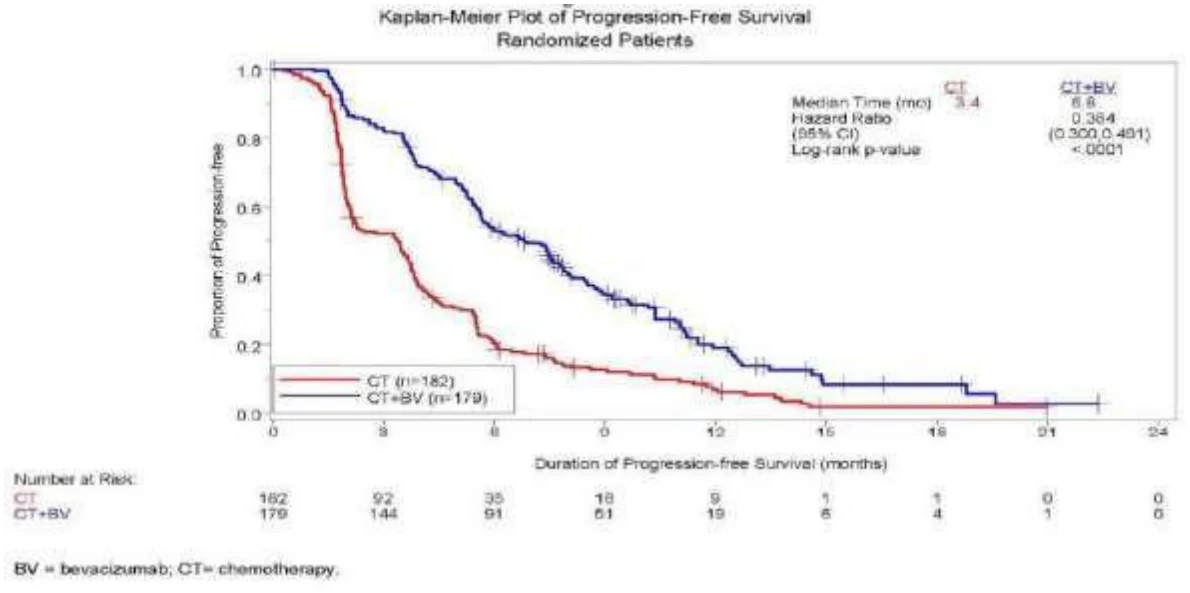
Table 26. Efficacy Results in Chemotherapy Cohorts from Study MO22224 (AURELIA)
| Efficacy Parameter | Paclitaxel | Topotecan | PLD | ||||||||||
|---|---|---|---|---|---|---|---|---|---|---|---|---|---|
| Efficacy Parameter | Paclitaxel | Topotecan | PLD | ||||||||||
CTb (N = 55) | CTb+ bevacizumab (N = 60) | CTb (N = 63) | CTb+ bevacizumab (N = 57) | CTb (N = 64) | CTb+ bevacizumab (N = 62) | ||||||||
CTb (N = 55) | CTb+ bevacizumab (N = 60) | CTb (N = 63) | CTb+ bevacizumab (N = 57) | CTb (N = 64) | CTb+ bevacizumab (N = 62) | ||||||||
| PFS per Investigator | |||||||||||||
| No. (%) of subjects with an event | 50 (90.9%) | 39 (65.0%) | 57 (90.5%) | 45 (78.9%) | 61 (95.3%) | 56 (90.3%) | |||||||
| Median (months) (95% CI) | 3.9 (3.5, 5.5) | 9.6 (7.8, 11.5) | 2.1 (1.9, 2.3) | 6.2 (5.3, 7.6) | 3.5 (1.9, 3.9) | 5.1 (3.9, 6.3) | |||||||
| Hazard Ratio (95% CI)a | 0.47 (0.31, 0.72) | 0.24 (0.15, 0.38) | 0.47 (0.32, 0.71) | ||||||||||
| Overall Survival | |||||||||||||
| No. (%) of subjects who died | 41 (74.5%) | 36 (60.0%) | 43 (68.3%) | 44 (77.2%) | 52 (81.3%) | 48 (77.4%) | |||||||
| Median (months) (95% CI) | 13.2 (8.2, 19.7) | 22.4 (16.7, 26.7) | 13.3 (10.4, 18.3) | 13.8 (11.0, 18.3) | 14.1 (9.9, 17.8) | 13.7 (11.0, 18.3) | |||||||
| Hazard Ratio (95% | 0.64 (0.41, 1.01) | 1.12 (0.73, 1.73) | 0.94 (0.63, 1.42) | ||||||||||
| CI)a | |||||||||||||
| Objective Response Rate | |||||||||||||
| Number of Patients with Measurable Disease at Baseline | 43 | 45 | 50 | 46 | 51 | 51 | |||||||
| Rate, % (95% CI) | 30 (17, 44) | 53 (39, 68) | 2 (0, 6) | 17 (6, 28) | 8 (0, 15) | 16 (6, 26) | |||||||
| Median of Response Duration (months) | 6.8 | 11.6 | NE | 5.2 | 4.6 | 8.0 | |||||||
aper stratified Cox proportional hazards model adjusting for the three stratification factors used for randomization (chemotherapy selected (paclitaxel; topotecan; PLD), prior anti-angiogenic therapy (yes or no), and platinum-free interval (< 3; 3−6 months));
bchemotherapy;
NE = Not Estimable
Malignant Glioma (WHO Grade IV) - Glioblastoma
Study EORTC 26101
Patients with previously treated glioblastoma were evaluated in a multicentre, randomized, open- label Phase 3 study comparing bevacizumab plus lomustine versus lomustine. A total of 432 patients with first progression following the treatment with radiotherapy and temozolomide were randomized (2:1) to receive either bevacizumab (10 mg/kg IV infusion every 2 weeks; n
- 283) plus lomustine (every 6 weeks; 90 mg/m2 [maximum dose 160 mg] in the first cycle and the dose could be escalated to 110 mg/m2 (maximum dose 200 mg) from the second cycle onwards in the absence of Grade > 1 hematological toxicity during the first cycle) or lomustine (110 mg/m2 [maximum dose 200 mg] every 6 weeks; n=149) until disease progression or unacceptable toxicity. Randomization was stratified by World Health Organization performance status (0 vs. > 0), steroid use (yes vs. no), largest tumour diameter (≤ 40 vs. > 40 mm) and institution. The primary outcome measure of the study was OS. Key secondary outcome measures included investigator-assessed PFS and ORR. Tumour response was assessed per the modified Response Assessment in Neuro-oncology (RANO) criteria.
The median patient age was 57.0 years on bevacizumab plus lomustine and 59.0 years on lomustine. Overall, 24.8% of patients were 65 years old or older. The majority of patients (60.4% in the bevacizumab plus lomustine arm and 61.1% in the lomustine arm) were male.
Study Results
There was no difference in OS (HR=0.91, p= 0.4578); therefore, all secondary outcome measures can be interpreted as descriptive only. PFS was shown to be longer among patients receiving bevacizumab plus lomustine compared to those receiving lomustine alone; the unblinded investigator-assessed results were a median PFS of 4.2 months vs. 1.5 months [HR 0.52 (95% CI 0.41, 0.64)]. The results are presented in Figure 7. Among the 399 patients with measurable disease, ORR was 26% in those receiving bevacizumab plus lomustine and 6% in those receiving only lomustine. A retrospective PFS analysis was conducted on subjects with available diagnostic information (91.2% and 95.3% of subjects receiving bevacizumab + lomustine and lomustine alone, respectively) by a blinded central review and results were a median PFS of 2.8 months vs. 1.5 months [HR 0.53 (95% CI 0.42, 0.66)].
Figure 7. Investigator-Assessed Progression-Free Survival in Study EORTC 26101
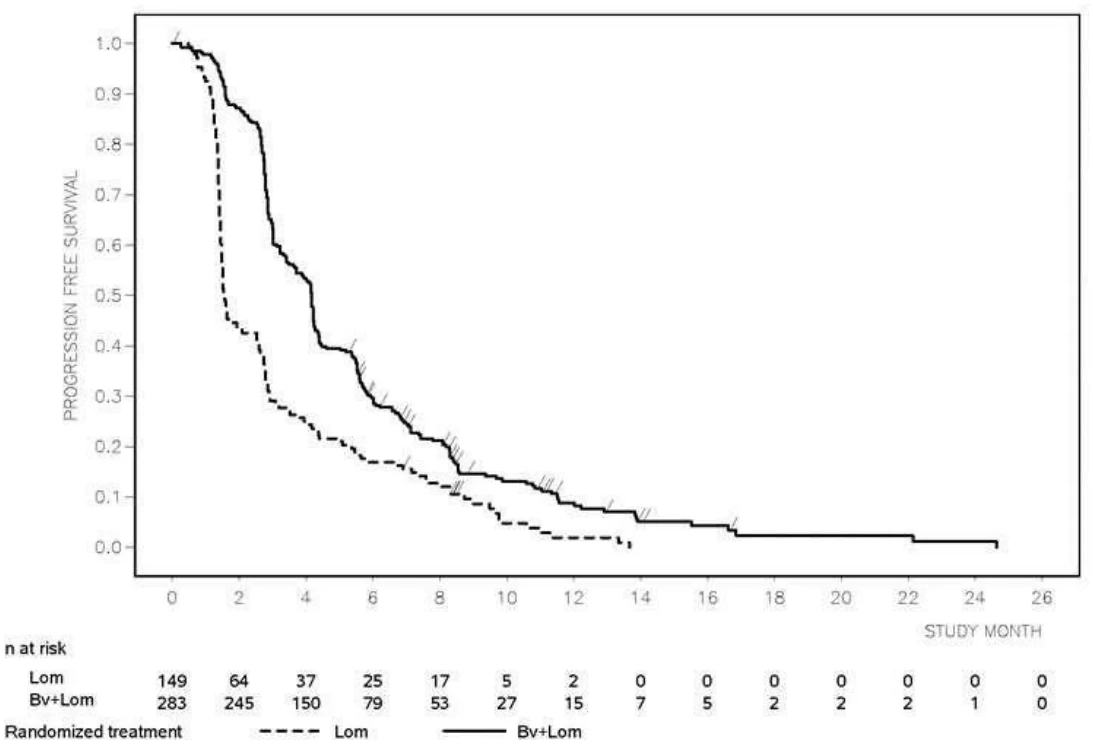
Among the patients taking corticosteroids at baseline (50.5% in the bevacizumab plus lomustine arm and 49.7% in the lomustine arm), more patients in the bevacizumab plus lomustine arm than in the lomustine arm discontinued corticosteroids (23.1% vs. 12.2%).
Pediatric Studies
Study BO20924 (Bernie)
Study Demographics and Trial Design
In a randomized phase II study (BO20924) a total of 154 patients aged ≥ 6 months to <18 years with newly diagnosed metastatic rhabdomyosarcoma and non-rhabdomyosarcoma soft tissue sarcoma were treated with standard of care (induction IVADO/IVA+/- local therapy followed by maintenance vinorelbine and cyclophosphamide) with or without bevacizumab (2.5 mg/kg/week) for a total duration of treatment of approximately 18 months.
Study Results
At the time of the final primary analysis, the primary endpoint of Event Free Survival (EFS) by an independent central review did not show a statistically significant difference between the two treatment arms, with HR of 0.93 (95% CI: 0.61, 1.41).
Study BO25041 (Herby)
Study Demographics and Trial Design
In a randomized phase II study (BO25041) a total of 121 patients aged ≥ 3 years to <18 years with newly diagnosed supratentorial or infratentorial cerebellar or peduncular high-grade glioma (HGG) were treated with post-operative radiation therapy (RT) and adjuvant temozolomide (T) with and without bevacizumab: 10 mg/kg every 2 weeks IV.
Study Results
The study did not meet its primary endpoint of demonstrating a significant improvement of EFS (Central Radiology Review Committee (CRRC)-assessed) when bevacizumab was added to the RT/T arm compared with RT/T alone (HR = 1.44; 95% CI: 0.90, 2.30).
15 Microbiology
No microbiological information is required for this drug product.
16 Non-Clinical Toxicology
General Toxicology:
Physeal Development
In studies of up to 26 weeks duration in cynomolgus monkeys, Avastin was associated with physeal dysplasia. Physeal dysplasia was characterised primarily by thickened growth plate cartilage, subchondral bony plate formation and inhibition of vascular invasion of the growth plate. This effect occurred at doses ≥ 0.8 times the human therapeutic dose and exposure levels slightly below the expected human clinical exposure, based on average serum concentrations. It should be noted, however, that physeal dysplasia occurred only in actively growing animals with open growth plates.
Wound Healing
In rabbits, the effects of bevacizumab on circular wound healing were studied. Wound re-epithelialisation was delayed in rabbits following five doses of bevacizumab, ranging from 2 - 50 mg/kg, over a 2-week period. A trend toward a dose-dependent relationship was observed. The magnitude of effect on wound healing was similar to that observed with corticosteroid administration. Upon treatment cessation with either 2 or 10 mg/kg bevacizumab, the wounds closed completely. The lower dose of 2 mg/kg was approximately equivalent to the proposed clinical dose. A more sensitive linear wound healing model was also studied in rabbits. Three doses of bevacizumab ranging from 0.5 - 2 mg/kg dose dependently and significantly decreased the tensile strength of the wounds, consistently with delayed wound healing. The low dose of 0.5 mg/kg was 5-fold below the proposed clinical dose.
As effects on wound healing were observed in rabbits at doses below the proposed clinical dose, the capacity for bevacizumab to adversely impact wound healing in human should be considered.
In cynomolgus monkeys, the effects of bevacizumab on the healing of a linear incision were highly variable and no dose-response relationship was evident.
Renal Function
In normal cynomolgus monkeys, bevacizumab had no measurable effect on renal function treated once or twice weekly for up to 26 weeks, and did not accumulate in the kidney of rabbits following two doses up to 100 mg/kg (approximately 80-fold the proposed clinical dose).
Investigative toxicity studies in rabbits, using the models of renal dysfunction, showed that bevacizumab did not exacerbate renal glomerular injury induced by bovine serum albumin or renal tubular damage induced by cisplatin.
Albumin
In male cynomolgus monkeys, bevacizumab administered at doses of 10 mg/kg twice weekly or 50 mg/kg once weekly for 26 weeks was associated with a statistically significant decrease in albumin and albumin to globulin ratio and increase in globulin. These effects were reversible upon cessation of exposure. As the parameters remained within the normal reference range of values for these endpoints, these changes were not considered as clinically significant.
Hypertension
At doses up to 50 mg/kg twice weekly in cynomolgus monkeys, bevacizumab showed no effects on blood pressure.
Hemostasis
Non-clinical toxicology studies of up to 26 weeks duration in cynomolgus monkeys did not find changes in hematology or coagulation parameters including platelet counts, prothrombin and activated partial thromboplastin time. A model of hemostasis in rabbits, used to investigate the effect of bevacizumab on thrombus formation, did not show alteration in the rate of clot formation or any other hematological parameters compared to treatment with bevacizumab vehicle.
Immunogenicity
Non-clinical toxicology studies of up to 26 weeks duration in cynomolgus monkeys did not reveal evidence of immunogenicity based on absence of detectable serum anti-drug antibodies.
Carcinogenicity: Studies have not been performed to evaluate the carcinogenic and mutagenic potential of Avastin.
Genotoxicity: No studies have been performed to establish the mutagenic potential of Avastin.
Reproductive and Developmental Toxicology: No specific studies in animals have been performed to evaluate the effect of Avastin on fertility. No adverse effect on male reproductive organ was observed in repeat dose toxicity studies in cynomolgus monkeys.
Inhibition of ovarian function was characterised by decreases in ovarian and/or uterine weight and the number of corpora lutea, a reduction in endometrial proliferation and an inhibition of follicular maturation in cynomolgus monkeys treated with Avastin for 13 or 26 weeks. The doses associated with this effect were ≥ 4 times the human therapeutic dose or ≥ 2-fold above the expected human exposure based on average serum concentrations in female monkeys. In rabbits, administration of 50 mg/kg of bevacizumab resulted in a significant decrease in ovarian weight and number of corpora lutea. The results in both monkeys and rabbits were reversible upon cessation of treatment. The inhibition of angiogenesis following administration of bevacizumab is likely to result in an adverse effect on female fertility.
17 Supporting Product Monographs
- 1. Avastin® (bevacizumab), Submission Control No.: 273329, Product Monograph, Hoffmann- La Roche Limited. August 4, 2023.