


Product Monograph - Cyramza
1 INDICATIONS
CYRAMZA® (ramucirumab) is indicated for:
- Gastric Cancer – CYRAMZA (ramucirumab) as a single agent or in combination with paclitaxel is indicated for the treatment of patients with advanced or metastatic gastric cancer or gastro-esophageal junction adenocarcinoma, with disease progression on or after prior platinum and fluoropyrimidine chemotherapy.
1.1 Pediatrics
Pediatrics (< 18 years of age)
The safety and effectiveness of CYRAMZA in children and adolescents have not been established. Therefore, Health Canada has not authorized an indication for pediatric use.
1.2 Geriatrics
Geriatrics (≥ 65 years of age)
No overall differences in safety or effectiveness have been observed between the elderly and younger patients, but greater safety sensitivity of some older individuals cannot be ruled out.
2 CONTRAINDICATIONS
- CYRAMZA (ramucirumab) is contraindicated in patients with a known hypersensitivity to ramucirumab or to any other ingredient used in the formulation, including any non-medicinal ingredient, or component of the container. For a complete listing, (see 6 DOSAGE FORMS, STRENGTHS, COMPOSITION AND PACKAGING).
3 SERIOUS WARNINGS AND PRECAUTIONS BOX
Serious Warnings and Precautions
Increases risk of hemorrhage, including gastrointestinal hemorrhage (see 7 WARNINGS
AND PRECAUTIONS and 4 DOSAGE AND ADMINISTRATION)
Increases risk of gastrointestinal perforations, including fatal events, (see 7 WARNINGS
AND PRECAUTIONS and 4 DOSAGE AND ADMINISTRATION)
- Impaired wound healing. Withhold prior to scheduled surgery and discontinue if there are wound healing complications (see 7 WARNINGS AND PRECAUTIONS and 4 DOSAGE AND ADMINISTRATION)
4 DOSAGE AND ADMINISTRATION
4.1 Dosing Considerations
It is recommended that treatment be continued until progression of the underlying disease or until unacceptable toxicity.
4.2 Recommended Dose and Dosage Adjustment
Gastric Cancer
CYRAMZA single agent:
The recommended dose of CYRAMZA as a single agent is 8 mg/kg every 2 weeks administered as an intravenous infusion over approximately 60 minutes (maximum infusion rate 25 mg/min).
CYRAMZA in combination with paclitaxel:
The recommended dose of CYRAMZA is 8 mg/kg administered by intravenous infusion over approximately 60 minutes on days 1 and 15 of a 28-day cycle prior to paclitaxel infusion. Administer paclitaxel at 80 mg/m2 by intravenous infusion over approximately 60 minutes on days 1, 8 and 15 of a 28-day cycle. Criteria to be met prior to each paclitaxel administration are provided in Table 1.
Table 1 - Criteria to be Met Prior to Each Paclitaxel Administration
| Criteria | |
| Neutrophils | Day 1: ≥ 1.5 x 10⁹/L Days 8 and 15: ≥ 1.0 x 10⁹/L |
| Platelets | Day 1: ≥ 100 x 109/L Days 8 and 15: ≥ 75 x 109/L |
| Bilirubin | ≤ 1.5 x upper limit of normal value (ULN) |
| AST/ALT | No liver metastases: ALT/AST ≤ 3 x ULN Liver metastases: ALT/AST ≤ 5 x ULN |
Premedication
Premedicate all patients with a histamine H1 antagonist (e.g., diphenhydramine) intravenously prior to administration of CYRAMZA.
If a patient experiences a Grade 1 or 2 infusion-related reaction (IRR), besides the histamine H1 antagonist, also administer dexamethasone (or equivalent) and acetaminophen prior to each CYRAMZA infusion (see Dose Adjustments below).
See paclitaxel prescribing information for paclitaxel premedication requirements.
Dose Adjustments
Infusion-Related Reactions
Reduce the CYRAMZA infusion rate by 50% for the duration of the infusion and all subsequent infusions if the patient experiences a Grade 1 or 2 IRR [per the National Cancer Institute Common Terminology Criteria for Adverse Events (NCI CTCAE)] (see Premedication subsection above). Immediately and permanently discontinue CYRAMZA for Grade 3 or 4 IRRs (see 7 WARNINGS AND PRECAUTIONS).
Hypertension
Monitor blood pressure during treatment with CYRAMZA and treat as clinically indicated. Temporarily suspend CYRAMZA for severe hypertension until controlled with medical management and permanently discontinue CYRAMZA for severe hypertension that cannot be controlled with antihypertensive therapy (see 7 WARNINGS AND PRECAUTIONS).
Posterior Reversible Encephalopathy Syndrome
Permanently discontinue CYRAMZA for patients who experience Posterior Reversible Encephalopathy Syndrome (PRES) (see 7 WARNINGS AND PRECAUTIONS and 8 ADVERSE REACTIONS).
Proteinuria
Monitor for the development or worsening of proteinuria during CYRAMZA therapy. If the urine protein level is ≥ 2+, perform a 24-hour urine collection. Temporarily discontinue CYRAMZA administration if the urine protein level is ≥ 2 g/24 hours. Resume treatment at a reduced dose level (to 6 mg/kg every 2 weeks) once the urine protein level returns to < 2 g/24 hours. A second dose reduction (to 5 mg/kg every 2 weeks) is recommended if a urine protein level ≥ 2 g/24 hours reoccurs.
Permanently discontinue CYRAMZA therapy if the urine protein level is > 3 g/24 hours or in the setting of nephrotic syndrome.
Wound Healing Complications
Interrupt CYRAMZA prior to scheduled surgery until the wound is fully healed (see 7 WARNINGS AND PRECAUTIONS).
Arterial Thromboembolic Events, Gastrointestinal Perforations, or Grade 3 or 4 Bleeding
Permanently discontinue CYRAMZA in patients who experience a severe arterial thromboembolic event, gastrointestinal perforations, or Grade 3 or 4 bleeding (see 7 WARNINGS AND PRECAUTIONS).
Paclitaxel
Paclitaxel dose reductions may be applied based upon the grade of toxicity experienced by the patient. For NCI-CTCAE Grade 4 hematological toxicity or Grade 3 paclitaxel-related nonhematological toxicity, it is recommended to reduce the paclitaxel dose by 10 mg/m2 for all following cycles. A second reduction of 10 mg/m2 is recommended if these toxicities persist or reoccur. See paclitaxel prescribing information for additional dosage and administration recommendations.
Health Canada has not authorized an indication in pediatric use (see 1 INDICATIONS).
4.3 Reconstitution
Only use sterile sodium chloride (0.9%) solution for injection as a diluent. Do not use dextrose as a diluent.
- 1. Prepare the infusion solution using aseptic technique to ensure the sterility of the prepared solution.
- 2. Each vial is intended for single use only. Inspect the content of the vials for particulate matter and discolouration (material should be clear to slightly opalescent and colourless to slightly yellow) prior to dilution. If particulate matter or discolourations are identified, discard the vial (see 11 STORAGE, STABILITY AND DISPOSAL).
- 3.
Calculate the dose and volume of CYRAMZA needed to prepare the infusion solution.
Vials contain either 100 mg or 500 mg as a 10 mg/mL solution of ramucirumab. Only use sterile sodium chloride (0.9%) solution for injection as a diluent.
In case of prefilled intravenous infusion container usage:
- 4.
Based on the calculated volume of CYRAMZA, remove the corresponding volume of sterile sodium chloride (0.9%) solution for injection from the prefilled 250 mL intravenous container. Aseptically transfer the calculated volume of CYRAMZA to the intravenous container. The final total volume in the container should be 250 mL. The container should be gently inverted to ensure adequate mixing. DO NOT FREEZE OR SHAKE the infusion solution. DO NOT dilute with other solutions or co-infuse with other electrolytes or medications (see 11 STORAGE, STABILITY AND DISPOSAL).
In case of empty intravenous infusion container usage:
- 5. Aseptically transfer the calculated volume of CYRAMZA into an empty intravenous container. Add a sufficient quantity of sterile sodium chloride (0.9%) solution for injection to the container to make the total volume 250 mL. The container should be gently inverted to ensure adequate mixing. DO NOT FREEZE OR SHAKE the infusion solution. DO NOT dilute with other solutions or co-infuse with other electrolytes or medications (see 11 STORAGE, STABILITY AND DISPOSAL).
Discard any unused portion of CYRAMZA left in a vial, as the product contains no preservatives.
4.4 Administration
Administer CYRAMZA as an intravenous infusion only. Do not administer CYRAMZA as an intravenous push or bolus.
Parenteral drug products should be inspected visually for particulate matter prior to administration. If particulate matter is identified, discard the infusion solution.
Administer via infusion pump. A separate infusion line with a protein sparing 0.22 micron filter must be used for the infusion and the line must be flushed with sterile sodium chloride (0.9%) solution for injection at the end of the infusion.
4.5 Missed Dose
Missed or delayed doses should not be omitted but administered at a later time point, at the discretion of the treating physician, taking into account the planned interval between doses.
5 OVERDOSAGE
There is no data on overdose in humans. In case of overdose, use supportive therapy. There is no known antidote to ramucirumab overdose.
For management of a suspected drug overdose, contact your regional poison control centre.
6 DOSAGE FORMS, STRENGTHS, COMPOSITION AND PACKAGING
To help ensure the traceability of biologic products, including biosimilars, health professionals should recognise the importance of recording both the brand name and the non-proprietary (active ingredient) name as well as other product-specific identifiers such as the Drug Identification Number (DIN) and the batch/lot number of the product supplied.
Table 2 - Dosage Forms, Strengths, Composition and Packaging
| Route of | Dosage Form / | Non-medicinal Ingredients | ||||
| Administration | Strength/Composition | |||||
| Intravenous infusion | Solution / 10 mg/mL | L-histidine, L-histidine monohydrochloride, sodium chloride, glycine, polysorbate 80, and water for injection. | ||||
CYRAMZA (ramucirumab) is supplied as a sterile, preservative-free solution for intravenous infusion in 10 mL or 50 mL single-use vials. Each vial contains either 100 mg ramucirumab in 10 mL (10 mg/mL) or 500 mg ramucirumab in 50 mL (10 mg/mL). Vials are individually packaged in a carton.
7 WARNINGS AND PRECAUTIONS
Please see 3 SERIOUS WARNINGS AND PRECAUTIONS BOX
Cardiovascular
Arterial Thromboembolic Events
Serious, sometimes fatal, arterial thromboembolic events (ATEs) including myocardial infarction, cardiac arrest, cerebrovascular accident, and cerebral ischemia have been reported in clinical trials. Permanently discontinue CYRAMZA in patients who experience a severe ATE (see 4 DOSAGE AND ADMINISTRATION).
Hypertension
An increased incidence of severe hypertension was reported in patients receiving CYRAMZA as compared to placebo. In most cases hypertension was managed using standard antihypertensive treatment.
Pre-existing hypertension should be controlled before starting CYRAMZA treatment. Monitoring of blood pressure is recommended during therapy.
Temporarily suspend CYRAMZA for severe hypertension until controlled with medical management. Permanently discontinue CYRAMZA if medically significant hypertension cannot be controlled with antihypertensive therapy (see 4 DOSAGE AND ADMINISTRATION).
Heart Failure
CYRAMZA belongs to the class of antiangiogenic drugs which are known to increase the risk of heart failure. CYRAMZA may enhance cardiotoxicity of chemotherapeutic cardiotoxic drugs.
Events consistent with heart failure have been reported in patients receiving CYRAMZA therapy in clinical trials at a numerically higher incidence in patients receiving ramucirumab in combination with a variety of chemotherapy regimens or erlotinib, compared to chemotherapy or erlotinib alone. This increased incidence was not observed in patients receiving ramucirumab compared to placebo in pooled data from single agent clinical trials.
Patients with known or increased risk of coronary artery disease should be treated with caution. Patients should be monitored for clinical signs and symptoms of heart failure during treatment. Suspension of treatment should be considered if clinical manifestations of heart failure are developed.
Driving and Operating Machinery
No studies on the effects of CYRAMZA (ramucirumab) on the ability to drive or operate machinery have been conducted. Patients should exercise caution when driving or operating machinery while taking CYRAMZA.
Endocrine and Metabolism
Thyroid Dysfunction
CYRAMZA may increase thyroid stimulating hormone (TSH) levels and the incidence of hypothyroidism. Monitor TSH levels and thyroid function during treatment with CYRAMZA. Some of these patients may need to be followed for evidence of persistent thyroid dysfunction after CYRAMZA therapy.
Gastrointestinal
Gastrointestinal Perforations
CYRAMZA increases the risk of gastrointestinal perforations. Permanently discontinue CYRAMZA in patients who experience gastrointestinal perforations (see 4 DOSAGE AND ADMINISTRATION).
Severe gastrointestinal perforations, including fatal events, were reported in patients with gastric cancer treated with CYRAMZA alone and in combination with paclitaxel. The typical presentation may include severe abdominal pain. Risk factors for gastrointestinal perforations can include intra-abdominal malignancy and metastases, inflammatory bowel disease, diverticulitis, ischemic bowel, peptic ulcers, obstruction and injury from an endoscopy, colonoscopy, laparoscopy, and surgery.
Fistula
CYRAMZA may increase the risk for development of fistulas. Permanently discontinue CYRAMZA in patients who experience fistula formation.
Hematologic
Hemorrhage
CYRAMZA increases the risk of hemorrhage, including gastrointestinal hemorrhage. Permanently discontinue CYRAMZA in patients who experience Grade 3 or 4 bleeding (see 4 DOSAGE AND ADMINISTRATION).
Severe gastrointestinal hemorrhage, including fatal events, was reported in patients with gastric cancer treated with CYRAMZA in combination with paclitaxel, and also in clinical trials of patients with other types of cancers treated with CYRAMZA alone or in combination therapy.
Neutropenia
Increased rates of severe neutropenia have been observed in patients treated with CYRAMZA in combination with paclitaxel compared to paclitaxel alone. Patients should be closely monitored and treated according to established oncologic standards.
Thrombocytopenia
The incidence of thrombocytopenia was higher in patients receiving CYRAMZA in combination with paclitaxel compared to paclitaxel alone and the majority of these events were Grade 1-2. Given the increased incidence of gastrointestinal hemorrhage, patients found to have high grade thrombocytopenia should be closely monitored and treated according to established oncologic standards.
Hepatic/Biliary/Pancreatic
Hepatic Impairment
CYRAMZA can cause clinical deterioration in patients with cirrhosis. New onset or worsening encephalopathy, ascites, or hepatorenal syndrome can occur in patients with Child-Pugh B or C cirrhosis. Use only if the potential benefits of treatment are judged to outweigh the risk of clinical deterioration in these patients.
Infusion-Related Reactions
Infusion-related reactions (IRRs) were reported in clinical trials with CYRAMZA. The majority of events occurred during or following a first or second CYRAMZA infusion. Monitor patients during the infusion for signs of hypersensitivity reactions with resuscitation equipment readily available. Symptoms included rigors/tremors, back pain/spasms, chest pain and/or tightness, chills, flushing, dyspnea, wheezing, hypoxia, and paresthesia. In severe cases symptoms included bronchospasm, supraventricular tachycardia, and hypotension. Premedicate all patients with a histamine H1 antagonist (e.g., diphenhydramine) intravenously prior to administration of CYRAMZA (see 4 DOSAGE AND ADMINISTRATION).
Immediately and permanently discontinue CYRAMZA for Grade 3 or 4 IRRs (see 4 DOSAGE AND ADMINISTRATION).
Neurologic
Posterior Reversible Encephalopathy Syndrome
Posterior Reversible Encephalopathy Syndrome (PRES) (also known as Reversible Posterior Leukoencephalopathy Syndrome [RPLS]) has been reported with a rate of < 0.1% in clinical studies with CYRAMZA. Symptoms of PRES include seizure, headache, nausea/vomiting, blindness, or altered consciousness, with or without associated hypertension. A diagnosis of PRES can be confirmed by brain imaging (e.g., magnetic resonance imaging). Permanently discontinue CYRAMZA in patients who develop PRES (see 8 ADVERSE REACTIONS, 8.5 Post-Market Adverse Reactions and 4 DOSAGE AND ADMINISTRATION). Symptoms may resolve or improve within days, although some patients with PRES can experience ongoing neurologic sequelae or death.
Peri-Operative Considerations
Impaired Wound Healing
CYRAMZA treatment should be withheld prior to scheduled surgery and discontinued if there are wound healing complications. The impact of CYRAMZA has not been evaluated in patients with serious or non-healing wounds. CYRAMZA is known to have the potential to adversely affect wound healing. The decision to resume CYRAMZA following surgical intervention should be based on clinical judgment of adequate wound healing.
If a patient develops wound healing complications during therapy, discontinue CYRAMZA until the wound is fully healed (see 4 DOSAGE AND ADMINISTRATION).
Renal
Proteinuria
An increased incidence of proteinuria was reported in patients treated with CYRAMZA plus paclitaxel compared to patients treated with paclitaxel alone. Patients should be monitored for the development or worsening of proteinuria during therapy. Based on urine protein levels, suspension of treatment, or dosage adjustment may be necessary (see 4 DOSAGE AND ADMINISTRATION).
Nephrotic syndrome has been observed in patients treated with CYRAMZA in combination therapy for metastatic colorectal carcinoma (3 cases). CYRAMZA should be permanently discontinued in patients who develop nephrotic syndrome (see 4 DOSAGE AND ADMINISTRATION).
Reproductive Health: Female and Male Potential
CYRAMZA is not recommended during pregnancy and in women of childbearing potential not using contraception. Advise women of child bearing potential to use effective contraception during treatment with CYRAMZA. Patients should avoid getting pregnant while receiving CYRAMZA and for at least 3 months after the last dose of CYRAMZA (see 7.1.1 Pregnant Women).
Fertility
Fertility in Females and Males of Reproductive Potential: There are no data on the effect of CYRAMZA on human fertility. Female fertility is likely to be compromised during treatment with ramucirumab based on studies in animals.
7.1 Special Populations
7.1.1 Pregnant Women
Based on CYRAMZA’s mechanism of action, CYRAMZA can cause fetal harm when administered to pregnant women. Animal models link angiogenesis, VEGF, and VEGF Receptor 2 to critical aspects of female reproduction, embryofetal development, and postnatal development (see 16 NON-CLINICAL TOXICOLOGY).
7.1.2 Breast-feeding
No studies have been conducted to assess CYRAMZA’s impact on milk production, its presence in breast milk, or its effects on the nursing child.
It is not known whether ramucirumab is excreted in human milk. Precaution should be exercised because human IgG is excreted in human milk. Due to potential risks to the nursing infant, breastfeeding is not recommended during treatment with CYRAMZA and for at least 3 months after the last dose of CYRAMZA. A decision must be made whether to discontinue breast-feeding or to postpone, if feasible, therapy with CYRAMZA. The benefits of therapy should be weighed against potential adverse effects on the breast-fed child from CYRAMZA.
7.1.3 Pediatrics
No data are available to Health Canada; therefore, Health Canada has not authorized an indication for pediatric use.
In animal studies, effects on epiphyseal growth plates were identified (see 16 NON-CLINICAL TOXICOLOGY).
7.1.4 Geriatrics
Of the 563 CYRAMZA-treated patients in two Phase 3 gastric cancer clinical studies, 36% were 65 and over, while 7% were 75 and over. No overall differences in safety or effectiveness were observed between these patients and younger patients, and other reported clinical experience has not identified differences in responses between the elderly and younger patients, but greater sensitivity of some older individuals cannot be ruled out.
8 ADVERSE REACTIONS
8.1 Adverse Reaction Overview
The most common adverse reactions observed in CYRAMZA (ramucirumab) treated patients are: fatigue/asthenia, neutropenia, leukopenia, diarrhea, epistaxis, hypertension, edema peripheral, and stomatitis.
Clinically relevant reactions (including Grade ≥ 3) associated with antiangiogenic therapy observed in CYRAMZA-treated patients across clinical trials were proteinuria, infusion-related reactions, and gastrointestinal perforations (see 4 DOSAGE AND ADMINISTRATION and 7 WARNINGS AND PRECAUTIONS).
A higher incidence of Grade 3 proteinuria and nephrotic syndrome was reported in Asian patients living in East Asia compared to Caucasian patients receiving CYRAMZA in studies involving patients with various types of cancer.
8.2 Clinical Trial Adverse Reactions
Clinical trials are conducted under very specific conditions. The adverse reaction rates observed in the clinical trials; therefore, may not reflect the rates observed in practice and should not be compared to the rates in the clinical trials of another drug. Adverse reaction information from clinical trials may be useful in identifying and approximating rates of adverse drug reactions in real-world use.
Gastric Cancer
The safety of CYRAMZA has been evaluated as a single agent and in combination with paclitaxel.
Gastric Cancer - Single Agent
REGARD was a Phase 3, placebo-controlled study of CYRAMZA as a single agent. Patients with locally advanced or metastatic gastric cancer (including adenocarcinoma of the gastro-esophageal junction [GEJ]) following platinum- or fluoropyrimidine-containing chemotherapy received best supportive care (BSC) plus an intravenous infusion of CYRAMZA 8 mg/kg or placebo solution every 2 weeks.
Table 3 provides the frequency and severity of adverse drug reactions (ADRs) reported in ≥ 5% of CYRAMZA-treated patients in REGARD.
Table 3 - ADRs Reported in ≥ 5% of CYRAMZA-Treated Patients in REGARD
| System Organ Class Preferred Terma,b | CYRAMZA + BSC | Placebo + BSC | ||||||||||
| N=236 | N=115 | |||||||||||
| All Gradesc | Grade 3-4 | All Grades | Grade 3-4 | |||||||||
| Toxicity | Toxicity | Toxicity | Toxicity | |||||||||
| (%) | (%) | (%) | (%) | |||||||||
| Gastrointestinal | ||||||||||||
| Abdominal Paind | 28.8 | 5.9 | 27.8 | 2.6 | ||||||||
| Diarrhea | 14.4 | 0.8 | 8.7 | 1.7 | ||||||||
| Metabolism and Nutrition Disorders | ||||||||||||
| Hypokalemiae | 5.9 | 2.1 | 5.2 | 0.9 | ||||||||
| Hyponatremia | 5.5 | 3.4 | 1.7 | 0.9 | ||||||||
| Nervous System Disorders | ||||||||||||
| Headache | 9.3 | 0 | 3.5 | 0 | ||||||||
| Vascular Disorders | ||||||||||||
| Hypertensionf | 16.1 | 7.6 | 7.8 | 2.6 | ||||||||
a MedDRA preferred term (Version 15.0)
b There were no Grade 5 ADRs for CYRAMZA. There was one Grade 4 ADR of hypokalemia and one of hyponatraemia.
c Refer to NCI CTCAE Criteria (Version 4.0) for each Grade of toxicity.
d MedDRA preferred terms included are: abdominal pain, abdominal pain lower, abdominal pain upper, and hepatic pain.
e MedDRA preferred terms included are: blood potassium decreased and hypokalemia. f MedDRA preferred terms included are: blood pressure increased and hypertension.
Clinically relevant ADRs reported in ≥ 1% and < 5% of the CYRAMZA-treated patients in REGARD were: neutropenia (3.8% CYRAMZA versus 0.9% placebo), arterial thromboembolic events (1.7% versus 0%), intestinal obstruction (2.1% versus 0%), proteinuria (3.0% versus 2.6%), epistaxis (4.7% versus 0.9%), and rash (3.8% versus 0.9%).
Table 4 lists treatment-emergent adverse events (TEAEs) reported in the REGARD study, regardless of causality assessment.
Table 4 - Treatment-Emergent Adverse Events Occurring in ≥ 1% of Patients in REGARD Study (Safety Population)
| System Organ Class Preferred Term | CYRAMZA + BSC | Placebo + BSC | ||||||||||
| N=236 | N=115 | |||||||||||
| Any Grade | Grade ≥ 3 | Any Grade | Grade ≥ 3 | |||||||||
| n (%) | n (%) | n (%) | n (%) | |||||||||
| Blood And Lymphatic System Disorders | ||||||||||||
| Anemia | 35 (14.8) | 15 (6.4) | 17 (14.8) | 9 (7.8) | ||||||||
| Leukopenia | 0 | 0 | 2 (1.7) | 0 | ||||||||
| Neutropenia | 9 (3.8) | 2 (0.8) | 1 (0.9) | 0 | ||||||||
| Pancytopenia | 0 | 0 | 2 (1.7) | 1 (0.9) | ||||||||
| Thrombocytopenia | 10 (4.2) | 1 (0.4) | 3 (2.6) | 3 (2.6) | ||||||||
| Cardiac Disorders | ||||||||||||
| Tachycardia | 3 (1.3) | 0 | 4 (3.5) | 0 | ||||||||
| Endocrine Disorders | ||||||||||||
| Hypothyroidism | 3 (1.3) | 0 | 0 | 0 | ||||||||
| Gastrointestinal Disorders | ||||||||||||
| Abdominal discomfort | 3 (1.3) | 0 | 0 | 0 | ||||||||
| Abdominal distension | 9 (3.8) | 1 (0.4) | 4 (3.5) | 1 (0.9) | ||||||||
| Abdominal pain | 45 (19.1) | 12 (5.1) | 29 (25.2) | 3 (2.6) | ||||||||
| Abdominal pain upper | 27 (11.4) | 3 (1.3) | 5 (4.3) | 0 | ||||||||
| Ascites | 23 (9.7) | 10 (4.2) | 11 (9.6) | 5 (4.3) | ||||||||
| Constipation | 36 (15.3) | 1 (0.4) | 26 (22.6) | 3 (2.6) | ||||||||
| Diarrhea | 34 (14.4) | 2 (0.8) | 10 (8.7) | 2 (1.7) | ||||||||
| Dry mouth | 4 (1.7) | 0 | 1 (0.9) | 0 | ||||||||
| Dyspepsia | 6 (2.5) | 1 (0.4) | 7 (6.1) | 0 | ||||||||
| Dysphagia | 25 (10.6) | 5 (2.1) | 12 (10.4) | 5 (4.3) | ||||||||
| Eructation | 0 | 0 | 2 (1.7) | 0 | ||||||||
| Flatulence | 2 (0.8) | 0 | 3 (2.6) | 0 | ||||||||
| Gastrointestinal hemorrhage | 3 (1.3) | 3 (1.3) | 2 (1.7) | 1 (0.9) | ||||||||
| Hematemesis | 9 (3.8) | 2 (0.8) | 3 (2.6) | 0 | ||||||||
| System Organ Class Preferred Term | CYRAMZA + BSC | Placebo + BSC | ||||||||||||||
| N=236 | N=115 | |||||||||||||||
| Any Grade | Grade ≥ 3 | Any Grade | Grade ≥ 3 | |||||||||||||
| n (%) | n (%) | n (%) | n (%) | |||||||||||||
| Intestinal obstruction | 5 (2.1) | 4 (1.7) | 0 | 0 | ||||||||||||
| Nausea | 45 (19.1) | 3 (1.3) | 30 (26.1) | 0 | ||||||||||||
| Small intestinal obstruction | 3 (1.3) | 1 (0.4) | 0 | 0 | ||||||||||||
| Vomiting | 47 (19.9) | 6 (2.5) | 29 (25.2) | 5 (4.3) | ||||||||||||
| General Disorders And Administration Site Conditions | ||||||||||||||||
| Asthenia | 28 (11.9) | 5 (2.1) | 19 (16.5) | 8 (7.0) | ||||||||||||
| Chills | 4 (1.7) | 0 | 2 (1.7) | 0 | ||||||||||||
| Death | 4 (1.7) | 4 (1.7) | 0 | 0 | ||||||||||||
| Disease progression | 11 (4.7) | 11 (4.7) | 7 (6.1) | 6 (5.2) | ||||||||||||
| Fatigue | 58 (24.6) | 10 (4.2) | 28 (24.3) | 4 (3.5) | ||||||||||||
| Feeling cold | 3 (1.3) | 0 | 0 | 0 | ||||||||||||
| General physical health deterioration | 5 (2.1) | 4 (1.7) | 1 (0.9) | 1 (0.9) | ||||||||||||
| Generalised edema | 3 (1.3) | 1 (0.4) | 0 | 0 | ||||||||||||
| Mucosal inflammation | 9 (3.8) | 0 | 1 (0.9) | 0 | ||||||||||||
| Multi-organ failure | 6 (2.5) | 6 (2.5) | 1 (0.9) | 1 (0.9) | ||||||||||||
| Non-cardiac chest pain | 3 (1.3) | 0 | 2 (1.7) | 0 | ||||||||||||
| Edema peripheral | 20 (8.5) | 1 (0.4) | 10 (8.7) | 2 (1.7) | ||||||||||||
| Pain | 10 (4.2) | 4 (1.7) | 1 (0.9) | 0 | ||||||||||||
| Pyrexia | 10 (4.2) | 0 | 5 (4.3) | 1 (0.9) | ||||||||||||
| Hepatobiliary Disorders | ||||||||||||||||
| Hyperbilirubinemia | 3 (1.3) | 1 (0.4) | 3 (2.6) | 3 (2.6) | ||||||||||||
| Jaundice | 4 (1.7) | 1 (0.4) | 1 (0.9) | 0 | ||||||||||||
| Infections And Infestations | ||||||||||||||||
| Nasopharyngitis | 6 (2.5) | 0 | 0 | 0 | ||||||||||||
| Oral candidiasis | 4 (1.7) | 0 | 1 (0.9) | 0 | ||||||||||||
| Pneumonia | 5 (2.1) | 4 (1.7) | 3 (2.6) | 2 (1.7) | ||||||||||||
| Sepsis | 3 (1.3) | 3 (1.3) | 2 (1.7) | 2 (1.7) | ||||||||||||
| Upper respiratory tract infection | 3 (1.3) | 0 | 1 (0.9) | 0 | ||||||||||||
| Urinary tract infection | 2 (0.8) | 0 | 5 (4.3) | 3 (2.6) | ||||||||||||
| Injury, Poisoning And Procedural Complications | ||||||||||||||||
| Fall | 4 (1.7) | 0 | 2 (1.7) | 1 (0.9) | ||||||||||||
| Medication error | 7 (3.0) | 0 | 1 (0.9) | 0 | ||||||||||||
| Procedural pain | 3 (1.3) | 0 | 0 | 0 | ||||||||||||
| Underdose | 4 (1.7) | 0 | 1 (0.9) | 0 | ||||||||||||
| Investigations | ||||||||||||||||
| System Organ Class Preferred Term | CYRAMZA + BSC | Placebo + BSC | ||||||||||||||
| N=236 | N=115 | |||||||||||||||
| Any Grade | Grade ≥ 3 | Any Grade | Grade ≥ 3 | |||||||||||||
| n (%) | n (%) | n (%) | n (%) | |||||||||||||
| Alanine aminotransferase increased | 9 (3.8) | 3 (1.3) | 2 (1.7) | 1 (0.9) | ||||||||||||
| Aspartate aminotransferase increased | 9 (3.8) | 3 (1.3) | 2 (1.7) | 2 (1.7) | ||||||||||||
| Blood alkaline phosphatase increased | 8 (3.4) | 4 (1.7) | 2 (1.7) | 1 (0.9) | ||||||||||||
| Blood bilirubin increased | 6 (2.5) | 3 (1.3) | 1 (0.9) | 1 (0.9) | ||||||||||||
| Blood creatinine increased | 4 (1.7) | 1 (0.4) | 0 | 0 | ||||||||||||
| Blood pressure increased | 3 (1.3) | 1 (0.4) | 0 | 0 | ||||||||||||
| Eastern Cooperative Oncology Group performance status worsened | 3 (1.3) | 1 (0.4) | 1 (0.9) | 0 | ||||||||||||
| Hemoglobin decreased | 3 (1.3) | 1 (0.4) | 1 (0.9) | 1 (0.9) | ||||||||||||
| Neutrophil count decreased | 3 (1.3) | 3 (1.3) | 0 | 0 | ||||||||||||
| Weight decreased | 27 (11.4) | 3 (1.3) | 11 (9.6) | 1 (0.9) | ||||||||||||
| Weight increased | 5 (2.1) | 0 | 0 | 0 | ||||||||||||
| Metabolism And Nutrition Disorders | ||||||||||||||||
| Decreased appetite | 57 (24.2) | 8 (3.4) | 26 (22.6) | 4 (3.5) | ||||||||||||
| Dehydration | 12 (5.1) | 5 ( 2.1) | 4 (3.5) | 4 (3.5) | ||||||||||||
| Hyperkalemia | 4 (1.7) | 3 (1.3) | 2 (1.7) | 2 (1.7) | ||||||||||||
| Hyperuricemia | 3 (1.3) | 0 | 0 | 0 | ||||||||||||
| Hypoalbuminemia | 12 (5.1) | 1 (0.4) | 6 (5.2) | 1 (0.9) | ||||||||||||
| Hypocalcemia | 7 (3.0) | 1 (0.4) | 3 (2.6) | 1 (0.9) | ||||||||||||
| Hypoglycemia | 3 (1.3) | 2 (0.8) | 2 (1.7) | 2 (1.7) | ||||||||||||
| Hypokalemia | 13 (5.5) | 5 (2.1) | 6 (5.2) | 1 (0.9) | ||||||||||||
| Hypomagnesemia | 2 (0.8) | 0 | 2 (1.7) | 0 | ||||||||||||
| Hyponatremia | 13 (5.5) | 8 (3.4) | 2 (1.7) | 1 (0.9) | ||||||||||||
| Hypophosphatemia | 5 (2.1) | 2 (0.8) | 0 | 0 | ||||||||||||
| Hypoproteinemia | 3 (1.3) | 1 (0.4) | 0 | 0 | ||||||||||||
| Musculoskeletal And Connective Tissue Disorders | ||||||||||||||||
| Arthralgia | 8 (3.4) | 0 | 4 (3.5) | 0 | ||||||||||||
| Back pain | 18 (7.6) | 3 (1.3) | 11 (9.6) | 3 (2.6) | ||||||||||||
| Bone pain | 3 (1.3) | 0 | 0 | 0 | ||||||||||||
| Flank pain | 1 (0.4) | 0 | 3 (2.6) | 1 (0.9) | ||||||||||||
| Joint swelling | 2 (0.8) | 0 | 2 (1.7) | 0 | ||||||||||||
| Musculoskeletal chest pain | 7 (3.0) | 0 | 1 (0.9) | 0 | ||||||||||||
| Musculoskeletal pain | 7 (3.0) | 0 | 3 (2.6) | 0 | ||||||||||||
| Myalgia | 2 (0.8) | 0 | 4 (3.5) | 0 | ||||||||||||
| System Organ Class Preferred Term | CYRAMZA + BSC | Placebo + BSC | ||||||||||
| N=236 | N=115 | |||||||||||
| Any Grade | Grade ≥ 3 | Any Grade | Grade ≥ 3 | |||||||||
| n (%) | n (%) | n (%) | n (%) | |||||||||
| Neck pain | 3 (1.3) | 0 | 1 (0.9) | 0 | ||||||||
| Pain in extremity | 8 (3.4) | 0 | 6 (5.2) | 1 (0.9) | ||||||||
| Neoplasms Benign, Malignant And Unspecified (Incl Cysts And Polyps) | ||||||||||||
| Neoplasm malignant | 0 | 0 | 2 (1.7) | 2 (1.7) | ||||||||
| Nervous System Disorders | ||||||||||||
| Dizziness | 4 (1.7) | 1 (0.4) | 6 (5.2) | 0 | ||||||||
| Dizziness postural | 0 | 0 | 2 (1.7) | 0 | ||||||||
| Dysgeusia | 7 (3.0) | 0 | 6 (5.2) | 0 | ||||||||
| Headache | 22 (9.3) | 0 | 4 (3.5) | 0 | ||||||||
| Lethargy | 4 (1.7) | 2 (0.8) | 1 (0.9) | 0 | ||||||||
| Neuropathy peripheral | 6 (2.5) | 0 | 3 (2.6) | 0 | ||||||||
| Paresthesia | 1 (0.4) | 0 | 2 (1.7) | 0 | ||||||||
| Peripheral sensory neuropathy | 1 (0.4) | 0 | 2 (1.7) | 1 (0.9) | ||||||||
| Psychiatric Disorders | ||||||||||||
| Anxiety | 7 (3.0) | 1 (0.4) | 3 (2.6) | 0 | ||||||||
| Confusional state | 3 (1.3) | 1 (0.4) | 0 | 0 | ||||||||
| Depression | 6 (2.5) | 0 | 3 (2.6) | 0 | ||||||||
| Insomnia | 13 (5.5) | 1 (0.4) | 8 (7.0) | 0 | ||||||||
| Mental status changes | 0 | 0 | 2 (1.7) | 2 (1.7) | ||||||||
| Renal And Urinary Disorders | ||||||||||||
| Dysuria | 2 (0.8) | 0 | 2 (1.7) | 0 | ||||||||
| Hematuria | 3 (1.3) | 1 (0.4) | 2 (1.7) | 0 | ||||||||
| Proteinuria | 7 (3.0) | 1 (0.4) | 3 (2.6) | 0 | ||||||||
| Renal failure acute | 6 (2.5) | 2 (0.8) | 4 (3.5) | 2 (1.7) | ||||||||
| Urinary retention | 2 (0.8) | 1 (0.4) | 3 (2.6) | 0 | ||||||||
| Respiratory, Thoracic And Mediastinal Disorders | ||||||||||||
| Cough | 19 (8.1) | 0 | 9 (7.8) | 0 | ||||||||
| Dysphonia | 3 (1.3) | 0 | 1 (0.9) | 0 | ||||||||
| Dyspnea | 22 (9.3) | 4 (1.7) | 15 (13.0) | 7 (6.1) | ||||||||
| Epistaxis | 11 (4.7) | 0 | 1 (0.9) | 0 | ||||||||
| Hiccups | 6 (2.5) | 2 (0.8) | 3 (2.6) | 1 (0.9) | ||||||||
| Pleural effusion | 5 (2.1) | 3 (1.3) | 2 (1.7) | 0 | ||||||||
| Productive cough | 4 (1.7) | 0 | 2 (1.7) | 0 | ||||||||
| Pulmonary embolism | 4 (1.7) | 3 (1.3) | 3 (2.6) | 3 (2.6) | ||||||||
| Respiratory failure | 1 (0.4) | 0 | 3 (2.6) | 2 (1.7) | ||||||||
| Skin And Subcutaneous Tissue Disorders | ||||||||||||
| System Organ Class Preferred Term | CYRAMZA + BSC | Placebo + BSC | |||||||||
| N=236 | N=115 | ||||||||||
| Any Grade | Grade ≥ 3 n (%) | Any Grade | Grade ≥ 3 | ||||||||
| n (%) | n (%) | n (%) | |||||||||
| Decubitus ulcer | 3 (1.3) | 1 (0.4) | 0 | 0 | |||||||
| Dry skin | 5 (2.1) | 0 | 1 (0.9) | 0 | |||||||
| Night sweats | 0 | 0 | 2 (1.7) | 0 | |||||||
| Pruritus | 4 (1.7) | 0 | 1 (0.9) | 0 | |||||||
| Rash | 9 (3.8) | 0 | 1 (0.9) | 0 | |||||||
| Vascular Disorders | |||||||||||
| Deep vein thrombosis | 3 (1.3) | 0 | 3 (2.6) | 2 (1.7) | |||||||
| Embolism | 0 | 0 | 2 (1.7) | 0 | |||||||
| Hypertension | 36 (15.3) | 17 (7.2) | 9 (7.8) | 3 (2.6) | |||||||
| Hypotension | 5 (2.1) | 1 (0.4) | 6 (5.2) | 1 (0.9) | |||||||
Abbreviations: BSC = best supportive care
Note: A patient was only counted once for each category.
Less Common Clinical Trial Adverse Drug Reactions (< 1%)
The following clinically important adverse drug reactions were reported in < 1% of patients treated with CYRAMZA in the REGARD study.
Gastrointestinal perforation (0.8% CYRAMZA versus 0.9% placebo)
Infusion related reaction (0.4% CYRAMZA versus 1.7% placebo)
Gastric Cancer – Combination with Paclitaxel
RAINBOW was a Phase 3, placebo-controlled study of CYRAMZA in combination with paclitaxel. Patients with locally advanced or metastatic gastric cancer (including adenocarcinoma of the GEJ) following platinum- and fluoropyrimidine-containing chemotherapy, with or without anthracycline, received CYRAMZA plus paclitaxel or placebo plus paclitaxel. CYRAMZA at 8 mg/kg or placebo was administered by intravenous infusion every 2 weeks (on days 1 and 15) of a 28-day cycle. Paclitaxel at 80 mg/m2 was administered by intravenous infusion on days 1, 8, and 15 of each 28-day cycle.
Table 5 provides the frequency and severity of ADRs reported in ≥ 5% of CYRAMZA-treated patients in RAINBOW.
Table 5 - ADRs Reported in ≥ 5% of CYRAMZA-Treated Patients in RAINBOW
System Organ Class Preferred Term | CYRAMZA + Paclitaxel | Placebo + Paclitaxel | |||||||||
| N=327 | N=329 | ||||||||||
| Any Grade | Grade ≥ 3 (%) | Any Grade | Grade ≥ 3 | ||||||||
| (%) | (%) | (%) | |||||||||
| Blood And Lymphatic System Disorders | |||||||||||
| Leukopenia | 33.9 | 17.4 | 21.0 | 6.7 | |||||||
| Neutropenia | 54.4 | 40.7 | 31.0 | 18.8 | |||||||
System Organ Class Preferred Term | CYRAMZA + Paclitaxel | Placebo + Paclitaxel | ||||||||||||||
| N=327 | N=329 | |||||||||||||||
| Any Grade | Grade ≥ 3 | Any Grade | Grade ≥ 3 | |||||||||||||
| (%) | (%) | (%) | (%) | |||||||||||||
| Thrombocytopenia | 13.1 | 1.5 | 6.1 | 1.8 | ||||||||||||
| Gastrointestinal Disorders | ||||||||||||||||
| Diarrhea | 32.4 | 3.7 | 23.1 | 1.5 | ||||||||||||
| Gastrointestinal hemorrhage eventsa | 10.1 | 3.7 | 6.1 | 1.5 | ||||||||||||
| Stomatitis | 19.6 | 0.6 | 7.3 | 0.6 | ||||||||||||
| General Disorders and Administration Site Disorders | ||||||||||||||||
| Fatigue/Asthenia | 56.9 | 11.9 | 43.8 | 5.5 | ||||||||||||
| Edema Peripheral | 25.1 | 1.5 | 13.7 | 0.6 | ||||||||||||
| Metabolism and Nutrition Disorders | ||||||||||||||||
| Hypoalbuminemia | 11.0 | 1.2 | 4.9 | 0.9 | ||||||||||||
| Renal and Urinary Disorders | ||||||||||||||||
| Proteinuria | 16.8 | 1.2 | 6.1 | 0.0 | ||||||||||||
| Respiratory, Thoracic, and Mediastinal Disorders | ||||||||||||||||
| Epistaxis | 30.6 | 0.0 | 7.0 | 0.0 | ||||||||||||
| Vascular Disorder | ||||||||||||||||
| Hypertensionb | 25.1 | 14.7 | 5.8 | 2.7 | ||||||||||||
a MedDRA preferred terms included anal hemorrhage, diarrhea hemorrhage, gastric hemorrhage, gastrointestinal hemorrhage, hematemesis, hematochezia, hemorrhoidal hemorrhage, Mallory-Weiss syndrome, melena, esophageal hemorrhage, rectal hemorrhage, and upper gastrointestinal hemorrhage.
b Includes hypertensive cardiomyopathy.
The RAINBOW safety population consisted of 402 (61.3%) White and 228 (34.8%) Asian patients, 96.5% of the Asian patients came from East Asia.
In the CYRAMZA plus paclitaxel arm, the incidence of any-grade proteinuria was higher in Asian patients (CYRAMZA plus paclitaxel versus placebo plus paclitaxel [26.6% versus 6.7%]) than in White patients (CYRAMZA plus paclitaxel versus placebo plus paclitaxel [12.1% versus 5.1%]). The majority of proteinuria events reported in Asian and White patients in the CYRAMZA plus paclitaxel arm were Grade 1 or Grade 2.
Independent of treatment arm, a higher incidence of neutropenia of any grade was observed in Asian patients (CYRAMZA plus paclitaxel versus placebo plus paclitaxel [77.1% versus 44.5%]) versus White patients (CYRAMZA plus paclitaxel versus placebo plus paclitaxel [43.7% versus 23.5%]). In the CYRAMZA plus paclitaxel arm the incidence of Grade 4 neutropenia was higher in Asian (CYRAMZA plus paclitaxel versus placebo plus paclitaxel [37.6% versus 4.2%]) than in White patients (CYRAMZA plus paclitaxel versus placebo plus paclitaxel [9.7% versus 3.1%]) although the incidences of neutropenic infectious complications and febrile neutropenia were similar between Asian and White patients.
Clinically relevant ADRs reported in ≥ 1% and < 5% of the CYRAMZA plus paclitaxel versus placebo plus paclitaxel-treated patients in RAINBOW were gastrointestinal perforation (1.2% versus 0.3%) and sepsis (3.1% versus 1.8%).
A higher incidence of events associated with congestive heart failure was observed in the CYRAMZA plus paclitaxel arm versus the placebo plus paclitaxel arm (2.4% versus 1.2%).
Table 6 lists TEAEs reported in the RAINBOW study, regardless of causality assessment.
Table 6 - Treatment-Emergent Adverse Events Occurring in ≥ 1% of Patients in RAINBOW Study (Safety Population)
System Organ Class Preferred Term | CYRAMZA + BSC | Placebo + BSC | ||||||||||
| N=327 | N=329 | |||||||||||
| Any Grade | Grade ≥ 3 | Any Grade | Grade ≥ 3 | |||||||||
| n (%) | n (%) | n (%) | n (%) | |||||||||
| Blood And Lymphatic System Disorders | ||||||||||||
| Anemia | 111 (33.9) | 30 (9.2) | 117 (35.6) | 34 (10.3) | ||||||||
| Febrile neutropenia | 10 (3.1) | 10 (3.1) | 8 (2.4) | 8 (2.4) | ||||||||
| Iron deficiency anemia | 4 (1.2) | 0 | 2 (0.6) | 0 | ||||||||
| Leukocytosis | 9 (2.8) | 1 (0.3) | 6 (1.8) | 2 (0.6) | ||||||||
| Leukopenia | 111 (33.9) | 57 (17.4) | 69 (21.0) | 22 (6.7) | ||||||||
| Lymphopenia | 5 (1.5) | 2 (0.6) | 5 (1.5) | 2 (0.6) | ||||||||
| Neutropenia | 178 (54.4) | 133 (40.7) | 102 (31.0) | 62 (18.8) | ||||||||
| Neutrophilia | 5 (1.5) | 0 | 1 (0.3) | 0 | ||||||||
| Thrombocytopenia | 43 (13.1) | 5 (1.5) | 20 (6.1) | 6 (1.8) | ||||||||
| Cardiac Disorders | ||||||||||||
| Atrial fibrillation | 4 (1.2) | 3 (0.9) | 2 (0.6) | 0 | ||||||||
| Tachycardia | 7 (2.1) | 0 | 2 (0.6) | 0 | ||||||||
| Ear and Labyrinth Disorders | ||||||||||||
| Vertigo | 3 (0.9) | 0 | 5 (1.5) | 1 (0.3) | ||||||||
| Eye Disorders | ||||||||||||
| Conjunctival hemorrhage | 4 (1.2) | 0 | 2 (0.6) | 0 | ||||||||
| Conjunctivitis | 4 (1.2) | 1 (0.3) | 3 (0.9) | 0 | ||||||||
| Eyelid edema | 7 (2.1) | 0 | 1 (0.3) | 0 | ||||||||
| Lacrimation increased | 3 (0.9) | 1 (0.3) | 4 (1.2) | 0 | ||||||||
| Vision blurred | 9 (2.8) | 0 | 1 (0.3) | 0 | ||||||||
| Gastrointestinal Disorders | ||||||||||||
| Abdominal discomfort | 7 (2.1) | 0 | 9 (2.7) | 0 | ||||||||
| Abdominal distension | 21 (6.4) | 2 (0.6) | 20 (6.1) | 4 (1.2) | ||||||||
| Abdominal pain | 101 (30.9) | 18 (5.5) | 67 (20.4) | 11 (3.3) | ||||||||
| Abdominal pain lower | 1 (0.3) | 0 | 5 (1.5) | 0 | ||||||||
| Abdominal pain upper | 32 (9.8) | 3 (0.9) | 35 (10.6) | 1 (0.3) | ||||||||
| Anal hemorrhage | 5 (1.5) | 0 | 3 (0.9) | 0 | ||||||||
| Ascites | 33 (10.1) | 12 (3.7) | 27 (8.2) | 13 (4.0) | ||||||||
System Organ Class Preferred Term | CYRAMZA + BSC | Placebo + BSC | ||||||||||||||
| N=327 | N=329 | |||||||||||||||
| Any Grade | Grade ≥ 3 | Any Grade | Grade ≥ 3 | |||||||||||||
| n (%) | n (%) | n (%) | n (%) | |||||||||||||
| Constipation | 70 (21.4) | 0 | 71 (21.6) | 2 (0.6) | ||||||||||||
| Dental caries | 4 (1.2) | 0 | 1 (0.3) | 0 | ||||||||||||
| Diarrhea | 106 (32.4) | 12 (3.7) | 76 (23.1) | 5 (1.5) | ||||||||||||
| Dry mouth | 9 (2.8) | 0 | 7 (2.1) | 0 | ||||||||||||
| Dyspepsia | 17 (5.2) | 0 | 16 (4.9) | 0 | ||||||||||||
| Dysphagia | 16 (4.9) | 4 (1.2) | 19 (5.8) | 7 (2.1) | ||||||||||||
| Esophageal pain | 4 (1.2) | 0 | 0 | 0 | ||||||||||||
| Esophagitis | 4 (1.2) | 3 (0.9) | 1 (0.3) | 0 | ||||||||||||
| Flatulence | 4 (1.2) | 0 | 3 (0.9) | 0 | ||||||||||||
| Gastric hemorrhage | 5 (1.5) | 4 (1.2) | 5 (1.5) | 2 (0.6) | ||||||||||||
| Gastrointestinal hemorrhage | 5 (1.5) | 4 (1.2) | 4 (1.2) | 2 (0.6) | ||||||||||||
| Gastroesophageal reflux disease | 11 (3.4) | 0 | 9 (2.7) | 0 | ||||||||||||
| Gingival bleeding | 9 (2.8) | 0 | 0 | 0 | ||||||||||||
| Gingival pain | 5 (1.5) | 0 | 0 | 0 | ||||||||||||
| Hematemesis | 4 (1.2) | 2 (0.6) | 1 (0.3) | 0 | ||||||||||||
| Hemorrhoidal hemorrhage | 5 (1.5) | 0 | 3 (0.9) | 0 | ||||||||||||
| Hemorrhoids | 7 (2.1) | 0 | 2 (0.6) | 0 | ||||||||||||
| Ileus | 2 (0.6) | 1 (0.3) | 4 (1.2) | 1 (0.3) | ||||||||||||
| Intestinal obstruction | 6 (1.8) | 5 (1.5) | 5 (1.5) | 3 (0.9) | ||||||||||||
| Melena | 6 (1.8) | 2 (0.6) | 3 (0.9) | 0 | ||||||||||||
| Mouth ulceration | 7 (2.1) | 1 (0.3) | 2 (0.6) | 0 | ||||||||||||
| Nausea | 115 (35.2) | 6 (1.8) | 108 (32.8) | 8 (2.4) | ||||||||||||
| Odynophagia | 5 (1.5) | 0 | 0 | 0 | ||||||||||||
| Oral pain | 5 (1.5) | 0 | 0 | 0 | ||||||||||||
| Periodontal disease | 4 (1.2) | 0 | 0 | 0 | ||||||||||||
| Proctalgia | 4 (1.2) | 0 | 2 (0.6) | 0 | ||||||||||||
| Rectal hemorrhage | 4 (1.2) | 0 | 1 (0.3) | 0 | ||||||||||||
| Small intestinal obstruction | 3 (0.9) | 3 (0.9) | 4 (1.2) | 3 (0.9) | ||||||||||||
| Stomatitis | 64 (19.6) | 2 (0.6) | 24 (7.3) | 2 (0.6) | ||||||||||||
| Toothache | 8 (2.4) | 0 | 1 (0.3) | 0 | ||||||||||||
| Vomiting | 88 (26.9) | 10 (3.1) | 68 (20.7) | 12 (3.6) | ||||||||||||
| General Disorders and Administration Site Conditions | ||||||||||||||||
| Asthenia | 69 (21.1) | 18 (5.5) | 45 (13.7) | 6 (1.8) | ||||||||||||
| Chest pain | 3 (0.9) | 2 (0.6) | 4 (1.2) | 0 | ||||||||||||
| Chills | 10 (3.1) | 0 | 3 (0.9) | 0 | ||||||||||||
System Organ Class Preferred Term | CYRAMZA + BSC | Placebo + BSC | ||||||||||||||
| N=327 | N=329 | |||||||||||||||
| Any Grade | Grade ≥ 3 | Any Grade | Grade ≥ 3 | |||||||||||||
| n (%) | n (%) | n (%) | n (%) | |||||||||||||
| Face edema | 5 (1.5) | 0 | 0 | 0 | ||||||||||||
| Fatigue | 130 (39.8) | 23 (7.0) | 106 (32.2) | 13 (4.0) | ||||||||||||
| Feeling cold | 1 (0.3) | 0 | 4 (1.2) | 0 | ||||||||||||
| General physical health deterioration | 17 (5.2) | 11 (3.4) | 18 (5.5) | 11 (3.3) | ||||||||||||
| Influenza like illness | 9 (2.8) | 0 | 5 (1.5) | 0 | ||||||||||||
| Malaise | 16 (4.9) | 0 | 13 (4.0) | 0 | ||||||||||||
| Mucosal inflammation | 10 (3.1) | 2 (0.6) | 6 (1.8) | 0 | ||||||||||||
| Non-cardiac chest pain | 6 (1.8) | 0 | 4 (1.2) | 0 | ||||||||||||
| Edema | 4 (1.2) | 0 | 3 (0.9) | 0 | ||||||||||||
| Edema peripheral | 82 (25.1) | 5 (1.5) | 45 (13.7) | 2 (0.6) | ||||||||||||
| Pain | 10 (3.1) | 3 (0.9) | 4 (1.2) | 1 (0.3) | ||||||||||||
| Performance status decreased | 4 (1.2) | 1 (0.3) | 1 (0.3) | 0 | ||||||||||||
| Pyrexia | 59 (18.0) | 3 (0.9) | 37 (11.2) | 1 (0.3) | ||||||||||||
| Spinal pain | 0 | 0 | 4 (1.2) | 1 (0.3) | ||||||||||||
| Hepatobiliary Disorders | ||||||||||||||||
| Hyperbilirubinemia | 7 (2.1) | 1 (0.3) | 7 (2.1) | 2 (0.6) | ||||||||||||
| Immune System Disorders | ||||||||||||||||
| Drug hypersensitivity | 4 (1.2) | 1 (0.3) | 3 (0.9) | 0 | ||||||||||||
| Infections and Infestations | ||||||||||||||||
| Bronchitis | 3 (0.9) | 0 | 5 (1.5) | 0 | ||||||||||||
| Cystitis | 4 (1.2) | 0 | 1 (0.3) | 0 | ||||||||||||
| Device related infection | 5 (1.5) | 2 (0.6) | 7 (2.1) | 4 (1.2) | ||||||||||||
| Gingivitis | 5 (1.5) | 0 | 2 (0.6) | 0 | ||||||||||||
| Influenza | 7 (2.1) | 0 | 3 (0.9) | 0 | ||||||||||||
| Lung infection | 6 (1.8) | 2 (0.6) | 1 (0.3) | 0 | ||||||||||||
| Nasopharyngitis | 23 (7.0) | 0 | 19 (5.8) | 0 | ||||||||||||
| Oral candidiasis | 6 (1.8) | 1 (0.3) | 3 (0.9) | 0 | ||||||||||||
| Paronychia | 4 (1.2) | 0 | 2 (0.6) | 0 | ||||||||||||
| Peritonitis | 7 (2.1) | 6 (1.8) | 0 | 0 | ||||||||||||
| Pharyngitis | 4 (1.2) | 0 | 2 (0.6) | 0 | ||||||||||||
| Pneumonia | 10 (3.1) | 5 (1.5) | 7 (2.1) | 5 (1.5) | ||||||||||||
| Rhinitis | 4 (1.2) | 0 | 1 (0.3) | 0 | ||||||||||||
| Sepsis | 5 (1.5) | 5 (1.5) | 2 (0.6) | 2 (0.6) | ||||||||||||
| Upper respiratory tract infection | 15 (4.6) | 1 (0.3) | 10 (3.0) | 0 | ||||||||||||
| Urinary tract infection | 19 (5.8) | 1 (0.3) | 12 (3.6) | 2 (0.6) | ||||||||||||
System Organ Class Preferred Term | CYRAMZA + BSC | Placebo + BSC | ||||||||||||||
| N=327 | N=329 | |||||||||||||||
| Any Grade | Grade ≥ 3 | Any Grade | Grade ≥ 3 | |||||||||||||
| n (%) | n (%) | n (%) | n (%) | |||||||||||||
| Injury, Poisoning and Procedural Complications | ||||||||||||||||
| Infusion related reaction | 14 (4.3) | 1 (0.3) | 8 (2.4) | 0 | ||||||||||||
| Investigations | ||||||||||||||||
| Alanine aminotransferase increased | 20 (6.1) | 4 (1.2) | 18 (5.5) | 3 (0.9) | ||||||||||||
| Aspartate aminotransferase increased | 27 (8.3) | 6 (1.8) | 17 (5.2) | 5 (1.5) | ||||||||||||
| Blood albumin decreased | 5 (1.5) | 0 | 3 (0.9) | 1 (0.3) | ||||||||||||
| Blood alkaline phosphatase increased | 15 (4.6) | 4 (1.2) | 15 (4.6) | 6 (1.8) | ||||||||||||
| Blood bilirubin increased | 16 (4.9) | 3 (0.9) | 11 (3.3) | 5 (1.5) | ||||||||||||
| Blood creatinine increased | 14 (4.3) | 2 (0.6) | 8 (2.4) | 2 (0.6) | ||||||||||||
| Blood lactate dehydrogenase increased | 6 (1.8) | 1 (0.3) | 7 (2.1) | 1 (0.3) | ||||||||||||
| Blood potassium increased | 4 (1.2) | 0 | 1 (0.3) | 0 | ||||||||||||
| Blood pressure increased | 5 (1.5) | 2 (0.6) | 2 (0.6) | 0 | ||||||||||||
| C-reactive protein increased | 10 (3.1) | 2 (0.6) | 6 (1.8) | 1 (0.3) | ||||||||||||
| Eastern Cooperative Oncology Group performance status worsened | 7 (2.1) | 3 (0.9) | 4 (1.2) | 3 (0.9) | ||||||||||||
| Ejection fraction decreased | 5 (1.5) | 2 (0.6) | 3 (0.9) | 1 (0.3) | ||||||||||||
| Electrocardiogram QT prolonged | 4 (1.2) | 0 | 2 (0.6) | 0 | ||||||||||||
| Gamma-glutamyltransferase increased | 11 (3.4) | 3 (0.9) | 6 (1.8) | 3 (0.9) | ||||||||||||
| Protein total decreased | 7 (2.1) | 0 | 1 (0.3) | 0 | ||||||||||||
| Weight decreased | 45 (13.8) | 6 (1.8) | 49 (14.9) | 4 (1.2) | ||||||||||||
| Weight increased | 13 (4.0) | 2 (0.6) | 11 (3.3) | 2 (0.6) | ||||||||||||
| Metabolism and Nutrition Disorders | ||||||||||||||||
| Cachexia | 3 (0.9) | 2 (0.6) | 12 (3.6) | 5 (1.5) | ||||||||||||
| Decreased appetite | 131 (40.1) | 10 (3.1) | 105 (31.9) | 13 (4.0) | ||||||||||||
| Dehydration | 15 (4.6) | 9 (2.8) | 13 (4.0) | 8 (2.4) | ||||||||||||
| Hyperglycemia | 8 (2.4) | 3 (0.9) | 10 (3.0) | 5 (1.5) | ||||||||||||
| Hyperkalemia | 10 (3.1) | 5 (1.5) | 11 (3.3) | 2 (0.6) | ||||||||||||
| Hyperuricemia | 5 (1.5) | 1 (0.3) | 5 (1.5) | 0 | ||||||||||||
| Hypoalbuminemia | 31 (9.5) | 4 (1.2) | 13 (4.0) | 2 (0.6) | ||||||||||||
| Hypocalcemia | 11 (3.4) | 0 | 5 (1.5) | 1 (0.3) | ||||||||||||
| Hypoglycemia | 4 (1.2) | 0 | 2 (0.6) | 1 (0.3) | ||||||||||||
System Organ Class Preferred Term | CYRAMZA + BSC | Placebo + BSC | ||||||||||||||
| N=327 | N=329 | |||||||||||||||
| Any Grade | Grade ≥ 3 | Any Grade | Grade ≥ 3 | |||||||||||||
| n (%) | n (%) | n (%) | n (%) | |||||||||||||
| Hypokalemia | 14 (4.3) | 6 (1.8) | 15 (4.6) | 5 (1.5) | ||||||||||||
| Hypomagnesemia | 10 (3.1) | 1 (0.3) | 6 (1.8) | 0 | ||||||||||||
| Hyponatremia | 19 (5.8) | 11 (3.4) | 9 (2.7) | 4 (1.2) | ||||||||||||
| Hypophosphatemia | 8 (2.4) | 4 (1.2) | 7 (2.1) | 4 (1.2) | ||||||||||||
| Hypoproteinemia | 5 (1.5) | 0 | 3 (0.9) | 0 | ||||||||||||
| Musculoskeletal and Connective Tissue Disorders | ||||||||||||||||
| Arthralgia | 29 (8.9) | 1 (0.3) | 20 (6.1) | 1 (0.3) | ||||||||||||
| Back pain | 39 (11.9) | 4 (1.2) | 40 (12.2) | 5 (1.5) | ||||||||||||
| Bone pain | 4 (1.2) | 0 | 7 (2.1) | 0 | ||||||||||||
| Flank pain | 4 (1.2) | 0 | 4 (1.2) | 1 (0.3) | ||||||||||||
| Joint swelling | 4 (1.2) | 0 | 2 (0.6) | 0 | ||||||||||||
| Muscle spasms | 5 (1.5) | 0 | 5 (1.5) | 0 | ||||||||||||
| Muscular weakness | 5 (1.5) | 1 (0.3) | 5 (1.5) | 3 (0.9) | ||||||||||||
| Musculoskeletal chest pain | 11 (3.4) | 0 | 4 (1.2) | 0 | ||||||||||||
| Musculoskeletal pain | 5 (1.5) | 1 (0.3) | 6 (1.8) | 1 (0.3) | ||||||||||||
| Myalgia | 34 (10.4) | 0 | 33 (10.0) | 1 (0.3) | ||||||||||||
| Neck pain | 5 (1.5) | 0 | 3 (0.9) | 0 | ||||||||||||
| Pain in extremity | 19 (5.8) | 0 | 10 (3.0) | 0 | ||||||||||||
| Neoplasms Benign, Malignant and Unspecified (including cysts and polyps) | ||||||||||||||||
| Cancer pain | 7 (2.1) | 1 (0.3) | 7 (2.1) | 2 (0.6) | ||||||||||||
| Malignant neoplasm progression | 52 (15.9) | 47 (14.4) | 60 (18.2) | 59 (17.9) | ||||||||||||
| Tumour pain | 4 (1.2) | 0 | 4 (1.2) | 1 (0.3) | ||||||||||||
| Nervous System Disorders | ||||||||||||||||
| Dizziness | 19 (5.8) | 1 (0.3) | 13 (4.0) | 0 | ||||||||||||
| Dysgeusia | 29 (8.9) | 0 | 21 (6.4) | 0 | ||||||||||||
| Headache | 32 (9.8) | 0 | 22 (6.7) | 1 (0.3) | ||||||||||||
| Hypoesthesia | 10 (3.1) | 1 (0.3) | 8 (2.4) | 0 | ||||||||||||
| Lethargy | 5 (1.5) | 1 (0.3) | 5 (1.5) | 0 | ||||||||||||
| Neuropathy peripheral | 47 (14.4) | 10 (3.1) | 30 (9.1) | 7 (2.1) | ||||||||||||
| Neurotoxicity | 9 (2.8) | 3 (0.9) | 3 (0.9) | 0 | ||||||||||||
| Paresthesia | 24 (7.3) | 6 (1.8) | 25 (7.6) | 1 (0.3) | ||||||||||||
| Peripheral sensory neuropathy | 57 (17.4) | 6 (1.8) | 36 (10.9) | 3 (0.9) | ||||||||||||
| Polyneuropathy | 18 (5.5) | 4 (1.2) | 22 (6.7) | 4 (1.2) | ||||||||||||
| Somnolence | 4 (1.2) | 0 | 2 (0.6) | 0 | ||||||||||||
| Psychiatric Disorders | ||||||||||||||||
System Organ Class Preferred Term | CYRAMZA + BSC | Placebo + BSC | ||||||||||||||
| N=327 | N=329 | |||||||||||||||
| Any Grade | Grade ≥ 3 | Any Grade | Grade ≥ 3 | |||||||||||||
| n (%) | n (%) | n (%) | n (%) | |||||||||||||
| Anxiety | 7 (2.1) | 0 | 9 (2.7) | 0 | ||||||||||||
| Depression | 8 (2.4) | 1 (0.3) | 7 (2.1) | 0 | ||||||||||||
| Insomnia | 30 (9.2) | 0 | 26 (7.9) | 0 | ||||||||||||
| Renal and Urinary Disorders | ||||||||||||||||
| Dysuria | 3 (0.9) | 0 | 4 (1.2) | 0 | ||||||||||||
| Hematuria | 16 (4.9) | 0 | 11 (3.3) | 0 | ||||||||||||
| Hydronephrosis | 6 (1.8) | 1 (0.3) | 3 (0.9) | 1 (0.3) | ||||||||||||
| Proteinuria | 54 (16.5) | 4 (1.2) | 20 (6.1) | 0 | ||||||||||||
| Renal failure acute | 1 (0.3) | 1 (0.3) | 5 (1.5) | 3 (0.9) | ||||||||||||
| Respiratory, Thoracic and Mediastinal Disorders | ||||||||||||||||
| Cough | 40 (12.2) | 0 | 25 (7.6) | 0 | ||||||||||||
| Dysphonia | 17 (5.2) | 1 (0.3) | 9 (2.7) | 0 | ||||||||||||
| Dyspnea | 42 (12.8) | 8 (2.4) | 31 (9.4) | 2 (0.6) | ||||||||||||
| Epistaxis | 100 (30.6) | 0 | 23 (7.0) | 0 | ||||||||||||
| Hemoptysis | 7 (2.1) | 1 (0.3) | 3 (0.9) | 0 | ||||||||||||
| Hiccups | 9 (2.8) | 0 | 11 (3.3) | 0 | ||||||||||||
| Interstitial lung disease | 0 | 0 | 4 (1.2) | 2 (0.6) | ||||||||||||
| Oropharyngeal pain | 15 (4.6) | 0 | 10 (3.0) | 0 | ||||||||||||
| Pleural effusion | 13 (4.0) | 4 (1.2) | 6 (1.8) | 4 (1.2) | ||||||||||||
| Pneumonitis | 4 (1.2) | 1 (0.3) | 2 (0.6) | 0 | ||||||||||||
| Productive cough | 13 (4.0) | 0 | 9 (2.7) | 0 | ||||||||||||
| Pulmonary embolism | 4 (1.2) | 4 (1.2) | 11 (3.3) | 10 (3.0) | ||||||||||||
| Rhinorrhea | 13 (4.0) | 0 | 9 (2.7) | 0 | ||||||||||||
| Skin and Subcutaneous Tissue Disorders | ||||||||||||||||
| Acne | 6 (1.8) | 0 | 2 (0.6) | 0 | ||||||||||||
| Alopecia | 107 (32.7) | 0 | 127 (38.6) | 1 (0.3) | ||||||||||||
| Dermatitis acneiform | 10 (3.1) | 0 | 7 (2.1) | 0 | ||||||||||||
| Dry skin | 25 (7.6) | 0 | 10 (3.0) | 1 (0.3) | ||||||||||||
| Erythema | 7 (2.1) | 1 (0.3) | 4 (1.2) | 0 | ||||||||||||
| Nail discolouration | 6 (1.8) | 0 | 2 (0.6) | 0 | ||||||||||||
| Nail disorder | 13 (4.0) | 0 | 5 (1.5) | 0 | ||||||||||||
| Night sweats | 4 (1.2) | 0 | 3 (0.9) | 0 | ||||||||||||
| Onychomadesis | 5 (1.5) | 0 | 1 (0.3) | 0 | ||||||||||||
Palmar-plantar erythrodysesthesia syndrome | 4 (1.2) | 1 (0.3) | 2 (0.6) | 1 (0.3) | ||||||||||||
| Pruritus | 21 (6.4) | 1 (0.3) | 11 (3.3) | 0 | ||||||||||||
System Organ Class Preferred Term | CYRAMZA + BSC | Placebo + BSC | ||||||||||
| N=327 | N=329 | |||||||||||
| Any Grade | Grade ≥ 3 | Any Grade | Grade ≥ 3 | |||||||||
| n (%) | n (%) | n (%) | n (%) | |||||||||
| Rash | 35 (10.7) | 0 | 26 (7.9) | 0 | ||||||||
| Rash maculo-papular | 8 (2.4) | 0 | 1 (0.3) | 0 | ||||||||
| Vascular Disorders | ||||||||||||
| Deep vein thrombosis | 5 (1.5) | 3 (0.9) | 3 (0.9) | 1 (0.3) | ||||||||
| Flushing | 8 (2.4) | 0 | 3 (0.9) | 0 | ||||||||
| Hemorrhage | 4 (1.2) | 0 | 0 | 0 | ||||||||
| Hot flush | 3 (0.9) | 0 | 10 (3.0) | 0 | ||||||||
| Hypertension | 78 (23.9) | 46 (14.1) | 16 (4.9) | 8 (2.4) | ||||||||
| Hypotension | 10 (3.1) | 4 (1.2) | 8 (2.4) | 2 (0.6) | ||||||||
Note: A patient was only counted once for each category.
Missing grades are included in Any Grade.
Adverse events were coded using MedDRA version 16.0.
8.3 Less Common Clinical Trial Adverse Reactions
Less Common Clinical Trial Adverse Drug Reactions (< 1%)
There were no clinically important adverse drug reactions reported in < 1% of patients treated with CYRAMZA plus paclitaxel in the RAINBOW study.
Post-Market Findings
8.5 Post-Market Adverse Reactions
The following adverse reactions have been identified during post-approval use of CYRAMZA. Because these reactions are reported voluntarily from a population of uncertain size, it is generally not possible to reliably estimate their frequency.
Blood and lymphatic system disorders: Thrombotic microangiopathy
Neoplasms benign, malignant and unspecified: Hemangioma
Nervous system disorders: Posterior Reversible Encephalopathy Syndrome (see 7 WARNINGS AND PRECAUTIONS and 4 DOSAGE AND ADMINISTRATION)
Respiratory, thoracic, and mediastinal disorders: Dysphonia
Vascular disorders: Arterial (including aortic) aneurysms, dissections, and rupture
9 DRUG INTERACTIONS
9.4 Drug-Drug Interactions
Paclitaxel: No pharmacokinetic drug-drug interactions were observed between CYRAMZA and paclitaxel. The pharmacokinetics (PK) of paclitaxel was not affected when coadministered with CYRAMZA and the PK of CYRAMZA was not affected when coadministered with paclitaxel.
9.5 Drug-Food Interactions
Interactions with food have not been established.
9.6 Drug-Herb Interactions
Interactions with herbal products have not been established.
9.7 Drug-Laboratory Test Interactions
Interactions with laboratory tests have not been established.
10 CLINICAL PHARMACOLOGY
10.1 Mechanism of Action
VEGF Receptor 2 (VEGFR-2) is the key mediator of VEGF induced angiogenesis. CYRAMZA (ramucirumab) is a recombinant human receptor-targeted Immunoglobulin G1 (IgG1) monoclonal antibody that specifically binds VEGFR-2 and blocks binding of VEGF-A, VEGF-C, and VEGF-D. As a result, CYRAMZA inhibits ligand stimulated activation of VEGFR-2 and its downstream signaling components, including p44/p42 mitogen-activated protein kinases, neutralizing ligand-induced proliferation and migration of human endothelial cells. Ramucirumab inhibited angiogenesis in an in vivo animal model.
10.2 Pharmacodynamics
Ramucirumab does not cross-react with murine VEGFR-2. Consequently, ramucirumab cannot be tested in mouse tumour models in which the host vasculature must be targeted. Therefore, in vivo studies were conducted using a “proof-of-principle” surrogate antibody for ramucirumab, designated DC101 that is an antagonist rat anti-mouse VEGFR-2. These preclinical studies were critical for modeling potential efficacy of ramucirumab in several tumour types (including gastric, hepatic, colorectal, lung, and breast cancer), characterizing its potential to combine with chemotherapy, and demonstrating its likely antiangiogenic mechanism of action in vivo.
10.3 Pharmacokinetics
The pharmacokinetics of ramucirumab were evaluated in a Phase 1 study in patients with advanced gastric adenocarcinomas. The pharmacokinetic parameters of ramucirumab following a single dose of 8 mg/kg ramucirumab IV infusion is summarized in Table 7.
Table 7 - Summary of Ramucirumab’s Pharmacokinetic Parameters in Patients with Gastric Cancer
| N=6 | Cmax | t½ | AUC0-∞ | CL | Vd (L) | ||||||||
| (µg/mL) | (day) | (µg·day/mL) | (L/h) | ||||||||||
| Single dose Geometric mean (CV%) | 171 (26) | 7.56b (5.74-9.36) | 1420c | 0.0166c | 3.27c | ||||||||
Abbreviations: AUC = area under the concentration-time curve; AUC(0-∞) = AUC from time 0 extrapolated to infinity; Cmax = maximum observed serum concentration; t1/2 = apparent elimination half-life. NPK = number of patients with valid PK parameter.
a Geometric mean (range) reported for t1/2.
b where NPK=4.
c NPK = 1.
Following the dose regimen of 8 mg/kg ramucirumab (single agent) every 2 weeks, the geometric means of ramucirumab Cmin were 49.5 µg/mL (range of 6.3-228 µg/mL) and 74.4 µg/mL (range of 13.8-234 µg/mL) prior to administration of the fourth and seventh dose, respectively, in serum from patients with advanced gastric cancer.
Absorption
CYRAMZA is for intravenous use only.
Distribution:
Based on population pharmacokinetic approach (PopPK), the mean volume of distribution at steady state for ramucirumab was 5.5 L.
Elimination
Based on PopPK, the mean clearance of ramucirumab was 0.014 L/hr and the mean half-life was 15 days.
Special Populations and Conditions
PopPK analysis suggested age, gender, body weight, and race had no detectable, clinically meaningful effect on the PK of ramucirumab.
- Pediatrics Health Canada has not authorized an indication for pediatric use.
- Geriatrics Based on the results of the PopPK analysis, there was no difference in ramucirumab exposure in patients ≥ 65 years of age compared to patients < 65 years old.
- Hepatic Insufficiency No formal studies have been conducted to evaluate the effect of hepatic impairment on the PK of ramucirumab.
- Renal Insufficiency No formal studies have been conducted to evaluate the effect of renal impairment on the PK of ramucirumab. Based on the results of the PopPK analysis, ramucirumab exposure was similar in patients with mild renal impairment (calculated creatinine clearance [CrCl] ≥ 60 to < 90 mL/min) and moderate renal impairment (CrCl ≥ 30 to < 60 mL/min) as to patients with normal renal function (CrCl ≥ 90 mL/min). No data were available from patients with severe renal impairment (CrCl < 30 mL/min).
11 STORAGE, STABILITY AND DISPOSAL
Vials should be stored in a refrigerator at 2°C to 8°C (36°F to 46°F) until time of use. Keep the vial in the outer carton in order to protect from light. DO NOT FREEZE OR SHAKE the vial. The shelf life is 24 months when vials are stored at 2°C to 8°C (36°F to 46°F) in the original carton protected from light.
The chemical and physical stability for the CYRAMZA (ramucirumab) infusion solution was demonstrated for up to 24 hours at 2°C to 8°C (36°F to 46°F) or for 4 hours at room temperature (below 30°C [86°F]). DO NOT FREEZE OR SHAKE the CYRAMZA infusion solution.
12 SPECIAL HANDLING INSTRUCTIONS
Any unused medicinal product or waste material should be disposed of according to local requirements.
PART II: SCIENTIFIC INFORMATION
13 PHARMACEUTICAL INFORMATION
Drug Substance
Proper name: Ramucirumab
Chemical name: Immunoglobulin G1, anti-(human vascular endothelial growth factor receptor VEGFR-2 extracellular domain) (human monoclonal IMC-1121B γ-chain), disulfide with human monoclonal IMC-1121B κ-chain, dimer
Immunoglobulin G1, anti-(human vascular endothelial growth factor receptor 2 (kinase insert domain receptor (KDR), human monoclonal IMC-1121B [125-leucine(CH19-F>L)]γ1 heavy chain (219-214’)- disulfide with human monoclonal IMC-1121B κ light chain dimer (225-225”:228-228”)-bisdisulfide
Molecular mass: The average molecular mass of ramucirumab with the predominant form of N-linked glycosylation is 147 kDa.
Structure: Ramucirumab is a human monoclonal antibody composed of 2 heavy chain (γ1-chain) molecules consisting of 446 amino acid residues each and 2 light chain (κ-chain) molecules consisting of 214 amino acid residues each. The antibody contains one conserved N-linked glycosylation site at each heavy chain, in the Fc region.
Physicochemical properties: Clear to slightly opalescent and colourless to slightly yellow liquid. The solution pH is 5.7 to 6.3. The osmolality is 250 to 320 mOsm/kg.
Product Characteristics:
Ramucirumab is produced in genetically engineered mammalian NS0 cells.
Ramucirumab drug product is a sterile, preservative-free solution for infusion of ramucirumab formulated in an aqueous solution at a concentration of 10 mg/mL. The buffer contains 10 mM histidine, 75 mM sodium chloride, 133 mM glycine, and 0.01% polysorbate 80.
All excipients used for the manufacture of ramucirumab drug product are of pharmacopeial grade.
The excipients used in the ramucirumab drug product are not of human or animal origin.
14 CLINICAL TRIALS
14.1 Clinical Trials by Indication
Gastric Cancer - Single Agent (REGARD)
The safety and efficacy of CYRAMZA (ramucirumab) were evaluated in patients with advanced gastric cancer or gastro-esophageal junction (GEJ) adenocarcinoma after disease progression during or following first-line platinum- or fluoropyrimidine-containing therapy (REGARD study).
Table 8 - Summary of Trial Design and Patient Demographics in REGARD
| Study # | Study design | Dosage, route of | Study subjects (n) | Mean age (Range) | Sex | ||
| administration | |||||||
| and duration |
| REGARD | Global, randomized (2:1), double-blind, placebo-controlled, multi-centre | CYRAMZA 8 mg/kg or placebo solution by intravenous infusion every 2 weeks | CYRAMZA (N=238) Placebo (N=117) | CYRAMZA arm Median age = 60 (30-86) years Placebo arm Median age = 60 (24-87) years | CYRAMZA arm Male (169) Female (69) Placebo arm Male (79) Female (38) |
Randomized Trial
REGARD was a global, Phase 3, multi-centre, randomized, double-blind study of CYRAMZA plus best supportive care (BSC) versus placebo plus BSC that randomized (2:1) 355 patients with locally advanced or metastatic gastric cancer (including adenocarcinoma of the GEJ) who previously received platinum- or fluoropyrimidine-containing chemotherapy. The primary endpoint was overall survival and secondary endpoints included progression-free survival (PFS) and 12-week PFS rate. Patients were required to have experienced disease progression either within 4 months after the last dose of first-line therapy for locally advanced or metastatic disease or within 6 months after the last dose of adjuvant therapy. Patients were also required to have Eastern Cooperative Oncology Group (ECOG) performance status of 0 or 1. Patients received either an intravenous infusion of CYRAMZA 8 mg/kg (n=238) or placebo solution (n=117) every 2 weeks. Randomization was stratified by weight loss over the prior 3 months (≥ 10% versus < 10%), geographic region, and location of the primary tumour (gastric versus GEJ).
Demographic and baseline characteristics were similar between treatment arms (Table 9). Patients had experienced disease progression during or following first-line therapy (85.1%), adjuvant therapy only (14.4%), or neoadjuvant therapy only (0.6%). Prior chemotherapy for gastric cancer consisted of platinum/fluoropyrimidine combination therapy (81.1%), fluoropyrimidine containing regimens without platinum (14.9%), or platinum-containing regimens without fluoropyrimidine (3.7%).
Table 9 - Demographic, Baseline, and Pre-Treatment Disease Characteristics ITT Population; REGARD
| Variable | CYRAMZA + | Placebo + | Total N = 355 | |||||||||
| BSC | BSC | |||||||||||
| N = 238 | N = 117 | |||||||||||
| Demographic and Baseline Characteristics | ||||||||||||
| Sex n (%) | Male Female | 169 (71.0) 69 (29.0) | 79 (67.5) 38 (32.5) | 248 (69.9) 107 (30.1) | ||||||||
| Age (years) | Median age (range) | 60.0 (30-86) | 60.0 (24-87) | 60.0 (24-87) | ||||||||
| Age group n (%) | Age < 65 years Age ≥ 65 years | 156 (65.5) 82 (34.5) | 71 (60.7) 46 (39.3) | 227 (63.9) 128 (36.1) | ||||||||
| Variable | CYRAMZA + | Placebo + | Total N = 355 | |||||||
| BSC | BSC | |||||||||
| N = 238 | N = 117 | |||||||||
| Race n (%) | White Asian Other | 181 (76.1) 39 (16.4) 4 (1.7) 14 (5.9) | 91 (77.8) 17 (14.5) 2 (1.7) 7 (6.0) | 272 (76.6) 56 (15.8) 6 (1.7) 21 (5.9) | ||||||
| ECOG PS n (%) | 0 1 2 | 67 (28.2) 171 (71.8) 0 (0.0) | 31 (26.5) 85 (72.6) 1 (0.9)a | 98 (27.6) 256 (72.1) 1 (0.3)a | ||||||
| Pre-Treatment Disease Characteristics | ||||||||||
| Measurable disease n (%) | Yes No | 218 (91.6) 20 (8.4) | 106 (90.6) 11 (9.4) | 324 (91.3) 31 (8.7) | ||||||
| Histology n (%) | Intestinal Diffuse Undetermined/Not available | 52 (21.8) 96 (40.3) 90 (37.8) | 35 (29.9) 44 (37.6) 38 (32.5) | 87 (24.5) 140 (39.4) 128 (36.1) | ||||||
| Primary tumour present n (%) | Yes No | 174 (73.1) 64 (26.9) | 86 (73.5) 31 (26.5) | 260 (73.2) 95 (26.8) | ||||||
| Site of metastasis n (%) | Peritoneal Liver | 64 (26.9) 104 (43.7) | 45 (38.5) 56 (47.9) | 109 (30.7) 160 (45.1) | ||||||
Number of metastatic sites | 0 1 2 ≥ 3 | 4 (1.7) 72 (30.3) 87 (36.6) 75 (31.5) | 2 (1.7) 24 (20.5) 45 (38.5) 46 (39.3) | 6 (1.7) 96 (27.0) 132 (37.2) 121 (34.1) | ||||||
| Progression-free interval on prior therapy n (%) | < 6 months ≥ 6 months Missing | 154 (64.7) 81 (34.0) 3 (1.3) | 83 (70.9) 34 (29.1) 0 (0.0) | 237 (66.8) 115 (32.4) 3 (0.8) | ||||||
Abbreviations: ECOG PS = Eastern Cooperative Oncology Group performance status; ITT = intent-to-treat; N = number of randomized patients; n = number of patients in category. a Patient randomized in violation of Inclusion Criterion 9.
Patients received a median of 4 doses (range 1-34) of CYRAMZA or 3 doses (range 1-30) of placebo, with the median duration of therapy being 8 weeks or 6 weeks, respectively. The median relative dose intensity of CYRAMZA was 99.6%. Eleven percent of patients treated with CYRAMZA and 6% of patients on placebo discontinued therapy due to adverse events.
Overall survival was statistically significantly improved in patients receiving CYRAMZA compared with patients receiving placebo (hazard ratio [HR] 0.776; 95%CI: 0.603 to 0.998; p=0.0473), corresponding to a 22% reduction in the risk of death and an increase in median survival to 5.2 months for CYRAMZA from 3.8 months for placebo.
Progression-free survival was statistically significantly improved in patients receiving CYRAMZA compared with patients receiving placebo (HR 0.483; 95%CI: 0.376 to 0.620; p < 0.0001), corresponding to a 52% reduction in the risk of progression or death and an increase in median PFS to 2.1 months for CYRAMZA from 1.3 months for placebo. Efficacy results are shown in Table 10.
Table 10 - Summary of Efficacy Data – Intent to Treat (ITT) Population
CYRAMZA + BSC N=238 | Placebo + BSC N=117 | |
| Overall Survival | ||
| Median – months (95% CI) | 5.2 (4.4, 5.7) | 3.8 (2.8, 4.7) |
| Hazard Ratio (95% CI) | 0.776 (0.603, 0.998) | |
| Stratified Log-rank p-value | 0.0473 | |
| Progression-free Survival | ||
| Median – months (95% CI) | 2.1 (1.5, 2.7) | 1.3 (1.3, 1.4) |
| Hazard Ratio (95% CI) | 0.483 (0.376, 0.620) | |
| Stratified Log-rank p-value | <0.0001 | |
| 12-week PFS rate, % | 40.1 | 15.8 |
| Objective Response Rate (CR + PR)* | ||
| Rate – percent | 3.4 | 2.6 |
Abbreviations: CI = confidence interval, PFS = progression-free survival
Primary analysis of OS and PFS were stratified by the randomization strata (weight loss over the prior 3 months, location of primary tumour and geographical region).
A gate-keeping strategy was utilized to control the overall type I error at 0.05 (2-sided) for the analysis of the primary OS endpoint and secondary PFS endpoint. Only if the primary OS test was significant would the analysis of PFS be considered inferential.
* based on tumour assessments by investigator
Figures 1 and 2 display the Kaplan-Meier curves for overall survival and progression-free survival, respectively, in the ITT population.
Figure 1: Kaplan-Meier curves of overall survival for CYRAMZA versus placebo in
REGARD.
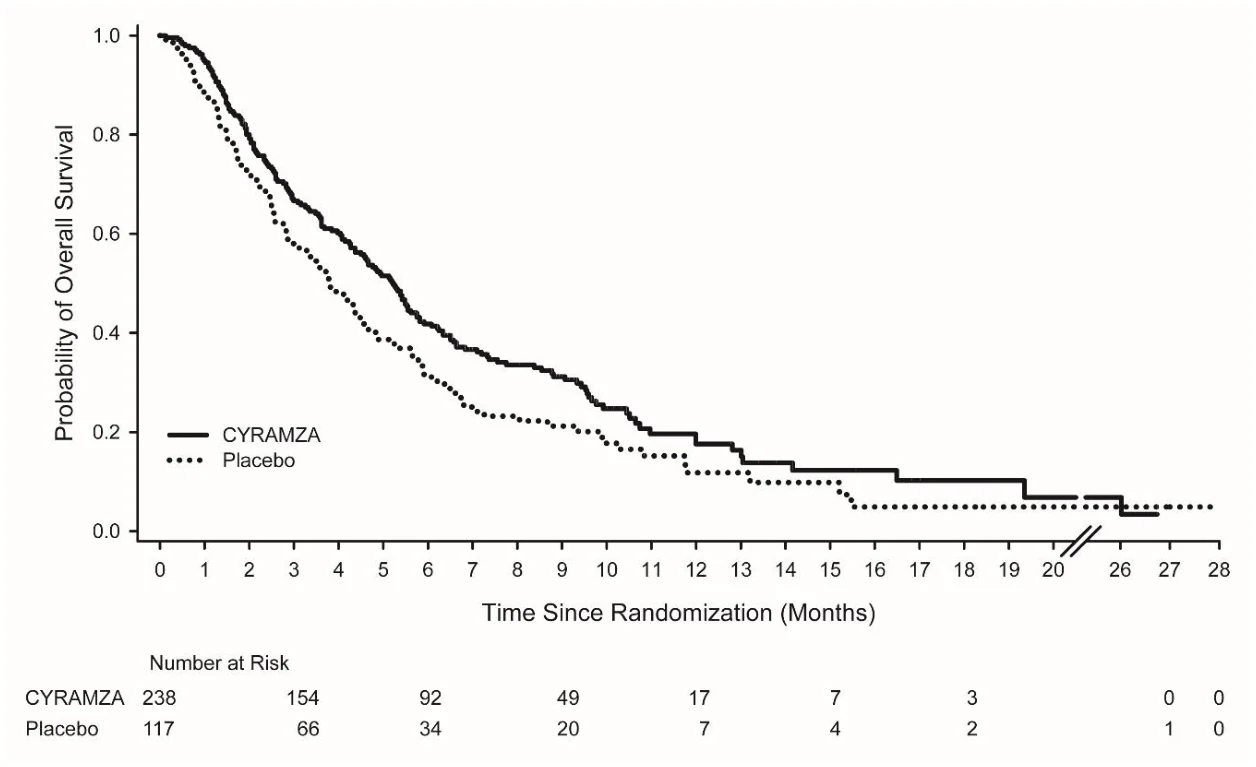
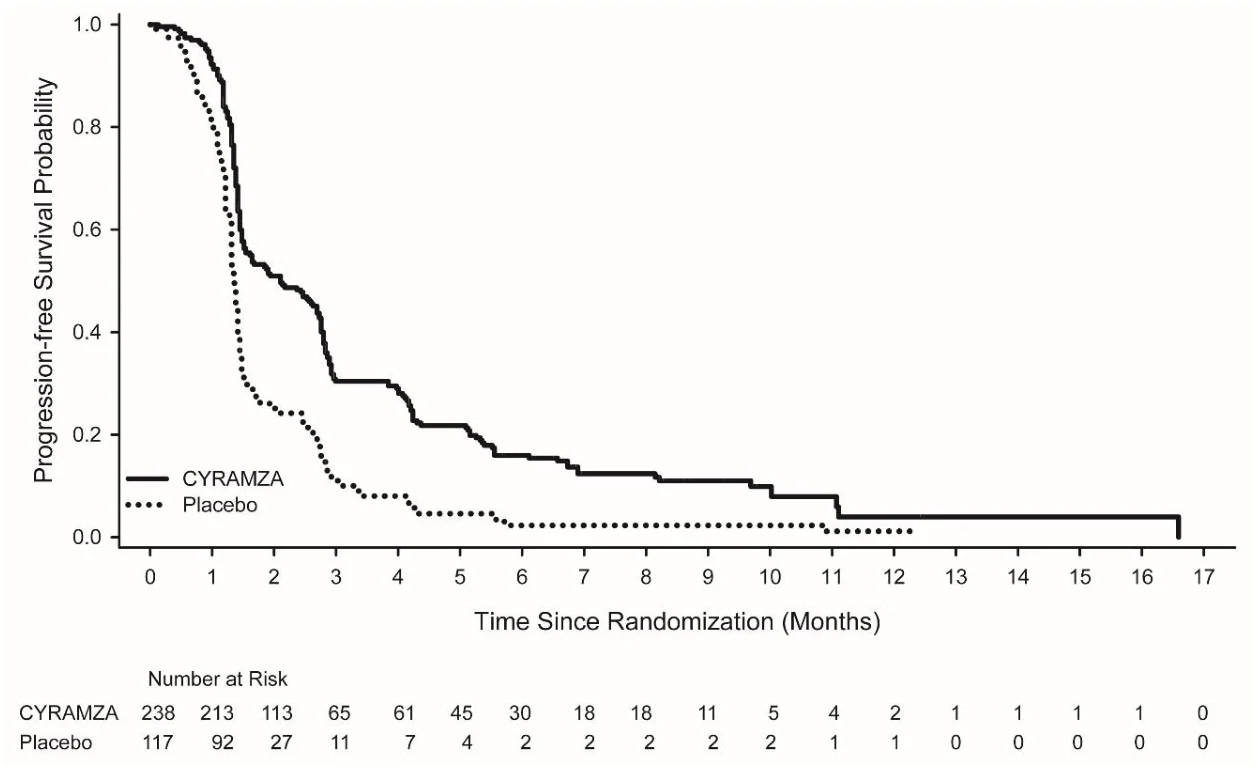 Figure 2: Kaplan-Meier curves of progression-free survival for CYRAMZA versus
placebo in REGARD.
Gastric Cancer – Combination with Paclitaxel (RAINBOW)
The safety and efficacy of CYRAMZA in combination with paclitaxel were evaluated in patients with locally advanced or metastatic gastric cancer (including adenocarcinoma of the GEJ) following platinum- and fluoropyrimidine-containing chemotherapy, with or without anthracycline (RAINBOW study).
Table 11 - Summary of Trial Design and Patient Demographics in RAINBOW
| Study # | Trial design | Dosage, route of administration and duration | Study subjects (N=number) | Median age (range) | Sex (number) |
| RAINBOW | Global, randomized (1:1), double-blind, placebo-controlled, multi-centre | CYRAMZA 8 mg/kg or placebo solution by intravenous infusion every 2 weeks (days 1 and
intravenous infusion on days 1, 8, and 15 of each 28-day cycle | CYRAMZA + Paclitaxel (N=330) Placebo + Paclitaxel (N=335) | CYRAMZA + Paclitaxel arm Median age = 61 (25-83) years Placebo + Paclitaxel arm Median age = 61 (24-84) years | CYRAMZA + Paclitaxel arm Male (229) Female (101) Placebo + Paclitaxel arm Male (243) Female (92) |
Randomized Trial
RAINBOW was a global, Phase 3, multi-centre, randomized, double-blind study of CYRAMZA plus paclitaxel versus placebo plus paclitaxel that randomized (1:1) 665 patients with locally advanced or metastatic gastric cancer (including adenocarcinoma of the GEJ) who previously received platinum- and fluoropyrimidine-containing chemotherapy, with or without anthracycline. The primary endpoint was overall survival and the secondary endpoints included progression free survival and overall response rate. Patients were required to have experienced disease progression during, or within 4 months after the last dose of, first-line therapy. Patients were also required to have ECOG performance status of 0 or 1. Patients received either an intravenous infusion of CYRAMZA at 8 mg/kg (n=330) or placebo (n=335) every 2 weeks (on days 1 and 15) of a 28-day cycle. Paclitaxel at 80 mg/m2 was administered by intravenous infusion on days 1, 8, and 15 of each 28-day cycle. Randomization was stratified by geographic region, time to progression from the start of first-line therapy (< 6 months versus ≥ 6 months) and disease measurability.
Demographics and baseline characteristics were similar between treatment arms (Table 11). Two-thirds of the patients experienced disease progression while on first-line therapy (66.8%). The majority of patients (76.1%) experienced disease progression within 6 months from the start of first-line therapy. Prior chemotherapy for gastric cancer consisted of platinum/fluoropyrimidine combination therapy without anthracycline (75.0%) or platinum/fluoropyrimidine combination therapy with anthracycline (24.5%).
Table 12 - Demographic, Baseline, and Pre-Treatment Disease Characteristics ITT Population; RAINBOW
| Variable | CYRAMZA + | Placebo + | Total N = 665 n (%) | |||||||||
| Paclitaxel | Paclitaxel | |||||||||||
| N = 330 | N = 335 | |||||||||||
| n (%) | n (%) | |||||||||||
| Demographic and Baseline Characteristics | ||||||||||||
| Sex n (%) | Male Female | 229 (69.4) 101 (30.6) | 243 (72.5) 92 (27.5) | 472 (71.0) 193 (29.0) | ||||||||
| Age (years) | Median age (range) | 61 (25-83) | 61 (24-84) | 61 (24-84) | ||||||||
| Age group n (%) | Age < 65 years Age ≥ 65 years | 204 (61.8) 126 (38.2) | 212 (63.3) 123 (36.7) | 416 (62.6) 249 (37.4) | ||||||||
| Race n (%) | White Asian Other | 208 (63.0) 110 (33.3) 6 (1.8) 6 (1.8) | 199 (59.4) 121 (36.1) 6 (1.8) 9 (2.7) | 407 (61.2) 231 (34.7) 12 (1.8) 15 (2.4) | ||||||||
| ECOG PS n (%) | 0 1 | 117 (35.5) 213 (64.5) | 144 (43.0) 191 (57.0) | 261 (39.2) 404 (60.8) | ||||||||
| Pre-Treatment Disease Characteristics | ||||||||||||
| Histological subtype | Intestinal Type Diffuse Type Mixed Unknown/Missing | 145 (43.9) 115 (34.8) 21 (6.4) 49 (14.8) | 135 (40.3) 133 (39.7) 14 (4.2) 53 (15.8) | 280 (42.1) 248 (37.3) 35 (5.3) 102 (15.3) | ||||||||
| Grade | Well differentiated Moderately differentiated Poorly differentiated Unknown/Missing | 28 (8.5) 96 (29.1) 186 (56.4) 20 (6.1) | 22 (6.6) 106 (31.6) 186 (55.5) 21 (6.3) | 50 (7.5) 202 (30.4) 372 (55.9) 41 (6.2) | ||||||||
| Primary tumour location | Gastric GEJ | 264 (80.0) 66 (20.0) | 264 (78.8) 71 (21.2) | 528 (79.4) 137 (20.6) | ||||||||
| Variable | CYRAMZA + | Placebo + | Total N = 665 n (%) | |||||
| Paclitaxel | Paclitaxel | |||||||
| N = 330 | N = 335 | |||||||
| n (%) | n (%) | |||||||
| Primary tumour present | Yes No | 209 (63.3) 121 (36.7) | 209 (62.4) 126 (37.6) | 418 (62.9) 247 (37.1) | ||||
| Extent of disease | Metastatic Locally Advanced | 324 (98.2) 6 (1.8) | 324 (96.7) 10 (3.0) | 648 (97.4) 16 (2.4) | ||||
| Most common sites of metastasisa | Lymph Nodes | 215 (65.2) | 205 (61.2) | 420 (63.2) | ||||
Peritoneal Liver Lung | 163 (49.4) 150 (45.5) 77 (23.3) | 152 (45.4) 138 (41.2) 70 (20.9) | 315 (47.4) 288 (43.3) 147 (22.1) | |||||
| Number of metastatic sitesb | 0 - 2 | 209 (63.3) | 232 (70.3) | 441 (66.3) | ||||
| ≥ 3 | 121 (36.7) | 103 (30.7) | 224 (33.7) | |||||
| Weight loss over prior 3 months | ≥ 10% < 10% Missing | 53 (16.1) 277 (83.9) 0 | 47 (14.0) 286 (85.4) 2 (0.6) | 100 (15.0) 563 (84.7) 2 (0.3) | ||||
| Presence of ascites | Yes No | 130 (39.4) 200 (60.6) | 107 (31.9) 228 (68.1) | 237 (35.6) 428 (64.4) | ||||
Abbreviations: ECOG PS = Eastern Cooperative Oncology Group performance status; GEJ = gastro-esophageal junction; ITT = intent-to-treat; N = number of randomized patients; n = number of patients in category; NOS = not otherwise specified.
a Sites of metastasis occurring in ≥ 20% of patients. Patients may record multiple sites of metastatic disease.
b Derived from the sites of metastatic disease case report form pages. Unknown and missing categories were counted as not involved.
Patients treated with CYRAMZA plus paclitaxel received a median of 9 doses (range 1-53) of CYRAMZA, with the median duration of therapy being 19 weeks. Patients treated with placebo plus paclitaxel received a median of 6 doses (range of 1-46) of placebo, with the median duration of therapy being 12 weeks. The median relative dose intensity of CYRAMZA was 98.6% and of placebo was 99.6%. The median relative dose intensity of paclitaxel was 87.7% for the CYRAMZA plus paclitaxel arm and 93.2% for the placebo plus paclitaxel arm. Post discontinuation systemic anticancer therapy was given to 47.9% of patients receiving CYRAMZA plus paclitaxel and 46.0% of patients receiving placebo plus paclitaxel.
Overall survival was statistically significantly improved in patients receiving CYRAMZA plus paclitaxel compared with patients receiving placebo plus paclitaxel (HR 0.807; 95%CI: 0.678 to 0.962; p=0.0169), corresponding to a 19% reduction in the risk of death and an increase in median survival to 9.63 months for CYRAMZA plus paclitaxel from 7.36 months for placebo plus paclitaxel.
Progression-free survival was statistically significantly improved in patients receiving CYRAMZA plus paclitaxel compared with patients receiving placebo plus paclitaxel (HR 0.635; 95%CI: 0.536 to 0.752; p < 0.0001), corresponding to a 37% reduction in the risk of progression or death and an increase in median PFS to 4.4 months for CYRAMZA plus paclitaxel from 2.9 months for placebo plus paclitaxel. Efficacy results are shown in Table 13.
Table13 - Summary of Efficacy Data – Intent to Treat (ITT) Population
CYRAMZA + Paclitaxel N=330 | Placebo + Paclitaxel N=335 | |
| Overall Survival | ||
| Median – months (95% CI) | 9.6 (8.5, 10.8) | 7.4 (6.3, 8.4) |
| Hazard Ratio (95% CI) | 0.807 (0.678, 0.962) | |
| Stratified Log-rank p-value | 0.0169 | |
| Progression-free Survival | ||
| Median – months (95% CI) | 4.4 (4.2, 5.3) | 2.9 (2.8, 3.0) |
| Hazard Ratio (95% CI) | 0.635 (0.536, 0.752) | |
| Stratified Log-rank p-value | <0.0001 | |
| Objective Response Rate (CR + PR)* | ||
| Rate – percent | 27.9 | 16.1 |
Abbreviations: CI = confidence interval
Primary analysis of OS and PFS were stratified by the randomization strata (geographic region, time-to-progression from the start of first-line therapy and disease measurability).
A gate-keeping strategy was utilized to control the overall type I error at 0.05 (2-sided) for the analysis of the primary OS endpoint and secondary PFS endpoint. Only if the primary OS test was significant would the analysis of PFS be considered inferential.
* based on tumour assessments by investigator
Figures 3 and 4 display the Kaplan-Meier curves for overall survival and progression-free survival, respectively, in the ITT population.
Figure 3: Kaplan-Meier curves of overall survival for CYRAMZA plus paclitaxel versus placebo plus paclitaxel in RAINBOW.
Figure 4: Kaplan-Meier curves of progression-free survival for CYRAMZA plus paclitaxel versus placebo plus paclitaxel in RAINBOW.
14.3 Immunogenicity 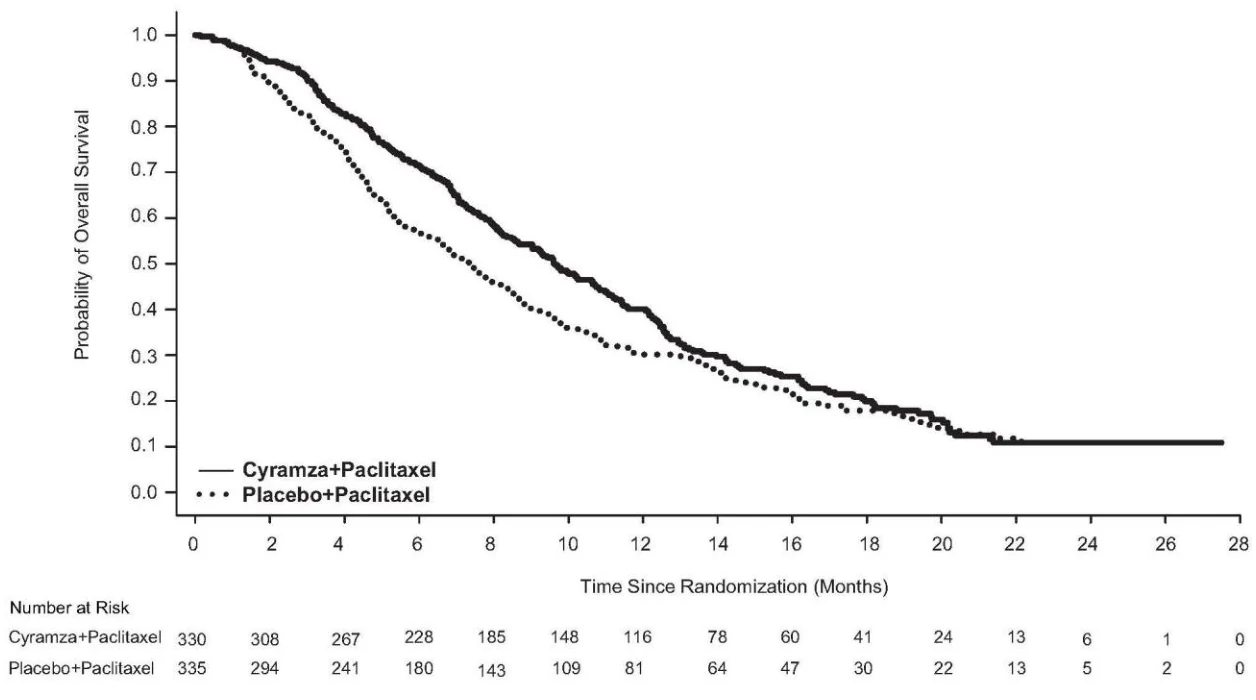
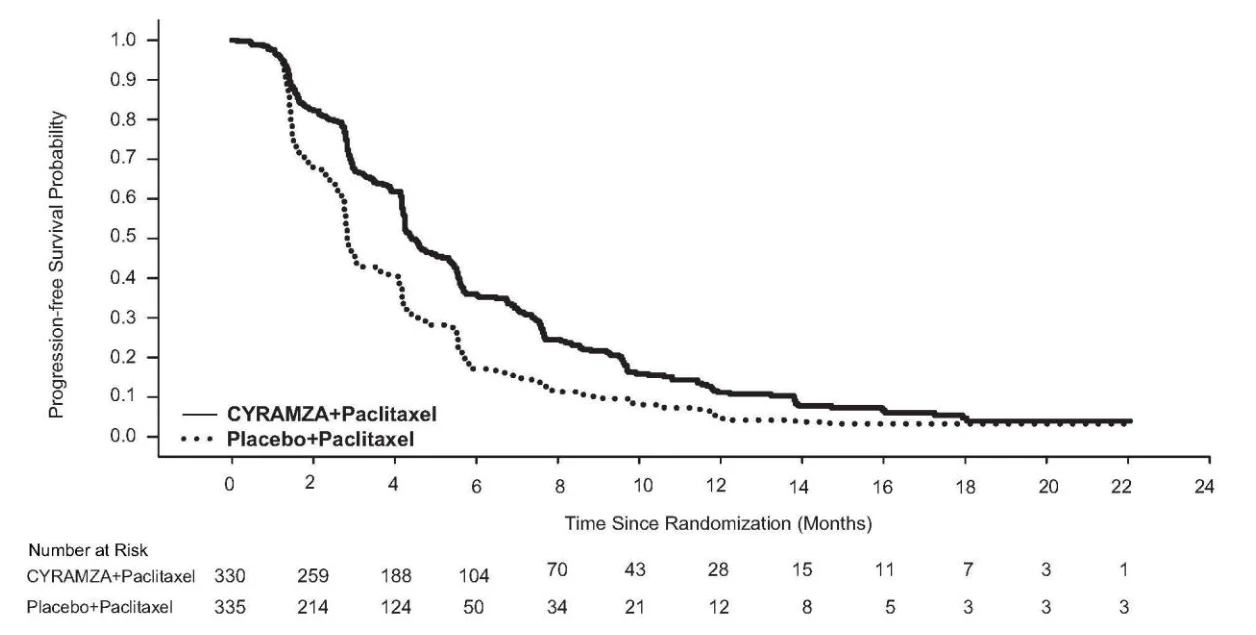
In 23 clinical trials, 86/2890 (3.0%) of the CYRAMZA-treated patients tested positive for treatment-emergent anti-ramucirumab antibodies by an enzyme-linked immunosorbent assay (ELISA). Neutralizing antibodies were detected in 14 of the 86 patients who tested positive for treatment-emergent anti-ramucirumab antibodies.
15 MICROBIOLOGY
No microbiological information is required for this drug product
16 NON-CLINICAL TOXICOLOGY
General Toxicology: The nonclinical safety assessment of ramucirumab was conducted in the cynomolgus monkey, which was established as an appropriate species for toxicity testing based on conservation of the binding epitope between human and monkey, affinity binding of ramucirumab to VEGFR-2, similar patterns of tissue binding in a broad panel of human and cynomolgus monkey tissues in a GLP-compliant tissue cross-reactivity study and because ramucirumab does not cross-react with murine VEGFR-2.
An overview of the nonclinical toxicology program is provided in Table 14.
Table 14 - Toxicology Study Overview
| Study Type | Species | Route of Administration | Duration of Dosing | Doses (mg/kg) |
| Repeat-dose toxicity | Cynomolgus monkey | IV (bolus) | 5 weeks (with a 6 week recovery phase) | 0, 4, 12, 40a |
| Repeat-dose toxicity | Cynomolgus monkey | IV (infusion) | Once per week for 12 weeks (interim sacrifice) or 39 weeks | 0, 5, 16, 50 |
| Wound Healing | Cynomolgus monkey | IV (infusion) | Single-dose (21-day observation period) | 5, 15, 50a |
Tissue Cross- Reactivity | Human and Cynomolgus Monkey tissue | In vitro binding | 1 hour incubation at room temperature | Conc. 5 and 0.5 µg/mL |
Abbreviation: IV = intravenous.
a Highest No Observed Adverse Effects Level (NOAEL).
Single-Dose Toxicity
No dedicated single-dose toxicity studies were conducted with ramucirumab. However, no signs of acute toxicity were evident after administration of the highest single ramucirumab test dose of 50 mg/kg in the 39-week and wound healing studies.
Repeat-Dose Toxicity
Repeated intravenous dosing of ramucirumab to monkeys for up to 5 and 39 weeks was well-tolerated. No treatment-related mortalities, adverse clinical observations, or effects on body weight and food consumption occurred in either study.
Ramucirumab was well tolerated in the 5-week repeat-dose toxicity study at dose levels from 4 to 40 mg/kg for 4 doses. The no-observable-adverse-effect level (NOAEL) in this study was 40 mg/kg, the highest dose administered.
No treatment-related adverse effects were observed after 11 weekly administrations of ramucirumab at dose levels of 5, 16, and 50 mg/kg to female cynomolgus monkeys in the 39-week study.
No adverse effects on any of the toxicological parameters evaluated, including clinical, anatomic, and microscopic pathology were attributed to ramucirumab after 11 weeks of dosing in the 39-week study.
Ramucirumab had no effect on any in-life clinical observations, including blood pressure, electrocardiographic or ophthalmological examinations, or immunophenotype profile.
Several adverse clinical pathology changes were evident in animals treated with 16 and 50 mg/kg of ramucirumab at both Study Day 183 and 273. Higher blood urea nitrogen, creatinine, or cholesterol concentrations; lower albumin concentrations; and urinary protein loss were observed that were considered to be secondary to adverse microscopic changes in the kidney noted at the terminal evaluation (Study Day 274). Gross anatomic observations at terminal necropsy revealed pale kidneys (one 16 mg/kg female; one 50 mg/kg male), and increases in kidney weights at 16 and 50 mg/kg. These changes correlated microscopically with glomerulonephritis in all monkeys treated intravenously with 16 or 50 mg/kg of ramucirumab for 39 weeks. The severity and distribution of the glomerulonephritis ranged from moderate, multifocal to marked, diffuse. Grading of glomerulonephritis was based on the severity and extent of the primary glomerular lesion. Changes observed in the tubules, collecting ducts, and interstitium were considered secondary to the glomerular damage and as such were included in the glomerulonephritis diagnosis.
Because of the importance of VEGF in normal bone growth, adverse effects on this parameter were anticipated from treatment with the anti-VEGFR-2 antibody. Therefore, a bone growth evaluation was performed on the femurs and stifle joints (with synovial tissue) of animals after 39 weeks of ramucirumab treatment. As expected, monkeys treated with 5, 16, or 50 mg/kg of ramucirumab exhibited thickening and osteochondropathy of the epiphyseal growth plate in the femurs at all dose levels. The lowest weekly dose tested in the cynomolgus monkey is 1.2 times the recommended dose of ramucirumab as a single agent (8 mg/kg every 2 weeks). There were no changes noted microscopically that were considered pathological involving the stifle joint with synovial tissue.
No treatment-related adverse effects were observed on male or female reproductive tissues in either the 5-week or 39-week study.
The bone growth plate and kidney were identified as target organs of ramucirumab toxicity after weekly intravenous administration to monkeys for 39 weeks. No treatment-related adverse effects were evident in animals after 11 doses (12 weeks) of up to 50 mg/kg of ramucirumab indicating that chronic exposures are necessary to induce the changes. The kidney changes were monitorable by standard clinical pathology evaluations. Reversibility was not assessed in this study. Although the bone growth plate pathology evident at the lowest test dose level (5 mg/kg) was an anticipated mechanism-related effect, the findings were considered adverse. Thus, a NOAEL for 39-week exposure to ramucirumab was not established.
Carcinogenicity: No animal studies have been performed to test ramucirumab for potential carcinogenicity.
Genotoxicity: No animal studies have been performed to test ramucirumab for potential genotoxicity.
Reproductive and Developmental Toxicology: No animal studies have been conducted to evaluate whether ramucirumab affects fertility in males or females. Reproductive and developmental toxicity testing of ramucirumab has not been conducted. A scientific assessment on the developmental and reproductive toxicity potential has been evaluated. In summary, VEGF is a critical mediator of angiogenesis that occurs across several stages of the female reproductive cycle, pregnancy, and embryo-fetal development. Interference with VEGF signaling through the use of transgenic models (for example, knockout mice), nonproprietary antibodies against VEGF, or its receptors, or proprietary antibodies against VEGFR-2 have been shown to block angiogenesis and functioning or development of tissues critical for mammalian reproduction and development. Therefore, administration of ramucirumab to patients poses a potential risk to establishing and maintaining pregnancy and to the embryo-fetal development. The potential risks of ramucirumab to reproduction and development in humans can be communicated appropriately to patients and prescribers in the product information based on existing scientific information.
Special Toxicology:
Local Tolerance
Local tolerance was investigated in the two repeat-dose toxicity evaluations in cynomolgus monkeys by clinical observations, and as part of the histopathological evaluations. Intravenous administration of ramucirumab was well-tolerated and no treatment-related adverse reactions at the injection site were observed in either study.
Tissue Binding Study of IMC-1121B-FITC with Normal Human and Cynomolgus Monkey Tissues
To characterize the tissue-binding profile of ramucirumab with particular focus on unexpected cell and tissue binding, and to confirm the relevance of the animal model (based on target distribution) used for the ramucirumab safety assessment, a comprehensive tissue cross-reactivity study was conducted in cryosections of normal human and cynomolgus monkey tissues. The tissue reactivity of ramucirumab observed in human tissues in this study was similar to that seen in the cynomolgus monkey tissues, indicating that the cynomolgus monkey is an appropriate animal model for toxicity of ramucirumab. Further, these data do not raise significant concerns as a consequence of human-specific binding of ramucirumab that would not have been evaluated in the monkey toxicology studies. The key finding in this study was the observation of IMC-1121B-FITC staining in vascular endothelium in both human and cynomolgus monkey tissues. This staining pattern is consistent with the distribution of the molecular target of ramucirumab, VEGFR-2, which is expressed predominantly on endothelial and hematopoietic cells, and overexpressed in the vasculature of the majority of human tumours.
Wound-Healing
Based on an anticipated mechanism-based impairment of wound-healing by an antagonist of the VEGFR-2, the effect of ramucirumab was assessed in an incisional model of wound healing after administration of a single intravenous dose (0, 5, 15, or 50 mg/kg) in cynomolgus monkeys. Serum concentrations of ramucirumab were determined to characterize the exposure:response relationship for wound-healing impairment. This study did not identify a clinical or histological impairment of wound-healing by ramucirumab in this model.
PATIENT MEDICATION INFORMATION
READ THIS FOR SAFE AND EFFECTIVE USE OF YOUR MEDICINE
Pr CYRAMZA®
Ramucirumab intravenous injection
Read this carefully before you start taking CYRAMZA and each time you get a refill. This leaflet is a summary and will not tell you everything about this drug. Talk to your healthcare professional about your medical condition and treatment and ask if there is any new information about CYRAMZA.
Serious Warnings and Precautions
- Increases risk of severe bleeding, including severe bleeding in your stomach or bowel.
- Increases risk of developing a hole in your stomach or bowel. In some cases this could result in death.
- Talk to your healthcare professional before you plan to have surgery and treatment should be stopped if you have a wound that is not healing properly.
What is CYRAMZA used for?
CYRAMZA is a targeted cancer medicine used to treat advanced stomach cancer (also known as gastric cancer) and cancer of the gastro-esophageal junction (part of the food tube just as it joins the stomach), either by itself or in combination with paclitaxel (another anticancer medicine), in adults whose disease has progressed despite prior treatment with chemotherapy.
How does CYRAMZA work?
CYRAMZA is a vascular endothelial growth factor (VEGF) Receptor 2 antagonist that belongs to a group of biologic substances called monoclonal antibodies. In order to grow, tumours require oxygen and nutrients which are delivered through the blood. As tumours grow, they require larger amounts of oxygen and nutrients. Tumours get this supply by inducing the growth of new blood vessels. This process is called angiogenesis (an´-gee-o-jen´-i-sis). CYRAMZA works by blocking angiogenesis and helps starve the tumour of oxygen and other nutrients. CYRAMZA is not chemotherapy; it is considered a biologic antiangiogenic therapy.
What are the ingredients in CYRAMZA?
Medicinal ingredients: ramucirumab
Non-medicinal ingredients: glycine (E640), histidine, histidine monohydrochloride, polysorbate 80 (E433), sodium chloride and water for injection
CYRAMZA comes in the following dosage forms:
CYRAMZA is available as a solution in 10 mL or 50 mL single-use vials. Each vial contains either 100 mg ramucirumab in 10 mL (10 mg/mL) or 500 mg ramucirumab in 50 mL (10 mg/mL). After dilution and preparation, CYRAMZA is administered as an intravenous infusion.
Do not use CYRAMZA if:
- you are allergic to this drug or to any ingredient in the formulation
To help avoid side effects and ensure proper use, talk to your healthcare professional before you take CYRAMZA. Talk about any health conditions or problems you may have, including if you:
- have any condition which increases the risk of bleeding;
- have high blood pressure;
- are going to have planned surgery, had recent surgery or have a poorly healing wound after surgery;
- have severe liver disease (‘cirrhosis’) and associated conditions, such as excessive accumulation of fluid in your abdomen (‘ascites’);
- have had blood clots in your arteries (‘arterial thromboembolic events’);
- have ever had a heart attack or stroke;
- have had a hole in your stomach or bowel (‘gastrointestinal perforation’);
- have a weakened heart muscle (‘heart failure’);
- have had an allergic reaction to the infusion;
- are pregnant or plan to become pregnant;
- are breastfeeding;
- have any allergies to this drug or its ingredients
Other warnings you should know about:
Pregnancy, breast-feeding and fertility
Avoid getting pregnant while receiving this medicine and for at least 3 months after the last dose of CYRAMZA as this medicine may potentially cause harm to your unborn child. As CYRAMZA inhibits the development of new blood vessels, it may decrease the likelihood of you becoming pregnant or maintaining a pregnancy. Talk to your doctor about the best contraception for you.
Discontinue nursing or discontinue CYRAMZA. Do not breast-feed your baby during treatment with CYRAMZA and for at least 3 months after you receive the last dose, as this medicine may have harmful effects on the growth and development of your baby.
Children and adolescents
CYRAMZA should not be given to patients under the age of 18 years because there is no information about the safety nor how it works in this age group.
Tell your healthcare professional about all the medicines you take, including any drugs, vitamins, minerals, natural supplements or alternative medicines.
The following may interact with CYRAMZA
- There are no known relevant Drug-Drug, Drug-Food or Drug-Herb interactions
How to take CYRAMZA:
CYRAMZA will be given to you by a healthcare professional.
CYRAMZA is given by intravenous infusion (through a needle placed in a vein in the arm, hand, or through a central line). The infusion lasts about 60 minutes. You will receive an infusion once every 2 weeks.
You may receive CYRAMZA alone or in combination with paclitaxel, another anticancer agent. Your doctor will determine your treatment plan. If you receive CYRAMZA in combination with paclitaxel, you should read the patient information for paclitaxel as well. Ask your doctor or health care team if you have any questions.
Usual dose:
The recommended dose of CYRAMZA for the treatment of gastric cancer is 8 mg per kg of your body weight once every 2 weeks.
If your doctor has prescribed paclitaxel, you will receive it once every week for 3 weeks followed by 1 week without treatment. It will be given by intravenous infusion for about 60 minutes. If you receive paclitaxel on the same day as CYRAMZA, it will be given after the CYRAMZA infusion has finished.
The number of infusions you will receive depends on how you are responding to treatment. Your doctor will discuss this with you.
Premedication:
You may be given medication to reduce the risk of an infusion-related reaction to the infusion before you receive CYRAMZA. If you experience an infusion-related reaction during CYRAMZA therapy, you will be given premedication for all future infusions. Symptoms of infusion-related reactions may include increased muscle tension, back pain, chest pain and/or tightness, chills, flushing, difficulty in breathing, wheezing, and feeling of tingling or numbness in hands or feet. In severe cases, symptoms may include breathing distress caused by narrowing of the airways, faster heartbeat, and feeling weak.
Dose adjustments:
During each infusion, your doctor or nurse will check for side effects. The time over which your infusion is given may lengthen if you experience an infusion-related reaction during treatment.
The amount of protein in your urine will be checked regularly during treatment. Depending on the protein level measured, CYRAMZA may be temporarily discontinued. Once the urine protein level has decreased to a certain level, treatment may be restarted with a lower dose.
CYRAMZA treatment will be temporarily stopped if you:
- develop high blood pressure, until it is controlled with antihypertensive medication
- develop wound healing problems, until the wound is healed or prior to planned surgery
- have significantly increased protein in your urine
CYRAMZA treatment will be permanently stopped if you:
- develop a blood clot in your arteries (‘arterial thromboembolic events’)
- develop a hole in your stomach or bowel (‘gastrointestinal perforation’)
- experience severe bleeding
- experience a severe infusion-related reaction
- develop high blood pressure that cannot be controlled with medication
- are passing more than a certain amount of protein with your urine or if you develop a severe kidney disease (‘nephrotic syndrome’)
Overdose:
If you think you, or a person you are caring for, have taken too much CYRAMZA, contact a healthcare professional, hospital emergency department, or regional poison control centre immediately, even if there are no symptoms.
Missed Dose:
If you miss an infusion, contact your doctor immediately for further instructions.
What are possible side effects from using CYRAMZA?
These are not all the possible side effects you may have when taking CYRAMZA. If you experience any side effects not listed here, tell your healthcare professional.
Tell your doctor immediately if you experience any of the following serious side effects during CYRAMZA treatment:
- vomit bright red blood or coffee ground material, blood in the stool or black, tarry stools, pain, severe fatigue, shortness of breath or a sense you may pass out when you get up from lying or sitting which could be due to bleeding from your stomach or bowel
- chest pain (may or may not feel like pressure or tightness in your chest) or loss of strength in an arm or leg, change in speech or change in vision which could be due to blood clots in the arteries (can lead to a heart attack or stroke)
- sudden onset of severe abdominal pain which could be a symptom of a hole in the stomach or bowel
- sudden onset of shivers and shakes often with a fever which could be the result of a serious infection (sepsis)
- new or worsening weakness and tiredness, swelling of the feet and ankles, and/or shortness of breath, which could be symptoms of weakened heart muscle (heart failure)
Tell your doctor if you experience any of the following other side effects:
Very common: may affect more than 1 in 10 people
- high blood pressure
- protein in the urine
- feeling tired or weak
- low white blood cell count (may increase risk of infection) which on its own may not cause any symptoms and is commonly only discovered as a result of routine blood tests
- diarrhea
- nose bleed
- abdominal pain
- swelling of hands, feet and legs due to fluid retention
- inflammation of the mouth
- low platelet count (cells that help the blood to clot). This does not usually cause any problems and is commonly found in routine blood tests.
- low blood levels of albumin
Common: may affect up to 1 in 10 people
- intestinal blockage; symptoms may include constipation and abdominal pain
- rash
- headache
- low blood levels of potassium (hypokalemia) which can cause muscle weakness, twitching or abnormal heart rhythm
- low blood levels of sodium (hyponatremia) which can cause tiredness and confusion or muscle twitching
- thyroid dysfunction
- abnormal growth of blood vessels usually on the surface of the skin; this may appear as a red, raised lesion and may grow larger and/or bleed (hemangioma)
- altered voice such as hoarseness
Uncommon: may affect up to 1 in 100 people
- fistula (an abnormal tube like connection between internal parts of the body that are not normally connected)
Rare: may affect up to 1 in 1000 people
A brain condition called Posterior Reversible Encephalopathy Syndrome (PRES). Symptoms may include seizure, headache, nausea/vomiting, blindness, or loss of alertness.
| Serious side effects and what to do about them | ||||||||
| Symptom / effect | Talk to your healthcare | Stop taking drug | ||||||
| professional | and get | |||||||
| Only if severe | In all cases | immediate | ||||||
| medical help | ||||||||
| COMMON | ||||||||
| Holes in the gut wall (gastrointestinal perforation): a hole in the stomach, gut or bowel [symptoms include severe stomach pain, vomiting, fever or chills] | ✓ | |||||||
| Severe bleeding in your gut [symptoms may include extreme tiredness, weakness, dizziness or change in the colour of your stools] | ✓ | |||||||
| Blood clots in the arteries: can lead to a heart attack or stroke [symptoms of a heart attack may include chest pain or heaviness in the chest; symptoms of a stroke may include sudden numbness or weakness of the arm, leg and face, feeling confused, difficulty speaking or understanding others, sudden difficulty in walking or loss of balance or coordination or sudden dizziness] | ✓ | |||||||
| RARE | ||||||||
| Damage to small blood vessels in various organs of the body. This occurs most commonly in the kidney. Red blood cells and platelets may be destroyed because of this blood vessel damage (thrombotic microangiopathy). Red blood cells carry oxygen and platelet are cells that help the blood to clot. Blood flow to organs may be reduced. [Symptoms include bruising/bleeding, tiredness, shortness of breath, decreased urine output, swollen legs, headache, confusion, and symptoms of stroke. Protein in the urine and high blood pressure may occur.] | ✓ | |||||||
| A brain condition called Posterior Reversible Encephalopathy Syndrome (PRES). [Symptoms may include seizure, headache, nausea/vomiting, blindness, or loss of alertness.] | ✓ | ✓ | ||||||
Tell your doctor if you have a troublesome symptom or side effect that is not listed here or becomes bad enough to interfere with your daily activities. These are not all the possible side effects you may feel when taking CYRAMZA. If you experience any side effects not listed here, contact your healthcare professional.
Reporting Side Effects
You can report any suspected side effects associated with the use of health products to Health Canada by:
Visiting the Web page on Adverse Reaction Reporting
(https://www.canada.ca/en/health-canada/services/drugs-health-products/medeffect-canada.html) for information on how to report online, by mail or by fax; or
- Calling toll-free at 1-866-234-2345.
NOTE: Contact your health professional if you need information about how to manage your side effects. The Canada Vigilance Program does not provide medical advice.
Storage:
Store CYRAMZA in a refrigerator at 2°C to 8°C (36°F to 46°F) until time of use. Keep the vial in the outer carton in order to protect from light.
Do not freeze or shake the vial.
Keep out of reach and sight of children.
If you want more information about CYRAMZA:
- Talk to your healthcare professional
- Find the full product monograph that is prepared for healthcare professionals and includes this Patient Medication Information by visiting the Health Canada website: (https://www.canada.ca/en/health-canada/services/drugs-health-products/drug-products/drug-product-database.html; the manufacturer’s website www.lilly.ca, or by calling 1-888-545-5972.
- The information in this document is current as of the last revision date shown below. For the most current information please visit our website or contact us directly.
- You may need to read this package insert again. Please do not throw it away until you have finished your medicine
CYRAMZA is a registered trademark owned by or licensed to Eli Lilly and Company, its subsidiaries, or affiliates.
Last Revised June 9, 2022
CYR-0007-CA-PM-20220609