


Product Monograph - Bicillin L-A
RECENT MAJOR LABEL CHANGES
| 3 Serious Warnings and Precautions Box | 04/2023 |
|---|---|
| 7 Warnings and Precautions, Cardiovascular | 05/2024 |
TABLE OF CONTENTS
Sections or subsections that are not applicable at the time of authorization are not listed.
RECENT MAJOR LABEL CHANGES ............................................................................................ 2
TABLE OF CONTENTS .............................................................................................................. 2
PART I: HEALTH PROFESSIONAL INFORMATION ...................................................................... 4
1 INDICATIONS ............................................................................................................... 4
1.1 Pediatrics ................................................................................................................ 4
1.2 Geriatrics ................................................................................................................ 4
2 CONTRAINDICATIONS ................................................................................................. 4
3 SERIOUS WARNINGS AND PRECAUTIONS BOX ............................................................ 5
4 DOSAGE AND ADMINISTRATION ................................................................................. 5
4.1 Dosing Considerations ............................................................................................ 5
4.2 Recommended Dose and Dosage Adjustment ....................................................... 5
4.4 Administration ........................................................................................................ 6
5 OVERDOSAGE .............................................................................................................. 6
6 DOSAGE FORMS, STRENGTHS, COMPOSITION AND PACKAGING ................................. 7
7 WARNINGS AND PRECAUTIONS .................................................................................. 7
7.1 Special Populations............................................................................................... 10
7.1.1 Pregnant Women ........................................................................................... 10
7.1.2 Breast-feeding ................................................................................................ 10
7.1.3 Pediatrics ........................................................................................................ 10
7.1.4 Geriatrics ........................................................................................................ 10
8 ADVERSE REACTIONS ................................................................................................ 10
8.1 Adverse Reaction Overview .................................................................................. 10
9 DRUG INTERACTIONS ................................................................................................ 12
9.4 Drug-Drug Interactions ......................................................................................... 12
9.5 Drug-Food Interactions ......................................................................................... 12
9.6 Drug-Herb Interactions ......................................................................................... 12
9.7 Drug-Laboratory Test Interactions ........................................................................ 12
10 CLINICAL PHARMACOLOGY ....................................................................................... 13
10.1 Mechanism of Action ...................................................................................... 13
10.3 Pharmacokinetics ........................................................................................... 13
11 STORAGE, STABILITY AND DISPOSAL ......................................................................... 13
12 SPECIAL HANDLING INSTRUCTIONS ........................................................................... 13
PART II: SCIENTIFIC INFORMATION ....................................................................................... 14
13 PHARMACEUTICAL INFORMATION ............................................................................ 14
14 CLINICAL TRIALS ........................................................................................................ 14
15 MICROBIOLOGY ........................................................................................................ 14
16 NON-CLINICAL TOXICOLOGY ..................................................................................... 16
PATIENT MEDICATION INFORMATION .................................................................................. 17
PART I: HEALTH PROFESSIONAL INFORMATION
1 INDICATIONS
Bicillin® L-A (intramuscular penicillin G benzathine) is indicated in the treatment of infections due to penicillin-G-sensitive microorganisms that are susceptible to the low and very prolonged serum levels common to this particular dosage form. Therapy should be guided by bacteriological studies (including sensitivity tests) and by clinical response.
The following infections will usually respond to adequate dosage of intramuscular penicillin G benzathine.
- Streptococcal infections (Group A without bacteremia): Mild-to-moderate infections of the upper respiratory tract (e.g., pharyngitis).
- Venereal infections: Syphilis, yaws, bejel, and pinta.
- Medical conditions in which penicillin G benzathine therapy is indicated as prophylaxis: Rheumatic fever and/or Sydenham chorea (strep A related chorea) - Prophylaxis with penicillin G benzathine has proven effective in preventing recurrence of these conditions. It has also been used as follow-up prophylactic therapy for rheumatic heart disease and acute post-streptococcal glomerulonephritis.
To reduce the development of drug-resistant bacteria and maintain the effectiveness of Bicillin® L-A and other antibacterial drugs, Bicillin® L-A should be used only to treat or prevent infections that are proven or strongly suspected to be caused by susceptible bacteria. When culture and susceptibility information are available, they should be considered in selecting or modifying antibacterial therapy. In the absence of such data, local epidemiology and susceptibility patterns may contribute to the empiric selection of therapy.
1.1 Pediatrics
Pediatrics (< 18 years of age): see 4 DOSAGE AND ADMINISTRATION and 7.1.3 Pediatrics.
1.2 Geriatrics
Geriatrics (> 65 years of age): Clinical studies did not include sufficient numbers of subjects aged 65 and over to determine whether they respond differently from younger subjects. Use in the geriatric population may be associated with differences in safety or effectiveness (see 7.1.4 Geriatrics).
2 CONTRAINDICATIONS
Bicillin® L-A is contraindicated in patients who are hypersensitive to this drug, have a history of a previous hypersensitivity reaction to any of the penicillins, or to any ingredient in the formulation, including any non-medicinal ingredient, or component of the container. For a complete listing, see 6 DOSAGE FORMS, STRENGTHS, COMPOSITION AND PACKAGING.
3 SERIOUS WARNINGS AND PRECAUTIONS BOX
Serious Warnings and Precautions
|
|---|
4 DOSAGE AND ADMINISTRATION
4.1 Dosing Considerations
- BICILLIN® L-A is intended for intramuscular injection only (see 3 SERIOUS WARNINGS AND PRECAUTIONS BOX, 4.4 Administration and 7 WARNINGS AND PRECAUTIONS, General).
- The risk of toxic reactions to this drug may be greater in patients with impaired renal function and elderly patients. Employ caution when dosing and monitor renal function (see 7.1.4 Geriatrics and 10.3 Pharmacokinetics).
4.2 Recommended Dose and Dosage Adjustment
The following dosages are recommended:
Streptococcal Group A: upper respiratory infections (e.g., pharyngitis):
Adults: A single dose of 1.2 million I.U.
Older children: A single dose of 900,000 I.U.
Children and infants under 27 kg (60 lbs): A single dose of 300,000 to 600,000 I.U.
Venereal infections:
Syphilis:
Primary, secondary, and early latent: 2.4 million I.U. (1 dose).
Late latent and tertiary (not involving the central nervous system): 2.4 million I.U. at 7-day intervals for three doses.
Congenital: Under 2 years of age: 50,000 I.U./kg/body weight; Ages 2-12 years: Adjust dosage based on adult dosage schedule.
Persons co-infected with HIV may require a longer course of treatment, as well as closer and longer follow-up.
Yaws, Bejel, and Pinta: A single dose of 1.2 million I.U.
Prophylaxis: for rheumatic fever and glomerulonephritis:
Following an acute attack, penicillin G benzathine (parenteral) may be given in doses of 1,200,000 I.U. once a month or 600,000 I.U. every 2 weeks.
Dosage Adjustment
- Geriatric: Dose selection should be cautious, usually starting at the low end of the dosing range.
- Renal Impairment: Dose selection should be cautious, usually starting at the low end of the dosing range.
4.4 Administration
- BICILLIN® L-A is intended for intramuscular injection only. Do not inject into or near an artery or nerve, or intravenously, or admixed with other intravenous solutions (see 3 SERIOUS WARNINGS AND PRECAUTIONS BOX and 7 WARNINGS AND PRECAUTIONS, General).
- Administer by deep, intramuscular injection in the upper, outer quadrant of the buttock (dorsogluteal) or the ventrogluteal site. In infants and small children, the midlateral aspect of the thigh may be preferable.
- When doses are repeated, vary the injection site.
- Care should be taken to avoid intravenous or intraarterial administration, or injection into or near major peripheral nerves or blood vessels, since such injection may produce neurovascular damage. Discontinue delivery of the dose if the subject complains of severe immediate pain at the injection site or if, especially in infants and young children, symptoms or signs occur suggesting onset of severe pain.
- Because of the high concentration of suspended material in this product, the needle may be blocked if the injection is not made at a slow, steady rate.
- Parenteral drug products should be inspected visually for particulate matter and discoloration prior to administration, whenever solution and container permit.
5 OVERDOSAGE
There have been no reported overdosages with Bicillin® L-A. Penicillin in overdosage has the potential to cause neuromuscular hyper-irritability or convulsive seizures. Since there is no antidote, treatment should be symptomatic and supportive.
| For management of a suspected drug overdose, contact your regional poison control centre. |
|---|
6 DOSAGE FORMS, STRENGTHS, COMPOSITION AND PACKAGING
Table – Dosage Forms, Strengths, Composition and Packaging
Each 2 mL disposable syringe (21 gauge, thin-wall 1-1/2 inch needle) contains 1,200,000 IU penicillin G benzathine as an aqueous suspension. Supplied in packages of 10 syringes.
7 WARNINGS AND PRECAUTIONS
Please see 3 SERIOUS WARNINGS AND PRECAUTIONS BOX.
General
- Penicillin G benzathine should only be prescribed for the indications listed in this monograph.
Penicillin should be used with caution in individuals with histories of significant allergies and/or asthma.
Whenever allergic reactions occur, penicillin should be withdrawn unless, in the opinion of the physician, the condition being treated is life-threatening and amenable only to penicillin therapy (see 2 CONTRAINDICATIONS).
- The use of antibiotics may result in overgrowth of nonsusceptible organisms. Constant observation of the patient is essential. If new infections due to bacteria or fungi appear during therapy, the drug should be discontinued and appropriate measures taken.
- In streptococcal infections, therapy must be sufficient to eliminate the organism; otherwise, the sequelae of streptococcal disease may occur. Cultures should be taken following completion of treatment to determine whether streptococci have been eradicated.
Method of administration
Care should be taken to avoid intravenous or intraarterial administration, or injection into or near major peripheral nerves or blood vessels, since such injection may produce neurovascular damage (See
| Route of Administration | Dosage Form/ Strength/Composition | Non-medicinal Ingredients |
| Intramuscular | Each 2 mL pre-filled syringe contains 1,200,000 IU penicillin G benzathine as an aqueous suspension | Lecithin Methylparaben Povidone USP C200 Propylparaben NF Sterile Pulverized Sodium Carboxymethylcellulose USP Sodium Citrate USP Anhydrous Water for Injection USP |
2 CONTRAINDICATIONS, 3 SERIOUS WARNINGS AND PRECAUTIONS BOX, 7 WARNINGS AND PRECAUTIONS, and 4 DOSAGE AND ADMINISTRATION).
Inadvertent intravascular administration, including inadvertent direct intra-arterial injection or injection immediately adjacent to arteries, of Bicillin® L-A and other penicillin preparations has resulted in severe neurovascular damage, including transverse myelitis with permanent paralysis, gangrene requiring amputation of digits and more proximal portions of extremities, and necrosis and sloughing at and surrounding the injection site consistent with the diagnosis of Nicolau syndrome. Such severe effects have been reported following injections into the buttock, thigh, and deltoid areas.
Other serious complications of suspected intravascular administration which have been reported include immediate pallor, mottling or cyanosis of the extremity both distal and proximal to the injection site followed by bleb formation; severe edema requiring anterior and/or posterior compartment fasciotomy in the lower extremity. The above-described severe effects and complications have most often occurred in infants and small children. Prompt consultation with an appropriate specialist is indicated if any evidence of compromise of the blood supply occurs at, proximal to, or distal to the site of injection. See 2 CONTRAINDICATIONS, 3 SERIOUS WARNINGS AND PRECAUTIONS BOX, 7 WARNINGS AND PRECAUTIONS, and 4 DOSAGE AND ADMINISTRATION.
Quadriceps femoris fibrosis and atrophy have been reported following repeated intramuscular injections of penicillin preparations into the anterolateral thigh. Therefore, administration in the anterolateral thigh is not recommended in adult patients.
Carcinogenesis and Mutagenesis
No long-term animal studies have been conducted with Bicillin® L-A.
Cardiovascular
Kounis syndrome, a serious allergic reaction that can result in myocardial infarction, can occur as chest pain in association with an allergic reaction to penicillin G benzathine.
Gastrointestinal
Clostridioides difficile-associated disease
Clostridioides difficile-associated disease (CDAD) has been reported with use of many antibacterial agents, including Bicillin® L-A (penicillin G benzathine). CDAD may range in severity from mild diarrhea to fatal colitis. It is important to consider this diagnosis in patients who present with diarrhea, or symptoms of colitis, pseudomembranous colitis, toxic megacolon, or perforation of colon subsequent to the administration of any antibacterial agent. CDAD has been reported to occur over 2 months after the administration of antibacterial agents.
Treatment with antibacterial agents may alter the normal flora of the colon and may permit overgrowth of Clostridioides difficile. C. difficile produces toxins A and B, which contribute to the development of CDAD. CDAD may cause significant morbidity and mortality. CDAD can be refractory to antimicrobial therapy.
If the diagnosis of CDAD is suspected or confirmed, appropriate therapeutic measures should be initiated. Mild cases of CDAD usually respond to discontinuation of antibacterial agents not directed against Clostridioides difficile. In moderate to severe cases, consideration should be given to management with fluids and electrolytes, protein supplementation, and treatment with an antibacterial agent clinically effective against Clostridioides difficile. Surgical evaluation should be instituted as clinically indicated, as surgical intervention may be required in certain severe cases (see 8 ADVERSE REACTIONS).
Immune
Hypersensitivity and anaphylaxis
Bicillin® L-A is contraindicated in patients who are hypersensitive to this drug or have a history of a previous hypersensitivity reaction to any of the penicillins (see 2 CONTRAINDICATIONS).
Serious and occasionally fatal hypersensitivity (anaphylactic) reactions have been reported in patients on penicillin therapy. These reactions are more likely to occur in individuals with a history of penicillin hypersensitivity and/or a history of hypersensitivity to multiple allergens. There have been reports of individuals with a history of penicillin hypersensitivity who have experienced severe reactions when treated with cephalosporins. Before initiating therapy with Bicillin® L-A, careful inquiry should be made concerning previous hypersensitivity reactions to penicillins, cephalosporins, or other allergens.
If an allergic reaction occurs:
- Bicillin® L-A should be discontinued and appropriate therapy instituted.
- Serious anaphylactic reactions require immediate emergency treatment with epinephrine, oxygen, intravenous steroids and airway management, including intubation should also be administered as indicated.
Monitoring and Laboratory Tests
Because elderly patients are more likely to have decreased renal function, it may be useful to monitor renal function.
Renal
Dose selection in patients with renal impairment should be cautious, usually starting at the low end of the dosing range (see 4.2 Recommended Dose and Dosage Adjustment).
Sensitivity/Resistance
Development of drug-resistant bacteria
Prescribing Bicillin® L-A in the absence of a proven or strongly suspected bacterial infection is unlikely to provide benefit to the patient and risks the development of drug-resistant bacteria.
Skin
Severe cutaneous adverse reactions
Severe cutaneous adverse reactions (SCAR) such as acute generalized exanthematous pustulosis (AGEP), drug reaction with eosinophilia and systemic symptoms (DRESS), Stevens-Johnson syndrome (SJS), and toxic epidermal necrolysis (TEN) have been reported in association with beta-lactam treatment. When SCAR is suspected, Bicillin® L-A should be discontinued and appropriate therapy and/or measures should be taken.
7.1 Special Populations
7.1.1 Pregnant Women
There are no adequate and well controlled studies in pregnant women showing conclusively that harmful effects of this drug on the fetus can be excluded.
Penicillins readily cross the placenta and the effect, if any, on the fetus is not known. Although generally considered to be safe, Bicillin® L-A should be used during pregnancy only if clearly needed.
7.1.2 Breast-feeding
Soluble penicillin G (the hydrolysate of penicillin G benzathine) is excreted in breast milk. The effect on the infant, if any, is not known. Caution should be used when Bicillin® L-A is administered to a nursing woman.
7.1.3 Pediatrics
Do not inject into or near an artery or nerve. Injection into or near a nerve may result in permanent neurological damage (see 3 SERIOUS WARNINGS AND PRECAUTIONS BOX).
Serious complications of suspected intravascular administration have been reported and have most often occurred in infants and small children (see 7 WARNINGS AND PRECAUTIONS, General).
7.1.4 Geriatrics
Geriatrics (> 65 years of age): In general, dose selection for an elderly patient should be cautious, usually starting at the low end of the dosing range, reflecting the greater frequency of decreased hepatic, renal, or cardiac function, and of concomitant disease or other drug therapy. It may be useful to monitor renal function in elderly patients.
This drug is known to be substantially excreted by the kidney, and the risk of toxic reactions to this drug may be greater in patients with impaired renal function (see 10.3 Pharmacokinetics).
Clinical studies of penicillin G benzathine did not include sufficient numbers of subjects aged 65 and over to determine whether they respond differently from younger subjects. Other reported clinical experience has not identified differences in responses between the elderly and younger patients.
8 ADVERSE REACTIONS
8.1 Adverse Reaction Overview
As with other penicillins, untoward reactions of the sensitivity phenomena are likely to occur, particularly in individuals who have previously demonstrated hypersensitivity to penicillins or in those with a history of allergy, asthma, hay fever or urticaria.
As with other treatments for syphilis, the Jarisch-Herxheimer reaction has been reported.
The following adverse reactions have been reported with penicillin G:
General: Hypersensitivity reactions including the following: skin eruptions (maculopapular to exfoliative dermatitis), erythema, cellulitis, paresthesia, urticaria, laryngeal edema, fever, eosinophilia; other serum sickness-like reactions (including chills, fever, edema, arthralgia and prostration); and anaphylaxis including shock and death.
Note: Urticaria, other skin rashes and serum sickness-like reactions may be controlled with antihistamines and, if necessary, systemic corticosteroids. Whenever such reactions occur, penicillin G should be discontinued unless, in the opinion of the physician, the condition being treated is life-threatening and amenable only to treatment with penicillin G. Serious anaphylactic reactions require immediate emergency treatment with epinephrine. Oxygen, intravenous steroids, and airway management, including intubation, should also be administered, as indicated.
Gastrointestinal: Pseudomembranous colitis. Onset of pseudomembranous colitis symptoms may occur during or after antibacterial treatment.
Hematologic: Hemolytic anemia, leukopenia, thrombocytopenia. There has been one report of pancytopenia in an elderly patient, who received concomitant methotrexate and flucloxacillin.
Neurologic: Neuropathy
Urogenital: Nephropathy
The following adverse events have been temporally associated with parenteral administration of penicillin G benzathine, although a causal relationship has not necessarily been established.
Body as a Whole: Hypersensitivity reactions including allergic vasculitis, pruritus, fatigue, asthenia and pain; aggravation of existing disorder; headache, Nicolau syndrome.
Cardiovascular: Cardiac arrest; hypotension; tachycardia; ventricular arrhythmia, palpitations; pulmonary hypertension; pulmonary embolism; vasodilation; vasovagal reactions; cerebrovascular accident; syncope.
Gastrointestinal: Nausea, vomiting; blood in stool; intestinal necrosis
Hemic and lymphatic: Lymphadenopathy
Immune: Acute myocardial ischemia with or without myocardial infarction may occur as part of an allergic reaction (Kounis syndrome).
Injection site: Injection site reactions including pain, inflammation, lump, abscess, cellulitis, necrosis, edema, hemorrhage, cellulites, hypersensitivity, atrophy, ecchymosis, and skin ulcer.
Neurovascular reactions including warmth, vasospasm, pallor, mottling, gangrene, numbness of the extremities, cyanosis of the extremities, and neurovascular damage.
Metabolic: Elevated BUN, creatinine and SGOT
Musculoskeletal: Joint disorder, periostitis, exacerbation of arthritis, myoglobinuria, rhabdomyolysis.
Nervous system: nervousness, tremors, dizziness, somnolence; confusion, memory impairment; anxiety; euphoria; transverse myelitis, seizures; coma.
A syndrome manifested by a variety of CNS symptoms, such as severe agitation with confusion, visual and auditory hallucinations, and a fear of impending death (Hoigne’s syndrome), has been reported after administration of penicillin G procaine and less commonly, after injection of the combination of penicillin G benzathine and penicillin G procaine. Other symptoms associated with this syndrome, such as psychosis, seizures, dizziness, tinnitus, cyanosis, palpitations, tachycardia and/or abnormal perception in taste, also may occur.
Respiratory: Hypoxia, apnea, dyspnea
Skin: Diaphoresis
Special Senses: Blurred vision, blindness
Urogenital: Neurogenic bladder; hematuria; proteinuria; renal failure; impotence; priapism
9 DRUG INTERACTIONS
9.4 Drug-Drug Interactions
Tetracycline, a bacteriostatic antibiotic, may antagonize the bactericidal effect of penicillin, and concurrent use of these drugs should be avoided.
The rate of excretion of the penicillins is decreased by concomitant administration of probenecid*; probenecid prolongs, as well as increases, blood levels of the penicillins.
*Product is not marketed in Canada.
9.5 Drug-Food Interactions
Interactions with food have not been established.
9.6 Drug-Herb Interactions
Interactions with herbal products have not been established.
9.7 Drug-Laboratory Test Interactions
In prolonged therapy with penicillin and particularly with high-dosage schedules, periodic evaluation of the renal and hematopoietic systems is recommended.
Penicillins can interfere with the copper sulfate reagent method of testing for glycosuria, resulting in falsely elevated or falsely decreased readings. Such interference does not occur with the glucose oxidase method.
10 CLINICAL PHARMACOLOGY
10.1 Mechanism of Action
Penicillin G exerts a bactericidal action against penicillin-susceptible microorganisms during the stage of active multiplication. It acts through the inhibition of biosynthesis of cell wall mucopeptide peptidoglycan, rendering the cell wall osmotically unstable.
10.3 Pharmacokinetics
Absorption:
Intramuscular penicillin G benzathine is absorbed very slowly into the bloodstream from the intramuscular site and converted by hydrolysis to penicillin G. This combination of hydrolysis and slow absorption results in blood serum levels much lower but much more prolonged than other parenteral penicillins.
Intramuscular administration of 300,000 units of penicillin G benzathine in adults results in blood levels of 0.03 to 0.05 units per mL, which are maintained for 4 to 5 days. Similar blood levels may persist for 10 days following administration of 600,000 units and for 14 days following administration of 1,200,000 units. Blood concentrations of 0.003 units per mL may still be detectable 4 weeks following administration of 1,200,000 units.
Distribution:
Approximately 60% of penicillin G is bound to serum protein. The drug is distributed throughout the body tissues in widely varying amounts. Highest levels are found in the kidneys with lesser amounts in the liver, skin, and intestines. Penicillin G penetrates into all other tissues to a lesser degree with a very small level found in the cerebrospinal fluid.
Elimination:
With normal kidney function the drug is excreted rapidly by tubular excretion. In neonates and young infants and in individuals with impaired kidney function, excretion is considerably delayed.
11 STORAGE, STABILITY AND DISPOSAL
Store under refrigeration (2o-8oC). May be removed from refrigerator and stored for 7 days at a temperature not exceeding 30oC. Protect from freezing.
12 SPECIAL HANDLING INSTRUCTIONS
There are no special handling instructions for this drug product.
PART II: SCIENTIFIC INFORMATION
13 PHARMACEUTICAL INFORMATION
Drug Substance
Proper name: Penicillin G Benzathine
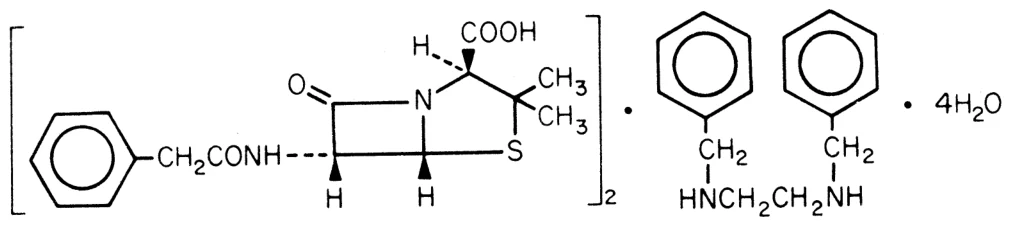
Chemical name: 4-Thia-1-azabicyclo [3.2.0] heptane-2-carboxylic acid, 3,3-dimethyl-7-oxo-6-[(phenylacetyl)amino]-,[2S-(2α,5α,6β)]-, compounded with N,N-bis(phenylmethyl)-1, 2-ethanediamine (2:1), tetrahydrate.
Molecular formula and molecular mass: (C16H18N2O4S)2·C16H20N2·4H2O, 909.11 (dried basis), 981.19 (hydrate)
Structural formula:
Physicochemical properties:
Physical Form: White, odourless, crystalline powder.
Solubility: Very slightly soluble in water (0.15 mg/mL)
pH Values: About 6 for a saturated aqueous solution.
Melting Point: 123o-124oC.
14 CLINICAL TRIALS
The clinical trial data on which the original indication was authorized is not available.
15 MICROBIOLOGY
Mechanism of Action
Penicillin G exerts a bactericidal action against penicillin-susceptible microorganisms during the stage of active multiplication. It acts through the inhibition of biosynthesis of cell wall peptidoglycan, rendering the cell wall osmotically unstable.
Mechanism of Resistance
Penicillin is not active against penicillinase-producing bacteria or against organisms resistant to beta-lactams because of alterations in the penicillin-binding proteins. Resistance to penicillin G has not been reported in Streptococcus pyogenes.
Spectrum of Activity
Penicillin has been shown to be active against most isolates of the following bacteria, both in vitro and in clinical infections as described (see 1 INDICATIONS).
Gram Positive Bacteria
Beta-haemolytic streptococci (group A, B, C, G, H, L and M)
Other Microorganisms
Treponema pallidum
In Vitro Activity
The following in vitro data are available, but their clinical significance is unknown: Penicillin G exerts high in vitro activity against pneumococci staphylococci (except penicillinase producing strains) and pneumococci.
Other organisms susceptible to penicillin G are Neisseria gonorrhoeae, Corynebacterium diphtheriae, Bacillus anthracis, Clostridia species, Actinomyces bovis, Streptobacillus moniliformis, Listeria monocytogenes and Leptospira species.
Susceptibility Test Methods
Susceptibility to Bicillin® L-A will vary with geography and time. Local susceptibility data should be consulted where available.
Dilution Techniques
Quantitative methods are used to determine antimicrobial minimum inhibitory concentrations (MICs). These MICs provide estimates of the susceptibility of bacteria to antimicrobial compounds. The MICs should be determined using a standardized procedure.
Diffusion techniques
Quantitative methods that require the measurement of zone diameters can also provide reproducible estimates of the susceptibility of bacteria to antimicrobial compounds. The zone size provides an estimate of the susceptibility of bacteria to antimicrobial compounds. The zone size should be determined using a standardized test method. This procedure uses paper discs impregnated with 10 units penicillin to test the susceptibility of microorganisms to penicillin G benzathine injectable solution. The disc diffusion interpretive criteria are provided in the table below.
Streptococcus pyogenes (Group A)
| Susceptibility Test Interpretive Criteria for Penicillin | |||||||||||||||
| MIC (mcg/mL) | Disk Diffusion (zone diameter in mm) | ||||||||||||||
| Pathogen | Susceptibl e (S) | Intermediate (I) | Resista nt (R) | Susceptibl e (S) | Intermedia te (I) | Resistant (R) | |||||||||
| Streptococcus pyogenesa,b | ≤ 0.12 | - | - | ≥ 24 | - | - | |||||||||
aSusceptibility testing of penicillins for treatment of β-hemolytic streptococcal infections need not be performed routinely, because non-susceptible isolates are extremely rare in any β-hemolytic streptococcus and have not been reported from Streptococcus pyogenes. Any β-hemolytic streptococcal isolate found to be non-susceptible to penicillin should be re-identified, retested, and, if confirmed, submitted to a public health authority.
bThe lack of data precludes defining any other interpretive criteria than ‘susceptible’.
Quality Control
Standardized susceptibility test procedures require the use of laboratory controls to monitor and ensure the accuracy and precision of the supplies and reagents used in the assay, and the techniques of the individuals performing the test. Standard penicillin powder should provide the range of MIC values noted in the following table. For the diffusion technique using the 10 unit penicillin disc, the criteria in the following table should be achieved.
Acceptable Quality Control Ranges for Penicillin
| QC Strain | MIC (mcg/mL) | Disc Diffusion (zone diameter in mm) |
|---|---|---|
| Streptococcus pneumoniae ATCC 49619 | 0.25-1 | 24 - 30 |
ATCC = American Type Culture Collection
16 NON-CLINICAL TOXICOLOGY
This information is not available for this drug product.