


Product Monograph - Penicillin G Sodium for Injection
ACTIONS AND CLINICAL PHARMACOLOGY
Penicillin G is bactericidal against penicillin-susceptible microorganisms during the stage of active multiplication. It acts by inhibiting biosynthesis of cell-wall mucopeptide. It is not active against the penicillinase-producing bacteria, which include many strains of staphylococci. Penicillin G is highly active in vitro against staphylococci (except penicillinase-producing strains), streptococci (groups A, C, G, H, L and M) and pneumococci. Other organisms susceptible in vitro to penicillin G are Neisseria gonorrhoeae, Corynebacterium diphtheriae, Bacillus anthracis, Clostridia, Actinomyces bovis, Streptobacillus moniliformis, Listeria monocytogenes, and Leptospira; Treponema pallidum is extremely susceptible. Some species of gram-negative bacilli are susceptible to moderate to high concentrations of penicillin G obtained with intravenous administration. These include most strains of Escherichia coli, all strains of Proteus mirabilis, Salmonella, and Shigella; and some strains of Enterobacter aerogenes (formerly Aerobacter aerogenes) and Alcaligenes faecalis.
Aqueous penicillin G is rapidly absorbed following both intramuscular and subcutaneous injection. Approximately 60 percent of a total dose of 300 000 units is excreted in the urine within the first five-hour period. Therefore, high and frequent doses are required to maintain the elevated serum levels desirable in treating certain severe infections in individuals with normal kidney function. In neonates and young infants and in individuals with impaired kidney function, excretion is considerably delayed.
INDICATIONS AND CLINICAL USE
Penicillin G Sodium for Injection is indicated in the treatment of severe infections caused by penicillin G-susceptible microorganisms when rapid and high penicillinemia is required. Therapy should be guided by bacteriological studies, including susceptibility tests and by clinical response. The following infections will usually respond to adequate dosage:
Streptococcal infections: Note: Streptococci in groups A, C, G, H, L, and M are very susceptible to penicillin G. Some group D organisms are susceptible to the high serum levels obtained with aqueous penicillin G. Aqueous penicillin G sodium is the penicillin dosage form of choice for bacteremia, empyema, severe pneumonia, pericarditis, endocarditis, meningitis, and other severe infections caused by susceptible strains of the gram-positive species listed above.
Pneumococcal Infections: Staphylococcal infections - Penicillin G-susceptible; Anthrax; Actinomycosis; Clostridial infections (including tetanus); Diphtheria (to prevent the carrier state); Erysipeloid endocarditis (Erysipelothrix insidiosa); Vincent's gingivitis and pharyngitis (fusospirochetosis) - Severe infections of the oropharynx (Note: necessary dental care should be accomplished in infections involving gum tissue) and lower respiratory tract and genital area infections due to F. fusiformisans spirochetes; Gram negative bacillary infections (bacteremias) - (E. coli, E. aerogenes, A. faecalis, Salmonella, Shigella and P. mirabilis); Listeria infections (L. monocytogenes); Meningitis and endocarditis; Pasteurella infections (P. multocida); Bacteremia and meningitis; Rat bite fever (S. minus or S. moniliformis); Gonorrheal endocarditis and arthritis (N. gonorrhoeae); Syphilis (T. pallidum) including congenital syphilis; Meningococcic meningitis.
Prevention of Bacterial Endocarditis (Patients unable to take oral antibiotics):
Although no controlled clinical efficacy studies have been conducted, aqueous crystalline penicillin G for injection (except penicillin G procaine suspension) has been suggested by the American Heart Association and the American Dental Association for prophylaxis against bacterial endocarditis in patients with congenital heart disease or rheumatic or other acquired valvular heart disease when they undergo dental procedures and surgical procedures of the upper respiratory tract. Since it may happen that alpha hemolytic streptococci relatively resistant to penicillin may be found when patients are receiving continuous oral penicillin for secondary prevention of rheumatic fever, prophylactic agents other than penicillin may be chosen for these patients and prescribed in addition to their continuous rheumatic fever prophylactic regimen. Note: When selecting antibiotics for the prevention of bacterial endocarditis, the physician or dentist should read the full joint statement of the American Heart Association and the American Dental Association.
To reduce the development of drug-resistant bacteria and maintain the effectiveness of Penicillin G Sodium for Injection and other antibacterial drugs, Penicillin G Sodium for Injection should be used only to treat infections that are proven or strongly suspected to be caused by bacteria. When culture and susceptibility information are available, they should be considered in selecting or modifying antibacterial therapy. In the absence of such data, local epidemiology and susceptibility patterns may contribute to the empiric selection of therapy.
CONTRAINDICATIONS
Contraindicated in patients with a history of hypersensitivity to any penicillin.
WARNINGS
Serious occasional fatal hypersensitivity (anaphylactoid) reactions have been reported in patients on penicillin therapy. Although anaphylaxis is more frequent following parenteral administration, it has occurred in patients on oral penicillins. These reactions are more apt to occur in individuals with a history of sensitivity to multiple allergens.
There have been well-documented reports of individuals with a history of penicillin hypersensitivity who have experienced severe hypersensitivity reactions when treated with cephalosporins. Before therapy with a penicillin, careful inquiry should be made concerning previous hypersensitivity reactions to penicillins, cephalosporins, and other allergens. If an allergic reaction occurs, the drug should be discontinued and the patient treated with the usual agents, e.g., pressor amines, antihistamines, and corticosteroids. Serious anaphylactoid reactions are not controlled by antihistamines alone, and require such emergency measures as the immediate use of epinephrine, aminophylline, oxygen, and intravenous corticosteroids.
Susceptibility/Resistance
Development of Drug Resistant Bacteria
Prescribing Penicillin G Sodium for Injection in the absence of a proven or strongly suspected bacterial infection is unlikely to provide benefit to the patient and risks the development of resistant organisms.
PRECAUTIONS
Penicillin G Sodium for Injection should be used with caution in individuals with histories of significant allergies and/or asthma.
In prolonged therapy with penicillin and particularly with high dosage schedules, periodic evaluation of the renal and hematopoietic systems is recommended.
In streptococcal infections, therapy must be sufficient to eliminate the organism (10 days minimum), otherwise the sequelae of streptococcal disease may occur. Cultures should be taken following the completion of treatment to determine whether streptococci have been eradicated.
In high doses (above 10 million units), intravenous aqueous Penicillin G Sodium for Injection should be administered slowly because of the adverse effects of electrolyte imbalance from the sodium content of the penicillin. The patient’s renal, cardiac and vascular status should be evaluated and if impairment of function is suspected or known to exist, a reduction in the total dosage should be considered. Frequent evaluation of electrolyte balance, and renal and hematopoietic function is recommended during therapy when high doses of intravenous aqueous Penicillin G Sodium for Injection are used.
Therapy of susceptible infections should be accompanied by any indicated surgical procedures. In suspected staphylococcal infections, proper laboratory studies, including susceptibility tests, should be performed.
When treating gonococcal infections in which primary or secondary syphilis may be suspected, proper diagnostic procedures, including darkfield examinations, should be done. In all cases in which concomitant syphilis is suspected, monthly serological tests should be made for at least four months. All cases of penicillin-treated syphilis should receive clinical and serological examinations every six months for at least two or three years.
ADVERSE REACTIONS
Penicillin is a substance of low toxicity but does possess a significant index of sensitization.
Hypersensitivity
The hypersensitivity reactions reported are skin rashes ranging from maculopapular eruptions to exfoliative dermatitis; urticaria; and serum sickness-like reactions including chills, fever, edema, arthralgia, and prostration. Severe and occasionally fatal anaphylaxis has occurred (see WARNINGS).
Hematologic Disturbances
Hemolytic anemia, leukopenia, thrombocytopenia, neuropathy, and nephropathy are rarely observed adverse reactions and are usually associated with high intravenous dosage. Urticaria, other skin rashes, and serum sickness-like reactions may be controlled by antihistamines and, if necessary, corticosteroids. Whenever such reactions occur, Penicillin G Sodium for Injection should be discontinued unless, in the opinion of the physician, the condition being treated is life-threatening and amenable only to penicillin therapy. High dosage of Penicillin G Sodium for Injection may result in congestive heart failure due to high sodium intake.
The Jarisch-Herxheimer reaction has been reported in patients treated for syphilis.
SYMPTOMS AND TREATMENT OF OVERDOSAGE
Prolonged use of antibiotics may promote overgrowth of non-susceptible organisms, including fungi. Should superinfection occur, appropriate measures should be taken. Indwelling intravenous catheters encourage superinfections and should be avoided whenever possible.
For the most recent information in the management of a suspected drug overdose, contact your regional poison control centre or Health Canada's toll-free number, 1-844 POISON-X
(1-844-764-7669).
DOSAGE AND ADMINISTRATION
Adult Dosage
Severe infections due to susceptible strains of streptococci, pneumococci, and staphylococci; bacteremia, pneumonia, endocarditis, pericarditis, empyema, meningitis and other severe infections: a minimum of 5 million units daily.
Anthrax: A minimum of 5 million units/day in divided doses until cure is effected; Actinomycosis: 1 to 6 million units/day for cervicofacial cases; 10 to 20 million units/day for thoracic and abdominal disease; Clostridial infections (as adjunctive therapy to antitoxin): 20 million units/day; Diphtheria: adjunctive therapy to antitoxin for prevention of the carrier state: 300 000 to 400 000 units/day in divided doses for 10 to 12 days; Erysipeloid: Endocarditis: 2 to 20 million units/day for four to six weeks; Fusospirochetal infections (fusospirochetosis) - severe infections of the oropharynx, lower respiratory tract and genital area: 5 to 10 million units/day; Gram-negative bacillary infections (E. coli, E. aerogenes, A. faecalis, Salmonella,
Shigella and P. mirabilis): Bacteremia: 20 to 80 million units/day; Listeria infections (L. monocytogenes): Neonates: 500 000 to 1 million units/day; Adults with meningitis: 15 to 20 million units/day for two weeks; Adults with endocarditis: 15 to 20 million units/day for four weeks; Pasteurella infections (P. multocida); Bacteremia and meningitis: 4 to 6 million units/day for two weeks; Rat bite fever (S. minus or S. moniliformis): 12 to 15 million units/day for three to four weeks.
Gonorrheal Endocarditis and Arthritis: A minimum of 5 million units daily.
Syphilis: Aqueous Penicillin G Sodium for Injection may be used in the treatment of acquired and congenital syphilis but, because of the necessity of frequent dosage, hospitalization is recommended. Dosage and duration of therapy are determined by the age of the patient and the state of the disease.
Meningococcic Meningitis: 1 to 2 million units intramuscular every two hours or continuous intravenous drip of 20 to 30 million units/day.
Prevention of Bacterial Endocarditis (Patients unable to take oral antibiotics): For prophylaxis against bacterial endocarditis in patients with congenital heart disease or rheumatic or other acquired valvular heart disease when undergoing dental procedures or surgical procedures of the upper respiratory tract, administer 2 million units (50 000 units/kg for children) aqueous penicillin G, except penicillin G procaine suspension, intravenously or intramuscularly 30 to 60 minutes before the procedure and 1 million units (25 000 units/kg for children) six hours later. Doses for children should not exceed recommendations for adults for a single dose or for a 24-hour period.
Infant and Children Dosage
Usual dose 50 000 to 100 000 units/kg/day given in divided doses every four to six hours.
ADMINISTRATION
Penicillin G Sodium for Injection may be given intramuscularly or by continuous intravenous drip. The 10 million units preparation should be administered by intravenous infusion. Intramuscular doses of 100 000 units per mL will produce the minimum of discomfort. The administered volume should not exceed 4 mL per single site of intramuscular administration. Doses up to 500 000 units per mL have been administered intramuscular.
Any entry into the container to effect solution of the powder or withdrawal must be accomplished with strict aseptic technique and sterile equipment.
Penicillin G Sodium for Injection – Prescribing Information Page 7 of 12
PHARMACEUTICAL INFORMATION
Drug Substance:
Proper Name : Penicillin G Sodium
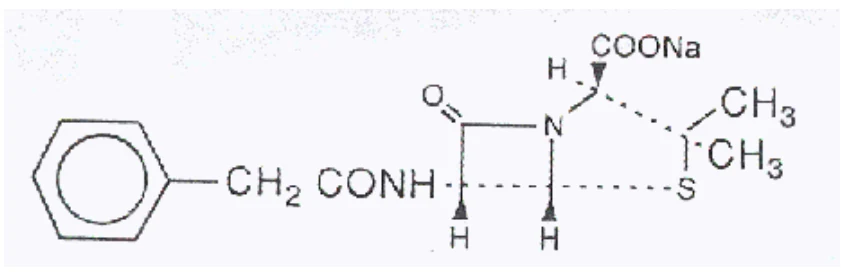
Chemical Name : 3,3-dimethyl-7-oxo-6[(phenylacetyl)amino]-4-thia-1-azabicyclo[3.2.0] heptane-2-carboxylic acid monosodium salt
Structural Formula :
Molecular Formula : C16H17N2NaO4S
Molecular Weight : 356.37 g/mol
Description : Penicillin G Sodium is a sterile crystalline powder which is soluble in water.
Pharmaceutical standard: Mfr. Std.
COMPOSITION
Each vial contains 1 million, 5 million, or 10 million units of penicillin G as penicillin G sodium. Each 1 million units of Penicillin G Sodium for Injection contains 2 mmol of sodium.
The product does not contain any preservative. Single use vial. Discard unused portion.
The vial stopper is not made with natural rubber latex.
STABILITY AND STORAGE RECOMMENDATIONS
Store dry powder at a controlled room temperature (15 °C to 30 °C).
RECONSTITUTED SOLUTIONS
Depending on the route of administration, use Sterile Water for Injection, Isotonic Sodium Chloride Injection, or Dextrose Injection. Use immediately upon reconstitution.
Penicillin G Sodium for Injection – Prescribing Information Page 8 of 12
RECONSTITUTION
Potency/Vial (Million units) | Volume of Diluent (mL) | Approximate Available Volume (mL) | Approximate Concentration (units/mL) |
| 1 | 1.6 3.6 | 2 4 | 500 000 250 000 |
| 5 | 3.0 8.0 | 5 10 | 1 000 000 500 000 |
| 10 | 5.9 15.9 | 10 20 | 1 000 000 500 000 |
NOTE: Penicillins are rapidly inactivated in the presence of carbohydrate solutions at alkaline pH.
PREPARATION OF SOLUTIONS
Solutions of penicillin should be prepared as follows: Loosen powder. Hold vial horizontally and rotate it while slowly directing the stream of diluent against the wall of the vial. Shake vial vigorously after all the diluent has been added until no powder residues are visible. Allow vial in standby position with gentle swirling until frothing subsides. If solution is not clear, allow to stand until a clear solution is visible before administration.
NOTE: Always visually check the reconstituted product for particulate matter, discolouration and leakage prior to administration
AVAILABILITY OF DOSAGE FORMS
Penicillin G Sodium for Injection is supplied as a dry powder in vials containing: 1 million, 5 million, or 10 million penicillin G units as penicillin G sodium. Each strength is packaged in 10 vials per carton.
REFERENCES
- 1. PrPenicillin G Sodium Injection, USP (powder for solution, 1 million units per vial, 5 million units per vial, 10 million units per vial), control #218533, product monograph, Fresenius Kabi Canada Ltd. (2019-07-03)