


Product Monograph - Pen-Vk
Recent Major Label Changes
| None at time of the most recent authorization |
|---|
Table of Contents
Certain sections or subsections that are not applicable at the time of the preparation of the most recent authorized product monograph are not listed.
Recent Major Label Changes .................................................................................................. 2
Table of Contents .................................................................................................................. 2
Part 1: Healthcare Professional Information........................................................................... 4
- 1.
Indications ............................................................................................................................... 4
1.1. Pediatrics ..................................................................................................................... 5
1.2. Geriatrics ..................................................................................................................... 5
- 2. Contraindications .................................................................................................................... 5
- 3. Serious Warnings and Precautions Box ................................................................................. 5
- 4.
Dosage and Administration .................................................................................................... 5
4.2. Recommended Dose and Dosage Adjustment ........................................................... 5
4.5. Missed Dose ................................................................................................................ 6
- 5. Overdose ................................................................................................................................. 6
- 6. Dosage Forms, Strengths, Composition, and Packaging ....................................................... 6
- 7.
Warnings and Precautions ..................................................................................................... 7
General .................................................................................................................................... 7
Immune ................................................................................................................................... 7
Respiratory .............................................................................................................................. 7
Sensitivity/resistance .............................................................................................................. 7
Skin .......................................................................................................................................... 7
7.1. Special Populations ..................................................................................................... 7
7.1.1. Pregnant Women ................................................................................................ 7
7.1.2. Breastfeeding ...................................................................................................... 7
7.1.3. Pediatrics ............................................................................................................. 7
7.1.4. Geriatrics ............................................................................................................. 8
- 8.
Adverse Reactions .................................................................................................................. 8
8.1. Adverse Reaction Overview ........................................................................................ 8
- 9.
Drug Interactions .................................................................................................................... 8
9.3. Drug-Behaviour Interactions ....................................................................................... 8
9.4. Drug-Drug Interactions ............................................................................................... 8
9.5. Drug-Food Interactions ............................................................................................... 8
9.6. Drug-Herb Interactions ............................................................................................... 8
9.7. Drug-Laboratory Test Interactions.............................................................................. 8
- 10.
Clinical Pharmacology ............................................................................................................. 8
10.1. Mechanism of Action .................................................................................................. 9
10.2. Pharmacodynamics ..................................................................................................... 9
10.3. Pharmacokinetics ........................................................................................................ 9
- 11. Storage, Stability, and Disposal .............................................................................................. 9
Part 2: Scientific Information ............................................................................................... 10
- 13. Pharmaceutical Information ................................................................................................ 10
- 14. Clinical Trials ......................................................................................................................... 10
- 16. Non-Clinical Toxicology ........................................................................................................ 10
Patient Medication Information .......................................................................................... 11
Part 1: Healthcare Professional Information
1. Indications
PEN-VK (Penicillin V Potassium (Phenoxymethylpenicillin Potassium)) is indicated for:
Mild to moderately severe infections caused by penicillin V sensitive microorganisms including streptococcal pharyngitis, staphylococcal infection without bacteremia and pneumococcal infections. Therapy should be guided by bacteriologic sensitivity tests and clinical response.
Severe pneumonia, empyema, bacteremia, pericarditis, meningitis, and arthritis should not be treated with potassium phenoxymethyl penicillin during the acute stage.
Indicated surgical procedures should be performed.
The following infections will usually respond to adequate dosage of potassium phenoxymethyl penicillin:
Streptococcal infections (without bacteremia): Mild to moderate infections of the upper respiratory tract, scarlet fever, and mild erysipelas.
Note: Streptococci in groups A, C, G, H, L, and M are very sensitive to penicillin. Other groups, including group D (enterococcus), are resistant.
- Pneumococcal infections: Mild to moderately severe infections of the respiratory tract.
Staphylococcal infections sensitive to penicillin V: Mild infections of the skin and soft tissues.
Note: Reports indicate an increasing number of strains of staphylococci resistant to penicillin V, which emphasizes the need for culture and sensitivity studies in treating suspected staphylococcal infections.
Fusospirochetosis (Vincent's Gingivitis and Pharyngitis): Mild to moderately severe infections of the oropharynx usually respond to therapy with oral penicillin.
Note: Necessary dental care should be accomplished in infections involving the gum tissue.
- For prophylaxis following rheumatic fever and/or chorea (Prophylaxis with oral penicillin on a continuing basis has proved effective in preventing recurrences of these conditions).
- To prevent bacterial endocarditis in patients with congenital and/or rheumatic heart lesions before dental procedures, minor upper respiratory tract surgery or instrumentation. Prophylaxis should be instituted the day of the procedure and continued for 2 or more postoperative days. Patients with a past history of rheumatic fever who are receiving continuous antibiotic prophylaxis may harbour increased numbers of penicillin resistant organisms; use of another anti-infective agent should be considered. If penicillin is to be used in these patients during surgery, the regular rheumatic fever program should be interrupted 1 week before the procedure. At the time of surgery, penicillin may be reinstituted prophylactically.
- For the prevention of bacteremia following tooth extraction.
To reduce the development of drug-resistant bacteria and maintain the effectiveness of PEN-VK and other antibacterial drugs, PEN-VK should be used only to treat infections that are proven or strongly suspected to be caused by bacteria. When culture and susceptibility information are available, they should be considered in selecting or modifying antibacterial therapy. In the absence of such data, local epidemiology and susceptibility patterns may contribute to the empiric selection of therapy.
1.1. Pediatrics
Pediatrics (< 12 years of age): Based on the data submitted and reviewed by Health Canada, the safety and efficacy of PEN-VK in pediatric patients has been established. Therefore, Health Canada has authorized an indication for pediatric use (See 4.2 Recommended Dose and Dosage Adjustment).
1.2. Geriatrics
Geriatrics: No data specific to this population are available to Health Canada.
2. Contraindications
PEN-VK is contraindicated in:
- patients who are hypersensitive to this drug or to any ingredient in the formulation, including any non-medicinal ingredient, or component of the container. For a complete listing, see 6 Dosage Forms, Strengths, Composition, and Packaging.
- adjunctive prophylaxis for genitourinary instrumentation or surgery, lower intestinal tract surgery, sigmoidoscopy and childbirth.
- patients with a history of penicillin or cephalosporin allergy; against beta lactamase (penicillinase) producing organisms.
- the active treatment of syphilis, subacute bacterial endocarditis, diphtheria, gas gangrene, or other severe infections due to penicillin susceptible organisms.
3. Serious Warnings and Precautions Box
- Serious and occasionally fatal hypersensitivity (anaphylactoid) reactions have been reported in patients receiving penicillin therapy. Cross-sensitivity between penicillin and cephalosporins has been documented. (See 7 Warnings and Precautions, Immune).
4. Dosage and Administration
4.2. Recommended Dose and Dosage Adjustment
- The dosage should be determined according to the sensitivity of the microorganisms, the severity of infection and the clinical response.
The usual dosage recommendations for adults and children 12 years and over are:
Streptococcal infections: Mild to moderately severe infections of the upper respiratory tract, including scarlet fever and mild erysipelas: 200,000 to 500,000 units every 6 to 8 hours for 10 days.
In streptococcal infections, therapy should be given for 10 days minimum. Cultures should be taken following treatment to assure eradication of streptococci.
- Pneumococcal infections: Mild to moderately severe infections of the respiratory tract, including otitis media: 400,000 to 500,000 units every 6 hours until the patient has been afebrile for at least 2 days.
- Staphylococcal infections: Mild infections of skin and soft tissue (culture and sensitivity tests should be performed): 400,000 to 500,000 units every 6 to 8 hours.
- Fusospirochetosis (Vincent's Infection) of the oropharynx: Mild to moderately severe infections: 400,000 to 500,000 units every 6 to 8 hours.
- Prophylaxis in the following conditions: To prevent recurrence following rheumatic fever and/or chorea: 200,000 to 250,000 units twice daily on a continuing basis.
- To prevent bacterial endocarditis in patients with rheumatic or congenital heart lesions who are to undergo dental or upper respiratory tract surgery or instrumentation: 500,000 units the day of the procedure, and 500,000 units every 6 hours for 2 days.
- Pediatrics: For children under 12 years of age, dosage is calculated on the basis of body weight. Infants and small children: 25,000 to 90,000 units (15 to 50 mg)/kg in 3 to 6 divided doses.
4.5. Missed Dose
If the patient misses a dose, instruct the patient to take the dose as soon as they remember. If it is almost time for the next dose, inform the patient to skip the missed dose and continue the regular dosing schedule.
5. Overdose
Treatment: Anaphylactic shock: epinephrine 0.3 mL of 1:1000 solution given by the i.v. or i.m. route in repeated doses until relief of bronchospasm and hypotension has occurred or excessive tachycardia induced. Mild hypersensitivity reactions may respond to antihistamines.
For the most recent information in the management of a suspected drug overdose, contact your regional poison control centre or Health Canada’s toll-free number, 1-844 POISON-X (1-844-764-7669).
- 6. Dosage Forms, Strengths, Composition, and Packaging
Table 1 – Dosage Forms, Strengths, and Composition
Description
Each orange, round, biconvex, film coated tablet, scored and engraved “300” on one side, other side plain, containing penicillin V potassium equivalent to 480,000 i.u. (300 mg) penicillin V. Available in bottles of 100, 500 and 1,000 tablets.
| Route of Administration | Dosage Form/ Strength/Composition | Non-Medicinal Ingredients |
| Oral | Tablet 300 mg | colloidal silicon dioxide, croscarmellose sodium, D&C Yellow #10 aluminum lake 14-18%, hydroxypropyl cellulose, magnesium stearate, methylcellulose, polyethylene glycol, purified water, sunset yellow aluminum lake 40% and titanium dioxide. |
7. Warnings and Precautions
See 3 Serious Warnings and Precautions Box.
General
Oral administration should not be relied on in patients with severe illness, with nausea, vomiting, gastric dilatation, cardiospasm, or intestinal hypermotility.
Occasional patients will not absorb therapeutic amounts of oral penicillin.
Immune
Penicillin should be used with caution in individuals with histories of allergies.
Careful inquiry should be made concerning previous hypersensitivity reactions to penicillins, cephalosporins and other allergens. Cross sensitivity between penicillin and cephalosporins is well documented. Effective and safe skin tests which will predict an anaphylactic reaction are not generally available.
Respiratory
Penicillin should be used with caution in individuals with histories of asthma.
Sensitivity/resistance
Development of Drug Resistant Bacteria: Prescribing PEN-VK in the absence of a proven or strongly suspected bacterial infection is unlikely to provide benefit to the patient and risks the development of resistant organisms.
Prolonged use of antibiotics may promote overgrowth of nonsusceptible organisms, including fungi. Should superinfection occur, take appropriate measures.
Skin
Severe Cutaneous Adverse Reactions: Severe cutaneous adverse reactions (SCAR) such as acute generalized exanthematous pustulosis (AGEP), drug reaction with eosinophilia and systemic symptoms (DRESS), Stevens-Johnson syndrome (SJS), and toxic epidermal necrolysis (TEN) have been reported in association with beta-lactam treatment. When SCAR is suspected, PEN-VK should be discontinued and appropriate therapy and/or measures should be taken.
7.1. Special Populations
7.1.1. Pregnancy
This information is not available for this drug product.
7.1.2. Breastfeeding
This information is not available for this drug product.
7.1.3. Pediatrics
Based on the data submitted and reviewed by Health Canada, the safety and efficacy of PEN-VK in pediatric patients has been established. Therefore, Health Canada has authorized an indication for pediatric use. See 1.1 Pediatrics and 4.2 Recommended Dose and Dosage Adjustment.
7.1.4. Geriatrics
This information is not available for this drug product.
8. Adverse Reactions
8.1. Adverse Reaction Overview
All degrees of hypersensitivity including fatal anaphylaxis have been reported.
The most common reactions to oral penicillin are;
Blood and lymphatic system disorders: Fever and eosinophilia may frequently be the only reactions observed. Hemolytic anemia, leucopenia, and thrombocytopenia may occur.
Gastrointestinal disorders: Nausea, vomiting, epigastric distress, diarrhea, and black hairy tongue.
Immune disorders: Reactions resembling serum sickness, including chills, fever, edema, and anaphylaxis.
Nervous system disorders: Neuropathy
Renal and urinary disorders: Nephropathy
Skin and subcutaneous tissue disorders: The hypersensitivity reactions are skin eruptions (maculopapular to exfoliative dermatitis), urticaria.
9. Drug Interactions
9.3. Drug-Behaviour Interactions
The interaction of PEN-VK with individual behavioural risks (e.g. cigarette smoking, cannabis use, and/or alcohol consumption) has not been studied.
9.4. Drug-Drug Interactions
Interactions with other drugs have not been established.
9.5. Drug-Food Interactions
Interactions with food have not been established.
9.6. Drug-Herb Interactions
Interactions with herbal products have not been established.
9.7. Drug-Laboratory Test Interactions
Interactions with laboratory tests have not been established.
10. Clinical Pharmacology
10.1. Mechanism of Action
This information is not available for this drug product.
10.2. Pharmacodynamics
This information is not available for this drug product.
10.3. Pharmacokinetics
This information is not available for this drug product.
Special populations and conditions
This information is not available for this drug product.
- 11. Storage, Stability, and Disposal
Store at room temperature 15°C - 30°C in a tightly closed container.
Part 2: Scientific Information
13. Pharmaceutical Information
Drug Substance
Non-proprietary name of the drug substance(s): Phenoxymethylpenicillin Potassium.
Chemical name: Potassium salt of (2S,5R,6R)-3,3-dimethyl-7-oxo-6-[(phenoxyacetyl)amino]-4-thia-1-azabicyclo [3.2.0]heptane-2-carboxylic acid
Molecular formula and molecular mass: C16H17KN2O5S and 388.5 g/mol
Structural formula: 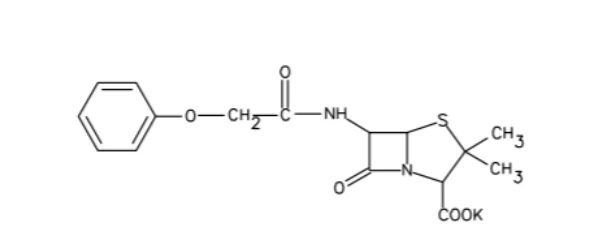
Physicochemical properties:
Phenoxymethylpenicillin potassium is a white to almost white, crystalline powder / granules that is freely soluble in water, moderately soluble in ethanol and insoluble in chloroform, ether, fatty oil and liquid paraffin.
14. Clinical Trials
The clinical trial data on which the original indication was authorized is not available.
16. Non-Clinical Toxicology
This information is not available for this drug product.