


Product Monograph - Bleomycin for Injection
INDICATIONS AND CLINICAL USE
Bleomycin for Injection should be considered palliative treatment to surgery and radiation therapy. It has been shown to be useful in the management of the following neoplasms:
Squamous Cell Carcinoma
Bleomycin for Injection is indicated in squamous cell carcinomas of the head and neck including mouth, tongue, tonsil, nasopharynx, oropharynx, sinus, palate, lip, buccal mucosa, gingiva, and epiglottis; skin; larynx and paralarynx.
Bleomycin for Injection is also indicated in squamous cell carcinomas of the penis, cervix, and vulva.
The response to Bleomycin for Injection is poorer in patients with head and neck cancer who have received previous irradiation.
Lymphomas
Bleomycin for Injection is indicated in Hodgkin’s disease and non-Hodgkin’s lymphoma.
Testicular Carcinoma
Bleomycin for Injection is indicated in embryonal cell carcinoma, choriocarcinoma, and teratocarcinoma. Studies to date have revealed that the use of vinblastine sulfate with bleomycin sulfate increases the response rate of testicular tumours.
Malignant Pleural Effusion
When administered by intrapleural injection, Bleomycin for Injection has been shown to be useful in the treatment of malignant pleural effusion and in the prevention of recurrence.
CONTRAINDICATIONS
Bleomycin for Injection is contraindicated in patients who have demonstrated hypersensitivity to the drug.
WARNINGS
Bleomycin for Injection should be administered under the supervision of a qualified physician experienced in the use of cancer chemotherapeutic agents. Adequate diagnostic and treatment facilities should be available to allow appropriate management of therapy and possible complications.
Patients receiving Bleomycin for Injection must be observed carefully and frequently during and after therapy. It should be used with extreme caution in patients with significant impairment of renal function or compromised pulmonary function.
Pulmonary toxicities occur in 10% of treated patients. In approximately 1% of treated patients, nonspecific pneumonitis induced by bleomycin progresses to pulmonary fibrosis, and death. Pulmonary toxicity is more frequent in patients over 70 years of age and in those receiving total doses greater than 400 units. Although pulmonary toxicity is age- and dose-related, the toxicity is unpredictable. Renal impairment is a risk factor in the development of pulmonary toxicity. Frequent monitoring is essential. (See ADVERSE REACTIONS and DOSAGE AND ADMINISTRATION.)
Idiosyncratic reactions similar to anaphylaxis have been reported in 1% of patients with lymphoma who were treated with bleomycin. Since these reactions usually occur after the first or second dose, careful monitoring is essential after these doses. (See ADVERSE REACTIONS.)
Renal and hepatic toxicity, beginning as a deterioration in renal or liver function tests, have been reported infrequently. These toxicities may occur, however, at any time after initiation of therapy.
Pregnancy
Bleomycin may cause fetal harm when administered to a pregnant woman. Women of childbearing potential should be advised to avoid becoming pregnant during therapy with bleomycin. If bleomycin is used during pregnancy or if the patient becomes pregnant while receiving this drug, the patient should be apprised of the potential hazard.
Lactation
It is not known if bleomycin is excreted in human milk. Because many drugs are excreted in human milk and because of the potential for serious adverse reactions in nursing infants from bleomycin, a decision should be made to discontinue nursing or to discontinue the drug, taking into account the importance of the drug to the mother. The benefits and risks of nursing against discontinuing the drug must be weighed carefully.
PRECAUTIONS
Bleomycin for Injection should be used as indicated; the physician must carefully weigh the therapeutic benefit versus risk of toxicity.
Bleomycin should be administered preferably to patients who are hospitalized and who can be observed carefully and frequently during and after therapy. It should be used with extreme caution in patients with significant impairment of renal function or compromised pulmonary function due to disease other than malignancy, and in patients over 70 years of age because of the apparent increased danger of pulmonary toxicity.
To monitor the onset of pulmonary toxicity, X-rays of the chest should be taken every 1 − 2 weeks. If pulmonary changes are noted, treatment should be discontinued until it can be determined whether the cause is drug related. Pneumonitis due to bleomycin should be treated with corticosteroids in an effort to prevent progression to pulmonary fibrosis. Infectious pneumonitis should receive appropriate antibiotic therapy.
Injection site reactions may occur during the administration of bleomycin (see ADVERSE REACTIONS). Therefore, it is recommended to closely monitor the injection site during drug administration.
Following intrapleural administration, resultant bleomycin plasma concentrations suggest a systemic absorption of approximately 45%. Thus, in the determination of cumulative exposure to bleomycin, systemic exposure following intrapleural administration of bleomycin for injection needs to be taken into account.
Since bleomycin is eliminated predominantly through renal excretion, the administration of nephrotoxic drugs with Blenoxane may reduce its renal clearance, potentially leading to bleomycin-related toxicity (see ACTIONS AND CLINICAL PHARMACOLOGY, WARNINGS, DOSAGE AND ADMINISTRATION and ADVERSE REACTIONS)
An association between decreased renal function and enhanced bleomycin-related toxicities has been reported. Pharmacokinetic/pharmacodynamic relationships suggest that enhancement of toxicity is a consequence of reduced renal clearance of bleomycin resulting in prolonged elimination half-life and increased area-under-the plasma- concentration-vs.-time-curve compared to patients with normal renal function. Dosage reductions of 40 − 75% have been recommended for patients with creatinine clearance values ≤ 40 mL/min.
ADVERSE REACTIONS
Pulmonary
Pulmonary toxicity is potentially the most serious side effect of bleomycin (see
WARNINGS).
The identification of patients with pulmonary toxicity due to bleomycin has been extremely difficult. The reason for this is the lack of specificity of the clinical syndrome, the X-ray changes and even the tissue changes seen on examination of biopsy and autopsy specimens.
Bleomycin-induced pneumonitis apparently produces dyspnea and fine rales that are in no way different from those produced by infectious pneumonias, or the signs and symptoms produced by primary or metastatic lung disease in some patients.
On X-ray, bleomycin-induced pneumonitis produces patchy opacities, usually of the lower lung fields, that look the same as infectious bronchopneumonia or even lung metastases in some patients.
The microscopic tissue changes due to bleomycin toxicity are frequently present as bronchiolar squamous metaplasia, reactive macrophages, atypical alveolar epithelial cells, fibrinous edema, and interstitial fibrosis. The acute stage may involve capillary changes and subsequent fibrinous exudation into alveoli producing a change similar to hyaline membrane formation and progressing to a diffuse interstitial fibrosis resembling the Hamman-Rich syndrome. These microscopic findings are nonspecific and are similar to the changes produced in radiation pneumonitis, pneumocystis pneumonitis, and at times reaction to long-standing malignant pulmonary disease.
Serial pulmonary function tests in 156 patients receiving bleomycin therapy revealed some demonstrable alteration in approximately 20%. The most common changes were a decrease in total lung volume and a decrease in vital capacity. However, no predictive correlation between these changes and the development of pulmonary fibrosis could be ascertained.
To monitor the onset of pulmonary toxicity, X-rays of the chest should be taken every 1 to 2 weeks. If pulmonary changes are noted, treatment should be discontinued until it can be determined if they are drug related. Studies have suggested that sequential measurement of the pulmonary diffusion capacity for carbon monoxide (DLco) during treatment with bleomycin may be an indicator to subclinical pulmonary toxicity.
It is recommended that the DLco be monitored monthly if it is to be employed to detect pulmonary toxicities, and thus the drug should be discontinued when the DLco falls below 30 to 35% of the pretreatment value.
Patients who have received bleomycin are at greater risk of developing pulmonary toxicity when oxygen is administered at surgery. While long exposure to very high oxygen concentrations is a known cause of lung damage, after bleomycin administration, lung damage can occur at lower concentrations than usually would be considered safe.
Suggestive preventive measures are:
- 1.
maintain FI O2 at concentrations approximately that of room air (25%)
- during surgery and the postoperative period;
- 2. carefully monitor fluid replacement, focusing more on colloid administration than crystalloid administration.
Sudden onset of an acute chest pain syndrome suggestive of pleuropericarditis has been rarely reported during bleomycin infusion. Although each patient must be individually evaluated, further courses of bleomycin do not appear to be contraindicated.
Pulmonary adverse events have been reported rarely following the intrapleural administration of bleomycin.
Skin and Mucous Membranes
Cutaneous effects are the most frequent side effects occurring in approximately 50% of treated patients. Skin and mucous membrane reactions include stomatitis, alopecia, hyperpigmentation, thickening, ulceration, erythema, hyperkeratosis, nail changes, rash, vesiculation, tenderness, pruritus, hyperesthesia, peeling, striae and bleeding. In 2% of treated patients, it was necessary to discontinue bleomycin therapy because of these toxicities. Cutaneous toxicity is a relatively late manifestation developing usually in the 2nd and 3rd weeks of treatment after 150 − 200 units of bleomycin have been administered and, in general, is related to total cumulative dose. Scleroderma like skin changes have also been reported as part of postmarketing surveillance.
Idiosyncratic Reactions
In approximately one percent of patients with lymphoma who were treated with bleomycin, an idiosyncratic reaction, similar clinically to anaphylaxis, has been reported. The reaction may be immediate or delayed for several hours and occurs usually after the first or second dose. It consists of hypotension, fever, chills, mental confusion and wheezing. Treatment is symptomatic, including volume expanders, pressor agents, antihistamines, and corticosteroids.
Other
Fever, chills and vomiting were frequently reported side effects. Anorexia and weight loss are common and may persist long after termination of bleomycin. Pain at the tumor site, phlebitis, and other local reactions were reported infrequently. Malaise has also been reported as part of postmarketing surveillance.
Vascular toxicities coincident with the use of bleomycin in combination with other antineoplastic agents have been reported rarely. The events are clinically heterogeneous and may include myocardial infarction, cerebrovascular accident, thrombotic microangiopathy (hemolytic-uremic syndrome) or cerebrovascular arteritis.
There are also reports of Raynaud's phenomenon occurring in patients treated with bleomycin in combination with vinblastine with or without cisplatin or, in few cases, with bleomycin as a single agent. It is currently unknown if the cause of Raynaud's phenomenon in these cases is the disease, underlying vascular compromise, bleomycin, vinblastine, hypomagnesemia, or a combination of any of these factors.
Bleomycin occasionally has been associated with local pain following intrapleural administration. Hypotension requiring symptomatic treatment has been reported infrequently. Very rarely death has been reported in association with bleomycin pleurodesis in very seriously ill patients.
Injection site local soft tissue toxicity has been reported following administration of bleomycin and may result in edema, pain and necrosis.
Toxicity to the renal, hepatic and central nervous systems are rare, but as with any potent drug, these symptoms should be monitored. It is noteworthy that there has been no evidence of bone marrow or immunological depression. This is contrary to the currently available antineoplastic drugs.
DOSAGE AND ADMINISTRATION
The following dosage schedule is recommended:
Squamous cell carcinoma, non-Hodgkin's lymphoma, testicular carcinoma
0.25 − 0.50 units/kg (10 − 20 units/m2) given intravenously or intramuscularly weekly or twice weekly.
Hodgkin's Disease
0.25 − 0.50 units/kg (10 − 20 units/m2) intravenously, intramuscularly or subcutaneously weekly or twice weekly. After a 50% response, the maintenance dose of 1 unit daily or 5 units weekly intravenously or intramuscularly should be given.
Malignant Pleural Effusion
60 units administered as a single intrapleural injection (see Reconstitution).
Because of the possibility of an anaphylactoid reaction, patients with lymphoma should be started with 2 units or less for the first 2 doses. If no acute reaction occurs, then the regular dose schedule may be followed.
Pulmonary toxicity from bleomycin sulfate appears to be dose-related with a striking increase when the total dose is over 400 units. Total doses over 400 units should be given with great caution.
Improvement or responses in testicular carcinoma and Hodgkin's lymphoma are usually prompt and noted within 2 weeks. When responses are not seen within this period of time, continued therapy with bleomycin should be re-evaluated.
Responses in patients with squamous cell cancers are slow, requiring up to three weeks before onset of response is noted.
Note: When bleomycin sulfate is used in combination with other antineoplastic agents, pulmonary toxicities may occur at lower doses. Bleomycin-related toxicities may be more frequent in patients with impaired renal function and dose modification has been suggested. Dosage reductions of 40 − 75% have been recommended for patients with creatinine clearance values ≤ 40 mL/min.
Bleomycin for Injection may be given by the intramuscular, intravenous, subcutaneous or intrapleural routes.
Reconstitution
Intramuscular or Subcutaneous Injection: Dissolve the contents of Bleomycin for Injection in 1 to 5 mL of Sterile Water for Injection, USP or 0.9% Sodium Chloride Injection, USP. The final concentration of the reconstituted solution is 3 units/mL to 15 units/mL.
Intravenous Injection: Dissolve the contents of Bleomycin for Injection in 5 to 10 mL of 0.9% Sodium Chloride Injection, USP and administer slowly over a period of ten minutes. The final concentration of the reconstituted solution is 1.5 units/mL to 3 units/mL.
Intrapleural Infusion: Dissolve 60 units of Bleomycin for Injection in 50 − 100 mL of 0.9% Sodium Chloride Injection, USP, resulting in 0.6 − 1.2 units/mL concentration, and administer as a rapid push through a thoracostomy tube following drainage of excess pleural fluid and the confirmation of complete lung expansion. The thoracostomy tube is then clamped and the patient is moved from the supine to the left and right lateral positions during the next four hours. The clamp is then removed and suction re-established. The amount of time the thoracostomy tube remains in place following sclerosis is based on individual patient requirements.
In general, intrapleural injection of local anesthetics or systemic narcotic analgesia is not required.
Special Instructions for Handling and Disposal
- 1. Preparation of Bleomycin for Injection should be done in a vertical laminar flow hood (Biological Safety Cabinet - Class II).
- 2. Personnel preparing Bleomycin for Injection should wear PVC gloves, safety glasses, disposable gowns, and masks.
- 3. All needles, syringes, vials, and other materials which have come in contact with Bleomycin for Injection should be segregated and incinerated at 1,000 °C or more. Sealed containers may explode. Intact vials should be returned to the manufacturer for destruction. Proper precautions should be taken in packaging these materials for transport.
- 4. Personnel regularly involved in the preparation and handling of Bleomycin for Injection should have bi-annual blood examinations.
OVERDOSE
For the most recent information in the management of a suspected drug overdose, contact your regional poison control centre or Health Canada’s toll-free number, 1-844 POISON-X (1-844-764-7669).
PHARMACEUTICAL INFORMATION
Drug Substance
Proper Name: Bleomycin Sulfate
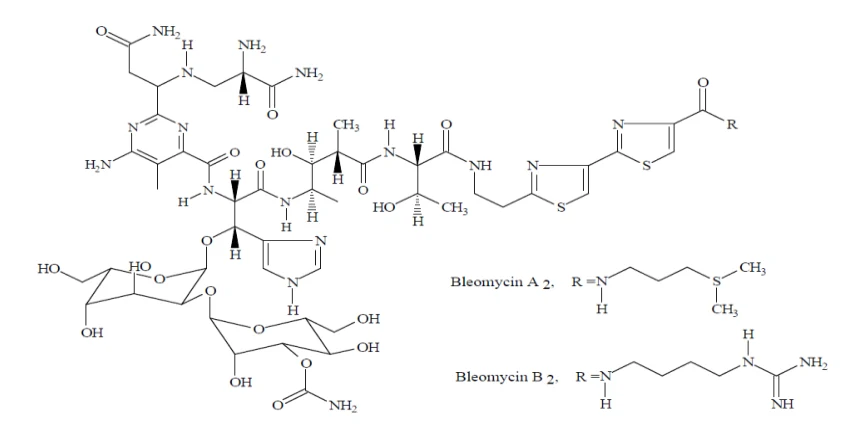
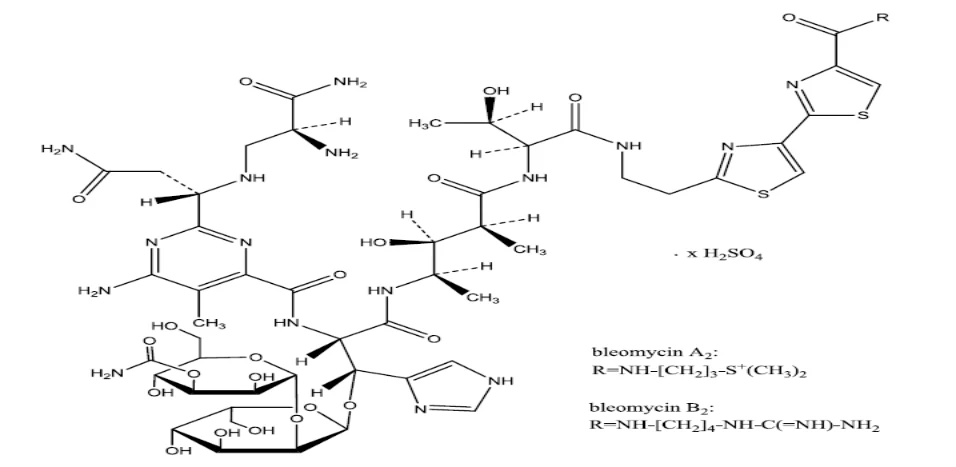
Chemical Name: Bleomycin A2: N1-[3 (dimethylsulphonio)propyl] bleomycinamide or N-[3-(dimethylsulfonio)propyl] bleomycinamide
Bleomycin B2: N1-4-(guanidobutyl)bleomycinamide or N-[4-(carbamimidoylamino)butyl]bleomycinamide
Molecular Formula: Bleomycin A2 sulfate: C55H84N17O21S3· xH2SO4
Bleyomycin B2 sulfate: C55H84N20O21S2· xH2SO4
Structural Formula:
Molecular Weight:
Bleomycin A2: 1415.6 g/mol (as free base)
Bleomycin B2: 1425.5 g/mol (as free base)
Description:
Bleomycin sulfate is a white to yellowish white powder. It is a mixture of glycopeptides from fermentation. It is very soluble in water. Practically insoluble in anhydrous ethanol and acetone. The pH of an aqueous solution of Bleomycin Sulfate (10 units/mL, corresponding to about 0.5%) is between 4.5 and 6.0.
COMPOSITION
Each vial contains sterile bleomycin sulfate equivalent to bleomycin 15 units.
Note: A unit of bleomycin is equal to the formerly used milligram activity.
STABILITY AND STORAGE RECOMMENDATIONS
Bleomycin for Injection dry powder should be stored between 2 °C and 8 °C. Protect from light. Single-dose vial. Discard unused portion.
Stability of Reconstituted Solutions
Reconstituted Bleomycin for Injection solution may be stored in refrigerator above freezing point for up to 48 hours.
Diluted Bleomycin for Injection is stable at 25 °C for 24 hours in 0.9% Sodium Chloride Injection, USP in PVC bags.
As with all parenteral drug products, intravenous admixtures should be inspected visually for clarity, particulate matter, precipitate, discolouration and leakage prior to administration whenever solution and container permit. Solutions showing haziness, particulate matter, precipitate, discolouration or leakage should not be used.
AVAILABILITY OF DOSAGE FORMS
Bleomycin for Injection is supplied in vials containing sterile bleomycin sulfate equivalent to bleomycin 15 units. Individually packaged.
Note: The vial stopper is not made with natural rubber latex.
PHARMACOLOGY
Animal Pharmacology
Bleomycin sulfate is well absorbed upon intramuscular, intraperitoneal and subcutaneous administration.
After administration of bleomycin, high concentrations are found in the skin, lungs, kidneys, peritoneum, lymphatic system and tumors, and this distribution is considered to have some relation to its effectiveness in the squamous cell carcinoma of human patients and to its toxicity. Bleomycin sulfate is excreted mainly by the kidney, with
69% of a dose (in rabbits) being eliminated, as active bleomycin, within 8 hours. In pregnant mice, bleomycin sulfate is recovered in high concentration in the amniotic fluid and to a lesser extent in the foetus.
Human Pharmacology
Blood concentrations have been studied in a few patients after intravenous or intramuscular injections of 15 units bleomycin. Although intravenous administration gives, as expected, higher initial levels, these are more sustained after intramuscular injection.
TOXICOLOGY
- 1.
The acute toxicity has been thoroughly investigated in mice, rats and dogs.
Acute Toxicity (units/kg of Copper-Free Bleomycin)
| Animal | Sex | IV | IP | SC |
|---|---|---|---|---|
| Mice | M | 210 | 312 | 200 |
| Mice | F | 187 | 190 | 188 |
| Rats | M | 168 | 168 | |
| Rats | F | 143 | 226 | |
| Dogs | M | < 100 |
- 2. The subacute toxicity has been studied in groups of 20 Wistar rats for 30 days. Daily intraperitoneal doses of 0.3 units/kg and 0.9 units/kg were well tolerated; no significant changes were observed in the blood picture, histopathology, or in the biochemical tests. Above this level, toxic effects on lung and skin began to appear.
- 3. Various chronic studies utilizing rats, dogs and monkeys showed that the principal toxic effect of bleomycin is epithelial in nature, affecting the lungs, skin, and kidneys. Hematopoietic toxicity, however, is only associated with high doses.
Carcinogenesis, Mutagenesis, Impairment of Fertility
The carcinogenic potential of bleomycin in humans is unknown. Given its mechanism of action, it should be considered to be a possible carcinogen in man. Bleomycin has been shown to be mutagenic in both in vitro and in vivo test systems. Bleomycin is teratogenic in rats and mice given the drug during organogenesis. The effects of bleomycin on fertility have not been established.
Reporting side effects
You can report any suspected side effects associated with the use of health products to Health Canada by:
- Visiting the Web page on Adverse Reaction Reporting (canada.ca/drug-device-reporting) for information on how to report online, by mail or by fax; or
- Calling toll-free at 1-866-234-2345.
NOTE: Contact your healthcare professional if you need information about how to manage your side effects. The Canada Vigilance Program does not provide medical advice.
If you want more information about Bleomycin for Injection:
- Talk to your healthcare professional
- Find the full product monograph that is prepared for healthcare professionals by visiting the Health Canada Drug Product Database website (https://www.canada.ca/en/health-canada/services/drugs-health-products/drug-products/drug-product-database.html); the manufacturer’s website www.marcanpharma.com; or by calling 1-855-627-2261.
Last Revised: 2026-03-03
BIBLIOGRAPHY
- 1. Audu PBD, Sing RF, Mette SA, Fallahnejhad M. Fatal diffuse alveolar injury following use of intrapleural bleomycin. Chest 1993; 103.:1638.
- 2. Blum RC, Carter SK, and Agre K. A clinical review of bleomycin - A new antineoplastic agent. Cancer. April 1973; 31(4):903-914.
- 3. Clinical Screening Co-operative Group of the European Organization for Research on the Treatment of Cancer. Study of the clinical efficiency of bleomycin in human cancer. Brit. Med. J. 13, June 1970; 2:643-645.
- 4. Crooke ST and Bradner WT. Bleomycin - A Review. Journal of Medicine 1976; 7(5):333-427.
- 5. Crooke ST, Luft F, Broughton A, Strong J, Casson K, and Einhorn L. Bleomycin serum pharmacokinetics as determined by a radioimmunoassay and a microbiologic assay in a patient with compromised renal function. Cancer. 1977; 39:1430-1434.
- 6. Crooke ST, Comis RL, Einhorn LH, Strong JE, Broughton A and Prestayko AW. Effects of various renal function on the clinical pharmacology of bleomycin administered as an IV bolus. Cancer Treat. Rep. 1977; 61(9): 1631-1636.
- 7. Dalgleish AG, Woods RL, Levi JA. Bleomycin pulmonary toxicity: Its relationship to renal dysfunction. Medical and Pediatric Oncology 1984; 12:313- 317.
- 8. Doll DC, List AF, Greco FA, Hainsworth JD, Hande KR, and Johnson DH. Acute vascular ischemic events after cisplatin-based combination chemotherapy for germ-cell tumors of the testis. Ann. Intern. Med. 1986; 105:48-5
- 9. Dorr RT. Bleomycin pharmacology: Mechanism of action and resistance, and clinical pharmacokinetics. Seminars in Oncology 1992; l9(suppl 5):3-8.
- 10. Gupta N, Opfell RW, Padova J, et al. Intrapleural bleomycin vs. tetracycline for control of malignant pleural effusion. Proceedings of AACR and ASCO 1980; 21:366 (Abstract #C-189).
- 11. Hall SW, Strong JE, Broughton A, Frazier ML and Benjamin RS. Bleomycin clinical pharmacology by radioimmunoassay. Cancer Chemother. Pharmacol. 1982; 9:22-25.
- 12. Ichikawa T, Nakano I, and Hirokawa I. Bleomycin treatment of the tumors of penis and scrotum. J. Urol. 1969; 102:699-707.
- 13. Ichikawa M et al.: Activity and toxicity of bleomycin. J. Antibiot. (A) (Tokyo), Jan. 1967; 20:15-24.
- 14. Ingrassia TS, Trastek VF and Rosenow EC. Oxygen-exacerbated bleomycin pulmonary toxicity. Mayo Clin. Proc. 1991; 66:173-178.
- 15. Kessinger A, Wigton RS. Intracavitary bleomycin and tetracycline in the management of malignant pleural effusions: A randomized study. Journal of Surgical Oncology 1987; 36:81-83.
- 16. Koberda M, Zieste PA, Raghavan NY and Payton RJ. Stability of bleomycin sulfate reconstituted in 5% dextrose injection or 0.9% sodium chloride injection stored in glass vials or polyvinyl chloride containers. Am. J. Hosp. Pharm. 1990;.47:2528-2529.
- 17.
Lacavino JR, Leitner J, Abbas AK, Lokich JJ, and Snider GL. Fatal pulmonary reaction from low doses of bleomycin. JAMA. March 22, 1976; 235 (12): 1253-
1255.
- 18. Levy RL and Chiarillo S. Hyperpyrexia, allergic-type response and death occurring with low-dose bleomycin administration. Oncology 1980; 37:316-317.
- 19. Livingston RB, Einhorn HE, Bodey GP, Burgess MA, Freireich EJ, and Gottlieb JA. COMB (cyclophosphamide, oncovin, methyl-CCNU and bleomycin): a four- drug combination in solid tumors. Cancer. 1975; 36: 327-332.
- 20. Matsuda A, Miyamoto K, Ishabashi H, et al. Effect on fetus and peculiar toxicity of bleomycin. Reference I-17, Biological Laboratory, Oji Pharmaceutical Factory, Nippon Kayaku Company, Ltd, 74 pp. paper, 1968.
- 21. Ostrowski MJ, Halsall GM. Intracavitary bleomycin in the management of malignant effusions: A multicenter study. Cancer Treatment Reports 1982; 66:1903-1907.
- 22. Paladine W, Cunningham TJ, Sponzo R, et al.: Intracavitary bleomycin in the management of malignant effusions. Cancer. 1976; 38:1903-1908.
- 23. Petrilli ES, Castaldo TW, Matutat RJ, et al. Bleomycin pharmacology in relation to adverse effects and renal function in cervical cancer patients. Gynecologic Oncology 1982; 14:350-354.
- 24. Ruckdeschel JC, Morres D, Lee JY et al.: Intrapleural therapy for malignant pleural effusions. Chest. 1991; l00: 1528-1535.
- 25. Samuels BL, Vogelzang NJ, and Kennedy BJ. Severe vascular toxicity associated with vinblastine, bleomycin, and cisplatin chemotherapy. Cancer Chemother. Pharmacol. 1987; 19:253-256.
- 26. Samuels ML, Holoye PY, and Johnson DE. Bleomycin combination chemotherapy in the management of testicular neoplasia. Cancer. 1975; 36:318- 326.
- 27. Samuels ML, Johnson DE, Holoye PY, and Lanzotti VJ. Large-dose bleomycin therapy and pulmonary toxicity. JAMA. 1976; 235:1117-1120.
- 28. Schwarzer S, Ebert B, Greinix H, and Lind P. Non-Q-wave myocardial infarction associated with bleomycin and etoposide chemotherapy. Eur. Heart J. 1991;12:748-750.
- 29. Shastri S et al. Clinical study with bleomycin. Ann. Intern. Med. 1971; 74:837- 838.
- 30. Tabara M et al. Development of remarkable lung fibrosis in a case of skin cancer during treatment with bleomycin. Jap. J. Chest. Dis. March 1970; 29:174-177. Amer. Rev. Resp. Dis. October 1970, 102:667-668.
- 31. Thompson G et al. Toxicity of bleomycin (NSC 125066), A new carcinostatic antibiotic, in dogs and monkeys. Pharmacologist. Fall 1970, 12:241.
- 32. Trotter JM, Stuart JFB, McBeth F, et al.: The management of malignant effusions with bleomycin. British Journal of Cancer. 1979; 40: 310.
- 33. Umezawa H et al. Studies on bleomycin. Cancer. 1967; 20(5):891-895.
- 34. Umezawa H. Fundamental studies on bleomycin. Reference I-42, Institute of Microbial Chemistry, Dept. of Antibiotics, National Institute of Health, Institute of Applied Microbiology, University of Tokyo, 40 pp. paper, 1970.
- 35. Umezawa H et al. New antibiotics, bleomycin A and B. J. Antibiot. (A). September 1966; 19(5):200- 209.
- 36. White DA, Schwartzberg LS, Kris MG, and Bosl GJ. Acute chest pain syndrome during bleomycin infusions. Cancer 1987; 59:1582-85.
- 37. Blenoxane (bleomycin for injection), Product Monograph, Bristol Laboratories of Canada, Control no. 141156, December 3, 2010.
- 38. BLEOMYCIN FOR INJECTION (powder for solution, 15 units / vial) , control 195028, product monograph, Fresenius Kabi Canada Ltd. (2016-06-01)