


Patient Medication Information: uses, side effects, how to take - Botox
What is Botox used for?
Botox works by temporarily weakening overactive muscles which may cause:
- crossed eyes (strabismus)
- persistent muscle spasms in the eyelid and face (blepharospasm)
persistent muscle spasms in the arm and/or leg in adults and in children two years or older (adult and pediatric focal spasticity)
In patients with upper and lower limb muscle contractions, Botox reduced the muscle contractions (focal spasticity) and increased the range of movement. In some patients, Botox has also reduced disability from their muscle contractions.
muscle contractions in the neck and twisting of the head (cervical dystonia)
In patients with cervical dystonia, Botox reduced the amount of head turning and shoulder elevation, decreased the size and strength of the overactive muscles and reduced pain.
- leakage of urine (urinary incontinence) due to a neurologic disease in adult patients with multiple sclerosis or spinal cord injury who had a poor response to or are intolerant of medicines called anticholinergics;
Serious Warnings and Precautions
|
overactive bladder with symptoms of leakage of urine (urinary incontinence), feeling a sudden urge to urinate, and urinating frequently, in adult patients who had a poor response to or are intolerant of medicines called anticholinergics.
In patients suffering from leakage of urine due to overactive bladder, Botox significantly reduced leakage of urine and improved quality of life.
- Botox can also block signals to the sweat glands thus reducing excessive sweating (hyperhidrosis).
- Botox can be used to prevent headaches in adults with chronic migraine who have 15 or more days each month with headache lasting 4 or more hours each day. It has been shown to significantly reduce the number of headache days per month.
How does Botox work?
Botox is a muscle relaxant that is injected into the muscles or deep into the skin. When injected into muscles, it blocks part of the nerve signals (impulses) to those muscles. It also reduces the movement of those muscles. This causes muscle relaxation, which goes away over time.
To treat chronic migraine, it is thought that Botox blocks pain signals, which indirectly block the development of a migraine.
When injected into the skin, Botox works on sweat glands to reduce the amount of sweat that is made.
When injected into the bladder wall, Botox works on the bladder muscle to prevent leakage of urine (urinary incontinence) from uncontrolled contractions of the bladder muscle.
What are the ingredients in Botox?
Medicinal ingredient: OnabotulinumtoxinA for injection, a sterile, form of purified botulinum neurotoxin type A complex.
Non-medicinal ingredients: Albumin (human) and sodium chloride.
Botox comes in the following dosage forms:
Sterile vacuum-dried concentrate; powder for solution for injection; 50, 100 and 200 Allergan Units per vial.
Do not use Botox if:
- you are allergic or sensitive to any of the ingredients
- you have an infection in the muscles where Botox is injected.
- you have any muscle disorders such as myasthenia gravis, Eaton Lambert Syndrome or amyotrophic lateral sclerosis.
- you are using Botox for leakage of urine and have a urinary tract infection or if you are not able to empty your bladder (and are not regularly using a catheter).
- you are not willing and able to start using a catheter.
To help avoid side effects and ensure proper use, talk to your healthcare professional before you take Botox. Talk about any health conditions or problems you may have, including if you:
- have myasthenia gravis or Eaton Lambert Syndrome, amyotrophic lateral sclerosis or another muscle disorder.
- are allergic or sensitive to Botox.
- have an infection at a proposed injection site.
- are being treated for leakage of urine with Botox and have either a urinary tract infection or a sudden inability to empty your bladder (and are not regularly using a catheter).
- are scheduled to have surgery using a general anaesthetic (a medicine that reduces your sensitivity to pain).
- are taking or are likely to take antibiotics, especially aminoglycoside antibiotics.
are pregnant or become pregnant while taking this drug. Botox given to pregnant rabbits caused abortion or birth defects.
- are nursing. We do not yet know if this drug gets into human milk and can be passed to your baby.
- are using Botox for leakage of urine due to neurologic disease and have had any previous episodes of autonomic dysreflexia (AD). AD is a serious problem that can cause changes of hear rate and high blood pressure.
Other warnings you should know about:
Seek immediate medical care if swallowing, speech or respiratory problems arise.
Tell your healthcare professional if you experience any difficulties in swallowing food while on Botox, as it could be related to the dosage. Difficulty in swallowing food, ranging from very mild to severe, can persist for 2-3 weeks after injection, or longer.
It is unlikely that this medicine will improve how far you can move or stretch joints where the muscle around it has lost its ability to stretch.
Botox should be used to treat adults with persistent ankle muscle spasms only if it is expected to help improve function (e.g., walking), symptoms (e.g., pain), or patient care. For patients who may be more likely to fall, your healthcare professional will judge if this treatment is right for you.
Botox should only be used to treat ankle muscle spasms if you have been evaluated by a healthcare professional that is experienced in managing the rehabilitation of patients after a stroke.
Tell your healthcare professional if you are taking other medicines, including any you have bought at your pharmacy, supermarket or health food shop. If you are being treated for leakage of urine with Botox, especially tell your healthcare professional if you are taking any anti-platelets (aspirin-like products) and/or anti-coagulants (blood thinners).
If you are being treated for leakage of urine with Botox, contact your healthcare professional if you experience difficulties in voiding as catheterization may be required.
You should know that, if you are being treated for leakage of urine with Botox, the injection is done under cystoscopy (a procedure to look inside the bladder with a thin camera). You may need local anesthetic, sedation or anesthesia to help you relax and prevent pain.
Tell your healthcare professional about all the medicines you take, including any drugs, vitamins, minerals, natural supplements or alternative medicines.
The following may interact with Botox:
Certain medicines may change how Botox works in your body and may increase the chance of side effects. Tell your healthcare professional if you take any of these medicines: aminoglycoside antibiotics (e.g., streptomycin, tobramycin, neomycin, gentamicin, netilmicin, kanamycin, amikacin), spectinomycin, polymyxins, tetracyclines, lincomycin or any other drugs that interfere with neuromuscular transmission.
How to take Botox:
Botox will be given to you by a doctor (or other authorized prescriber for the chronic migraine indication) in a healthcare setting.
- Into your muscles (intramuscularly) for all indications except hyperhidrosis
- Into the muscles of the bladder wall for Urinary Incontinence
- Into the skin (intradermal) for hyperhidrosis only
Usual dose:
Botox is injected into your muscles (intramuscularly), into the bladder wall via a specific instrument (cystoscope) to inject into the bladder, or into the skin (intradermally). It is injected directly into the affected area of your body; your healthcare professional will usually inject Botox into several sites within each affected area.
A unit of Botox is a dose measurement that is specific to Botox and cannot be interchanged with the units used to measure other botulinum toxin products.
Your healthcare professional will decide how much, how often, and in which muscle(s) Botox will be given to you. It is recommended that your healthcare professional uses the lowest effective dose. The dose can be increased in subsequent treatments if needed.
If you feel that the effect of Botox is not optimal, let your healthcare professional know. There are several potential reasons for this that your healthcare professional can assess.
Below are details corresponding to each condition.
Persistent muscle spasms in the eyelid and face (blepharospasm)
Your doctor may give you multiple injections in the affected muscles. You will usually see an improvement within 3 days after the injection. The maximum effect is usually seen 1 to 2 weeks after treatment. The effects last about 3 months. After 3 months, you can receive another treatment. There is no limit to how many treatments you can have.
Crossed eyes (strabismus)
Your doctor may give you multiple injections in the affected muscles. You will usually see an improvement within 1 to 2 days after the injection. The maximum effect is usually seen 1 week after treatment and lasts 2 to 6 weeks. The effect starts to wear off slowly over the next 2 to 6 weeks.
Muscle contractions in the neck and twisting of the head (cervical dystonia)
Your doctor may give you multiple injections in the affected muscles, especially for larger muscles. The maximum effect is usually seen about 6 weeks after treatment. When the effect starts to wear off, you can have the treatment again if needed. You cannot have more than one treatment every 2 months.
Muscle contractions in the limbs in adults (adult focal spasticity)
Your doctor may decide to use electromyographic (EMG) guidance or nerve stimulation to determine where injections should be administered in a muscle. Your doctor may give you multiple injections in the affected muscles. The dose and number of injections will change depending on several factors. These factors include your needs, the muscles to be injected, the size of the muscles, severity of spasms, local muscle weakness and response to earlier treatments. You will usually see an improvement within the first 2 weeks after the injection. The maximum effect is usually seen about 4 to 6 weeks after treatment. When the effect starts to wear off, you can have the treatment again if needed. You cannot have more than one treatment every 12 weeks.
Muscle contractions in the limbs in pediatric patients (pediatric focal spasticity)
Your doctor may give you multiple injections in the affected muscles. You will usually see improvement within the first 7 days after the injection. When the effect starts to wear off, you can have the treatment again if needed. You cannot have more than one treatment every 3 months.
Excessive Sweating of the Underarm
Your doctor may give you multiple injections into the skin of the underarm area. Improvement in symptoms usually happens within the first 2 weeks after the injection. When the effect starts to wear off, you can have the treatment again if needed. You cannot have more than one treatment every 3 months.
Chronic Migraine
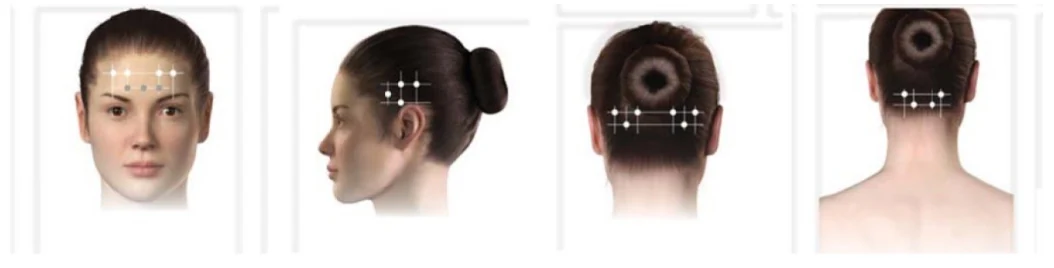
Botox is injected by needle into 7 specific head and neck muscle areas. These areas may play a part into your headaches. Your healthcare professional will determine the number of injection sites needed to treat your specific condition. The recommended dose of Botox is 155 Units in 31 sites. If your healthcare professional thinks it is necessary, they may decide to inject more units of Botox. The recommended treatment schedule is every 12 weeks.
Leakage of Urine and Overactive Bladder
Your doctor may give you multiple injections in the bladder wall. Improvement in symptoms usually happens within the first 2 weeks after the injection. When the effect starts to wear off, you can have the treatment again if needed. You cannot have more than one treatment every 3 months.
Lack of Response
Talk to your healthcare professional if you feel that you had a lack of or decreased response to your treatment with Botox.
There could be several possible reasons for this including: the wrong dose was used, selection of inappropriate muscles for injection, cannot reach muscles to inject, underlying issues such as muscle contractures (tightening) or bone disorders, changes in the pattern of muscles involved in your condition, inappropriate storage or inappropriate mixture of the Botox powder with a liquid. It is also possible that the body naturally defends against the botulinum toxin.
Overdose:
| If you think you, or a person you are caring for, have taken too much Botox, contact a healthcare professional, hospital emergency department, or regional poison control centre immediately, even if there are no symptoms. |
|---|
Missed Dose:
If you missed an injection treatment of this medication, talk to your healthcare professional.
What are possible side effects from using Botox?
These are not all the possible side effects you may feel when taking Botox. If you experience any side effects not listed here, contact your healthcare professional.
General
Pain, tenderness and/or bruising at the site of injection. Malaise (generally feeling unwell), lasting up to six weeks after injection with Botox. Weakness and rarely, changes in the way the heart beats, chest pain, skin rash and allergic reaction (symptoms: shortness of breath, wheezing or difficulty breathing; swelling of the face, lips, tongue or other parts of the body; rash, itching or hives on the skin); anaphylaxis; cardiovascular events; seizures; dysphagia; and respiratory compromise.
The following events have been reported rarely (<0.1%) since Botox has been marketed: skin rash, itching, allergic reaction, and facial paralysis. There have also been rare reports of adverse events involving the cardiovascular system, including arrhythmia and myocardial infarction, some with fatal outcomes. Some of these patients had risk factors, including cardiovascular disease. Skin tightness (including raising of the outer eyebrows) could be reported in chronic migraine treatment, particularly after injection in the forehead area.
Serious side effects and what to do about them
| Symptom / effect | Talk to your healthcare professional | Stop taking drug and get immediate medical help | |
|---|---|---|---|
| Only if severe | In all cases | ||
| RARE | |||
| Difficulty Swallowing | ✓ | ||
| Difficulty Breathing | ✓ | ||
Blepharospasm
Drooping of the eyelids, irritation or tearing, dry eye, not being able to close the eye, and sensitivity to light. Less commonly, inward or outward turning of the eye, inflammation of the eye, double vision, and swelling of the eyelid skin lasting several days.
Strabismus
Drooping of the eyelids, vertical turning of the eye, double vision, bleeding beneath the eye lids and at the front of the eye. Less commonly, bleeding behind the eye ball, piercing of the sclera (the tough skin covering part of the eye bulb), dilation of the pupil, loss of awareness of space and past pointing (the inability to place a finger on another part of the body accurately), headache, inability to focus, dizziness, discomfort/irritation of the eye, increased pressure in the eye.
Injections for children with persistent muscle spasms in the arm and/or legs:
Upper respiratory tract infection, nausea, muscle weakness, and pain at the site of injection.
Cervical Dystonia
Soreness or bruising where the injection was given, difficulty in swallowing, weakness of the neck, and less commonly, general weakness, malaise and nausea. Side effects, if they occur, tend to appear in the first week after injection, and last about two weeks.
However, in rare instances, patients may have difficulty in swallowing that could persist for longer than two weeks after injection and may develop into a more serious condition. Make sure you tell your doctor if you experience any difficulty in swallowing.
Primary hyperhidrosis
Increase in sweating in other areas of the body, headaches and pain at the injection site.
Adult Focal spasticity
Upper Limb Spasticity
Most side effects that have been reported in patients being treated for focal spasticity were mild to moderate and got better without needing medical attention. Side effects reported include: pain in the affected limb, nausea, muscle weakness, fatigue and swelling in the hands, feet, or other parts of the body. Less common side effects include: fever, flu syndrome, weakness or a loss of energy, joint pain, skin problems, nausea, ‘pins & needles’, itching and lack of coordination.
Lower Limb Spasticity
Fall and pain in extremity were the common side effects reported in patients being treated for lower limb spasticity in clinical trials.
Serious side effects and what to do about them
| Symptom / effect | Talk to your healthcare professional | Stop taking drug and get immediate medical help | |
|---|---|---|---|
| Only if severe | In all cases | ||
VERY COMMON Joint pain | ✓ | ||
Chronic migraine
The following common events were reported in patients being treated for chronic migraine in clinical trials: headache, facial muscle weakness, drooping of the eyelids, muscle spasm, muscle tightness, injection pain and rash.
Urinary Incontinence Due to Neurologic Disease
Common side effects: problems with walking, fall, muscle weakness, muscle spasm, tiredness, difficulty sleeping (insomnia), constipation, blood in the urine after the injection, painful urination after the injection.
Serious side effects and what to do about them
| Symptom / effect | Talk to your healthcare professional | Stop taking drug and get immediate medical help | |
|---|---|---|---|
| Only if severe | In all cases | ||
VERY COMMON Urinary Tract infection | ✓ | ||
| Inability to empty your bladder (urinary retention) | ✓ | ||
Overactive Bladder
Common side effects: bacteria in the urine; inability to empty your bladder (urinary retention), incomplete emptying of the bladder, frequent daytime urination, blood in the urine after the injection**.
Serious side effects and what to do about them
| Symptom / effect | Talk to your healthcare professional | Stop taking drug and get immediate medical help | |
|---|---|---|---|
| Only if severe | In all cases | ||
VERY COMMON Urinary tract infection | ✓ | ||
| Painful urination after the injection* | ✓ | ||
*This side effect may also be related to the injection procedure.
**This side effect is only related to the injection procedure.
If you have a troublesome symptom or side effect that is not listed here or becomes bad enough to interfere with your daily activities, talk to your healthcare professional.
Reporting Side Effects
You can report any suspected side effects associated with the use of health products to Health Canada by:
NOTE: Contact your health professional if you need information about how to manage your side effects. The Canada Vigilance Program does not provide medical advice. |
Storage:
Store the vacuum-dried product either in a refrigerator at 2 - 8oC, or in a freezer at or below -5o C.
Keep out of reach and sight of children.
If you want more information about Botox:
- Talk to your healthcare professional
- Find the full product monograph that is prepared for healthcare professionals and includes this Patient Medication Information by visiting the Health Canada website: (www.canada.ca/en/health-canada/services/drugs-health-products/drug-products/drug-product-database.html); the manufacturer’s website www.botox.ca, or by calling 1-888-704-8271.
Last revised: March 10, 2025
© 2025 AbbVie. All rights reserved. BOTOX and its design are trademarks of AbbVie Corporation.