


Product Monograph - Botox
RECENT MAJOR LABEL CHANGES
| 1 INDICATIONS, Focal Spasticity | 02/2024 |
|---|---|
| 1 INDICATIONS, Pediatric Focal Spasticity | 03/2021 |
| 1 INDICATIONS, 1.1 Pediatrics | 03/2021 |
| 3 SERIOUS WARNINGS AND PRECAUTIONS BOX | 03/2025 |
| 4 DOSAGE AND ADMINISTRATION, 4.1 Dosing Considerations | 03/2025 |
| 4 DOSAGE AND ADMINISTRATION, 4.2 Recommended Dose and Dosage Adjustment | 02/2024 |
| 7 WARNINGS AND PRECAUTIONS, General | 03/2025 |
| 7 WARNINGS AND PRECAUTIONS, 7.1 Special Populations, 7.1.3 Pediatrics | 03/2021 |
TABLE OF CONTENTS
Sections or subsections that are not applicable at the time of authorization are not listed.
RECENT MAJOR LABEL CHANGES .......................................................................................................... 2
TABLE OF CONTENTS ............................................................................................................................ 2
1 INDICATIONS ........................................................................................................................... 4
1.1 Pediatrics ............................................................................................................................ 5
1.2 Geriatrics ............................................................................................................................. 5
2 CONTRAINDICATIONS .............................................................................................................. 5
3 SERIOUS WARNINGS AND PRECAUTIONS BOX ......................................................................... 6
4 DOSAGE AND ADMINISTRATION .............................................................................................. 6
4.1 Dosing Considerations ........................................................................................................ 6
4.2 Recommended Dose and Dosage Adjustment ................................................................... 7
4.3 Reconstitution ................................................................................................................... 19
4.4 Administration .................................................................................................................. 19
4.5 Missed Dose ...................................................................................................................... 20
5 OVERDOSAGE ........................................................................................................................ 20
6 DOSAGE FORMS, STRENGTHS, COMPOSITION AND PACKAGING ............................................ 20
7 WARNINGS AND PRECAUTIONS ............................................................................................. 21
7.1 Special Populations ........................................................................................................... 25
7.1.1 Pregnant Women ......................................................................................................... 25
7.1.2 Breast-feeding .............................................................................................................. 25
7.1.3 Pediatrics ...................................................................................................................... 25
7.1.4 Geriatrics ...................................................................................................................... 26
8 ADVERSE REACTIONS ............................................................................................................. 26
8.1 Adverse Reaction Overview .............................................................................................. 26
8.2 Clinical Trial Adverse Reactions ........................................................................................ 26
8.2.1 Clinical Trial Adverse Reactions – Pediatrics ................................................................ 33
8.3 Less Common Clinical Trial Adverse Reactions ................................................................. 34
8.4 Abnormal Laboratory Findings: Hematologic, Clinical Chemistry and Other Quantitative Data 36
8.5 Post-Market Adverse Reactions ........................................................................................ 36
9 DRUG INTERACTIONS ............................................................................................................. 37
9.2 Drug Interactions Overview .............................................................................................. 37
9.3 Drug-Behavioural Interactions .......................................................................................... 37
9.4 Drug-Drug Interactions ..................................................................................................... 37
9.5 Drug-Food Interactions ..................................................................................................... 38
9.6 Drug-Herb Interactions ..................................................................................................... 38
9.7 Drug-Laboratory Test Interactions .................................................................................... 38
10 CLINICAL PHARMACOLOGY .................................................................................................... 38
10.1 Mechanism of Action ........................................................................................................ 38
10.2 Pharmacodynamics ........................................................................................................... 38
10.3 Pharmacokinetics .............................................................................................................. 39
11 STORAGE, STABILITY AND DISPOSAL ...................................................................................... 39
12 SPECIAL HANDLING INSTRUCTIONS ........................................................................................ 40
PART II: SCIENTIFIC INFORMATION .................................................................................................... 41
13 PHARMACEUTICAL INFORMATION ......................................................................................... 41
14 CLINICAL TRIALS..................................................................................................................... 41
14.1 Clinical Trials by Indication................................................................................................ 41
Blepharospasm .............................................................................................................................. 41
Strabismus...................................................................................................................................... 42
Cervical Dystonia (spasmodic torticollis) ....................................................................................... 42
Adult Focal Spasticity ..................................................................................................................... 43
Upper Limb .................................................................................................................................... 43
Lower Limb ..................................................................................................................................... 46
Pediatric Focal Spasticity ............................................................................................................... 47
Upper Limb .................................................................................................................................... 47
Lower Limb ..................................................................................................................................... 49
Primary Hyperhidrosis of the Axillae ............................................................................................. 52
Chronic Migraine ............................................................................................................................ 52
Neurogenic Detrusor Overactivity Associated with a Neurologic Condition ................................. 54
Overactive Bladder ........................................................................................................................ 59
15 MICROBIOLOGY ..................................................................................................................... 65
16 NON-CLINICAL TOXICOLOGY .................................................................................................. 65
PATIENT MEDICATION INFORMATION ............................................................................................... 68
PART I: HEALTH PROFESSIONAL INFORMATION
1 INDICATIONS
BOTOX® (onabotulinumtoxinA for injection) is indicated for:
Blepharospasm
- for the treatment of blepharospasm associated with dystonia, including benign essential blepharospasm or VII nerve disorders in patients 12 years of age or older,
Strabismus
- for the treatment of strabismus in patients 12 years of age or older. Botox is ineffective in chronic paralytic strabismus except to reduce antagonist contracture in conjunction with surgical repair,
Cervical Dystonia (spasmodic torticollis)
- to reduce the subjective symptoms and objective signs of cervical dystonia (spasmodic torticollis) in adults,
Focal Spasticity
- in the management of focal spasticity, including the treatment of upper limb spasticity in adults,
- for the symptomatic treatment of lower limb spasticity in adults,
- for symptomatic treatment of upper and/or lower limb spasticity in pediatric patients two years of age or older,
Botox is not intended as a replacement for usual standard of care regimens and is not likely to be effective in improving range of motion at a joint affected by a fixed contracture.
Primary Hyperhidrosis of the Axillae
- for the treatment of hyperhidrosis of the axilla in patients 18 years of age or older,
Chronic Migraine
- for the prophylaxis of headaches in adults with chronic migraine (≥15 days per month with headache lasting 4 hours a day or longer),
Bladder Dysfunction
Neurogenic Detrusor Overactivity associated with a neurological condition
- for the treatment of urinary incontinence due to neurogenic detrusor overactivity resulting from neurogenic bladder associated with multiple sclerosis or sub cervical spinal cord injury in adults who had an inadequate response to or are intolerant of anticholinergic medications,
Overactive Bladder
- for the treatment of overactive bladder with symptoms of urinary incontinence, urgency, and frequency, in adult patients who have an inadequate response to or are intolerant of anticholinergic medication,
1.1 Pediatrics
Based on the data submitted and reviewed by Health Canada, the safety and efficacy of Botox has only been established in the authorized indications in the authorized age group in pediatric patients (see above).
1.2 Geriatrics
Geriatrics (>65 years of age): Based on the data submitted and reviewed by Health Canada, the safety and efficacy of Botox has only been established in the authorized indications in patients older than 65 years of age (see above). Studies specifically designed to determine the dose in elderly patients have not been performed. Dosages for the elderly are as for other adults. Initial dosing should begin at the lowest recommended dose for the specific indication.
2 CONTRAINDICATIONS
Botox is contraindicated in:
- patients who are hypersensitive to any botulinum toxin type A or to any ingredient in the formulation or component of the container. For a complete listing, see the 4 DOSAGE FORMS, STRENGTHS, COMPOSITION AND PACKAGING section of the product monograph.
- the presence of infection at the proposed injection site(s).
Botox for the treatment of bladder dysfunction is also contraindicated in:
- patients who have a urinary tract infection or a recent history of frequent urinary tract infections.
- patients with urinary retention who are not routinely catheterizing.
- patients who are not willing and able to have clean intermittent catheterization (CIC) initiated.
3 SERIOUS WARNINGS AND PRECAUTIONS BOX
4 DOSAGE AND ADMINISTRATION
4.1 Dosing Considerations
- Intramuscular Use for All Indications except Hyperhidrosis and Bladder Dysfunction
- Intradetrusor Use for Bladder Dysfunction only
- Intradermal Use for Hyperhidrosis only
- Botox should only be given by physicians (or authorized prescribers for chronic migraine only) with the appropriate qualifications and experience in the treatment and the use of required equipment.
- The term “Allergan unit” upon which dosing is based, is a specific measurement of toxin activity that is unique to AbbVie’s formulation of botulinum toxin type A. Therefore, the “Allergan units” used to describe Botox activity are different from those used to describe that of other botulinum toxin preparations and the units representing Botox activity are not interchangeable with other products.
- The use of one vial for more than one patient is not recommended because the product and diluent do not contain a preservative.
- Follow the recommended dosage and frequency of administration for each indication.
- Generally, optimum dose levels and the number of injection sites per muscle have not been established for all indications. The exact dosage and number of injection sites should be tailored
Serious Warnings and Precautions
- The term “Allergan unit” upon which dosing is based is a specific measurement of toxin activity that is unique to this formulation of botulinum toxin type A. Therefore, the “Allergan units” used to describe Botox and Botox Cosmetic’s activity are different from those used to describe that of other botulinum toxin preparations and the units representing Botox and Botox Cosmetic’s activity are NOT interchangeable with other products.
- Botox should only be given by physicians (or authorized prescribers for chronic migraine only) with the appropriate qualifications and experience in the treatment and the use of required equipment.
- Follow the recommended dosage and frequency of administration for Botox (See 7 WARNINGS AND PRECAUTIONS, General and 4 DOSAGE AND ADMINISTRATION).
DISTANT SPREAD OF TOXIN EFFECT: The effects of Botox and all botulinum toxin products may spread from the area of injection to produce symptoms consistent with botulinum toxin effects. These symptoms have been reported hours to weeks after injection. Swallowing and breathing difficulties can be life-threatening and there have been reports of death. The risk of symptoms is probably greatest in children treated for spasticity, but symptoms can occur in adults, particularly in those patients who have underlying conditions that would predispose them to these symptoms.
- of disease, presence of local muscle weakness, response to previous treatment, and the patient’s medical condition. Treatment should be initiated at the lowest effective dose. This dose can be gradually increased in subsequent treatments to the maximum recommended dose, if needed.
- Injection intervals of Botox should be according to the specific indication.
- When combining indications, the maximum cumulative dose in a 3-month interval should generally not exceed 7 Units/kg or 400 Units, whichever is lower, in adults, and 10 Units/kg or 340 Units, whichever is lower, in pediatric patients.
- To help ensure the traceability of biologic products, including biosimilars, health professionals should recognize the importance of recording both the brand name and the non-proprietary (active ingredient) name as well as other product-specific identifiers such as the Drug Identification Number (DIN) and the batch/lot number of the product supplied.
4.2 Recommended Dose and Dosage Adjustment
Blepharospasm
For blepharospasm, diluted Botox (see Dilution Table 7) is injected using a sterile, 27 – 30-gauge needle with or without electromyographic guidance. The initial recommended dose is 1.25 Units to 2.5 Units (0.05 mL to 0.1 mL volume at each site) injected into the medial and lateral pre-tarsal orbicularis oculi of the upper lid and into the lateral pre-tarsal orbicularis oculi of the lower lid.
In general, the initial effect of the injections is seen within three days and reaches a peak at one to two weeks post-treatment. Treatment effects last approximately three months, following which the procedure can be repeated indefinitely.
The initial dose should not exceed 25 Units per eye. At repeat treatment sessions, the dose may be increased up to two-fold if the response from the initial treatment is considered insufficient (i.e., defined as an effect that lasts no longer than two months). However there appears to be little benefit obtainable from injecting more than 5.0 Units per site. Some tolerance may be found when Botox is used in treating blepharospasm if treatments are given more frequently than every three months, and it is rare to have the effect be permanent.
The cumulative dose of Botox for treatment of blepharospasm in a two-month period should not exceed 200 Units.
Avoiding injection near the levator palpebrae superioris may reduce the complication of ptosis. Avoiding medial lower lid injections, and thereby reducing diffusion into the inferior oblique, may reduce the complication of diplopia.
Strabismus
Botox is intended for injection into extraocular muscles utilizing the electrical activity recorded from the tip of the injection needle as a guide to placement within the target muscle. Injection without surgical exposure or electromyographic guidance should not be attempted. Physicians should be familiar with electromyographic techniques.
To prepare the eye for Botox injection, it is recommended that several drops of a local anesthetic and an ocular decongestant be given several minutes prior to injection.
Note: The recommended volume of Botox injected for treatment of strabismus is 0.05 mL to 0.15 mL per muscle.
The initial listed doses of the diluted Botox (see Dilution Table 7) typically create paralysis of injected muscles beginning one to two days after injection and increasing in intensity during the first week. The paralysis lasts for 2-6 weeks and gradually resolves over a similar time period. Overcorrections lasting over six months have been rare.
About one-half of patients will require subsequent doses because of inadequate paralytic response of the muscle to the initial dose, or because of mechanical factors such as large deviations or restrictions, or because of the lack of binocular motor fusion to stabilize the alignment.
I. Initial doses in units. Use the lower listed doses for treatment of small deviations. Use the larger doses only for large deviations.
A. For vertical muscles, and for horizontal strabismus of less than 20 prism diopters: 1.25 Units to 2.5 Units in any one muscle.
B. For horizontal strabismus of 20 prism diopters to 50 prism diopters: 2.5 Units to 5.0 Units in any one muscle.
C. For persistent VI nerve palsy of one month or longer duration: 1.25 Units to 2.5 Units in the medial rectus muscle.
II. Subsequent doses for residual or recurrent strabismus.
A. It is recommended that patients be re-examined 7-14 days after each injection to assess the effect of that dose.
B. Patients experiencing adequate paralysis of the target muscle that require subsequent injections should receive a dose comparable to the initial dose.
C. Subsequent doses for patients experiencing incomplete paralysis of the target muscle may be increased up to two-fold compared to the previously administered dose.
D. Subsequent injections should not be administered until the effects of the previous dose have dissipated as evidenced by substantial function in the injected and adjacent muscles.
E. The maximum recommended dose as a single injection for any one muscle is 25 Units.
F. The recommended volume of Botox injected for treatment of strabismus is 0.05 mL to 0.15 mL per muscle.
Cervical dystonia (spasmodic torticollis)
Several dosing regimens have been used in clinical trials for treatment of cervical dystonia with Botox. Dosing must be tailored to the individual patient based on the patient's head and neck position, localization of pain and muscle hypertrophy, patient's bodyweight, and patient response. In initial controlled clinical trials to establish safety and efficacy for cervical dystonia, doses of diluted Botox ranged from 140 Units to 280 Units. However, in clinical practice, a range of 200 Units to 360 Units have been used effectively.
A 25, 27 or 30-gauge needle may be used for superficial muscles, and a 22-gauge needle may be used for deeper musculature. For cervical dystonia, localization of the involved muscles with electromyographic guidance may be useful.
Multiple injection sites allow Botox to have more uniform contact with the innervation areas of the dystonic muscle and are especially useful in larger muscles. The optimal number of injection sites is dependent upon the size of the muscle to be chemically denervated.
Clinical improvement generally occurs within the first two weeks after injection. The maximum clinical benefit generally occurs approximately six weeks post-injection. Repeat doses should be administered when the clinical effect of a previous injection diminishes, but not more frequently than every two months. The interval between injections reported in the clinical trials showed substantial variation (from 2 to 32 weeks), with a typical duration of approximately 12 to 16 weeks, depending on patient's individual symptoms and responses.
The maximum cumulative dose for cervical dystonia should not generally exceed 360 Units in a 3-month interval.
Table 1 is intended to give dosing guidelines for injection of Botox in the treatment of cervical dystonia.
Table 1 - Dosage Guide for Cervical dystonia
| Classification | Muscle Groupings | Total Dosage; Number of Sites |
Type I Head rotated toward side of shoulder elevations | Sternocleidomastoid Levator scapulae Scalene Splenius capitis Trapezius | 50-100 Units; at least 2 sites 50 Units; 1-2 sites 25-50 Units; 1-2 sites 25-75 Units; 1-3 sites 25-100 Units; 1-8 sites |
Type II Head rotation only | Sternocleidomastoid | 25-100 Units; at least 2 sites if >25 Units given |
Type III Head tilted toward side of shoulder elevation | Sternocleidomastoid Levator scapulae Scalene Trapezius | 25-100 Units; at posterior border; at least 2 sites if >25 Units given 25-100 Units; at least 2 sites 25-75 Units; at least 2 sites 25-100 Units; 1-8 sites |
Type IV Bilateral posterior cervical muscle spasm with elevation of the face | Splenius capitis and cervicis | 50-200 Units; 2-8 sites, treat bilaterally |
This information is provided as guidance for the initial injection. The extent of muscle hypertrophy and the muscle groups involved in the dystonic posture may change with time necessitating alterations in the dose of toxin and muscles to be injected. The exact dosage and sites injected must be individualized for each patient.
Adult Focal Spasticity
Upper Limb
The exact dosage and number of injection sites should be tailored to the individual based on the size, number and location of muscles involved, the severity of spasticity, presence of local muscle weakness, and the patient response to previous treatment. Total dosing should not exceed 400 Units per treatment session divided among selected muscles (See 4 DOSAGE AND ADMINISTRATION, 4.1 Dosing Consideration).
Table 2 is intended to give dosing guidelines for the injection of Botox in selected muscles evaluated in supporting clinical trials.
Table 2 - Dosing Guidelines in Upper Limb Spasticity
| Muscle | Total Dosage; Number of Sites |
Elbow: Biceps brachii Brachioradialis Brachialis Forearm: Pronator Quadratus Pronator Teres Fingers/Hand: Flexor digitorum profundus Flexor digitorum sublimis Lumbricals* Interossei* Wrist: Flexor carpi radialis Flexor carpi ulnaris Thumb: Adductor pollicis Flexor pollicis longus Flexor pollicis brevis Opponens pollicis | 60 - 200 Units; 2 to 4 sites 45 – 75 Units; 1 to 2 sites 30 – 50 Units; 1 to 2 sites 10 – 50 Units; 1 site 15 – 25 Units; 1 site 15 - 50 Units; 1-2 sites 15 - 50 Units; 1-2 sites 5 – 10 Units; 1 site 5 – 10 Units; 1 site 15 - 60 Units; 1-2 sites 10 - 50 Units; 1-2 sites 20 Units; 1-2 sites 20 Units; 1-2 sites 5 – 25 Units; 1 site 5 – 25 Units; 1 site |
| * When injecting both lumbricals and/or interossei, the recommended maximum dose is 50 Units per hand. | |
In controlled and open non-controlled clinical trials doses usually between 200 and 240 Units, and up to 400 Units divided among selected muscles have been used at a given treatment session.
In controlled clinical trials patients were followed for 12 weeks after single treatment. Improvement in muscle tone occurred within two weeks with the peak effect generally seen within four to six weeks. In an open label continuation study, most of the patients were re- injected after an interval of 12 to 16 weeks, when the effect on muscle tone had diminished. These patients received up to four injections with a maximal cumulative dose of 960 Units over 54 weeks. If it is deemed appropriate by the treating physician, repeat doses may be administered, when the effect of a previous injection has diminished. Re-injections should not occur before 12 weeks. The degree and pattern of muscle spasticity at the time of reinjection may necessitate alterations in the dose of Botox and muscles to be injected. The lowest effective dose should be used.
A 25, 27 or 30-gauge needle may be used for superficial muscles, and a 22-gauge needle may be used for deeper musculature. For focal spasticity, localization of the involved muscles with electromyographic guidance or nerve stimulation techniques may be useful.
Multiple injection sites allow Botox to have more uniform contact with the innervation areas of the muscle and are especially useful in larger muscles.
Lower Limb
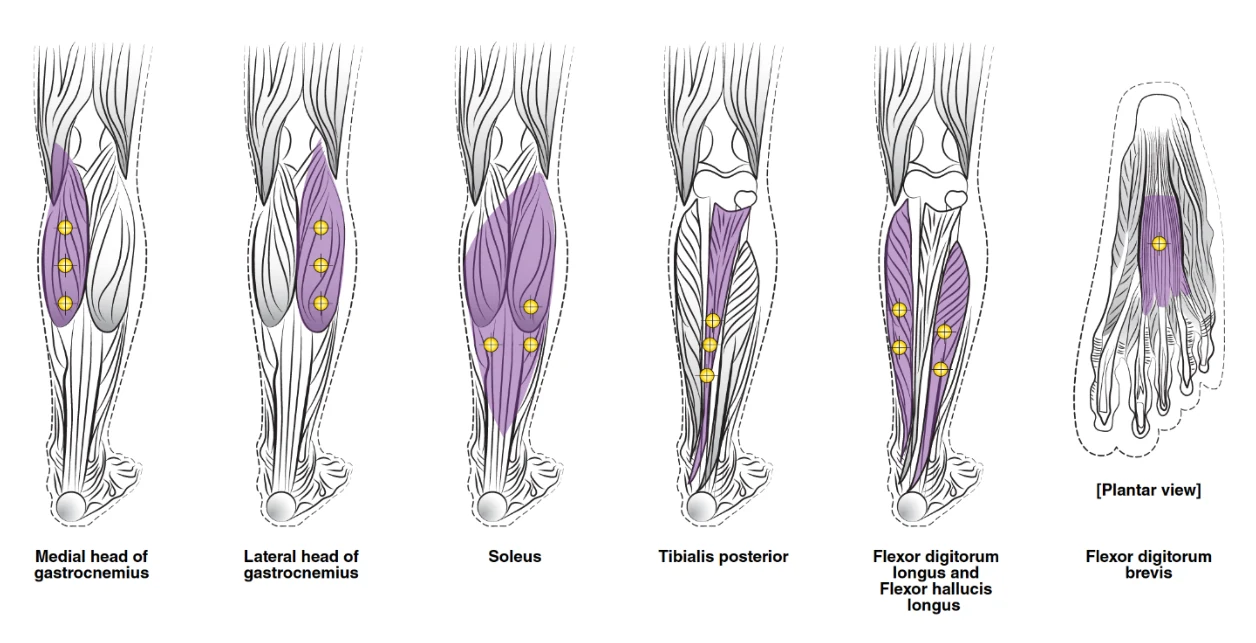
The recommended dose for treating adult lower limb spasticity involving the ankle and toes is 300 Units to 400 Units divided among up to 6 muscles (gastrocnemius, soleus, tibialis posterior, flexor hallucis longus, flexor digitorum longus, and flexor digitorum brevis) (see Table 3 and Figure 1 below).
If it is deemed appropriate by the treating physician, repeat Botox treatment may be administered when the effect of a previous injection has diminished, but generally no sooner than 12 weeks after the previous injection.
Table 3 - Botox Dosing by Muscle for Adult Lower Limb Spasticity
| Muscle | Recommended Dose Total Dosage; Number of Sites |
|---|---|
Gastrocnemius Medial head Lateral head | 75 Units; 3 sites 75 Units; 3 sites |
| Soleus | 75 Units; 3 sites |
| Tibialis posterior | 75 Units; 3 sites |
| Flexor hallucis longus | 50 Units; 2 sites |
| Flexor digitorum longus | 50 Units; 2 sites |
| Flexor digitorum brevis | 25 Units; 1 site |
Figure 1 Injection Sites for Adult Lower Limb Spasticity
Pediatric Focal Spasticity
Upper Limb
Appropriately sized sterile needle is recommended. Needle length should be determined based on muscle location and depth.
Localisation of the involved muscles with techniques such as needle electromyographic guidance, nerve stimulation, or ultrasound is recommended.
The following diagram indicates the injection sites for each muscle affected by pediatric upper limb spasticity:
Figure 2 Injection Sites for Pediatric Upper Limb Spasticity
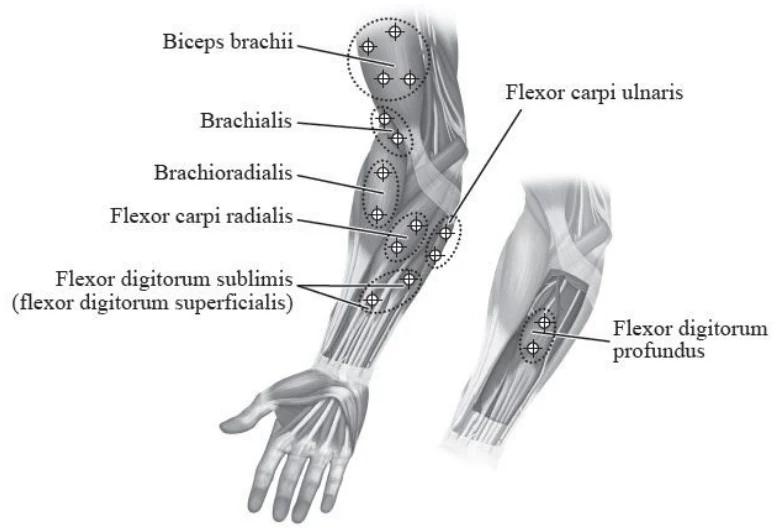
The recommended dose for treating pediatric upper limb spasticity is 3 Units/kg to 6 Units/kg divided among the affected muscles.
Table 4 - Botox Dosing by Muscle for Pediatric Upper Limb Spasticity
| Muscle | Total Dosage; Number of Sites |
|---|---|
| Biceps brachii | 1.5 Units/kg to 3 Units/kg; 4 sites |
| Brachialis | 1 Unit/kg to 2 Units/kg; 2 sites |
| Brachioradialis | 0.5 Units/kg to 1 Unit /kg; 2 sites |
| Flexor carpi radialis | 1 Unit/kg to 2 Units/kg; 2 sites |
| Flexor carpi ulnaris | 1 Unit/kg to 2 Units/kg; 2 sites |
| Flexor digitorum profundus | 0.5 Unit/kg to 1 Unit/kg; 2 sites |
| Flexor digitorum sublimis | 0.5 Units/kg to 1 Unit/kg; 2 sites |
The total dose of Botox administered per treatment session in the upper limb should not exceed 6Units/kg or 200 Units, whichever is lower. If it is deemed appropriate by the treating physician, the patient should be considered for re-injection when the clinical effect of the previous injection has diminished, no sooner than 12 weeks after the previous injection. When treating the upper and lower limbs in combination or any other combination, the total dose should not exceed 10 Units/kg body weight or 340 Units, in a 12-week interval, whichever is lower.
Clinical improvement may be expected within 7 days after administration of Botox. Treatment with Botox is not intended to substitute the usual standard of care rehabilitation regimens.
Lower Limb
Appropriately sized sterile needle. Needle length should be determined based on muscle location and depth.
Localisation of the involved muscles with techniques such as needle electromyographic guidance, nerve stimulation, or ultrasound is recommended.
The following diagram indicates the injection sites for paediatric lower limb spasticity:
Figure 3 Injection Sites for Pediatric Lower Limb Spasticity
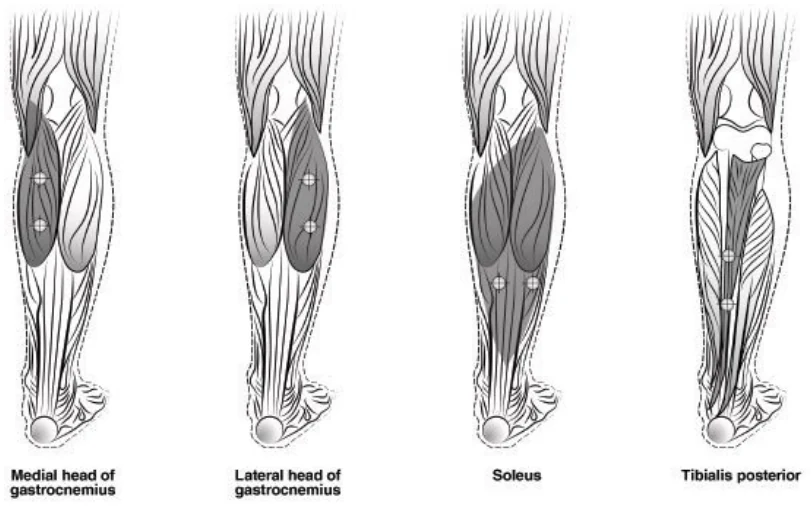
The recommended dose for treating pediatric lower limb spasticity is 4 Units/kg to 8 Units/kg body weight divided among the affected muscles.
Table 5 - Botox Dosing by Muscle for Pediatric Lower Limb Spasticity
| Muscle | Total Dosage; Number of Sites |
|---|---|
| Gastrocnemius medial head | 1 Unit/kg - 2 Units/kg; 2 sites |
| Gastrocnemius lateral head | 1 Unit/kg - 2 Units/kg; 2 sites |
| Soleus | 1 Unit/kg - 2 Units/kg; 2 sites |
| Tibialis posterior | 1 Unit/kg - 2 Units/kg; 2 sites |
The total dose of Botox administered per treatment session in the lower limb should not exceed 8 Units/kg body weight or 300 Units, whichever is lower. If it is deemed appropriate by the treating physician, the patient should be considered for re-injection when the clinical effect of the previous injection has diminished, no sooner than 12 weeks after the previous injection. When treating both lower limbs or the upper and lower limbs in combination or any other combination, the total dose should not exceed 10 Units/kg body weight or 340 Units, in a 12-week interval, whichever is lower.
Clinical improvement may be expected within 7 days after administration of Botox. Treatment with Botox is not intended to substitute the usual standard of care rehabilitation regimens.
Primary Hyperhidrosis of the Axilla
Botox is reconstituted with 0.9% non-preserved sterile saline (100 Units/4.0 mL). Using a 30-gauge needle, 50 Units of Botox (2.0 mL) is injected intradermally, evenly distributed in multiple sites (10-15) approximately 1-2 cm apart within the hyperhidrotic area of the axilla. The hyperhidrotic area may be defined using standard staining techniques, for example Minor’s iodine-starch test.
Chronic Migraine
The recommended dilution is 200 Units/4 mL or 100 Units/2 mL, with a final concentration of 5 Units per 0.1 mL (see Dilution Table 7). The recommended dose for treating chronic migraine is 155 Units administered intramuscularly (IM) as 0.1 ml (5 Units) injections to 31 sites using a 30-gauge, 0.5-inch needle. Injections should be divided across 7 specific head/neck muscle areas as specified in diagrams 1 – 4 and Table 6 below. A 1-inch needle may be needed in the neck region for patients with extremely thick neck muscles. With the exception of the procerus muscle, which should be injected at 1 site (midline), all muscles should be injected bilaterally with the minimum dose per muscle as indicated below, with half the number of injections sites administered to the left, and half to the right side of the head and neck (diagrams 1 – 4). The recommended retreatment schedule is every 12 weeks.
Diagrams 1 – 4: Recommended injection sites for chronic migraine
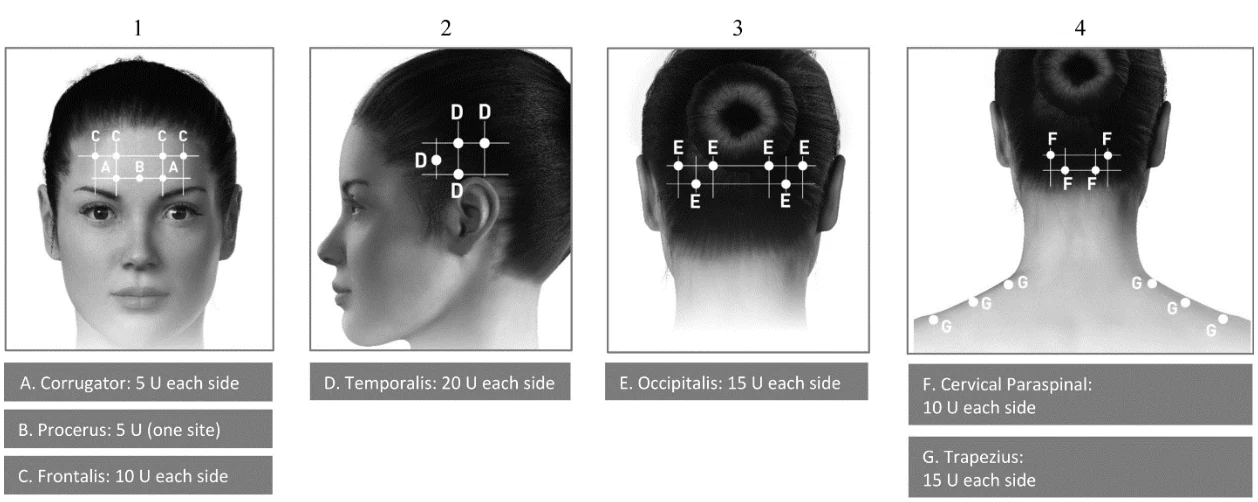
Table 6 - Botox Dosing by Muscle for Chronic Migraine
| Recommended Dose | |
|---|---|
| Head/Neck Area | Total Number of Units (U) (number of IM injection sitesa) |
| Corrugatorb | 10 Units (2 sites) |
| Procerus | 5 Units (1 site) |
| Frontalisb | 20 Units (4 sites) |
| Temporalisb | 40 Units (8 sites) |
| Occipitalisb | 30 Units (6 sites) |
| Cervical Paraspinal Muscle Groupb | 20 Units (4 sites) |
| Trapeziusb | 30 Units (6 sites) |
| Total Dose Range: | 155 Units (31 sites) |
a1IM injection site = 0.1 mL = 5 Units Botox bDose distributed bilaterally for minimum dose. | |
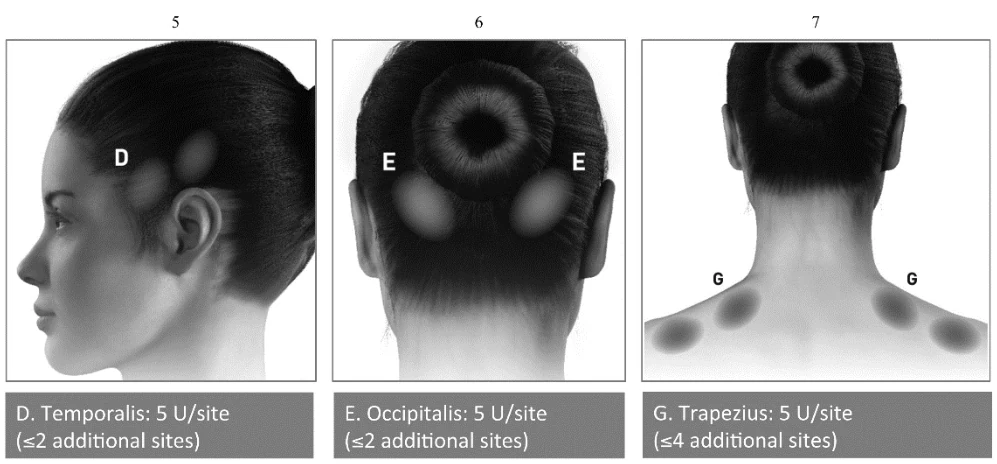
If there is a predominant pain location(s), optional additional injections to one or both sides may be administered in up to 3 specific muscle groups (occipitalis, temporalis, and trapezius), up to the maximum dose per muscle as indicated in diagrams 5 – 7. This represents a total maximum dose for chronic migraine of 195 Units (39 sites).
Diagrams 5 – 7: Recommended muscle groups for optional additional injections for chronic migraine
Bladder Dysfunction
Patients should not have urinary tract infection prior to treatment. Prophylactic antibiotics (except aminoglycosides, see 9 DRUG INTERACTIONS) should be administered 1-3 days pre-treatment, on the treatment day, and 1-3 days post-treatment.
It is recommended that patients discontinue anti-platelet therapy at least three days before the injection procedure. Patients on anti-coagulant therapy need to be managed appropriately to decrease the risk of bleeding.
Neurogenic Detrusor Overactivity associated with a neurological condition
An intravesical instillation of diluted local anesthetic with or without sedation, or general anesthesia may be used prior to injection, per local site practice. If a local anesthetic instillation is performed, the bladder should be drained and irrigated with sterile saline before injection.
The recommended dose is 200 Units of Botox.
Reconstitution of 200 Unit Vial
Reconstitute a 200 Unit vial of Botox with 6 mL of 0.9% non-preserved saline solution and mix the vial gently. Draw 2 mL from the vial into each of three 10 mL syringes. Complete the reconstitution by adding 8 mL of 0.9% non-preserved saline solution into each of the 10 mL syringes and mix gently. This will result in three 10 mL syringes each containing 10 mL (~67 Units in each), for a total of 200 Units of reconstituted Botox. Use immediately after reconstitution in the syringe. Dispose of any unused saline.
Reconstitution of 100 Unit Vial
Reconstitute two 100 Unit vials of Botox, each with 6 mL of 0.9% non-preserved saline solution and mix the vials gently. Draw 4 mL from each vial into each of two 10 mL syringes. Draw the remaining 2 mL from each vial into a third 10 mL syringe. Complete the reconstitution by adding 6 mL of 0.9% non-preserved saline solution into each of the 10 mL syringes and mix gently. This will result in three 10 mL syringes each containing 10 mL (~67 Units in each), for a total of 200 Units of reconstituted Botox. Use immediately after reconstitution in the syringe. Dispose of any unused saline.
Administration
Reconstituted Botox (200 Units/30 mL) is injected into the detrusor muscle via a flexible or rigid cystoscope, avoiding the trigone. The bladder should be instilled with enough saline to achieve adequate visualization for the injections, but over-distension should be avoided.
The injection needle should be filled (primed) with approximately 1 mL prior to the start of injections (depending on the needle length) to remove any air.
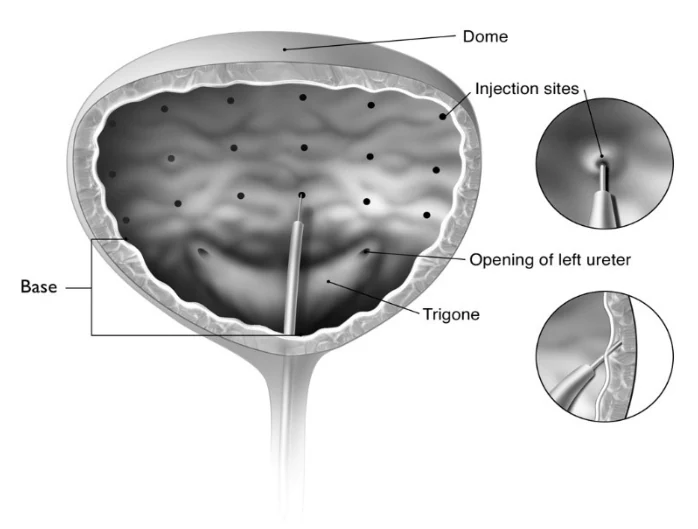
The needle should be inserted approximately 2 mm into the detrusor, and 30 injections of 1 mL each (total volume of 30 mL) should be spaced approximately 1 cm apart (see Figure 4 below). For the final injection, approximately 1 mL of sterile normal saline should be injected so the full dose is delivered. After the injections are given, the saline used for bladder wall visualization should be drained. The patient should be observed for at least 30 minutes post-injection.
Clinical improvement may occur within 2 weeks. Patients should be considered for reinjection when the clinical effect of the previous injection diminished (median duration in phase 3 clinical studies was 256-295 days (36-42 weeks) for Botox 200 Units), but no sooner than 3 months from the prior bladder injection. Based on patients who received treatments with only Botox 200 Units from the pivotal studies through the open label extension study (N=174), the overall median duration of response was 253 days (~36 weeks).
Figure 4 Injection Pattern for Intradetrusor Injections
Overactive Bladder
An intravesical instillation of diluted local anesthetic with or without sedation may be used prior to injection, per local site practice. If a local anesthetic instillation is performed, the bladder should be drained and irrigated with sterile saline before injection.
The recommended dose is 100 Units of Botox. The recommended dilution is 100 Units/10 mL with 0.9% non-preserved saline solution (see Dilution Table 7). Dispose of any unused saline.
Reconstituted Botox (100 Units/10 mL) is injected into the detrusor muscle via a flexible or rigid cystoscope, avoiding the trigone. The bladder should be instilled with enough saline to achieve adequate visualization for the injections, but over-distension should be avoided.
The injection needle should be filled (primed) with approximately 1 mL of reconstituted Botox prior to the start of injections (depending on the needle length) to remove any air.
The needle should be inserted approximately 2 mm into the detrusor, and 20 injections of 0.5 mL each (total volume of 10 mL) should be spaced approximately 1 cm apart (see Figure 4 above). For the final injection, approximately 1 mL of sterile normal saline should be injected so the full dose is delivered. After the injections are given, the saline used for bladder wall visualization should not be drained so that patients can demonstrate their ability to void prior to leaving the clinic. The patient should be observed for at least 30 minutes post-injection and until a spontaneous void has occurred. Post void residual urine volume should be measured within 2 weeks of treatment and CIC initiated if necessary.
Clinical improvement may occur within 2 weeks. Patients should be considered for reinjection when the clinical effect of the previous injection has diminished (median duration in phase 3 clinical studies was 166 days [~24 weeks]), but no sooner than 3 months from the prior bladder injection. Based on patients who received treatments with only Botox 100 Units from the pivotal studies through the open label extension study (N=438), the overall median duration of response was ~212 days (~30 weeks).
Lack of Response
There are several potential explanations for a lack or diminished response to an individual treatment with Botox. These may include inadequate dose selection, selection of inappropriate muscles for injection, muscles inaccessible to injection, underlying structural abnormalities such as muscle contractures or bone disorders, change in pattern of muscle involvement, patient perception of benefit compared with initial results, inappropriate storage or reconstitution, as well as neutralizing antibodies to botulinum toxin. A neutralizing antibody is defined as an antibody that inactivates the biological activity of the toxin. However, there have been patients who continued to respond to therapy and demonstrated presence of neutralizing antibodies; the proportion of patients which lose their response to botulinum toxin therapy and have demonstrable levels of neutralizing antibodies is small.
The critical factors for neutralizing antibody production are the frequency and dose of injection. Some cervical dystonia patients acquired immunity to botulinum toxin when injected at two to three-week intervals with doses exceeding 300 Units in a 30-day period. Some tolerance may be observed when Botox is used in treating blepharospasm if treatments are given more frequently than every three months. To reduce the potential for neutralizing antibody formation, it is recommended that injection intervals should be no more frequent than two months. In general, the dose should not exceed 400 Units in any three-month period. For the treatment of blepharospasm, the cumulative dose of Botox in a two-month period should not exceed 200 Units. No patients among 496 chronic migraine patients with analyzed specimens showed the presence of neutralizing antibodies.
A suggested course of action when patients do not respond to Botox injections is:
- 1) wait the usual treatment interval;
- 2) consider reasons for lack of response listed above;
- 3) more than one treatment course should be considered before classification of a patient as a non-responder;
- 4) test patient serum for neutralizing antibody presence.
4.3 Reconstitution
Parenteral Products:
To reconstitute vacuum-dried Botox, use sterile normal saline without a preservative; 0.9% Sodium Chloride Injection is the only recommended diluent. Draw up the proper amount of diluent in the appropriate size syringe. Since Botox is denatured by bubbling or similar violent agitation, inject the diluent into the vial gently. Discard the vial if a vacuum does not pull the diluent into the vial. Record the date and time of reconstitution on the space on the label. Botox should be administered within twenty-four hours after reconstitution.
During this time period, reconstituted Botox should be stored in a refrigerator (2 to 8o C). Reconstituted Botox should be clear, colourless and free of particulate matter. Parenteral drug products should be inspected visually for particulate matter and discolouration prior to administration and whenever the solution and the container permit.
Table 7 - Dilution
Quantity of Diluent Added (0.9% Sodium Chloride Injection) | Resulting dose Units per 0.1 mL | ||
| 50 Unit Vial | 100 Unit Vial | 200 Unit Vial | |
| 1.0 mL | 5.0 Units | 10.0 Units | 20.0 Units |
| 2.0 mL | 2.5 Units | 5.0 Units | 10.0 Units |
| 4.0 mL | 1.25 Units | 2.5 Units | 5.0 Units |
| 8.0 mL | - | 1.25 Units | 2.5 Units |
| 10.0 mL | - | 1 Units | 2 Units |
| Note: These dilutions are calculated for an injection volume of 0.1 mL. A decrease or increase in the Botox dose is also possible by administering a smaller or larger injection volume (i.e., 0.05 mL (50% decrease in dose) to 0.15 mL (50% increase in dose)). | |||
For reconstitution technique for intradetrusor injections for neurogenic detrusor overactivity please refer to 4 DOSAGE AND ADMINISTRATION, Recommended Dose and Dosage Adjustment, Neurogenic Detrusor Overactivity.
4.4 Administration
An injection of Botox is prepared by drawing into a sterile 1.0 mL tuberculin syringe an amount of the properly diluted toxin (see Dilution Table 7) slightly greater than the intended dose. Air bubbles in the syringe barrel are expelled and the syringe may be attached to the electromyographic injection needle, preferably a 1.5-inch, 27-gauge needle. Injection volume in excess of the intended dose is expelled through the needle into an appropriate waste container to assure patency of the needle and to confirm that there is no syringe-needle leakage. A new sterile needle and syringe should be used to enter the vial on each occasion for dilution or removal of Botox.
4.5 Missed Dose
Missed doses may be administered as soon as is practical.
5 OVERDOSAGE
| For management of a suspected drug overdose, contact your regional poison control centre. |
|---|
Overdose of Botox is a relative term and depends upon dose, site of injection, and underlying tissue properties. Signs and symptoms of overdose are not apparent immediately post-injection. Excessive doses may produce local, or distant, generalized and profound neuromuscular paralysis. Should accidental injection or oral ingestion occur, or overdose be suspected, the person should be medically monitored for up to several weeks for progressive signs or symptoms of muscular weakness, which could be local or distant from the site of injection that may include ptosis, diplopia, swallowing and speech disorders, generalized weakness or respiratory failure. These patients should be considered for further medical evaluation and appropriate medical therapy immediately instituted, which may include hospitalization.
If the musculature of the oropharynx and esophagus are affected, aspiration may occur which may lead to development of aspiration pneumonia. If the respiratory muscles become paralyzed or sufficiently weakened, intubation and assisted respiration may be necessary until recovery takes place. Supportive care could involve the need for a tracheostomy and/or prolonged mechanical ventilation, in addition to other general supportive care.
6 DOSAGE FORMS, STRENGTHS, COMPOSITION AND PACKAGING
Botox is available in 50, 100 and 200 Unit sterile vials of Clostridium botulinum toxin type A in a vacuum-dried form without a preservative. One Allergan unit corresponds to the calculated median lethal dose (LD50) in mice using reconstituted Botox and injected intraperitoneally.
Table 8 - Dosage Forms, Strengths, Composition and Packaging
| Route of Administration | Dosage Form / Strength/Composition | Non-medicinal Ingredients |
Intramuscular Use for All Indications except Hyperhidrosis and Bladder Dysfunction Intradetrusor Use for Bladder Dysfunction only Intradermal Use for Hyperhidrosis only | Sterile vacuum-dried concentrate; powder for solution for injection; 50, 100 and 200 Allergan Units per vial | Albumin (human) Sodium Chloride |
The quantities of the ingredients in each vial are listed below:
Table 9 - List of Ingredients
| INGREDIENTS | 50 Botox Unit Vial | 100 Botox Unit Vial | 200 Botox Unit Vial |
| Clostridium botulinum toxin type A neurotoxin complex (900kD) | 50 Units | 100 Units | 200 Units |
| Human Serum Albumin | 0.25 mg | 0.5 mg | 1.0 mg |
| Sodium Chloride | 0.45 mg | 0.9 mg | 1.8 mg |
7 WARNINGS AND PRECAUTIONS
Please see 3 SERIOUS WARNINGS AND PRECAUTIONS BOX section.
General
Use Botox only as directed.
Do not use dosage recommendations and potency Units applied to other botulinum toxin products when using Botox.
The safe and effective use of Botox depends upon proper storage of the product, selection of the correct dose, and proper reconstitution and administration techniques.
Injectors administering Botox should be familiar with the relevant anatomy of the area involved and any alterations to the anatomy due to prior surgical procedures. Care should be taken when injecting in or near vulnerable anatomic structures. Serious adverse events including fatal outcomes have been reported in patients who had received Botox injected directly into salivary glands, the oro-lingual-pharyngeal region, esophagus and stomach. Some patients had pre-existing dysphagia or significant debility. An understanding of standard electromyographic techniques is also required for treatment of strabismus and may be useful for the treatment of cervical dystonia, and focal spasticity associated with pediatric cerebral palsy and upper and lower limb spasticity in adults.
Pneumothorax associated with injection procedure has been reported following the administration of Botox near the thorax. Caution is warranted when injecting in proximity to the lung, particularly the apices.
Caution should be used when Botox is used in the presence of inflammation at the proposed injection site(s) or when excessive weakness or atrophy is present in the target muscle.
Local muscle weakness represents the expected pharmacological action of botulinum toxin in muscle tissue. However, weakness of adjacent muscles associated with local diffusion and/or injection technique has been reported.
Progressive signs or symptoms of muscular weakness remote to the site of injection may include ptosis and diplopia, as well as other serious adverse effects including swallowing and speech disorders, generalized weakness or respiratory failure. In addition, certain adverse effects (e.g., dysphagia, aspiration pneumonia) have been rarely reported in both pediatric and adult patients, some of which have been associated with a fatal outcome.
When exposed to very high doses, patients with neurologic disorders, e.g., pediatric cerebral palsy or adult spasticity, may be at increased risk of clinically significant systemic effects.
Patients or caregivers should be advised to seek immediate medical care if swallowing, speech or respiratory disorders arise.
Patients with a history of underlying neurological disorders, dysphagia and/or aspiration should be treated with extreme caution. The botulinum toxin product should be used under specialist supervision in these patients and should only be used if the benefit of treatment is considered to outweigh the risk.
Injection specific dosage and administration recommendations should be followed for each indication. When combining indications, the maximum cumulative dose in a 3-month interval should generally not exceed 7 Units/kg or 400 Units, whichever is lower, in adults, and 10 Units/kg or 340 Units, whichever is lower, in pediatric patients.
The primary release procedure for Botox uses a cell-based potency assay to determine the potency relative to a reference standard. The assay is specific to AbbVie’s product Botox. One Allergan Unit corresponds to the calculated median intraperitoneal lethal dose (LD50) in mice. Due to specific details of this assay such as the vehicle, dilution scheme and laboratory protocols, Units of biological activity of Botox cannot be compared to nor converted into Units of any other botulinum toxin or any toxin assessed with any other specific assay method. The specific activity of Botox is approximately 20 Units/nanogram of neurotoxin protein complex.
This product contains human serum albumin, a derivative of human blood. Based on effective donor screening and product manufacturing processes, it carries an extremely remote risk for transmission of viral diseases. A theoretical risk for transmission of Creutzfeldt-Jakob disease (CJD) also is considered extremely remote. No cases of transmission of viral diseases or CJD have ever been identified for albumin.
Focal Spasticity in adult and pediatric patients
Botox is a treatment of spasticity that has only been studied in association with usual standard of care regimens and is not intended as a replacement for these treatment modalities. Botox is not likely to be effective in improving range of motion at a joint affected by a fixed contracture.
Botox should be used for the treatment of focal lower limb spasticity in adult patients only if muscle tone reduction is expected to result in improved function (e.g., improvement in gait), or improved symptoms (e.g., reduction in pain), or to facilitate care.
Caution should be exercised when treating adult patients with spasticity who may be at increased risk of fall.
Botox should be used with caution for the treatment of focal lower limb spasticity in elderly patients with significant co-morbidity and treatment should only be initiated if the benefit of treatment is considered to outweigh the potential risk.
Chronic Migraine
No efficacy has been shown for Botox in the prophylaxis of headaches in patients with episodic migraine (< 15 headache days per month).
Bladder Dysfunction
Appropriate medical caution should be exercised for performing a cystoscopy.
Patients who are not catheterizing prior to treatment may subsequently require catheterization for urinary retention. In patients who are not catheterizing, post-void residual urine volume should be assessed within 2 weeks post-treatment and periodically as medically appropriate up to 12 weeks. Patients should be instructed to contact their physician if they experience difficulties in voiding.
Neurogenic Detrusor Overactivity
In these patients, autonomic dysreflexia associated with the procedure could occur, which may require prompt medical therapy.
Patients with spinal cord injury above T1 were excluded from Botox clinical trials for neurogenic detrusor overactivity.
Primary hyperhidrosis of the axillae
Medical history and physical examination, along with specific additional investigations as required, should be performed to exclude potential causes of secondary hyperhidrosis (e.g., hyperthyroidism or phaeochromocytoma). This will avoid symptomatic treatment of hyperhidrosis without the diagnosis and/or treatment of underlying disease.
Carcinogenesis and Mutagenesis
Studies in animals have not been performed to evaluate the carcinogenic potential of Botox. Botox was not mutagenic in in vitro and in vivo mutagenicity studies. See 16 NON-CLINICAL TOXICOLOGY section for more information.
Cardiovascular
There have been reports following administration of botulinum toxin of adverse events involving the cardiovascular system, including arrhythmia and myocardial infarction, some with fatal outcomes. Some of these patients had risk factors including pre-existing cardiovascular disease. The exact relationship of these events to Botox/Botox Cosmetic is unknown. Needle-related pain and/or anxiety have resulted in vasovagal responses, including transient symptomatic hypotension and syncope.
Ear/Nose/Throat
Cervical Dystonia - Dysphagia is a commonly reported adverse event following treatment of cervical dystonia patients with all types of botulinum toxins. Patients with cervical dystonia should be informed of the possibility of experiencing dysphagia which may be mild but could be severe. Consequent to the dysphagia there is the potential for aspiration, dyspnea and occasionally the need for tube feeding. In rare cases, dysphagia followed by aspiration pneumonia and death has been reported.
Injections into the levator scapulae may be associated with an increased risk of upper respiratory infection and dysphagia.
Dysphagia has contributed to decreased food and water intake resulting in weight loss and dehydration. Patients with subclinical dysphagia may be at increased risk of experiencing more severe dysphagia following a Botox injection.
Limiting the dose injected into both sternocleidomastoid muscles to less than 100 Units may decrease the occurrence of dysphagia. Patients with smaller neck muscle mass, or patients who receive bilateral injections into the sternocleidomastoid muscle, have been reported to be at greater risk of dysphagia. Dysphagia is attributable to the localized diffusion of the toxin to the oesophageal musculature.
Patients or caregivers should be advised to seek immediate medical care if swallowing, speech or respiratory disorders arise.
Immune
Formation of neutralizing antibodies to botulinum toxin type A may reduce the effectiveness of Botox treatment by inactivating the biological activity of the toxin. The critical factors for neutralizing antibody formation have not been well characterized. The results from some studies suggest that Botox injections at more frequent intervals or at higher doses may lead to greater incidence of antibody formation. When appropriate, the potential for antibody formation may be minimized by injecting with the lowest effective dose given at the longest feasible intervals between injections.
As with all biologic products, an anaphylactic reaction may occur. Necessary precautions should be taken, and epinephrine should be available.
Serious and/or immediate hypersensitivity reactions such as anaphylaxis and serum sickness have been rarely reported, as well as other manifestations of hypersensitivity including urticaria, soft tissue edema, and dyspnea. Some of these reactions have been reported following the use of Botox either alone or in conjunction with other products associated with similar reactions. One fatal case of anaphylaxis has been reported in which lidocaine was used as the diluent for Botox and consequently the causal agent cannot be reliably determined. If such a reaction occurs, further injection should be discontinued, and appropriate medical therapy initiated immediately.
Neurologic
Extreme caution should be exercised when administering Botox to individuals with peripheral motor neuropathic diseases (e.g., amyotrophic lateral sclerosis, or motor neuropathy) or neuromuscular junction disorders (e.g., myasthenia gravis or Lambert-Eaton syndrome). Patients with neuromuscular junction disorders may be at increased risk of clinically significant systemic effects including severe dysphagia and respiratory compromise from typical doses of Botox. There have been rare cases of administration of botulinum toxin to patients with known or unrecognized neuromuscular junction disorders where the patients have shown extreme sensitivity to the systemic effects of typical clinical doses. In some of these cases, dysphagia has lasted several months and required placement of a gastric feeding tube. When exposed to very high doses, patients with neurologic disorders, e.g., pediatric cerebral palsy or adult spasticity, may also be at increased risk of clinically significant systemic effects.
New onset or recurrent seizures have been reported, typically in patients who are predisposed to experiencing these events. The reports in children were reports predominantly from cerebral palsy patients treated for spasticity. The exact relationship of these events to the botulinum toxin injection has not been established.
Ophthalmologic
Blepharospasm
Reduced blinking following Botox injection into the orbicularis oculi muscle can lead to corneal exposure, persistent epithelial defect, and corneal ulceration, especially in patients with VII nerve disorders. One case of corneal perforation in an aphakic eye requiring corneal grafting has occurred because of this effect. Careful testing of corneal sensation in eyes previously operated upon, avoidance of injection into the lower lid area to avoid ectropion, and vigorous treatment of any epithelial defect should be employed. This may require protective drops, ointment, therapeutic soft contact lenses, or closure of the eye by patching or other means.
Because of the anticholinergic activity of botulinum toxin, caution should be exercised when treating patients at risk for angle closure glaucoma, including patients with anatomically narrow angles. Acute angle closure glaucoma has been reported very rarely following periorbital injections of botulinum toxin.
Strabismus
Botox is ineffective in chronic paralytic strabismus except to reduce antagonist contracture in conjunction with surgical repair. The efficacy of Botox in deviations over 50 prism diopters, in restrictive strabismus, in Duane's syndrome with lateral rectus weakness, and in secondary strabismus caused by prior surgical over-recession of the antagonist is doubtful. In order to enhance efficacy, multiple injections over time may be required.
During the administration of Botox for the treatment of strabismus, retrobulbar hemorrhages sufficient to compromise retinal circulation have occurred from needle penetrations into the orbit. It is recommended that appropriate instruments to decompress the orbit be accessible. Ocular (globe) penetrations by needles have also occurred. An ophthalmoscope to diagnose this condition should be available.
Inducing paralysis in one or more extraocular muscles may produce spatial disorientation, double vision, or past-pointing. Covering the affected eye may alleviate these symptoms.
Reproductive Health: Female and Male Potential
See 7.1.1 Pregnant Women and 16 NON-CLINICAL TOXICOLOGY.
Skin
As is expected for any injection procedure, localized pain, inflammation, paresthesia, hypoaesthesia, tenderness, swelling/edema, erythema, localized infection, bleeding and/or bruising have been associated with the injection.
7.1 Special Populations
7.1.1 Pregnant Women
There are no adequate and well-controlled studies of Botox administration in pregnant women. Studies in animals have shown reproductive toxicity. The potential risk for humans is unknown. Botox should not be used during pregnancy unless clearly necessary. If this drug is used during pregnancy, or if the patient becomes pregnant while taking this drug, the patient should be apprised of the potential risks, including abortion or fetal malformations, which have been observed in rabbits.
7.1.2 Breast-feeding
It is not known whether this drug is excreted in human milk. Because many drugs are excreted in human milk, caution should be exercised when Botox is administered to a nursing woman.
7.1.3 Pediatrics
There have been rare spontaneous reports of death associated with severe adverse reactions, including aspiration pneumonia, in children with severe cerebral palsy after treatment with botulinum toxin. A causal association to Botox has not been established in these cases. Post-marketing reports of possible distant spread of toxin have been very rarely reported in pediatric patients with co-morbidities, predominantly with cerebral palsy, who received > 8 Units/kg. Extreme caution should be exercised when treating pediatric patients who have significant neurologic debility, dysphagia, or have a recent history of aspiration pneumonia or lung disease.
7.1.4 Geriatrics
Studies of Botox specifically designed to determine dose in elderly patients have not been performed. Dosages for the elderly are as for other adults. In addition, aggregate review of Botox post-marketing and clinical trial safety reports showed that, in general, the risk of adverse events is comparable between the elderly and younger population. In general, dose selection for an elderly patient should be cautious, usually starting at the lowest recommended dose for the specific indication.
Of 1242 patients in placebo-controlled clinical studies of Botox for the treatment of overactive bladder, 41.4% (n=514) were 65 years of age or older, and 14.7% (n=182) were 75 years of age or older. No overall difference in the safety profile following Botox treatment was observed between patients aged 65 years and older compared to younger patients in these studies, with the exception of urinary tract infection where the incidence was higher in patients 65 years of age or older in both the placebo and Botox groups compared to the younger patients.
8 ADVERSE REACTIONS
8.1 Adverse Reaction Overview
In general, adverse reactions occur within the first few days following injection and while generally transient may have duration of several months or, in rare cases, longer.
Local muscle weakness represents the expected pharmacological action of botulinum toxin in muscle tissue. However, weakness of adjacent muscles associated with local diffusion and/or injection technique has been reported. Muscle weakness remote to the site of injection and other serious adverse effects (e.g., dysphagia, aspiration pneumonia) have been rarely reported in both pediatric and adult patients, some associated with a fatal outcome.
As is expected for any injection procedure, localized pain, inflammation, paresthesia, hypoesthesia, tenderness, swelling/oedema, erythema, localized infection, bleeding and/or bruising have been associated with the injection. Needle-related pain and/or anxiety have resulted in vasovagal responses, including transient symptomatic hypotension and syncope.
8.2 Clinical Trial Adverse Reactions
Because clinical trials are conducted under very specific conditions, the adverse reaction rates observed in the clinical trials may not reflect the rates observed in practice and should not be compared to the rates in the clinical trials of another drug. Adverse reaction information from clinical trials is useful for identifying drug-related adverse events and for approximating rates.
For each indication the frequency of adverse reactions documented during clinical trials is given. The following lists events that occurred in ≥ 1% of subjects. The frequency is defined as follows: Very Common (≥ 1/10); Common (≥1/100, <1/10).
Blepharospasm
Safety data compiled from controlled clinical trials and open label studies involving 1732 patients treated with Botox, the following adverse reactions were reported.
Table 10 - Adverse Reactions in Blepharospasm
| Eye disorders | |
|---|---|
| Very common (≥ 1/10) | Eyelid ptosis |
| Common (≥1/100, <1/10) | Punctate keratitis, lagophthalmos, dry eye, photophobia, eye irritation, lacrimation increase |
| Skin and subcutaneous tissue disorders | |
| Common (≥1/100, <1/10) | Ecchymosis |
Strabismus
Safety data compiled from clinical trials involving approximately 2058 patients treated with Botox, the following adverse reactions were reported.
Table 11 - Adverse Reactions in Strabismus
| Eye disorders | |
|---|---|
| Very common (≥ 1/10) | Eyelid ptosis, eye movement disorder |
Cervical dystonia
Safety data compiled from placebo controlled, double-blind trial involving 231 patients treated with Botox, the following adverse reactions were reported.
Table 12 - Adverse Reactions in Cervical Dystonia
| Gastrointestinal disorders | |
|---|---|
| Very common (≥ 1/10) | Dysphagia |
| Common (≥1/100, <1/10) | Dry mouth, nausea |
| General disorders and administration site conditions | |
| Very common (≥ 1/10) | Pain |
| Common (≥1/100, <1/10) | Asthenia, malaise, influenza like illness |
| Infections and infestations | |
| Common (≥1/100, <1/10) | Rhinitis, upper respiratory tract infection |
| Musculoskeletal and connective tissue disorders | |
| Very common (≥ 1/10) | Muscular weakness |
| Common (≥1/100, <1/10) | Musculoskeletal stiffness |
| Nervous system disorders | |
| Common (≥1/100, <1/10) | Dizziness, hypertonia, hypoesthesia, somnolence, headache |
Adult Focal Spasticity
Upper Limb
Safety data was evaluated in 1330 patients treated with Botox of which 658 patients were from double-blind, placebo-controlled studies. The following adverse reactions were reported. In general, the majority of adverse events reported were mild to moderate in severity and were typically self-limiting.
Table 13 - Adverse Reactions in Upper Limb Spasticity in Adult Patients in Double-blind, Placebo-controlled Studies
Botox (All doses) N = 658 (%) | Placebo N = 396 (%) | |
Gastrointestinal disorders Nausea | 11 (1.7%) | 2 (0.5%) |
Musculoskeletal and connective tissue disorders Muscular weakness Pain in extremity | 11 (1.7%) 31 (4.7%) | 3 (0.8%) 10 (2.5%) |
General Disorder and administration site condition Fatigue Edema peripheral | 8 (1.2%) 12 (1.8%) | 0 (0.0%) 2 (0.5%) |
No change was observed in the overall safety profile with repeat dosing.
Lower Limb
A total of 538 adult patients have been treated with Botox for lower limb spasticity in 7 double-blind, placebo-controlled studies.
The most frequently reported adverse events in patients treated in the All-Botox group were fall (which occurred in 4.5% and 4.5% in Botox groups and placebo groups, respectively) and pain in extremity (which occurred in 5.0% and 4.7% in Botox groups and placebo groups, respectively).
Table 14 - Adverse Reactions Reported in ≥2% of Botox treated Patients and More Frequent than in Placebo-treated Patients in Adult Lower Limb spasticity – A Single Dose Placebo-Controlled Study (First 12 Weeks of Double-blind Phase)
Botox (300-400 Units) N = 231 (%) | Placebo N = 233 (%) | |
General Disorder and administration site condition Injection site pain | 5 (2%) | 3 (1%) |
Botox (300-400 Units) N = 231 (%) | Placebo N = 233 (%) | |
Infections and infestations Upper respiratory tract infection | 4 (2%) | 2 (1%) |
Musculoskeletal and connective tissue disorders Arthralgia Back Pain Myalgia | 8 (4%) 6 (3%) 4 (2%) | 2 (1%) 4 (2%) 3 (1%) |
No change was observed in the overall safety profile with repeat dosing.
Table 15 - Adverse Reactions in Primary Hyperhidrosis of the Axillae
| Gastrointestinal disorders | |
|---|---|
| Common (≥1/100, <1/10) | Nausea |
| General disorders and administration site conditions | |
| Very common (≥ 1/10) | Injection site pain |
| Common (≥1/100, <1/10) | Pain, injection site edema, injection site hemorrhage, injection site hypersensitivity, injection site irritation, asthenia |
| Musculoskeletal and connective tissue disorders | |
| Common (≥1/100, <1/10) | Pain in extremity |
| Nervous system disorders | |
| Common (≥1/100, <1/10) | Headache, paresthesia |
| Skin and subcutaneous tissue disorders | |
| Common (≥1/100, <1/10) | Hyperhidrosis, skin odor abnormal, pruritus, subcutaneous nodule, alopecia |
| Vascular disorders | |
| Common (≥1/100, <1/10) | Hot flush |
Note: increase in non-axillary sweating was reported in 4.5% of patients within one month after injection and showed no pattern with respect to anatomical sites affected. Resolution was seen in approximately 30% of the patients within four months.
Chronic Migraine
Safety data compiled from two chronic migraine double-blind, placebo-controlled phase 3 clinical trials involving 687 patients treated with Botox. The following adverse reactions were reported.
Table 16 - Adverse Reactions Reported by ≥ 2% of Botox Treated Patients and More Frequent than in Placebo-treated Patients in Two Phase 3 Chronic Migraine Double-blind, Placebo-controlled Clinical Trials
Botox N = 687 (%) | Placebo N = 692 (%) | |
| OVERALL | 429 (62.4%) | 358 (51.7%) |
Eye Disorders Eyelid ptosis | 25 (3.6%) | 2 (0.3%) |
General Disorders & Administration Site Conditions Injection site pain | 23 (3.3%) | 14 (2.0%) |
| Infections and infestations | ||
| Sinusitis | 28 (4.1%) | 27 (3.9%) |
| Bronchitis | 17 (2.5%) | 11 (1.6%) |
| Musculoskeletal & Connective Tissue Disorders | ||
| Neck pain | 60 (8.7%) | 19 (2.7%) |
| Musculoskeletal stiffness | 25 (3.6%) | 6 (0.9%) |
| Muscular weakness | 24 (3.5%) | 2 (0.3%) |
| Myalgia | 21 (3.1%) | 6 (0.9%) |
| Musculoskeletal pain | 18 (2.6%) | 10 (1.4%) |
| Nervous System Disorders | ||
| Headache | 32 (4.7%) | 22 (3.2%) |
| Migraine | 26 (3.8%) | 18 (2.6%) |
| Facial paresis | 15 (2.2%) | 0 (0.0%) |
The discontinuation rate due to adverse events in these phase 3 trials was 3.8% for Botox vs. 1.2% for placebo. The most frequently reported adverse events leading to discontinuation in the Botox group were neck pain (0.6%), muscular weakness (0.4%), headache (0.4%), and migraine (0.4%).
Neurogenic Detrusor Overactivity associated with a neurologic condition
The table below presents the most frequently reported adverse reactions in two double-blind, placebo-controlled studies with Botox 200 Units within 12 weeks of injection for detrusor overactivity associated with a neurologic condition.
Table 17 - Adverse Reactions Reported by >1% of Botox treated Patients and More Frequent than in Placebo-treated Patients Within the First 12 Weeks after Intradetrusor Injection in Two Double-blind, Placebo-controlled Clinical Trials
Botox 200 Units (N=262) | Placebo (N=272) | |
|---|---|---|
General disorders and administration site conditions Fatigue | 10 (4%) | 3 (1%) |
Infections and infestations Urinary tract infection | 64 (24%) | 47 (17%) |
Psychiatric disorders Insomnia | 4 (2%) | 0 (0%) |
Renal and urinary disorders Urinary retention Hematuria | 45 (17%) 10 (4%) | 8 (3%) 8 (3%) |
The following adverse event rates with Botox 200 Units were reported at any time following initial injection and prior to re-injection or study exit (median duration of 44 weeks of exposure): urinary tract infections (49%), urinary retention (17%), fatigue (6%), constipation (4%), muscular weakness (4%), dysuria (4%), fall (3%), gait disturbance (3%), insomnia (3%), and muscle spasm (2%).
In the multiple sclerosis (MS) patients enrolled in the pivotal studies, the MS exacerbation annualized rate (i.e., number of MS exacerbation events per patient-year) was 0.23 for Botox and 0.20 for placebo.
Among patients who were not catheterizing at baseline prior to treatment, catheterization was initiated in 38.9% following treatment with Botox 200 Units versus 17.3% on placebo. Catheterization rates by etiology (multiple sclerosis [MS] and spinal cord injury [SCI]) are further presented in the table below.
Table 18 - Proportion of Patients by Etiology (MS and SCI) not Using CIC at Baseline and then Initiating Catheterization following Injection at Any Time During the Complete Treatment Cycle in Two Double-blind, Placebo-controlled Clinical Trials
| MS | SCI | ||||||||
|---|---|---|---|---|---|---|---|---|---|
Botox 200 Units (N=86) | Placebo (N=88) | Botox 200 Units (N=22) | Placebo (N=16) | ||||||
| CIC initiated for any reason | 34 (40%) | 15 (17%) | 8 (36%) | 3 (19%) | |||||
| CIC initiated for urinary retention | 27 (31%) | 4 (5%) | 6 (27%) | 3 (19%) | |||||
In these clinical trials, no change in the type of adverse reactions was observed following two treatments.
No change was observed in the overall safety profile with repeat dosing.
Post-Approval Commitment Study
A placebo-controlled, double-blind post-approval study with Botox 100 Units was conducted in Multiple Sclerosis (MS) patients with urinary incontinence due to neurogenic detrusor overactivity. These patients were not adequately managed with at least one anticholinergic agent and not catheterizing at baseline. The table below presents the most frequently reported adverse reactions within 12 weeks of injection.
Table 19 - Adverse Reactions Reported by >1% of Botox treated Patients and More Frequent than in Placebo-treated Patients Within the First 12 Weeks after Intradetrusor Injection
Botox 100 Units (N=66) | Placebo (N=78) | |
|---|---|---|
Infections and infestations Urinary tract infection Bacteriuria | 17 (26%) 6 (9%) | 5 (6%) 4 (5%) |
Investigations Residual urine volume* | 11 (17%) | 1 (1%) |
Renal and urinary disorders Urinary retention Dysuria | 10 (15%) 3 (5%) | 1 (1%) 1 (1%) |
| * Elevated PVR not requiring catheterization | ||
The following adverse event rates with Botox 100 Units were reported at any time following initial injection and prior to re-injection or study exit (median duration of 51 weeks of exposure): urinary tract infections (39%), bacteriuria (18%), urinary retention (17%), residual urine volume* (17%), dysuria (9%), and hematuria (5%).
No difference on the MS exacerbation annualized rate (i.e., number of MS exacerbation events per patient-year) was observed (Botox=0, placebo=0.07).
Catheterization was initiated in 15.2% of patients following treatment with Botox 100 Units versus 2.6% on placebo.
Overactive Bladder
The table below presents the most frequently reported adverse reactions in double-blind, placebo-controlled, pivotal Phase 3 studies within 12 weeks of injection for overactive bladder.
Table 20 - Adverse Reactions Reported by >1% of Botox treated Patients and More Frequent than in Placebo-treated Patients Within the First 12 Weeks, in Double-blind, Placebo-controlled, Pivotal Phase 3 Clinical Trials
Botox 100 Units (N=552) | Placebo (N=542) | |||
|---|---|---|---|---|
Infections and infestations Urinary tract infection Bacteriuria | 99 (18%) 24 (4%) | 30 (6%) 11 (2%) | ||
Investigations Residual urine volume* | 17 (3%) | 1 (0%) | ||
Renal and urinary disorders Dysuria Urinary retention | 50 (9%) 31 (6%) | 36 (7%) 2 (0%) | ||
| *Elevated PVR not requiring catheterization | ||||
During the complete treatment cycle, the following adverse reactions with Botox 100 Units were reported: urinary tract infections (26%), dysuria (11%), bacteriuria (8%), urinary retention (6%), residual urine volume (3%), and pollakiuria (2%).
Events considered to be procedure-related by the investigator reported at any time following initial injection were dysuria (6%) and haematuria (2%).
Catheterization was initiated in 6.5% following treatment with Botox 100 Units versus 0.4% in the placebo group.
No change was observed in the overall safety profile with repeat dosing.
8.2.1 Clinical Trial Adverse Reactions – Pediatrics
Pediatric Focal Spasticity
Upper Limb
The most frequently reported adverse reactions following injection of Botox in pediatric patients 2 years of age or older with upper limb spasticity are listed in table below. In a double-blind, placebo-controlled trial, 78 patients were treated with 3 Units/kg of Botox, and 77 patients received 6 Units/kg to a maximum dose of 200 Units of Botox and were compared to 79 patients who received placebo. Patients were followed for an average of 91 days after injection.
Table 21 - Adverse Reactions Reported by >1% of Botox treated Patients and More Frequent than in Placebo-treated Patients in Pediatric Upper Limb Spasticity Double-blind, Placebo-controlled Clinical Trial
Botox 3 Units/kg (N=78) % | Botox 6 Units/kg (N=77) % | Placebo (N=79) % | |
|---|---|---|---|
Gastrointestinal disorders Nausea | 2.6% (2) | 3.9% (3) | 1.3% (1) |
General disorders and administration site conditions Injection site pain | 3.8% (3) | 1.3% (1) | 1.3% (1) |
Infections and infestations Upper respiratory tract infection | 5.1% (4) | 9.1% (7) | 2.5% (2) |
Musculoskeletal and connective tissue disorders Muscular weakness | 0.0% (0) | 3.9% (3) | 0.0% (0) |
Lower Limb
The most frequently reported adverse reactions following injection of Botox in pediatric patients 2 years of age or older with lower limb spasticity are listed in table below. In a double-blind, placebo-controlled trial, 126 patients were treated with 4 Units/kg of Botox, and 128 patients received 8 Units/kg to a maximum dose of 300 Units of Botox and were compared to 128 patients who received placebo. Patients were followed for an average of 89 days after injection.
Table 22 - Adverse Reactions Reported by >1% of Botox 8 Units/kg Treated Patients and More Frequent than in Placebo-Treated Patients in Pediatric Lower Limb Spasticity Double-Blind, Placebo-Controlled Clinical Trial
Botox 1 Units/kg (N=126) % | Botox 8 Units/kg (N=128) % | Placebo (N=128) % | |
|---|---|---|---|
General disorders and administration site conditions Injection site pain | 1.6% (2) | 2.3% (3) | 0.0% (0) |
8.3 Less Common Clinical Trial Adverse Reactions
For each indication the frequency of adverse reactions documented during clinical trials is given. The frequency is defined as follows: Uncommon (≥1/1,000, <1/100); Rare (≥1/10,000, <1/1,000); Very Rare (<1/10,000).
Blepharospasm
| Eye disorders | |
|---|---|
| Uncommon | Keratitis, ectropion, diplopia, entropion, vision blurred |
| Rare | Eyelid edema |
| Very rare | Ulcerative keratitis, corneal epithelium defect, corneal perforation |
| General disorders and administration site conditions | |
| Uncommon | Fatigue |
| Nervous system disorders | |
| Uncommon | Dizziness, facial palsy |
| Skin and subcutaneous tissue disorder | |
| Uncommon | Rash |
Strabismus
| Eye disorders | |
|---|---|
| Uncommon | Ocular retrobulbar hemorrhages, eye penetration, Holmes-Adie pupil |
| Rare | Vitreous hemorrhage |
Cervical dystonia
| Eye disorders | |
|---|---|
| Uncommon | Diplopia, eyelid ptosis |
| General disorders and administration site conditions | |
| Uncommon | Pyrexia |
Focal Spasticity
| General disorders and administration site conditions | |
|---|---|
| Uncommon: | Asthenia, pain, injection site hypersensitivity, malaise |
| Musculoskeletal and connective tissue disorders | |
| Uncommon: | Arthralgia, bursitis |
| Skin and subcutaneous tissue disorders | |
| Uncommon: | Dermatitis, pruritis, rash |
| Vascular disorders | |
| Uncommon: | Orthostatic hypotension |
Chronic Migraine
| Gastrointestinal disorders | |
|---|---|
| Uncommon: | Dysphagia |
| Musculoskeletal and connective tissue disorders | |
| Uncommon: | Pain in jaw |
| Skin and subcutaneous tissue disorders | |
| Uncommon: | Pain of skin Skin tightness (including Mephisto sign) could be reported, particularly associated with the frontalis muscle |
8.4 Abnormal Laboratory Findings: Hematologic, Clinical Chemistry and Other Quantitative Data
No specific trends in abnormal hematologic or clinical chemistry findings have been reported.
8.5 Post-Market Adverse Reactions
Botox and Botox Cosmetic contain the same active ingredient in the same formulation. Therefore, adverse events observed with the use of Botox Cosmetic also have the potential to be associated with the use of Botox.
Adverse events after treatment with botulinum toxin include rare spontaneous reports of death, sometimes associated with dysphagia, respiratory compromise, pneumonia, and/or other significant debility. There have also been reports of adverse events involving the cardiovascular system, including arrhythmia and myocardial infarction, some with fatal outcomes. Some of these patients had risk factors including pre-existing cardiovascular disease. The exact relationship of these events to the botulinum toxin injection has not been established.
New onset or recurrent seizures have also been reported, typically in patients who are predisposed to experiencing these events. The reports in children were predominantly from cerebral palsy patients treated for spasticity. The exact relationship of these events to the botulinum toxin injection has not been established.
Serious and/or immediate hypersensitivity reactions such as anaphylaxis and serum sickness have been rarely reported, as well as other manifestations of hypersensitivity including urticaria, soft tissue edema, and dyspnea. Some of these reactions have been reported following the use of Botox either alone or in conjunction with other products associated with similar reactions. One fatal case of anaphylaxis has been reported in which the patient died after being injected with Botox inappropriately diluted with 5 ml of 1% lidocaine. The causal role of Botox, lidocaine, or both cannot be reliably determined.
The following list of adverse drug reactions or other medically relevant adverse events have been reported since the drug has been marketed, regardless of indication, and may be in addition to those cited in the 7 WARNING AND PRECAUTIONS, and 8 ADVERSE REACTIONS, Clinical Trial Adverse Reactions sections: denervation/muscle atrophy; respiratory depression and/or respiratory failure; dyspnea; aspiration pneumonia; dysarthria; dysphonia; dry mouth; strabismus; peripheral neuropathy; abdominal pain; diarrhea; nausea; vomiting; pyrexia; anorexia; vision blurred; visual disturbance, hypoacusis; tinnitus; vertigo; facial palsy, facial paresis; brachial plexopathy; radiculopathy; syncope; hypoesthesia; malaise; myalgia; myasthenia gravis; paresthesia; allergic reaction, skin rash (including erythema multiforme, urticaria, dermatitis psoriasiform and psoriasiform eruption); pruritus;
hyperhidrosis; alopecia, including madarosis; worsening of migraine; dry eye; localized muscle twitching/involuntary muscle contractions.
Angle closure glaucoma has been reported very rarely following Botox treatment for blepharospasm.
Eyelid edema has been reported following periocular Botox injection.
These reactions are reported voluntarily from a population of uncertain size. The exact relationship of these events to botulinum toxin is unknown.
9 DRUG INTERACTIONS
9.2 Drug Interactions Overview
No specific interactions have been reported.
9.3 Drug-Behavioural Interactions
Drug-behavioural interactions have not been established.
9.4 Drug-Drug Interactions
Table 23 - Established or Potential Drug-Drug Interactions
| Proper/Common name | Source of Evidence | Effect | Clinical comment |
| Aminoglycoside antibiotics or spectinomycin, or other medicinal products that interfere with neuromuscular transmission (e.g., neuromuscular blocking agents, both depolarizing (succinylcholine) and non-depolarizing (tubocurarine derivatives), lincosamides, polymyxins, quinidine, magnesium sulfate, and anticholinesterases). | T | Theoretically, the effect of botulinum toxin type A may be potentiated | The effect of botulinum toxin may be potentiated by aminoglycoside antibiotics or spectinomycin, or other drugs that interfere with neuromuscular transmission (e.g., tubocurarine-type muscle relaxants). Caution should be exercised when Botox is used with aminoglycosides (e.g., streptomycin, tobramycin, neomycin, gentamycin, netilmicin, kanamycin, amikacin), spectinomycin, polymyxins, tetracyclines, lincomycin or any other drugs that interfere with neuromuscular transmission. |
| Different botulinum neurotoxin serotypes | T | Unknown | The effect of administering different botulinum neurotoxin serotypes at the same time or within several months of each other is unknown. Excessive weakness may be exacerbated by administration of another botulinum toxin prior to the resolution of the effects of a previously administered botulinum toxin. |
9.5 Drug-Food Interactions
Interactions with food have not been established.
9.6 Drug-Herb Interactions
Interactions with herbal products have not been established.
9.7 Drug-Laboratory Test Interactions
Interactions with laboratory tests have not been established.
10 CLINICAL PHARMACOLOGY
10.1 Mechanism of Action
Botox is a sterile, vacuum-dried form of purified botulinum neurotoxin type A complex, produced from a culture of the Hall strain of Clostridium botulinum grown in a medium containing N-Z amine, glucose and yeast extract. It is purified to a crystalline complex consisting of the neurotoxin, a non-toxic protein and four major hemagglutinin proteins.
Botox blocks neuromuscular conduction by binding to receptor sites on motor nerve terminals, entering the nerve terminals, and inhibiting the release of acetylcholine. When injected intramuscularly at therapeutic doses, Botox produces partial chemical denervation of the muscle resulting in localized muscle paralysis. When chemically denervated, the muscle may atrophy, axonal sprouting may occur, and extrajunctional acetylcholine receptors may develop. There is evidence that reinnervation of the muscle may occur, thus reversing muscle weakness produced by localized injection of Botox. In sensory neurons, Botox inhibits the release of sensory neurotransmitters (e.g., Substance P, CGRP) and downregulates the expression of cell surface receptors (e.g., TRPV1). Botox also prevents and reverses sensitization in nociceptive sensory neurons.
Following intradetrusor injections, Botox affects the efferent pathways of detrusor activity via inhibition of acetylcholine release. In addition, Botox inhibits afferent neurotransmitters and sensory pathways.
The primary release procedure for Botox uses a cell-based potency assay to determine the potency relative to a reference standard. The assay is specific to AbbVie’s product Botox. One Allergan Unit corresponds to the calculated median intraperitoneal lethal dose (LD50) in mice. Due to specific method details such as the vehicle, dilution scheme and laboratory protocols, Units of biological activity of Botox can not be compared to or converted into units of any other botulinum toxin activity. The specific activity of Botox is approximately 20 Units/nanogram of neurotoxin protein complex.
10.2 Pharmacodynamics
When injected into neck muscles, Botox reduces both objective signs and subjective symptoms of cervical dystonia (spasmodic torticollis). These improvements include reduced angle of head turning, reduced shoulder elevation, decreased size and strength of hypertrophic muscles, and decreased pain. Based on the results of well-controlled studies, 40-58% of patients with cervical dystonia would be expected to have a significant improvement in their symptoms.
The paralytic effect on muscles injected with Botox reduces the excessive, abnormal contractions of blepharospasm associated with dystonia.
When used for the treatment of strabismus, it has been postulated that the administration of Botox affects muscle pairs by inducing an atrophic lengthening of the injected muscle and a corresponding shortening of the antagonist muscle.
Following injection of Botox some distant muscles have shown increased electrophysiologic neuromuscular jitter. This effect is not associated with other types of electrophysiologic abnormalities, or with clinical signs of weakness or symptoms regarding either safety or efficacy.
In the treatment of pediatric cerebral palsy patients with dynamic equinus foot deformity due to spasticity, Botox injections into the gastrocnemius produce an improvement in ankle position (reduction in equinus) and an improvement in gait pattern due to increased heel-to-floor contact.
In the treatment of hyperhidrosis of the axilla (N=320), Botox-treated patients demonstrated a responder rate based on gravimetric assessment of 95% at Week 1 and 82% at Week 16. The mean percentage reduction in sweat production in the Botox-treated patients ranged from 83% at Week 1 to 69% at Week 16. Treatment response has been reported to persist for 4 to 7 months (average of 5.2 months) in patients (N=12) treated with 50 Units per axilla. Repeat injections should be administered when effects from previous injections subside.
When used for the treatment of focal spasticity Botox injected into upper limb muscles reduces the objective signs and subjective symptoms of spasticity. Improvements include reduction of muscle tone, increase in range of motion, and in some patients’ reduction of spasticity-related disability.
When used for the prophylaxis of headaches in adults with chronic migraine Botox may act as an inhibitor of neurotransmitters associated with the genesis of pain. The presumed mechanism for headache prophylaxis is by blocking peripheral signals to the central nervous system, which inhibits central sensitization, as suggested by pre-clinical studies.
10.3 Pharmacokinetics
It is believed that little systemic distribution of therapeutic doses of Botox occurs. Botox is not expected to be presented in the peripheral blood at measurable levels following IM or intradermal injection at the recommended doses. The recommended quantities of neurotoxin administered at each treatment session are not expected to result in systemic, overt distant clinical effects, i.e., muscle weakness, in patients without other neuromuscular dysfunction. However, clinical studies using single fiber electromyographic techniques have shown subtle electrophysiologic findings consistent with neuromuscular inhibition (i.e., “jitter”) in muscles distant to the injection site, but these were unaccompanied by any clinical signs or symptoms of neuromuscular inhibition from the effects of botulinum toxin.
11 STORAGE, STABILITY AND DISPOSAL
- Store the vacuum-dried product either in a refrigerator at 2 - 8oC, or in a freezer at or below -5o C.
- Administer Botox within 24 hours after the vial is removed from the freezer or refrigerator and reconstituted in the vial.
- During these 24 hours, Botox reconstituted in the vial should be stored in a refrigerator (2 to 8o C).
- Reconstituted Botox should be clear, colourless and free of particulate matter.
- If reconstituted Botox is further diluted in a syringe for intradetrusor injections, it should be used immediately.
- Do not freeze reconstituted Botox.
- At the time of use, product acceptability should be confirmed relative to the expiration date indicated on the product vial and outer box.
12 SPECIAL HANDLING INSTRUCTIONS
All vials, including expired vials, or equipment used in direct contact with the drug should be disposed of medical waste. In cases when deactivation of the toxin is desired (e.g., spills), the use of dilute hypochlorite solution (0.5% or 1%) for five minutes is recommended prior to disposal as medical waste.
PART II: SCIENTIFIC INFORMATION
13 PHARMACEUTICAL INFORMATION
Drug Substance
Proper name: OnabotulinumtoxinA for injection
Chemical name: Clostridium botulinum type A neurotoxin complex
Molecular formula: The amino acid composition of the neurotoxin complex (based on the average of three independent assays) is as follows:
Asx1442Thr485Ser531Glx719Pro237Gly395Ala341Val390Cys103Met84Ile644Leu718Tyr499Phe356Lys486His47Arg241Trp115 where Asx represents a mixture of Asn and Asp, and Glx represents a mixture of Gln and Glu.
Molecular mass: 900kD
Structural formula: The Purified Neurotoxin Complex is a 900 kD complex composed of a 150 kD neurotoxin, a 130 kD non-toxic, non-hemagglutinating protein, and various hemagglutinins ranging between 14 and 48 kD. The 150 kD neurotoxin is produced as a single-chain polypeptide. The polypeptide is activated by the proteolytic enzymes of C. botulinum during fermentation in a process known as nicking, which converts the single-chain polypeptide into a di-chain polypeptide comprised of a 97 kD heavy chain linked by a disulfide bond to a 53 kD light chain. The complete amino acid sequence of the neurotoxin was derived from a cloned DNA sequence. The neurotoxin, before nicking, consists of 1296 amino acids (1295 after the Met at the N-terminus is cleaved. Ten amino acid residues, from Leu438 - Lys447, are removed during nicking.
The primary release procedure for Botox uses a cell-based potency assay to determine the potency relative to a reference standard. The assay is specific to AbbVie’s product Botox. One Allergan Unit corresponds to the calculated median intraperitoneal lethal dose (LD50) in mice. Due to specific details of this assay such as the vehicle, dilution scheme and laboratory protocols, Units of biological activity of Botox cannot be compared to nor converted into Units of any other botulinum toxin or any toxin assessed with any other specific assay method. The specific activity of Botox is approximately 20 Units/nanogram of neurotoxin protein complex.
14 CLINICAL TRIALS
14.1 Clinical Trials by Indication
Blepharospasm
The paralytic effect on muscles injected with Botox reduces the excessive, abnormal contractions of blepharospasm associated with dystonia.
In one study, injection of botulinum toxin was evaluated in 27 patients with essential blepharospasm. Twenty-six (26) of the patients had previously undergone drug treatment utilizing benztropine mesylate, clonazepam and/or baclofen without adequate clinical results. Three of these patients then underwent muscle stripping surgery, again without an adequate outcome. One patient of the 27 was previously untreated.
Twenty-five (25) of the 27 patients reported improvement within 48 hours following injection of botulinum toxin. Blepharospasm in one of the other patients was later controlled with a higher dosage of botulinum toxin. The remaining patient reported only mild improvement but remained functionally impaired.
In a double-blind, placebo-controlled study, 12 patients with blepharospasm were evaluated; 8 patients received botulinum toxin and 4 received placebo. All patients who received botulinum toxin improved compared to none in the placebo group. Among the botulinum toxin-treated patients, the mean dystonia score improved by 72%, the self-assessment score rating improved by 61%, and a videotape evaluation rating improved by 39%. The mean duration of treatment effects was 12.5 weeks.
In an open trial, 1684 patients with blepharospasm showed clinical improvement after treatment with Botox lasting an average of 12.5 weeks prior to the need for re-treatment.
Strabismus
When used for the treatment of strabismus, it has been postulated that the administration of Botox affects muscle pairs by inducing an atrophic lengthening of the injected muscle and a corresponding shortening of the antagonist muscle.
In an open trial, 677 patients with strabismus were treated with one or more injections of Botox. Fifty-five percent (55%) of these patients were improved to an alignment of 10 prism diopters or less when evaluated six months or more following injection. These results are consistent with results from additional open label trials which were conducted for this indication.
Cervical Dystonia (spasmodic torticollis)
When injected into neck muscles, Botox reduces both objective signs and subjective symptoms of cervical dystonia (spasmodic torticollis). These improvements include reduced angle of head turning, reduced shoulder elevation, decreased size and strength of hypertrophic muscles, and decreased pain. Based on the results of well-controlled studies, 40-58% of patients with cervical dystonia would be expected to have a significant improvement in their symptoms.
In a double-blind, vehicle-controlled parallel study, 51 patients with idiopathic cervical dystonia (spasmodic torticollis) were evaluated.
Two additional double-blind, vehicle-controlled crossover studies evaluated the efficacy of Botox in patients with cervical dystonia.
In a double-blind, vehicle-controlled parallel study, 51 patients with idiopathic cervical dystonia (spasmodic torticollis) were evaluated. Patients treated with Botox experienced an average of 8 to 12 degrees decrease in head rotation at rest, corresponding to a mean decrease of 13% to 20%, respectively. There was also a significant decrease in strength and size of the contralateral sternocleidomastoid and trapezii (i.e., muscles involved in head rotation). Vehicle-treated patients showed a mean decrease of only 0 to 4 degrees (0% to 6%) of head rotation at rest and had no change in muscle strength or size. The difference in head rotation between treatment groups was statistically significant. Among Botox treated patients, improvement was reported by 42%, 58% and 57% of the patients at 2, 6 and 12 weeks after injection, respectively. Improvement was reported by 8%, 8% and 17% of vehicle-treated subjects at the same time points, respectively.
In a double-blind, vehicle-controlled crossover study, there was a significant decrease in the size of the sternocleidomastoid muscle contralateral to head turning following Botox compared to placebo injection. By crossover analysis, 41% of patients reported a positive global assessment of response after Botox injection (which includes measures of head rotation, head tilt, anterocollis, retrocollis, duration of sustained movements, shoulder elevation and tremor duration and severity), compared to 14% after vehicle injection.
Two additional double-blind, vehicle-controlled crossover studies evaluated the efficacy of Botox in patients with cervical dystonia. There was a significant decrease in discomfort in the patients treated with Botox in one study. In the other study, patients treated with Botox had a mean decrease in head rotation of 18% (crossover analysis) and 30% (parallel analysis) compared with a mean decrease in head rotation of 3% (crossover) and 16% (parallel) in patients treated with placebo. In both of these studies, the global assessment of cervical dystonia showed trends of improvement for patients treated with Botox relative to those treated with vehicle.
Adult Focal Spasticity
Upper Limb
The efficacy of Botox used for the treatment of upper limb spasticity associated with stroke was evaluated in several double-blind and open label studies.
In a three month, double-blind, placebo-controlled study (Study 1), 126 patients with upper limb spasticity post-stroke were treated with 200 Units to 240 Units of Botox into the wrist, finger, and thumb flexor muscles.
The primary efficacy endpoint was wrist flexor muscle tone at Week 6, as measured by the Ashworth score. Key secondary endpoints included Physician Global Assessment, finger flexors muscle tone and thumb flexors muscle tone at Week 6. Study 1 results on the primary endpoint and the key secondary endpoints are shown in the table below.
Table 24 Primary and Secondary Efficacy Endpoints Results at Week 6 in Study 1
| Botox 200 to 240 Units (N=64) | Placebo (N=62) | |
|---|---|---|
| Mean Change from Baseline in Wrist Flexor Muscle Tone on the Ashworth Scale a | -1.7* | -0.5 |
| Mean Physician Global Assessment of Response to Treatmentb | 1.8* | 0.6 |
| Mean Change from Baseline in Finger Flexor Muscle Tone on the Ashworth Scalea | -1.3* | -0.5 |
| Mean Change from Baseline in Thumb Flexor Muscle Tone on the Ashworth Scalea | -1.66* | -0.48 |
* Significantly different from placebo (p<0.05) a The Ashworth Scale is a 5-point scale (0 [no increase in muscle tone], 1, 2, 3, and 4 [limb rigid in flexion or extension]) which measures the force required to move an extremity around a joint, with a reduction in score representing improvement in spasticity. b The Physician Global Assessment evaluated the response to treatment in terms of how the patient was doing in his/her life using a scale from -4 = very marked worsening to +4 = very marked improvement. | ||
A clinically significant greater reduction in muscle tone was observed in Botox treated patients compared to placebo as measured on the Ashworth scale 1 to 12 weeks post-treatment. The Physician Global Assessment showed parallel statistically significant improvements. Furthermore, patients treated with Botox had significant improvement for a pre-determined, targeted disability item associated with upper limb spasticity at 4 to 12 weeks post-treatment.
In three- and four-month, double-blind, placebo-controlled, dose-ranging studies (Studies 2 and 3) involving a total of 130 patients with upper limb spasticity post-stroke, patients were treated with a total dose of up to 300 Units or 360 Units of Botox.
Improvements in wrist, elbow and finger flexor muscle tone were reported at the highest dose in each study at various timepoints. The Physician Global Assessment also showed significant benefit at doses ranging from 75 to 360 units at various timepoints.
The efficacy and safety of Botox for the treatment of adult upper limb spasticity was further evaluated in 3 randomized, multicentre, double-blind, placebo-controlled studies (Studies 4, 5 and 6).
Study 4 was a 12-week randomized, double-blind, controlled phase 3 study that included 124 post-stroke adult patients with upper limb spasticity who received either 400 Units Botox (240 Units in wrist, finger and thumb flexors and 160 Units in the elbow flexors; n=61) or 240 Units Botox (wrist, finger and thumb flexors and placebo in the elbow flexors; n=63). See table below. EMG, nerve stimulation, or ultrasound techniques were recommended to assist in proper muscle localization for injections. Patients were followed for 12 weeks and then entered the open label phase during which they could receive up to 3 additional treatments of 400 Units Botox at 12-week intervals distributed among finger, thumb, wrist, and elbow flexors, forearm pronators and shoulder adductors/internal rotators.
Table 25 Botox Dose and Injection Sites in Study 4
| Joint | Muscles | Botox 400 Units Dose (Units) | Botox 240 Units / Placebo Dose (Units) |
|---|---|---|---|
| Elbow | Biceps brachii | 70 | Placebo |
| Brachialis | 45 | ||
| Brachioradialis | 45 | ||
| Wrist | Flexor carpi radialis | 50 | 50 |
| Flexor carpi ulnaris | 50 | 50 | |
| Finger | Flexor digitorum profundus | 50 | 50 |
| Flexor digitorum superficialis | 50 | 50 | |
| Thumb | Flexor pollicis longus | 20 | 20 |
| Adductor pollicis | 20 | 20 | |
The main efficacy results for Study 4 are shown in the table below.
Table 26 Efficacy Results for Elbow Flexors at Week 6 in Study 4
Botox 400 Units (160 Units elbow) (N=61) | Botox 240 Units (placebo elbow) (N=63) | |
|---|---|---|
| MAS Elbow Flexors Responder Ratea | 68.9%* | 50.8% |
| Mean Change from Baseline in Elbow Flexor Muscle Tone on the MASb | -1.09** | -0.71 |
| Mean CGI score by Physicianc | 1.5 | 1.4 |
| CGI by Physician Responder Rated | 82.0% | 79.4% |
| Mean CGI score by Patientc | 1.2 | 1.3 |
* difference from 240 Units=18.1%; 95% Confidence Interval 1.1 to 35.0. **nominal p value <0.05 a Proportion of patients with MAS score ≥ 1-grade improvement. b The MAS is a 6-point scale (0 [no increase in muscle tone], 1, 1+, 2, 3, and 4 [limb rigid in flexion or extension]) which measures the force required to move an extremity around a joint, with a reduction in score representing improvement in spasticity. c CGI score evaluates global improvement from -4 (very much worsened) to +4 (very much improved). d Proportion of patients with CGI score ≥+1. | ||
Study 5 enrolled 53 post-stroke adult patients with upper limb spasticity. Patients received a single fixed-dose, fixed-muscle treatment of either Botox 300 Units (150 Units elbow), or placebo, divided across defined muscles of the elbow and shoulder in a single limb. See table below. EMG, nerve stimulation, or ultrasound techniques were recommended to assist in proper muscle localization for injections. The duration of follow-up was 12 to 16 weeks.
Table 27 Botox Dose and Injection Sites in Study 5
| Joint | Required Muscle | Botox 300 Units Dose |
|---|---|---|
| Elbow | Biceps brachii | 60 Units |
| Brachialis | 30 Units | |
| Brachioradialis | 45 Units | |
| Pronator teres | 15 Units | |
| Total Elbow | 150 Units |
The main efficacy results for Study 5 are shown in the table below.
Table 28 Efficacy Results for Elbow at Week 6 in Study 5
Botox 300 Units (N=18) | Placebo (N=18) | |
|---|---|---|
| Mean Change from Baseline in Elbow Flexor Muscle Tone on the MAS | -1.47 | -0.74 |
| MAS Elbow Flexors Responder Ratea | 72.2% | 47.1% |
| a Proportion of patients with MAS score ≥ 1-grade improvement. | ||
Across 4 studies (Studies 1, 4, 5 and 6) in patients with adult upper limb spasticity, neutralizing antibodies developed in 2 of 406 patients (0.49%) treated with Botox. One patient was not a clinical responder following any treatment cycle. The second patient experienced inconsistent clinical response both before and after seroconversion.
Lower Limb
The efficacy and safety of Botox for the treatment of lower limb spasticity was evaluated in a randomized, multicentre, double-blind, placebo-controlled study. This study included 468 post-stroke patients (233 Botox and 235 placebo) with ankle spasticity (Modified Ashworth Scale [MAS] ankle score of at least 3) who were at least 3 months post-stroke. Botox 300 to 400 Units or placebo were injected intramuscularly into the study mandatory muscles gastrocnemius, soleus, and tibialis posterior and optional muscles including flexor hallucis longus, flexor digitorum longus, flexor digitorum brevis, extensor hallucis, and rectus femoris. The use of electromyographic guidance, nerve stimulation, or ultrasound was required to assist in proper muscle localization for injections. Patients were followed for 12 weeks.
The primary endpoint was the average change from baseline of weeks 4 and 6 MAS ankle score and a key secondary endpoint was the average CGI (Physician Global Assessment of Response) at weeks 4 and 6. The MAS uses a similar scoring system as the Ashworth Scale. The CGI evaluated the response to treatment in terms of how the patient was doing in his/her life using a 9-point scale from -4=very marked worsening to +4=very marked improvement.
The efficacy and safety of Botox for the treatment of adult lower limb spasticity was evaluated in a multicentre, randomized, double-blind, placebo-controlled study. The primary and key secondary efficacy endpoints are presented below.
Table 29 - Primary and Key Secondary Efficacy Endpoints
Botox 300 to 400 Units (ITT) (N=233) | Placebo (N=235) | P-value1&2 Difference 95% CI | |
|---|---|---|---|
LS Mean Changes from Baseline in Ankle Plantar Flexors in MAS Score Week 4 and 6 Average | -0.81 | -0.61 | 0.010 -0.2 (−0.356, −0.050) |
Botox 300 to 400 Units (ITT) (N=233) | Placebo (N=235) | P-value1&2 Difference 95% CI | ||||
|---|---|---|---|---|---|---|
LS Mean Clinical Global Impression Score by Investigator Week 4 and 6 Average | 0.86 | 0.65 | 0.012 0.22 (0.048, 0.383) | |||
| ||||||
Pediatric Focal Spasticity
Upper Limb
The efficacy and safety of Botox for the treatment of upper limb spasticity in pediatric patients of ages 2 years and older was evaluated in a multicentre, randomized, double-blind, placebo-controlled, parallel-group, 12-week study (NCT01603602).
The study included 234 pediatric patients with upper limb spasticity due to cerebral palsy or stroke, and baseline MAS score ≥ 2 for the principal muscle group (elbow flexors or wrist flexors) in three treatment groups (77 in Botox 6 Units/kg, 78 in Botox 3 Units/kg and 79 in placebo). The patients were injected a total dose of 3 Units/kg (maximum 100 Units) or 6 Units/kg (maximum 200 Units) or volume-matched placebo in the elbow or wrist and finger muscles and then followed for 12 weeks. All patients also received weekly standardized occupational therapy (OT) sessions from Week -2 through Week 11. The primary efficacy endpoint was the average change from baseline in MAS score of the principal muscle group at Weeks 4 and 6. The key secondary efficacy endpoint was the average Clinical Global Impression (CGI) at Weeks 4 and 6.
Eligible patients could enter an open-label extension study, in which they received up to five treatments at doses up to 10 Units/kg (maximum 340 Units), if treating more than one limb.
Compared to the placebo, statistically significant improvement in the primary efficacy, i.e., average MAS change from baseline at Weeks 4 and 6, was observed in the Botox-treated groups (Table 30).
Table 30 - Primary and Key Secondary Efficacy Endpoints Results
Botox 3 Units/kg + OT (N=78) | Botox 6 Units/kg +OT (N=77) | Placebo + OT (N=79) | |||||||||
|---|---|---|---|---|---|---|---|---|---|---|---|
| Mean Change from Baseline in Principal Muscle Group (Elbow or Wrist) on the modified Ashworth Scale1 | |||||||||||
| Week 4 and 6 Average | -1.92* | -1.87* | -1.21 | ||||||||
P-value 2 Difference 95% CI | <0.001 -0.71 -0.992, -0.426 | <0.001 -0.66 -0.938, -0.379 | |||||||||
| Mean Clinical Global Impression Score3 | |||||||||||
| Week 4 and 6 Average | 1.88 | 1.87 | 1.66 | ||||||||
P-value 2 Difference 95% CI | 0.147 0.22 -0.079, 0.523 | 0.155 0.21 -0.082, 0.511 | |||||||||
* Significantly different from placebo (p<0.05)
OT: Weekly occupational therapy sessions from Week -2 through Week 11. | |||||||||||
Figure 5 Modified Ashworth Scale Score for Study 191622-101 (Pediatric Upper Limb Spasticity) – Mean Change from Baseline by Visit
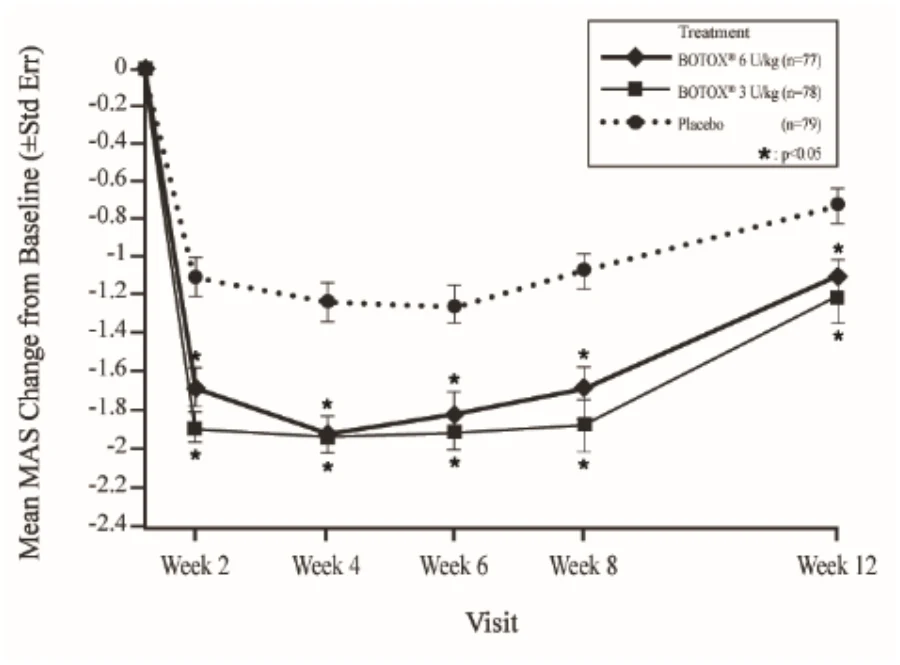
Figure 6 Clinical Global Impression of Overall Change for Study 191622-101 (Pediatric Upper Limb Spasticity) – Mean Scores by Visit
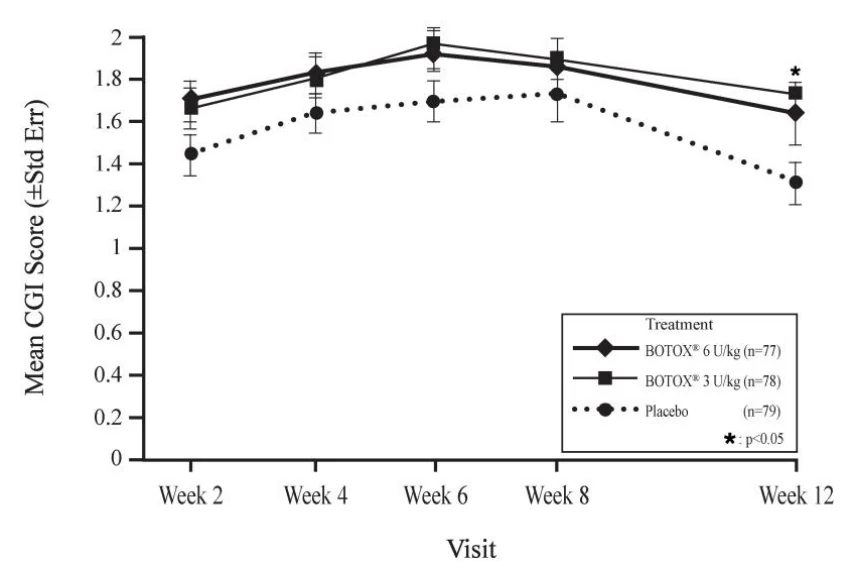
Lower Limb
The efficacy and safety of Botox for the treatment of lower limb spasticity in pediatric patients of ages 2 years and older was evaluated in a multicentre, randomized, double-blind, placebo-controlled, parallel-group, 12-week study (NCT01603628).
The study included 384 pediatric patients with lower limb spasticity due to cerebral palsy and baseline MAS score ≥ 2 for the ankle plantar flexors in the study limb in three treatment groups (128 Botox 8 Units/kg, 126 Botox 4 Units/kg and 128 placebo). The patients were intramuscularly injected a total dose of 4 Units/kg (maximum 150 Units) or 8 Units/kg (maximum 300 Units) or volume-matched placebo in the gastrocnemius, soleus and tibialis posterior in the study limb and then followed for 12 weeks. All patients also received weekly standardized physical therapy (PT) sessions from Week -2 through Week 11. The primary endpoint was the average of the change from baseline in MAS ankle score at Week 4 and Week 6. The key secondary endpoint was the average CGI at Week 4 and Week 6.
Eligible patients could enter an open-label extension study, in which they received up to five treatments at doses up to 10 Units/kg (maximum 340 Units), if treating more than one limb.
Compared to the placebo, statistically significant improvement in the primary efficacy, i.e., average MAS change from baseline at Weeks 4 and 6, was observed in the Botox-treated groups (Table 31).
Table 31 - Primary and Key Secondary Efficacy Endpoints Results
Botox 4 Units/kg + PT (N = 125) | Botox 8 Units/kg + PT (N=127) | Placebo + PT (N=129) | ||||||||
|---|---|---|---|---|---|---|---|---|---|---|
| Mean Change from Baseline in Plantar Flexors on the modified Ashworth Scale1 | ||||||||||
| Week 4 and 6 Average | -1.01* | -1.06* | -0.80 | |||||||
P-value 2 Difference 95% CI | 0.033 -0.21 -0.405, -0.018 | 0.010 -0.26 -0.453, -0.063 | ||||||||
| Mean Clinical Global Impression Score3 | ||||||||||
| Week 4 and 6 Average | 1.49 | 1.65* | 1.36 | |||||||
P-value 2 Difference 95% CI | 0.299 0.13 -0.115, 0.374 | 0.023 0.29 0.040, 0.532 | ||||||||
* Significantly different from placebo (p<0.05)
PT: Weekly physical therapy sessions from Week -2 through Week 11. | ||||||||||
Figure 7 Modified Ashworth Scale Ankle Score for Study 191622-111 (Pediatric Lower Limb Spasticity) – Mean Change from Baseline by Visit
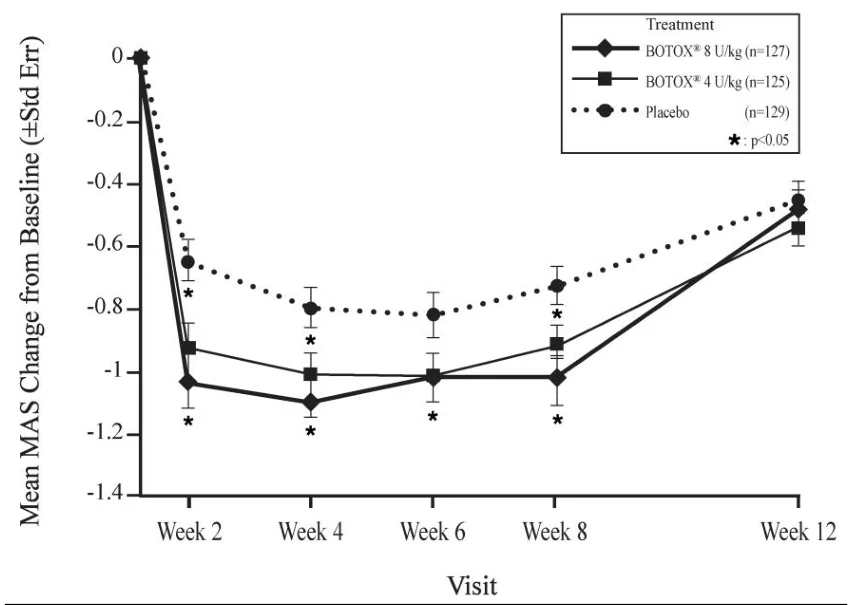
Figure 8 Clinical Global Impression of Overall Change for Study 191622-111 (Pediatric Lower Limb Spasticity) – Mean Scores by Visit
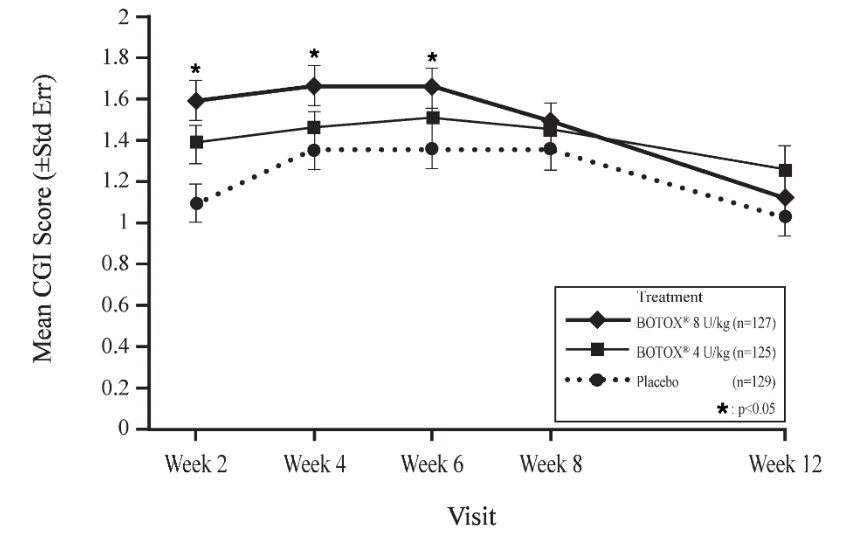
In pediatric lower limb spasticity patients with analyzed specimens from one phase 3 study and the open-label extension study, neutralizing antibodies developed in 2 of 264 patients (0.8%) treated with Botox for up to 5 treatment cycles. Both patients continued to experience clinical benefit following subsequent Botox treatments.
Primary Hyperhidrosis of the Axillae
When injected intradermally, Botox produces temporary chemical denervation of the sweat gland resulting in local reduction in sweating. The efficacy and safety of Botox for the treatment of primary axillary hyperhidrosis were evaluated in a randomized, multicentre, double-blind, placebo-controlled study.
In the study, 320 adults with bilateral axillary primary hyperhidrosis were randomized to receive either 50 Units of Botox (n=242) or placebo (n=78). Treatment responders were defined as subjects showing at least a 50% reduction from baseline in axillary sweating measured by gravimetric measurement at 4 weeks.
In one randomized, multicentre, double-blind, placebo-controlled study, at Week 4 post-injection, the percentages of responders were 91% (219/242) in the Botox group and 36% (28/78) in the placebo group, p < 0.001. The difference in percentage of responders between Botox and placebo was 55% (95% CI = 43.3, 65.9).
Chronic Migraine
Botox was evaluated in two multi-national, multi-centre 56-week studies that included a 24-week, 2 injection cycle, double-blind phase comparing Botox to placebo that was followed by a 32-week, 3 injection cycle, open-label phase. A total of 1,384 chronic migraine adults who had either never received or were not using any concurrent headache prophylaxis, had > 15 headache days, with 50% being migraine/probable migraine, and > 4 headache episodes during a 28-day baseline phase were studied in 2 phase 3 clinical trials. These patients were randomized to placebo or to 155 Units - 195 Units Botox injections every 12 weeks, maximum 5 injection cycles. Patients were allowed to use acute headache treatments (65.5% overused acute treatments during the baseline period). The number (percentage) of patients who received Botox injections at 31 sites and at 39 sites at Week 12 were N=345/627 (55.0%) and N=44/627 (7.0%), respectively.
Results from two multicentre, double-blind, placebo-controlled studies are presented in Table 32 and Table 33.
Table 32 - Phase 3 Study 1*: Least Square (LS) Mean Change from Baseline, Between-Group Differences and 99% Confidence Intervals for Primary and Secondary Efficacy Variables at Week 24 Primary Timepoint
| Efficacy per 28 daysc | Botox (N=341) | Placebo (N=338) | Between-Group Difference (99% CI)a | P-value a,b |
|---|---|---|---|---|
| Frequency of headache days | -7.8 | -6.4 | -1.4 (-2.72, -0.09) | 0.006 |
| Frequency of migraine/probable migraine episodes | -5.0 | -4.5 | -0.5 (-1.45, 0.50) | 0.206 |
| Frequency of migraine/probable migraine days | -7.6 | -6.0 | -1.6 (-2.91, -0.27) | 0.002 |
| Frequency of headache episodesd | -5.4 | -5.0 | -0.4 | 0.344 |
| Efficacy per 28 daysc | Botox (N=341) | Placebo (N=338) | Between-Group Difference (99% CI)a | P-value a,b | ||||
|---|---|---|---|---|---|---|---|---|
| (-1.36, 0.63) | ||||||||
| Frequency of acute headache pain medication intakes | -10.1 | -9.8 | -0.3 (-3.82, 3.12) | 0.795 | ||||
* AbbVie study 191622-079 a. To control the type-1 error rate at 0.05, p-values were examined relative to 0.01 under a Bonferroni multiple-comparison adjustment for the 5 variables that were protocol-specified as primary or secondary. Accordingly, for the least-squares means’ difference between treatment groups, 99% confidence intervals are displayed rather than 95% confidence intervals. b. P-values for between-treatment comparisons are from covariate analysis of variance (ANCOVA), with baseline values as covariate. The main effects in the ANCOVA included treatment and medication-overuse strata, where the type III sum of squares was used. c. Missing values were estimated using modified last observation carried forward, with the patient’s most-recent previous score multiplied by the change rate across non-missing observations for all other patients, applied iteratively across sequential time periods. d. Primary endpoint | ||||||||
Table 33 - Phase 3 Study 2*: LS Mean Change from Baseline, Between-Group Differences and 95% Confidence Intervals for Primary and Secondary Efficacy Variables at Week 24 Primary Timepoint
| Efficacy per 28 daysc | Botox (N=347) | Placebo (N=358) | Between-Group Difference (95% CI) | P-valuea,b |
|---|---|---|---|---|
| Frequency of headache dayse | -9.2 | -6.9 | -2.3 (-3.25, -1.31) | <0.001 |
| Frequency of migraine/probable migraine days | -8.8 | -6.5 | -2.3 (-3.31, -1.36) | <0.001 |
| Number of moderate/severe headache days | -8.4 | -6.0 | -2.4 (-3.37, -1.48) | <0.001 |
| Total cumulative hours of headache on headache days | -134.15 | -94.54 | -39.6 (-58.23, -21.05) | <0.001 |
| Proportion of patients with severe (≥60) Headache Impact Test (HIT)-6 scored | 66.3% | 76.5% | -10.3% (-16.9, -3.6) | 0.003 |
| Frequency of headache episodes | -5.6 | -4.6 | -1.0 (-1.65, -0.33) | 0.003 |
* AbbVie study 191622-080 a. To control the type 1 error rate for multiple secondary endpoints, a gatekeeping approach was used for the five secondary variables at the primary visit (Week 24). Each secondary variable could only indicate significance if the primary variable and each secondary variable ranked ahead of it indicated statistical significance. b. P-values for between-treatment comparisons are from covariate analysis of variance (ANCOVA), with baseline values as covariate. The main effects in the ANCOVA included treatment and medication-overuse strata, where the type III sum of squares was used. | ||||
| Efficacy per 28 daysc | Botox (N=347) | Placebo (N=358) | Between-Group Difference (95% CI) | P-valuea,b |
|---|---|---|---|---|
c. Missing values were estimated using modified last observation carried forward, with the patient’s most-recent previous score multiplied by the change rate across non-missing observations for all other patients, applied iteratively across sequential time periods. d. P-values from statistical comparisons are for raw values, not for changes from baseline. e. Primary endpoint | ||||
In Study 1, at the Week 24 primary timepoint, the mean changes from baseline in total cumulative hours of headache on headache days were -106.7 hours in the Botox group and -70.4 hours in the placebo group. At the Week 24 primary timepoint, the mean changes from baseline for total HIT-6 score were -4.7 in the Botox group and -2.4 in the placebo group in Study 1, and -4.9 in the Botox group and -2.4 in the placebo group in Study 2.
The treatment effect appeared smaller in the subgroup of male patients (N=188) than in the whole study population.
Botox for chronic migraine has not been evaluated in clinical trials beyond 5 injection cycles.
Neurogenic Detrusor Overactivity Associated with a Neurologic Condition
Two double-blind, placebo-controlled, randomized, multicentre Phase 3 clinical studies were conducted in patients with urinary incontinence due to neurogenic detrusor overactivity who were either spontaneously voiding or using catheterization. A total of 691 spinal cord injury or multiple sclerosis patients, not adequately managed with at least one anticholinergic agent, were enrolled. These patients were randomized to receive either 200 Units of Botox (n=227), 300 Units of Botox (n=223), or placebo (n=241).
A total of 397 patients were evaluated in a long-term extension study.
In both phase 3 studies, significant improvements compared to placebo in the primary efficacy variable of change from baseline in weekly frequency of incontinence episodes were observed for Botox (200 Units and 300 Units) at the primary efficacy time point at Week 6. Significant improvements in urodynamic parameters including increase in maximum cystometric capacity and decreases in peak detrusor pressure during the first involuntary detrusor contraction were observed. These primary and secondary endpoints are shown in Table 34 and Table 35, and Figure 9 and Figure 10.
No additional benefit of Botox 300 Units over 200 Units was demonstrated.
Table 34 - Primary and Secondary Endpoints at Baseline and Change from Baseline in Study 1 (ITT population with LOCF Imputation)
Botox 200 Units (N=135) | Placebo (N=149) | Treatment difference* | p-values | |
|---|---|---|---|---|
Weekly Frequency of Urinary Incontinence* N Mean Baseline Mean Change at Week 2 | 135 32.3 | 149 28.3 |
Botox 200 Units (N=135) | Placebo (N=149) | Treatment difference* | p-values | |||||
|---|---|---|---|---|---|---|---|---|
Mean Change at Week 6a Mean Change at Week 12 | -15.3 -19.9 -19.8 | -10.0 -10.6 -8.8 | -5.3 -9.3 (-13.2, -5.4) -11.0 | p<0.001 | ||||
Maximum Cystometric Capacity (mL) N Mean Baseline Mean Change at Week 6b | 123 253.8 +135.9 | 129 259.1 +12.1 | 123.9 (89.1, 158.7) | p<0.001 | ||||
Maximum Detrusor Pressure during 1st Involuntary Detrusor Contraction (cmH20) N Mean Baseline Mean Change at Week 6b | 41 63.1 -28.1 | 103 57.4 -3.7 | -24.4 | |||||
* Mean change, treatment difference and p-value are based on a LOCF analysis using an ANCOVA model with baseline weekly endpoint as covariate and treatment group, etiology at study entry (spinal cord injury or multiple sclerosis), concurrent anticholinergic therapy at screening, and investigator as factors. a. Primary endpoint b. Key secondary endpoints | ||||||||
Study 1 = Study 191622-515
Study 2 = Study 191622-516
Table 35 - Primary and Secondary Endpoints at Baseline and Change from Baseline in Study 2 (ITT population with LOCF Imputation)
Botox 200 Units (N=92) | Placebo (N=92) | Treatment difference* | p-values | |||||
|---|---|---|---|---|---|---|---|---|
Weekly Frequency of Urinary Incontinence* N Mean Baseline Mean Change at Week 2 Mean Change at Week 6a Mean Change at Week 12 | 92 32.5 -18.1 -19.8 -19.6 | 92 36.7 -7.9 -10.8 -10.7 | -10.3 -9.0 (-14.8, -3.3) -8.9 | p=0.002 | ||||
Maximum Cystometric Capacity (mL) N Mean Baseline Mean Change at Week 6b | 88 239.6 +150.8 | 85 253.8 +2.8 | 148.0 (101.8, 194.3) | p<0.001 | ||||
Maximum Detrusor Pressure during 1st Involuntary Detrusor Contraction (cmH20) N Mean Baseline Mean Change at Week 6b | 29 65.6 -28.7 | 68 43.7 +2.1 | -30.7 | |||||
* Mean change, treatment difference and p-value are based on a LOCF analysis using an ANCOVA model with baseline weekly endpoint as covariate and treatment group, etiology at study entry (spinal cord injury or multiple sclerosis), concurrent anticholinergic therapy at screening, and investigator as factors. a. Primary endpoint b. Key secondary endpoints | ||||||||
Study 1 = Study 191622-515
Study 2 = Study 191622-516
Figure 9 Mean Change from Baseline in Weekly Frequency of Urinary Incontinence Episodes During Treatment Cycle 1 in Study 1
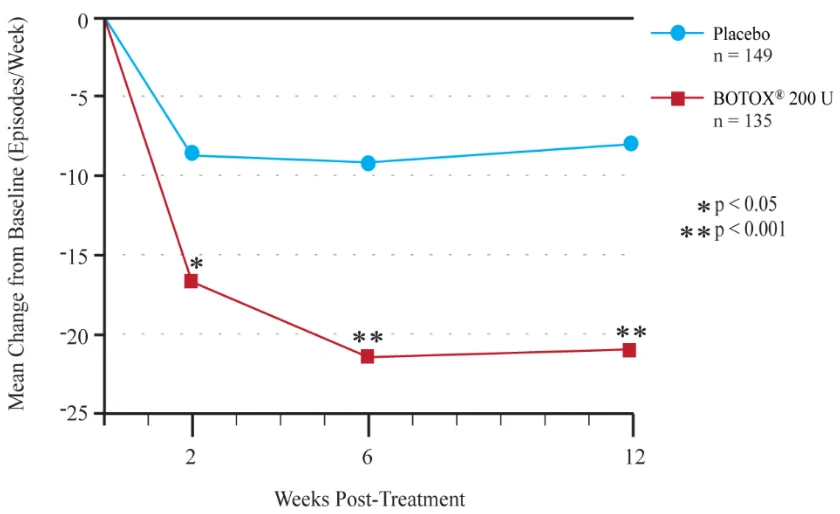
Figure 10 Mean Change from Baseline in Weekly Frequency of Urinary Incontinence Episodes During Treatment Cycle 1 in Study 2
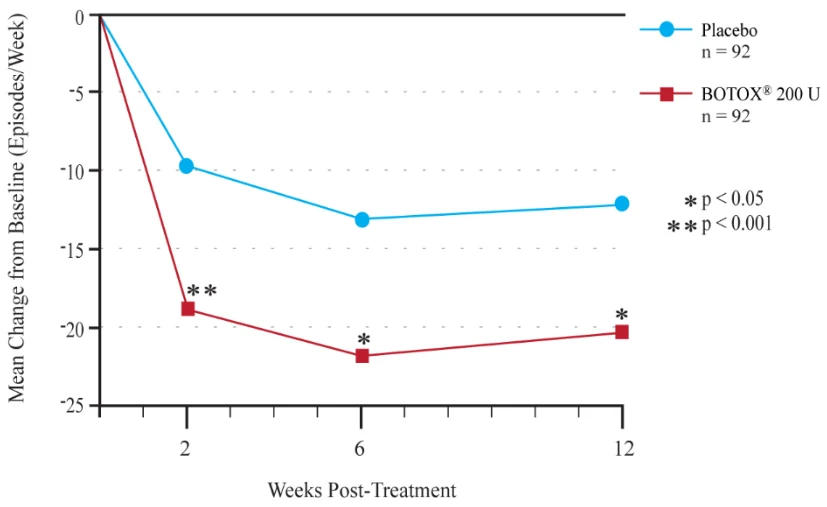
The median duration of response in the two pivotal studies, based on patient request for re-treatment, was 256-295 days (36-42 weeks) for the 200 Unit dose group compared to 92 days (13 weeks) with placebo. Retreatment criteria were: patient request, at least 12 weeks since previous treatment, and < 50% reduction (Study 1) or < 30% reduction (Study 2) from baseline in urinary incontinence episodes. The median duration of response in patients who continued into the open label extension study and received treatments with only Botox 200 Units (N=174) was 253 days (~36 weeks).
A total of 397 patients were evaluated in a long-term extension study. For all efficacy endpoints, patients experienced consistent response with re-treatments.
In the pivotal studies, none of the 475 neurogenic detrusor overactivity patients with analyzed specimens developed the presence of neutralizing antibodies. In patients with analyzed specimens in the drug development program (including the open-label extension study), neutralizing antibodies developed in 3 of 300 patients (1.0%) after receiving only Botox 200 Unit doses and 5 of 258 patients (1.9%) after receiving at least one 300 Unit dose. Four of these eight patients continued to experience clinical benefit.
Post-Approval Commitment Study
A placebo controlled, double-blind post-approval study was conducted in multiple sclerosis (MS) patients with urinary incontinence due to neurogenic detrusor overactivity who were not adequately managed with at least one anticholinergic agent and not catheterizing at baseline. These patients were randomized to receive either 100 Units of Botox (n=66) or placebo (n=78).
Significant improvements compared to placebo in the primary efficacy variable of change from baseline in daily frequency of incontinence episodes were observed for Botox (100 Units) at the primary efficacy time point at Week 6.
Table 36 - Study Baseline and Mean Change from Baseline in Primary Endpoints (Daily Average Frequency of Urinary Incontinence Episodes) and Mean Changes from Baseline for Secondary Endpoints (ITT population with LOCF)
Botox 100 Units (N=66) | Placebo (N=78) | P-value LS mean difference 95% CI | ||||||||
|---|---|---|---|---|---|---|---|---|---|---|
| Daily Average Frequency of Urinary Incontinence Episodes | ||||||||||
| Mean (Baseline) | 4.18 | 4.32 | ||||||||
| Mean (Week 6) | -3.34 | -1.10 | p<0.001 | |||||||
| LS mean (Week 6) | -3.39 | -1.07 | -2.32 | |||||||
| (-2.97, -1.66) | ||||||||||
| Maximum Cystometic Capacity (mL) | N=62 | N=72 | ||||||||
| Mean (Week 6) | +127.2 | -1.8 | ||||||||
| Min, Max (Week 6) | -139, +449 | -239, +221 | ||||||||
| Maximum Detrusor Pressure during 1st Involuntary Detrusor Contraction (cm H2O) | N=25 | N=51 | ||||||||
| Mean (Week 6) | -19.6 | +3.7 | ||||||||
| Min, Max (Week 6) | -170, +27 | -85, +87 | ||||||||
*LS = least squares *LS means, the between-group difference of LS means, its p-value and its 95% CI are based on an ANCOVA model with treatment group and propensity score stratification as factors, and baseline value as a covariate. | ||||||||||
Overactive Bladder
Two double-blind, placebo-controlled, randomized, multicentre, 24-week Phase 3 clinical studies were conducted in patients with OAB with symptoms of urinary incontinence, urgency, and frequency. A total of 1105 patients, whose symptoms had not been adequately managed with anticholinergic therapy (inadequate response or intolerable side effects), were randomized to receive either 100 Units of Botox (n=557), or placebo (n=548).
A total of 834 patients were evaluated in a long-term extension study.
In both studies, significant improvements compared to placebo in the change from baseline in daily frequency of urinary incontinence episodes were observed for Botox (100 Units) at the primary time point of Week 12, including the proportion of dry patients. Using the Treatment Benefit Scale, the proportion of patients reporting a positive treatment response (their condition has been ‘greatly improved’ or ‘improved’) was significantly greater in the Botox group compared to the placebo group in both studies. Significant improvements compared to placebo were also observed for the daily frequency of micturition, urgency, and nocturia episodes. Volume voided per micturition was also significantly higher. Significant improvements were observed in all OAB symptoms from Week 2.
Botox treatment was associated with significant improvements over placebo in health-related quality of life as measured by the Incontinence Quality of Life (I-QOL) questionnaire (including avoidance and limiting behavior, psychosocial impact, and social embarrassment) and the King’s Health Questionnaire (KHQ) (including incontinence impact, role limitations, social limitations, physical limitations, personal relationships, emotions, sleep/energy, and severity/coping measures).
A total of 834 patients were evaluated in a long-term extension study. For all efficacy endpoints, patients experienced consistent response with re-treatments.
The median duration of response following Botox treatment, based on patient request for re-treatment, was 166 days (~24 weeks). Retreatment criteria for all phase 3 studies were: patient request, at least 12 weeks since previous treatment, and at least 2 urinary incontinence episodes in 3 days. The median duration of response in patients who continued into the open label extension study and received treatments with only Botox 100 Units (N=438) was 212 days (~30 weeks).
In the pivotal studies, none of the 615 (0%) patients with analyzed specimens developed the presence of neutralizing antibodies. In patients with analyzed specimens from the pivotal phase 3 and the open-label extension studies, neutralizing antibodies developed in 0 of 954 patients (0.0%) while receiving Botox 100 Unit doses and 3 of 260 patients (1.2%) after subsequently receiving at least one 150 Unit dose. One of these three patients continued to experience clinical benefit.
Results from the pivotal studies are presented below:
Table 37 - Primary and Secondary Efficacy Endpoints at Baseline and Change from Baseline in the Pooled Pivotal Studies
Endpoint Timepoint | Botox 100 Units (N=557) | Placebo (N=548) | P-value |
|---|---|---|---|
| Daily Frequency of Urinary Incontinence Episodes* | |||
| Mean Baseline | 5.49 | 5.39 |
Endpoint Timepoint | Botox 100 Units (N=557) | Placebo (N=548) | P-value | |||
|---|---|---|---|---|---|---|
| Mean Change at Week 2 | -2.85 | -1.21 | < 0.001 | |||
| Mean Change at Week 6 | -3.11 | -1.22 | < 0.001 | |||
| Mean Change at Week 12a | -2.80 | -0.95 | < 0.001 | |||
| Proportion with Positive Treatment Response using Treatment Benefit Scale (%) | ||||||
| Week 2 | 64.4 | 34.7 | < 0.001 | |||
| Week 6 | 68.1 | 32.8 | < 0.001 | |||
| Week 12a | 61.8 | 28.0 | < 0.001 | |||
| Daily Frequency of Micturition Episodes | ||||||
| Mean Baseline | 11.99 | 11.48 | ||||
| Mean Change at Week 2 | -1.53 | -0.78 | < 0.001 | |||
| Mean Change at Week 6 | -2.18 | -0.97 | < 0.001 | |||
| Mean Change at Week 12b | -2.35 | -0.87 | < 0.001 | |||
| Daily Frequency of Urgency Episodes | ||||||
| Mean Baseline | 8.82 | 8.31 | ||||
| Mean Change at Week 2 | -2.89 | -1.35 | < 0.001 | |||
| Mean Change at Week 6 | -3.56 | -1.40 | < 0.001 | |||
| Mean Change at Week 12b | -3.30 | -1.23 | < 0.001 | |||
| Incontinence Quality of Life Total Score | ||||||
| Mean Baseline | 34.1 | 34.7 | ||||
| Mean Change at Week 12bc | +22.5 | +6.6 | < 0.001 | |||
| King’s Health Questionnaire: Role Limitation | ||||||
| Mean Baseline | 65.4 | 61.2 | ||||
| Mean Change at Week 12bc | -25.4 | -3.7 | < 0.001 | |||
| King’s Health Questionnaire: Social Limitation | ||||||
| Mean Baseline | 44.8 | 42.4 | ||||
| Mean Change at Week 12bc | -16.8 | -2.5 | < 0.001 | |||
* Percentage of patients who were dry (without incontinence) at Week 12 was 27.1% for the Botox group and 8.4% for placebo group. The proportions achieving at least a 75% and 50% reduction from baseline in urinary incontinence episodes were 46.0% and 60.5% in the Botox group compared to 17.7% and 31.0% in the placebo group, respectively. a. Co-primary endpoints | ||||||
Endpoint Timepoint | Botox 100 Units (N=557) | Placebo (N=548) | P-value |
|---|---|---|---|
b. Secondary endpoints c. Pre-defined minimally important change from baseline was +10 points for I-QOL and -5 points for KHQ | |||
Table 38 - Primary and Secondary Efficacy Endpoints at Baseline and Change from Baseline in Study 1
Endpoint Timepoint | Botox 100 Units (N=280) | Placebo (N=277) | P-value |
|---|---|---|---|
| Daily Frequency of Urinary Incontinence Episodes* | |||
| Mean Baseline | 5.47 | 5.09 | |
| Mean Change at Week 2 | -2.85 | -1.09 | < 0.001 |
| Mean Change at Week 6 | -3.05 | -1.07 | < 0.001 |
| Mean Change at Week 12a | -2.65 | -0.87 | < 0.001 |
| Proportion with Positive Treatment Response using Treatment Benefit Scale (%) | |||
| Week 2 | 64.5 | 32.6 | < 0.001 |
| Week 6 | 66.9 | 34.7 | < 0.001 |
| Week 12a | 60.8 | 29.2 | < 0.001 |
| Daily Frequency of Micturition Episodes | |||
| Mean Baseline | 11.98 | 11.20 | |
| Mean Change at Week 2 | -1.58 | -0.79 | 0.041 |
| Mean Change at Week 6 | -1.96 | -0.98 | < 0.001 |
| Mean Change at Week 12b | -2.15 | -0.91 | < 0.001 |
| Daily Frequency of Urgency Episodes | |||
| Mean Baseline | 8.54 | 7.85 | |
| Mean Change at Week 2 | -2.83 | -1.34 | < 0.001 |
| Mean Change at Week 6 | -3.21 | -1.45 | < 0.001 |
| Mean Change at Week 12b | -2.93 | -1.21 | < 0.001 |
| Incontinence Quality of Life Total Score | |||
| Mean Baseline | 36.5 | 37.3 | |
| Mean Change at Week 12bc | +21.9 | +6.8 | < 0.001 |
Endpoint Timepoint | Botox 100 Units (N=280) | Placebo (N=277) | P-value | |||
|---|---|---|---|---|---|---|
| King’s Health Questionnaire: Role Limitation | ||||||
| Mean Baseline | 61.2 | 56.2 | ||||
| Mean Change at Week 12bc | -24.3 | -2.4 | < 0.001 | |||
| King’s Health Questionnaire: Social Limitation | ||||||
| Mean Baseline | 40.5 | 39.4 | ||||
| Mean Change at Week 12bc | -17.3 | -3.8 | < 0.001 | |||
* Percentage of patients who were dry (without incontinence) at Week 12 was 22.9% for the Botox group and 6.5% for placebo group. The proportions achieving at least a 75% and 50% reduction from baseline in urinary incontinence episodes were 44.6% and 57.5% in the Botox group compared to 15.2% and 28.9% in the placebo group, respectively. a. Co-primary endpoints b. Secondary endpoints c. Pre-defined minimally important change from baseline was +10 points for I-QOL and -5 points for KHQ | ||||||
Table 39 - Primary and Secondary Efficacy Endpoints at Baseline and Change from Baseline in Study 2
Endpoint Timepoint | Botox 100 Units (N=277) | Placebo (N=271) | P-value |
|---|---|---|---|
| Daily Frequency of Urinary Incontinence Episodes* | |||
| Mean Baseline | 5.52 | 5.70 | |
| Mean Change at Week 2 | -2.85 | -1.34 | < 0.001 |
| Mean Change at Week 6 | -3.18 | -1.37 | < 0.001 |
| Mean Change at Week 12a | -2.95 | -1.03 | < 0.001 |
| Proportion with Positive Treatment Response using Treatment Benefit Scale (%) | |||
| Week 2 | 64.2 | 36.8 | < 0.001 |
| Week 6 | 69.3 | 30.9 | < 0.001 |
| Week 12a | 62.8 | 26.8 | < 0.001 |
| Daily Frequency of Micturition Episodes | |||
| Mean Baseline | 12.01 | 11.77 | |
| Mean Change at Week 2 | -1.48 | -0.77 | 0.009 |
Endpoint Timepoint | Botox 100 Units (N=277) | Placebo (N=271) | P-value | |||
|---|---|---|---|---|---|---|
| Mean Change at Week 6 | -2.40 | -0.97 | < 0.001 | |||
| Mean Change at Week 12b | -2.56 | -0.83 | < 0.001 | |||
| Daily Frequency of Urgency Episodes | ||||||
| Mean Baseline | 9.11 | 8.78 | ||||
| Mean Change at Week 2 | -2.95 | -1.36 | < 0.001 | |||
| Mean Change at Week 6 | -3.91 | -1.35 | < 0.001 | |||
| Mean Change at Week 12b | -3.67 | -1.24 | < 0.001 | |||
| Incontinence Quality of Life Total Score | ||||||
| Mean Baseline | 31.7 | 32.1 | ||||
| Mean Change at Week 12bc | +23.1 | +6.3 | < 0.001 | |||
| King’s Health Questionnaire: Role Limitation | ||||||
| Mean Baseline | 69.6 | 66.4 | ||||
| Mean Change at Week 12bc | -26.5 | -5.0 | < 0.001 | |||
| King’s Health Questionnaire: Social Limitation | ||||||
| Mean Baseline | 49.1 | 45.4 | ||||
| Mean Change at Week 12bc | -16.2 | -1.3 | < 0.001 | |||
* Percentage of patients who were dry (without incontinence) at Week 12 was 31.4% for the Botox group and 10.3% for placebo group. The proportions achieving at least a 75% and 50% reduction from baseline in urinary incontinence episodes were 47.3% and 63.5% in the Botox group compared to 20.3% and 33.2% in the placebo group, respectively. a. Co-primary endpoints b. Secondary endpoints c. Pre-defined minimally important change from baseline was +10 points for I-QOL and -5 points for KHQ | ||||||
Figure 11 Mean Change from Baseline in Daily Frequency of Urinary Incontinence Episodes During Treatment Cycle 1 in Pooled Pivotal Studies
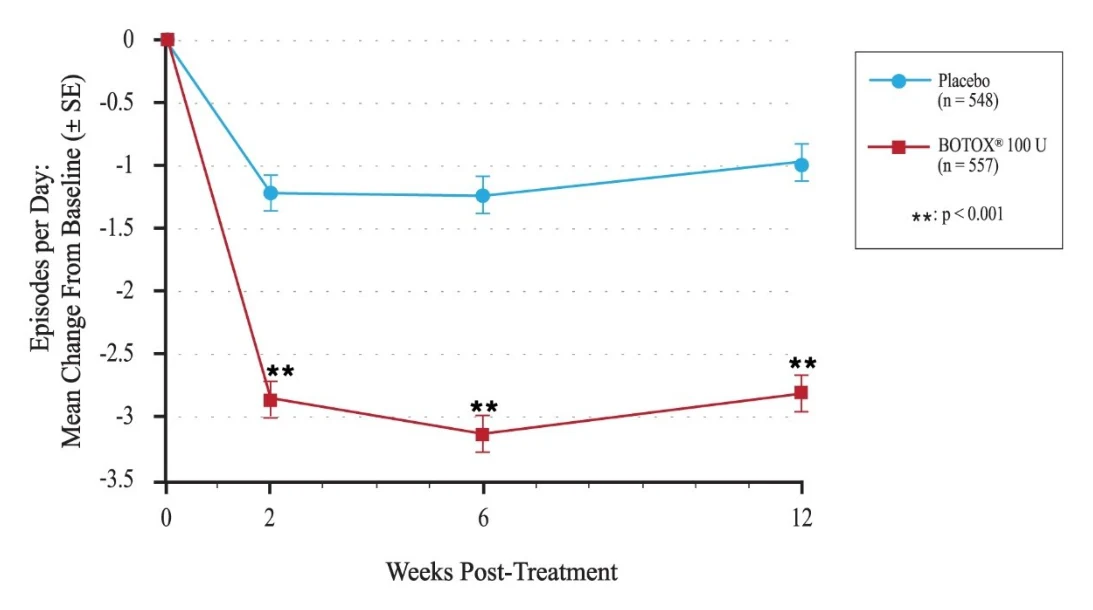
Figure 12 Mean Change from Baseline in Daily Frequency of Urinary Incontinence Episodes During Treatment Cycle 1 in Study 1
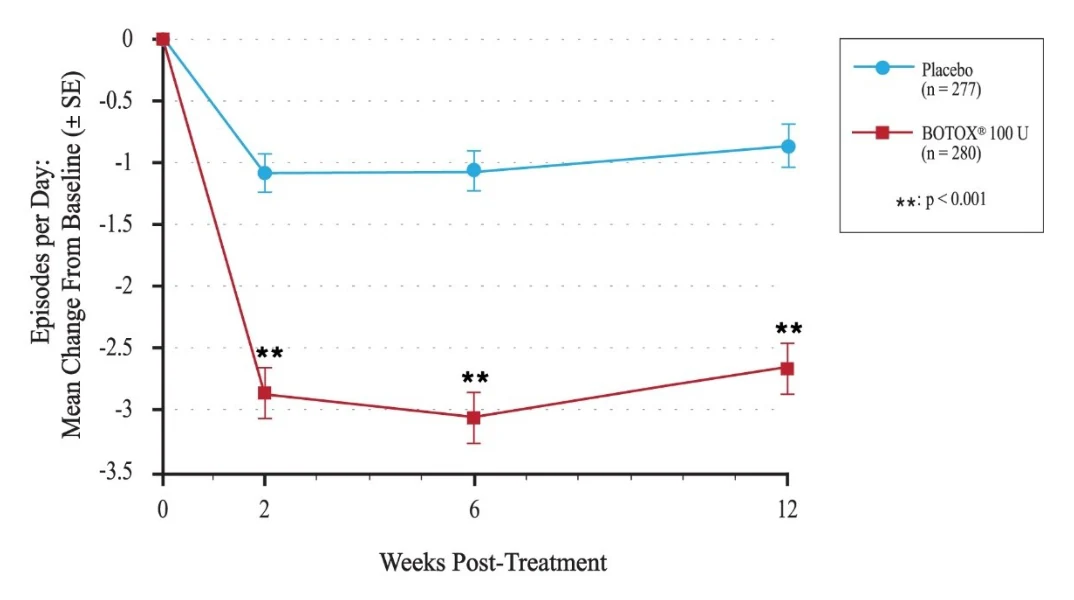
Figure 13 Mean Change from Baseline in Daily Frequency of Urinary Incontinence Episodes During Treatment Cycle 1 in Study 2
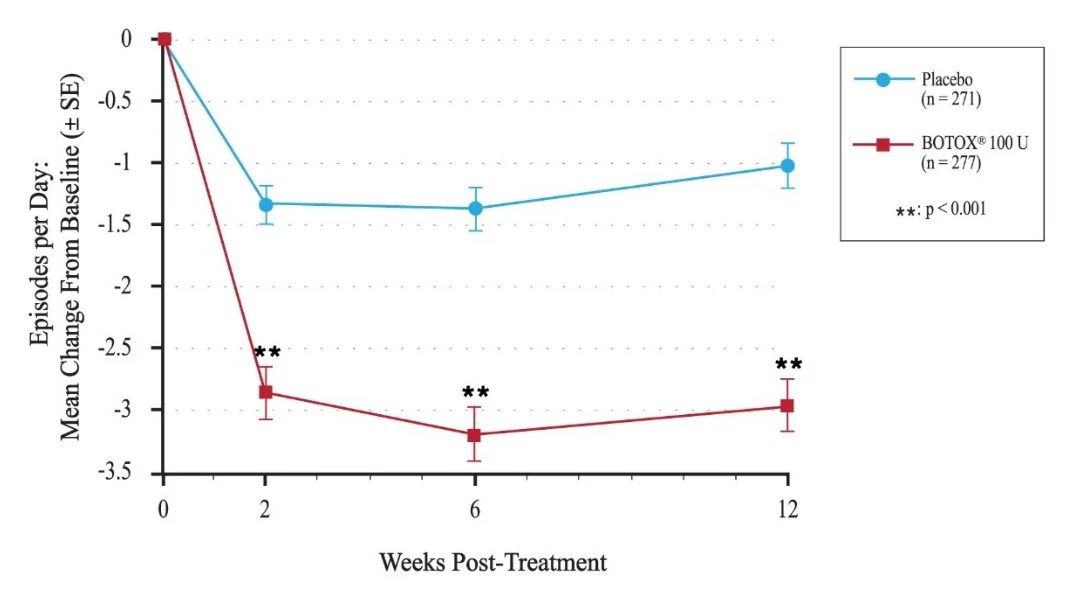
15 MICROBIOLOGY
No microbiological information is required for this drug product.
16 NON-CLINICAL TOXICOLOGY
General Toxicology:
Animal Toxicology Studies
There were no observable toxic effects in rats that received a single intravenous or intramuscular injection of 5 Units/kg of Botox, and in monkeys that received 8 Units/kg intramuscularly.
In a one-year study where monkeys received seven intramuscular injections (once every two months), there were no observable toxic effects at a Botox dosage level of 4 Units/kg (approximately 2/3 of the maximum recommended human dose). Three out of six female monkeys in the 16 Units/kg group were sacrificed in extremis. This probably was a treatment-related effect of high doses of Botox. Local muscle atrophy and degeneration at the injection site (expected pharmacological effects) were observed in all Botox treated monkeys. There was evidence of systemic toxicity in animals treated with 8 Units/kg and 16 Units/kg. No antibodies were detected in the sera of animals during the study.
Neurogenic Detrusor Overactivity associated with a neurological condition
No systemic toxicity was observed following a single intradetrusor injection of <50 Units/kg Botox in rats. In a study to evaluate inadvertent peribladder administration, bladder stones were observed in 1 of 4 male monkeys that were injected with a total of 6.8 Units/kg divided into the prostatic urethra and proximal rectum (single administration). No bladder stones were observed in male or female monkeys following injection of up to 36 Units/kg (~12X the human dose) directly to the bladder as either single or 4 repeat dose injections or in female rats for single injections up to 100 Units/kg (~33X the human dose).
In a 9 month repeat dose intradetrusor study (4 injections), ptosis was observed at 24 Units/kg, and mortality was observed at doses ≥24 Units/kg. No adverse effects were observed in monkeys at 12 Units/kg, which corresponds to a 3-fold greater exposure to Botox than the recommended clinical dose of 200 Units for urinary incontinence due to neurogenic detrusor overactivity (based on a 50 kg person).
Carcinogenicity:
No long-term animal studies have been performed to evaluate carcinogenic potential Botox.
Genotoxicity:
Botox was not mutagenic in the in vitro Ames microbial mutagen test with or without metabolic activation at a maximum concentration of 42.9 Units/plate using tester strains of Salmonella typhimurium and Escherichia coli. No increases in the average mutant frequencies were seen in in vitro evaluations of Botox at dosages as high as 43.0 Units/plate (approximately 100,000 times the maximum anticipated clinical dose, based upon 360 Units/60 kg person) with and without metabolic S9 activation in AS52/XPRT mammalian cells. No chromosomal aberrations were produced in in vitro evaluations of Botox in Chinese hamster ovary cells at dosages as high as 43.0 Units/kg with and without metabolic activation. No clastogenic effects were observed in in vivo micronucleus evaluations of Botox in mice at doses as high as six to seven times the maximum anticipated human dose.
The teratogenic effects of Botox were evaluated in mice, rats and rabbits. No teratogenic effects were observed when presumed pregnant mice were injected intramuscularly with doses of 4 Units/kg (approximately 2/3 of the maximum recommended human dose) and 8 Units/kg on days 5 and 13 of gestation; however, dosages of 16 Units/kg induced a slightly lower fetal body weight. No teratogenic effects were observed in rats when injected intramuscularly with doses of 16 Units/kg on days 6 and 13 of gestation, and 2 Units/kg/day on days 6 through 15 of gestation. In rabbits, daily injections at dosages of 0.5 Units/kg/day (days 6 through 18 of gestation) and 4 and 6 Units/kg (days 6 and 13 of gestation) caused death and abortions among surviving animals. External malformations were observed in the fetus in one 0.125 Units/kg/day and one 2 Units/kg dosage. The rabbit appears to be a more sensitive species to Botox.
Reproductive and Developmental Toxicology:
The reproductive and developmental effects of Botox were evaluated in rats at dose levels of 4, 8 and 16 Units/kg. Muscle atrophy at the injected site, reduced body weight gains and reduced absolute feed consumption were observed following intramuscular injection of Botox at dosages of 4 Units/kg and higher on days 5 and 13 of presumed gestation, and day 7 of lactation. No effects on maternal reproductive performance were observed at the highest dose tested, 16 Units/kg (approximately three times the maximum recommended human dose). No adverse effects on development of the pups were observed at 4 Units/kg; however, higher dosages were associated with reduced pup body weight and/or pup viability at birth.
A fertility and reproductive toxicity study with Botox was evaluated in rats. No effects on reproduction were observed following intramuscular injection of Botox at dosages of 4 Units/kg (approximately 2/3 of the maximum recommended human dose) in male rats and at dosages of 8 Units/kg in female rats. Higher dosages (8 and 16 Units/kg) were associated with dose-dependent reductions in fertility in male rats, and the cohabitation period was slightly increased at dosages of 16 Units/kg. Altered estrous cycling (prolonged diestrus) and interrelated reductions in fertility occurred in the female rats dosed with 16 Units/kg.
Special Toxicology:
Antigenicity
Antigenicity studies in rats and guinea pigs showed no effects. In an indirect hemagglutination assay, mice were immunized once per week for two weeks. Both the placebo (human serum albumin) and Botox were antigenic when Complete Freund's Adjuvant (CFA) was used. No antigenicity was detected without the adjuvant.
Ocular or dermal irritation
No ocular or dermal irritation was observed in rabbits at concentrations of Botox up to 200 Units/mL.
Juvenile Toxicity:
In a 20-week study where juvenile monkeys received a series of three im injection sessions (each session divided into four sites, distributed bilaterally into the heads of the gastrocnemius muscles, and given at 8-week intervals), the NOEL was at a Botox dosage level of 8 Units/kg. Local pharmacologic effects were observed in all Botox-treated animals and included decreases in size and weights of the injected site (gastrocnemius muscles) and microscopic observations of muscle fiber atrophy with occasional involvement of the underlying soleus muscle. Systemic effects included a slight transient decrease in body weight gains in animals receiving 12 Units/kg.
In a study in which juvenile rats received intramuscular injection of Botox every other week from postnatal day 21 for 3 months at the doses of 8, 16, or 24 Units/kg, changes in bone size/geometry associated with decreased bone density and bone mass secondary to the limb disuse, lack of muscle contraction and decrease in body weight gain observed. The changes were less severe at the lowest dose tested, with signs of reversibility at all dose levels. The no-effect dose for adverse developmental effects in juvenile animals (8 Units/kg) was similar to the human dose (400 Units) on a body weight (kg) basis.