


Product Monograph - Campral
SUMMARY PRODUCT INFORMATION
Route of Administration | Dosage Form / Strength | Clinically Relevant Nonmedicinal Ingredients |
| Oral | Tablet / 333 mg | No known clinically relevant nonmedicinal ingredients. For a complete listing see Dosage Forms, Composition and Packaging section. |
INDICATIONS AND CLINICAL USE
Adults
CAMPRAL® (acamprosate calcium) is indicated for the maintenance of abstinence from alcohol in patients with alcohol dependence who are abstinent at treatment initiation. Treatment with CAMPRAL® should be part of a comprehensive management program that includes counselling.
The efficacy of CAMPRAL® in promoting abstinence has not been demonstrated in subjects who have not undergone detoxification and not achieved alcohol abstinence prior to beginning CAMPRAL® treatment. The efficacy of CAMPRAL® in promoting abstinence from alcohol in polysubstance abusers has not been adequately assessed.
Geriatrics (> 65 years of age):
Forty-one of the 4234 patients in double-blind, placebo-controlled, clinical trials of CAMPRAL® were 65 years of age or older. There were too few patients in this age group to evaluate any differences in safety or efficacy in geriatric patients compared to younger patients. However, since renal function diminishes in elderly patients and acamprosate is excreted unchanged in urine, acamprosate plasma concentrations are likely to be higher in the elderly population compared to younger adults. (See WARNINGS AND PRECAUTIONS, Special Populations, Geriatrics.)
Pediatrics (< 18 years of age):
The safety and efficacy of CAMPRAL® have not been established in the pediatric population.
CONTRAINDICATIONS
- Patients who are hypersensitive to this drug or to any ingredient in the formulation or component of the container. For a complete listing, see the Dosage Forms, Composition and Packaging section of the product monograph.
- Patients with severe renal impairment (creatinine clearance ≤ 30 mL/min).
- In nursing women.
WARNINGS AND PRECAUTIONS
General:
CAMPRAL® treatment should only be initiated after detoxification or weaning therapy, once the patient is abstinent from alcohol.
CAMPRAL® does not constitute treatment for the withdrawal period.
CAMPRAL® does not prevent the harmful effects of continuous alcohol abuse.
Renal:
No dose adjustment is recommended in patients with mild renal impairment (creatinine clearance of 80-50 mL/min). Treatment with CAMPRAL® in patients with moderate renal impairment (creatinine clearance of 30-50 mL/min) requires a reduction of the dose (see DOSAGE AND ADMINISTRATION). Patients with severe renal impairment (creatinine clearance of ≤30 mL/min) should not be given CAMPRAL®, (see CONTRAINDICATIONS).
Carcinogenesis and Mutagenesis:
See PART II: SCIENTIFIC INFORMATION, Toxicology, Carcinogenicity and Mutagenicity.
Dependence/Tolerance:
CAMPRAL® did not produce any evidence of withdrawal symptoms in patients in clinical trials at therapeutic doses. Post marketing data, retrospectively collected, provided no evidence of drug abuse or dependence.
Driving and Operating Machinery:
Although in controlled studies CAMPRAL has not been shown to impair psychomotor coordination, any psychoactive drug may impair judgment, thinking, or motor skills. Patients should be cautioned about operating hazardous machinery, including automobiles, until they are reasonably certain that CAMPRAL® therapy does not affect their ability to engage in such activities.
Psychiatry:
Suicidality: In controlled clinical trials of acamprosate, adverse events of a suicidal nature (suicidal ideation, suicide attempts, completed suicides) were infrequent overall, but were more common in acamprosate-treated patients than in patients treated with placebo (1.4% vs. 0.5% in studies of 6 months or less; 2.4% vs. 0.8% in year-long studies). Completed suicides occurred in 3 of 2272 (0.13%) patients in the pooled acamprosate group from all controlled studies and 2 of 1962 patients (0.10%) in the placebo group. Adverse events coded as "depression" were reported at similar rates in acamprosate-treated and placebo-treated patients. Because the interrelationship between alcohol dependence, depression and suicidality is well-recognized and complex, rigorous clinical monitoring is recommended in alcohol-dependent patients, including those treated with acamprosate.
Special Populations
Pregnant Women and Women of child-bearing potential:
The safety of this product for use in human pregnancy has not been established. Acamprosate may be used during pregnancy only after a careful benefit/risk assessment, when the patient cannot abstain from drinking alcohol without being treated with acamprosate and when there is consequently a risk of foetotoxicity or teratogenicity due to alcohol.
Acamprosate calcium has been shown to be teratogenic in rats when given in doses that are approximately equal to the human dose (on a mg / m2 basis) and in Burgundy Tawny rabbits when given in doses that were approximately 3 times the human dose (on a mg / m2 basis). No developmental effects were observed in New Zealand white rabbits at doses up to approximately 8 times the human dose (on a mg / m2 basis).
The findings in animals should be considered in relation to known adverse developmental effects of ethyl alcohol, which include the characteristics of foetal alcohol syndrome (craniofacial dysmorphism, intrauterine and postnatal growth retardation, retarded psychomotor and intellectual development) and milder forms of neurological and behavioural disorders in humans).
Nursing Women:
In animal studies, acamprosate calcium was excreted in the milk of lactating rats dosed orally with acamprosate calcium. It is not known whether acamprosate calcium is excreted in human milk, therefore, CAMPRAL® is contraindicated for use in nursing mothers (see CONTRAINDICATIONS).
Pediatrics (18 years of age):
The safety and efficacy of CAMPRAL® have not been established in the pediatric population, therefore, acamprosate is not recommended for use in patients under 18 years of age.
Geriatrics (> 65 years of age):
The safety and efficacy of acamprosate have not been established in patients older than 65 years of age. CAMPRAL® is excreted unchanged in the urine, and the elderly are more likely to have
decreased renal function. Therefore, care should be taken in dose selection. (See DOSAGE and ADMINISTRATION)
Hepatic:
No dose adjustment is needed in patients with mild to moderate liver impairment (Child-Pugh A and B). No pharmacokinetic study has been done in the severely liver impaired patients (Child-Pugh C), however, physicians should carefully consider the potential risks and benefits of using acamprosate, when the patient cannot abstain from drinking alcohol without being treated with acamprosate.
ADVERSE REACTIONS
Adverse Drug Reaction Overview:
Adverse events associated with CAMPRAL® tend to be mild and transient in nature. They are predominantly gastrointestinal or dermatological in nature.
Diarrhoea, and less frequently, vomiting and abdominal pain are the gastrointestinal adverse reaction. Pruritus is the predominant dermatological adverse reaction. An occasional maculopapular rash and rare cases of bullous skin reactions have been reported.
Clinical Trial Adverse Drug Reactions
Adverse Events Leading to Discontinuation:
For studies where adverse events were reported either by worksheet or spontaneously, among the 1749 alcohol dependent patients who received CAMPRAL®1998/2000 mg/day in placebo-controlled trials, 8% discontinued treatment due to an adverse event, as compared to 6% of 1962 patients receiving placebo. Among patients receiving CAMPRAL® 1998/2000 mg/day in studies collecting spontaneous adverse events, only diarrhea was associated with the discontinuation of more than 1% of patients. Diarrhea occurred at a higher rate among patients taking CAMPRAL® (2%) versus patients taking placebo (<1%).
Common Adverse Events Reported in Controlled Trials:
Common, non-serious adverse events were collected spontaneously in some controlled studies and using a checklist in other studies. The overall profile of adverse events was similar using either method. Table 1 shows those events that occurred in any CAMPRAL treatment group at a rate of 3% or greater and greater than the placebo group in controlled clinical trials with spontaneously reported adverse events. The reported frequencies of adverse events represent the proportion of individuals who experienced, at least once, a treatment-emergent adverse event of the type listed, without regard to the causal relationship of the events to the drug. Table 1. Events Occurring at a Rate of at Least 3% and Greater than Placebo in any CAMPRAL Treatment Group in Controlled Clinical Trials with Spontaneously Reported Adverse Events
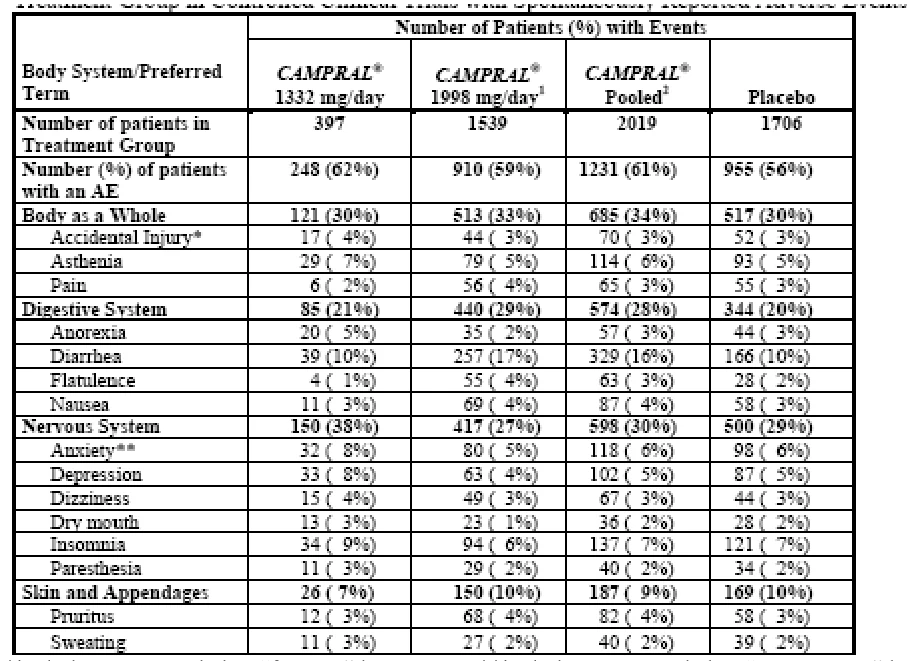
*includes events coded as “fracture” by sponsor; **includes events coded as “nervousness” by sponsor 1 includes 258 patients treated with acamprosate calcium 2000 mg/day, using a different dosage strength and regimen. 2 includes all patients in the first two columns as well as 83 patients treated with acamprosate calcium 3000 mg/day, using a different dosage strength and regimen.
Other Events Observed During the Pre-marketing Evaluation of CAMPRAL:
Following is a list of terms that reflect treatment-emergent adverse events reported by patients treated with CAMPRAL in 20 clinical trials (4461 patients treated with CAMPRAL, 3526 of whom received the maximum recommended dose of 1998 mg/day for up to one year in duration). This listing does not include those events already listed above; events for which a drug cause was considered remote; event terms which were so general as to be uninformative; and events reported only once which were not likely to be acutely life-threatening.
Events are further categorized by body system and listed in order of decreasing frequency according to the following definitions: frequent adverse events are those occurring in at least 1/100 patients (only those not already listed in the summary of adverse events in controlled trials appear in this listing); infrequent adverse events are those occurring in 1/100 to 1/1000 patients; rare events are those occurring in fewer than 1/1000 patients.
Body as a Whole – Frequent: headache, abdominal pain, back pain, infection, flu syndrome, chest pain, chills, suicide attempt; Infrequent: fever, intentional overdose, malaise, allergic reaction, abscess, neck pain, hernia, intentional injury; Rare: ascites, face edema, photosensitivity reaction, abdomen enlarged, sudden death.
Cardiovascular System – Frequent: palpitation, syncope; Infrequent: hypotension, tachycardia, hemorrhage, angina pectoris, migraine, varicose vein, myocardial infarct, phlebitis, postural hypotension; Rare: heart failure, mesenteric arterial occlusion, cardiomyopathy, deep thrombophlebitis, shock.
Digestive System – Frequent: vomiting, dyspepsia, constipation, increased appetite; Infrequent: liver function tests abnormal, gastroenteritis, gastritis, dysphagia, eructation, gastrointestinal hemorrhage, pancreatitis, rectal hemorrhage, liver cirrhosis, esophagitis, hematemesis, nausea and vomiting, hepatitis; Rare: melena, stomach ulcer, cholecystitis, colitis, duodenal ulcer, mouth ulceration, carcinoma of liver.
Endocrine System – Rare: goiter, hypothyroidism.
Hemic and Lymphatic System – Infrequent: anemia, ecchymosis, eosinophilia, lymphocytosis, thrombocytopenia; Rare: leukopenia, lymphadenopathy, monocytosis.
Metabolic and Nutritional Disorders – Frequent – peripheral edema, weight gain; Infrequent: weight loss, hyperglycemia, SGOT increased, SGPT increased, gout, thirst, hyperuricemia, diabetes mellitus, avitaminosis, bilirubinemia; Rare: alkaline phosphatase increased, creatinine increased, hyponatremia, lactic dehydrogenase increased.
Musculoskeletal System – Frequent – myalgia, arthralgia; Infrequent: leg cramps; Rare: rheumatoid arthritis, myopathy.
Nervous System – Frequent – somnolence, libido decreased, amnesia, thinking abnormal, tremor,vasodilatation, hypertension; Infrequent: convulsion, confusion, libido increased, vertigo, withdrawal syndrome, apathy, suicidal ideation, neuralgia, hostility, agitation, neurosis, abnormal dreams, hallucinations, hypesthesia; Rare: alcohol craving, psychosis, hyperkinesia, twitching, depersonalization, increased salivation, paranoid reaction, torticollis, encephalopathy, manic reaction.
Respiratory System – Frequent: rhinitis, cough increased, dyspnea, pharyngitis, bronchitis; Infrequent: asthma, epistaxis, pneumonia; Rare: laryngismus, pulmonary embolus.
Skin and Appendages – Frequent: rash; Infrequent: acne, eczema, alopecia, maculopapular rash, dry skin, urticaria, exfoliative dermatitis, vesiculobullous rash; Rare: psoriasis.
Special Senses – Frequent: abnormal vision, taste perversion; Infrequent: tinnitus, amblyopia, deafness; Rare: ophthalmitis, diplopia, photophobia.
Urogenital System – Frequent: impotence; Infrequent – metrorrhagia, urinary frequency, urinary tract infection, sexual function abnormal, urinary incontinence, vaginitis; Rare: kidney calculus, abnormal ejaculation, hematuria, menorrhagia, nocturia, polyuria, urinary urgency.
Abnormal Hematologic and Clinical Chemistry Findings
Overall, there was no evidence of any negative effect of acamprosate calcium on hematologic or clinical chemistry parameters during the course of clinical trials in alcohol-dependent patients of up to one year in duration.
Post-Market Adverse Drug Reactions:
It is estimated that more than 1.6 million alcohol-dependent patients have been treated with CAMPRAL®since market introduction. Although no causal relationship to CAMPRAL® has been found, the following serious adverse events have been reported to be temporally associated with CAMPRAL® treatment in at least 3 patients and are not described elsewhere in the monograph: acute kidney failure.
DRUG INTERACTIONS
Overview:
Acamprosate calcium had no inducing potential on the cytochrome CYP1A2 and 3A4 systems, and in vitro enzyme inhibition studies suggest that acamprosate calcium does not inhibit in vivo metabolism mediated by cytochrome CYP1A2, 2C9, 2C19, 2D6, 2E1, or 3A4.
Drug-Drug Interactions
The pharmacokinetics of acamprosate calcium were unaffected when co-administered with alcohol, disulfiram or diazepam. Similarly, the pharmacokinetics of ethanol, diazepam and nordiazepam, imipramine and desipramine, naltrexone and 6-beta naltrexol were unaffected following co-administration with acamprosate calcium. However, co-administration of CAMPRAL® with naltrexone led to a 33% increase in the Cmax and a 25% increase in the AUC of acamprosate calcium. No adjustment of dosage is recommended in such patients
An open-label study in patients receiving febarbamate, difebarbamate, phenobarbital, meprobamate, or oxazepam, showed that acamprosate calcium could be initiated safely during the acute detoxification phase with these medications.
Other concomitant therapies: In clinical trials, CAMPRAL® has been safely administered in combination with antidepressants, anxiolytics, hypnotics and sedatives, and non-opioid analgesics.
Drug-Food Interactions:
Administration of CAMPRAL® with food diminishes its bioavailability compared with administration of the drug in the fasting state. Although dosing may be done without regard to a meal, dosing with meals was employed during clinical trials and is suggested as an aid to compliance in those patients who regularly eat three meals daily.
Drug-Herb Interactions:
Interactions with herbal products have not been established.
Drug-Laboratory Interactions:
In clinical studies, CAMPRAL® had no detrimental effects on standard laboratory tests, including tests that evaluated hepatic and renal function.
Drug-Lifestyle Interactions:
The concomitant intake of alcohol and CAMPRAL® does not affect the pharmacokinetics of either alcohol or CAMPRAL®.
DOSAGE AND ADMINISTRATION
Dosing Considerations:
Placebo controlled studies demonstrated the efficacy of CAMPRAL® as an adjunct to counselling. Treatment with CAMPRAL® should be part of a comprehensive management program that includes counselling
Renal impairment (see Recommended Dose and Dosage Adjustment)
In some patients, daily dose could be lowered temporarily for tolerability reasons. The recommended treatment duration is 1 year.
Adults :
Recommended Dose and Dosage Adjustment
The recommended dose of CAMPRAL® is two 333 mg tablets taken three times daily. Treatment with CAMPRAL® should be initiated as soon as possible after detoxification and should be maintained if the patient relapses. Re-detoxification may be required according to clinical judgement.
Dosage in Renal Impairment
No dose adjustment is recommended in patients with mild renal impairment (creatinine clearance of 80-50 mL/min). For patients with moderate renal impairment (creatinine clearance of 30-50 mL/min), a dose of one 333 mg tablet taken three times daily is recommended. Patients with severe renal impairment (creatinine clearance of ≤30 mL/min) should not be given CAMPRAL®, (see CONTRAINDICATIONS).
Missed Dose:
Double doses of CAMPRAL® tablets should not be taken. If a dose is missed or the patient does not remember whether the dose was taken, he/she should be instructed to take the next dose at the scheduled time.
Administration:
CAMPRAL® tablets are enteric coated and should be swallowed whole, not split or crushed or chewed. Although dosing may be done without regard to a meal, dosing with meals was employed during clinical trials and is suggested as an aid to compliance in those patients who regularly eat three meals daily.
OVERDOSAGE
| For | management of a suspected drug overdose, contact your regional Poison | Control | ||
| Centre. | ||||
In all reported cases of acute overdosage with CAMPRAL® (total reported doses of up to 56 grams of acamprosate calcium), the main symptom was diarrhea. No case of hypercalcaemia has ever been reported. A risk of hypercalcemia may be considered in chronic overdosage. Treatment of overdose should be symptomatic and supportive.
ACTION AND CLINICAL PHARMACOLOGY
Mechanism of Action:
Acamprosate calcium is a synthetic compound which dissociates into two molecules of acetylhomotaurine and one calcium ion. Acetylhomotaurine has a chemical structure similar to that of the endogenous amino acid homotaurine, which is a structural analogue of the amino acid neurotransmitter γ-aminobutyric acid and the amino acid neuromodulator taurine. Acetylation of its amine function facilitates passage of acetylhomotaurine through the blood brain barrier. Acamprosate calcium modulates glutamatergic and GABAergic neurotransmission and modifies neuronal excitability.
The mechanism of action of acamprosate calcium in maintenance of alcohol abstinence is not completely understood. In animal studies, acamprosate calcium acts centrally and appears to restore the normal balance between neuronal excitation and inhibition that becomes altered as a result of chronic alcohol exposure.
Pharmacodynamics:
Acamprosate calcium has negligible CNS activity outside of its effects on alcohol dependence, exhibiting no anticonvulsant, antidepressant, or anxiolytic activity in animals or effects on psychometric tests in healthy volunteers.
The administration of CAMPRAL® is not associated with the development of tolerance or dependence in animal studies, nor would it be expected to precipitate withdrawal symptoms in patients physically dependent on opioids, by virtue of its mechanism of action.
CAMPRAL® is not alcohol aversive therapy and does not cause a disulfiram-like reaction as a result of ethanol ingestion.
Pharmacokinetics
Pharmacokinetic studies of acamprosate were based on acetylhomotaurine determination in urine and plasma.
Absorption:
The absolute bioavailability of CAMPRAL® after oral administration is about 11%. Steady-state plasma concentrations of acamprosate calcium are reached within 5 days of dosing. Steady-state peak plasma concentrations after CAMPRAL® doses of 2 x 333 mg tablets TID average 350 ng/mL and occur at 3-8 hours post-dose. Coadministration of CAMPRAL® with food
decreases bioavailability by 20% compared with its administration in the fasting state. This decrease is not clinically significant and no adjustment of dose is necessary.
Distribution:
The volume of distribution for acamprosate calcium following intravenous administration of acamprosate is estimated to be 72-109 liters (approximately 1 L/kg), and the volume of distribution at steady-state is estimated to be 24 liters. The binding of acamprosate to plasma proteins is negligible.
Metabolism:
Acamprosate calcium does not undergo metabolism following oral and intravenous administration.
Excretion:
After oral dosing of 2 x 333 mg of CAMPRAL®, the terminal half-life of acamprosate was about 20 – 33 hours. Following oral administration of 14C-acamprosate calcium, urinary excretion accounted for 11% of the administered dose, i.e. 100% of the absorbed drug, while fecal excretion accounted for the remainder.
Special Populations and Conditions
Pediatrics:
The pharmacokinetics of CAMPRAL® have not been evaluated in a pediatric population.
Geriatrics:
The pharmacokinetics of CAMPRAL® have not been evaluated in a geriatric population. However, since renal function diminishes in elderly patients and acamprosate is excreted unchanged in urine, its plasma concentrations are likely to be higher in the elderly population compared with younger adults.
Gender:
CAMPRAL® does not exhibit any significant pharmacokinetic differences between male and female subjects.
Race:
No specific study of CAMPRAL® pharmacokinetics in various racial groups has been performed.
Hepatic Insufficiency:
Acamprosate calcium is not metabolized by the liver and the pharmacokinetics of acamprosate calcium are not altered in patients with mild to moderate hepatic impairment (groups A and B of the Child-Pugh classification). No adjustment of dosage is recommended in such patients.
No pharmacokinetic study has been done in the severely liver impaired patients (Child-Pugh C), however, physician should carefully consider the potential risks and benefits of using
acamprosate, when the patient cannot abstain from drinking alcohol without being treated with acamprosate.
Renal Insufficiency:
Peak plasma concentrations of acamprosate after administration of a single dose of 2 x 333 mg CAMPRAL® tablets to patients with moderate or severe renal impairment were about 2-fold and 4-fold higher, respectively, compared to healthy subjects. Similarly, elimination half-life of acamprosate was about 1.8-fold and 2.6-fold longer, respectively, compared to healthy subjects. There is a linear relationship between creatinine clearance values and total apparent plasma clearance, renal clearance and plasma half-life of acamprosate calcium. No dose adjustment is recommended in patients with mild renal impairment (creatinine clearance of 80-50 mL/min).
A dose of 1 x 333 mg TID is recommended in patients with moderate renal impairment (creatinine clearance of 30-50 mL/min, see WARNINGS AND PRECAUTIONS, Renal).
Patients with severe renal impairment (creatinine clearance ≤30 mL/min) must not be given CAMPRAL® (see CONTRAINDICATIONS).
Alcohol-Dependent Subjects:
Cross-study comparison of CAMPRAL® at doses of 2 x 333 mg TID indicated similar pharmacokinetics between alcohol-dependent subjects and healthy subjects.
STORAGE AND STABILITY
Store at controlled room temperature (15º- 30ºC).
Others:
Keep in a safe place out of the reach of children.
DOSAGE FORMS, COMPOSITION AND PACKAGING
Each CAMPRAL® (acamprosate calcium) delayed-release tablet 333 mg is available as an enteric-coated, white, round-shaped tablet with “333” on one side. Tablets are supplied in blisters of 84 tablets.
Each tablet of CAMPRAL® delayed-release formulation for oral administration contains 333 mg of acamprosate calcium and the following non-medicinal ingredients (in alphabetical order): anionic copolymer of methacrylic acid and acrylic acid ethyl ester, colloidal anhydrous silica, crospovidone, magnesium silicate, magnesium stearate, microcrystalline cellulose, propylene glycol, sodium starch glycolate and talc.
PART II: SCIENTIFIC INFORMATION
PHARMACEUTICAL INFORMATION
Drug Substance
Proper name: Acamprosate calcium
Chemical name: Calcium 3-(acetylamino)propane-1-sulfonate
Molecular formula and molecular mass: C10H20N2O8S2Ca, 400.48
Structural formula:
C
H3C NH
CH2
CH2
CH2
O
SO3
C
H3C NH
CH2
CH2
CH2
O
SO3
_
_
Ca2+
Physicochemical properties: Acamprosate calcium is a white, odourless or nearly odourless powder. It is freely soluble in water, practically insoluble in 96% ethanol and dichloromethane.
CLINICAL TRIALS
The efficacy of CAMPRAL® in the maintenance of abstinence is supported by three clinical studies involving a total of 998 patients who were administered at least one dose of CAMPRAL® or placebo as an adjunct to counselling therapy.
Demographic characteristics and aspects of alcohol history were similar across these 3 studies. The majority (80%) of the patients were male, the mean age was 42 years, and the mean weight was 71 kg. On study entry, patients had an average of 9.7 years of alcohol dependence and at least 73% had been drinking more than 10 standard drinks per day (defined as 12 g of pure alcohol per standard drink).
Each study was a double-blind, placebo-controlled trial in alcohol dependent patients who had undergone inpatient detoxification and were abstinent from alcohol on the day of randomization. Of the three studies, the first one was a 90-day study and the other two were 360-day studies. CAMPRAL® was superior to placebo in maintaining abstinence, as indicated by a greater percentage of subjects being assessed as continuously abstinent throughout treatment.
In a fourth study, the efficacy of CAMPRAL® was evaluated in alcoholics, including patients with a history of polysubstance abuse and patients who had not undergone detoxification and were not required to be abstinent at baseline. This study failed to demonstrate superiority of CAMPRAL® over placebo.
DETAILED PHARMACOLOGY
Human Data
Pharmacodynamics:
Acamprosate calcium has negligible CNS activity outside of its effects on alcohol dependence, exhibiting no anticonvulsant, antidepressant, or anxiolytic activity in animals or effects on psychometric tests in healthy volunteers.
The administration of CAMPRAL® is not associated with the development of tolerance or dependence in animal studies, nor would it be expected to precipitate withdrawal symptoms in patients physically dependent on opioids, by virtue of its mechanism of action.
CAMPRAL® is not alcohol aversive therapy and does not cause a disulfiram-like reaction as a result of ethanol ingestion.
Pharmacokinetics:
CAMPRAL® tablets have low (about 11%) bioavailability though plasma concentrations are measurable for 48 hours. The rate of oral absorption appears to decrease with higher doses, with second and third doses of the day (compared to the first dose), and with steady-state (compared to single-dose) administration.
Acamprosate dissociates into acetylhomotaurine and calcium in plasma.
Acamprosate calcium is not protein bound when tested in vitro, it is not metabolized, and it is eliminated entirely by the kidneys as the parent drug, with glomerular filtration and tubular secretion.
There is no apparent influence of gender on acamprosate calcium kinetics.
Administration of CAMPRAL® with food diminishes its bioavailability compared with administration of the drug in the fasting state. Although dosing may be done without regard to a meal, dosing with meals was employed during clinical trials and is suggested as an aid to compliance in those patients who regularly eat three meals daily.
Pharmacokinetics of acamprosate calcium are similar in alcohol-dependent and normal subjects. There is no influence of mild to moderate hepatic insufficiency (groups A and B of the Child-Pugh classification) on acamprosate calcium kinetics and no influence of ethanol on the product’s disposition. Likewise, there is no effect of acamprosate calcium on ethanol kinetics.
Kidney impairment significantly affects acamprosate calcium kinetics, with a direct correlation between decrease in creatinine clearance and decrease in acamprosate calcium clearance (renal and total).
Animal Data
Pharmacodynamics:
Acamprosate calcium, both parenterally and orally, reduced voluntary consumption of alcohol in various alcohol-preferring or alcohol-dependent test animals in a dose-dependent manner. The pharmacodynamic studies additionally demonstrated that acamprosate calcium reduced some parameters of alcohol toxicity (particularly ethanol-related changes in motor activity) and acetaldehyde toxicity and attenuated the ethanol withdrawal syndrome, without any major effect on ethanol kinetics. The latter results allowed the conclusion to be drawn that the reduction in toxicity of alcohol was not caused by accelerated ethanol elimination.
Overall, acamprosate calcium had very few pharmacological effects outside of its primary activity. The actions observed in the central nervous system were insufficient to categorize acamprosate calcium in any known pharmacological class. Specifically, acamprosate calcium did not have any muscle relaxant, hypnotic, anxiolytic, antidepressant, neuroleptic, anticonvulsant, or central analgesic effects. Acamprosate calcium inhibited manifestations of cerebral anoxia induced by gallamine triiodoethylate and attenuated acetylpyridine-induced
trembling and kainic acid- induced shaking.
The dependence potential of acamprosate calcium has been evaluated in rhesus monkeys experienced in self-administration of cocaine and pentobarbital and in rhesus monkeys trained to discriminate between saline and either d-amphetamine or pentobarbital. In addition, acamprosate calcium was tested in pigeons trained to discriminate pentobarbital from saline. In these tests, acamprosate calcium lacked both reinforcing properties and stimulus discrimination properties, indicating that the compound had little or no abuse potential. Studies in rats trained to discriminate either phencyclidine (PCP) or midazolam, showed no generalization of acamprosate calcium to either drug, at i.p. doses of acamprosate calcium ranging from 30 to 560 mg/kg, which resulted in blood acamprosate calcium levels markedly higher than those seen at the usual clinical doses or at intravenous doses in man of 30 mg/kg during clinical pharmacology studies.
Pharmacokinetics:
The pharmacokinetics of acamprosate calcium were investigated in rat, rabbit, and dog following single oral and intravenous administration and in mouse, rat, and dog following repeated oral administration. The dosages employed covered both pharmacologically active doses and the higher doses used in toxicity studies. Acamprosate calcium labelled with 35S was used to determine the fate of acetylhomotaurine and 45Ca-labelled acamprosate calcium was used to determine the fate of calcium. 14C-labelled acamprosate calcium was also used in the pharmacokinetic studies.
These studies indicated that gastrointestinal absorption of acamprosate calcium was about 12-20% in rat, 35% in dog, and 55% in rabbit. Pharmacokinetics were not affected by repeated administration in animals. Acamprosate calcium was not metabolized in any of the species studied. In rat and dog, acamprosate calcium was extensively distributed throughout tissues, although concentrations within individual tissues were low. High concentrations (over 95% of the total amount) observed in the gastrointestinal tract were attributed to unabsorbed drug. Low concentrations were detected in the brain of rat. In rat, acamprosate calcium was shown to cross the placental barrier. Acamprosate calcium was not protein bound.
Following absorption acamprosate calcium was largely excreted via the urine in man and animals. Small amount were excreted in the milk of lactating rats.
TOXICOLOGY
Single Dose Toxicity:
Single dose toxicity studies in mice, rats, and rabbits demonstrated that acamprosate calcium had a low order of toxicity by the parenteral route and was virtually non-toxic after oral administration. The toxicity exhibited by acamprosate calcium was essentially due to the calcium component. The derivatives of acamprosate, homotaurine and sodium acetylhomotaurinate, similarly were practically free of toxicity.
Repeat Dose Toxicity:
In mouse and rat treated for up to 13 weeks with acamprosate calcium in the diet at doses between 500 and 2000 mg/kg/day, no major signs of toxicity were evident. In both species, alterations in water intake and electrolyte imbalances were observed at the highest doses. In dogs treated for 4 weeks and monkeys treated for 7 days, doses of acamprosate calcium up to 3000 mg/kg/day and 1000 mg/kg/day, respectively, produced no treatment-related signs apart from gastrointestinal disturbances presenting as loose feces. When administered intravenously to dogs at doses of 25 to 200 mg/kg/day, acamprosate demonstrated no significant toxicity.
The chronic oral toxicity of acamprosate calcium was assessed in rat and dog treated for 26 weeks with doses up to 2400 mg/kg/day and 1000 mg/kg/day, respectively. The rat study included a 6-week recovery period. The dose levels used in these studies were considered to be the maximum tolerated doses for these species. In rats, acamprosate calcium was well tolerated at doses of 320 and 960 mg/kg/day with only metabolic imbalances observed. At 2400 mg/kg/day there was a high incidence of mortality, severe metabolic imbalances and a variety of soft tissue calcifications, cardiac, gastric and renal lesions. In dog, there was a dose-related incidence of diarrhea at 500 and 1000 mg/kg/day and a dose-related increase in urinary calcium in all acamprosate treated groups.
The signs of toxicity observed in both subchronic and chronic studies were attributed to the calcium component of acamprosate calcium.
Carcinogenicity:
Dietary administration of acamprosate calcium for 2 years to Sprague-Dawley rats at doses of 25, 100 and 400 mg/kg/day (up to 3 times the MRHD on an AUC basis) and CD-1 mice at doses of 400, 1200 and 3600 mg/kg/day (up to 25 times the MRHD on an AUC basis) showed no evidence of increased tumor incidence.
Mutagenicity:
Acamprosate calcium was negative in all genetic toxicology studies conducted. Acamprosate calcium demonstrated no evidence of genotoxicity in an in vitro bacterial reverse point mutation assay (Ames assay) or an in vitro mammalian cell gene mutation test using Chinese Hamster Lung V79 cells. No clastogenicity was observed in an in vitro chromosomal aberration assay in human lymphocytes and no chromosomal damage detected in an in vivo mouse micronucleus assay.
Reproductive Toxicology
Fertility:
Acamprosate calcium had no effect on fertility after treatment for 70 days prior to mating in male rats and for 14 days prior to mating, throughout mating, gestation and lactation in female rats at doses up to 1000 mg/kg/day (approximately 4 times the maximum recommended human daily oral dose on a mg/m2 basis). In mice, acamprosate calcium administered orally for 60 days prior to mating and throughout gestation in females at doses up to 2400 mg/kg/day (approximately 5 times the maximum recommended human daily oral dose on a mg/m2 basis) had no effect on
fertility. Whether or not acamprosate affects the fertility in humans is unknown.
Teratogenic effects:
Acamprosate calcium has been shown to be teratogenic in rats when given in doses that are approximately equal to the human dose (on a mg/m2 basis) and in rabbits when given in doses that are approximately 3 times the human dose (on a mg/m2 basis). Acamprosate calcium produced a dose-related increase in the number of fetuses with malformations in rats at oral doses of 300 mg/kg/day or greater (approximately equal to the maximum recommended human daily oral dose on a mg/m2 basis). The malformations included hydronephrosis, malformed iris, retinal dysplasia, and retroesophageal subclavian artery. No findings were observed at an oral dose of 50 mg/kg/day (approximately one-fifth the maximum recommended human daily oral dose on a mg/m2 basis). An increased incidence of hydronephrosis was also noted in Burgundy Tawny rabbits at oral doses of 400 mg/kg/day or greater (approximately 3 times the maximum recommended human daily oral dose on a mg/m2 basis). No developmental effects were observed in New Zealand white rabbits at oral doses up to 1000 mg/kg/day (approximately 8 times the maximum recommended human daily oral dose on a mg/m2 basis). The findings in animals should be considered in relation to known adverse developmental effects of ethyl alcohol, which include the characteristics of foetal alcohol syndrome (craniofacial dysmorphism, intrauterine and postnatal growth retardation, retarded psychomotor and intellectual development) and milder forms of neurological and behavioural disorders in humans. There are no adequate and well controlled studies in pregnant women. CAMPRAL® should be used during pregnancy only if the potential benefit justifies the potential risk to the foetus.
Nonteratogenic effects:
A study conducted in pregnant mice that were administered acamprosate calcium by the oral route starting on Day 15 of gestation through the end of lactation on postnatal day 28 demonstrated an increased incidence of still-born foetuses at doses of 960 mg/kg/day or greater (approximately 2 times the maximum recommended human daily oral dose on a mg/m2 basis). No effects were observed at a dose of 320 mg/kg/day (approximately one-half the maximum recommended human daily dose on a mg/m2 basis).
REFERENCES
- 1. Pelc I., Verbanck P., Le Bon O., Gavrilovic M., Lion K., Lehert P. Efficacy and safety of acamprosate in the treatment of detoxified alcohol-dependent patients. Br. J. Psychiatry, 1997, 171:73-77.
- 2.
Sass H., Soyka M., Mann K., Zieglgansberger W. Relapse prevention by Acamprosate.
Results from a placebo-controlled study on alcohol dependence. Arch. Gen. Psy., 1996, 53.8:673-680.
- 3. Paille F., Guelfi J.D., Perkins A.,Royer R.J., Steru L., Parot P. Double-blind randomized multicentre trial of acamprosate in maintaining abstinence from alcohol. Alcohol, 1995, 30.2:239-247.
- 4. Saivin S, Hulot T, Chabac S, Potgieter A, Durbin P, Houin G. Clinical pharmacokinetics of acamprosate. Clin Pharmacokinet. 1998 Nov; 35(5):331-45.