


Product Monograph - Cathflo
SUMMARY PRODUCT INFORMATION
| Route of Administration | Dosage Form / Strength | Clinically Relevant Nonmedicinal Ingredients |
| Intracatheter Instillation | Lyophilized Powder, 2mg | L-arginine, polysorbate 80 and phosphoric acid |
Cathflo® (alteplase, recombinant) is a tissue plasminogen activator (t-PA) produced by recombinant DNA technology. It is a sterile, purified glycoprotein of 527 amino acids. It is synthesized using the complementary DNA (cDNA) for natural human tissue-type plasminogen activator (t-PA) obtained from an established mammalian cell line. The manufacturing process involves secretion of the enzyme alteplase into the culture medium by an established mammalian cell line into which the cDNA for alteplase has been genetically inserted.
The biological potency is determined by an in vitro clot lysis assay and is expressed in International Units. The specific activity is 59 x 104 I.U./mg Activase® rt-PA.
Cathflo® is a sterile, white to pale yellow, lyophilized powder for intracatheter administration (instillation) following reconstitution with Sterile Water for Injection, USP.
INDICATIONS AND CLINICAL USE
Cathflo® (alteplase, recombinant) is indicated for the restoration of function to central venous access devices.
CONTRAINDICATIONS
Patients who are hypersensitive to Cathflo® (alteplase, recombinant), to any ingredient in the formulation (i.e. L-arginine, phosphoric acid and polysorbate 80) or component of the container.
WARNINGS AND PRECAUTIONS
General
Catheter dysfunction may be caused by a variety of conditions other than thrombus formation, such as catheter malposition, mechanical failure, constriction caused by a suture, and lipid deposits or drug precipitates within the lumen of the catheter.
During attempts to determine catheter occlusion, vigorous suction should not be applied because of the risk of damage to the vascular wall or collapse of soft-walled catheters. Excessive pressure should be avoided when any medication including Cathflo™ (alteplase, recombinant) is instilled into the catheter. Such force could cause rupture of the catheter or expulsion of the clot into the circulation.
Bleeding
The most frequent adverse reaction associated with all thrombolytics in all approved indications is bleeding. Known conditions have been associated with an increased risk of bleeding with the use of thrombolytics. Patients with known conditions associated with bleeding events were excluded from the pivotal trials; thus Cathflo® has not been studied in this patient population. Caution should be exercised with patients who have active internal bleeding or who have had any of the following within 48 hours: coronary artery bypass graft surgery, obstetrical delivery, organ biopsy, or puncture of non-compressible vessels. In addition, caution should be exercised with patients who have hemostatic defects (including those secondary to severe hepatic or renal disease) or any condition in which bleeding constitutes a significant hazard or would be particularly difficult to manage because of its location, or who are at high risk for embolic complications (e.g., recent pulmonary embolism, deep vein thrombosis, endarterectomy). Death and permanent disability have been reported in patients who have experienced stroke and other serious bleeding episodes when receiving pharmacologic doses of a thrombolytic.
Should serious bleeding in a critical location (e.g., intracranial, gastrointestinal, retroperitoneal, pericardial) occur, treatment with Cathflo® should be stopped and the drug should be withdrawn from the catheter.
When treating infected catheters, risks for systemic infection include surgical replacement of the catheter and successful thrombolysis; both may release localized infection into systemic circulation. In the pivotal safety trial, four patients developed sepsis from 16 minutes to 3 days following alteplase treatment. All four patients responded to antibiotic therapy (see PHARMACOLOGY: Safety Trial). Cathflo® should be used with caution in the presence of known or suspected infection in the catheter. As with all catheterization procedures, care should be used to maintain aseptic technique.
Immune
Hypersensitivity
Hypersensitivity might occur during treatment of occluded catheters in cases where Cathflo reaches the systemic circulation. In the event that an anaphylactoid reaction were to occur upon the administration of Cathflo®, appropriate therapy should be initiated.
Special Populations
Pregnant Women:
The use of Cathflo® in pregnant women has not been studied. Animal toxicity studies have indicated no maternal or fetal toxicity at 33 times the human dose for restoration of function to occluded CVADs (TOXICILOGY). Cathflo® should be used during pregnancy only if the potential benefit justifies the potential risk to the fetus.
Nursing Women:
It is not known whether Cathflo® is excreted in human milk. Because many drugs are excreted in human milk, caution should be exercised when Cathflo® is administered to a nursing woman.
Pediatrics:
Alteplase has been studied in patients from 2 to 16 years of age. No study drug related adverse events were observed in these pediatric patients. Patients with low body weights ≥10 kg and <30 kg received up to two doses of alteplase, with each dose equal to 110% of the internal lumen volume of the dysfunctional CVAD (to a maximum dose of 2 mg). The treatment efficacy in these subsets of patients was similar to that observed in adult patients.
Alteplase has not been studied in patients who are younger than 2 years of age or who weigh less than 10 kg.
Geriatrics:
No incidents of ICH, embolic events, or major bleeding events were observed in geriatric patients. The effect of alteplase on common age-related comorbidities has not been studied. In general, caution should be used in geriatric patients with conditions known to increase the risk of bleeding.
Monitoring and Laboratory Tests
Potential interactions between Cathflo® and laboratory tests have not been studied.
Re-administration
In clinical trials for restoration of function to CVADs, patients received a single treatment of up to two doses of 2 mg/2 mL (4 mg total of alteplase). The re-administration of Cathflo® on subsequent occasions has not been studied. Antibody formation was not studied in clinical trial. However, in acute myocardial infarction (AMI) trials, transient antibody formation as observed in less than 0.5% of AMI patients administered a single intravenous dose of 100mg Activase® rt-PA (alteplase recombinant).
ADVERSE REACTIONS
Adverse Drug Reaction Overview
Hypersensitivity might occur during treatment of occluded catheters in cases where Cathflo reaches the systemic circulation.
Clinical Trial Adverse Drug Reactions
Because clinical trials are conducted under very specific conditions the adverse reaction rates observed in the clinical trials may not reflect the rates observed in practice and should not be compared to the rates in the clinical trials of another drug. Adverse drug reaction information from clinical trials is useful for identifying drug-related adverse events and for approximating rates.
Because clinical trials are conducted under widely varying conditions, adverse reaction rates observed in the clinical trials of a drug cannot be directly compared to rates in the clinical trials of another drug and may not reflect the rates observed in practice. The adverse reaction information from clinical trials does, however, provide a basis for identifying the adverse events that appear to be related to drug use and for approximating rates.
In the pivotal trials, patients were excluded if they were at high risk for bleeding or embolic stroke, had a known condition for which bleeding constituted a significant hazard, had received a fibrinolytic agent within 24 hours, or had known right-to-left shunt, a patent foramen ovale, or an atrial or ventricular septal defect.
In the pivotal trials during the 30-day posttreatment period, no incidents of ICH, major hemorrhages, embolic events or death were reported as related to alteplase administration. Patients had indwelling catheters to treat underlying disease. Complications observed after alteplase instillation were attributed to underlying illness, concomitant medications, or disease progression.
The most serious adverse events occurring in <0.5% of patients in the pivotal trials were sepsis, gastrointestinal bleeding and venous thrombosis. The cases of gastrointestinal bleeding and venous thrombosis were deemed unrelated to alteplase.
Treatment of infected dysfunctional catheters, whether using thrombolysis or surgically replacing the CVAD, may release localized infected clot or fluid into the systemic circulation. In the pivotal trials, sepsis was reported in 4 of 1135 treated patients. These events occurred from 16 minutes to 3 days following alteplase instillation. All 4 patients had positive catheter cultures within 24 hours before or after symptom onset. Two of the 4 patients had positive peripheral blood cultures within 24 hours before or after symptom onset. Two of the 4 patients had pre-existing fever.
In the pivotal trials, there were no observed differences in the adverse reaction profile in the following subpopulations: age, sex, low body weight or catheter type. Adverse reaction profiles associated with specific comorbidities or concomitant medications have not been documented.
Cathflo® (alteplase, recombinant) was studied in one randomized, double-blind, placebo-controlled trial and one open-label trial. The data described in Table 1 reflects the experience with alteplase in 1144 patients.
Table 1 Demographic Characteristics and Dose Information for the Pivotal Trials
| Demographic Group | Efficacy Trial (N = 149) | Safety Trial (N = 995) |
| Age range | 2 - 87 years | 2 - 92 years |
| Geriatric (65 years and over) | 30 | 282 |
| Pediatric (2 - 16 years) | 12 | 114 |
| Low body weight (10 to < 30 kg) | 5 | 65 |
| Sex distribution Female: Male: | 82 (35.0%) 67 (45.0%) | 562 (56.5%) 433 (43.5%) |
| Number of doses of active drug recorded: 0 1 2 | 23 (15.4%) 94 (63.1%) 32 (21.5%) | 0 (0%) 786 (78.0%) 209 (21.0%) |
Hypersensitivity
No hypersensitivity reactions were observed in the pivotal trials in patients treated with up to two 2 mg/2mL (4mg) doses of Cathflo® instilled into the catheter lumen for 30 minutes to 4 hours.
DRUG INTERACTIONS
Overview
The interaction of Cathflo® with other drugs has not been formally studied. Concomitant use of drugs affecting coagulation and/or platelet function has not been studied.
DOSAGE AND ADMINISTRATION
Dosing Considerations
Cathflo® (alteplase, recombinant) is for intracatheter administration (instillation into the dysfunctional catheter).
Recommended Dose and Dosage Adjustment
For patients weighing 30 kg and over, the dose of Cathflo® is 2 mg, with a dose volume of 2 mL. The recommended dose for patients weighing less than 30 kg is 110% of the internal lumen volume of their CVAD, not to exceed 2 mL. There is no efficacy and safety information on dosing in excess of 2 mg per dose. Studies have not been performed with total doses greater than 4 mg (two 2-mg doses).
Preparation and Administration
Preparation of Solution:
- 1. Reconstitute Cathflo® to a final concentration of 1 mg/mL:
- 2. Aseptically withdraw 2.2 mL of Sterile Water for Injection, USP (diluent is not provided). Do not use Bacteriostatic Water for Injection, USP, for reconstitution as it has not been studied clinically.
- 3. Inject the 2.2 mL of Sterile Water for Injection, USP, into the Cathflo® vial, directing the diluent stream into the powder. Slight foaming is not unusual; let the vial stand undisturbed to allow large bubbles to dissipate.
- 4. Mix by gently swirling until the contents are completely dissolved. DO NOT SHAKE. The reconstituted preparation results in a colourless to pale yellow transparent solution containing 1 mg/mL Cathflo® at a pH of approximately 7.3.
- 5. Cathflo® contains no antibacterial preservatives and should be reconstituted immediately before use. The solution may be used within 8 hours following reconstitution when stored at 2°C-30°C.
- 6. Withdraw 2.0 mL (2.0 mg) of solution from the reconstituted vial.
No other medication should be added to solutions containing Cathflo®.
Administration:
- 1. Inspect the product prior to administration for foreign matter and discolouration.
- 2. Instill the appropriate dose of Cathflo® (see Usual Dose) into the occluded catheter.
- 3. After 30 minutes of dwell time, assess catheter function by attempting to aspirate blood. If the catheter is functional, go to Step 6. If the catheter is not functional, go to Step 4.
- 4. After 120 minutes of dwell time, assess catheter function by attempting to aspirate blood and catheter contents. If the catheter is functional, go to Step 6. If the catheter is not functional, go to Step 5.
- 5. If catheter function is not restored after one dose of Cathflo®, a second dose may be instilled. Repeat the procedure beginning with Step 2.
- 6. If catheter function has been restored, aspirate 4-5 mL of blood to remove Cathflo® and residual clot, discard aspirate and gently irrigate the catheter with 0.9% Sodium Chloride, USP.
Any unused solution should be discarded.
OVERDOSAGE
| For management of a suspected drug overdose, contact your regional Poison Control Centre. |
ACTION AND CLINICAL PHARMACOLOGY
Mechanism of Action
Alteplase is an enzyme (serine protease) that has the property of fibrin-enhanced conversion of plasminogen to plasmin. It produces limited conversion of plasminogen in the absence of fibrin. Alteplase binds to fibrin in a thrombus and converts the entrapped plasminogen to plasmin, thereby initiating local fibrinolysis.
In patients with acute myocardial infarction, studies have shown that alteplase is rapidly cleared from the plasma, with an initial half-life of less than 5 minutes. Clearance is mediated primarily by the liver.
When Cathflo® (alteplase, recombinant) is administered according to the instructions in DOSAGE AND ADMINISTRATION; circulating plasma levels of alteplase will not reach pharmacologic concentrations. If a 2-mg dose of alteplase were administered by bolus injection directly into the systemic circulation (rather than instilled into the catheter), the concentration of circulating alteplase would return to endogenous circulating levels of 5-10 ng/mL within 30 minutes.
STORAGE AND STABILITY
Store lyophilized Cathflo® at refrigerated temperature 2°C to 8°C. Do not use beyond the expiration date on the vial. Protect the lyophilized material during extended storage from excessive exposure to light.
SPECIAL HANDLING INSTRUCTIONS
Not applicable.
DOSAGE FORMS, COMPOSITION AND PACKAGING
Cathflo® (alteplase, recombinant) is a sterile, white to pale yellow, lyophilized powder for intracatheter administration (instillation) following reconstitution with Sterile Water for Injection, USP.
The composition of the lyophilized product is alteplase (medicinal ingredient), L-arginine, polysorbate 80 and phosphoric acid used for pH adjustment.
Cathflo® (alteplase, recombinant) is supplied as a sterile, lyophilized powder in 2-mg vials.
Each carton contains ten 2-mg vials of Cathflo®.
Each reconstituted vial will deliver 2 mg of Cathflo®, at a pH of approximately 7.3.
PART II: SCIENTIFIC INFORMATION
PHARMACEUTICAL INFORMATION
Cathflo® (alteplase, recombinant) is a tissue plasminogen activator (t-PA) produced by recombinant DNA technology. It is a sterile, purified glycoprotein of 527 amino acids. It is synthesized using the complementary DNA (cDNA) for natural human tissue-type plasminogen activator (t-PA) obtained from an established mammalian cell line. The manufacturing process involves secretion of the enzyme alteplase into the culture medium by an established mammalian cell line into which the cDNA for alteplase has been genetically inserted.
The biological potency is determined by an in vitro clot lysis assay and is expressed in International Units. The specific activity is 59 x 104 I.U./mg Activase® rt-PA.
CLINICAL TRIALS
Clinical Studies
A placebo-controlled, double-blind, randomized efficacy trial and an open-label safety trial investigated the use of alteplase in patients with dysfunctional central venous access devices (CVADs). Both trials enrolled patients with dysfunctional CVADs (defined as the inability to withdraw blood from the device) and excluded patients with a known mechanical, non-thrombotic occlusion. An angiogram was not required for enrollment. Both trials excluded patients with conditions known to increase the risks of bleeding (see PRECAUTIONS), as well as patients who were younger than 2 years old or less than 10 kg.
Efficacy Trial
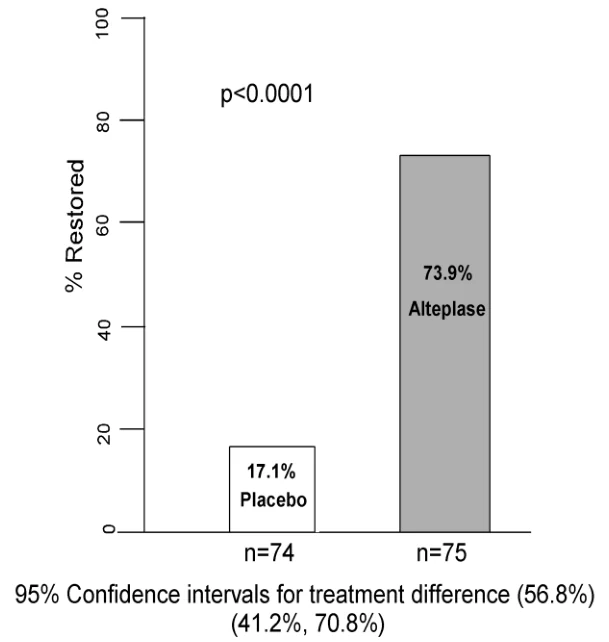
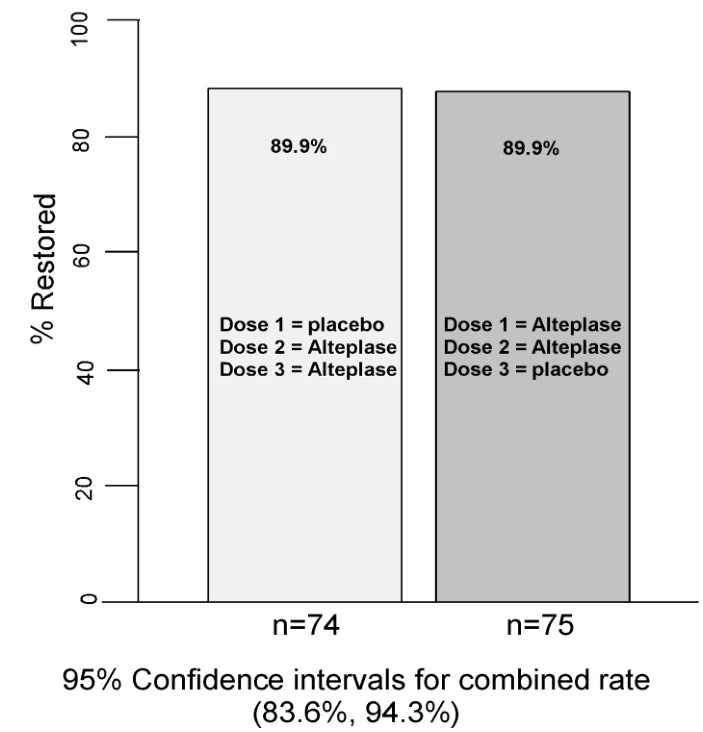
There were 149 patients randomized out of 150 enrolled in this placebo-controlled, double-blind trial. This trial tested the efficacy of a 2 mg/2 mL alteplase dose. Patients were randomized to receive either placebo or alteplase treatment with a 120-minute dwell time for their first dose. Two additional doses were given (alteplase followed by alteplase, or alteplase followed by placebo; respectively) to allow for a maximum of two doses of active drug (each with a 120-minute dwell time) while maintaining the blind. Serious adverse events were collected during the treatment period (2-6 hours). Results for the primary endpoint of the trial, the proportion of patients with restored catheter function after one dose of treatment with a 120-minute dwell time, are shown in Figure 1.
Figure 1
Successful Restoration of Function to CVADs
120 Minutes after First Dose: Placebo versus Alteplase
The rate of catheter function restoration after administration of up to two bolus doses of alteplase was also assessed, and the results are presented in Figure 2.
Figure 2
Successful Restoration of CVAD Function
after up to Two Doses of Alteplase (Cumulative Rate)
A similar result was observed for all catheter types studied (single-, double-, and triple-lumen, and implanted ports). No study drug-related serious adverse events were seen in this trial (see ADVERSE REACTIONS). No major hemorrhages, emboli, intracranial hemorrhages (ICH), or deaths due to study drug were observed.
Safety Trial
An open-label safety trial was conducted in 997 patients with dysfunctional CVADs, of which 995 were treated with alteplase. The primary endpoint of the trial was the safety of up to two 2 mg/2 mL doses of alteplase (up to 4 mg total) with a dwell time of 30 or 120 minutes. The trial measured the incidence of ICH within 5 days following exit from the treatment algorithm. The secondary safety outcome measures were the incidence of major hemorrhage (defined as severe blood loss [ > 5 mL/kg], blood loss requiring transfusion, or blood loss causing hypotension) and embolic events at 5 days following exit from the treatment algorithm, and the incidence of study drug-related serious adverse events within 30 days of exit from the treatment algorithm.
Of the 995 patients treated using this regimen, no patients developed an ICH. No patients had embolic events, and 3 of 995 had deep vein thrombosis deemed unrelated to alteplase. Three patients had a major hemorrhage (2 developed hematemesis and 1 had gastrointestinal bleeding); however, none of the major hemorrhages were deemed to be related to alteplase instillation and were considered associated with concurrent illness or concomitant medication. Two patients developed hematemesis 2 days following treatment with alteplase. One patient was receiving chemotherapy, and hematemesis was assessed as related to chemotherapy. One pediatric patient was receiving palliative radiation therapy and had underlying thrombocytopenia, and hematemesis was assessed as related to underlying disease. One patient with ulcerative colitis developed a gastrointestinal bleed 3 days following treatment that was assessed as related to underlying disease.
One event of sepsis occurred in a 65-year-old patient without baseline symptoms of infection who developed chills and dyspnea 16 minutes following alteplase instillation. Peripheral and catheter blood cultures obtained 51 minutes after alteplase instillation were positive. The patient was treated with intravenous antibiotics and vasopressors and later recovered. One event occurred in a patient without baseline symptoms of infection who developed confusion, lethargy, and fever within 24 hours of alteplase instillation. A catheter blood culture obtained within 24 hours of alteplase instillation was positive and a peripheral blood culture was negative. The patient later recovered. One event of sepsis occurred in a patient with pre-existing fever and a positive peripheral blood culture within 24 hours of alteplase instillation. The event required antibiotic therapy and withdrawal from the study after one alteplase instillation prior to restoration of function. The patient later recovered. The event was not deemed related to study drug. One event of sepsis occurred 3 days after alteplase instillation in a patient with pre-existing fever. The event required antibiotic therapy and was assessed as related to underlying disease. The patient later recovered. The event was not deemed related to study drug.
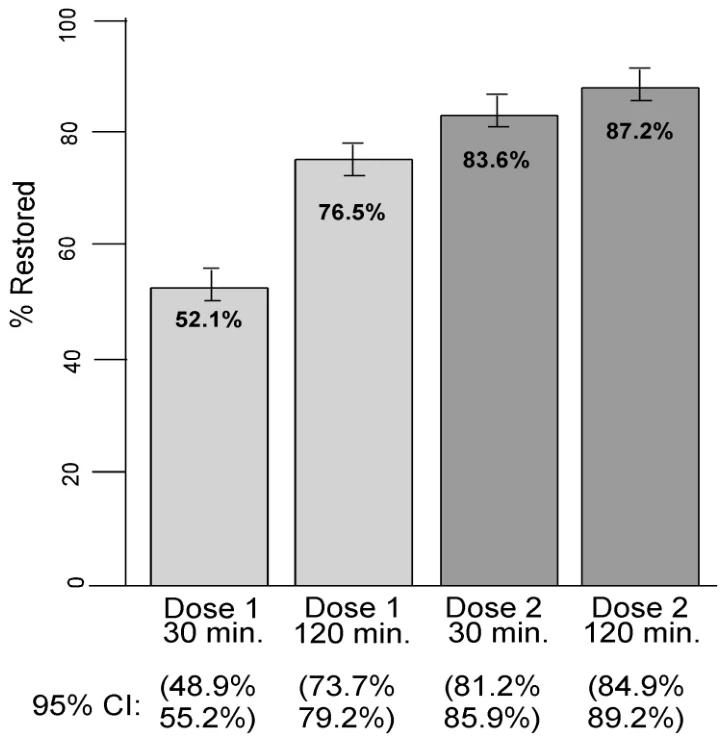
The efficacy of one or two 2 mg/2 mL doses of alteplase was also studied as a secondary endpoint in the open-label safety trial. Results for the proportion of patients with restored catheter function after a 30-minute or 120-minute dwell time following one or two doses of alteplase are shown in Figure 3 and are consistent with the results of the efficacy trial.
Figure 3
Rate of Restoration of Function to CVADs by Dwell Time
(Cumulative Rate) following Alteplase Administration
Similar benefits were seen for all catheter types studied (single-, double-, and triple-lumen, and implanted ports).
In the safety trial, 114 of the 995 (11.5%) patients treated were pediatric (2-16 years of age) patients. None experienced an ICH, embolic event, or other study drug-related serious adverse events during the period following alteplase treatment. The treatment efficacy in this subset of patients was similar to that observed in adult patients.
Additional Supportive Study: Haire Trial
In 1994, Haire and colleagues conducted a randomized, double-blind, parallel-arm trial comparing the efficacy of a dose of alteplase (n = 28) at 2 mg/2 mL with that of a dose of 10,000 U/2 mL of urokinase (UK) (n = 22) in restoring function to central venous catheters with angiographically documented obstruction due to thrombus (3). Up to two doses of study drug (alteplase or UK) were administered to clear the obstruction. Study drug was injected into the dysfunctional catheter and allowed to remain undisturbed for 2 hours. At the end of the 2 hours, withdrawal function was assessed and a second dose of identical study drug was administered for an additional 2 hours. Catheter function was assessed in a blinded manner by one individual. Function was considered normal if blood could be withdrawn and solution infused without resistance or discomfort.
An independent analysis of the data showed that the first dose of alteplase resulted in a higher rate of function restoration compared with urokinase (64% for alteplase versus 45% for UK, p = 0.25). After up to two doses, alteplase resulted in a higher cumulative rate of function restoration compared with urokinase (89% for alteplase versus 64% for UK, p = 0.04). No adverse events, including bleeding, embolism, or septicemia, were reported in either group. These results are consistent with those obtained in the two pivotal trials.
TOXICOLOGY
The safety of the pharmacological administration of alteplase was evaluated for the acute myocardial infarction (AMI) indication by conducting acute and sub-acute toxicity studies in rats, dogs and monkeys.
Acute Toxicology
- 1. Rats were monitored for fourteen days after receiving one intravenous bolus injection of alteplase at dosages of 0.5, 1.5 and 5.0 mg/kg. Additional acute toxicity studies were conducted in rats and these studies employed alteplase at dosages of 1, 3 and 10 mg/kg given as an intravenous bolus injection. In all studies there were no deaths during the study period, no significant toxic signs observed, and no alteplase related macroscopic changes observed at the terminal necropsy.
- 2.
Cynomolgus monkeys were administered alteplase at doses of 1, 3 and 10 mg/kg infused intravenously for 60 minutes. All of the animals appeared normal for the entire observation period of 7 days.
There were no significant effects of alteplase on the electrocardiograms, heart rate, systolic blood pressure or hematological parameters. Consistent with its pharmacologic activity, alteplase caused significant fibrinogenolysis at the doses of 3 and 10 mg/kg. Fibrinogen levels at 2 and 4 hours after alteplase infusion were decreased to about 60% of excipient controls with the 3 mg/kg dose and about 18% of controls with the 10 mg/kg dose. Fibrin/fibrinogen degradation products were increased at 2 and 4 hours after alteplase infusion. The parameters were not significantly different from excipient controls at 24 hours. alteplase did not induce any unexpected physiological or pathological changes in the Cynomolgus monkeys.
Sub-acute Toxicology
- 1. In rats, dosages of 1, 3 and 10 mg/kg were given daily for 14 days via the tail vein. All results were considered to be comparable and normal between treated animals and those in the excipient control group, except for small changes in the hematology determinations including significantly lower mean erythrocyte, hemoglobin and haematocrit values as compared to control values. These changes were consistent with a mild anaemia and occurred primarily in females at 3 and 10 mg/kg/day.
- 2. Dogs were given doses of 0.5, 1.0 and 1.5 mg/kg/day (6 hour intravenous infusion) for 14 days. There was no evidence of any systemic toxicity related to the test article at any dosage level, or in any dog in the excipient control group.
- 3.
Beagle dogs were given alteplase as a six hour i.v. infusion at 1, 2, 3 and 10 mg/kg/day for 14 days. There were some hematological changes observed which were consistent with mild anaemia (e.g. decreased hemoglobin, hematocrit and erythrocytes) in the 3 and 10 mg/kg/day groups. Serum biochemical and urine analyses were comparable to control values. There was little or no change in the levels of fibrinogen and fibrinogen degradation products in plasma samples taken approximately 18 hours after the infusion was completed. Electrocardiograms were normal in all dose groups. Gross and microscopic pathology revealed evidence of hemorrhage and fibrosis at the injection site; this occurred in all dose groups including some dogs in the control group.
In addition, evidence of hemorrhage was observed at sites distant to the injection site, including various locations in the gastrointestinal tract, in 4 of 6 dogs which received 10 mg/kg/day. Organ weights were comparable between treated and control animals.
Reproductive Toxicology
Alteplase has been shown to have an embryocidal effect (increased post-implantation loss rate) in rabbits when administered intravenously at doses approximately 100 times (3 mg/kg) the human dose for restoration of function to occluded CVADs. No maternal or fetal toxicity was evident at 33 times (1 mg/kg) the human dose for restoration of function to occluded CVADs in pregnant rats and rabbits dosed during the period of organogenesis. The no observable effect level (NOEL) of alteplase administered intravenously on maternal or developmental toxicity was 1 mg/kg/day (approximately 33 times the human dose for restoration of function to occluded CVADs).
Summary of Toxicology
Acute and sub-acute toxicity studies with alteplase in the rat, dog and monkey demonstrated no acute systemic toxicity. In sub-acute studies, significant systemic toxicity was observed only in dogs given doses of 10 mg/kg/day for 14 days and consisted of hemorrhagic sites, primarily in the gastrointestinal tract. A mild anaemia was observed in rats and dogs at dosages of 3 and 10 mg/kg/day for 14 days; this could be due to the hemorrhage which was detected at the injection site. Alteplase has been shown to have an embryocidal effect in rabbits at doses approximately 100 times the human dose. No maternal or fetal toxicity was evident at 33 times the human dose in pregnant rats and rabbits.
The clinical administration of alteplase for approved indications (AMI and acute ischemic stroke [AIS]) is by various infusion regimens, while intra-catheter administration (instillation) is used for restoration of function to central venous access devices (CVADs). This intra-catheter administration (instillation) does not precisely mimic the methodology used in a number of the alteplase toxicology studies; however, the total dose in the approved indications (AMI, AIS) are in excess of that used in the CVAD indication. The 90-minute accelerated infusion of alteplase for AMI begins with a 15 mg initial bolus administration. Assuming the entire 2 mg dose was to be improperly bolused into the systemic circulation (rather than instilled into the catheter as per the package insert directions), a safety factor of 7.5-fold exists over the current initial bolus dose of alteplase used for treatment for AMI (2 mg versus 15 mg initial bolus dose). Therefore, the toxicology studies performed with alteplase, previously described, support intra-catheter administration (instillation) of Cathflo® (alteplase, recombinant) for restoration of function to occluded CVADs with greater safety factors compared to the current approved alteplase dose for treatment of AMI.
REFERENCES
- 1. Collen D, Lijnen HR. Fibrinolysis and the control of hemostasis. In: Stamatoyannopoulos G, Nienhui AW, Majerus PW, Varmus H, editors. The molecular basis of blood diseases, 2nd edition. Philadelphia: Saunders, 1994:662-88.
- 2. Tanswell P, Tebbe U, Neuhaus K-L, Glasle-Schwarz L, Wojick J, Seifried E. Pharmacokinetics and fibrin specificity of alteplase during accelerated infusions in acute myocardial infarction. J Am Coll Cardiol 1992;19:1071-5.
- 3. Haire WD, Atkinson JB, Stephens LC, Kotulak GD. Urokinase versus recombinant tissue plasminogen activator in thrombosed central venous catheters: a double-blinded, randomized trial. Thromb Haemost 1994;72:543-7.
- 4. Califf RM, Topol EJ, George BS, Boswick JM, Abbottsmith C, Sigmon KN, et al., and the Thrombolysis and Angioplasty in Myocardial Infarction Study Group. Hemorrhagic complications associated with the use of intravenous tissue plasminogen activator in treatment of acute myocardial infarction. Am J Med 1988;85:353-9.
- 5. Bovill EG, Terrin ML, Stump DC, Berke AD, Frederick M, Collen D, et al. Hemorrhagic events during therapy with recombinant tissue-type plasminogen activator, heparin, and aspirin for acute myocardial infarction: results of the thrombolysis in myocardial infarction (TIMI), phase II trial. Ann Int Med 1991;115:256-65.
- 6. Pearson ML and The Hospital Infection Control Practices Advisory Committee. Guideline for prevention of intravascular device-related infections. Hospital Infectious Program; Atlanta (GA): CDC April, 1995.
- 7. Ponec D, Irwin D, Haire, WD et al. Recombinant tissue plasminogen activator (alteplase) for restoration of flow in occluded central venous access devices. JVIR 2001;12:951-55.
- 8. Deitcher SR, Fesen MR, Kiproff PM et al. Safety and efficacy of alteplase for restoring function in occluded central venous catheters: results of the Cardiovascular thrombolytic to Open Occluded Lines trial. J Clin Oncol 2002;20: 317-24.