


Product Monograph - Cloxacillin for Injection
SUMMARY PRODUCT INFORMATION
| Route of Administration | Dosage Form / Strength | Clinically Relevant Non-medicinal Ingredients |
| IV, IM, IV Infusion | Powder for reconstitution for injection | None |
INDICATIONS AND CLINICAL USE
The treatment of beta-hemolytic streptococcal and pneumococcal infections as well as staphylococcal infections (including those caused by beta-lactamase producing organisms). In severe staphylococcal infections (septicaemia, osteomyelitis, endocarditis, pneumonia) or when staphylococci are suspected and treatment is required before sensitivity results are available, parenteral cloxacillin should be administered at once, followed by cloxacillin orally, when indicated.
It is not effective against the so called “methicillin-resistant” strains of staphylococcus. If the results of identification and susceptibility testing indicate that the infection is due to an organism other than a penicillinase producing staphylococcus susceptible to cloxacillin sodium, treatment should be discontinued and therapy with an alternative agent instituted.
To reduce the development of drug-resistant bacteria and maintain the effectiveness of Cloxacillin for Injection and other antibacterial drugs, Cloxacillin for Injection should be used only to treat infections that are proven or strongly suspected to be caused by susceptible bacteria. When culture and susceptibility information are available, they should be considered in selecting or modifying antibacterial therapy. In the absence of such data, local epidemiology and susceptibility patterns may contribute to the empiric selection of therapy.
CONTRAINDICATIONS
Cloxacillin for Injection is contraindicated for use:
- in patients who are hypersensitive to this drug, to penicillin, or to cephalosporins or to any component of the container. For a complete listing, see the Dosage Forms, Composition and Packaging section of the Prescribing Information.
WARNINGS AND PRECAUTIONS
Hematologic:
During long-term therapy, renal, hepatic and hematopoietic functions should be checked periodically.
Hepatic:
During long-term therapy, renal, hepatic and hematopoietic functions should be checked periodically.
Immune:
Serious and occasionally fatal hypersensitivity (anaphylactoid) reactions have been reported in patients receiving penicillin or cephalosporin therapy. These reactions are more apt to occur in individuals with a history or sensitivity to multiple allergens. Careful inquiry should be made concerning previous hypersensitivity to reactions to penicillins, cephalosporins or other allergens. If allergic or anaphylactic reactions occurs, discontinue treatment and administer the usual agents, e.g. antihistamines, pressor amines, corticosteroids. See Contraindications.
Neurologic:
The passage of any penicillin from blood into brain is facilitated by inflamed meninges and during cardiopulmonary bypass. In the presence of such factors, particularly in renal failure when high serum concentration can be attained, CNS adverse effects including myoclonia, convulsive seizures and depressed consciousness can be expected. Although this complication has not been reported with cloxacillin, it should be anticipated.
Sensitivity/Resistance:
Candidiasis and other superinfections may occur, especially in debilitated and malnourished patients, or those with low resistance to infection due to corticosteroids, immunosuppressors or irradiation. If superinfection occurs, institute appropriate measures.
Renal:
During long-term therapy, renal, hepatic and hematopoietic functions should be checked periodically.
Special Populations
Pregnant Women:
Safety in pregnancy has not yet been established.
Paediatrics:
Experience in premature and newborn infants is limited. Cautious administration of the drug to such patients and frequent evaluation of organ system function is recommended.
Susceptibility/Resistance
Development of Drug Resistant Bacteria
Prescribing Cloxacillin for Injection in the absence of a proven or strongly suspected bacterial infection is unlikely to provide benefit to the patient and risks the development of resistant organisms.
ADVERSE REACTIONS
Adverse Drug Reaction Overview
It may be expected the most common untoward reactions will be related to sensitivity. They are more likely to occur in individuals who have previously demonstrated hypersensitivity to penicillins and cephalosporins and in those with a history of allergy, asthma, hay fever or urticaria. All degrees of hypersensitivity, including fatal anaphylaxis, have been reported with penicillin.
Gastrointestinal:
Nausea, vomiting, epigastric discomfort, flatulence and loose stools have been noted in some patients.
Hematologic: Eosinophilia, leucopenia, anemia, thrombocytopenia, thrombocytopenic, purpura, neutropenia and agranulocytosis have been reported during therapy with penicillins. These reactions are usually reversible on discontinuation of therapy and are believed to be hypersensitivity phenomena. Thrombophlebitis has occurred during the course of i.v. therapy. Mildly elevated SGOT level (less than 100 units) have been reported.
Immune:
Allergic reactions (rash, urticaria) including wheezing and sneezing have been reported.
DRUG INTERACTIONS
Drug-Drug Interactions
Probenecid
As with other penicillins, concurrent administration of probenecid enhances the serum concentration of cloxacillin.
DOSAGE AND ADMINISTRATION
Dosing Considerations:
Preparation and Storage of Parenteral Solution:
Tap vial gently to loosen powder. Use only Sterile Water for injection. Immediate use of reconstituted solutions is recommended, however reconstituted solutions may be stored for up to 24 hours at controlled room temperature not exceeding 25°C or 48 hours under refrigeration. Products should be reconstituted as directed below and may be added to an appropriate infusion fluid in the amount calculated to give the desired dose.
For IM use: Using Sterile Water for Injection, reconstitute as follows:
Fill Size
Volume of Diluent Added
Withdrawable Volume
Nominal Concentration
(mg)
(mL)
(mL)
(mg/mL)
250
1.9
2.0
125
500
1.7
2.0
250
For IV Use: Using Sterile Water for Injection, reconstitute as follows:
Fill Size
Volume of Diluent Added
Withdrawable Volume
Nominal Concentration
(mg)
(mL)
(mL)
(mg/mL)
250
4.9
5.0
50
500
4.8
5.0
100
1000
9.6
10.0
100
For IV Infusion: Using Sterile Water for Injection, reconstitute as follows:
Fill Size
Volume of Diluent Added
Withdrawable Volume
Nominal Concentration
(mg)
(mL)
(mL)
(mg/mL)
1000
3.4
4.0
250
2000
6.8
8.0
250
10000
34.0
40.0
250
Cloxacillin for Injection should be reconstituted as described above and added to an appropriate infusion fluid in the amount calculated to give the desired dose.
Recommended Dose and Dosage Adjustment:
Adults: 250 to 500 mg i.m. or i.v. every 6 hours. I.V. dosage may be increased in serious infections. Maximum dosage for adults is 6 g/day.
Pediatrics (up to 20 kg): 25 to 50 mg/kg/day into 4 equal doses administered i.m. or i.v. every 6 hours.
Administration:
IM/IV use: Shake well to dissolve. Administer total contents of vial by slow infusion over 2-4 minutes. Immediate use of the reconstituted solution is recommended.
IV Infusion: Shake well to dissolve. Administer total contents of vial by slow infusion over 30-40 minutes. Immediate use of the reconstituted solution is recommended.
Dispensing from Pharmacy Bulk Vial: The use of pharmacy bulk vial is restricted to hospitals with a recognized intravenous admixture program. The pharmacy bulk vial is intended for single puncture, multiple dispensing.
OVERDOSAGE
For the most recent information in the management of a suspected drug overdose, contact your regional poison control centre or Health Canada’s toll-free number, 1-844 POISON-X (1-844-764-7669).
Treatment is likely needed only in patients with severely impaired renal function, since patients with normal kidneys excrete penicillins at a fast rate. No specific treatment can be recommended.
In patients with severe allergic reactions, general supportive measures (if the patient is in shock) or symptomatic therapy similar to that applied in all cases of hypersensitivity are recommended.
ACTION AND CLINICAL PHARMACOLOGY
Cloxacillin exerts a bacterial action against susceptible microorganisms during the stage of active multiplication. It acts through the inhibition of biosynthesis of cell wall mucopeptides.
Cloxacillin demonstrates activity against strains of beta-hemolytic streptococci, pneumococci, penicillin G sensitive staphylococci and, due to its resistance to penicillinase, penicillin G resistant (β-lactamase producing) staphylococci. Cloxacillin displays less intrinsic antibacterial activity and a narrower spectrum than penicillin G.
Pharmacokinetics
Cloxacillin is stable in an acid medium and is approximately 50% absorbed orally. After an oral dose of 500mg cloxacillin, a peak serum level of about 8 micrograms/mL is reached in about 1 hour. The serum level after i.m. cloxacillin is approximately twice that obtained when the same dose is given orally to fasting adults. Food in the stomach or small intestine reduces absorption and peak serum levels are approximately 50% those obtained after fasting. As with other penicillins, concurrent administration of probenecid enhances the serum concentration.
Once absorbed, approximately 94% are bound to plasma proteins. After oral administration, roughly 20% of the dose is excreted in the urine, together with one or more active metabolites as yet unidentified. The half life of elimination is about 30 minutes.
STORAGE AND STABILITY
Store dry powder at controlled room temperature 15-30°C.
Cloxacillin for Injection is compatible at concentrations of 1 and 2 mg/mL up to 12 hours at controlled room temperature not exceeding 25°C in dextrose 5% in water, fructose 10% in water or normal saline, M/6 sodium lactate, Lactated Ringer’s invert sugar 10% in water or normal saline.
Reconstituted solution may be stored for up to 24 hours at controlled room temperature not exceeding 25°C or in refrigerator at 2°- 8°C (36° - 46°F) for up to 48 hours. Discard unused portion.
DOSAGE FORMS, COMPOSITION AND PACKAGING
How Supplied:
PrCloxacillin for Injection is supplied as a dry powder in vials containing: 500 mg, 1,000 mg, 2,000 mg, or 10 g of cloxacillin base as the sodium salt.
Each gram of Cloxacillin Sodium for injection contains approximately 50 mg, or approximately 5-7% sodium.
PART II: SCIENTIFIC INFORMATION
PHARMACEUTICAL INFORMATION
Drug Substance
Proper Name: Cloxacillin sodium
Chemical Name: 6-[[[3-(2-Chlorophenyl)-5-methyl-4isoxazolyl[carbonyl]amino]-3,3-dimethyl-7-oxo-4-thia-1-azabicyclo[3.2.0]heptane-2-carboxylic acid, sodium salt
Empirical Formula: C19H17CIN3NaO5S • H2O
Molecular Weight: 475.88
Structural Formula:
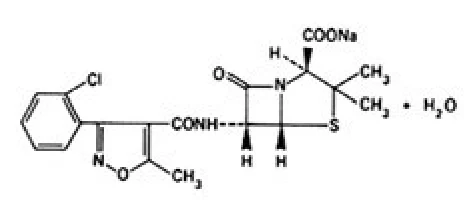
Physical Characteristics: Cloxacillin sodium is a white, crystalline powder
Solubility: Soluble at 20°C in 2.5 parts water, in 30 parts ethanol (95%) and in 500 parts chloroform.