


Product Monograph - Cortrosyn Inj 0.25mg
SUMMARY PRODUCT INFORMATION
| Route of Administration | Dosage Form / Strength | All Nonmedicinal Ingredients |
| I.V. or intramuscular | Lyophilized powder for injection 0.25 mg/ vial | Mannitol and water for injection May contain glacial acetic acid and sodium hydroxide for pH adjustment. |
INDICATIONS AND CLINICAL USE
Cortrosyn® (Cosyntropin for injection, 0.25 mg) is indicated for:
- use as a diagnostic agent in the screening of patients presumed to have adrenocortical insufficiency.
Because of the possibility of an allergic reaction, the injection should be given under medical supervision and the patient kept under observation for about an hour. Self injection by patients is not recommended.
Because of its rapid effect on the adrenal cortex, it is now possible to perform a 30 minute test of adrenal function (plasma cortisol response) as an office or outpatient procedure using only 2 venipunctures. (See DOSAGE AND ADMINISTRATION)
Geriatrics (> 65 years of age):
No data is available.
Pediatrics (< 16 years of age):
No data is available.
CONTRAINDICATIONS
Patients who are hypersensitive to this drug or to any ingredient in the formulation or component of the container. For a complete listing, see the Dosage Forms, Composition and Packaging section of the product monograph.
WARNINGS AND PRECAUTIONS
General
It is not advisable to add a synthetic polypeptide such as tetracosactide to blood and plasma transfusions because prolonged interaction with enzymes, present in these fluids, can cause breakdown of the polypeptide.
Sensitivity/Resistance
Allergic reactions may occur in response to CORTROSYN®. Reactions of this type include: marked redness and pain at the injection site, urticaria, pruritis, severe malaise or dyspnea.
Should prodromal signs occur, further use of CORTROSYN® should be stopped.
Severe anaphylactic reactions usually can be avoided by discontinuing the use of the drug at the earliest sign of local or systemic hypersensitivity. In the rare event of a serious incident occurring despite these precautions, initiate the following emergency measures as treatment for shock: 0.1 to 0.8 mg I.V. aqueous epinephrine, as well as a large I. V. dose of corticosteroid, e.g. hydrocortisone or methylprednisolone.
Repeat administration of CORTROSYN® may increase the risk of hypersensitivity.
Patients should be instructed to inform subsequent physicians of previous use of corticotropic hormones.
Hematologic
ACTH induces the release of glucocorticoid such as cortisol which tends to increase the hemoglobin and red-cell content of the blood, as evidence by the occurrence of polycythemia in Cushing’s syndrome and a mild normochromic, normocytic anemia in Addison’s disease. ACTH also induces the release of glucocorticoid such as cortisol which tends to affect circulating white cells. Administration of corticosteroid including ACTH may lead to an increase in the number of polymorphonuclear leukocytes in the blood, while the number of lymphocytes, eosinophils, monocytes, and basophils decrease. The response of platelets is unclear, as both thrombocytosis and thrombocytopenia have been reported following corticosteroid and/or ACTH administration.(4)
Adverse reactions related to glucocorticoid effects are unlikely to be observed with short-term use of cosyntropin when used as a diagnostic tool.
Special Populations
Pregnant Women: When pregnancy is present or suspected the benefits of the use of CORTROSYN® should be weighed against the possible hazards to the fetus.
Nursing Women: It is unknown if the drug is excreted in human milk. Because many drugs are excreted in human milk precaution should be exercised.
Geriatrics (> 65 years of age):
No data is available.
Pediatrics (< 16 years of age):
No data is available.
Monitoring and Laboratory Tests:
As ACTH has the ability to stimulate the adrenal glands to release corticosteroids such as cortisol which has pharmacological effects on systemic electrolyte such as sodium, potassium, calcium, blood urea nitrogen, creatinine, glucose, hemoglobin, hematocrit and white blood cells, standard laboratory monitoring such as a metabolic panel and complete blood count are recommended. In addition, vital signs should be monitored and IV fluids administered to support hydration, if applicable.(10)
ADVERSE REACTIONS
Adverse Drug Reaction Overview
CORTROSYN® (cosyntropin for injection, 0.25 mg) is intended for short-term use only.
Hypersensitivity is thus anticipated, but rarely observed. To date, only nine such reactions have been reported in the literature and in each instance, the patient had a pre-existing allergic disease and/or a previous reaction to natural ACTH.
Post-Market Adverse Drug Reactions
General disorders and administration site conditions: Lack of efficacy, chest pain, injection site atrophy.
Gastrointestinal disorders: Abdominal pain and tremor, churning of stomach, nausea.
Nervous system disorders: Fainting, paralysis, headache, numbness of upper extremity, slurred speech.
Vascular disorders:.Hypotension, feeling flushed.
Skin and subcutaneous tissue disorders: Skin reported to be “sloughing off” and turned red.
DRUG INTERACTIONS
Drug-Drug Interactions
Patients taking inadvertent doses of hydrocortisone on the test day may exhibit abnormally high basal plasma cortisol levels. A paradoxical response may be noted, as seen in a decrease in plasma cortisol values following a stimulating dose of CORTROSYN®.
Women taking estrogen containing drugs may exhibit abnormally high basal plasma cortisol levels. Only a normal incremental response is to be expected.
Please refer to Dosing Consideration section for more details on how to interpret test results in these patients.
Drug-Food Interactions
Interactions with food have not been established.
Drug-Herb Interactions
Interactions with herbal products have not been established.
Drug-Laboratory Interactions
Changes to systemic electrolytes and hematologic lab values might occur. Please refer to the Monitoring and Laboratory Tests section and Hematologic warnings and precautions for more details.
DOSAGE AND ADMINISTRATION
Dosing Considerations
It is not advisable to add a synthetic polypeptide such as tetracosactide to blood and plasma transfusions because prolonged interaction with enzymes, present in these fluids, can cause breakdown of the polypeptide.
Patients taking inadvertent doses of hydrocortisone on the test day and women taking estrogen containing drugs may exhibit abnormally high basal plasma cortisol levels. A paradoxical response may be noted in the former group as seen in a decrease in plasma cortisol values following a stimulating dose of CORTROSYN®. In the latter group, only a normal incremental response is to be expected.
Patients receiving hydrocortisone should omit their pre-test doses on the day selected for testing. The test may be performed at any time during the day but because of the physiological diurnal variation of plasma cortisol the criteria established to denote a normal response cannot apply.
It has been shown that basal plasma cortisol levels and the post- CORTROSYN® increment exhibit diurnal changes. However, the 30 minute plasma cortisol level remains unchanged throughout the day so that only this single criterion (30 minute plasma level should exceed 18 micrograms/100 ml) should be used(13).
Recommended Dose and Dosage Adjustment
Adults
CORTROSYN® may be administered intramuscularly, as a direct intravenous injection and by intravenous infusion. The dose should be administered intramuscularly or by the direct intravenous injection route when used as a rapid screening test of adrenal function.
Administration of the intravenous infusion over a 4 to 8 hour period provides a greater stimulus to the adrenal glands.
Doses of 0.25 mg to 0.75 mg per injection have been used in clinical studies, and a maximal response has been noted with the smallest dose.
Direct intravenous injection: Reconstitute dose in 2 to 5 mL of saline, and administer over a 2 minute period as part of a rapid screening test of adrenal function.
Intravenous infusion: 0.25 mg may be added to glucose or saline solutions and given at a rate of approximately 40 micrograms per hour over a 6 hours period.
Children ≤ 2years of age: A dose of up to 0.125 mg, administered intramuscularly is recommended. (1, 8)
Missed Dose
Not applicable.
Administration
A suggested method for rapid screening test of adrenal function has been described by Wood and Associates (15).
A control blood sample is taken and 0.25 mg of CORTROSYN®, dissolved in sterile saline, is then injected intramuscularly. A second blood sample is collected exactly 30 minutes later and the plasma cortisol response is then determined.
The usual normal response in most cases is an approximate doubling of the basal level, provided that this does not exceed the normal range. Many patients with normal adrenal function, however, do not respond to the expected degree so that the following criteria have been established to denote a normal response:
- 1. The control plasma cortisol level should exceed 5 micrograms/100 ml.
- 2. The 30 minute level should show an increment of at least 7 micrograms/100 ml above the basal level.
- 3. The 30 minute level should exceed 18 micrograms/100 ml.
Comparable figures have been reported by Greig and co-workers.(6) These criteria also apply when the drug is injected intravenously in 2 to 5 ml of saline over a 2 minute period.
Plasma cortisol levels usually peak about 45 to 60 minutes after an injection of
CORTROSYN® and some prefer the 60 minute interval for testing for this reason. While it is true that the 60 minute values are usually higher than the 30 minute values, the difference may not be significant enough in most cases to outweigh the disadvantages of a longer testing period. If the 60 minute test period is used, the criterion for a normal response is an approximate doubling of the basal plasma cortisol value.
Adrenal response may be measured in the usual manner by determining urinary steroid excretion before and after treatment or by measuring plasma cortisol levels before and at the end of the infusion. The latter is preferable because urinary steroid excretion does not always accurately reflect the adrenal or plasma cortisol response to ACTH.
Reconstitution:
Reconstitute the vial contents with 1 mL of Sodium Chloride Injection, USP (0.9%) to obtain a 0.25 mg/mL Cosyntropin solution for injection, 0.25 mg.
Reconstitution
| Vial Size | Volume of Diluent to be Added to Vial | Approximate Available Volume | Nominal Concentration per mL |
| 3 mL | 1 mL normal saline | 1 mL | 0.25 mg/mL |
Each vial is intended for single use only.
Parenteral drug products should be inspected visually for particulate matter and discoloration prior to administration, whenever solution and container permit.
OVERDOSAGE
| For management of a suspected drug overdose, contact your regional Poison Control Centre. |
ACTION AND CLINICAL PHARMACOLOGY
Mechanism of Action
The pharmacologic profile of CORTROSYN® (Cosyntropin for injection, 0.25 mg) is similar to that of purified natural ACTH. It has been established that 0.25 mg of CORTROSYN® will stimulate the adrenal cortex maximally and to the same extent as 25 units of natural ACTH.(1)
Severe hypofunction of the pituitary-adrenal axis is usually associated with subnormal plasma cortisol values but a low basal level is not per se evidence of adrenal insufficiency and does not suffice to make the diagnosis. Many patients with proven insufficiency will have normal basal levels and will develop signs of insufficiency only when stressed.
For this reason, the only criterion which should be used in establishing the diagnosis is the failure to respond to adequate corticotropin stimulation as provided by 0.25 mg of
CORTROSYN® (Cosyntropin for injection, 0.25 mg). When presumptive adrenal insufficiency is diagnosed by a negative CORTROSYN® test, further studies are indicated to determine if it is primary or secondary.
Pharmacodynamics
Primary adrenal insufficiency (Addison's disease) is the result of an intrinsic disease process, such as tuberculosis, within the gland. The production of adrenocortical hormones is deficient despite high ACTH levels (feedback mechanism). Secondary or relative insufficiency arises as the result of defective production of ACTH leading in turn to disuse atrophy of the adrenal cortex. It is commonly seen, for example, as a result of corticosteroid therapy, Sheehan’s syndrome and pituitary tumors or ablation.
The differentiation of both types is based on the premise that a primarily defective gland cannot be stimulated by ACTH whereas a secondarily defective gland is potentially functional and will respond to adequate stimulation with ACTH.
Patients selected for further study as a result of a negative CORTROSYN® test should be given a 3 or 4 day course of treatment with Purified Cortrophin Gel and then retested. Suggested doses are 40 U.S.P. units twice daily for 4 days or 60 U.S.P. units twice daily for 3 days. Under these conditions little or no increase in plasma cortisol levels will be seen in Addison's disease whereas higher or even normal levels will be seen in cases with secondary adrenal insufficiency.
Pharmacokinetics
Absorption: After IM administration, cosyntropin is absorbed rapidly. After rapid IV administration in patients with normal adrenal function, plasma cortisol levels begin to increase within 5 minutes and double within 15-30 minutes. Peak levels begin to decrease in 2 to 4 hours. Plasma half-life is about 15 minutes(3).
Distribution: Not fully understood, but drug is removed rapidly from plasma by many tissues.
Metabolism: Unknown.
Excretion: Probably excreted by the kidneys. (3, 5)
Special Populations and Conditions
Pediatrics (< 16 years of age):
No data is available.
Geriatrics (> 65 years of age):
No data is available.
STORAGE AND STABILITY
Store at 15-30○ C.
SPECIAL HANDLING INSTRUCTIONS
CORTROSYN® is intended as a single dose injection and contains no antimicrobial preservative. Any unused portion should be discarded.
DOSAGE FORMS, COMPOSITION AND PACKAGING
Dosage Forms
Cortrosyn® (Cosyntropin for injection, 0.25 mg) is available in glass vials. The vial contents needs to be reconstituted with 1 mL of Sodium Chloride Injection, USP (0.9%) to obtain a concentration of 0.25 mg/mL Cosyntropin for injection.
Composition
Each CORTROSYN® (Cosyntropin for injection, 0.25 mg) vial contains 0.25 mg of lyophilized cosyntropin (equivalent to approx. 25 I.U. or USP units ACTH).
Nonmedicinal ingredients include: mannitol and water for injection.
May contain glacial acetic acid and sodium hydroxide for pH adjustment.
Packaging
Vials containing 0.25 mg of CORTROSYN® (cosyntropin for injection as a lyophilized powder).
Ten such vials packaged in one carton box. PART II: SCIENTIFIC INFORMATION
PHARMACEUTICAL INFORMATION
Drug Substance
Proper name: Cosyntropin (USP name)
Tetracosactide (Ph. Eur. name)
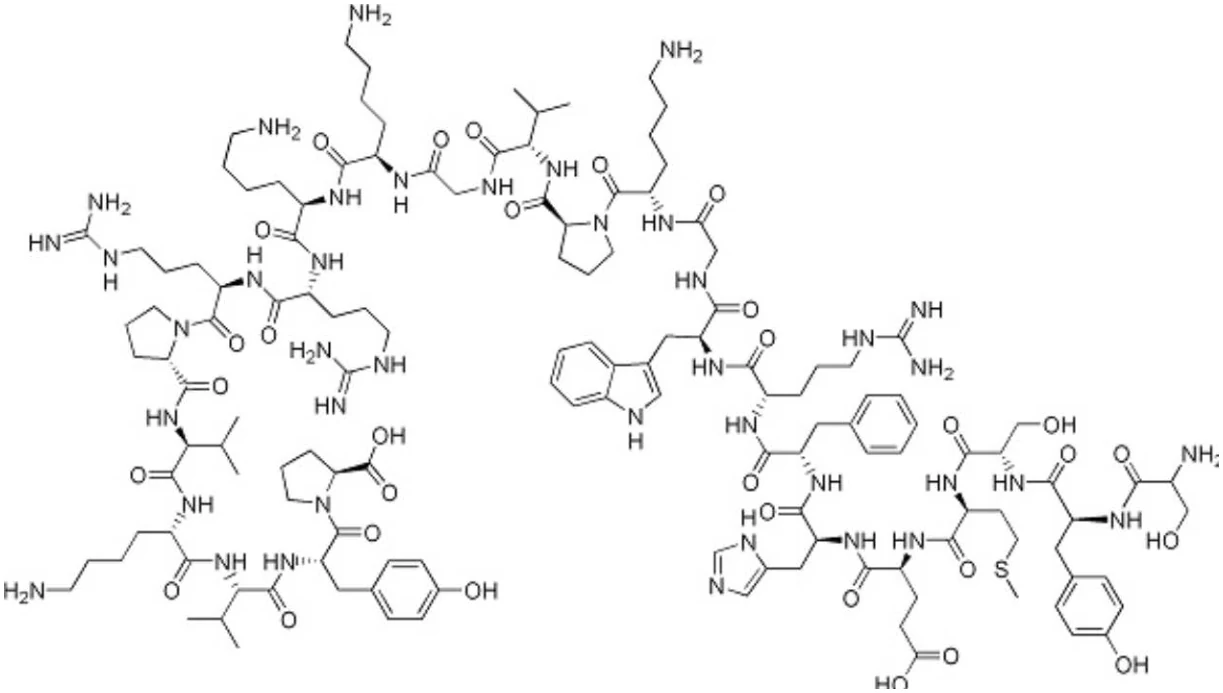
Chemical name: L-Seryl-L-trosyn-L-methionyl-L-glutamyl-L-histidyl-Lphenylalanyl-
L-arginyl-L-tryptophyl-glycyl-L-lysyl-Lpropyl-L-Valyl-glycycl-L-lysyl-L-arginyl-L-arginyl-Lpropyl-Lvalyl-Lvalyl-Llysyl-Lvalyl-Ltyrosyl-L-proline
Molecular formula and molecular mass: C136H210N40O31S; 2933.4 g/mol
Structural formula:
Physicochemical properties:
Physical Description: White to pale yellow amorphous powder
Solubility Profile: Sparingly soluble in water
Appearance of Solution: Clear, complete
Optical Rotation: -98°to -108°
CLINICAL TRIALS
No recent clinical trials were conducted with CORTROSYN®.
DETAILED PHARMACOLOGY
CORTROSYN® (cosyntropin for injection, 0.25 mg) exhibits the full range of biologic activity seen with natural ACTH. Various studies have shown that the biologic activity of ACTH resides in the N-terminal portion of the molecule and that the 1-20 amino acid residues are the minimal sequences retaining full activity. Partial or complete loss of activity is noted with progressive shortening of the chain beyond 20 amino acid residues. For example, the decrement from 20 to
19 results in a 70% loss of potency.
The pharmacologic profile of CORTROSYN® (cosyntropin for injection, 0.25 mg) is similar to that of purified natural ACTH. It has been established that 0.25 mg of CORTROSYN® will stimulate the adrenal cortex maximally and to the same extent as 25 units of natural ACTH.(12) These clinical observations confirm earlier animal and assay studies establishing the 1: 100 ratio.(2,14) This dose of CORTROSYN® will produce maximal secretion of 17 -OH corticosteroids, 17- ketosteroids and/or 17-ketogenic steroids.(11)
Aldosterone secretion is increased also to some degree.
The extra-adrenal effects which natural ACTH and CORTROSYN® have in common include increased melanotropic activity,(14) increased growth hormone secretion and an adipokinetic effect. (7) These are considered to be without physiological or clinical significance.
Animal, human and synthetic ACTH ( 1-39), which all contain 39 amino acids, exhibit similar immunologic activity. This activity resides in the C-terminal portion of the molecule and the 22-39 amino acid residues exhibit the greatest degree of antigenicity.
In contrast, synthetic polypeptides containing 1-19 or fewer amino acids have no detectable immunologic activity. Those containing 1-26, 1-24 or 1-23 amino acids have very little immunologic although full biologic activity. (13) This property of CORTROSYN® assumes added importance in view of the known antigenicity of natural ACTH
TOXICOLOGY
No tolerance studies in humans nor toxicity or reproductive studies in animals were performed.
REFERENCES
| 1 | Ayse Pinar Cemeroglu, et. al. Pediatrics International 53, 175-180, (2011) |
| 2 | Barthe, P., et al. Nature 202,908 (1964). |
| 3 | Drug Facts and Comparisons, Adrenocortical Steroids, Corticotropin (ACTH), 318-320, (2000) |
| 4 | Goodman and Gilman, The Pharmacological Basis of Therapeutics, 42, 1209-1236, (2011) |
| 5 | Global Library of Women’s Medicine, https://www.glowm.com/resources/glowm/cd/pages/drugs/c086.html, accessed October 15, 2015 |
| 6 | Greig, W.R., el al. J. Endocr. 34,411 (1966). |
| 7 | Gries, F.A. and Bethge, H. Metabolism 16,967 (1967). |
| 8 | Imke H. Bartelink, et al. Clin Pharmacokinet 45(11)1077-1097, (2006) |
| 9 | Imura, H., et al. J. Clin. Endocr. 25,1361 (1965). |
| 10 | www.labdxtest.com/labdxtest/view/David-Lab-and-Diagnostic-Test/425331/all/Adrenocorticotropic Hormone and Challenge Tests, accessed October 15, 2015 |
| 11 | Lamberg, B.A., et al. Acta Med. Scand. 179,551 (1966). |
| 12 | Landon, J., et al. J. Clin. Endocr. 24,1206 ( 1964 ). |
| 13 | McGill, P.E., et al. Ann. Rheum. Dis. 26,123 (1967). |
| 14 | Schuler, W., et al Schweiz. Med. Wschr 93,1027 (1963). |
| 15 | Wood, J.B., et al. Lancet 1,243 (1965). |