


Product Monograph - Covifenz
RECENT MAJOR LABEL CHANGES
| [08/2022] |
|---|---|
| [08/2022] |
| [08/2022] |
TABLE OF CONTENTS
Sections or subsections that are not applicable at the time of authorization are not listed.
RECENT MAJOR LABEL CHANGES ........................................................................................2
TABLE OF CONTENTS .............................................................................................................2
PART I: HEALTH PROFESSIONAL INFORMATION .................................................................3
1 INDICATIONS ...............................................................................................................3
1.1 Pediatrics ......................................................................................................................3
1.2 Geriatrics .......................................................................................................................3
2 CONTRAINDICATIONS ................................................................................................3
3 SERIOUS WARNINGS AND PRECAUTIONS ..............................................................3
4 DOSAGE AND ADMINISTRATION ..............................................................................3
4.1 Dosing Considerations ..................................................................................................3
4.2 Recommended Dose and Dosage Adjustment ..............................................................3
4.3 Reconstitution ...............................................................................................................4
4.4 Administration ...............................................................................................................6
5 OVERDOSAGE.............................................................................................................6
6 DOSAGE FORMS, STRENGTHS, COMPOSITION AND PACKAGING .......................6
7 WARNINGS AND PRECAUTIONS ...............................................................................8
7.1 Special Populations .......................................................................................................9
7.1.1 Pregnant Women ......................................................................................................9
7.1.2 Breast-feeding ...........................................................................................................9
7.1.3 Pediatrics ..................................................................................................................9
7.1.4 Geriatrics ..................................................................................................................9
8 ADVERSE REACTIONS ...............................................................................................9
8.1 Adverse Reaction Overview ..........................................................................................9
8.2 Clinical Trial Adverse Reactions .................................................................................. 11
9 DRUG INTERACTIONS .............................................................................................. 17
10 CLINICAL PHARMACOLOGY .................................................................................... 17
10.1 Mechanism of Action ................................................................................................... 17
11 STORAGE, STABILITY AND DISPOSAL ................................................................... 17
12 SPECIAL HANDLING INSTRUCTIONS ..................................................................... 17
PART II: SCIENTIFIC INFORMATION ..................................................................................... 18
13 PHARMACEUTICAL INFORMATION ......................................................................... 18
14 CLINICAL TRIALS ...................................................................................................... 18
14.1 Trial Design and Study Demographics ........................................................................ 18
14.2 Study Results .............................................................................................................. 19
14.2.1 Efficacy in Participants 18 to 64 Years of Age (Based on Cut-off Date of August 20, 2021) .................................................................................................................. 19
14.2.2 Immunogenicity in Participants 65 Years of Age and Older ................................... 20
- 15. MICROBIOLOGY ........................................................................................................ 21
- 16. NON-CLINICAL TOXICOLOGY .................................................................................. 21
PATIENT MEDICATION INFORMATION ................................................................................. 23
PART I: HEALTH PROFESSIONAL INFORMATION
1 INDICATIONS
COVIFENZ, COVID-19 Vaccine (plant-based virus-like particles [VLP], recombinant, adjuvanted), is indicated for active immunization to prevent coronavirus disease 2019 (COVID-19) caused by severe acute respiratory syndrome coronavirus 2 (SARS-CoV-2) in individuals 18 years of age and older.
Circulating SARS-CoV-2 viral variants may be associated with breakthrough infections in individuals that have received a primary vaccination series of COVIFENZ. The use of this vaccine should be in accordance with official public health recommendations. (see 14 CLINICAL TRIALS section).
1.1 Pediatrics
The safety and efficacy of COVIFENZ in individuals younger than 18 years of age have not been established.
1.2 Geriatrics
Clinical studies of COVIFENZ include participants 65 years of age and older and their data contribute to the overall assessment of safety and efficacy.
2 CONTRAINDICATIONS
COVID-19 Vaccine (plant-based virus-like particles [VLP], recombinant, adjuvanted) is contraindicated in individuals who are hypersensitive to the active substance or to any ingredient in the formulation. For a complete listing, see 6 DOSAGE FORMS, STRENGTHS, COMPOSITION AND PACKAGING.
3 SERIOUS WARNINGS AND PRECAUTIONS
At the time of authorization, there are no known serious warnings or precautions associated with this product.
4 DOSAGE AND ADMINISTRATION
4.1 Dosing Considerations
COVIFENZ is an emulsion for intramuscular injection. The antigen component of COVIFENZ is a suspension, which must be mixed 1:1 with the AS03 adjuvant emulsion component prior to administration. It should be administered by a trained healthcare professional authorized to deliver intramuscular injections.
4.2 Recommended Dose and Dosage Adjustment
Vaccination Schedule for Individuals 18 years of age and older
COVIFENZ is administered intramuscularly into the deltoid muscle, after mixing, as a series of two doses (0.5 mL each), 21 days apart.
There are no data available on the interchangeability of COVIFENZ with other COVID-19 vaccines to complete primary vaccination. Individuals who have received one dose of COVIFENZ should receive the second dose of COVIFENZ to complete the primary vaccination series.
4.3 Reconstitution
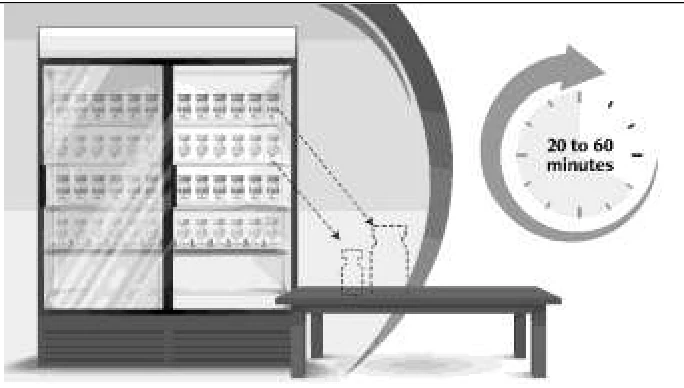
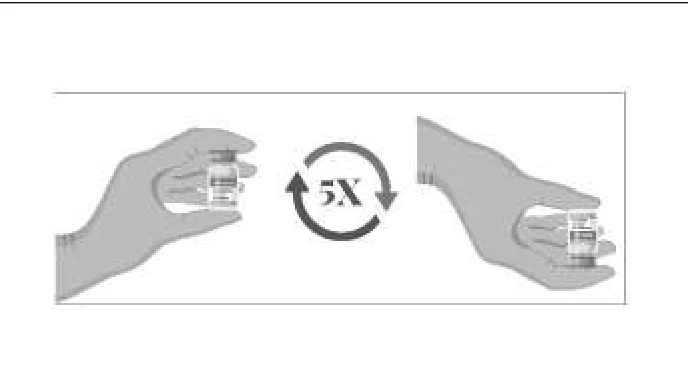
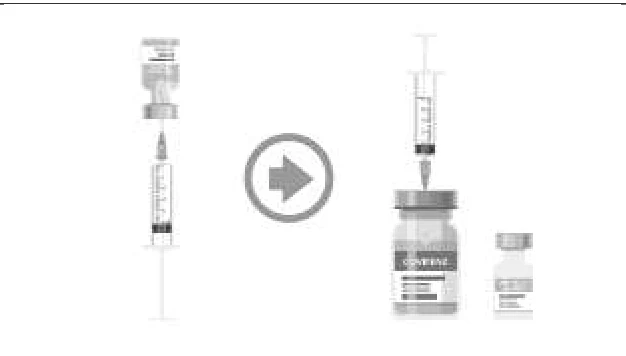
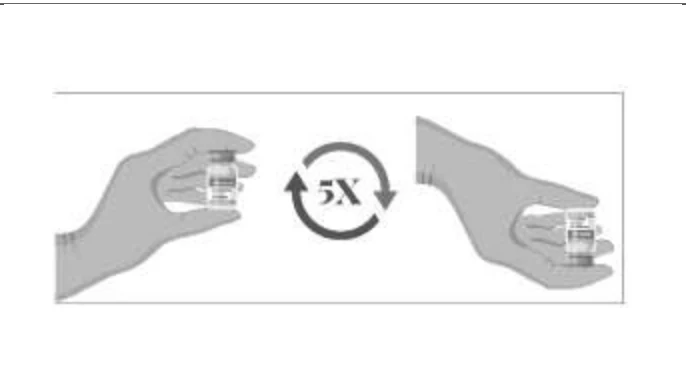
Check the expiry date on the antigen and adjuvant vials. Mixing of the COVIFENZ antigen with the adjuvant is required prior to administration.
Preparation for Administration:
| Prior to mixing | |
|---|---|
|  |
|  |
| Mixing | ||
|---|---|---|
|  | |
|  | |
|  | |
|
|---|
4.4 Administration
- 1. Before every administration, gently invert the vial until homogeneity is obtained.
- 2. Inspect for foreign matter, change in colour and / or leakage. If any of these conditions exists, the vaccine must not be administered.
- 3. Cleanse the vial stopper with a single-use antiseptic swab, allow to dry.
- 4. Use a syringe with a 23-gauge needle for vaccine withdrawal and injection.
- 5. Choose needle length based on the patient weight. Ensure that the needle is tightly attached to the syringe.
- 6. Withdraw a dose (0.5 mL) and administer into the deltoid muscle.
- 7. Do not inject the vaccine intravascularly, subcutaneously or intradermally.
5 OVERDOSAGE
In the event of suspected overdose, monitoring of vital functions and symptomatic treatment are recommended. Contact your regional poison control centre.
6 DOSAGE FORMS, STRENGTHS, COMPOSITION AND PACKAGING
COVIFENZ is a sterile emulsion for intramuscular injection. It is supplied as two refrigerated containers: one multidose vial containing the antigen (suspension) and a second multidose vial containing the adjuvant system (emulsion).
Each antigen vial must be mixed (mix ratio 1:1) with the entire content of the AS03 adjuvant vial prior to use. Once mixed with the adjuvant, the vial contains 10 doses of 0.5 mL of the formulation to be administered.
Each 0.5 mL dose contains 0.25 mL of the antigen component containing 3.75 mcg of the virus- like particles (VLP) SARS-CoV-2 spike (S) protein, 0.25 mL of the AS03 adjuvant and the non-medicinal ingredients listed in Table 1 below.
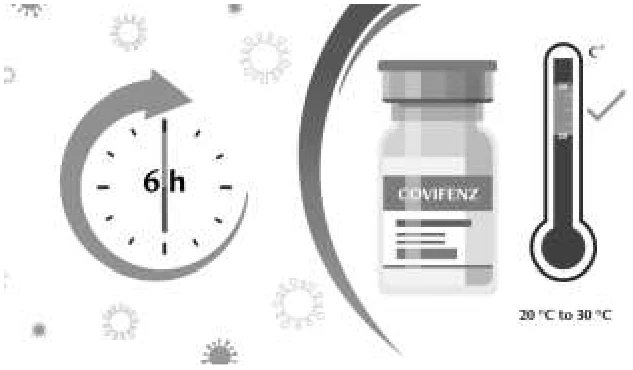 |
Table 1. Dosage Forms, Strengths, Composition and Packaging
| Route of Administration | Dosage Form / Strength / Composition | Ingredients (per 0.5 mL vaccine dose) |
| Intramuscular injection | Emulsion, after mixing |
|
The antigen component is a sterile transparent to opalescent colorless to yellowish liquid suspension for injection that may contain visible white particulates, preservative-free.
AS03 adjuvant system is a sterile, homogenized, whitish to yellowish homogenous milky emulsion.
Immediately prior to use, the entire content of the AS03 vial is withdrawn and added to the antigen vial (mix ratio 1:1). The mixed final vaccine is a whitish to yellowish homogeneous milky liquid emulsion.
COVIFENZ is supplied in an outer pack containing a carton with antigen vials and a carton with adjuvant vials. Each carton contains 10 multidose vials of antigen and 10 multidose vials of adjuvant that must be mixed 1:1 prior to administration.
Each outer pack contains sufficient antigen and adjuvant to obtain 100 doses of 0.5 mL:
- 10 vials containing 2.5 mL of antigen suspension (10 doses of 0.25 mL)
- 10 vials containing 2.5 mL of AS03 adjuvant emulsion (10 doses of 0.25 mL)
The antigen vials are made of Type 1 clear borosilicate glass. The chlorobutyl vial stoppers are not made with natural rubber latex; and are capped with a green flip-off aluminum cap seal.
The adjuvant vials are made of Type 1 glass. The butyl vial rubber stoppers are not made with natural rubber latex and are capped with a light gold flip-off aluminum cap seal.
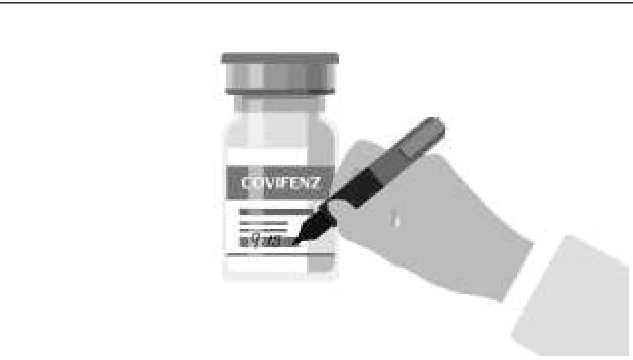
To help ensure the traceability of vaccines for patient immunization record-keeping as well as safety monitoring, health professionals should record the time and date of administration, quantity of administered dose, anatomical site and route of administration, brand name and common name of the vaccine, the product lot number and expiry date.
7 WARNINGS AND PRECAUTIONS
General
The administration of COVIFENZ should be postponed in individuals suffering from any severe febrile illness or severe acute infection.
Syncope (fainting) can occur following, or even before, any vaccination as a psychogenic response to the needle injection. Individuals should be advised to bring up symptoms (e.g., dizziness, increases in heart rate, feeling short of breath, tingling sensations, or sweating) to the attention of the vaccination provider for evaluation. Procedures should be in place to avoid injury from fainting.
As with any vaccine, vaccination with COVIFENZ may not protect all recipients. Individuals may not be optimally protected until at least 7 days after their second dose of vaccine (see 14 CLINICAL TRIALS section).
Acute Allergic Reactions
Although no events of anaphylaxis have been reported during the clinical trials, COVIFENZ should be administered with caution in individuals who have history of confirmed anaphylaxis to plant materials.
As with all injectable vaccines, appropriate medical treatment and supervision should always be readily available in case of an anaphylactic event following the administration of a vaccine.
Vaccine recipients should be kept under observation for at least 15 minutes after immunization; 30 minutes is a preferred interval when there is a specific concern about possible vaccine reaction.
A second dose of the vaccine should not be given to those who have experienced anaphylaxis to the first dose of COVIFENZ.
Driving and Operating Machinery
COVIFENZ has no or negligible influence on the ability to drive and use machines. However, some of the effects mentioned under 8 ADVERSE REACTIONS may temporarily affect the ability to drive or use machines.
Fertility
It is unknown whether COVIFENZ has an impact on fertility. An animal study does not indicate direct or indirect harmful effects with respect to female fertility or reproductive toxicity (see 16 NON-CLINICAL TOXICOLOGY).
Hematologic
Individuals receiving anticoagulant therapy or those with a bleeding disorder that would contraindicate intramuscular injection should not be given the vaccine unless the potential benefit clearly outweighs the risk of administration.
Immune
Immunocompromised persons, including individuals receiving immunomodulatory therapy, may have a diminished immune response to the vaccine.
7.1 Special Populations
7.1.1 Pregnant Women
The safety and efficacy of COVIFENZ in pregnant women have not yet been established.
An animal study does not indicate any direct or indirect harmful effects with respect to reproductive or developmental toxicity (see 16 NON-CLINICAL TOXICOLOGY).
Use of COVIFENZ in pregnant women should be based on an assessment of whether the benefits of vaccination outweigh the potential risks.
7.1.2 Breast-feeding
It is unknown whether COVIFENZ is excreted in human milk. A risk to the newborns / infants cannot be excluded.
The developmental and health benefits of breastfeeding should be considered along with the mother’s clinical need for immunization against COVID-19.
7.1.3 Pediatrics
The safety and efficacy of COVIFENZ in individuals younger than 18 years of age have not yet been established.
7.1.4 Geriatrics
Clinical studies of COVIFENZ include participants 65 years of age and older and their data contribute to the overall assessment of safety and efficacy.
8 ADVERSE REACTIONS
8.1 Adverse Reaction Overview
The safety profile in participants 18 years of age and older presented below is based on data generated from an ongoing Phase 3 portion of Study 021 (CP-PRO-CoVLP-021) in participants ≥ 18 years of age.
The Phase 3 portion of Study 021 was a randomized, observer-blind, placebo-controlled study to assess the safety, efficacy and immunogenicity of COVIFENZ in adults 18 years of age or older in North America, South America and Great Britain. The Safety Analysis Set (SAS)
included all randomized participants who received ≥ 1 vaccine or placebo. The SAS was used for unsolicited AE data analysis and comprised 24,076 participants, 12,036 receiving COVIFENZ and 12,040 receiving placebo.
Among the participants of 18 to 64 years of age, 11,933 received COVIFENZ and 11,924 the placebo. Reactogenicity was analyzed in a subset of participants who received both doses (vaccine or placebo) as per protocol specified regimen and completed 2-month median safety follow-up. For participants 18 to 64 years of age in the safety subset, there were 4,094 participants for COVIFENZ and 3,635 participants for the placebo. The participants were monitored for solicited local and systemic reactions after each vaccination with an electronic or paper diary during the 7 days following any dose of vaccination. Participants continued to be monitored for unsolicited adverse events, including serious adverse events, throughout the study.
Solicited local and systemic adverse reactions were reported more frequently among participants in the COVIFENZ group than in the placebo group. The most reported solicited local and systemic adverse reactions in adults 18 to 64 years old, after receiving the first and / or second vaccination were pain at injection site (92.5 %), headache (68.5 %), muscle aches (67.8 %), fatigue (64.7 %), feeling of general discomfort (63.8 %), chills (46.7 %), joint aches (40.0 %), swelling at injection site (38.0 %), swelling in the neck (22.2 %), erythema at injection site (20.1 %), swelling in the axilla (15.1 %) and fever (9.7 %).
Among the participants of 65 years of age and older from phase 3,102 received COVIFENZ and 117 received the placebo representing a 9.4-month and 5.9-month median safety follow-up for participants in the COVIFENZ and placebo group respectively. Due to lower numbers of participants ≥ 65 years of age, the safety data from Phase 2 and Phase 3 portions of the study have been pooled for Elderly. Overall, there were 381 participants who received COVIFENZ and 173 participants who received placebo in the Safety Analysis Set from Phase 2 (cut-off date: 18 September 2022) and Phase 3 (cut-off date: 13 August 2022) for participants 65 years of age and older. The most frequently reported solicited local and systemic adverse reactions in adults 65 years of age and older after receiving the first and / or second vaccination of COVIFENZ were pain at injection site (71.9 %), muscle aches (50.1 %), fatigue (49.3 %), feeling of general discomfort (43.3 %), headache (41.7 %), joint aches (33.3 %), chills (29.7 %), swelling at injection site (29.1 %), erythema at injection site (28.1 %), swelling in the neck (13.9 %), swelling in the axilla (7.3 %) and fever (5.8 %).
In adults 18 years of age and older, the adverse reactions after vaccination were usually of mild or moderate intensity and resolved within a few days (1 to 3 days). Adverse reactions were generally milder and reported less frequently in older adults (≥ 65 years old). Grade 2 and higher solicited adverse reactions (both local and systemic) were more frequent after the second dose, compared to the first one (see Table 2 to Table 5).
There were no serious related adverse reactions reported with COVIFENZ, see 8.2 Clinical Trial Adverse Reactions for more details.
8.2 Clinical Trial Adverse Reactions
Clinical trials are conducted under very specific conditions. The adverse event and adverse reaction rates observed in clinical trials, therefore, may not reflect the rates observed in practice and should not be compared to the rates in the clinical trials of another vaccine. Adverse events and adverse reaction information from clinical trials may be useful in identifying and approximating rates of adverse reactions in real-world use.
Adults 18 to 64 Years of Age
Solicited Adverse Reactions
Solicited adverse reactions were collected from time of vaccination to Day 7 after each vaccination and reported by participants in the Safety Subset. Table 2 and Table 3 present the frequency and severity of solicited local and systemic adverse reactions following each dose of COVIFENZ and placebo.
Table 2. Frequency and Severity of Solicited Local Reactions within 7 Days after Each Dose in Adults 18 to 64 Years Old – Phase 3 of Study 021 (Reactogenicity Subset of the Safety Population*, Data cut-off: 25 October 2021)
| Local Reaction | Vaccination 1 | Vaccination 2 | |||||||||||||||||
COVIFENZ Na = 4,094 nb (%) | Placebo Na = 3,635 nb (%) | COVIFENZ Na = 4,094 nb (%) | Placebo Na = 3,635 nb (%) | ||||||||||||||||
| Pain at Injection Site | |||||||||||||||||||
| Any Grade | 3,494 (85.3) | 1,080 (29.7) | 3,522 (86.0) | 1,101 (30.3) | |||||||||||||||
| Grade 3c,e | 22 (0.5) | 1 (< 0.1) | 29 (0.7) | 0 | |||||||||||||||
| Swelling at Injection Site | |||||||||||||||||||
| Any Grade | 772 (18.9) | 107 (2.9) | 1,263 (30.9) | 113 (3.1) | |||||||||||||||
| Grade 3c,d | 12 (0.3) | 1 (< 0.1) | 27 (0.7) | 0 | |||||||||||||||
| Erythema at Injection Site | |||||||||||||||||||
| Any Grade | 278 (6.8) | 107 (2.9) | 646 (15.8) | 78 (2.1) | |||||||||||||||
| Grade 3c,d | 7 (0.2) | 1 (< 0.1) | 41 (1.0) | 1 (< 0.1) | |||||||||||||||
* Reactogenicity Subset: All randomized participants who received both the doses (vaccine or placebo) as per protocol specified regimen and completed 2-month median safety follow-up.
a N = Number of participants in Safety Subset who received vaccination 1 or vaccination 2, respectively.
b n = Number of participants with the specified reaction.
c No grade 4 reactions were reported.
d Erythema and Swelling: Grade 3: > 100 mm / > 10 cm or prevents daily activity
Erythema and Swelling Grade 4: Necrosis/exfoliative dermatitis
e Pain: Grade 3: Any use of prescription pain reliever / prevents daily activity.
Grade 4: Results in a visit to emergency room (ER) or hospitalization
Table 3. Frequency and Severity of Solicited Systemic Reactions within 7 Days after Each Dose in Adults 18 to 64 Years Old – Phase 3 of Study 021 (Reactogenicity Subset of the Safety Population*, Data cut-off: 25 October 2021)
| Systemic Reaction | Vaccination 1 | Vaccination 2 | |||||||||||||||||||||
COVIFENZ Na = 4,094 nb (%) | Placebo Na = 3,635 nb (%) | COVIFENZ Na = 4,094 nb (%) | Placebo Na = 3,635 nb (%) | ||||||||||||||||||||
| Headache | |||||||||||||||||||||||
| Any Grade | 1,640 (40.1) | 1,297 (35.7) | 2,363 (57.7) | 938 (25.8) | |||||||||||||||||||
| Grade 3c | 14 (0.3) | 10 (0.3) | 35 (0.9) | 10 (0.3) | |||||||||||||||||||
| Feeling of General Discomfort | |||||||||||||||||||||||
| Any Grade | 1,196 (29.2) | 698 (19.2) | 2,323 (56.7) | 573 (15.8) | |||||||||||||||||||
| Grade 3d | 15 (0.4) | 6 (0.2) | 37 (0.9) | 6 (0.2) | |||||||||||||||||||
| Fatigue | |||||||||||||||||||||||
| Any Grade | 1,484 (36.2) | 1,035 (28.5) | 2,319 (56.6) | 786 (21.6) | |||||||||||||||||||
| Grade 3e | 14 (0.3) | 12 (0.3) | 66 (1.6) | 12 (0.3) | |||||||||||||||||||
| Muscle Aches | |||||||||||||||||||||||
| Any Grade | 1,758 (42.9) | 770 (21.2) | 2,306 (56.3) | 616 (16.9) | |||||||||||||||||||
| Grade 3e | 13 (0.3) | 2 (< 0.1) | 43 (1.1) | 5 (0.1) | |||||||||||||||||||
| Chills | |||||||||||||||||||||||
| Any Grade | 570 (13.9) | 351 (9.7) | 1,721 (42.0) | 262 (7.2) | |||||||||||||||||||
| Grade 3e | 4 (< 0.1) | 0 | 25 (0.6) | 1 (< 0.1) | |||||||||||||||||||
| Joint Aches | |||||||||||||||||||||||
| Any Grade | 640 (15.6) | 403 (11.1) | 1,384 (33.8) | 308 (8.5) | |||||||||||||||||||
| Grade 3d | 3 (< 0.1) | 3 (< 0.1) | 20 (0.5) | 1 (< 0.1) | |||||||||||||||||||
| Swelling in the Neck | |||||||||||||||||||||||
| Any Grade | 474 (11.6) | 327 (9.0) | 638 (15.6) | 244 (6.7) | |||||||||||||||||||
| Grade 3d | 2 (< 0.1) | 2 (<0.1) | 6 (0.1) | 0 | |||||||||||||||||||
| Swelling in the Axilla | |||||||||||||||||||||||
| Any Grade | 264 (6.4) | 123 (3.4) | 470 (11.5) | 70 (1.9) | |||||||||||||||||||
| Grade 3d | 1 (< 0.1) | 0 | 2 (< 0.1) | 0 | |||||||||||||||||||
| Fever | |||||||||||||||||||||||
| Any Grade | 44 (1.1) | 34 (0.9) | 361 (8.8) | 18 (0.5) | |||||||||||||||||||
| ≥39.0 °C – 40.0 °Cf | 3 (< 0.1) | 1 (< 0.1) | 26 (0.6) | 2 (< 0.1) | |||||||||||||||||||
* Reactogenicity Subset: All randomized participants who received both the doses (vaccine or placebo) as per protocol specified regimen and completed 2-month median safety follow-up.
a N = Number of participants in the Safety Subset who received vaccination 1 or vaccination 2, respectively.
b n = Number of participants with the specified reaction.
c Grade 3 headache: Defined as significant; any use of prescription pain reliever or prevents daily activity.
d Grade 3 feeling of general discomfort or uneasiness (malaise), chills, joint ache, swelling in axilla, swelling in the neck: Defined as prevents daily activity and requires medical intervention.
e Grade 3 fatigue, muscle ache: Defined as significant; prevents daily activity.
f Grade 3 fever: ≥39.0 °C – 40.0 °C.
Grade 4 AEs: Defined as requires emergency room visit or hospitalization or for fever grade 4 is defined as > 40.0 °C. Overall, six Grade 4 AEs were reported in three subjects: two in the COVIFENZ group (one subject with Chills, Feeling of General Discomfort, Headache and Muscles Aches, one subject with Fever) and one in the Placebo group (Headache).
Unsolicited Adverse Events
As of the cut-off date 25 October 2021, among participants aged 18 to 64 years old who received the first and / or second vaccination of COVIFENZ (11,933 participants) or placebo (11,924 participants) within the Safety Analysis Set, 3,140 (26.3 %) who received COVIFENZ and 2,759 (23.1 %) who received placebo experienced an unsolicited adverse event (includes both non-serious and serious unsolicited AEs).
Serious Adverse Events
As of the cut-off date 25 October 2021, among the participants of 18 to 64 years old, 47 participants (0.4 %) who received COVIFENZ, and 38 participants (0.3 %) who received placebo experienced a serious adverse event.
There were no notable patterns or significant numerical imbalances between treatment groups for specific categories of serious adverse events that would suggest a causal relationship to COVIFENZ.
No deaths or other serious adverse events related to COVIFENZ were reported.
Non-Serious Unsolicited Adverse Events
Unsolicited adverse events that occurred within 21 days following each vaccination are reported below.
Non-serious AEs were reported by 3,121 (26.2 %) who received COVIFENZ and 2,731 (22.9 %) who received placebo, respectively. The most frequently reported non-serious unsolicited adverse events in adults 18 to 64 years old after receiving the first and / or second vaccination in COVIFENZ or placebo group occurring in ≥ 1.0 % of the participants were: headache (4.2 % and 3.8 %, respectively), nasal congestion (2.5 % and 2.3 %, respectively), influenza (2.1 % and 1.9 %, respectively), oropharyngeal pain (1.6 % and 1.7 %, respectively), cough (1.4 % and 1.3 %, respectively), catarrh (1.1 % and 0.9 %, respectively), diarrhea (1.4 % and 1.1 %, respectively), nausea (1.3 % and 0.8 %, respectively), myalgia (1.4 % and 1.0 %, respectively) and influenza-like illness (1.4 % and 1.3 %, respectively). In addition, lymphadenopathy was reported at 0.4 % in the COVIFENZ group and 0.2 % in the placebo group.
There were no notable patterns or numerical imbalances between treatment groups for specific categories of non-serious adverse events that would suggest a causal relationship to COVIFENZ.
Throughout the safety follow-up period, facial paralysis (or Bell’s palsy) was reported by 3 participants in the COVIFENZ group and 1 in the placebo group. Onset in the vaccine group participants was from 5 days after dose 1, 13 and 60 days after dose 2, respectively. Onset in the placebo group participants was from 20 days after dose 2. Non-serious cases of pharyngeal swelling were reported by 5 participants in the COVIFENZ group. The onset date was from 0, 8 and 18 days after dose 1, and 18 and 40 days after dose 2, respectively. Available information on facial paralysis (or Bell’s palsy) and pharyngeal swelling is insufficient to determine a causal relationship with the vaccine.
Adults 65 Years of Age and Older
Solicited Adverse Reactions
Solicited adverse reactions were collected from time of vaccination to Day 7 after each vaccination and reported by participants in the Safety Analysis Set (SAS). Table 4 and Table 5 present the frequency and severity of solicited local and systemic adverse reactions following each dose of COVIFENZ or placebo.
Table 4. Frequency and Severity of Solicited Local Reactions within 7 Days after Each Dose in Adults 65 Years Old and Over– Phase 2 and Phase 3 Portions of Study 021 (Reactogenicity SAS, Data cut-offs: Phase 2 (18 September 2022); Phase 3 (13 August 2022))
| Local Reaction | Vaccination 1 | Vaccination 2 | ||||||||||||||||||
COVIFENZ Na = 379 nb (%) | Placebo Na = 172 nb (%) | COVIFENZ Na = 370 nb (%) | Placebo Na = 164 nb (%) | |||||||||||||||||
| Pain at Injection Site | ||||||||||||||||||||
| Any Grade | 188 (49.6) | 16 (9.3) | 246 (66.5) | 11 (6.7) | ||||||||||||||||
| Grade 3c,d | 0 | 0 | 2 (0.5) | 0 | ||||||||||||||||
| Erythema at Injection Site | ||||||||||||||||||||
| Any Grade | 30 (7.9) | 1 (0.6) | 92 (24.9) | 1 (0.6) | ||||||||||||||||
| Grade 3c,e | 1 (0.3) | 0 | 20 (5.4) | 0 | ||||||||||||||||
| Swelling at Injection Site | ||||||||||||||||||||
| Any Grade | 36 (9.5) | 5 (2.9) | 92 (24.9) | 2 (1.2) | ||||||||||||||||
| Grade 3c,e | 1 (0.3) | 0 | 9 (2.4) | 0 | ||||||||||||||||
a N = Number of participants in Safety Analysis Set who received vaccination 1 or vaccination 2, respectively.
b n = Number of participants with the specified reaction.
c No grade 4 reactions were reported.
d Pain: Grade 3: Any use of prescription pain reliever / prevents daily activity.
Grade 4: Results in a visit to emergency room (ER) or hospitalization
e Erythema and Swelling: Grade 3: > 100 mm / > 10 cm or prevents daily activity
Erythema and Swelling Grade 4: Necrosis/exfoliative dermatitis
Table 5. Frequency and Severity of Solicited Systemic Reactions within 7 Days after Each Dose in Adults 65 Years Old and Over – Phase 2 and Phase 3 Portions of Study 021 (Reactogenicity SAS, Data cut-offs: Phase 2 (18 September 2022); Phase 3 (13 August 2022))
| Systemic Reaction | Vaccination 1 | Vaccination 2 | |||||||||||||||||||
COVIFENZ Na = 379 nb (%) | Placebo Na = 172 nb (%) | COVIFENZ Na = 370 nb (%) | Placebo Na = 164 nb (%) | ||||||||||||||||||
| Fatigue | |||||||||||||||||||||
| Any Grade | 96 (25.3) | 33 (19.2) | 160 (43.2) | 24 (14.6) | |||||||||||||||||
| Grade 3c,d | 0 | 0 | 3 (0.8) | 0 | |||||||||||||||||
| Muscle Aches | |||||||||||||||||||||
| Any Grade | 117 (30.9) | 23 (13.4) | 151 (40.8) | 13 (7.9) | |||||||||||||||||
| Grade 3c,d | 0 | 0 | 3 (0.8) | 0 | |||||||||||||||||
| Feeling of General Discomfort | |||||||||||||||||||||
| Any Grade | 61 (16.1) | 19 (11.0) | 145 (39.2) | 14 (8.5) | |||||||||||||||||
| Grade 3c,e | 0 | 0 | 0 | 0 | |||||||||||||||||
| Headache | |||||||||||||||||||||
| Any Grade | 70 (18.5) | 30 (17.4) | 132 (35.7) | 22 (13.4) | |||||||||||||||||
| Grade 3c,f | 0 | 0 | 3 (0.8) | 1 (0.6) | |||||||||||||||||
| Joint Aches | |||||||||||||||||||||
| Any Grade | 56 (14.8) | 20 (11.6) | 104 (28.1) | 15 (9.1) | |||||||||||||||||
| Grade 3c,e | 0 | 1 (0.6) | 0 | 0 | |||||||||||||||||
| Chills | |||||||||||||||||||||
| Any Grade | 35 (9.2) | 10 (5.8) | 95 (25.7) | 8 (4.9) | |||||||||||||||||
| Grade 3c,e | 0 | 0 | 1 (0.3) | 0 | |||||||||||||||||
| Swelling in the Neck | |||||||||||||||||||||
| Any Grade | 24 (6.3) | 12 (7.0) | 39 (10.5) | 7 (4.3) | |||||||||||||||||
| Grade 3c,e | 0 | 0 | 1 (0.3) | 0 | |||||||||||||||||
| Swelling in the Axilla | |||||||||||||||||||||
| Any Grade | 13 (3.4) | 4 (2.3) | 18 (4.9) | 3 (1.8) | |||||||||||||||||
| Grade 3c,e | 0 | 0 | 0 | 0 | |||||||||||||||||
| Fever | |||||||||||||||||||||
| Any Grade | 6 (1.6) | 0 | 16 (4.3) | 0 | |||||||||||||||||
| ≥ 39.0 °C – 40.0 °Cc,g | 1 (0.3) | 0 | 0 | 0 | |||||||||||||||||
a N = Number of participants in the Safety Analysis Set who received vaccination 1 or vaccination 2, respectively.
b n = Number of participants with the specified reaction.
c No grade 4 reactions were reported.
d Grade 3 fatigue, muscle ache: Defined as significant; prevents daily activity.
e Grade 3 feeling of general discomfort or uneasiness (malaise), chills, joint ache, swelling in axilla, swelling in the neck: Defined as prevents daily activity and requires medical intervention.
f Grade 3 headache: Defined as significant; any use of prescription pain reliever or prevents daily activity.
g Grade 3 fever: ≥ 39.0 °C – 40.0 °C.
Grade 4 AEs: Defined as requires emergency room visit or hospitalization or for fever grade 4 is defined as > 40.0 °C.
Unsolicited Adverse Events
As of the cut-off dates 18 September 2022 (Phase 2) and 13 August 2022 (Phase 3), among participants aged 65 years of age and older who received the first and / or second vaccination of COVIFENZ (381 participants) or placebo (173 participants) within the Safety Analysis Set, 125 (32.8 %) who received COVIFENZ and 37 (21.4 %) who received placebo experienced an unsolicited adverse event (includes both non-serious and serious unsolicited AEs).
Serious Adverse Events
As of the cut-off dates 18 September 2022 (Phase 2) and 13 August 2022 (Phase 3), among the participants of 65 years of age and older, 12 participants (3.1 %) who received COVIFENZ, and 2 participants (1.2 %) who received placebo experienced a serious adverse event.
There were no notable patterns or numerical imbalances between treatment groups for specific categories of serious adverse events that would suggest a causal relationship to COVIFENZ.
No deaths or other serious adverse events related to COVIFENZ were reported.
Non-Serious Unsolicited Adverse Events
In adults 65 years of age and older, non-serious AEs were reported by 124 participants (32.5 %) who received COVIFENZ and 37 participants (21.4 %) who received placebo. The most frequently reported non-serious unsolicited adverse events in adults 65 years of age and older after receiving the first and / or second vaccination in COVIFENZ or placebo group (i.e.: occurring in ≥ 1.0 % of the participants) were: headache (3.9 % and 2.3 %, respectively), arthralgia and back pain (each 2.6 % and 1.7 %, respectively), diarrhea (2.1 % and 2.9 %, respectively), nausea (2.1 % and 0.6 %, respectively), rhinorrhea (1.8 % and 1.7 %, respectively), dizziness (1.8 % and 1.2 %, respectively), fatigue (1.6 % and 2.3 %, respectively), oropharyngeal pain (1.6 % and 1.7 %, respectively), chills (1.6 % and 1.2 %, respectively), hypertension (1.6 % and 0 %, respectively), myalgia (1.3 % and 2.3 %, respectively), cough (1.3 % and 1.2 %, respectively), pain in extremity (1.0 % and 1.2 %, respectively), nasal congestion (1.0 % and 0.6 %, respectively), discomfort (1.0 % and 0.6 %, respectively), urinary tract infection (1.0 % and 0 %, respectively), musculoskeletal stiffness (1.0 % and 0 %, respectively) and hematuria (1.0 % and 0 %, respectively). In addition, lymphadenopathy was reported in 1 subject (0.3 %) in the COVIFENZ group while it has not been reported in the placebo group.
There were no notable patterns or numerical imbalances between treatment groups for specific categories of non-serious adverse events that would suggest a causal relationship to COVIFENZ.
Post-Market Adverse Reactions
No post-market data are currently available for COVIFENZ.
9 DRUG INTERACTIONS
No interaction studies have been performed.
Do not mix COVIFENZ antigen or adjuvant components, with other vaccines / products in the same syringe.
10 CLINICAL PHARMACOLOGY
10.1 Mechanism of Action
COVIFENZ is an adjuvanted vaccine composed of plant-based virus-like particles (VLP) that closely mimics the structure of native SARS-CoV-2 virus and activates local innate immune responses.
The vaccine then elicits both neutralizing antibody and cellular immune responses to the spike antigen, which may contribute to protection against COVID-19.
11 STORAGE, STABILITY AND DISPOSAL
Storage:
- 1. Unopened vials must be stored in a refrigerator (2 °C to 8 °C).
- 2. Do not freeze. If frozen, discard.
- 3. Check the expiry date on the antigen and adjuvant vials. The shelf-life on outer cartons, containing the antigen and the adjuvant, is based on the component with the shorter expiry date.
- 4. Once the antigen and adjuvant components are mixed, the vaccine must be used within 6 hours, handled, and stored at room temperature (20 °C to 30 °C). Protect from light. Do not refrigerate. If the vaccine is refrigerated, it must be discarded.
- 5. Any unused product or waste material should be disposed of in accordance with local requirements.
12 SPECIAL HANDLING INSTRUCTIONS
For important information on handling and preparation for administration, see sections 4.3 RECONSTITUTION and 11 STORAGE, STABILITY AND DISPOSAL.
PART II: SCIENTIFIC INFORMATION
13 PHARMACEUTICAL INFORMATION
Proper name: COVIFENZ, COVID-19 Vaccine (plant-based virus-like particles [VLP], recombinant, adjuvanted)
Other names: Coronavirus-like particles (CoVLP)
Recombinant SARS-CoV-2 spike (S)-protein virus-like particle
ATC Classification: J07BN04
Product Characteristics
COVIFENZ, COVID-19 Vaccine (plant-based virus-like particles [VLP], recombinant, adjuvanted), contains purified spike protein of SARS-CoV-2 expressed in virus-like particles (VLP) produced by plant-based technology. The production process of COVIFENZ starts with the SARS-CoV-2 genomic sequence of the spike protein from the original strain. The sequence is delivered to host leaf cells of non-transgenic plants using a bacterial vector, via agroinfiltration. The enveloped VLP in COVIFENZ present spike protein trimers of SARS-CoV-2 stabilized in pre-fusion conformation on their surface.
COVIFENZ is supplied as a transparent to opalescent, colourless to yellowish suspension that may contain visible white particulates. No live viruses, egg proteins, preservatives or human-derived materials are used in the formulation and manufacture of the antigen. COVIFENZ is supplied as multidose vials that must be mixed with the sterile AS03 adjuvant before use (see 4.3 RECONSTITUTION).
14 CLINICAL TRIALS
14.1 Trial Design and Study Demographics
14.1.1 Vaccine Efficacy Studies
COVIFENZ used in clinical trials contains the recombinant SARS-CoV-2 spike (S)-protein, derived from original strain of SARS-CoV-2.
The safety and efficacy of COVIFENZ were evaluated in Study 021, a Phase 2/3 randomized, placebo-controlled, multicentre study in participants 18 years of age and older.
The Phase 2 portion of Study 021 (CP-PRO-CoVLP-021) was a randomized, observer-blind, placebo-controlled, clinical study conducted in Canada and in the United States to evaluate the safety and immunogenicity in adults 18 years of age and older. A total of 753 participants were randomized; 421 participants in the group 18 to 64 years of age, and 332 participants in the group 65 years of age and older received at least one dose of COVIFENZ or placebo and were included in the safety analysis set. Six-hundred and thirty-two (632) participants received COVIFENZ, and 121 participants received placebo.
The Phase 3 portion of Study 021 was an event-driven, randomized, observer-blinded, placebo-controlled study, and was conducted in North America, South America and Great Britain to evaluate the safety, immunogenicity and efficacy in participants 18 years of age and older. The date of the first participant visit was 15 March 2021. The study is still ongoing.
As of the efficacy data cut-off date of 20 August 2021, a total of 24,141 (12,074 in the COVIFENZ group and 12,067 in the placebo group) participants were randomized equally to receive two doses of COVIFENZ or placebo separated by 21 days (19 - 23 days, per study protocol). Among all the randomized subjects, 24,076 subjects (99.7 %) received at least one dose of COVIFENZ or placebo. Of all the subjects, 1,508 subjects (12.5 %) who received the COVIFENZ and 4,567 subjects (37.9 %) who received the placebo discontinued the study prematurely. The per protocol (PP) population comprised 20,090 participants.
Participants with pre-existing stable chronic disease (including but not limited to obesity, documented hypertension, diabetes in ≥1% in at least one group), defined as no new onset or exacerbation of pre-existing chronic disease three months prior to vaccination, were included. The study excluded participants who had previous virologically confirmed diagnosis of COVID-19.
The primary endpoint was defined as occurrence of laboratory-confirmed (by RT-PCR) symptomatic SARS-CoV-2 infection (≥ 7 days post-second vaccination). Participants continue to be followed for a period of 12 months after the last vaccination to evaluate the durability of the immune response and safety.
Demographic and baseline characteristics were balanced amongst participants who received COVIFENZ and those who received placebo. In the Per Protocol (PP) population analysis set, for participants who received COVIFENZ, the median age was 29 years (range: 18 to 64 years); 99.4 % (n=9,541) were 18 to 64 years old and 0.6 % (n=55) were aged 65 and older; 50.1% were female aged 18 to 64 years old; in the 18 to 64 years old group, 45 % were from Argentina, 31.8 % from Brazil, 9.3 % from USA, 6.7 % from Mexico, 5.9 % from Canada and 1.2 % from Great Britain; 88.9 % were White, 6.3 % were Black or African American, 1.8 % were from multiple races, 1.2 % were Asian, 0.5 % did not report their race, 0.2 % were American Indian (including Native Americans), 0.2 % were Native Hawaiian or Other Pacific Islander and less than 0.1 % were reported missing or other. At least one pre-existing comorbidity or lifestyle characteristic associated with an increased risk of severe COVID-19 was present in 3,467 (14.4 %) participants. Comorbidities included: obesity (10.0 %), documented hypertension (2.8 %), type 2 diabetes (0.9 %), immunocompromised (0.4 %), chronic obstructive lung disease (0.4 %), cardiovascular disease (0.3 %), asthma (0.2 %).
14.1.2 Immunogenicity study
An immunobridging analysis was performed with the primary objective to evaluate the non-inferiority of COVIFENZ immunogenicity in the Elderly (65 years and older from combined Phase 2 and Phase 3, with or without comorbidities; 331 participants) compared to the Phase 3 Healthy Adults (429 participants) to support that vaccine efficacy in the elderly is similar to that demonstrated in the healthy adult population.
14.2 Study Results
14.2.1 Efficacy in Participants 18 to 64 Years of Age (Based on Cut-off Date of August 20, 2021)
In the PP population, a total of 157 participants had virologically (RT-PCR) confirmed COVID-19 occurring ≥ 7 days post second dose. There were 39 cases confirmed in the vaccine group and 118 cases confirmed in the placebo group. Based on these cases, vaccine efficacy (VE) was estimated to be 71.0 % (95% CI: 58.7, 80.0), Error! Reference source not found. below presents the diversity of variants that were identified during the Phase 3 study (March to August 2021).
A total of two participants with their first occurrence of severe COVID-19 occurring ≥ 7 days post second vaccination was documented among all the participants in the PP population, with both participants in the placebo group.
As of 03 December 2021, 114 of the 157 cases (72.6 %) have been sequenced in the PP population. An additional 21 of the 157 cases (13.4 %) could not be amplified to determine the variant sequence. The variants detected in the 114 participants are shown in Error! Reference source not found..
Table 6. Participants with COVID-19 (≥ 7 days post second vaccination) by Variant (PP Population)
Variant (RT-PCR confirmed; per COVID-19 type) | COVIFENZ (N =10,544)a nb (Attack Ratec) | Placebo (N = 9,536)a nb (Attack Ratec) |
|---|---|---|
| Any variant (all subjects)d | 39 (0.4) | 118 (1.2) |
| Original | 0 | 0 |
| Alpha / B.1.1.7 | 0 | 5 (< 0.1) |
| Delta / B.1.617.2 | 11 (0.1) | 39 (0.4) |
| Gamma / P.1 | 6 (< 0.1) | 46 (0.5) |
| Lambda / C.37 | 0 | 3 (< 0.1) |
| Mu / B.1.621 | 0 | 4 (< 0.1) |
Abbreviations: COVID-19 = coronavirus disease 2019; PP = Per Protocol; RT-PCR = Reverse Transcriptase Polymerase Chain Reaction.
a N = Number of participants in a population.
b n = Number of participants in categories.
c Attack Rate = the number of cases as a proportion of number in population; Attack rates represent results up to the date of by-strain analysis and not of the complete population of cases.
d As of 03 December 2021, 114 of the 157 cases (72.6 %) have been sequenced and an additional 21 cases could not be amplified to determine the variant sequence.
14.2.2 Immunogenicity in Participants 65 Years of Age and Older
Due to the low enrollment of participants 65 years of age and older in Study 021, an immunobridging approach was used to infer vaccine effectiveness in those participants. Neutralizing antibody (NAb) responses against SARS-CoV-2 at Day 42 (21 days after the second dose of COVIFENZ) were used to demonstrate non-inferiority in GMTs and seroconversion rate between seronegative participants 65 years of age and older in the Phase 2 and Phase 3 portions of Study 021 and participants 18 to 64 years of age in the Phase 3 portion of Study 021 in whom efficacy had been demonstrated. The geometric mean titer (GMT) ratio in participants 65 years of age and older to that of adults 18 to 64 years of age was 1.227 (two-sided 95 % CI: 0.9432, 1.5967), meeting the non-inferiority criterion (lower bound of the two-sided 95 % CI for the GMT ≥ 0.67). The difference between the seroconversion rate (SCR) in participants 65 years of age and older and that of adults 18 to 64 years of age was 0.5 % (two-sided 95 % CI: -2.7, 3.8), meeting the non-inferiority criterion (lower bound of the two-sided 95
% CI for the SCR ≥ -10 %). Results are presented in Table 7. The study met the immunobridging criteria, supporting inferred vaccine effectiveness in this age group.
Table 7. Neutralizing Antibody Response Induced against the SARS-CoV-2 Virus (IPP set): Non-Inferiority Comparison of Participants 18 to 64 Years of Age (Phase 3 Portion of Study 021) to Participants 65 Years of Age and Older (Phase 2 and 3 Portions of Study 021) with Seronegative Status at Baseline
GMT Day 42 (21 days after second dose) | GMT Ratio (95 % CI)b | Immunobridging Criterion met (Yes / No) |
|---|---|---|
18 to 64 Years Old Na = 279 | 65 Years of Age and Older Na = 235 | |
| 1460.3 | ||
| 1796.4 | ||
1.227 (0.9432, 1.5967) | Yes | |
SCRc Day 42 (21 days after second dose) | Difference in SCR (95 % CI)d | Immunobridging Criterion met (Yes / No) |
18 to 64 Years Old Na = 279 | 65 Years of Age and Older Na = 235 | |
Yes: 268 (96.1) No: 11 (3.9) | ||
Yes: 227 (96.6) No: 8 (3.4) | 0.5 (-2.7. 3.8) | Yes |
Abbreviations: CI = Confidence Interval; GMT = Geometric Mean Titers; IPP = immunogenicity per protocol; SCR: Seroconversion rate
a N = Number of participants
b Two-sided 95% CI on the adjusted ratio of the GMTs calculated as the antilog of the 95% CI for the difference in the logarithmically transformed GMTs between the analysis groups.
c For subjects with detectable Nab titer at Day 0 (i.e. baseline Nab titer ≥ 10), seroconversion is defined as a ≥ 4-fold increase in Nab titers. For subjects with undetectable Nab titer at Day 0 (i.e. baseline Nab titer < 10), seroconversion is defined as a Nab titer ≥ 40. Seropositive/seronegative refers to positive/negative result for SARS-CoV-2 antibodies.
d Two-sided 95% CI is based on the Wald confidence limits.
Using a qualified live viral neutralization assay against the Omicron variant of SARS-CoV-2 (BA.1), the PRNT50 GMT at 21-days (Day 42) post-second primary dose vaccination among a subset of 20 study participants 65 years of age and older was 13.0 [95% CI: 8.1, 20.8]. The PRNT50 GMT at 21-days (Day 42) post-second primary dose vaccination among a subset of 20 study participants 18 to 64 years of age was 12.9 [95% CI: 8.4, 19.8].
15. MICROBIOLOGY
No microbiological information is required for this product.
16. NON-CLINICAL TOXICOLOGY
Non-clinical data did not suggest any special hazard of COVIFENZ for humans based on several safety studies, a conventional study of repeat dose toxicity and a reproductive and developmental toxicity study.
General Toxicology:
Intramuscular administration of COVIFENZ at doses ranging from 1 to 10 mcg / dose administered to mice twice (21 days apart) resulted in transient signs of inflammation at the injection site (erythema and edema) and slight body weight changes. In general, all changes resolved within 2 weeks. Increased splenic and more rarely hepatic extramedullary hematopoiesis (correlating with increased spleen weight) were observed and are consistent with an expected immunostimulatory response following intramuscular administration of a vaccine and are therefore not deemed adverse.
Carcinogenicity:
Carcinogenic potential was not assessed, as carcinogenicity studies are not considered relevant to this vaccine.
Genotoxicity:
Genotoxicity potential was not assessed, as genotoxicity studies are not considered relevant to this vaccine.
Reproductive and Developmental Toxicology:
In a developmental and reproductive toxicity study, either placebo or 3 mcg / dose (4 doses) of COVIFENZ were intramuscularly administered to female rats 22 and 8 days prior to cohabitation for mating and on gestational day (GD) 6 and GD19. IM administration of COVIFENZ elicited detectable anti-SARS-CoV-2 S-glycoprotein maternal antibodies in dams that were detected in fetuses and pups. No vaccine-related adverse effects on female fertility, fetal development, or postnatal development were reported in the study.