


Product Monograph - Differin
RECENT MAJOR LABEL CHANGES
| 1 Indication, 1.1 Pediatrics (< 12 years of age) | 09/2021 |
| 1 Indication, 1.2 Geriatrics (> 65 years of age) | 09/2021 |
| 5 Overdosage | 09/2021 |
| 7 Warnings and Precautions, Reproductive Health: Female and Male Potential | 09/2021 |
| 7 Warnings and Precautions, 7.1.1 Pregnant Women | 09/2021 |
TABLE OF CONTENTS
RECENT MAJOR LABEL CHANGES ..................................................................................... 2
TABLE OF CONTENTS .......................................................................................................... 2
PART I: HEALTH PROFESSIONAL INFORMATION............................................................... 4
1 INDICATIONS.............................................................................................................. 4
1.1 Pediatrics (< 12 years of age)............................................................................ 4
1.2 Geriatrics (> 65 years of age) ............................................................................ 4
2 CONTRAINDICATIONS ............................................................................................... 4
4 DOSAGE AND ADMINISTRATION .............................................................................. 4
4.2 Recommended Dose and Dosage Adjustment................................................... 4
4.5 Missed Dose ..................................................................................................... 5
5 OVERDOSAGE ........................................................................................................... 5
6 DOSAGE FORMS, STRENGTHS, COMPOSITION AND PACKAGING ........................ 6
7 WARNINGS AND PRECAUTIONS .............................................................................. 7
7.1 Special Populations .......................................................................................... 8
7.1.1 Pregnant Women .............................................................................................. 8
7.1.2 Breast-feeding .................................................................................................. 8
7.1.3 Pediatrics (< 12 years of age )........................................................................... 8
7.1.4 Geriatrics (> 65 years of age) ............................................................................ 8
8 ADVERSE REACTIONS .............................................................................................. 8
8.1 Adverse Reaction Overview .............................................................................. 8
8.2 Clinical Trial Adverse Reactions ........................................................................ 9
8.2.1 Clinical Trial Adverse Reactions – Pediatrics (12 – 18 years) ........................... 11
8.3 Less Common Clinical Trial Adverse Reactions (<1%) ..................................... 11
8.3.1 Less Common Clinical Trial Adverse Reactions – Pediatrics (12 – 18 years) .... 12
8.5 Post-Market Adverse Reactions ...................................................................... 12
9 DRUG INTERACTIONS ............................................................................................. 12
9.2 Drug Interactions Overview ............................................................................. 12
9.4 Drug-Drug Interactions .................................................................................... 12
9.6 Drug-Herb Interactions .................................................................................... 13
9.7 Drug-Laboratory Test Interactions ................................................................... 13
10 CLINICAL PHARMACOLOGY ................................................................................... 13
10.1 Mechanism of Action....................................................................................... 13
10.2 Pharmacodynamics ........................................................................................ 13
10.3 Pharmacokinetics ........................................................................................... 14
11 STORAGE, STABILITY AND DISPOSAL .................................................................. 15
12 SPECIAL HANDLING INSTRUCTIONS ..................................................................... 15
PART II: SCIENTIFIC INFORMATION .................................................................................. 16
13 PHARMACEUTICAL INFORMATION ........................................................................ 16
14 CLINICAL TRIALS .................................................................................................... 17
14.1 Efficacy and Safety Studies ............................................................................. 17
14.2 Study Results ................................................................................................. 18
15 MICROBIOLOGY....................................................................................................... 20
16 NON-CLINICAL TOXICOLOGY ................................................................................. 20
PATIENT MEDICATION INFORMATION .............................................................................. 23
PART I: HEALTH PROFESSIONAL INFORMATION
1 INDICATIONS
DIFFERIN (adapalene) topical cream, gel and lotion, and DIFFERIN XP (adapalene) topical gel are indicated for:
- Treatment of acne vulgaris in patients 12 years of age and older.
1.1 Pediatrics (< 12 years of age)
Safety and effectiveness of DIFFERIN and DIFFERIN XP in children below the age of 12 have not been established; therefore, Health Canada has not authorized an indication in children under 12.
1.2 Geriatrics (> 65 years of age)
Safety and effectiveness of DIFFERIN and DIFFERIN XP in geriatric patients aged 65 years and above have not been established; therefore, Health Canada has not authorized an indication in adults over 65 years.
2 CONTRAINDICATIONS
- Patients who are hypersensitive to this drug or to any ingredient in the formulation or component of the container. For a complete listing, see 6 DOSAGE FORMS, STRENGTHS, COMPOSITION AND PACKAGING section of the Product Monograph.
- Patients with eczema or seborrheic dermatitis.
- Pregnancy
- Women planning a pregnancy.
4 DOSAGE AND ADMINISTRATION
4.2 Recommended Dose and Dosage Adjustment
DIFFERIN (adapalene) topical cream, gel and lotion, or DIFFERIN XP (adapalene) topical gel should be applied to the affected areas of the face, chest and back once a day before retiring and after washing. A small amount should be applied to provide a thin film, avoiding eyes, lips and mucous membranes. Ensure that the affected areas are dry before application.
DIFFERIN products should not come into contact with the eyes, mouth, angles of the nose or mucous membranes. If product enters the eye, wash immediately with warm water. This medication should not be applied to cuts, abrasions, eczematous, or sunburned skin.
Discontinue treatment if a severe local inflammatory response is experienced. Reinstitute therapy when the reaction has subsided, initially applying the preparation less frequently. Once daily application may be resumed if it is judged that the patient is able to tolerate the treatment.
Clinical improvement is expected to be clearly evident after four to eight weeks of treatment, with further improvement expected with continued use. Cutaneous safety of DIFFERIN topical gel has been demonstrated over a six-month period of treatment. Cutaneous safety of DIFFERIN XP topical gel has been demonstrated over a 12-month period of treatment.
4.5 Missed Dose
Dosing should continue as per usual the following evening, and the usual amount should be applied.
5 OVERDOSAGE
DIFFERIN (adapalene) topical cream, gel and lotion, and DIFFERIN XP (adapalene) topical gel are intended for cutaneous use only. If the medication is applied excessively, no more rapid or better results will be obtained and marked redness, peeling or discomfort may occur.
Inadvertent oral ingestion of adapalene may lead to the same adverse effects as those associated with excessive oral intake of Vitamin A including teratogenesis in women of childbearing years. Therefore, in such cases, pregnancy testing should be carried out in women of childbearing years.
| For management of a suspected drug overdose, contact your regional poison control centre. |
6 DOSAGE FORMS, STRENGTHS, COMPOSITION AND PACKAGING
Table – Dosage Forms, Strengths, Composition and Packaging
| Route of Administration | Dosage Form / Strength/Composition | Non-medicinal Ingredients | |
| topical | cream 0.1% w/w (1 mg) | carbomer 934P, cyclomethicone, edetate disodium, glycerin, methyl gluceth-20 sesquistearate, methyl glucose sesquistearate, methylparaben, phenoxyethanol, propylparaben, squalane, trolamine, and purified water | |
| gel 0.1% w/w (1 mg) | carbomer 940, edetate disodium, methylparaben, poloxamer 182, propylene glycol, sodium hydroxide and/or hydrochloric acid for pH adjustment, and purified water | ||
| lotion 0.1% w/w (1 mg) | carbomer 941, disodium edetate, medium chain triglycerides, methylparaben, phenoxyethanol, poloxamer 124, polyoxyl-6-polyoxyl-32 palmitostearate, PPG-12 / SMDI copolymer, propylene glycol, propylparaben, sodium hydroxide, stearyl alcohol, and purified water | ||
| gel 0.3% w/w (3 mg) | carbomer homopolymer type C, edetate disodium, methylparaben, poloxamer 124, propylene glycol, sodium hydroxide and/or hydrochloric acid for pH adjustment, and purified water | ||
DIFFERIN (adapalene) topical cream, 0.1% w/w is supplied in the following sizes:
60 g laminate tube
DIFFERIN (adapalene) topical gel, 0.1% w/w is supplied in the following sizes:
60 g laminate tube
DIFFERIN (adapalene) topical lotion, 0.1% w/w is supplied in the following sizes:
60 mL HDPE bottle with pump
120 mL HDPE bottle with pump
DIFFERIN XP (adapalene) topical gel, 0.3% w/w is supplied in the following sizes:
60 g laminate tube
7 WARNINGS AND PRECAUTIONS
General
For external use only. Avoid contact with the eyes, lips, angles of the nose, mucous membranes and open wounds. Certain cutaneous signs and symptoms such as erythema, dryness, scaling, burning or pruritus are associated with the topical application of retinoids and can also be expected with the use of DIFFERIN (adapalene) topical cream, gel or lotion, and with DIFFERIN XP (adapalene) topical gel. These treatment-related effects generally occur during the first two to four weeks of therapy and usually resolve as the skin undergoes adjustment with continued use. Depending on the degree of the side effects, patients can be directed to use a moisturizer, use the medication less frequently or temporarily discontinue use until the symptoms subside or to discontinue use altogether (see 4 DOSAGE AND ADMINISTRATION).
As with any retinoid, exposure to excessive sunlight, including sunlamps, should be avoided while using the preparation, or a suitably effective sunscreen product and protective clothing over the treated areas is recommended when exposure cannot be avoided. Weather extremes, such as wind or cold, also may be irritating to patients under treatment with adapalene. As with other retinoids, use of "waxing" as a depilatory method should be avoided on skin treated with adapalene.
Avoid concomitant use of other potentially irritating topical products (abrasive soaps and cleansers, soaps and cosmetics that have strong skin-drying effect and products with high concentrations of alcohol, astringents, spices, or limes).
Patients should be advised to use non-comedogenic cosmetics. Colour cosmetics such as blushers and powders are acceptable, however, make-up cosmetics should be water based only. Cosmetics must be removed by thorough cleansing before the area is treated.
Carcinogenesis and Mutagenesis
See 16 NON-CLINICAL TOXICOLOGY.
Reproductive Health: Female and Male Potential
Teratogenic Risk (class effect)
Orally administered retinoids have been associated with congenital abnormalities. Topical adapalene is contraindicated in pregnant women and women planning a pregnancy because of the possibility of an increased systemic exposure due to various factors (e.g. damaged skin barrier, excessive use) (see 2 CONTRAINDICATIONS).
7.1 Special Populations
7.1.1 Pregnant Women
DIFFERIN and DIFFERIN XP are contraindicated in women who are or may become pregnant (see 2 CONTRAINDICATIONS).
There have been rare reports of birth defects among babies born to women exposed to topical retinoids during pregnancy. However, there are no well controlled prospective studies of the use of topical retinoids, including adapalene, in pregnant women. A retrospective study of mothers exposed to topical tretinoin during the first trimester of pregnancy found no increase in the incidence of birth defects. If the patient becomes pregnant while using these drugs, treatment should be discontinued.
There are no adequate and well-controlled studies in pregnant women (see 16 NON-CLINICAL TOXICOLOGY).
7.1.2 Breast-feeding
It is not known whether this drug is excreted in human milk. Animal pharmacology studies indicate that adapalene is excreted in milk at levels lower than plasma levels. Because many drugs are excreted in human milk, caution should be exercised when DIFFERIN topical cream, gel or lotion, or DIFFERIN XP topical gel is administered to a nursing mother. To avoid contact exposure of the infant, application of DIFFERIN and DIFFERIN XP to the chest should be avoided when used during breast-feeding.
7.1.3 Pediatrics (< 12 years of age )
No specific monitoring or hazards are associated with the use of the product in pediatric patients between the ages of 12 and 16 years. Safety and effectiveness in children below the age of 12 have not been established.
7.1.4 Geriatrics (> 65 years of age)
Safety and effectiveness in geriatric patients age 65 and above have not been established.
8 ADVERSE REACTIONS
8.1 Adverse Reaction Overview
Treatment-related adverse reactions typically associated with use of DIFFERIN and DIFFERIN XP include mild to moderate application site reactions, such as skin irritation characterized by scaling, dryness, erythema, burning and stinging. DIFFERIN XP results in a slightly greater incidence of these events, as would be expected with the higher concentration of adapalene.
These reactions usually occur early in the treatment and tend to resolve after 2 to 4 weeks of therapy (see 7 WARNINGS AND PRECAUTIONS).
8.2 Clinical Trial Adverse Reactions
Clinical trials are conducted under very specific conditions. The adverse reaction rates observed in the clinical trials; therefore, may not reflect the rates observed in practice and should not be compared to the rates in the clinical trials of another drug. Adverse reaction information from clinical trials may be useful in identifying and approximating rates of drug reactions in real-world use.
DIFFERIN (adapalene) Topical Cream or Topical Gel
In clinical trials with DIFFERIN topical gel and cream 0.1%, most of the reactions occurred within two to four weeks of initiation of therapy and were generally observed to resolve with continued use of the product or temporary adjustment of the treatment schedule. Contact allergy to topical adapalene was not reported during clinical trials. To date, all adverse effects of DIFFERIN topical cream or gel 0.1% have been reversible upon discontinuation of therapy.
DIFFERIN Topical Lotion
During two multicentre, active- and vehicle-controlled, Phase III clinical trials, patients with acne vulgaris, 12 years and older, were treated with DIFFERIN Lotion or its vehicle once daily for 12 weeks. A total of 1068 patients were exposed to DIFFERIN Lotion in these trials. In general, most of the signs and symptoms of cutaneous irritation (erythema, scaling, dryness, and/or burning/stinging) were either mild or moderate in severity and occurred primarily during the first two weeks of treatment, and decreased thereafter. The majority of cases of local irritation were managed with moisturizers.
DIFFERIN XP (adapalene) Topical Gel:
In a multi-centre, placebo- and active-controlled Phase III clinical trial, signs and symptoms of local cutaneous irritation were monitored in 258 adult acne patients who used DIFFERIN XP topical gel 0.3% once daily for 12 weeks. Of the patients who experienced cutaneous irritation (erythema, scaling, dryness, and/or burning/stinging), the majority of cases were mild to moderate in severity, occurred in the first week of treatment, and decreased thereafter.
In a one-year, open-label safety study of 551 patients with acne vulgaris who used DIFFERIN XP, the pattern of adverse events was similar to the 12-week controlled study. The percentage of subjects who experienced cutaneous irritation (scaling, erythema, dryness, and/or stinging/burning) greater than baseline was highest after one week of treatment and decreased thereafter, continuing to decrease during the one-year treatment period.
| Table 1: Related Adverse Drug Reactionsa from Open, and Vehicle- and Active-Controlled Studies | ||||||||||||||||||
DIFFERIN XP adapalene gel 0.3% n= 1087 (%) | DIFFERIN adapalene gel 0.1% n=1463 (%) | DIFFERIN adapalene cream 0.1% n=311 (%) | DIFFERIN adapalene lotion 0.1% n=1068 (%) | Gel Vehicle n=134 (%) | Lotion Vehicle n=1073 (%) | |||||||||||||
| Total No. (%) of Subjects with Related1 Adverse Drug Reaction(s) | 267 (24.6%) | 153 (10.5%) | 16 (5.1%) | 109 (10.2%) | 6 (4.5%) | 49 (4.6%) | ||||||||||||
| Skin and Appendages | 263 (24.2%) | 164 (11.2%) | 17 (5.5%) | 109 (10.2%) | 6 (4.5%) | 48 (4.5%) | ||||||||||||
| Skin dry | 117 (10.8%) | 58 (4.0%) | 1 (0.3%) | 79 (7.4%) | 2 (1.5%) | 32 (3.0%) | ||||||||||||
| Erythema | 27 (2.5%) | 18 (1.2%) | 0 (0%) | 2 (0.2%) | 0 (0%) | 0 (0.0%) | ||||||||||||
| Skin discomfort | 70 (6.4%) | 40 (2.7%) | 1 (0.3%) | 5 (0.5%) | 0 (0%) | 0 (0.0%) | ||||||||||||
| Desquamation | 28 (2.6%) | 9 (0.6%) | 0 (0%) | 0 (0.0%) | 0 (0%) | 0 (0.0%) | ||||||||||||
| Pruritus | 18 (1.7%) | 13 (0.9%) | 0 (0%) | 5 (0.5%) | 0 (0%) | 5 (0.5%) | ||||||||||||
| Sunburn | 21 (1.9%) | 13 (0.9%) | 3 (1.0%) | 2 (0.2%) | 2 (1.5%) | 1 (0.1%) | ||||||||||||
| Irritant dermatitis | 59 (5.4%) | 33 (2.3%) | 0 (0%) | 0 (0.0%) | 0 (0%) | 0 (0.0%) | ||||||||||||
| Skin irritation | 0 (0%) | 4 (0.4%) | 5 (1.6%) | 8 (0.7%) | 0 (0%) | 7 (0.7%) | ||||||||||||
1 Related = Possibly, probably, or definitely related
a Adverse drug reactions do not include known local adverse events (local tolerability) of retinoids
The proportion of subjects with adverse events was generally higher for the DIFFERIN XP group compared to the adapalene gel 0.1% group, as was expected with the higher concentration. Almost all related adverse events were in the Skin and Appendages body system and most were mild to moderate in severity.
In controlled clinical trials for DIFFERIN Gel or Cream, 0.1%, local cutaneous irritation in acne patients was monitored. Patients commonly experienced cutaneous irritation (erythema, scaling, dryness, pruritis, and/or burning/stinging); the majority of cases were mild to moderate in severity.
In a controlled clinical trial for DIFFERIN Gel, 0.3%, local cutaneous irritation in acne patients was monitored. Patients very commonly experienced cutaneous irritation (erythema, scaling, dryness, and/or burning/stinging), the majority of cases were mild to moderate in severity, occurred early in treatment and decreased thereafter.
In controlled clinical trials for DIFFERIN Lotion, 0.1%, the incidence of local cutaneous irritation in acne patients was monitored and the data is provided in the following table:
Table 2: Incidence of Local Cutaneous Irritation - Emergent Signs and Symptoms for Adapalene Lotion in RD.06.SPR.18113 and RD.06.SPR.18114 (Combined)
| Combined Studies | Maximum Severity During Treatment (N=1057) | End of Treatment (12 Weeks) Severity (N=950) | ||||||||||
| Local Cutaneous Irritation (skin irritation) | Mild | Moderate | Severe | Mild | Moderate | Severe | ||||||
| Erythema | 21.8% | 8.0% | 0.2% | 7.9% | 2.6% | 0.2% | ||||||
| Scaling | 25.3% | 6.5% | 0.1% | 5.3% | 1.1% | 0 | ||||||
| Dryness | 36.1% | 7.3% | 0.3% | 7.6% | 2.0% | 0 | ||||||
| Stinging/burning | 22.1% | 7.0% | 0.9% | 4.6% | 1.0% | 0.4% | ||||||
8.2.1 Clinical Trial Adverse Reactions – Pediatrics (12 – 18 years)
Overall, the proportion of paediatric subjects (aged 12 to 18) with related AEs was generally higher for the DIFFERIN XP treatment group compared to the adapalene gel 0.1% groups.
In the SOC of skin and subcutaneous tissue disorders, the most experienced related AEs included cutaneous irritation of dry skin, skin irritation, erythema, skin discomfort and pruritus for all treatment groups.
For the SOC of skin, the related AEs were more common in the DIFFERIN XP treatment group compared to the adapalene gel 0.1% groups and included skin dry, discomfort skin, desquamation and sunburn. All other SOCs reported very few related AEs by preferred term.
8.3 Less Common Clinical Trial Adverse Reactions (<1%)
The following less common events have been designated as related (possibly, probably, definitely) to treatment with DIFFERIN AND DIFFERIN XP, considering all patients in the clinical trials in acne vulgaris:
Blood and Lymphatic System Disorders No significant abnormal values were observed in the short-term controlled studies or the long term safety study.
General Disorders and Administration Site Conditions: Pain, facial edema.
Skin and Subcutaneous Tissue Disorders: Eczema, contact dermatitis, atopic dermatitis, skin edema, dermatitis, acne, worsening of treated disease, urticaria, skin discolouration, seborrhea, herpes simplex, vesicular rash, eyelid edema, burning/stinging, pityriasis alba, erythematous rash, skin exfoliation.
Special Senses: Eye pain, keratoconjunctivitis.
8.3.1 Less Common Clinical Trial Adverse Reactions – Pediatrics (12 – 18 years)
Overall, the proportion of paediatric subjects (12 – 18 years) with less common (<1%) related AEs were mostly similar for the DIFFERIN XP and the adapalene gel 0.1% treatment groups. In the SOC of skin and subcutaneous tissue disorders, the related AEs occurring in <1% of paediatric subjects included cutaneous irritation of pruritus and skin burning sensation for all treatment groups. For the SOC of skin, the less common (<1%) related AEs included cutaneous irritation of skin dry, discomfort skin, desquamation and sunburn. All other SOCs reported very few less common (<1%) related AEs by preferred term.
8.5 Post-Market Adverse Reactions
Eye Disorders: eyelid irritation, eyelid erythema, eyelid pruritus, eyelid swelling.
Immune System Disorders: anaphylactic reaction, angioedema.
Skin and Subcutaneous Tissue Disorders: allergic dermatitis (allergic contact dermatitis), pain of skin, skin swelling, application site burn*, skin hypopigmentation, skin hyperpigmentation.
* Most of the cases of “application site burn” were superficial burns but cases with second degree burn reactions have been reported.
9 DRUG INTERACTIONS
9.2 Drug Interactions Overview
There are no known interactions with other medications which are likely to be used topically and concurrently with DIFFERIN (adapalene) topical cream, gel or lotion, or with DIFFERIN XP (adapalene) topical gel. Absorption of adapalene through human skin is low, and therefore interaction with systemic medications is unlikely.
9.4 Drug-Drug Interactions
As DIFFERIN and DIFFERIN XP have the potential for local irritation, it is possible that concomitant use of abrasive cleansers, strong drying agents, or irritant products may produce additive irritant effects. Particular caution should be exercised in using preparations containing sulfur, resorcinol, or salicylic acid in combination with DIFFERIN topical cream, gel or lotion, or with DIFFERIN XP. If these preparations have been used, it is advisable not to start therapy with DIFFERIN until the effects of such preparations have subsided.
Other cutaneous anti-acne treatments (e.g., erythromycin topical solution, clindamycin phosphate topical solution 1% or benzoyl peroxide products in concentrations up to 10%) may be used in the morning when DIFFERIN topical cream, gel or lotion, or DIFFERIN XP is used at night.
9.6 Drug-Herb Interactions
Interactions with herbal products have not been established.
9.7 Drug-Laboratory Test Interactions
Interactions with laboratory tests have not been established.
10 CLINICAL PHARMACOLOGY
10.1 Mechanism of Action
Adapalene is a chemically stable, retinoid-like compound. Biochemical and pharmacological profile studies have demonstrated that adapalene is a potent modulator of cellular differentiation, keratinization and inflammatory processes all of which represent important features in the pathology of acne vulgaris. Mechanistically, adapalene binds to specific retinoic acid nuclear receptors but, unlike tretinoin, does not bind to the cytosolic receptor protein. Although the exact mode of action of adapalene is unknown, current evidence suggests that topical adapalene normalizes the differentiation of follicular epithelial cells resulting in decreased microcomedone formation.
10.2 Pharmacodynamics
Studies in acne patients provide clinical evidence that topical adapalene is effective in reducing the noninflammatory acne lesions (open and closed comedones). Adapalene inhibits the chemotactic (directional) and chemokinetic (random) responses of human polymorphonuclear leucocytes in in vitro assay models; it also inhibits the metabolism of arachidonic acid, by lipoxidation, to inflammatory mediators. This profile suggests that the cell mediated inflammatory component of acne is modified by adapalene. Studies in human patients provide clinical evidence that topical adapalene is effective in reducing the inflammatory components of acne (i.e., papules and pustules).
10.3 Pharmacokinetics
Table 3: Summary of Adapalene's Pharmacokinetic Parameters in Adult Patients with Acne vulgaris Following Application of 0.3% Gel
| Cmax | t2 (h) | AUC0-24 | Clearance | |
|---|---|---|---|---|
| Repeated dose mean | 0.553 ± 0.466 ng/mLa | 13 - 16b | 8.94 ± 8.99 ng.hr/mLc | Within 72 hours |
a Derived from 15/16 subjects
b Derived from 7/16 subjects
c Derived from 14/16 subjects
Absorption:
Absorption of adapalene through human skin is low. No quantifiable levels of parent substance have been found in the plasma of patients following chronic adapalene gel 0.1% application in controlled clinical trials (limit of quantification = 0.25 ng/mL). In adult patients with acne vulgaris who received daily applications of 0.3% gel for 10 days, the mean AUC(0-24h) on Day 10 was 8.94 ng.h/mL (SD: 8.99) and the mean Cmax was 0.553 ng/mL (SD: 0.466). The Cmax ranged from < 0.1 to 2 ng/mL and the maximum AUC(0-24h) value obtained was 36.1 ng.h/mL. The terminal apparent half-life ranged from 13 to 16 hours, thereby indicating that a pharmacokinetic steady-state was reached before Day 10.
Systemic exposure of adapalene following a topical application of adapalene lotion 0.1% was studied in one clinical study. Fourteen adult subjects with severe acne were treated with 2 g of adapalene lotion once daily for 30 days to approximately 1000 cm² of acne involved skin. Serial plasma samples were collected for 24 or 72 hours following application on days 1, 15 and 30. All plasma concentrations for 12 out of 14 patients were below the limit of quantification (LOQ=0.1 ng/mL). One patient had one sample above LOQ at day 30 and the other patient had four plasma samples above LOQ on both days 1 and 15, which ranged from 0.102 and 0.131 ng/mL. Due to the limited number of available data points, PK analysis was not undertaken.
Distribution:
Classical plasma protein binding techniques were not feasible for adapalene due to the physiochemical properties of the molecule. However, an alternative method was adopted which measures the partitioning of the drug between plasma or protein solutions and erythrocytes. When 3H-adapalene was incubated with human whole blood, 26% was bound to erythrocytes and total binding of adapalene in blood was > 99%. Adapalene bound primarily to lipoproteins and human serum albumin.
Metabolism:
Following 24-hour incubation with human hepatocytes, more than 90% of adapalene has been metabolized. Both metabolites and adapalene showed a possibility for conjugation - predominantly glucuronidation and sulfatation.
Elimination:
Excretion appears to be primarily by the biliary route. The majority of an administered dose of
0.3% gel was excreted by 144 hours post dose and no drug was detected after the 6th day following last application. Under maximized conditions, the mean total unchanged drug substance excreted in the faeces was 0.07% ± 0.06% of the total dose applied (range, 0.02% to 0.19%).
11 STORAGE, STABILITY AND DISPOSAL
DIFFERIN (adapalene) topical cream, gel and lotion, and DIFFERIN XP (adapalene) topical gel should be stored at room temperature (15° to 30°C). Keep from freezing. Keep container tightly closed. Keep in a safe place out of the reach of children.
12 SPECIAL HANDLING INSTRUCTIONS
There are no special handling requirements for this product.
PART II: SCIENTIFIC INFORMATION
13 PHARMACEUTICAL INFORMATION
Drug Substance
Proper Name: adapalene
Chemical Name: 6-[3-(1-adamantyl)-4-methoxyphenyl]-2-naphthoic acid
Molecular Formula and Molecular Mass: C28H28O3; 412.52
Structural Formula:
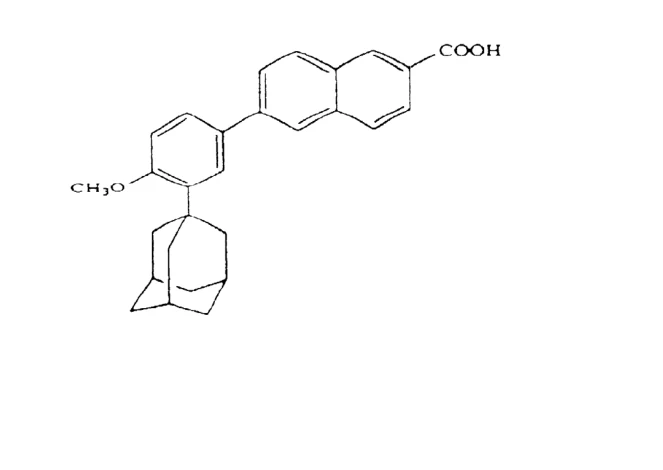
Physicochemical properties: Adapalene is a white to off-white powder, which is sparingly soluble in tetrahydrofuran and practically insoluble in water and ethanol (96%).
14 CLINICAL TRIALS
14.1 Efficacy and Safety Studies
Table 4: Summary of patient demographics for North American Phase III active- and vehicle-controlled clinical trial in acne vulgaris
| Study # | Trial design | Dosage , route of administration, and duration | Study subjects (n=number) | Mean age (Range) Years | Gender % M/F |
| RD.06.SRE.18081 | Double-blind, parallel, controlled (active & vehicle | 0.3% adapalene gel 0.1% adapalene gel gel vehicle Topical 12 weeks | (653) 258 261 134 | 18.2 (12 - 52 ) | 49.5/50.5 |
| RD.06.SPR.18113 and RD.06.SPR.18114 | Double-blind, parallel, controlled (active & vehicle) | 0.1% adapalene lotion lotion vehicle Topical 12 weeks | 1068 1073 | 19.3 (12 - 54) 19.0 (12 - 64) | 45.4/54.6 47.6/52.4 |
| 9111-CD271C-EV | Parallel, Randomized, Double-blind, Controlled (active & vehicle) | 0.1% adapalene cream cream vehicle Topical 12 weeks | (350) 175 175 | 19 (12 - 31) | 59/41 |
Male and female subjects, 12 years of age or older, were eligible to enroll in these controlled clinical trials. In study RD.06.SRE.18081, subjects with acne vulgaris with 20 to 50 inflammatory and 20 to 100 non-inflammatory lesions and no nodules or cysts were eligible to enroll in this study. In study RD.06.SPR.18113 and study RD.06.SPR.18114 with adapalene lotion 0.1%, patients with 20 to 50 inflammatory lesions on the face and 30 to 100 non-inflammatory lesions on the face, with no cysts and no more than one nodule on the face were eligible for enrollment. Subjects in study RD.06.SPR.18113 and study RD.06.SPR.18114 also had an Investigator's Global Assessment score of 3 (moderate) or 4 (severe) at Baseline.
Table 5: Summary of patient demographics for European Phase III active-controlled clinical trial in acne vulgaris
| Study # | Trial design | Dosage, route of administration, and duration | Study subjects (n=number) | Mean age (Range) Years | Gender % M/F |
| RD.03.SRE.2673 | Double-blind, parallel, active-controlled | 0.3% adapalene gel 0.1% adapalene gel Topical 12 weeks | (418) 208 210 | 19.1 (12 – 39) | 40.0/60.0 |
Male and female subjects, 12 years of age or older, were eligible to enroll in this controlled clinical trial. In study RD.03.SRE.2673, subjects with acne vulgaris with 15 to 50 inflammatory and 30 to 200 non-inflammatory lesions and a maximum of two nodules / cysts were eligible to enroll in this study.
14.2 Study Results
Table 6: Results of North American Study RD.06.SRE.18081 in acne vulgaris at Week 12 (Observed)
| Primary Endpoints* | Adapalene Gel, 0.3% (n=227) | Adapalene Gel, 0.1% (n=237) | Gel Vehicle (placebo) (n=120) |
Success rate [% of subjects with "Clear" or "Almost Clear" on Investigator's Global Assessment (IGA)] | 23.3% [p value vs 0.1%: 0.072] [p value vs vehicle: 0.002] | 16.97% | 10.0% |
| Median % lesion count reduction | |||
| Total | -55.60 [p value vs 0.1%: 0.003] [p value vs vehicle: <0.001] | -48.25 | -36.40 |
| Inflammatory | -62.50 [p value vs 0.1%: 0.099] [p value vs vehicle: <0.001] | -57.80 | -47.25 |
| Non-inflammatory | -52.10 [p value vs 0.1%: 0.003 [p value vs vehicle: <0.001] | -43.45 | -29.35 |
*CMH analysis
Table 7: Results of North American Studies RD.06.SPR.18113 and RD.06.SPR.18114 (combined) in acne vulgaris at Week 12 (LOCF, ITT)
| Primary Endpoints | Adapalene Lotion 0.1% (n=1068) | Lotion Vehicle (n=1073) | p-value |
Success Rate [% of patients with a Week 12 Investigator's Global Assessment (IGA) at least 2 grades lower than Baseline] | 25.2% | 16.9% | p<0.001a |
| Mean absolute (percent) reduction from Baseline in lesion counts: | |||
| Inflammatory | 13.7 (-50.5%) | 10.4 (-38.6%) | p<0.001b |
| Non-inflammatory | 21.4 (-46.4%) | 14.6 (-33.0%) | p<0.001b |
| Total | 35.2 (-48.0%) | 25.0 (-35.0%) | p<0.001b |
a Cochran-Mantel-Haenszel test, stratified by analysis centre
bANCOVA (ranked and unranked)
Table 8: Results of European Study RD.03.SRE.2673 in acne vulgaris at Week 12 (Observed)
| Primary Endpoints | Adapalene Gel, 0.3% (ITT n=208) | Adapalene Gel, 0.1% (ITT n=210) |
| Median % lesion count reduction | ||
| Total | -67.1% [p value vs 0.1%: 0.134] | -61.4% |
| Inflammatory | -65.4% [p value vs 0.1%: 0.310] | -64.0% |
| Non-inflammatory | -68.8% [p value vs 0.1%: 0.145] | -60.0% |
Table 9: Results of North American Study 9111-CD271C-EV in acne vulgaris at Week 12 (Observed)
| Primary Endpoints | Adapalene Cream, 0.1% (n=162) | Vehicle Cream (n=167) |
| Mean % lesion count reduction | ||
| Total | -32% [p value vs vehicle: 0.0001] | -15% |
| Inflammatory | -15% [p value vs vehicle: 0.2396] | -5% |
| Non-inflammatory | -37% [p value vs 0.05%: 0.0001] | -15% |
15 MICROBIOLOGY
Not applicable.
16 NON-CLINICAL TOXICOLOGY
General Toxicology:
The acute oral LD50 of adapalene in Sprague-Dawley rats and in Charles River CD1 mice was found to be greater than 5000 mg/kg. The acute LD50 of adapalene 0.3% gel or solution was found to be greater than 6 mg/kg in Sprague-Dawley rats (topical) and greater than 30 mg/kg in Iffa Credo OF1 mice (oral), respectively. No pharmacotoxic effects were observed in these studies.
The acute oral toxicity of adapalene topical gel, 0.1% in mice and rats is greater than 10 mL/kg (10 mg/kg).
Systemic administration of adapalene produced a hypervitaminosis A syndrome in mice, rats and dogs. In rats, it was present after four weeks at 5 mg/kg with adapalene given orally by dietary administration. The main target organ appears to be the bone.
Slight decreases in red blood cell parameters were observed in all species where adapalene was given orally. These slight changes were also observed in some topical studies in rats and rabbits, and occurred mainly with adapalene at 0.3% solution or aqueous gel. No morphological or histopathological changes were observed in bone marrow in several oral studies in rats and topical studies in rats and rabbits for periods up to six months. It is concluded that these changes were peripheral rather than central. The dose producing these minimal changes corresponds to 17 times the MRHD of adapalene 0.3% gel based on mg/m2 comparisons for rats and 32 times the MRHD for rabbits.
Changes in clinical chemistry parameters (mostly decreases in protein and albumin concentrations, and increases in triglyceride concentration and liver-specific alkaline phosphatase activity) were observed in animals when adapalene was administered dermally (rats) or orally (rats and dogs). The effects were dose related, but reversible in recovery studies.
Given topically in solution (rabbits) or in aqueous gel (rabbits and mice), adapalene gave slight to moderate irritation according to the concentration and the duration and frequency of treatment.
Following 26 weeks of daily cutaneous application to rats at concentrations of up to 0.3% (6 mg/kg/day), adapalene gel was well tolerated. The dose related changes observed included erythema, flaking, and acanthosis at the application site, all of which were reversible over the course of an 8-week recovery period.
Adapalene lotion 0.1%, at doses up to 1.2 mg/kg/day, was applied to the skin of minipigs in a 3-month dermal toxicity study with toxicokinetic analysis. Most of the treatment-related effects were of a local dermal nature including very slight erythema with very slight or slight edema to minimal eschar formation. These mild signs of skin irritation essentially disappeared by the end of the one month recovery period. There were no signs of systemic toxicity. No significant plasma levels of drug were observed on day 1, and after 91 days of repeated application, plasma levels were noted in some of the animals in the 0.2 mg/kg/day group and in most of the animals in the 0.6 and 1.2 mg/kg/day groups, although levels were very variable. Plasma steady-state levels were probably not reached in all animals by day 91. The NOAEL for this study was considered to be the high dose of 1.2 mg/kg/day.
Carcinogenicity:
Lifetime studies with adapalene have been completed in mice at topical doses of 0.6 (0.03%), 2 (0.1%) and 6 (0.3%) mg/kg/day and in rats at oral doses of 0.15, 0.5 and 1.5 mg/kg/day and demonstrated no carcinogenic effect. However, a high incidence of splenic extra-medullary haematopoiesis was observed in male mice treated with 6 mg/kg/day (0.3%) topically applied adapalene gel. Oral administration of adapalene to Sprague-Dawley rats at a dose of 1.5 mg/kg/day for two years resulted in a higher incidence in males, relative to controls, of benign phaeochromocytoma of the adrenal medulla. These neoplastic changes are considered to have no relevance to the topical use of adapalene in humans in clinical conditions.
Animal studies have shown an increased tumorigenic risk with the use of related drugs (e.g., tretinoin) when combined with exposure to the ultraviolet (UV) light in sunlight, or from other UV sources. Studies to determine whether adapalene may accelerate the tumorigenic effects of UV radiation have not been conducted.
Genotoxicity:
In a series of in vivo and in vitro tests, adapalene did not demonstrate any mutagenic or genotoxic activity.
Reproductive and Developmental Toxicology:
Adapalene administered orally at doses of ≥ 25 mg/kg/day can induce major structural changes including cleft palate, cranial abnormalities and spina bifida in rat and rabbit foetuses. Similar teratogenic effects have also been reported with other retinoids.
Adapalene administered orally at doses of ≥ 25 mg/kg/day (38 times the Maximum Recommended Human Dose [MRHD] based on mg/m2 comparisons for rats or 65 times MRHD for rabbits) has been shown to be teratogenic. No teratogenic effects were seen in rats at oral doses of up to 5.0 mg/kg/day adapalene (7.6 times the MRHD). Cutaneous teratology studies in rats and rabbits at doses of 0.6 (0.03 %), 2.0 (0.1 %) and 6.0 (0.3 %) mg/kg/day (17 times the MRHD for rats or 32 times the MRHD for rabbits) exhibited no teratogenicity. At 2 mg/kg/day (0.1% adapalene gel), no adverse events were observed in rabbits and only a marginal increase in the incidence of additional lumbar ribs was observed in rats. However, at 6 mg/kg/day (0.3% adapalene gel), in addition to the recorded increase in foetal rib numbers in the rat and rabbit, there were also other skeletal anomalies in both species.
In the topical studies at the clinical concentration of 0.3% (equivalent to 6 mg/kg/day of applied adapalene, and corresponding to 17 times the MRHD for rats or 32 times the MRHD for rabbits), increases in additional foetal rib numbers were recorded in both rats and rabbits. In the rat, there were also other minimal increases in skeletal anomalies such as small additional fissure in the parietal bone and asymmetric pelvis. In the rabbit, the skeletal anomalies were small additional fissures in the inter-parietal bone, 27 pre-sacral vertebrae, incomplete ossification of the head of limb long bones, and tail anomalies.
In the topical studies at the clinical concentration of 0.1% (equivalent to 2 mg/kg/day of applied adapalene), no adverse effects were observed in rabbits and only a marginal increase in the incidence of rudimentary additional lumbar ribs in rats was observed. The doses used in the topical teratology studies correspond to about 51 and 96 times the MRHD of adapalene 0.1% in the rat and rabbit respectively.
No effects of adapalene (doses up to 20 mg/kg/day) were found in rats on the reproductive performance or fertility of the F0 males or females. Total litter loss was suffered by 3 out of 25 F0 female rats (12%) orally dosed at 15 mg/kg/day; these females had pale and inactive mammary tissues. There were no detectable effects on the growth, development and subsequent reproductive function of the F1 offspring.