


Patient Medication Information: uses, side effects, how to take - Duodopa
What is DUODOPA used for?
DUODOPA helps to reduce disabling motor symptoms of Parkinson’s disease and improve the ability to perform activities of daily living.
DUODOPA belongs to a group of medicines for Parkinson’s disease.
DUODOPA is a gel that goes through a pump and a tube into your gut (small intestine). In the gel there are two active substances:
- Levodopa
- Carbidopa
This type of treatment is for use in patients with advanced Parkinson’s disease who have severe and disabling motor symptoms that cannot be well controlled with available combinations of medications for Parkinson’s disease.
How does DUODOPA work?
Levodopa is made into dopamine in your body. Dopamine is naturally present in the brain and spinal cord. In Parkinson’s disease there is too little dopamine in the brain. This can cause symptoms of the disease such as tremor, rigidity/muscle stiffness, slow movements, difficulty keeping your balance. Treatment with levodopa increases the amount of dopamine in the brain and reduces the symptoms of Parkinson’s disease.
Carbidopa is used together with levodopa to improve the effect of levodopa. Carbidopa also reduces
Serious Warnings and Precautions
- Before you can use DUODOPA, a surgeon will create a small opening in your stomach wall. The surgeon will insert a tube through this opening to deliver DUODOPA. This surgery can lead to serious problems, including death. Also, keeping the medication delivery tube in your body for a long time can lead to serious problems, including death.
You may feel sleepy, or drowsy when taking DUODOPA. You may also suddenly fall asleep without warning (without feeling sleepy or drowsy) when taking DUODOPA. When you are taking DUODOPA, take special care when you drive or operate a machine. If you suddenly get very drowsy or suddenly fall asleep, do not drive, or operate machines, and contact your physician.
the unwanted effects of levodopa, such as upset stomach.
DUODOPA is a gel that is delivered continuously throughout the day with a pump by a tube, directly into your small intestine. This tube provides more constant amounts of levodopa and carbidopa in the body throughout the day.
What are the ingredients in DUODOPA?
Medicinal ingredients: levodopa and carbidopa
Non-medicinal ingredients: carmellose sodium and purified water
DUODOPA comes in the following dosage forms:
DUODOPA is available as a ready-to-use intestinal gel contained in a reservoir bag inside a hard plastic cassette. Each cassette contains 100 mL of DUODOPA. Each 1 mL of DUODOPA contains 20 milligrams levodopa and 5 milligrams carbidopa monohydrate.
Do not use DUODOPA if:
- you have a history of problems with your stomach and/or intestines (such as swelling or obstruction). This could make it difficult for your healthcare professional to insert the tube through your stomach and into your small intestine.
- you have a history of problems with your pancreas. This could make it difficult for your healthcare professional to insert the tube through your stomach and into your small intestine.
- you have a history of blood clotting problems.
- you are allergic to levodopa, carbidopa, or any of the other ingredients of DUODOPA, including non-medicinal ingredients, or component of the container.
- you have narrow-angle glaucoma.
- you have untreated heart, liver, kidney, lung, blood, or hormonal disease.
- you have problems with the blood flow to your brain.
- you have had an acute stroke in the last 6 months.
- you have been treated during the last 2 weeks with certain drugs used to treat depression or Parkinson’s disease (monoamine oxidase [MOA] inhibitors).
- you have been told you should not take sympathomimetic drugs such as isoproterenol, amphetamines, epinephrine or cough and cold medications containing drugs related to epinephrine.
- you have suspicious, undiagnosed skin lesions or a history of skin cancer (melanoma).
Be sure to tell your doctor if you have had any of the above.
To help avoid side effects and ensure proper use, talk to your healthcare professional before you take DUODOPA. Talk about any health conditions or problems you may have, including if you:
- have severe heart disease, irregular heart rhythm or history of heart attack.
- are taking any medications which may cause a sudden drop in your blood pressure when you stand up.
- have severe lung problems, asthma, swelling of your bronchial tubes (chronic bronchitis).
- have eye disease (glaucoma).
- have hormonal disturbances.
- have severe liver or kidney disease.
- have depression, suicidal tendencies, or any mental disorder.
- have gastric ulcer or previous surgery in the upper part of your abdomen.
- have a history of seizures (convulsions).
- have allergies to any other medicines, foods, dyes, or preservatives.
- have a history of a condition in which the nerves outside of your brain and spinal cord become damaged (polyneuropathy). Your doctor will decide if DUODOPA is right for you. If you have any known risk factors for polyneuropathy, such as low vitamin B12 and/or vitamin B6, high blood sugar or low thyroid levels. Your doctor will decide if DUODOPA is right for you.
- have had or have psychosis, a condition that effects the way your brain processes information. In psychosis, you may see, hear, or believe things that are not real.
It is also important to tell your doctor before beginning treatment if:
- you drive or operate machinery.
- you or your family member/caregiver notices you are developing urges to gamble, increased sexual urges, excessive eating, or spending, and/or other intense urges that could harm yourself or others. These behaviors are called impulse control disorders. Your doctor may need to review your treatments.
Other warnings you should know about:
Studies of people with Parkinson’s disease show that they may be at an increased risk of developing melanoma, a form of skin cancer, when compared to people without Parkinson’s disease. It is not known if this problem is associated with Parkinson’s disease or the drugs used to treat Parkinson’s disease. Therefore, your doctor should perform periodic skin examinations.
Your doctor may need to replace your intestinal tube from time to time. Your doctor will let you know if the tube needs to be replaced.
The tube going to your stomach or intestine can move out of place and possibly damage your intestine. This may cause stomach pain and/or worsening slowness of movement (return of Parkinson’s symptoms). If this happens, your healthcare provider will have to find the end of the tube and put it back in place. Sometimes this can be serious and may require surgery.
You may develop a blockage in your intestine if the food you eat gets stuck around or at the tip of the tube. The tubing may also cause one part of the intestine to slide into a neighbouring part of the intestine. Both of these tubing problems may cause stomach pain, nausea and vomiting. These problems can be life-threatening and will require urgent medical treatment (including surgery). Contact your healthcare provider right away if you experience stomach pain, nausea and vomiting.
Your doctor will need to carefully examine your overall condition to determine if DUODOPA treatment will be suitable for you.
Use in children
DUODOPA should not be given to children or people under 18 years.
Pregnancy
If you are pregnant or think you may be pregnant, do not use DUODOPA before talking to your doctor.
Breastfeeding
You should not breastfeed while under treatment with DUODOPA.
Tell your healthcare professional about all the medicines you take, including any drugs, vitamins, minerals, natural supplements, or alternative medicines. In particular, if you are already taking or have recently taken medicines for:
- Parkinson’s disease
- severe allergic reactions, asthma, chronic bronchitis, such as sympathomimetics
- heart disease
- anemia, such as iron tablets or multivitamins containing iron
- anxiety, such as benzodiazepines
- depression, such as certain monoamine oxidase inhibitors or tricyclic antidepressants
- fits (convulsions) or epilepsy
- high blood pressure or low blood pressure
- nausea or vomiting, such as metoclopramide
- schizophrenia
- spasms in the blood vessels, such as papaverine
- tuberculosis, such as isoniazid
- cough and cold, such as certain medications that contain epinephrine
Protein rich diets (for example, a lot of meat, poultry, or fish) may reduce the beneficial effects of levodopa.
How to take DUODOPA:
Your doctor or trained healthcare professional will tell you how to use DUODOPA properly.
DUODOPA is delivered into your small intestine by a pump through a tube (called percutaneous endoscopic gastrostomy jejunal tube or PEG-J tube). To use DUODOPA, a surgery is required to create a small opening (called a “stoma”) in your stomach wall for the tube to go through. The stoma will heal over time, but will remain open since the tube goes through it. The surgery to insert the tube is performed by a gastroenterologist or other healthcare provider experienced in this procedure.
Before you have surgery, your doctor will usually first insert a temporary tube through the nose into the small intestine. This tube will be inserted for at least a few days to see if you respond well to DUODOPA treatment. This tube will also be used to adjust the dose.
Only the CADD-Legacy DUODOPA pump should be used for administration of DUODOPA.
Use of the CADD-Legacy DUODOPA Pump
Before you take DUODOPA, carefully inspect the tubing and connections for kinks or other blockages. Any kinks or blockage may result in too little or no medication delivery. This could also cause nuisance alarms from the pump. These may result in the return of your Parkinson’s disease symptoms.
Prior to attaching the cassette to the pump, inspect the cassette tube. If the tube contents appear milky white, or slightly yellow, the cassette may be used. If the tube contents appear discoloured, other than milky white or slightly yellow, or the container is leaking, do not use the product.
To attach the cassette to the pump:
- 1. Insert the cassette hooks into the hinge pins on the pump.
- 2. Place the pump and cassette upright on a firm, flat surface. Press down so the cassette fits tightly against the pump.
- 3. Insert a coin into the latch, push in, and turn counterclockwise until the line on the latch lines up with the arrow on the side of the pump and you feel the latch click into place.
- 4. Gently twist, push, and pull on the cassette to make sure it is firmly attached. If the cassette is not secure, repeat the procedure.
If the cassette is not attached properly, it could result in an error in your dosing.
For more details on how to handle the pump, an Instruction Manual is provided with the pump.
To attach the cassette to the PEG-J tube:
- 1. Remove red protective cap from the cassette tube and open any tube clamps.
- 2. Connect the cassette tube to the intestinal port of the PEG-J tube. Make sure to twist the cassette tube and not the PEG-J tube.
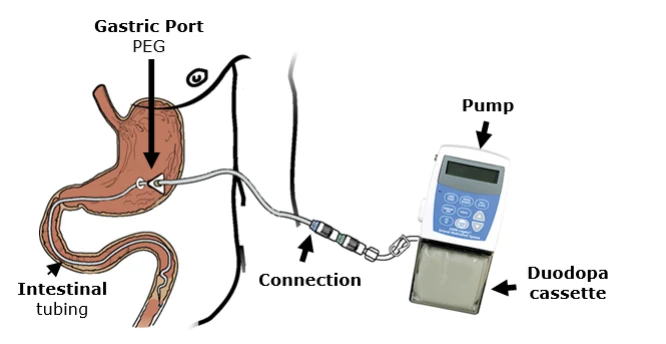
The following diagram shows how all the components of the DUODOPA system should look when in use.
Care of the CADD-Legacy DUODOPA pump
To clean the pump and accessories, dampen a soft, lint-free cloth with soapy water and wipe the exterior surface of the pump. Do not immerse the pump in water or cleaning fluid. Do not use acetone, solvents, or abrasive cleaners. Wipe the surface dry with another soft, lint-free cloth. Allow the pump to dry completely before use.
Maintenance and care of the intestinal tubing:
The external PEG tubing and connectors should be cleaned regularly with warm, soapy water.
The intestinal tube should be flushed with tap water every night to prevent blockages.
Do not use your PEG tube to take any substances other than DUODOPA without consulting your doctor.
During the initial test phase DO NOT flush the nasojejunal tube because this can result in too much medication entering your body at one time. If using an extension tube, the extension tube should be removed, capped, and placed in the refrigerator each night. The extension tube should not be flushed.
During treatment with DUODOPA, your internal and external tubing will need to be replaced from time to time. Your doctor should regularly assess how the tubes are working.
Maintenance and care of the surgical wound:
The surgical wound should be cleaned and disinfected daily for the first 10 days after surgery. The dressing on your surgical wound should be changed daily for the first 3 weeks.
After the initial wound healing, the tube opening should be cleaned with soap and water during showers and baths, or every 2 to 3 days. Always make sure that the skin is properly dried afterwards.
It is important to keep your wound clean to reduce problems. It is also important to carefully inspect your wound daily to reduce problems. If the tube wound becomes red and swollen or infected, contact your doctor.
Usual dose:
Always use DUODOPA exactly as your doctor has instructed you. You should check with your doctor or pharmacist if you are not sure. The dose of DUODOPA is different for each patient and may need regular small adjustments, to reach the best dose for your symptoms. Your prescription is programmed into your pump by your doctor/nurse and should only be adjusted by your doctor/nurse if your medication needs change.
Your doctor will decide how much DUODOPA you should use and for how long. Usually, a larger morning dose (called the ‘bolus dose’) is given. This allows you to quickly get the right amount of medicine in your blood. After that dose, a steady (‘maintenance’) dose is given. If needed, you may have extra doses – this will be decided by your doctor.
The tube should be disconnected from the pump at bedtime. Flush the tube daily with room temperature tap water to prevent the tube from becoming blocked.
You should take your usual night-time dose of levodopa/carbidopa tablets (or antiparkinson medication) as prescribed by your doctor.
If needed, your doctor may have you use DUODOPA during the night.
It is normal that some gel may remain in your cassette after the 16-hour period. You should never reuse any leftover gel after the 16-hour period. You may require more than one cassette over the 16-hour period. Your doctor will tell you exactly how much DUODOPA you need.
Intentional stopping of treatment:
If you wish to stop treatment with DUODOPA, talk to your doctor. Your doctor will remove the tube to allow the wound to heal. Treatment will continue with levodopa tablets taken by mouth.
Abrupt or unintentional stopping of treatment:
Do not change the dosage or stop DUODOPA treatment without talking to your doctor.
- It is important that you do not stop taking DUODOPA or lower your dose until you are told to do so by your healthcare provider. Suddenly stopping or lowering DUODOPA dose may result in a serious, life-threatening problem called Neuroleptic Malignant Syndrome.
- If your symptoms suddenly or slowly become worse, it is possible that the tube in the small intestine is blocked, disconnected, or has moved. If this happens, call your doctor immediately.
Overdose:
| If you think you, or a person you are caring for, have taken too much DUODOPA, contact a healthcare professional, hospital emergency department or regional poison control centre immediately, even if there are no symptoms. |
Missed dose:
If your pump stops working, restart the pump as per the instructions above to receive the medication. If you do not receive the correct dose because of a problem with your pump or your tubing, and your condition gets worse, contact your doctor, nurse or pharmacist. You will require treatment with oral levodopa/carbidopa until the problem with the pump or tubing is fixed.
What are possible side effects from using DUODOPA?
These are not all the possible side effects you may feel when taking DUODOPA. If you experience any side effects not listed here, contact your healthcare professional.
Like all medicines, DUODOPA can cause side effects. You may not experience any of them. If you experience any of these side effects, contact your doctor as soon as you can. Many of the side effects can be relieved by adjusting the dose.
Side effects of the medication
Very common side effects (affecting more than 1 user in 10)
- upset stomach, vomiting
- involuntary movements (dyskinesia)
- constipation
- decrease in weight
- falls
Common side effects (affecting 1 to 10 users in 100)
- dizzy spell
- feeling lightheaded or faint after standing
- decreased appetite
- involuntary movements, muscle cramps
- cold, burning, tingling, prickling sensations in the hands, feet, arms or legs (polyneuropathy)
- hallucinations (seeing or hearing things that are not there)
- depression
- anxiety
- diarrhea
Problems related to the surgical procedure
Very common problems
- pain in the abdomen
- redness and swelling around the surgical wound
- excessive tissue growing around the surgical wound
- infection around the tube
- leakage of stomach fluid around the surgical wound
Common problems
- infection and/or irritation in your abdomen
- air or gas in your abdomen
- pain when breathing, feeling short of breath, chest infections (pneumonia)
Uncommon problems
- damage to nearby organs or the intestine
- ulcers or bleeding in your intestine
Pain in the abdomen can be a sign of a serious problem. Pneumonia can become severe or lead to complications that are more serious. Contact your healthcare provider right away if you experience pain in the abdomen, or respiratory problems, or any of the other symptoms described above.
Problems related to the tubing
The tube going to your stomach or intestine can move out of place and possibly damage your intestine. This may cause stomach pain and/or worsening slowness of movement (return of Parkinson’s symptoms). If this happens your healthcare provider will have to find the end of the tube and put it back in place. Sometimes this can be serious and may require surgery.
You may develop a blockage in your intestine if the food you eat gets stuck around or at the tip of the tube. The tubing may also cause one part of the intestine to slide into a neighbouring part of the intestine. Both of these tubing problems may cause stomach pain, nausea and vomiting. These problems can be life-threatening and will require urgent medical treatment (including surgery). Contact your healthcare provider right away if you experience stomach pain, nausea and vomiting.
The most common side effect of problems related to the tubing is worsening or slowness in movement (return of Parkinson’s symptoms). Contact your healthcare provider if you experience worsening or slowness in movement.
If any problem occurs with the pump or the tube system, contact your doctor immediately.
Serious side effects and what to do about them
| Symptom / effect | Talk to your healthcare professional | Stop taking drug and get immediate medical help | |
|---|---|---|---|
| Only if severe | In all cases | ||
| COMMON | |||
| Changes in mental condition such as hallucinations, depression or worsening of depression | ✓ | ||
| A sudden return of your Parkinson’s disease symptoms, as this may represent a blockage of the intestinal tube | ✓ | ||
| Irregular heartbeat, feeling dizzy or faint when standing up, fainting | ✓ | ||
Serious side effects and what to do about them
| Symptom / effect | Talk to your healthcare professional | Stop taking drug and get immediate medical help |
|---|
| Only if severe | In all cases | ||
|---|---|---|---|
| Pain when breathing, difficult breathing, cough, fever | ✓ | ||
| RARE | |||
| Allergic reaction such as: redness, itching or swelling of your skin, hives; swelling around eyes or lips, swelling of hands, feet, or throat; any trouble with breathing not present before using this medicine | ✓ | ||
| Severe abdominal pain, which may be associated with fever, vomiting, abdominal tenderness, or swelling of the abdomen | ✓ | ||
| Signs of skin cancer – irregular or new skin lesions | ✓ | ||
| Developing urges to gamble, increased sexual urges, excessive eating or spending, and/or other intense urges that could harm yourself or others | ✓ | ||
| VERY RARE | |||
| Falling asleep without warning | ✓ | ||
| Vomiting blood or notice blood in your stool | ✓ | ||
| When lowering or stopping medication, you may develop high fever, neurological findings including muscle rigidity, involuntary movements, altered consciousness, mental status changes; more frequent breathing, sweating or dizziness (signs of Neuroleptic Malignant Syndrome) | ✓ | ||
If you have a troublesome symptom or side effect that is not listed here or becomes bad enough to interfere with your daily activities, talk to your healthcare professional.
Reporting Side Effects
You can report any suspected side effects associated with the use of health products to Health Canada by:
NOTE: Contact your health professional if you need information about how to manage your side effects. The Canada Vigilance Program does not provide medical advice. |
Storage:
Store at 2 to 8°C (in a refrigerator).
Close the carton carefully. DUODOPA is sensitive to light.
Keep out of reach and sight of children.
Use before the expiry date printed on the carton. Cassettes with left-over gel should never be reused.
By the end of the storage time, the gel might become slightly yellow. This does not affect the amount of the drug or the treatment.
If you want more information about DUODOPA:
- Talk to your healthcare professional.
- Find the full product monograph that is prepared for healthcare professionals and includes this Patient Medication Information by visiting the Health Canada website (https://www.canada.ca/en/health-canada/services/drugs-health-products/drug-products/drug-product-database.html); the manufacturer’s website (www.abbvie.ca); or by calling 1-888-704-8271.
Last Revised April 4, 2022
CADD-Legacy is a trademark of its respective owner and is not a trademark of AbbVie Corporation.