


Patient Medication Information: uses, side effects, how to take - Emerade
What is EMERADE used for?
EMERADE is used for the emergency treatment of a sudden, severe and life-threatening allergic reaction. This is type of severe reaction is called anaphylaxis. EMERADE is used in people:
- who are at a higher risk for severe allergic reactions
- with a history of allergic reactions
It is used to treat people with severe allergies to:
- foods like peanuts, tree nuts, shellfish, fish, milk, eggs and wheat
- insect stings like those from bees, wasps, hornets, yellow jackets and fire ants
- insect bites like those from mosquitos and black flies
- certain medicines
- latex
- other allergens (a substance that causes allergies)
These severe allergic reactions can also be caused by exercise, asthma or by unknown causes.
EMERADE should be used right away when you or your child is having a severe allergic reaction. Using it does not replace seeing a doctor or going to the hospital. You must get medical help right away after you or your child has used it.
Some of the warning signs that you or your child may be having a severe allergic reaction are:
- swelling of the throat, lips, tongue or the area around the eyes
- hives
- difficulty breathing or swallowing
- wheezing and cough
- a metallic taste or itching in the mouth
- flushing, itching, or redness of the skin
- stomach cramps, nausea, vomiting, or diarrhea
- an increased heart rate
- decreased blood pressure
- chest pain
- irregular heartbeat
- paleness
- a sudden feeling of weakness
- feeling faint
- fear, worry (anxiety) or an overwhelming sense of doom
- collapse
- loss of consciousness
How does EMERADE work?
When you or your child comes into contact with something that you (or they) are allergic to the body releases chemicals to fight against it. For most people the symptoms from this are not serious. But, for some people, when their body releases these chemicals it can lead to life-threatening symptoms.
EMERADE contains epinephrine. This helps to decrease your body’s reaction to whatever you are allergic to. Some of the ways it works include:
- relaxing the muscles in your airways. This allows you to breathe more easily.
- helping to reverse the quick and dangerous drop in your blood pressure.
- relaxing the muscles in your stomach, intestines, and bladder.
What are the ingredients in EMERADE?
Medicinal ingredient: Epinephrine as epinephrine hydrogen tartrate
Non-medicinal ingredients: Disodium Edetate, Hydrochloric Acid (to adjust pH), Sodium Chloride, Sodium Meta-Bisulfite and Water for Injection.
EMERADE comes in the following dosage forms:
Solution for Injection in single-use pre-filled auto-injectors: 0.15 mg (green), 0.3 mg (blue) and 0.5 mg (red)
To help avoid side effects and ensure proper use, talk to your healthcare professional before you take EMERADE. Talk about any health conditions or problems you may have, including if you:
- are allergic to any of the ingredients in EMERADE
- have heart disease
- an irregular heart beat
- have high blood pressure
- have diabetes
- have problems with your thyroid
- have narrow-angle glaucoma
- have depression or other severe mental disorders
- have Parkinson’s disease
- have severe kidney disease or a certain type of tumor in the kidney
- have a tumor in the prostate gland
- very high calcium levels in your blood
- very low potassium levels in your blood
- have asthma
- have previously had an allergic reaction
are pregnant or planning to become pregnant
- are breastfeeding
Other warnings you should know about:
General: if you have had severe, life-threatening allergic reactions in the past, you are at a higher risk for having it again. You should carry EMERADE with you at all times. You or your child should also wear some form of medical identification bracelet or necklace.
Using EMERADE does not replace seeing a doctor or going to the hospital. You must get medical help right away after you or your child has used it.
Patients with Asthma: if you or your child has asthma, and it is not controlled properly, you are at a higher risk of having breathing problems when you have a severe allergic reaction.
EMERADE contains meta-bisulfite. This can cause allergic reactions and bronchospasms in those with a history of asthma. You should follow your doctor’s instructions carefully on when you or child can use EMERADE.
Patients with Parkinson’s disease: if you suffer from Parkinson’s disease, you may notice that your symptoms may temporarily get worse after using EMERADE.
EMERADE is the first line emergency treatment for severe, life-threatening allergic reactions even if you have the above conditions.
Injection site: You should ONLY inject EMERADE into the outer side of your upper thigh - into the muscle (see Instructions for Use).
Do not inject it into the:
- vein (intravenously (IV))
- buttocks
- hands, fingers, feet and toes
If you do, it can either cause dangerously high blood pressure or you or your child may not get the effect of the emergency treatment that you or they need.
If you accidentally inject it into any of these areas, go right away to the nearest hospital (emergency room) for further treatment.
When injecting a young child with EMERADE hold their leg firmly in place to limit movement before and during the injection. This will prevent injuries. Ask your healthcare provider to show you how to properly hold the leg of a young child during an injection.
If you have a thick layer of fat under your skin the epinephrine in EMERADE may not reach your muscle tissue. In some cases, this might make EMERADE not work as well.
Tell your healthcare professional about all the medicines you take, including any drugs, vitamins, minerals, natural supplements or alternative medicines.
The following may interact with EMERADE:
- Drugs used to treat heart rhythm disorders (such as digoxin (also known as digitalis) and quinidine)
- Diuretic drugs. These are also called ‘water pills’
- Cardiac glycoside drugs
- Monoamine Oxidase Inhibitors (MAOIs)
- Antihistamines (such as chlorpheniramine, tripelennamine and diphenhydramine
- Beta-adrenergic blocking drugs (such as propanol)
- Alpha-adrenergic blocking drugs (such as phentolamine)
- Phenothiazines
- Isoproterenol, orciprenaline, salbutamol and long-acting beta antagonists (LABAs)
- Sodium levothyroxine
- Cocaine
How to take EMERADE:
When you are prescribed EMERADE by your doctor or when you get it from your pharmacist make sure they go through the important information with you and show you how to use it properly.
IMPORTANT NOTE:
Severe, life-threatening allergic reactions (anaphylaxis) can result in death if not treated right away. You should talk to your doctor about the warning signs and symptoms of a severe allergic reaction and when to use EMERADE.
If you have been told by your doctor that you or your child is at a higher risk for severe, life-threatening allergic reactions, you should carry EMERADE with you at all times.
When your doctor prescribes EMERADE, you must make sure you understand the reason it has been prescribed for you. You should be confident that you know exactly how and when to use it.
Use EMERADE exactly how your doctor or pharmacist has told you. Ask to have the instructions repeated to you if you are unsure about how to use it. It is recommended that your family members, carers or teachers are also instructed in the correct use of EMERADE.
If you have been stung by an insect, try to remove the stinger with your fingernails. Do not squeeze, pinch or push the stinger deeper into the skin.
If possible, put an ice pack on the area of the sting. Keep yourself warm and avoid exercise.
For allergic reactions caused by foods, remove all food from the mouth right away.
The EMERADE pre-filled- auto-injector:
- is for single use only. Do not reuse the auto-injector.
- can be injected through clothes.
EMERADE should ONLY be injected into the outer side of your upper thigh - into the muscle. Do not inject it anywhere else. If you do:
- it can cause dangerously high blood pressure or
- you or your child may not get the right dose you or your child needs
Inject EMERADE right away if you experience any of the symptoms of a severe allergic reaction, such as swelling of the throat, lips, tongue or around the eyes, trouble breathing or swallowing. It is really important that you get to the hospital after using EMERADE. You can:
- call 911 and get taken to the hospital OR
you can have someone take you (or you can take your child) to the nearest hospital
(emergency room)
If you or your child do not feel better or get worse, you can inject another dose of EMERADE 5 to 15 minutes after the first injection. Do not inject more than 2 injections right after each other. It is therefore recommended that you always carry 2 EMERADE auto-injectors with you at all times.
Throw away and replace the auto-injector:
- after the expiry date. The expiry date is indicated on the label.
- if the solution in the auto-injector has changed colour or contains particles. You can check the colour of the solution by lifting the label on the auto-injector at the picture of the arrow.
- if there are any signs that auto-injector is leaking.
- if you drop the auto-injector on the ground or in water. The auto-injector is not waterproof.
Usual dose:
Your or your child’s dose will be determined by your doctor. It will depend on your weight and your age or your child’s weight and age.
Children:
EMERADE 0.5 mg is not recommended for use in children
Children who weigh between 15 kg and 30 kg: 0.15 mg
Children who weigh more than 30 kg: 0.3 mg
Adolescent weighing more than 30 kg: dosing instructions for Adults should be followed
Adults:
Adults who weigh less than 60 kg: 0.3 mg
Adults weighing more than 60 kg: 0.3 mg to 0.5 mg
Instructions for Use:
Follow these instructions carefully.
Step 1:
Remove the needle cap (Figure 1). Do not remove the needle cap until you need to use the auto-injector.
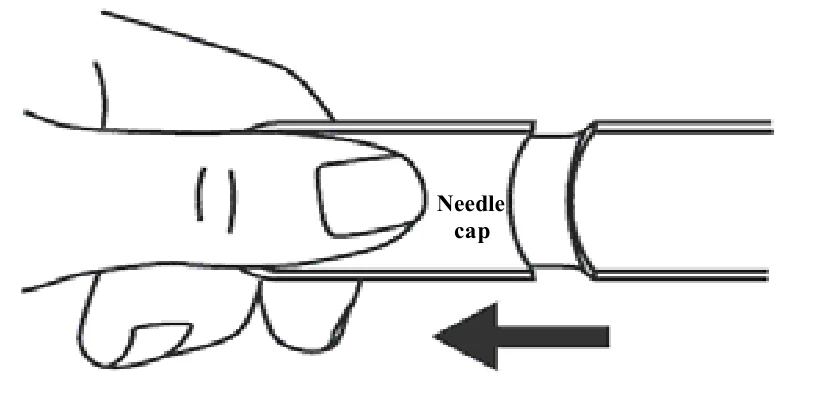
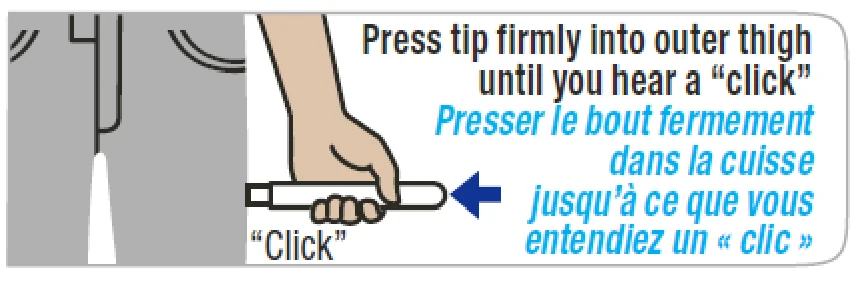
Figure 1
Step 2:
Place EMERADE against the outer side of the thigh at a 90⁰ angle and press firmly so the needle cover is depressed (Figure 2). You will hear a “click” when the device has activated and the needle has penetrated the thigh.
Figure 2
Needle cap
Step 3:
Hold the auto-injector against the thigh for 5 seconds (Figure 3). Lightly massage the injection site afterwards.
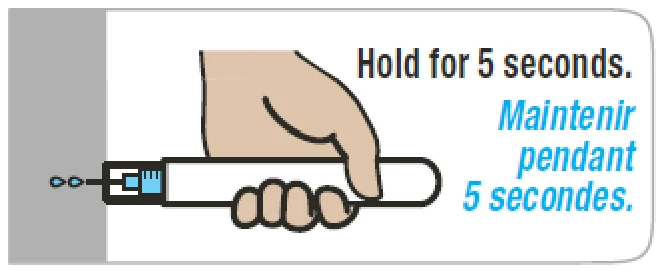
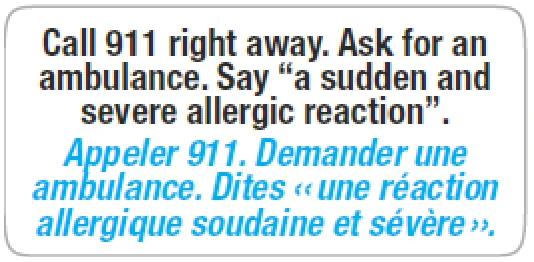
Figure 3
Step 4:
Get medical help right away
- call 911 and get taken to the hospital OR
- go to the nearest hospital (emergency room)
- You should stay with another person, if possible, until you get medical help.
- If you are conscious, you should lie flat with your feet up. If you are having trouble breathing, you should sit up.
- Unconscious patients should be placed on their side.
Figure 4
Step 5:
Repeat steps 1 to 3 if you need to take a second dose 5 to 15 minutes after the first one.
You should take the used EMERADE auto-injector (s) with you. Tell the doctor that you have taken an injection of epinephrine.
After you have finished using the auto-injector:
- You can confirm that you have taken or given a dose of epinephrine because the plunger is now visible. You can check by lifting the label at the picture of the arrow.
- Some solution may remain in the auto-injector.
The needle in EMERADE is protected before, during and after the injection.
Overdose:
If you, or a person you are caring for, take more than the recommended dose, or inject EMERADE anywhere other than the thigh, contact a healthcare professional, hospital emergency department, or regional poison control centre immediately, even if there are no symptoms.
Too much epinephrine can cause dangerously high blood pressure, stroke, or death.
Signs of an overdose include:
- irregular heartbeat
- abnormal heartbeat
- difficulty breathing caused by a build-up of fluid in your lungs
What are possible side effects from using EMERADE?
These are not all the possible side effects you or your child may feel when taking EMERADE. If you or your child experience any side effects not listed here, contact your healthcare professional.
Side effects include:
- Paleness
- Dizziness
- Weakness
- Shaking
- Headache
- Rapid heartbeat
- Restlessness
- Anxiety
- Feeling tense
- Fear
Patients who have used EMERADE may develop infections at the injection site within a few days of an injection. Some of these infections can be serious. Call your healthcare provider right away if you have any of the following at an injection site:
- redness that does not go away
- swelling
- tenderness
- the area feels warm to the touch
Cuts on the skin, bent needles, and needles that remain in the skin after the injection, have been seen in kids who kick or move during an injection.
| Serious side effects and what to do about them | |||||
| Symptom / effect | Talk to your healthcare | Stop taking drug and get immediate medical help | |||
| professional | |||||
| Only if severe | In all cases | ||||
| Difficulty breathing | ✓ | ||||
| Increased heart rate (pounding heart) | ✓ | ||||
| Irregular or skipped heart beats | ✓ | ||||
| Chest pain (angina) | ✓ | ||||
| Stroke (blurred vision, difficulty speaking, headache, dizziness and weakness) | ✓ | ||||
If you have a troublesome symptom or side effect that is not listed here or becomes bad enough to interfere with your daily activities, talk to your healthcare professional.
Reporting Side Effects
You can report any suspected side effects associated with the use of health products to Health Canada by:
Visiting the Web page on Adverse Reaction Reporting
(https://www.canada.ca/en/health-canada/services/drugs-health-products/medeffect-canada/adverse-reaction-reporting.html) for information on how to report online, by mail or by fax; or
- Calling toll-free at 1-866-234-2345.
NOTE: Contact your health professional if you need information about how to manage your side effects. The Canada Vigilance Program does not provide medical advice.
Storage:
Keep EMERADE:
- in the original package - a durable case to protect the auto-injector
- at room temperature (15°C to 25°C). Do not freeze.
- Keep out of reach and sight of children.
- The expiry date is indicated on the label. Do not use it after this date. Throw it away and replace the auto-injector after this date.
- Every now and then you should inspect the solution in the auto-injector. Throw it away and replace the auto-injector if the solution has changed colour or contains particles or is leaking.
Proper disposal: Talk to your doctor or pharmacist about how to properly dispose of any used or unused EMERADE auto-injectors.
If you want more information about EMERADE:
- Talk to your healthcare professional
- Find the full Prescribing Information that is prepared for healthcare professionals and includes this Patient Medication Information by visiting the Health Canada website: (https://www.canada.ca/en/health-canada/services/drugs-health-products/drug-products/drug-product-database.html); or by calling the manufacturer’s med info line at 1-800-361-4261.
www.bauschhealth.ca