


Patient Medication Information: uses, side effects, how to take - Fentora
Serious warnings and precautions box:
|
|---|
|
What FENTORA is used for:
FENTORA is used in adults (18 years of age and older) to manage sudden bursts of pain described as “breakthrough pain” in adults with cancer who are already taking other opioid pain medicines regularly for cancer pain.
FENTORA is started only after you have been taking other opioid pain medicines and your body has become used to them (you are “opioid–tolerant”). Do NOT use FENTORA if you are not opioid-tolerant.
How FENTORA works:
FENTORA is a painkiller belonging to the class of drugs known as opioids. It relieves pain by acting on specific nerve cells of the spinal cord and brain.
The ingredients in FENTORA are:
Medicinal ingredient: Fentanyl citrate.
Non-medicinal ingredients: Citric acid, magnesium stearate, mannitol, sodium bicarbonate, sodium carbonate, and sodium starch glycolate.
FENTORA comes in the following dosage forms:
Buccal/sublingual effervescent tablets (a tablet that you place between your gum and cheek or under the tongue): 100 mcg, 200 mcg, 400 mcg, 600 mcg and 800 mcg of fentanyl (as fentanyl citrate). Each tablet strength comes in a box and blister pack with a different colour, as shown below:
| Tablet Strength | Box and Blister Colour |
|---|---|
| 100 mcg | Blue |
| 200 mcg | Orange |
| 400 mcg | Sage green |
| 600 mcg | Magenta (pink) |
| 800 mcg | Yellow |
Do not use FENTORA if:
- your healthcare professional did not prescribe it for you.
- you are not taking other opioid pain medicines for your cancer pain. Your body must already be used to taking opioid pain medicine when you take FENTORA.
- you are allergic to fentanyl citrate, other opioids, or any of the other ingredients in FENTORA.
- you have severe asthma, trouble breathing, or other lung problems.
- you have any heart problems.
- you have bowel blockage or narrowing of the stomach or intestines.
- you have a condition where the bowel does not work properly (ileus) or have severe pain in your abdomen.
- you have increased pressure in your skull or have a head injury.
- you have epilepsy (seizures) or a history with epilepsy.
you suffer from alcoholism or alcohol withdrawal.
- you are taking or have taken within the past 2 weeks a monoamine oxidase inhibitor (MAOi) used to treat depression (such as phenelzine sulphate, tranylcypromine sulphate, moclobemide or selegiline).
- you are going to have a surgery or operation or have had a surgery in the last 24 hours.
- you have severe central nervous system (CNS) depression (nervous system slows down).
To help avoid side effects and ensure proper use, talk to your healthcare professional before you take FENTORA. Talk about any health conditions or problems you may have, including if you:
- have a history or family history of illicit or prescription drug or alcohol abuse.
- have kidney, liver, or lung problems.
- have been told you are at risk of having heart problems or seizures.
- have low blood pressure.
- have or have had problems with your mood (such as depression or anxiety), or other mental health problems.
- suffer from migraines.
- have gastrointestinal problems such as chronic or severe constipation.
- have problems with your thyroid, adrenal or prostate gland.
- are pregnant, planning to become pregnant, or are in labour.
- are breastfeeding or planning to breastfeed.
- have sleep apnea, a sleep disorder which causes pauses in breathing or shallow breathing while sleeping.
- are planning on drinking alcohol. Drinking alcohol while taking FENTORA may cause dangerous side effects, including death. Do NOT drink alcohol while taking FENTORA.
- have a condition that causes weakness or frailty.
Other warnings you should know about:
Drug addiction, dependence and tolerance: Like any opioid, FENTORA may cause mental and physical dependence. Fentanyl citrate also has the potential to cause addiction. There are important differences between physical dependence and addiction. Tolerance means that, over time, a higher dose may be needed to get the same level of pain relief. It is important that you talk to your healthcare professional if you have questions or concerns about addiction, physical dependence, or tolerance. Your healthcare professional should prescribe and administer FENTORA with the same degree of caution appropriate to the use of other oral opioid medications. It is not recommended to use these products for a long period of time.
Pregnancy, breastfeeding, labour and delivery: Opioids can be transferred to your baby through breast milk, or while still in the womb. FENTORA can then cause life-threatening breathing problems in your unborn baby or breastfeeding infant. Your healthcare professional will determine if the benefits of using FENTORA outweigh the risks to your unborn baby or breastfeeding infant.
If you are pregnant and are taking FENTORA, it is important that you don’t stop taking your medication all of a sudden. If you do, it can cause a miscarriage or a still-birth. Your healthcare professional will monitor and guide you on how to slowly stop taking FENTORA. This may help avoid serious harm to your unborn baby.
Driving and using machines: Before you do tasks which may require special attention, you should wait until you know how you react to FENTORA. FENTORA can cause:
- drowsiness,
- dizziness, or
- lightheadedness.
This can usually occur after you take your first dose and when your dose is increased. Taking FENTORA with other medicines that affect your nervous system, including:
- other opioids,
- phenothiazine (used to treat mental health problems and prevent vomiting during chemotherapy),
- sedatives and hypnotics (used to cause relaxation and help you sleep),
- gabapentin (used to prevent seizures),
- pregabalin (used to treat nerve pain), and
- alcohol, which can make these side effects worse.
Disorder of the adrenal gland: You may develop a disorder of the adrenal gland called adrenal insufficiency. This means that your adrenal gland is not making enough of certain hormones. You may experience symptoms such as:
- nausea, vomiting;
- feeling tired, weak or dizzy;
- decreased appetite.
You may be more likely to have problems with your adrenal gland if you have been taking opioids for longer than one month. Your healthcare professional may do tests, give you another medication, and slowly take you off FENTORA.
Serotonin toxicity (also known as serotonin syndrome): FENTORA can cause serotonin toxicity, a rare but potentially life-threatening condition. It can cause serious changes in how your brain, muscles and digestive system work. You may develop serotonin toxicity if you take FENTORA with certain antidepressants, migraine or muscle relaxants medications.
Serotonin toxicity symptoms include:
- fever, sweating, shivering, diarrhea, nausea, vomiting;
- muscle shakes, jerks, twitches or stiffness, overactive reflexes, loss of coordination;
- fast heartbeat, changes in blood pressure;
- confusion, agitation, restlessness, hallucinations, mood changes, unconsciousness, and coma.
Sexual function/reproduction: Long-term use of opioids may lead to a decrease in sex hormone levels. It may also lead to low libido (desire to have sex), erectile dysfunction or being infertile.
Sleep apnea: Opioids can cause a problem called sleep apnea. This is a sleep disorder where you have pauses in your breathing, or shallow breathing while sleeping. Tell your healthcare professional if you have a history of sleep apnea or if anyone notices that you have irregular breathing while sleeping.
Worsening pain: Taking opioids for pain can sometimes have the unintended effect of making your pain feel worse (opioid-induced hyperalgesia). This can occur even if your dose has not been changed or increased. This can include feeling pain in new places in your body, or from something that would not normally hurt, for example, feeling pain from clothing touching your skin. Tell your healthcare professional if you notice a change like this in your pain while you are taking FENTORA.
Testing and check-ups: Your healthcare professional will regularly monitor your health. This includes monitoring for signs of:
- misuse and abuse;
- sleep apnea;
- respiratory depression and sedation (e.g., slow, shallow, or weak breathing).
Tell your healthcare professional about all the medicines you take, including any drugs, vitamins, minerals, natural supplements or alternative medicines.
Serious drug interactions:
Taking FENTORA with the following medicines can cause serious side effects, including breathing problems that can lead to death:
|
|---|
The following may also interact with FENTORA:
- medicines used to treat migraines (e.g. triptans).
- diuretics or “water pills” used to lower high blood pressure (e.g. amiloride, furosemide, hydrochlorothiazide, acetazolamide).
- medicines used to treat HIV/AIDS (e.g. efavirenz, nevirapine).
- medicines used to treat diabetes (troglitazone, pioglitazone).
- glucocorticoids, steroid medicines used to reduce inflammation.
- modafinil, used to reduce sleepiness in sleep apnea and other sleep disorders.
- oxybutynin, used to treat bladder problems such as overactive bladder.
- herbal supplements such as valerian, kava, chamomile and ginseng.
How to take FENTORA:
- Take FENTORA exactly as directed by your healthcare professional.
- Do NOT split, suck, chew, or swallow FENTORA tablets. You will get less relief for your breakthrough cancer pain. Use FENTORA tablets whole.
- Review your pain regularly with your healthcare professional to determine if you still need FENTORA. Be sure to use FENTORA only for the condition for which it was prescribed.
- If your pain increases or you develop any side effect as a result of taking FENTORA, tell your healthcare professional immediately.
- Wait 30 minutes after using FENTORA. If any FENTORA tablet is left in your mouth, you may drink a glass of water to help you swallow the left-over medicine.
Usual Dose:
All patients MUST begin treatment using one 100 mcg FENTORA tablet.
Your dose is tailored/personalized just for you. Be sure to follow your healthcare professional’s dosing instructions exactly. Do not increase or decrease your dose without talking to your healthcare professional. Your healthcare professional will instruct you on how to safely increase your dose until you reach a dose that gives you enough pain relief.
Your healthcare professional will give you a prescription to treat up to four breakthrough pain episodes per day by using the right dose.
You must not use more than one dose of FENTORA for each episode of breakthrough cancer pain.
- If your breakthrough pain does not get better after the single dose of FENTORA, call your healthcare professional for instructions. Do not use another dose of FENTORA for the same episode of breakthrough pain.
Wait at least 4 hours before treating a new episode of breakthrough cancer pain with FENTORA.
- Take only one dose of FENTORA for an episode of breakthrough pain. You must wait 4 hours from the time of that dose to take another dose of FENTORA for a new episode of breakthrough pain.
It is important for you to keep taking your opioid pain medicine regularly while using FENTORA.
Talk to your healthcare professional if your dose of FENTORA does not relieve your breakthrough cancer pain. Your healthcare professional will decide if your dose of FENTORA needs to be changed. Do not skip to a higher dose unless instructed to do so by your healthcare professional.
Do not treat more than 4 breakthrough pain episodes per day with FENTORA. Talk to your healthcare professional if you have more than 4 episodes of breakthrough cancer pain per day. The dose of your regular opioid pain medicine may need to be changed.
If you begin to feel dizzy, sick to your stomach, or very sleepy before the tablet is completely dissolved, rinse your mouth with water and spit the remaining pieces of the tablet into a sink or toilet right away. Rinse the sink or flush the toilet to dispose of any remaining tablet pieces.
FENTORA Dosing Instructions:
When you get an episode of breakthrough cancer pain, use the dose of FENTORA prescribed by your healthcare professional as follows:
FENTORA comes packaged as a blister card containing 4 blister units. Each blister unit contains 1 FENTORA tablet.
- Do not open a blister until ready to use.
- Separate one of the blister units from the blister card by tearing apart at the perforations. See Figure 1
- Bend the blister unit along the line where indicated. The product strength of your FENTORA tablets will be printed in the box below and in Figure 1:
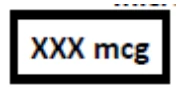

Figure 1
- Peel back foil on blister unit to expose tablet (see Figure 2).
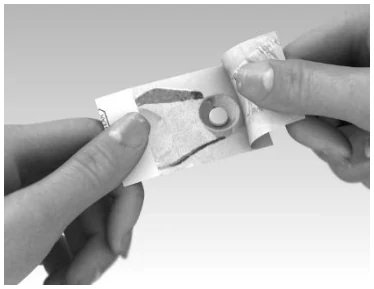
Figure 2
- Do not push the tablet through the foil on the blister unit because this could damage the tablet.
- When removed from the blister unit, FENTORA tablet must be used right away.
- Do NOT split the FENTORA tablet. Use FENTORA tablets whole.
You can place a FENTORA tablet in your mouth two ways:
- 1. Buccal: above a back molar tooth between the upper cheek and gum (see Figure 3).
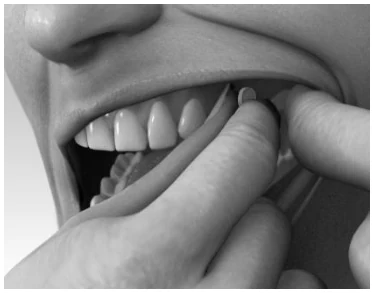
Figure 3
- 2. Sublingual: on the floor of your mouth, under your tongue (see Figures 4a, 4b, 4c, 4d). When placing the tablet under your tongue, first lift your tongue (4b), then place the tablet under your tongue (4c), and lower your tongue over the tablet (4d).
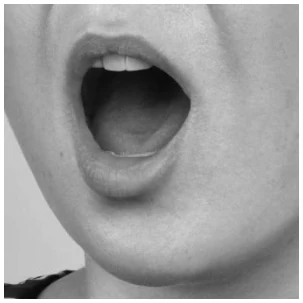
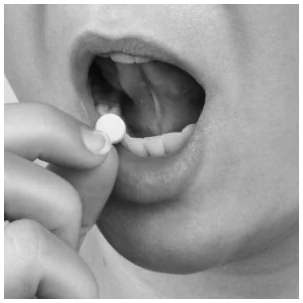
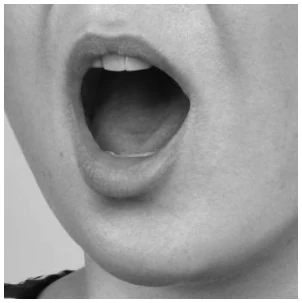
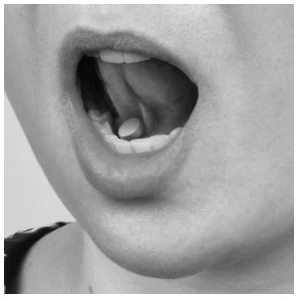
Figure 4a Figure 4b Figure 4c Figure 4d
- Leave the tablet in place until it dissolves. A FENTORA tablet generally takes 14 to 25 minutes to dissolve.
- After 30 minutes, if there is any FENTORA left in your mouth, you may drink a glass of water to help you swallow the left-over medicine.
- If you cannot use FENTORA in this manner, tell your healthcare professional. Your healthcare professional will tell you what to do. Do NOT split the tablet.
- Do NOT split, suck, chew or swallow FENTORA tablets. You will get less relief for your breakthrough cancer pain.
Stopping your Medication
If you have been taking FENTORA for more than a few days you should not stop taking it all of a sudden. Your healthcare professional will monitor and guide you on how to slowly stop taking FENTORA. You should do it slowly to avoid uncomfortable symptoms such as having:
- body aches;
- diarrhea;
- goosebumps;
- loss of appetite;
- nausea;
- feeling nervous or restless;
- runny nose;
- sneezing;
- tremors or shivering;
- stomach cramps;
- rapid heart rate (tachycardia);
- having trouble sleeping;
- an unusual increase in sweating;
- heart palpitations;
- an unexplained fever;
- weakness;
- yawning.
By reducing or stopping your opioid treatment, your body will become less used to opioids. If you start treatment again, you will need to start at the lowest dose. You may overdose if you restart at the last dose you took before you slowly stopped taking FENTORA.
Refilling your Prescription for FENTORA:
A new written prescription is required from your healthcare professional each time you need more FENTORA. Therefore, it is important that you talk to your healthcare professional before your current supply runs out.
Only obtain prescriptions for this medicine from the healthcare professional in charge of your treatment. Do not seek prescriptions from other healthcare professionals unless you switch to another healthcare professional for your pain management.
Overdose:
Signs of overdose may include:
- unusually slow or weak breathing,
- fluid in the lungs (difficulty breathing, shortness of breath, cough with frothy sputum)
- slow heartbeat,
- inability to walk normally,
- floppy muscles/low muscle tone,
- cold and clammy skin,
- pinpoint pupils,
- confusion,
- extreme sleepiness,
- low blood pressure (dizziness, fainting, light-headedness),
- low blood sugar (dizziness, lack of energy, drowsiness, headache, trembling, sweating),
- coma.
In cases of possible overdose try to remove any FENTORA tablets still remaining in the mouth.
| FENTORA is an opioid. Naloxone can reverse the effects of an opioid overdose. It is recommended to have naloxone readily available if you are taking FENTORA. If an overdose occurs, another person will need to give it to you. They should call 911 right away and follow the instructions provided with the naloxone product. |
|---|
Possible side effects from using FENTORA:
These are not all the possible side effects you may have when taking FENTORA. If you experience any side effects not listed here, tell your healthcare professional.
Side effects may include:
- Drowsiness;
- Insomnia;
- Dizziness;
- Fainting;
- Nausea, vomiting, or a poor appetite;
- Dry mouth;
- Headache;
- Problems with vision;
- Weakness, uncoordinated muscle movement;
- Itching;
- Sweating;
- Constipation. Talk with your healthcare professional about ways to prevent constipation when you start using FENTORA;
- Low sex drive, impotence (erectile dysfunction), infertility.
Serious side effects and what to do about them:
| Frequency/Side Effect/Symptom | Talk to your healthcare professional | Get immediate medical help | |
|---|---|---|---|
| Frequency/Side Effect/Symptom | Talk to your healthcare professional | Get immediate medical help | |
| Frequency/Side Effect/Symptom | Talk to your healthcare professional | Get immediate medical help | |
| Only if severe | In all cases | ||
| Only if severe | In all cases | ||
| Only if severe | In all cases | ||
| Common | |||
| Gastrointestinal problems: constipation, diarrhea, abdominal cramping, nausea, vomiting, bloating. | √ | ||
| Uncommon | |||
| Hypoglycemia (low blood sugar levels): dizziness, lack of energy, drowsiness, headache, trembling, sweating. | √ | ||
| Rare | |||
| Allergic reaction: itchy, red, painful, and irritated or swollen skin (rash), outbreak of pale red bumps or welts on the skin that appear suddenly (hives), swelling of the face, lips, tongue or throat, difficulty swallowing, or difficulty breathing. | √ | ||
| Bowel blockage (impaction): abdominal pain, severe constipation, nausea. | √ | ||
| Fast, slow or irregular heartbeat: heart palpitations. | √ | ||
| Hypotension (low blood pressure): dizziness, fainting, light-headedness. | √ | ||
| Overdose: unusually slow or weak breathing, fluid in the lungs (difficulty breathing, shortness of breath, cough with frothy sputum), slow heartbeat, inability to walk normally, floppy muscles/low muscle tone, cold and clammy skin, pinpoint pupils, confusion, extreme sleepiness, low blood sugar (dizziness, lack of energy, drowsiness, headache, trembling, sweating), low blood pressure (dizziness, fainting, light-headedness), coma. | √ | ||
| Respiratory depression: slow, shallow or weak breathing or shortness of breath. | √ | ||
| Serotonin toxicity (also known as serotonin syndrome): a reaction which may cause feelings of agitation or restlessness, flushing, muscle twitching, involuntary eye movements, heavy sweating, high | √ | ||
| body temperature (>38°C), or rigid muscles. | |||
| Withdrawal: nausea, vomiting, diarrhea, anxiety, shivering, cold and clammy skin, body aches, loss of appetite, sweating. | √ | ||
| Unknown | |||
| Opioid-induced esophageal dysfunction (OIED) (a gastrointestinal disorder): trouble swallowing, acid reflux, chest pain. | √ | ||
| Sleep apnea (a sleep disorder where you stop breathing for short periods of time during your normal nightly sleep): loud snoring, abrupt awakening with gasping or choking. | √ | ||
If you have a troublesome symptom or side effect that is not listed here or becomes bad enough to interfere with your daily activities, tell your healthcare professional.
Reporting Side Effects
You can report any suspected side effects associated with the use of health products to Health Canada by:
NOTE: Contact your healthcare professional if you need information about how to manage your side effects. The Canada Vigilance Program does not provide medical advice. |
Storage:
- Store FENTORA in original package between 15o and 30oC, until ready to use. Keep in a dry place and protected from moisture.
- Keep FENTORA in the original blister unit. FENTORA should be used immediately after opening the child-resistant package. Do NOT remove FENTORA from its blister packaging for storage in a temporary container, such as a pill box.
- Do NOT use if the blister package has been tampered with.
- Keep FENTORA under lock, out of sight and reach of children and pets.
- Never take medicine in front of small children as they will want to copy you. Accidental ingestion by a child is dangerous and may result in death. If a child accidentally takes FENTORA, get emergency help right away.
- Keep unused or expired FENTORA in a secure place to prevent theft, misuse or accidental exposure.
Disposal: To prevent accidental ingestion, and to reduce the chance of children taking the medication, it is important to properly dispose of any excess FENTORA as soon as it is no longer needed. FENTORA should never be thrown into household trash, where children and pets may find it. It should be returned to a pharmacy for proper disposal.
If you want more information about FENTORA:
- Talk to your healthcare professional.
- Find the full product monograph that is prepared for healthcare professionals and includes this Patient Medication Information by visiting the Health Canada Drug Product Database website (https://www.canada.ca/en/health-canada/services/drugs-health-products/drug-products/drug-product-database.html); or by calling 1-800-881-3550.
Date of Authorization: 2026-10-29