


Product Monograph - Flagystatin (Aventis Pharma)
INDICATIONS AND CLINICAL USE
Mixed vaginal infection due to Trichomonas vaginalis and Candida albicans.
CONTRAINDICATIONS
Hypersensitivity to FLAGYSTATIN (metronidazole and nystatin); or any of its constituents, or to imidazoles.
Combined treatment with oral metronidazole should be avoided in cases of active neurological disorders or a history of blood dyscrasia, hypothyroidism or hypoadrenalism unless, in the opinion of the physician, the benefits outweigh the possible hazard to the patient.
WARNINGS
General
Metronidazole has been shown to be carcinogenic in mice and rats (see TOXICOLOGY section). Unnecessary use of the drug should be avoided and prolonged treatment duration should be carefully weighed. Its use should be reserved for the conditions described in the INDICATIONS section.
Nystatin possesses little or no antibacterial activity while metronidazole is selective against certain anaerobic bacteria; therefore, FLAGYSTATIN may not be effective in bacterial vaginal infections.
Nystatin is not absorbed from mucous membranes; therefore, no systemic effect is expected (see PHARMACOLOGY section).
FLAGYSTATIN should not be prescribed unless there is direct evidence of trichomonal infestation or candidiasis.
Once candidiasis has been confirmed, care must be taken to investigate the possible factors that could promote fungal growth. To avoid recurrences, it is essential to eradicate or offset these promoting factors.
It is recommended to treat all sites associated with Candida concomitantly (e.g. intestinal and vaginal or other infections).
Hepatic
FLAGYSTATIN, a metronidazole containing preparation, should be used with great caution in patients with a history of hepatic enzyme increase or liver injury associated with previous administration of metronidazole (see ADVERSE REACTIONS section).
Cases of severe hepatotoxicity/acute hepatic failure, including cases with a fatal outcome, with very rapid onset after treatment initiation, in patients with Cockayne syndrome have been reported with products containing metronidazole for systemic use. In this population,
FLAGYSTATIN should therefore only be used after careful benefit-risk assessment and only if no alternative treatment is available. Liver function tests must be performed just prior to the start of therapy, throughout and after end of treatment until liver function is within normal ranges, or until the baseline values are reached. If the liver function tests become markedly elevated during treatment, the drug should be discontinued. Patients with Cockayne syndrome should be advised to immediately report any symptoms of potential liver injury to their physician and stop taking FLAGYSTATIN.
PRECAUTIONS
Where there is evidence of trichomonal infestation in the sexual partner, he should be treated concomitantly with oral metronidazole to avoid reinfestation.
The effectiveness of condoms or diaphragms could be impaired by some of the fatty constituents contained in nystatin and metronidazole gynaecological ovule, therefore their use during FLAGYSTATIN treatment is not recommended.
Vaginal injection, menstrual tampons and soaps with an acid pH (for personal hygiene use) should not be used during treatment because they may promote fungal replication.
It is possible that adverse effects normally associated with oral administration of metronidazole or nystatin may occur following the vaginal administration of FLAGYSTATIN.
Patients should be warned against consuming alcohol, during FLAGYSTATIN therapy and for at least one day afterward, because of a possible disulfiram-like reaction related to the metronidazole.
Although no persistent hematologic abnormalities have been observed in clinical studies, total and differential leukocyte counts should be made before and after treatment, especially if a second course of metronidazole therapy is needed.
Patients should be monitored for adverse reactions such as peripheral or central neuropathy (such as paresthesia, ataxia, dizziness, and convulsive seizures) related to metronidazole.
FLAGYSTATIN should be used with caution in patients with active or chronic severe peripheral and central nervous system diseases due to the risk of neurological aggravation related to metronidazole.
Treatment with metronidazole should be discontinued if ataxia or any other symptom of CNS involvement occurs.
FLAGYSTATIN should be administered with caution to patients with hepatic encephalopathy. Patients with severe hepatic disease metabolize metronidazole slowly with resultant accumulation of metronidazole and its metabolites in the plasma. Accordingly, for such patients, doses of FLAGYSTATIN below those usually recommended should be administered and with caution.
Patients should be warned that FLAGYSTATIN may darken urine (due to metronidazole metabolite).
Pregnant Women
Metronidazole passes the placental barrier. Although it has been given to pregnant women without apparent complication, its effects on human fetal organogenesis are not known; it is advisable that its use be avoided in pregnant patients and the drug be withheld during the first trimester of pregnancy.
No reliable teratogenicity data related to nystatin administration from animal studies is available. Use of nystatin should be avoided unless the benefits to the mother outweigh the potential risks to the fetus or baby.
The applicator should not be used after the 7th month of pregnancy.
Nursing Women
As metronidazole is excreted in human milk, exposure to the drug should be avoided.
No data is available whether nystatin enters the breast milk.
Occupational Hazards
Patients should be warned about the potential for confusion, dizziness, hallucinations, convulsions or eye disorders when treated with metronidazole, and advised not to drive or operate machinery if these symptoms occur.
DRUG INTERACTIONS
Precautions must be borne in mind, as it is possible that drug interactions usually associated with oral administration of metronidazole or nystatin may occur following the vaginal administration of FLAGYSTATIN.
Alcohol: alcoholic beverages and drugs containing alcohol should not be consumed during therapy and for at least one day afterwards because of the possibility of a disulfiram-like (antabuse effect) reaction (flushing, vomiting, tachycardia).
Busulfan: Plasma levels of busulfan may be increased by metronidazole, which may lead to severe busulfan toxicity.
Cyclosporin: risk of elevation of cyclosporin serum levels. Serum cyclosporin and serum creatinine should be closely monitored when coadministration with metronidazole is necessary.
Disulfiram: psychotic reactions have been reported in patients who were using metronidazole and disulfiram concurrently.
5 Fluorouracil: reduced clearance of 5 fluorouracil resulting in increased toxicity of 5 fluorouracil (coadministration with metronidazole)
Lithium: Plasma levels of lithium may be increased by metronidazole. Plasma concentration of lithium, creatinine and electrolytes should be monitored in patients under treatment with lithium while they receive metronidazole.
Oral anticoagulant therapy (warfarin type): potentiation of the anticoagulant effect and increased hemorrhagic risk caused by decreased hepatic catabolism. In case of coadministration with metronidazole, prothrombin time should be more frequently monitored and anticoagulant therapy adjusted during treatment with metronidazole.
Phenytoin or phenobarbital: increased elimination of metronidazole resulting in reduced plasma levels. Patients maintained on phenytoin were found to have toxic blood levels after oral metronidazole administration. Phenytoin concentration returned to therapeutic blood level after discontinuance of metronidazole.
ADVERSE REACTIONS
They are infrequent and minor: vaginal burning and granular sensation. Bitter taste, nausea and vomiting, already known to occur with metronidazole, were mainly seen when oral metronidazole was administered concomitantly with FLAGYSTATIN local treatment.
In the course of clinical trials with FLAGYSTATIN, reactions, not necessarily related to the product, were observed: spots on the skin around the knees, welts all over the body, aching and swelling of wrists and ankles, pruritis, headache, coated tongue and fatigue.
Other adverse events related to metronidazole, usually observed after oral or I.V. administration of metronidazole, and to nystatin include:
Blood and lymphatic system disorders
Metronidazole: Transient eosinophilia, neutropenia, cases of agranulocytosis and thrombocytopenia have been reported.
Cardiac disorders
Metronidazole: Palpitation and chest pain
Eye disorders
Metronidazole: Transient vision disorders such as diplopia, myopia, blurred vision, decreased visual acuity, changes in color vision. Optic neuropathy/neuritis has been reported.
Ear and labyrinth disorders
- hearing impaired/hearing loss (including hypoacusis, deafness, deafness neurosensory)
- tinnitus
Gastrointestinal disorders
Metronidazole: Diarrhea, nausea, vomiting, epigastric distress, epigastric pain, dyspepsia, constipation, coated tongue, dry mouth, taste disorders including metallic taste, oral mucositis. Reversible cases of pancreatitis have been reported.
General disorders and administration site conditions
Metronidazole: Thrombophlebitis has occurred with I.V. administration. Fever has been reported.
Hepatobiliary disorders
Metronidazole: increase in liver enzymes (AST, ALT, alkaline phosphatase), cholestatic or mixed hepatitis and hepatocellular liver injury, sometimes with jaundice have been reported.
Cases of liver failure requiring liver transplant have been reported in patients treated with metronidazole in combination with other antibiotic drugs.
Cases of severe hepatotoxicity/acute hepatic failure, including cases with a fatal outcome, in patients with Cockayne syndrome have been reported with products containing metronidazole.
Immune system disorders
Metronidazole: angioedema, anaphylactic shock.
Nystatin: Hypersensitivity reactions may occur.
Infections and infestations
Metronidazole: Cases of pseudomembranous colitis have been reported.
Metabolism and nutrition disorders
Metronidazole: Anorexia has been reported.
Nervous system disorders
Metronidazole: Convulsive seizures, peripheral sensory neuropathy, transient ataxia, dizziness, drowsiness, insomnia, headache, and aseptic meningitis.
Reports of encephalopathy (e.g. confusion) and subacute cerebellar syndrome (e.g. ataxia, dysarthria, gait impairment, nystagmus, and tremor) have been reported, which may resolve with discontinuation of the drug.
Psychiatric disorders
Metronidazole: psychotic disorders including confusion, hallucinations. Depressed mood.
Skin and subcutaneous tissue disorders
Metronidazole: Hypersensitivity reactions including flushing, urticaria and pustular eruptions. Rash and pruritus, fixed drug eruption. Cases of Stevens-Johnson Syndrome (SJS) and toxic epidermal necrolysis (TEN) have been reported. Many of these case reports revealed the use of concomitant medications known to be associated with SJS or TEN.
Nystatin: Local irritation or sensitization have been reported after local application, treatment should be stopped if such reaction occurs. Skin reaction may occur, notably Stevens-Johnson syndrome, have been reported.
Other
Metronidazole: Proliferation of Candida albicans in the vagina, vaginal dryness and burning; dysuria; and headaches. Reversible lowering of serum lipids has been reported. A case of gynecomastia has been reported which resolved on discontinuing metronidazole administration.
Nystatin: Nystatin is not absorbed from mucous membranes; therefore, no systemic manifestations are observed after local application of the product (see PHARMACOLOGY section).
SYMPTOMS AND TREATMENT OF OVERDOSAGE
Symptoms
No case of accidental massive ingestion of FLAGYSTATIN has been reported yet. However, single oral doses of metronidazole, up to 12 g have been reported in suicide attempts and accidental overdoses. Symptoms were limited to vomiting, ataxia and slight disorientation.
The administration of massive peroral nystatin doses can as well induce gastro-intestinal disorders (nausea, vomiting, and diarrhoea).
Treatment
There is no specific antidote. Activated charcoal may be administered to aid in the removal of unabsorbed drug. General supportive measures are recommended.
For management of a suspected drug overdose, contact your regional Poison Control Centre.
DOSAGE AND ADMINISTRATION
One vaginal ovule daily, inserted deep into the vagina, for 10 consecutive days.
If after 10 days of treatment a cure has not been achieved, a second 10-day course of treatment should be given.
If Trichomonas vaginalis has not been completely eliminated, oral metronidazole 250 mg b.i.d. should be administered for 10 days.
The applicator should not be used after the 7th month of pregnancy.
PHARMACEUTICAL INFORMATION
FLAGYSTATIN is a preparation delivering 500 mg of metronidazole a) and 100,000 units of nystatin b) per vaginal application.
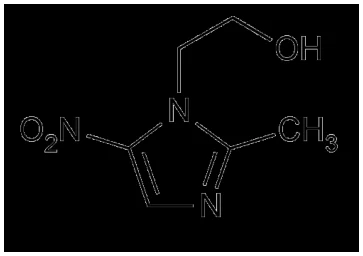
Structural Formula
 |
|
Molecular Formula: a) C6H9N3O3
- b) Not applicable – Nystatin is a mixture of two or more substances
Molecular Weight: a) 171.2
- b) Not applicable – Nystatin is a mixture of two or more substances
Chemical Name: a) 1H-Imidazole-1-ethanol,2-methyl-5-nitro or 2-Methyl-5-nitroimidazole-1-ethanol.
- b) nystatin
Description: Metronidazole is a white to pale yellow, odorless crystals or crystalline powder. It is stable in air, but darkens on exposure to light. Soluble in dilute hydrochloric acid (1 in 2); sparingly soluble in water and in alcohol; slightly soluble in ether and in chloroform.
Nystatin is a polyene antifungal antibiotic produced by the growth of Streptomyces noursei, It is a yellow to light tan powder, having an odor suggestive of cereals. Is hygroscopic, and is affected by long exposure to light, heat, and air. Freely soluble in dimethylformamide and in dimethyl sulfoxide; slightly to sparingly soluble in methanol, in n-propyl alcohol, and in n-butyl alcohol; practically insoluble in water and in alcohol; insoluble in chloroform and in ether.
STORAGE AND STABILITY
Store the vaginal ovules at room temperature between 15 - 25ºC and protect from light.
DOSAGE FORMS, COMPOSITION AND PACKAGING
Vaginal ovules containing 500 mg metronidazole and 100,000 IU nystatin; boxes of 10 ovules with applicator.
Non-medicinal ingredient: glycerides of saturated fatty acid (hard fat).
PHARMACOLOGY
Metronidazole shows little or no effect on the cardiovascular, respiratory or autonomic nervous systems of dogs, rats and mice.
In vitro, activity was studied using decreasing concentrations of metronidazole which were added to a series of Trichomonas vaginalis cultures maintained at 37ºC. A 1:400,000 dilution of metronidazole kills up to 99% of the trichomonads in 24 hours.
In vivo, 0.5 mL of a 48-hour culture of Trichomonas vaginalis injected under the dorsal skin in a control and a test group of mice revealed, seven days later, extensive abscess-like lesions swarming with trichomonads in the control group and normal subcutaneous tissue free of trichomonads in the animals which had received oral metronidazole in a daily dosage of 12.5 mg/kg of body weight.
Nystatin is not absorbed from mucous membranes; therefore, no systemic manifestations are observed after local application of the product.
In vitro, nystatin is fungistatic against Candida albicans at a concentration of 3.12 μg/mL (4.4-6.2 U/mL) in liquid medium. A fungicidal activity is observed after a 5-hour contact with 1000 μg/mL (1400-2000 U/mL) or after 24 hours with 100 μg/mL (140-200 U/mL).
In vivo, rabbits were infested by the oral route with 2.5 x 10⁸ cells of C. albicans. The administration of 50 mg/kg (100,000 U/kg) per os for 3 days reduced the number of organisms found in the feces from a few millions to less than 20 yeast cells per g.
Mortality in rabbits infested with C. albicans by the I.V. route is usually 100%. It is reduced to 62.5% when 20 mg (40,000 I.U.) is administered twice daily by the S.C. route for 4 days.
Metronidazole and nystatin do not show antagonism in vitro. It was demonstrated that, when used in combination, (in the proportion of 5μg of metronidazole to 1 unit of nystatin as in FLAGYSTATIN vaginal inserts) nystatin does not alter the antitrichomonal activity of metronidazole and that metronidazole does not affect the anticandidal activity of nystatin. Furthermore, the presence of excessive amounts of either product failed to alter the specific effectiveness of the other.
It was also shown that both FLAGYSTATIN vaginal inserts and ovules and metronidazole/nystatin cream exert antitrichomonal and anticandidal activities comparable to those of the individual components.
TOXICOLOGY
Local Tolerance
FLAGYSTATIN vaginal inserts were administered daily to six female Rhesus monkeys for thirty days. As compared with a control group given a placebo insert, no significant compound-related effects were observed with respect to appearance, behavior, signs of toxicity, hematological or biochemical values. No distinctive consistent gross or microscopic alterations in the vagina or cervix of treated animals were seen.
Acute Toxicity
The acute toxicity of metronidazole by the oral route is 4.35 g/kg of body weight in the mouse and 5 g/kg in the rat.
Orally, doses of 7.68 million units/kg of nystatin in rats and of 8.1 to 12.5 million units/kg in mice were still non-toxic. By the I.P. route, the LD50's were in the range of 29,430 to 50,040 units/kg in mice and 85,068 to 93,440 units/kg in rats.
Subacute Toxicity
In rats, doses of up to 1,000 mg/kg per os of metronidazole for thirty days were well tolerated. Dogs given up to 50 mg/kg for a period of one month showed no sign of toxicity while others given up to 225 mg/kg for a period of 6 months developed signs of ataxia, muscular rigidity and tremor. This might be due to species difference in addition to high dosage over a prolonged time.
In the rat given daily oral doses of 121,000 to 810,000 units/kg of nystatin for a period of three months, no effects on red or white blood cells were noted. With the lower dosages, diarrhea, depression of growth and nasal discharge could be observed. In the animals given 810,000 units/kg per day, gastro-intestinal irritation, diarrhea, emaciation, dehydration and death occurred. In dogs, daily oral doses of up to 450,000 units/kg for periods of 185 to 217 days produced no histological changes in the organs.
Carcinogenesis – Mutagenesis
Metronidazole has been shown to be carcinogenic in the mouse and in the rat. However similar studies in the hamster have given negative results. Metronidazole has been shown to be mutagenic in bacteria in vitro. In studies conducted in mammalian cells in vitro as well as in rodent or humans in vivo, there was inadequate evidence of a mutagenic effect of metronidazole.
Therefore, the use of FLAGYSTATIN for prolonged treatment duration should be carefully weighed (see WARNINGS section).
REFERENCES
- 1. Cosar, C., Ganter, P., and Julou, L. Étude expérimentale du métronidazole (8823 R.P.). Activités trichomonacide et amoebicide. Toxicité et propriétés pharmacologiques générales. Presse Méd., 69, 1069, 1961.
- 2. Danezis, J., and Marsellou, U. Fréquence de la coexistence du Trichomonas avec le Candida albicans. Résultats thérapeutiques après emploi de la trichomycine et de la mycostatine. La Presse Méd., 68, 519-520, 1960.
- 3. Drouhet, E. Action de la Nystatine (Fungidicine) in vitro et in vivo sur Candida Albicans et autres champignons levuriformes. Ann. Inst. Pasteur, 88(3), 298-314, 1955.
- 4. Durel, P., Roiron, V., Siboulet, A., and Borel, L.J. Systemic treatment of trichomoniasis with nitroimidazole derivative, R.P. 8823. Presented at the Canadian Symposium on non-gonococcal urethritis, held in Montreal, Sept. 1959.
- 5. Fortier, L. Treatment of trichomoniasis in women with a new imidazole derivative. Presented at the Canadian Symposium on non-gonococcal urethritis, held in Montreal, Sept. 1959.
- 6. Gardner, H.L. General concepts of vaginitis therapy. J. Mississippi Med. Assoc., 8, 529-534, Sept. 1967.
- 7. Hartgill, J.C. Diagnosis and treatment of vaginitis. The Practitioner, 202, 363-371, 1969.
- 8. Hazen, E.H., and Brown, R. Fungicidin, an antibiotic produced by a soil Actinomycete (18397). Proc. Soc. Exper. Biol. & Med. 76, 93-97, 1951.
- 9. Jillson, O.F., and Lyle, S.J. Yeast vulvo vaginitis. Arch. Derm. 74, 489-492, 1956.
- 10. Kantor, H.I., Kamholz, J.H., and Boulas, S.H. Treatment trends in monilial vaginitis.Southern Med. J., 59, 535-537, 1966.
- 11. Luthra, R. and Boyd, J.R. The treatment of trichomoniasis with metronidazole. Amer. J. Obstet, Gynec., 83, 1288-1293, May 15, 1962.
- 12. Mendel, E.B., and Haberman, S. The vaginal ecology and its relationship to symptoms in vaginitis. Southern Med. J., 58, 374-378, 1965.
- 13. Peterson, W.F., Hansen, F.W., Stauch, J.E., and Ryder, C.D. Trichomonal Vaginitis: Epidemiology and therapy. Am. J. Obstet. Gynec. 97 : 472-478, 1967.
- 14. Robinson, S.C., and Johnston, D.W. Observation on vaginal trichomoniasis. II - Treatment with metronidazole. Can. Med. Ass. J., 85, 1094, 1961.
- 15. Vartiainen, E., and Widholm, O. The combination product Flagyl Comp(R) (metronidazole & nystatin) in the treatment of severe cases of colpitis. Acta Obst. Gynec. Scand., 49, (Supp. 2), 11-13, 1970.