


Patient Medication Information: uses, side effects, how to take - Glycopyrronium / Formoterol Fumarate Dihydrate Pressurized Inhalation Suspension
What is glycopyrronium/formoterol fumarate dihydrate pressurized inhalation suspension used for?
- Glycopyrronium/formoterol fumarate dihydrate pressurized inhalation suspension is used in adults for the long-term treatment of a lung disease called chronic obstructive pulmonary disease (COPD), including chronic bronchitis and emphysema.
If you are a smoker, it is important to quit smoking. This will help decrease the symptoms of COPD and may increase your lifespan.
How does glycopyrronium/formoterol fumarate dihydrate pressurized inhalation suspension work?
It contains 2 medicinal ingredients:
- glycopyrronium is a long-acting muscarinic antagonist (LAMA)
- formoterol fumarate dihydrate is a long-acting beta2 agonist (LABA)
Both ingredients belong to a group of medicines called bronchodilators. Bronchodilators help to open and relax the muscles of the airways. This allows more air to get in and out of the lungs. This makes it easier for patients with COPD to breathe and helps prevent shortness of breath and wheezing.
This medicine does not cure COPD but helps to control it. It is therefore important that you take glycopyrronium/formoterol fumarate dihydrate pressurized inhalation suspension regularly even if you feel fine.
What are the ingredients in glycopyrronium/formoterol fumarate dihydrate pressurized inhalation suspension?
Medicinal ingredients: glycopyrronium (as bromide) and formoterol fumarate dihydrate
Non-medicinal ingredients: hydrofluoroalkane (HFA-134a) and porous particles (comprised of 1,2-distearoyl-sn-glycero-3-phosphocholine (DSPC) and calcium chloride)
Serious Warnings and Precautions
ASTHMA-RELATED DEATH Glycopyrronium/formoterol fumarate dihydrate pressurized inhalation suspension should only be used to treat COPD. Glycopyrronium/formoterol fumarate dihydrate pressurized inhalation suspension should not be used to treat asthma. Long-acting beta2-agonist (LABA) medicines may increase the chance of death from asthma. In a large study, more patients who used another LABA (salmeterol) died from asthma compared with patients who did not use that LABA. This finding may also apply to glycopyrronium/formoterol fumarate dihydrate pressurized inhalation suspension. |
|---|
Glycopyrronium/formoterol fumarate dihydrate pressurized inhalation suspension comes in the following dosage forms:
Pressurized inhalation suspension in a metered dose inhaler (for oral inhalation): 8.3 mcg glycopyrronium (as bromide) / 5.8 mcg of formoterol fumarate dihydrate per actuation (also called puffs).
Do not use glycopyrronium/formoterol fumarate dihydrate pressurized inhalation suspension:
- if you are allergic to glycopyrronium, formoterol fumarate dihydrate or any of the other ingredients in this medicine
- to treat sudden symptoms of COPD, such as shortness of breath or wheezing. Always have a rescue inhaler with you to treat sudden symptoms (“flare ups”). If you do not have a rescue inhaler, ask your healthcare professional to prescribe one for you
- to treat asthma
To help avoid side effects and ensure proper use, talk to your healthcare professional before you take glycopyrronium/formoterol fumarate dihydrate pressurized inhalation suspension. Talk about any health conditions or problems you may have, including if you:
have heart problems, such as:
- heart disease
- rapid or irregular heart beat or any problems with how your heart beats
- a condition called “QT prolongation”
- have high blood pressure
- have ever had seizures
- have thyroid problems
- have eye problems such as increased pressure in the eye, glaucoma, cataracts, blurry vision or other changes in vision
- have prostate or bladder problems or any problems passing urine
- have kidney or liver problems
- have diabetes
- have low levels of potassium in your blood
- are taking similar medicines for your lung disease
are pregnant or planning to become pregnant. Talk to your healthcare professional if you become pregnant while taking glycopyrronium/formoterol fumarate dihydrate pressurized inhalation suspension. Your healthcare professional will consider the benefit to you and the risk to your unborn baby
- are breastfeeding. It is not known if glycopyrronium/formoterol fumarate dihydrate pressurized inhalation suspension can pass into breastmilk
Other warnings you should know about:
Driving and Using Machines
Avoid driving and using machines if you feel dizzy, or have nausea, blurred vision or headaches.
Worsening of COPD Symptoms
Tell your healthcare professional right away if your COPD symptoms do not improve or if they get worse while you are taking glycopyrronium/formoterol fumarate dihydrate pressurized inhalation suspension. Also tell your healthcare professional if you need to use your rescue inhaler more often. These could be signs that your COPD is getting worse or that your dose of glycopyrronium/formoterol fumarate dihydrate pressurized inhalation suspension needs to be changed.
Paradoxical Bronchospasm
If you feel tightness of the chest, coughing, wheezing or breathlessness right after using glycopyrronium/formoterol fumarate dihydrate pressurized inhalation suspension, you may have a serious condition called “paradoxical bronchospasm” (an unexpected closing of your airways). Stop using glycopyrronium/formoterol fumarate dihydrate pressurized inhalation suspension and seek medical help right away.
Eye Problems
Glycopyrronium/formoterol fumarate dihydrate pressurized inhalation suspension can cause eye problems:
- Glaucoma: an increased pressure in your eyes, eye pain, halos around lights or coloured images, red eyes. Untreated, it may lead to permanent vision loss.
If you have any change in your vision, tell your healthcare professional right away. You may need regular eye exams.
Tell your healthcare professional about all the medicines you take, including any drugs, vitamins, minerals, natural supplements or alternative medicines.
The following may interact with glycopyrronium/formoterol fumarate dihydrate pressurized inhalation suspension:
- Other medicines used to treat breathing problems
- Oral corticosteroids, such as prednisone, used to supress the immune system and treat inflammation
- Certain types of diuretics or “water pills”, used to treat high blood pressure and heart problems that lower the amount of potassium in your blood
- Beta blockers, such as atenolol or propranolol, used to treat high blood pressure or other heart problems
- Medicines used to treat depression, such as monoamine oxidase (MAO) inhibitors and tricyclic antidepressants
- Eye drops, such as timolol, used to treat glaucoma
How to take glycopyrronium/formoterol fumarate dihydrate pressurized inhalation suspension:
- Always take glycopyrronium/formoterol fumarate dihydrate pressurized inhalation suspension exactly as your healthcare professional has told you to. You should check with your healthcare professional if you are unsure.
- Do not take glycopyrronium/formoterol fumarate dihydrate pressurized inhalation suspension more than twice a day.
- Read the “Instructions for Use” at the end of this Patient Medication Information for instructions on how to use glycopyrronium/formoterol fumarate dihydrate pressurized inhalation suspension. If you have any questions, talk to your healthcare professional.
- You can use glycopyrronium/formoterol fumarate dihydrate pressurized inhalation suspension any time before or after food or drink.
Usual adult dose:
Take 2 oral inhalations (puffs) twice daily in the morning and evening.
Overdose:
If you take too much glycopyrronium/formoterol fumarate dihydrate pressurized inhalation suspension you may experience blurred vision, being unable to pass urine, dry mouth, nausea and a fast or irregular heartbeat.
| If you think you, or a person you are caring for, have taken too much glycopyrronium/formoterol fumarate dihydrate pressurized inhalation suspension, contact a healthcare professional, hospital emergency department, or regional poison control centre immediately, even if there are no symptoms. |
Missed Dose:
If you forget a dose, inhale the dose as soon as you remember. However, if it is nearly time for your next dose, skip the missed dose. Do not take an extra dose to make up for a missed dose.
What are possible side effects from using glycopyrronium/formoterol fumarate dihydrate
pressurized inhalation suspension?
These are not all the possible side effects you may have when taking glycopyrronium/formoterol fumarate dihydrate pressurized inhalation suspension. If you experience any side effects not listed here, tell your healthcare professional.
Side effects may include:
- Dry mouth
- Headache
- Shaking/tremor
- Nausea
- Muscle cramps/spasms
- Anxiety/agitation
- Nervousness
- Restlessness
- Difficulty sleeping (insomnia)
- Fatigue
- Dizziness
- Cough
- Vomiting
Serious side effects and what to do about them
| Symptom / effect | Talk to your healthcare professional | Stop taking drug and get immediate medical help | |
|---|---|---|---|
| Only if severe | In all cases | ||
| COMMON | |||
| Urinary Tract Infection: painful and frequent urination, blood in the urine | ✓ | ||
| UNCOMMON | |||
| Chest Pain | ✓ | ||
| Heart Palpitations: unusually fast or irregular heartbeat | ✓ | ||
| Allergic Reactions: rash; hives; swelling of the face, lips, tongue or throat; difficulty swallowing or breathing | ✓ | ||
| Urinary Retention: difficulty when passing urine, urinating frequently, urination in a weak stream or drips | ✓ | ||
| UNKNOWN | |||
| Glaucoma: new or worsened pressure in your eyes, eye pain or discomfort, blurred vision, seeing halos of bright colours around lights, red eyes | ✓ | ||
| High Blood Sugar: frequent urination, thirst and hunger | ✓ | ||
| Low Blood Potassium: muscle weakness, twitching and/or irregular heartbeat | ✓ | ||
| Paradoxical Bronchospasm: sudden tightness of the chest, coughing, wheezing or breathlessness immediately after inhaling your medicine | ✓ | ||
If you have a troublesome symptom or side effect that is not listed here or becomes bad enough to interfere with your daily activities, tell your healthcare professional.
Reporting Side Effects
You can report any suspected side effects associated with the use of health products to Health Canada by:
NOTE: Contact your health professional if you need information about how to manage your side effects. The Canada Vigilance Program does not provide medical advice. |
Storage:
Store between 15 to 30°C.
Keep the glycopyrronium/formoterol fumarate dihydrate pressurized inhalation suspension protected inside the sealed pouch until you start to use it. Use the glycopyrronium/formoterol fumarate dihydrate pressurized inhalation suspension within 3 months of opening the pouch.
Do not use glycopyrronium/formoterol fumarate dihydrate pressurized inhalation suspension after the expiry date, which is on the inhaler label, carton and inhaler pouch after “EXP”. The expiry date refers to the last day of the month.
Do not use glycopyrronium/formoterol fumarate dihydrate pressurized inhalation suspension if you notice that the pack is damaged or shows signs of tampering.
The canister should not be broken, punctured or burnt, even when it seems empty. Do not use or store near heat or open flame. Do not expose to temperatures higher than 50°C.
Throw away your inhaler after the last dose. Ask your pharmacist how to throw away medicines no longer required. These measures will help protect the environment.
Keep out of reach and sight of children.
If you want more information about glycopyrronium/formoterol fumarate dihydrate pressurized inhalation suspension:
- Talk to your healthcare professional
- Find the full product monograph that is prepared for healthcare professionals and includes this Patient Medication Information by visiting the Health Canada website: https://www.canada.ca/en/health-canada/services/drugs-health-products/drug-products/drug-product-database.html; the manufacturer’s website www.astrazeneca.ca, or by calling 1-800-668-6000.
- This Patient Medication Information is current at the time of printing. The most up-to-date version can be found at www.astrazeneca.ca.
The AstraZeneca logo is a registered trademark of AstraZeneca AB, used under license by AstraZeneca Canada Inc.
© AstraZeneca 2018 – 2022

Last Revised: JAN 20, 2022
Instructions for Use
glycopyrronium / formoterol fumarate dihydrate pressurized inhalation suspension
Read this Instructions for Use before you start using glycopyrronium/formoterol fumarate dihydrate pressurized inhalation suspension and each time you get a new pack. There may be new information. This information does not take the place of talking to your healthcare professional about your medical condition or treatment.
Important Information:
- For oral inhalation use only.
- Use glycopyrronium/formoterol fumarate dihydrate pressurized inhalation suspension exactly as your doctor tells you to.
- If you have any questions about the use of your inhaler, ask your healthcare professional or pharmacist.
Parts of your glycopyrronium/formoterol fumarate dihydrate pressurized inhalation suspension inhaler (See Figure 1):
Glycopyrronium/formoterol fumarate dihydrate pressurized inhalation suspension comes as a canister that fits into an actuator with a dose indicator.
- Do not use the glycopyrronium/formoterol fumarate dihydrate pressurized inhalation suspension actuator with a canister of medicine from any other inhaler.
- Do not use the glycopyrronium/formoterol fumarate dihydrate pressurized inhalation suspension canister with an actuator from any other inhaler.
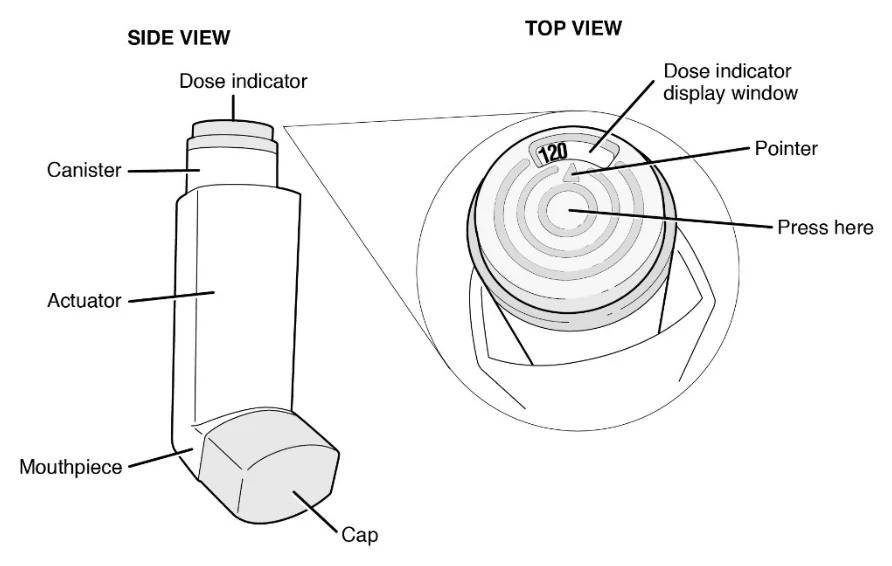
Figure 1
Glycopyrronium/formoterol fumarate dihydrate pressurized inhalation suspension comes with a dose indicator located on the top of the canister (See Figure 1). The dose indicator display
- window will show you how many puffs of medicine you have left. A puff of medicine is released each time you press the centre of the dose indicator.
Before you use glycopyrronium/formoterol fumarate dihydrate pressurized inhalation suspension for the first time make sure that the pointer on the dose indicator is pointing to the right of the “120” inhalation mark in the dose indicator display window (See Figure 1).
- The pointer will be pointing to 120 after 10 puffs are delivered from glycopyrronium/formoterol fumarate dihydrate pressurized inhalation suspension. This means that there are 120 puffs of medicine left in the canister (See Figure 2a).
- The pointer will be pointing between 100 and 120 after you take 10 more puffs. This means that there are 110 puffs of medicine left in the canister (See Figure 2b).
- The pointer will be pointing to 100 after you take 10 more puffs. This means that there are 100 puffs of medicine left in the canister (See Figure 2c).



- The dose indicator display window will continue to move after every 10 puffs. The number in the dose indicator display window will continue to change after every 20 puffs.

Figure 2d
- The colour in the dose indicator display window will change to red, as shown in the shaded area, when there are only 20 puffs of medicine left in your inhaler (See Figure 2d).
Preparing your glycopyrronium/formoterol fumarate dihydrate pressurized inhalation suspension for use:
- Glycopyrronium/formoterol fumarate dihydrate pressurized inhalation suspension should be at room temperature before you use it.
Your glycopyrronium/formoterol fumarate dihydrate pressurized inhalation suspension comes in a foil pouch that contains a drying packet (desiccant).
- Take the glycopyrronium/formoterol fumarate dihydrate pressurized inhalation suspension out of the foil pouch.



- Throw away the pouch and the drying packet. Do not eat or breathe in the contents of the drying packet.
Priming your glycopyrronium/formoterol fumarate dihydrate pressurized inhalation suspension:
Before you use glycopyrronium/formoterol fumarate dihydrate pressurized inhalation suspension for the first time, you must prime the inhaler.
- Remove the cap from the mouthpiece (See Figure 3). Check inside the mouthpiece for objects before use.
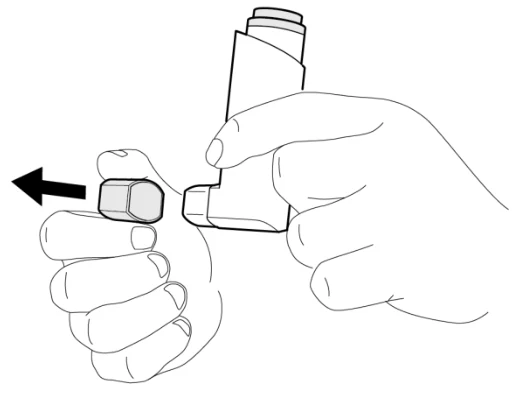
Figure 3
- Hold the inhaler in the upright position away from your face and shake the inhaler well (See Figure 4).
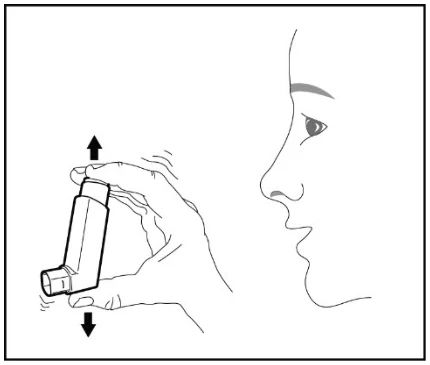
Figure 4
- Press down firmly on the centre of the dose indicator until the canister stops moving in the actuator, to release a puff of medicine from the mouthpiece (See Figure 5). You may hear a soft click from the dose indicator as it counts down during use.
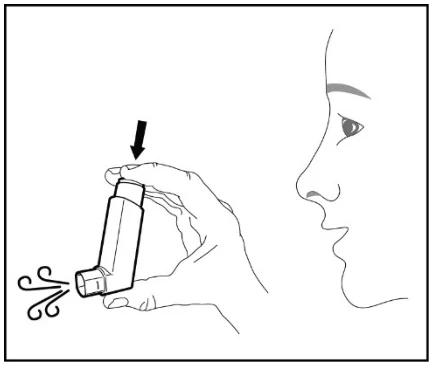
Figure 5
- Repeat the priming steps 3 more times (See Figure 4 and Figure 5). Shake the inhaler well before each priming puff.
- After priming 4 times, the dose indicator should be pointing to the right of “120” and your inhaler is now ready to use.
Using your glycopyrronium/formoterol fumarate dihydrate pressurized inhalation suspension:
Step 1: Remove the cap from the mouthpiece (See Figure 6).
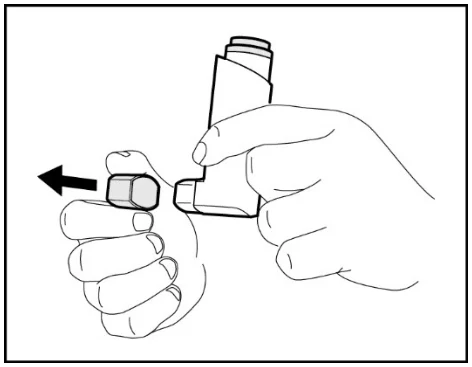
Figure 6
Step 2: Shake the inhaler well before each use (See Figure 7).
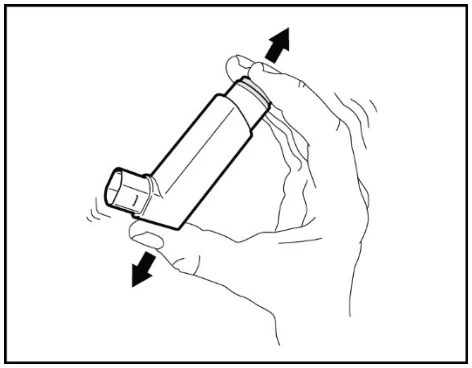
Figure 7
Step 3: Hold the inhaler with the mouthpiece pointing towards you and breathe out as fully as you comfortably can through your mouth (See Figure 8).
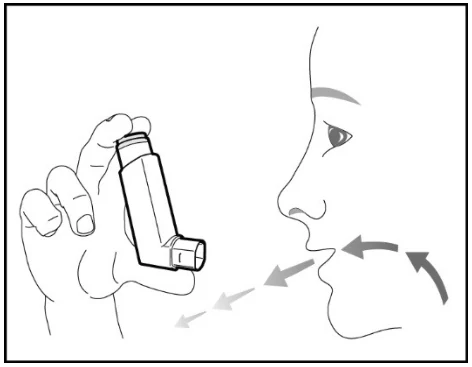
Figure 8
Step 4: Close your lips around the mouthpiece and tilt your head back, keeping your tongue below the mouthpiece (See Figure 9).
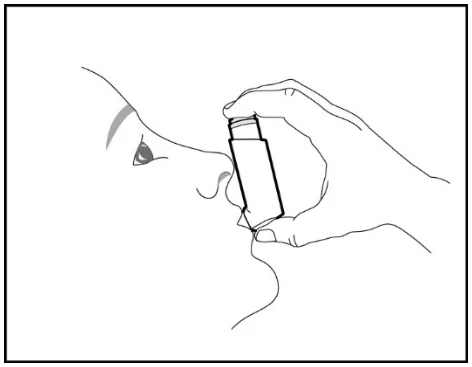
Figure 9
Step 5: While breathing in deeply and slowly, press down on the centre of the dose indicator until the canister stops moving in the actuator and a puff of medicine has been released (See Figure 10). Then stop pressing the dose indicator.
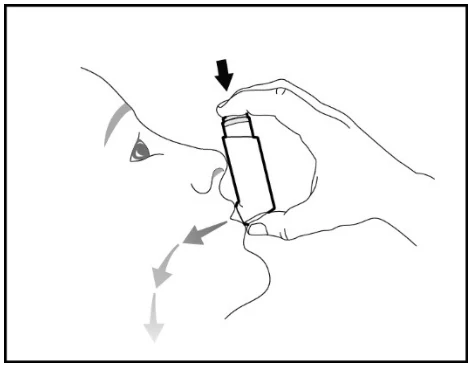
Figure 10
Step 6: When you have finished breathing in, remove the mouthpiece from your mouth. Hold your breath as long as you comfortably can, up to 10 seconds (See Figure 11).

Figure 11
Step 7: Breathe out gently (See Figure 12). Repeat steps 2 through 7 to take your second puff of glycopyrronium/formoterol fumarate dihydrate pressurized inhalation suspension.
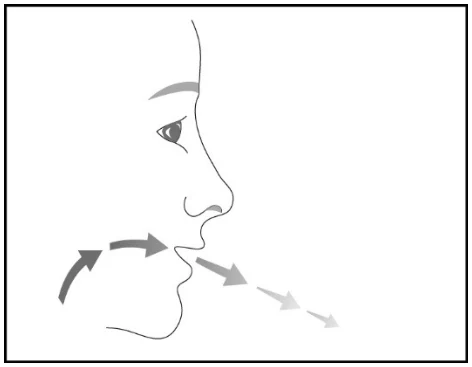
Figure 12
Step 8: Replace the cap over the mouthpiece right away after use (See Figure 13).
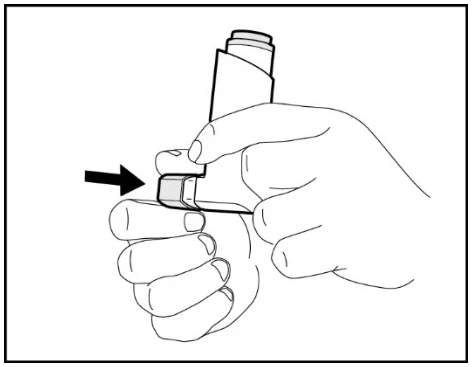
Figure 13
How to clean your glycopyrronium/formoterol fumarate dihydrate pressurized inhalation suspension:
Clean the inhaler 1 time each week for the first 3 weeks. It is very important to keep your inhaler clean so that medicine will not build-up and block the spray through the mouthpiece (See Figure 14).
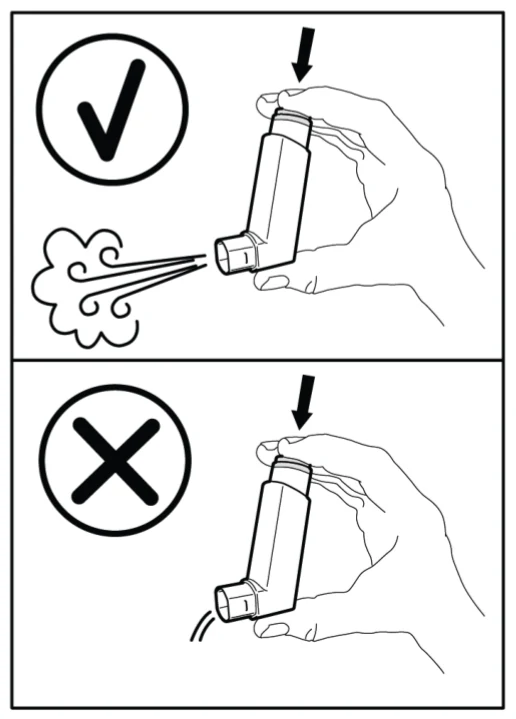
Figure 14
Step 1: Take the canister out of the actuator (See Figure 15). Do not clean the canister or let it get wet.
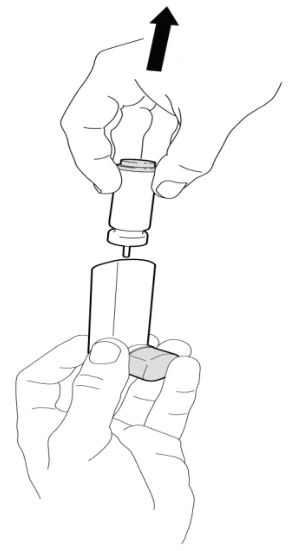
Figure 15
Step 2: Take the cap off the mouthpiece.
Step 3: Hold the actuator under the faucet and run warm water through it for about 30 seconds. Turn the actuator upside down and rinse the actuator again through the mouthpiece for about 30 seconds (See Figure 16).
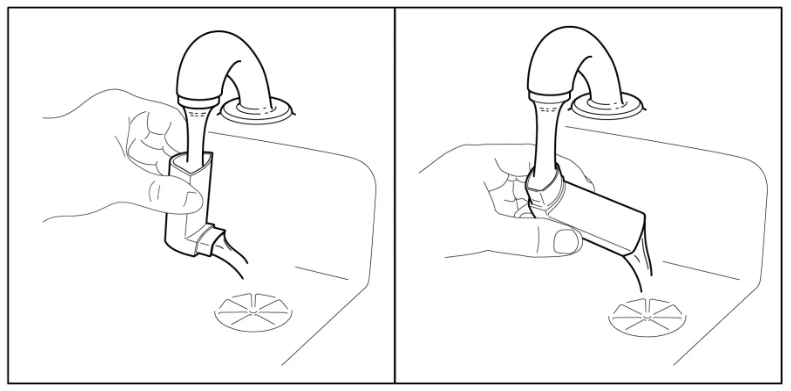
Figure 16
Step 4: Shake off as much water from the actuator as you can.
Step 5: Look into the actuator and the mouthpiece to make sure any medicine build-up has been completely washed away. If there is any build-up, repeat Steps 3 through 5 in the section “How to clean your glycopyrronium/formoterol fumarate dihydrate pressurized inhalation suspension”.
Step 6: Let the actuator air-dry overnight (See Figure 17). Do not put the canister back into the actuator if it is still wet.
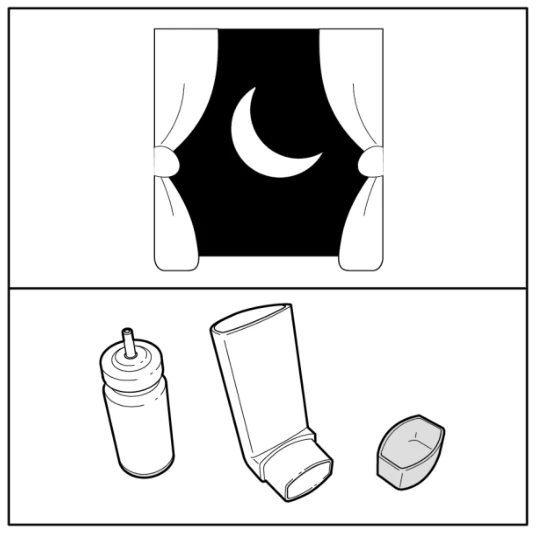
Figure 17
Step 7: When the actuator is dry, gently press the canister down in the actuator (See Figure 18). Do not press down too hard on the canister. This could cause a puff of medicine to be released.
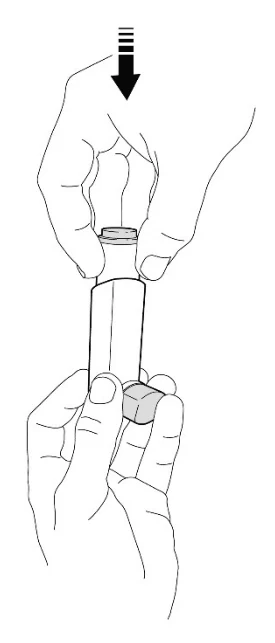
Figure 18
Step 8: Re-prime your glycopyrronium/formoterol fumarate dihydrate pressurized inhalation suspension after each cleaning. To re-prime the inhaler, shake the inhaler well and press down on the centre of the dose indicator 2 times to release a total of 2 puffs into the air away from your face. Your inhaler is now ready to use.
If you do not use your glycopyrronium/formoterol fumarate dihydrate pressurized inhalation suspension for more than 7 days or if your glycopyrronium/formoterol fumarate dihydrate pressurized inhalation suspension has been exposed to cold temperatures or if you have dropped your glycopyrronium/formoterol fumarate dihydrate pressurized inhalation suspension, you will need to re-prime it before use.
To re-prime the inhaler, shake the inhaler well and press down on the centre of the dose indicator 2 times to release a total of 2 puffs into the air away from your face. Your inhaler is now ready to use.
The AstraZeneca logo is a registered trademark of AstraZeneca AB, used under license by AstraZeneca Canada Inc.
© AstraZeneca 2018 – 2022